Market Minds Advisory
Motorcycle Horn Market

Motorcycle Horn Market: Duty cycle divergence, solid-state reliability and sound output compliance to 2036

The same horn lasts under a year in Delhi traffic and a decade in Munich, and manufacturers specifying one product globally get it badly wrong in one direction or the other.

Lead Analyst

David Horsley

Published

September 2026

Make Smarter Decisions with Customized Research Insights

Request a free sample report and evaluate market opportunities, growth trends, and competitive dynamics relevant to your business needs.

2025 MARKET VALUE$0.7BMarket Size 2025
2036 FORECAST VALUE$1.2BBase Case , 2026 to 2036
CAGR 2026 TO 20364.6 %Bull 5.8% / Bear 3.4%
INCREMENTAL OPPORTUNITY$0.4BNet 10- year value creation
EXPANSION MULTIPLE1.57x2036 value over 2026 base
Strategic Levers
M&A Pipeline
Regional Outlook
Country Rankings
Competitive Intelligence
Segmental Deep-dive
Call-Us : 91 93563 13602

Executive Snapshot and Market Trajectory

A horn in dense Indian or Southeast Asian traffic operates around 340 times daily, and an electromagnetic disc horn degrades after roughly 60,000 operations as its contacts erode. That is under a year. The same horn on a European motorcycle lasts a decade. Manufacturers ship one part to both.
Solid-state electronic horns grow at 6.9%, half again the market rate of 4.6%, because they contain no contacts to erode and therefore survive duty cycles that destroy conventional horns quickly. East Asia holds 28% of value on Chinese and Japanese manufacture. Approval standards require at least 93 decibels of output from any horn fitted. Riders want louder and enforcement wants quieter, and both positions are entirely legitimate.
Five manufacturers hold 38% of supply and this is a genuine commodity where a horn costs a few dollars and competes almost entirely on price. The uncomfortable regulatory position is that roughly 34% of aftermarket replacement horns exceed permitted sound output, while approval simultaneously requires a minimum. Riders want louder and enforcement wants quieter, and both are legitimate. Enforcement swings between them and nobody has reconciled the two positions. Both remain legitimate positions.
Market Definition
This report covers audible warning devices supplied for motorcycles, scooters and light three-wheelers across original equipment and replacement channels, spanning electromagnetic disc horns, trumpet and snail horns, solid-state electronic horns, air and compressor horns, integrated horn and alerting systems, and multi-tone and novelty horns. Value is measured at manufacturer level on units supplied. Excluded are automotive car horns, industrial and marine signalling, alarm and immobiliser sounders, exhaust systems, and audio entertainment equipment.
Base Year Value
$0.7B in 2025 (MMA Primary Research Dataset, August 2026)
Forecast Period
2026 to 2036, eleven discrete annual values
CAGR
4.6% base case. Bull 5.8%. Bear 3.4%.
Fastest Growth Segment
Solid-State Electronic Horns: 6.9% CAGR
Fastest Growth Country
India: 7.8% CAGR
Fastest Growth Region
South Asia and Pacific: 6.8% CAGR
Largest Region
East Asia: 28% of 2025 global value
Market Leaders
Minda Industries, Fiem Industries, Roots Industries, Denso and Mitsuba lead the market. Source: MMA Primary Research Dataset, July 2026.
Primary Survey
n=3,800 procurement and R&D decision-makers, Q4 2025, six countries
Methodology
Demand-side build-up, cross-validated against public data, 47 expert interviews

Motorcycle Horn Market Forecast Scenarios

motorcycle-horn-market-size-forecast-scenario-1787555737951
Growth ran at 3.6% between 2020 and 2025 and Asian motorcycle production carried nearly all of it. Indian and Southeast Asian output recovered strongly after pandemic disruption and kept expanding on household income and first-vehicle purchase across very large populations. Solid-state horn adoption advanced slowly against price resistance in exactly the markets where duty cycles most justified it, which is the persistent commercial contradiction in this category.
The 4.6% base case rests on three mechanisms. Asian motorcycle fleets keep expanding and replacement demand follows extreme duty cycles rather than any purchase decision anybody makes. Solid-state horns keep taking share at 6.9% as unit costs fall toward electromagnetic parity and riders tire of replacing horns annually. And electric two-wheeler adoption creates demand for integrated warning systems combining horn function with the audibility that quiet vehicles require. Replacement follows wear here.
The 5.8% bull case is acoustic alerting requirements extending to electric two-wheelers across major markets, which would convert a simple horn into an integrated system at several times the value. The 3.4% bear case is enforcement against non-compliant aftermarket horns tightening sharply, since roughly 34% of replacement product exceeds permitted output and much of that volume would simply disappear.

One Product, Two Service Lives

The commercially decisive fact about motorcycle horns is that duty cycle varies by more than an order of magnitude between markets that buy the same product. A horn in dense Indian, Indonesian or Vietnamese traffic operates around 340 times a day, because in those riding cultures the horn is a continuous communication tool rather than an emergency warning. An electromagnetic horn degrades after roughly 60,000 operations as contacts erode, so under a year. The identical horn on a European motorcycle lasts a decade.
TOP-FIVE CONCENTRATION38%Combined position across motorcycle horn supply held by leaders
APPROVAL SOUND LEVEL RANGE93 dBMinimum output the approval standard requires from a horn
DAILY ACTUATION COUNT340Times a horn operates daily in dense urban riding
ELECTROMAGNETIC CONTACT LIFE60,000Operations before contact erosion degrades the sound output
METAL COST SHARE44%Portion of manufacturer cost attributable to raw metal inputs
AFTERMARKET NON-COMPLIANCE RATE34%Portion of replacement horns exceeding permitted sound output
That divergence creates a genuine specification problem nobody solves well. Solid-state electronic horns contain no contacts to erode and survive extreme duty cycles indefinitely, which is worth a great deal in Asian commuter markets and almost nothing in European touring use. The markets where durability matters most are also the most price sensitive, and manufacturers find that argument hard to win despite the arithmetic.
Regulation pulls in two directions at once. Approval standards require a minimum output near 93 decibels so a horn is genuinely audible, while urban noise rules and enforcement drives push the opposite way, and roughly 34% of aftermarket replacements exceed permitted levels.
"Everybody treats a horn as a commodity and then ships the same part to a rider who uses it three hundred times a day and one who uses it three times a month. Those are different products and the industry keeps pretending they are the same one."
Director, Two-Wheeler Electrical Components Practice · MMA Automotive Practice · August 2026

Market Trends

Solid-state horns survive duty cycles that destroy contacts

An electromagnetic horn works by making and breaking an electrical contact hundreds of times a second, and those contacts erode until the sound output falls below approval requirements after roughly 60,000 operations. At around 340 actuations daily in dense Asian traffic that is less than a year of service. Solid-state horns drive the diaphragm electronically with no contacts to erode at all, which removes the failure mode rather than delaying it. Growth at 6.9% follows that advantage into exactly the markets where duty cycles justify it, though unit price resistance in those same markets has slowed adoption considerably.
Market Impact: Drives 340 daily actuations
Electric two-wheelers require audibility conventional horns ignore

An electric motorcycle produces almost no sound at low speed, which creates a pedestrian detection problem that regulators addressed for cars through acoustic alerting requirements and are now considering for two-wheelers across several jurisdictions. That converts a simple horn into an integrated system generating continuous low-speed sound alongside the warning function, at several times the value of a conventional horn. Growth at 6.2% follows electric two-wheeler adoption and regulatory development together. Manufacturers treating electric platforms as a conventional horn fitting are missing a considerably larger opportunity than the component they are quoting.
Market Impact: Requires 93 decibel minimum output

Market Opportunities and Growth Drivers

Asian riding culture drives replacement demand relentlessly

Horn use across Indian, Indonesian, Vietnamese and Bangladeshi traffic functions as continuous communication between riders rather than as emergency warning, which produces around 340 actuations daily and consumes horns at rates developed markets never approach. That creates a replacement market considerably larger than original equipment supply and one entirely insensitive to new motorcycle sales. Indian growth at 7.8% is the fastest of any country here and follows fleet expansion combined with duty cycles that guarantee replacement. The demand requires no persuasion and no marketing, only availability at the price the rider will pay.
Market Impact: Exceeds limits on 34% of replacements

Approval standards guarantee a minimum audible output

Type approval requires an audible warning device producing at least around 93 decibels measured at a specified distance, which makes a functioning horn a legal requirement on every motorcycle rather than an optional convenience anybody could omit. A degraded horn falling below that threshold constitutes a roadworthiness failure in markets that inspect, which converts wear into a compliance event rather than merely an inconvenience. That regulatory floor underpins replacement demand in every market with periodic testing and gives manufacturers a specification they must meet rather than a performance claim they might make.
Market Impact: Consumes 44% in metal inputs

Market Restraints and Challenges

Non-compliant aftermarket horns face enforcement pressure

Roughly 34% of aftermarket replacement horns exceed permitted sound output, including multi-tone and pressure horns that several jurisdictions have banned outright and periodically enforce against. The root cause is that riders want to be heard in dense traffic and louder horns sell better, while approval standards set both a minimum and a maximum that aftermarket product frequently ignores. Commercially this places a substantial share of replacement volume at regulatory risk. Manufacturers are responding by offering compliant products with better tonal penetration rather than raw volume, which addresses the rider's actual problem legally.
Market Impact: Survives beyond 60,000 operations

Commodity pricing leaves no room for durability investment

A motorcycle horn sells for a few dollars and competes almost entirely on unit price across markets where the buyer is a mechanic or an assembly purchaser rather than the rider who suffers the failure. The root cause is that horn function appears binary at purchase, since any working horn sounds acceptable on a test bench and durability only reveals itself months later. Commercially this makes the solid-state durability argument extremely difficult to win at the counter. Manufacturers are responding with warranty periods that make durability visible before purchase rather than after it.
Market Impact: Segment compounds at 6.2% annually
3 additional market trends, 4 additional growth drivers, and 2 additional restraints and challenges are covered in the full report. Contact sales@marketmindsadvisory.com to access the complete intelligence.

Segment CAGR and Growth Architecture

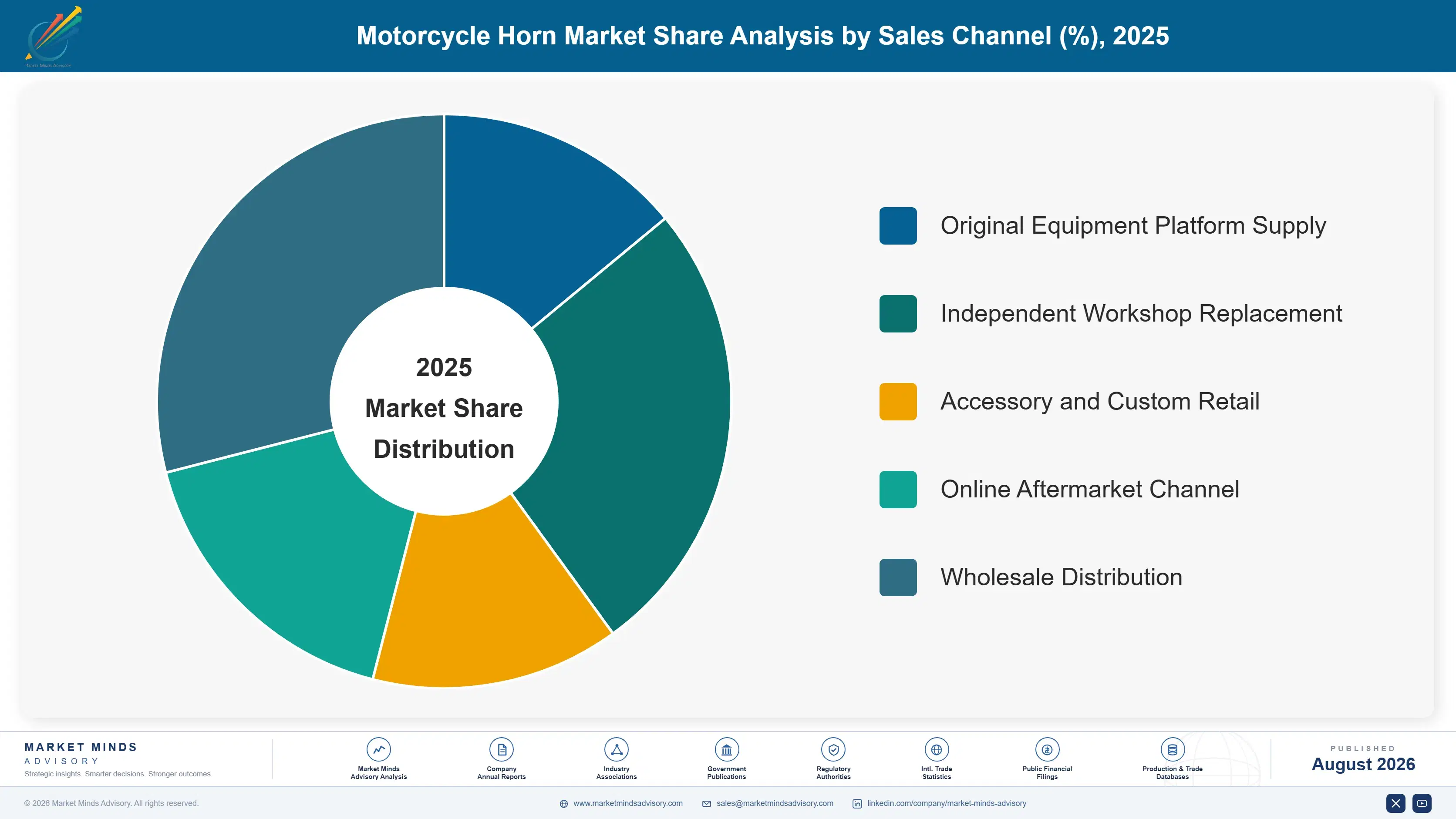
Horns are classified here by sounding technology, since that determines durability under duty cycle, sound character and unit cost. Motorcycle segment, sales channel and mounting arrangement are handled separately in the framework, because one technology serves commuter, touring and performance machines without any change to how it works. Technology decides durability and price together, and nothing else does.
motorcycle-horn-market-market-share-analysis-1787555738480

Solid-State Electronic Horns

Growing at 6.9%, half again the market rate, solid-state horns remove the failure mode that defines this category rather than merely delaying it. An electromagnetic horn makes and breaks a contact hundreds of times per second and those contacts erode until output falls below the approval threshold after roughly 60,000 operations, which at 340 daily actuations is under a year. Electronic drive eliminates contacts entirely. The commercial difficulty is that the durability advantage is worth most in Asian commuter markets that are also the most sensitive to a few dollars of unit price, and mechanics buying on price rarely experience the failure they are effectively choosing. That contradiction persists. Nobody resolves it.
CAGR 6.9%

Integrated Horn and Alerting Systems

Electric two-wheelers produce almost no sound at low speed, creating a pedestrian detection problem that regulators addressed for cars through acoustic vehicle alerting requirements and are now extending toward two-wheelers in several jurisdictions. An integrated system generates continuous low-speed sound alongside the conventional warning function, which is a considerably more sophisticated product than a horn and worth several times as much per vehicle. Growth at 6.2% tracks electric adoption and regulatory progress together. Manufacturers quoting electric platforms as ordinary horn fittings are competing for a fraction of what the vehicle will eventually require from them. Electronics engineering rather than diaphragm and coil manufacturing decides who can actually supply these systems at all, which excludes most conventional horn manufacturers entirely.
CAGR 6.2%
Full segment breakdown across 6 segments available in the complete report.

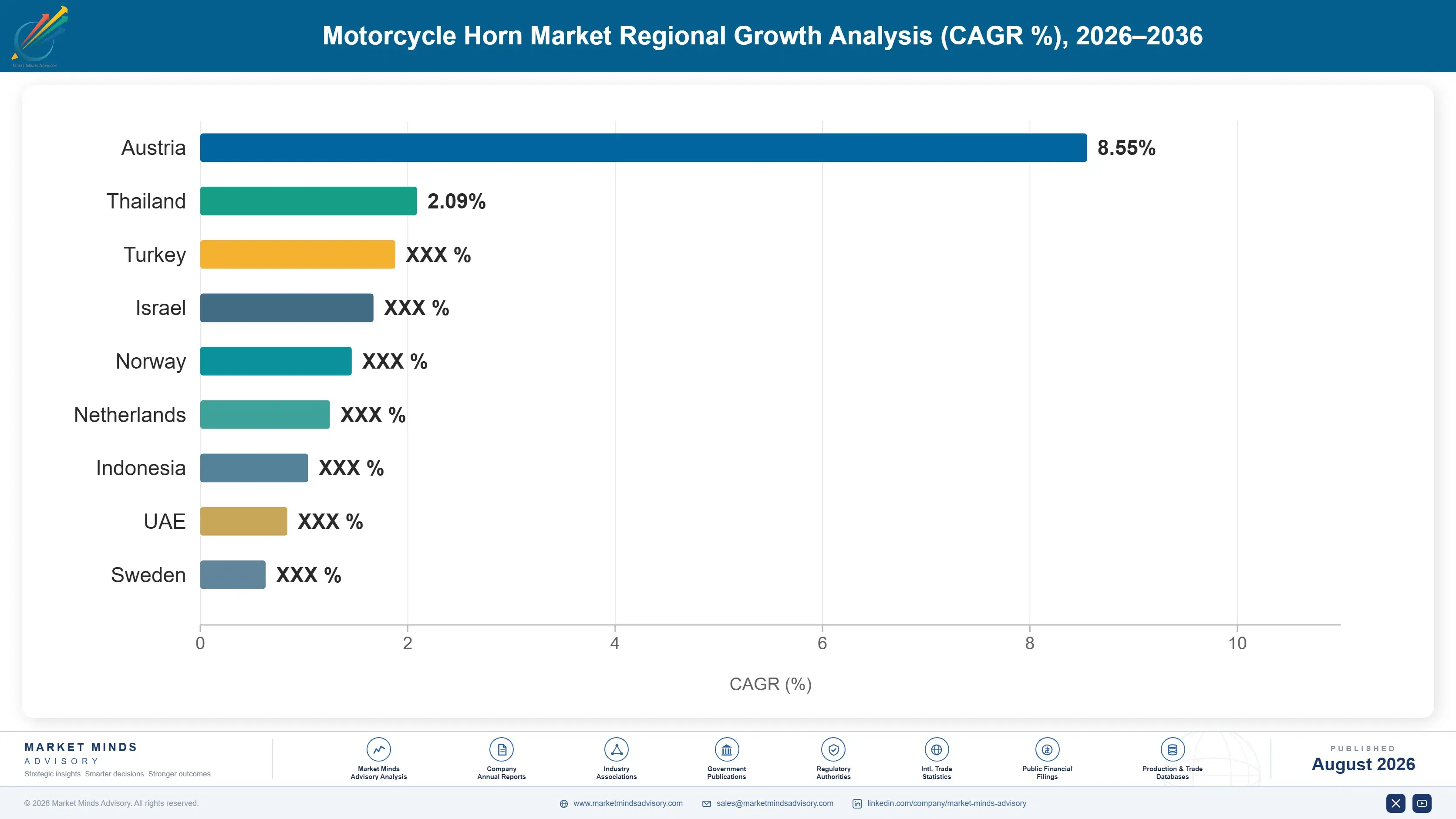
Regional Architecture and Country Demand Map

East Asia holds 28% of value on Chinese and Japanese manufacture, while South Asia drives the fastest growth on duty cycles nothing elsewhere approaches. Riding culture rather than fleet size explains most of the replacement demand pattern here. Fleet size explains considerably less than how riders actually use the component.

East Asia

Chinese motorcycle and scooter production at enormous volume drives original equipment demand while Japanese manufacturers including Denso and Mitsuba hold the deepest engineering capability in the category and supply premium and electric platform applications globally. Chinese urban riding produces duty cycles between Asian and Western extremes, with horn use frequent but less continuous than in South Asia. Domestic manufacture serves nearly all regional demand at prices international suppliers do not attempt to match on conventional product. Growth at 5.6% combines production volume with electric two-wheeler platforms requiring integrated alerting systems that conventional horns cannot provide. Electric platforms increasingly need alerting conventional horns cannot supply. Domestic supply dominates entirely. Nothing is imported.
Share: 28% | CAGR: 5.6% (2026 to 2036)

North America

Horn use here is genuinely exceptional rather than communicative, which means duty cycles are low, service lives are long and replacement demand is minimal relative to the fleet. That makes this an original equipment and premium aftermarket market rather than a replacement one. Aftermarket demand concentrates on louder air and trumpet horns fitted by riders concerned about being seen by drivers, which is a safety argument rather than a communication one. Enforcement against excessive output is limited. Growth at 4.0% reflects fleet stability and value rather than any volume expansion in replacement demand. Aftermarket demand is a safety argument rather than a communication one entirely. Enforcement is minimal here. Volume stays flat.
Share: 22% | CAGR: 4.0% (2026 to 2036)
Regional intelligence for 5 additional markets available in the complete report: Western Europe, South Asia and Pacific, Latin America, Middle East and Africa, Eastern Europe. Contact sales@marketmindsadvisory.com.
motorcycle-horn-market-country-cagr-analysis-1787555738993

Where Horn Margin Actually Sits

Four moves matter for a component that costs a few dollars, gets bought by somebody who never uses it, and lasts either a decade or ten months depending on which country it ends up in. Two are about making durability visible before purchase, and two are about the products regulation is creating. Competing on unit price is not among them.

Specify separately for high and low duty markets

A horn actuated around 340 times daily in Asian traffic and one used a handful of times monthly in Europe face duty cycles differing by more than an order of magnitude, and shipping identical product to both means over-engineering one market or failing in the other. Solid-state construction is worth a great deal where contacts would erode within a year and almost nothing where they never would. Manufacturers running a single global specification are simultaneously wasting cost in Europe and generating warranty claims in India, which is an unusually avoidable pair of mistakes.
Market Impact: Addresses a full 60,000 operation contact erosion life

Make durability visible with warranty, not argument

Solid-state horns survive duty cycles that destroy electromagnetic ones, and the buyer is a mechanic or an assembly purchaser who never experiences the failure and compares only unit price at the counter. Technical arguments about contact erosion do not survive that conversation. A published warranty period covering the duty cycle makes durability a purchase-time attribute rather than a claim the customer discovers eighteen months later, and it costs the manufacturer nothing if the product genuinely lasts. Almost nobody in this category offers one at all. Roughly 60,000 rated operations is a number a mechanic can compare directly.
Market Impact: Covers well beyond a rated 60,000 operation life

Build integrated alerting for electric platforms

Electric two-wheelers produce almost no sound at low speed and regulators are extending acoustic alerting requirements toward them across several jurisdictions, which converts a horn into an integrated system generating continuous sound alongside the warning function. That product is worth several times a conventional horn per vehicle and requires electronics capability rather than the diaphragm and coil manufacturing this industry knows. Growth at 6.2% follows regulation. Manufacturers quoting electric platforms as ordinary horn fittings are bidding for a fraction of what those vehicles will eventually require. Systems beat components. Regulation sets the clock.
Market Impact: Enters a segment now compounding at 6.2% annually

Sell tonal penetration rather than raw volume

Roughly 34% of aftermarket replacement horns exceed permitted sound output because riders want to be heard in dense traffic and louder product sells, which places substantial replacement volume at regulatory risk wherever enforcement tightens. The rider's actual problem is penetration through traffic noise rather than absolute decibels, and tonal frequency selection achieves that within legal limits. Offering compliant horns engineered for audibility rather than volume addresses the genuine need legally and protects the volume from enforcement action that periodically removes non-compliant product from shelves entirely. Enforcement arrives abruptly. Compliant product survives.
Market Impact: Protects a full 34% of replacement channel volume

Who Controls the Margin Pool

Five manufacturers hold 38% of motorcycle horn supply, measured on units supplied annually across original equipment and replacement, the basis used throughout this section. That concentration reflects original equipment platform positions with motorcycle manufacturers rather than any manufacturing advantage, since a horn is a diaphragm, a coil and a housing that many companies assemble competently at low cost. Assembly is genuinely straightforward at this price point. Nothing about it is difficult.
Competition runs on three dimensions. Original equipment platform position, which carries volume at thin margin and confers aftermarket credibility with riders replacing like for like. Cost, since a horn sells for a few dollars and the buyer compares little else. And electronics capability, which decides who can serve electric platforms requiring integrated alerting rather than a conventional horn. Electronics decides the next decade rather than this one.

Rankings shift as electric two-wheeler platforms require integrated alerting systems that conventional horn manufacturers cannot produce, which favours suppliers with electronics rather than electromechanical capability. Indian manufacturers dominate the largest replacement market. Enforcement against non-compliant aftermarket product would redistribute volume toward compliant suppliers overnight. Enforcement would redistribute aftermarket volume overnight.
motorcycle-horn-market-company-positioning-matrix-1787555739505

Competitive Moat and Risk Dimensions

MINDA INDUSTRIES

Moat: Indian platform and replacement reach

Minda holds original equipment positions across Indian motorcycle platforms alongside distribution reaching the mechanics who fit replacement horns in the largest and highest duty cycle market anywhere. That combination captures both the original fitment and the annual replacement that Indian riding conditions guarantee, which is a considerably better position than either alone.
MINDA INDUSTRIES

Risk: Commodity price exposure throughout

A horn sells for a few dollars against Chinese imports and domestic competitors offering comparable function at lower cost, and the mechanic buying it experiences none of the durability difference. Platform positions carry volume at thin margin. Suppliers moving toward integrated electric alerting systems escape that comparison while conventional horn suppliers cannot.
DENSO

Moat: Electronics and alerting capability

Denso holds automotive electronics capability that transfers directly into the integrated acoustic alerting systems electric two-wheelers require, which is a genuinely different engineering problem from the diaphragm and coil manufacturing conventional horn suppliers understand. That positions the company for a product worth several times a conventional horn per vehicle as regulation extends.
DENSO

Risk: Limited replacement market presence

The largest volume in this category is Asian replacement demand driven by extreme duty cycles, and that channel runs through mechanics buying on price rather than through original equipment relationships. Premium engineering commands nothing in that conversation. Indian and Chinese manufacturers hold replacement positions that automotive electronics capability does not reach.

Players Tracked

Prominent Players

Minda Industries
Fiem Industries
Roots Industries
Denso
Mitsuba

Other Key Players

Hella
Bosch
Marelli
Stebel
FIAMM
Wolo Manufacturing
Klaxon Signals
Zhejiang Ruifeng Auto Parts
Wenzhou Ruicheng Electrical
Autotech Industries
Nikko Electric
Imasen Electric
Elta Automotive
Vitaloni
Sun Auto Electric

Recent Developments

MARCH 2025

An Indian manufacturer launched solid-state horns with extended warranty

An Indian horn manufacturer introduced solid-state products carrying an extended warranty period covering the duty cycles Indian riding produces, making durability visible at purchase rather than discoverable eighteen months afterwards. This was a product and commercial terms decision rather than any transaction. Competitors offer nothing comparable.
Signal: Warranty converts a durability argument mechanics ignore into a purchase-time attribute they can actually compare directly
AUGUST 2025

A regulator proposed acoustic alerting requirements for electric two-wheelers

A national regulator proposed extending acoustic vehicle alerting requirements from cars to electric two-wheelers, requiring continuous low-speed sound generation alongside the conventional warning horn function. This was a regulatory proposal rather than any commercial transaction between component suppliers. Conventional horns cannot generate continuous low-speed sound at all.
Signal: Alerting requirements convert a few dollar horn into an integrated system worth several times as much per vehicle
DECEMBER 2025

Enforcement action removed non-compliant horns from regional markets

Enforcement action across several Asian markets removed multi-tone and pressure horns exceeding permitted sound output from retail distribution, targeting aftermarket product that approval standards prohibit. This was regulatory enforcement rather than any commercial transaction between manufacturers or distributors. Retail stock disappeared abruptly. Compliant suppliers gained.
Signal: Enforcement removes non-compliant volume abruptly rather than gradually, which strongly favours whoever already sells compliant product

What Moves Manufacturer Cost

Copper wire and steel account for around 44% of manufacturer cost, since a conventional horn is essentially a coil, a diaphragm and a pressed housing. Contact materials add cost disproportionate to their mass given the silver alloys involved. Electronic drive components replace contacts in solid-state products at broadly similar cost. Assembly is highly automated at volume and adds relatively little.
Copper and steel prices moved sharply through 2021 and 2022 on energy costs and supply disruption, and IEA data record industrial energy movement across that period. Hella noted raw material and component cost pressure across its electronics operations in its Annual Report 2022. Manufacturers holding original equipment contracts absorbed most of the movement, since a motorcycle manufacturer fixes component prices for a model year and does not reopen them for copper.

Contact materials are the cost line that separates durability from price, and they are invisible in a comparison. Silver alloy contacts resist erosion far better than cheaper alternatives and cost meaningfully more per unit, which is precisely the specification a manufacturer cuts to win a price-driven tender. That decides whether the horn survives one year or three in Indian conditions, and nobody discovers it at purchase.
motorcycle-horn-market-cost-volatility-analysis-1787555739700

Specify contact materials by destination duty cycle

Silver alloy contacts resist erosion far better than cheaper alternatives and cost meaningfully more, which matters enormously at 340 daily actuations and not at all at three. Specifying by destination market rather than globally puts the cost where it earns and removes it where it does not. Running one specification everywhere overspends in Europe and generates Asian warranty claims.

Index original equipment contracts to copper benchmarks

Copper and steel at 44% of cost move on energy and supply conditions unconnected to motorcycle demand, and model year fixed pricing transfers that whole exposure to the supplier. Indexing to published copper benchmarks with periodic reset removes it cleanly. Motorcycle manufacturers resist because vehicle pricing is fixed across a model year, which makes this a real negotiation.

Build electronics capability before alerting requirements arrive

Integrated acoustic alerting for electric two-wheelers requires electronics engineering rather than the electromechanical manufacturing this industry understands, and the requirement is advancing through regulation on a visible timetable. Building or partnering for that capability before specifications land positions a supplier for a product worth several times a conventional horn. Waiting means quoting components while competitors quote systems.

Portfolio Architecture for Margin Defence

Margin here tracks electronics content rather than manufacturing scale, because assembling a conventional horn is straightforward and hundreds of companies do it at low cost. Electromagnetic disc horns run at gross margins in the low teens against Chinese imports and domestic competitors offering identical function. Trumpet and air horns run somewhat better on aftermarket positioning and rider preference. Solid-state and integrated alerting systems run considerably higher, because electronics capability excludes most conventional manufacturers entirely. Electronics separates the two entirely.
The tension is that conventional horns carry the volume while electronic products carry the future, and the two require genuinely different engineering organisations. A company that makes coils and diaphragms well has no obvious route into acoustic signal generation and vehicle network integration. Several manufacturers have discovered that electric platform enquiries ask for capabilities they cannot demonstrate, which loses positions on vehicles they have supplied for decades.

High-value pools sit in integrated alerting systems, warranty-backed solid-state product and compliant aftermarket horns. None of the three is where the conventional volume is. Coil winding capacity by itself defends very little against a platform requiring electronics. Electronics defends considerably more now.

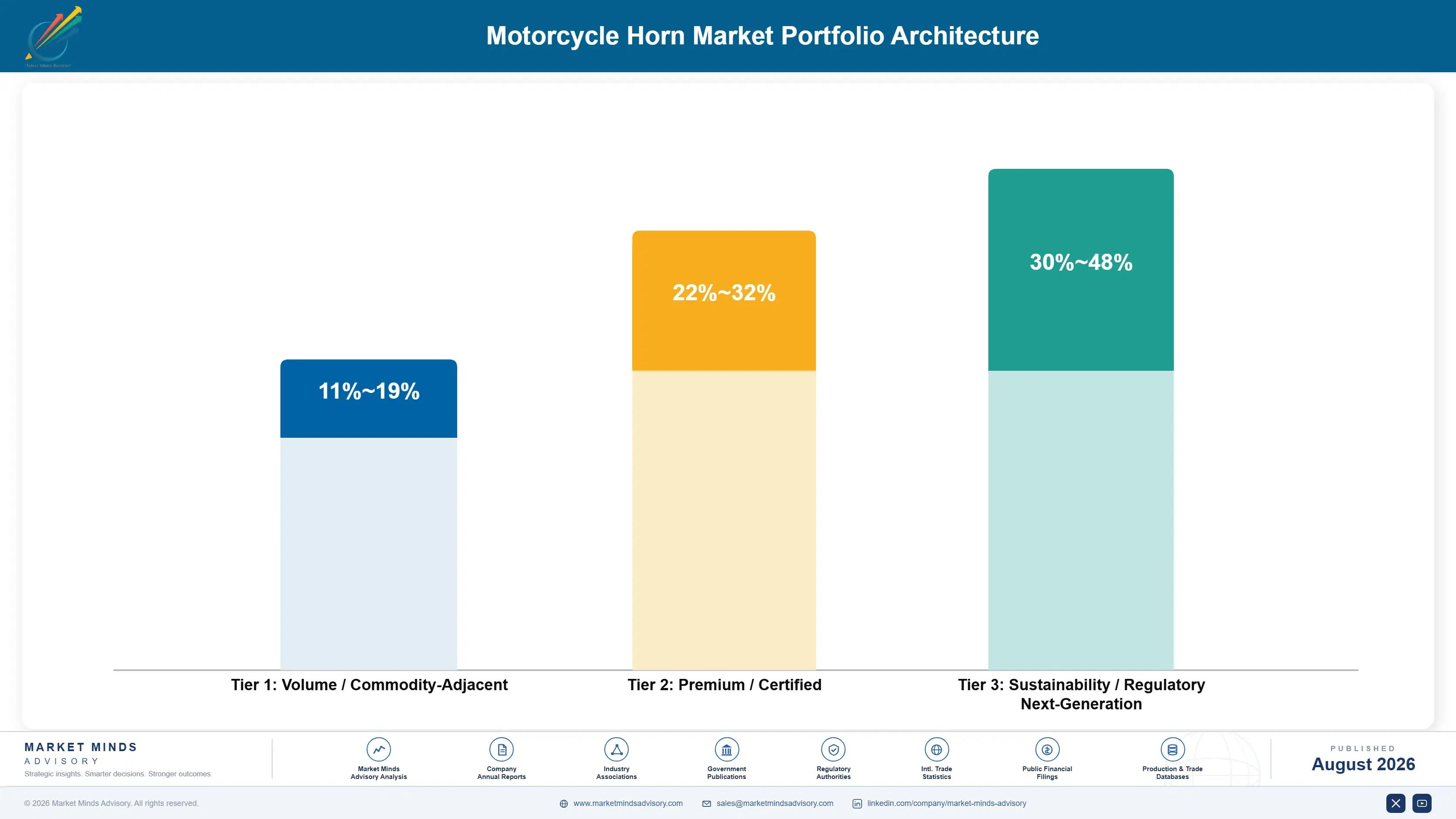
Volume / Commodity-Adjacent

Electromagnetic disc horns supplied to assembly lines and replacement channels on unit price against Chinese imports and domestic competitors offering identical function. The eight-point range separates manufacturers with indexed copper contracts from those absorbing metal movement across fixed model years.
Gross Margin: 11%-19%

Premium / Certified

Trumpet, snail and air horns where tonal character and aftermarket rider preference carry the sale beyond function alone. The ten-point spread reflects brand recognition with riders, which is limited but genuine in the louder aftermarket segments.
Gross Margin: 22%-32%

Sustainability / Regulatory / Next-Generation

Solid-state horns with warranty backing and integrated acoustic alerting systems for electric platforms. The eighteen-point range is wide because electronics capability excludes most conventional manufacturers and regulation is creating the requirement rather than any customer preference.
Gross Margin: 30%-48%
motorcycle-horn-market-portfolio-architecture-1787555740206

High-value Sub-segments and Strategic Watch-out

Integrated Alerting Systems

Compounding at 6.2% as regulators extend acoustic alerting from cars to electric two-wheelers, converting a few dollar horn into an integrated system worth several times as much per vehicle fitted. Electronics capability rather than coil winding decides who can supply it at all. Very few hold it.
Gross Margin: 34%-48%

Warranty Backed Solid-State

Growing at 6.9% and solving a failure mode that destroys conventional horns within a year at 340 daily actuations. Warranty makes durability visible at purchase rather than discoverable much later. Mechanics compare numbers rather than technical arguments about contact erosion. A published number beats any technical argument at a counter.
Gross Margin: 28%-40%

Electromagnetic Disc Volume

The unit volume, competed on price against imports and domestic manufacturers offering identical function on a test bench. Manage for copper indexation and automation rather than for margin recovery. Every working horn sounds acceptable on a test bench, which is the whole problem. Durability never shows.
Gross Margin: 11%-19%

Compliant Aftermarket Product

Roughly 34% of replacement horns exceed permitted output and enforcement removes them abruptly rather than gradually. Compliant product engineered for tonal penetration serves the rider's real problem legally. Tonal penetration solves the rider's actual problem entirely within legal limits. Enforcement removes competitors abruptly rather than gradually.
Gross Margin: 24%-36%

How Horn Demand Renews

Demand renews on wear in high duty cycle markets and on vehicle replacement in low duty cycle ones, which produces two entirely different demand patterns from the same component. An Indian commuter horn degrades within a year and gets replaced because it stopped being loud enough, while a European touring horn outlasts the motorcycle. Aggregate demand looks smooth while individual market behaviour is nothing of the kind.
Stickiness is essentially absent in replacement and moderate in original equipment. A mechanic fitting a replacement horn selects whatever is on the shelf at an acceptable price, and no brand loyalty survives that decision. Original equipment positions last a platform and confer some aftermarket advantage through riders replacing like for like, which is the only mechanism approaching loyalty anywhere in this category.

The decision-maker is almost never the person who experiences the product, which explains most of what is odd about this market. An assembly buyer and a mechanic both compare unit price on a bench where every working horn sounds acceptable. The rider replacing a horn annually is never consulted and rarely knows a better option exists.
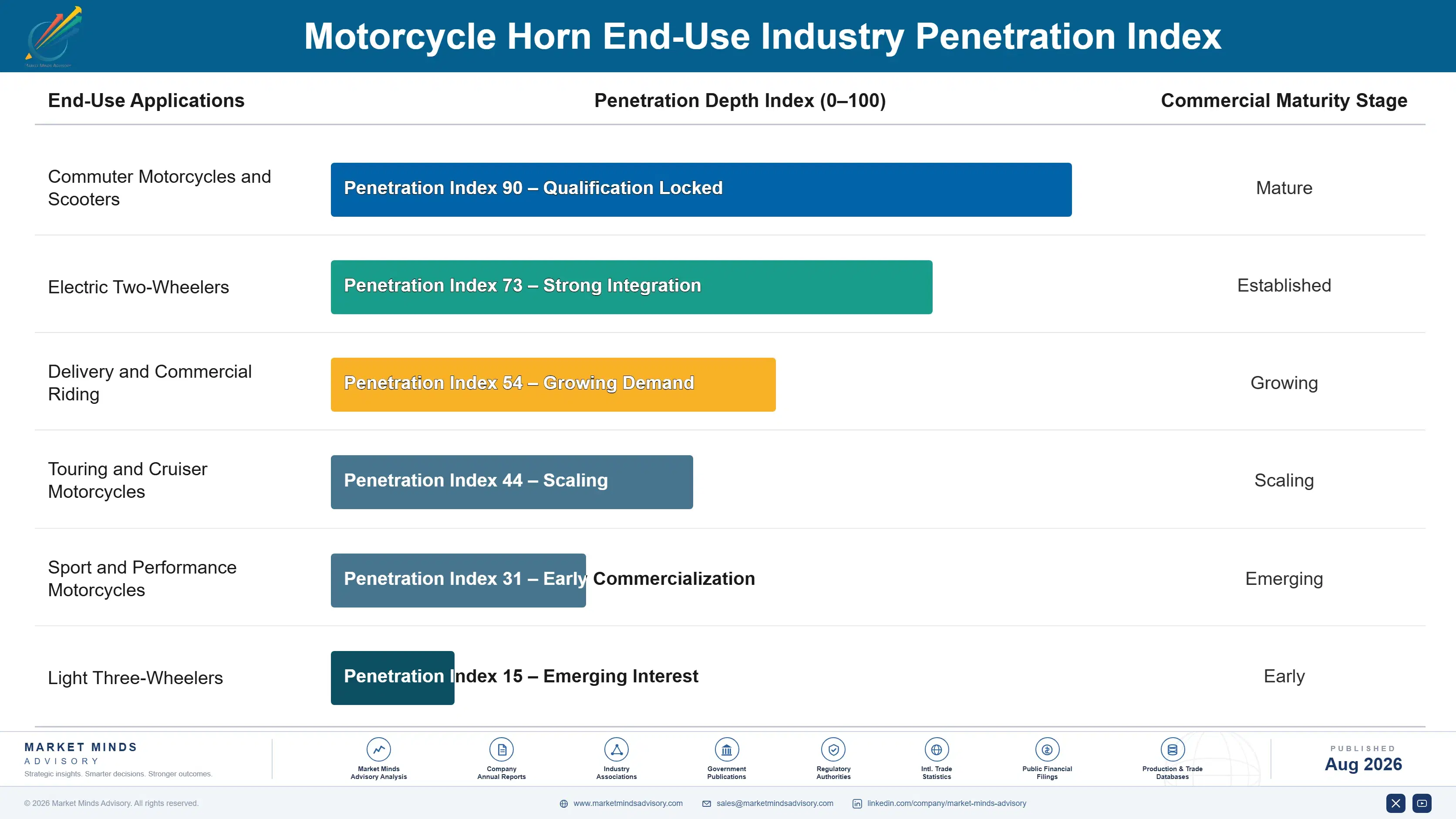
motorcycle-horn-market-end-use-penetration-index-1787555740693

Where To Place The Bet

These are among the four positions where our research anticipates prominent divergence between winners and laggards over the coming forecast period. Each is grounded in the demand model, the regulatory perimeter, and the announced capacity pipeline.
01 / DUTY CYCLE SPECIFICATION

Build two products, not one global part

A motorcycle horn actuated around 340 times daily in dense Asian traffic and one used a handful of times monthly in European riding face duty cycles differing by more than an order of magnitude, and shipping an identical part to both guarantees a mistake in one direction. Silver alloy contacts and solid-state construction are worth a great deal where erosion destroys a horn within a year and worth nothing at all where it never would. Running one global specification overspends in Europe and generates Asian warranty claims simultaneously.
02 / WARRANTY VISIBILITY MOVE

Put durability where the buyer can see it

Solid-state horns survive duty cycles that erode electromagnetic contacts within a year, and the person buying is a mechanic or assembly purchaser who never experiences the failure and compares only unit price at a counter where every working horn sounds identical. Technical arguments about contact erosion simply do not survive that conversation anywhere. A published warranty covering the rated duty cycle converts durability into a purchase-time attribute the buyer can compare directly, and it costs a manufacturer nothing whatever if the product genuinely lasts as claimed.
03 / ELECTRONICS CAPABILITY BUILD

Quote systems before competitors quote components

Electric two-wheelers produce almost no sound at low speed and regulators are extending acoustic alerting requirements toward them across several jurisdictions on a visible timetable that anybody can read. That converts a few dollar horn into an integrated system generating continuous sound alongside the warning function, worth several times as much per vehicle and requiring electronics engineering rather than the coil and diaphragm manufacturing this industry actually understands. Manufacturers quoting electric platforms as conventional horn fittings are bidding for a fraction of the eventual requirement.
04 / COMPLIANCE POSITIONING SHIFT

Sell penetration instead of raw decibels

Roughly 34% of aftermarket replacement horns exceed permitted sound output, because riders genuinely want to be heard in dense traffic and louder product sells more readily at the counter than compliant product does. That places a substantial share of replacement volume at risk wherever enforcement tightens, and enforcement removes non-compliant stock abruptly rather than gradually. The rider's actual problem is penetration through traffic noise rather than absolute output, and careful tonal frequency selection achieves exactly that within the legal limits.

Engagement Snapshot From the Field

A live engagement with an industry participant carrying material or product regulatory and market exposure ahead of a defining policy shift, showing how our research translates into a defensible multi-year portfolio strategy.
MARKET MINDS ADVISORY · CLIENT ENGAGEMENT SUMMARY
Motorcycle Horn Producer Strategic Portfolio Review and Transition Roadmap 2026·Investment Scenario on Motorcycle Horn Exposure Evaluation 2025-26
CLIENT PROFILE
An Asian motorcycle horn manufacturer with annual revenue around USD 64 million (client-reported, unverified by MMA), producing electromagnetic disc and trumpet horns for domestic original equipment and export replacement markets. A single global specification served every destination. No solid-state or electronics capability existed. Warranty terms were minimal across the range. Duty cycles were never measured.
STRATEGIC CHALLENGE
Warranty claims from South Asian export markets had risen sharply (client-reported, unverified by MMA) while European customers complained about cost. Management proposed reducing contact material specification to cut cost. Nobody had asked whether one specification could sensibly serve markets whose duty cycles differ by more than an order of magnitude.
MMA APPROACH
MMA measured actual duty cycles across the client's destination markets rather than assuming comparable use, establishing actuation frequency from rider observation and returned product analysis. Contact erosion was assessed against those cycles. Solid-state cost parity was modelled, and emerging acoustic alerting requirements were mapped against the client's engineering capability. Enforcement exposure was also reviewed.
KEY FINDINGS
  1. Measured duty cycles across South Asian destinations exceeded European ones by more than an order of magnitude, which meant a single specification could not serve both without failing somewhere.
  2. Reducing contact specification would have cut European cost usefully and multiplied South Asian warranty claims, which would have made the overall position materially worse.
  3. Solid-state construction had reached near cost parity with high-specification electromagnetic horns, making it the better answer for high duty cycle markets on economics alone.
  4. Acoustic alerting requirements were advancing across two of the client's export markets and the business held no electronics capability to address them at all.
CLIENT PROFILE
An Asian motorcycle horn manufacturer with annual revenue around USD 64 million (client-reported, unverified by MMA), producing electromagnetic disc and trumpet horns for domestic original equipment and export replacement markets. A single global specification served every destination. No solid-state or electronics capability existed. Warranty terms were minimal across the range. Duty cycles were never measured.
STRATEGIC CHALLENGE
Warranty claims from South Asian export markets had risen sharply (client-reported, unverified by MMA) while European customers complained about cost. Management proposed reducing contact material specification to cut cost. Nobody had asked whether one specification could sensibly serve markets whose duty cycles differ by more than an order of magnitude.
MMA APPROACH
MMA measured actual duty cycles across the client's destination markets rather than assuming comparable use, establishing actuation frequency from rider observation and returned product analysis. Contact erosion was assessed against those cycles. Solid-state cost parity was modelled, and emerging acoustic alerting requirements were mapped against the client's engineering capability. Enforcement exposure was also reviewed.
KEY FINDINGS
  1. Measured duty cycles across South Asian destinations exceeded European ones by more than an order of magnitude, which meant a single specification could not serve both without failing somewhere.
  2. Reducing contact specification would have cut European cost usefully and multiplied South Asian warranty claims, which would have made the overall position materially worse.
  3. Solid-state construction had reached near cost parity with high-specification electromagnetic horns, making it the better answer for high duty cycle markets on economics alone.
  4. Acoustic alerting requirements were advancing across two of the client's export markets and the business held no electronics capability to address them at all.
RECOMMENDED STRATEGY
Phase 1: Phase one: abandon the single global specification and build separate high and low duty cycle products rather than compromising between two incompatible requirements. Phase 2: Phase two: convert South Asian export ranges to solid-state construction and publish a warranty covering the duty cycles those markets actually produce. Phase 3: Phase three: partner for electronics capability to address acoustic alerting requirements before any of those specifications arrive on electric platforms.
OUTCOME
Separate duty cycle specifications shipped from late 2026 and South Asian warranty claims fell substantially. Solid-state conversion is complete across two export ranges with published warranty. An electronics partnership is agreed, and the client reports European cost complaints resolved (client-reported, unverified by MMA). One specification never worked.

Frequently Asked Questions

Foundational context covering the market sizes, CAGR, scope, country, region and competition that inform every finding below. This section is provided to cover basics and most often pre-purchase conversations, answered from the MMA Primary Research Dataset.

What is the current size of the Motorcycle Horn Market?

The market was valued at USD 0.72 billion in 2025, rising to an estimated USD 0.75 billion in 2026. East Asia holds the largest regional share at 28% of value.

How large will the Motorcycle Horn Market be by 2036?

MMA forecasts USD 1.18 billion by 2036 under the base case, an expansion multiple of 1.57 times the 2026 value. That represents USD 0.43 billion of incremental value.

What is the CAGR for the Motorcycle Horn Market 2026 to 2036?

The base case runs at 4.6% compound annual growth between 2026 and 2036, with a bull case at 5.8% and a bear case at 3.4%. Historical growth from 2020 to 2025 was 3.6%.

Which segment is growing fastest?

Solid-state electronic horns lead at 6.9%, half again the market rate, because they contain no contacts to erode under extreme duty cycles. Integrated alerting systems follow at 6.2%.

Who are the major companies in the Motorcycle Horn Market?

Minda Industries, Fiem Industries, Roots Industries, Denso and Mitsuba hold 38% of supply between them. Platform positions rather than any manufacturing capability sustain those positions.

Which country is growing fastest?

India leads at 7.8%, where horn use functions as continuous communication in dense traffic and produces around 340 daily actuations that consume horns within a year.

Report Segmentation Architecture

The full report scope spans multiple orthogonal segmentation dimensions, with cross-tabulated demand data provided for each dimension pair. Coverage extends further to regional breakdowns, trend trajectories, and the competitive detail needed to support segment-level decision-making.

By Sounding Technology

  • Electromagnetic Disc Horns
  • Trumpet and Snail Horns
  • Solid-State Electronic Horns
  • Air and Compressor Horns
  • Integrated Horn and Alerting Systems
  • Multi-Tone and Novelty Horns

By End-Use Industry

  • Commuter Motorcycles and Scooters
  • Electric Two-Wheelers
  • Delivery and Commercial Riding
  • Touring and Cruiser Motorcycles
  • Sport and Performance Motorcycles
  • Light Three-Wheelers

By Sales Channel

  • Original Equipment Platform Supply
  • Independent Workshop Replacement
  • Accessory and Custom Retail
  • Online Aftermarket Channel
  • Wholesale Distribution

By Region

  • North America
  • Western Europe
  • East Asia
  • South Asia and Pacific
  • Latin America
  • Middle East and Africa
  • Eastern Europe

Scope, Methodology, and Coverage

Every figure in this report is reproducible from documented input assumptions. The scope below maps the historical period, the forecast horizon, the segmentation dimensions, and the countries covered, alongside the underlying primary and qualitative methodology.
Historical Period
2020 to 2025
Forecast Period
2026 to 2036
Base Year
2025 (USD billions; MMA Primary Research Dataset, August 2026)
Market Definition
The market comprises audible warning devices supplied for motorcycles, scooters, electric two-wheelers and light three-wheelers across original equipment and replacement channels, covering electromagnetic disc horns, trumpet and snail horns, solid-state electronic horns, air and compressor horns, integrated horn and alerting systems, and multi-tone and novelty horns. Value is measured at manufacturer level on units supplied annually. Automotive car horns, industrial and marine signalling equipment, alarm and immobiliser sounders, exhaust systems and audio entertainment equipment fall outside scope.
Quantitative Units
USD billions (current prices); million horn units supplied annually; USD per unit by sounding technology
Segmentation Dimensions
By Sounding Technology; By End-Use Industry; By Sales Channel; By Region
Regions Covered
North America, Western Europe, East Asia, South Asia and Pacific, Latin America, Middle East and Africa, Eastern Europe
Countries Covered
India, Bangladesh, Indonesia, Vietnam, Thailand, Philippines, Australia, China, Japan, South Korea, Taiwan, United States, Canada, Mexico, Brazil, Colombia, Argentina, Germany, Italy, France, United Kingdom, Spain, Netherlands, Poland, Czechia, Romania, Nigeria, Kenya, Egypt, United Arab Emirates
Key Companies Profiled
Minda Industries, Fiem Industries, Roots Industries, Denso, Mitsuba, Hella, Bosch, Marelli, Stebel, FIAMM, Wolo Manufacturing, Klaxon Signals, Zhejiang Ruifeng Auto Parts, Wenzhou Ruicheng Electrical, Autotech Industries, Nikko Electric, Imasen Electric, Elta Automotive, Vitaloni, Sun Auto Electric
Quantitative Methodology
Primary survey, n=3,800 respondents, Q4 2025, six countries; demand-side model with trade association cross-validation
Qualitative Methodology
47 expert interviews, Q4 2025; applied to validate demand model assumptions, identify emerging dynamics, and assess competitive positioning
Report Format
PDF and XLSX data workbook (Word format preview document)
Publisher
Market Minds Advisory
Report Code
MMA-2026-AUT-355
Published
August 2026
Contact
sales@marketmindsadvisory.com | www.marketmindsadvisory.com

Purchase the full Motorcycle Horn Market Report (2026 to 2036).

The full report sizes the global motorcycle horn market to 2036 across six sounding technologies and seven regions, measured on units supplied at manufacturer level. It quantifies duty cycle divergence between markets directly, since actuation frequency differs by more than an order of magnitude and determines service life entirely. Competitive analysis covers 20 participants evaluated on units supplied, with moat and risk assessment for the two leaders. Acoustic alerting requirements for electric two-wheelers are assessed as a product category change rather than a specification adjustment. Four quantified revenue levers close the analysis.
Six-technology segment sizing with segment-level growth rates
Seven-region share and growth breakdown to 2036
Twenty-participant competitive map on one unit basis
Duty cycle measured by market against contact erosion life
Acoustic alerting requirements mapped against electric platform timelines
Four quantified revenue levers with commercial impact ranges

Built For The People Who Decide

From boardroom strategy to bench-side execution, this report is read cover-to-cover by leaders shaping the next decade of their industry, turning demand scenarios, market dynamics and valuation benchmarks into decisions.
CXOs/ Presidents/ VPs/ Managers
M&A and Corporate Development
Strategy Teams and R&D Heads
Procurement and Product Directors
Regulatory and Compliance Leaders
Investor Relations and Equity Analysts