

Market Minds Advisory
Motorcycle Headlight Bracket Market

Motorcycle Headlight Bracket Market: Fairing integration, custom demand and lighting approval compliance to 2036

Nearly half of new motorcycles now build the headlight into a fairing with no separate bracket at all, and the business that remains has moved from function toward visible design.

Lead Analyst

David Horsley

Published

September 2026

Make Smarter Decisions with Customized Research Insights

Request a free sample report and evaluate market opportunities, growth trends, and competitive dynamics relevant to your business needs.

2025 MARKET VALUE$0.4BMarket Size 2025
2036 FORECAST VALUE$0.7BBase Case , 2026 to 2036
CAGR 2026 TO 20365.6 %Bull 6.8% / Bear 4.4%
INCREMENTAL OPPORTUNITY$0.3BNet 10- year value creation
EXPANSION MULTIPLE1.72x2036 value over 2026 base
Strategic Levers
M&A Pipeline
Regional Outlook
Country Rankings
Competitive Intelligence
Segmental Deep-dive
Call-Us : 91 93563 13602

Executive Snapshot and Market Trajectory

Around 43% of new motorcycles integrate the headlight into a fairing or cast structure with no discrete bracket at all. The addressable population is shrinking as a share of production even while motorcycle output rises, which is an awkward position for anybody making only brackets. Design keeps deleting the part.
CNC machined aluminium brackets grow at 8.4%, half again the market rate of 5.6%, because custom and retro builders treat the bracket as a visible design element and pay accordingly. East Asia holds 29% of value on Chinese and Japanese production. Approval standards set minimum mounting height near 500 millimetres and specify aim precisely. Owners select these from photographs and pay several times what any stamping would cost them, which changes the whole business.
Five manufacturers hold just 14% of supply, which makes this among the most fragmented components in motorcycling, produced by hundreds of small fabricators. The commercially awkward fact almost nobody in the aftermarket mentions is that roughly 28% of custom installations fail roadworthiness lighting checks, usually on height or beam aim after somebody changed the bracket. Nobody warns them beforehand. Installers rarely measure it.
Market Definition
This report covers brackets, mounts and mounting assemblies supplied to locate motorcycle headlights on forks, frames and front structures, spanning steel stamped brackets, cast aluminium brackets, CNC machined aluminium brackets, polymer integrated mounts, tubular and fabricated brackets, and adjustable and multi-fit brackets. Value is measured at manufacturer level on units supplied. Excluded are headlight units and lighting electronics, fairings and bodywork, fork tubes and yokes, indicator and auxiliary light mounts, and instrument mounting hardware.
Base Year Value
$0.4B in 2025 (MMA Primary Research Dataset, August 2026)
Forecast Period
2026 to 2036, eleven discrete annual values
CAGR
5.6% base case. Bull 6.8%. Bear 4.4%.
Fastest Growth Segment
CNC Machined Aluminium Brackets: 8.4% CAGR
Fastest Growth Country
India: 9.2% CAGR
Fastest Growth Region
South Asia and Pacific: 7.8% CAGR
Largest Region
East Asia: 29% of 2025 global value
Market Leaders
Varroc Engineering, Minda Industries, Stanley Electric, Koito Manufacturing and Rinder Group lead the market. Source: MMA Primary Research Dataset, July 2026.
Primary Survey
n=3,800 procurement and R&D decision-makers, Q4 2025, six countries
Methodology
Demand-side build-up, cross-validated against public data, 47 expert interviews

Motorcycle Headlight Bracket Market Forecast Scenarios

motorcycle-headlight-bracket-market-size-forecast-scenario-1787555714951
Growth ran at 4.6% between 2020 and 2025 and two opposing forces produced that modest number. Fairing integration advanced steadily across sportbike and scooter platforms, removing the discrete bracket from a rising share of new production. Custom and retro motorcycle building expanded strongly through the same period, particularly across North America and Europe, and those builders buy machined brackets at prices no original equipment part approaches.
The 5.6% base case rests on three mechanisms. Naked, retro and adventure motorcycle segments keep growing as a share of production, and every one of those machines retains a discrete visible bracket. Custom building keeps expanding at 8.4% for machined aluminium as owners treat the bracket as a design choice rather than a fixing. And Asian motorcycle populations keep growing, which sustains replacement and repair demand regardless of what new platforms integrate.
The 6.8% bull case is retro and naked motorcycle popularity continuing to grow at the expense of faired sportbikes, since those segments preserve exactly the component fairings eliminate. The 4.4% bear case is fairing integration accelerating beyond 43% as manufacturers pursue aerodynamic and cost advantages, which removes the part rather than changing what it must do.

A Part Design Keeps Deleting

The governing fact about this component is that motorcycle designers keep deleting it. Around 43% of new motorcycles mount the headlight directly into a fairing or a cast front structure, which removes the discrete bracket entirely rather than changing its specification, and that proportion rises with every sportbike and scooter generation. What preserves the business is that naked, retro and adventure motorcycles all retain a visible bracket, and those segments have grown as a share of production over the past decade rather than shrunk.
TOP-FIVE CONCENTRATION14%Combined position across headlight bracket supply held by leaders
REGULATED MOUNTING HEIGHT RANGE500 mmMinimum height above ground the approval standard requires
FAIRING INTEGRATION RATE43%Share of new motorcycles with no discrete bracket at all
AFTERMARKET COMPLIANCE FAILURE28%Portion of custom installations failing roadworthiness lighting checks
STEEL COST SHARE38%Portion of manufacturer cost attributable to raw metal input
LED UNIT WEIGHT REDUCTION62%How much lighter a light emitting diode headlight assembly is
Where the discrete bracket survives, it has changed from a fixing into a design element. Custom and retro building treats the headlight mount as visible motorcycle jewellery, and a machined aluminium bracket sells at many multiples of a steel stamping to an owner who selected it deliberately from photographs. That segment compounds at 8.4% and carries almost all the margin in a category where original equipment supply is a stamping bought on price.
The compliance problem is real and almost nobody discusses it. Approval standards require the headlight above roughly 500 millimetres and specify lateral position and beam aim, and around 28% of custom installations fail roadworthiness lighting checks after a bracket change.
"This is a part that half the industry has designed out and the other half has turned into jewellery. The people selling machined brackets to café racer builders are in a completely different business from the people stamping steel for a scooter assembly line."
Director, Motorcycle Components and Custom Aftermarket Practice · MMA Automotive Practice · August 2026

Market Trends

Fairing integration removes the component from new platforms

Around 43% of new motorcycles now locate the headlight within a fairing or a cast front structure, which eliminates the discrete bracket rather than altering what it must do. The reasons are aerodynamic, cost and assembly related, and none of them favour a separate part that adds weight, tolerance stack and an assembly operation. That share rises with each sportbike and scooter generation. What offsets it is naked, retro and adventure segment growth, since those machines display the headlight mount deliberately and would look wrong without one, which makes the design trend and the segment trend pull in opposite directions.
Market Impact: Protects against 43% integration rate

Custom building turns a fixing into visible jewellery

Café racer, scrambler and bobber building treats the headlight bracket as one of a handful of visible components defining how a motorcycle looks from the front, which puts it in the same purchasing category as bar ends and mirrors rather than alongside frame fasteners. Owners select brackets from photographs and pay many multiples of a steel stamping for machined aluminium. Growth at 8.4% follows that culture rather than any technical requirement. The commercial consequence is that a component category with almost no original equipment margin carries genuine premium pricing wherever an owner rather than an assembly buyer chooses.
Market Impact: Cuts mounted mass by 62%

Market Opportunities and Growth Drivers

Retro and naked segments preserve the visible bracket

Naked, retro and adventure motorcycles have grown as a share of production across a decade while faired sportbikes have declined, and every one of those machines displays a headlight mounted on a visible bracket that the styling depends on. A retro motorcycle with an integrated fairing headlight would simply not read as retro, which makes the component a design requirement rather than an engineering one. That protects the category against integration in exactly the segments growing fastest. Manufacturers serving those platforms hold positions that sportbike suppliers have already lost entirely.
Market Impact: Fails 28% of custom installations

Light emitting diode units reduce cantilever loading substantially

A headlight assembly using light emitting diodes weighs around 62% less than the halogen unit it replaces, which reduces the cantilevered mass a bracket must support on a vibrating fork by a substantial margin. That permits lighter bracket sections, more elaborate machined geometry and mounting arrangements that halogen mass would fatigue rapidly. Commercially it opens design freedom exactly where design is what the customer is buying, in the custom and retro segments. It also lets a bracket manufacturer use aluminium where steel was previously necessary, which improves both appearance and margin.
Market Impact: Appears months after 100% of sales

Market Restraints and Challenges

Custom installations routinely fail lighting approval checks

Around 28% of custom headlight installations fail roadworthiness lighting inspection, usually on mounting height below the roughly 500 millimetre minimum or on beam aim after a bracket change moved the unit. The root cause is that bracket manufacturers rarely specify approval implications and installers rarely measure, since the part looks like a simple mounting decision rather than a regulated one. Commercially this creates rework, failed inspections and occasional liability that nobody in the chain expected. Manufacturers responding by publishing height and aim guidance with each bracket are solving a problem their competitors pretend does not exist.
Market Impact: Deletes it from 43% of platforms

Vibration fatigue destroys brackets after the sale

A headlight bracket carries a cantilevered mass on a fork that vibrates continuously, which makes fatigue cracking the classic failure mode and one that appears months after purchase rather than immediately. The root cause is that section geometry and material fatigue properties decide life while appearance decides the sale, and the two are not correlated at all. Commercially this damages brands in a segment where owners discuss failures publicly and at length. Manufacturers are responding with finite element analysis and fatigue testing, which small fabricators producing visually attractive brackets do not perform.
Market Impact: Segment compounds at 8.4% annually
3 additional market trends, 4 additional growth drivers, and 2 additional restraints and challenges are covered in the full report. Contact sales@marketmindsadvisory.com to access the complete intelligence.

Segment CAGR and Growth Architecture

Brackets are classified here by construction and material, since that determines appearance, fatigue life, cost and which customer a product actually serves. Motorcycle segment, sales channel and mounting arrangement are handled separately in the framework, because one construction fits several machines without changing what it is. Construction decides customer, price and whether anybody sees the part at all.
motorcycle-headlight-bracket-market-market-share-analysis-1787555715486

CNC Machined Aluminium Brackets

Growing at 8.4%, half again the market rate, machined aluminium is where this component stopped being hardware and became jewellery. Custom and retro builders select brackets from photographs as one of a handful of visible parts defining how a motorcycle looks from the front, and they pay many multiples of a steel stamping for finish, section detail and anodised colour. Light emitting diode headlights weighing around 62% less than halogen units permit sections and geometries that heavier assemblies would fatigue quickly. The commercial risk is that appearance sells the part while fatigue life determines whether the customer complains publicly six months afterwards, and those two things correlate poorly. Complaints follow six months later.
CAGR 8.4%

Polymer Integrated Mounts

Polymer mounts integrate the headlight location into a moulded structure that also carries instruments, wiring and sometimes bodywork, which suits modern platform design and reduces assembly operations meaningfully. Growth at 7.2% follows manufacturers pursuing part count reduction on scooters and commuter machines particularly. This is the construction that most directly threatens the discrete bracket business, since a polymer mount frequently absorbs functions three separate parts previously performed. The material also damps vibration considerably better than metal, which addresses the fatigue problem that metal brackets carry. Aftermarket demand is minimal because nobody displays a moulded polymer mount deliberately. Nobody displays a moulded polymer mount deliberately, which removes any aftermarket entirely and leaves this purely an original equipment segment.
CAGR 7.2%
Full segment breakdown across 6 segments available in the complete report.

Regional Architecture and Country Demand Map

East Asia holds 29% of value on Chinese and Japanese motorcycle manufacture. North America and Western Europe hold 45% between them on custom building and premium retro machines. Volume and value diverge sharply here. Custom building rather than motorcycle production explains where the money actually sits in this category.

East Asia

Chinese and Japanese motorcycle manufacture at enormous scale drives original equipment bracket demand, though much of that production is scooters and small commuter machines where fairing integration has advanced furthest and the discrete bracket is disappearing fastest. Japanese manufacturers lead retro and naked platform design globally, which preserves the component in exactly the segments they build best. Domestic Chinese fabrication supplies most original equipment demand at prices international suppliers do not attempt. Growth at 6.6% combines production volume with retro platform popularity that Japanese manufacturers largely created and continue to lead worldwide. Japanese retro platforms preserve the component in the segments they lead globally. Retro platforms are where the component survives.
Share: 29% | CAGR: 6.6% (2026 to 2036)

North America

Custom motorcycle building is more established here than anywhere and it treats the headlight bracket as a visible design decision rather than a fixing, which puts value per unit far above what production volume would suggest. Café racer, bobber and scrambler building sustains a genuine specialist manufacturing sector producing machined aluminium brackets at premium prices. Retro and cruiser platforms dominate the motorcycle population and all retain discrete brackets. Lighting approval enforcement varies considerably by state, which is why compliance failure rates run high. Growth at 5.0% reflects a mature but high-value market. Custom building here treats the bracket as a design decision rather than a fixing entirely. Enforcement varies considerably by state.
Share: 24% | CAGR: 5.0% (2026 to 2036)
Regional intelligence for 5 additional markets available in the complete report: Western Europe, South Asia and Pacific, Latin America, Middle East and Africa, Eastern Europe. Contact sales@marketmindsadvisory.com.
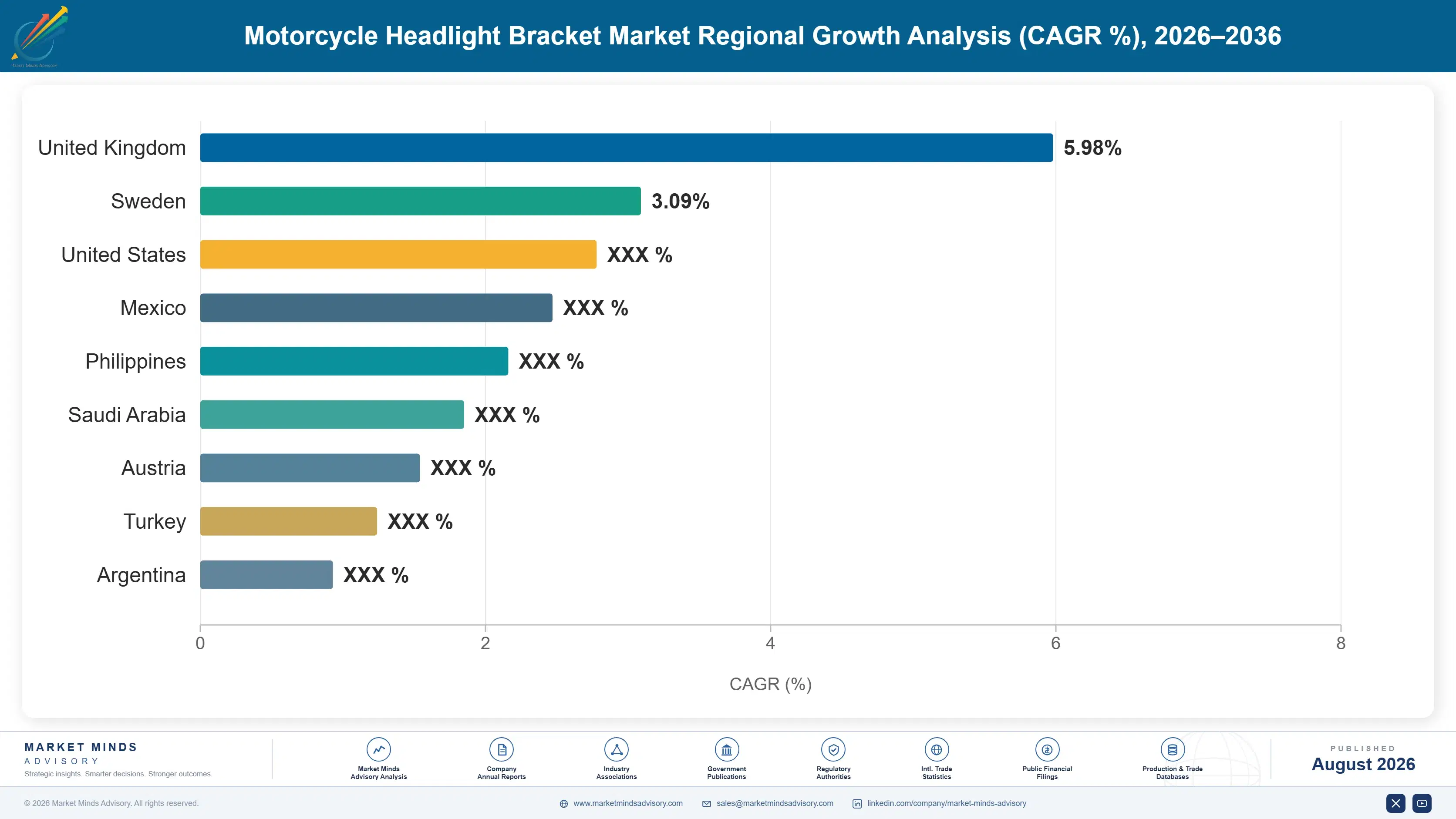
motorcycle-headlight-bracket-market-country-cagr-analysis-1787555715999

Where Bracket Margin Actually Sits

Four moves matter for a component that designers keep deleting and that builders keep turning into jewellery. Two are about the segments where the part survives and carries value, and two are about the failures nobody warns customers about. Competing for original equipment stampings is not among them. That volume is disappearing anyway. Nothing there is defensible.

Follow retro and naked platforms, not sportbikes

Fairing integration has removed the discrete bracket from around 43% of new motorcycles and that share rises with each sportbike and scooter generation, while naked, retro and adventure segments preserve a visible bracket the styling actively depends on. Those segments have grown as a share of production across a decade. Manufacturers holding sportbike platform positions are serving a shrinking population, and repositioning toward retro and naked platforms addresses machines where the component is a design requirement rather than an engineering convenience anybody could design away. Design decisions removed it. Nobody reversed it.
Market Impact: Avoids the full 43% of platform integration exposure

Sell to owners rather than assembly buyers

An original equipment bracket is a low-value stamping bought on price by somebody comparing quotations, while a machined aluminium bracket is chosen from photographs by an owner treating it as visible motorcycle jewellery alongside bar ends and mirrors. Machined product compounds at 8.4% and carries several times the value per unit. The commercial capabilities differ completely: one requires assembly line supply and cost control, the other requires photography, community presence and finish quality. Manufacturers trying to serve both from one organisation consistently underperform in the segment that actually pays. Pick one and commit.
Market Impact: Serves a segment now compounding at 8.4% annually

Publish approval guidance competitors avoid mentioning

Roughly 28% of custom headlight installations fail roadworthiness lighting inspection on mounting height below the 500 millimetre minimum or on beam aim after a bracket change. Bracket manufacturers rarely mention approval implications and installers rarely measure, which produces failed inspections, rework and occasional liability nobody anticipated. Publishing mounting height and aim guidance with each product solves a genuine customer problem, differentiates from competitors pretending it does not exist, and builds credibility with the workshops that recommend brackets. Almost nobody in this aftermarket does it at all. It costs almost nothing.
Market Impact: Addresses a 28% lighting inspection failure rate directly

Validate fatigue before appearance sells the part

A bracket carries cantilevered mass on a vibrating fork and fatigue cracking appears months after purchase rather than at installation, in a segment where owners discuss failures publicly and at length across forums and social media. Appearance sells the part and section geometry determines whether it survives, and those two properties correlate poorly. Finite element analysis and fatigue testing cost modestly and small fabricators producing visually attractive brackets skip both entirely. A published fatigue validation is a differentiator competitors cannot easily match without engineering capability they lack. Testing costs perhaps 2 weeks of engineering time.
Market Impact: Prevents failures appearing after 100% of all sales

Who Controls the Margin Pool

Five manufacturers hold just 14% of headlight bracket supply, measured on units supplied at manufacturer level, the basis used throughout this section. That is among the most fragmented positions in motorcycling and it follows from a component that hundreds of small fabricators can produce with a press or a milling machine. The gap between leaders and everybody else is original equipment platform position rather than any manufacturing capability worth defending. A press or a mill is the entire barrier.
Competition runs on three dimensions that differ entirely by channel. Platform specification with motorcycle manufacturers, which carries volume at very thin margin. Design and finish quality in the custom aftermarket, where an owner chooses from photographs. And fatigue validation, which almost nobody performs and which decides whether a brand survives its own product failures. Almost nobody performs the third.

Rankings shift as fairing integration removes original equipment positions permanently rather than transferring them, which is a different competitive dynamic from losing a tender. Specialist custom manufacturers hold aftermarket positions that scale confers no advantage in. Indian and Chinese fabricators dominate original equipment volume on cost. Cost decides original equipment entirely.
motorcycle-headlight-bracket-market-company-positioning-matrix-1787555716517

Competitive Moat and Risk Dimensions

VARROC ENGINEERING

Moat: Integrated lighting assembly supply

Varroc supplies complete lighting assemblies including mounting hardware rather than brackets alone, which means the bracket travels with a lighting specification decision rather than being tendered separately as a fabricated part. That integration protects the position against the small fabricators who compete effectively on brackets sold in isolation.
VARROC ENGINEERING

Risk: Fairing integration removes assemblies

Platform decisions integrating the headlight into a fairing or cast structure eliminate the discrete bracket entirely, and supplying the lighting assembly does not preserve a component the designer deleted. Around 43% of new motorcycles already dispense with it. Manufacturers serving retro and naked segments face far less of that exposure.
RINDER GROUP

Moat: European platform engineering depth

Rinder engineers lighting and mounting systems to European approval requirements including height, aim and vibration validation, which matters where roadworthiness testing catches failures that other markets never detect. That engineering discipline is genuinely absent from most participants in this category and it protects positions with manufacturers who cannot afford an approval problem.
RINDER GROUP

Risk: European fleet decline exposure

Motorcycle populations across several European markets are mature and shrinking slightly as ageing riders exit and replacement purchases fall behind. Engineering capability defends margin without creating volume. Suppliers weighted toward Indian or Southeast Asian production access growth that European platform positions cannot reach at all.

Players Tracked

Prominent Players

Varroc Engineering
Minda Industries
Stanley Electric
Koito Manufacturing
Rinder Group

Other Key Players

Lumax Industries
Fiem Industries
Neolite ZKW
Hella
Valeo
JW Speaker
Motogadget
LSL
Rizoma
Kellermann
Highsider
Puig
Motone Customs
Dime City Cycles
British Customs

Recent Developments

MARCH 2025

A European manufacturer published approval guidance with bracket products

A European aftermarket bracket manufacturer began publishing mounting height and beam aim guidance alongside each product, addressing roadworthiness inspection failures that follow bracket changes on custom builds. This was a documentation and product support decision rather than any commercial transaction. Nobody else publishes anything comparable.
Signal: Publishing compliance guidance differentiates from competitors pretending the problem does not exist, which is unusually cheap
AUGUST 2025

A motorcycle manufacturer integrated headlight mounting into a cast structure

A motorcycle manufacturer integrated headlight mounting into a cast front structure across a new platform, removing the discrete bracket alongside several other components to reduce part count and assembly operations. This was a platform engineering decision rather than any supplier transaction. Part count fell across the whole front end.
Signal: Integration removes the component rather than resourcing it, which is a permanent loss rather than a competitive one
DECEMBER 2025

A custom parts supplier introduced fatigue validated bracket designs

A custom motorcycle parts supplier introduced bracket designs supported by published finite element analysis and fatigue testing results, addressing cracking failures that appear months after installation on vibrating forks. This was product development rather than any transaction between companies. Small fabricators skip both entirely. Cracking drove it.
Signal: Fatigue validation is a genuine differentiator in a segment where appearance sells and section geometry decides survival

What Moves Manufacturer Cost

Raw metal accounts for around 38% of manufacturer cost, principally steel strip for stampings and aluminium billet or castings for machined and cast products. Machining time dominates cost on CNC products and is modest on stampings. Surface finishing including anodising, powder coating and polishing is substantial on aftermarket parts where appearance is the product. Tooling amortisation varies enormously with production volume.
Steel and aluminium prices moved sharply through 2021 and 2022 on energy costs and supply disruption, and IEA data record European industrial energy far above Asian levels through that period. Hella noted raw material and energy cost pressure across its lighting operations in its Annual Report 2022. Manufacturers on platform contracts absorbed most of it, since a motorcycle manufacturer sets component prices for a model year.

Machining time rather than material determines cost on the products that actually carry margin. A machined aluminium bracket may spend an hour on a milling machine and contain a few dollars of metal, which means programming efficiency, fixturing and batch size decide profitability far more than aluminium price ever does. Small fabricators frequently price against material cost and discover that machine hours consumed the margin they thought they had.
motorcycle-headlight-bracket-market-cost-volatility-analysis-1787555716713

Design machined parts for fixturing and cycle time

A machined bracket may hold a few dollars of aluminium and consume an hour of machine time, which makes fixturing, tool path and batch size the actual cost drivers rather than metal price. Single setup machining and shared fixtures cut cycle time substantially without changing appearance. Fabricators pricing on material discover machine hours consumed the margin.

Index original equipment contracts to metal benchmarks

Steel and aluminium at 38% of cost move on energy and supply conditions unconnected to motorcycle demand, and model year fixed pricing transfers that whole exposure to the supplier. Indexing to published benchmarks with periodic reset removes it cleanly. Motorcycle manufacturers resist because vehicle pricing is fixed across a model year. Indexation is the only real answer here.

Validate fatigue in design rather than in the field

Bracket cracking appears months after sale on vibrating forks, in a segment where owners discuss failures publicly and at considerable length. Finite element analysis and bench fatigue testing cost modestly at design stage and prevent a warranty and reputation problem that no marketing budget repairs afterwards. Small fabricators skip both entirely, which is precisely why published validation differentiates so effectively.

Portfolio Architecture for Margin Defence

Margin here tracks who chooses the part rather than how it is made, which is unusual and decisive. Original equipment steel stampings run at gross margins in the low teens against hundreds of fabricators competing for assembly line supply on price alone. Cast aluminium and fabricated brackets run somewhat better on tooling and finish. Machined aluminium and adjustable multi-fit products run considerably higher, because an owner selects them personally and pays for appearance rather than function.
The tension is that original equipment volume fills presses while aftermarket product earns returns, and the two need entirely different capabilities. Assembly line supply requires cost control, quality systems and platform relationships. Custom aftermarket requires photography, community presence, finish quality and fatigue engineering. Manufacturers attempting both from one organisation have generally found original equipment cost pressure preventing the finish investment that aftermarket customers actually pay for.

High-value pools sit in machined aftermarket product, fatigue validated designs and approval compliant mounting. None of the three is where the original equipment volume is. Press capacity by itself defends nothing against a design decision that deleted the part. Engineering and channel defend considerably more.

Volume / Commodity-Adjacent

Steel stamped and basic fabricated brackets supplied into motorcycle assembly on price against hundreds of competing fabricators. The eight-point range separates manufacturers with indexed metal contracts and efficient tooling from those absorbing steel movement across a fixed model year.
Gross Margin: 11%-19%

Premium / Certified

Cast aluminium and engineered brackets where tooling investment, finish quality and approval validation narrow the competing field. The ten-point spread reflects engineering capability, since fatigue validation and approval documentation exclude most small fabricators entirely.
Gross Margin: 22%-32%

Sustainability / Regulatory / Next-Generation

CNC machined aftermarket brackets, adjustable multi-fit products and fatigue validated custom designs. The eighteen-point range is wide because owners choose these personally from photographs and pay for appearance rather than any measurable function.
Gross Margin: 30%-48%
motorcycle-headlight-bracket-market-portfolio-architecture-1787555717207

High-value Sub-segments and Strategic Watch-out

Machined Custom Aftermarket

Compounding at 8.4% because builders treat the bracket as visible jewellery alongside bar ends and mirrors rather than as hardware. Owners choose from photographs and pay several times what any stamping costs. It is the same purchasing category as bar ends and mirrors entirely. Function barely matters.
Gross Margin: 32%-48%

Fatigue Validated Designs

Cracking appears months after sale on vibrating forks and owners discuss failures publicly at length. Published validation costs little and small fabricators skip it entirely, which makes it an unusually cheap differentiator. Engineering capability rather than marketing spend produces it, which competitors mostly lack. Failures spread publicly.
Gross Margin: 28%-42%

Original Equipment Stampings

The volume, competed by hundreds of fabricators on price and being deleted from 43% of new platforms by fairing integration. Manage for tooling efficiency rather than margin, which is not available. Tooling efficiency is the only lever remaining in the segment at all. Integration keeps advancing.
Gross Margin: 11%-19%

Approval Compliant Mounting

Around 28% of custom installations fail lighting inspection on height or aim, and almost nobody publishes guidance. Solving a genuine customer problem competitors pretend does not exist builds credibility with workshops. Workshops recommend suppliers who solved a problem for them once. Credibility follows quickly here.
Gross Margin: 26%-40%

How Bracket Demand Renews

Demand renews on two mechanisms that share nothing. Original equipment demand follows motorcycle production and renews on platform cycles, where a bracket specified into a model ships for the production life and then disappears entirely when the next platform integrates it away. Aftermarket demand renews on damage, modification and taste, with a custom builder buying a bracket because he wants a different appearance rather than because anything failed.
Stickiness barely exists in either channel and manufacturers should stop expecting it. An original equipment position lasts a platform and confers nothing on the next one, since the decision is made afresh by engineers who may delete the part entirely. Aftermarket purchases are one-off and discretionary, with a builder buying once per project and choosing on appearance photographs rather than any prior relationship or brand loyalty worth naming.

The buyer differs so completely between channels that most manufacturers should pick one. An assembly buyer comparing stamping quotations against a target cost and a café racer builder scrolling photographs at midnight share no criteria, no vocabulary and no channel. Serving both means running two businesses that happen to make similar shapes.
motorcycle-headlight-bracket-market-end-use-penetration-index-1787555717704

Where To Place The Bet

These are among the four positions where our research anticipates prominent divergence between winners and laggards over the coming forecast period. Each is grounded in the demand model, the regulatory perimeter, and the announced capacity pipeline.
01 / PLATFORM SEGMENT SELECTION

Chase retro and naked, not faired sportbikes

Fairing integration has already removed the discrete headlight bracket from around 43% of new motorcycles and that proportion continues rising with each sportbike and scooter platform generation, because integration reduces part count, weight and assembly operations simultaneously. Naked, retro and adventure segments preserve a visible bracket that the styling genuinely depends on, and those segments have grown as a share of production across the past decade rather than declined. Manufacturers holding sportbike platform positions are serving a population that design decisions keep shrinking.
02 / OWNER CHANNEL FOCUS

Sell to the builder, not the assembly line

An original equipment bracket is a low-value steel stamping purchased on price by somebody comparing quotations against a target cost, while a machined aluminium bracket gets chosen from photographs by an owner treating it as visible motorcycle jewellery alongside bar ends and mirrors. Machined product compounds at 8.4% and carries several times the value per unit sold. The required capabilities differ completely, since one demands cost control and platform relationships while the other demands photography, community presence and genuine finish quality.
03 / COMPLIANCE GUIDANCE PUBLICATION

Tell customers what competitors will not

Roughly 28% of custom headlight installations fail roadworthiness lighting inspection, usually on mounting height falling below the 500 millimetre minimum or on beam aim after a bracket change moved the unit's position. Bracket manufacturers rarely mention approval implications and installers rarely measure anything, which produces failed inspections, rework and occasional liability that nobody in the chain had anticipated. Publishing height and aim guidance with each product costs almost nothing and differentiates sharply from competitors who prefer to pretend the problem does not exist.
04 / FATIGUE ENGINEERING INVESTMENT

Validate the part before appearance sells it

A headlight bracket carries cantilevered mass on a fork that vibrates continuously, which makes fatigue cracking the classic failure mode and one appearing months after purchase rather than at installation. Appearance sells the part while section geometry and material properties determine whether it survives, and those two things correlate remarkably poorly in practice. Owners in this segment discuss failures publicly and at length across forums, and finite element analysis with bench fatigue testing costs modestly against a reputation no marketing budget repairs afterwards.

Engagement Snapshot From the Field

A live engagement with an industry participant carrying material or product regulatory and market exposure ahead of a defining policy shift, showing how our research translates into a defensible multi-year portfolio strategy.
MARKET MINDS ADVISORY · CLIENT ENGAGEMENT SUMMARY
Motorcycle Headlight Bracket Producer Strategic Portfolio Review and Transition Roadmap 2026·Investment Scenario on Motorcycle Headlight Bracket Exposure Evaluation 2025-26
CLIENT PROFILE
A European motorcycle parts manufacturer with annual revenue around EUR 22 million (client-reported, unverified by MMA), producing machined aluminium brackets and mounting hardware for the custom and retro aftermarket. Products sold through dealers, workshops and online. No fatigue validation was performed. Approval guidance was not published with any product. Warranty exposure was rising steadily. Online criticism spread quickly.
STRATEGIC CHALLENGE
Warranty claims for cracked brackets had risen sharply (client-reported, unverified by MMA) and online criticism was affecting sales of unaffected products. Management proposed thickening sections across the range. Nobody had established where the cracks originated, which meant a general thickening would have added weight and cost without necessarily addressing the actual failure mode.
MMA APPROACH
MMA analysed returned brackets and modelled stress distribution rather than accepting that thickness was the answer, identifying where fatigue initiated across the affected designs. Workshop feedback on approval inspection failures was gathered through the expert interview programme. Competitor engineering practice was benchmarked, and channel economics were compared across dealer, workshop and direct online sales.
KEY FINDINGS
  1. Cracking initiated at specific geometry transitions rather than from general section thinness, which meant thickening the whole range would have added cost without addressing the actual failure.
  2. Workshops reported that a substantial share of the client's brackets caused lighting inspection failures on height or aim, which the client had never been told about directly.
  3. No competitor anywhere in the client's segment published fatigue validation or approval guidance, leaving both available as differentiators at modest engineering cost.
  4. Direct online sales carried materially better margins than dealer channel and reached exactly the builders who choose brackets from photographs rather than from a counter.
CLIENT PROFILE
A European motorcycle parts manufacturer with annual revenue around EUR 22 million (client-reported, unverified by MMA), producing machined aluminium brackets and mounting hardware for the custom and retro aftermarket. Products sold through dealers, workshops and online. No fatigue validation was performed. Approval guidance was not published with any product. Warranty exposure was rising steadily. Online criticism spread quickly.
STRATEGIC CHALLENGE
Warranty claims for cracked brackets had risen sharply (client-reported, unverified by MMA) and online criticism was affecting sales of unaffected products. Management proposed thickening sections across the range. Nobody had established where the cracks originated, which meant a general thickening would have added weight and cost without necessarily addressing the actual failure mode.
MMA APPROACH
MMA analysed returned brackets and modelled stress distribution rather than accepting that thickness was the answer, identifying where fatigue initiated across the affected designs. Workshop feedback on approval inspection failures was gathered through the expert interview programme. Competitor engineering practice was benchmarked, and channel economics were compared across dealer, workshop and direct online sales.
KEY FINDINGS
  1. Cracking initiated at specific geometry transitions rather than from general section thinness, which meant thickening the whole range would have added cost without addressing the actual failure.
  2. Workshops reported that a substantial share of the client's brackets caused lighting inspection failures on height or aim, which the client had never been told about directly.
  3. No competitor anywhere in the client's segment published fatigue validation or approval guidance, leaving both available as differentiators at modest engineering cost.
  4. Direct online sales carried materially better margins than dealer channel and reached exactly the builders who choose brackets from photographs rather than from a counter.
RECOMMENDED STRATEGY
Phase 1: Phase one: redesign only the specific geometry transitions where cracking actually initiates rather than thickening the entire product range unnecessarily. Phase 2: Phase two: publish fatigue validation and lighting approval guidance with every product, since no competitor currently does either at all. Phase 3: Phase three: shift channel weight toward direct online sales where margins are better and the actual purchasing builder can be reached.
OUTCOME
Redesigned geometry shipped from mid 2026 and warranty claims have fallen substantially. Fatigue and approval documentation now accompanies every product. Direct online share has risen materially, and the client reports online criticism reversing (client-reported, unverified by MMA). Section thickening was avoided entirely, which preserved both appearance and cost.

Frequently Asked Questions

Foundational context covering the market sizes, CAGR, scope, country, region and competition that inform every finding below. This section is provided to cover basics and most often pre-purchase conversations, answered from the MMA Primary Research Dataset.

What is the current size of the Motorcycle Headlight Bracket Market?

The market was valued at USD 0.38 billion in 2025, rising to an estimated USD 0.40 billion in 2026. East Asia holds the largest regional share at 29% of value.

How large will the Motorcycle Headlight Bracket Market be by 2036?

MMA forecasts USD 0.69 billion by 2036 under the base case, an expansion multiple of 1.72 times the 2026 value. That represents USD 0.29 billion of incremental value.

What is the CAGR for the Motorcycle Headlight Bracket Market 2026 to 2036?

The base case runs at 5.6% compound annual growth between 2026 and 2036, with a bull case at 6.8% and a bear case at 4.4%. Historical growth from 2020 to 2025 was 4.6%.

Which segment is growing fastest?

CNC machined aluminium brackets lead at 8.4%, half again the market rate, because custom builders treat the bracket as visible design. Polymer integrated mounts follow at 7.2%.

Who are the major companies in the Motorcycle Headlight Bracket Market?

Varroc Engineering, Minda Industries, Stanley Electric, Koito and Rinder Group hold just 14% of supply between them. Hundreds of small fabricators produce this component competently.

Which country is growing fastest?

India leads at 9.2%, on motorcycle production larger than any other country and replacement demand driven by road and traffic conditions damaging front-end components frequently.

Report Segmentation Architecture

The full report scope spans multiple orthogonal segmentation dimensions, with cross-tabulated demand data provided for each dimension pair. Coverage extends further to regional breakdowns, trend trajectories, and the competitive detail needed to support segment-level decision-making.

By Bracket Construction

  • Steel Stamped Brackets
  • Cast Aluminium Brackets
  • CNC Machined Aluminium Brackets
  • Polymer Integrated Mounts
  • Tubular and Fabricated Brackets
  • Adjustable and Multi-Fit Brackets

By End-Use Industry

  • Retro and Naked Motorcycles
  • Adventure and Dual Sport
  • Commuter Motorcycles and Scooters
  • Custom and Café Racer Building
  • Cruiser and Touring Motorcycles
  • Off-Road and Competition

By Sales Channel

  • Original Equipment Platform Supply
  • Specialist Custom Retail
  • Workshop and Installer Supply
  • Online Direct to Builder
  • General Aftermarket Distribution

By Region

  • North America
  • Western Europe
  • East Asia
  • South Asia and Pacific
  • Latin America
  • Middle East and Africa
  • Eastern Europe

Scope, Methodology, and Coverage

Every figure in this report is reproducible from documented input assumptions. The scope below maps the historical period, the forecast horizon, the segmentation dimensions, and the countries covered, alongside the underlying primary and qualitative methodology.
Historical Period
2020 to 2025
Forecast Period
2026 to 2036
Base Year
2025 (USD billions; MMA Primary Research Dataset, August 2026)
Market Definition
The market comprises brackets, mounts and mounting assemblies supplied to locate motorcycle headlights on forks, frames and front structures across retro, adventure, commuter, custom, cruiser and competition applications, covering steel stamped brackets, cast aluminium brackets, CNC machined aluminium brackets, polymer integrated mounts, tubular and fabricated brackets, and adjustable and multi-fit brackets. Value is measured at manufacturer level on units supplied. Headlight units and lighting electronics, fairings and bodywork, fork tubes and yokes, indicator and auxiliary light mounts, and instrument mounting hardware fall outside scope.
Quantitative Units
USD billions (current prices); million bracket units supplied annually; USD per unit by bracket construction
Segmentation Dimensions
By Bracket Construction; By End-Use Industry; By Sales Channel; By Region
Regions Covered
North America, Western Europe, East Asia, South Asia and Pacific, Latin America, Middle East and Africa, Eastern Europe
Countries Covered
India, Indonesia, Vietnam, Thailand, Australia, China, Japan, South Korea, Taiwan, United States, Canada, Mexico, Brazil, Colombia, Argentina, Germany, Italy, United Kingdom, France, Spain, Netherlands, Poland, Czechia, Romania, Nigeria, Kenya, Uganda, United Arab Emirates, Egypt, South Africa
Key Companies Profiled
Varroc Engineering, Minda Industries, Stanley Electric, Koito Manufacturing, Rinder Group, Lumax Industries, Fiem Industries, Neolite ZKW, Hella, Valeo, JW Speaker, Motogadget, LSL, Rizoma, Kellermann, Highsider, Puig, Motone Customs, Dime City Cycles, British Customs
Quantitative Methodology
Primary survey, n=3,800 respondents, Q4 2025, six countries; demand-side model with trade association cross-validation
Qualitative Methodology
47 expert interviews, Q4 2025; applied to validate demand model assumptions, identify emerging dynamics, and assess competitive positioning
Report Format
PDF and XLSX data workbook (Word format preview document)
Publisher
Market Minds Advisory
Report Code
MMA-2026-AUT-348
Published
August 2026
Contact
sales@marketmindsadvisory.com | www.marketmindsadvisory.com

Purchase the full Motorcycle Headlight Bracket Market Report (2026 to 2036).

The full report sizes the global motorcycle headlight bracket market to 2036 across six constructions and seven regions, measured on units supplied at manufacturer level. It treats fairing integration as permanent component deletion rather than competitive loss, and quantifies the platform segments where the part survives by design requirement. Competitive analysis covers 20 participants evaluated on units supplied, with moat and risk assessment for the two leaders. Lighting approval compliance failure in custom installations is quantified, since almost nobody in the aftermarket addresses it at all. Four quantified revenue levers close the analysis.
Six-construction segment sizing with segment-level growth rates
Seven-region share and growth breakdown to 2036
Twenty-participant competitive map on one unit basis
Fairing integration quantified as permanent component deletion
Lighting approval failure rates measured across custom installations
Four quantified revenue levers with commercial impact ranges

Built For The People Who Decide

From boardroom strategy to bench-side execution, this report is read cover-to-cover by leaders shaping the next decade of their industry, turning demand scenarios, market dynamics and valuation benchmarks into decisions.
CXOs/ Presidents/ VPs/ Managers
M&A and Corporate Development
Strategy Teams and R&D Heads
Procurement and Product Directors
Regulatory and Compliance Leaders
Investor Relations and Equity Analysts