

Market Minds Advisory
Motorcycle Chain Market

Motorcycle Chain Market: Sealed chain penetration, aftermarket dominance and electrification exposure to 2036

One product name covers two entirely different businesses, and manufacturers who treat a three dollar Indian commuter chain and a European sealed racing chain as one market misread both of them.

Lead Analyst

David Horsley

Published

September 2026

Make Smarter Decisions with Customized Research Insights

Request a free sample report and evaluate market opportunities, growth trends, and competitive dynamics relevant to your business needs.

2025 MARKET VALUE$2.4BMarket Size 2025
2036 FORECAST VALUE$4.1BBase Case , 2026 to 2036
CAGR 2026 TO 20365.0 %Bull 6.2% / Bear 3.8%
INCREMENTAL OPPORTUNITY$1.6BNet 10- year value creation
EXPANSION MULTIPLE1.63x2036 value over 2026 base
Strategic Levers
M&A Pipeline
Regional Outlook
Country Rankings
Competitive Intelligence
Segmental Deep-dive
Call-Us : 91 93563 13602

Executive Snapshot and Market Trajectory

A sealed chain lasts around four times longer than an unsealed one and only 24% of Asian commuter motorcycles are fitted with one. That gap is the largest addressable opportunity in this category, and it persists because a mechanic recommends whatever he already stocks. Nobody has fixed that yet.
X-ring sealed chain grows at 7.5%, half again the market rate of 5.0%, on developed market performance motorcycles where owners choose brands and on Asian premium segments finally converting. East Asia holds 30% of value on Chinese and Japanese production together. Replacement supply accounts for 71% of all units shipped. That makes this a consumables business rather than a component one, with a demand base new motorcycle sales do not control at all.
Five manufacturers hold 47% of chain supply and the concentration reflects heat treatment and pin metallurgy rather than any assembly advantage, since this looks like a commodity and is not. The problem nobody in the industry discusses openly is counterfeits: roughly 19% of aftermarket samples fail authenticity verification, and a chain is a safety component whose failure throws a rider off. Nobody discusses it publicly.
Market Definition
This report covers drive chains supplied for motorcycles, scooters and light three-wheelers across original equipment and replacement channels, spanning standard roller chain, O-ring sealed chain, X-ring sealed chain, heavy duty non-sealed chain, chain and sprocket kits, and specialty and racing chain. Value is measured at manufacturer level on units supplied. Excluded are sprockets sold separately, belt and shaft drive systems, industrial and agricultural chain, bicycle chain, and chain lubricants and maintenance products.
Base Year Value
$2.4B in 2025 (MMA Primary Research Dataset, August 2026)
Forecast Period
2026 to 2036, eleven discrete annual values
CAGR
5.0% base case. Bull 6.2%. Bear 3.8%.
Fastest Growth Segment
X-Ring Sealed Chain: 7.5% CAGR
Fastest Growth Country
India: 8.4% CAGR
Fastest Growth Region
South Asia and Pacific: 7.2% CAGR
Largest Region
East Asia: 30% of 2025 global value
Market Leaders
Daido Kogyo, RK Japan, Tsubakimoto Chain, LG Balakrishnan and Bros and Renold lead the market. Source: MMA Primary Research Dataset, July 2026.
Primary Survey
n=3,800 procurement and R&D decision-makers, Q4 2025, six countries
Methodology
Demand-side build-up, cross-validated against public data, 47 expert interviews

Motorcycle Chain Market Forecast Scenarios

motorcycle-chain-market-trends-growth-size-forecast-scenario-1787555695720
Growth ran at 4.0% between 2020 and 2025 and Asian motorcycle production carried the volume while developed markets carried the value. Indian and Southeast Asian output recovered strongly after pandemic disruption and kept expanding on household income and first-vehicle purchase. Sealed chain penetration rose slowly across commuter segments as price gaps narrowed, and remained far below developed market levels throughout the whole period.
The 5.0% base case rests on three mechanisms. Asian motorcycle populations keep expanding and every one of those machines consumes replacement chain on a wear cycle nothing changes. Sealed chain penetration keeps rising in commuter segments at 7.5% as manufacturers demonstrate total cost of ownership to riders who currently buy on shelf price alone. And developed market performance motorcycle owners keep upgrading to premium sealed products they choose personally. Wear decides the volume.
The 6.2% bull case is sealed chain conversion accelerating across Asian commuter fleets, since penetration at 24% leaves enormous headroom in the largest motorcycle population anywhere. The 3.8% bear case is electric two-wheeler adoption reaching Asian commuter segments faster than expected, because belt drive and hub motors remove the chain from those machines entirely rather than changing what they need.

Two Businesses, One Product Name

Motorcycle chain looks like one market and behaves like two that share almost nothing. An Indian or Indonesian commuter chain sells for a few dollars, wears out within a year on poor roads and gets replaced by a roadside mechanic who fits whatever he has in stock. A European sealed chain costs many multiples, lasts four times as long and gets chosen personally by an owner who researched it. Units sit in Asia and value sits elsewhere.
TOP-FIVE CONCENTRATION47%Combined position across motorcycle chain supply held by leaders
SEALED CHAIN LIFE MULTIPLE4xHow much longer sealed chain lasts than unsealed equivalents
AFTERMARKET VOLUME SHARE71%Portion of chain units supplied as replacement rather than original
ASIAN SEALED CHAIN PENETRATION24%Share of commuter motorcycles fitted with a sealed chain
STEEL COST SHARE52%Portion of manufacturer cost attributable to the wire and strip
COUNTERFEIT INCIDENCE RATE19%Portion of aftermarket chain samples failing authenticity verification
The largest addressable opportunity in the category is the gap between those two worlds. Sealed chains retain grease in the pin and bush joint, which extends life around four times and cuts the maintenance a rider must perform. Penetration across Asian commuter motorcycles sits at only 24% against effectively universal fitment in developed markets. Total cost favours sealed chains even at Indian price points, and the barrier is a channel where the mechanic decides.
Counterfeiting is the problem nobody in this industry discusses in public. Around 19% of aftermarket samples fail authenticity verification, and a chain failing at speed throws a rider onto the road. Legitimate brands carry the damage.
"Everybody in this category knows the sealed chain pays for itself in eighteen months and almost nobody has worked out how to explain that to a mechanic in Uttar Pradesh who makes his margin on the chain he already bought. That conversation is the whole opportunity."
Director, Two-Wheeler Components and Aftermarket Practice · MMA Automotive Practice · August 2026

Market Trends

Sealed chain conversion stalls at the distribution channel

A sealed chain lasts around four times longer than an unsealed equivalent and costs perhaps twice as much, which makes the total cost arithmetic favourable even for a rider counting rupees carefully. Penetration across Asian commuter motorcycles nonetheless sits at only 24%, because the purchase decision belongs to a roadside mechanic fitting what he stocks and earning on what he already bought rather than to the rider who pays. Commercially this is a channel problem masquerading as a price problem, and manufacturers addressing it through rider marketing have consistently failed while nobody has properly addressed the mechanic.
Market Impact: Delivers 71% of unit volume

Electrification removes chains from commuter machines entirely

Most electric two-wheelers built for commuting use belt drive or direct hub motors, which eliminates the chain rather than changing its specification, and those are precisely the machines making up Asian volume. Higher-power electric motorcycles retain chain drive and their instant full torque is genuinely harder on a chain than a combustion engine's delivery, which raises specification rather than removing demand. The commercial exposure is therefore concentrated entirely in the commuter volume segment while the performance segment is broadly unaffected or marginally better off. Manufacturers weighted toward Asian commuter units face a very different future from premium specialists.
Market Impact: Drives 8.4% Indian growth

Market Opportunities and Growth Drivers

Replacement demand follows wear rather than any purchase decision

Chains wear out and must be replaced, which makes 71% of unit volume aftermarket rather than original equipment and gives this category a demand base that new motorcycle sales do not control. An Indian commuter machine on poor roads may consume a chain annually while a European touring motorcycle runs one for years, but both eventually buy again. That wear cycle continues through economic conditions that suppress new vehicle purchases entirely, which makes the aftermarket considerably more stable than original equipment supply and rather more profitable per unit. Downturns barely touch it.
Market Impact: Fails 19% of authenticity samples

Asian motorcycle populations keep expanding with household income

Motorcycle fleets across India, Indonesia, Vietnam and the Philippines continue growing as household income converts into first-vehicle purchase at price points nothing else approaches. Every machine added becomes a permanent chain consumer on a wear cycle measured in months rather than years given road conditions and maintenance practice. Indian growth at 8.4% is the fastest of any country here and rests on fleet expansion rather than on any specification improvement. The value per chain remains low and the unit volumes involved are unmatched anywhere else in the world. Nothing else reaches those volumes.
Market Impact: Consumes 52% of manufacturer cost

Market Restraints and Challenges

Counterfeit product endangers riders and damages brands

Around 19% of aftermarket chain samples fail authenticity verification, meaning the product carries a recognised brand marking without that brand's metallurgy, heat treatment or quality control behind it. The root cause is that chain looks simple, brand marking is easy to copy and the aftermarket channel provides no verification a mechanic could realistically perform. Commercially this destroys brand value and creates genuine safety exposure, since a chain failing at speed throws a rider onto the road. Manufacturers are responding with authentication marking, traceable packaging and mechanic education, none of which any single participant can make effective alone.
Market Impact: Reaches only 24% Asian penetration

Steel cost dominates and passes straight through pricing

Wire and strip steel accounts for around 52% of manufacturer cost, which is high enough that any movement passes almost entirely into price given the thin conversion margins this product carries. The root cause is that a chain is a precision assembly of simple steel parts, adding value through heat treatment and tolerance rather than through material transformation. Commercially this makes low-cost segments genuinely difficult to defend when steel moves. Manufacturers are responding with indexed contracts where channel structure permits and by concentrating on sealed products where conversion value exceeds material cost meaningfully.
Market Impact: Threatens 71% aftermarket volume base
3 additional market trends, 4 additional growth drivers, and 2 additional restraints and challenges are covered in the full report. Contact sales@marketmindsadvisory.com to access the complete intelligence.

Segment CAGR and Growth Architecture

Chains are classified here by construction, since that determines service life, maintenance requirement and which market a product actually serves. Motorcycle category, sales channel and geography are handled separately in the framework, because one construction reaches commuter, touring and performance machines depending purely on specification. Construction decides which market a product genuinely serves at all.
motorcycle-chain-market-trends-growth-market-share-analysis-1787555696292

X-Ring Sealed Chain

Growing at 7.5%, half again the market rate, X-ring construction improves on O-ring sealing by using a profile that flexes rather than compresses, which reduces drag while sealing better and lasting longer. Developed market performance motorcycles specify it almost universally, and owners choose it personally after reading about it, which makes this one of very few motorcycle components where brand recognition reaches the end user directly. Asian premium segments are converting steadily as riders trade up from commuter machines. The manufacturing difficulty is genuine, since seal profile tolerance and pin metallurgy together decide whether the advantage materialises or the chain simply costs more. Getting that wrong just raises the price.
CAGR 7.5%

Chain and Sprocket Kits

Chains and sprockets wear together and replacing one without the other destroys the new component quickly, which every competent mechanic knows and many riders discover expensively. Kits packaging matched chain and both sprockets grow at 6.8% because they solve that problem and because they raise transaction value substantially over a chain alone. The commercial advantage is that a kit is harder to counterfeit convincingly than a chain, since matching three components with correct tooth profiles and pitch requires more capability than stamping a brand name onto a chain. That difficulty makes kits a partial answer to a counterfeiting problem nobody has otherwise solved. Nobody else has solved it. Counterfeiters lack the tooling.
CAGR 6.8%
Full segment breakdown across 6 segments available in the complete report.

Regional Architecture and Country Demand Map

East Asia holds 30% of value on Chinese and Japanese manufacture together, and North America and Western Europe hold 42% between them on premium sealed products. Units sit in Asia and value sits elsewhere, which is the defining feature. Manufacturers confusing them misjudge both. Nothing else matters as much.

East Asia

Chinese motorcycle and scooter production at enormous volume sits alongside Japanese manufacturers holding the deepest chain metallurgy and heat treatment capability anywhere, which is an unusual combination of scale and technical depth in one region. Japanese chain makers supply premium sealed products globally and set the specifications performance markets work to. Chinese production serves domestic commuter demand and exports at prices international manufacturers do not attempt to match on unsealed product. Korean and Taiwanese demand is smaller and premium weighted. Growth at 6.0% combines domestic fleet expansion with premium export supply from Japanese producers simultaneously. Japanese producers set the specifications performance markets everywhere else work toward. Scale and depth rarely coincide.
Share: 30% | CAGR: 6.0% (2026 to 2036)

North America

Value per chain is the highest anywhere, since the motorcycle population skews heavily toward large displacement machines whose owners specify sealed chains, replace them proactively and choose brands personally after research. That makes this a brand market rather than a channel market, which is the opposite of Asian commuter dynamics entirely. Aftermarket distribution through dealers, independent shops and online retail is well developed and price transparency is high. Electric motorcycle adoption remains modest and concentrated in higher-power machines that retain chain drive. Growth at 4.4% reflects a stable fleet where value rather than volume expands. Brand rather than channel decides purchases here, which is the exact opposite of Asian dynamics.
Share: 22% | CAGR: 4.4% (2026 to 2036)
Regional intelligence for 5 additional markets available in the complete report: Western Europe, South Asia and Pacific, Latin America, Middle East and Africa, Eastern Europe. Contact sales@marketmindsadvisory.com.
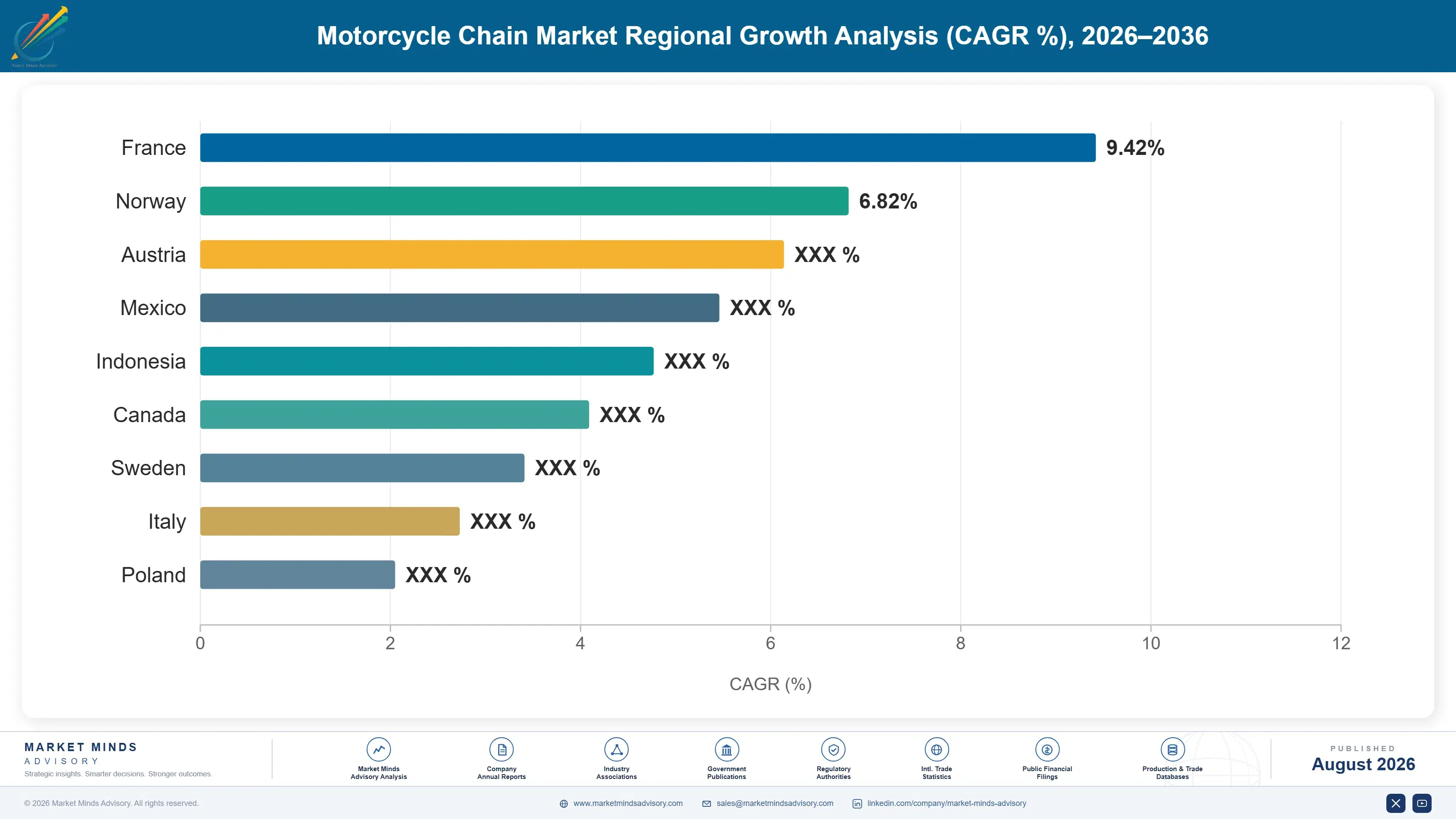
motorcycle-chain-market-trends-growth-country-cagr-analysis-1787555696816

Where Chain Margin Actually Sits

Four moves matter in a category where units and value sit in different hemispheres and the largest opportunity is blocked by a mechanic rather than a rider. Two are about converting the Asian commuter fleet, and two are about defending value where riders actually choose. Competing on unsealed chain price is not among them.

Sell sealed chains to mechanics, not to riders

Sealed chains last around four times longer and penetration across Asian commuter motorcycles sits at only 24%, which is a channel failure rather than a price failure. The decision belongs to a roadside mechanic fitting what he stocks and earning on what he already bought, and rider marketing has repeatedly failed to reach him. Programmes paying mechanics on sealed chain fitment, providing stock on consignment and demonstrating the labour saving from fewer replacements address the actual decision-maker. Nobody has done this properly, which leaves the largest conversion opportunity in the category unclaimed.
Market Impact: Converts upward from a 24% penetration base today

Package kits where counterfeiting is hardest

Around 19% of aftermarket samples fail authenticity verification and a chain failing at speed injures the rider, which makes this a safety problem rather than a commercial nuisance. Matched chain and sprocket kits are considerably harder to counterfeit convincingly than a chain alone, since reproducing three components with correct tooth profiles and pitch requires capability that stamping a brand name does not. Kits also raise transaction value substantially and solve the genuine technical problem of replacing worn components together. Growth at 6.8% reflects both, and the counterfeiting defence is an underused argument.
Market Impact: Defends against a full 19% counterfeit sample incidence

Concentrate value where the rider chooses personally

Developed market performance motorcycle owners select chains themselves after research, which makes this one of very few motorcycle components where brand recognition reaches the end user directly rather than passing through a workshop. X-ring products compound at 7.5% on exactly that dynamic. Manufacturers building brand with riders rather than with distributors capture pricing that channel-driven competition never permits. That effort is wasted entirely in Asian commuter markets where the mechanic decides, which is why the two businesses need genuinely separate commercial approaches. Two businesses, two organisations, no overlap between them at all.
Market Impact: Serves premium segments now compounding at 7.5% annually

Position for electrification by machine type

Belt drive and hub motors remove the chain from commuter electric two-wheelers entirely, which threatens exactly the Asian volume that carries 71% aftermarket units. Higher-power electric motorcycles retain chain drive and their instant torque delivery is harder on a chain than combustion, which raises specification and value per unit. Manufacturers weighted toward commuter volume face a shrinking base while premium specialists face a marginally better one. Recognising which business a manufacturer is actually in determines whether electrification is an existential problem or a mild specification opportunity. That distinction decides everything.
Market Impact: Protects against exposure across 71% of unit volume

Who Controls the Margin Pool

Five manufacturers hold 47% of motorcycle chain supply, measured on units supplied annually across original equipment and aftermarket, the basis used throughout this section. That concentration rests on heat treatment and pin metallurgy rather than assembly capability, since a chain looks like a simple mechanical assembly and its service life depends entirely on material science that is difficult to get right consistently. Material science is genuinely hard to get consistently right.
Competition runs on three dimensions that differ completely by market. Brand recognition with riders in developed markets where owners choose personally. Channel position with mechanics and distributors across Asian commuter segments where riders do not. And original equipment specification with motorcycle manufacturers, which carries volume at thin margin and confers aftermarket credibility. Price competes hardest in unsealed commuter product. Very little transfers between the two.

Rankings shift as sealed chain penetration rises in Asian markets, which favours manufacturers with both the product and the channel programmes to convert mechanics. Japanese producers hold premium positions built over decades. Counterfeiting suppresses everybody's brand value rather than transferring share to any particular competitor. Counterfeiting suppresses all brand value at once.
motorcycle-chain-market-trends-growth-company-positioning-matrix-1787555697349

Competitive Moat and Risk Dimensions

DAIDO KOGYO

Moat: Sealed chain metallurgy depth

Daido Kogyo holds heat treatment and pin metallurgy capability developed across decades of racing and premium motorcycle supply, which decides whether a sealed chain actually delivers the four times life advantage or simply costs more. Riders in developed markets recognise the brand and specify it personally, which is rare in motorcycle components and difficult for any competitor to replicate quickly.
DAIDO KOGYO

Risk: Premium segment concentration

Positions concentrate in developed market performance motorcycles where fleets are mature and shrinking slightly as ageing riders exit the market. The volume growth sits entirely in Asian commuter segments where a premium brand commands limited advantage and channel economics differ completely. Manufacturers with strong Asian channel positions access growth this position cannot easily reach.
LG BALAKRISHNAN AND BROS

Moat: Indian channel and manufacture

The company combines Indian manufacturing cost with distribution reaching the roadside mechanics who actually decide replacement chain fitment across the largest motorcycle population in the world. That channel access is what converts sealed chain penetration from 24% upward, and it took decades of relationship building that no international brand has replicated.
LG BALAKRISHNAN AND BROS

Risk: Electrification of commuter fleets

Indian commuter motorcycles are precisely the machines most likely to electrify toward belt drive and hub motors, which removes the chain entirely rather than changing its specification. A strong position in that fleet becomes a shrinking position rather than a defensible one. Manufacturers weighted toward higher-power motorcycles retaining chain drive face considerably less of that exposure.

Players Tracked

Prominent Players

Daido Kogyo
RK Japan
Tsubakimoto Chain
LG Balakrishnan and Bros
Renold

Other Key Players

Rockman Industries
TIDC India
Regina Catene Calibrate
IWIS
Hangzhou Donghua Chain
Zhejiang Hengjiu Chain
Wippermann
JT Sprockets
Ognibene
KMC Chain
Sunstar Engineering
Enuma Chain
Diamond Chain
SFR Racing
Sedis

Recent Developments

FEBRUARY 2025

An Indian manufacturer launched a mechanic incentive programme

An Indian chain manufacturer introduced a fitment incentive programme paying roadside mechanics directly for sealed chain installation, addressing the channel decision rather than attempting to persuade riders through advertising. This was a commercial programme rather than any transaction between manufacturers or distributors. Riders were never the obstacle.
Signal: Somebody has finally addressed the mechanic rather than the rider, which is where the sealed chain conversion actually stalls
AUGUST 2025

Industry testing found widespread aftermarket chain counterfeiting

Aftermarket chain sampling across several Asian and African markets found a substantial proportion of branded product failing authenticity and metallurgical verification, with implications for rider safety given chain failure characteristics. This was a testing survey rather than any commercial announcement. Metallurgy failed alongside marking. Riders bear the risk.
Signal: Published counterfeit findings damage every legitimate brand at once, which harms manufacturers far more than counterfeiters
DECEMBER 2025

An electric motorcycle manufacturer specified chain drive for torque

An electric motorcycle manufacturer specified reinforced chain drive rather than belt drive on a higher-power model, citing instant torque delivery that belt systems handle poorly at the power levels involved. This was an engineering specification rather than any transaction between component suppliers. Belt systems could not cope.
Signal: Electrification removes chains from commuter machines and raises specification on performance ones, which splits the exposure entirely

What Moves Manufacturer Cost

Wire and strip steel accounts for around 52% of manufacturer cost, purchased to tight specification since pin and bush metallurgy determine service life directly. Heat treatment energy is substantial and the process control involved is where genuine capability sits. Sealing components for O-ring and X-ring products add material cost that unsealed chains avoid entirely. Assembly labour is modest and largely automated at volume.
Steel prices moved sharply through 2021 and 2022 on energy costs and supply disruption, and IEA data record European industrial energy far above Asian levels through that period. Renold noted raw material and energy cost pressure across its chain operations in its Annual Report 2022. Manufacturers holding original equipment contracts absorbed most of the movement, since a motorcycle manufacturer sets component prices for a model year and does not reopen them.

Heat treatment capability rather than steel purchasing separates manufacturers, and it appears nowhere in a cost comparison. Two chains built from identical steel to identical dimensions can differ several times over in service life depending on case hardening depth, core toughness and process consistency. That difference is invisible at purchase and decisive in use, which is what makes counterfeiting so damaging.
motorcycle-chain-market-trends-growth-cost-volatility-analysis-1787555697546

Index original equipment contracts to steel benchmarks

Wire and strip at 52% of cost prices on steel markets moving for reasons unconnected to motorcycle demand, and model year fixed pricing transfers that whole exposure to the manufacturer. Indexing to published wire rod benchmarks with periodic reset removes it. Motorcycle manufacturers resist because vehicle pricing is fixed for a model year. Indexation is the only real answer available.

Load heat treatment capacity across chain product ranges

Heat treatment is the capability that decides service life and the equipment is expensive enough to require utilisation across a whole product range rather than a single segment. Manufacturers running treatment lines for premium sealed products alone carry capital that competitors amortise across commuter and industrial volumes as well. Loading it properly makes premium metallurgy affordable at commuter prices.

Specify sealing compounds for regional operating conditions

Seals degrade with heat, dust and water, and African taxi fleets or Indian monsoon riding differ enormously from European touring use. Temperate seals fail early there and destroy the four times life advantage sold. Compound selection by market costs nothing at design and preserves the argument. Riders discover the failure long before anybody in manufacturing does.

Portfolio Architecture for Margin Defence

Margin here tracks construction and channel rather than manufacturing scale, because assembling a chain is straightforward and heat treating one properly is not. Unsealed commuter chain runs at gross margins in the mid teens against domestic Asian manufacturers and counterfeit product simultaneously. O-ring sealed chain runs considerably better on sealing components and life advantage. X-ring products, kits and racing chain run higher again, because riders choose them personally and pay for a brand they researched.
The tension is that commuter volume fills the lines while premium products earn the returns, and the two require entirely different commercial organisations. Reaching a roadside mechanic in Bihar and reaching a track day rider in Bavaria share no distribution, no marketing and no product knowledge whatsoever. Manufacturers serving both from one commercial structure have generally found the volume business consuming resource that brand building required, which shows up as premium positions eroding.

High-value pools sit in X-ring products, matched kits and mechanic conversion programmes in Asia. Only the last of those three is where the units are. Manufacturing capacity by itself defends very little against a counterfeit carrying your own brand name.

Volume / Commodity-Adjacent

Unsealed standard roller chain for commuter motorcycles, competing against domestic Asian manufacturers and counterfeit product carrying legitimate brand markings simultaneously. The eight-point range separates manufacturers with indexed steel contracts from those absorbing wire rod movement entirely.
Gross Margin: 14%-22%

Premium / Certified

O-ring sealed chain and heavy duty constructions where sealing components and heat treatment depth deliver measurable life advantage. The ten-point spread reflects metallurgy consistency, since case hardening quality separates chains that deliver four times life from those that merely cost more.
Gross Margin: 26%-36%

Sustainability / Regulatory / Next-Generation

X-ring sealed products, matched chain and sprocket kits and specialty racing chain. The eighteen-point range is wide because riders select these personally after research, which permits pricing that channel-driven segments never allow anywhere.
Gross Margin: 34%-52%
motorcycle-chain-market-trends-growth-portfolio-architecture-1787555698041

High-value Sub-segments and Strategic Watch-out

Asian Mechanic Conversion

Sealed penetration at 24% against four times life advantage is a channel failure rather than a price one, and nobody has properly paid the mechanic who actually decides. That leaves the largest conversion opportunity in this category unclaimed entirely. Paying him is the entire answer.
Gross Margin: 22%-34%

Matched Kit Packaging

Growing at 6.8% and considerably harder to counterfeit than a chain alone, since matching three components with correct tooth profiles needs capability that stamping a brand name simply does not require anywhere. Transaction value rises substantially at the same time, which makes it an unusually easy decision.
Gross Margin: 32%-46%

Unsealed Commuter Chain

The unit volume, competed against domestic manufacturers and counterfeits carrying legitimate brand names at once. Manage for utilisation and steel indexation rather than for margin, which is genuinely not available in it. Counterfeits carrying your own brand cannot be undercut at any price at all.
Gross Margin: 14%-22%

Rider Selected Premium Chain

One of very few motorcycle components where brand recognition reaches the end user directly rather than through a workshop, which permits pricing channel-driven competition never allows. X-ring compounds at 7.5% on that. Rider loyalty here is genuine and rare across mechanical components generally. Worth protecting carefully.
Gross Margin: 36%-52%

How Chain Demand Renews

Demand renews on wear, which makes this a consumables business rather than a component one and gives it a demand base that new motorcycle sales do not control. Around 71% of units go to replacement, and a machine consumes chain on a cycle set by road conditions, load, maintenance and riding style rather than by anything commercial. That cycle continues through downturns that stop new vehicle purchases entirely, which makes the aftermarket considerably more stable than original equipment supply.
Stickiness depends entirely on who chooses. In developed markets the rider selects personally after research and returns to a brand that performed, which produces genuine loyalty rare in mechanical components. In Asian commuter markets the mechanic chooses and loyalty attaches to whichever distributor gives him credit terms and stock, which no manufacturer brand overcomes. Original equipment fitment influences the first replacement and considerably less thereafter.

The decision-maker differs by market more sharply than in almost any component category, and manufacturers frequently address the wrong one. Advertising to Indian riders about metallurgy reaches somebody who will accept whatever the mechanic fits. Approaching European dealers on trade terms reaches somebody whose customer already specified a brand before arriving.
motorcycle-chain-market-trends-growth-end-use-penetration-index-1787555698526

Where To Place The Bet

These are among the four positions where our research anticipates prominent divergence between winners and laggards over the coming forecast period. Each is grounded in the demand model, the regulatory perimeter, and the announced capacity pipeline.
01 / MECHANIC CHANNEL PROGRAMME

Pay the person who actually decides fitment

Sealed chains last around four times longer than unsealed equivalents and penetration across Asian commuter motorcycles remains at only 24%, which is a channel failure rather than any price failure by riders unwilling to pay. The purchase decision belongs to a roadside mechanic fitting whatever he already stocks and earning his margin on inventory bought weeks earlier, and rider-directed advertising has failed repeatedly to reach him. Fitment incentives, consignment stock and labour saving demonstrations address the actual decision-maker, and remarkably nobody has done this properly at scale.
02 / COUNTERFEIT DEFENCE PACKAGING

Sell kits where copying gets genuinely difficult

Roughly 19% of aftermarket chain samples fail authenticity verification, and a chain failing under load at speed throws a rider onto the road rather than merely leaving them stranded somewhere inconvenient. Matched chain and sprocket kits are considerably harder to counterfeit convincingly, since reproducing three components with correct tooth profiles and matching pitch demands capability that stamping a brand name onto a chain never requires. Kits grow at 6.8%, raise transaction value substantially and solve the genuine technical problem of replacing worn components together.
03 / RIDER BRAND CONCENTRATION

Build brand where the rider chooses himself

Developed market performance motorcycle owners select chains personally after reading about them, which makes this one of very few motorcycle components where brand recognition reaches the end user directly rather than passing through a workshop that decides on his behalf. X-ring products compound at 7.5% on precisely that dynamic, and manufacturers building recognition with riders rather than distributors capture pricing that channel competition never permits. That entire effort is wasted in Asian commuter markets where a mechanic decides, which is why these need separate commercial approaches.
04 / ELECTRIFICATION EXPOSURE MAPPING

Know which of the two businesses you run

Belt drive and hub motors eliminate the chain entirely from commuter electric two-wheelers, which are precisely the machines making up the Asian volume carrying 71% of aftermarket units across this whole category. Higher-power electric motorcycles retain chain drive, and their instant torque delivery is genuinely harder on a chain than combustion engines managed, which raises specification and value per unit rather than removing demand. Recognising which of these two businesses a manufacturer actually operates decides whether electrification is existential or mildly favourable.

Engagement Snapshot From the Field

A live engagement with an industry participant carrying material or product regulatory and market exposure ahead of a defining policy shift, showing how our research translates into a defensible multi-year portfolio strategy.
MARKET MINDS ADVISORY · CLIENT ENGAGEMENT SUMMARY
Motorcycle Chain Producer Strategic Portfolio Review and Transition Roadmap 2026·Investment Scenario on Motorcycle Chain Exposure Evaluation 2025-26
CLIENT PROFILE
An Asian motorcycle chain manufacturer with annual revenue around USD 118 million (client-reported, unverified by MMA), producing unsealed and O-ring chain for domestic commuter and export markets. Roughly 80% of volume was unsealed commuter product. Distribution ran through wholesalers to roadside mechanics. No X-ring capability or kit packaging existed. Counterfeiting exposure was severe and rising.
STRATEGIC CHALLENGE
Margins had compressed for three years (client-reported, unverified by MMA) against domestic competition and counterfeit product carrying the client's own brand markings. Management proposed price reductions to defend volume. Nobody had established whether the unsealed segment could be defended at any price, or what converting customers to sealed product would be worth.
MMA APPROACH
MMA assessed the unsealed segment against domestic and counterfeit cost structures to establish whether any price could defend it. Sealed chain conversion economics were modelled from the mechanic's perspective rather than the rider's, since the mechanic makes the decision. Kit packaging counterfeiting resistance was evaluated, and export premium segment access was benchmarked against the client's capability.
KEY FINDINGS
  1. No achievable price defended the unsealed segment against counterfeit product using the client's own brand, since a counterfeiter incurs no development, warranty or brand cost whatsoever.
  2. Mechanics fitting sealed chains earned less per job through fewer replacement visits, which explained a conversion failure that every rider-focused campaign had entirely missed.
  3. Kit packaging raised transaction value substantially and proved materially harder to counterfeit, since matching sprocket tooth profiles requires tooling that copying a chain does not.
  4. Export premium segments were reachable with X-ring capability the client's existing heat treatment could support, requiring sealing investment rather than any metallurgical development.
CLIENT PROFILE
An Asian motorcycle chain manufacturer with annual revenue around USD 118 million (client-reported, unverified by MMA), producing unsealed and O-ring chain for domestic commuter and export markets. Roughly 80% of volume was unsealed commuter product. Distribution ran through wholesalers to roadside mechanics. No X-ring capability or kit packaging existed. Counterfeiting exposure was severe and rising.
STRATEGIC CHALLENGE
Margins had compressed for three years (client-reported, unverified by MMA) against domestic competition and counterfeit product carrying the client's own brand markings. Management proposed price reductions to defend volume. Nobody had established whether the unsealed segment could be defended at any price, or what converting customers to sealed product would be worth.
MMA APPROACH
MMA assessed the unsealed segment against domestic and counterfeit cost structures to establish whether any price could defend it. Sealed chain conversion economics were modelled from the mechanic's perspective rather than the rider's, since the mechanic makes the decision. Kit packaging counterfeiting resistance was evaluated, and export premium segment access was benchmarked against the client's capability.
KEY FINDINGS
  1. No achievable price defended the unsealed segment against counterfeit product using the client's own brand, since a counterfeiter incurs no development, warranty or brand cost whatsoever.
  2. Mechanics fitting sealed chains earned less per job through fewer replacement visits, which explained a conversion failure that every rider-focused campaign had entirely missed.
  3. Kit packaging raised transaction value substantially and proved materially harder to counterfeit, since matching sprocket tooth profiles requires tooling that copying a chain does not.
  4. Export premium segments were reachable with X-ring capability the client's existing heat treatment could support, requiring sealing investment rather than any metallurgical development.
RECOMMENDED STRATEGY
Phase 1: Phase one: abandon price defence of unsealed product and launch a mechanic fitment incentive that compensates for the lost replacement visits sealed chains cause. Phase 2: Phase two: introduce matched chain and sprocket kit packaging, raising transaction value while making counterfeiting materially harder for anybody attempting it. Phase 3: Phase three: invest in X-ring sealing capability to reach export premium segments where riders choose brands themselves rather than accepting fitment.
OUTCOME
The mechanic incentive launched in mid 2026 and sealed fitment rates rose materially in participating territories. Kit packaging is in market with counterfeit incidence measurably lower. X-ring investment is approved, and the client reports margin recovering despite unsealed volume declining (client-reported, unverified by MMA). Unsealed defence had failed.

Frequently Asked Questions

Foundational context covering the market sizes, CAGR, scope, country, region and competition that inform every finding below. This section is provided to cover basics and most often pre-purchase conversations, answered from the MMA Primary Research Dataset.

What is the current size of the Motorcycle Chain Market?

The market was valued at USD 2.4 billion in 2025, rising to an estimated USD 2.52 billion in 2026. East Asia holds the largest regional share at 30% of value.

How large will the Motorcycle Chain Market be by 2036?

MMA forecasts USD 4.10 billion by 2036 under the base case, an expansion multiple of 1.63 times the 2026 value. That represents USD 1.58 billion of incremental value.

What is the CAGR for the Motorcycle Chain Market 2026 to 2036?

The base case runs at 5.0% compound annual growth between 2026 and 2036, with a bull case at 6.2% and a bear case at 3.8%. Historical growth from 2020 to 2025 was 4.0%.

Which segment is growing fastest?

X-ring sealed chain leads at 7.5%, half again the market rate, on performance motorcycles where riders choose brands personally. Chain and sprocket kits follow at 6.8%.

Who are the major companies in the Motorcycle Chain Market?

Daido Kogyo, RK Japan, Tsubakimoto Chain, LG Balakrishnan and Renold hold 47% between them. Heat treatment and pin metallurgy rather than assembly capability sustain those positions.

Which country is growing fastest?

India leads at 8.4%, on a motorcycle population larger than any other country and a wear cycle measured in months given road conditions and maintenance practice.

Report Segmentation Architecture

The full report scope spans multiple orthogonal segmentation dimensions, with cross-tabulated demand data provided for each dimension pair. Coverage extends further to regional breakdowns, trend trajectories, and the competitive detail needed to support segment-level decision-making.

By Chain Construction

  • Standard Roller Chain
  • O-Ring Sealed Chain
  • X-Ring Sealed Chain
  • Heavy Duty Non-Sealed Chain
  • Chain and Sprocket Kits
  • Specialty and Racing Chain

By End-Use Industry

  • Commuter Motorcycles and Scooters
  • Performance and Sport Motorcycles
  • Touring and Cruiser Motorcycles
  • Delivery and Commercial Riding
  • Off-Road and Competition
  • Light Three-Wheelers

By Sales Channel

  • Original Equipment Supply
  • Authorised Dealer Aftermarket
  • Independent Workshop Supply
  • Online Retail Channel
  • Wholesale Distribution

By Region

  • North America
  • Western Europe
  • East Asia
  • South Asia and Pacific
  • Latin America
  • Middle East and Africa
  • Eastern Europe

Scope, Methodology, and Coverage

Every figure in this report is reproducible from documented input assumptions. The scope below maps the historical period, the forecast horizon, the segmentation dimensions, and the countries covered, alongside the underlying primary and qualitative methodology.
Historical Period
2020 to 2025
Forecast Period
2026 to 2036
Base Year
2025 (USD billions; MMA Primary Research Dataset, August 2026)
Market Definition
The market comprises drive chains supplied for motorcycles, scooters and light three-wheelers across original equipment and replacement channels, covering standard roller chain, O-ring sealed chain, X-ring sealed chain, heavy duty non-sealed chain, chain and sprocket kits, and specialty and racing chain. Value is measured at manufacturer level on units supplied annually across original equipment, dealer, workshop, online and wholesale channels. Sprockets sold separately, belt and shaft drive systems, industrial and agricultural chain, bicycle chain, and chain lubricants and maintenance products fall outside scope.
Quantitative Units
USD billions (current prices); million chain units supplied annually; USD per unit by chain construction
Segmentation Dimensions
By Chain Construction; By End-Use Industry; By Sales Channel; By Region
Regions Covered
North America, Western Europe, East Asia, South Asia and Pacific, Latin America, Middle East and Africa, Eastern Europe
Countries Covered
India, Indonesia, Vietnam, Thailand, Philippines, Australia, China, Japan, South Korea, Taiwan, United States, Canada, Mexico, Brazil, Colombia, Argentina, Germany, Italy, France, United Kingdom, Spain, Netherlands, Poland, Czechia, Romania, Nigeria, Kenya, Uganda, United Arab Emirates, Egypt
Key Companies Profiled
Daido Kogyo, RK Japan, Tsubakimoto Chain, LG Balakrishnan and Bros, Renold, Rockman Industries, TIDC India, Regina Catene Calibrate, IWIS, Hangzhou Donghua Chain, Zhejiang Hengjiu Chain, Wippermann, JT Sprockets, Ognibene, KMC Chain, Sunstar Engineering, Enuma Chain, Diamond Chain, SFR Racing, Sedis
Quantitative Methodology
Primary survey, n=3,800 respondents, Q4 2025, six countries; demand-side model with trade association cross-validation
Qualitative Methodology
47 expert interviews, Q4 2025; applied to validate demand model assumptions, identify emerging dynamics, and assess competitive positioning
Report Format
PDF and XLSX data workbook (Word format preview document)
Publisher
Market Minds Advisory
Report Code
MMA-2026-AUT-341
Published
August 2026
Contact
sales@marketmindsadvisory.com | www.marketmindsadvisory.com

Purchase the full Motorcycle Chain Market Report (2026 to 2036).

The full report sizes the global motorcycle chain market to 2036 across six chain constructions and seven regions, measured on units supplied at manufacturer level. It separates the commuter and performance businesses throughout, since units concentrate in Asia while value concentrates in developed markets and the two behave nothing alike. Competitive analysis covers 20 participants evaluated on units supplied, with moat and risk assessment for the two leaders. Sealed chain conversion is analysed from the mechanic's economics rather than the rider's, which is where it actually stalls. Four quantified revenue levers close the analysis.
Six-construction segment sizing with segment-level growth rates
Seven-region share and growth breakdown to 2036
Twenty-participant competitive map on one unit basis
Sealed chain conversion modelled from mechanic economics directly
Electrification exposure separated by machine type and drive system
Four quantified revenue levers with commercial impact ranges

Built For The People Who Decide

From boardroom strategy to bench-side execution, this report is read cover-to-cover by leaders shaping the next decade of their industry, turning demand scenarios, market dynamics and valuation benchmarks into decisions.
CXOs/ Presidents/ VPs/ Managers
M&A and Corporate Development
Strategy Teams and R&D Heads
Procurement and Product Directors
Regulatory and Compliance Leaders
Investor Relations and Equity Analysts