Market Minds Advisory
Motor Control IC Market

Motor Control IC Market: Motor Control IC Market: Design Socket Persistence, Efficiency Mandates and Chips Chosen For A Decade 2026 to 2036

A motor control chip designed into an appliance ships in that product for years without anybody ever reconsidering it again. Winning the design socket is the entire commercial event here.

Lead Analyst

Published

September 2026

Make Smarter Decisions with Customized Research Insights

Request a free sample report and evaluate market opportunities, growth trends, and competitive dynamics relevant to your business needs.

2025 MARKET VALUE$6.9BMarket Size 2025
2036 FORECAST VALUE$19.5BBase Case , 2026 to 2036
CAGR 2026 TO 20369.9 %Bull 11.2% / Bear 8.7%
INCREMENTAL OPPORTUNITY$11.9BNet 10- year value creation
EXPANSION MULTIPLE2.57x2036 value over 2026 base
Strategic Levers
M&A Pipeline
Regional Outlook
Country Rankings
Competitive Intelligence
Segmental Deep-dive
Call-Us : 91 93563 13602

Executive Snapshot and Market Trajectory.

A motor control chip designed into an appliance or a vehicle subsystem ships in that product for years without anybody reconsidering it. Winning the design socket is the entire commercial event in this market, and it happens exactly once per platform. Requalifying an alternative takes around eleven months.
The market reaches USD 7.6 billion in 2026 and USD 19.5 billion by 2036, a 2.57 times expansion at 9.9% annually. Integrated gate driver and controller devices grow at 14.9%, half again the market rate of 9.9%, because combining functions removes board area and component count a designer must otherwise justify. East Asia holds 44% of consumption, far above the usual band, on appliance and motor manufacturing. Requalification takes about eleven months nobody funds.
Five suppliers hold 58% of consumption value, and the position rests on design tool support and reference designs rather than on silicon performance. Infineon Technologies, Texas Instruments, STMicroelectronics, Renesas Electronics and onsemi lead. Reference design coverage decides which parts engineers evaluate at all. Around 64% of designs start from a supplier reference rather than from first principles. Reference coverage decides which parts reach an evaluation at all.
Market Definition
This report covers motor control integrated circuits: the semiconductor devices that drive and regulate electric motors in end products. It spans integrated gate driver and controller devices, motor control microcontrollers and digital signal controllers, discrete gate drivers, motor driver integrated circuits with output stages, position and current sensing devices supplied for motor control, and the reference designs and development tooling supplied with them. It excludes discrete power transistors and modules, complete motor drive systems and inverters, motors themselves, general purpose microcontrollers without motor peripherals, and power supply controllers.
Base Year Value
$6.9B in 2025 (MMA Primary Research Dataset, September 2026)
Forecast Period
2026 to 2036, eleven discrete annual values
CAGR
9.9% base case. Bull 11.2%. Bear 8.7%.
Fastest Growth Segment
Integrated Gate Driver And Controller Devices: 14.9% CAGR
Fastest Growth Country
India: 16.3% CAGR
Fastest Growth Region
South Asia and Pacific: 12.1% CAGR
Largest Region
East Asia: 44% of 2025 global value
Market Leaders
Infineon Technologies, Texas Instruments, STMicroelectronics, Renesas Electronics and onsemi lead on motor control integrated circuit consumption value. Source: MMA Analysis.
Primary Survey
n=3,800 procurement and R&D decision-makers, Q4 2025, six countries
Methodology
Demand-side build-up, cross-validated against public data, 47 expert interviews

Motor Control IC Market Forecast Scenarios

motor-control-ic-market-size-forecast-scenario-1790004171317
Between 2020 and 2025 the category compounded at 8.6%, driven by efficiency regulation rather than by any appetite for better motor control. Appliance and industrial equipment makers moved from simple fixed speed motors toward electronically commutated ones because minimum efficiency rules left them no alternative, and that conversion required a controller where previously there had been none at all.
The base case holds 9.9% on three mechanisms. Efficiency regulation keeps tightening across appliance, pump and fan applications, which forces electronic commutation into products that never had it. Integration keeps removing board area and component count from designs where physical space is genuinely constrained. And vehicle electrification keeps adding motor subsystems that each require their own control silicon regardless of the main traction inverter. Those three mechanisms run largely independently of one another across the forecast period.
The bull case at 11.2% assumes efficiency rules tighten faster across developing markets, which converts a large installed base of simple motors that regulation has not yet reached. The bear case at 8.7% is appliance demand weakness, where consumer replacement cycles extend and the unit volumes behind most motor control shipments soften regardless of what any regulation requires.

The Socket Is The Sale

One decision governs years of shipments. A device designed into a product platform ships there for around seven years, and requalifying an alternative takes about eleven months of engineering nobody wants to fund. That makes the design socket the entire commercial event, and it explains why suppliers invest so heavily in reference designs and development tooling that reach engineers before any purchasing conversation exists.
TOP FIVE CONCENTRATION58%Held by suppliers with reference design and tooling coverage
DESIGN SOCKET DURATION7 yearsTypical time a chosen device ships in a product platform
REFERENCE DESIGN INFLUENCE64%Designs starting from a supplier reference rather than scratch
EFFICIENCY DRIVEN CONVERSION41%New designs replacing fixed speed motors under efficiency rules
BOARD AREA REDUCTION38%Space saved by integrated devices against discrete combinations
REQUALIFICATION PERIOD11 monthsTime to qualify an alternative device into a platform
Reference designs decide what gets evaluated. Around 64% of motor control designs start from a supplier reference rather than from first principles, because a working design that meets the efficiency requirement is worth more to an engineer under schedule pressure than any silicon specification comparison. Suppliers without reference coverage for an application are not on the shortlist, whatever their devices actually do in isolation.
Regulation is what created most of this demand. Around 41% of new motor control designs replace fixed speed motors that efficiency rules made non-compliant, and those products previously required no controller at all. That conversion is still running through appliance, pump and fan categories across most markets, and it is the single largest source of genuinely new sockets rather than competitive displacement.
"Engineers do not choose a motor control chip. They choose a reference design that already works and take whatever silicon is on it. Suppliers who understand that spend their money on application engineers and evaluation boards, and the ones who do not keep publishing datasheets nobody reads."
Director, Power Semiconductor and Motion Control Practice · MMA Technology Practice · September 2026

Market Trends

Reference Designs Decide What Engineers Evaluate

Around 64% of motor control designs begin from a supplier reference rather than from first principles, because a working design meeting the efficiency requirement is worth more to an engineer under schedule pressure than any specification comparison. Suppliers without reference coverage for an application never reach the shortlist regardless of device capability. That makes application engineering headcount and evaluation hardware the actual competitive investment rather than silicon development. Suppliers publishing datasheets rather than funding evaluation hardware are producing material that nobody in the design process ever reads. Coverage decides evaluation.
Market Impact: Efficiency drives 41% of designs

Integration Removes Board Area Designers Must Justify

Integrated gate driver and controller devices reduce board area by around 38% against discrete combinations, which matters in appliances and vehicle subsystems where physical space is genuinely constrained and enclosure size drives cost. Those devices grow at 14.9% against 9.9% for the market as a result. Integration also reduces component count and assembly steps, which reaches a manufacturing engineer whose priorities differ entirely from the designer choosing the silicon. Suppliers arguing only device performance are addressing one of several people who actually decide what eventually ships. Enclosure size drives cost.
Market Impact: Sockets last around 7 years

Market Opportunities and Growth Drivers

Efficiency Rules Convert Motors That Had No Controller

Around 41% of new motor control designs replace fixed speed motors that efficiency regulation made non-compliant, and those products previously required no control silicon whatsoever. That conversion creates genuinely new sockets rather than displacing an incumbent supplier, which is far easier commercially. India compounds at 16.3% partly because appliance efficiency rules are tightening alongside manufacturing growth, so conversion and volume expansion arrive together rather than sequentially. Tracking efficiency regulation across appliance, pump and fan categories reaches that conversion before anybody establishes a position in it. New sockets are easier. Conversion runs globally.
Market Impact: Requalification takes 11 months

Vehicle Subsystems Multiply Motors Per Platform

Electrification adds motor subsystems well beyond the traction inverter, covering pumps, compressors, actuators and thermal management that each require their own control silicon on their own qualification path. Those sockets are smaller individually than traction but far more numerous, and they carry automotive qualification requirements that narrow the supplier field considerably. Design socket duration around seven years also runs longer in vehicles than in appliances, which raises what each win is worth. Automotive qualification takes years to obtain and cannot be accelerated with capital, which narrows the field before any capability is compared.
Market Impact: Efficiency conversion covers 41%

Market Restraints and Challenges

Requalification Cost Blocks Any Competitive Displacement

Qualifying an alternative device into an existing platform takes around eleven months of engineering that delivers no product improvement, which means a designed-in supplier holds the socket for its full seven year life almost regardless of price. The root cause is that motor control affects safety, acoustics and efficiency compliance together. Commercially this makes displacement nearly impossible. Mitigation runs through new platform timing, through pin-compatible alternatives, and through applications where regulation forces a redesign anyway. Platform calendars are consequently worth more to a supplier than any competitive comparison could be.
Market Impact: Some 64% start from references

Appliance Volume Cycles Drive Everything Underneath

Most motor control shipments ride consumer appliance and industrial equipment unit volumes, which soften when replacement cycles extend and households defer purchases. The root cause is that a socket win produces revenue only when the end product actually sells in quantity. Commercially this ties suppliers to demand they cannot influence. Mitigation runs through automotive and industrial diversification, through applications where regulation forces replacement, and through content growth per unit rather than unit growth. Content per unit rather than unit volume is the only growth a supplier can actually influence here.
Market Impact: Integration cuts board area 38%
4 additional market trends, 3 additional growth drivers, and 2 additional restraints and challenges are covered in the full report. Contact sales@marketmindsadvisory.com to access the complete intelligence.

Segment CAGR and Growth Architecture

Segmentation follows device class and integration level, since each carries quite different design engagement, qualification burden and application fit. Six classes cover the market: integrated gate driver and controller devices, motor control microcontrollers and digital signal controllers, motor driver devices with output stages, discrete gate drivers, position and current sensing devices, and reference designs and development tooling.
motor-control-ic-market-market-share-analysis-1790004171904

Integrated Gate Driver And Controller Devices

Integrated gate driver and controller devices grow at 14.9%, half again the market rate of 9.9%, because they reduce board area by around 38% against discrete combinations in applications where enclosure size drives product cost directly. Integration also removes component count and assembly steps, which reaches a manufacturing engineer whose priorities differ entirely from the designer selecting silicon. That dual argument is why these devices win sockets against discrete solutions that may perform identically but require more space, more parts and more assembly effort. Enclosure size drives product cost directly in most of these applications. Devices performing identically still lose when they need more space and more parts. Manufacturing engineers weigh it too.
CAGR 14.9%

Motor Control Microcontrollers And Digital Signal Controllers

Motor control microcontrollers and digital signal controllers compound at 11.6% because efficiency regulation pushes designs toward electronic commutation requiring real time control that simpler devices cannot deliver at all. Around 41% of new designs replace fixed speed motors that previously needed no controller whatsoever. Reference design coverage matters most in this class, since an engineer implementing a commutation algorithm under schedule pressure will take working code and the silicon it runs on rather than building any of it from first principles. Working code and the silicon it runs on arrive together, which settles the socket before any commercial evaluation begins at all. Commutation code decides silicon. Nobody rebuilds it from scratch.
CAGR 11.6%
Full segment breakdown across 6 segments available in the complete report.

Regional Architecture and Country Demand Map

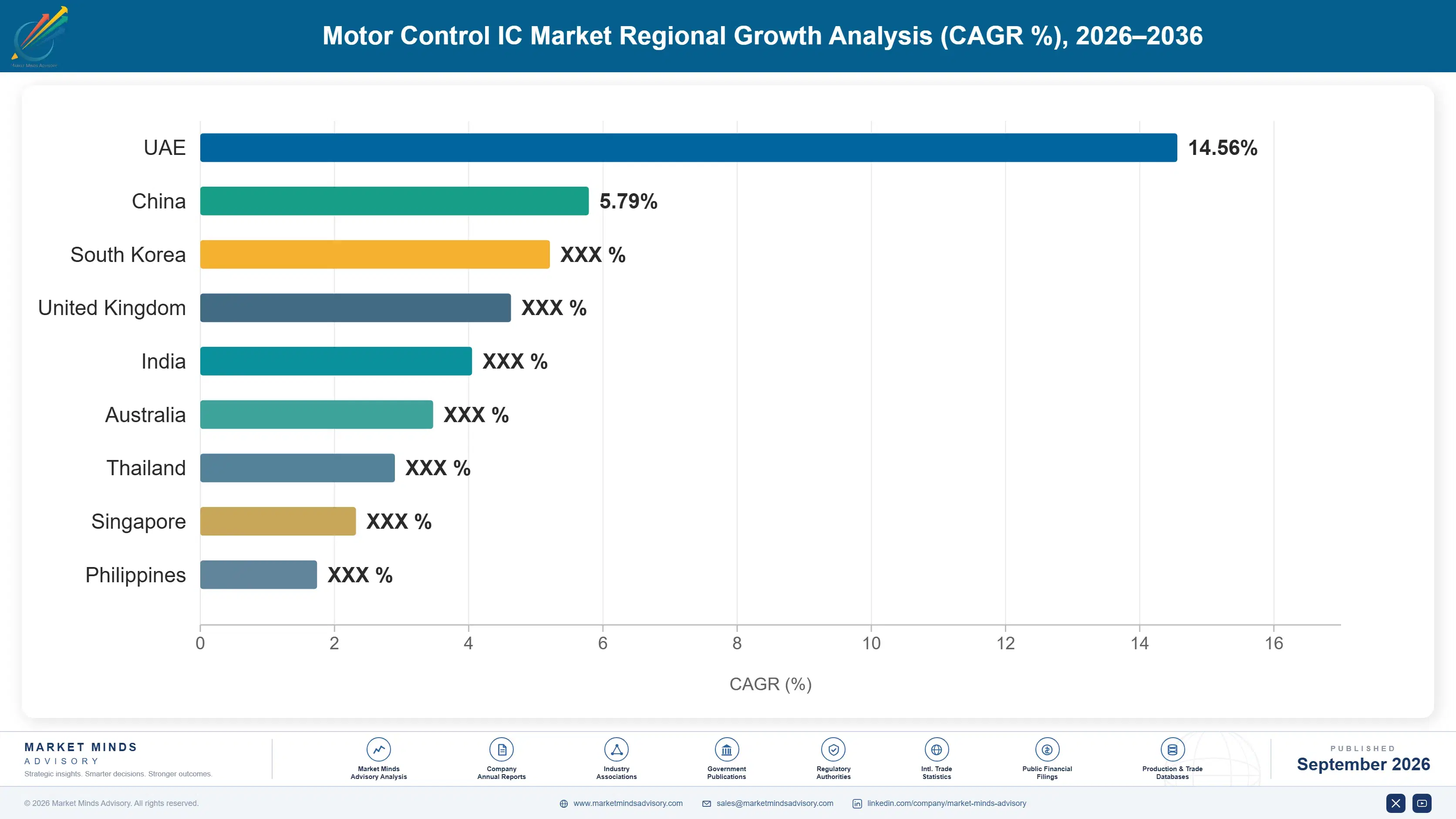
East Asia holds 44% of consumption, far above the usual band, because appliance, motor and equipment manufacturing concentrate there and motor control silicon is consumed where products are built. North America follows at 17% on automotive and industrial design. India compounds fastest at 16.3% on efficiency conversion.

East Asia

East Asia takes 44% of consumption, far above the 30% band ceiling, because appliance, motor and industrial equipment manufacturing all concentrate here and motor control silicon is consumed where products are physically built rather than where they are designed. Chinese appliance makers convert to electronic commutation at volumes no other region approaches under efficiency rules. Regional suppliers compete hard on price in simpler driver devices. Growth at 10.9% runs above the global rate on manufacturing volume and efficiency conversion together. Reference design support matters less in the simpler driver devices where regional suppliers compete most effectively on price. Volume dominates everything here. Efficiency rules convert enormous appliance volumes. Growth follows manufacturing.
Share: 44% | CAGR: 10.9% (2026 to 2036)

Western Europe

Western Europe accounts for 19% of consumption, weighted toward automotive subsystems, industrial drives and premium appliance design rather than volume manufacturing. Infineon Technologies and STMicroelectronics both developed positions alongside the region's automotive and industrial base. Efficiency regulation originated here and remains most demanding, which pulls design activity even where manufacturing has moved elsewhere. Growth at 8.3% is the slowest of any region, on manufacturing absence rather than any weakness in design or regulatory demand. Automotive qualification requirements originating here narrow the supplier field for vehicle subsystem sockets considerably. Design activity persists here even where the manufacturing behind it moved elsewhere years ago. Regulation originated here and stays most demanding. Automotive depth persists.
Share: 19% | CAGR: 8.3% (2026 to 2036)
Regional intelligence for 5 additional markets available in the complete report: North America, South Asia and Pacific, Latin America, Middle East and Africa, Eastern Europe. Contact sales@marketmindsadvisory.com.
motor-control-ic-market-country-cagr-analysis-1790004172457

Where Design Sockets Are Won

Reference designs rather than device specifications determine what engineers evaluate, sockets last years once won, and efficiency regulation creates genuinely new demand rather than competitive displacement. The four levers below follow those conditions rather than any argument about silicon performance. Each addresses a design engagement condition rather than a silicon one, which is where most supplier effort still goes.

Fund Application Engineers Before Silicon Development

Around 64% of motor control designs start from a supplier reference rather than from first principles, because a working design meeting the efficiency requirement beats any specification comparison for an engineer under schedule pressure. Suppliers without reference coverage never reach the shortlist. Application engineering headcount and evaluation hardware are therefore the real competitive investment, and suppliers publishing datasheets instead are funding material that nobody reads. Working designs beat specifications. Around 64% of designs are settled this way before purchasing sees anything. Datasheets reach nobody at all. Evaluation hardware is the spend.
Market Impact: Around 64% of designs now start from references

Target New Platforms Rather Than Existing Sockets

Requalifying an alternative device into an existing platform takes around 11 months of engineering delivering no product improvement, so a designed-in supplier holds the socket for its full 7 year life almost regardless of price. Displacement therefore almost never happens. Suppliers timing engagement to new platform starts reach the only moment selection is genuinely open, and platform calendars are worth more than any competitive comparison. Platform calendars beat comparisons. A socket held is a socket held for 7 years regardless of pricing. New platforms are the only opening. Calendars are the tool.
Market Impact: Requalification now takes a full 11 long months

Follow Regulation Into Motors With No Controller

Around 41% of new designs replace fixed speed motors that efficiency rules made non-compliant, and those products previously carried no control silicon at all. Those sockets are genuinely new rather than taken from a competitor, which makes them far easier to win. Suppliers tracking efficiency regulation across appliance, pump and fan categories reach conversion demand before anybody has established an incumbent position in it. New sockets beat displacement. Conversion is still running through appliance, pump and fan categories globally. Incumbency has not formed yet. Genuinely new demand appears. Incumbents have not formed.
Market Impact: Efficiency now drives fully 41% of new designs

Sell Board Area To The Manufacturing Engineer

Integration reduces board area by around 38% against discrete combinations and removes component count and assembly steps at the same time. That argument reaches a manufacturing engineer whose priorities differ entirely from the designer choosing silicon, and who frequently has more influence over cost than anybody expects. Suppliers arguing only device performance address one of two people who decide what actually ships. Manufacturing engineers decide too. Landed cost differs from unit price. Board area, component count and assembly steps all move together, which is a stronger combined argument than device performance alone.
Market Impact: Integration now cuts board area by fully 38%

Who Controls the Margin Pool

Five suppliers hold 58% of motor control integrated circuit consumption, and that position rests on reference design coverage and development tooling rather than on any silicon performance advantage between comparable devices. Infineon Technologies, Texas Instruments, STMicroelectronics, Renesas Electronics and onsemi lead. All participants are assessed on motor control device consumption value rather than on broader semiconductor businesses they also operate across other categories. Concentration has held because reference coverage costs money continuously and cannot be assembled quickly by anybody entering now.
Competition runs on application engineering coverage and platform timing far more than on device specification, which converges quickly. The second dimension is automotive qualification, because vehicle subsystems multiply the number of motor sockets per platform and those applications narrow the supplier field to participants holding current qualification. Device specification competes a distant third behind both of those.

Pressure is emerging from Chinese suppliers competing on price in simpler driver devices where reference design support matters least. Rankings shift where efficiency regulation converts fixed speed motors and where vehicle subsystem content grows, particularly across India, China and Western Europe. Suppliers concentrated in simpler devices carry the most exposure to that pricing.
motor-control-ic-market-company-positioning-matrix-1790004172987

Competitive Moat and Risk Dimensions

INFINEON TECHNOLOGIES

Moat: Automotive Qualification Breadth

Infineon holds automotive qualification across a wide motor control device range, and vehicle electrification multiplies motor subsystems that each need their own qualified silicon on a seven year platform. Qualification takes years and narrows the field before capability is compared. Competitors without current automotive qualification cannot bid for subsystem sockets whatever their devices demonstrate on a bench.
INFINEON TECHNOLOGIES

Risk: Appliance Price Exposure

Appliance motor control carries no automotive qualification barrier and Chinese suppliers compete hard on price in simpler driver devices where reference support matters least. Automotive strength defends the qualified applications and does nothing for the larger unit volumes in consumer products. Qualification cost structures carried into price-competitive appliance sockets lose volume that cannot be defended.
TEXAS INSTRUMENTS

Moat: Reference Design Coverage

Texas Instruments maintains reference designs and evaluation hardware across an unusually wide set of motor applications, which matters because around 64% of designs start from a supplier reference rather than from first principles. Engineers under schedule pressure take working designs. Competitors without coverage for a given application are simply not evaluated, whatever their device specifications happen to show.
TEXAS INSTRUMENTS

Risk: Integration Level Position

Integrated gate driver and controller devices grow at 14.9% against 9.9% for the market on board area and component count arguments that discrete portfolios cannot make. Reference coverage helps a designer choose within a supplier's range rather than across integration levels. Breadth of support matters less where the decisive argument is what fits in the enclosure.

Players Tracked

Prominent Players

Infineon Technologies
Texas Instruments
STMicroelectronics
Renesas Electronics
onsemi

Other Key Players

Microchip Technology
NXP Semiconductors
Analog Devices
Toshiba
ROHM Semiconductor
Nexperia
Allegro MicroSystems
Melexis
Monolithic Power Systems
Diodes Incorporated
Silergy
3PEAK
Sanken Electric
Trinamic
Elmos Semiconductor

Recent Developments

MARCH 2025

Appliance Efficiency Rules Convert Fixed Speed Motor Designs

Appliance manufacturers converted fixed speed motor products to electronic commutation under tightening efficiency rules, a regulatory development rather than any corporate transaction. Around 41% of new designs now replace motors that previously required no control silicon, which creates genuinely new sockets rather than displacing an incumbent.
Signal: Regulation now creates entirely new sockets where competitive displacement has almost never succeeded against any incumbent.
SEPTEMBER 2024

Vehicle Subsystems Multiply Qualified Motor Control Sockets

Vehicle programmes added motor subsystems beyond traction covering pumps, compressors, actuators and thermal management, a design development rather than any acquisition. Each carries its own qualification path and its own control silicon, and automotive design sockets run longer than the seven year figure typical across appliance platforms.
Signal: Many small qualified sockets now outweigh one large traction inverter for most of these silicon suppliers.
JUNE 2025

Indian Manufacturing Adopts Reference Designs Under Schedule Pressure

Indian appliance and motor manufacturers relied heavily on supplier reference designs as efficiency conversion and volume growth arrived together, a design practice development rather than any corporate event. India compounds at 16.3%, and engineers under schedule pressure take working designs rather than building commutation control from first principles.
Signal: Reference coverage rather than device specification now decides which suppliers even get evaluated at all nowadays.

What Motor Control Silicon Costs

Wafer fabrication and packaging absorb roughly 46% of device cost, and higher voltage processes carry materially more expense than the logic nodes general microcontrollers use. Application engineering and reference design development take around 18%, which is high for semiconductors and reflects how designs actually get chosen. Test and qualification absorb about 14%, rising sharply for automotive parts, with sales and distribution taking the balance.
Higher voltage process capacity tightened through 2022 and 2023 as electrification demand competed for specialist fabrication that expands slowly and serves several markets simultaneously. Infineon Technologies Annual Report 2024 and Texas Instruments Annual Report 2024 both record fabrication capacity and application engineering investment among principal operating variables. Suppliers with internal high voltage capacity met design win commitments that competitors relying on foundry allocation could not.

The competitive disadvantage mechanism is application engineering scale rather than silicon cost. A supplier maintaining reference designs across many motor applications carries fixed engineering cost that pays back only across a wide device range and many design wins. Exposure concentrates among smaller suppliers, since reference coverage costs the same regardless of how many sockets it eventually wins and cannot be reduced without losing evaluations entirely.
motor-control-ic-market-cost-volatility-analysis-1790004173189

Reuse Reference Design Platforms Across Applications

Application engineering and reference design development absorb around 18% of device cost, and building each reference from scratch multiplies that expense across the applications a supplier wants to serve. Platform reuse with application-specific variants spreads it considerably further. The engineering discipline is architectural and it directly determines how many applications a supplier can afford to cover at all.

Secure High Voltage Fabrication Capacity Internally

Wafer fabrication and packaging absorb roughly 46% of device cost and higher voltage processes expand slowly while serving several competing markets simultaneously. Internal capacity or long-term foundry commitments secure allocation and support design win delivery commitments. Missing a platform launch loses a socket that then ships somebody else's silicon for around seven years without any further opportunity.

Amortise Automotive Qualification Across Device Families

Test and qualification absorb about 14% of cost and rise sharply for automotive parts where requirements are demanding and testing is extensive. Designing families around common qualified platforms spreads that expense across many devices rather than a few. The architecture decision must be taken early, since retrofitting qualification commonality into an existing range is not realistically achievable.

Portfolio Architecture for Margin Defence

Margin architecture separates on integration and qualification rather than on silicon difficulty. Discrete gate drivers earn least, since the function is simple and numerous suppliers including regional competitors offer comparable parts. Motor driver devices and sensing components sit above on application fit. Integrated controller devices, automotive qualified parts and control microcontrollers earn most, because each combines design engagement with a barrier competitors cannot cross quickly.
The volume versus premium tension runs between appliance volume and automotive qualification, which reward opposite investments entirely. Appliance requires manufacturing cost discipline against suppliers with lower cost bases and no qualification overhead. Automotive requires qualification investment costing the same regardless of volume. Suppliers carrying automotive cost structures into appliance sockets lose volume they cannot defend on any qualification argument. Most discover that too late.

High-value pools concentrate in integrated controller devices and in automotive qualified parts, and neither is reached through silicon capability alone. Integration requires combining high voltage and control functions on one die profitably. Automotive qualification requires years and testing that cannot be compressed. Both explain why five suppliers hold 58% while simpler driver devices fragment beneath them across many regional competitors.

Volume / Commodity-Adjacent

Discrete gate drivers, where the function is straightforward and numerous suppliers including regional competitors offer directly comparable parts at aggressive pricing. The twelve point spread separates suppliers with internal fabrication capacity from those relying entirely on external foundry allocation.
Gross Margin: 29% to 41%

Premium / Certified

Motor driver devices with output stages and position and current sensing devices, where application fit and integration with control silicon determine selection rather than unit price. The thirteen point spread tracks reference design coverage against suppliers competing on device specification alone.
Gross Margin: 47% to 60%

Sustainability / Regulatory / Next-Generation

Integrated gate driver and controller devices, motor control microcontrollers and automotive qualified parts, each combining design engagement with a barrier competitors cannot cross quickly. The fifteen point spread reflects integration capability and automotive qualification breadth taken together across the range.
Gross Margin: 64% to 79%
motor-control-ic-market-portfolio-architecture-1790004173715

High-value Sub-segments and Strategic Watch-out

Integrated Gate Driver And Controller Devices

Grows at 14.9% because integration reduces board area by around 38% where enclosure size drives product cost directly. The fifteen point spread reflects integration capability. The argument reaches manufacturing engineers as well as the designer choosing silicon. Component count falls alongside it. Assembly steps fall too.
Gross Margin: 64% to 79%

Motor Control Microcontrollers And Digital Signal Controllers

Grows at 11.6% because efficiency rules push designs toward electronic commutation needing real time control. The fifteen point spread reflects reference design depth. Engineers take working commutation code rather than building any of it themselves. Regulation created this demand entirely. Real time control is required.
Gross Margin: 64% to 79%

Motor Driver Devices With Output Stages

Grows at 9.2% on appliance and industrial applications where an integrated output stage removes external switching components. The thirteen point spread reflects application coverage. Regional suppliers compete hard here where reference support matters comparatively less. External switching components disappear. Regional suppliers compete hard. Support matters less here.
Gross Margin: 47% to 60%

Discrete Gate Drivers

Grows at 5.7%, slowest of the six classes, as a straightforward function where numerous suppliers offer directly comparable parts. The twelve point spread reflects fabrication position. Integration takes designs away from this class rather than adding anything to it. Price competition is severe. Integration takes the designs.
Gross Margin: 29% to 41%

Why Sockets Hold For Years

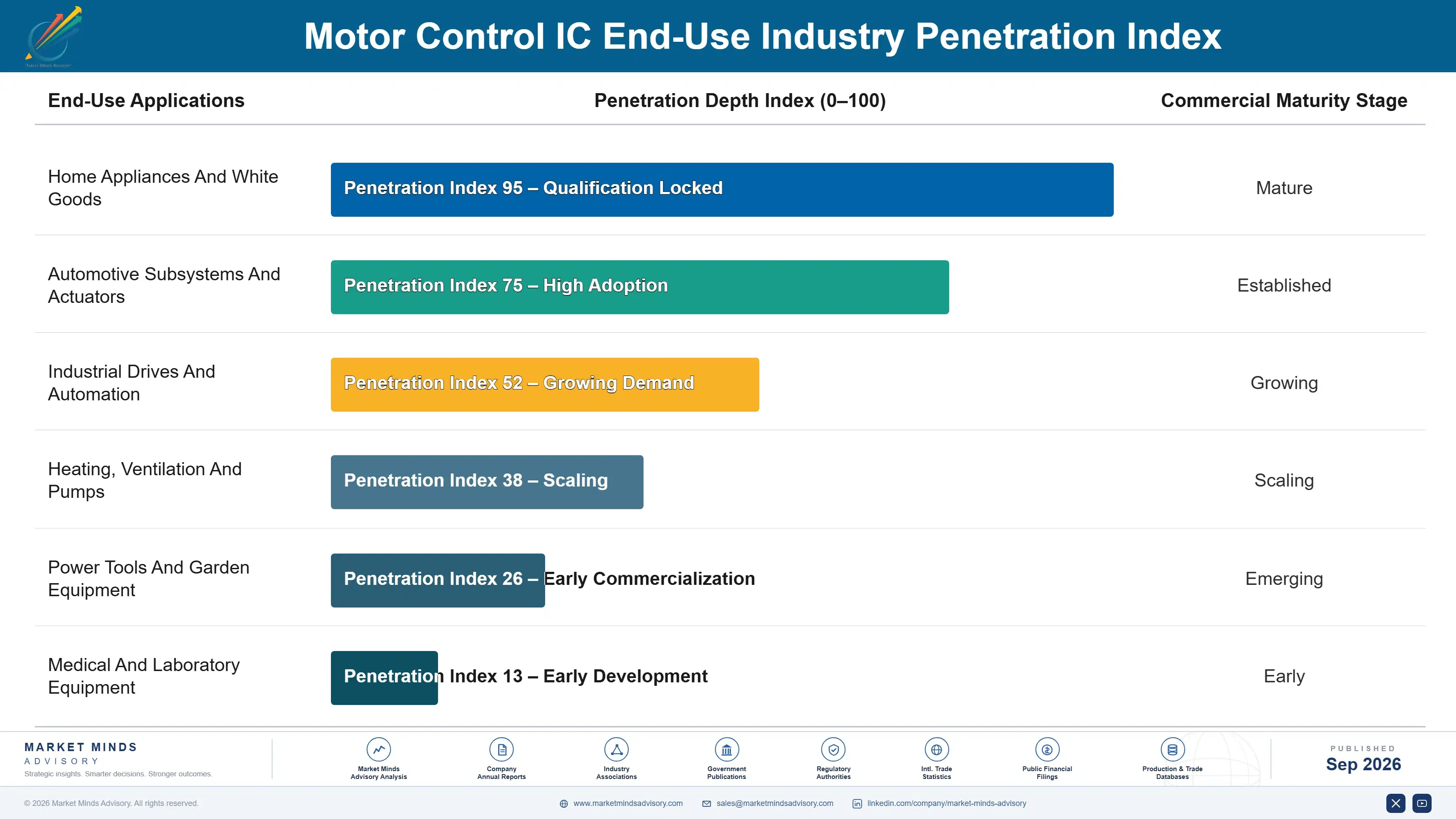
The annuity here is the design socket rather than any supply agreement. A device designed into a platform ships there for around 7 years, and qualifying an alternative takes about eleven months of engineering that delivers no product improvement whatsoever. Nobody funds that. A supplier winning a socket therefore holds it almost regardless of price movements, and a supplier losing one waits years for the platform to be redesigned.
Depth varies by how the design started. A platform built from a supplier's reference design carries that supplier's silicon along with tooling, code and application support the engineer never has to reconsider. A platform designed from first principles could in principle take alternatives more easily. Around 64% start from references, which means most sockets are decided before any commercial evaluation happens at all.

The buyer has changed more than the silicon has. A design engineer evaluated device capability against a control requirement and a schedule. A manufacturing engineer evaluates board area, component count and assembly steps against enclosure and line cost. A compliance function evaluates whether the product meets efficiency rules at all. Suppliers reaching only the first are addressing one of three people who decide.
motor-control-ic-market-end-use-penetration-index-1790004174205

What Wins Motor Control Sockets

These are among the four positions where our research anticipates prominent divergence between winners and laggards over the coming forecast period. Each is grounded in the demand model, the regulatory perimeter, and the announced capacity pipeline.
01 / APPLICATION ENGINEERING PRIORITY

Spend On References, Not Datasheets

Around 64% of motor control designs start from a supplier reference rather than from first principles, because a working design meeting the efficiency requirement beats every specification comparison for an engineer working under schedule pressure. Suppliers without reference coverage for an application never reach the shortlist regardless of what their devices actually do. Application engineering headcount and evaluation hardware are the genuine competitive investment in this category rather than silicon development or process improvement at any stage whatsoever or benefit.
02 / PLATFORM TIMING DISCIPLINE

Bid New Designs, Not Existing Ones

Requalifying an alternative device into an existing platform takes around eleven months of engineering that delivers no product improvement to anybody, so a designed-in supplier holds that socket for its full seven year life almost regardless of pricing. Competitive displacement therefore almost never actually happens in this market. Suppliers timing engagement to new platform starts reach the only moment when device selection is genuinely open to a competitor at any price offered by a competitor or on any terms at all.
03 / REGULATORY CONVERSION TRACKING

Follow Rules Into Uncontrolled Motors

Around 41% of new motor control designs replace fixed speed motors that efficiency regulation made non-compliant, and those products previously carried no control silicon of any kind at all. Those sockets are genuinely new rather than taken from an incumbent competitor, which makes them substantially easier to win. Suppliers tracking efficiency regulation across appliance, pump and fan categories reach that conversion before anybody establishes a position in it before competitors arrive and establish it first while it remains open to anybody.
04 / SECOND BUYER COVERAGE

Sell Space To The Factory Too

Integration reduces board area by around 38% against discrete combinations while removing component count and assembly steps from the production line at the same time. That argument reaches a manufacturing engineer whose priorities differ entirely from the designer choosing the silicon and who frequently holds more influence over landed cost. Suppliers arguing device performance alone address one of the several people who actually decide what ships in the final product or on the line during assembly or in the enclosure.

Engagement Snapshot From the Field

A live engagement with an industry participant carrying material or product regulatory and market exposure ahead of a defining policy shift, showing how our research translates into a defensible multi-year portfolio strategy.
MARKET MINDS ADVISORY · CLIENT ENGAGEMENT SUMMARY
Motor Control IC Producer Strategic Portfolio Review and Transition Roadmap 2026·Investment Scenario on Motor Control IC Exposure Evaluation 2025-26
CLIENT PROFILE
An appliance manufacturer redesigning a product family for tightened efficiency rules, evaluating motor control devices on unit price while its engineering team was already working from one supplier's reference design. Management treated the selection as a component purchasing decision, without recognising that the design had effectively been made months earlier. The socket had been decided months earlier.
STRATEGIC CHALLENGE
Purchasing wanted competitive quotes across three suppliers on unit price. Engineering had built the prototype on one supplier's reference and had no schedule to rebuild it. Nobody had costed the redesign effort implied by switching, and the product launch date allowed no room for a second development cycle. Nobody had recognised the timing.
MMA APPROACH
MMA costed the engineering effort implied by moving away from the reference design the prototype was built on, and compared total landed cost including board area, component count and assembly steps rather than device price alone. Work drew on 47 expert interviews conducted in Q4 2025 with appliance manufacturers, semiconductor suppliers and contract assemblers.
KEY FINDINGS
  1. Switching away from the reference design the prototype used would have required around 5 months of engineering the launch schedule could not absorb.
  2. The lowest unit price device required more board area and 4 additional components, which raised landed cost above the apparently more expensive part.
  3. The socket would ship for roughly 7 years, making unit price differences far smaller than the redesign and assembly effects (client-reported, unverified by MMA).
  4. Purchasing had been evaluating a decision that engineering had effectively already taken months earlier when it selected a reference design to prototype against.
CLIENT PROFILE
An appliance manufacturer redesigning a product family for tightened efficiency rules, evaluating motor control devices on unit price while its engineering team was already working from one supplier's reference design. Management treated the selection as a component purchasing decision, without recognising that the design had effectively been made months earlier. The socket had been decided months earlier.
STRATEGIC CHALLENGE
Purchasing wanted competitive quotes across three suppliers on unit price. Engineering had built the prototype on one supplier's reference and had no schedule to rebuild it. Nobody had costed the redesign effort implied by switching, and the product launch date allowed no room for a second development cycle. Nobody had recognised the timing.
MMA APPROACH
MMA costed the engineering effort implied by moving away from the reference design the prototype was built on, and compared total landed cost including board area, component count and assembly steps rather than device price alone. Work drew on 47 expert interviews conducted in Q4 2025 with appliance manufacturers, semiconductor suppliers and contract assemblers.
KEY FINDINGS
  1. Switching away from the reference design the prototype used would have required around 5 months of engineering the launch schedule could not absorb.
  2. The lowest unit price device required more board area and 4 additional components, which raised landed cost above the apparently more expensive part.
  3. The socket would ship for roughly 7 years, making unit price differences far smaller than the redesign and assembly effects (client-reported, unverified by MMA).
  4. Purchasing had been evaluating a decision that engineering had effectively already taken months earlier when it selected a reference design to prototype against.
RECOMMENDED STRATEGY
Phase 1: Phase one: stop evaluating on unit price alone, since board area and component count moved landed cost more than device pricing did. Phase 2: Phase two: bring purchasing into reference design selection at prototype stage, which is where the socket decision genuinely gets made. Phase 3: Phase three: cost every motor platform decision across the full seven year shipping life rather than against a single unit price comparison.
OUTCOME
The manufacturer selected on landed cost rather than unit price and involved purchasing at reference design stage on the next platform (client-reported, unverified by MMA). Landed cost fell against the original preferred device, and the launch schedule held. Reference design selection is now a joint engineering and purchasing decision, which outlasted the engagement.

Frequently Asked Questions

Foundational context covering the market sizes, CAGR, scope, country, region and competition that inform every finding below. This section is provided to cover basics and most often pre-purchase conversations, answered from the MMA Primary Research Dataset.

What is the current size of the Motor Control IC Market?

Global value reaches USD 7.6 billion in 2026, measured as motor control device consumption value across six classes. The 2025 base was USD 6.9 billion.

How large will the Motor Control IC Market be by 2036?

The market reaches USD 19.5 billion by 2036, an increase of USD 11.9 billion across the forecast period. That represents 2.57 times expansion from the 2026 base.

What is the CAGR for the Motor Control IC Market 2026 to 2036?

The base case runs at 9.9% annually, with a bull case at 11.2% if efficiency rules tighten faster in developing markets and a bear case at 8.7% if appliance demand weakens.

Which segment is growing fastest?

Integrated gate driver and controller devices grow at 14.9%, half again the market rate of 9.9%. Integration removes board area and component count designers must justify.

Who are the major companies in the Motor Control IC Market?

Infineon Technologies, Texas Instruments, STMicroelectronics, Renesas Electronics and onsemi lead on consumption value, holding 58% between them. Microchip and NXP hold smaller positions in the category.

Which country is growing fastest?

India leads at 16.3%, because efficiency rules tighten alongside manufacturing growth so conversion and volume expansion arrive together rather than sequentially. Vietnam and Indonesia follow.

Report Segmentation Architecture

The full report scope spans multiple orthogonal segmentation dimensions, with cross-tabulated demand data provided for each dimension pair. Coverage extends further to regional breakdowns, trend trajectories, and the competitive detail needed to support segment-level decision-making.

By Device Class And Integration Level

  • Integrated Gate Driver And Controller Devices
  • Motor Control Microcontrollers And Digital Signal Controllers
  • Motor Driver Devices With Output Stages
  • Position And Current Sensing Devices
  • Reference Designs And Development Tooling
  • Discrete Gate Drivers

By End-Use Industry

  • Home Appliances And White Goods
  • Automotive Subsystems And Actuators
  • Industrial Drives And Automation
  • Heating, Ventilation And Pumps
  • Power Tools And Garden Equipment
  • Medical And Laboratory Equipment

By Commercial Dimension

  • Original Equipment Manufacturer Design Win
  • Electronic Component Distribution
  • Contract Manufacturer Procurement
  • Automotive Tier One Supply
  • Reference Design Partner Programmes
  • Module Maker Bundled Supply

By Region

  • North America
  • Western Europe
  • East Asia
  • South Asia and Pacific
  • Latin America
  • Middle East and Africa
  • Eastern Europe

Scope, Methodology, and Coverage

Every figure in this report is reproducible from documented input assumptions. The scope below maps the historical period, the forecast horizon, the segmentation dimensions, and the countries covered, alongside the underlying primary and qualitative methodology.
Historical Period
2020 to 2025
Forecast Period
2026 to 2036
Base Year
2025 (USD billions; MMA Primary Research Dataset, September 2026)
Market Definition
This report covers motor control integrated circuits: the semiconductor devices driving and regulating electric motors in end products, spanning integrated gate driver and controller devices, motor control microcontrollers and digital signal controllers, discrete gate drivers, motor driver devices with output stages, position and current sensing devices supplied for motor control, and reference designs and development tooling. It excludes discrete power transistors and modules, complete motor drive systems, motors themselves, general purpose microcontrollers without motor peripherals, and power supply controllers.
Quantitative Units
USD millions, motor control device consumption value basis; devices shipped; design socket duration in years; reference design influence on new designs; efficiency-driven conversion share; board area reduction from integration; requalification periods in months.
Segmentation Dimensions
Device class and integration level; end-use industry; commercial design win route; geography across seven regions.
Regions Covered
North America, Western Europe, East Asia, South Asia and Pacific, Latin America, Middle East and Africa, Eastern Europe
Countries Covered
China, Japan, South Korea, Taiwan, India, Vietnam, Thailand, Indonesia, Germany, Italy, France, Switzerland, Netherlands, Poland, Czechia, United States, Mexico, Brazil, Israel, Turkey.
Key Companies Profiled
Infineon Technologies, Texas Instruments, STMicroelectronics, Renesas Electronics, onsemi, Microchip Technology, NXP Semiconductors, Analog Devices, Toshiba, ROHM Semiconductor, Nexperia, Allegro MicroSystems, Melexis, Monolithic Power Systems, Elmos Semiconductor.
Quantitative Methodology
Primary survey, n=3,800 respondents, Q4 2025, six countries; demand-side model with trade association cross-validation
Qualitative Methodology
47 expert interviews, Q4 2025; applied to validate demand model assumptions, identify emerging dynamics, and assess competitive positioning
Report Format
PDF and XLSX data workbook (Word format preview document)
Publisher
Market Minds Advisory
Report Code
MMA-2026-TEC-311
Published
September 2026
Contact
sales@marketmindsadvisory.com | www.marketmindsadvisory.com

Purchase the full Motor Control IC Market Report (2026 to 2036).

This report sizes the global motor control integrated circuit market from 2026 to 2036 across six device classes, six industries and seven regions. It explains why around 64% of designs start from a supplier reference rather than first principles, which makes application engineering rather than silicon development the decisive competitive investment. Design sockets shipping for around seven years against eleven month requalification are analysed as the reason displacement almost never happens. Efficiency regulation driving around 41% of new designs is examined as the source of genuinely new sockets. Regional analysis explains why East Asia holds 44% of consumption.
Six device classes sized through to 2036
Reference design influence quantified against design selection
Socket duration analysed against requalification effort
Twenty named suppliers assessed on consumption value
Four revenue levers with quantified commercial impact
Anonymised appliance platform selection engagement documented in full

Built For The People Who Decide

From boardroom strategy to bench-side execution, this report is read cover-to-cover by leaders shaping the next decade of their industry, turning demand scenarios, market dynamics and valuation benchmarks into decisions.
CXOs/ Presidents/ VPs/ Managers
M&A and Corporate Development
Strategy Teams and R&D Heads
Procurement and Product Directors
Regulatory and Compliance Leaders
Investor Relations and Equity Analysts