Market Minds Advisory
More Electric Aircraft Market

More Electric Aircraft Market: More Electric Aircraft: Bleedless Architecture, Thermal Limits And The Systems Replacing Hydraulics And Air

Replacing hydraulics and engine bleed air with electrical power sounds like an efficiency argument, and it is really a thermal management problem that the industry keeps discovering rather later than it should.

Lead Analyst

Published

September 2026

Make Smarter Decisions with Customized Research Insights

Request a free sample report and evaluate market opportunities, growth trends, and competitive dynamics relevant to your business needs.

2025 MARKET VALUE$8.2BMarket Size 2025
2036 FORECAST VALUE$20.3BBase Case , 2026 to 2036
CAGR 2026 TO 20368.6 %Bull 9.8% / Bear 7.4%
INCREMENTAL OPPORTUNITY$11.4BNet 10- year value creation
EXPANSION MULTIPLE2.28x2036 value over 2026 base
Strategic Levers
M&A Pipeline
Regional Outlook
Country Rankings
Competitive Intelligence
Segmental Deep-dive
Call-Us : 91 93563 13602

Executive Snapshot and Market Trajectory.

The electrical aircraft argument is usually made on fuel burn and rarely won there. What actually drives adoption is removing hydraulic maintenance, bleed ducting and the mechanical accessories hanging off an engine. Every one of those is a cost the operator sees. Fuel burn never sold anything.
Electric environmental control and thermal management grow fastest at 12.9%, and the reason is unglamorous. Moving from bleed air to electrically driven cabin conditioning generates waste heat that has to go somewhere, and existing airframes were never designed to reject it. Thermal capacity now constrains how much electrical power an aircraft can actually use, which nobody found interesting until the 787 taught everyone about it. Nobody thought to put that part in the brochure.
Concentration is high at 61%, because electrical power systems are integrated at aircraft level rather than bought as components. Five suppliers hold architecture positions across essentially every programme. Entry requires qualification, integration authority and a relationship with the airframer that takes a programme cycle to establish, and programme cycles run long. That is precisely why the same five names appear on essentially every programme and have done for years.
Market Definition
Revenue from electrical power generation, distribution and consumption systems replacing hydraulic, pneumatic and mechanical functions on aircraft, covering electric power generation and conversion, distribution and protection, electric actuation, electric environmental control and thermal management, electric engine accessories and starting, and electric braking and landing gear systems. Excludes propulsion electrification, batteries sold for propulsion, cabin electrical loads serving passengers, and avionics unrelated to power system function.
Base Year Value
$8.2B in 2025 (MMA Primary Research Dataset, August 2026)
Forecast Period
2026 to 2036, eleven discrete annual values
CAGR
8.6% base case. Bull 9.8%. Bear 7.4%.
Fastest Growth Segment
Electric Environmental Control and Thermal Management: 12.9% CAGR
Fastest Growth Country
India: 10.8% CAGR
Fastest Growth Region
South Asia and Pacific: 10.8% CAGR
Largest Region
North America: 31% of 2025 global value
Market Leaders
Collins Aerospace, Safran Electrical and Power, Honeywell Aerospace, Thales and Liebherr-Aerospace lead on electrical system revenue at aircraft level. Source: company annual reports and MMA Primary Research Dataset, July 2026.
Primary Survey
n=3,800 procurement and R&D decision-makers, Q4 2025, six countries
Methodology
Demand-side build-up, cross-validated against public data, 47 expert interviews

More Electric Aircraft Market Forecast Scenarios

more-electric-aircraft-market-size-forecast-scenario-1788023827602
Between 2020 and 2025 production rate rather than technology set the pace here. Programme deliveries collapsed and recovered, and the electrical content per aircraft rose steadily through it because the architectures had already been chosen years earlier. Retrofit and modification work continued through the downturn. Revenue compounded near 7.3%, lower than content growth alone would suggest because delivery volumes did so much of the damage.
Three mechanisms carry the base case. New single-aisle programmes are specifying bleedless or partly bleedless architecture from the outset, which raises electrical content per aircraft sharply. Thermal management is becoming a separate purchased system rather than an afterthought, creating revenue where none previously existed. And hydraulic system removal continues on modification programmes because the maintenance saving is visible on every operator's cost sheet. None of the three waits on a technical breakthrough.
The bull catalyst is a next-generation single-aisle launch specifying full bleedless architecture, which would set content per aircraft for two decades of production. The bear risk is thermal limits proving harder than expected on a major programme, since a heat rejection shortfall discovered late has already forced architecture retreat once and would do so again.

Heat Is The Real Constraint

The efficiency case for electrical architecture is genuine and modest. What convinces an operator is different: hydraulic systems are unpleasant to maintain, bleed ducting runs hot through the airframe and fails expensively, and engine-mounted accessories complicate every shop visit. Removing hydraulics has cut system maintenance hours by around 31% where it has been done properly, and that number appears on cost sheets in a way fuel burn arguments never do.
MARKET CONCENTRATION CR561%Share of aircraft level electrical system revenue held by leaders
ELECTRICAL POWER PER AIRCRAFT1.45 MWTypical generation capacity on recent widebody electrical architectures
HYDRAULIC MAINTENANCE SAVING31%Reduction in system maintenance hours where hydraulics were removed
HEAT REJECTION REQUIREMENT220 kWWaste heat a bleedless architecture must dissipate in cruise
QUALIFICATION CYCLE42 monthsTypical time from selection to certified system on programme
AFTERMARKET REVENUE SHARE37%Portion of revenue from spares and support rather than delivery
Then comes the part nobody puts in the sales material. Generating 1.45 megawatts on a widebody and using it to drive cabin conditioning, actuation and engine accessories produces waste heat approaching 220 kilowatts in cruise, and an airframe designed around bleed air has nowhere to reject it. The 787 taught the industry this lesson at considerable expense. Thermal capacity now constrains electrical architecture more than generation capacity does.
That constraint has created a purchased system where previously there was only ducting and hope. Electric environmental control and thermal management is now specified, competed and integrated as its own discipline. Qualification runs roughly 42 months from selection to certified system, which is why architecture positions taken on one programme persist across its entire production run and aftermarket at 37% follows them.
"Everybody sold electrical architecture on fuel burn and delivered a heat rejection problem. The suppliers who worked that out early now sell thermal management as a system, and the ones who did not are still arguing about generator efficiency."
Director, Aircraft Systems Practice · MMA Aerospace Systems and Equipment Practice · August 2026

Market Trends

Thermal Management Became A Purchased System Not An Afterthought

Waste heat approaching 220 kilowatts in cruise on a bleedless widebody cannot be handled by airframe design assumptions written for pneumatic architectures, which turned heat rejection into a specified and competed system with its own suppliers and integration authority. That created revenue where previously there was ducting and optimism. Suppliers who recognised it early hold architecture positions on current programmes. Those still selling generation efficiency are competing for a decision the airframer made some time ago. The commercial position in this market moved while several participants were still busy optimising generators.
Market Impact: Locks content across 20 years
Maintenance Economics Are Winning The Argument Fuel Burn Lost

Operators evaluating electrical architecture respond to hydraulic maintenance reduction of around 31% far more readily than to fuel burn improvements measured in fractions of a percent, because one appears on the maintenance cost sheet and the other disappears into operational variance. Airframers have adjusted their commercial arguments accordingly. Suppliers still leading with efficiency claims are addressing an audience that stopped being persuaded by them several programme cycles ago now. Maintenance cost is visible, attributable and argued about at every fleet review, which is exactly why it persuades where a fractional efficiency claim does not.
Market Impact: Reduces maintenance hours 31%

Market Opportunities and Growth Drivers

New Single Aisle Architecture Decisions Set Content For Decades

Programme architecture chosen at launch determines electrical content across an entire production run measured in thousands of aircraft and twenty years of deliveries. Suppliers winning a position at that point hold it essentially unchallenged, since requalifying a replacement mid-programme costs roughly 42 months and considerably more money than any saving justifies. That makes architecture selection the single most consequential commercial event in this market. Everything afterwards is production and aftermarket against a decision already made. Winning or losing at that moment settles perhaps two decades of revenue in a single decision.
Market Impact: Caps rejection near 220 kW

Hydraulic Removal Continues On Modification Programmes

Operators removing hydraulic systems from in-service aircraft see maintenance hour reductions near 31% and fewer of the fluid contamination and leak events that consume unscheduled maintenance capacity. Modification programmes therefore proceed independently of any new aircraft decision, generating steady revenue between programme launches. The work suits suppliers holding certification data and installed base familiarity. It is unglamorous, predictable and considerably more profitable than most new production content is. Certification data and installed base familiarity matter more here than any technical capability, which is why the work tends to stay with whoever already holds the position.
Market Impact: Requires 42 months to qualify

Market Restraints and Challenges

Thermal Limits Cap How Much Electrification Is Possible

Heat rejection near 220 kilowatts is what a bleedless architecture demands, and airframes have finite surface area, ram air capacity and volume available to provide it. The root cause is that electrical conversion produces waste heat at every stage while bleed air carried its losses out through the engine. Commercially it caps electrical content regardless of supplier capability. Mitigation runs through higher voltage distribution reducing conductor losses, better power electronics efficiency, and airframe-level thermal integration designed in from the start. None of those pathways removes the ceiling, and each one moves it only modestly.
Market Impact: Rejects 220 kW in cruise

Qualification Cycles Lock Out Everyone Not Already Selected

Roughly 42 months from selection to certified system means a supplier not chosen at programme launch has no realistic route in until the next programme, which may be a decade away. The root cause is that electrical architecture is integrated at aircraft level rather than assembled from components, so substitution touches everything. Commercially it produces a market of five participants and very little movement. Mitigation runs through subsystem supply to incumbents, modification programmes, and positioning early on programmes not yet launched. Every one of those routes accepts somebody else's architecture as given.
Market Impact: Cuts maintenance hours by 31%
4 additional market trends, 3 additional growth drivers, and 2 additional restraints and challenges are covered in the full report. Contact sales@marketmindsadvisory.com to access the complete intelligence.

Segment CAGR and Growth Architecture

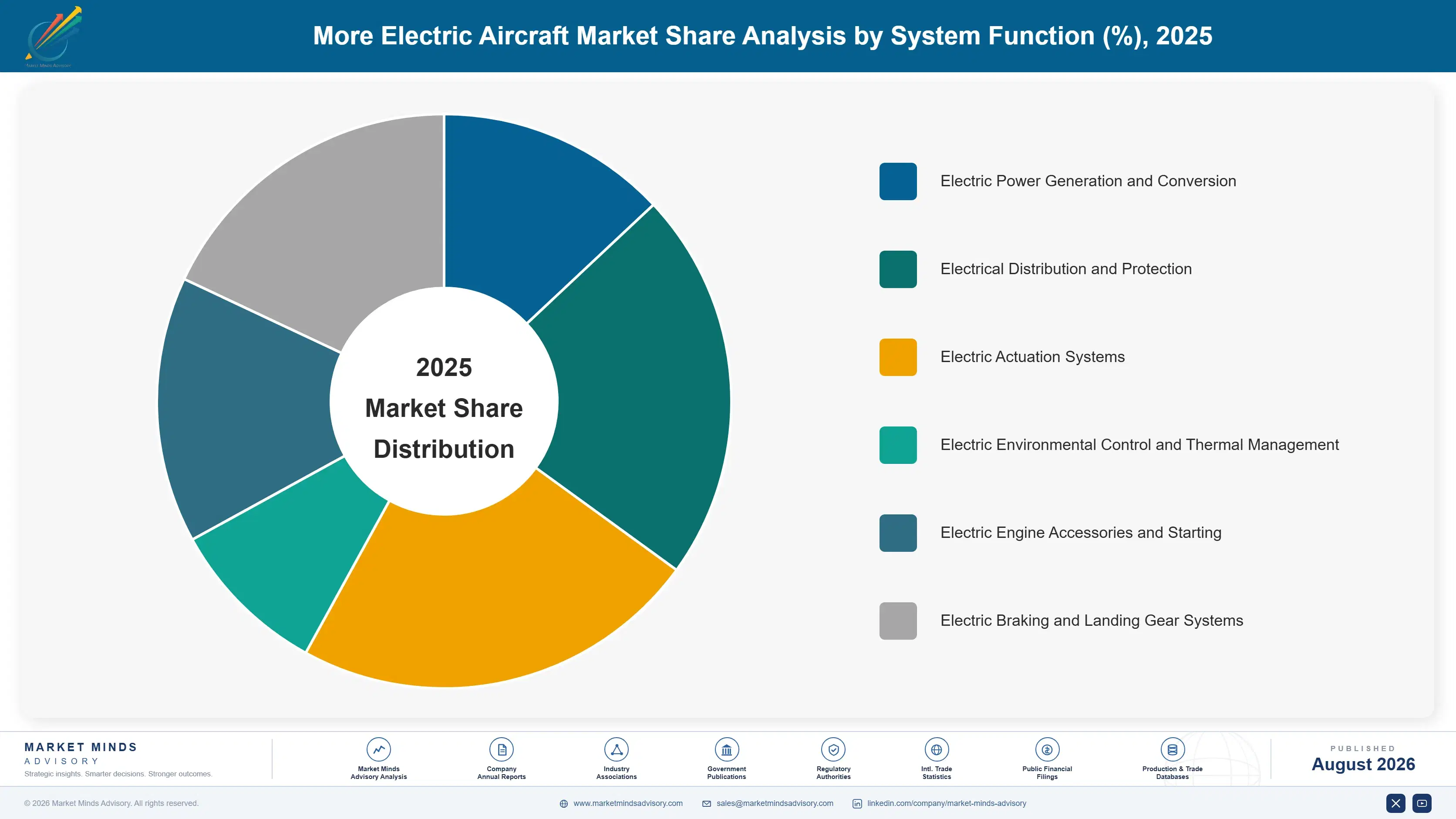
Segmentation follows system function, since each replaces a different mechanical, hydraulic or pneumatic predecessor and carries its own qualification path and integration authority. Six functions describe the market completely, from power generation where the technology is mature through to thermal management where the constraint everybody underestimated now sits and is at last being properly priced.
more-electric-aircraft-market-market-share-analysis-1788023828140

Electric Environmental Control and Thermal Management

The fastest function grows at 12.9%, half again the market rate of 8.6%, and it grew out of a problem rather than an opportunity. Electrically driven cabin conditioning removes engine bleed air and produces waste heat approaching 220 kilowatts in cruise that an airframe designed for pneumatic architecture cannot reject. The 787 established that at considerable cost to everybody involved. Heat rejection is now specified, competed and integrated as its own system with dedicated suppliers, which is revenue that simply did not exist a decade ago. Thermal capacity, not generation capacity, is what now limits how far electrification can go on any airframe. The lesson arrived late and cost a great deal.
CAGR 12.9%

Electric Actuation Systems

Electric and electrohydrostatic actuation grows at 10.4% as flight control, landing gear and utility functions move away from centralised hydraulic systems. The commercial argument is maintenance rather than weight: hydraulic distribution means fluid, leaks, contamination and unscheduled work across the whole airframe, and removing it cuts system maintenance hours around 31%. Qualification is demanding because actuation is flight critical and failure modes must be demonstrated exhaustively over roughly 42 months. That barrier is precisely why positions once won are so rarely lost, and why the five participants holding them face very little competitive pressure from outside. Actuation positions are among the most durable commercial assets anywhere in aerospace equipment supply.
CAGR 10.4%
Full segment breakdown across 6 segments available in the complete report.

Regional Architecture and Country Demand Map

Content follows aircraft programme architecture rather than operator demand, so shares track where systems are designed, qualified and integrated. North America and Western Europe hold most of that capability, with East Asia expanding on manufacturing and South Asia growing fastest from a small base. The pattern is stable.

North America

The largest share at 31% follows programme architecture authority rather than any manufacturing advantage. Electrical system integration for the aircraft that established bleedless architecture was led here, and the lessons about heat rejection were learned here first and expensively. Collins and Honeywell hold positions across essentially every Western programme. Military transport and rotorcraft electrification adds substantial content, and modification programmes removing hydraulics from in-service fleets generate steady work independent of any new aircraft. Architecture authority is worth more than manufacturing share in this market, because the supplier who defines how power moves around an aircraft decides what everybody else gets to sell into that programme for a full twenty years.
Share: 31% | CAGR: 8.4% (2026 to 2036)

Western Europe

System design and qualification capability concentrates heavily here, with Safran, Thales and Liebherr holding architecture positions across European and several American programmes alike. Electric actuation development has been pursued more aggressively here than anywhere, supported by research funding treating aircraft electrification as a decarbonisation pathway. Regional airframer programmes specify electrical content early, which suits suppliers with integration authority. Thermal management capability has developed alongside, though somewhat later than the electrical generation work. Research funding treating electrification as a decarbonisation pathway has paid for development work that programme revenue alone would never have justified, which is a genuine competitive advantage that suppliers elsewhere have to fund entirely from their own balance sheets instead.
Share: 26% | CAGR: 7.2% (2026 to 2036)
Regional intelligence for 5 additional markets available in the complete report: East Asia, South Asia and Pacific, Latin America, Middle East and Africa, Eastern Europe. Contact sales@marketmindsadvisory.com.
more-electric-aircraft-market-country-cagr-analysis-1788023828650

Where Electrical System Margin Sits

Four levers work on architecture timing, thermal capability and aftermarket capture rather than on component efficiency, which decides very little at this point. Programme positioning, thermal system ownership, modification capture and higher voltage development each address something a supplier can act on right now. None of the four turns on building a more efficient generator anywhere.

Win Architecture Positions Before Programme Launch

Architecture chosen at launch sets electrical content across a production run of thousands of aircraft and twenty years of deliveries, and requalifying a replacement mid-programme costs roughly 42 months plus considerably more money than any saving justifies. Suppliers not selected at that moment have no realistic route in until the next programme, which may be a decade away. Positioning work therefore has to happen before any request for proposal exists. Most suppliers begin far too late. The 42 month requalification cost is what makes an early position effectively permanent afterward.
Market Impact: Sets aircraft content across 20 year production runs

Own Thermal Management As A System

Heat rejection approaching 220 kilowatts turned an airframe design assumption into a competed system with its own integration authority, and that revenue simply did not exist a decade ago. Suppliers who recognised it early hold positions on current programmes while others compete on generation efficiency the airframer settled long ago. Thermal capacity now caps electrical content, which makes its owner the participant every other supplier has to work through. That position is worth considerably more than it costs to build. Very few suppliers hold electrical and thermal integration together at present.
Market Impact: Owns the binding 220 kW heat rejection constraint

Capture Modification Work Between Programme Launches

Hydraulic removal on in-service aircraft cuts maintenance hours around 31% and proceeds independently of any new programme decision, which makes it revenue available between launches that are perhaps 10 years apart. It suits suppliers holding certification data and installed base familiarity, and it carries margins above new production content. Most participants treat it as a distraction from programme work. That neglect is precisely why it stays available to whoever bothers with it. Certification data already held costs nothing further to use, which makes the 31% maintenance saving straightforwardly sellable to operators.
Market Impact: Delivers revenue across 10 year programme gaps reliably

Develop Higher Voltage Distribution Ahead Of Requirement

Conductor losses fall as distribution voltage rises, which relieves the thermal constraint capping electrical content on every current architecture. Moving beyond 270 volt direct current systems requires arc management, insulation and protection work that takes years and is not yet specified by anybody. Suppliers developing it now will hold the capability when the next architecture decision arrives. Those waiting for a requirement will be qualifying while somebody else is already flying it. Arc management at 540 volts is a different engineering problem, and it takes years to solve properly enough to certify.
Market Impact: Moves distribution beyond 270 volt direct current systems

Who Controls the Margin Pool

Concentration is high at around 61% across the five largest participants measured on aircraft level electrical system revenue, and the reason is architectural rather than commercial. Electrical power systems are integrated at aircraft level, so an airframer selects an architecture partner rather than assembling components from a wide supply base. Five suppliers hold positions across essentially every Western programme. That is unusual in aerospace supply.
Competition runs on integration authority, qualification position and thermal capability. Integration authority decides whether a supplier is competing for the architecture or for a box inside somebody else's. Qualification position decides whether it can bid at all within a programme timeline. Thermal capability has become the third dimension recently and is where the current competitive movement actually is. Thermal is where the movement is.

Pressure is arriving from adjacent industries rather than from new aerospace entrants. Power electronics and thermal engineering developed for automotive and industrial applications at volumes aerospace never reaches are entering through subsystem supply. Airframers meanwhile have begun retaining more architecture authority themselves. Rankings will shift toward suppliers holding thermal integration alongside electrical generation, since very few currently hold both convincingly.
more-electric-aircraft-market-company-positioning-matrix-1788023829171

Competitive Moat and Risk Dimensions

COLLINS AEROSPACE

Moat: Architecture positions across major programmes

Collins Aerospace holds electrical architecture positions across essentially every large Western programme, and those positions persist for the full production run because requalifying a replacement costs roughly 42 months and more money than any saving justifies. Breadth across generation, distribution and actuation lets it bid at architecture level rather than component level, which is a different competition entirely.
COLLINS AEROSPACE

Risk: Thermal capability developed comparatively late

Heat rejection became the binding constraint faster than most participants anticipated, and thermal integration capability was assembled after the electrical positions were already won rather than alongside them. Suppliers who built the two together compete more convincingly for current architecture decisions. Retrofitting organisational capability is slower than acquiring the underlying technology.
SAFRAN ELECTRICAL AND POWER

Moat: Generation depth with programme access

Safran combines electrical generation and distribution capability with programme access across European airframers that competitors reach only through partnership arrangements. Its actuation and power electronics development has been supported by research funding treating electrification as a decarbonisation route. Positions won on programmes launching now will generate production and aftermarket revenue well into the 2040s.
SAFRAN ELECTRICAL AND POWER

Risk: Concentration in European programme cycles

Revenue concentrated in European programme launches carries timing exposure, since those launches are infrequent and a delayed or cancelled programme removes years of expected content at once. Diversifying into American programmes means competing against incumbents holding architecture positions that are extremely difficult to displace. Programme timing is not something any supplier controls.

Players Tracked

Prominent Players

Collins Aerospace
Safran Electrical and Power
Honeywell Aerospace
Thales
Liebherr-Aerospace

Other Key Players

Meggitt
Parker Aerospace
Moog
Astronics
TransDigm
Amphenol Aerospace
Eaton
Woodward
GE Aerospace
Nidec
Mitsubishi Electric
Kawasaki Heavy Industries
Hindustan Aeronautics
Diehl Aerospace
Crane Aerospace and Electronics

Recent Developments

JUNE 2024

Airframer specified dedicated thermal management system on new programme

An airframer specified heat rejection as a separately competed aircraft system on a development programme rather than treating it as an airframe design assumption, reflecting electrical loads that pneumatic era design practice cannot accommodate. This was a programme specification decision rather than any commercial transaction between suppliers.
Signal: Thermal management becoming a competed system confirms it now constrains electrical content more than generation does.
OCTOBER 2024

Supplier acquired power electronics capability from adjacent industry

An aerospace electrical supplier acquired a power electronics business developed for industrial and automotive applications, seeking conversion efficiency capability at volumes aerospace programmes alone would never fund. This was an acquisition rather than a merger or joint venture, and the acquired operations continue serving non-aerospace customers.
Signal: Adjacent industry power electronics is entering aerospace through acquisition rather than through any direct competitive entry.
FEBRUARY 2025

Operator completed hydraulic removal modification across fleet section

A commercial operator completed a modification programme removing hydraulic subsystems from a portion of its in-service fleet, reporting maintenance hour reductions consistent with expectations set at programme approval. This was an operator modification programme rather than any corporate transaction between the parties involved in it.
Signal: Modification demand proceeding independently of new aircraft decisions gives suppliers steady revenue between distant programme launches.

What Electrical Architecture Costs

Cost divides four ways and qualification dominates more than most participants expect. Development and qualification absorb roughly 33% of programme cost across the life of a position, power electronics and semiconductors near 26%, magnetic materials, conductors and mechanical content near 24%, and thermal hardware the remaining 17%. Suppliers pricing on component cost alone consistently misjudge what an architecture position actually requires of them.
Rare earth magnet pricing has moved sharply across recent years and moved generator and actuator economics with it, since permanent magnet machines depend on materials whose supply is concentrated in very few places. Safran and Honeywell have both discussed input cost and supply conditions across recent reporting periods. Semiconductor availability for power conversion remains a separate constraint, since aerospace volumes never command priority allocation from any supplier.

Exposure varies by position rather than by geography. Suppliers holding architecture authority carry qualification cost once across a twenty year production run and recover it comfortably. Subsystem suppliers carry material and semiconductor exposure without that amortisation behind them. Participants without aftermarket positions lose the 37% of revenue that actually absorbs development cost, which is why supply-only contracts so rarely make commercial sense here.
more-electric-aircraft-market-cost-volatility-analysis-1788023829367

Magnet material substitution and reduced rare earth designs

Permanent magnet machines depend on materials concentrated in very few places and priced accordingly, which puts generator and actuator economics outside any supplier's control. Reduced rare earth and magnet-free machine designs sacrifice some power density for supply security, and several participants have qualified them. The performance cost is real and considerably smaller than a supply interruption would be.

Semiconductor qualification ahead of programme demand

Aerospace power conversion volumes never command priority allocation, so devices become unavailable at exactly the wrong point in a programme schedule. Qualifying alternative devices before demand arrives costs comparatively little against a stalled certification programme. Most suppliers begin qualification after supply has already failed, which is both slower and considerably more expensive than doing it early.

Aftermarket position secured alongside original programme content

Aftermarket produces 37% of revenue and is where qualification cost is genuinely recovered, yet suppliers still accept supply-only positions that leave support to somebody else entirely. Negotiating both together at architecture selection changes programme economics fundamentally. Airframers will concede it more readily at selection than at any point afterward, when the position has already been given away.

Portfolio Architecture for Margin Defence

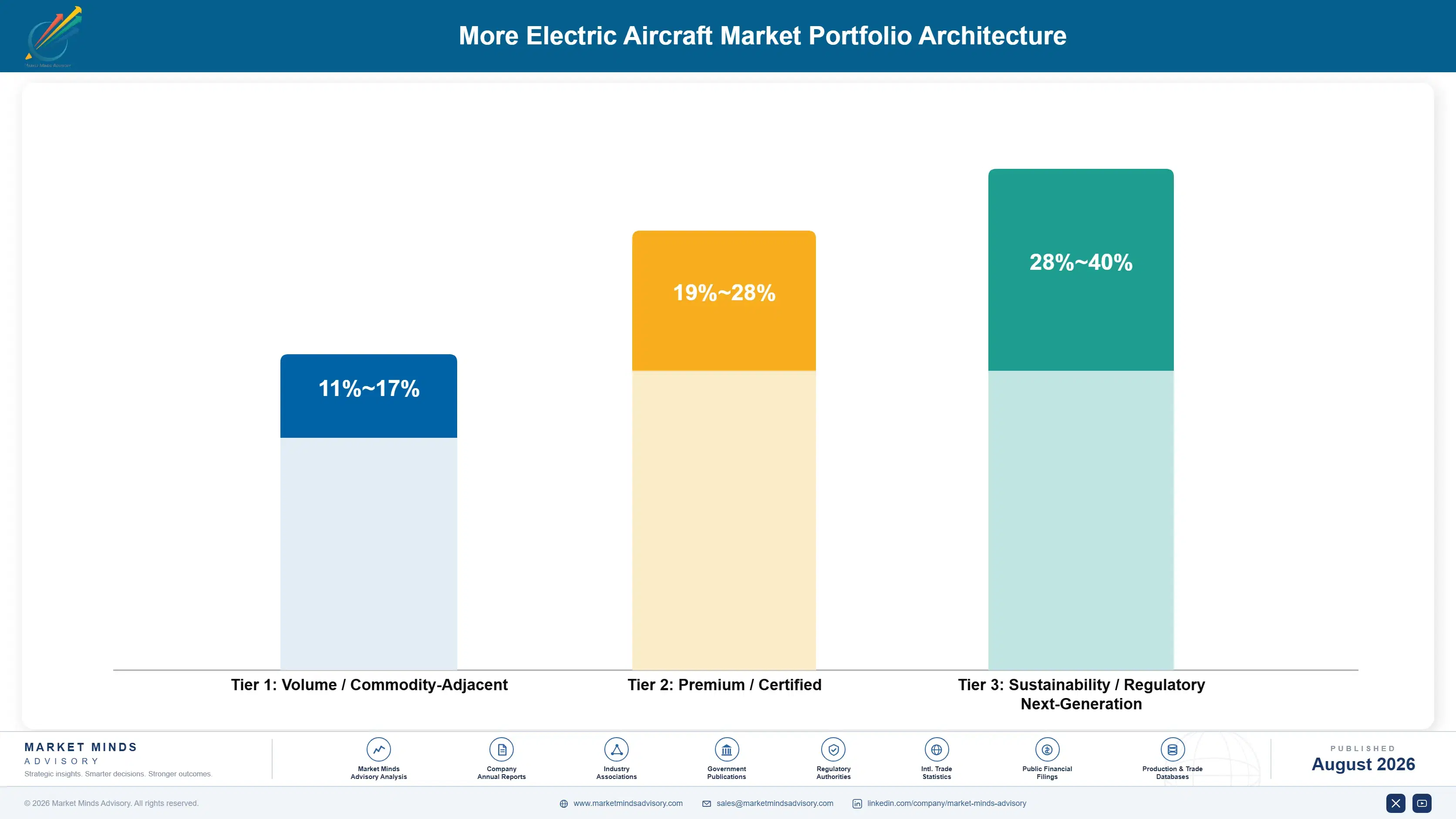
The portfolio separates by whether a supplier holds architecture authority or supplies inside somebody else's. Distribution hardware, harnesses, connectors and protection devices form the volume core: substantial revenue, competed on cost and delivery, and margins reflecting exactly that. Necessary work, and not where anybody builds a defensible position in this market. Volume is real and the margin reflects the competition.
Margin concentrates where integration authority and qualification create genuine barriers. Electric actuation, generation architecture and thermal management all require roughly 42 months of qualification and integration relationships built across programme cycles. Positions won there persist for the full production run and carry aftermarket at 37% of revenue behind them, which is the part that actually recovers development cost. Development cost has to come back from somewhere.

The overlooked pool is modification. Hydraulic removal on in-service aircraft cuts maintenance hours around 31%, proceeds independently of programme launches perhaps a decade apart, and carries margins above new production content. Most participants treat it as a distraction from programme work, which is exactly why it remains available to anyone prepared to take it seriously. Neglect by everybody else creates the opening here.

Volume / Commodity-Adjacent

Distribution hardware, harnesses, connectors and protection devices supplied into other participants' architectures. Range spans six points because volume and delivery performance decide outcomes far more than any technical differentiation does.
Gross Margin: 11-17%

Premium / Certified

Electric generation, conversion and engine accessory systems held under qualification on active programmes. Range spans nine points because aftermarket position varies enormously between suppliers who secured it at selection and those who did not.
Gross Margin: 19-28%

Sustainability / Regulatory / Next-Generation

Electric actuation, thermal management systems and hydraulic removal modification work. Range spans twelve points because integration authority and modification capability are held together by remarkably few participants. Modification capability is the rarest of them.
Gross Margin: 28-40%
more-electric-aircraft-market-portfolio-architecture-1788023829867

High-value Sub-segments and Strategic Watch-out

Electric Environmental Control and Thermal Management

High value and high growth at 12.9%, created by a constraint the industry underestimated rather than by any opportunity anyone identified. The ten point range separates suppliers holding integration authority from those supplying heat exchangers into somebody else's system. Incumbency here is not yet deep.
Gross Margin: 30-40%

Electric Actuation Systems

High value with moderate growth at 10.4%, protected by flight critical qualification running roughly 42 months. The eight point range reflects whether a supplier holds aftermarket position alongside original content, which decides whether development cost is ever properly recovered. Aftermarket concession at selection is rarely recoverable.
Gross Margin: 26-34%

Distribution Hardware and Protection

The volume core, competed on cost and delivery inside architectures other participants defined and control. Necessary content at modest margin, and the part of this market where technical differentiation earns almost nothing from the customer. The architecture was defined long before anybody here was invited in.
Gross Margin: 11-17%

Thermal Capacity Ceiling

The strategic watch-out rather than a growth pool. Heat rejection near 220 kilowatts caps how far any architecture can electrify, and a shortfall discovered late on a programme has already forced retreat once before. No supplier controls how much heat an airframe can actually reject.
Gross Margin: Variable

Why Programme Positions Persist

Architecture selection produces annuity economics of an unusually long kind. A supplier chosen at programme launch supplies every aircraft built to that configuration across twenty years of production and supports them for decades afterward, and requalifying a replacement costs roughly 42 months and more than any saving justifies. Aftermarket at 37% of revenue arrives on exactly that basis. The decision is made once and settles the commercial outcome almost entirely.
Stickiness varies by function rather than by customer. Actuation and generation positions are close to permanent, since both are flight critical and integrated at aircraft level. Thermal management positions are currently contestable because the discipline is new and nobody's incumbency runs deep yet. Distribution hardware is the most contestable, competed on cost within architectures that somebody else defined and that nobody is going to reopen.

Buyer behaviour is changing in one respect that matters. Airframers have begun retaining more architecture authority in-house rather than delegating it to a system partner, which turns suppliers holding integration positions into component suppliers over time. That shift favours participants able to demonstrate thermal and electrical integration together, since that is the capability airframers find hardest to build themselves.
more-electric-aircraft-market-end-use-penetration-index-1788023830359

Where Systems Suppliers Should Commit

These are among the four positions where our research anticipates prominent divergence between winners and laggards over the coming forecast period. Each is grounded in the demand model, the regulatory perimeter, and the announced capacity pipeline.
01 / PROGRAMME ARCHITECTURE TIMING

Position before the request for proposal exists

Architecture chosen at programme launch sets electrical content across a production run of thousands of aircraft and twenty years of deliveries, and requalifying a replacement mid-programme costs roughly 42 months plus more money than any saving could possibly justify anywhere. Suppliers not selected at that moment have no realistic route back in until the next programme launches, which may be a full decade away or more. Positioning work therefore has to happen well before any formal competition opens at all.
02 / THERMAL SYSTEM OWNERSHIP

Heat rejection is the position worth holding now

Waste heat approaching 220 kilowatts turned an airframe design assumption into a separately competed system with its own integration authority, creating revenue that did not exist a decade ago anywhere in this market. Thermal capacity now caps how much electrical content any architecture can carry, which makes whoever owns it the participant every other supplier must work through eventually, whether they like it or not. Suppliers still competing on generation efficiency are arguing about a decision the airframer settled several years ago already.
03 / MODIFICATION REVENUE CAPTURE

The work between programmes is quietly profitable

Hydraulic removal on in-service aircraft cuts system maintenance hours by around 31% and proceeds entirely independently of new programme decisions that arrive perhaps once a decade in this particular industry. It suits suppliers already holding certification data and installed base familiarity, and it carries margins above new production content by a genuinely comfortable margin at that. Most participants treat it as a distraction from programme work, which is precisely why it remains available to anyone willing to take it seriously.
04 / VOLTAGE ARCHITECTURE DEVELOPMENT

Higher voltage relieves the constraint capping everything

Conductor losses fall sharply as distribution voltage rises, which directly relieves the thermal ceiling limiting electrical content on every architecture currently flying or in active development anywhere today. Moving beyond 270 volt direct current demands arc management, insulation and protection work taking many years, and no airframer has yet specified it in any programme requirement so far. Suppliers developing it now will hold the capability when the next architecture decision arrives, and everybody else will still be qualifying long afterward.

Engagement Snapshot From the Field

A live engagement with an industry participant carrying material or product regulatory and market exposure ahead of a defining policy shift, showing how our research translates into a defensible multi-year portfolio strategy.
MARKET MINDS ADVISORY · CLIENT ENGAGEMENT SUMMARY
More Electric Aircraft Producer Strategic Portfolio Review and Transition Roadmap 2026·Investment Scenario on More Electric Aircraft Exposure Evaluation 2025-26
CLIENT PROFILE
An aerospace electrical systems supplier holding generation and distribution positions on two large commercial programmes, with subsystem content on several others and a modification business it had allowed to decline. Revenue was stable on production deliveries while the company had lost two consecutive architecture competitions on programmes it expected to win comfortably on technical merit.
STRATEGIC CHALLENGE
The board needed to understand why technically strong bids were losing architecture competitions, and whether building thermal management capability justified the investment against continuing to improve generation efficiency. It also had to decide what to do with a neglected modification business that engineering leadership regarded as a distraction from programme work entirely.
MMA APPROACH
MMA reconstructed both lost competitions from airframer interviews and evaluation documentation, isolating what actually decided each outcome. It modelled thermal capability development cost against architecture position value across two decades of production. Expert interviews with airframers, operators, competing suppliers and certification authorities established how architecture decisions are genuinely made and when.
KEY FINDINGS
  1. Both competitions were decided on thermal integration capability the client could not demonstrate, and generation efficiency was not raised as a differentiator in either evaluation at all.
  2. Airframer architecture preferences had formed roughly 30 months before either formal competition opened, by which point the client had not yet begun engaging with them.
  3. The neglected modification business carried gross margins above new production content and required certification data the client already held and was not otherwise using.
  4. Aftermarket position had been conceded at selection on one programme, removing the revenue that would have recovered qualification cost across its whole production run.
CLIENT PROFILE
An aerospace electrical systems supplier holding generation and distribution positions on two large commercial programmes, with subsystem content on several others and a modification business it had allowed to decline. Revenue was stable on production deliveries while the company had lost two consecutive architecture competitions on programmes it expected to win comfortably on technical merit.
STRATEGIC CHALLENGE
The board needed to understand why technically strong bids were losing architecture competitions, and whether building thermal management capability justified the investment against continuing to improve generation efficiency. It also had to decide what to do with a neglected modification business that engineering leadership regarded as a distraction from programme work entirely.
MMA APPROACH
MMA reconstructed both lost competitions from airframer interviews and evaluation documentation, isolating what actually decided each outcome. It modelled thermal capability development cost against architecture position value across two decades of production. Expert interviews with airframers, operators, competing suppliers and certification authorities established how architecture decisions are genuinely made and when.
KEY FINDINGS
  1. Both competitions were decided on thermal integration capability the client could not demonstrate, and generation efficiency was not raised as a differentiator in either evaluation at all.
  2. Airframer architecture preferences had formed roughly 30 months before either formal competition opened, by which point the client had not yet begun engaging with them.
  3. The neglected modification business carried gross margins above new production content and required certification data the client already held and was not otherwise using.
  4. Aftermarket position had been conceded at selection on one programme, removing the revenue that would have recovered qualification cost across its whole production run.
RECOMMENDED STRATEGY
Phase 1: Phase one: build thermal integration capability through acquisition rather than development, since the next architecture competition opens inside two years. Phase 2: Phase two: begin airframer engagement on unlaunched programmes immediately, well ahead of any formal competition or published request for proposal. Phase 3: Phase three: rebuild the modification business as a standing operation and never concede aftermarket position at the architecture selection stage again.
OUTCOME
The client reported winning the next architecture competition on a combined electrical and thermal proposal (client-reported, unverified by MMA). Modification revenue recovered to prior levels within five quarters. Aftermarket position was retained on the new programme, and engineering engagement began on two further unlaunched aircraft.

Frequently Asked Questions

Foundational context covering the market sizes, CAGR, scope, country, region and competition that inform every finding below. This section is provided to cover basics and most often pre-purchase conversations, answered from the MMA Primary Research Dataset.

What is the current size of the More Electric Aircraft Market?

The market is valued at USD 8.2 billion in 2025, measured as revenue from electrical systems replacing hydraulic, pneumatic and mechanical functions on commercial and military aircraft.

How large will the More Electric Aircraft Market be by 2036?

MMA forecasts USD 20.32 billion by 2036, up from USD 8.91 billion in 2026. That represents incremental revenue of USD 11.42 billion and an expansion multiple of 2.28 times.

What is the CAGR for the More Electric Aircraft Market 2026 to 2036?

The base case CAGR is 8.6%, with a bull case of 9.8% and a bear case of 7.4%. New programme architecture decisions supply most of that growth.

Which segment is growing fastest?

Electric environmental control and thermal management grows at 12.9%, half again the market rate of 8.6%, because heat rejection became a competed system rather than a design assumption.

Who are the major companies in the More Electric Aircraft Market?

Collins Aerospace, Safran Electrical and Power, Honeywell Aerospace, Thales and Liebherr-Aerospace lead on aircraft level electrical system revenue, holding around 61% between them across the whole market.

Which country is growing fastest?

India grows fastest at 10.8%, driven by engineering capability moving from design services into qualified system supply across both domestic and export aircraft programmes alike.

Report Segmentation Architecture

The full report scope spans multiple orthogonal segmentation dimensions, with cross-tabulated demand data provided for each dimension pair. Coverage extends further to regional breakdowns, trend trajectories, and the competitive detail needed to support segment-level decision-making.

By System Function

  • Electric Power Generation and Conversion
  • Electrical Distribution and Protection
  • Electric Actuation Systems
  • Electric Environmental Control and Thermal Management
  • Electric Engine Accessories and Starting
  • Electric Braking and Landing Gear Systems

By End-Use Industry

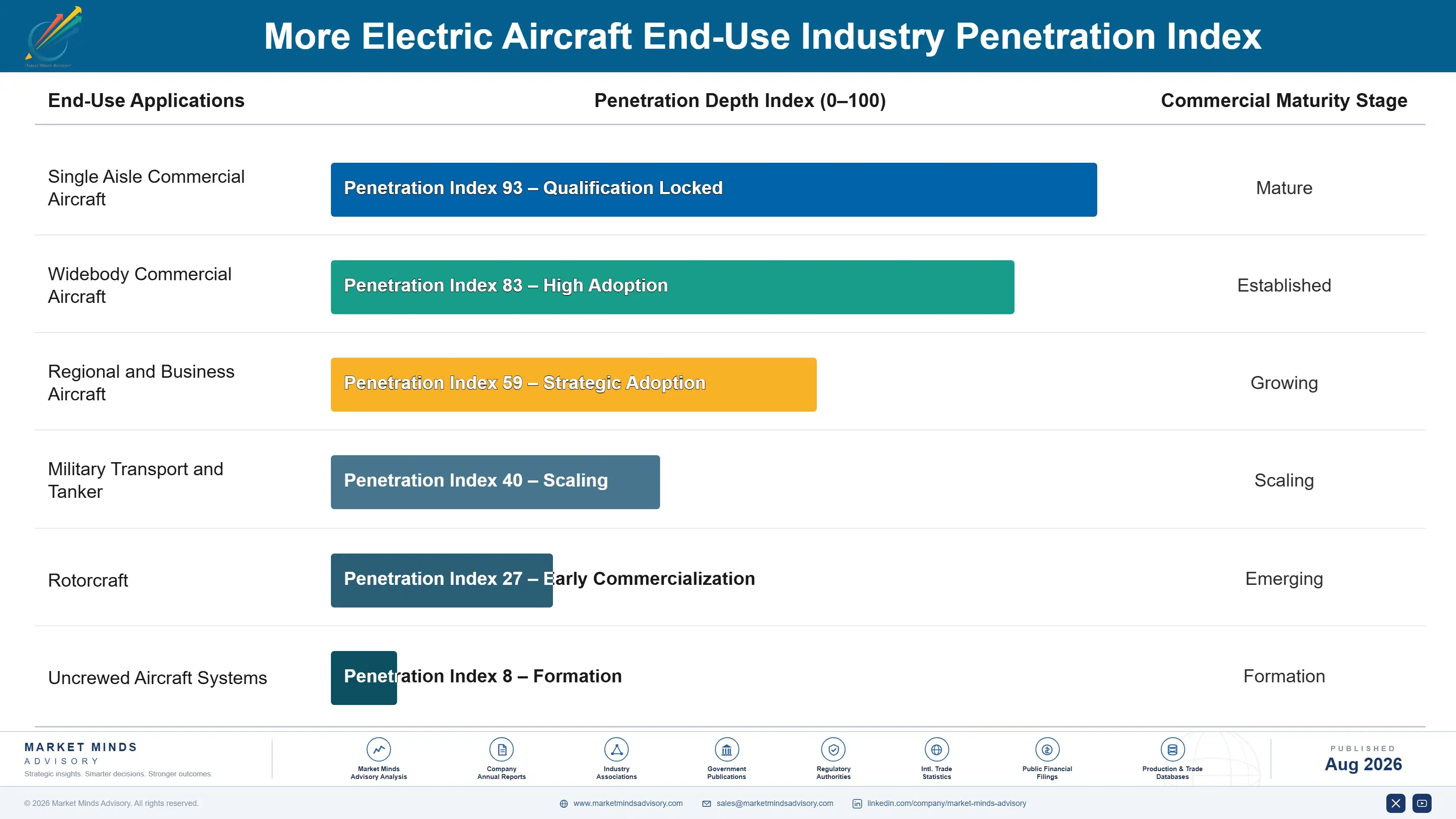
  • Single Aisle Commercial Aircraft
  • Widebody Commercial Aircraft
  • Regional and Business Aircraft
  • Military Transport and Tanker
  • Rotorcraft
  • Uncrewed Aircraft Systems

By Commercial Dimension

  • Architecture Level Selection
  • Subsystem Supply To Integrators
  • Aftermarket Spares and Support
  • Modification and Retrofit Programmes
  • Risk Sharing Partnership
  • Engineering Services Contracting

By Region

  • North America
  • Western Europe
  • East Asia
  • South Asia and Pacific
  • Latin America
  • Middle East and Africa
  • Eastern Europe

Scope, Methodology, and Coverage

Every figure in this report is reproducible from documented input assumptions. The scope below maps the historical period, the forecast horizon, the segmentation dimensions, and the countries covered, alongside the underlying primary and qualitative methodology.
Historical Period
2020 to 2025
Forecast Period
2026 to 2036
Base Year
2025 (USD billions; MMA Primary Research Dataset, August 2026)
Market Definition
Revenue from electrical power generation, distribution and consumption systems replacing hydraulic, pneumatic and mechanical functions on aircraft, spanning power generation and conversion, distribution and protection, electric actuation, electric environmental control and thermal management, electric engine accessories and starting, and electric braking and landing gear systems. Architecture level selection, subsystem supply, aftermarket support, modification programmes, risk sharing partnership and engineering services are included. Propulsion electrification, batteries for propulsion, passenger cabin electrical loads, and avionics unrelated to power system function are excluded.
Quantitative Units
USD billions, aircraft level electrical system revenue
Segmentation Dimensions
System function, aircraft category, commercial supply model, region
Regions Covered
North America, Western Europe, East Asia, South Asia and Pacific, Latin America, Middle East and Africa, Eastern Europe
Countries Covered
United States, United Kingdom, France, Germany, Italy, Canada, China, Japan, South Korea, India, Australia, Brazil, Poland, Czechia
Key Companies Profiled
Collins Aerospace, Safran Electrical and Power, Honeywell Aerospace, Thales, Liebherr-Aerospace, Moog, Parker Aerospace, Astronics, GE Aerospace, Diehl Aerospace
Quantitative Methodology
Primary survey, n=3,800 respondents, Q4 2025, six countries; demand-side model with trade association cross-validation
Qualitative Methodology
47 expert interviews, Q4 2025; applied to validate demand model assumptions, identify emerging dynamics, and assess competitive positioning
Report Format
PDF and XLSX data workbook (Word format preview document)
Publisher
Market Minds Advisory
Report Code
MMA-2026-CON-371
Published
August 2026
Contact
sales@marketmindsadvisory.com | www.marketmindsadvisory.com

Purchase the full More Electric Aircraft Market Report (2026 to 2036).

The full report treats aircraft electrification as the thermal problem it turned out to be rather than the efficiency argument it was sold as. It quantifies heat rejection requirements against airframe capacity, maps architecture positions across current and unlaunched programmes, and separates the modification revenue that proceeds independently of any programme decision. Segment analysis covers all six system functions, with particular attention to thermal management where a design assumption became a competed system within a decade. Competitive assessment ranks twenty participants on aircraft level electrical system revenue.
Six system function segmentation with growth rates
Heat rejection requirements mapped against airframe capacity
Twenty participant assessment on aircraft level revenue
Architecture positions traced across launched and unlaunched programmes
Modification revenue quantified separately from production content
Higher voltage distribution development assessed by supplier

Built For The People Who Decide

From boardroom strategy to bench-side execution, this report is read cover-to-cover by leaders shaping the next decade of their industry, turning demand scenarios, market dynamics and valuation benchmarks into decisions.
CXOs/ Presidents/ VPs/ Managers
M&A and Corporate Development
Strategy Teams and R&D Heads
Procurement and Product Directors
Regulatory and Compliance Leaders
Investor Relations and Equity Analysts