Market Minds Advisory
MOPP Packaging Films Market

MOPP Packaging Films Market: Downgauging Economics, the Mono-Material Opening and a Sealing Window Nobody Planned For

Stretching polypropylene in one direction makes it far stronger along that axis, which lets a converter take a third of the thickness out of a film and keep the performance the pack actually needs.

Lead Analyst

Bilal Shaikh

Published

September 2026

Make Smarter Decisions with Customized Research Insights

Request a free sample report and evaluate market opportunities, growth trends, and competitive dynamics relevant to your business needs.

2025 MARKET VALUE$3.1BMarket Size 2025
2036 FORECAST VALUE$7.5BBase Case , 2026 to 2036
CAGR 2026 TO 20368.3 %Bull 9.5% / Bear 7.1%
INCREMENTAL OPPORTUNITY$4.1BNet 10- year value creation
EXPANSION MULTIPLE2.22x2036 value over 2026 base
Strategic Levers
M&A Pipeline
Regional Outlook
Country Rankings
Competitive Intelligence
Segmental Deep-dive
Call-Us : 91 93563 13602

Executive Snapshot and Market Trajectory

Machine direction orientation does something unusual to polypropylene. Stretching it along one axis lines the polymer chains up so tightly that stiffness rises sharply, and a converter can then remove a third of the thickness while keeping the properties a pack genuinely requires. Nothing is added and nothing is coated.
Mono-material laminate grades compound at 12.5%, exactly 1.50 times the market, because recyclability rules pushed brands toward all-polypropylene structures and a laminate needs one layer far stiffer than the sealant. East Asia holds 33% of demand, above the standard band, on film extrusion capacity and converting volume no other region approaches. Polyester had filled that role for decades and loses it permanently. Capability rather than extrusion capacity decides participation here.
Five producers hold 38%. Orientation lines are expensive and the process window is narrow, so capability rather than converting scale decides who can supply. The complication is thermal: an oriented polypropylene layer and a polypropylene sealant melt uncomfortably close together, and that narrows the sealing window at exactly the moment lines are running faster. Trials run on the customer's own filling line are what settle it. Downgauging economics follow from the same stiffness property.
Market Definition
The market covers machine direction oriented polypropylene films used in packaging applications, spanning mono-material laminate grades, high-stiffness downgauging films, barrier-coated and metallised MOPP, label and sleeve films, retort and high-temperature grades, and cast-embossed and specialty surface films. Biaxially oriented polypropylene, unoriented cast polypropylene, polyethylene films and converted packaging products are excluded.
Base Year Value
$3.1B in 2025 (MMA Primary Research Dataset, August 2026)
Forecast Period
2026 to 2036, eleven discrete annual values
CAGR
8.3% base case. Bull 9.5%. Bear 7.1%.
Fastest Growth Segment
Mono-Material Laminate MOPP Films: 12.5% CAGR
Fastest Growth Country
India: 11.4% CAGR
Fastest Growth Region
South Asia and Pacific: 10.5% CAGR
Largest Region
East Asia: 33% of 2025 global value
Market Leaders
Toray Industries, Jindal Films, Taghleef Industries, Cosmo First, Profol. Source: MMA Analysis based on company annual reports.
Primary Survey
n=3,800 procurement and R&D decision-makers, Q4 2025, six countries
Methodology
Demand-side build-up, cross-validated against public data, 47 expert interviews

MOPP Packaging Films Market Forecast Scenarios

mopp-packaging-films-market-size-forecast-scenario-1787308596884
Growth ran at an implied 6.9% across 2020 to 2025, driven initially by downgauging economics as resin costs rose and later by something quite different. From 2022 European recyclability requirements pushed brand owners toward all-polypropylene laminates, and that redesign created demand for a stiff oriented layer that had previously been served by polyester. Two quite different arguments drove one number.
The base case at 8.3% rests on three mechanisms. Mono-material conversion continues across Europe and increasingly North America, and every all-polypropylene laminate needs an oriented layer polyester used to provide. Downgauging remains attractive whenever resin prices rise, since the film delivers equivalent performance at lower weight. And barrier-coated grades are opening applications that previously required a foil or polyester component. None of the three depends on packaging volume growth at all.
The bull case at 9.5% assumes mono-material recyclability requirements extend into further categories and geographies faster than expected, since each conversion displaces a polyester layer permanently. The bear case at 7.1% follows from sealing window difficulties slowing conversions on high-speed lines, where converters have found all-polypropylene structures generate defect rates that offset the recyclability benefit.

What Stretching in One Direction Actually Buys

Orient a polypropylene film in the machine direction and the polymer chains align along that axis, raising modulus by around 3.2 times against unoriented film of identical composition. Nothing has been added and nothing has been coated. The material is simply stronger in the direction that matters most for web handling, and a converter can consequently take roughly 34% of the thickness out and still meet specification.
TOP FIVE CONCENTRATION38%Combined share held by the five largest global film producers
ACHIEVABLE DOWNGAUGING34% thickness reductionWeight removed while holding equivalent stiffness and tensile performance
STIFFNESS IMPROVEMENT3.2 timesModulus gain along the orientation axis against unoriented film
SEALING WINDOW WIDTH11 degrees CelsiusTemperature latitude available on an all-polypropylene laminate structure
RESIN COST SHARE59% of COGSPolymer input as proportion of total film production cost
LINE QUALIFICATION TIME13 weeksTypical time to qualify a film on a converting line
That downgauging argument sold the film for two decades. What transformed it was recyclability. All-polypropylene laminate structures need one layer considerably stiffer than the sealant to give the pack body, print stability and machinability, and that role had always belonged to polyester. Oriented polypropylene fills it while keeping the whole structure inside a single polymer family and a single recycling stream.
The difficulty arrived with the opportunity. When the stiff layer and the sealant are both polypropylene they melt at uncomfortably similar temperatures, and the usable sealing window narrows to around 11 degrees against roughly double that on a polyester laminate. High-speed filling lines running near their limits produce seal defects as a direct result, which is where most stalled conversions actually fail.
"Everybody talks about mono-material as though the only question were whether the recycler accepts it. The question converters actually face is whether their filling line can seal it at full speed, and a surprising number of trials die quietly at that point."
Director, Flexible Packaging Films and Polymer Conversion Practice · MMA Flexibl

Market Trends

Mono-Material Structures Displace Polyester With Oriented Polypropylene

European Packaging and Packaging Waste Regulation recyclability requirements pushed brand owners toward laminates built entirely from one polymer family. Every such structure needs a layer far stiffer than the sealant to provide pack body, print registration and machinability, and polyester had always supplied it. Machine direction oriented polypropylene delivers comparable stiffness while keeping the structure within a single recycling stream. The segment compounds at 12.5% against a market at 8.3%, and each conversion displaces a polyester layer permanently rather than temporarily. Polyester loses that layer for good. Recyclability created a role that did not exist.
Market Impact: Thickness reduced 34% at equal stif
Narrow Sealing Windows Stall Conversions on Fast Lines

An all-polypropylene laminate places sealant and substrate in the same polymer family, so their melting behaviour overlaps and the usable sealing window narrows to roughly 11 degrees against about double that on a polyester structure. Filling lines running close to their speed limits produce seal defects as a direct result, and seal failure is the dominant packaging defect mode. Higher-orientation grades and heat-resistant surface layers widen the window at added cost, and converters unable to demonstrate a workable window on the customer's own line lose the conversion. Laboratory windows flatter every structure.
Market Impact: Coated grades at 23% of volume

Market Opportunities and Growth Drivers

Downgauging Economics Improve Whenever Resin Prices Rise

Polymer accounts for 59% of film cost, so removing thickness removes cost almost proportionally. Machine direction orientation raises modulus around 3.2 times along the web axis, which lets a converter take roughly 34% of the thickness out while holding stiffness and tensile performance the pack requires. Every resin price increase strengthens that argument mechanically, and the 2022 and 2023 polymer movements accelerated conversions that had been under discussion for years without resolution. The saving is permanent once the structure is requalified. Requalification is the only cost. Structures converted this way rarely revert.
Market Impact: Qualification adding 13 week delays

Barrier Coating Opens Applications Requiring Foil Previously

Coated and metallised MOPP grades deliver oxygen and moisture barrier sufficient for many applications that previously required an aluminium foil or polyester layer, both of which break the single-polymer structure recyclability requirements now demand. Vapour-deposited and dispersion barrier coatings applied to an oriented polypropylene substrate keep the laminate recyclable while extending shelf life materially. Snack, confectionery and dry food categories have converted furthest, since their barrier requirements sit within what coated MOPP can genuinely deliver in practice. Coating adhesion to a low surface energy oriented film is the technical difficulty that decides who can actually supply.
Market Impact: Polyester holding 41% of laminates

Market Restraints and Challenges

Orientation Line Capital Restricts the Supplier Field

Machine direction orientation requires a dedicated stretching section with precise roll temperature and speed control, and the process window is narrow enough that small deviations produce thickness variation and curl. The root cause is that the polymer must be drawn above its softening point but below melting, within a range measured in a few degrees. Capital cost per line is substantial. Producers without orientation capability cannot participate whatever their extrusion capacity, and building it takes eighteen months before any qualification work begins at all. Extrusion capacity alone buys nothing here.
Market Impact: Mono-material compounding at 12.5%

Polyester Retains Advantages Mono-Material Cannot Match

Polyester delivers higher temperature resistance, better dimensional stability under print registration and a considerably wider sealing window than any all-polypropylene structure. The root cause is simply chemistry: polyester melts far above polypropylene, so a polyester substrate tolerates sealing heat that would distort an oriented polypropylene one. Where retort processing, high-speed printing or demanding registration apply, polyester holds. Producers mitigate through higher-orientation and heat-stabilised grades that narrow the gap, though they do not close it entirely. Retort processing remains firmly out of reach. Higher-orientation and heat-stabilised grades narrow the gap without closing it entirely.
Market Impact: Window narrowing to 11 degrees
3 additional market trends, 4 additional growth drivers, and 2 additional restraints and challenges are covered in the full report. Contact sales@marketmindsadvisory.com to access the complete intelligence.

Segment CAGR and Growth Architecture

Segmentation follows film grade and function, because each carries different orientation ratios, surface treatment and qualification requirements. A mono-material laminate grade and a barrier-coated film start from the same oriented substrate and are sold into entirely different conversations about recyclability and shelf life. Orientation ratio and surface treatment follow from the application rather than from any production preference.
mopp-packaging-films-market-market-share-analysis-1787308597415

Mono-Material Laminate MOPP Films

Mono-material grades compound at 12.5%, exactly 1.50 times the market rate, because recyclability regulation created a requirement that did not previously exist. An all-polypropylene laminate needs a layer far stiffer than the sealant to supply pack body, print registration and machinability, and polyester had filled that role for decades. Oriented polypropylene delivers comparable stiffness while keeping every layer inside one polymer family and one recycling stream. The catch is thermal: substrate and sealant now melt at similar temperatures, narrowing the usable sealing window to around 11 degrees. Higher-orientation grades and heat-resistant surface layers widen it at added cost, and demonstrating a workable window on the customer's own line is what converts a trial into volume.
CAGR 12.5%

Barrier-Coated and Metallised MOPP

Coated and metallised grades grow at 10.4% by removing the last non-polypropylene component from many laminate structures. Aluminium foil and metallised polyester both deliver excellent barrier and both break the single-polymer requirement recyclability rules impose. Vapour-deposited aluminium oxide, dispersion coatings and direct metallisation applied to an oriented polypropylene substrate keep the laminate within one stream while extending shelf life materially. Snack, confectionery and dry food have converted furthest because their barrier requirements fall inside what these coatings genuinely achieve. Coating adhesion to a highly oriented surface is the technical difficulty, since orientation reduces surface energy and treatment is required before anything will hold reliably. Treatment precedes every coating. Untreated film holds nothing reliably.
CAGR 10.4%
Full segment breakdown across 6 segments available in the complete report.

Regional Architecture and Country Demand Map

Demand follows flexible packaging conversion rather than consumption, since film is laminated and printed where packs are made. Recyclability regulation determines how much conversion has moved to mono-material structures, and that varies far more between regions than converting volume does. Regulatory reach rather than tonnage matters here.

East Asia

East Asia holds 33% of global demand. Note: this exceeds the standard band because Chinese flexible packaging conversion and polypropylene film extrusion capacity together exceed any other region several times over, and film is consumed where laminates are made. Chinese producers serve both domestic converting and substantial export volumes, competing on delivered cost that Western producers cannot match on standard grades. Japanese demand is smaller, technically demanding and weighted toward barrier-coated and specialty surface films where Toray holds strong positions. Korean converting supports snack and confectionery packaging at high specification. Mono-material conversion is less advanced than in Europe because recyclability requirements arrived later, so the regional grade mix remains weighted toward downgauging rather than recyclability applications.
Share: 33% | CAGR: 9.3% (2026 to 2036)

South Asia and Pacific

The fastest growing region at 10.5%, with India compounding at 11.4%, South Asia and Pacific accounts for 12% of demand. Indian flexible packaging conversion has expanded rapidly with packaged food penetration and organised retail growth, and domestic film producers including Cosmo First and Jindal have built substantial orientation capacity serving both home demand and export. Extended Producer Responsibility rules under national plastic waste management provisions have begun driving mono-material conversion, though downgauging economics still dominate purchasing conversations. Southeast Asian converting has grown with food processing investment. Australian demand is smaller and follows Western European recyclability patterns with a short lag. Downgauging still dominates the purchasing conversation regionally. Extended Producer Responsibility rules are beginning to shift that.
Share: 12% | CAGR: 10.5% (2026 to 2036)
Regional intelligence for 5 additional markets available in the complete report: North America, Western Europe, Latin America, Middle East and Africa, Eastern Europe. Contact sales@marketmindsadvisory.com.
mopp-packaging-films-market-country-cagr-analysis-1787308597923

Selling Stiffness Where Polyester Used to Sit

Two quite separate arguments sell this film. One is that removing thickness removes cost, which every converter understands. The other is that a stiff polypropylene layer keeps a laminate recyclable, which reaches a different budget entirely. Four positions build on those, and none is defended on price per kilogram. Each reaches a different budget holder entirely.

Demonstrate Sealing Windows on the Customer's Own Line

All-polypropylene laminates narrow the usable sealing window to roughly 11 degrees against about double that on polyester, and high-speed lines produce seal defects as a direct consequence. Most stalled mono-material conversions fail there rather than on any recyclability question. Producers that measure the achievable window on the customer's actual filling equipment, rather than under laboratory conditions, convert trials into volume that competitors supplying compliant film alone never reach. Mono-material grades compound at 12.5% and price roughly 19 to 28% above standard downgauging films. Compliant film alone converts nothing. Trials decide everything.
Market Impact: Mono-material grades priced 19 to 2

Sell Downgauging Against Resin Cost Rather Than Film Price

Polymer is 59% of film cost and orientation raises modulus around 3.2 times along the web axis, letting a converter remove roughly 34% of thickness while holding required performance. Presented as a film price comparison the grade looks expensive per kilogram. Presented as cost per thousand packs it is straightforwardly cheaper, and the saving is permanent once the structure requalifies. Producers that build the comparison in the customer's own units win conversions that a per-kilogram tender would have lost outright without anybody understanding why. Units decide the outcome. Nobody understands why the tender was lost.
Market Impact: Downgauging removing 34% of the tot

Coat the Substrate to Remove the Last Foil Layer

Aluminium foil and metallised polyester both break the single-polymer structure recyclability requires, and they are frequently the only remaining non-polypropylene component in an otherwise converted laminate. Barrier coatings and direct metallisation on an oriented polypropylene substrate keep the whole structure in one stream. Coated grades already represent 23% of volume and grow at 10.4%. Adhesion to a highly oriented surface is the genuine technical difficulty, since orientation lowers surface energy, and producers solving it capture structures competitors cannot complete. Orientation lowers surface energy, so treatment must precede any coating step.
Market Impact: Coated grades now holding 23% of al

Develop Heat-Resistant Grades for High-Speed Conversions

The sealing window problem is a materials problem before it is a machine problem, and higher-orientation grades with heat-resistant surface layers widen it measurably at added cost. Converters running fast lines will pay for that, because the alternative is either a slower line or a defect rate that erases the recyclability benefit entirely. Development requires orientation process capability rather than formulation work, which restricts the field to producers already holding the lines. That capability takes eighteen months to build before qualification even begins. Widening a window from roughly 11 degrees is worth paying for on a fast line.
Market Impact: Window widening beyond the 11 degre

Who Controls the Margin Pool

Five producers hold 38% of the market measured on oriented polypropylene film revenue, the basis applied consistently through this section. Concentration reflects orientation line capital and process capability rather than extrusion scale, since ordinary polypropylene film capacity is widely available. Toray Industries and Jindal Films lead, from technical and cost positions respectively. Ordinary extrusion capacity separates nobody.
Competition operates on three dimensions. Orientation process capability decides who can produce high-modulus grades with acceptable thickness uniformity and curl. Surface treatment and coating capability decides participation in barrier structures where adhesion to an oriented surface is genuinely difficult. And application support decides who can demonstrate a workable sealing window on a customer's actual line. All three take years to build rather than capital to buy. Application support in particular is scarce.

Two pressures are reshaping position. Chinese and Indian producers have built substantial orientation capacity and compete hard on standard downgauging grades. Against that, mono-material conversion rewards producers who can solve the sealing window problem rather than simply supply a compliant film. Rankings will move toward whoever pairs orientation capability with genuine converting application support. Very few hold both today.
mopp-packaging-films-market-company-positioning-matrix-1787308598444

Competitive Moat and Risk Dimensions

TORAY INDUSTRIES

Moat: Film science and coating depth

Toray brings polymer and film technology depth spanning far more than packaging, which matters where barrier coating adhesion to a low surface energy oriented substrate is the binding technical problem. Vapour deposition and surface treatment capability developed for other film applications transfers directly, and that combination is difficult for a producer built purely around packaging film extrusion to assemble.
TORAY INDUSTRIES

Risk: Standard grade cost position

Downgauging grades represent substantial category volume and face Indian and Chinese producers with materially lower delivered costs, particularly in Asian converting markets. With resin at 59% of film cost, technical capability adds little a converter will pay for on a straightforward downgauging application, and the cost gap is visible in every quotation for standard specification work.
JINDAL FILMS

Moat: Orientation capacity and reach

Jindal operates orientation capacity across multiple regions with cost positions built on scale and integrated resin access, which matters in a category where resin is 59% of film cost. Serving European, North American and Asian converters from regional lines avoids the freight and lead time penalties that a single-region producer carries into every distant quotation.
JINDAL FILMS

Risk: Sealing window application support

Mono-material conversion is decided by whether a converter can seal the structure reliably at line speed, not by whether the film meets specification. That requires application engineers running trials on customer equipment rather than film supplied against a datasheet, and a capacity-led position competes at a disadvantage where a stalled trial is the actual obstacle to volume.

Players Tracked

Prominent Players

Toray Industries
Jindal Films
Taghleef Industries
Cosmo First
Profol

Other Key Players

Innovia Films
Mitsubishi Chemical Group
Oben Group
Vibac Group
Polibak
Uflex
SRF Limited
Zhejiang Kinlead Innovative Materials
Yem Chio
Futamura Chemical
Sibur
Achilles Corporation
Toyobo
Poligal
Irplast

Recent Developments

FEBRUARY 2025

Mono-material conversions stall on high-speed line sealing performance

Brand owners converting to all-polypropylene laminate structures reported elevated seal defect rates on fast filling lines, tracing the cause to a narrowed process window rather than to film quality. These were conversion trial findings rather than commercial developments between film producers. Several planned portfolio conversions were paused.
Signal: The obstacle to recyclable laminates is th
JUNE 2025

Barrier coating adoption removes foil from converted laminates

Converters extended use of vapour-deposited and dispersion barrier coatings on oriented polypropylene substrates, removing the aluminium foil layer that had prevented otherwise converted structures from qualifying as single-polymer. This reflects structure redesign rather than any corporate transaction. One foil layer disqualifies an otherwise converted structure.
Signal: The last non-polypropylene layer is the on
OCTOBER 2025

Asian orientation capacity expands against European cost pressure

Indian and Chinese film producers commissioned additional machine direction orientation capacity, serving domestic converting and export markets where European producers face higher energy costs. These were organic capital investments rather than acquisitions or joint ventures. Energy cost positions rather than technology decided the shift. Export volumes followed the capacity.
Signal: Standard grade competition is shifting dec

Polymer, Orientation Energy and Coating

Polypropylene resin accounts for roughly 59% of cost of goods, purchased regionally from petrochemical producers with limited film producer influence over pricing. Orientation energy runs a further 16%, since the process holds the web at elevated temperature through the stretching section. Coating chemistry, surface treatment, packaging and line conversion make up most of the remainder, with coated grades carrying materially higher cost.
European natural gas disruption from 2022 raised both polypropylene feedstock and orientation energy costs simultaneously, and International Energy Agency reporting across that period documents the underlying movement. Orientation is more energy intensive than cast film extrusion, so the effect was sharper here than on unoriented grades. Company annual reports covering film segments disclose the resulting margin compression and the competitive shift toward Asian and Middle Eastern producers.

Exposure divides by energy position rather than by scale. European producers on spot gas carried the full 2022 movement with orientation lines that cannot be run at reduced temperature. Indian, Chinese and Gulf producers held materially lower energy and resin costs through the same period and gained export competitiveness on standard grades. Coated and mono-material grades are less exposed, since capability rather than cost decides.
mopp-packaging-films-market-cost-volatility-analysis-1787308598642

Index film pricing to published polypropylene benchmarks

Indexing moves 59% of the cost base outside the producer's risk, and larger producers achieve it routinely while smaller operations frequently cannot. Where a converter resists formal indexation, shortening contract terms delivers much of the same protection, though it reduces the forward visibility that orientation line scheduling depends on for efficient operation. Scheduling suffers as a result.

Weight capacity toward coated and mono-material grades

Standard downgauging grades compete against Asian producers on delivered cost with resin at 59% of the total, which is an unwinnable position for a high energy cost producer. Coated and mono-material grades are awarded on sealing window performance and coating adhesion, where technical capability rather than cost position decides, and the same shift improves margin as well as exposure.

Recover orientation heat across the stretching section

Orientation holds the web at elevated temperature through stretching and then cools it, and much of that heat is currently rejected. Recovery is mechanically straightforward on newer lines and retrofittable on many older ones, and payback shortened considerably after European energy prices moved. It also reduces the exposure that made those lines uncompetitive against imports in the first place.

Portfolio Architecture for Margin Defence

The portfolio separates on whether the customer is buying stiffness or buying recyclability. Standard downgauging grades sell on cost per thousand packs against a resin index, and Asian producers compete hard for that work. Mono-material grades sell into a recyclability commitment held by a sustainability function. Coated and barrier grades sell on removing the last foil layer. Retort and high-temperature grades sell on process survival. What the customer is buying draws the whole ladder.
The tension is that standard grades fill the orientation lines and carry the fixed cost that makes the whole operation viable. A producer chasing only mono-material and coated work finds expensive capacity idle while conversions qualify one customer at a time across thirteen week cycles. Sequencing that shift against actual conversion rates rather than announced commitments is where producers most often misjudge the timing. Announced commitments and actual conversions move at different speeds.

High-value pools concentrate where a regulation or a process requirement sets the specification. Mono-material laminates, barrier-coated structures and heat-resistant grades for fast lines all qualify, and none of them is awarded on price per kilogram of film. Technical capability rather than cost decides each award.

Volume / Commodity-Adjacent Tier

Standard downgauging and general-purpose oriented polypropylene films sold against a resin index for conventional laminate structures. Indian, Chinese and Gulf producers compete effectively on delivered cost wherever freight and lead time permit.
Gross Margin: 17-25%

Premium / Certified Tier

High-stiffness downgauging grades, label and sleeve films, and retort and high-temperature constructions requiring tighter orientation control and thermal stability than standard production delivers reliably. Orientation process control rather than resin selection separates the credible suppliers here.
Gross Margin: 27-38%

Sustainability / Regulatory / Next-Generation Tier

Mono-material laminate grades and barrier-coated or metallised films that keep a structure within one recycling stream. The wide margin range reflects the gap between established coated grades and mono-material work still failing on customer line sealing performance.
Gross Margin: 32-54%
mopp-packaging-films-market-portfolio-architecture-1787308599143

High-value Sub-segments and Strategic Watch-out

Mono-Material Laminate Grades

Compounding at 12.5% by taking the stiff layer role polyester held for decades while keeping a structure inside one recycling stream. The sealing window narrows to roughly 11 degrees, which is where most stalled conversions actually fail rather than on any recyclability question. Line trials settle it.
Gross Margin: 38-54%

Barrier-Coated and Metallised Films

Growing at 10.4% by removing the aluminium foil or metallised polyester that prevents an otherwise converted structure from qualifying as single-polymer. Coating adhesion to a low surface energy oriented surface is the genuine technical difficulty producers must solve. Surface treatment precedes coating. Foil removal completes the structure.
Gross Margin: 34-48%

Standard Downgauging Films

The volume core at 6.4%, sold against a resin index with Asian producers competing hard on delivered cost. Run for orientation line utilisation and converter relationships, since expensive capacity idle while conversions qualify is the worse outcome by far. Utilisation carries the fixed cost. Idle capacity is worse.
Gross Margin: 17-25%

Retort and High-Temperature Grades

The watch-out and the opportunity together. Polyester holds a genuine advantage where retort processing or demanding print registration applies, because it melts far above polypropylene, and higher-orientation grades narrow that gap without closing it. Print registration is polyester's other advantage. Higher-orientation grades narrow both gaps.
Gross Margin: 26-40%

Qualified Structures Rarely Change

Revenue here is locked by structure qualification rather than by contract. A film qualified into a laminate, printed, laminated and run at speed on a converter's equipment is not lightly replaced, because requalifying takes around thirteen weeks and risks defect rates on packs already selling. The switching cost sits entirely with the converter and the brand owner, which is unusual comfort for a supplier of a product that is 59% commodity polymer by cost. Requalification risk deters change.
Depth varies by application demand. Brand owners with recyclability commitments buy deepest, involving film producers in structure redesign and sealing trials. High-speed converters buy deeply on window performance because their line economics depend on it. General flexible converters buy on delivered cost with genuine substitution freedom. Contract laminators sit shallowest, running whatever structure their customer's specification names.

The specifying population has widened awkwardly. Film selection once sat with a converter's technical function balancing performance and cost. Now a brand sustainability function holds a recyclability deadline while a converter's operations function holds line efficiency, and those two participants frequently want incompatible things from the same structure. Reconciling them is now part of the sale.
mopp-packaging-films-market-end-use-penetration-index-1787308599632

Where Oriented Polypropylene Wins

These are among the four positions where our research anticipates prominent divergence between winners and laggards over the coming forecast period. Each is grounded in the demand model, the regulatory perimeter, and the announced capacity pipeline.
01 / SEALING WINDOW DEMONSTRATION

Recyclable structures stall on heat, not on recycler acceptance

All-polypropylene laminates place sealant and substrate in the same polymer family, narrowing the usable sealing window to roughly 11 degrees against about double on a polyester structure. High-speed filling lines produce seal defects as a direct consequence of that, and it is where most stalled mono-material conversions actually fail in practice. Producers that measure the achievable window on the customer's own equipment rather than under laboratory conditions convert trials into committed volume, which competitors supplying compliant film alone never reach.
02 / DOWNGAUGING UNIT REFRAMING

Per kilogram this film looks expensive and per pack it is not

Machine direction orientation raises modulus by around 3.2 times along the web axis, which lets a converter remove roughly 34% of the thickness while holding required stiffness and tensile performance. With resin representing 59% of film cost, that thickness removal takes out delivered cost almost proportionally. Presented as a film price the grade loses on a per kilogram tender; presented as cost per thousand packs converted it wins straightforwardly, and that saving becomes permanent as soon as the structure requalifies.
03 / LAST LAYER REMOVAL

One foil layer disqualifies an otherwise recyclable structure

Aluminium foil and metallised polyester both deliver excellent barrier performance and both break the single-polymer requirement, and they are frequently the only remaining non-polypropylene component left in a laminate a converter has otherwise finished converting. Barrier coating and direct metallisation applied to an oriented substrate keep the whole structure inside one recycling stream. Coated grades already hold roughly 23% of category volume, and adhesion to a low surface energy oriented surface is the technical barrier deciding who can actually supply them.
04 / CAPACITY SEQUENCING JUDGEMENT

Orientation lines are too expensive to sit idle waiting for conversions

Standard downgauging grades carry the orientation line utilisation which makes the whole production operation viable at all, while mono-material conversions qualify one customer at a time across thirteen week cycles that cannot be compressed. A producer that shifts capacity toward recyclable grades on the strength of announced brand commitments rather than on actual conversion rates simply strands expensive capital. Sequencing that shift against measured qualification progress rather than against corporate announcements is where producers most consistently misjudge this particular market.

Engagement Snapshot From the Field

A live engagement with an industry participant carrying material or product regulatory and market exposure ahead of a defining policy shift, showing how our research translates into a defensible multi-year portfolio strategy.
MARKET MINDS ADVISORY · CLIENT ENGAGEMENT SUMMARY
MOPP Packaging Films Producer Strategic Portfolio Review and Transition Roadmap 2026·Investment Scenario on MOPP Packaging Films Exposure Evaluation 2025-26
CLIENT PROFILE
A snack and confectionery manufacturer with roughly EUR 2.1 billion in revenue (client-reported, unverified by MMA), filling across seven European plants. The company had committed to fully recyclable flexible packaging by 2030 and had converted about 38% of its portfolio (client-reported, unverified by MMA), with the remainder blocked on either barrier performance or seal reliability at line speed.
STRATEGIC CHALLENGE
Four mono-material conversion trials had been abandoned after seal defect rates rose above acceptable levels on the fastest filling lines, and the packaging team had concluded that all-polypropylene structures were unsuitable for high-speed operation. Procurement had separately tendered film on price per kilogram and awarded to a lower-cost supplier without technical support capability.
MMA APPROACH
MMA measured achievable sealing windows on the client's actual filling equipment across the four abandoned structures, comparing them against laboratory results supplied by the film producers. Barrier requirements were reassessed by product to establish which structures genuinely required foil rather than coated alternatives. Supplier application engineering capability was assessed separately.
KEY FINDINGS
  1. Sealing windows measured on the client's fastest lines were narrower than the laboratory figures supplied, and the gap was widest on the two structures where trials had been abandoned earliest without further investigation.
  2. Two of the four abandoned structures sealed acceptably using higher-orientation heat-resistant grades that neither the client nor the awarded supplier had evaluated at any point during the trials.
  3. Three product lines carried foil purely on legacy specification, and measured shelf life requirements sat comfortably within what barrier-coated oriented polypropylene delivers in practice.
  4. The awarded film supplier held no application engineering capability, so no trial had ever been run with a producer present to adjust conditions on the line itself.
CLIENT PROFILE
A snack and confectionery manufacturer with roughly EUR 2.1 billion in revenue (client-reported, unverified by MMA), filling across seven European plants. The company had committed to fully recyclable flexible packaging by 2030 and had converted about 38% of its portfolio (client-reported, unverified by MMA), with the remainder blocked on either barrier performance or seal reliability at line speed.
STRATEGIC CHALLENGE
Four mono-material conversion trials had been abandoned after seal defect rates rose above acceptable levels on the fastest filling lines, and the packaging team had concluded that all-polypropylene structures were unsuitable for high-speed operation. Procurement had separately tendered film on price per kilogram and awarded to a lower-cost supplier without technical support capability.
MMA APPROACH
MMA measured achievable sealing windows on the client's actual filling equipment across the four abandoned structures, comparing them against laboratory results supplied by the film producers. Barrier requirements were reassessed by product to establish which structures genuinely required foil rather than coated alternatives. Supplier application engineering capability was assessed separately.
KEY FINDINGS
  1. Sealing windows measured on the client's fastest lines were narrower than the laboratory figures supplied, and the gap was widest on the two structures where trials had been abandoned earliest without further investigation.
  2. Two of the four abandoned structures sealed acceptably using higher-orientation heat-resistant grades that neither the client nor the awarded supplier had evaluated at any point during the trials.
  3. Three product lines carried foil purely on legacy specification, and measured shelf life requirements sat comfortably within what barrier-coated oriented polypropylene delivers in practice.
  4. The awarded film supplier held no application engineering capability, so no trial had ever been run with a producer present to adjust conditions on the line itself.
RECOMMENDED STRATEGY
Phase 1: Phase 1 (months 1 to 6): Re-run the two viable abandoned conversions using heat-resistant grades with the film producer present at line trials. Phase 2: Phase 2 (months 6 to 16): Convert the three legacy foil structures to barrier-coated oriented polypropylene after confirming measured shelf life requirements. Phase 3: Phase 3 (months 16 to 28): Rebuild film supplier selection around application support capability rather than price per kilogram alone.
OUTCOME
Recyclable portfolio coverage reached 71% within twenty months against the previous 38% (client-reported, unverified by MMA). Film cost rose by roughly EUR 3.4 million annually while packaging weight fell and seal defect rates returned to baseline. Two further conversions entered trial following the foil removal work (client-reported, unverified by MMA).

Frequently Asked Questions

Foundational context covering the market sizes, CAGR, scope, country, region and competition that inform every finding below. This section is provided to cover basics and most often pre-purchase conversations, answered from the MMA Primary Research Dataset.

What is the current size of the MOPP Packaging Films Market?

The global market was worth USD 3.1 billion in 2025, reaching USD 3.36 billion in 2026. East Asia holds the largest regional share at 33% of demand.

How large will the MOPP Packaging Films Market be by 2036?

MMA forecasts USD 7.46 billion by 2036, an expansion multiple of 2.22 times the 2026 base. That represents roughly USD 4.1 billion of incremental value.

What is the CAGR for the MOPP Packaging Films Market 2026 to 2036?

The base case compounds at 8.3% annually, with a bull case of 9.5% and a bear case of 7.1%. Historical growth from 2020 to 2025 ran at 6.9%.

Which segment is growing fastest?

Mono-material laminate grades compound at 12.5%, exactly 1.50 times the market rate. They take the stiff layer role polyester held while keeping structures within one recycling stream.

Who are the major companies in the MOPP Packaging Films Market?

Toray Industries, Jindal Films, Taghleef Industries, Cosmo First and Profol hold a combined 38% of the market. Orientation line capability rather than extrusion scale determines who can participate.

Which country is growing fastest?

India compounds at 11.4%, ahead of every other national market. Flexible packaging conversion is expanding rapidly there, and domestic producers have built substantial orientation capacity to serve it.

Report Segmentation Architecture

The full report scope spans multiple orthogonal segmentation dimensions, with cross-tabulated demand data provided for each dimension pair. Coverage extends further to regional breakdowns, trend trajectories, and the competitive detail needed to support segment-level decision-making.

By Film Grade and Function

  • Mono-Material Laminate MOPP Films
  • High-Stiffness Downgauging Films
  • Barrier-Coated and Metallised MOPP
  • Label and Sleeve Films
  • Retort and High-Temperature Grades
  • Cast-Embossed and Specialty Surface Films

By End-Use Industry

  • Snack, Confectionery and Dry Foods
  • Personal Care and Household Products
  • Fresh and Chilled Food Packaging
  • Pet Food and Animal Nutrition
  • Industrial and Technical Applications

By Commercial Dimension

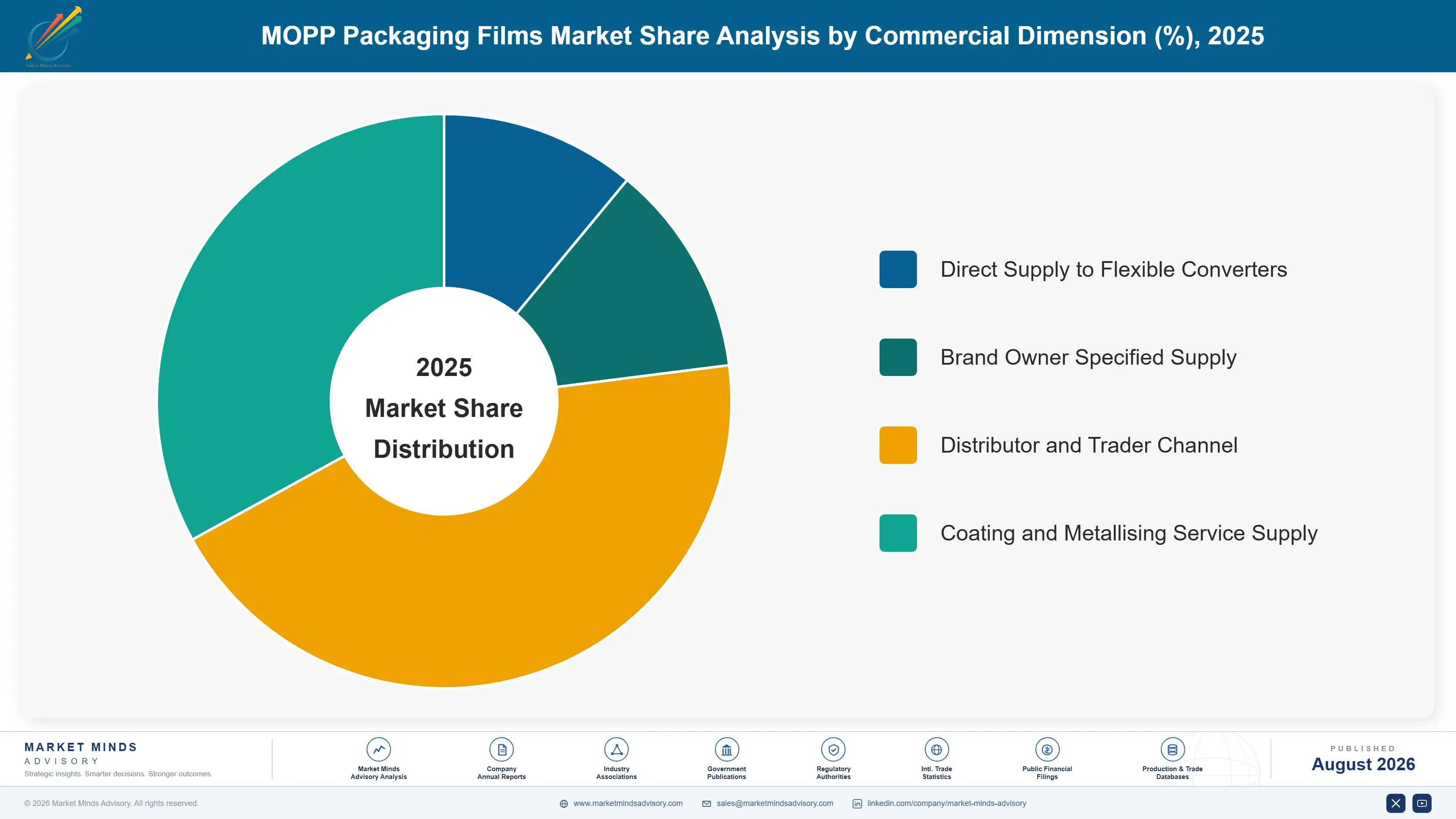
  • Direct Supply to Flexible Converters
  • Brand Owner Specified Supply
  • Distributor and Trader Channel
  • Coating and Metallising Service Supply

By Region

  • North America
  • Western Europe
  • East Asia
  • South Asia and Pacific
  • Latin America
  • Middle East and Africa
  • Eastern Europe

Scope, Methodology, and Coverage

Every figure in this report is reproducible from documented input assumptions. The scope below maps the historical period, the forecast horizon, the segmentation dimensions, and the countries covered, alongside the underlying primary and qualitative methodology.
Historical Period
2020 to 2025
Forecast Period
2026 to 2036
Base Year
2025 (USD billions; MMA Primary Research Dataset, August 2026)
Market Definition
The market covers machine direction oriented polypropylene films produced for packaging applications, spanning mono-material laminate grades, high-stiffness downgauging films, barrier-coated and metallised grades, label and sleeve films, retort and high-temperature constructions, and cast-embossed and specialty surface films. Biaxially oriented polypropylene, unoriented cast polypropylene, polyethylene and polyester films, and converted packaging products such as pouches and labels are excluded. Sizing is measured at film producer revenue in current prices, inclusive of resin pass-through.
Quantitative Units
USD billions (current prices); tonnes of film and square metres at specified gauge where applicable
Segmentation Dimensions
By Film Grade and Function; By End-Use Industry; By Commercial Dimension; By Region
Regions Covered
North America, Western Europe, East Asia, South Asia and Pacific, Latin America, Middle East and Africa, Eastern Europe
Countries Covered
USA, China, Germany, France, UK, Japan, South Korea, India, Australia, Canada, Brazil, Mexico, Indonesia, Vietnam, Thailand, Malaysia, UAE, Saudi Arabia, South Africa, Nigeria, Turkey, Poland, Netherlands, Italy, Spain, Sweden, Switzerland, Argentina, Colombia, Singapore, and additional markets relevant to this sector
Key Companies Profiled
Toray Industries, Jindal Films, Taghleef Industries, Cosmo First, Profol, Innovia Films, Mitsubishi Chemical Group, Oben Group, Vibac Group, Polibak, Uflex, SRF Limited, Zhejiang Kinlead Innovative Materials, Yem Chio, Futamura Chemical, Sibur, Achilles Corporation, Toyobo, Poligal, Irplast
Quantitative Methodology
Primary survey, n=3,800 respondents, Q4 2025, six countries; demand-side model with trade association cross-validation
Qualitative Methodology
47 expert interviews, Q4 2025; applied to validate demand model assumptions, identify emerging dynamics, and assess competitive positioning
Report Format
PDF and XLSX data workbook (Word format preview document)
Publisher
Market Minds Advisory
Report Code
MMA-2026-PAC-752
Published
August 2026
Contact
sales@marketmindsadvisory.com | www.marketmindsadvisory.com

Purchase the full MOPP Packaging Films Market Report (2026 to 2036).

The full report sizes machine direction oriented polypropylene films across six grade categories, three commercial dimensions and seven regions, with annual forecasts to 2036 under base, bull and bear scenarios. Sealing window performance is measured by structure against realistic line conditions rather than laboratory results, which is where mono-material conversions actually succeed or fail. Downgauging economics are modelled on cost per thousand packs rather than per kilogram of film. Foil removal opportunities are identified by product category against measured shelf life requirements. Twenty producers are profiled on a consistent film revenue basis.
Sealing windows measured against realistic filling line conditions
Downgauging economics modelled per thousand packs converted
Foil removal opportunities identified against measured shelf life
Orientation capacity mapped by region and energy cost position
Coating adhesion requirements assessed on oriented substrates
Mono-material conversion progress tracked against announced commitments

Built For The People Who Decide

From boardroom strategy to bench-side execution, this report is read cover-to-cover by leaders shaping the next decade of their industry, turning demand scenarios, market dynamics and valuation benchmarks into decisions.
CXOs/ Presidents/ VPs/ Managers
M&A and Corporate Development
Strategy Teams and R&D Heads
Procurement and Product Directors
Regulatory and Compliance Leaders
Investor Relations and Equity Analysts