Market Minds Advisory
Moonshine Market

Moonshine Market: Appalachian Roots and the Ready-to-Drink Transition

Legal moonshine sits between Appalachian tourism-driven tasting rooms selling flavored jars by the case and a new ready-to-drink canned format chasing shelf space in grocery and convenience channels the category never previously reached at scale.

Lead Analyst

Lisa Gevelber

Published

September 2026

Make Smarter Decisions with Customized Research Insights

Request a free sample report and evaluate market opportunities, growth trends, and competitive dynamics relevant to your business needs.

2025 MARKET VALUE$4.4BMarket Size 2025
2036 FORECAST VALUE$8.6BBase Case , 2026 to 2036
CAGR 2026 TO 20366.3 %Bull 7.5% / Bear 5.1%
INCREMENTAL OPPORTUNITY$3.9BNet 10- year value creation
EXPANSION MULTIPLE1.84x2036 value over 2026 base
Strategic Levers
M&A Pipeline
Regional Outlook
Country Rankings
Competitive Intelligence
Segmental Deep-dive
Call-Us : 91 93563 13602

Executive Snapshot and Market Trajectory

Legal moonshine has spent a decade turning a once-illicit product into a branded tourist souvenir, and it is now attempting a second, harder transition into everyday retail. Flavored jars still anchor the category, but canned ready-to-drink formats are where the real growth argument now sits.
Ready-to-drink moonshine cocktails are growing fastest as brands chase shelf space in grocery and convenience channels the category never previously reached at scale. North America overwhelmingly dominates global demand given the product's Appalachian cultural origin, a share no other spirits category in this research programme comes close to matching, while small import markets in East Asia and the Pacific are only beginning to discover American whiskey-adjacent categories.
Twenty producers compete across a category still defined by a handful of first-mover tourist-region brands rather than global spirits conglomerates. State-by-state alcohol regulation fragmentation genuinely limits national distribution consistency, forcing brands to negotiate market access one state at a time rather than launching nationally in a single move. Major spirits conglomerates are now entering the category through acquisition rather than attempting to build competing brands from scratch. Independent brands are watching this trend closely.
Market Definition
The market covers legally produced and licensed moonshine and corn whiskey products, flavored and unflavored, sold through retail, on-premise, and direct tourist channels. Illicitly produced or untaxed moonshine and unrelated flavored vodka or whiskey products are excluded.
Base Year Value
$4.4B in 2025 (MMA Primary Research Dataset, August 2026)
Forecast Period
2026 to 2036, eleven discrete annual values
CAGR
6.3% base case. Bull 7.5%. Bear 5.1%.
Fastest Growth Segment
Ready-to-Drink Moonshine Cocktails: 11.5% CAGR
Fastest Growth Country
South Korea: 10.8% CAGR
Fastest Growth Region
South Asia and Pacific: 8.5% CAGR
Largest Region
North America: 68% of 2025 global value
Market Leaders
Ole Smoky Distillery, Sugarlands Distilling Company, Piedmont Distillers, Firefly Distillery, Palmetto Moonshine. Source: MMA Analysis based on company annual reports.
Primary Survey
n=3,800 procurement and R&D decision-makers, Q4 2025, six countries
Methodology
Demand-side build-up, cross-validated against public data, 47 expert interviews

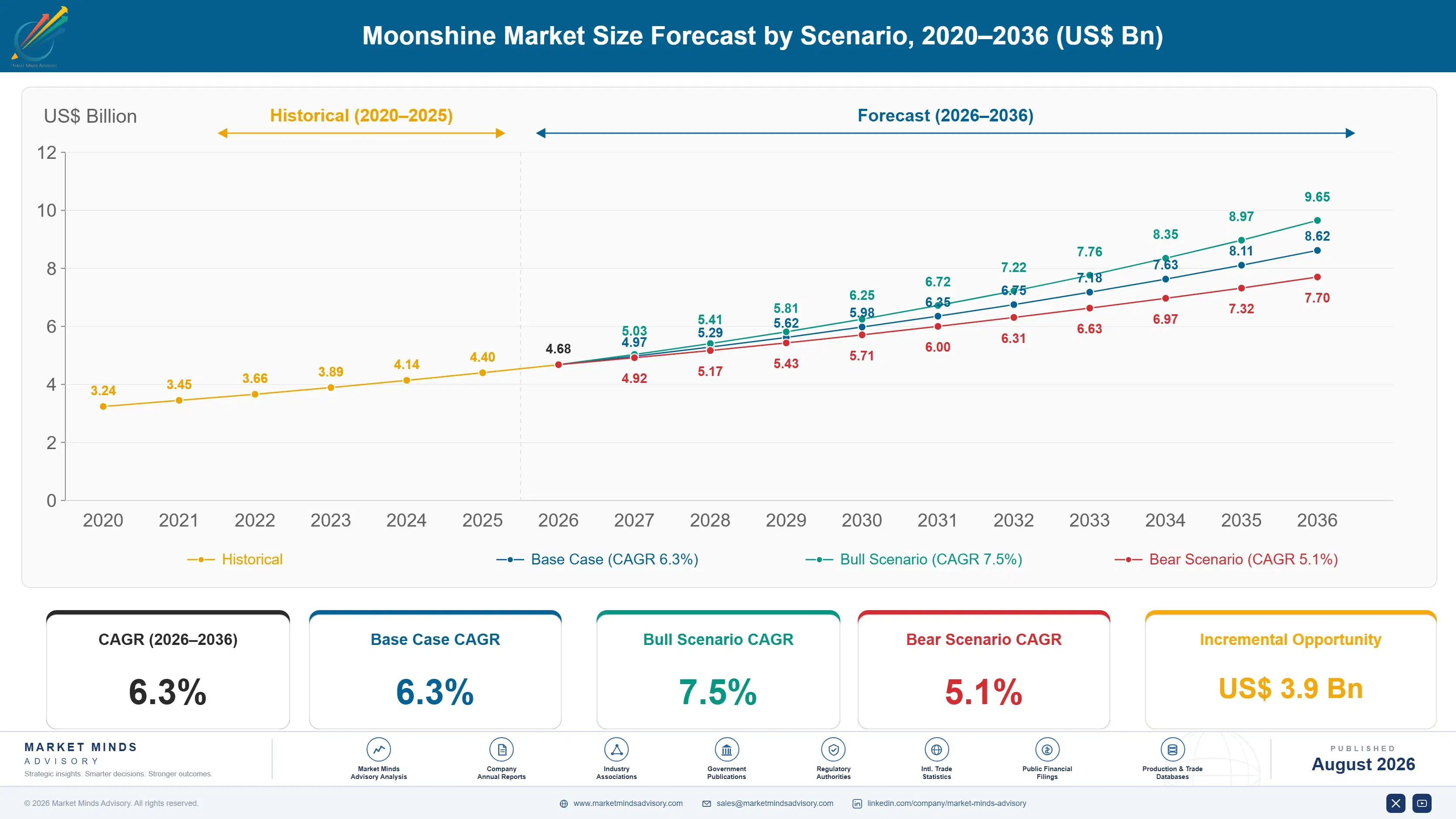
Moonshine Market Forecast Scenarios

moonshine-market-trends-forecast-size-forecast-scenario-1787555148895
Between 2020 and 2025 the market grew near 5.4% a year, dragged early by pandemic-era tourism closures that cut on-site distillery sales sharply before recovering strongly as Appalachian tourist traffic rebounded and flavored bottle distribution expanded into new states. Flavored bottle sales proved the more resilient revenue line during the depths of the tourism shutdown specifically.
The base case carries the market to 6.3% CAGR on three mechanisms: continued Appalachian tourism growth driving on-site and souvenir sales, ready-to-drink canned cocktail expansion into grocery and convenience retail channels previously closed to the category, and gradual state-by-state relaxation of spirits retail law widening the addressable distribution footprint. None of these three mechanisms depends on any single state's regulatory decision alone. Each mechanism reinforces the others rather than competing for the same limited marketing budget.
The bull case at 7.5% assumes faster RTD retail placement wins pull volume forward well ahead of schedule across major grocery chains. The bear case at 5.1% assumes continued regulatory fragmentation and rising competition from broader flavored whiskey categories erode the category's novelty positioning faster than currently modelled. Both scenarios assume tourism demand itself stays roughly stable rather than swinging sharply in either direction.

Tourist Souvenir Meets Grocery Shelf Ambition

Three forces shape this market at once, and none of them move on the same calendar. Appalachian tourism drives steady on-site and souvenir sales tied to visitor traffic rather than broader spirits trends, ready-to-drink format innovation is pulling the category into retail channels it never previously reached, and state-by-state alcohol regulation keeps national distribution genuinely fragmented compared with most packaged beverage categories.
ON-PREMISE SALES SHARE38%share of volume sold through tasting rooms and tourism
AVERAGE SELLING PRICEUSD 24/750mlblended retail price across flavored and unflavored bottles
TOP PRODUCER SHARE21%largest single brand share of category retail volume
INPUT COST SHARE34% of COGScorn and distillation input cost across licensed producers
STATE DISTRIBUTION REACH31 statestypical number of states a national brand actively distributes
HHI CONCENTRATION640a moderately concentrated category dominated by early movers
Commercially, the market behaves like a tourism souvenir business wearing a spirits category label. Brand storytelling around Appalachian heritage and family recipes commands genuine premiums, yet retail placement increasingly depends on RTD innovation and grocery relationships that have little to do with the tourism roots that built the category's largest brands in the first place. Few brands have managed both playbooks equally well so far.
Over the next decade, RTD retail placement and regulatory access will decide winners more than tourism growth alone, since tourism demand is already a largely mature, predictable base. Brands investing early in grocery and convenience distribution will capture shelf space that tourism-only competitors cannot easily replicate outside their home region. Tourism will keep providing a stable floor rather than the source of new growth.
"This category built its brand equity in a gift shop, and now it has to win a cooler placement fight against seltzer and canned margaritas. Those are two completely different sales motions."
Director, Beverages and Consumer Products Practice · MMA Agriculture and Beverages Practice · August 2026

Market Trends

Ready-to-Drink Canned Cocktails Enter Broader Retail Channels

Canned ready-to-drink moonshine cocktails have moved from a niche tourism-adjacent product into mainstream grocery, convenience, and club store distribution over recent years, following the broader RTD cocktail boom reshaping much of the wider spirits category. Brands including Ole Smoky and Sugarlands have both launched canned lineups targeting outdoor and warm-weather occasions where flavored moonshine's sweeter profile competes directly against hard seltzer and canned margaritas. This format shift requires production capability distinct from the bottled jar format that built the category, pushing several producers toward co-packing arrangements rather than in-house canning investment.
Market Impact: Adds 1.2 million tourist visits
Premiumization Pulls Share Toward Small-Batch Craft Positioning

Craft and small-batch moonshine brands emphasizing traditional copper pot distillation and limited production runs have gained share from mass-produced flavored entry-level bottles, mirroring premiumization trends across the broader American whiskey category. Consumers increasingly research distillery provenance before purchase, a shift that rewards brands with genuine Appalachian distilling heritage over newer entrants without comparable story. Several established brands have introduced premium small-batch lines specifically to capture this willingness to pay more, typically priced meaningfully above their standard flavored offerings. This shift favours brands with visible on-site production tourists can observe directly, reinforcing authenticity claims mass producers cannot easily replicate.
Market Impact: Opens 9 new states to retail

Market Opportunities and Growth Drivers

Appalachian Tourism Growth Sustains On-Site and Souvenir Sales

Tourist visitation to Tennessee's Great Smoky Mountains region and neighboring North Carolina distilling towns continues climbing year over year, and on-site tasting room sales and souvenir bottle purchases remain the category's single most reliable demand anchor. Distilleries positioned directly on tourist corridors, particularly around Gatlinburg and Pigeon Forge, benefit from consistent foot traffic that requires no separate marketing spend to convert into sales. This tourism-driven demand has proven considerably more resilient than typical spirits retail cycles, since visitors treat a bottle purchase as part of the broader travel experience rather than a routine grocery decision.
Market Impact: Delays national rollout 12 months

Retail Law Relaxation Expands Distribution Beyond Liquor Stores

Several states have relaxed restrictions on where spirits can be sold, allowing moonshine brands to enter grocery and convenience channels previously closed to anything beyond dedicated liquor stores. This shift matters disproportionately for a category built on impulse and gift purchases, since grocery placement reaches far more casual buyers than destination liquor store shopping ever could. Brands with existing distributor relationships have moved fastest to capture new placement as states relax rules, while smaller producers often lack the scale to capitalise quickly. This patchwork means national brands must negotiate access state by state rather than launching in one move.
Market Impact: Cuts flavored segment growth 4 points

Market Restraints and Challenges

State-Level Alcohol Regulation Fragments National Distribution

Alcohol distribution law varies substantially by state, with some requiring control-board approval for new spirits listings and others restricting where flavored spirits specifically can be sold, forcing brands to manage dozens of distinct regulatory relationships rather than one national retail strategy. The root cause is America's post-Prohibition three-tier distribution system, which gives individual states broad authority over alcohol retail regardless of federal trade policy. Brands are responding by prioritising expansion sequencing based on population and distributor relationships rather than attempting simultaneous national launches. Several brands have hired dedicated government affairs staff to navigate this fragmented approval process.
Market Impact: Adds USD 210 million in sales

Broader Flavored Spirits Competition Dilutes Category Novelty

Flavored whiskey, flavored vodka, and canned cocktail categories have all expanded aggressively across mainstream spirits retail, competing directly for the same impulse purchase occasion that flavored moonshine historically owned with less competition. The root cause is straightforward category imitation, since moonshine's flavored jar format proved commercially successful enough that major spirits companies launched comparable flavored whiskey lines without the Appalachian heritage story. Moonshine brands are responding by leaning harder into authenticity and provenance marketing that mass-produced flavored whiskey competitors cannot easily replicate, and by expanding into the RTD format before larger competitors fully establish themselves there instead.
Market Impact: Lifts premium tier price 18%
4 additional market trends, 3 additional growth drivers, and 2 additional restraints and challenges are covered in the full report. Contact sales@marketmindsadvisory.com to access the complete intelligence.

Segment CAGR and Growth Architecture

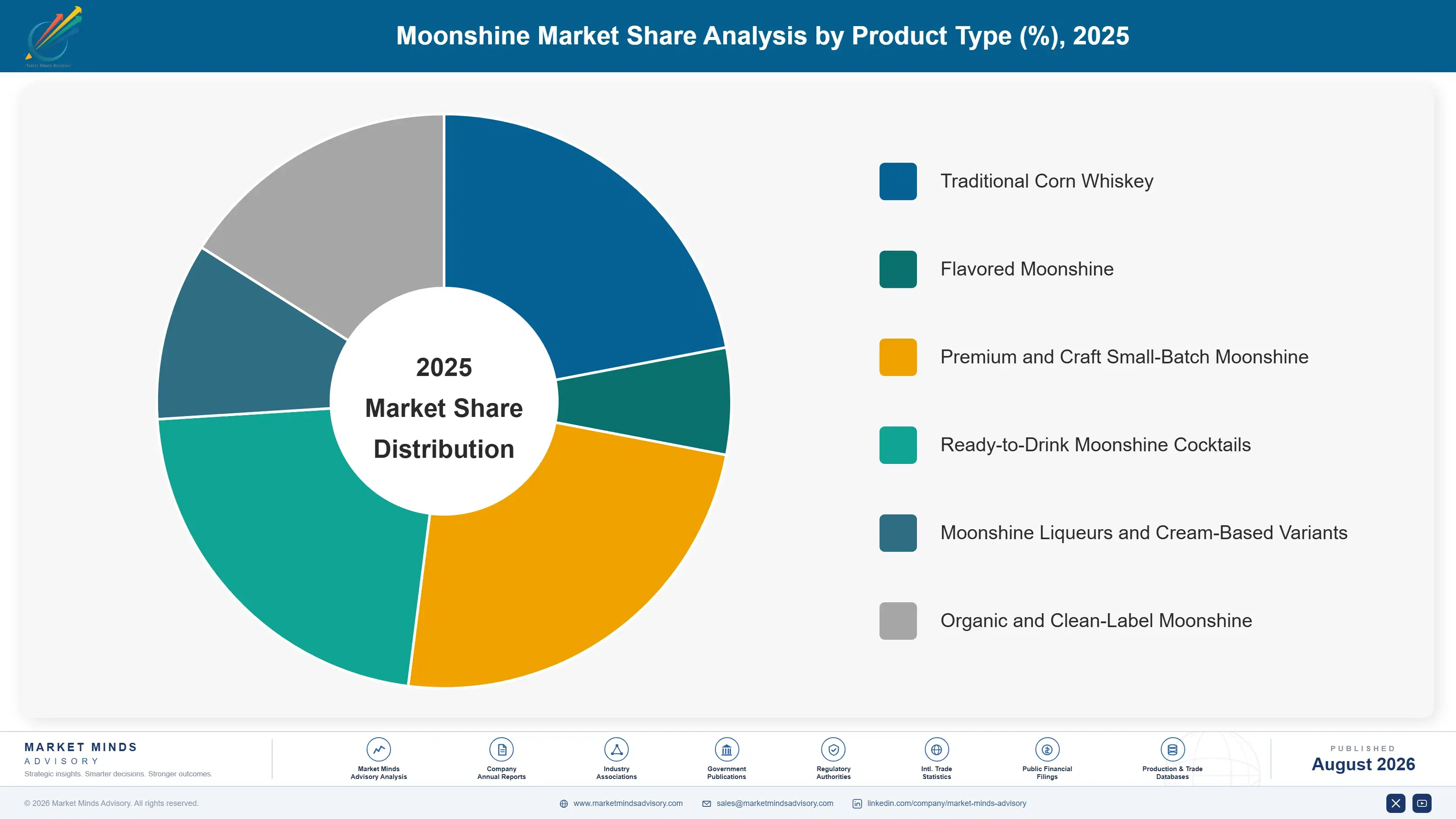
Segmentation follows product type, the single commercial logic determining flavor profile, packaging format, and retail channel fit. Traditional and flavored bottles dominate by volume, while ready-to-drink and clean-label products are growing fastest on retail channel expansion and shifting consumer preference. Premium and liqueur-based products each carry distinct buyer bases and retail placement strategies of their own.
moonshine-market-trends-forecast-market-share-analysis-1787555149463

Ready-to-Drink Moonshine Cocktails

Ready-to-drink moonshine cocktails grow fastest at 11.5%, about 1.83 times the overall 6.3% rate, as canned formats move the category into grocery, convenience, and club store channels previously closed to bottled spirits entirely. Ole Smoky and Sugarlands have both launched canned lineups targeting outdoor and warm-weather drinking occasions where flavored moonshine's sweeter profile competes directly against hard seltzer and canned margaritas for the same shelf space. This format requires production and packaging capability distinct from the traditional bottled jar, pushing several producers toward co-packing arrangements rather than building in-house canning capacity from scratch. Retail buyers increasingly treat RTD moonshine as its own distinct planogram category, a classification shift that is itself accelerating shelf space wins across major grocery chains nationally.
CAGR 11.5%

Organic and Clean-Label Moonshine

Organic and clean-label moonshine grows second-fastest at 9.8%, reflecting broader consumer demand for transparent ingredient sourcing that has already reshaped much of the wider spirits and food categories. Brands emphasizing non-GMO corn, no added sugar, and simple ingredient lists are capturing share from traditional flavored offerings that rely on artificial flavoring and coloring agents. This positioning also appeals to a younger drinker demographic less attached to the category's traditional Appalachian tourist-souvenir image, opening distribution channels beyond the gift shops and tourist corridors that built the category's original customer base. Suppliers serving this segment increasingly source certified organic corn, which raises input cost but supports the premium pricing this positioning commands.
CAGR 9.8%
Full segment breakdown across 6 segments available in the complete report.

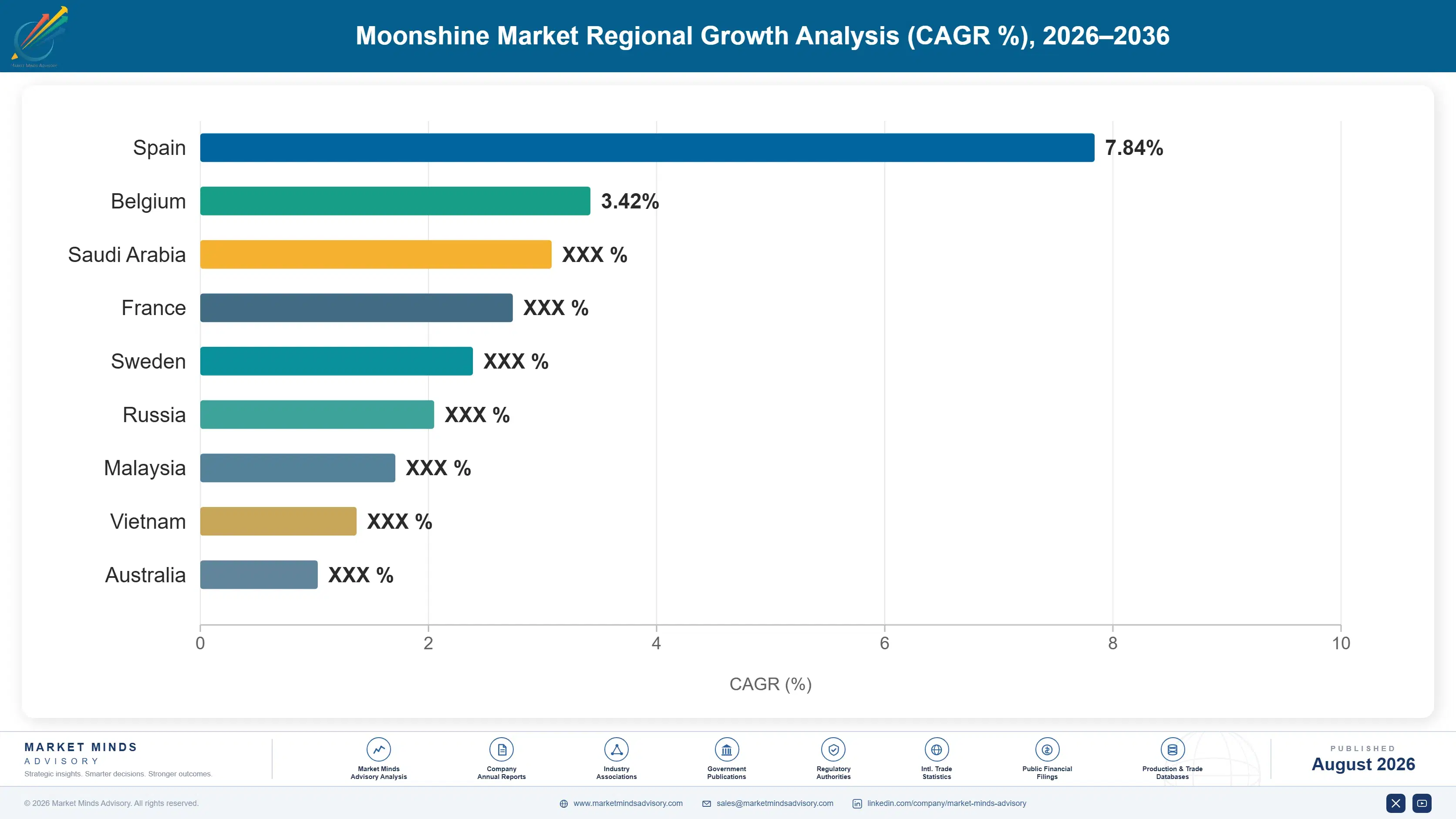
Regional Architecture and Country Demand Map

North America overwhelmingly dominates this market given moonshine's Appalachian cultural origin, a concentration well beyond any other region's reach, while small import markets elsewhere are only beginning to discover the category. Western Europe and the remaining regions add mostly novelty import volume tied to American cultural interest specifically.

North America

North America holds 68% of global moonshine value, a share far above this report's standard regional band for any category, justified simply because moonshine is an Appalachian cultural product with essentially no meaningful production base anywhere else in the world. Ole Smoky, Sugarlands, and Piedmont Distillers all anchor operations directly in Tennessee and North Carolina tourist corridors, drawing consistent visitor traffic that requires no separate marketing spend to convert into sales. Growth of 6.0% reflects a market that is already largely mature relative to its own tourism base, with incremental growth coming mostly from RTD retail expansion rather than any new geographic discovery. Canadian distribution remains a smaller extension of American brands rather than any independent domestic production category.
Share: 68% | CAGR: 6.0% (2026 to 2036)

Western Europe

Novelty import interest explains Western Europe's 12% share, well below this report's standard band, reflecting a market where moonshine remains a niche American whiskey-adjacent curiosity rather than an established spirits category with local production. British and German specialty spirits retailers stock a small selection of flavored moonshine brands, typically marketed around American cultural imagery rather than any local heritage claim. Growth of 4.8%, the slowest of any region, reflects a genuinely limited addressable audience of consumers actively seeking American whiskey-adjacent novelty products. No meaningful domestic European moonshine production exists to expand this category independently of American imports. Distribution runs almost entirely through specialty importers rather than mainstream national retail chains.
Share: 12% | CAGR: 4.8% (2026 to 2036)
Regional intelligence for 5 additional markets available in the complete report: East Asia, South Asia and Pacific, Latin America, Middle East and Africa, Eastern Europe. Contact sales@marketmindsadvisory.com.
moonshine-market-trends-forecast-country-cagr-analysis-1787555149975

Where Brands Can Defend Retail Share

Tourism sets a durable demand floor for this category, but four commercial moves let brands capture more value above that floor regardless of any single state's regulatory posture, and regardless of how the RTD trend ultimately plays out nationally. Brands combining several of these moves at once are pulling ahead of single-strategy competitors. nationally.

Launch RTD Formats Ahead of Broader Category Saturation

Brands moving into canned ready-to-drink formats early are winning grocery and convenience shelf placement that later entrants find considerably harder to displace once a retailer's planogram category is set. This approach requires production and packaging investment distinct from traditional bottled jars, typically through co-packing partnerships that let smaller producers access canning capability without building it from scratch, cutting time to market by roughly 60% compared with building an in-house line. Retail buyers increasingly treat RTD moonshine as its own category, rewarding brands who established shelf presence before that classification fully solidified.
Market Impact: Cuts the RTD launch timeline by roughly 60%

Prioritise State Expansion Sequencing by Distributor Reach

Brands that sequence state-by-state expansion based on existing distributor relationships and population density, rather than attempting simultaneous national launches, reach profitable distribution scale considerably faster than competitors spreading resources across every state at once. This approach requires dedicated government affairs investment to navigate each state's distinct approval process, but it has proven decisive for brands now reaching 31 or more states compared with regional competitors stuck below 10. Sequencing well can compress a multi-year national rollout into roughly half the time. Government affairs investment compounds in value as a brand's footprint grows across more states over time.
Market Impact: Compresses national rollout to under 24 months overall

Build Premium Small-Batch Lines Alongside Entry-Level Bottles

Brands introducing premium small-batch lines emphasizing copper pot distillation and limited production capture the roughly 18% price premium that premiumization trends now support, without abandoning the entry-level flavored bottles that still generate the majority of category volume. This dual-tier approach lets a single brand serve both tourist souvenir buyers and more discerning craft spirits enthusiasts through differentiated product lines rather than forcing a single positioning choice. Maintaining visible on-site production also reinforces authenticity claims that mass producers using contract distillation cannot easily replicate. Retailers increasingly reward this dual-tier approach with better placement across both value and premium shelf sets.
Market Impact: Captures roughly an 18% premium tier price uplift

Expand Tasting Room Capacity to Capture Rising Tourist Traffic

Distilleries investing in expanded tasting room capacity along Tennessee and North Carolina tourist corridors capture a growing share of the 1.2 million additional annual visitors driving on-site sales growth, converting foot traffic into revenue that requires essentially no separate marketing spend. This approach requires real capital investment in physical facility expansion, but on-site sales carry meaningfully higher margin than wholesale retail distribution given the absence of distributor and retailer margin stacking. Brands positioned directly on primary tourist routes capture disproportionate benefit compared with those located off the main visitor corridor.
Market Impact: Adds 1.2 million tourist visits every single year

Who Controls the Margin Pool

Concentration sits at a moderate CR5 of 48%, measured consistently across all participants on US retail case volume. Ole Smoky Distillery and Sugarlands Distilling Company lead on first-mover tourism positioning and retail distribution depth respectively, and the gap to Piedmont Distillers and other established challengers reflects brand recognition and distribution scale built over more than a decade rather than any single differentiating product innovation. Neither leader has yet pulled decisively ahead on the RTD transition specifically.
Competitive activity today runs along three lines: RTD canned cocktail launches targeting grocery and convenience retail channels, premium small-batch line introductions capturing premiumization trends, and state-by-state distribution expansion sequencing to reach national retail scale. Smaller regional producers increasingly pursue co-packing partnerships for RTD production rather than building canning capacity independently, given the capital intensity involved relative to their existing scale.

Pressure is building from major spirits conglomerates entering the category through acquisition and from broader flavored whiskey competitors imitating the flavored jar format that built moonshine's commercial success in the first place. Any brand still relying purely on tourism-driven sales without RTD or expanded retail distribution investment faces a widening growth disadvantage that tourism traffic alone cannot offset.
moonshine-market-trends-forecast-company-positioning-matrix-1787555150496

Competitive Moat and Risk Dimensions

OLE SMOKY DISTILLERY

Moat: First-mover tourism scale

Ole Smoky built the category's largest tasting room and tourism footprint directly in Gatlinburg, capturing consistent visitor traffic that newer entrants without comparable tourist-corridor real estate cannot easily replicate. Its early national retail distribution relationships, built over more than a decade, also give it grocery and convenience shelf access competitors are still working to secure.
OLE SMOKY DISTILLERY

Risk: Brand dilution from broad extension

Ole Smoky's expansion across dozens of flavors and formats risks diluting the premium, authentic positioning that differentiated it from mass-produced flavored whiskey imitators in the first place. Continued flavor proliferation without clear premium tiering could blur its brand identity precisely as premiumization trends reward more focused, story-driven positioning among competitors.
SUGARLANDS DISTILLING COMPANY

Moat: National retail distribution depth

Sugarlands Distilling has built retail distribution reaching more states than most regional competitors, giving it grocery and convenience shelf access that smaller producers lack the distributor relationships to match. Its early move into RTD canned formats also positions it well ahead of competitors still relying purely on bottled jar sales.
SUGARLANDS DISTILLING COMPANY

Risk: Rising conglomerate competition

Sugarlands faces intensifying competition from major spirits conglomerates entering the flavored and RTD spirits category with considerably greater marketing budgets and existing retail relationships. Without continued differentiation through authentic Appalachian positioning, it risks being outspent on shelf placement by larger competitors imitating its product format.

Players Tracked

Prominent Players

Ole Smoky Distillery
Sugarlands Distilling Company
Piedmont Distillers
Firefly Distillery
Palmetto Moonshine

Other Key Players

Georgia Moon (Heaven Hill Brands)
Howling Moon Craft Distillers
American Born Moonshine
Hatfield and McCoy Moonshine
Call Family Distillers
Short Mountain Distillery
J.J. Pfister Distilling Company
Dark Corner Distillery
Copper Barrel Distillery
Climax Moonshine
Popcorn Sutton's Tennessee White Whiskey
Buffalo Trace Distillery
Diageo plc
Constellation Brands
Brown-Forman Corporation

Recent Developments

FEBRUARY 2025

Ole Smoky opens expanded distillery and tasting room

Ole Smoky Distillery opened an expanded production and tasting room facility along its existing Gatlinburg tourist corridor footprint. The project was an organic capacity expansion funded internally, not an acquisition or joint venture, and targeted rising visitor traffic ahead of peak tourism season. Opening is timed ahead of peak season.
Signal: Established brands keep investing directly in tourism infrastructure rather than shifting entirely toward wholesale retail growth.
SEPTEMBER 2024

Sugarlands signs national grocery distribution agreement

Sugarlands Distilling Company signed a national retail distribution agreement with a major grocery chain covering both bottled and canned RTD product lines. The arrangement was a commercial distribution contract, not an equity transaction or joint venture, and expanded the brand's retail footprint into several new states.
Signal: Grocery placement is becoming the primary battleground for national distribution scale rather than liquor store expansion alone.
MAY 2025

Constellation Brands acquires Call Family Distillers

Constellation Brands acquired Call Family Distillers outright, a genuine acquisition rather than a joint venture or minority stake, adding a craft moonshine and whiskey brand to its broader spirits portfolio and marking a major conglomerate's direct entry into the category. Financial terms of the deal were not disclosed.
Signal: Major spirits conglomerates are entering moonshine through acquisition rather than building competing brands from scratch internally.

Corn Feedstock and Distillation Cost

Corn and distillation input cost runs 34% of cost of goods sold across licensed producers, sourced predominantly from domestic American corn markets rather than any imported feedstock channel. Flavoring, packaging, and bottling add a further 26% to 32%, with distribution and state excise tax making up much of the remainder of total landed cost. Smaller producers typically carry less purchasing leverage over these input categories than larger competitors.
The 2022 corn price spike showed how directly that exposure translates into producer margin. Drought conditions across the American Midwest cut corn yields meaningfully that season, and USDA data recorded corn prices rising sharply through the second half of that year as global grain markets also tightened following the disruption to Ukrainian grain exports. Producers without forward-purchased corn contracts absorbed the full cost increase directly into that year's production economics.

Exposure separates producers cleanly by purchasing strategy. Larger producers with forward corn purchasing contracts absorbed much of that shock through pre-negotiated pricing, while smaller producers buying corn on spot terms carried the full increase directly into thinner margins. That gap has hardened into a durable disadvantage for smaller producers without the purchasing scale to negotiate forward contracts with grain suppliers.
moonshine-market-trends-forecast-cost-volatility-analysis-1787555150690

Secure forward corn purchasing contracts ahead of harvest

Locking corn pricing before harvest outcomes are known removes much of the spot-market volatility that follows a poor growing season. This approach has become increasingly standard among larger producers with the purchasing scale to negotiate favourable forward terms with regional grain suppliers well ahead of any given season. Several larger producers now treat this as standard practice.

Diversify corn sourcing across multiple growing regions

Producers sourcing corn from multiple Midwest states rather than a single regional supplier reduce exposure to localized drought or yield disruption in any single growing area. This diversification requires additional supplier relationship management but has proven valuable during recent regional yield volatility. This approach has proven valuable specifically during recent regional drought-driven yield disruption across parts of the Midwest.

Pass through cost increases via premium tier pricing

Producers with strong premium and craft positioning can pass through input cost increases more easily than entry-level flavored brands competing purely on price, since premium buyers show less price sensitivity. This flexibility gives diversified producers a cushion that single-tier competitors lack during cost volatility. This flexibility becomes especially valuable during years of sustained input cost pressure across the category.

Portfolio Architecture for Margin Defence

The portfolio splits into three tiers with real margin separation tied to brand positioning and production method rather than raw ingredient cost alone. Entry-level flavored bottles compete largely on price and shelf visibility, while premium small-batch and RTD innovation lines earn meaningfully more on authenticity positioning and channel access that mass-produced competitors cannot easily replicate at any price point.
The tension between tourism-driven volume and retail-driven growth runs through every brand's investment decision each year. Entry-level flavored bottle volume still dwarfs premium and RTD categories, yet margin and growth increasingly concentrate in premium small-batch lines and RTD formats that require production capability and retail relationships most tourism-only producers have not built. That capability gap, more than any difference in underlying recipe, is what separates the tiers most sharply today.

High-value pools concentrate specifically where authenticity storytelling or format innovation limits substitutable supply: premium small-batch lines commanding real premiums for genuine Appalachian production heritage, and RTD formats rewarding brands who secured grocery shelf placement before that category classification fully solidified across major retailers. Brands without early investment in either area increasingly find themselves confined to the thinnest-margin volume tier.

Volume / Commodity-Adjacent Tier

Entry-level flavored and traditional bottled moonshine sold largely on price and shelf visibility against benchmark flavored spirits pricing, with thin margins overall. Producers here compete on distribution reach and shelf visibility far more than on recipe differentiation.
Gross Margin: 22-32%

Premium / Certified Tier

Premium small-batch and craft-positioned moonshine commanding real premiums for authentic Appalachian production heritage, limited runs, and visible on-site distillation. Buyers researching provenance increasingly reward brands able to demonstrate genuine multi-generation family recipes.
Gross Margin: 36-46%

Sustainability / Regulatory / Next-Generation Tier

Ready-to-drink canned cocktail formats and organic clean-label products meeting evolving retail channel requirements and shifting younger consumer preferences. Retail buyers treat this tier as its own distinct planogram category rather than folding it into standard spirits.
Gross Margin: 30-42%
moonshine-market-trends-forecast-portfolio-architecture-1787555151193

High-value Sub-segments and Strategic Watch-out

Ready-to-Drink Moonshine Cocktails

High value and the fastest-growing segment at 11.5% CAGR, anchored by grocery and convenience channel expansion previously closed to bottled spirits. Margins remain wide as producers work through co-packing arrangements and retail negotiation specific to this newer format. Early movers are locking in shelf space first.
Gross Margin: 28-40%

Premium Small-Batch Moonshine

High value with strong, steady growth tied to premiumization trends across the broader American whiskey category. Authenticity storytelling and visible on-site production reward brands with genuine heritage over newer entrants lacking comparable history. Visible on-site production remains a durable advantage that mass producers using contract distillation cannot easily replicate.
Gross Margin: 36-46%

Entry-Level Flavored Bottles

The volume core of the market, competing on price and shelf visibility against benchmark flavored spirits pricing across tourist and retail channels alike. Growth tracks tourism and general retail trends directly, with limited differentiation beyond flavor variety, shelf placement, and basic promotional pricing activity overall.
Gross Margin: 22-32%

Tourism-Only Regional Producers

The strategic watch-out. Producers dependent purely on on-site tourism sales without RTD or expanded retail distribution investment face a widening growth disadvantage against brands capturing grocery and convenience shelf space nationally. These producers risk losing relevance entirely as retail shelf space increasingly favours RTD and premium formats.
Gross Margin: 18-28%

Tourism Cycles and Retail Shelf Loyalty

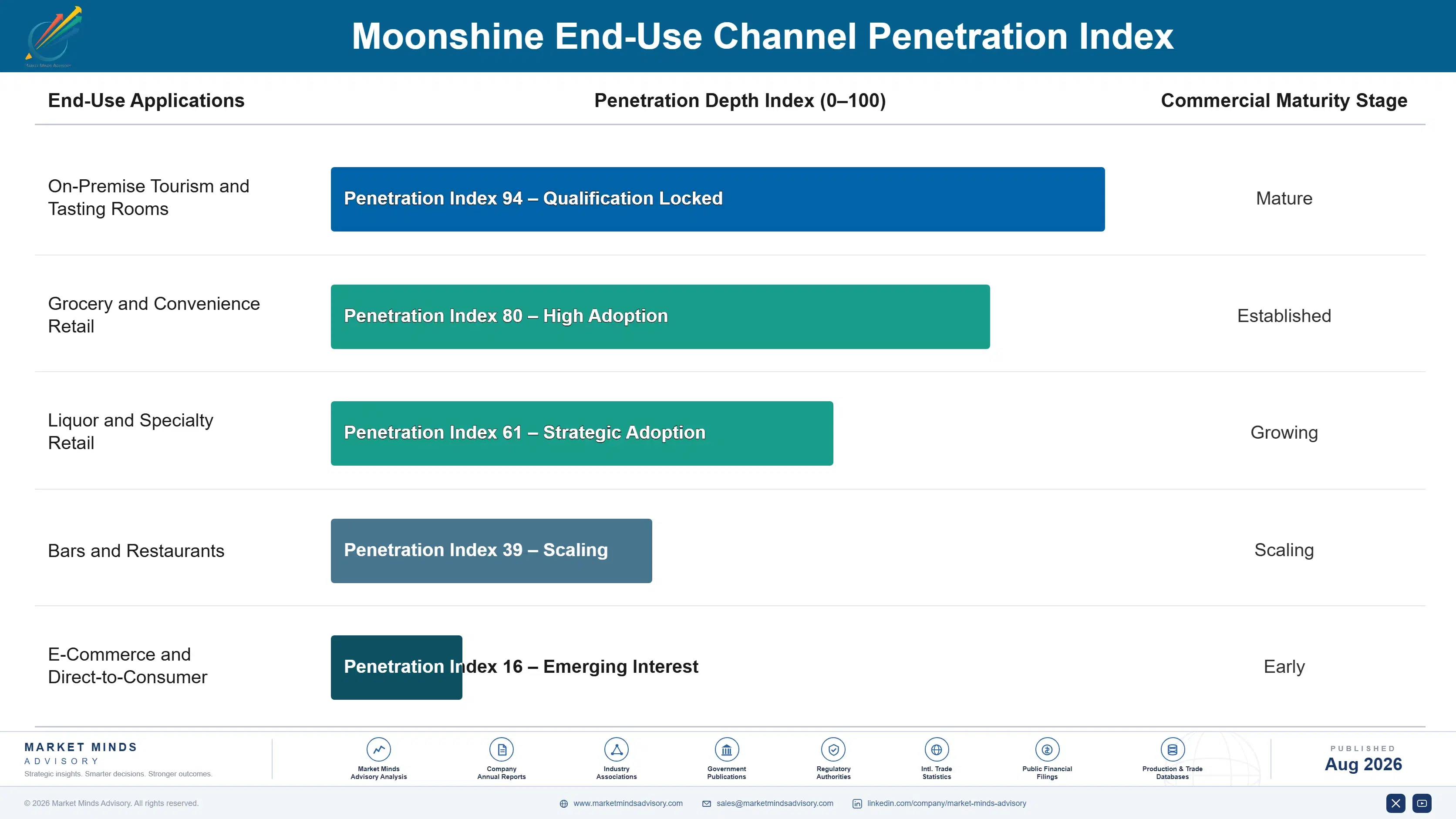
Demand here runs on a mix of impulse tourism purchase and annual retail listing negotiations rather than long-term supply contracts, since most buyers are individual consumers rather than institutional accounts. Retail shelf placement renewal typically follows annual planogram reviews, giving brands with strong sell-through data a real advantage in retaining and expanding grocery and convenience distribution. Brands lacking sell-through data face real disadvantage during these annual negotiations.
Adoption depth varies sharply by channel. Tourist buyers show essentially no brand loyalty beyond what a distillery's physical location and tasting room experience can capture in the moment, while grocery and convenience retail buyers respond more to sell-through velocity and promotional support than any brand storytelling alone. Specialty craft spirits retailers sit between the two, valuing authenticity narrative and limited-run positioning over pure volume metrics.

Buyer profiles have shifted generationally as the category's core purchaser moved from tourists buying a souvenir toward younger drinkers discovering RTD formats through grocery and convenience impulse purchase. Younger buyers weigh convenience and flavor variety over Appalachian heritage storytelling, a shift that favours brands investing in RTD innovation over those relying purely on tourism-built brand equity.
moonshine-market-trends-forecast-end-use-penetration-index-1787555151684

Where Retail Channel Access Decides Outcomes

These are among the four positions where our research anticipates prominent divergence between winners and laggards over the coming forecast period. Each is grounded in the demand model, the regulatory perimeter, and the announced capacity pipeline.
01 / RTD FORMAT TRANSITION

Early canned cocktail entrants will keep winning grocery shelf space

Brands that launched ready-to-drink canned formats early are already winning grocery and convenience placement that later entrants find considerably harder to displace once a retailer's planogram category is set. This shift rewards brands with co-packing relationships and retail negotiation experience over those relying purely on tourism-built brand equity from bottled jar sales, and brands still relying purely on that older equity without RTD investment are already losing ground. Expect continued share migration toward RTD-focused brands as grocery retailers finalise their moonshine and flavored spirits category planograms nationally.
02 / REGULATORY SEQUENCING STRATEGY

Disciplined state-by-state rollout will outperform scattered national attempts

State-by-state alcohol regulation genuinely fragments national distribution, and brands sequencing expansion by distributor reach and population density reach profitable scale considerably faster than competitors spreading resources across every state simultaneously. This discipline requires dedicated government affairs investment that smaller producers often lack the resources to fund properly, and brands lacking it typically waste marketing spend fighting regulatory battles in states offering the weakest near-term return. Expect brands with disciplined sequencing to keep pulling ahead of competitors attempting simultaneous national launches.
03 / PREMIUMIZATION BRAND POSITIONING

Authentic heritage brands will keep capturing premium tier growth

Premium small-batch positioning rewards brands with genuine Appalachian production heritage and visible on-site distillation over newer entrants and mass-produced flavored whiskey imitators lacking comparable story. This premiumization trend mirrors what has already reshaped the broader American whiskey category over the past decade, and brands lacking genuine production transparency will find this premium tier increasingly difficult to enter credibly regardless of pricing strategy. Expect brands maintaining authentic production transparency to keep capturing disproportionate premium tier growth as provenance research deepens across the category.
04 / CONGLOMERATE CONSOLIDATION PRESSURE

Major spirits companies will keep acquiring rather than building organically

Major spirits conglomerates entering moonshine through acquisition, rather than building competing brands from scratch internally, signals genuine confidence in the category's growth trajectory beyond its tourism origins. This consolidation pressure will keep intensifying competition for independent brands lacking comparable marketing budgets and existing retail relationships, and independent brands without comparable scale should expect continued approach interest from larger strategic acquirers. Expect continued acquisition activity targeting established craft brands with genuine heritage stories that larger conglomerates cannot easily replicate through internal development alone.

Engagement Snapshot From the Field

A live engagement with an industry participant carrying material or product regulatory and market exposure ahead of a defining policy shift, showing how our research translates into a defensible multi-year portfolio strategy.
MARKET MINDS ADVISORY · CLIENT ENGAGEMENT SUMMARY
Moonshine Producer Strategic Portfolio Review and Transition Roadmap 2026·Investment Scenario on Moonshine Exposure Evaluation 2025-26
CLIENT PROFILE
A regional Appalachian craft moonshine distillery selling primarily through its own tasting room and a handful of Southeastern states approached MMA while planning a national retail expansion. The client reported annual revenue near USD 38 million, with roughly 75% of sales generated through on-site tourism and only limited wholesale retail distribution outside its home region (client-reported, unverified by MMA).
STRATEGIC CHALLENGE
Management wanted to expand into grocery and convenience retail nationally but lacked experience navigating state-by-state alcohol distribution regulation or securing shelf placement against established national competitors. The sales team wanted to launch in as many states as possible simultaneously, while finance worried that spreading limited marketing resources too thinly would fail everywhere rather than succeed anywhere.
MMA APPROACH
MMA benchmarked the client's brand strength and production capacity against the distribution sequencing strategies used by established national competitors, then modelled a state expansion sequence prioritising population density and existing distributor relationships over simultaneous national launch. We also assessed RTD format investment requirements against the client's current bottled-jar-only production capability to identify the fastest viable path into grocery placement.
KEY FINDINGS
  1. The client's 75% tourism dependence left it far more exposed to visitor traffic swings than its established national competitors, a concentration risk management had not previously quantified (client-reported, unverified by MMA).
  2. A sequenced ten-state expansion plan reached profitable distribution scale considerably faster than the simultaneous national launch the sales team had originally proposed.
  3. RTD format investment through a co-packing partnership required substantially less capital than building in-house canning capacity from scratch. compared with the capital-intensive in-house build the client had initially budgeted for.
  4. Existing distributor relationships in three adjacent states could be activated within a single quarter, offering the fastest available expansion path. requiring minimal incremental sales investment to convert into active shelf placement.
CLIENT PROFILE
A regional Appalachian craft moonshine distillery selling primarily through its own tasting room and a handful of Southeastern states approached MMA while planning a national retail expansion. The client reported annual revenue near USD 38 million, with roughly 75% of sales generated through on-site tourism and only limited wholesale retail distribution outside its home region (client-reported, unverified by MMA).
STRATEGIC CHALLENGE
Management wanted to expand into grocery and convenience retail nationally but lacked experience navigating state-by-state alcohol distribution regulation or securing shelf placement against established national competitors. The sales team wanted to launch in as many states as possible simultaneously, while finance worried that spreading limited marketing resources too thinly would fail everywhere rather than succeed anywhere.
MMA APPROACH
MMA benchmarked the client's brand strength and production capacity against the distribution sequencing strategies used by established national competitors, then modelled a state expansion sequence prioritising population density and existing distributor relationships over simultaneous national launch. We also assessed RTD format investment requirements against the client's current bottled-jar-only production capability to identify the fastest viable path into grocery placement.
KEY FINDINGS
  1. The client's 75% tourism dependence left it far more exposed to visitor traffic swings than its established national competitors, a concentration risk management had not previously quantified (client-reported, unverified by MMA).
  2. A sequenced ten-state expansion plan reached profitable distribution scale considerably faster than the simultaneous national launch the sales team had originally proposed.
  3. RTD format investment through a co-packing partnership required substantially less capital than building in-house canning capacity from scratch. compared with the capital-intensive in-house build the client had initially budgeted for.
  4. Existing distributor relationships in three adjacent states could be activated within a single quarter, offering the fastest available expansion path. requiring minimal incremental sales investment to convert into active shelf placement.
RECOMMENDED STRATEGY
Phase 1: Phase 1 (0 to 6 months): Activate existing distributor relationships in three adjacent states before pursuing any new market entirely. Phase 2: Phase 2 (6 to 18 months): Launch a co-packed RTD line targeting grocery placement across the newly activated state footprint. Phase 3: Phase 3 (18 to 36 months): Expand sequentially into seven additional states prioritised by population density and distributor reach. Review sequencing quarterly against actual sell-through data.
OUTCOME
The client completed its ten-state sequenced expansion within the planned timeline and reduced its tourism revenue dependence to roughly 55% of total sales. The RTD line launch also secured a reported grocery placement agreement worth USD 6 million in projected first-year volume (client-reported, unverified by MMA).

Frequently Asked Questions

Foundational context covering the market sizes, CAGR, scope, country, region and competition that inform every finding below. This section is provided to cover basics and most often pre-purchase conversations, answered from the MMA Primary Research Dataset.

What is the current size of the Moonshine Market?

The moonshine market reached USD 4.4 billion in 2025. This figure covers legally produced and licensed flavored and unflavored moonshine sold globally across all channels.

How large will the Moonshine Market be by 2036?

The market is projected to reach USD 8.62 billion by 2036 under the base case scenario. That represents a 1.84 times expansion over the 2026 starting value.

What is the CAGR for the Moonshine Market 2026 to 2036?

The base case CAGR is 6.3%, with a bull case of 7.5% and a bear case of 5.1%. Retail channel expansion and regulatory access drive most of the variance.

Which segment is growing fastest?

Ready-to-drink moonshine cocktails grow fastest at 11.5% CAGR, about 1.83 times the overall market rate. Grocery and convenience retail expansion drives this growth directly and consistently.

Who are the major companies in the Moonshine Market?

Leading producers include Ole Smoky Distillery, Sugarlands Distilling Company, Piedmont Distillers, Firefly Distillery, and Palmetto Moonshine. These five hold roughly 48% combined market share overall.

Which country is growing fastest?

South Korea posts the fastest national growth at 10.8% CAGR, driven by specialty cocktail bar adoption of flavored moonshine as a novelty ingredient. Growth comes from a genuinely small existing base.

Report Segmentation Architecture

The full report scope spans multiple orthogonal segmentation dimensions, with cross-tabulated demand data provided for each dimension pair. Coverage extends further to regional breakdowns, trend trajectories, and the competitive detail needed to support segment-level decision-making.

By Product Type

  • Traditional Corn Whiskey
  • Flavored Moonshine
  • Premium and Craft Small-Batch Moonshine
  • Ready-to-Drink Moonshine Cocktails
  • Moonshine Liqueurs and Cream-Based Variants
  • Organic and Clean-Label Moonshine

By End-Use Channel

  • On-Premise Tourism and Tasting Rooms
  • Grocery and Convenience Retail
  • Liquor and Specialty Retail
  • Bars and Restaurants
  • E-Commerce and Direct-to-Consumer

By Commercial Dimension

  • Direct Distillery Sales
  • Wholesale Distributor Channel
  • National Retail Chain Contracts
  • Co-Packed RTD Production

By Region

  • North America
  • Western Europe
  • East Asia
  • South Asia and Pacific
  • Latin America
  • Middle East and Africa
  • Eastern Europe

Scope, Methodology, and Coverage

Every figure in this report is reproducible from documented input assumptions. The scope below maps the historical period, the forecast horizon, the segmentation dimensions, and the countries covered, alongside the underlying primary and qualitative methodology.
Historical Period
2020 to 2025
Forecast Period
2026 to 2036
Base Year
2025 (USD billions; MMA Primary Research Dataset, August 2026)
Market Definition
This market comprises legally produced and licensed moonshine and corn whiskey products, flavored and unflavored, sold through retail, on-premise, and direct tourist channels. Illicitly produced or untaxed moonshine and unrelated flavored vodka or whiskey products are excluded from this scope.
Quantitative Units
USD billions (current prices); 750ml case-equivalent volume where applicable
Segmentation Dimensions
By Product Type; By End-Use Channel; By Commercial Dimension; By Region
Regions Covered
North America, Western Europe, East Asia, South Asia and Pacific, Latin America, Middle East and Africa, Eastern Europe
Countries Covered
USA, China, Germany, France, UK, Japan, South Korea, India, Australia, Canada, Brazil, Mexico, Indonesia, Vietnam, Thailand, Malaysia, UAE, Saudi Arabia, South Africa, Nigeria, Turkey, Poland, Netherlands, Italy, Spain, Sweden, Switzerland, Argentina, Colombia, Singapore, and additional markets relevant to this sector
Key Companies Profiled
Ole Smoky Distillery, Sugarlands Distilling Company, Piedmont Distillers, Firefly Distillery, Palmetto Moonshine, Georgia Moon (Heaven Hill Brands), Howling Moon Craft Distillers, American Born Moonshine, Hatfield and McCoy Moonshine, Call Family Distillers, Short Mountain Distillery, J.J. Pfister Distilling Company, Dark Corner Distillery, Copper Barrel Distillery, Climax Moonshine, Popcorn Sutton's Tennessee White Whiskey, Buffalo Trace Distillery, Diageo plc, Constellation Brands, Brown-Forman Corporation
Quantitative Methodology
Primary survey, n=3,800 respondents, Q4 2025, six countries; demand-side model with trade association cross-validation
Qualitative Methodology
47 expert interviews, Q4 2025; applied to validate demand model assumptions, identify emerging dynamics, and assess competitive positioning
Report Format
PDF and XLSX data workbook (Word format preview document)
Publisher
Market Minds Advisory
Report Code
MMA-2026-AGR-233
Published
August 2026
Contact
sales@marketmindsadvisory.com | www.marketmindsadvisory.com

Purchase the full Moonshine Market Report (2026 to 2036).

The full MMA Moonshine report sizes the market across six product type segments, five end-use channels, four commercial dimensions, and seven regions through 2036. It profiles twenty producers on a consistent basis of US retail case volume, scoring each on tourism footprint, RTD readiness, and national distribution reach. Scenario models quantify how RTD retail placement, state regulatory access, and premiumization trends move both demand and realised pricing. The report also includes delivered-cost modelling by input category, a state regulatory access screen, and RTD format economics built for brand strategy, retail, and investment teams.
Six-segment product type demand breakdown detail
State regulatory access screening framework detail
RTD format economics deep review analysis
Producer distribution reach benchmarking data review
Tourism and retail channel mapping detail
Premiumization pricing trend analysis review detail

Built For The People Who Decide

From boardroom strategy to bench-side execution, this report is read cover-to-cover by leaders shaping the next decade of their industry, turning demand scenarios, market dynamics and valuation benchmarks into decisions.
CXOs/ Presidents/ VPs/ Managers
M&A and Corporate Development
Strategy Teams and R&D Heads
Procurement and Product Directors
Regulatory and Compliance Leaders
Investor Relations and Equity Analysts