Market Minds Advisory
Montenegro Home Mortgage Finance Market

Montenegro Home Mortgage Finance Market: Euro Without A Central Bank, Coastal Collateral and Two Buyer Populations

A country using the euro without any authority able to create it, lending against coastline priced by foreign buyers who mostly pay cash and never needed a mortgage at all.

Lead Analyst

Published

September 2026

Make Smarter Decisions with Customized Research Insights

Request a free sample report and evaluate market opportunities, growth trends, and competitive dynamics relevant to your business needs.

2025 MARKET VALUE$1.3BMarket Size 2025
2036 FORECAST VALUE$3.6BBase Case , 2026 to 2036
CAGR 2026 TO 20369.8 %Bull 11.0% / Bear 8.6%
INCREMENTAL OPPORTUNITY$2.2BNet 10- year value creation
EXPANSION MULTIPLE2.55x2036 value over 2026 base
Strategic Levers
M&A Pipeline
Regional Outlook
Country Rankings
Competitive Intelligence
Segmental Deep-dive
Call-Us : 91 93563 13602

Executive Snapshot and Market Trajectory

Montenegro adopted the euro unilaterally in 2002 and has no institution able to create it. Every mortgage in the country is therefore funded from deposits or from a parent bank abroad, and no domestic authority can supply liquidity if that funding ever withdraws at all.
The property market and the mortgage market are not the same market at all. Coastal dwellings are priced by non-resident purchasers, roughly 31% of coastal transactions, and most of those buyers complete in cash without any borrowing whatsoever. Domestic households borrow against inland and suburban property their salaries can actually service. The two populations share a currency and essentially nothing else. Credit committees still treat them as one market anyway, which is a mistake.
Growth is genuine but from a very small base. Mortgage penetration sits near 16% of national output, well under half the European Union average, and the Europe Now wage reforms since 2022 lifted the number of households able to carry a loan at all. Non-resident and second home lending grows fastest at 14.7% as foreign buyers begin using local credit rather than importing it from home. That shift is recent.
Market Definition
Outstanding residential mortgage lending secured on dwellings located in Montenegro, including construction, self-build and renovation loans secured against residential property. Covers lending by licensed banks and by development finance institutions channelling credit lines through them. Excludes commercial real estate lending, unsecured consumer credit, and the substantial share of property transactions completed in cash without any borrowing.
Base Year Value
$1.3B in 2025 (MMA Primary Research Dataset, August 2026)
Forecast Period
2026 to 2036, eleven discrete annual values
CAGR
9.8% base case. Bull 11.0%. Bear 8.6%.
Fastest Growth Segment
Non-Resident and Second Home Mortgages: 14.7% CAGR
Fastest Growth Country
India: 11.8% CAGR
Fastest Growth Region
South Asia and Pacific: 11.8% CAGR
Largest Region
Eastern Europe: 92% of 2025 global value
Market Leaders
Crnogorska Komercijalna Banka, NLB Banka Podgorica, Erste Bank Podgorica, Hipotekarna Banka and Prva Banka Crne Gore lead on residential mortgage balances. Source: Central Bank of Montenegro and company annual reports, MMA Analysis.
Primary Survey
n=3,800 procurement and R&D decision-makers, Q4 2025, six countries
Methodology
Demand-side build-up, cross-validated against public data, 47 expert interviews

Montenegro Home Mortgage Finance Market Forecast Scenarios

montenegro-home-mortgage-finance-market-size-forecast-scenario-1787917274573
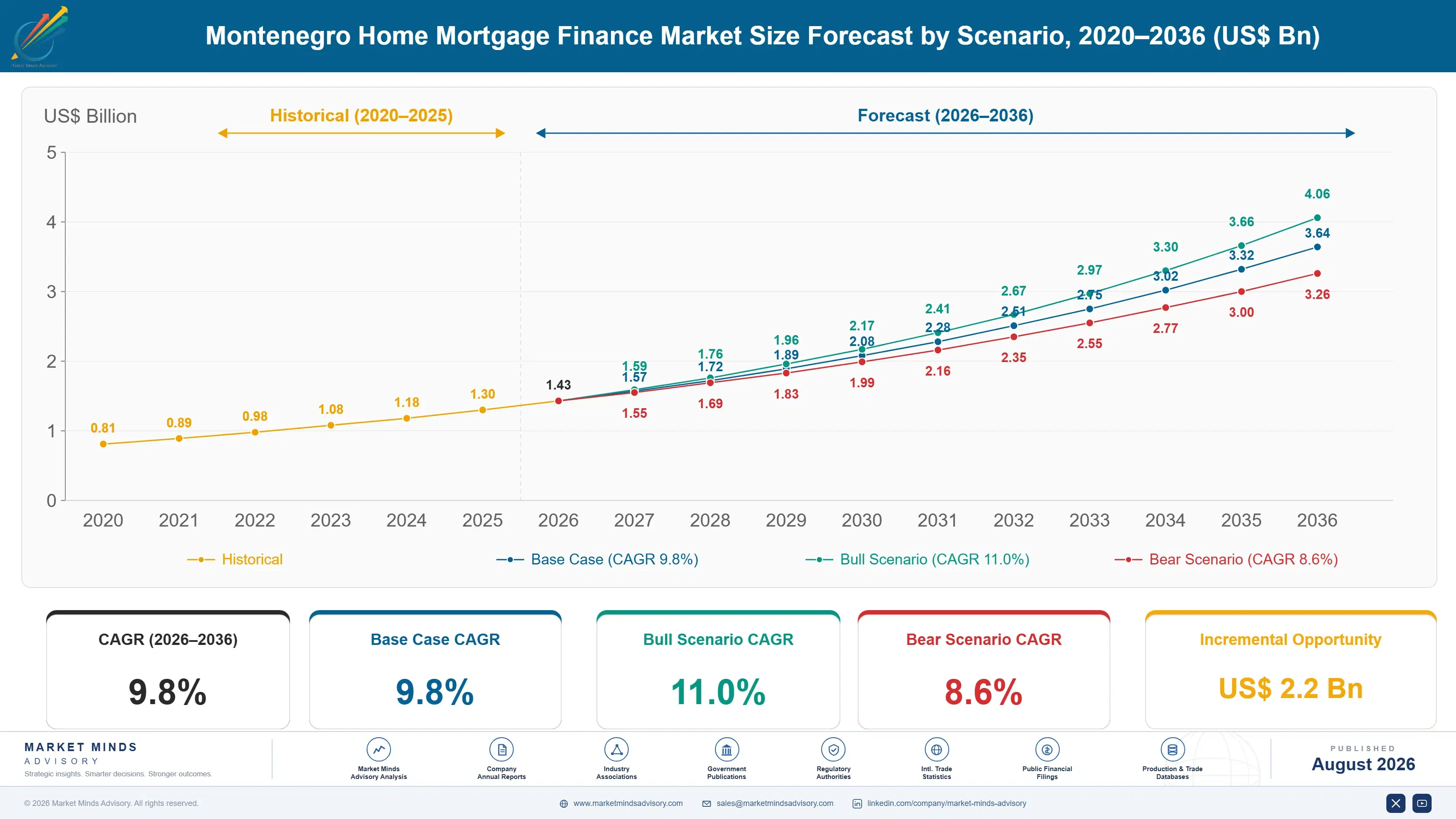
The 2020 to 2025 period contained a collapse and a boom in quick succession. Tourism stopped in 2020 and with it the income supporting a large share of household borrowing capacity, then property demand returned sharply after February 2022 as buyers from Russia, Turkey and Serbia arrived in numbers the market had never absorbed before. Mortgage balances compounded near 8.4% across the whole period.
Three mechanisms carry the base case forward. Wage reform under the Europe Now programmes raised net household income and pulled more families above the threshold at which a bank will lend at all. European Union accession preparation is improving cadastre reliability and foreclosure enforcement, both of which reduce the risk premium banks currently apply. And non-resident buyers are shifting from cash purchase toward local credit as residency and tax positions settle.
The bull catalyst is accession itself: a credible 2028 or 2029 membership date would compress country risk premiums and reprice the entire mortgage book downward within two years. The bear risk is parent bank retrenchment. Montenegrin subsidiaries depend on group funding decisions taken in Vienna, Ljubljana and Budapest, and a European banking retreat from the Western Balkans would remove liquidity nobody domestically can replace.

Lending In A Currency Nobody Here Can Create

Unilateral euro adoption removed exchange rate risk from Montenegrin mortgage lending and replaced it with something less familiar. The Central Bank of Montenegro supervises banks but cannot act as lender of last resort in a currency it does not issue, so every institution holds liquidity against its own deposits or committed parent funding. That constraint, more than credit risk, explains why rates near 5.1% sit above eurozone pricing.
MARKET CONCENTRATION CR574%Share of residential mortgage balances held by leaders
AVERAGE MORTGAGE RATE5.1%Weighted average rate on newly approved housing loans
MORTGAGE PENETRATION16%Housing loan balances measured against national economic output
AVERAGE LOAN TERM19 yearsTypical contracted maturity on a new housing loan
FOREIGN BUYER SHARE31%Coastal transactions completed by non resident foreign purchasers
NON PERFORMING RATIO3.2%Housing loans overdue beyond the regulatory reporting threshold
The collateral is unusual as well. Coastal property in Budva, Tivat and Kotor is valued in a market where roughly 31% of transactions involve non-resident purchasers, many paying cash, and where prices bear little relationship to local incomes. A bank lending against that collateral is exposed to foreign demand conditions rather than to the domestic economy. Inland and suburban lending behaves conventionally, and most banks underwrite the two quite separately.
Penetration near 16% of national output means the market is genuinely underdeveloped rather than merely small. Cadastre records remain incomplete in places, informal construction required a dedicated legalisation process, and foreclosure enforcement is slow. Each adds to the risk premium. European Union accession work is addressing all three, so the growth outlook depends more on institutional reform than on any credit cycle.
"Montenegrin banks price coastal collateral as though it were domestic property. It is not. It is an internationally traded asset that happens to sit inside their lending territory, and the buyers setting its price have never needed a mortgage from anybody."
Director, Southeast European Banking Practice · MMA Financial Services and Insurance Practice · August 2026

Market Trends

Non-Resident Buyers Shift From Cash Toward Local Credit

Foreign purchasers who bought outright in 2022 and 2023 are increasingly arranging local mortgages instead, partly because residency and tax positions have settled and partly because moving large cash sums across borders has become considerably more difficult. Banks have responded cautiously, since a non-resident borrower with income earned elsewhere is harder to assess and harder to pursue. Those that built the assessment capability now write the fastest growing segment in the market at 14.7%. Most competitors decline the business and describe the decision as prudence rather than incapacity. That is not the same thing.
Market Impact: Adds 23% to eligible households

Accession Work Improves Collateral Enforceability Measurably

European Union accession preparation has pushed cadastre digitisation, property registration completeness and foreclosure procedure reform forward together, and each directly affects what a mortgage is actually worth to the lender holding it. Enforcement timelines that ran for years are shortening, and registration gaps that made title uncertain in parts of the coast are closing. Banks have not yet repriced for the improvement because the evidence base is still thin. The institutions building loss-given-default estimates on the new procedures rather than the old ones will price ahead of the rest. The evidence is accumulating quickly.
Market Impact: Supplies EUR 65 million credit lines

Market Opportunities and Growth Drivers

Wage Reform Expanded The Borrowing Eligible Population

The Europe Now programmes introduced from January 2022 raised net wages substantially by cutting labour taxation and lifting the minimum wage, then went further in a second phase during 2024. The effect on mortgage lending was mechanical: debt service ratio tests that previously excluded a large share of employed households began to pass. Banks did not change their underwriting standards at all, and the eligible population expanded anyway. That is a rare form of growth, arriving without any relaxation of credit discipline by anybody involved. Fiscal policy did what product design never managed.
Market Impact: Adds 90 basis points to pricing

Development Finance Credit Lines Fund Energy Renovation

EBRD, KfW and the European Fund for Southeast Europe channel dedicated credit lines through Montenegrin banks for residential energy efficiency work, frequently with grant incentives attached for the borrower on completion. That funding carries below-market cost and long tenor, which is exactly what a small deposit-funded bank cannot generate on its own. Renovation lending grows at 12.4% as a direct result. The constraint is administrative capacity rather than demand, since the reporting and verification obligations attached deter smaller institutions entirely. Two staff is apparently too many for most institutions here to contemplate hiring.
Market Impact: Limits coastal lending to 65% value

Market Restraints and Challenges

No Lender Of Last Resort In The Currency Used

Montenegro uses the euro without membership of the monetary union, so the central bank supervises without any capacity to supply emergency euro liquidity. The root cause is a unilateral adoption decision taken in 2002 for entirely sound reasons at the time. Commercially it forces banks to hold liquidity buffers above what a eurozone institution would carry, and that cost lands in the mortgage rate. Mitigation runs through committed parent funding lines, longer deposit maturities, and development finance facilities that supply term funding no domestic source can provide. None of it replaces a central bank.
Market Impact: Grows non-resident lending 14.7%

Coastal Collateral Tracks Foreign Demand Not Local Income

Property in Budva, Tivat and Kotor is priced by non-resident purchasers rather than by domestic salaries, which means the collateral behind a large share of mortgage lending responds to conditions in Moscow, Istanbul and Belgrade. The root cause is a small coastline with international appeal and no supply constraint on foreign purchase. A demand withdrawal would reprice collateral without any change in domestic economic conditions. Banks mitigate through lower loan-to-value limits on coastal property, separate valuation panels, and concentration caps by municipality. Portfolio level limits conceal exactly the concentration that matters most here.
Market Impact: Cuts enforcement timeline 14 months
3 additional market trends, 4 additional growth drivers, and 2 additional restraints and challenges are covered in the full report. Contact sales@marketmindsadvisory.com to access the complete intelligence.

Segment CAGR and Growth Architecture

Segmentation follows loan purpose, since that determines the underwriting approach, the collateral position and the funding source behind any Montenegrin mortgage. Six purposes describe the market completely, from ordinary dwelling purchase through to self-build construction work to the non-resident second home lending that grows fastest of all, and that most local banks decline outright.
montenegro-home-mortgage-finance-market-market-share-analysis-1787917275108

Non-Resident and Second Home Mortgages

The fastest purpose grows at 14.7%, half again the market rate of 9.8%, and it grows because foreign buyers who once paid cash have started borrowing locally instead. Residency and tax positions have settled since the 2022 influx, and moving large sums across borders has become considerably harder than it was. The underwriting is genuinely difficult: income is earned elsewhere, employment verification crosses jurisdictions, and enforcement against a borrower with no domestic assets beyond the property itself is untested. Banks that built the capability write the segment at rates well above domestic lending. Those that declined it describe the decision as prudence, which in several cases it plainly is not.
CAGR 14.7%

Home Improvement and Renovation Loans

Renovation lending grows at 12.4% and exists largely because development finance institutions decided it should. EBRD, KfW and the European Fund for Southeast Europe supply dedicated credit lines at below-market cost with long tenor, frequently attaching completion grants that reduce the effective borrower cost further. For a small deposit-funded bank, that term funding is unobtainable from any domestic source at all. The obstacle is administrative rather than commercial: verification, reporting and technical certification obligations attached to the facilities require staff that smaller institutions simply do not employ. Consequently the segment concentrates among the three or four banks willing to carry that overhead. Demand is not the constraint anywhere in this segment at all.
CAGR 12.4%
Full segment breakdown across 6 segments available in the complete report.

Regional Architecture and Country Demand Map

This is a Montenegrin market, so Eastern Europe carries effectively all of it under the regional grouping used here. Other regions appear as sources of parent bank funding, development finance credit lines, non-resident purchaser demand and outsourced operations, none of which represent mortgage balances secured in Montenegro.

North America

Share sits far below the standard band because a mortgage is counted where the property stands, and every property here is Montenegrin. The connections are narrow but not trivial. Montenegrin diaspora households in the United States and Canada remit funds that support deposit balances and occasionally fund purchases outright, and a small number of North American buyers have acquired coastal property as investment. Correspondent banking relationships with United States institutions also matter disproportionately for a country using a currency it cannot create, since dollar clearing access is not automatic for small Balkan banks. None of that appears in the balances counted here, which measure only lending secured on Montenegrin dwellings.
Share: 1% | CAGR: 9.2% (2026 to 2036)

Western Europe

Share falls below the standard band for the same definitional reason, though the influence far exceeds the number. NLB, Erste and OTP all own Montenegrin subsidiaries, which means funding cost, capital allocation and risk appetite are decided in Ljubljana, Vienna and Budapest rather than Podgorica. The European Investment Bank and KfW supply term funding no domestic source could generate. European Union accession requirements shape cadastre reform, foreclosure procedure and banking supervision simultaneously, so the institutional quality of the mortgage market is being determined by a process running entirely outside the country. A bank in Podgorica therefore competes on terms set several countries away, which is a position its management can describe accurately but cannot alter.
Share: 3% | CAGR: 8.2% (2026 to 2036)
Regional intelligence for 5 additional markets available in the complete report: East Asia, South Asia and Pacific, Latin America, Middle East and Africa, Eastern Europe. Contact sales@marketmindsadvisory.com.
montenegro-home-mortgage-finance-market-country-cagr-analysis-1787917275629

Where Montenegrin Mortgage Margin Is Found

Four levers work on funding cost, collateral quality and segments competitors decline. Non-resident underwriting capability, development finance access, coastal concentration management and enforcement-based repricing each address something a Montenegrin bank genuinely controls, which excludes almost everything about its own funding position. Three of the four require no capital at all, only staff and procedure.

Build Non-Resident Underwriting Others Refuse To Attempt

Most Montenegrin banks decline non-resident mortgage applications because income verification crosses jurisdictions and enforcement against a foreign borrower is untested. That refusal leaves the fastest growing segment in the market, expanding at 14.7%, to the two or three institutions willing to build the capability. Rates on that business run 120 to 180 basis points above comparable domestic lending, and loan-to-value limits are lower, so risk-adjusted return is materially better. The investment required is legal and procedural rather than capital: correspondent verification arrangements, cross-border enforcement counsel, and a valuation panel that understands coastal pricing.
Market Impact: Earns roughly 150 basis points above domestic lending

Take The Development Finance Term Funding Available

EBRD, KfW and the European Fund for Southeast Europe supply credit lines at below-market cost with tenor no Montenegrin deposit base can match, and the facilities remain undersubscribed because the verification and reporting obligations deter smaller banks. A bank willing to carry that administrative overhead accesses funding roughly 130 to 190 basis points cheaper than its own deposit-plus-liquidity-buffer cost. Renovation lending built on those lines grows at 12.4%. The overhead is perhaps two dedicated staff, which is trivial against the funding advantage and apparently prohibitive to most competitors. Very few institutions here bother applying.
Market Impact: Cuts funding cost by roughly 160 basis points

Cap Coastal Concentration By Municipality Not Portfolio

Portfolio-level coastal limits conceal the real exposure, which is concentrated within a handful of municipalities where non-resident demand sets prices. A withdrawal of foreign buyers would reprice Budva and Tivat collateral simultaneously while leaving inland lending untouched, so a bank at 30% coastal exposure spread across two municipalities is considerably riskier than the headline suggests. Setting caps municipality by municipality typically reveals 15% to 20% of a book sitting above prudent concentration. Repricing or declining that portion costs volume and removes the single largest correlated exposure on the balance sheet.
Market Impact: Reduces correlated exposure by 18% of the book

Reprice Against New Enforcement Timelines Before Competitors

Accession-driven reform has shortened foreclosure procedures and improved cadastre completeness, yet almost every bank still prices loss given default off the old timelines because the new evidence base looks thin. Building estimates on current procedure rather than historical experience typically supports 40 to 70 basis points of rate reduction on well-secured lending without changing risk appetite at all. That is enough to win share from competitors pricing on outdated assumptions. The work requires legal analysis of recent cases rather than any new capital or systems investment whatsoever. The analysis costs almost nothing at all.
Market Impact: Supports around a 55 basis point rate reduction

Who Controls the Margin Pool

Concentration is high in a market this small. The five largest lenders hold around 74% of residential mortgage balances, and the leading group is defined by parent ownership rather than domestic strategy: CKB within OTP, NLB Banka within the Slovenian group, Erste Bank Podgorica within Erste. The gap to independent domestic banks reflects funding access more than capability, and none can close it alone.
Competition runs on three dimensions. Funding cost is the first and the most decisive, since a subsidiary drawing on parent liquidity prices below a bank funded entirely from local deposits. Collateral assessment is second: institutions with genuine coastal valuation capability against those applying a domestic template to internationally traded property. Willingness to underwrite non-residents is third, and most have simply opted out.

Pressure is arriving from two directions. Development finance supplies term funding that partly offsets the parent advantage, helping independent banks that will carry the administrative load. Accession is meanwhile improving enforcement and registration, reducing the risk premium and favouring whoever reprices first. Rankings shift against banks holding neither cheap funding nor distinctive underwriting capability, since a small market rewards specialisation over presence.
montenegro-home-mortgage-finance-market-company-positioning-matrix-1787917276146

Competitive Moat and Risk Dimensions

CRNOGORSKA KOMERCIJALNA BANKA

Moat: Group funding and branch reach

CKB combines the largest domestic branch network with OTP group funding, which supplies liquidity at a cost no independent Montenegrin bank can approach and removes the buffer constraint that unilateral euro use imposes on everybody else. That combination allows competitive pricing across the domestic mortgage book. Replicating either half needs a foreign parent or a deposit base nobody can assemble.
CRNOGORSKA KOMERCIJALNA BANKA

Risk: Strategy decided outside the country

Funding availability, capital allocation and risk appetite are all determined at group level in Budapest rather than in Podgorica, so a regional retrenchment decision taken for reasons unrelated to Montenegro would constrain lending immediately. The subsidiary has limited ability to substitute that funding domestically. Scale built on parent liquidity is only as durable as the parent's interest in the region.
HIPOTEKARNA BANKA

Moat: Independent coastal lending specialism

Hipotekarna built genuine capability in coastal property valuation and non-resident lending while foreign-owned competitors applied group templates designed for entirely different markets. That specialism lets it write business the larger banks decline and price it accordingly. Independent ownership also means lending decisions are taken domestically, with local knowledge that group credit committees elsewhere cannot practically replicate at this scale.
HIPOTEKARNA BANKA

Risk: Deposit funded without parent backstop

Funding comes from domestic deposits with no group liquidity line behind it, which in a country lacking any lender of last resort in euro means holding buffers that directly reduce lending capacity and margin. A deposit outflow has no institutional backstop available at all. Development finance lines help but cannot substitute for a parent balance sheet under stress.

Players Tracked

Prominent Players

Crnogorska Komercijalna Banka
NLB Banka Podgorica
Erste Bank Podgorica
Hipotekarna Banka
Prva Banka Crne Gore

Other Key Players

Universal Capital Bank
Lovcen Banka
Adriatic Bank
Zapad Banka
Ziraat Bank Montenegro
Investment Development Fund of Montenegro
EBRD
European Investment Bank
KfW Development Bank
European Fund for Southeast Europe
Green for Growth Fund
Council of Europe Development Bank
OTP Group
NLB Group
Erste Group

Recent Developments

JANUARY 2022

Europe Now wage reform raised net household income

The Europe Now programme cut labour taxation and raised the net minimum wage substantially, lifting take-home pay across employed households nationally. This was fiscal policy enacted by government, not any commercial arrangement among lenders, and it expanded the population passing bank debt service tests without underwriting changes.
Signal: Lending capacity expanded through fiscal policy rather than through any decision taken by a single bank.
OCTOBER 2024

Second phase of wage reform lifted incomes further

A second Europe Now phase raised the minimum wage again and adjusted pension and contribution arrangements, extending the earlier effect on household borrowing capacity. This was a further government fiscal measure rather than any merger, acquisition, joint venture or supply agreement between participants in the mortgage market.
Signal: Two rounds of wage reform did more for mortgage eligibility than a decade of product development achieved.
MARCH 2025

Accession progress advanced cadastre and enforcement reform

European Union accession work continued to drive property registration completeness and foreclosure procedure reform, shortening enforcement timelines that had historically run for years. This reflected legislative and administrative reform undertaken by the state, not any transaction or commercial agreement between banks operating in the country.
Signal: Collateral became genuinely more enforceable, and almost no lender has yet repriced anything to reflect it.

What Funding A Montenegrin Mortgage Costs

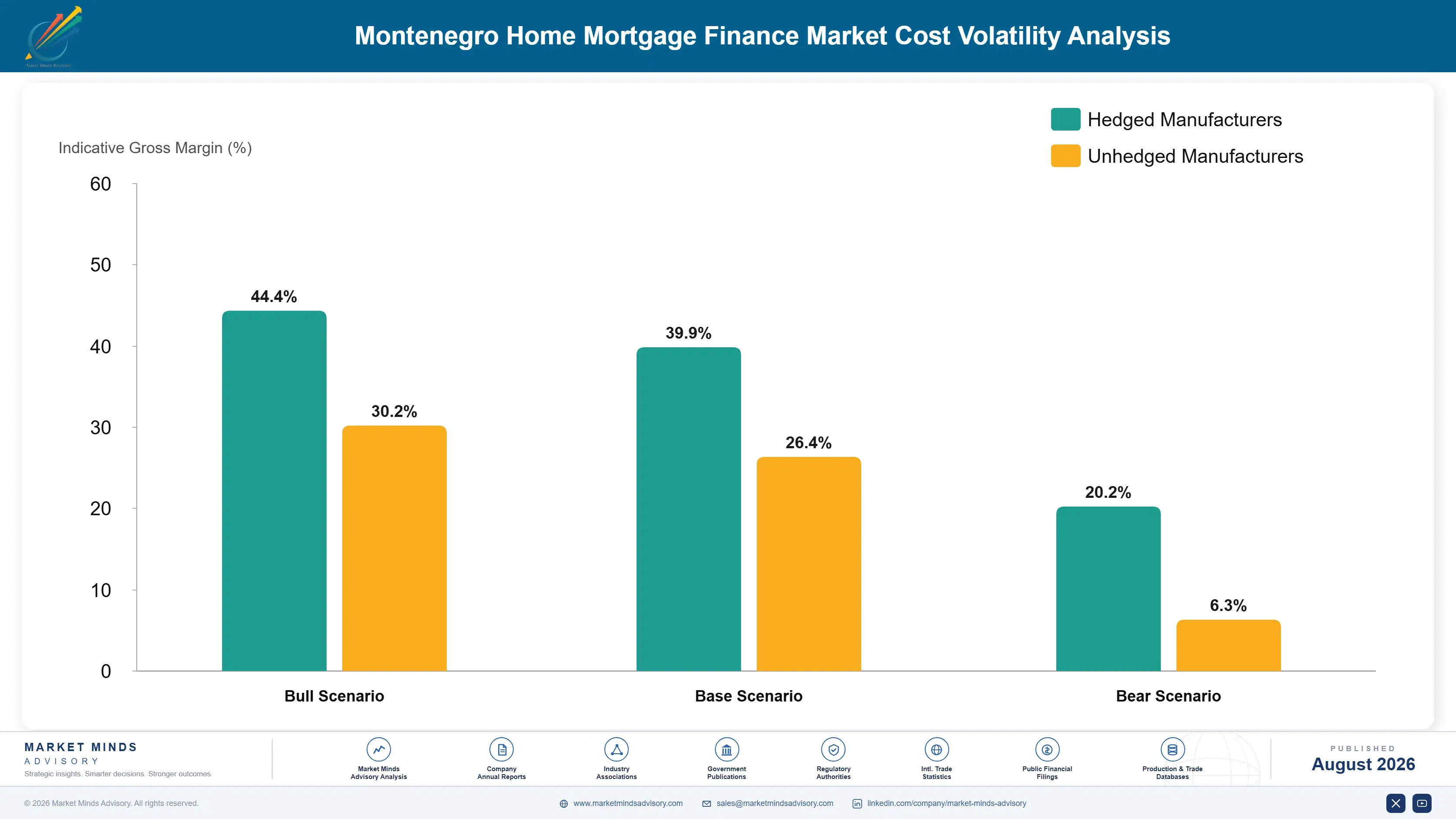
Funding cost divides into components that behave unlike those in a monetary union member. Retail and corporate deposits supply roughly 62% of mortgage funding, parent group lines near 21%, development finance facilities near 11%, and retained capital the remaining 6%. The liquidity buffer held against the absence of any euro lender of last resort is carried on top of all four.
The 2022 non-resident deposit influx demonstrated how quickly the funding base can move. Large sums arrived from Russia, Ukraine and Turkey within months, improving liquidity ratios across the system and then proving considerably less stable than domestic deposits when circumstances changed. NLB Group and OTP both discussed Western Balkan deposit volatility across that period in their annual reporting. Banks pricing lending off that temporary liquidity ended up funding long assets with balances already leaving.

Exposure to funding cost varies enormously and it decides who can compete. Foreign-owned subsidiaries draw on parent liquidity at group transfer pricing well below domestic deposit cost. Independent banks fund entirely locally and must carry heavier buffers, which shows directly in their mortgage rates. Development finance credit lines partly close that gap, but only for institutions carrying the verification overhead attached.
montenegro-home-mortgage-finance-market-cost-volatility-analysis-1787917276344

Development finance term funding to extend maturity profile

EBRD, KfW and European Fund for Southeast Europe facilities supply tenor and pricing no domestic deposit base can generate, which matters enormously for a nineteen year mortgage. The facilities remain undersubscribed because reporting and verification obligations deter smaller institutions. Two dedicated staff is the practical entry cost, against a funding advantage measured in triple digit basis points.

Deposit maturity lengthening through term product pricing

Paying meaningfully more for two and three year term deposits than for demand balances lengthens the funding profile and reduces the liquidity buffer a bank must hold without any lender of last resort behind it. The margin cost is real but smaller than the buffer cost it removes. Most Montenegrin banks price term and demand deposits far too closely together.

Non-resident deposit concentration limits by source country

The 2022 influx showed that deposits arriving from a single country during a single event leave the same way, so treating them as stable funding for long mortgage assets is a serious error. Capping reliance on any single source geography, and funding long assets only from balances with demonstrated stability, costs lending volume and prevents the mismatch that follows.

Portfolio Architecture for Margin Defence

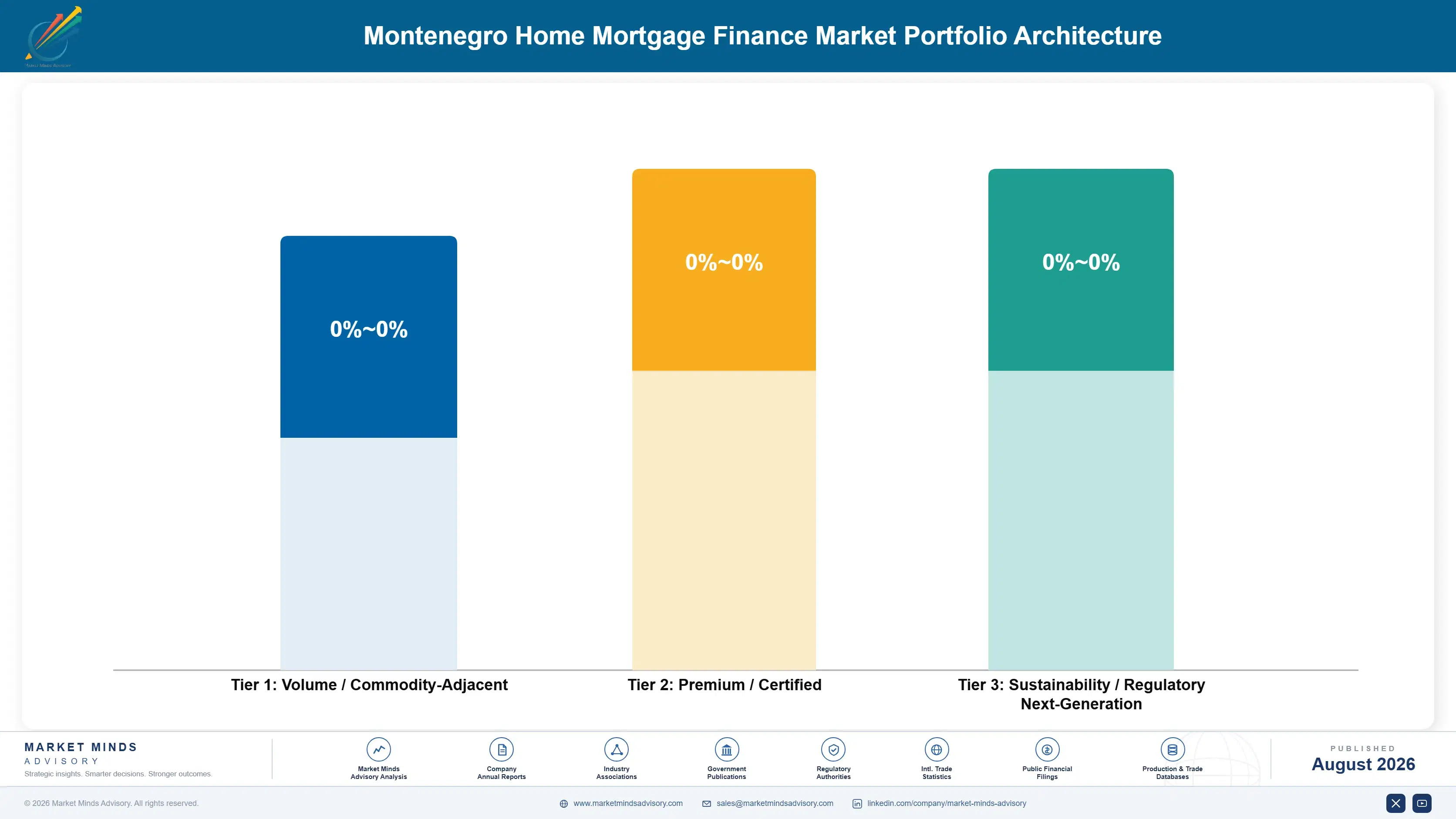
The mortgage portfolio separates by collateral behaviour rather than by borrower type. Standard resident purchase lending against inland and suburban dwellings is the volume core: conventional underwriting, collateral tracking domestic incomes, and margins compressed by competition among five banks pursuing the same limited eligible population. It exists because a bank of this size needs the volume, not because the individual loan earns anything remarkable.
Margin concentrates where competitors decline to operate. Non-resident and second home lending earns 120 to 180 basis points above domestic equivalents precisely because most institutions refuse to build the cross-border verification and enforcement capability required. Renovation lending funded through development finance lines earns well for the same reason inverted: the funding is cheap and the administrative overhead deters everybody unwilling to hire two people for it.

The genuine risk pool is coastal concentration, and it is not visible at portfolio level. Exposure clusters inside a handful of municipalities where non-resident demand sets prices entirely, so a foreign buyer withdrawal would reprice that collateral simultaneously while inland lending continued unaffected. Very few banks measure the exposure the way it would actually behave.

Volume / Commodity-Adjacent

Standard resident purchase mortgages secured on inland and suburban dwellings. Conventional underwriting, domestic income assessment and margins compressed by five banks competing for the same eligible population. Held for volume rather than for individual loan economics.
Gross Margin: 1.4-2.2%

Premium / Certified

Non-resident, second home and construction lending requiring cross-border verification or staged disbursement capability. Margins reflect the capability barrier rather than any higher credit risk, since loan-to-value limits on this business run materially lower throughout.
Gross Margin: 2.6-3.4%

Sustainability / Regulatory / Next-Generation

Energy efficiency renovation lending funded through development finance credit lines with completion grants attached. Margin comes from funding cost advantage rather than pricing, and depends entirely on carrying the verification overhead the facilities require.
Gross Margin: 3.2-4.6%
montenegro-home-mortgage-finance-market-portfolio-architecture-1787917276844

High-value Sub-segments and Strategic Watch-out

Non-Resident Second Home Lending

High value and high growth at 14.7%, as foreign buyers who paid cash in 2022 shift toward local credit. Margin persists only while most competitors continue declining the business and calling that decision prudence rather than incapacity. That remains a decision rather than any real constraint.
Gross Margin: 3.8-4.6%

Energy Efficiency Renovation Lending

High value with moderate growth at 12.4%, funded by development finance lines at below-market cost. The advantage is funding rather than pricing, and it lasts exactly as long as competitors decline to carry the reporting overhead attached. Two dedicated staff is the entire barrier involved.
Gross Margin: 3.0-3.8%

Resident Dwelling Purchase

The volume core, competed for by every bank in the market against a limited eligible population. Europe Now wage reform expanded that population meaningfully, which is why balances still grow despite margins that have not improved at all. Every bank in the country competes for it.
Gross Margin: 1.4-2.2%

Coastal Collateral Concentration

The strategic watch-out rather than a growth pool. Exposure clusters within a few municipalities where non-resident demand sets prices, so a foreign buyer withdrawal would reprice that collateral together while inland lending continued entirely unaffected. Very few banks here measure it that way at present.
Gross Margin: Variable

Why The Mortgage Book Persists

A nineteen year average maturity produces annuity economics that require nothing from the lender once the loan is written. Repayments arrive monthly regardless of competitive activity, and refinancing is uncommon because switching costs, notarial fees and re-registration expenses exceed any rate saving available in a market where five banks price within a narrow band of one another. That inertia is worth more than any acquisition campaign a bank could run.
Depth varies sharply between the two buyer populations. Resident households borrow against dwellings their salaries service, hold the loan to term, and rarely move. Non-resident purchasers behave quite differently: they refinance more readily, repay early when circumstances abroad change, and treat the property as a portfolio position rather than a home. Diaspora households sit between the two, servicing loans from remittances that arrive reliably from incomes no bank can verify.

Buyer profiles are shifting as wage reform and accession progress together. Younger employed households now pass debt service tests that excluded them before 2022, entering the market with no prior banking relationship anywhere. Older households hold loans written under considerably tighter eligibility. No bank here currently serves both groups with genuinely different propositions, and most have not noticed the divergence.
montenegro-home-mortgage-finance-market-end-use-penetration-index-1787917277333

Where Montenegrin Lenders Should Concentrate

These are among the four positions where our research anticipates prominent divergence between winners and laggards over the coming forecast period. Each is grounded in the demand model, the regulatory perimeter, and the announced capacity pipeline.
01 / NON-RESIDENT UNDERWRITING CAPABILITY

The segment competitors decline is the one that pays

Most Montenegrin banks refuse non-resident mortgage applications because income verification crosses jurisdictions and enforcement against a foreign borrower has never once been properly tested in the local courts. That refusal hands the fastest growing segment in the market, expanding at 14.7%, to the two or three institutions willing to build the capability properly. Rates run 120 to 180 basis points above domestic lending against lower loan-to-value limits, so the risk-adjusted return is materially better than anything else currently available to them.
02 / TERM FUNDING ACCESS

Development finance lines are undersubscribed for administrative reasons

EBRD, KfW and the European Fund for Southeast Europe supply tenor and pricing that no Montenegrin deposit base could ever generate, which matters enormously against a nineteen year average mortgage maturity here. Those lines remain undersubscribed because verification and reporting obligations deter smaller institutions from ever applying at all. The practical entry cost is roughly two dedicated members of staff, set against funding perhaps 130 to 190 basis points cheaper than a bank's own blended deposit and liquidity buffer cost.
03 / COLLATERAL CONCENTRATION CONTROL

Measure coastal exposure by municipality, not by portfolio

Portfolio-level coastal limits conceal the exposure that actually matters most, because non-resident demand sets prices inside a handful of municipalities rather than across the whole coast evenly. A bank at 30% coastal exposure clustered in Budva and Tivat carries far more correlated risk than the headline figure suggests to anybody reading the report. Municipality-level caps typically reveal 15% to 20% of a book already sitting above prudent concentration, and repricing that portion removes the largest single correlated exposure the bank holds.
04 / ENFORCEMENT BASED REPRICING

Price loss given default off current procedure, not history

Accession reform has shortened foreclosure timelines and improved cadastre completeness together, yet nearly every bank here still prices loss given default using historical enforcement experience because the newer evidence base still looks uncomfortably thin. Rebuilding those estimates on current procedure typically supports 40 to 70 basis points of rate reduction on well-secured domestic lending without any change at all in risk appetite. That is enough to take share from competitors still pricing against enforcement timelines the courts no longer produce.

Engagement Snapshot From the Field

A live engagement with an industry participant carrying material or product regulatory and market exposure ahead of a defining policy shift, showing how our research translates into a defensible multi-year portfolio strategy.
MARKET MINDS ADVISORY · CLIENT ENGAGEMENT SUMMARY
Montenegro Home Mortgage Finance Producer Strategic Portfolio Review and Transition Roadmap 2026·Investment Scenario on Montenegro Home Mortgage Finance Exposure Evaluation 2025-26
CLIENT PROFILE
An independently owned Montenegrin bank holding a mid-market position in residential mortgage lending, funded almost entirely from domestic deposits with no parent group liquidity line available to it. The institution had grown its mortgage book steadily since 2022 while its net interest margin narrowed each year, and management could not establish whether the cause was competitive pricing or its own funding structure.
STRATEGIC CHALLENGE
The board needed to compete against foreign-owned subsidiaries drawing on parent liquidity at group transfer pricing, without a comparable funding source of its own. It also suspected its coastal exposure was more concentrated than portfolio reporting suggested, but had no framework for measuring how that collateral would actually behave under a withdrawal of foreign buyers.
MMA APPROACH
MMA decomposed the funding base by source, stability and maturity, modelled the liquidity buffer cost attributable to the absence of any euro lender of last resort, and rebuilt coastal exposure analysis at municipality rather than portfolio level. Expert interviews with development finance institutions, valuation practices and cross-border enforcement counsel established what funding and capability were genuinely obtainable at the bank's scale.
KEY FINDINGS
  1. Liquidity buffers held against the absence of a lender of last resort cost roughly 84 basis points of margin, considerably more than the pricing gap against foreign-owned competitors.
  2. Development finance credit lines the bank had never applied for would have supplied term funding around 150 basis points below its blended domestic cost of funds.
  3. Coastal exposure stood at 34% of the mortgage book but clustered across only two municipalities, representing a correlated concentration the portfolio reporting had never once identified.
  4. Non-resident applications were being declined at 91%, largely through absence of any verification procedure rather than through any considered assessment of the underlying credit.
CLIENT PROFILE
An independently owned Montenegrin bank holding a mid-market position in residential mortgage lending, funded almost entirely from domestic deposits with no parent group liquidity line available to it. The institution had grown its mortgage book steadily since 2022 while its net interest margin narrowed each year, and management could not establish whether the cause was competitive pricing or its own funding structure.
STRATEGIC CHALLENGE
The board needed to compete against foreign-owned subsidiaries drawing on parent liquidity at group transfer pricing, without a comparable funding source of its own. It also suspected its coastal exposure was more concentrated than portfolio reporting suggested, but had no framework for measuring how that collateral would actually behave under a withdrawal of foreign buyers.
MMA APPROACH
MMA decomposed the funding base by source, stability and maturity, modelled the liquidity buffer cost attributable to the absence of any euro lender of last resort, and rebuilt coastal exposure analysis at municipality rather than portfolio level. Expert interviews with development finance institutions, valuation practices and cross-border enforcement counsel established what funding and capability were genuinely obtainable at the bank's scale.
KEY FINDINGS
  1. Liquidity buffers held against the absence of a lender of last resort cost roughly 84 basis points of margin, considerably more than the pricing gap against foreign-owned competitors.
  2. Development finance credit lines the bank had never applied for would have supplied term funding around 150 basis points below its blended domestic cost of funds.
  3. Coastal exposure stood at 34% of the mortgage book but clustered across only two municipalities, representing a correlated concentration the portfolio reporting had never once identified.
  4. Non-resident applications were being declined at 91%, largely through absence of any verification procedure rather than through any considered assessment of the underlying credit.
RECOMMENDED STRATEGY
Phase 1: Phase one: apply for development finance term funding facilities and recruit the two staff required to carry the verification and reporting obligations attached. Phase 2: Phase two: rebuild coastal exposure limits at municipality level and reprice or decline the portion sitting above prudent concentration thresholds. Phase 3: Phase three: establish cross-border income verification and enforcement procedures to underwrite non-resident applications rather than simply declining them by default.
OUTCOME
The client reported net interest margin improving by 41 basis points within five quarters (client-reported, unverified by MMA), with roughly two thirds attributable to the development finance funding lines. Coastal concentration fell from 34% to 26% of the book. Non-resident lending reached 7% of new origination, written at rates well above the domestic average throughout.

Frequently Asked Questions

Foundational context covering the market sizes, CAGR, scope, country, region and competition that inform every finding below. This section is provided to cover basics and most often pre-purchase conversations, answered from the MMA Primary Research Dataset.

What is the current size of the Montenegro Home Mortgage Finance Market?

The market is valued at USD 1.3 billion in 2025, measured as outstanding residential mortgage balances secured on Montenegrin dwellings. Penetration sits near 16% of national economic output.

How large will the Montenegro Home Mortgage Finance Market be by 2036?

MMA forecasts USD 3.64 billion by 2036, up from USD 1.43 billion in 2026. That represents incremental balances of USD 2.21 billion and an expansion multiple of 2.55 times.

What is the CAGR for the Montenegro Home Mortgage Finance Market 2026 to 2036?

The base case CAGR is 9.8%, with a bull case of 11.0% and a bear case of 8.6%. Low starting penetration and wage reform supply most of that growth.

Which segment is growing fastest?

Non-resident and second home mortgages grow at 14.7%, half again the market rate of 9.8%. Foreign buyers who paid cash in 2022 are increasingly arranging local credit instead.

Who are the major companies in the Montenegro Home Mortgage Finance Market?

Crnogorska Komercijalna Banka, NLB Banka Podgorica, Erste Bank Podgorica, Hipotekarna Banka and Prva Banka Crne Gore lead, holding around 74% of residential mortgage balances between them.

Which country is growing fastest?

India grows fastest at 11.8%, reflecting expanding offshore processing and development work for parent banking groups rather than any lending activity. All mortgages here are secured domestically.

Report Segmentation Architecture

The full report scope spans multiple orthogonal segmentation dimensions, with cross-tabulated demand data provided for each dimension pair. Coverage extends further to regional breakdowns, trend trajectories, and the competitive detail needed to support segment-level decision-making.

By Loan Purpose

  • New Build Purchase Mortgages
  • Existing Dwelling Purchase Mortgages
  • Construction and Self-Build Loans
  • Home Improvement and Renovation Loans
  • Refinancing and Balance Transfer
  • Non-Resident and Second Home Mortgages

By End-Use Industry

  • Resident Households
  • Non-Resident Purchasers
  • Diaspora Remitting Households
  • Tourism Rental Investors
  • Public Sector Employees
  • Small Business Owner Households

By Commercial Dimension

  • Branch Origination
  • Developer Partnership Channels
  • Real Estate Agency Referral
  • Digital Application Channels
  • Employer Payroll Schemes
  • Development Finance Credit Lines

By Region

  • North America
  • Western Europe
  • East Asia
  • South Asia and Pacific
  • Latin America
  • Middle East and Africa
  • Eastern Europe

Scope, Methodology, and Coverage

Every figure in this report is reproducible from documented input assumptions. The scope below maps the historical period, the forecast horizon, the segmentation dimensions, and the countries covered, alongside the underlying primary and qualitative methodology.
Historical Period
2020 to 2025
Forecast Period
2026 to 2036
Base Year
2025 (USD billions; MMA Primary Research Dataset, August 2026)
Market Definition
Outstanding residential mortgage lending secured on dwellings located in Montenegro, spanning new build and existing dwelling purchase, construction and self-build, renovation and energy efficiency work, refinancing, and non-resident second home acquisition. Lending by licensed banks and by development finance institutions channelling credit lines through them is included. Commercial real estate lending, unsecured consumer credit and cash property purchases completed without borrowing are excluded.
Quantitative Units
USD billions, outstanding mortgage balances
Segmentation Dimensions
Loan purpose, borrower household type, commercial origination dimension, region
Regions Covered
North America, Western Europe, East Asia, South Asia and Pacific, Latin America, Middle East and Africa, Eastern Europe
Countries Covered
Montenegro, with funding and purchaser exposure across Western Europe, Eastern Europe, Middle East and Africa
Key Companies Profiled
Crnogorska Komercijalna Banka, NLB Banka Podgorica, Erste Bank Podgorica, Hipotekarna Banka, Prva Banka Crne Gore, Universal Capital Bank, Lovcen Banka, Adriatic Bank, Zapad Banka, Ziraat Bank Montenegro
Quantitative Methodology
Primary survey, n=3,800 respondents, Q4 2025, six countries; demand-side model with trade association cross-validation
Qualitative Methodology
47 expert interviews, Q4 2025; applied to validate demand model assumptions, identify emerging dynamics, and assess competitive positioning
Report Format
PDF and XLSX data workbook (Word format preview document)
Publisher
Market Minds Advisory
Report Code
MMA-2026-TEC-391
Published
August 2026
Contact
sales@marketmindsadvisory.com | www.marketmindsadvisory.com

Purchase the full Montenegro Home Mortgage Finance Market Report (2026 to 2036).

The full report examines Montenegrin home mortgage finance as a lending market operating in a currency no domestic institution can create, and identifies where margin survives that constraint. It quantifies the liquidity buffer cost imposed by the absence of a euro lender of last resort, models the funding gap between foreign-owned subsidiaries and independent domestic banks, and rebuilds coastal collateral exposure at municipality rather than portfolio level. Segment analysis covers all six loan purposes with particular attention to non-resident lending most institutions decline. Competitive assessment ranks twenty participants on mortgage balances held or funded. Regional coverage addresses parent funding, development finance and non-resident demand as the forces setting domestic pricing.
Six loan purpose segmentation with growth rates
Liquidity buffer cost quantified against eurozone comparators
Twenty participant assessment on mortgage balances
Municipality level coastal concentration exposure analysis
Development finance credit line access and pricing benchmarks
Enforcement timeline impact on loss given default

Built For The People Who Decide

From boardroom strategy to bench-side execution, this report is read cover-to-cover by leaders shaping the next decade of their industry, turning demand scenarios, market dynamics and valuation benchmarks into decisions.
CXOs/ Presidents/ VPs/ Managers
M&A and Corporate Development
Strategy Teams and R&D Heads
Procurement and Product Directors
Regulatory and Compliance Leaders
Investor Relations and Equity Analysts