Market Minds Advisory
Mono-Material Packaging Film Market

Mono-Material Packaging Film Market: Recyclability Bought With a Fifteen Degree Window

A laminate works because the outer web melts far above the sealant. Building both from one polymer removes that difference, which is exactly what makes the structure recyclable and exactly what stops production lines.

Lead Analyst

Bilal Shaikh

Published

September 2026

Make Smarter Decisions with Customized Research Insights

Request a free sample report and evaluate market opportunities, growth trends, and competitive dynamics relevant to your business needs.

2025 MARKET VALUE$4.8BMarket Size 2025
2036 FORECAST VALUE$16.7BBase Case , 2026 to 2036
CAGR 2026 TO 203612.0 %Bull 13.2% / Bear 10.8%
INCREMENTAL OPPORTUNITY$11.3BNet 10- year value creation
EXPANSION MULTIPLE3.10x2036 value over 2026 base
Strategic Levers
M&A Pipeline
Regional Outlook
Country Rankings
Competitive Intelligence
Segmental Deep-dive
Call-Us : 91 93563 13602

Executive Snapshot and Market Trajectory

Conventional laminates work because the polyester outer web melts far above the polyethylene sealant, so a sealing jaw melts one and not the other. Build both webs from the same polymer family and that difference disappears, which is the entire point and the entire problem.
Growth is driven by regulation rather than by any performance advantage, since these structures cost more and run slower than what they replace. Oxide-coated mono-material barrier grows fastest at 18.0%, exactly 1.50 times the market rate, because barrier without polyester or foil is what most structures actually need. All-polypropylene follows at 14.6%. Western Europe holds the largest share, well above its framework band, entirely on design-for-recycling legislation that exists nowhere else in comparable form.
Concentration reaches 33% across the top five measured on annual mono-material volume converted, split between flexible converters and the polyolefin producers who supply the oriented substrates. Adoption is happening despite the economics rather than because of them: these structures need 22% more microns for equivalent stiffness, and they run 18% slower on filling machines built around polyester laminates that nobody has yet retuned for a softer web.
Market Definition
This market covers flexible packaging films constructed entirely within one polymer family so the finished structure enters a single recycling stream, spanning all-polyethylene non-barrier, metallised mono-material barrier, oxide-coated mono-material barrier, all-polypropylene, ethylene vinyl alcohol containing, and retort-capable mono-material structures. Scope is measured at converter realised prices. Multi-material laminates, monolayer films without laminated construction, rigid packaging, base resin production, and packaging machinery are excluded.
Base Year Value
$4.8B in 2025 (MMA Primary Research Dataset, August 2026)
Forecast Period
2026 to 2036, eleven discrete annual values
CAGR
12.0% base case. Bull 13.2%. Bear 10.8%.
Fastest Growth Segment
Oxide-Coated Mono-Material Barrier: 18.0% CAGR
Fastest Growth Country
China: 19.8% CAGR
Fastest Growth Region
South Asia and Pacific: 14.0% CAGR
Largest Region
Western Europe: 33% of 2025 global value
Market Leaders
Amcor, Mondi, Berry Global, Constantia Flexibles, Dow. Source: MMA Analysis based on company annual reports.
Primary Survey
n=3,800 procurement and R&D decision-makers, Q4 2025, six countries
Methodology
Demand-side build-up, cross-validated against public data, 47 expert interviews

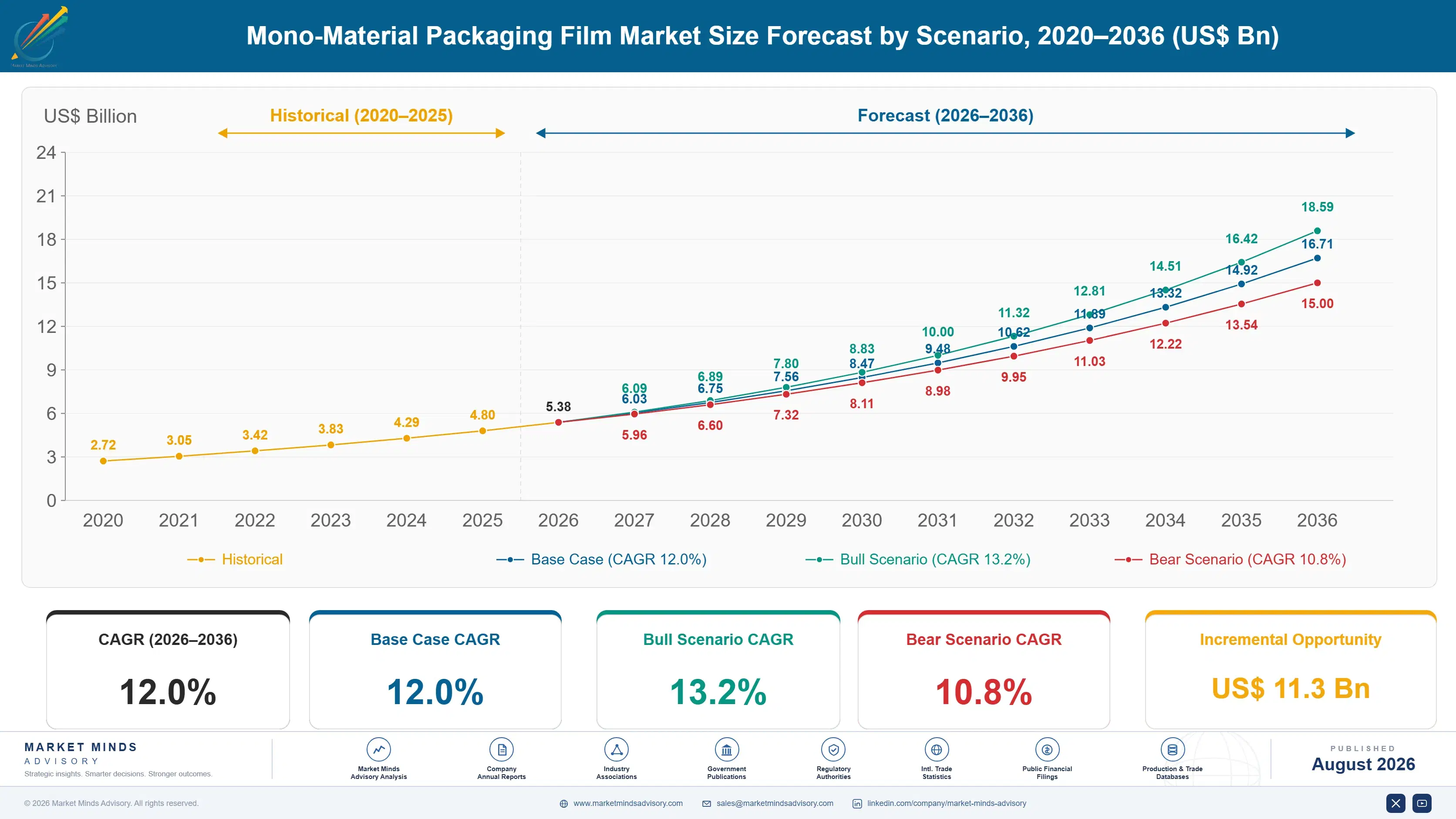
Mono-Material Packaging Film Market Forecast Scenarios

mono-material-packaging-film-market-size-forecast-scenario-1787299406943
The 2020 to 2025 period took mono-material from demonstration to obligation. European packaging rules moved from aspiration toward dated design-for-recycling requirements, and brand owners published commitments that their converters then had to deliver against. Oriented polyethylene substrate capacity was built to serve it, largely in China. A 10.6% historical rate reflects a category growing from a small base against genuine technical difficulty rather than easy demand.
Three mechanisms carry the 12.0% base case. European design-for-recycling requirements are the largest, since compliance is dated and non-compliant structures face escalating producer responsibility fees or outright exclusion from the market. Brand global standardisation is the second, as companies headquartered in Europe apply the same packaging specification across markets with no such rule of their own. And barrier development is the third, where oxide coating finally allows a recyclable structure to hold commercially useful shelf life.
The 13.2% bull case rests on sealing window widening through resin and structure development, which would remove the line speed penalty that currently makes converters and fillers resist adoption. The 10.8% bear case is design-for-recycling thresholds proving unattainable for high-barrier applications, which would force regulators to grant exemptions and remove the compulsion that drives this entire category.

The Property You Have to Give Up

Everything about this category follows from one physical fact. A conventional laminate pairs a polyester outer web melting near two hundred and fifty degrees with a polyethylene sealant melting near one hundred and twenty, which gives the sealing jaw around forty degrees of latitude to melt one and not the other. Oriented polyethylene outer webs melt barely above their own sealant, and that latitude collapses to roughly fifteen degrees.
TOP FIVE CONCENTRATION33%Split between flexible converters and polyolefin resin producers
MONO-MATERIAL SEALING WINDOW15 degreesTemperature latitude before the outer web begins burning through
CONVENTIONAL STRUCTURE WINDOW40 degreesLatitude available where the outer web is polyester
THICKNESS PENALTY22%More microns required for equivalent stiffness against polyester structures
MAXIMUM BARRIER CONTENT5%Ethylene vinyl alcohol permitted before recyclability classification is lost
LINE SPEED REDUCTION18%Slower running achieved on machines designed for polyester laminates
Fifteen degrees is not much on a vertical form-fill-seal machine running at speed with a jaw that heats unevenly across its width. Below the window the pack does not seal; above it the outer web burns through. Fillers respond by slowing the line, typically by around 18%, which is a real cost that appears nowhere in the film price and lands on somebody who did not choose the material.
Two other penalties compound it. All-polyethylene structures need roughly 22% more microns for equivalent stiffness, so material cost per square metre rises even though the resin is cheaper. And design-for-recycling guidelines cap ethylene vinyl alcohol content near 5%, which removes the easiest barrier solution available and pushes converters toward oxide coating they mostly do not have.
"Brands announce the recyclable pack and the converter takes the credit. Six months later somebody in a filling hall is running eighteen percent slower on a fifteen degree window and nobody has costed that anywhere. The film quotation was the small part of what this actually costs."
Director, Recyclable Flexible Structures Practice · MMA Packaging and Recyclable

Market Trends

Oxide Coating Replaces Barrier That Recyclability Rules Removed

Design-for-recycling guidelines cap ethylene vinyl alcohol content near 5% of structure weight, which is well below what most barrier applications need, and they exclude polyester and foil entirely from a polyethylene structure. Silicon and aluminium oxide coatings applied to oriented polyethylene deliver oxygen and moisture barrier while remaining wholly within the polymer family. That is currently the only route to a genuinely high-barrier recyclable flexible structure. Growth runs at 18.0% against a market rate of 12.0%, and coating capacity rather than demand is the present constraint on how fast it can grow further.
Market Impact: Fee spread reaches 3.4 times
Oriented Polyethylene Substrate Capacity Is Being Built In Asia

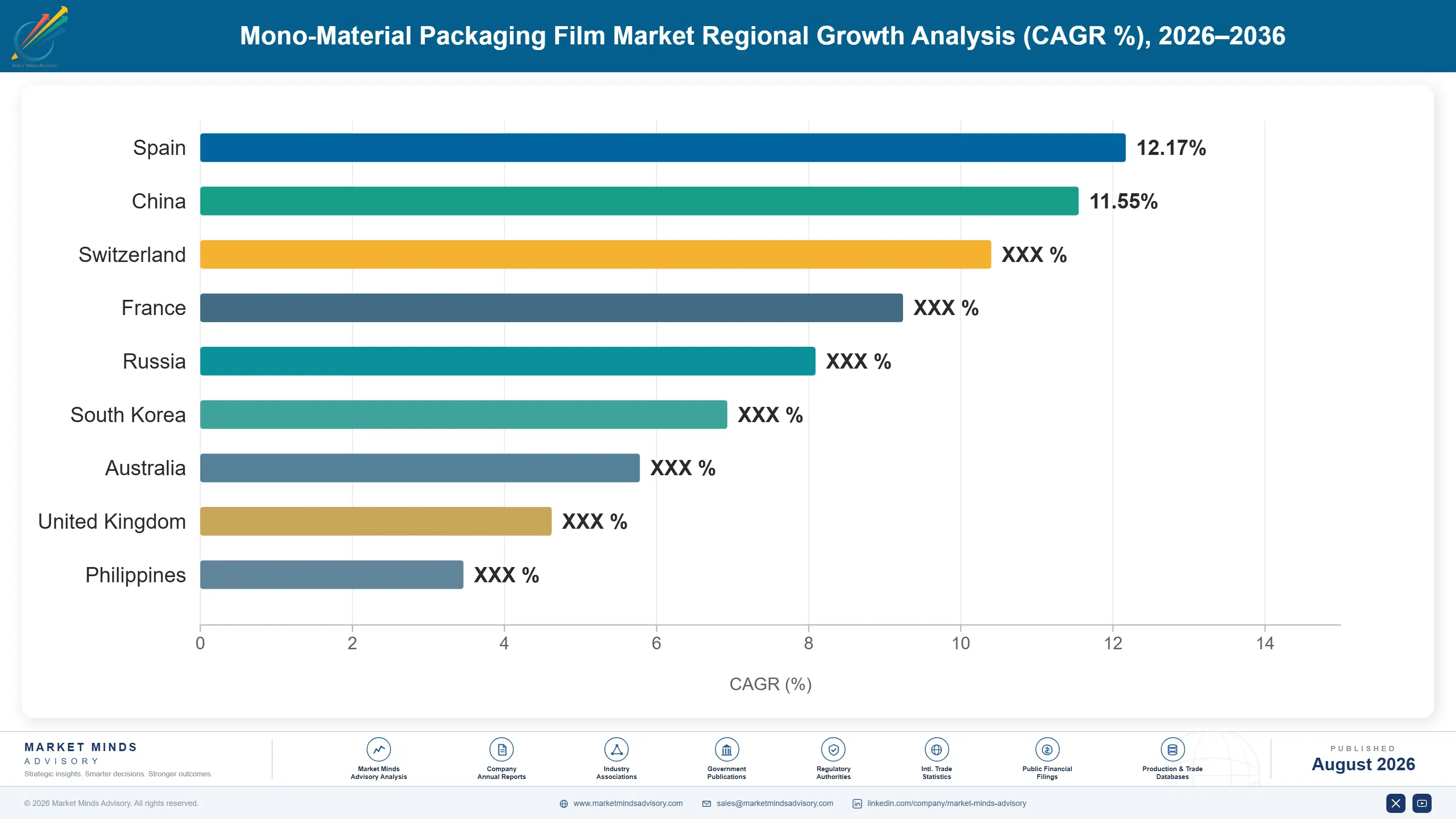
Machine direction oriented and biaxially oriented polyethylene are the substrates that make an all-polyethylene laminate possible at all, since unoriented film lacks both the stiffness and the heat resistance an outer web requires. Most new capacity for these grades has been commissioned in China, which places the substrate supply base for a European regulatory programme several thousand kilometres from the converters who need it. China contributes the fastest national growth rate in this forecast at 19.8%, reflecting both that capacity and rapid domestic conversion demand. European converters import the material their own regulation created demand for.
Market Impact: Around 33% of non-European volume

Market Opportunities and Growth Drivers

European Rules Make Non-Compliant Structures Progressively Expensive

Design-for-recycling requirements attached to producer responsibility fees mean a multi-material structure now costs more to place on the market than a mono-material equivalent, independently of what the film itself costs. Eco-modulated fee spreads reach several times between best and worst recyclability bands, and dated compliance requirements are following behind them. That converts an environmental preference into a recurring line on a brand's own accounts. Converters no longer need to persuade anybody, which is a considerable change from five years ago. The argument now happens inside the brand between packaging and finance rather than with the supplier.
Market Impact: Cuts line speed by 18%

Brand Standardisation Exports European Rules To Unregulated Markets

Consumer goods companies headquartered in Europe apply a single packaging specification across their global operations, because running two structures for the same product doubles qualification work and complicates supply. That means design-for-recycling requirements written for European regulation arrive in markets with no equivalent rule at all. Around a third of mono-material volume outside Europe exists for this reason rather than for any local requirement. Converters in those markets must build capability against a regulation their own government has never contemplated. Qualification work and application engineering both have to be built where no regulator asked for them.
Market Impact: Requires 22% more material

Market Restraints and Challenges

A Fifteen Degree Window Stops Filling Lines

Sealing latitude in an all-polyethylene structure runs near fifteen degrees against roughly forty in a conventional polyester laminate, because the outer web and the sealant belong to the same polymer family and melt within a narrow range of one another. The root cause is construction rather than any quality problem. Commercial impact falls on the filler, who slows the line by around 18% to stay inside the window, and who did not choose the material. Participants are working on higher melting oriented grades, sealant modification, and jaw temperature uniformity. None of that has widened the window much yet.
Market Impact: Growing at 18.0% annually

Equivalent Stiffness Costs Twenty-Two Percent More Material

Oriented polyethylene is less stiff than polyester at the same thickness, so a mono-material structure needs around 22% more microns to run on the same machine and hold the same pack shape. Polyethylene resin is cheaper per kilogram, and the extra material largely erases that advantage on a cost per square metre basis. The root cause is polymer modulus and no processing change alters it. Mitigation runs through higher orientation ratios, stiffer polyethylene grades, redesign of the pack itself, and accepting reduced downgauging targets. Nobody has removed it and the penalty looks permanent.
Market Impact: China grows at 19.8% annually
3 additional market trends, 4 additional growth drivers, and 2 additional restraints and challenges are covered in the full report. Contact sales@marketmindsadvisory.com to access the complete intelligence.

Segment CAGR and Growth Architecture

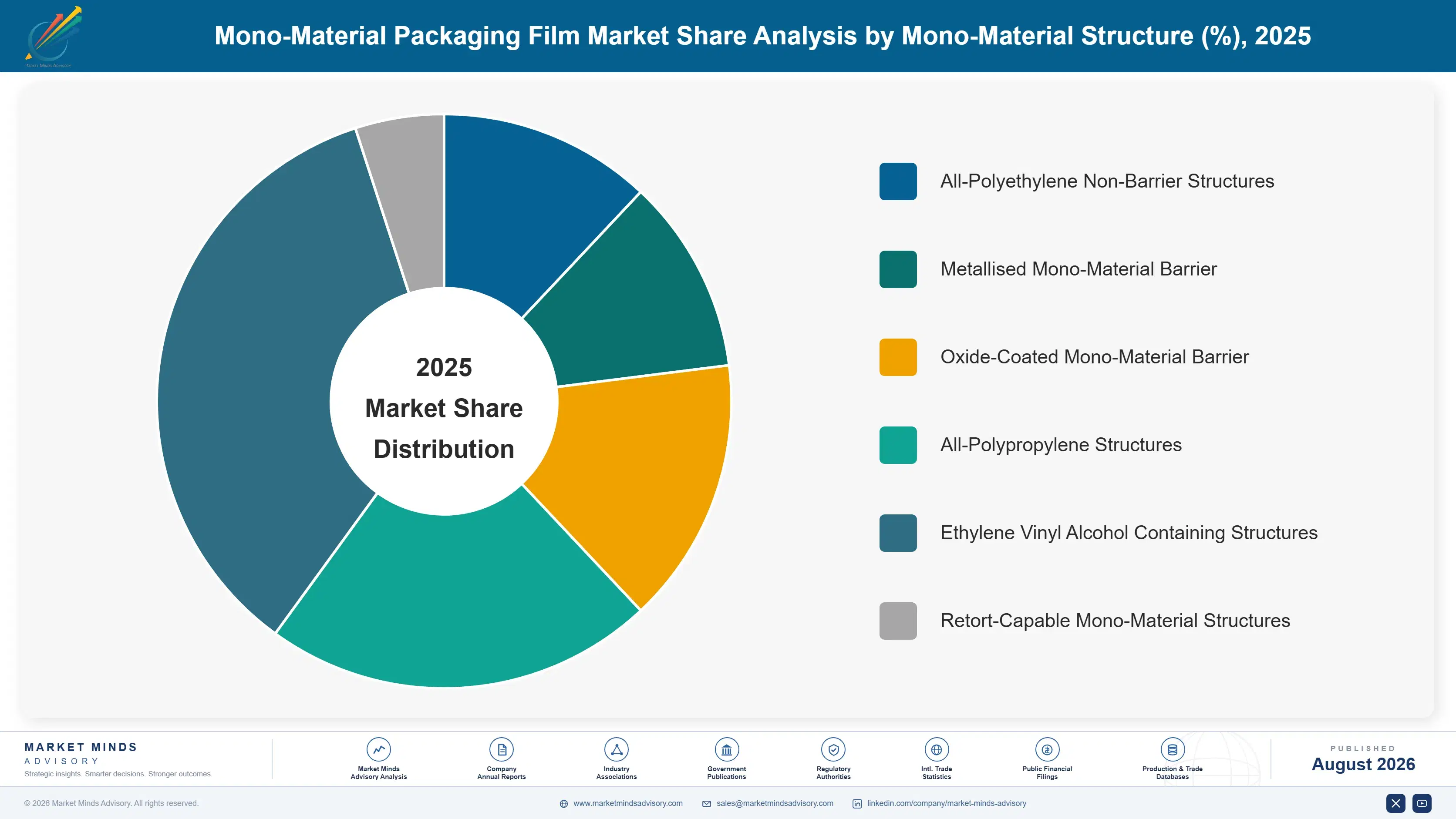
Segmentation follows mono-material structure, because structure determines the barrier delivered, the sealing behaviour a filler will experience, the machinability of the web, and whether the design satisfies recyclability classification at all. End-use category and pack format both cut across every structure rather than separating them cleanly, so neither works as a primary dimension here.
mono-material-packaging-film-market-market-share-analysis-1787299407474

Oxide-Coated Mono-Material Barrier

The fastest structure at 18.0%, exactly 1.50 times the market rate, and currently the only route to genuinely high barrier inside a recyclable flexible pack. Silicon and aluminium oxide coatings a few nanometres thick applied to oriented polyethylene deliver oxygen and moisture performance far above uncoated film while adding no material that breaks polymer family classification. Coating capacity is the constraint rather than demand, since oxide deposition equipment is expensive and the qualified converter set remains small. Flex-crack resistance is the technical weakness, because the coating is brittle and a fold in distribution can compromise the barrier it provides. Coated film also demands tighter web handling through lamination than uncoated substrate does.
CAGR 18.0%

All-Polypropylene Structures

Second fastest at 14.6%, and technically easier than all-polyethylene because oriented polypropylene already exists in volume as a stiff outer web with a genuinely useful melting point gap above cast polypropylene sealant. That gives a wider sealing window than the polyethylene equivalent achieves, which fillers notice immediately. The obstacle is that polypropylene recycling streams are less developed than polyethylene ones in most collection systems, so a technically superior structure can score worse on actual recyclability. Confectionery, snacks, and dry goods have adopted it fastest, since those applications need stiffness and clarity more than they need extreme barrier. Recycling collection infrastructure rather than any film performance limitation is what constrains this structure now.
CAGR 14.6%
Full segment breakdown across 6 segments available in the complete report.

Regional Architecture and Country Demand Map

Adoption follows regulation rather than any commercial advantage, since these structures cost more per square metre and run slower on the line than what they replace. Western Europe sits well above its framework band on design-for-recycling legislation that exists nowhere else in any comparable form.

Western Europe

Thirty-three percent, well above the framework band, and the justification is legislation that has no equivalent anywhere else. Design-for-recycling requirements attached to producer responsibility fees make multi-material structures progressively more expensive to place on the market, and dated compliance obligations follow behind the fee pressure. German, Italian, and Spanish converters lead on all-polyethylene development because their customers demanded it first. Brand owners headquartered here also export the specification globally. Growth at 10.5% is the slowest of any region only because the base is already the largest and the easiest conversions have happened. What remains here is retort, high-barrier, and private label volume that nobody has yet worked out how to fund. The straightforward conversions are finished.
Share: 33% | CAGR: 10.5% (2026 to 2036)

East Asia

Twenty-six percent, and China holds most of the world's oriented polyethylene substrate capacity, which places the material base for a European regulatory programme thousands of kilometres from the converters implementing it. China contributes the fastest national growth rate in this forecast at 19.8%, reflecting that substrate position alongside rapidly growing domestic conversion for both export and local brands. Japanese and Korean adoption is smaller and driven by brand commitment rather than by any rule. Growth at 13.2% runs above the global rate on substrate capacity and on export conversion for European-bound product. Substrate exported west while adoption remains modest at home, which is an odd shape for a supply base of this size.
Share: 26% | CAGR: 13.2% (2026 to 2036)
Regional intelligence for 5 additional markets available in the complete report: North America, South Asia and Pacific, Latin America, Middle East and Africa, Eastern Europe. Contact sales@marketmindsadvisory.com.
mono-material-packaging-film-market-country-cagr-analysis-1787299407993

Selling a Film That Runs Slower

Nobody buys mono-material because it performs better, since it plainly does not. Value comes from selling the sealing window rather than the recyclability claim, from supplying machine commissioning alongside the film itself, from recovering part of the thickness penalty through orientation and grade, and from building oxide barrier capacity before the demand for it arrives.

Sell The Sealing Window Rather Than The Recycling Claim

Every converter can offer a recyclable structure, and the brand already knows it needs one, so the claim differentiates nothing at all. What differentiates is sealing latitude, because a structure offering twenty degrees instead of fifteen lets the filler run measurably faster and recovers part of the 18% speed penalty. Measuring and publishing window data across a structure range costs around 700,000 dollars in test capability. It converts a compliance conversation into a productivity one that the filling operation actually cares about. Fillers do not buy recyclability, and they never have.
Market Impact: Sealing window test capability costs about 700,000 dollars

Supply Machine Setup Alongside The Film Itself

Mono-material film stretches more and tolerates less heat than the polyester structures a filling machine was set up for, and most line problems attributed to the film are actually tension and temperature settings nobody adjusted. Converters who send an application engineer to commission the film on the customer's own machine resolve those problems in days rather than months. That service costs perhaps 4,000 dollars per line and converts an unhappy trial into a running programme, which no amount of film improvement achieves on its own. Trials fail on settings, not on film.
Market Impact: Commissioning support costs about 4,000 dollars per line

Recover The Thickness Penalty Through Orientation And Grade

All-polyethylene structures need roughly 22% more microns for equivalent stiffness, which erases the resin cost advantage entirely on a square metre basis. Higher orientation ratios and stiffer polyethylene grades recover part of that, typically eight to twelve percentage points, and redesigning the pack itself recovers more where the brand will engage on it. Each micron removed is material cost saved permanently across the programme life. Converters accepting the penalty as fixed are leaving the largest available saving untouched. Most converters never try, because the penalty arrived with the polymer and looked like a property rather than a choice.
Market Impact: Recovers 8 to 12 percentage points of thickness

Build Oxide Barrier Capacity Ahead Of Demand Arriving

Ethylene vinyl alcohol is capped near 5% by recyclability guidelines and polyester and foil are excluded outright, which leaves oxide coating as the only route to high barrier inside a compliant structure. Coating capacity rather than demand is the current constraint, and equipment costs roughly 18 million dollars per line with an eighteen month lead time. Converters commissioning now will be supplying applications that competitors physically cannot serve when dated compliance requirements arrive. Demand already exceeds installed European capacity, and the enquiries that get declined do not come back later.
Market Impact: Oxide coating line costs about 18 million dollars

Who Controls the Margin Pool

Concentration reaches 33% across the top five measured on annual mono-material volume converted, and the composition is unusual because resin producers appear alongside converters. Polyolefin manufacturers developed the oriented grades and the sealant chemistries that made these structures possible in the first place, and they now market them as qualified systems rather than as raw material. That places them inside a value chain they historically supplied at arm's length, and the gap between lea
Competition runs on three fronts. Sealing window performance is the first and it is what fillers actually experience on the line, though almost nobody markets on it. Oxide coating capacity is the second, since it restricts who can serve high-barrier applications at all. Application engineering is the third, because most reported film failures turn out to be machine setup problems in disguise.

Pressure comes from two directions. Chinese converters with local oriented substrate supply compete on landed cost against European converters importing the same material. And any regulatory exemption granted for high-barrier applications would remove the compulsion this entire category depends upon, which is where rankings would shift fastest.
mono-material-packaging-film-market-company-positioning-matrix-1787299408516

Competitive Moat and Risk Dimensions

AMCOR

Moat: Global structure qualification across markets

Brand owners applying one packaging specification worldwide need a converter who can supply the identical qualified structure on several continents, and very few can. Mono-material qualification is more demanding than conventional laminate work because sealing behaviour must be validated on each customer machine. Holding that capability across a global footprint is worth more than any technical advantage in film construction.
AMCOR

Risk: Portfolio conversion is enormous work

Global scale means every structure in a very large portfolio eventually needs a compliant successor, and each one requires shelf life testing and machine validation with individual customers. That programme is far larger for a multinational converter than for a regional one with fewer structures. Breadth that helps in steady conditions multiplies the work when the product's technical basis changes.
MONDI

Moat: Integrated polymer film and conversion

Producing oriented polyethylene film alongside converting it removes dependence on substrate supply concentrated in Asia and allows structure development to happen across both stages at once. In a category where the outer web determines both sealing window and stiffness penalty, controlling that film is a genuine advantage rather than a procurement convenience. It also secures supply European converters otherwise import.
MONDI

Risk: Concentrated in regulated European demand

The strongest position sits in the region where adoption is compulsory, which is also where the base is largest and growth consequently slowest. Faster growth is in Asia and in export conversion serving multinational brands, where local competitors hold substrate cost advantages. Integration in Europe is valuable and does not transfer to markets where the substrate is already made locally.

Players Tracked

Prominent Players

Amcor
Mondi
Berry Global
Constantia Flexibles
Dow

Other Key Players

Borealis
ExxonMobil
LyondellBasell
SABIC
TotalEnergies
Sealed Air
ProAmpac
Huhtamaki
Coveris
Wipak
Toppan
UFlex
Cosmo Films
Jindal Poly Films
Taghleef Industries

Recent Developments

FEBRUARY 2025

European converter commissions oxide coating line for mono-material barrier

A flexible packaging converter commissioned vacuum oxide coating capacity dedicated to oriented polyethylene substrates, targeting high-barrier applications where recyclability rules exclude polyester and foil. The investment was organic capital expenditure rather than any partnership with a coating equipment supplier or resin producer. Qualified customers were already waiting.
Signal: Coating capacity rather than demand is the constraint, so whoever commissions first supplies applications others cannot
MAY 2025

Chinese producer expands biaxially oriented polyethylene substrate capacity

A Chinese film producer commissioned additional biaxially oriented polyethylene capacity aimed at both domestic converters and export supply into European mono-material programmes. The expansion was organic capital investment funded internally rather than any joint venture with a European converter or brand owner. European offtake was named as the primary driver.
Signal: The substrate base for a European regulatory programme keeps being built several thousand kilometres away from it
SEPTEMBER 2025

Consumer goods group standardises mono-material specification globally

An international consumer goods company applied a single mono-material packaging specification across all operating markets, including those with no design-for-recycling requirement of any kind. The decision was internal packaging policy rather than any regulatory obligation outside Europe, and it applies to all supplying converters. Supplier compliance dates accompanied the policy.
Signal: European rules keep arriving in markets whose regulators have never contemplated them, carried by brand specification

Resin Is Cheaper and Costs More

Substrate dominates as it does across flexible packaging. Oriented and cast polyethylene films together run about 63% of mono-material structure cost, and while polyethylene resin is considerably cheaper per kilogram than polyester, the 22% thickness penalty consumes most of that advantage. Oxide coating adds roughly 14% where used, adhesive around eight percent, and printing and conversion carry the remainder.
Oriented polyethylene availability was the exposure that mattered rather than resin price. Machine direction oriented and biaxially oriented grades come from a limited producer set with most new capacity commissioned in Asia, and European converters found lead times stretching as programme volumes ramped faster than substrate supply. EIA reporting on petrochemical markets documents underlying resin movements, which were modest by comparison with the availability problem itself.

The competitive disadvantage mechanism runs through substrate access rather than purchasing skill. A converter producing its own oriented film controls both supply and the stiffness and sealing characteristics that determine structure performance, while one buying substrate accepts whatever grades the market offers on whatever lead time. Coating capacity creates a parallel constraint. Small converters holding neither carry both exposures and can serve only the simplest non-barrier structures.
mono-material-packaging-film-market-cost-volatility-analysis-1787299408712

Contract oriented polyethylene substrate on committed annual volumes

Oriented grades come from a limited producer set and lead times stretched materially as European programme volumes ramped ahead of substrate capacity. Annual committed volumes secure allocation rather than merely price, and allocation is what matters when a grade is genuinely short. Converters buying spot discovered that European brand deadlines do not move because a substrate was unavailable.

Qualify two oriented grades within the same performance envelope

Structures specified around one producer's exact oriented film cannot be built when that grade tightens, while those documented with equivalence between two can. Qualification requires sealing window testing and customer machine validation, both of which take months and cannot be started once supply has already become a problem. The work is inexpensive in advance and impossible to compress later.

Design structures to tolerate a wider sealing temperature band

Sealant modification and multi-layer sealant construction can widen the process window beyond the fifteen degrees a simple all-polyethylene structure delivers, which reduces the line speed penalty the customer experiences. That is a formulation choice made at structure design rather than a property of the polymer family. Converters treating the narrow window as unavoidable have not attempted the work.

Portfolio Architecture for Margin Defence

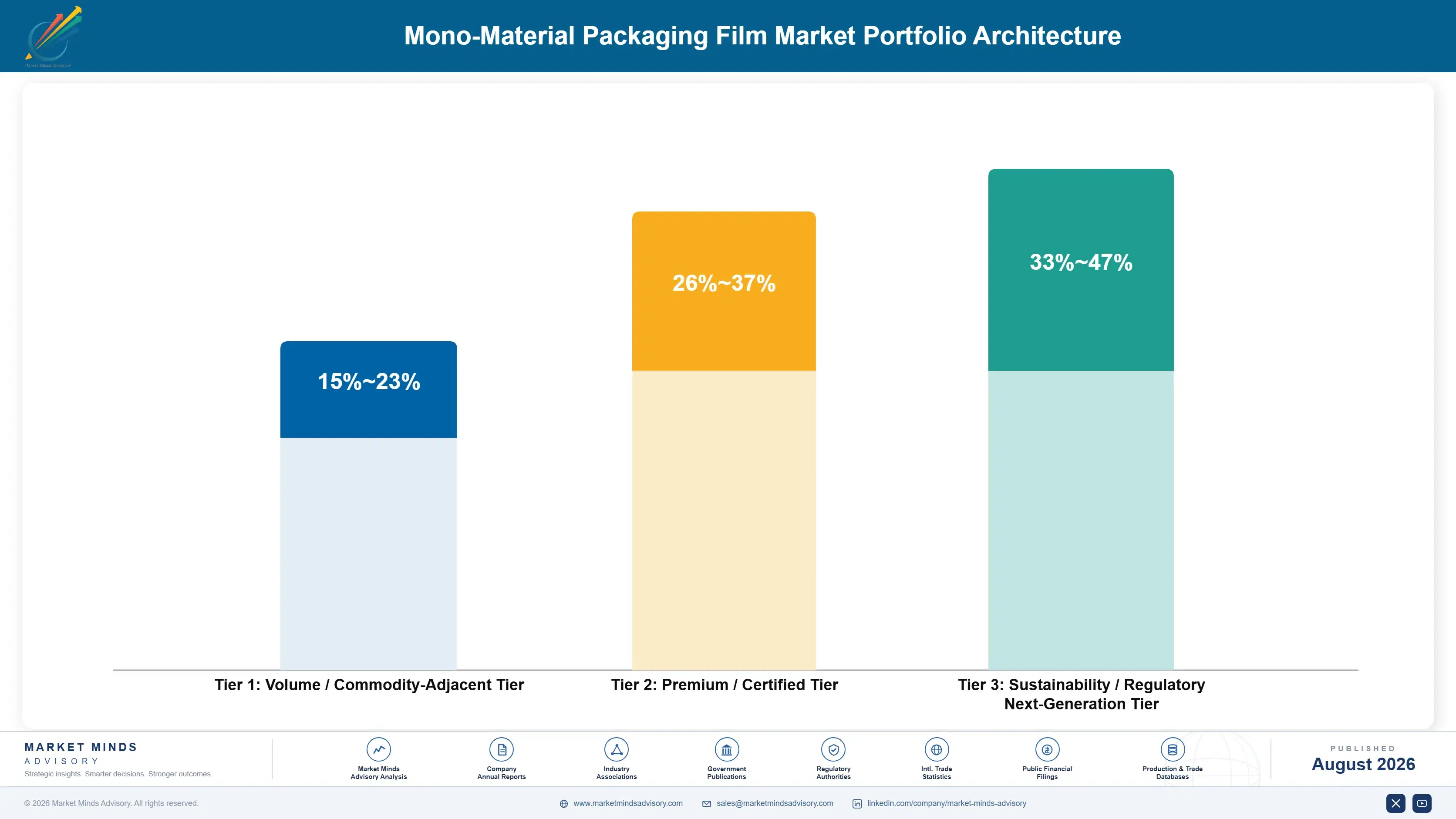
Three tiers describe this business and the spread reflects barrier capability rather than material cost. Non-barrier all-polyethylene structures sit at the bottom, technically straightforward and available from any converter with oriented substrate access. Metallised and moderate-barrier structures sit meaningfully higher on process capability. And oxide-coated high-barrier structures occupy a third tier where coating capacity restricts supply to a handful of converters worldwide. Margin follows
The tension is that non-barrier volume funds the capability development. Sealing window testing, application engineering, and coating qualification are all expensive fixed costs, and they need volume underneath them. Several converters concentrated on high-barrier development and found they lacked the throughput to justify the test and engineering infrastructure that made the offer credible in the first place. The order matters. Volume first, then capability, then premium structures.

High-value pools concentrate where the converter solves the filler's problem rather than the brand's. Wider sealing windows and machine commissioning both address the production floor, and nobody else is selling to that audience. The brand signs the contract but the filling hall decides whether the structure survives its first quarter in production.

Volume / Commodity-Adjacent Tier

Non-barrier all-polyethylene structures for dry goods, household products, and secondary packaging. Technically straightforward and available from any converter with substrate access, but the volume that funds sealing window testing and application engineering capability.
Gross Margin: 15-23%

Premium / Certified Tier

Metallised and moderate-barrier mono-material structures with validated sealing windows and documented recyclability classification. Margin reflects process capability and machine validation work rather than any difference in the polymer being converted.
Gross Margin: 26-37%

Sustainability / Regulatory / Next-Generation Tier

Oxide-coated high-barrier structures and retort-capable mono-material constructions supplied with shelf life evidence. Best margin because coating capacity restricts supply and no other route to high barrier exists inside a compliant structure.
Gross Margin: 33-47%
mono-material-packaging-film-market-portfolio-architecture-1787299409211

High-value Sub-segments and Strategic Watch-out

Oxide-Coated High-Barrier Structures

Best margin and fastest growth at 18.0%, and the only route to high barrier once recyclability rules exclude polyester and foil and cap ethylene vinyl alcohol near 5%. Coating capacity rather than demand is the binding constraint on supply today. Equipment lead times run to eighteen months.
Gross Margin: 33-47%

Validated Sealing Window Structures

Strong margin earned by recovering part of the 18% line speed penalty that fillers currently absorb without compensation. Almost nobody markets on sealing latitude, which leaves the most valuable differentiator in this category largely uncontested. Very few converters have measured the latitude they actually deliver, let alone published it.
Gross Margin: 26-37%

Non-Barrier All-Polyethylene Structures

The volume core at thin margin, available from any converter holding oriented substrate access and increasingly price-competed. It funds the testing and engineering infrastructure that makes the higher tiers credible to a customer at all. Margin here will keep compressing as more converters qualify oriented substrate supply.
Gross Margin: 15-23%

Ethylene Vinyl Alcohol Structures

The strategic watch-out, delivering useful barrier while sitting against a recyclability cap near 5% that most applications need to exceed. A tightening of that threshold would strand these structures with no straightforward successor available. Reformulating toward oxide coating requires capital these structures were chosen to avoid.
Gross Margin: 24-35%

How Compliance Demand Behaves

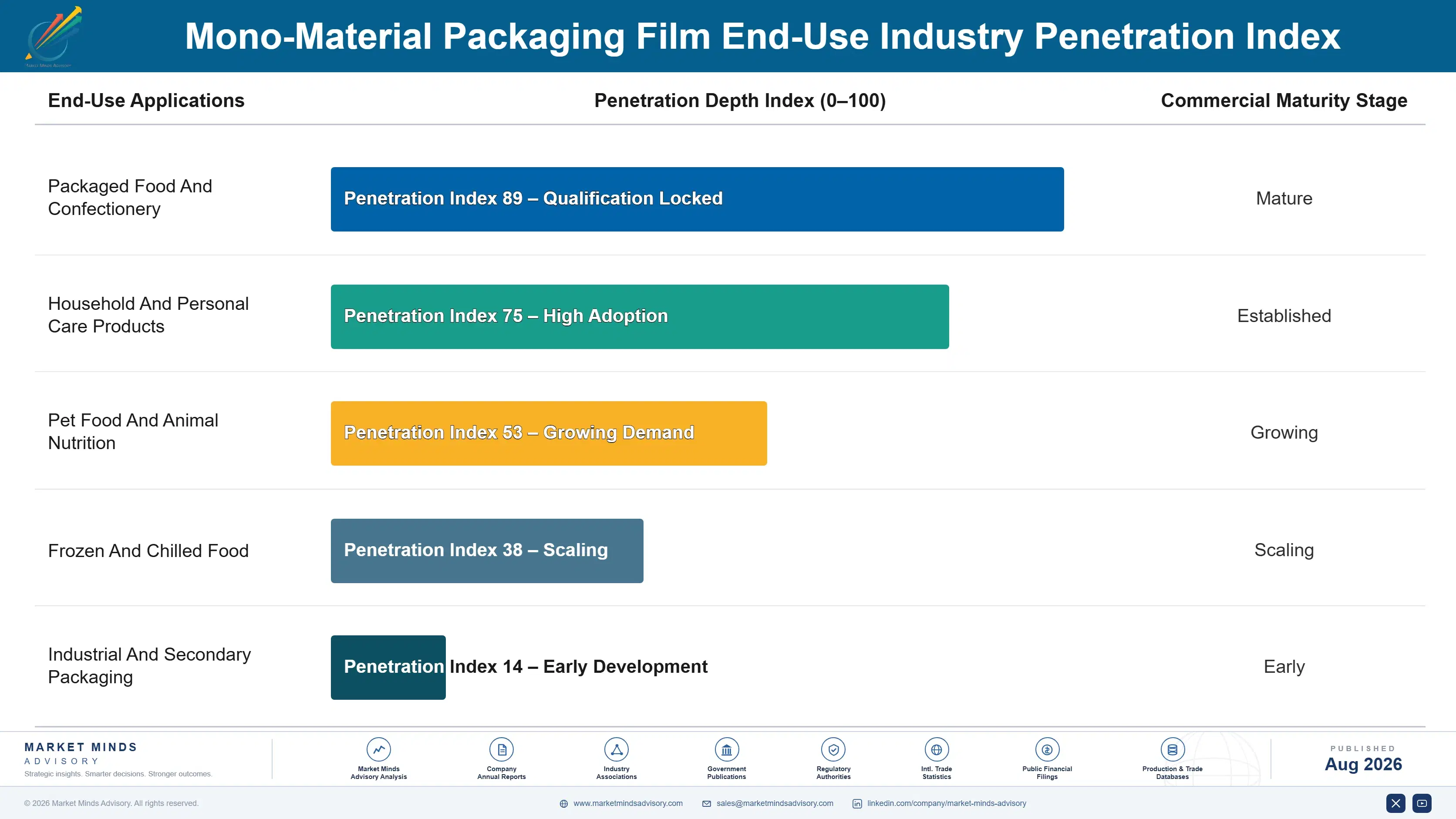
This demand is deadline-shaped rather than continuous, which is unusual for flexible packaging. A brand converts a product line to mono-material once, against a compliance date or an internal commitment, and the structure then runs for that product's life with volume tracking its own sales. Conversion is a project rather than a purchase, involving shelf life testing, machine validation, and artwork adaptation together. Converters who handle the whole project keep the volume afterwards almost aut
Depth of adoption varies enormously by product economics. Premium and mid-tier packaged goods absorb the 22% material penalty without much difficulty. Sachet and single-serve formats in India, Africa, and Latin America cannot, because the penalty exceeds the entire packaging margin. Retort and high-barrier applications remain partly unconverted for technical rather than economic reasons. Private label sits awkwardly, since retailers demand compliance while refusing to fund it.

Buyer profiles have shifted completely. Sustainability and regulatory functions now initiate these conversions, packaging development executes them, and procurement is frequently informed rather than consulted, which is why price-led selling lands so poorly here. A younger cohort of packaging technologists has also arrived expecting recyclability as a starting condition rather than as a project to be justified.
mono-material-packaging-film-market-end-use-penetration-index-1787299409701

What We Would Tell a Board

These are among the four positions where our research anticipates prominent divergence between winners and laggards over the coming forecast period. Each is grounded in the demand model, the regulatory perimeter, and the announced capacity pipeline.
01 / SEALING WINDOW DIFFERENTIATION

Everybody has a recyclable film; sell the latitude

Every converter can now offer a compliant mono-material structure, and the brand already knows it needs one, so the recyclability claim differentiates precisely nothing. Sealing latitude does, because a structure delivering twenty degrees instead of fifteen lets a filler recover part of the 18% line speed penalty they currently absorb uncompensated. Building the test capability to measure and publish window data across a structure range costs around 700,000 dollars and changes who in the customer organisation actually cares about the quotation.
02 / APPLICATION ENGINEERING DELIVERY

Most film failures are machine settings in disguise

Mono-material webs stretch more and tolerate less heat than the polyester structures a filling machine was originally set up for, and the majority of problems blamed on the film turn out to be tension and temperature settings nobody adjusted. Sending an application engineer to commission the film on the customer's own line costs perhaps 4,000 dollars and resolves in days what otherwise festers for months. No amount of further film development achieves the same result on its own, and several converters have spent years proving it.
03 / THICKNESS PENALTY RECOVERY

Twenty-two percent more material is not a fixed cost

All-polyethylene structures need roughly 22% more microns for equivalent stiffness, which erases the resin price advantage entirely on a cost per square metre basis and is widely treated as unavoidable. Higher orientation ratios, stiffer polyethylene grades, and redesigning the pack itself together recover eight to twelve percentage points of that penalty. Every micron removed is material cost saved for the entire programme life, and converters accepting the penalty as given are leaving the largest available saving completely untouched on every programme they run.
04 / BARRIER CAPACITY TIMING

Coating capacity, not demand, is the current constraint

Recyclability guidelines cap ethylene vinyl alcohol near 5% and exclude polyester and foil outright, which leaves oxide coating as the only route to high barrier inside a compliant structure. Coating equipment costs roughly 18 million dollars per line with an eighteen month lead time, and demand already exceeds installed capacity. Converters commissioning capacity now will be supplying high-barrier applications that competitors physically cannot serve at the point when dated compliance obligations actually arrive, which is a position that cannot be bought later.

Engagement Snapshot From the Field

A live engagement with an industry participant carrying material or product regulatory and market exposure ahead of a defining policy shift, showing how our research translates into a defensible multi-year portfolio strategy.
MARKET MINDS ADVISORY · CLIENT ENGAGEMENT SUMMARY
Mono-Material Packaging Film Producer Strategic Portfolio Review and Transition Roadmap 2026·Investment Scenario on Mono-Material Packaging Film Exposure Evaluation 2025-26
CLIENT PROFILE
A European flexible packaging converter with approximately 320 million dollars in annual revenue (client-reported, unverified by MMA), supplying food and household product brand owners across Europe. The company had developed mono-material structures and marketed them on recyclability, bought all oriented polyethylene substrate on spot terms, held no oxide coating capacity, and provided no machine commissioning support with the film.
STRATEGIC CHALLENGE
Mono-material trials with six customers had converted to production in only two cases, with the remainder abandoned after filling line problems the customers attributed to the film. High-barrier enquiries were being declined entirely. Management proposed reducing mono-material pricing to improve conversion, and the board wanted an independent view of what was actually failing before agreeing to it.
MMA APPROACH
We reviewed all six trials against what actually failed, measuring sealing window on the client's structures and comparing recorded machine settings against the film's requirements. Substrate supply terms were benchmarked against converters holding committed volumes, and oxide coating capacity was mapped across European converters against enquiry volumes the client was turning away.
KEY FINDINGS
  1. Three of the four abandoned trials failed on machine tension and sealing temperature settings that had never been adjusted from the previous polyester structure at all.
  2. The client's sealing window measured near fourteen degrees against structures from two competitors delivering nineteen, and this had never been measured or communicated to any customer.
  3. Declined high-barrier enquiries over eighteen months exceeded the annual output an oxide coating line would produce, and every one had gone to a competitor with capacity.
  4. Spot substrate purchasing had caused two delivery delays against brand compliance deadlines that customers could not move, damaging relationships beyond the immediate orders.
CLIENT PROFILE
A European flexible packaging converter with approximately 320 million dollars in annual revenue (client-reported, unverified by MMA), supplying food and household product brand owners across Europe. The company had developed mono-material structures and marketed them on recyclability, bought all oriented polyethylene substrate on spot terms, held no oxide coating capacity, and provided no machine commissioning support with the film.
STRATEGIC CHALLENGE
Mono-material trials with six customers had converted to production in only two cases, with the remainder abandoned after filling line problems the customers attributed to the film. High-barrier enquiries were being declined entirely. Management proposed reducing mono-material pricing to improve conversion, and the board wanted an independent view of what was actually failing before agreeing to it.
MMA APPROACH
We reviewed all six trials against what actually failed, measuring sealing window on the client's structures and comparing recorded machine settings against the film's requirements. Substrate supply terms were benchmarked against converters holding committed volumes, and oxide coating capacity was mapped across European converters against enquiry volumes the client was turning away.
KEY FINDINGS
  1. Three of the four abandoned trials failed on machine tension and sealing temperature settings that had never been adjusted from the previous polyester structure at all.
  2. The client's sealing window measured near fourteen degrees against structures from two competitors delivering nineteen, and this had never been measured or communicated to any customer.
  3. Declined high-barrier enquiries over eighteen months exceeded the annual output an oxide coating line would produce, and every one had gone to a competitor with capacity.
  4. Spot substrate purchasing had caused two delivery delays against brand compliance deadlines that customers could not move, damaging relationships beyond the immediate orders.
RECOMMENDED STRATEGY
Phase 1: Phase 1 (months one to six): cancel the price reduction, build sealing window test capability, and offer machine commissioning support on every trial. Phase 2: Phase 2 (months six to eighteen): contract oriented substrate on committed annual volumes and qualify a second grade within the same envelope. Phase 3: Phase 3 (months eighteen to thirty-six): commission oxide coating capacity against the high-barrier enquiries currently being declined. and price that capacity on scarcity.
OUTCOME
The client abandoned the price reduction and introduced commissioning support with every trial. Trial-to-production conversion improved to most trials within three quarters, sealing window data became the lead argument in proposals, and oxide coating capacity was approved for commissioning (client-reported, unverified by MMA). Substrate contracting followed in the same year.

Frequently Asked Questions

Foundational context covering the market sizes, CAGR, scope, country, region and competition that inform every finding below. This section is provided to cover basics and most often pre-purchase conversations, answered from the MMA Primary Research Dataset.

What is the current size of the Mono-Material Packaging Film Market?

The market is valued at USD 4.8 billion in 2025, rising to USD 5.38 billion in 2026. These structures cost more and run slower than what they replace.

How large will the Mono-Material Packaging Film Market be by 2036?

MMA forecasts USD 16.70 billion by 2036, an increase of USD 11.32 billion over the 2026 base. That represents an expansion multiple of 3.10 times.

What is the CAGR for the Mono-Material Packaging Film Market 2026 to 2036?

The base case CAGR is 12.0%, with a bull case of 13.2% and a bear case of 10.8%. The historical rate from 2020 to 2025 was 10.6%.

Which segment is growing fastest?

Oxide-coated mono-material barrier at 18.0%, exactly 1.50 times the market rate. It is the only route to high barrier once recyclability rules exclude polyester and foil.

Who are the major companies in the Mono-Material Packaging Film Market?

Amcor, Mondi, Berry Global, Constantia Flexibles, and Dow lead on annual mono-material volume converted. The top five together hold 33% of the market, an unusual mix of converters and resin producers.

Which country is growing fastest?

China at 19.8%, holding most of the world's oriented polyethylene substrate capacity alongside rapidly growing domestic conversion. The material base for European regulation sits largely there.

Report Segmentation Architecture

The full report scope spans multiple orthogonal segmentation dimensions, with cross-tabulated demand data provided for each dimension pair. Coverage extends further to regional breakdowns, trend trajectories, and the competitive detail needed to support segment-level decision-making.

By Mono-Material Structure

  • All-Polyethylene Non-Barrier Structures
  • Metallised Mono-Material Barrier
  • Oxide-Coated Mono-Material Barrier
  • All-Polypropylene Structures
  • Ethylene Vinyl Alcohol Containing Structures
  • Retort-Capable Mono-Material Structures

By End-Use Industry

  • Packaged Food And Confectionery
  • Household And Personal Care Products
  • Pet Food And Animal Nutrition
  • Frozen And Chilled Food
  • Industrial And Secondary Packaging

By Adoption Driver

  • Regulatory Design Requirement Compliance
  • Global Brand Specification Standardisation
  • Retailer And Private Label Mandate
  • Voluntary Sustainability Commitment

By Region

  • Western Europe
  • East Asia
  • North America
  • South Asia and Pacific
  • Latin America
  • Middle East and Africa
  • Eastern Europe

Scope, Methodology, and Coverage

Every figure in this report is reproducible from documented input assumptions. The scope below maps the historical period, the forecast horizon, the segmentation dimensions, and the countries covered, alongside the underlying primary and qualitative methodology.
Historical Period
2020 to 2025
Forecast Period
2026 to 2036
Base Year
2025 (USD billions; MMA Primary Research Dataset, August 2026)
Market Definition
This market comprises flexible packaging films constructed entirely within a single polymer family so that the finished laminated structure qualifies for one recycling stream, measured at converter realised prices for printed and unprinted output. Structure coverage spans all-polyethylene non-barrier, metallised mono-material barrier, oxide-coated mono-material barrier, all-polypropylene, ethylene vinyl alcohol containing structures within recyclability thresholds, and retort-capable mono-material constructions. Multi-material laminates combining polymer families, monolayer films without laminated construction, rigid and semi-rigid packaging, base resin and unconverted substrate production, and packaging and filling machinery fall outside scope.
Quantitative Units
USD billions (current prices); million square metres converted; realised price per square metre
Segmentation Dimensions
By Mono-Material Structure; By End-Use Industry; By Adoption Driver; By Region
Regions Covered
Western Europe, East Asia, North America, South Asia and Pacific, Latin America, Middle East and Africa, Eastern Europe
Countries Covered
Germany, Italy, France, Spain, Netherlands, Belgium, UK, Sweden, Switzerland, Austria, Poland, Czechia, Turkey, China, Japan, South Korea, Taiwan, India, Thailand, Vietnam, Australia, USA, Canada, Mexico, Brazil, Chile, Colombia, Egypt, Morocco, and additional markets relevant to this sector
Key Companies Profiled
Amcor, Mondi, Berry Global, Constantia Flexibles, Dow, Borealis, ExxonMobil, LyondellBasell, SABIC, TotalEnergies, Sealed Air, ProAmpac, Huhtamaki, Coveris, Wipak, Toppan, UFlex, Cosmo Films, Jindal Poly Films, Taghleef Industries
Quantitative Methodology
Primary survey, n=3,800 respondents, Q4 2025, six countries; demand-side model with trade association cross-validation
Qualitative Methodology
47 expert interviews, Q4 2025; applied to validate demand model assumptions, identify emerging dynamics, and assess competitive positioning
Report Format
PDF and XLSX data workbook (Word format preview document)
Publisher
Market Minds Advisory
Report Code
MMA-2026-PAC-371
Published
August 2026
Contact
sales@marketmindsadvisory.com | www.marketmindsadvisory.com

Purchase the full Mono-Material Packaging Film Market Report (2026 to 2036).

The full report sizes mono-material packaging film across six structures, five end-use industries, four adoption drivers, and seven regions, with country detail for the twenty largest national markets. Sealing window performance is measured and compared across commercial structures, since that latitude rather than the recyclability claim is what determines whether a conversion succeeds on a filling line. Thickness penalty and line speed impact are quantified by structure against conventional polyester equivalents. Competitive profiling covers twenty companies on mono-material volume converted. Oriented substrate and oxide coating capacity is mapped by producer and region.
Sealing window performance measured across commercial structures
Thickness penalty and line speed impact quantified by structure
Oriented substrate and coating capacity mapped by producer
Recyclability classification thresholds tracked by guideline body
Adoption driver analysed by regulation, brand, and retailer mandate
Sachet economics assessed against material penalty by market

Built For The People Who Decide

From boardroom strategy to bench-side execution, this report is read cover-to-cover by leaders shaping the next decade of their industry, turning demand scenarios, market dynamics and valuation benchmarks into decisions.
CXOs/ Presidents/ VPs/ Managers
M&A and Corporate Development
Strategy Teams and R&D Heads
Procurement and Product Directors
Regulatory and Compliance Leaders
Investor Relations and Equity Analysts