Market Minds Advisory
Monk Fruit Sugar Market

Monk Fruit Sugar Market: Single-province supply, fermentation substitution and the European approval gap to 2036

Almost all of the world's monk fruit grows in one Chinese province and none of it is authorised for sale anywhere in Europe, which are two problems the same technology happens to solve.

Lead Analyst

Lisa Gevelber

Published

September 2026

Make Smarter Decisions with Customized Research Insights

Request a free sample report and evaluate market opportunities, growth trends, and competitive dynamics relevant to your business needs.

2025 MARKET VALUE$0.3BMarket Size 2025
2036 FORECAST VALUE$1.2BBase Case , 2026 to 2036
CAGR 2026 TO 203612.4 %Bull 13.7% / Bear 11.1%
INCREMENTAL OPPORTUNITY$0.8BNet 10- year value creation
EXPANSION MULTIPLE3.22x2036 value over 2026 base
Strategic Levers
M&A Pipeline
Regional Outlook
Country Rankings
Competitive Intelligence
Segmental Deep-dive
Call-Us : 91 93563 13602

Executive Snapshot and Market Trajectory

Roughly 93% of the world's monk fruit grows in one Chinese province, in a climate niche nobody has replicated commercially. That is vanilla-level concentration risk in a globally traded ingredient, and almost nobody buying it prices the exposure properly at all. One bad season moves world price severely.
Fermentation-derived mogrosides grow at 18.6%, half again the market rate of 12.4%, because precision fermentation produces the sweet compound without the fruit and therefore without Guangxi. East Asia holds 32% of value, above the usual band, on cultivation and processing concentrated there. Extraction recovers only about 1.2% of dried fruit weight as usable extract. That yield is precisely why fermentation matters so much to everybody involved here.
Five suppliers hold 44% of ingredient supply and the concentration follows access to fruit rather than any processing advantage. The commercial fact that shapes investment more than any other is that zero monk fruit sweetener uses are authorised across Europe, which closes one of the three largest food markets entirely. Suppliers plan around a world with a hole in it. Global brands resent maintaining two formulations for one product line. Nobody plans around it willingly.
Market Definition
This report covers monk fruit derived sweetening ingredients supplied to food, beverage and consumer applications, spanning mogroside V extract powder, monk fruit and erythritol blends, monk fruit and allulose blends, liquid monk fruit concentrates, fermentation-derived mogrosides, and monk fruit and stevia co-formulations. Value is measured at ingredient supplier level. Excluded are other high-intensity sweeteners sold alone, sugar alcohols and bulking agents supplied separately, whole or dried monk fruit sold as produce, and finished consumer products.
Base Year Value
$0.3B in 2025 (MMA Primary Research Dataset, August 2026)
Forecast Period
2026 to 2036, eleven discrete annual values
CAGR
12.4% base case. Bull 13.7%. Bear 11.1%.
Fastest Growth Segment
Fermentation-Derived Mogrosides: 18.6% CAGR
Fastest Growth Country
India: 16.8% CAGR
Fastest Growth Region
South Asia and Pacific: 14.6% CAGR
Largest Region
East Asia: 32% of 2025 global value
Market Leaders
Layn Natural Ingredients, Monk Fruit Corp, Tate and Lyle, Ingredion and GLG Life Tech lead the market. Source: MMA Primary Research Dataset, July 2026.
Primary Survey
n=3,800 procurement and R&D decision-makers, Q4 2025, six countries
Methodology
Demand-side build-up, cross-validated against public data, 47 expert interviews

Monk Fruit Sugar Market Forecast Scenarios

monk-fruit-sugar-market-trends-size-forecast-scenario-1787555677113
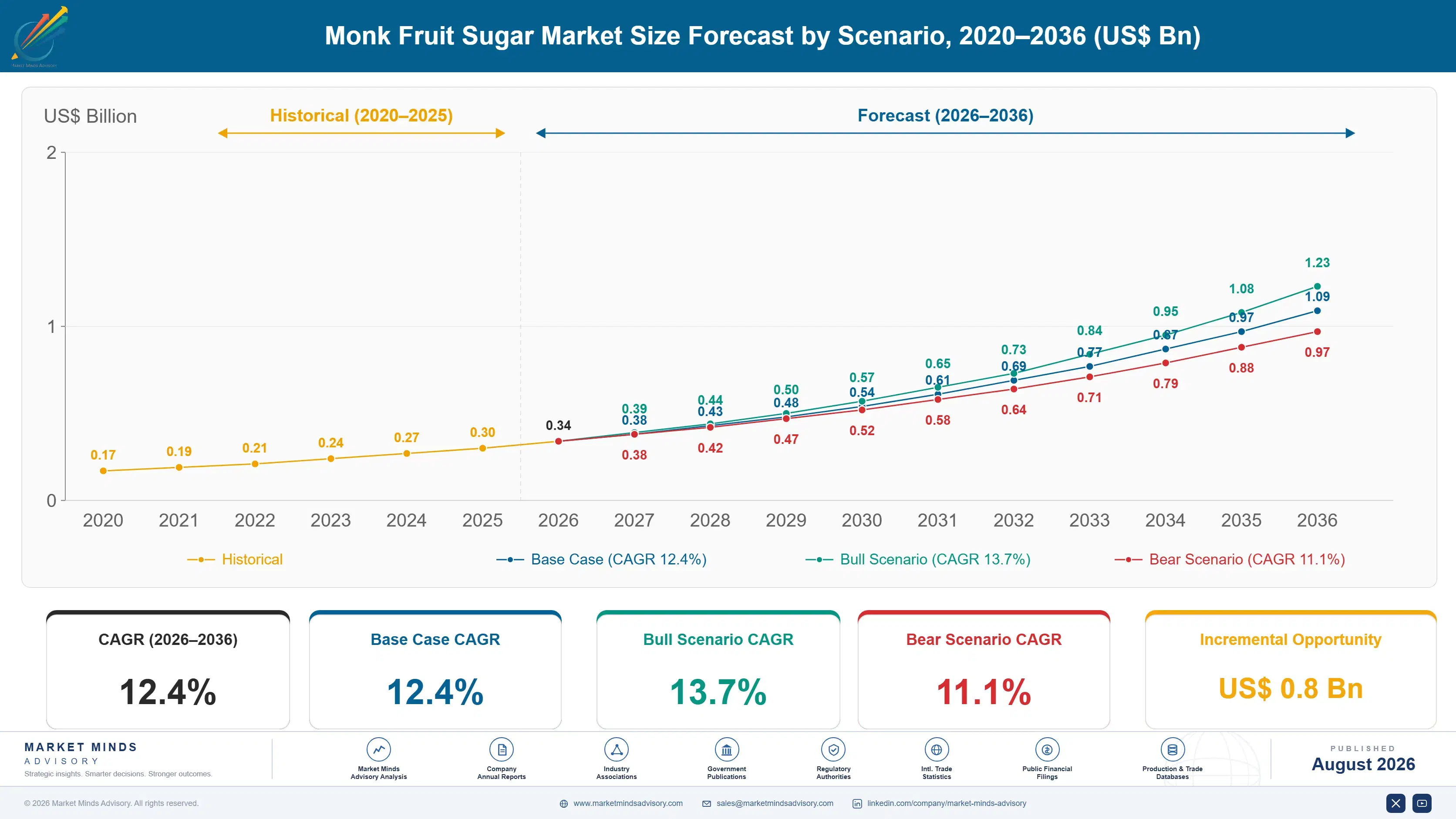
Growth ran at 10.9% between 2020 and 2025 and sugar reduction policy drove nearly all of it. Sugar taxes and front-of-pack labelling requirements spread across more than a hundred jurisdictions, forcing beverage and food reformulation at a pace nothing commercial would have produced. Monk fruit benefited from a cleaner taste profile than stevia, and suffered from a cost that kept it out of price-sensitive categories.
The 12.4% base case rests on three mechanisms. Sugar reduction regulation keeps expanding across jurisdictions and forces reformulation regardless of any consumer preference. Allulose blends keep taking share at 16.4% as formulators move away from erythritol following published cardiovascular association research. And fermentation-derived mogrosides keep advancing at 18.6% toward costs extraction cannot approach. Cost per sweetness equivalent decides which sweetener wins each reformulation. Monk fruit loses that comparison more often than it wins one.
The 13.7% bull case is European novel food authorisation arriving, which would open a market currently closed entirely and change where every supplier invests. The 11.1% bear case is a harvest failure or disease event in Guangxi, since 93% of cultivation sits in one province and no alternative growing region exists commercially. That exposure is genuine and almost nobody prices it.

One Province, No Europe

Two facts define this ingredient and neither is about taste. Roughly 93% of world monk fruit cultivation sits in Guangxi province in southern China, growing in a specific climate niche that nobody has successfully replicated at commercial scale elsewhere. That concentrates weather, disease and policy risk comparably to vanilla in Madagascar, and formulators building around it accept an exposure most never assessed. A single bad season moves world price severely.
TOP-FIVE CONCENTRATION44%Combined position across monk fruit ingredient supply held by leaders
GUANGXI CULTIVATION SHARE93%Portion of world monk fruit grown in one Chinese province
SWEETNESS MULTIPLE VERSUS SUGAR200xHow much sweeter the extract is than an equal weight
EUROPEAN APPROVAL STATUS0Number of authorised monk fruit sweetener uses across Europe
MOGROSIDE EXTRACTION YIELD1.2%Portion of dried fruit weight recovered as usable extract
RAW FRUIT COST SHARE63%Portion of supplier cost attributable to purchased monk fruit
The second fact is that zero monk fruit sweetener uses are authorised across Europe, since the extract has never received novel food approval and the dossier requirements are substantial. That closes one of the three largest food markets in the world entirely, caps the category's addressable size and shapes where every supplier puts development money. A formulator working across global brands cannot use an ingredient available in America and Asia but prohibited in Europe without maintaining separate formulations.
Extraction economics explain the price. Mogroside V is present at low concentration and recovery runs around 1.2% of dried fruit weight, which puts cost per unit of sweetness far above stevia and orders of magnitude above sugar. That yield is why fermentation matters so much to everybody involved.
"This ingredient is running the stevia playbook about a decade behind. Leaf extraction, taste advantage, cost problem, then fermentation arrives and rewrites the economics. The only question worth asking is who owns the strain when it does."
Principal, Sweetener Systems and Food Ingredients Practice · MMA Agriculture and Food Practice · August 2026

Market Trends

Fermentation routes break the single-province dependency

Precision fermentation producing mogroside V directly removes the fruit from the process, which addresses the two problems this ingredient has simultaneously: agricultural cost driven by a 1.2% extraction yield, and supply concentrated at 93% in one Chinese province. Stevia ran exactly this arc, moving from leaf extraction with taste problems to fermentation-derived compounds at good taste and steadily falling cost. Monk fruit is roughly a decade behind and following the same sequence. Growth at 18.6% reflects development progress rather than current volume, and the commercial question is which strains and processes end up owned by whom.
Market Impact: Applies across 100 separate jurisdictions
Erythritol concern pushes formulators toward allulose bulking

Monk fruit is 200 times sweeter than sugar, which means a formulator needs a bulking agent to replace the volume and mouthfeel sugar provides, and erythritol filled that role almost universally. Published research associating erythritol with cardiovascular events created consumer concern that reformulation had to answer regardless of how the science eventually settles. Allulose and soluble fibre blends compound at 16.4% as brands move away, and they cost more while delivering better mouthfeel. The commercial lesson is that this ingredient's fortunes depend heavily on a bulking agent nobody thinks of as part of the product.
Market Impact: Blends carry 14.8% growth

Market Opportunities and Growth Drivers

Sugar reduction regulation forces reformulation across jurisdictions

Sugar taxes, front-of-pack warning labels and marketing restrictions on high sugar products now apply across more than a hundred jurisdictions, which compels beverage and food reformulation at a pace no consumer preference would ever have produced. Manufacturers reformulating need sweetness without calories and increasingly want a natural origin claim alongside it, which is precisely the position monk fruit occupies. The demand arrives on regulatory timetables that manufacturers cannot negotiate, making it considerably more predictable than any trend-driven category. Cost per sweetness equivalent decides whether monk fruit or stevia gets the reformulation.
Market Impact: Authorises 0 European uses

Taste profile beats stevia in applications where it matters

Monk fruit extract carries a cleaner sweetness profile than stevia leaf extracts, with substantially less of the bitterness and liquorice note that made early stevia reformulations unpopular with consumers who noticed immediately. That advantage matters most in delicately flavoured applications including water, dairy and light beverages where an off-note has nowhere to hide. Formulators frequently blend the two, using monk fruit to mask stevia's profile while stevia carries cost. The advantage is genuine and it narrows as fermentation-derived stevia compounds improve, which is worth watching closely. That window will not stay open indefinitely.
Market Impact: Recovers only 1.2% extract yield

Market Restraints and Challenges

European authorisation is absent and the dossier is expensive

Zero monk fruit sweetener uses are authorised across Europe because the extract has never received novel food approval, and the safety dossier and application process required are substantial in both cost and time. The root cause is regulatory rather than any safety finding, since the ingredient is approved across America and Asia without issue. Commercially this closes one of the three largest food markets and forces global brands to maintain separate formulations. Suppliers are pursuing authorisation collectively and individually, though the cost falls on whoever files while the benefit reaches every competitor equally.
Market Impact: Escapes 93% single-province concentration

Extraction yield keeps cost far above competing sweeteners

Mogroside V occurs at low concentration in the fruit and recovery runs around 1.2% of dried weight, which puts cost per unit of sweetness well above stevia and orders of magnitude above sugar. The root cause is the plant itself rather than any processing inefficiency, and decades of agronomy have not raised concentration materially. Commercially this excludes monk fruit from price-sensitive categories entirely and confines it to premium applications where the natural claim justifies the cost. Fermentation addresses it directly and is the only route anybody has found that genuinely changes the arithmetic.
Market Impact: Shifts blends growing at 16.4%
3 additional market trends, 4 additional growth drivers, and 2 additional restraints and challenges are covered in the full report. Contact sales@marketmindsadvisory.com to access the complete intelligence.

Segment CAGR and Growth Architecture

Products are classified here by ingredient form, since that determines the bulking system, the application suitability and what a formulator must declare on the label. Application category, sweetness system and supply arrangement are handled separately in the framework, because one form serves beverages, dairy and bakery without changing what it is. Form decides the whole system.
monk-fruit-sugar-market-trends-market-share-analysis-1787555677643

Fermentation-Derived Mogrosides

Growing at 18.6%, half again the market rate, fermentation is the answer to both problems this ingredient has. Producing mogroside V through engineered microorganisms removes agricultural yield from the equation entirely, which addresses a 1.2% extraction recovery that decades of agronomy have failed to improve, and it removes dependence on a single Chinese province growing 93% of world supply. Stevia demonstrated the whole sequence a decade earlier, moving from leaf extraction with taste compromises to fermentation compounds at good taste and falling cost. Volumes remain small and the development pipeline is where the value currently sits. Strain ownership will decide who benefits. Timing decides who benefits. Volumes remain small for now.
CAGR 18.6%

Monk Fruit and Stevia Co-Formulations

Blending the two natural high-intensity sweeteners lets a formulator use monk fruit to mask stevia's characteristic bitterness and liquorice note while stevia carries most of the sweetness at considerably lower cost. That combination delivers a better taste profile than stevia alone at a price monk fruit alone could never reach, which is why growth runs at 14.8% across beverage and dairy applications particularly. The commercial exposure is that fermentation-derived stevia compounds keep improving on taste, which erodes the specific problem monk fruit was added to solve. Formulators will not pay for masking a defect that no longer exists. That erosion is already visible in stevia development pipelines. The window is closing steadily.
CAGR 14.8%
Full segment breakdown across 6 segments available in the complete report.

Regional Architecture and Country Demand Map

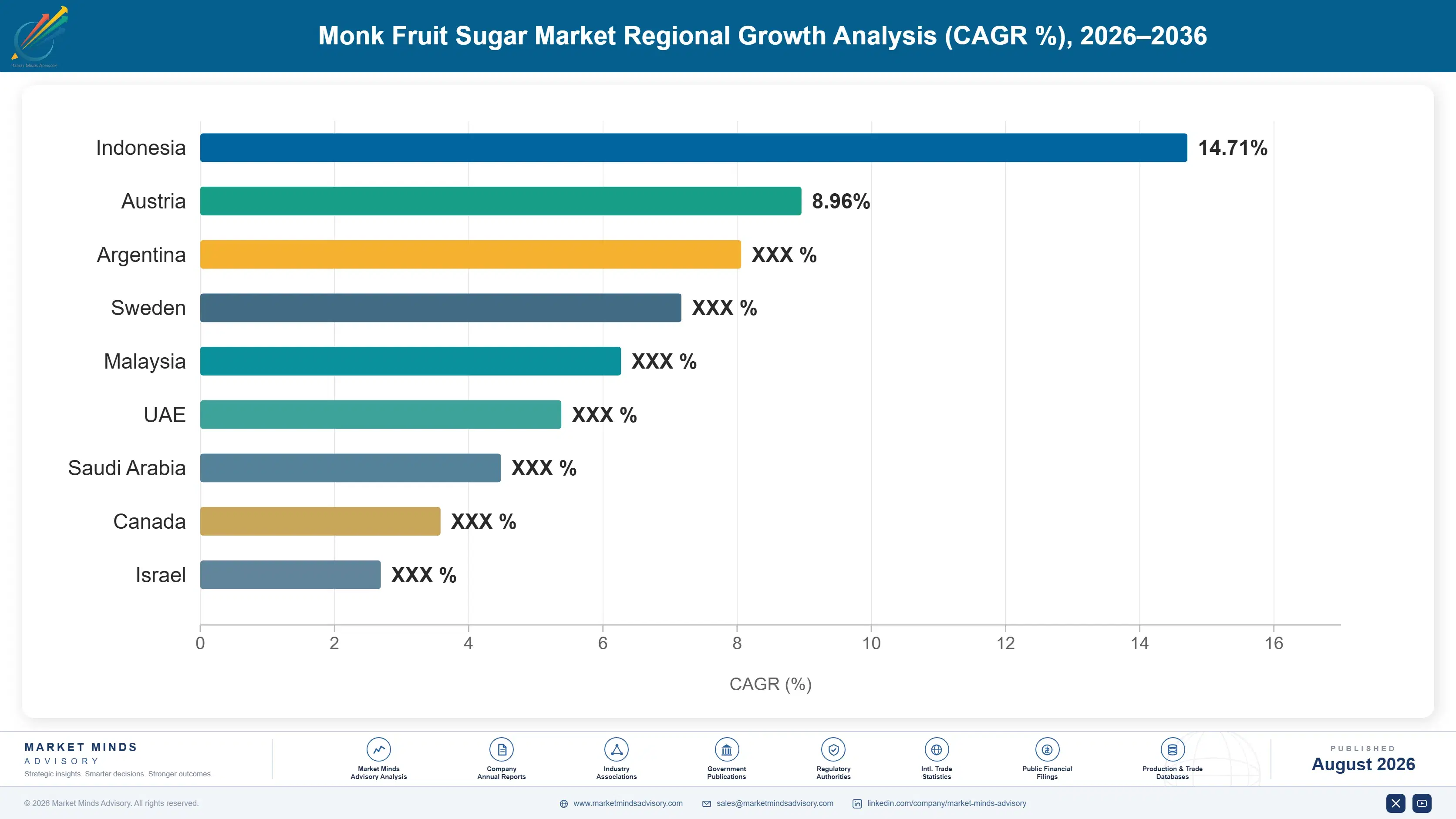
East Asia holds 32% of value, above the usual band, because cultivation and processing sit there almost entirely. Western Europe holds just 12% and falls below its band, since no monk fruit use is authorised across the region at all. Regulation carves this map. Taste explains rather little.

East Asia

At 32% this region sits above the usual band ceiling, and the reason is that cultivation and processing both sit here almost completely. Guangxi province grows roughly 93% of world monk fruit in a climate niche that nobody has replicated commercially, and Chinese extraction capacity processes nearly all of it. Traditional medicinal use of the fruit predates any Western sweetener interest by centuries and supports a domestic market that behaves quite differently from export demand. Japanese approval dates back decades and supports steady beverage use. Growth at 13.4% combines domestic consumption with the export processing that supplies everybody else entirely. This share sits above the usual ceiling because no other ingredient concentrates its cultivation this heavily anywhere.
Share: 32% | CAGR: 13.4% (2026 to 2036)

North America

This is the largest export market by a wide margin, built on generally recognised safe status that permitted use long before most jurisdictions considered the ingredient. Consumer interest in natural zero-calorie sweetening is stronger here than anywhere and monk fruit's taste advantage over stevia is well understood by formulators. The erythritol association research landed hardest in this market, since American blends relied on it almost universally, and reformulation toward allulose has been fastest here as a direct consequence. Growth at 12.0% sits close to the market average and reflects a market where adoption is mature relative to elsewhere. Adoption here is mature relative to every other market listed on this table.
Share: 31% | CAGR: 12.0% (2026 to 2036)
Regional intelligence for 5 additional markets available in the complete report: Western Europe, South Asia and Pacific, Latin America, Middle East and Africa, Eastern Europe. Contact sales@marketmindsadvisory.com.
monk-fruit-sugar-market-trends-country-cagr-analysis-1787555678164

Where Sweetener Margin Actually Sits

Four moves matter for an ingredient grown almost entirely in one province and banned across an entire continent. Two are about escaping the agricultural constraint, and two are about the formulation systems that decide whether anybody can actually use the product. Competing with stevia on price is not among them. Cost is not the battle here.

Own fermentation strains before the cost curve breaks

Precision fermentation producing mogroside V removes both the 1.2% extraction yield and the 93% dependence on one Chinese province, which are the two problems that have capped this ingredient since it reached Western markets. Stevia ran the identical sequence a decade earlier and the companies owning the strains captured most of the value the transition created. Monk fruit is following the same path at 18.6% growth from a small base. Suppliers relying entirely on agricultural extraction are positioned exactly where leaf-based stevia producers were before fermentation arrived and rewrote their economics.
Market Impact: Escapes a punishing 1.2% extraction yield ceiling entirely

Fund the European dossier jointly rather than individually

Zero monk fruit uses are authorised across Europe, which closes one of the three largest food markets entirely and forces global brands into separate formulations they resent maintaining. The novel food dossier is expensive and the benefit reaches every competitor equally once granted, which is precisely why nobody has filed alone and why the market stays closed. A consortium approach spreads the cost across the beneficiaries and opens a market worth considerably more than the filing. Somebody must organise it. Europe represents roughly 20% of world food ingredient demand currently unavailable to this category.
Market Impact: Opens the 0 currently authorised European sweetener uses

Move blends from erythritol toward allulose bulking

Monk fruit is 200 times sweeter than sugar and needs a bulking agent to replace the volume and mouthfeel sugar provided, and erythritol filled that role almost universally until published cardiovascular association research created consumer concern. Allulose and soluble fibre blends compound at 16.4% as brands reformulate away regardless of how the science ultimately settles. Those systems cost more and deliver better mouthfeel, which is an easier conversation than most cost increases. Suppliers still defaulting to erythritol blends are shipping a formulation their customers are actively trying to leave. Customers are leaving anyway.
Market Impact: Enters blend systems now compounding at 16.4% annually

Sell taste masking where stevia still tastes wrong

Monk fruit carries a cleaner profile than stevia leaf extracts with far less bitterness and liquorice character, which matters most in water, dairy and delicately flavoured beverages where an off-note has nowhere to hide from the consumer. Co-formulations compound at 14.8% using monk fruit to mask stevia while stevia carries cost. The exposure is real and worth naming: fermentation-derived stevia compounds keep improving on taste, and formulators will not pay to mask a defect that has stopped existing. Suppliers should sell this position while it lasts. Sell it while it lasts.
Market Impact: Serves co-formulations now growing at 14.8% each year

Who Controls the Margin Pool

Five suppliers hold 44% of monk fruit ingredient supply, measured on ingredient revenue at supplier level, the basis used throughout this section. That concentration follows access to fruit rather than any processing advantage, since 93% of cultivation sits in one Chinese province and long-term grower relationships there determine who can supply reliably at scale. The gap between leaders and everybody else is raw material security rather than extraction technology. Extraction is well understood everywhere.
Competition runs on three dimensions. Fruit supply security, which decides who ships through a poor harvest. Formulation and application support, since a high-intensity sweetener requires a whole system rather than a single ingredient. And fermentation development position, which will decide the next decade rather than this one. Price competes hardest against stevia rather than between monk fruit suppliers. Systems rather than ingredients win reformulations.

Rankings will shift decisively when fermentation reaches commercial cost, since agricultural supply security becomes irrelevant the moment the fruit is unnecessary. Chinese processors hold cultivation relationships Western suppliers cannot replicate. European authorisation would redistribute positions toward whoever prepared for it rather than whoever holds fruit today. Fruit access becomes irrelevant then.
monk-fruit-sugar-market-trends-company-positioning-matrix-1787555678688

Competitive Moat and Risk Dimensions

LAYN NATURAL INGREDIENTS

Moat: Guangxi grower relationships

Layn holds long-established cultivation and grower relationships in Guangxi province where roughly 93% of world monk fruit grows, which determines who obtains fruit reliably when a harvest disappoints. In an ingredient where supply concentration is the defining commercial risk, that access is worth considerably more than any extraction or processing capability a competitor could develop.
LAYN NATURAL INGREDIENTS

Risk: Fermentation makes fruit irrelevant

The entire advantage rests on securing an agricultural raw material that precision fermentation is specifically designed to make unnecessary, and stevia demonstrated exactly how quickly that transition can erode a supply-based position. Leaf-based stevia producers held similar advantages until they did not. Development timing rather than any competitive action determines when the exposure becomes real.
TATE AND LYLE

Moat: Sweetener system formulation depth

Tate and Lyle formulates complete sweetener systems combining high-intensity sweeteners, bulking agents and flavour modifiers rather than supplying a single ingredient, which is what a reformulating manufacturer actually needs when replacing sugar. That systems capability spans allulose, fibres and multiple sweeteners, and it lets the company follow a customer through the erythritol transition without losing the account.
TATE AND LYLE

Risk: No proprietary monk fruit position

The company formulates with monk fruit rather than controlling its supply, which leaves it dependent on Chinese processors for an ingredient concentrated in one province. A supply disruption reaches the formulation business directly with no alternative source available. Suppliers holding grower relationships or fermentation development carry that risk very differently.

Players Tracked

Prominent Players

Layn Natural Ingredients
Monk Fruit Corp
Tate and Lyle
Ingredion
GLG Life Tech

Other Key Players

ADM
Sweegen
Cargill
Steviva Ingredients
Guilin Sanleng Biotech
Hunan NutraMax
Biolotus Technology
Vitasweet
Apura Ingredients
Nutra Food Ingredients
Merck KGaA
Wisdom Natural Brands
Icon Foods
Xi'an App-Chem Bio
Health Way Food

Recent Developments

FEBRUARY 2025

A beverage manufacturer reformulated blends away from erythritol

A beverage manufacturer reformulated its monk fruit sweetened range away from erythritol bulking toward allulose, citing consumer concern following published cardiovascular association research rather than any regulatory requirement. This was a reformulation decision rather than any commercial transaction between ingredient suppliers. The science remains genuinely unsettled.
Signal: Reformulation is following consumer concern rather than regulation, which moves faster and gives suppliers less warning
AUGUST 2025

A fermentation company reported mogroside production at pilot scale

An ingredient technology company reported producing mogroside V through precision fermentation at pilot scale, targeting cost levels that agricultural extraction at 1.2% recovery cannot reach. This was a development milestone rather than any commercial transaction or supply agreement with a customer. Agricultural supply positions are on notice.
Signal: Fermentation reaching pilot scale starts the clock on agricultural supply positions exactly as it did for stevia
DECEMBER 2025

Suppliers formed a consortium to pursue European authorisation

Several monk fruit ingredient suppliers formed a consortium to jointly fund and file a European novel food authorisation dossier, spreading a cost that no single participant could recover alone given that approval benefits every competitor equally. This was a collaborative regulatory arrangement rather than any commercial transaction.
Signal: Joint filing solves the free rider problem that has kept Europe closed, which suggests the market may finally open

What Moves Supplier Cost

Purchased monk fruit accounts for around 63% of supplier cost, priced on Guangxi harvest volumes and quality that vary with weather in a single growing region. Extraction solvents, energy and purification make up most of the remainder, and yields at around 1.2% of dried weight mean a great deal of material moves for very little product. Bulking agents purchased for blends are a separate and increasingly significant cost line.
Monk fruit prices moved sharply through 2021 and 2022 on harvest variability and freight disruption, and USDA and Chinese agricultural data record the volume and price movements across those seasons. Ingredion noted input cost and supply chain pressure across its speciality ingredients operations in its Annual Report 2022. Suppliers on annual customer contracts absorbed most of it, since a beverage manufacturer sets formulation costs yearly.

The cost that determines this ingredient's future is not on any current profit and loss statement. Fermentation development consumes capital for years before producing a saleable tonne, and the suppliers funding it are carrying an expense that agricultural competitors avoid entirely while enjoying identical current economics. Stevia showed how that resolves: the spenders captured the transition and the others lost their positions.
monk-fruit-sugar-market-trends-cost-volatility-analysis-1787555678885

Contract Guangxi fruit supply across multiple seasons

Roughly 93% of world cultivation sits in one province, which makes a poor harvest a world supply event rather than a local one and turns spot purchasing into a bet on Guangxi weather. Multi-season grower contracts secure allocation when harvests disappoint and competitors cannot obtain fruit at any price. That security beats any price advantage spot buying occasionally delivers.

Fund fermentation development as a separate capital line

Fermentation development consumes capital for years before producing revenue and always loses budget arguments against activities showing immediate return. Ring-fencing acknowledges that extraction and fermentation are different businesses on different timelines. Stevia demonstrated how the comparison resolves for anybody who declined to spend. Budget processes reward immediate return over a transition nobody has scheduled yet.

Price bulking agents into blend costs explicitly

Monk fruit at 200 times sweetness needs bulking to replace sugar volume, and the shift from erythritol toward allulose raises that cost materially while suppliers frequently quote sweetener price alone. Presenting the complete system cost avoids a conversation where the customer discovers the increase later and blames the sweetener supplier. Transparency here builds credibility that the reformulation cycle rewards.

Portfolio Architecture for Margin Defence

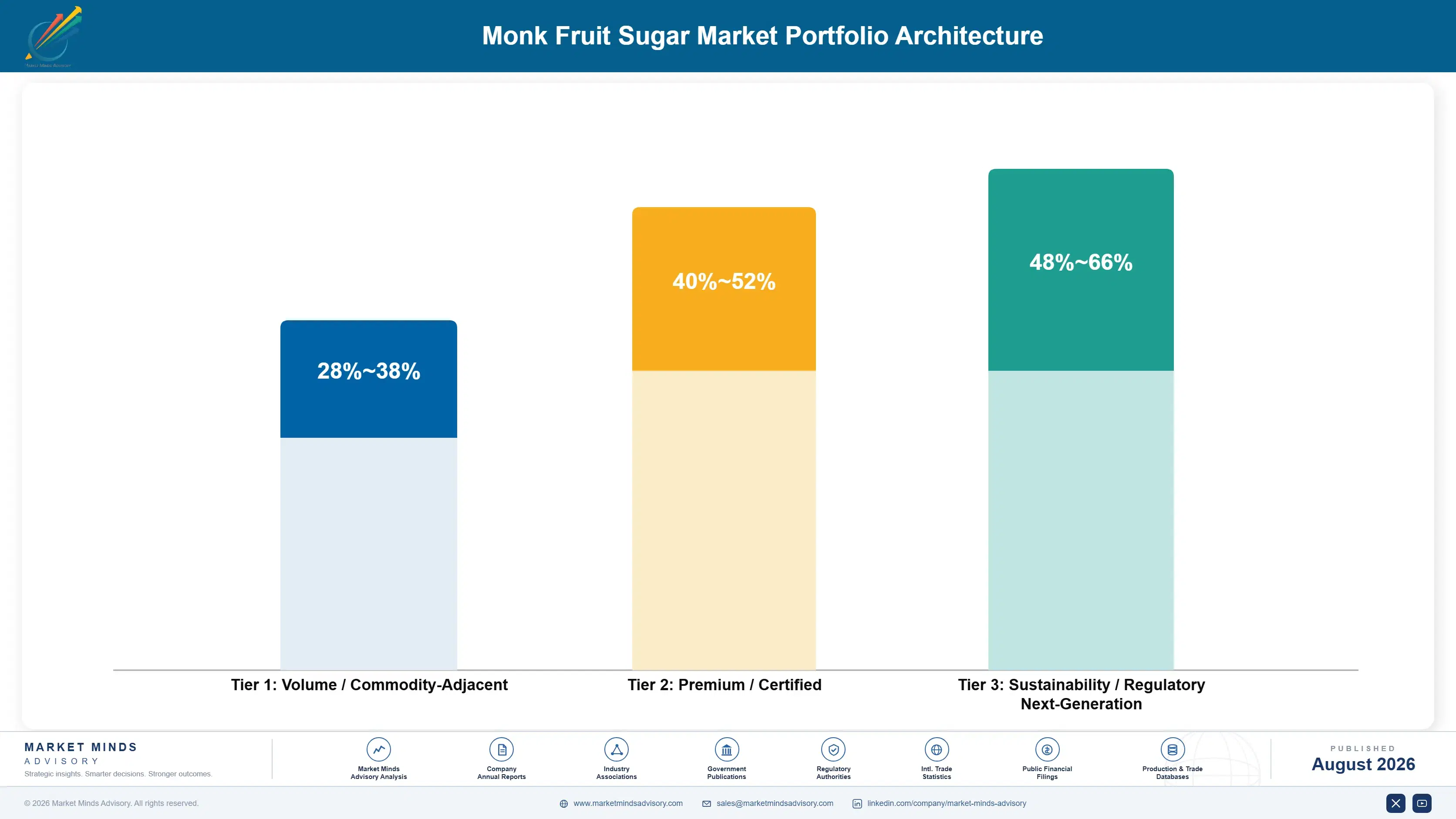
Margin here tracks formulation capability and supply security rather than extraction efficiency, because extracting mogrosides is well understood and obtaining fruit reliably is not. Commodity extract powder runs at gross margins in the low thirties against Chinese processors with better fruit access. Blended systems run considerably better on formulation work and application support. Fermentation-derived material and co-formulations run higher again, on scarcity and on solving problems single ingredients cannot address alone.
The tension is that extract powder carries the current volume while fermentation carries the future, and funding the second consumes returns from the first with no revenue for years. Suppliers without the balance sheet to run both are effectively choosing to be agricultural extractors permanently, which stevia suggests is a losing position. Several have made that choice by default rather than deliberately, through budget processes that reward immediate return over a transition nobody has scheduled.

High-value pools sit in fermentation development, allulose blend systems and any European authorisation position. None of the three depends on holding fruit. Grower relationships defend a great deal today and possibly very little within a decade. Fermentation changes that entirely.

Volume / Commodity-Adjacent

Commodity mogroside extract powder sold on specification against Chinese processors holding better cultivation access and lower conversion costs. The ten-point range separates suppliers with contracted grower relationships from those buying fruit on spot markets each season.
Gross Margin: 28%-38%

Premium / Certified

Blended systems and liquid concentrates where bulking selection, application support and formulation work carry the value beyond the sweetener itself. The twelve-point spread reflects formulation depth, since a system solves a customer problem that an ingredient alone cannot.
Gross Margin: 40%-52%

Sustainability / Regulatory / Next-Generation

Fermentation-derived mogrosides, allulose blend systems and any position holding European authorisation. The eighteen-point range is wide because these price against scarcity and regulatory access rather than against any comparable ingredient available.
Gross Margin: 48%-66%
monk-fruit-sugar-market-trends-portfolio-architecture-1787555679379

High-value Sub-segments and Strategic Watch-out

Fermentation Strain Positions

Compounding at 18.6% and addressing both a 1.2% extraction yield and 93% single-province concentration at once. Stevia showed the companies owning strains capture most of the value a transition creates. Development timing rather than any competitive action decides when this becomes real. Nobody schedules it.
Gross Margin: 50%-66%

Allulose Blend Systems

Growing at 16.4% as brands reformulate away from erythritol following published cardiovascular research, regardless of how the science eventually settles. Better mouthfeel makes the cost increase an easier conversation. Suppliers still defaulting to erythritol are shipping what customers are leaving. Mouthfeel improves as well. Costs rise slightly.
Gross Margin: 44%-58%

Commodity Extract Powder

The current volume, competed against Chinese processors with better fruit access and lower conversion cost throughout. Manage for grower contracts and utilisation rather than for margin, which is not really available. Chinese processors hold cultivation access nobody outside can replicate at all. Grower contracts are the only defence.
Gross Margin: 28%-38%

European Authorisation Access

Zero uses are currently authorised, which closes one of the three largest food markets entirely and caps this whole category. A consortium filing solves the free rider problem that has kept everybody out. Somebody has to organise the filing, and nobody yet has. A consortium finally solves it.
Gross Margin: 46%-62%

How Sweetener Demand Renews

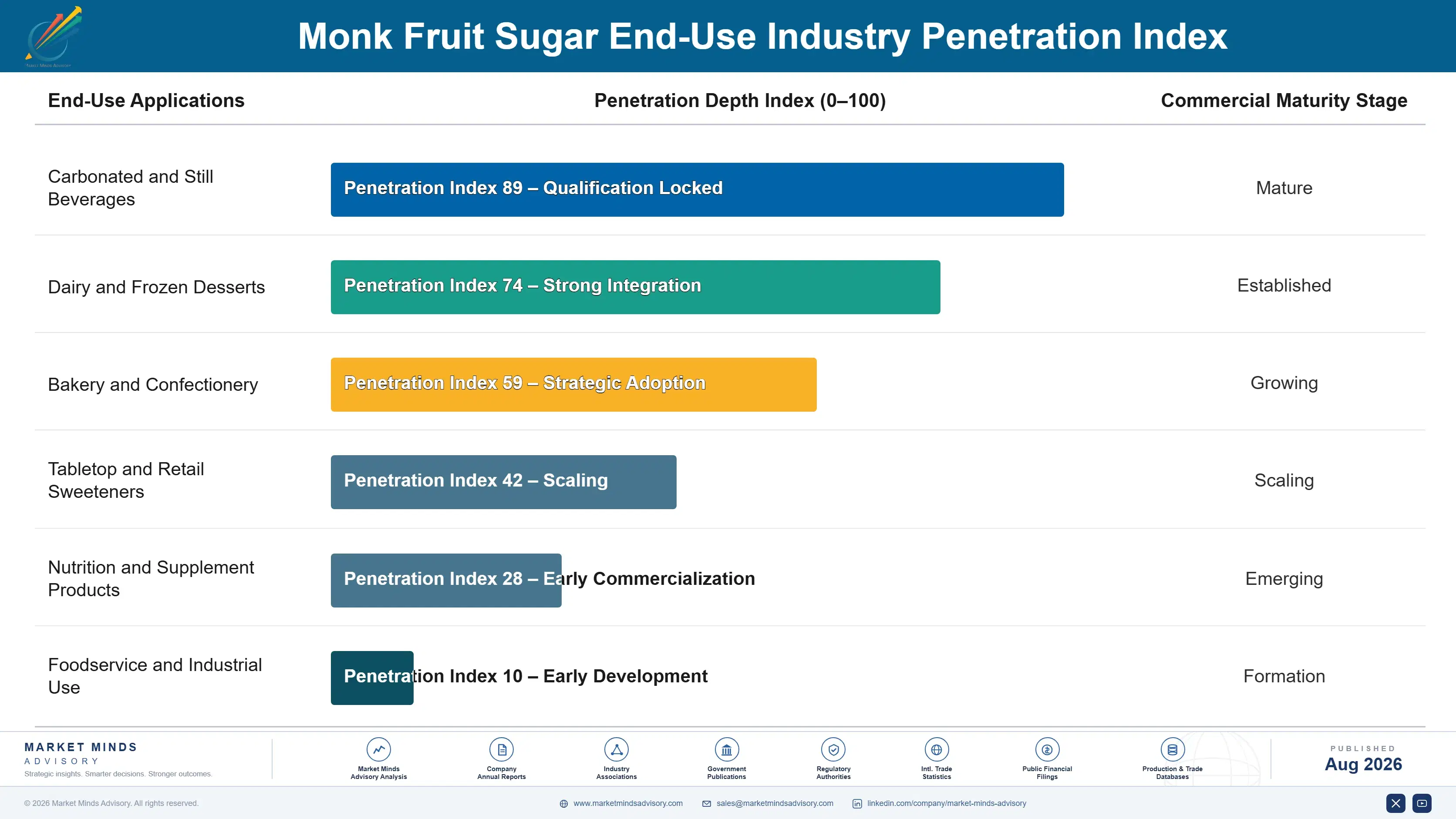
Demand renews through the formulation rather than through any purchasing cycle. A sweetener written into a beverage or food recipe ships continuously for as long as that product sells, with no repurchasing decision and volumes following retail performance entirely. Changing means reformulation, sensory testing and frequently consumer validation, which manufacturers avoid unless something forces them. Regulation and ingredient controversy force them, and both have been unusually active.
Stickiness runs through the whole sweetener system rather than the ingredient. A formulator who has balanced a high-intensity sweetener against a bulking agent and a flavour modifier to reach an acceptable profile will not disturb any part of it casually. That makes system suppliers considerably stickier than ingredient suppliers, and it explains why the erythritol concern was so disruptive: it forced open a formulation everybody had settled.

The buyer weighs regulation more heavily than taste, which surprises people arriving from consumer marketing. A beverage manufacturer reformulating under a sugar tax has a deadline and a cost target, and an ingredient unavailable in a market they sell into is simply excluded regardless of how good it tastes. The European position therefore matters more than any sensory advantage.
monk-fruit-sugar-market-trends-end-use-penetration-index-1787555679869

Where To Place The Bet

These are among the four positions where our research anticipates prominent divergence between winners and laggards over the coming forecast period. Each is grounded in the demand model, the regulatory perimeter, and the announced capacity pipeline.
01 / FERMENTATION POSITION PRIORITY

Own the strain before the fruit stops mattering

Precision fermentation producing mogroside V removes both constraints that have capped this ingredient since it reached Western markets: an extraction yield of around 1.2% that decades of agronomy have failed to improve, and a supply base with 93% of world cultivation in a single Chinese province. Stevia ran precisely this sequence a decade earlier and the companies that owned the strains captured most of the value the transition created for everybody. Suppliers relying entirely on agricultural extraction sit exactly where leaf-based stevia producers sat beforehand.
02 / EUROPEAN ACCESS ORGANISATION

Fund the dossier together and open Europe

Zero monk fruit sweetener uses are authorised anywhere across Europe because the extract has never received novel food approval, which closes one of the three largest food markets entirely and forces global brands into separate formulations they genuinely resent maintaining. The dossier is expensive and its benefit reaches every competitor equally once granted, which is exactly why no supplier has ever filed alone and why the market has stayed shut. A consortium spreads that cost across the beneficiaries and opens a market worth far more than the filing.
03 / BULKING SYSTEM MIGRATION

Leave erythritol before customers make you

Monk fruit is roughly 200 times sweeter than sugar, which means every application needs a bulking agent to restore the volume and mouthfeel that sugar provided, and erythritol filled that role almost universally across the category. Published research associating erythritol with cardiovascular events created consumer concern that manufacturers must answer regardless of how the underlying science eventually resolves itself. Allulose and soluble fibre blends compound at 16.4%, cost more and deliver better mouthfeel, which makes the increase an unusually easy conversation.
04 / MASKING WINDOW EXPLOITATION

Sell the stevia problem while it exists

Monk fruit carries a noticeably cleaner sweetness profile than stevia leaf extracts, with far less of the bitterness and liquorice character that consumers detect immediately in delicately flavoured water, dairy and light beverage applications. Co-formulations compound at 14.8%, using monk fruit to mask stevia while stevia itself carries most of the sweetness at considerably lower cost. The exposure deserves naming plainly: fermentation-derived stevia compounds keep improving on taste, and no formulator anywhere pays to mask a defect that has stopped existing.

Engagement Snapshot From the Field

A live engagement with an industry participant carrying material or product regulatory and market exposure ahead of a defining policy shift, showing how our research translates into a defensible multi-year portfolio strategy.
MARKET MINDS ADVISORY · CLIENT ENGAGEMENT SUMMARY
Monk Fruit Sugar Producer Strategic Portfolio Review and Transition Roadmap 2026·Investment Scenario on Monk Fruit Sugar Exposure Evaluation 2025-26
CLIENT PROFILE
A North American speciality sweetener supplier with annual revenue around USD 96 million (client-reported, unverified by MMA), supplying monk fruit extract and erythritol blends to beverage and food manufacturers. Fruit was purchased from Chinese processors without any grower relationship. No fermentation development existed. European market access had never been pursued. Supply security was never assessed properly.
STRATEGIC CHALLENGE
Two customers had reformulated away from erythritol blends (client-reported, unverified by MMA) and management proposed reducing blend prices to retain them. Nobody had established whether the customers objected to price or to erythritol itself, which made the proposed response a solution to a problem that had not been diagnosed at all.
MMA APPROACH
MMA established the actual reformulation reasoning with both departed customers through the expert interview programme rather than accepting the price assumption. Fruit supply security was assessed against the client's purchasing arrangements and Guangxi harvest variability. Fermentation development positions across the industry were mapped, and European authorisation economics were modelled on a consortium basis.
KEY FINDINGS
  1. Neither customer left on price, and both cited consumer concern about erythritol specifically, which meant a price reduction would have retained neither of them at any level.
  2. The client purchased fruit through Chinese processors with no grower relationship, leaving it last in the allocation queue whenever a Guangxi harvest disappointed materially.
  3. No fermentation development existed anywhere in the business, while several competitors had reached pilot scale on routes that would eventually remove fruit from the equation.
  4. European authorisation was economically viable on a consortium basis and the client had never approached any other supplier about jointly funding a dossier.
CLIENT PROFILE
A North American speciality sweetener supplier with annual revenue around USD 96 million (client-reported, unverified by MMA), supplying monk fruit extract and erythritol blends to beverage and food manufacturers. Fruit was purchased from Chinese processors without any grower relationship. No fermentation development existed. European market access had never been pursued. Supply security was never assessed properly.
STRATEGIC CHALLENGE
Two customers had reformulated away from erythritol blends (client-reported, unverified by MMA) and management proposed reducing blend prices to retain them. Nobody had established whether the customers objected to price or to erythritol itself, which made the proposed response a solution to a problem that had not been diagnosed at all.
MMA APPROACH
MMA established the actual reformulation reasoning with both departed customers through the expert interview programme rather than accepting the price assumption. Fruit supply security was assessed against the client's purchasing arrangements and Guangxi harvest variability. Fermentation development positions across the industry were mapped, and European authorisation economics were modelled on a consortium basis.
KEY FINDINGS
  1. Neither customer left on price, and both cited consumer concern about erythritol specifically, which meant a price reduction would have retained neither of them at any level.
  2. The client purchased fruit through Chinese processors with no grower relationship, leaving it last in the allocation queue whenever a Guangxi harvest disappointed materially.
  3. No fermentation development existed anywhere in the business, while several competitors had reached pilot scale on routes that would eventually remove fruit from the equation.
  4. European authorisation was economically viable on a consortium basis and the client had never approached any other supplier about jointly funding a dossier.
RECOMMENDED STRATEGY
Phase 1: Phase one: abandon the price reduction and reformulate the blend range onto allulose bulking, since the customers objected to erythritol rather than to cost. Phase 2: Phase two: establish direct Guangxi grower contracts to secure allocation ahead of the next poor harvest rather than buying through processors. Phase 3: Phase three: initiate a fermentation development partnership and approach several competitors directly about jointly funding a European novel food dossier.
OUTCOME
Allulose blends launched during 2026 and both departed customers have returned. Direct grower contracts are agreed for two seasons. A fermentation partnership is under negotiation, and the client reports blend margins improving despite higher bulking costs (client-reported, unverified by MMA). Supply security also improved considerably.

Frequently Asked Questions

Foundational context covering the market sizes, CAGR, scope, country, region and competition that inform every finding below. This section is provided to cover basics and most often pre-purchase conversations, answered from the MMA Primary Research Dataset.

What is the current size of the Monk Fruit Sugar Market?

The market was valued at USD 0.34 billion in 2025, rising to an estimated USD 0.38 billion in 2026. East Asia holds the largest regional share at 32% of value.

How large will the Monk Fruit Sugar Market be by 2036?

MMA forecasts USD 1.23 billion by 2036 under the base case, an expansion multiple of 3.22 times the 2026 value. That represents USD 0.85 billion of incremental value.

What is the CAGR for the Monk Fruit Sugar Market 2026 to 2036?

The base case runs at 12.4% compound annual growth between 2026 and 2036, with a bull case at 13.7% and a bear case at 11.1%. Historical growth from 2020 to 2025 was 10.9%.

Which segment is growing fastest?

Fermentation-derived mogrosides lead at 18.6%, half again the market rate, because producing the compound without fruit escapes both yield and supply constraints. Stevia co-formulations follow at 14.8%.

Who are the major companies in the Monk Fruit Sugar Market?

Layn Natural Ingredients, Monk Fruit Corp, Tate and Lyle, Ingredion and GLG Life Tech hold 44% between them. Access to fruit rather than extraction technology sustains those positions.

Which country is growing fastest?

India leads at 16.8%, driven by diabetes prevalence among the highest anywhere alongside genuine consumer interest in sugar reduction and regulatory approval permitting food use.

Report Segmentation Architecture

The full report scope spans multiple orthogonal segmentation dimensions, with cross-tabulated demand data provided for each dimension pair. Coverage extends further to regional breakdowns, trend trajectories, and the competitive detail needed to support segment-level decision-making.

By Ingredient Form

  • Mogroside V Extract Powder
  • Monk Fruit and Erythritol Blends
  • Monk Fruit and Allulose Blends
  • Liquid Monk Fruit Concentrates
  • Fermentation-Derived Mogrosides
  • Monk Fruit and Stevia Co-Formulations

By End-Use Industry

  • Carbonated and Still Beverages
  • Dairy and Frozen Desserts
  • Bakery and Confectionery
  • Tabletop and Retail Sweeteners
  • Nutrition and Supplement Products
  • Foodservice and Industrial Use

By Supply Arrangement

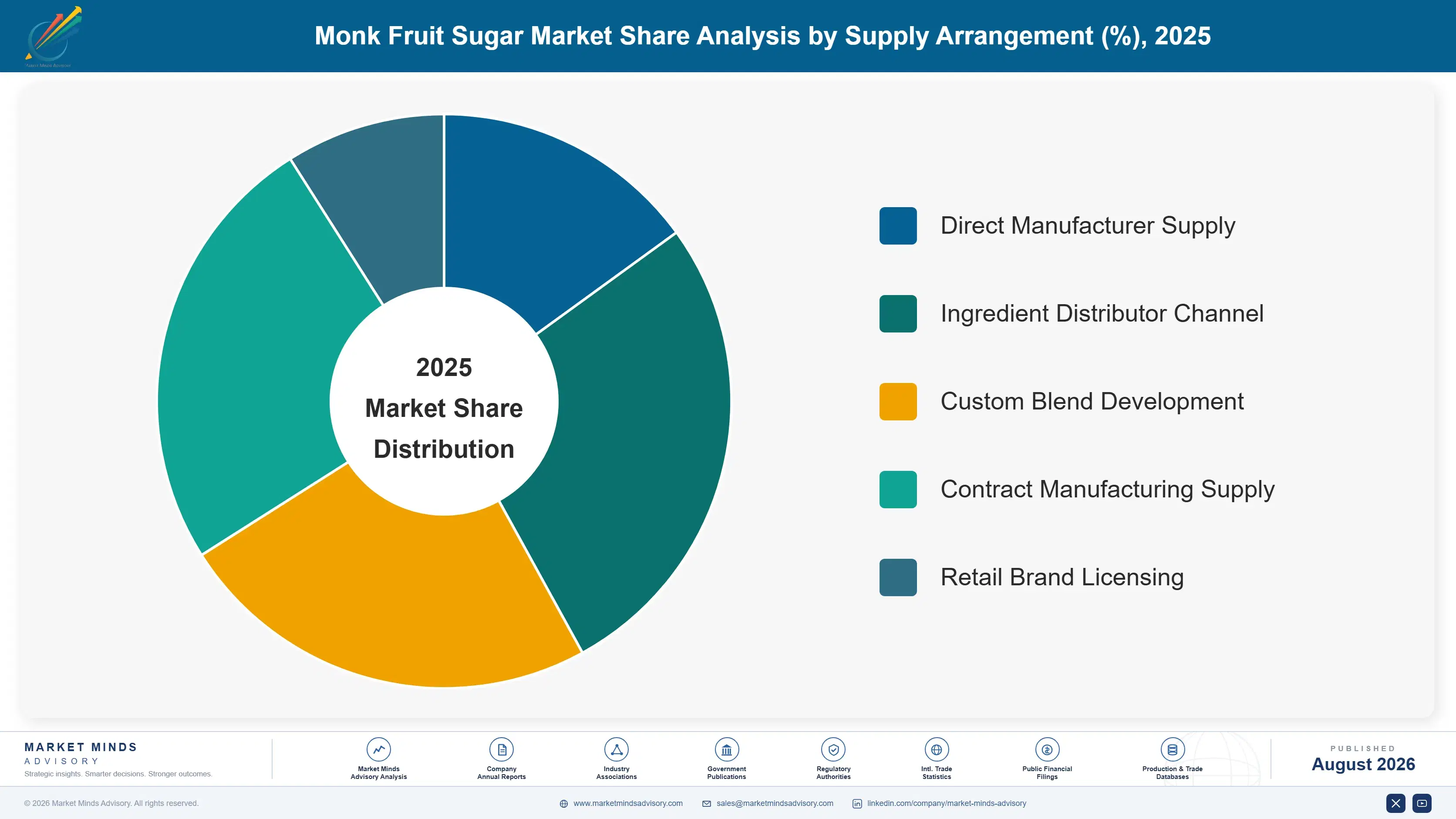
  • Direct Manufacturer Supply
  • Ingredient Distributor Channel
  • Custom Blend Development
  • Contract Manufacturing Supply
  • Retail Brand Licensing

By Region

  • North America
  • Western Europe
  • East Asia
  • South Asia and Pacific
  • Latin America
  • Middle East and Africa
  • Eastern Europe

Scope, Methodology, and Coverage

Every figure in this report is reproducible from documented input assumptions. The scope below maps the historical period, the forecast horizon, the segmentation dimensions, and the countries covered, alongside the underlying primary and qualitative methodology.
Historical Period
2020 to 2025
Forecast Period
2026 to 2036
Base Year
2025 (USD billions; MMA Primary Research Dataset, August 2026)
Market Definition
The market comprises monk fruit derived sweetening ingredients supplied to beverage, dairy, bakery, tabletop, nutrition and foodservice applications, covering mogroside V extract powder, monk fruit and erythritol blends, monk fruit and allulose blends, liquid monk fruit concentrates, fermentation-derived mogrosides, and monk fruit and stevia co-formulations. Value is measured at ingredient supplier level across direct, distributor and contract channels. Other high-intensity sweeteners sold alone, sugar alcohols and bulking agents supplied separately, whole or dried monk fruit sold as produce, and finished consumer products fall outside scope.
Quantitative Units
USD billions (current prices); tonnes of ingredient supplied annually; USD per kilogram by ingredient form
Segmentation Dimensions
By Ingredient Form; By End-Use Industry; By Supply Arrangement; By Region
Regions Covered
North America, Western Europe, East Asia, South Asia and Pacific, Latin America, Middle East and Africa, Eastern Europe
Countries Covered
China, Japan, South Korea, Taiwan, India, Australia, New Zealand, Thailand, Malaysia, Philippines, United States, Canada, Mexico, Brazil, Chile, Colombia, United Kingdom, Germany, France, Netherlands, Spain, Italy, Poland, Czechia, Hungary, Saudi Arabia, United Arab Emirates, South Africa, Egypt, Turkey
Key Companies Profiled
Layn Natural Ingredients, Monk Fruit Corp, Tate and Lyle, Ingredion, GLG Life Tech, ADM, Sweegen, Cargill, Steviva Ingredients, Guilin Sanleng Biotech, Hunan NutraMax, Biolotus Technology, Vitasweet, Apura Ingredients, Nutra Food Ingredients, Merck KGaA, Wisdom Natural Brands, Icon Foods, Xi'an App-Chem Bio, Health Way Food
Quantitative Methodology
Primary survey, n=3,800 respondents, Q4 2025, six countries; demand-side model with trade association cross-validation
Qualitative Methodology
47 expert interviews, Q4 2025; applied to validate demand model assumptions, identify emerging dynamics, and assess competitive positioning
Report Format
PDF and XLSX data workbook (Word format preview document)
Publisher
Market Minds Advisory
Report Code
MMA-2026-AGR-119
Published
August 2026
Contact
sales@marketmindsadvisory.com | www.marketmindsadvisory.com

Purchase the full Monk Fruit Sugar Market Report (2026 to 2036).

The full report sizes the global monk fruit sweetener market to 2036 across six ingredient forms and seven regions, measured on ingredient revenue at supplier level. It treats single-province cultivation concentration and the absence of European authorisation as the two facts determining the category's shape, and models both explicitly. Competitive analysis covers 20 participants evaluated on ingredient revenue, with moat and risk assessment for the two leaders. Fermentation development is assessed against the stevia transition, since the sequence and the timing look closely comparable. Four quantified revenue levers close the analysis.
Six-form segment sizing with segment-level growth rates
Seven-region share and growth breakdown to 2036
Twenty-participant competitive map on one revenue basis
Cultivation concentration risk quantified against harvest variability
Fermentation transition assessed against the stevia precedent directly
Four quantified revenue levers with commercial impact ranges

Built For The People Who Decide

From boardroom strategy to bench-side execution, this report is read cover-to-cover by leaders shaping the next decade of their industry, turning demand scenarios, market dynamics and valuation benchmarks into decisions.
CXOs/ Presidents/ VPs/ Managers
M&A and Corporate Development
Strategy Teams and R&D Heads
Procurement and Product Directors
Regulatory and Compliance Leaders
Investor Relations and Equity Analysts