Market Minds Advisory
Molecular Diagnostics Market

Molecular Diagnostics Market: When Assay Speed Outpaces Reimbursement Speed

A commercial reading of molecular diagnostics, where sequencing costs keep falling and point-of-care platforms keep shrinking, yet reimbursement committees still decide which tests actually reach a patient's bedside at all.

Lead Analyst

Alice Ballenger

Published

September 2026

Make Smarter Decisions with Customized Research Insights

Request a free sample report and evaluate market opportunities, growth trends, and competitive dynamics relevant to your business needs.

2025 MARKET VALUE$9.6BMarket Size 2025
2036 FORECAST VALUE$26.9BBase Case , 2026 to 2036
CAGR 2026 TO 20369.8 %Bull 11.0% / Bear 8.6%
INCREMENTAL OPPORTUNITY$16.3BNet 10- year value creation
EXPANSION MULTIPLE2.55x2036 value over 2026 base
Strategic Levers
M&A Pipeline
Regional Outlook
Country Rankings
Competitive Intelligence
Segmental Deep-dive
Call-Us : 91 93563 13602

Executive Snapshot and Market Trajectory

Molecular diagnostics keeps producing breakthrough assays faster than payers can decide what to reimburse at meaningful volume across most therapeutic areas. That mismatch, not sequencing chemistry, is what actually determines which tests reach patients and which stay confined to research use only for years.
The market stands at USD 9.6 billion in 2025 and reaches USD 26.85 billion by 2036 at a 9.8% CAGR. Next-generation sequencing diagnostics grows fastest at 15.9%, roughly 1.62 times the overall rate, as sequencing costs keep falling toward routine clinical use across oncology and rare disease testing worldwide. North America holds 34% of value on dense reimbursement infrastructure and concentrated reference laboratory capacity, while China posts the quickest national growth at 13.5%.
Concentration is high at roughly 48%, dominated by diagnostics majors holding platform, assay menu, and laboratory relationships simultaneously across most major reimbursement markets worldwide today. Two forces dominate the period ahead. Companion diagnostics tied to precision oncology approvals are pulling molecular testing directly into drug development timelines, and point-of-care platforms are pushing decentralised testing into settings that previously required a full reference laboratory to process results at all.
Market Definition
The molecular diagnostics market covers in vitro diagnostic testing that detects, quantifies, or characterises nucleic acids or related molecular biomarkers to inform clinical decisions, valued at platform, reagent, and testing service revenue. Conventional immunoassay, culture-based microbiology, and research-use-only testing are excluded.
Base Year Value
$9.6B in 2025 (MMA Primary Research Dataset, August 2026)
Forecast Period
2026 to 2036, eleven discrete annual values
CAGR
9.8% base case. Bull 11.0%. Bear 8.6%.
Fastest Growth Segment
Next-Generation Sequencing Diagnostics: 15.9% CAGR
Fastest Growth Country
China: 13.5% CAGR
Fastest Growth Region
South Asia and Pacific: 11.7% CAGR
Largest Region
North America: 34% of 2025 global value
Market Leaders
Roche Diagnostics, Abbott Laboratories, Danaher, Thermo Fisher Scientific, Hologic. Source: MMA Analysis based on company annual reports.
Primary Survey
n=3,800 procurement and R&D decision-makers, Q4 2025, six countries
Methodology
Demand-side build-up, cross-validated against public data, 47 expert interviews

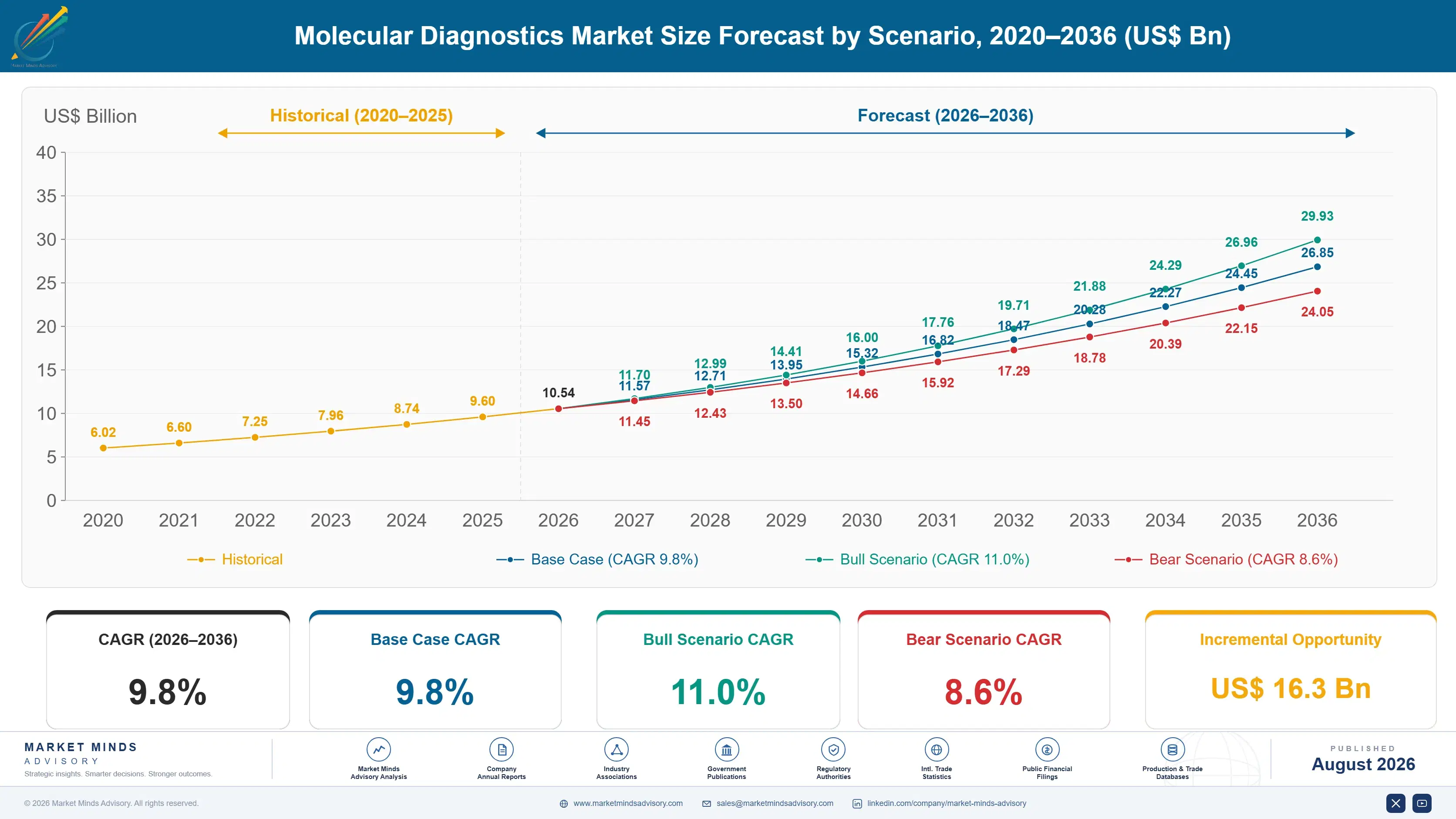
Molecular Diagnostics Market Forecast Scenarios

molecular-diagnostics-market-size-forecast-scenario-1787324968397
Growth from 2020 to 2025 compounded near 8.8%, and pandemic-driven PCR testing infrastructure left a durable legacy of laboratory capacity and public familiarity with molecular testing behind. That infrastructure pivoted quickly toward oncology and infectious disease panels once acute pandemic volume declined, while sequencing cost curves continued falling steadily enough to pull genomic testing into mainstream clinical protocols across major markets.
Three mechanisms carry the base case to 9.8%. First, precision oncology drug approvals increasingly requiring a companion diagnostic test at launch, tying molecular testing volume directly to pharmaceutical development pipelines. Second, sequencing cost declines continuing to broaden genomic testing beyond specialist academic centres into mainstream community oncology and prenatal care. Third, point-of-care molecular platforms expanding testing access into primary care and urgent care settings that previously depended entirely on reference laboratories.
The bull case at 11.0% assumes sequencing costs fall further still and payers broaden reimbursement for multi-gene panel testing across additional cancer types quickly. The bear case at 8.6% assumes reimbursement committees stay conservative, laboratory consolidation slows new assay rollout, and companion diagnostic approval timelines lag behind the therapeutic approvals they are meant to accompany.

Why Reimbursement Speed, Not Assay Speed, Sets The Pace

Three forces set demand here. Companion diagnostic requirements drive the most durable volume, as an increasing share of new oncology approvals now mandate a specific molecular test at launch. Reference laboratory consolidation drives a second stream, since large networks standardise testing menus and drive volume through preferred platform partners. Decentralised point-of-care testing drives a third stream, extending molecular testing into settings a full laboratory never reached.
MARKET CONCENTRATIONCR5: 48%Highly concentrated across five diagnostics majors holding platform breadth
AVERAGE SELLING PRICE PREMIUM3 to 5xAverage selling price premium against traditional culture-based testing methods
COMPANION DIAGNOSTIC SHAREOver 40%Share of oncology drug approvals requiring a companion diagnostic
LABORATORY TURNAROUND TIME1 to 5 daysReference laboratory turnaround from sample receipt to reported result
REGULATORY CLEARANCE TIMELINE8 to 14 monthsTime to secure regulatory clearance for a new diagnostic assay
POINT-OF-CARE VOLUME SHIFTAbout 22% of testsShare of testing volume shifting toward decentralised point-of-care platforms
The commercial character is defined by a widening gap between assay development speed and reimbursement decision speed. A laboratory can validate and launch a new molecular panel within months, while payer coverage decisions for that panel routinely take years to finalise. That mismatch concentrates commercial risk with laboratories and platform makers who invest ahead of reimbursement, rewarding companies with genuine payer relationship depth over purely superior assay chemistry alone.
The decade turns on whether sequencing and point-of-care platform costs fall fast enough to reach community and primary care settings priced out of molecular testing today. Reference laboratories still capture the highest-complexity testing, but decentralised platforms are steadily pulling simpler assays out of that channel. That shift matters more than any assay launch, because it determines who owns the patient relationship and resulting testing volume.
"A brilliant assay that nobody can bill for is a research finding, not a product. The companies winning this decade treat reimbursement strategy as seriously as they treat the chemistry itself."
Director, Diagnostics and Precision Medicine Practice · MMA Medical Devices / In

Market Trends

Companion Diagnostics Are Becoming A Standard Drug Development Step

Companion diagnostics, once a niche regulatory requirement for a handful of targeted oncology drugs, are becoming a standard element of precision oncology drug development, with regulators increasingly expecting a validated molecular test alongside any new targeted therapy submission. That shift ties diagnostic revenue directly to pharmaceutical pipeline timelines rather than to independent laboratory demand, converting molecular diagnostics companies into genuine development partners rather than downstream test suppliers. Companies with deep companion diagnostic development relationships are winning platform selection decisions years before a therapy reaches commercial launch, locking in testing volume that independent laboratories cannot easily displace.
Market Impact: Covers over 40% of approvals
Falling Sequencing Costs Are Pulling Genomics Into Mainstream Care

Sequencing costs have fallen dramatically enough that whole-exome and targeted panel sequencing are migrating from specialist academic and research settings into mainstream community oncology and prenatal care programmes across most developed healthcare systems worldwide. That cost decline is expanding the addressable testing population considerably, since panels once reserved for the most complex or ambiguous cases are increasingly ordered as a routine first-line diagnostic step rather than a last resort. Laboratories that scaled sequencing infrastructure early are capturing disproportionate volume as ordering physicians shift their default testing behaviour toward genomic panels.
Market Impact: Costs fell over 90% since 2015

Market Opportunities and Growth Drivers

Companion Diagnostic Mandates Are Tying Testing To Drug Approvals

Regulatory agencies increasingly require a validated companion diagnostic alongside targeted oncology drug approvals, converting molecular testing from an optional clinical tool into a mandatory element of the treatment pathway for an expanding share of new cancer therapies reaching market. That regulatory structure creates durable demand regardless of standalone diagnostic pricing pressure, since a physician cannot legally prescribe certain targeted therapies without first confirming eligibility through the paired diagnostic test. Each new companion diagnostic approval adds directly to addressable testing volume without requiring independent commercial persuasion from the diagnostics company involved.
Market Impact: Takes 2 to 5 years

Sequencing Cost Declines Are Expanding The Addressable Population

Sequencing cost declines have been dramatic enough that whole-genome and targeted panel testing costs a small fraction of what comparable testing cost a decade ago, pulling genomic diagnostics out of specialist research settings and into mainstream clinical protocols across oncology, prenatal, and rare disease testing simultaneously and broadly. That cost trajectory continues to expand the addressable patient population for genomic testing considerably each year, since panels once affordable only for the most complex cases are increasingly ordered as routine first-line diagnostics rather than a last-resort option reserved for unusual presentations.
Market Impact: Access gaps exceed 60% globally

Market Restraints and Challenges

Reimbursement Delay Strands Companies Ahead Of Coverage

Payer reimbursement decisions for newly launched molecular diagnostic panels routinely take years to finalise, creating a prolonged gap between when a laboratory can technically deliver a test and when it can bill for that test at a sustainable rate. The root cause is that most reimbursement committees require extensive clinical utility evidence, generated only after real-world use accumulates, before granting coverage for genuinely novel testing categories. The commercial impact is that laboratories and platform makers absorb years of below-cost delivery before reimbursement catches up with actual clinical demand. Mitigation runs through evidence-generation partnerships, value-based contracts, and staged coverage pilots.
Market Impact: Over 40% of new oncology drugs

Laboratory Infrastructure Access Remains Highly Uneven Globally

Reference laboratory infrastructure and specialist interpretation expertise remain heavily concentrated in developed healthcare systems, leaving large populations across emerging markets without practical access to advanced molecular diagnostic testing even where the underlying disease burden justifies it clinically. The root cause is that molecular testing requires capital-intensive laboratory infrastructure and trained specialist staff that many healthcare systems have not yet built at meaningful scale. The commercial impact is that global testing volume growth concentrates disproportionately in already-developed markets. Mitigation runs through point-of-care platform deployment, telepathology partnerships, and regional reference laboratory hub investment.
Market Impact: Sequencing costs fell over 90%
3 additional market trends, 4 additional growth drivers, and 2 additional restraints and challenges are covered in the full report. Contact sales@marketmindsadvisory.com to access the complete intelligence.

Segment CAGR and Growth Architecture

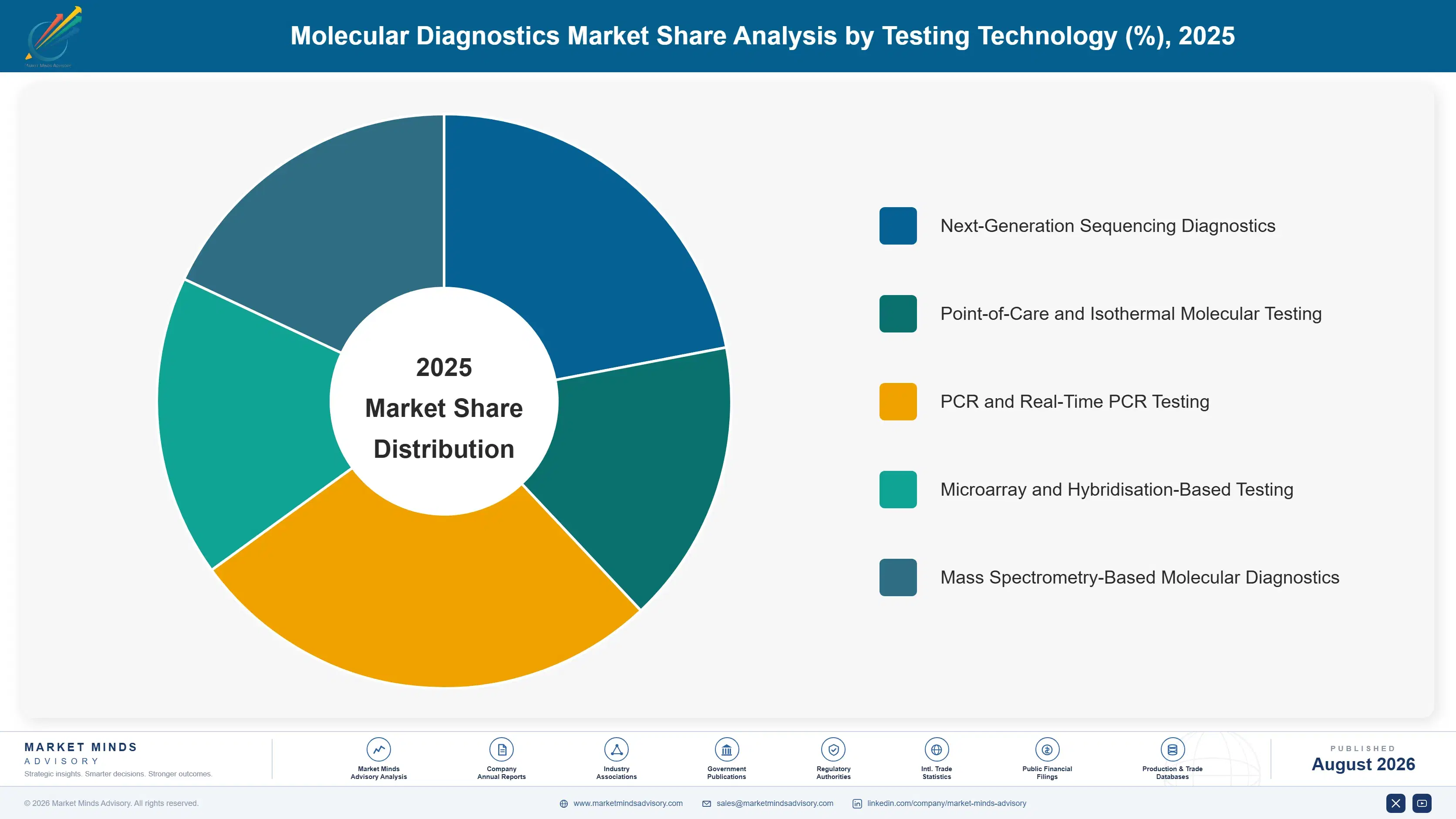
Segmentation follows testing technology, a single technical logic describing which molecular method actually generates the diagnostic result rather than what disease category the test addresses. Each technology carries its own cost structure, turnaround time, and regulatory pathway, so commercial position tracks the underlying method rather than the clinical application it happens to serve currently.
molecular-diagnostics-market-market-share-analysis-1787324968933

Next-Generation Sequencing Diagnostics

Next-generation sequencing diagnostics grow fastest at 15.9%, about 1.62 times the overall 9.8% rate, as falling sequencing costs pull whole-genome and targeted panel testing from specialist research settings into mainstream oncology, prenatal, and rare disease protocols across most developed healthcare systems today. Growth concentrates where multi-gene panels replace what used to require multiple sequential single-gene tests, since a broad panel run once resolves diagnostic questions that previously took months of iterative testing to answer conclusively. Illumina and Thermo Fisher Scientific hold established platform positions in this segment. Turnaround time and bioinformatics interpretation capacity remain the primary constraints on how quickly laboratories can scale sequencing volume to meet rising physician demand.
CAGR 15.9%

Point-of-Care and Isothermal Molecular Testing

Point-of-care and isothermal molecular testing grows at 12.8%, extending molecular diagnostic capability into primary care, urgent care, and pharmacy settings that previously depended entirely on samples sent to a distant reference laboratory for processing and interpretation of results. Adoption is concentrated in infectious disease testing, where a result available within minutes changes clinical decisions in ways a next-day laboratory result cannot, particularly for antiviral and antibiotic prescribing choices made at the point of care. Cepheid and Abbott hold strong positions built on established point-of-care platform installed bases across thousands of testing sites worldwide. Regulatory clearance timelines for new point-of-care assay menus remain the primary constraint on how quickly new applications reach commercial deployment at scale.
CAGR 12.8%
Full segment breakdown across 5 segments available in the complete report.

Regional Architecture and Country Demand Map

Reimbursement infrastructure density and reference laboratory concentration, rather than population, set this seven-region value distribution across the market. North America dominates on payer coverage depth and laboratory scale, East Asia follows on manufacturing and testing volume, and China grows fastest on expanding domestic laboratory investment.

North America

North America holds 34% of value at 10.4% growth, well above the 22 to 32% band, because dense private and public payer reimbursement infrastructure combined with concentrated reference laboratory capacity makes it the single largest molecular diagnostics market by a wide margin globally today. Roche Diagnostics, Abbott Laboratories, and Danaher's Cepheid business all maintain deep domestic commercial infrastructure spanning decades of laboratory and hospital system relationships. Quest Diagnostics and Labcorp operate reference laboratory networks unmatched in scale anywhere else in the world. FDA regulatory clearance pathways, while demanding, remain more predictable than many international equivalents, encouraging launch-first commercial strategies across most therapeutic categories. Canadian demand follows comparable patterns at considerably smaller scale.
Share: 34% | CAGR: 10.4% (2026 to 2036)

Western Europe

Western Europe holds 20% of value at 8.4% growth, the slowest of the seven regions, shaped by fragmented national reimbursement systems that require separate coverage negotiations across member states rather than one unified payer decision made centrally across the bloc. The European Union's in vitro diagnostic regulation framework has raised compliance costs and lengthened launch timelines considerably compared to the pathway many companies previously used before the framework changed. Roche and Qiagen both hold strong regional positions built on deep laboratory and hospital system relationships across major markets. German and French reimbursement systems remain the most predictable regionally. Growth reflects steady adoption tempered by genuine regulatory and reimbursement fragmentation across the bloc.
Share: 20% | CAGR: 8.4% (2026 to 2036)
Regional intelligence for 5 additional markets available in the complete report: East Asia, South Asia and Pacific, Latin America, Middle East and Africa, Eastern Europe. Contact sales@marketmindsadvisory.com.
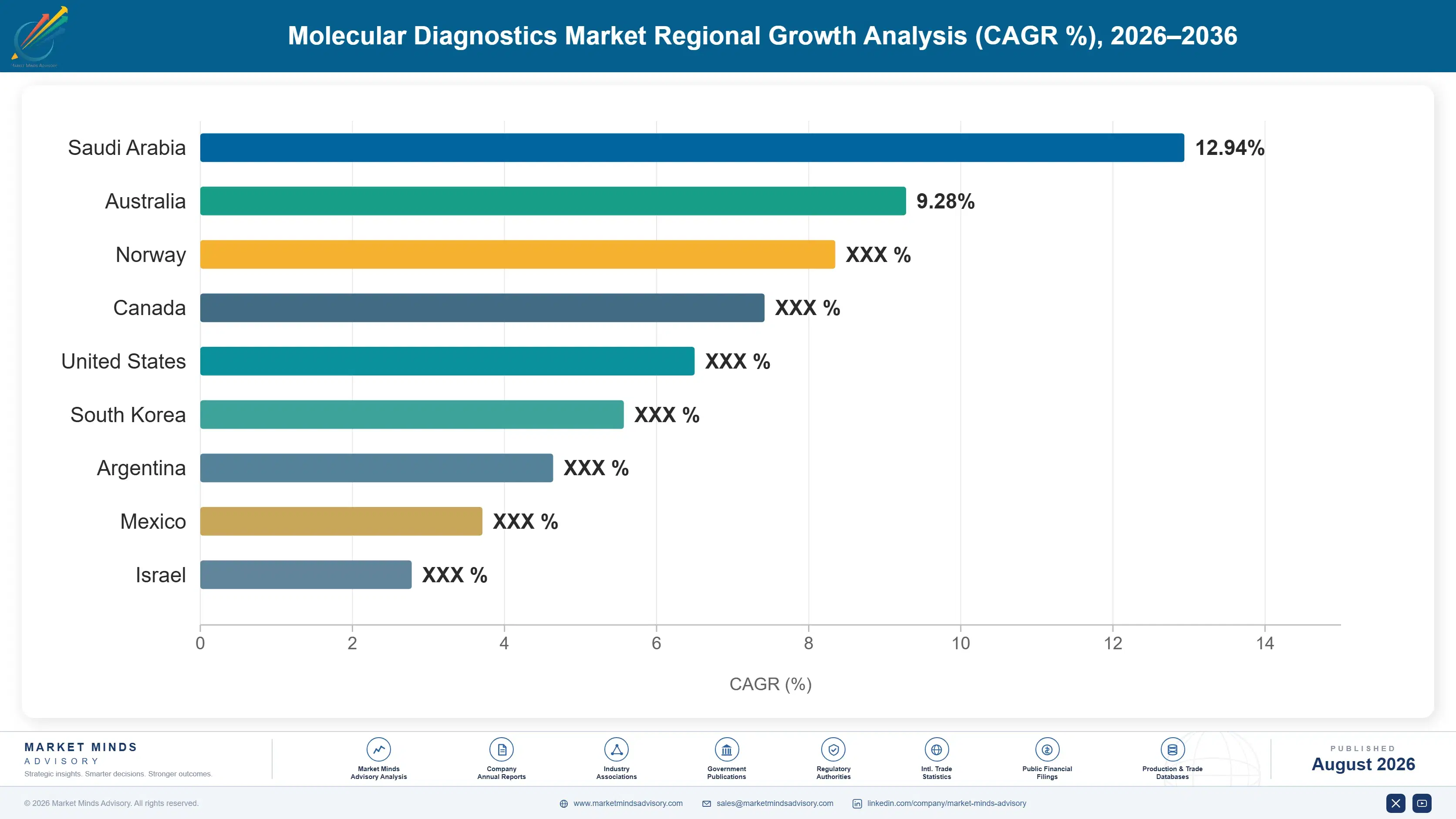
molecular-diagnostics-market-country-cagr-analysis-1787324969449

Where Molecular Diagnostics Companies Hold Margin

A laboratory selling standalone sequencing capacity while a competitor bundles companion diagnostic development, reimbursement navigation, and point-of-care deployment into one relationship is fighting the wrong battle entirely today. The four moves below shift earnings toward what actually captures share: companion diagnostic partnerships, payer evidence generation, point-of-care menu expansion, and reference laboratory consolidation built early.

Build Companion Diagnostic Development Partnerships Early

Diagnostics companies that embed themselves in pharmaceutical development programmes years before a therapy's approval capture the resulting companion diagnostic revenue almost automatically, since the paired test is written directly into the drug's regulatory label at launch. That positioning commands a premium of 25 to 40% over standalone diagnostic pricing, since pharmaceutical partners pay for development speed and regulatory alignment as much as for the underlying assay technology itself. Roche and Thermo Fisher built this depth over decades, and it is not quickly replicated by laboratories entering from a pure testing services background.
Market Impact: Commands a 25 to 40% development pr

Fund Payer Evidence Generation Ahead Of Launch

Reimbursement committees routinely take 2 to 5 years to grant coverage for genuinely novel molecular panels, and companies that fund real-world evidence generation studies before launch shorten that gap considerably compared to competitors waiting for organic clinical adoption to accumulate the same evidence over time. That upfront evidence investment converts a multi-year reimbursement delay into a manageable commercial runway, since payers increasingly require exactly this kind of data before granting coverage for expensive genomic testing. Companies skipping this step routinely absorb years of below-cost delivery that better-prepared competitors avoid entirely.
Market Impact: Cuts coverage delay by up to 2 year

Expand Point-Of-Care Assay Menus Into Primary Care

Point-of-care platforms installed across more than 5,000 primary care and urgent care sites generate ongoing menu expansion revenue every time a new assay clears regulatory review, since the installed hardware base is already in place and simply needs a new reagent cartridge to release incremental testing volume. That installed-base economics gives platform leaders a durable cost advantage over new entrants who must fund both hardware placement and assay development simultaneously before generating any revenue. Cepheid and Abbott have both built menu expansion into a reliable, recurring, high-margin revenue stream over multiple product cycles.
Market Impact: Installed base now spans over 5,000

Consolidate Reference Laboratory Networks For Scale

Reference laboratory consolidation concentrates testing volume, specialist interpretation expertise, and payer contracting leverage into fewer, larger networks capable of negotiating more favourable reimbursement terms than any single independent laboratory could achieve alone. Quest Diagnostics and Labcorp have both used acquisition to build laboratory networks spanning more than 5,000 testing sites combined, converting fragmented regional demand into standardised national testing menus that smaller competitors cannot easily replicate. That scale advantage compounds over time, since larger networks amortise sequencing and bioinformatics infrastructure investment across considerably more testing volume than smaller independent laboratories ever achieve.
Market Impact: Networks now span over 5,000 testin

Who Controls the Margin Pool

Concentration is high at roughly 48% for the top five, reflecting diagnostics majors that hold platform, assay menu, and laboratory relationships simultaneously across most major reimbursement markets. The gap between leaders and challengers is companion diagnostic partnership depth and reference laboratory network scale rather than raw assay chemistry, broadly comparable across established players. All participants are assessed on one basis, revenue from molecular diagnostic platforms, reagents
Competition runs along three lines. First, companion diagnostic partnership depth, since that increasingly determines which companies capture the highest-value precision oncology contracts. Second, payer evidence generation capability, which shortens the multi-year reimbursement gap that stalls competitors relying on organic clinical adoption alone. Third, reference laboratory network scale, since consolidation concentrates testing volume and payer contracting leverage into fewer, larger organisations.

Pressure is building from two directions. Large diversified diagnostics majors are acquiring specialist genomics and point-of-care firms to build platform breadth faster than organic development allows. Meanwhile venture-backed genomics specialists are entering oncology and prenatal testing directly, bringing sequencing cost advantages traditional laboratories cannot easily match. Rankings should favour companies combining companion diagnostic depth with genuine payer evidence capability over those competing on assay menu breadth alone.
molecular-diagnostics-market-company-positioning-matrix-1787324969970

Competitive Moat and Risk Dimensions

ROCHE DIAGNOSTICS

Moat: Companion diagnostic partnership depth

Roche Diagnostics maintains deep companion diagnostic development relationships with pharmaceutical partners built over decades of joint oncology drug and test co-development programmes. Its platform installed base spans thousands of laboratories globally, providing distribution reach smaller specialists cannot match. Continued investment in sequencing and companion diagnostic partnership depth positions it ahead of narrower single-technology competitors.
ROCHE DIAGNOSTICS

Risk: Reimbursement pace lags assay pipeline

Its broad companion diagnostic pipeline still depends on payer reimbursement decisions that routinely take years to finalise, creating a persistent gap between assay launch and sustainable commercial return. Nimbler specialist competitors focused on faster-reimbursing categories can move capital more efficiently in the interim. Maintaining pipeline breadth while reimbursement timelines stay slow remains a genuine ongoing commercial tension for the business.
DANAHER

Moat: Point-of-care installed base scale

Danaher's Cepheid business operates a point-of-care platform installed base spanning thousands of testing sites, generating recurring menu expansion revenue every time a new assay clears regulatory review. Its infectious disease testing franchise built deep clinical trust during the pandemic period. Continued investment in oncology and companion diagnostic menu expansion extends that installed base into higher-value testing categories.
DANAHER

Risk: Exposure to infectious disease cycles

Its installed base remains meaningfully exposed to infectious disease testing volume cycles, which move independently of the steadily expanding oncology and companion diagnostic segment driving longer-term category growth. Diversification into oncology testing requires assay development capability the business is still actively building. Genomics specialists entering point-of-care oncology testing directly threaten its historical infectious-disease-led market position.

Players Tracked

Prominent Players

Roche Diagnostics
Abbott Laboratories
Danaher
Thermo Fisher Scientific
Hologic

Other Key Players

Qiagen
bioMérieux
Illumina
Becton Dickinson
Siemens Healthineers
Bio-Rad Laboratories
Grifols
Sysmex
Myriad Genetics
Exact Sciences
Guardant Health
Natera
Quest Diagnostics
Labcorp
Revvity

Recent Developments

SEPTEMBER 2023

FDA clears major companion diagnostic menu expansion

The FDA cleared a major expansion of a leading companion diagnostic platform's oncology testing menu, adding several new targeted therapy indications simultaneously. This was regulatory clearance rather than any corporate transaction, and it converted an existing installed platform base directly into expanded revenue across multiple new precision oncology categories.
Signal: Menu expansion clearances on existing plat
APRIL 2024

Diagnostics major acquires specialist sequencing oncology company

A leading diagnostics major announced an acquisition of a specialist next-generation sequencing oncology testing company, adding genomic panel capability directly into its companion diagnostic pipeline. This was a genuine acquisition rather than a joint venture or minority stake, and it closed a sequencing capability gap the company previously lacked.
Signal: Acquiring genomic sequencing capability di
JANUARY 2025

Major reference laboratory network acquires regional laboratory chain

A major reference laboratory network completed an acquisition of a regional laboratory chain, consolidating testing volume and payer contracting leverage across an expanded geographic footprint. This was a genuine acquisition rather than a joint venture, and it extended the acquirer's negotiated reimbursement rates across newly added markets and testing sites.
Signal: Laboratory network consolidation keeps con

Sequencing Reagents And Specialty Enzyme Supply Risk

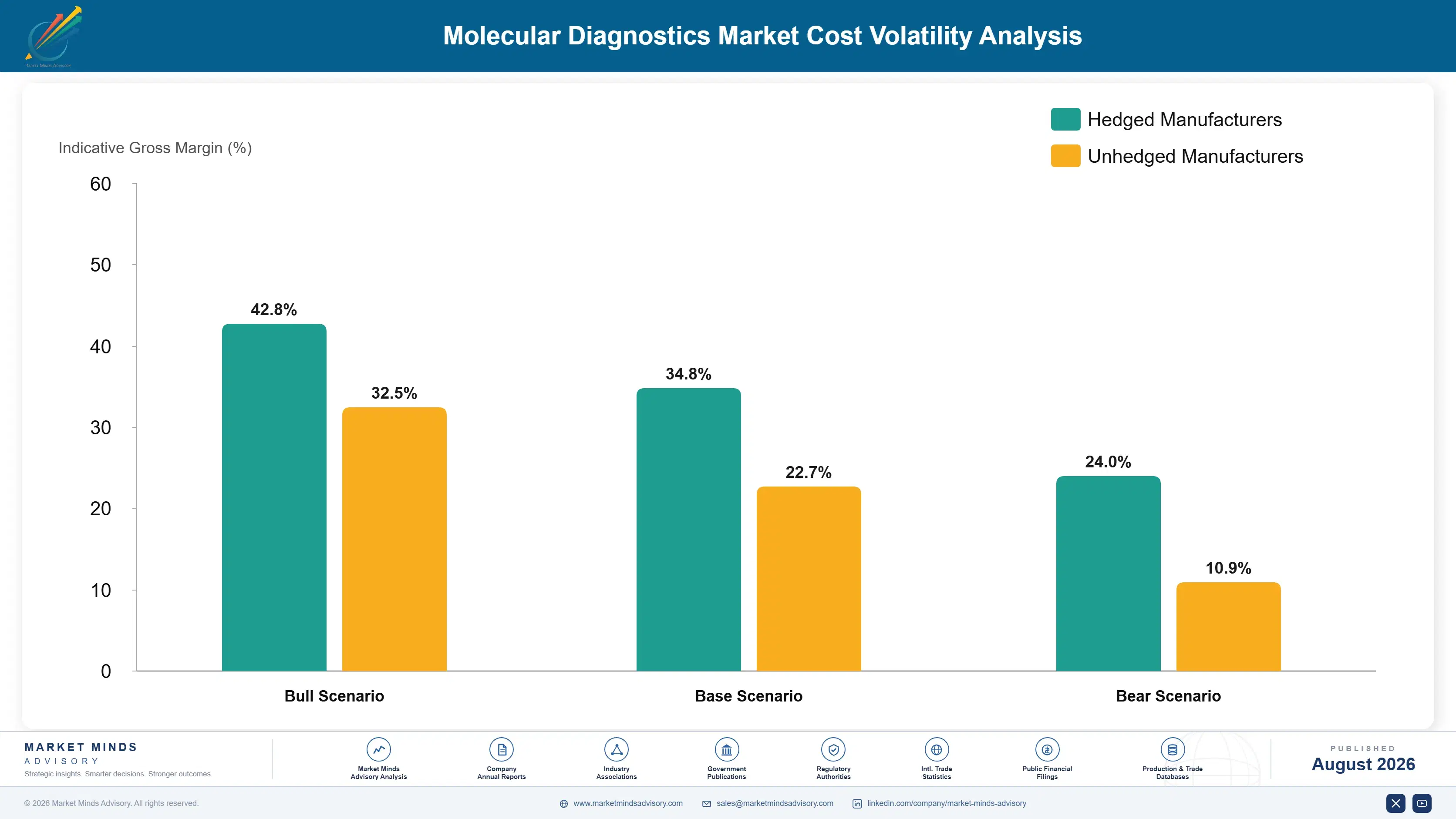
Sequencing reagents and enzyme kits dominate cost structure for molecular diagnostics. Polymerases, primers, fluorescent probes, and library preparation reagents together account for a substantial share of assay cost, sourced primarily from specialty biochemical and enzyme manufacturers concentrated in a handful of countries. Instrument capital, bioinformatics infrastructure, and specialist interpretation staff complete the cost structure for reference laboratory operations.
Specialty enzyme and reagent supply tightened considerably through 2021 and 2022 as pandemic-driven PCR testing demand strained global manufacturing capacity for polymerases and other core molecular biology reagents simultaneously. Several diagnostics companies disclosed the resulting margin pressure and allocation constraints across their annual reporting through that period, and industry supply data recorded extended lead times for specialty enzymes that persisted well after acute pandemic testing volume declined.

Exposure divides sharply by reagent sourcing strategy rather than by laboratory size specifically. Companies with vertically integrated reagent manufacturing or long-term supplier agreements held cost considerably better than those buying enzymes and reagents on spot markets during the shortage period. The disadvantage compounds, because a laboratory unable to fulfil testing contracts during a shortage loses the physician ordering relationship that competitors, once established, retain for years afterward.
molecular-diagnostics-market-cost-volatility-analysis-1787324970165

Diversify reagent sourcing across multiple enzyme manufacturers

Concentrating reagent sourcing with a single enzyme manufacturer ties production directly to that supplier's specific capacity and allocation decisions, which the pandemic-era shortage demonstrated quite expensively across the entire global industry. Diversifying sourcing across multiple qualified manufacturers spreads that exposure and improves reagent availability during any single supplier's capacity constraint or unexpected disruption considerably.

Secure multi-year reagent supply agreements early

Spot buying specialty enzymes and reagents exposes laboratories to allocation cuts precisely when testing demand is also rising sharply across the industry simultaneously and quite unpredictably each cycle. Multi-year supply agreements with reagent manufacturers, even at modest committed volume, provide allocation priority and pricing stability that spot buyers competing during a shortage simply cannot access.

Invest in vertically integrated reagent manufacturing capability

Laboratories entirely dependent on external reagent suppliers cannot control allocation priority when a shortage hits, leaving no real alternative but to absorb delay and cost increases directly and pass them downstream. Vertically integrated reagent manufacturing, even at modest internal scale, preserves supply continuity and negotiating leverage that externally dependent competitors simply cannot access or replicate.

Portfolio Architecture for Margin Defence

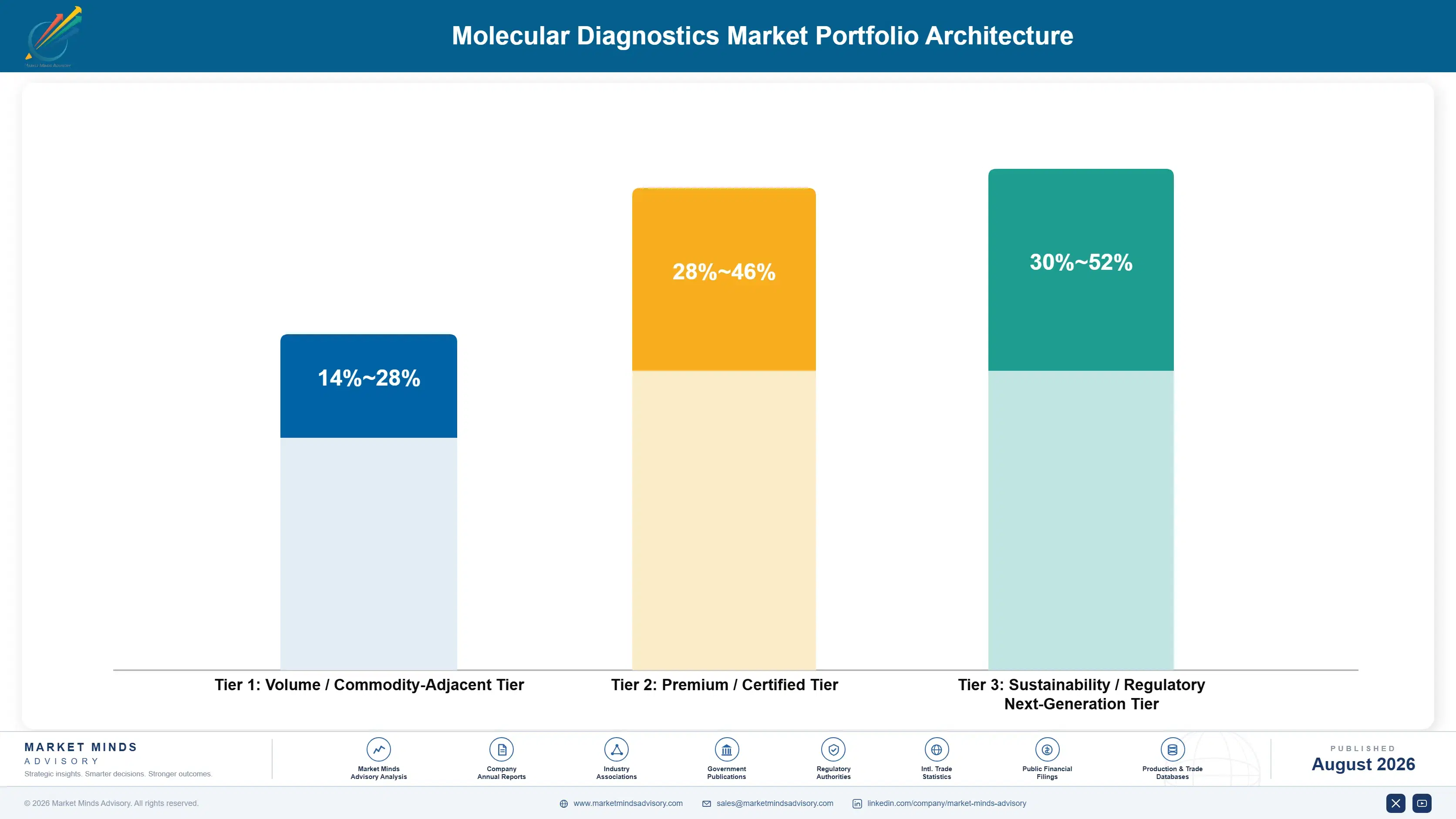
The portfolio splits into three tiers with genuinely different economics. Conventional PCR and hybridisation-based testing is the volume tier, where reagent cost and laboratory throughput drive competition directly. Companion diagnostic and payer-reimbursed genomic panels earn considerably more, because pharmaceutical partnership depth narrows the qualified field. Point-of-care and next-generation sequencing platforms sit differently again, priced against the access problem they solve rather tha
The tension runs between standard PCR volume that fills laboratory throughput and premium sequencing work that earns the return. Conventional molecular panels generate the tonnage that keeps laboratory instruments running and maintains physician relationships through which higher-value conversations eventually happen. Yet this testing competes on cost against every qualified laboratory serving the same reimbursed demand. Companies managing this well treat standard volume as capacity utilisation and direct investment toward companion diagnostic depth.

High-value pools concentrate where regulatory partnership or reimbursement complexity genuinely limits competition: companion diagnostics tied to an approved therapy, sequencing panels replacing multiple sequential single-gene tests, and point-of-care platforms solving access in settings a laboratory never reached. All three resist the price competition defining standard PCR testing, because the customer is purchasing a solved clinical problem rather than comparing interchangeable assay results across laboratories.

Volume / Commodity-Adjacent Tier

Conventional PCR and hybridisation-based testing sold into routine infectious disease and screening demand at high volume. The range is wide because throughput-optimised laboratories earn respectably while smaller operations competing purely on price frequently do not.
Gross Margin: 14-28%

Premium / Certified Tier

Companion diagnostic and payer-reimbursed genomic panels carrying deep pharmaceutical partnership relationships and established reimbursement coverage in oncology and rare disease. The range is wide because partnership depth and reimbursement maturity vary considerably by therapeutic area.
Gross Margin: 28-46%

Sustainability / Regulatory / Next-Generation Tier

Point-of-care and next-generation sequencing platforms addressing the access and speed problem directly and durably across settings a laboratory never reached before. The range is wide because sequencing scale and platform installed-base maturity still vary enormously by company.
Gross Margin: 30-52%
molecular-diagnostics-market-portfolio-architecture-1787324970660

High-value Sub-segments and Strategic Watch-out

Next-Generation Sequencing Diagnostics

High value and the fastest growth at 15.9%, from a moderate base as falling sequencing costs pull genomic testing from research settings into mainstream oncology and prenatal protocols. Reimbursement coverage remains inconsistent across geographies, limiting near-term adoption to well-covered indications and premium health systems specifically.
Gross Margin: 32-52%

Point-of-Care and Isothermal Molecular Testing

High value with strong growth, protected by installed-base economics and regulatory clearance timelines that create a durable barrier newer entrants find genuinely difficult to replicate quickly. Menu expansion revenue compounds steadily as new assays clear review on hardware already deployed across thousands of care settings.
Gross Margin: 28-46%

PCR and Real-Time PCR Testing

The volume core across infectious disease and routine screening testing worldwide, and the category with the longest commercial history of the five segments listed here. Growth is steady but competition on cost is direct, holding margin below the sequencing and point-of-care tiers positioned above it.
Gross Margin: 14-28%

Microarray and Hybridisation-Based Testing

The strategic watch-out, growing slowest as reimbursement committees favour newer, higher-clinical-utility panel and sequencing formats over conventional single-marker microarray testing across most major markets today. Declining physician preference limits addressable volume exactly where reimbursement scrutiny is intensifying fastest, threatening this segment's position over time considerably.
Gross Margin: 16-30%

How Molecular Testing Contracts Actually Commit

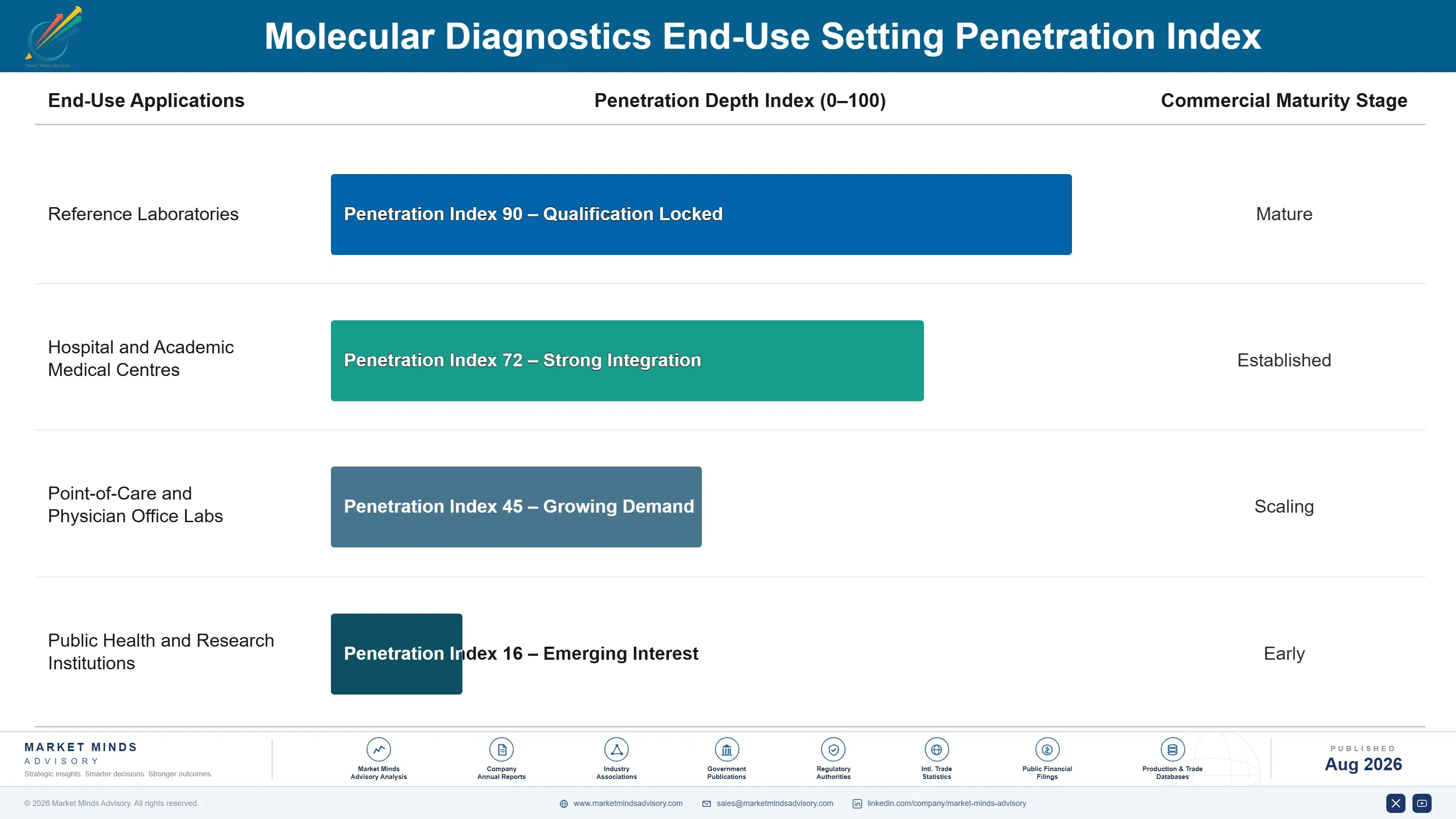
Revenue commits differently depending on which mechanism drives the test order. Companion diagnostic testing locks in tightly once a paired therapy reaches approval, since prescribing physicians have no alternative but the validated test and reorder without further evaluation. Elective testing moves more slowly and stays genuinely reversible if reimbursement or clinical guidelines shift. Understanding which mechanism applies shapes both pricing power and retention expectations.
Adoption depth varies sharply by care setting. Academic and specialist oncology centres go deepest, standardising sequencing-based testing across their patient population once clinical guidelines endorse a panel. Community hospitals and clinics adopt more selectively, often ordering targeted single-gene tests before broader sequencing panels become standard. Primary care and pharmacy point-of-care buyers weigh turnaround speed more heavily, since a same-visit result changes treatment decisions a laboratory result cannot.

Buyer profiles have shifted from pathologists toward precision medicine committees and payer relations functions with distinct priorities. A pathologist once compared assay sensitivity and specificity directly; a precision medicine committee now tracks guideline inclusion, and a payer relations function drives specification against reimbursement coverage a purely technical evaluation would never have prioritised. Laboratories selling on assay performance alone find decisions made by committees that never reviewed their validation data.
molecular-diagnostics-market-end-use-penetration-index-1787324971148

Our Call On Molecular Diagnostics

These are among the four positions where our research anticipates prominent divergence between winners and laggards over the coming forecast period. Each is grounded in the demand model, the regulatory perimeter, and the announced capacity pipeline.
01 / COMPANION DIAGNOSTIC STRATEGY

Build companion diagnostic partnerships years before approval

Diagnostics companies that embed themselves in pharmaceutical development programmes years before a therapy's approval capture the resulting companion diagnostic revenue almost automatically, since the paired test is written directly into the drug's regulatory label at launch. That positioning commands a premium of 25 to 40% over standalone diagnostic pricing, since pharmaceutical partners pay for development speed and regulatory alignment as much as for the underlying assay technology. Companies should prioritise this depth now, because it is not quickly replicated once rivals close the gap.
02 / PAYER EVIDENCE INVESTMENT

Fund reimbursement evidence generation ahead of launch

Reimbursement committees routinely take two to five years to grant coverage for genuinely novel molecular panels, and companies that fund real-world evidence generation studies before launch shorten that gap considerably compared to competitors waiting for organic clinical adoption to accumulate the same evidence. That upfront evidence investment converts a multi-year reimbursement delay into a manageable commercial runway, since payers increasingly require exactly this kind of data before granting coverage. Companies skipping this step routinely absorb years of below-cost delivery that better-prepared competitors avoid.
03 / POINT-OF-CARE MENU EXPANSION

Expand installed-base menus rather than chase new placements

Point-of-care platforms installed across thousands of primary care and urgent care sites generate ongoing menu expansion revenue every time a new assay clears regulatory review, since the installed hardware base is already in place and simply needs a new reagent cartridge to release incremental testing volume. That installed-base economics gives platform leaders a durable cost advantage over new entrants who must fund both hardware placement and assay development simultaneously. Companies should prioritise menu depth over new platform placements to compound existing advantage.
04 / LABORATORY NETWORK SCALE

Consolidate laboratory networks to build contracting leverage

Reference laboratory consolidation concentrates testing volume, specialist interpretation expertise, and payer contracting leverage into fewer, larger networks capable of negotiating more favourable reimbursement terms than any single independent laboratory could achieve alone in isolation. Quest Diagnostics and Labcorp have both used acquisition to build laboratory networks spanning thousands of testing sites, converting fragmented regional demand into standardised national testing menus smaller competitors cannot easily replicate. That scale advantage compounds steadily as networks amortise infrastructure investment across considerably more testing volume than smaller laboratories ever achieve.

Engagement Snapshot From the Field

A live engagement with an industry participant carrying material or product regulatory and market exposure ahead of a defining policy shift, showing how our research translates into a defensible multi-year portfolio strategy.
MARKET MINDS ADVISORY · CLIENT ENGAGEMENT SUMMARY
Molecular Diagnostics Producer Strategic Portfolio Review and Transition Roadmap 2026·Investment Scenario on Molecular Diagnostics Exposure Evaluation 2025-26
CLIENT PROFILE
A mid-sized precision oncology biopharmaceutical company engaged MMA while planning companion diagnostic strategy ahead of a pivotal targeted therapy approval expected within eighteen months' time. The client reported development budget near USD 45 million allocated to diagnostic partnership and faced a compressed regulatory timeline requiring a validated companion test at launch (client-reported, unverified by MMA).
STRATEGIC CHALLENGE
Selecting a companion diagnostic partner early would lock in development speed, but the client's internal team had limited experience evaluating diagnostics companies on reimbursement and laboratory network criteria specifically. The board wanted certainty that the chosen partner could deliver a validated test on the compressed regulatory timeline without delaying the broader approval.
MMA APPROACH
MMA evaluated five candidate companion diagnostic partners against development speed, existing reimbursement relationships, and reference laboratory network reach relevant to the client's target patient population. We modelled reimbursement timeline risk under each partner scenario rather than development cost alone. We then assessed each partner's regulatory clearance track record against the client's compressed approval timeline.
KEY FINDINGS
  1. Only two of five candidate partners had prior companion diagnostic clearance experience directly relevant to the client's specific therapeutic mechanism and target patient population.
  2. The fastest-moving partner's reimbursement relationships covered 70% of the client's target patient population at launch, compared to under 40% for the slowest option (client-reported, unverified by MMA).
  3. Laboratory network reach varied considerably, with the strongest partner's network covering three times more testing sites than the weakest candidate evaluated overall.
  4. A partner selected purely on development speed would have delayed reimbursement coverage by an estimated fourteen months relative to the recommended partner.
CLIENT PROFILE
A mid-sized precision oncology biopharmaceutical company engaged MMA while planning companion diagnostic strategy ahead of a pivotal targeted therapy approval expected within eighteen months' time. The client reported development budget near USD 45 million allocated to diagnostic partnership and faced a compressed regulatory timeline requiring a validated companion test at launch (client-reported, unverified by MMA).
STRATEGIC CHALLENGE
Selecting a companion diagnostic partner early would lock in development speed, but the client's internal team had limited experience evaluating diagnostics companies on reimbursement and laboratory network criteria specifically. The board wanted certainty that the chosen partner could deliver a validated test on the compressed regulatory timeline without delaying the broader approval.
MMA APPROACH
MMA evaluated five candidate companion diagnostic partners against development speed, existing reimbursement relationships, and reference laboratory network reach relevant to the client's target patient population. We modelled reimbursement timeline risk under each partner scenario rather than development cost alone. We then assessed each partner's regulatory clearance track record against the client's compressed approval timeline.
KEY FINDINGS
  1. Only two of five candidate partners had prior companion diagnostic clearance experience directly relevant to the client's specific therapeutic mechanism and target patient population.
  2. The fastest-moving partner's reimbursement relationships covered 70% of the client's target patient population at launch, compared to under 40% for the slowest option (client-reported, unverified by MMA).
  3. Laboratory network reach varied considerably, with the strongest partner's network covering three times more testing sites than the weakest candidate evaluated overall.
  4. A partner selected purely on development speed would have delayed reimbursement coverage by an estimated fourteen months relative to the recommended partner.
RECOMMENDED STRATEGY
Phase 1: Phase 1 (0 to 3 months): Select the companion diagnostic partner combining the fastest development timeline with broadest reimbursement coverage. Phase 2: Phase 2 (3 to 14 months): Co-develop the companion diagnostic assay in parallel with the therapy's remaining regulatory approval process. Phase 3: Phase 3 (14 to 24 months): Launch the paired therapy and diagnostic together, prioritising reimbursement coverage in the highest-volume markets first.
OUTCOME
The client selected a companion diagnostic partner combining fast development with the broadest existing reimbursement coverage, avoiding the delay a speed-only selection would have caused. The paired therapy and diagnostic launched on schedule with reimbursement coverage already in place across the client's priority markets, and the approach is now the client's standard companion diagnostic selection framework (client-reported, unverified by MMA).

Frequently Asked Questions

Foundational context covering the market sizes, CAGR, scope, country, region and competition that inform every finding below. This section is provided to cover basics and most often pre-purchase conversations, answered from the MMA Primary Research Dataset.

What is the current size of the Molecular Diagnostics Market?

The global molecular diagnostics market is valued at USD 9.6 billion in 2025, covering PCR, sequencing, point-of-care, microarray, and mass spectrometry-based diagnostic testing. Conventional immunoassay and culture-based diagnostics are excluded from scope.

How large will the Molecular Diagnostics Market be by 2036?

The market is forecast to reach USD 26.85 billion by 2036 in the base case, about 2.55 times the 2026 level. That represents incremental value of roughly USD 16.31 billion across the forecast decade.

What is the CAGR for the Molecular Diagnostics Market 2026 to 2036?

The market grows at a 9.8% CAGR in the base case, with bull and bear scenarios at 11.0% and 8.6%. The spread turns mainly on sequencing cost trajectory and payer reimbursement pace.

Which segment is growing fastest?

Next-generation sequencing diagnostics grows fastest at 15.9%, about 1.62 times the overall rate, as falling sequencing costs pull genomic testing into mainstream oncology and prenatal care. Point-of-care testing follows at 12.8% on decentralised access demand.

Who are the major companies in the Molecular Diagnostics Market?

Leading suppliers include Roche Diagnostics, Abbott Laboratories, Danaher, Thermo Fisher Scientific, and Hologic, holding roughly 48% between them. Companies combining companion diagnostic depth with laboratory network scale are increasingly capturing premium positioning.

Which country is growing fastest?

China grows fastest at a 13.5% CAGR, building on rapidly expanding domestic laboratory infrastructure and broadening reimbursement coverage. India follows closely on scaling laboratory chains and rising molecular testing adoption.

Report Segmentation Architecture

The full report scope spans multiple orthogonal segmentation dimensions, with cross-tabulated demand data provided for each dimension pair. Coverage extends further to regional breakdowns, trend trajectories, and the competitive detail needed to support segment-level decision-making.

By Testing Technology

  • Next-Generation Sequencing Diagnostics
  • Point-of-Care and Isothermal Molecular Testing
  • PCR and Real-Time PCR Testing
  • Microarray and Hybridisation-Based Testing
  • Mass Spectrometry-Based Molecular Diagnostics

By End-Use Setting

  • Reference Laboratories
  • Hospital and Academic Medical Centres
  • Point-of-Care and Physician Office Labs
  • Public Health and Research Institutions

By Commercial Dimension

  • Direct Reference Laboratory Contracts
  • Companion Diagnostic Partnership Agreements
  • Point-of-Care Platform Placement and Menu Licensing
  • Distributor and Reseller Channels

By Region

  • North America
  • Western Europe
  • East Asia
  • South Asia and Pacific
  • Latin America
  • Middle East and Africa
  • Eastern Europe

Scope, Methodology, and Coverage

Every figure in this report is reproducible from documented input assumptions. The scope below maps the historical period, the forecast horizon, the segmentation dimensions, and the countries covered, alongside the underlying primary and qualitative methodology.
Historical Period
2020 to 2025
Forecast Period
2026 to 2036
Base Year
2025 (USD billions; MMA Primary Research Dataset, August 2026)
Market Definition
The molecular diagnostics market comprises in vitro diagnostic testing that detects, quantifies, or characterises nucleic acids or related molecular biomarkers to inform clinical decisions, valued at platform, reagent, and testing service revenue. It spans PCR and real-time PCR testing, next-generation sequencing diagnostics, point-of-care and isothermal molecular testing, microarray and hybridisation-based testing, and mass spectrometry-based molecular diagnostics used in clinical settings. Conventional immunoassay, culture-based microbiology, and histopathology testing that does not rely on molecular nucleic acid detection, along with research-use-only testing not intended for clinical decision-making, are excluded.
Quantitative Units
USD billions (current prices); testing volume in millions of assays by testing technology where applicable
Segmentation Dimensions
By Testing Technology; By End-Use Setting; By Commercial Dimension; By Region
Regions Covered
North America, Western Europe, East Asia, South Asia and Pacific, Latin America, Middle East and Africa, Eastern Europe
Countries Covered
USA, Canada, Germany, France, UK, Italy, Spain, Netherlands, China, Japan, South Korea, India, Australia, Vietnam, Indonesia, Brazil, Mexico, Chile, Argentina, UAE, Saudi Arabia, South Africa, Egypt, Poland, Czechia, Hungary, Romania, and additional markets relevant to this sector
Key Companies Profiled
Roche Diagnostics, Abbott Laboratories, Danaher, Thermo Fisher Scientific, Hologic, Qiagen, bioMérieux, Illumina, Becton Dickinson, Siemens Healthineers, Bio-Rad Laboratories, Grifols, Sysmex, Myriad Genetics, Exact Sciences, Guardant Health, Natera, Quest Diagnostics, Labcorp, Revvity
Quantitative Methodology
Primary survey, n=3,800 respondents, Q4 2025, six countries; demand-side model with trade association cross-validation
Qualitative Methodology
47 expert interviews, Q4 2025; applied to validate demand model assumptions, identify emerging dynamics, and assess competitive positioning
Report Format
PDF and XLSX data workbook (Word format preview document)
Publisher
Market Minds Advisory
Report Code
MMA-2026-MED-212
Published
August 2026
Contact
sales@marketmindsadvisory.com | www.marketmindsadvisory.com

Purchase the full Molecular Diagnostics Market Report (2026 to 2036).

The full MMA Molecular Diagnostics report sizes the market across five testing technologies, four end-use settings, and seven regions through 2036. It profiles 20 companies on a consistent basis of molecular diagnostics revenue, scoring each on companion diagnostic partnership depth, payer evidence generation capability, point-of-care menu breadth, and reference laboratory network scale. Scenario models quantify how companion diagnostic mandates, sequencing cost declines, and reimbursement timelines move both testing volume and achievable margin by technology. The report also includes reimbursement coverage mapping and reagent supply chain risk tracking.
Five-technology and four-setting market sizing through 2036
Twenty-company benchmark on molecular diagnostics revenue
Reimbursement coverage mapping by technology and region
Companion diagnostic partnership and pipeline tracking
Reagent and enzyme supply chain risk mapping
Reference laboratory network consolidation tracking globally

Built For The People Who Decide

From boardroom strategy to bench-side execution, this report is read cover-to-cover by leaders shaping the next decade of their industry, turning demand scenarios, market dynamics and valuation benchmarks into decisions.
CXOs/ Presidents/ VPs/ Managers
M&A and Corporate Development
Strategy Teams and R&D Heads
Procurement and Product Directors
Regulatory and Compliance Leaders
Investor Relations and Equity Analysts