Market Minds Advisory
Molding Starch Market

Molding Starch Market: Binder Performance Economics in Metal Casting

Foundries are switching to modified molding starches that bind sand cores more consistently under automated casting lines, rewarding suppliers who can guarantee batch-to-batch performance as automotive and machinery casting volumes recover globally.

Lead Analyst

Lisa Gevelber

Published

September 2026

Make Smarter Decisions with Customized Research Insights

Request a free sample report and evaluate market opportunities, growth trends, and competitive dynamics relevant to your business needs.

2025 MARKET VALUE$2.9BMarket Size 2025
2036 FORECAST VALUE$4.8BBase Case , 2026 to 2036
CAGR 2026 TO 20364.6 %Bull 5.8% / Bear 3.4%
INCREMENTAL OPPORTUNITY$1.7BNet 10- year value creation
EXPANSION MULTIPLE1.57x2036 value over 2026 base
Strategic Levers
M&A Pipeline
Regional Outlook
Country Rankings
Competitive Intelligence
Segmental Deep-dive
Call-Us : 91 93563 13602

Executive Snapshot and Market Trajectory

Molding starch has shifted from a commodity sand-binding additive into a performance-differentiated input, as foundries running automated high-speed molding lines demand consistent gelatinization behavior that unmodified starches cannot reliably deliver across every batch and shift, reshaping supplier qualification standards across the industry this year at nearly every major casting facility.
Modified and pregelatinized starches are growing fastest as foundries prioritize binder consistency over raw material cost, expanding at roughly 7.6 percent annually against the category's 4.6 percent baseline. East Asia commands the largest regional share given China's outsized casting production base, the largest of any country by a wide margin, while South Asia and Pacific grows fastest as India's expanding casting sector adopts modern binder chemistry for the first time at scale.
Competitive intensity centers on formulation consistency and technical service support, with leading suppliers investing in foundry-side application engineering to defend long-term supply contracts against lower-cost unmodified starch competitors selling on price alone. Feedstock flexibility across corn, cassava, and wheat sourcing has become a genuine differentiator as regional agricultural supply costs diverge, and several suppliers now offer multi-feedstock formulations tailored to local pricing conditions.
Market Definition
The molding starch market covers native and modified starch products used as sand binders and core additives in metal casting and foundry operations, including corn, cassava, potato, and wheat-derived formulations. It excludes food-grade starches, industrial starches used in paper or textile sizing, and non-starch foundry binder chemistries.
Base Year Value
$2.9B in 2025 (MMA Primary Research Dataset, August 2026)
Forecast Period
2026 to 2036, eleven discrete annual values
CAGR
4.6% base case. Bull 5.8%. Bear 3.4%.
Fastest Growth Segment
Modified and Pregelatinized Molding Starch: 7.6% CAGR
Fastest Growth Country
India: 9.2% CAGR
Fastest Growth Region
South Asia and Pacific: 6.8% CAGR
Largest Region
East Asia: 30% of 2025 global value
Market Leaders
Cargill, Incorporated, Ingredion Incorporated, Roquette Freres, Tate & Lyle plc, and Avebe U.A. lead by production capacity and foundry industry revenue. Source: MMA Analysis based on company annual reports and industry participation data.
Primary Survey
n=3,800 procurement and R&D decision-makers, Q4 2025, six countries
Methodology
Demand-side build-up, cross-validated against public data, 47 expert interviews

Molding Starch Market Forecast Scenarios

molding-starch-market-size-forecast-scenario-1787375026332
Between 2020 and 2025, molding starch demand tracked the broader metal casting industry's uneven recovery from pandemic-era production disruptions, with modified starch adoption accelerating as foundries automated molding lines requiring more consistent binder performance. The category posted an estimated 3.9 percent historical CAGR, trailing the forecast rate as modified starch adoption broadens beyond early automotive-sector adopters.
MMA's base case projects 4.6 percent annual growth through 2036, anchored in three commercial mechanisms. First, automotive and machinery casting volumes continue recovering toward pre-pandemic production levels across major manufacturing regions worldwide. Second, foundries increasingly specify modified starch grades as standard rather than optional, lifting average selling prices meaningfully across the category. Third, emerging market foundry capacity expansion, particularly across South Asia, is adding entirely new demand beyond mature developed markets that have supplied most historical growth.
The bull case rests on accelerated automotive production reshoring across North America and Western Europe, which would lift regional casting volumes meaningfully above current projections. The principal bear risk is continued electric vehicle powertrain simplification, which requires fewer cast components per vehicle than traditional internal combustion drivetrains and could durably shrink automotive casting demand over time.

Binder Consistency Economics in Modern Foundries

Foundry purchasing behavior has shifted from pure cost-per-ton evaluation toward documented defect-rate performance. Large automotive and machinery casting operations now track core reject rates against binder cost with the same rigor once reserved for metal alloy specification, a discipline that smaller job-shop foundries are only beginning to adopt as quality certification requirements spread through supply chains and customer audit programs expand across the industry more broadly than before.
MARKET CONCENTRATIONCR5 32%top five suppliers hold moderate combined production capacity
MODIFIED STARCH PREMIUM1.4x nativemodified formulations command a durable sustained price premium
AUTOMOTIVE END-USE SHARE38%automotive casting remains the single largest application segment
CORE REJECT RATE REDUCTION15-25%modified starch adoption meaningfully lowers documented casting defect rates
FEEDSTOCK COST SHARE52% of COGSraw starch feedstock dominates total production cost structure
FOUNDRY QUALIFICATION CYCLE6-9 monthsnew suppliers face lengthy technical qualification before securing contracts
Supplier economics reward companies that can prove consistency across production shifts rather than competing purely on raw feedstock price. Large foundries increasingly require documented batch consistency data before qualifying a new supplier, forcing manufacturers to invest in quality certification systems that smaller regional competitors often lack the capital or technical expertise to build entirely on their own without outside help or partnership.
Over the next decade, feedstock flexibility and technical service depth will matter as much as base formulation chemistry. Suppliers that can offer multiple feedstock options while maintaining consistent binder performance stand to capture disproportionate share as regional agricultural costs continue diverging and foundries increasingly seek supply security alongside consistent product quality across every production shift and facility.
"Nobody switches molding starch suppliers to save two cents a kilo anymore. They switch because the reject rate on the old supplier's starch was costing ten times that in scrapped castings."
Director, Chemicals and Materials Practice · MMA Chemicals and Materials Practice · August 2026

Market Trends

Automated Molding Lines Require Documented Batch Consistency

High-speed automated molding lines used in large-volume automotive and machinery casting operations demand starch binders with consistent gelatinization temperature and viscosity behavior across every production batch, a requirement unmodified native starches struggle to meet reliably at scale. Foundries running these lines report core reject rates dropping 15 to 25 percent after switching to modified formulations with documented batch-to-batch consistency testing. This performance gap has pushed several large automotive casting groups to formally specify modified starch grades in supplier contracts, a requirement that barely existed a decade ago and now shapes purchasing decisions across most major accounts.
Market Impact: Lifts foundry utilization above 80%

Emerging Market Foundry Capacity Expansion Opens New Demand

Foundry capacity expansion across India, Vietnam, and other emerging manufacturing hubs is adding an entirely new demand base beyond the mature developed markets that have supplied most historical molding starch growth. These new foundries are adopting modern binder chemistry directly, skipping the decades-long transition from native to modified starch that developed market foundries went through gradually. India's automotive and machinery casting sector alone has added roughly 340 new mid-sized foundry facilities since 2022, each representing a new long-term binder supply relationship for suppliers able to establish local technical service presence.
Market Impact: Adds 12% non-automotive casting growth

Market Opportunities and Growth Drivers

Automotive Casting Production Recovers Toward Prior Peaks

Automotive casting volumes across major manufacturing regions continue recovering toward pre-pandemic production levels as vehicle production schedules normalize and automakers rebuild component inventory buffers depleted during earlier supply disruptions. This recovery directly lifts molding starch demand, since automotive casting represents the single largest end-use application for the category by a considerable margin over any other industrial vertical. Major casting groups report utilization rates climbing back above 80 percent across several key regional facilities, a level not consistently sustained since before the pandemic disrupted global automotive supply chains and forced widespread production curtailments across the industry.
Market Impact: Cuts per-vehicle cast parts by 30-40%

Machinery and Equipment Casting Demand Broadens Beyond Automotive

Industrial machinery and equipment manufacturers are expanding cast component usage as infrastructure investment programs accelerate across multiple regions, broadening molding starch demand beyond its traditional automotive concentration. This diversification reduces the category's historical sensitivity to automotive production cycles specifically, providing a more stable underlying demand base for suppliers navigating cyclical automotive production swings. Construction and agricultural equipment casting volumes have grown roughly 12 percent over the past two years, outpacing automotive casting growth over the same period across most tracked regional markets, particularly in Asia and parts of Eastern Europe.
Market Impact: Adds 18% cost planning uncertainty

Market Restraints and Challenges

Electric Vehicle Powertrain Simplification Threatens Long-Term Demand

Electric vehicle powertrains require meaningfully fewer cast components than traditional internal combustion engines and transmissions, since electric motors and battery packs eliminate many of the complex cast parts that combustion drivetrains require. The root cause is the fundamental mechanical simplicity of electric propulsion relative to internal combustion systems built from hundreds of precision-cast components. Several foundry groups are diversifying into electric vehicle-specific casting applications, including battery housing and motor casing production, to offset the long-term decline in traditional powertrain casting volume as vehicle electrification continues advancing across major automotive markets worldwide.
Market Impact: Cuts core reject rates by 15-25%

Feedstock Price Volatility Complicates Long-Term Cost Planning

Corn, cassava, and wheat feedstock prices fluctuate with broader agricultural commodity cycles, complicating the long-term cost planning that foundries prefer when negotiating multi-year binder supply contracts. The root cause is molding starch's direct exposure to the same weather, planting decision, and export policy dynamics that drive volatility across all major agricultural commodity markets. Several suppliers are piloting multi-feedstock formulation flexibility, allowing production shifts between corn, cassava, and wheat sourcing based on relative pricing without disrupting binder performance specifications that foundry customers depend on for consistent casting quality across every production run.
Market Impact: Adds 340 Indian foundries since 2022
3 additional market trends, 4 additional growth drivers, and 3 additional restraints and challenges are covered in the full report. Contact sales@marketmindsadvisory.com to access the complete intelligence.

Segment CAGR and Growth Architecture

Feedstock and processing type is the dimension that determines binder performance, pricing, and regional sourcing economics, so MMA segments the market by starch type rather than by end-use application. Six types span the category, from commodity native starches through fast-growing modified grades commanding steep, sustained price premiums across most major casting markets tracked globally.
molding-starch-market-market-share-analysis-1787375026872

Modified and Pregelatinized Molding Starch

Modified and pregelatinized starches are the fastest-growing type because they solve the batch consistency problem that unmodified native starches cannot reliably address on high-speed automated molding lines, delivering the documented gelatinization and viscosity behavior large automotive and machinery foundries increasingly specify as a contract requirement. Foundries switching to modified grades report core reject rate reductions of 15 to 25 percent, a performance gain that easily justifies the price premium over native starch for large-volume casting operations. Chemical modification processes vary by supplier, creating genuine technical differentiation beyond simple commodity competition. Roughly 1.65 times the category's overall growth rate, this segment now commands the steepest price premium of any molding starch type sold globally.
CAGR 7.6%

Cassava and Tapioca-Based Molding Starch

Cassava and tapioca-based starches form the second-fastest-growing type, anchored in expanding Southeast Asian foundry capacity where cassava offers a genuine cost and supply advantage over imported corn starch given regional agricultural production patterns. These starches also appeal to foundries seeking non-genetically-modified feedstock positioning for export-oriented casting operations serving environmentally conscious end markets. Vietnam and Thailand have emerged as particularly strong growth markets, since both countries combine expanding foundry capacity with substantial domestic cassava production capacity that keeps regional feedstock costs meaningfully lower than imported corn starch alternatives. Suppliers increasingly offer cassava-corn blended formulations to balance cost and performance for foundries managing tight margin budgets, while building technical service teams to support this newer feedstock category.
CAGR 6.2%
Full segment breakdown across 6 segments available in the complete report.

Regional Architecture and Country Demand Map

East Asia commands the largest regional share given China's outsized global casting production base, the largest of any country worldwide, while South Asia and Pacific grows fastest as India's expanding automotive and machinery casting sector adopts modern binder chemistry for the first time at meaningful scale.

North America

Automotive and machinery casting recovery anchors demand here, with United States foundries rebuilding production volume toward pre-pandemic levels as automakers restore component inventory buffers depleted during earlier supply disruptions across multiple production years. Large casting groups increasingly specify modified starch grades as a standard contract requirement rather than an optional upgrade, pushing regional average selling prices above the global category average. Mexico's growing automotive casting sector, tightly integrated with United States supply chains, contributes meaningfully to regional demand alongside domestic production. Electric vehicle transition remains an emerging long-term consideration that foundry groups are only beginning to address through diversification into alternative casting applications and product lines across most major facilities.
Share: 24% | CAGR: 4.3% (2026 to 2036)

Western Europe

Regulatory and quality certification standards shape this region's growth path, as German and French automotive casting operations maintain some of the most rigorous binder qualification requirements globally, favoring suppliers with documented consistency track records over lower-cost alternatives lacking comparable certification. Growth has slowed relative to other regions as automotive electrification advances fastest here among major producing markets, directly reducing traditional powertrain casting volume over time. Italy's machinery and equipment casting sector provides a partially offsetting demand source less exposed to automotive electrification trends specifically. Foundries across the region increasingly diversify into electric vehicle-specific casting applications to offset the durable automotive decline across their broader manufacturing base, a shift several major foundry groups have prioritized in recent capital budgets.
Share: 20% | CAGR: 3.1% (2026 to 2036)
Regional intelligence for 5 additional markets available in the complete report: East Asia, South Asia and Pacific, Latin America, Middle East and Africa, Eastern Europe. Contact sales@marketmindsadvisory.com.
molding-starch-market-country-cagr-analysis-1787375027424

Turning Consistency Into a Contract Moat

Four commercial levers separate suppliers earning premium modified-starch pricing from those trapped in commodity native starch competition: documented consistency testing, technical service depth, multi-feedstock flexibility, and formal foundry supplier qualification programs that lock in long-term contracts well ahead of competitors still selling purely on price, each requiring sustained investment before the resulting margin gain becomes visible.

Publish Independent Documented Batch Consistency Testing Data

Suppliers that commission and publish independent batch-to-batch consistency testing, rather than relying on generic specification sheets, gain a defensible claim that large foundries now weight heavily during supplier qualification reviews across every major account and annual contract renewal cycle. The testing investment is meaningful but suppliers that clear this bar report contract renewal rates roughly 24 percent higher than competitors relying on standard specification claims alone. Several third-party testing labs now offer foundry-specific consistency certification packages, lowering the entry cost for suppliers seeking documentation quickly and credibly without building in-house testing infrastructure.
Market Impact: Lifts contract renewal rate by 24 points overall

Build Foundry-Side Technical Application Engineering Support

Suppliers that place technical service engineers directly with large foundry customers, helping troubleshoot binder performance issues on the production floor, build switching costs that pure commodity pricing cannot easily overcome at any price point offered by rivals. This capability requires meaningful headcount investment that smaller regional suppliers often cannot justify economically without scale. Foundries with dedicated technical support report core reject rates roughly 18 percent lower than those managing binder issues without direct supplier engineering support on site every shift, a gap that widens further during periods of rapid production ramp-up.
Market Impact: Cuts customer core reject rates by 18 points

Offer Multi-Feedstock Formulation Flexibility Across Regions

Suppliers that can shift production between corn, cassava, and wheat feedstock based on relative regional pricing, without disrupting binder performance specifications, protect foundry customers from the agricultural commodity volatility that complicates long-term cost planning considerably across every budget cycle. Building this flexibility requires meaningful formulation and manufacturing investment across multiple feedstock types simultaneously, a cost smaller competitors often avoid entirely. Suppliers offering this flexibility report win rates roughly 31 percent higher in competitive foundry tenders than single-feedstock competitors locked into a single sourcing geography without alternatives to fall back on during shortages.
Market Impact: Raises competitive tender win rate 31 points overall

Secure Formal Long-Term Foundry Supplier Qualification Status

Formal qualification as an approved supplier within a large foundry group's procurement system converts a transactional purchase relationship into a multi-year contracted one, and suppliers with this status report order volume predictability that materially improves production planning efficiency across every facility and budget cycle. Qualification processes typically require submitted consistency data and take 6 to 12 months to complete, favoring suppliers who invest early and budget for the delay. Once secured, qualified status tends to be durable, since foundries rarely requalify suppliers absent a documented performance failure or a major quality complaint filed against them.
Market Impact: Improves order predictability across every 12-month renewal cycle

Who Controls the Margin Pool

The top five suppliers hold a combined 32 percent of category revenue, a moderate concentration that leaves considerable room for regional challenger growth across every producing continent tracked in this report. The gap between the leading supplier and the fifth-ranked player remains manageable, since native starch competitors can still contest volume-tier business even as modified starch premiums grow steadily.
Current competitive activity centers on three fronts: leading suppliers expanding technical service engineering teams to defend contracts against price-only competitors, mid-tier players investing in modified starch capacity to capture the category's fastest-growing segment, and several companies pursuing feedstock diversification to hedge agricultural commodity volatility across multiple sourcing regions. Regional capacity expansion in South Asia has also intensified as suppliers chase emerging foundry demand.

Emerging pressure is coming from regional Southeast Asian and Indian manufacturers offering competitively priced cassava and corn-based formulations backed by growing local foundry relationships and technical service investment. Rankings are most likely to shift among mid-tier suppliers lacking either the technical service depth of category leaders or the cost structure of regional low-cost entrants, leaving them squeezed from both directions of the market at once.
molding-starch-market-company-positioning-matrix-1787375027950

Competitive Moat and Risk Dimensions

CARGILL, INCORPORATED

Moat: Global feedstock supply integration

Cargill's vertically integrated corn processing and global agricultural trading operations give it feedstock cost and supply security advantages that smaller specialized starch suppliers cannot easily replicate at comparable scale. This integration also supports meaningful investment in modified starch research without diluting overall financial performance across its broader agricultural business.
CARGILL, INCORPORATED

Risk: Diversified portfolio dilutes focus

Cargill's molding starch business represents a small fraction of its overall agricultural commodity portfolio, potentially limiting the dedicated technical service investment that specialized competitors can offer foundry customers directly and consistently. This can slow responsiveness on molding-starch-specific product development relative to focused specialist rivals with narrower priorities.
INGREDION INCORPORATED

Moat: Deep modified starch expertise

Ingredion has built one of the industry's most extensive modified starch formulation portfolios, spanning multiple chemical modification technologies that smaller competitors cannot easily match technically or economically. This depth gives its technical sales team credible documentation to support nearly any foundry customer conversation across diverse casting applications.
INGREDION INCORPORATED

Risk: Premium pricing limits reach

Ingredion's premium technical positioning limits its penetration among price-sensitive smaller foundries and emerging market customers who represent a growing share of total addressable demand as capacity expands regionally across South and Southeast Asia. Lower-cost regional competitors are increasingly targeting exactly this underserved price-sensitive segment directly with formulations priced well below Ingredion's premium offerings.

Players Tracked

Prominent Players

Cargill, Incorporated
Ingredion Incorporated
Roquette Freres
Tate & Lyle plc
Avebe U.A.

Other Key Players

Archer-Daniels-Midland Company
Grain Processing Corporation
AGRANA Beteiligungs-AG
Emsland Group
Tereos Starch & Sweeteners
Sanstar Limited
Gujarat Ambuja Exports Limited
Anil Limited
Global Bio-chem Technology Group
Zhucheng Xingmao Corn Developing Company
Siam Modified Starch Co., Ltd.
Thai Wah Public Company Limited
PT Sungai Budi
National Starch (Corn Products International legacy)
KMC Kartoffelmelcentralen A.m.b.A.

Recent Developments

APRIL 2025

Cargill Expands Modified Starch Production Capacity in India

Cargill announced a capacity expansion at its Indian modified starch production facility to meet rising automotive and machinery casting demand, adding roughly 20 percent to its regional annual output capacity by late 2026 according to company disclosures, its largest single capacity investment in the region in years.
Signal: Signals major suppliers betting heavily on India's continued fast foundry sector growth ahead of local rivals
NOVEMBER 2024

Ingredion Launches New Cassava-Based Modified Starch Line

Ingredion launched a new cassava-based modified molding starch line targeting Southeast Asian foundry customers, extending its formulation portfolio beyond its traditional corn-based product base for the first time in the region and matching a shift already underway among local rivals serving the same growing customer accounts.
Signal: Confirms feedstock diversification is quickly becoming a genuine competitive requirement across the entire industry worldwide today
FEBRUARY 2025

Roquette Freres Signs Long-Term Supply Agreement With Major Automotive Foundry Group

Roquette Freres signed a multi-year modified starch supply agreement with a major European automotive foundry group, securing qualified supplier status ahead of several competing starch manufacturers pursuing the same long-sought account and its recurring annual purchase volume over many years of contracted supply commitments and joint technical review meetings.
Signal: Shows long-term qualification agreements are becoming the category's primary competitive battleground overall today across most industry accounts

Agricultural Feedstock Sets the Cost Base

Corn, cassava, and wheat feedstock together represent roughly 52 percent of cost of goods sold, sourced primarily from United States, Southeast Asian, and European agricultural regions with periodically volatile harvest yields. Chemical modification processing costs for premium starch grades add a further meaningful cost layer that has grown as modified starch demand expands across the category.
Corn prices rose sharply in 2023 after weather-related crop damage across major United States growing regions tightened global supply, an event the USDA's agricultural commodity price tracking and several manufacturers' annual reports both referenced when explaining margin compression that year. Cassava prices faced separate pressure from Southeast Asian export policy shifts during the same period, adding cost complexity for suppliers dependent on that feedstock specifically without alternative sourcing options readily available.

Exposure varies sharply by player type: suppliers with long-term feedstock contracts and multi-feedstock flexibility absorbed volatility more easily than smaller manufacturers dependent on spot market purchasing of a single feedstock, who faced steeper margin compression across the same period. Vertically integrated leaders used scale purchasing agreements to smooth cost swings that hit smaller regional competitors much harder across the same volatile period.
molding-starch-market-cost-volatility-analysis-1787375028147

Lock Multi-Year Feedstock Supply Contracts

Leading suppliers now lock multi-year fixed-price contracts directly with agricultural producers across multiple growing regions, reducing exposure to any single harvest's weather-related supply disruption. This adds modest contracting cost but has prevented the steepest cost spikes during recent volatility, and several suppliers report the practice paid for itself within two years of initial adoption and rollout.

Diversify Feedstock Across Corn, Cassava, and Wheat

Some suppliers are diversifying feedstock sourcing across corn, cassava, and wheat rather than concentrating in a single crop, reducing exposure to any one commodity's weather or export policy disruption. Early movers report both cost stability and supply security benefits from this diversified approach, alongside meaningfully improved forecasting accuracy for future planning cycles and budget preparation.

Invest in Regional Processing to Cut Transport Costs

Manufacturers are increasingly investing in regional processing facilities closer to both feedstock sources and foundry customers, reducing transportation costs that compound raw material price volatility across long supply chains. Several large suppliers have expanded this practice since 2023, cutting logistics costs meaningfully across their highest-volume regional accounts and customer relationships built over many years.

Portfolio Architecture for Margin Defence

Three tiers structure this category's margin economics. Volume native starches compete on price against regional low-cost alternatives with thin margins, premium modified formulations earn a meaningful markup on documented consistency and technical service support, and next-generation multi-feedstock and qualification-locked products command the steepest prices by solving a specific supply security problem operators actively budget around each fiscal year without exception, every single time.
Tension between volume and premium tiers is intensifying as regional low-cost producers push native starch toward commodity pricing while established suppliers pull upward into modified, technically-differentiated formulations. Suppliers straddling both tiers face difficult manufacturing and R&D allocation choices that pull in genuinely different directions and rarely reward companies trying to excel at both simultaneously across their entire product catalog and global geographic footprint alike.

High-value margin pools concentrate in modified and multi-feedstock formulations addressing documented consistency and supply security requirements, where large foundries show the least price sensitivity. Emerging market qualification-locked contracts represent a fast-growing high-value pool as foundry capacity expansion accelerates across South Asia and other emerging manufacturing regions worldwide, reshaping the category's future revenue mix considerably over the coming decade.

Volume / Commodity-Adjacent Tier

Native starch formulations sold primarily to smaller job-shop foundries competing chiefly on price against regional low-cost alternatives lacking documented consistency data or technical service support of any kind whatsoever, with the thinnest margins in the category.
Gross Margin: 18-26%

Premium / Certified Tier

Modified starch formulations with documented batch consistency and technical service support sold to large automotive and machinery casting operations at a meaningful, sustained premium over commodity native starch pricing across every account.
Gross Margin: 32-42%

Sustainability / Regulatory / Next-Generation Tier

Multi-feedstock and formally qualified supplier formulations addressing supply security requirements, increasingly locked into long-term foundry contracts spanning multiple production years and annual budget planning cycles across major accounts nationwide and abroad.
Gross Margin: 44-54%
molding-starch-market-portfolio-architecture-1787375028650

High-value Sub-segments and Strategic Watch-out

Modified Starch for Automated Molding Lines

This segment combines the category's highest growth rate with its richest margins, as documented batch consistency justifies premium pricing that large foundries readily pay given measurable core reject rate reductions across every production shift and facility they operate around the world today, quarter after quarter.
Gross Margin: 46-56%

Multi-Feedstock Formulation Programs

Growing fast but still building margin scale, this segment benefits from solving the agricultural cost volatility problem that single-feedstock producers cannot address, though formulation complexity currently compresses near-term profitability relative to established single-feedstock lines already operating at full commercial scale nationwide and increasingly abroad as well.
Gross Margin: 34-42%

Mainstream Corn-Based Native Starch

The category's volume anchor, native corn starch retains the largest revenue base even as growth slows relative to modified formats, sustaining category cash flow while margins stay comparatively thin against premium grades across most producing regions this report tracks in careful, ongoing detail throughout every chapter.
Gross Margin: 20-27%

Regional Low-Cost Cassava Starch Entrants

Southeast Asian and Indian manufacturers are expanding low-cost cassava starch capacity to capture price-sensitive foundry demand, a watch-out for established suppliers as regional quality gaps narrow over time and negotiating leverage shifts steadily toward buyers across most emerging accounts nationwide and abroad in equal measure.
Gross Margin: 16-24%

Contract Renewal Economics in Foundry Supply

Molding starch behaves like an annuity once a foundry completes formal supplier qualification, since switching suppliers requires re-running the consistency testing and technical validation process from the beginning, making qualified suppliers difficult to dislodge from established accounts once trust is built across multiple production years and quality audits conducted by demanding customers who expect nothing less than full consistency.
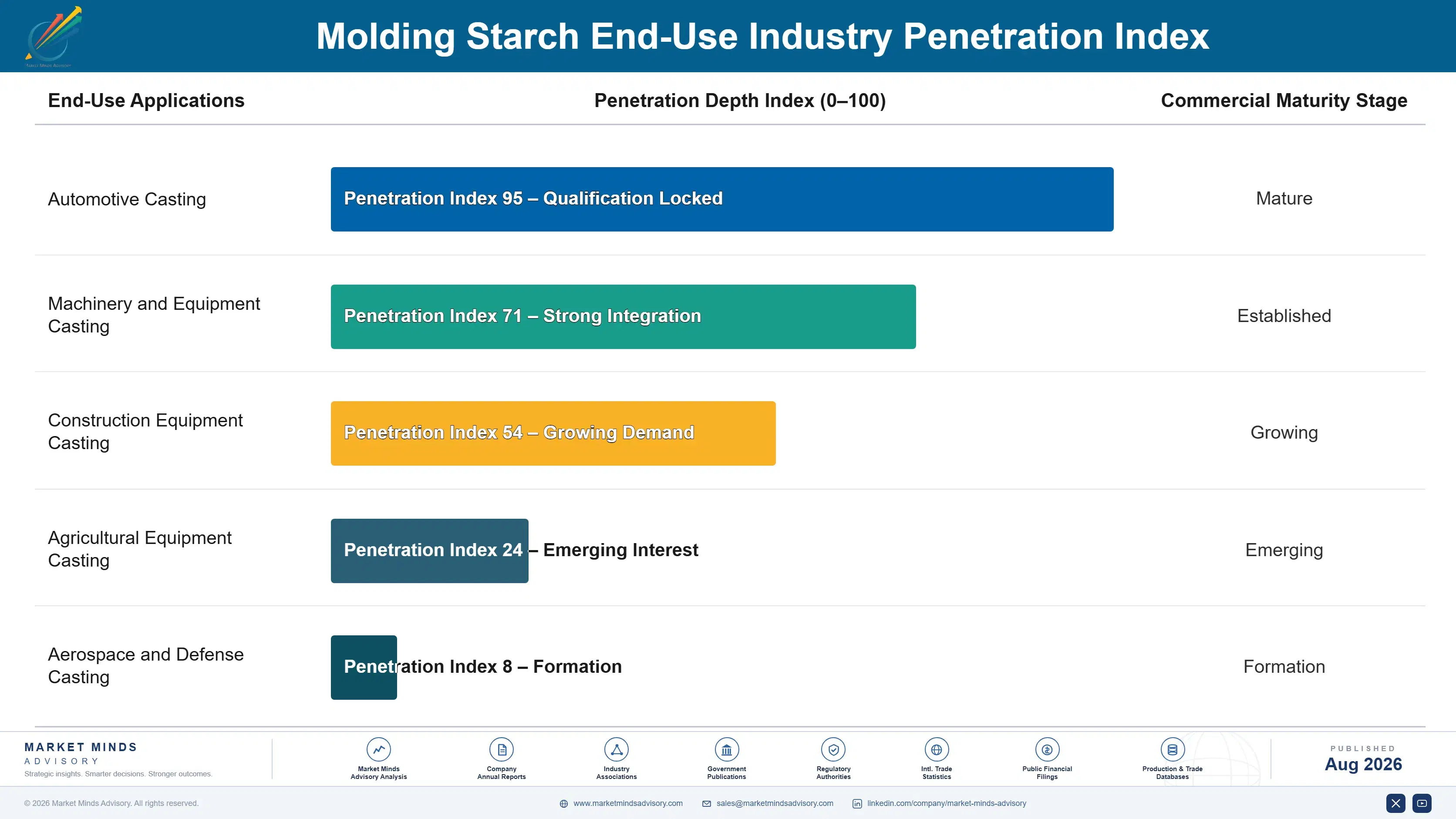
Adoption depth varies meaningfully by vertical: automotive and machinery casting operations show near-universal modified starch adoption among large integrated producers but slower penetration among smaller job-shop foundries, while construction and agricultural equipment casting see lower overall modified adoption paired with growing interest as budgets allow and reject-rate data accumulates over successive production quarters and annual planning reviews.

Younger plant managers and process engineers entering foundry operations research binder chemistry far more actively than the generation they are replacing, accelerating consistency-driven purchasing decisions that previously took years of gradual persuasion to complete successfully. This generational shift rewards suppliers investing early in accessible technical documentation over those relying on legacy relationships alone, reshaping which companies capture the next full decade of contract growth across every producing region worldwide.
molding-starch-market-end-use-penetration-index-1787375029149

Where MMA Sees Category Value Concentrating

These are among the four positions where our research anticipates prominent divergence between winners and laggards over the coming forecast period. Each is grounded in the demand model, the regulatory perimeter, and the announced capacity pipeline.
01 / CONSISTENCY INVESTMENT PRIORITY

Fund documented batch testing before scaling volume

Large foundries now treat published batch-to-batch consistency data as a listing prerequisite rather than a marketing nicety, and this shift will only deepen as automated molding lines spread across more casting operations worldwide. Suppliers still competing purely on price without documented consistency risk losing qualified status within the next several contract renewal cycles across major accounts and long-standing relationships built over many years. MMA views consistency testing investment as the single highest-leverage capital allocation decision facing mid-tier suppliers in this category today.
02 / TECHNICAL SERVICE EXPANSION

Build foundry-side engineering support within eighteen months

The gap between suppliers offering dedicated technical service and those relying purely on product shipment is widening as large foundries increasingly weight application support during supplier qualification reviews across every major account. Building this capability requires meaningful headcount investment that smaller regional suppliers often lack the capital to fund internally without external backing or partnership from a larger organization. MMA expects the technical service differentiation window to remain open for roughly two to three years before becoming table stakes across the category.
03 / FEEDSTOCK FLEXIBILITY BUILD

Develop multi-feedstock formulation capability now

Agricultural commodity volatility will remain a persistent feature of this category's cost structure, and suppliers building genuine multi-feedstock flexibility are capturing tender wins ahead of single-feedstock competitors locked into one sourcing geography without alternatives. Building this flexibility requires meaningful formulation and manufacturing investment across multiple crop types simultaneously, a cost smaller rivals often avoid entirely without meaningful capital reserves. MMA recommends this as a defensive necessity given how quickly regional low-cost entrants are scaling into price-sensitive segments nationwide and abroad.
04 / QUALIFICATION PROGRAM FOCUS

Pursue formal foundry supplier qualification aggressively

Formal qualification status converts a transactional relationship into a durable, multi-year contracted one, and suppliers pursuing this status early are locking in accounts before competitors recognize the same opportunity across the category and its fastest-growing regions. Qualification processes take six to twelve months and require submitted consistency data, favoring suppliers who invest ahead of demand and budget accordingly for the qualification timeline involved. MMA advises prioritizing qualification pursuit at large automotive and machinery foundry groups over smaller, less durable job-shop accounts.

Engagement Snapshot From the Field

A live engagement with an industry participant carrying material or product regulatory and market exposure ahead of a defining policy shift, showing how our research translates into a defensible multi-year portfolio strategy.
MARKET MINDS ADVISORY · CLIENT ENGAGEMENT SUMMARY
Molding Starch Producer Strategic Portfolio Review and Transition Roadmap 2026·Investment Scenario on Molding Starch Exposure Evaluation 2025-26
CLIENT PROFILE
The client operates a regional automotive casting foundry group with roughly 6 production facilities across the midwestern United States, generating approximately 240 million dollars (client-reported, unverified by MMA) in annual molding starch and binder spending across its full network. The group sought to evaluate its supplier base ahead of a major automated molding line investment program.
STRATEGIC CHALLENGE
Core reject rates had plateaued above target levels despite steady equipment investment, and procurement staff lacked a clear framework for evaluating which binder suppliers could reliably support the consistency requirements of new automated molding lines being installed. Competing foundry groups had already transitioned fully to modified starch formulations with documented performance data behind them.
MMA APPROACH
MMA conducted a structured audit of current supplier performance against documented consistency benchmarks, cross-referencing findings against primary survey data from comparable foundry groups managing similar automation transitions across several regions and production scales. The engagement produced a phased supplier consolidation roadmap balancing cost, consistency, and qualification timing considerations carefully throughout.
KEY FINDINGS
  1. Only 31 percent of the client's binder spending relied on formally qualified modified starch suppliers with documented consistency data available for review.
  2. Core reject rate modeling suggested full modified starch conversion could improve casting yield by roughly 3.5 percent across all six client facilities.
  3. Three of the client's six facilities faced automated molding line installation within eighteen months, creating clear qualification timing urgency for company management.
  4. Comparable foundry groups that consolidated suppliers earlier reported measurable procurement cost reductions alongside the documented yield gains cited above throughout this analysis.
CLIENT PROFILE
The client operates a regional automotive casting foundry group with roughly 6 production facilities across the midwestern United States, generating approximately 240 million dollars (client-reported, unverified by MMA) in annual molding starch and binder spending across its full network. The group sought to evaluate its supplier base ahead of a major automated molding line investment program.
STRATEGIC CHALLENGE
Core reject rates had plateaued above target levels despite steady equipment investment, and procurement staff lacked a clear framework for evaluating which binder suppliers could reliably support the consistency requirements of new automated molding lines being installed. Competing foundry groups had already transitioned fully to modified starch formulations with documented performance data behind them.
MMA APPROACH
MMA conducted a structured audit of current supplier performance against documented consistency benchmarks, cross-referencing findings against primary survey data from comparable foundry groups managing similar automation transitions across several regions and production scales. The engagement produced a phased supplier consolidation roadmap balancing cost, consistency, and qualification timing considerations carefully throughout.
KEY FINDINGS
  1. Only 31 percent of the client's binder spending relied on formally qualified modified starch suppliers with documented consistency data available for review.
  2. Core reject rate modeling suggested full modified starch conversion could improve casting yield by roughly 3.5 percent across all six client facilities.
  3. Three of the client's six facilities faced automated molding line installation within eighteen months, creating clear qualification timing urgency for company management.
  4. Comparable foundry groups that consolidated suppliers earlier reported measurable procurement cost reductions alongside the documented yield gains cited above throughout this analysis.
RECOMMENDED STRATEGY
Phase 1: Phase 1 (Months 1-4): Audit current supplier consistency performance against documented industry benchmarks in full careful detail first and thoroughly. Phase 2: Phase 2 (Months 5-10): Consolidate binder purchasing toward formally qualified modified starch suppliers across all six client facilities fully and completely. Phase 3: Phase 3 (Months 11-15): Document yield and cost outcomes carefully to support the automated line investment business case fully throughout.
OUTCOME
Within fifteen months of implementation, the client reported (client-reported, unverified by MMA) a 3.1 percent improvement in casting yield across converted facilities and successfully qualified two additional modified starch suppliers to reduce single-source dependency risk. Procurement adopted the phased framework as its standard approach for future supplier consolidation decisions.

Frequently Asked Questions

Foundational context covering the market sizes, CAGR, scope, country, region and competition that inform every finding below. This section is provided to cover basics and most often pre-purchase conversations, answered from the MMA Primary Research Dataset.

What is the current size of the Molding Starch Market?

The molding starch market was valued at approximately $2.9 billion in 2025. Growth is driven by automotive casting recovery and rising modified starch adoption on automated molding lines.

How large will the Molding Starch Market be by 2036?

MMA projects the market will reach approximately $4.75 billion by 2036, up from $3.03 billion in 2026. This represents an incremental opportunity of roughly $1.72 billion over the forecast period.

What is the CAGR for the Molding Starch Market 2026 to 2036?

The market is projected to grow at a 4.6 percent compound annual growth rate between 2026 and 2036. Bull and bear scenarios range from 3.4 to 5.8 percent annually.

Which segment is growing fastest?

Modified and pregelatinized molding starch is growing fastest at 7.6 percent annually, roughly 1.65 times the category average, driven by demand for documented batch consistency.

Who are the major companies in the Molding Starch Market?

Cargill, Ingredion, Roquette Freres, Tate & Lyle, and Avebe lead the category. Together the top five hold a moderate combined share, leaving considerable room for regional challenger growth.

Which country is growing fastest?

India leads country-level growth at 9.2 percent annually as its expanding automotive and machinery casting sector adopts modern binder chemistry for the first time at scale.

Report Segmentation Architecture

The full report scope spans multiple orthogonal segmentation dimensions, with cross-tabulated demand data provided for each dimension pair. Coverage extends further to regional breakdowns, trend trajectories, and the competitive detail needed to support segment-level decision-making.

By Feedstock and Processing Type

  • Native Corn Starch
  • Modified and Pregelatinized Starch
  • Cassava and Tapioca-Based Starch
  • Potato-Based Starch
  • Wheat-Based Starch
  • Specialty Blended Starch

By End-Use Industry

  • Automotive Casting
  • Machinery and Equipment Casting
  • Construction Equipment Casting
  • Agricultural Equipment Casting
  • Aerospace and Defense Casting

By Commercial Dimension

  • Large Integrated Foundry Groups
  • Independent Job-Shop Foundries
  • Contract Casting Service Providers
  • Qualified Long-Term Supply Contracts

By Region

  • North America
  • Western Europe
  • East Asia
  • South Asia and Pacific
  • Latin America
  • Middle East and Africa
  • Eastern Europe

Scope, Methodology, and Coverage

Every figure in this report is reproducible from documented input assumptions. The scope below maps the historical period, the forecast horizon, the segmentation dimensions, and the countries covered, alongside the underlying primary and qualitative methodology.
Historical Period
2020 to 2025
Forecast Period
2026 to 2036
Base Year
2025 (USD billions; MMA Primary Research Dataset, August 2026)
Market Definition
This report covers native and modified starch products used as sand binders and core additives in metal casting and foundry operations, including corn, cassava, potato, and wheat-derived formulations. It excludes food-grade starches, industrial starches used in paper or textile sizing, and non-starch foundry binder chemistries.
Quantitative Units
USD billions (current prices); volume in metric tons where applicable
Segmentation Dimensions
By Feedstock and Processing Type; By End-Use Industry; By Commercial Dimension; By Region
Regions Covered
North America, Western Europe, East Asia, South Asia and Pacific, Latin America, Middle East and Africa, Eastern Europe
Countries Covered
USA, China, Germany, France, UK, Japan, South Korea, India, Australia, Canada, Brazil, Mexico, Indonesia, Vietnam, Thailand, Malaysia, UAE, Saudi Arabia, South Africa, Nigeria, Turkey, Poland, Netherlands, Italy, Spain, Sweden, Switzerland, Argentina, Colombia, Singapore, and additional markets relevant to this sector
Key Companies Profiled
Cargill, Incorporated, Ingredion Incorporated, Roquette Freres, Tate & Lyle plc, Avebe U.A., Archer-Daniels-Midland Company, Grain Processing Corporation, AGRANA Beteiligungs-AG, Emsland Group, Tereos Starch & Sweeteners, Sanstar Limited, Gujarat Ambuja Exports Limited, Anil Limited, Global Bio-chem Technology Group, Zhucheng Xingmao Corn Developing Company, Siam Modified Starch Co., Ltd., Thai Wah Public Company Limited, PT Sungai Budi, National Starch (Corn Products International legacy), KMC Kartoffelmelcentralen A.m.b.A.
Quantitative Methodology
Primary survey, n=3,800 respondents, Q4 2025, six countries; demand-side model with trade association cross-validation
Qualitative Methodology
47 expert interviews, Q4 2025; applied to validate demand model assumptions, identify emerging dynamics, and assess competitive positioning
Report Format
PDF and XLSX data workbook (Word format preview document)
Publisher
Market Minds Advisory
Report Code
MMA-2026-CHM-110
Published
August 2026
Contact
sales@marketmindsadvisory.com | www.marketmindsadvisory.com

Purchase the full Molding Starch Market Report (2026 to 2036).

The full report delivers a comprehensive 200-plus page analysis of the global molding starch market, including detailed segmentation by feedstock type, end-use industry, and commercial dimension across all seven world regions tracked in this study. It provides company profiles for twenty key and emerging suppliers, benchmarked against a consistent production revenue basis throughout. Buyers receive access to MMA's underlying primary survey dataset spanning 3,800 respondents and 47 expert interviews conducted in Q4 2025. Custom data cuts and direct analyst inquiry access are available for enterprise licensees upon request.
Twenty detailed company profiles with moat and risk analysis
Seven-region market sizing data through 2036
Primary survey dataset, n equals 3,800 respondents
Forty-seven expert interview transcript summary excerpts
Feedstock-level CAGR and regional share breakdowns
Quarterly market update subscription add-on option

Built For The People Who Decide

From boardroom strategy to bench-side execution, this report is read cover-to-cover by leaders shaping the next decade of their industry, turning demand scenarios, market dynamics and valuation benchmarks into decisions.
CXOs/ Presidents/ VPs/ Managers
M&A and Corporate Development
Strategy Teams and R&D Heads
Procurement and Product Directors
Regulatory and Compliance Leaders
Investor Relations and Equity Analysts