Market Minds Advisory
Molded Wood Pallets Market

Molded Wood Pallets Market: Phytosanitary Exemption, Nesting Economics and the Export Pallet That Skips Fumigation

Heat and pressure during moulding kill everything living in the wood, which exempts the finished pallet from the fumigation and stamping that every sawn timber export pallet must carry before it leaves.

Lead Analyst

Bilal Shaikh

Published

September 2026

Make Smarter Decisions with Customized Research Insights

Request a free sample report and evaluate market opportunities, growth trends, and competitive dynamics relevant to your business needs.

2025 MARKET VALUE$1.0BMarket Size 2025
2036 FORECAST VALUE$2.0BBase Case , 2026 to 2036
CAGR 2026 TO 20367.2 %Bull 8.4% / Bear 6.0%
INCREMENTAL OPPORTUNITY$1.0BNet 10- year value creation
EXPANSION MULTIPLE1.98x2036 value over 2026 base
Strategic Levers
M&A Pipeline
Regional Outlook
Country Rankings
Competitive Intelligence
Segmental Deep-dive
Call-Us : 91 93563 13602

Executive Snapshot and Market Trajectory

A moulded wood pallet is pressed from wood fibre and resin under heat, and that process sterilises the material completely. The pallet therefore leaves the plant already exempt from ISPM 15, which is the treatment and stamping every sawn timber export pallet needs beforehand. Nothing living survives the press.
Export phytosanitary-exempt pallets compound at 10.8%, exactly 1.50 times the market, because the exemption removes a fumigation step, a certification cost and a rejection risk from every international shipment. East Asia holds 32% of demand, above the standard band, on export manufacturing volume no other region matches. Chinese, Korean and Japanese exporters ship more internationally than anywhere else. The exemption arrives free with the manufacturing process itself.
Five producers hold 52%, high for a pallet product, and moulding capital explains it. A press line costs far more than a nailing machine, so the fragmented workshop economics that define sawn timber pallets simply do not apply here. A press line costs around USD 6.8 million against a few tens of thousands for a nailing machine, which keeps the field narrow and capacity slow to follow demand. Utilisation dominates everything.
Market Definition
The market covers pallets pressed from wood fibre, chips or sawdust bonded with resin under heat and pressure, spanning nestable export pallets, phytosanitary-exempt export pallets, heavy-duty moulded pallets, display and half pallets, moisture-resistant treated pallets, and pallets incorporating recycled wood waste. Sawn timber pallets, plastic and metal pallets, corrugated pallets and pallet collars or accessories are excluded.
Base Year Value
$1.0B in 2025 (MMA Primary Research Dataset, August 2026)
Forecast Period
2026 to 2036, eleven discrete annual values
CAGR
7.2% base case. Bull 8.4%. Bear 6.0%.
Fastest Growth Segment
Export Phytosanitary-Exempt Pallets: 10.8% CAGR
Fastest Growth Country
India: 11.2% CAGR
Fastest Growth Region
South Asia and Pacific: 9.4% CAGR
Largest Region
East Asia: 32% of 2025 global value
Market Leaders
Litco International, Inka Paletten, Nefab Group, Conitex Sonoco, Vecoplan. Source: MMA Analysis based on company annual reports.
Primary Survey
n=3,800 procurement and R&D decision-makers, Q4 2025, six countries
Methodology
Demand-side build-up, cross-validated against public data, 47 expert interviews

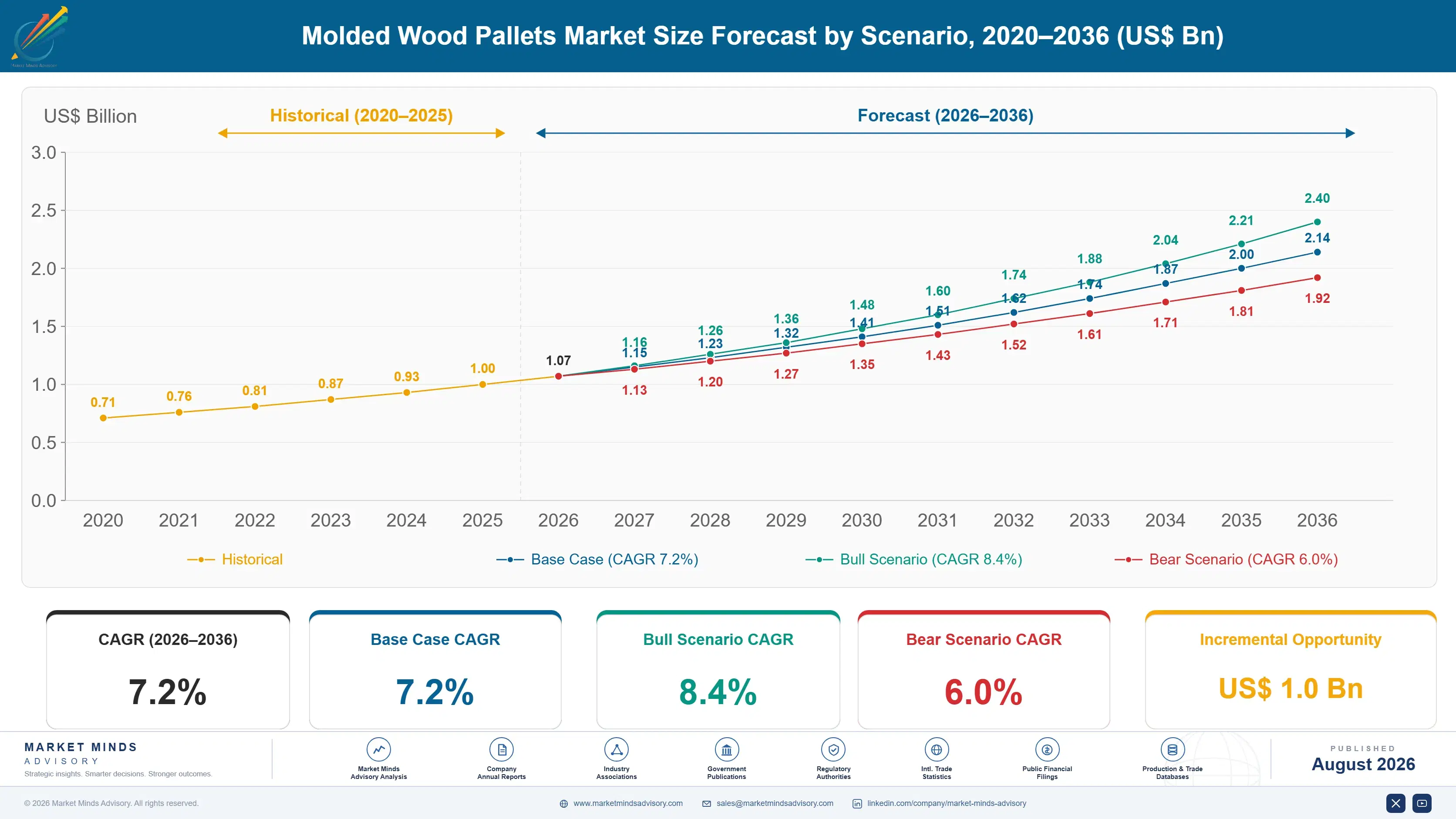
Molded Wood Pallets Market Forecast Scenarios

molded-wood-pallets-market-size-forecast-scenario-1787308588673
Growth ran at an implied 6.0% across 2020 to 2025 and export volume drove almost all of it. Sea freight disruption through 2021 and 2022 raised the cost of every rejected or delayed shipment, and a pallet that cannot be turned back at a border became worth considerably more than the timber it replaced, quite apart from its weight advantage. Border risk repriced the whole category.
The base case at 7.2% rests on three mechanisms. Export manufacturing keeps growing across Asia and the requirement for treated wood packaging travels with it. Nesting economics matter more as container and warehouse space costs rise, since a moulded pallet stacks at a fraction of the height of a timber one. And timber pricing volatility keeps making the comparison favourable. None of the three depends on pallet demand growing. Export shipping drives all three.
The bull case at 8.4% assumes phytosanitary enforcement tightens further at major ports, since every additional inspection raises the value of an exempt pallet against a stamped timber one. The bear case at 6.0% follows from timber prices falling back and from plastic nestable pallets taking the same export applications on durability rather than on the treatment argument.

The Pallet That Was Never Alive

The commercial argument for a moulded wood pallet is one most people in logistics have never had explained to them. Wood fibre pressed at temperature and pressure with a resin binder emerges sterile, because nothing living survives the process. That means the finished pallet is already outside the scope of ISPM 15, the international standard requiring heat treatment or fumigation of solid wood packaging. Almost nobody in logistics knows that.
TOP FIVE CONCENTRATION52%Combined share held by the five largest global producers
NESTING HEIGHT REDUCTION76% less spaceStorage volume saved against stacked sawn timber pallets
WEIGHT AGAINST TIMBER41% lighterMass reduction on an equivalent load-rated export pallet
TREATMENT COST AVOIDEDUSD 3.40 per palletFumigation, certification and stamping removed from export shipments
PRESS LINE INVESTMENTUSD 6.8 millionTypical capital required for a single moulding production line
WOOD WASTE FEEDSTOCK83% of inputRecovered chips and sawdust rather than virgin timber
For an exporter that removes a whole sequence: no treatment booking, no certification, no stamp, and no risk of a container being held or turned back because an inspector questioned the marking. Treatment cost avoided runs around USD 3.40 per pallet, and the avoided delay is worth considerably more than that on any shipment where a customer is waiting.
Two other properties follow from moulding rather than nailing. The pallets nest, cutting storage and return transport volume by roughly 76% against stacked timber, and they weigh around 41% less at equivalent load rating. On air freight and on long sea routes where volumetric charging applies, those numbers frequently matter more than the treatment exemption does.
"Exporters obsess about container rates and then hand a shipment to a pallet that might get it stopped at the border. The moulded pallet solves a problem they have priced at zero because it has never actually happened to them yet."
Director, Transit Packaging and Export Logistics Practice · MMA Transit and Unit

Market Trends

Phytosanitary Enforcement Raises the Value of Exemption

ISPM 15 requires solid wood packaging entering most countries to be heat treated or fumigated and stamped, and enforcement has tightened at major ports as inspection resources improved. A container held over questionable marking costs demurrage, delay and sometimes the sale. Moulded pallets are exempt because the manufacturing process sterilises the material, removing treatment cost of roughly USD 3.40 per pallet along with the risk entirely. The exempt segment compounds at 10.8% against a market at 7.2%, and enforcement is tightening rather than easing. Inspection resources keep improving. Exemption value rises with it.
Market Impact: Waste feedstock at 83% of input
Nesting Economics Improve as Space Costs Rise

Moulded pallets nest into one another, so a stack of fifty occupies roughly 76% less height than fifty timber pallets. That matters in three separate places: warehouse storage before use, container fill on outbound shipments where volumetric charging applies, and return transport of empties where the alternative is shipping air. Warehouse rental and container rates have both risen faster than general costs, which strengthens an argument that used to be a secondary consideration rather than a primary one. Empties are the worst offender. Three separate cost lines improve at once from a single specification change.
Market Impact: Weight reduced 41% against timber

Market Opportunities and Growth Drivers

Wood Waste Feedstock Insulates Against Timber Price Volatility

Moulded pallets use recovered chips, sawdust and mill residue for roughly 83% of their input rather than sawn lumber, which prices on an entirely different basis from structural timber. When lumber markets spike, as they did sharply through 2021, the moulded pallet cost base moves far less and the comparison against a nailed timber pallet swings decisively. That insulation also appeals to buyers who have been burned by pallet cost volatility disrupting budgets they thought were stable. Budget stability matters to them. Lumber spikes barely register on the moulded cost base at all.
Market Impact: Press lines costing USD 6.8 million

Air Freight and Volumetric Charging Reward Lighter Pallets

A moulded pallet weighs around 41% less than an equivalent timber pallet at the same load rating, which on air freight translates directly into chargeable weight saved on every single shipment. Pharmaceutical, electronics and aerospace component shippers move enough by air for that arithmetic to compound quickly. Sea freight applies volumetric charging on light dense cargo too, so the weight and nesting advantages frequently arrive together on the same shipment rather than trading against each other. Both advantages therefore arrive on the same shipment rather than trading against one another.
Market Impact: Load ratings trailing timber 32%

Market Restraints and Challenges

Press Line Capital Restricts Who Can Enter at All

A moulding press line costs around USD 6.8 million against a few tens of thousands for a nailing machine and a saw. The root cause is that heat and pressure forming requires heavy tooling, hydraulic presses and drying capacity that nailing simply does not. That capital keeps the field narrow and concentration high at 52%, and it also means capacity cannot follow demand quickly. Producers mitigate by running lines hard and by concentrating on applications where the pallet earns a premium. Utilisation becomes the dominant variable. Capacity cannot follow demand quickly.
Market Impact: Treatment avoided at USD 3.40 each

Load Rating Limits Confine Use in Heavy Industrial Handling

Moulded pallets carry less static and dynamic load than a well-built timber pallet of comparable footprint, and racking performance is weaker still. The root cause is material rather than design: bonded wood fibre behaves differently from continuous timber under bending. Heavy engineering, steel and building materials shippers therefore stay with timber. Producers mitigate through heavy-duty grades with denser pressing and reinforcement, though the gap narrows rather than closing, and racking remains the hardest limitation. Racking is the hardest limitation of all. Heavy engineering and building materials shippers stay with timber regardless.
Market Impact: Nesting cutting volume by 76%
3 additional market trends, 4 additional growth drivers, and 2 additional restraints and challenges are covered in the full report. Contact sales@marketmindsadvisory.com to access the complete intelligence.

Segment CAGR and Growth Architecture

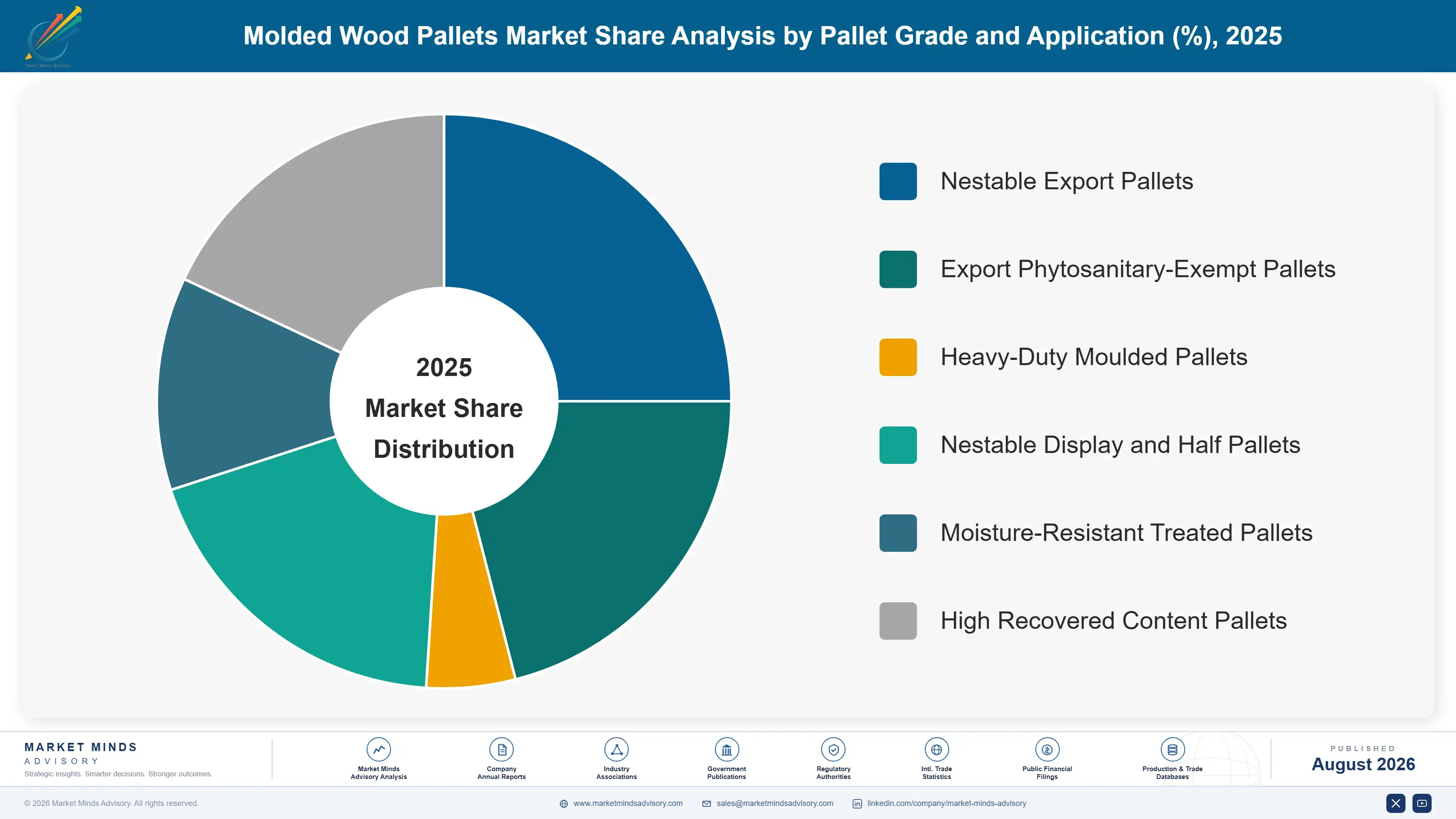
Segmentation follows pallet grade and application, because each carries a different load rating, a different export purpose and a different buyer. An export nestable pallet and a heavy-duty moulded pallet are pressed on similar equipment and are bought for reasons that barely overlap at all. Load rating and border crossing decide it. Buyers barely overlap.
molded-wood-pallets-market-market-share-analysis-1787308589597

Export Phytosanitary-Exempt Pallets

Export exempt pallets compound at 10.8%, exactly 1.50 times the market rate, on a regulatory advantage that arrives free with the manufacturing process. ISPM 15 requires solid wood packaging to be heat treated or fumigated and stamped before crossing most borders, and a container whose marking an inspector questions can be held, fumigated at destination or turned back entirely. Moulded pallets fall outside the standard because pressing at temperature sterilises the material, so no treatment, certification or stamp is required at all. Avoided treatment cost runs around USD 3.40 per pallet, and the avoided delay is worth far more than that on any shipment with a customer waiting at the other end.
CAGR 10.8%

Nestable Display and Half Pallets

Nestable display and half pallets grow at 9.0% by serving retail and distribution applications where a full-size pallet is simply too large for the delivery. Half pallets and quarter pallets go directly onto a shop floor as a display base, and moulded construction gives a clean consistent appearance that a nailed timber half pallet never achieves. The nesting property matters more here than anywhere, since retail backrooms and delivery vehicles are both space constrained and empties accumulate quickly. Load requirements are modest, which suits the material well, and moulded pallets compete against corrugated and plastic alternatives rather than against timber in this application. Timber barely competes here. Empties accumulate quickly in a backroom.
CAGR 9.0%
Full segment breakdown across 6 segments available in the complete report.

Regional Architecture and Country Demand Map

Demand follows export shipping activity rather than domestic pallet consumption, since the phytosanitary advantage only applies at a border. Manufacturing regions that ship internationally in volume dominate, while purely domestic distribution stays with timber almost everywhere. Export shipping direction rather than pallet consumption is the map worth reading.

East Asia

East Asia holds 32% of global demand. Note: this exceeds the standard band because moulded pallet demand follows export shipping rather than domestic distribution, and Chinese, Korean and Japanese manufacturers ship more internationally than any other region by a wide margin. Chinese electronics, machinery and consumer goods exporters face phytosanitary inspection at every major destination, and a held container costs demurrage plus a delayed customer. Domestic Chinese pallet use remains overwhelmingly timber, since the exemption is worthless on a domestic route. Japanese exporters value the weight and nesting properties as much as the exemption, given air freight volumes. Regional growth of 8.2% tracks export manufacturing rather than pallet consumption overall.
Share: 32% | CAGR: 8.2% (2026 to 2036)

South Asia and Pacific

The fastest growing region at 9.4%, with India compounding at 11.2%, South Asia and Pacific accounts for 12% of demand. Indian pharmaceutical, engineering and textile exports have grown substantially, and pharmaceutical shipments in particular move by air where the 41% weight saving translates directly into freight cost. Indian timber supply is also constrained and expensive relative to wood waste, which improves the comparison further. Southeast Asian electronics and component exporters across Vietnam, Thailand and Malaysia face the same phytosanitary requirements on shipments into Western markets. Australian demand is smaller and driven by agricultural and wine export where treatment requirements at destination are strictly enforced. Constrained timber supply improves the comparison further.
Share: 12% | CAGR: 9.4% (2026 to 2036)
Regional intelligence for 5 additional markets available in the complete report: North America, Western Europe, Latin America, Middle East and Africa, Eastern Europe. Contact sales@marketmindsadvisory.com.
molded-wood-pallets-market-country-cagr-analysis-1787308590521

Selling a Border Crossing Rather Than a Pallet

Nobody wakes up wanting a better pallet. What exporters want is a container that clears inspection, fits more product and costs less to ship empty. All three arguments belong to moulded construction and none of them appears on a pallet specification sheet. Four positions follow. None of it appears on a specification sheet. Specification sheets show none of it.

Quantify Treatment Cost and Delay Risk Together

ISPM 15 treatment, certification and stamping cost around USD 3.40 per pallet, and exporters know that number. What they do not price is a held container: demurrage, a delayed customer and occasionally a lost order. Producers that present both the certain saving and the avoided risk, using the customer's own shipment volumes and destination inspection rates, reach a logistics function rather than a purchasing one. Exempt pallets compound at 10.8% and carry gross margins roughly 14 to 22 points above domestic grades. Nobody prices the delay. Logistics functions do not compare pallet prices.
Market Impact: Treatment costing USD 3.40 for ever

Sell Nesting Into Warehouse and Container Space Costs

Fifty moulded pallets occupy roughly 76% less height than fifty timber ones, which shows up in warehouse storage, in container fill where volumetric charging applies and in return transport of empties. Warehouse rental and container rates have both risen faster than general costs, so the arithmetic has moved from secondary to primary. Calculating the space value on the customer's own rental rate and shipment profile converts an argument that reads as a product feature into a facilities and freight saving with a number attached. Facilities functions understand it immediately. The number is easily calculated.
Market Impact: Storage volume cut 76% through nest

Target Air Freight Shippers on Chargeable Weight

A moulded pallet weighs around 41% less than an equivalent timber pallet at the same load rating, and on air freight that difference is chargeable weight removed from every shipment. Pharmaceutical, electronics and aerospace component shippers move enough by air for the saving to compound into a serious annual figure. Those shippers also face phytosanitary requirements and volumetric considerations simultaneously, so all three arguments land on the same customer at once rather than requiring separate conversations. Air shippers face phytosanitary requirements and volumetric charging at the same time, so three separate arguments land together in one conversation.
Market Impact: Chargeable weight reduced 41% on ev

Run Press Capacity Hard Against Its Capital Cost

A press line costs around USD 6.8 million and cannot be added quickly, which keeps concentration at 52% and rewards utilisation above almost anything else. Producers that fill lines with domestic and display grades between export campaigns protect the fixed cost that export work carries, and those that chase only premium export volume find expensive capacity standing idle. The capital barrier that keeps competitors out also punishes any producer who treats it as a reason to be selective about what runs. Selectivity is expensive here. Capital barriers cut both ways.
Market Impact: Press lines costing USD 6.8 million

Who Controls the Margin Pool

Five producers hold 52% of the market measured on moulded pallet revenue, the basis applied consistently through this section. Concentration is high for a pallet product, and press line capital explains it entirely: at around USD 6.8 million a line, the workshop economics defining sawn timber pallets do not apply. Litco International and Inka Paletten lead in their respective regions. Workshop economics do not apply.
Competition operates on three dimensions. Press capacity location decides freight cost on a bulky product that nests well but still occupies volume. Load rating capability decides how far into industrial applications a producer can reach beyond export nestables. And export logistics channel access decides who reaches the shipper rather than the pallet purchaser. All three sit outside the pressing operation.

Two pressures are reshaping position. Plastic nestable pallets attack the same export applications on durability and reuse rather than on treatment, and they are also phytosanitary exempt. Against that, wood waste feedstock and recovered content documentation favour moulded pallets on sustainability reporting. Rankings will move toward whoever pairs regional press capacity with genuine export channel access. Very few hold both today.
molded-wood-pallets-market-company-positioning-matrix-1787308591402

Competitive Moat and Risk Dimensions

LITCO INTERNATIONAL

Moat: Export exemption market development

Litco effectively built the North American moulded pallet market by explaining the phytosanitary exemption to exporters who had not understood it, and that education role converted into brand recognition among logistics functions rather than purchasing departments. Owning the argument matters where the product's principal advantage is invisible on a specification sheet.
LITCO INTERNATIONAL

Risk: Plastic nestable competition

Plastic nestable export pallets are equally exempt from phytosanitary requirements, nest comparably and survive far more trips, which makes them a genuine alternative wherever a shipper can recover the pallet or amortise it over multiple uses. The wood fibre advantage rests on cost per single trip and on recovered content documentation rather than on the exemption both products share.
INKA PALETTEN

Moat: European press capacity and feedstock

Inka operates substantial European press capacity alongside established wood waste feedstock relationships, which matters where 83% of input is recovered chips and sawdust rather than purchased lumber. Regional press capacity also limits freight on a product that nests well but still occupies volume, and European recycling infrastructure supplies feedstock more reliably than in most other regions.
INKA PALETTEN

Risk: Intra-European exemption irrelevance

Most European manufacturing exports move within Europe, where phytosanitary treatment requirements do not apply at all, which removes the product's principal argument on the majority of shipments. Growth depends on the minority of consignments heading to Asian, North American or other extra-European destinations, and that limits the addressable base considerably compared with export-oriented Asian manufacturing.

Players Tracked

Prominent Players

Litco International
Inka Paletten
Nefab Group
Conitex Sonoco
Vecoplan

Other Key Players

Brambles
Greif
Palm Paletten
Rotom Group
Craemer Group
Kronospan
Nelson Company
PalletOne
Cabka Group
Wood Pallet Solutions
Anhui Sanyou
Shandong Ligno Pallets
Nihon Pallet Pool
Loscam
Corplex

Recent Developments

JANUARY 2025

Port phytosanitary inspection tightens at major destinations

Customs and agricultural inspection authorities at several major ports increased scrutiny of solid wood packaging markings, holding containers where treatment stamps were questionable or absent. These were enforcement practice changes rather than regulatory amendments or commercial developments between pallet producers. Every opened container raises the value of an exemption.
Signal: The value of an exempt pallet rises with e
JUNE 2025

Warehouse rental inflation strengthens nesting arguments

Distribution operators increasingly evaluated pallet storage volume against warehouse rental cost, favouring nestable constructions that reduce empty pallet footprint substantially. This reflects facility cost pressure rather than any commercial action, and it applies to domestic operations as well as export ones. Domestic operations gain from it as well.
Signal: Nesting was always a product feature and i
OCTOBER 2025

Plastic nestable pallets contest export exemption applications

Plastic pallet producers expanded nestable export ranges competing directly for phytosanitary-exempt applications, offering multi-trip durability against single-trip wood fibre economics. These were product range extensions rather than acquisitions, and both materials share the same regulatory exemption. Cost per trip and recovered content decide between them.
Signal: Both products escape the same regulation,

Wood Waste, Resin and Press Energy

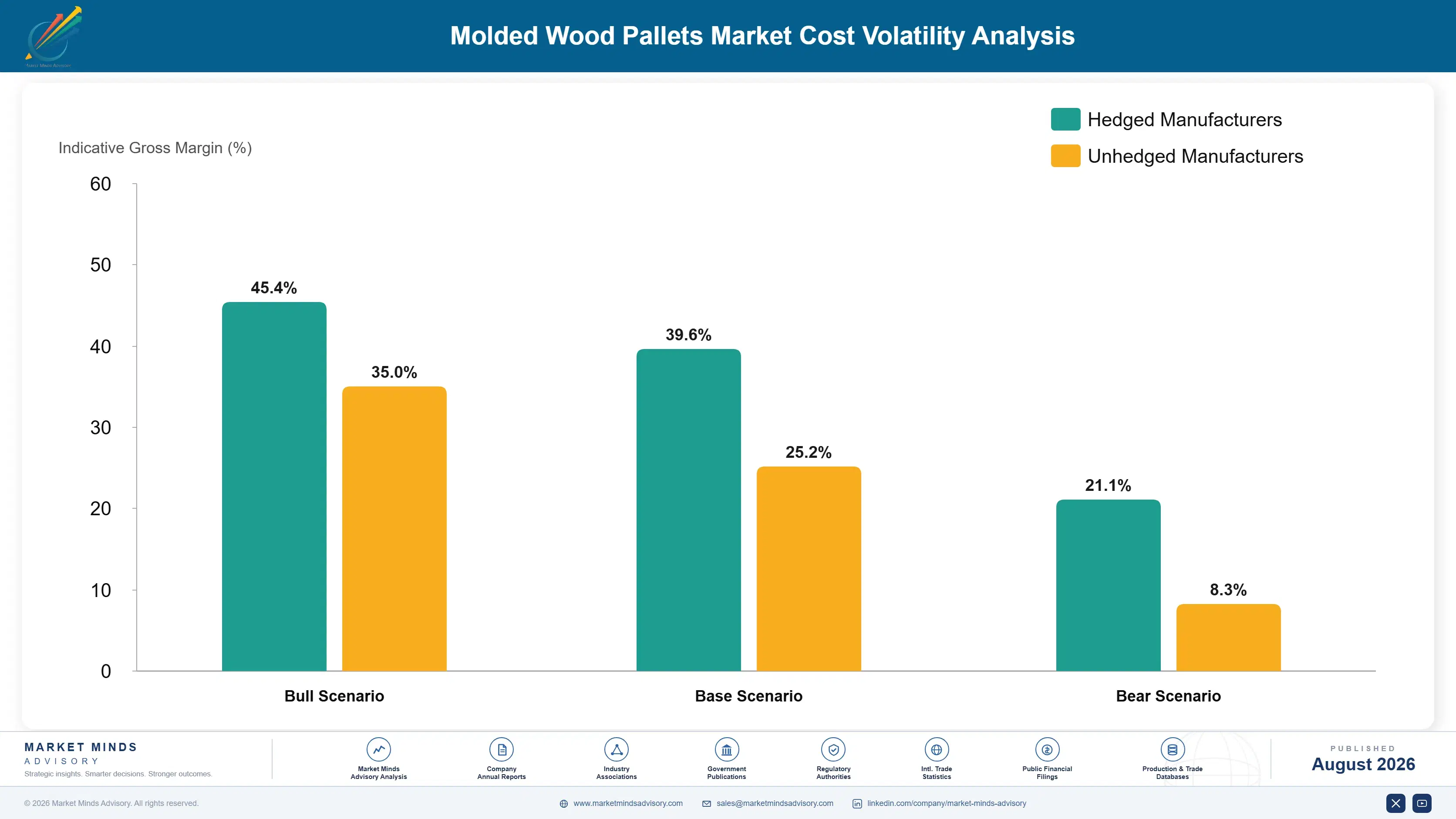
Recovered wood chips, sawdust and mill residue account for roughly 34% of cost of goods, purchased regionally from sawmills, furniture producers and construction waste recovery. Resin binder runs a further 26% and is the most volatile input by some margin. Press energy for heating and forming takes around 15%, with labour, tooling amortisation and freight making up the remainder.
Resin binder pricing moved sharply through 2022 and 2023 as European energy disruption fed into formaldehyde and urea chemistry, and International Energy Agency reporting across that period documents the underlying movement. Press energy costs rose in parallel. Company annual reports covering wood-based panel and packaging segments disclose the resulting margin compression, and producers with annual export contracts absorbed it for several quarters before recovering any of it.

Exposure divides by feedstock access rather than by scale. Producers with established sawmill and furniture waste relationships buy chips at genuinely low cost, while those competing for the same material against biomass energy and panel board manufacturers pay considerably more. Biomass demand in particular has raised wood waste pricing in several European markets, which is an unwelcome competitor for the same tonnage.
molded-wood-pallets-market-cost-volatility-analysis-1787308591711

Contract wood waste directly with sawmills and furniture producers

Recovered chips and sawdust are bulky, low in value and traded regionally, which makes direct relationships with generators more valuable than purchasing scale. Biomass energy and panel board manufacturers compete for the same tonnage, so multi-year contracting secures both price and availability. Feedstock consistency also matters, since particle size variation affects press cycle and finished density.

Qualify alternative resin chemistries before pricing moves

Resin binder is the most volatile input at roughly 26% of cost, and formaldehyde-based chemistry moves with energy markets that producers cannot influence. Qualifying an alternative binder system during development rather than in response to a price event preserves the option, and emissions requirements in several markets are pushing that development anyway. Emissions rules push the same way.

Fill press capacity with domestic grades between export campaigns

A press line costs around USD 6.8 million and its economics depend on utilisation more than on mix. Export campaigns are seasonal and lumpy, and domestic, display and half pallet grades absorb the gaps at lower margin but positive contribution. Treating that filler work as capacity absorption produces better decisions. Planning beats improvising at that scale.

Portfolio Architecture for Margin Defence

The portfolio separates on whether the pallet crosses a border. Export exempt grades carry a regulatory advantage nothing else in wood can match and price accordingly. Nestable display and half pallets sell on appearance and space rather than on treatment. Heavy-duty grades chase industrial applications where load rating is the binding constraint. Domestic standard grades compete against timber on cost alone and rarely win. The border draws the whole ladder.
The tension is that press capital demands utilisation while export demand is seasonal and lumpy. A producer holding lines for premium export campaigns finds them idle between shipments, and USD 6.8 million of press does not tolerate that for long. Filling gaps with domestic and display grades at lower margin is the only structure that works, and it has to be planned rather than improvised. Improvised gap filling never works.

High-value pools concentrate where a border, an air freight rate or a display requirement sets the specification. Export exempt pallets, air freight weight-critical applications and retail display formats all qualify, and none of them is decided by comparing pallet price against timber. Timber comparison reaches none of them.

Volume / Commodity-Adjacent Tier

Standard domestic moulded pallets competing directly against sawn timber on delivered cost for internal distribution routes. The phytosanitary exemption confers nothing here, and timber is usually cheaper unless nesting or weight genuinely matters to the operation.
Gross Margin: 16-24%

Premium / Certified Tier

Export phytosanitary-exempt pallets and weight-critical air freight grades, sold on avoided treatment cost, avoided delay risk and chargeable weight. Logistics functions rather than purchasing departments decide these specifications in almost every case.
Gross Margin: 30-42%

Sustainability / Regulatory / Next-Generation Tier

Nestable display and half pallets, moisture-treated grades and high recovered content constructions. The wide margin range reflects the gap between established display formats and moisture treatment work still competing against plastic on durability grounds.
Gross Margin: 28-46%
molded-wood-pallets-market-portfolio-architecture-1787308592641

High-value Sub-segments and Strategic Watch-out

Export Phytosanitary-Exempt Pallets

Compounding at 10.8% on a regulatory advantage arriving free with the manufacturing process, avoiding roughly USD 3.40 of treatment per pallet plus the risk of a held container. Enforcement at major ports is tightening rather than easing, which widens the advantage. Logistics rather than purchasing decides it.
Gross Margin: 34-42%

Nestable Display and Half Pallets

Growing at 9.0% into retail applications where a full pallet is too large and appearance matters on a shop floor. Nesting counts most here, since backrooms and delivery vehicles are space constrained and empties accumulate very quickly. Appearance matters on a shop floor. Plastic and corrugated compete instead.
Gross Margin: 32-46%

Standard Domestic Moulded Pallets

The volume core at 5.2%, competing against timber on cost with no exemption benefit on an internal route. Run to fill press capacity between lumpy export campaigns rather than for margin, since USD 6.8 million of press cannot stand idle. Timber usually wins on cost alone.
Gross Margin: 16-24%

Heavy-Duty Load-Rated Grades

The watch-out. Bonded wood fibre carries roughly 32% less load than comparable timber and performs worse in racking, so heavy engineering and building materials shippers stay with timber whatever else the moulded pallet offers. Heavy-duty grades narrow the gap without closing it. Racking performance is worse still.
Gross Margin: 22-36%

Specified by Whoever Owns the Shipment

Demand here follows export programmes rather than pallet purchasing cycles. An exporter that has adopted moulded pallets for a destination continues using them for as long as that trade lane operates, because the treatment exemption applies to every consignment and nobody reintroduces a compliance step voluntarily. That makes the position durable without any contractual mechanism, which is unusual for a product this simple. Nobody reinstates a compliance step voluntarily.
Depth varies by shipment value and destination. Pharmaceutical and electronics air freight shippers buy deepest, since weight, exemption and space arguments all land together. Machinery exporters buy on exemption and load rating. Agricultural and food exporters buy on exemption alone where destination inspection is strict. Domestic distributors buy almost nothing, because the exemption is worthless on an internal route.

The deciding population sits with logistics rather than procurement. A pallet that removes a border risk is chosen by whoever answers for a held container, and that person does not compare pallet prices. Purchasing negotiates afterwards within whatever the logistics function has already specified, which is why the argument has to be made upstream. The argument has to be made upstream.
molded-wood-pallets-market-end-use-penetration-index-1787308593483

Where Moulded Pallets Win

These are among the four positions where our research anticipates prominent divergence between winners and laggards over the coming forecast period. Each is grounded in the demand model, the regulatory perimeter, and the announced capacity pipeline.
01 / BORDER RISK PRICING

Exporters price the treatment and ignore the held container

ISPM 15 treatment, certification and stamping cost around USD 3.40 per pallet and every exporter knows that figure precisely. What almost none of them price is a container held over questionable marking, which carries demurrage, a delayed customer and sometimes a lost order. Producers that present both the certain saving and the avoided risk, using the customer's own destination inspection rates, reach a logistics function which never compares pallet prices at all, and that conversation never returns to a pallet price comparison afterwards.
02 / SPACE COST CONVERSION

Nesting stopped being a feature and became a facilities calculation

Fifty moulded pallets occupy roughly 76% less height than fifty timber ones, and that shows up in warehouse storage, in container fill where volumetric charging applies, and in return transport of empties. Warehouse rental and container rates have both risen faster than general costs over recent years. Calculating that space value against the customer's own rental rate and shipment profile turns a product characteristic into a saving with a real number attached, and container rates and rental both rose faster than general costs recently.
03 / COMBINED ARGUMENT TARGETING

Air freight shippers receive all three arguments simultaneously

A moulded pallet weighs around 41% less than equivalent timber at the same load rating, which removes chargeable weight from every air shipment. Pharmaceutical, electronics and aerospace component exporters move enough by air for that to compound seriously, and those same shippers face phytosanitary requirements and volumetric charging at once. All three arguments therefore land on a single customer together, rather than needing three separate conversations before any of them can be won, and winning one of them tends to carry the other two along with it.
04 / CAPITAL UTILISATION DISCIPLINE

A press line will not tolerate a selective order book

A moulding press costs around USD 6.8 million and cannot be added quickly, which keeps concentration at 52% and makes utilisation the dominant economic variable. Export demand is seasonal and lumpy by nature. Producers filling the gaps with domestic and display grades at lower margin protect the fixed cost that premium export work depends on, while those chasing only premium export volume watch extremely expensive capacity stand idle between campaigns, and utilisation rather than mix is what determines the plant economics here.

Engagement Snapshot From the Field

A live engagement with an industry participant carrying material or product regulatory and market exposure ahead of a defining policy shift, showing how our research translates into a defensible multi-year portfolio strategy.
MARKET MINDS ADVISORY · CLIENT ENGAGEMENT SUMMARY
Molded Wood Pallets Producer Strategic Portfolio Review and Transition Roadmap 2026·Investment Scenario on Molded Wood Pallets Exposure Evaluation 2025-26
CLIENT PROFILE
A machinery manufacturer exporting roughly 9,400 shipments annually (client-reported, unverified by MMA) from three European plants into Asian, North American and Middle Eastern markets. Transit packaging spend ran near EUR 14 million (client-reported, unverified by MMA), with pallets purchased locally at each plant and treatment arranged through separate contractors on a shipment basis. No group specification existed at all.
STRATEGIC CHALLENGE
Eleven containers had been held at destination ports over the previous two years on wood packaging marking questions, and logistics attributed it to contractor stamping quality. Procurement had separately tendered pallets on unit price and moved to a lower-cost timber supplier. Nobody had costed the held containers against the pallet saving achieved.
MMA APPROACH
MMA reconstructed the full cost of each held container including demurrage, destination fumigation, re-inspection and delivery delay, then compared it against the treatment and pallet costs that moulded construction would have avoided. Destination inspection rates were established by port from the client's own shipment records. Air freight chargeable weight was modelled separately.
KEY FINDINGS
  1. The eleven held containers had cost roughly eighteen times the annual pallet saving procurement had achieved, and every one involved treated timber whose marking an inspector had questioned rather than any actual infestation.
  2. Three destination ports accounted for nine of the eleven holds, and inspection rates at those ports were substantially higher than at the client's other destinations across the same period.
  3. Air freight shipments representing 14% of volume carried timber pallets, where the 41% weight saving would have exceeded the entire pallet cost difference on chargeable weight alone.
  4. Empty pallet storage at two consolidation facilities occupied floor space the client was separately renting external capacity to compensate for, and nobody had connected those two costs.
CLIENT PROFILE
A machinery manufacturer exporting roughly 9,400 shipments annually (client-reported, unverified by MMA) from three European plants into Asian, North American and Middle Eastern markets. Transit packaging spend ran near EUR 14 million (client-reported, unverified by MMA), with pallets purchased locally at each plant and treatment arranged through separate contractors on a shipment basis. No group specification existed at all.
STRATEGIC CHALLENGE
Eleven containers had been held at destination ports over the previous two years on wood packaging marking questions, and logistics attributed it to contractor stamping quality. Procurement had separately tendered pallets on unit price and moved to a lower-cost timber supplier. Nobody had costed the held containers against the pallet saving achieved.
MMA APPROACH
MMA reconstructed the full cost of each held container including demurrage, destination fumigation, re-inspection and delivery delay, then compared it against the treatment and pallet costs that moulded construction would have avoided. Destination inspection rates were established by port from the client's own shipment records. Air freight chargeable weight was modelled separately.
KEY FINDINGS
  1. The eleven held containers had cost roughly eighteen times the annual pallet saving procurement had achieved, and every one involved treated timber whose marking an inspector had questioned rather than any actual infestation.
  2. Three destination ports accounted for nine of the eleven holds, and inspection rates at those ports were substantially higher than at the client's other destinations across the same period.
  3. Air freight shipments representing 14% of volume carried timber pallets, where the 41% weight saving would have exceeded the entire pallet cost difference on chargeable weight alone.
  4. Empty pallet storage at two consolidation facilities occupied floor space the client was separately renting external capacity to compensate for, and nobody had connected those two costs.
RECOMMENDED STRATEGY
Phase 1: Phase 1 (months 1 to 5): Convert all shipments to the three highest-inspection destination ports onto moulded exempt pallets immediately. Phase 2: Phase 2 (months 5 to 14): Move all air freight shipments to moulded construction on chargeable weight grounds regardless of destination. Phase 3: Phase 3 (months 14 to 24): Reassign pallet specification authority from plant procurement to the group export logistics function entirely.
OUTCOME
No further containers were held at the three converted destinations during the following year (client-reported, unverified by MMA). Pallet spend rose by approximately EUR 780,000 against avoided demurrage, air freight and external storage costs the client valued near EUR 3.9 million (client-reported, unverified by MMA).

Frequently Asked Questions

Foundational context covering the market sizes, CAGR, scope, country, region and competition that inform every finding below. This section is provided to cover basics and most often pre-purchase conversations, answered from the MMA Primary Research Dataset.

What is the current size of the Molded Wood Pallets Market?

The global market was worth USD 0.96 billion in 2025, reaching USD 1.03 billion in 2026. East Asia holds the largest regional share at 32% of demand.

How large will the Molded Wood Pallets Market be by 2036?

MMA forecasts USD 2.04 billion by 2036, an expansion multiple of 1.98 times the 2026 base. That represents roughly USD 1.01 billion of incremental value.

What is the CAGR for the Molded Wood Pallets Market 2026 to 2036?

The base case compounds at 7.2% annually, with a bull case of 8.4% and a bear case of 6.0%. Historical growth from 2020 to 2025 ran at 6.0%.

Which segment is growing fastest?

Export phytosanitary-exempt pallets compound at 10.8%, exactly 1.50 times the market rate. Moulding sterilises the material entirely, removing treatment, certification and border rejection risk together.

Who are the major companies in the Molded Wood Pallets Market?

Litco International, Inka Paletten, Nefab Group, Conitex Sonoco and Vecoplan hold a combined 52% of the market. Press line capital rather than pallet expertise sustains that concentration.

Which country is growing fastest?

India compounds at 11.2%, ahead of every other national market. Pharmaceutical and engineering exports move by air, where the weight saving translates directly into freight cost.

Report Segmentation Architecture

The full report scope spans multiple orthogonal segmentation dimensions, with cross-tabulated demand data provided for each dimension pair. Coverage extends further to regional breakdowns, trend trajectories, and the competitive detail needed to support segment-level decision-making.

By Pallet Grade and Application

  • Nestable Export Pallets
  • Export Phytosanitary-Exempt Pallets
  • Heavy-Duty Moulded Pallets
  • Nestable Display and Half Pallets
  • Moisture-Resistant Treated Pallets
  • High Recovered Content Pallets

By End-Use Industry

  • Machinery and Industrial Equipment Export
  • Pharmaceutical and Medical Devices
  • Electronics and Component Shipping
  • Food, Beverage and Agricultural Export
  • Retail Distribution and Display

By Commercial Dimension

  • Direct Supply to Exporters
  • Packaging Distributor Channel
  • Contract Packer and Freight Forwarder Supply
  • Retail and Display Programme Supply

By Region

  • North America
  • Western Europe
  • East Asia
  • South Asia and Pacific
  • Latin America
  • Middle East and Africa
  • Eastern Europe

Scope, Methodology, and Coverage

Every figure in this report is reproducible from documented input assumptions. The scope below maps the historical period, the forecast horizon, the segmentation dimensions, and the countries covered, alongside the underlying primary and qualitative methodology.
Historical Period
2020 to 2025
Forecast Period
2026 to 2036
Base Year
2025 (USD billions; MMA Primary Research Dataset, August 2026)
Market Definition
The market covers pallets pressed from wood fibre, chips or sawdust bonded with resin under heat and pressure, spanning nestable export pallets, export phytosanitary-exempt pallets, heavy-duty moulded pallets, nestable display and half pallets, moisture-resistant treated pallets, and high recovered content constructions. Sawn timber and nailed wooden pallets, plastic and metal pallets, corrugated and honeycomb pallets, pallet collars, lids and other accessories sold separately are excluded. Sizing is measured at producer revenue in current prices.
Quantitative Units
USD billions (current prices); pallet units and static load rating in kilograms where applicable
Segmentation Dimensions
By Pallet Grade and Application; By End-Use Industry; By Commercial Dimension; By Region
Regions Covered
North America, Western Europe, East Asia, South Asia and Pacific, Latin America, Middle East and Africa, Eastern Europe
Countries Covered
USA, China, Germany, France, UK, Japan, South Korea, India, Australia, Canada, Brazil, Mexico, Indonesia, Vietnam, Thailand, Malaysia, UAE, Saudi Arabia, South Africa, Nigeria, Turkey, Poland, Netherlands, Italy, Spain, Sweden, Switzerland, Argentina, Colombia, Singapore, and additional markets relevant to this sector
Key Companies Profiled
Litco International, Inka Paletten, Nefab Group, Conitex Sonoco, Vecoplan, Brambles, Greif, Palm Paletten, Rotom Group, Craemer Group, Kronospan, Nelson Company, PalletOne, Cabka Group, Wood Pallet Solutions, Anhui Sanyou, Shandong Ligno Pallets, Nihon Pallet Pool, Loscam, Corplex
Quantitative Methodology
Primary survey, n=3,800 respondents, Q4 2025, six countries; demand-side model with trade association cross-validation
Qualitative Methodology
47 expert interviews, Q4 2025; applied to validate demand model assumptions, identify emerging dynamics, and assess competitive positioning
Report Format
PDF and XLSX data workbook (Word format preview document)
Publisher
Market Minds Advisory
Report Code
MMA-2026-PAC-808
Published
August 2026
Contact
sales@marketmindsadvisory.com | www.marketmindsadvisory.com

Purchase the full Molded Wood Pallets Market Report (2026 to 2036).

The full report sizes moulded wood pallets across six grades, three commercial dimensions and seven regions, with annual forecasts to 2036 under base, bull and bear scenarios. Avoided cost is modelled to include held container risk by destination port inspection rate, not merely the treatment charge that exporters already know. Nesting value is quantified against warehouse rental and container volumetric charging by market. Plastic nestable competition is assessed on cost per trip against recovered content documentation. Twenty producers are profiled on a consistent moulded pallet revenue basis.
Avoided cost modelled including held container risk by port
Nesting value quantified against warehouse rental and freight charging
Plastic nestable competition assessed on cost per trip
Load rating limitations compared against timber by application
Wood waste feedstock availability mapped against biomass competition
Press capacity utilisation modelled against export demand seasonality

Built For The People Who Decide

From boardroom strategy to bench-side execution, this report is read cover-to-cover by leaders shaping the next decade of their industry, turning demand scenarios, market dynamics and valuation benchmarks into decisions.
CXOs/ Presidents/ VPs/ Managers
M&A and Corporate Development
Strategy Teams and R&D Heads
Procurement and Product Directors
Regulatory and Compliance Leaders
Investor Relations and Equity Analysts