Market Minds Advisory
Japan Molded Fiber Pulp Packaging Market

Japan Molded Fiber Pulp Packaging Market: The Conversion Already Happened Thirty Years Ago

Every other market is only now converting electronics cushioning away from foam. Japan finished that under recycling law three decades ago, which leaves precision rather than substitution as the only remaining growth.

Lead Analyst

Bilal Shaikh

Published

September 2026

Make Smarter Decisions with Customized Research Insights

Request a free sample report and evaluate market opportunities, growth trends, and competitive dynamics relevant to your business needs.

2025 MARKET VALUE$0.6BMarket Size 2025
2036 FORECAST VALUE$1.0BBase Case , 2026 to 2036
CAGR 2026 TO 20364.2 %Bull 5.4% / Bear 3.0%
INCREMENTAL OPPORTUNITY$0.3BNet 10- year value creation
EXPANSION MULTIPLE1.51x2036 value over 2026 base
Strategic Levers
M&A Pipeline
Regional Outlook
Country Rankings
Competitive Intelligence
Segmental Deep-dive
Call-Us : 91 93563 13602

Executive Snapshot and Market Trajectory

Western moulded fibre producers are enjoying a substitution boom as electronics and appliance makers abandon foam cushioning. Japan completed that conversion in the nineteen nineties under recycling legislation, and 87% of electronics cushioning here left foam long ago. There is no substitution growth left here.
Growth therefore comes from capability rather than substitution. Precision thermoformed fibre grows fastest at 6.3%, exactly 1.50 times the market rate, holding tolerance near four tenths of a millimetre with a presentation surface premium electronics depends on. Foodservice and tableware grades follow at 5.5%. Domestic recovered paper supplies almost all furnish. Domestic recovered paper collection supplies almost all the furnish, at a consistency importing markets would envy, at a consistency importing markets would envy.
Concentration reaches 54% across the top five measured on annual Japanese moulded fibre tonnage, split between integrated paper groups and moulding specialists. The cost position is unusual: recovered paper collection at 81% gives cheap and consistent domestic furnish, while drying energy at 33% of conversion cost runs against some of the highest industrial power prices anywhere. That furnish advantage is real, and insufficient to offset it.
Market Definition
This market covers moulded fibre packaging produced in Japan from wet pulp furnish, spanning thick-wall transfer moulded trays, precision thermoformed fibre, industrial cushioning and corner blocks, foodservice and tableware grades, coated and barrier-treated mouldings, and agricultural and horticultural mouldings. Scope is measured at producer realised prices. Expanded foam cushioning, corrugated and folding carton packaging, thermoformed plastic trays, pulp production sold as furnish, and moulded fibre imported into Japan are excluded.
Base Year Value
$0.6B in 2025 (MMA Primary Research Dataset, August 2026)
Forecast Period
2026 to 2036, eleven discrete annual values
CAGR
4.2% base case. Bull 5.4%. Bear 3.0%.
Fastest Growth Segment
Precision Thermoformed Fibre: 6.3% CAGR
Fastest Growth Country
Japan: 4.2% CAGR
Fastest Growth Region
South Asia and Pacific: 6.2% CAGR
Largest Region
East Asia: 87% of 2025 global value
Market Leaders
Oji Holdings. Nippon Molding. Rengo. Daio Paper. Chuetsu Pulp and Paper. Source: MMA Analysis based on company annual reports.
Primary Survey
n=3,800 procurement and R&D decision-makers, Q4 2025, six countries
Methodology
Demand-side build-up, cross-validated against public data, 47 expert interviews

Japan Molded Fiber Pulp Packaging Market Forecast Scenarios

molded-fiber-pulp-packaging-industry-in-japan-size-forecast-scenario-1787299400913
The 2020 to 2025 period offered no substitution windfall of the kind Western producers enjoyed. Electronics cushioning had already converted decades earlier, egg and fruit tray volumes declined with population, and energy costs rose sharply against a drying-intensive process. What grew was precision thermoformed work for premium electronics and appliance presentation. A 3.1% historical rate averages declining commodity volume against genuine growth in high-specification mouldings.
Three mechanisms carry the 4.2% base case. Precision thermoformed demand is the largest, driven by premium consumer electronics and appliance brands specifying presentation-quality fibre in place of the foam or plastic they once used. Foodservice conversion is the second, as single-use plastic reduction finally reaches Japanese takeaway, convenience, and bento formats. And barrier coating is the third mechanism, extending moulded fibre into applications that moisture sensitivity had previously excluded it from entirely.
The 5.4% bull case rests on Japanese precision moulding capability being exported as technology and product into Western markets now converting away from foam, which would open demand well beyond domestic consumption. The 3.0% bear case is plant closures driven by labour shortage rather than by demand, since vacancy rates near 14% across production and finishing are already constraining output at several sites.

No Conversion Story Left to Tell

Japanese recycling legislation pushed electronics and appliance cushioning out of expanded foam and into moulded fibre during the nineteen nineties, which means 87% of that conversion finished before most Western markets had considered it. Producers here consequently have no easy substitution growth available. What they built instead was precision, and the thermoformed grades holding four tenths of a millimetre with a smooth presentation face came out of thirty years of that pressure.
TOP FIVE CONCENTRATION54%Concentrated among integrated paper groups and moulding specialists
RECOVERED PAPER COLLECTION81%Japanese recovery feeding moulded fibre furnish from domestic sources
DRYING ENERGY SHARE33%Thermal energy as a proportion of moulded fibre conversion cost
PRECISION TOLERANCE ACHIEVED0.4 mmDimensional accuracy on thermoformed grades for electronics presentation
FOAM CUSHIONING DISPLACED87%Electronics cushioning already converted away from foam decades ago
PLANT LABOUR VACANCY14%Positions unfilled across moulded fibre production and finishing
The cost position pulls in two directions at once. Japanese recovered paper collection runs at 81%, which gives moulding plants cheap, consistent, domestically sourced furnish that producers in importing markets would envy. Against that, drying energy is 33% of conversion cost and Japanese industrial electricity is among the most expensive anywhere, which erases much of the furnish advantage.
Two constraints shape the next decade. Labour vacancy near 14% across de-moulding and finishing is already limiting output at several sites, since those positions are physically demanding and hard to fill. And commodity tray volumes decline with population, leaving precision and foodservice as the only places growth can come from. Those positions are physically demanding and genuinely hard to fill, and wage increases have not solved it.
"Western producers keep telling us moulded fibre is a growth story because foam is leaving. In Japan foam left in nineteen ninety-eight. What is left here is a business that has already had its easy decade and now has to earn growth through tolerance, surface finish, and automation, which is a considerably harder way to do it."
Director. Moulded Fibre and Protective Packaging Practice · MMA Packaging and Mo

Market Trends

Precision Thermoforming Becomes The Only Real Growth Route

With foam substitution long finished. Japanese producers have pushed moulded fibre toward dimensional tolerances and surface quality that ordinary transfer moulding never approaches. Thermoformed grades now hold around four tenths of a millimetre with a smooth face suitable for premium electronics presentation, where the packaging is part of the product experience rather than merely protecting it. That capability took thirty years of pressure from domestic electronics customers to develop. It grows at 6.3% against a market rate of 4.2% and represents genuine exportable technology. Packaging becomes part of the product experience at that level.
Market Impact: Precision grades grow at 6.3%

Labour Shortage Constrains Output Before Demand Does

De-moulding, trimming, inspection, and stacking are physically demanding positions that Japanese plants cannot reliably fill, and vacancy rates near 14% across production and finishing are already capping output at several sites regardless of order book. This is a genuinely unusual constraint for a mature packaging category, where capacity normally exceeds demand comfortably. Automation of de-moulding and stacking is the response, and producers who invested early are running shifts that competitors cannot staff at all. Capacity normally exceeds demand comfortably in mature packaging, which makes this constraint genuinely unusual, and automation is the only available response.
Market Impact: Collection reaches 81% domestically

Market Opportunities and Growth Drivers

Premium Electronics Presentation Specifies Fibre Over Plastic

Japanese and Korean consumer electronics brands increasingly specify moulded fibre for the inner presentation packaging that a customer sees when opening a product, replacing thermoformed plastic that reads as cheap and generates visible waste. That application demands the tolerance and surface finish precision thermoforming delivers, since a visible moulding defect undermines a premium proposition immediately. Domestic producers hold the capability and the relationships. Growth here runs at 6.3% against a market rate of 4.2%, and the specifications propagate outward as those brands standardise globally. A visible moulding defect undermines a premium proposition instantly.
Market Impact: Drying is 33% of conversion cost

Domestic Recovered Fibre Supply Keeps Furnish Cheap And Consistent

Japanese recovered paper collection runs at 81%, among the highest rates anywhere, which supplies moulding plants with domestically sourced furnish at stable quality and without import exposure. Producers in markets importing recovered fibre face both freight cost and contamination variability that Japanese plants largely avoid. That advantage is real and it partly offsets an energy position that is otherwise punishing. It also supports recycled content claims that customers increasingly require without any additional sourcing effort at all. Importing markets face freight cost and contamination variability, which Japanese plants largely avoid entirely, and recycled content claims follow automatically.
Market Impact: Commodity grades grow at 3.2%

Market Restraints and Challenges

Drying Energy Meets Some Of The Highest Power Prices Anywhere

Forming a moulded fibre part means evaporating water out of a wet pulp preform, and thermal drying accounts for around 33% of conversion cost with no process route that avoids it. The root cause is physics rather than inefficiency. Japanese industrial electricity and gas prices sit among the highest in the developed world, which turns an unavoidable process cost into a competitive disadvantage against imports. Mitigation runs through dryer exhaust heat recovery, mechanical dewatering ahead of thermal drying, and scheduling energy-intensive runs against off-peak tariffs. Imports from cheaper energy markets exploit that difference.
Market Impact: Holds 0.4 millimetre tolerance

Commodity Tray Volumes Decline With The Population

Egg trays, fruit trays, and agricultural mouldings are the historic volume base of this industry and they track household formation and food consumption, both of which are falling steadily in Japan. The root cause is demographic and no commercial action reverses it. Commercial impact is capacity that was sized for a larger market and now runs below efficient loading, which raises conversion cost across every other grade produced on the same assets. Producers are responding by consolidating commodity production onto fewer lines and repurposing freed capacity toward precision work. Capacity was sized for a considerably larger market.
Market Impact: Vacancy rate reaches 14%
2 additional market trends, 3 additional growth drivers, and 4 additional restraints and challenges are covered in the full report. Contact sales@marketmindsadvisory.com to access the complete intelligence.

Segment CAGR and Growth Architecture

Segmentation follows moulding process and grade, because process determines achievable tolerance, surface finish, tooling cost, and drying energy per part. End-use industry and part size both cut across every process rather than separating them cleanly, so neither works as a workable primary dimension for this market. Six process families result, and their tooling costs diverge sharply.
molded-fiber-pulp-packaging-industry-in-japan-market-share-analysis-1787299401445

Precision Thermoformed Fibre

The fastest process at 6.3%, exactly 1.50 times the market rate, and the capability Japanese producers built when substitution growth ran out three decades ago. Thermoforming the moulded part between heated tools after initial forming holds dimensional tolerance near four tenths of a millimetre and produces a smooth face that transfer moulding cannot approach. Premium electronics and appliance brands specify it for inner presentation packaging where the customer sees the moulding directly. Tooling is considerably more expensive and cycle times longer, so the grade only pays where surface quality genuinely matters to the buying decision rather than merely to the engineer. Surface quality has to matter to the buying decision, rather than merely to the packaging engineer.
CAGR 6.3%

Foodservice And Tableware Grades

Second fastest at 5.5%, and the one place where Japan is finally getting a substitution story of its own as single-use plastic reduction reaches takeaway, convenience store, and bento formats. Japanese foodservice packaging is unusually demanding on appearance, since presentation matters to the purchase in a way it does not in most markets. Grease and moisture resistance require barrier coating, and the fluorochemical treatments once used for that have been withdrawn. Domestic producers hold an advantage on surface quality that imported commodity mouldings cannot match, which is what keeps this volume from simply leaving for cheaper Asian supply. Presentation matters to the purchase in a way it does not elsewhere, which raises the specification considerably.
CAGR 5.5%
Full segment breakdown across 6 segments available in the complete report.

Regional Architecture and Country Demand Map

This is a single-country market, so the seven-region table cannot describe demand geography at all here. It has been repurposed to show where the recovered fibre furnish feeding Japanese moulded fibre originates, which puts every share outside band. Domestic collection supplies the overwhelming majority of it.

East Asia

Eighty-seven percent of furnish feeding Japanese moulded fibre originates within East Asia, far outside the framework band because this table shows fibre origin rather than demand geography. Domestic Japanese recovered paper accounts for the overwhelming majority, supported by a collection rate near 81% that is among the highest anywhere and delivers consistent quality without import exposure. Small volumes of Korean and Chinese recovered grades supplement it where specific fibre length is required. Growth at 5.0% runs above the market rate because precision grades consume more furnish per part than commodity trays do. Korean and Chinese recovered grades supplement where fibre length matters, and the volumes involved remain small, Precision grades consume more furnish per part than trays.
Share: 87% | CAGR: 5.0% (2026 to 2036)

South Asia and Pacific

Three percent of furnish originates across South and Southeast Asia, below the framework band under this repurposed reading, and it arrives principally as recovered fibre grades that Japanese collection does not generate in sufficient volume. Longer-fibre recovered grades from regional sources improve wet strength in structural mouldings where domestic mixed office waste alone performs poorly. Volumes are small and opportunistic rather than contracted. Growth at 6.2% is the highest of any origin, reflecting rising use of blended furnish in precision grades that need more consistent fibre length than domestic collection reliably supplies. Longer-fibre grades improve wet strength in structural mouldings, where domestic mixed office waste performs poorly, Volumes are small and opportunistic rather than contracted.
Share: 3% | CAGR: 6.2% (2026 to 2036)
Regional intelligence for 5 additional markets available in the complete report: North America, Western Europe, Latin America, Middle East and Africa, Eastern Europe. Contact sales@marketmindsadvisory.com.
molded-fiber-pulp-packaging-industry-in-japan-country-cagr-analysis-1787299401970

Where Japanese Moulders Can Still Grow

Furnish is cheap and domestically abundant, so nobody wins on material here. Value comes from exporting precision capability rather than product, from automating around a labour shortage, from recovering drying heat, and from moving mix toward barrier-coated foodservice. Four levers follow, and two of them address costs, rather than addressing revenue at all, which is what a mature market demands.

Export Precision Capability Rather Than Export Product

Japanese thermoformed moulding holds tolerances near four tenths of a millimetre that Western producers converting from foam cannot yet achieve, and moulded fibre parts travel badly because they are mostly air. Licensing tooling design, process parameters, and forming technology into Western converters captures value from a capability without shipping anything. Licence structures typically return 4 to 7% of licensee revenue on qualifying grades. That is considerably better than competing on freight against local producers who will always be closer to the customer. Local producers will always sit closer to the customer.
Market Impact: Returns 4 to 7% of the licensee rev

Automate De-Moulding And Finishing Against Vacancy Rates

Vacancy near 14% across production and finishing is capping output at several Japanese sites regardless of demand, and those positions are physically demanding enough that wage increases have not filled them. Robotic de-moulding and automated stacking cost roughly 3 million dollars per line and remove the constraint permanently rather than bidding for scarce labour. Producers who invested early are running shifts competitors simply cannot staff. In a market where output is limited by people rather than by orders, that is the difference between growing and not. Wage increases have not filled these positions anywhere.
Market Impact: Automation costs 3 million dollars

Recover Dryer Heat Against Punishing Japanese Energy Prices

Drying is 33% of conversion cost and most of that energy leaves as warm wet air, while Japanese industrial power prices sit among the highest in the developed world. Exhaust heat recovery preheating process water and forming air typically removes 15 to 19 percentage points of drying energy on a retrofitted line for around 800,000 dollars. Payback runs under three years at current Japanese tariffs, which is considerably faster than the same investment achieves in markets with cheaper power. The same investment takes far longer to justify elsewhere, which makes deferring it here hard to defend.
Market Impact: Removes 15 to 19 points of drying e

Build Barrier Coating For Japanese Foodservice Presentation

Single-use plastic reduction is finally reaching Japanese takeaway, convenience, and bento formats, and moulded fibre needs grease and moisture barrier to serve them now that fluorochemical treatments have gone. Japanese foodservice is unusually demanding on appearance, which advantages domestic producers over imported commodity mouldings on surface quality. Qualifying aqueous barrier systems across representative formats costs roughly 2 million dollars. It converts a substitution opportunity that would otherwise go to cheaper Asian supply into domestic volume instead. Fluorochemical treatments have been withdrawn from these applications, and aqueous systems are the replacement.
Market Impact: Barrier qualification costs about 2

Who Controls the Margin Pool

Concentration reaches 54% across the top five measured on annual Japanese moulded fibre tonnage, and the field splits between integrated paper groups treating moulding as one outlet for recovered fibre and specialists who do nothing else. The specialists hold most of the precision thermoforming capability, because that took decades of focused development that a diversified group would have struggled to justify against alternative uses of the same capital. A diversified group had easier uses for
Competition runs on three fronts. Precision tolerance and surface finish is the first, and it separates producers who can serve premium electronics from those confined to commodity trays. Automation is the second, since labour availability now determines who can actually run shifts. Barrier coating capability is the third, deciding access to the foodservice conversion now arriving. Very few producers hold all three capabilities together.

Pressure comes from two directions. Chinese and Southeast Asian commodity mouldings arrive at prices Japanese producers cannot match on trays and cushioning. And domestic demographic decline shrinks the commodity base that keeps forming lines efficiently loaded. Both pressures squeeze line loading from opposite directions, which is a difficult position to manage.
molded-fiber-pulp-packaging-industry-in-japan-company-positioning-matrix-1787299402487

Competitive Moat and Risk Dimensions

OJI HOLDINGS

Moat: Integrated recovered fibre and scale

Owning recovered paper collection and pulping alongside moulding operations secures furnish at cost rather than at market, and in a business where fibre is the principal material input that integration matters. Scale across multiple sites also allows commodity and precision production to be separated onto appropriate assets rather than competing for the same line. Few competitors can match either advantage.
OJI HOLDINGS

Risk: Moulding competes for internal capital

Moulded fibre sits inside a very large paper and packaging group where capital competes against businesses with larger addressable markets and clearer growth. Automation investment and precision tooling both need funding that a corporate centre may reasonably question against a domestically declining category. Specialists concentrating exclusively on moulding move faster on exactly the investments this market now requires.
NIPPON MOLDING

Moat: Precision thermoforming specialisation

Decades of focused development on tolerance, surface finish, and tooling for demanding electronics customers produced capability that diversified paper groups did not build, because they had easier uses for the capital at the time. That specialisation is now the only growth route available in this market, and the accumulated tooling knowledge is difficult to replicate quickly from a standing start.
NIPPON MOLDING

Risk: Narrow exposure to electronics cycles

Concentration in precision work for consumer electronics and appliance customers ties revenue to product launch cycles that are irregular and to a customer base that has been consolidating for years. A single major customer moving presentation packaging in-house or to a different material would remove volume that no other application replaces easily. Specialisation cuts both ways here.

Players Tracked

Prominent Players

Oji Holdings
Nippon Molding
Rengo
Daio Paper
Chuetsu Pulp and Paper

Other Key Players

Nippon Paper Industries
Hokuetsu Corporation
Marusumi Paper
Tokushu Tokai Paper
Sanko
Gifu Plastic Industry
Sekisui Plastics
JSP Corporation
Kyoraku
Fuji Seal International
Toyo Seikan
Dai Nippon Printing
Huhtamaki
Brodrene Hartmann
CDL Omni-Pac

Recent Developments

FEBRUARY 2025

Japanese moulder installs robotic de-moulding across production lines

A Japanese moulded fibre producer commissioned robotic de-moulding and automated stacking across several forming lines, addressing vacancy rates that had been limiting shift coverage. The investment was organic capital expenditure funded internally rather than any partnership with an automation supplier or customer. Line numbers were not disclosed publicly.
Signal: Output here is limited by people rather th
MAY 2025

Electronics brand specifies precision fibre for inner presentation packaging

A consumer electronics manufacturer specified precision thermoformed moulded fibre for the inner presentation packaging across a premium product range, replacing thermoformed plastic. The decision was an internal packaging and sustainability choice rather than any commercial arrangement with a moulded fibre producer. Product volumes were not published.
Signal: Presentation packaging that a customer act
AUGUST 2025

Convenience chain converts bento trays to barrier-coated moulded fibre

A Japanese convenience store operator converted its prepared meal trays from plastic across to barrier-coated moulded fibre across part of its range, following single-use plastic reduction commitments. The conversion was an internal procurement decision alone, and appearance standards were specified alongside the functional requirements throughout.
Signal: Japan is finally getting its own substitut

Cheap Fibre. Expensive Heat

Two inputs dominate and they pull in opposite directions. Recovered paper furnish runs about 21% of conversion cost, which is low by international standards because Japanese collection at 81% supplies plants domestically at stable quality. Thermal drying energy accounts for roughly 33%, which is high because Japanese industrial power and gas prices are among the most expensive in the developed world. Tooling, labour, and finishing carry the remainder.
Energy was the exposure that mattered and it mattered more here than almost anywhere. Japanese industrial electricity and gas prices rose sharply through the recent period following fuel import cost increases, and a process where drying is a third of conversion cost absorbed that directly. Company annual reports across Japanese paper producers describe the effect consistently, and it contributed to line closures at smaller moulding operations.

The competitive disadvantage mechanism runs through energy rather than material. A Japanese moulder pays substantially more per kilowatt hour than a Chinese or Southeast Asian competitor for identical drying work, which is why commodity trays and cushioning have become difficult to defend against imports. Furnish advantage is real and insufficient to offset it, and producers without heat recovery carry the full penalty on every part.
molded-fiber-pulp-packaging-industry-in-japan-cost-volatility-analysis-1787299402682

Retrofit dryer exhaust heat recovery across forming lines

Drying is 33% of conversion cost and most of that heat simply leaves the building as warm wet air, which at Japanese power prices makes recovery pay back faster than in almost any other market anywhere. Preheating process water and forming air removes a substantial share of it for around 800,000 dollars per line.

Increase mechanical dewatering before the thermal drying stage

Every percentage point of water removed by mechanical pressing rather than by thermal evaporation avoids that energy entirely, and many of the older forming lines under-press quite badly because the equipment was specified back when the energy was cheap. Improved vacuum and press systems shift that balance measurably across every single part formed thereafter.

Schedule energy-intensive grades against off-peak tariff windows

Japanese industrial tariffs vary considerably across the day, and drying load is the largest controllable demand in a moulding plant. Scheduling thick-wall and high-moisture grades into off-peak windows while running lighter parts at peak reduces cost without any capital investment at all. Production planning resists it because it complicates scheduling, and the saving is real enough to justify the complication.

Portfolio Architecture for Margin Defence

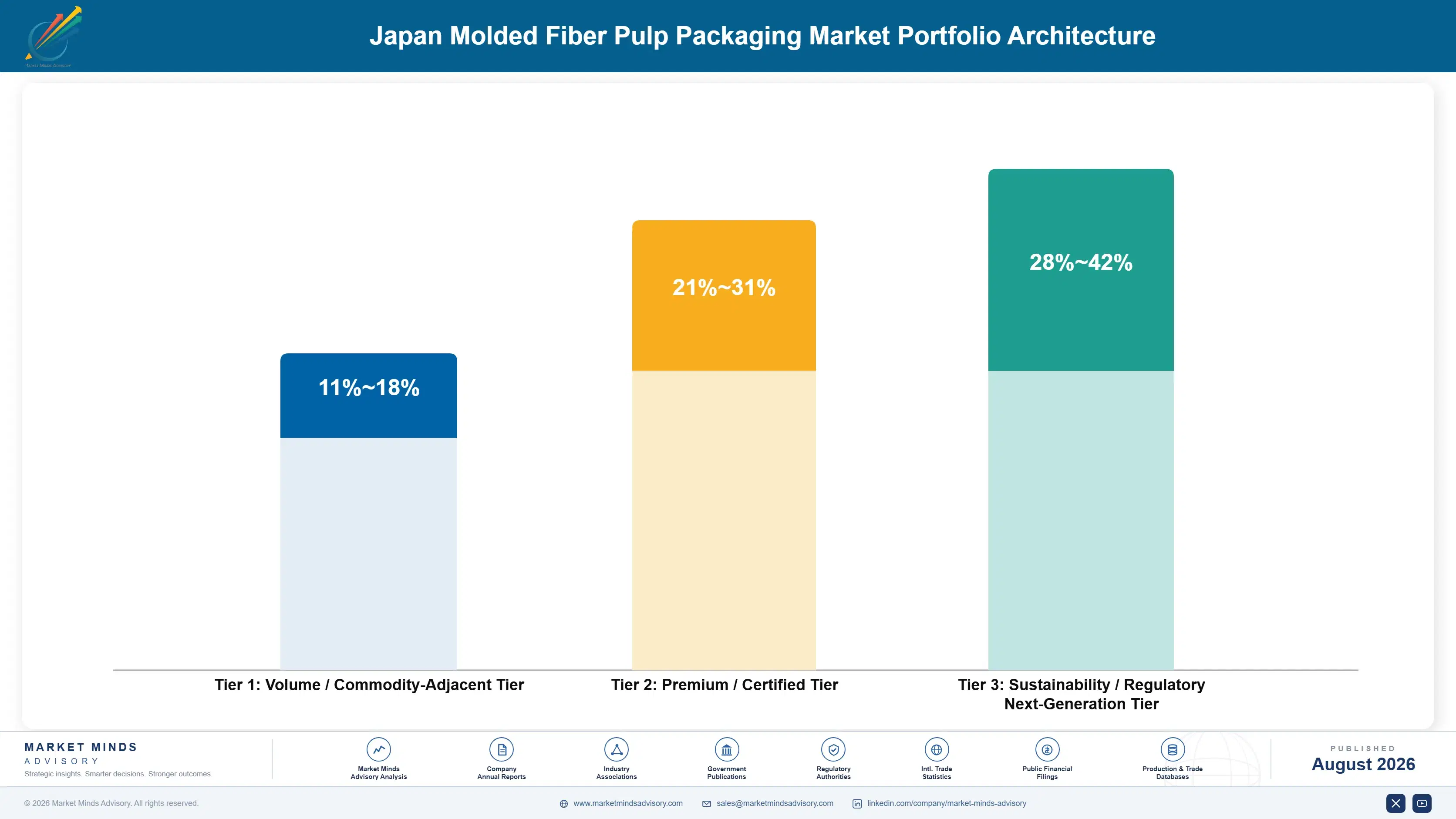
Three tiers describe this market and the spread reflects tolerance and surface quality rather than material. Commodity egg, fruit, and agricultural trays sit at the bottom, competing against Chinese and Southeast Asian imports on price alone. Industrial cushioning and standard protective mouldings sit modestly higher on engineering content. And precision thermoformed and barrier-coated grades occupy a third tier where domestic capability genuinely cannot be matched from abroad. Furnish content d
The tension is that commodity volume keeps forming lines loaded, and a moulding plant running below capacity spreads enormous fixed drying and tooling cost across fewer parts. Domestic commodity demand is declining with population while imports take what remains, which squeezes loading from both sides simultaneously. Producers who consolidated commodity work onto fewer lines and freed capacity for precision have generally managed this better than those who did not.

High-value pools concentrate where the customer sees the moulding. Presentation packaging and foodservice both put the part in front of an end consumer, and appearance commands a price that protective performance never will. Protective performance has never commanded a price premium anywhere, and appearance reliably does.

Volume / Commodity-Adjacent Tier

Egg trays, fruit trays, and agricultural mouldings competing directly against Chinese and Southeast Asian imports on delivered price. Thin margin and declining domestic volume, yet still the tonnage that keeps forming and drying capacity loaded efficiently.
Gross Margin: 11-18%

Premium / Certified Tier

Industrial cushioning, corner blocks, and engineered protective mouldings designed against specific product geometries and drop requirements. Margin reflects design and tooling content rather than any difference in the recovered furnish being formed.
Gross Margin: 21-31%

Sustainability / Regulatory / Next-Generation Tier

Precision thermoformed presentation grades and barrier-coated foodservice mouldings where the end consumer sees the part directly. Best margin because surface quality and tolerance cannot be matched by imported commodity moulding at any price.
Gross Margin: 28-42%
molded-fiber-pulp-packaging-industry-in-japan-portfolio-architecture-1787299403183

High-value Sub-segments and Strategic Watch-out

Precision Thermoformed Presentation Grades

Best margin and the fastest growth in this whole category at 6.3%, holding tolerances near four tenths of a millimetre that imported commodity moulding simply cannot approach at all. The capability is also exportable as licensed technology, which travels where the parts themselves never can.
Gross Margin: 28-42%

Barrier-Coated Foodservice Mouldings

Strong margin on Japan's own substitution story finally arriving as plastic reduction reaches takeaway and bento formats. Appearance standards here are unusually demanding, which is what keeps the volume from leaving for cheaper Asian supply. Fluorochemical barrier treatments have been withdrawn entirely, and aqueous systems are the only replacement.
Gross Margin: 25-36%

Commodity Egg And Fruit Trays

The volume core at very thin margin, declining with population while imports take what remains and squeezing line loading from both directions at once. Consolidating it onto fewer lines is the only sensible response available. Tooling here is cheap and switching costs customers nothing, and imports keep taking what remains.
Gross Margin: 11-18%

Industrial Cushioning Mouldings

The strategic watch-out, since foam conversion finished here decades ago and there is no substitution growth left to capture. Engineering content protects margin while Asian imports keep testing the simpler geometries within the range. Engineering content is what protects the remaining margin, and Asian imports keep testing simpler geometries.
Gross Margin: 21-31%

How Moulding Demand Repeats Here

Moulded fibre demand is tool-shaped, which makes it unusually predictable once established. A part is designed against a specific product geometry, tooling is cut for it, and reorders follow that product's own production schedule until the product changes. Precision presentation tooling is expensive enough that customers rarely move mid-lifecycle, while commodity tray tooling is cheap and switching is trivial. That difference explains most of the margin spread across this market.
Depth of relationship varies sharply by customer type. Electronics brands specifying presentation packaging engage deeply on tolerance and surface, audit consistently, and hold suppliers across product generations. Appliance makers buy engineered cushioning against drop specifications and behave similarly. Food producers buying trays switch on price with almost no friction. Convenience and foodservice operators sit between the two, caring about appearance but tendering regularly, which makes them the least defensible accounts in the portfolio.

Buyer profiles are shifting as sustainability functions gain influence over packaging decisions engineering used to own. Recycled content and end-of-life questions now arrive alongside protection requirements rather than afterwards. Packaging engineers are being consulted rather than deciding alone, and producers have been slow to notice.
molded-fiber-pulp-packaging-industry-in-japan-end-use-penetration-index-1787299403674

What We Would Tell a Board

These are among the four positions where our research anticipates prominent divergence between winners and laggards over the coming forecast period. Each is grounded in the demand model, the regulatory perimeter, and the announced capacity pipeline.
01 / CAPABILITY EXPORT STRATEGY

Licence the technology; the parts cannot travel

Japanese precision thermoforming holds tolerances near four tenths of a millimetre that Western producers converting away from foam simply cannot yet achieve, and a moulded fibre part is mostly air so freight destroys any export economics. Licensing tooling design and process parameters captures value from that capability without shipping anything at all, typically returning 4 to 7% of licensee revenue on qualifying grades. Competing on freight against local producers who will always sit closer to the customer is the only alternative available.
02 / AUTOMATION AGAINST LABOUR

Output is limited by people, not by orders

Vacancy near 14% across de-moulding and finishing is already capping shift coverage at several Japanese sites regardless of order book, and these positions are physically demanding enough that wage increases have not filled them. Robotic de-moulding and automated stacking cost roughly 3 million dollars per line and remove the constraint permanently rather than bidding against every other employer for scarce labour. In a market constrained by staffing rather than by orders, that is a growth investment rather than a cost reduction.
03 / ENERGY RECOVERY PRIORITY

Heat recovery pays faster here than anywhere else

Drying accounts for 33% of conversion cost and most of that energy leaves the building as warm wet air, while Japanese industrial power prices sit among the highest in the developed world. Exhaust heat recovery removes 15 to 19 percentage points of drying energy for around 800,000 dollars per line, with payback under three years at current tariffs. The identical investment takes far longer to justify in markets with cheaper power, which makes deferring it here particularly hard to defend.
04 / FOODSERVICE BARRIER READINESS

Japan's own substitution story is finally arriving

Single-use plastic reduction is finally reaching takeaway, convenience, and bento formats three decades after the electronics conversion finished here, and moulded fibre needs grease and moisture barrier to serve them now that fluorochemical treatments have been withdrawn. Qualifying aqueous barrier systems across representative Japanese formats costs roughly 2 million dollars in trials and shelf testing. Japanese foodservice appearance standards are demanding enough to advantage domestic producers, and that is precisely what keeps this volume from going to cheaper imported supply instead.

Engagement Snapshot From the Field

A live engagement with an industry participant carrying material or product regulatory and market exposure ahead of a defining policy shift, showing how our research translates into a defensible multi-year portfolio strategy.
MARKET MINDS ADVISORY · CLIENT ENGAGEMENT SUMMARY
Japan Molded Fiber Pulp Packaging Producer Strategic Portfolio Review and Transition Roadmap 2026·Investment Scenario on Japan Molded Fiber Pulp Packaging Exposure Evaluation 2025-26
CLIENT PROFILE
A Japanese moulded fibre manufacturer with approximately 95 million dollars in annual revenue (client-reported, unverified by MMA), operating three forming lines producing egg trays, industrial cushioning, and a small volume of precision thermoformed parts. The company had no heat recovery installed, was running reduced shifts on two lines because of unfilled positions, and treated precision work as an occasional specialty rather than a strategy.
STRATEGIC CHALLENGE
Volume had declined for three consecutive years and energy cost per part had risen sharply, while two commodity tray customers had moved to imported supply. Management proposed closing one forming line. The board wanted an independent view before permanently removing capacity from a business already constrained by staffing. Nobody had examined the staffing constraint.
MMA APPROACH
We modelled conversion cost per part by line against drying energy and shift coverage, quantified the output currently lost to unfilled positions across all three lines, and benchmarked precision thermoformed pricing against the client's commodity realisation. Customer interviews across seven accounts tested willingness to pay for surface quality and dimensional consistency.
KEY FINDINGS
  1. Unfilled positions rather than demand were limiting output on two lines, and closing a line would have removed capacity the company could not currently staff anyway.
  2. Energy cost per part ran roughly 29% above comparable producers operating dryer exhaust heat recovery, and no recovery equipment was installed anywhere on site.
  3. Precision thermoformed parts realised more than three times commodity tray pricing per unit of forming capacity, and the client had never marketed the capability actively.
  4. Five of seven customers interviewed indicated they would pay materially more for improved surface consistency, and two were already sourcing precision parts from competitors.
CLIENT PROFILE
A Japanese moulded fibre manufacturer with approximately 95 million dollars in annual revenue (client-reported, unverified by MMA), operating three forming lines producing egg trays, industrial cushioning, and a small volume of precision thermoformed parts. The company had no heat recovery installed, was running reduced shifts on two lines because of unfilled positions, and treated precision work as an occasional specialty rather than a strategy.
STRATEGIC CHALLENGE
Volume had declined for three consecutive years and energy cost per part had risen sharply, while two commodity tray customers had moved to imported supply. Management proposed closing one forming line. The board wanted an independent view before permanently removing capacity from a business already constrained by staffing. Nobody had examined the staffing constraint.
MMA APPROACH
We modelled conversion cost per part by line against drying energy and shift coverage, quantified the output currently lost to unfilled positions across all three lines, and benchmarked precision thermoformed pricing against the client's commodity realisation. Customer interviews across seven accounts tested willingness to pay for surface quality and dimensional consistency.
KEY FINDINGS
  1. Unfilled positions rather than demand were limiting output on two lines, and closing a line would have removed capacity the company could not currently staff anyway.
  2. Energy cost per part ran roughly 29% above comparable producers operating dryer exhaust heat recovery, and no recovery equipment was installed anywhere on site.
  3. Precision thermoformed parts realised more than three times commodity tray pricing per unit of forming capacity, and the client had never marketed the capability actively.
  4. Five of seven customers interviewed indicated they would pay materially more for improved surface consistency, and two were already sourcing precision parts from competitors.
RECOMMENDED STRATEGY
Phase 1: Phase 1 (months one to nine): install robotic de-moulding on the two understaffed lines and retrofit dryer heat recovery across all three. Phase 2: Phase 2 (months nine to twenty-one): reallocate freed capacity toward precision thermoformed work and market the capability to existing customers. Phase 3: Phase 3 (months twenty-one to thirty-six): qualify aqueous barrier coating for foodservice formats and then pursue convenience chain conversion volume.
OUTCOME
The client cancelled the line closure and installed automation and heat recovery instead. Output recovered as shifts became staffable, energy cost per part fell back toward comparable producers, and precision volume grew enough to offset continuing commodity decline (client-reported, unverified by MMA), with no line closure required at all.

Frequently Asked Questions

Foundational context covering the market sizes, CAGR, scope, country, region and competition that inform every finding below. This section is provided to cover basics and most often pre-purchase conversations, answered from the MMA Primary Research Dataset.

What is the current size of the Japan Molded Fiber Pulp Packaging Market?

The market is valued at USD 0.64 billion in 2025, rising to USD 0.67 billion in 2026. Around 87% of electronics cushioning converted away from foam decades ago.

How large will the Japan Molded Fiber Pulp Packaging Market be by 2036?

MMA forecasts USD 1.01 billion by 2036, an increase of USD 0.34 billion over the 2026 base. That represents an expansion multiple of 1.51 times.

What is the CAGR for the Japan Molded Fiber Pulp Packaging Market 2026 to 2036?

The base case CAGR is 4.2%, with a bull case of 5.4% and a bear case of 3.0%. The historical rate from 2020 to 2025 was 3.1%.

Which segment is growing fastest?

Precision thermoformed fibre at 6.3%, exactly 1.50 times the market rate. It holds tolerances near four tenths of a millimetre with a presentation surface transfer moulding cannot approach.

Who are the major companies in the Japan Molded Fiber Pulp Packaging Market?

Oji Holdings, Nippon Molding, Rengo, Daio Paper, and Chuetsu Pulp and Paper lead on annual Japanese moulded fibre tonnage. The top five together hold 54% of the market.

Which country is growing fastest?

This is a single-country market, so the Japanese growth rate matches the market rate of 4.2%. Precision thermoformed and foodservice grades grow considerably faster within it.

Report Segmentation Architecture

The full report scope spans multiple orthogonal segmentation dimensions, with cross-tabulated demand data provided for each dimension pair. Coverage extends further to regional breakdowns, trend trajectories, and the competitive detail needed to support segment-level decision-making.

By Moulding Process And Grade

  • Thick-Wall Transfer Moulded Trays
  • Precision Thermoformed Fibre
  • Industrial Cushioning And Corner Blocks
  • Foodservice And Tableware Grades
  • Coated And Barrier-Treated Mouldings
  • Agricultural And Horticultural Mouldings

By End-Use Industry

  • Consumer Electronics And Appliances
  • Egg, Fruit And Fresh Produce
  • Foodservice And Convenience Retail
  • Industrial And Automotive Components
  • Pharmaceutical And Medical Devices

By Commercial Model

  • Bespoke Tooled Programme Supply
  • Standard Tray Catalogue Supply
  • Technology And Tooling Licensing
  • Contract Moulding For Customer Tools

By Region

  • East Asia
  • South Asia and Pacific
  • North America
  • Western Europe
  • Latin America
  • Middle East and Africa
  • Eastern Europe

Scope, Methodology, and Coverage

Every figure in this report is reproducible from documented input assumptions. The scope below maps the historical period, the forecast horizon, the segmentation dimensions, and the countries covered, alongside the underlying primary and qualitative methodology.
Historical Period
2020 to 2025
Forecast Period
2026 to 2036
Base Year
2025 (USD billions; MMA Primary Research Dataset, August 2026)
Market Definition
This market comprises moulded fibre packaging produced in Japan from wet pulp furnish through transfer moulding, thermoforming, and related processes, measured at producer realised prices across all end-use industries. Process and grade coverage spans thick-wall transfer moulded trays, precision thermoformed fibre, industrial cushioning and corner blocks, foodservice and tableware grades, coated and barrier-treated mouldings, and agricultural and horticultural mouldings. Expanded foam cushioning, corrugated and folding carton packaging, thermoformed plastic trays, pulp production sold as furnish to third parties, moulding equipment manufacture, and moulded fibre imported into Japan fall outside scope.
Quantitative Units
USD billions (current prices); thousand tonnes moulded annually; realised price per tonne
Segmentation Dimensions
By Moulding Process And Grade; By End-Use Industry; By Commercial Model; By Region
Regions Covered
East Asia, South Asia and Pacific, North America, Western Europe, Latin America, Middle East and Africa, Eastern Europe
Countries Covered
Japan as the market geography, with furnish origin coverage spanning South Korea, China, Taiwan, Thailand, Malaysia, Vietnam, Indonesia, USA, Canada, Sweden, Finland, Germany, Brazil, Chile, Poland, Latvia, Estonia, Turkey, South Africa, Egypt, Australia, New Zealand, India, Philippines, Singapore, Mexico, Argentina, UAE, and additional origins relevant to this supply chain
Key Companies Profiled
Oji Holdings, Nippon Molding, Rengo, Daio Paper, Chuetsu Pulp and Paper, Nippon Paper Industries, Hokuetsu Corporation, Marusumi Paper, Tokushu Tokai Paper, Sanko, Gifu Plastic Industry, Sekisui Plastics, JSP Corporation, Kyoraku, Fuji Seal International, Toyo Seikan, Dai Nippon Printing, Huhtamaki, Brodrene Hartmann, CDL Omni-Pac
Quantitative Methodology
Primary survey, n=3,800 respondents, Q4 2025, six countries; demand-side model with trade association cross-validation
Qualitative Methodology
47 expert interviews, Q4 2025; applied to validate demand model assumptions, identify emerging dynamics, and assess competitive positioning
Report Format
PDF and XLSX data workbook (Word format preview document)
Publisher
Market Minds Advisory
Report Code
MMA-2026-PAC-364
Published
August 2026
Contact
sales@marketmindsadvisory.com | www.marketmindsadvisory.com

Purchase the full Japan Molded Fiber Pulp Packaging Market Report (2026 to 2036).

The full report sizes Japanese moulded fibre packaging across six process and grade families, five end-use industries, four commercial models, and seven furnish origins, treating Japan as the single market geography throughout. The completed foam conversion is documented by application, since the absence of substitution growth distinguishes this market from every Western equivalent. Conversion cost per part is modelled against drying energy and shift coverage across the installed forming base. Competitive profiling covers twenty companies on Japanese moulded fibre tonnage. Precision tolerance capability is benchmarked against Western converters now converting from foam.
Completed foam conversion documented application by application
Conversion cost modelled against drying energy and shift coverage
Precision tolerance benchmarked against Western converting capability
Labour vacancy impact quantified by production and finishing function
Furnish origin flows tracked across seven supplying regions
Barrier coating options compared for Japanese foodservice appearance standards

Built For The People Who Decide

From boardroom strategy to bench-side execution, this report is read cover-to-cover by leaders shaping the next decade of their industry, turning demand scenarios, market dynamics and valuation benchmarks into decisions.
CXOs/ Presidents/ VPs/ Managers
M&A and Corporate Development
Strategy Teams and R&D Heads
Procurement and Product Directors
Regulatory and Compliance Leaders
Investor Relations and Equity Analysts