Market Minds Advisory
Modularised Emulsion Plant Market

Modularised Emulsion Plant Market: Modularised Emulsion Plant Market: The Plant Is What The Contract Cost

Nobody sells these plants. An explosives company builds one on a mine's lease to win a seven year supply contract, and the plant is simply what winning that contract cost.

Lead Analyst

Published

September 2026

Make Smarter Decisions with Customized Research Insights

Request a free sample report and evaluate market opportunities, growth trends, and competitive dynamics relevant to your business needs.

2025 MARKET VALUE$1.6BMarket Size 2025
2036 FORECAST VALUE$4.0BBase Case , 2026 to 2036
CAGR 2026 TO 20368.8 %Bull 10.0% / Bear 7.6%
INCREMENTAL OPPORTUNITY$2.3BNet 10- year value creation
EXPANSION MULTIPLE2.32x2036 value over 2026 base
Strategic Levers
M&A Pipeline
Regional Outlook
Country Rankings
Competitive Intelligence
Segmental Deep-dive
Call-Us : 91 93563 13602

Executive Snapshot and Market Trajectory.

This is not an equipment market and treating it as one explains nothing. An explosives supplier builds a modular plant on a customer's mining lease to secure a seven year supply agreement, so the USD 14 million is capital deployed to win offtake rather than a sale.
Automated remote-operated modular plants grow at 13.2%, half again the market rate of 8.8%, because remote mine sites cannot reliably staff four operators around the clock and nobody wants people standing next to a sensitising process anyway. South Asia and Pacific holds 24% of demand, far outside its usual band, on Australian and Indonesian mining scale and on haul distances that make manufacturing anywhere else uneconomic. Orebodies rather than economies decide this whole map.
Concentration is high at 57% of installed capacity, and the reason is a licence rather than any technology. Manufacturing explosives at a site requires authorisation that takes 22 months to obtain and is granted to a named operator, so whoever holds it holds the position for as long as the mine runs. Competitors do not really bid against that at all; they simply wait for it to eventually lapse.
Market Definition
The modularised emulsion plant market covers factory-built, transportable plants that manufacture emulsion matrix and finished emulsion products at or near the point of use, spanning containerised sub-skid plants below five tonnes per hour, skid-mounted modular trains between five and twenty tonnes per hour, multi-module site plants above twenty tonnes per hour, relocatable mobile emulsion units, hybrid modular and fixed retrofit plants, and automated remote-operated modular plants. Scope covers installed plant value across mining explosives, bitumen and industrial emulsion applications. Excluded are fixed central manufacturing facilities, mobile mixing and delivery vehicles, raw material supply, downstream initiation systems, and blasting services delivered without any plant.
Base Year Value
$1.6B in 2025 (MMA Primary Research Dataset, September 2026)
Forecast Period
2026 to 2036, eleven discrete annual values
CAGR
8.8% base case. Bull 10.0%. Bear 7.6%.
Fastest Growth Segment
Automated Remote-Operated Modular Plants: 13.2% CAGR
Fastest Growth Country
India: 10.8% CAGR
Fastest Growth Region
South Asia and Pacific: 10.8% CAGR
Largest Region
South Asia and Pacific: 24% of 2025 global value
Market Leaders
Orica, Dyno Nobel, Enaex, AECI and Austin Powder. Source: MMA Analysis, July 2026.
Primary Survey
n=3,800 procurement and R&D decision-makers, Q4 2025, six countries
Methodology
Demand-side build-up, cross-validated against public data, 47 expert interviews

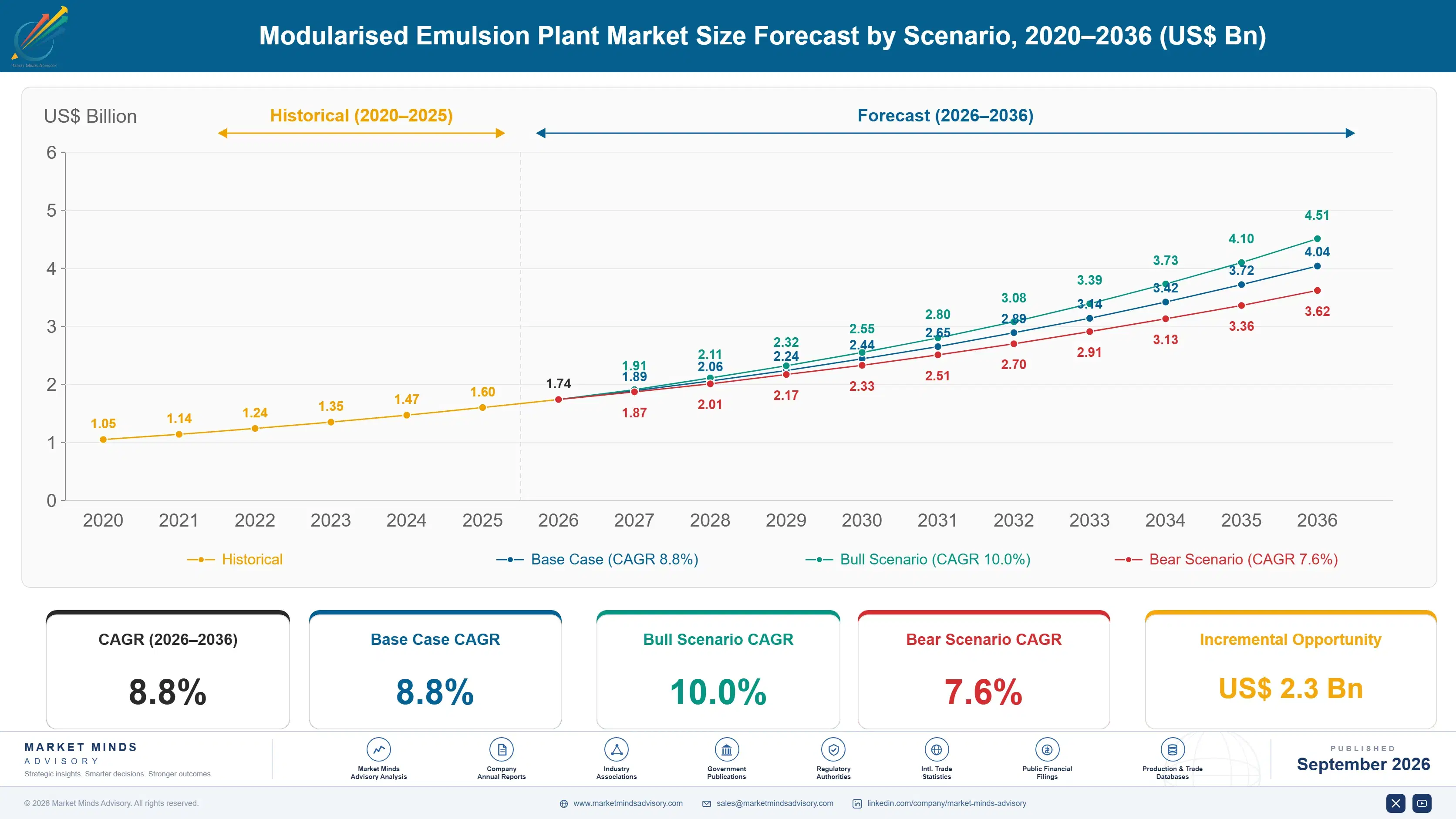
Modularised Emulsion Plant Market Forecast Scenarios

modularised-emulsion-plant-market-size-forecast-scenario-1788255464194
Between 2020 and 2025 installed capacity compounded at 7.4% and mine development rather than any equipment cycle explained it. Copper and iron ore expansion in South America and Australia placed plants on new leases, while African gold development added smaller units at scattered locations. Nitrate price movement through the period changed product cost and not how much plant anybody built.
The 8.8% base case rests on three mechanisms. New orebodies sit further from infrastructure than the ones being depleted, which lengthens hauls and makes on-site manufacturing economic where it was not. Remote site staffing is genuinely difficult and automation lets a plant run with fewer people. And agreements secured by placing a plant run seven years, committing capital that would otherwise be competed for annually. None of the three depends on commodity prices rising.
The bull case at 10.0% turns on copper development accelerating to meet electrification demand, which would place plants at a rate the sector has not seen in a decade. The bear case at 7.6% is mine deferral: capital projects slip on commodity prices and permitting, and a plant due next year simply is not placed, with nothing else to redeploy the capital toward.

The Plant Goes To The Orebody

The product cannot travel economically and that single fact created this market. Emulsion matrix is handled far more simply than sensitised explosive, and hauling finished product on public roads is expensive, tightly regulated and sometimes prohibited. Manufacturing at the mine removes a median 260 kilometres of road transport per delivery. The plant exists because the alternative is a convoy nobody wants running daily.
TOP FIVE CONCENTRATION57%Share of installed emulsion capacity held by five suppliers
PLANT CAPITAL COSTUSD 14mTypical investment for a mid-capacity modular emulsion train
HAULAGE DISTANCE REMOVED260 kmMedian road transport avoided by manufacturing at the site
SUPPLY CONTRACT TERM7 yearsTypical offtake period secured by placing a plant
ON-SITE STAFFING REQUIRED4 operatorsPeople needed to run a conventional modular plant continuously
SITE LICENSING LEAD TIME22 monthsTime to obtain manufacturing authorisation at a new location
Nobody buys these plants in the way the phrase suggests. An explosives supplier funds and installs one on a customer's mining lease as the price of securing a seven year supply agreement, which makes the USD 14 million a customer acquisition cost carried on the supplier's balance sheet rather than a transaction with a buyer. Analysing this as equipment demand misses what is actually happening commercially at every site.
Licensing rather than engineering decides who occupies a site. Manufacturing explosives requires site-specific authorisation naming an operator, obtained over roughly 22 months through a process that examines the applicant as closely as the facility. Once granted it is not readily transferred. A competitor cannot bid a mine away midway through a contract because it cannot lawfully manufacture there, which makes incumbency close to absolute.
"People keep asking me how big the market for these plants is and the question does not quite work. Nobody is buying one. An explosives company is deciding whether a mine is worth fourteen million dollars of its own capital, and that is a completely different calculation."
Director, Mining Chemicals and Equipment Practice · MMA Construction and Industrial Equipment Practice · September 2026

Market Trends

Remote automation answers a staffing problem, not a cost one

A conventional modular plant needs around four operators to run continuously, and remote mine sites across Western Australia, the Chilean interior and Central Africa cannot reliably recruit, house and rotate that crew at any acceptable cost. Automated plants running with minimal on-site presence remove the constraint rather than merely reducing the wage bill, and they also cut the number of people standing beside a sensitising process. Those plants grow at 13.2% against a market rate of 8.8%, and the argument that closes the sale is availability of people rather than any saving on them.
Market Impact: Converts tenders into 7 year deals
New orebodies sit further from everything than old ones

Deposits entering development are consistently more remote than the ones being depleted, because accessible ground was mined first and what remains is deeper, further inland or in jurisdictions without infrastructure. That lengthens the haul from any central manufacturing facility and pushes the economic crossover toward on-site production at sites that would previously have been supplied by road. Median haul distance removed by placing a plant now runs around 260 kilometres. The trend is geological rather than commercial and it moves in one direction only. Geology moves in one direction and it does not reverse.
Market Impact: Drives 19% Latin American share

Market Opportunities and Growth Drivers

A plant secures offtake that would otherwise be tendered

Placing a modular plant on a mining lease converts an annually contested supply contract into a seven year agreement, because the customer is not going to license a second manufacturer on the same site and the incumbent's capital is already in the ground. Explosives suppliers therefore fund plants as a commercial instrument rather than selling them as equipment. That logic drives installation decisions far more than any technical comparison between plant designs, and it explains why the largest suppliers install rather than sell almost without exception. Nobody sells these plants at all.
Market Impact: Strands capital for 22 months

Copper and battery mineral development keeps placing plants

Electrification demand has moved copper, nickel and lithium projects through development in numbers the sector has not seen for years, and each new open pit operation of any scale needs emulsion supply from somewhere. Chilean, Peruvian, Indonesian and Central African projects are placing plants at sites where road haulage from a central facility would be uneconomic. Latin America takes 19% of category demand on copper alone, far above what its industrial economy would otherwise support. The driver is a commodity cycle rather than anything about the technology. Copper is doing most of the work here.
Market Impact: Exposes 7 year supply agreements

Market Restraints and Challenges

Capital sits idle when a mine defers development

A plant is built against a specific mine plan, and when a project slips on commodity prices, permitting or financing, the supplier holds committed capital and fabricated modules with nowhere else to place them quickly. The root cause is that plant configuration follows a site's throughput, ore type and layout closely enough that redeployment requires modification and a new licence taking around 22 months. Commercial impact is stranded capital on a supplier's balance sheet. Participants are responding with standardised configurations, staged fabrication tied to project milestones, relocatable designs and contract structures sharing deferral risk with the miner.
Market Impact: Removes 4 operators from site

Ammonium nitrate supply concentrates in few hands

Emulsion manufacture depends on ammonium nitrate produced by a small number of large plants, and its price follows natural gas and fertiliser demand entirely unconnected to mining activity, while trade measures and security controls restrict who may supply it and where. The root cause is that the input is a fertiliser and an explosive precursor at once, which attracts both commodity volatility and regulation. Commercial impact is margin exposure on long supply agreements. Mitigation runs through backward integration into nitrate production, long-term supply contracts, price escalation clauses and regional sourcing arrangements.
Market Impact: Removes 260 km of haulage
3 additional market trends, 4 additional growth drivers, and 2 additional restraints and challenges are covered in the full report. Contact sales@marketmindsadvisory.com to access the complete intelligence.

Segment CAGR and Growth Architecture

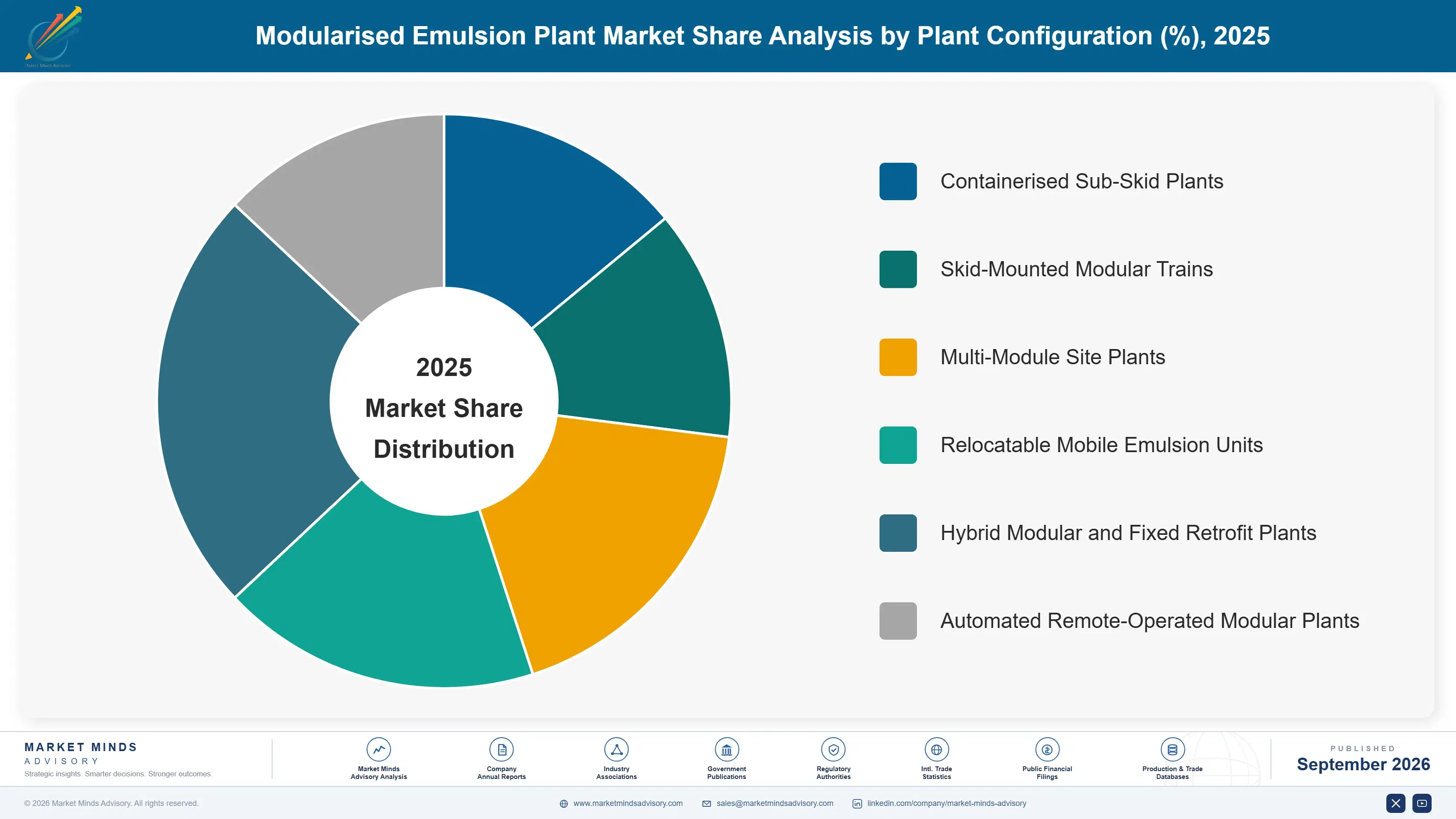
Segmentation follows plant configuration, the dimension on which capital cost, throughput and site suitability all move together. Skid-mounted trains and multi-module site plants carry the installed capacity at large established operations. Automated and relocatable configurations carry the growth, because both answer remoteness rather than any question about how emulsion is actually made. Remoteness is the whole question.
modularised-emulsion-plant-market-market-share-analysis-1788255464769

Automated Remote-Operated Modular Plants

Automated remote-operated modular plants grow at 13.2%, half again the market rate of 8.8%, and a labour market rather than a technology roadmap produced that number. Conventional plants need around four operators running continuously, and remote sites across Western Australia, the Chilean interior and Central Africa cannot recruit, house and rotate that crew reliably at any price a mine plan will bear. Automated configurations with remote monitoring and minimal on-site presence remove the constraint entirely, and they reduce the number of people standing beside a sensitising process, which safety cases increasingly favour. Capital cost runs above conventional plants and the comparison is not against cost at all, because the alternative frequently is not building the plant.
CAGR 13.2%

Relocatable Mobile Emulsion Units

Relocatable mobile emulsion units at 11.4% address the deposits that do not justify a permanent installation, which includes short-life open pits, contract mining operations and quarry groups running several sites within a region. A unit that can be demobilised and licensed at a new location within months changes the economics of any deposit with under a decade of reserves, where committing fourteen million dollars of fixed plant never made sense. The licensing burden remains substantial and jurisdictions vary considerably in how readily they permit relocation. Contract miners in particular value this configuration, because their own tenure at any given site is shorter than the plant would otherwise need to earn out.
CAGR 11.4%
Full segment breakdown across 6 segments available in the complete report.

Regional Architecture and Country Demand Map

South Asia and Pacific takes 24%, Latin America 19% and Middle East and Africa 16%, all far outside their usual bands, because this market follows orebodies rather than industrial economies. Three positions sit far outside their usual bands, and mining geography explains all of them.

South Asia and Pacific

A 24% share far outside the usual band follows from mining scale and from distance rather than from any economic weight. Western Australian iron ore and gold operations sit hundreds of kilometres from anything, Indonesian coal and nickel operations are scattered across islands where road haulage is not an option at all, and Indian coal and iron ore expansion is placing plants at a pace that makes it the fastest growing country covered at 10.8%. Australian operators pioneered on-site emulsion manufacture and the practice is now standard rather than innovative. Remote staffing difficulty here is more acute than anywhere else, which is driving automated configurations faster than in any other region.
Share: 24% | CAGR: 10.8% (2026 to 2036)

Latin America

The 19% share sits far above the usual band and copper explains almost all of it. Chilean and Peruvian operations are among the largest open pit mines anywhere and consume emulsion in quantities that make central supply impossible over Andean distances and altitudes. Brazilian iron ore adds substantially, and electrification demand is moving further copper projects through development across the region. Enaex is domiciled here and holds a position built over decades of serving exactly this geography. Altitude and terrain create genuine technical requirements around emulsion stability and pumping that suppliers without regional experience consistently underestimate before they arrive. Suppliers arriving without regional experience learn those requirements at their own expense, which several have done.
Share: 19% | CAGR: 9.4% (2026 to 2036)
Regional intelligence for 5 additional markets available in the complete report: North America, Western Europe, East Asia, Middle East and Africa, Eastern Europe. Contact sales@marketmindsadvisory.com.
modularised-emulsion-plant-market-country-cagr-analysis-1788255465303

Four Moves On Placed Capital

None of these four is about building a better emulsion plant, because the process chemistry is mature and every serious supplier makes acceptable matrix. Each works on the actual commercial question, which is whether committing fourteen million dollars of your own capital to somebody else's mine site pays. All four are capital decisions rather than engineering ones.

Start the licence before the contract closes

Site manufacturing authorisation takes around 22 months and is granted to a named operator, which means a supplier beginning the application only after winning a supply agreement has already lost two years of a seven year contract to paperwork. Applications can begin during commercial negotiation at modest cost and are abandoned cheaply if the contract goes elsewhere. Suppliers who work this way can offer a start date competitors cannot match. Almost everybody in this sector still treats licensing as a post-award activity rather than as a competitive weapon. It is a competitive weapon, not administration.
Market Impact: Recovers 22 months of the seven year term

Standardise configurations to redeploy stranded capital

Plants are engineered around a specific site's throughput, ore type and layout closely enough that a deferred mine leaves fabricated modules with nowhere to go, and mine deferrals are routine rather than exceptional. A standardised configuration range covering most duty points allows modules built for one project to be placed at another with modification rather than redesign. It costs some optimisation per site and converts USD 14 million of stranded capital into deployable inventory instead. Suppliers carrying bespoke designs absorb every deferral in full. Bespoke designs absorb every deferral in full.
Market Impact: Redeploys USD 14m of otherwise stranded plant capital

Automate for availability, not for wage cost

Remote sites cannot reliably recruit, house and rotate the four operators a conventional plant needs, and suppliers pitching automation as a saving on wages are answering a question the mine did not ask. The genuine argument is that the plant runs at all, and secondarily that fewer people stand beside a sensitising process, which safety cases increasingly require. Automated plants grow at 13.2% against a market rate of 8.8% on exactly that logic. Repositioning the proposal costs nothing and reaches the operations director rather than the accountant. It reaches operations rather than finance.
Market Impact: Replaces all 4 operators with remote monitoring instead

Integrate backwards into ammonium nitrate supply

Emulsion manufacture depends on ammonium nitrate whose price follows natural gas and fertiliser demand with no connection to mining activity, while 7 year supply agreements fix the output price against a moving input. Suppliers holding nitrate production or long-term supply contracts price steadily across that exposure and those buying on open market terms absorb every movement. Backward integration is expensive and supply contracting is not. The distinction between the two options is rarely examined properly before somebody decides the position is unaffordable. Few examine the difference before deciding it is unaffordable.
Market Impact: Covers the input cost across 7 year terms

Who Controls the Margin Pool

CR5 stands at 57% of installed emulsion capacity in tonnes per hour, which is the only comparable basis since these plants are almost never sold and therefore generate no equipment revenue anybody reports. Concentration is high because the capital commitment required excludes smaller participants entirely, and because site licensing gives incumbents positions that cannot be contested during a contract. Few can commit capital at that scale.
Competition runs on capital availability, licensing capability and mining relationships. Capital decides who can commit fourteen million dollars against a single customer's mine plan. Licensing capability decides how quickly a supplier can start manufacturing once awarded. Relationships decide who is invited to propose at all, since these agreements are frequently negotiated rather than tendered. Plant engineering differentiates remarkably little between established suppliers. These agreements are negotiated more often than tendered.

Rankings will move on where the next generation of orebodies sits rather than on any product development. Copper and battery mineral projects are placing plants across South America, Indonesia and Central Africa, and suppliers without positions there are watching share move to firms that have been present for decades. The pressure comes from geology rather than from competitors. Geology sets this map.
modularised-emulsion-plant-market-company-positioning-matrix-1788255465830

Competitive Moat and Risk Dimensions

ORICA

Moat: Installed base across remote operations

Plants placed across Australian, Indonesian and African mining operations over decades give the group both incumbency protected by site licensing and operating experience at exactly the remote conditions where these installations are hardest to run. Each contract renewal is defended by a licence a competitor cannot obtain. That position compounds, because remote experience qualifies the group for the next site.
ORICA

Risk: Capital committed to single customers

Every plant represents substantial capital committed against one mine's production plan, and a deferral, closure or ownership change leaves that investment exposed with no ready alternative placement. Diversification across many sites reduces the individual exposure and increases the aggregate capital employed considerably. Scale in this business means carrying more single-customer risk rather than less of it.
ENAEX

Moat: Andean copper operating experience

Decades supplying Chilean and Peruvian copper operations give the company technical understanding of emulsion behaviour at altitude and in Andean conditions that suppliers arriving from elsewhere consistently underestimate before they try it. Regional incumbency across the largest copper operations anywhere compounds that. Competing here means solving problems the company solved a generation ago.
ENAEX

Risk: Concentration in one commodity

Revenue weighted heavily toward copper operations in a single geography exposes the company to a commodity cycle and to a regulatory environment that can change with a Chilean or Peruvian government. Diversifying means competing where other incumbents hold equivalent positions built over equally long periods. The advantage that creates the moat is the same one that concentrates the exposure.

Players Tracked

Prominent Players

Orica
Dyno Nobel
Enaex
AECI
Austin Powder

Other Key Players

MAXAM
EPC Groupe
Solar Industries India
NOF Corporation
Yahua Group
Poly Union Chemical
BME Mining
Hanwha Corporation
Titanobel
Nelson Brothers
Chemring Group
Premier Explosives
Sasol
Kemek Explosives
Omnia Holdings

Recent Developments

FEBRUARY 2025

Automated plant commissioned at remote Australian operation

A modular emulsion plant designed for minimal on-site staffing entered service at a remote Western Australian mining operation, monitored from a regional centre rather than crewed continuously. The installation was justified on crew availability at the site rather than on any saving in wage cost against a conventional plant.
Signal: The argument that won this one was about people being unavailable rather than people being expensive.
JUNE 2025

Copper developer awarded seven year on-site supply agreement

A copper project in development awarded a seven year emulsion supply agreement to a supplier funding and installing a modular plant on the mining lease, with the capital carried entirely by the supplier. Competing bidders offering road haulage from central facilities could not match the delivered cost over Andean distances.
Signal: Distance decided this contract long before anybody had compared any of the plant designs or emulsion formulations.
OCTOBER 2025

Mine deferral stranded fabricated plant modules

A deferred mining project left fabricated emulsion plant modules without a site, and the supplier holding them faced modification and fresh licensing running around 22 months before they could be placed elsewhere. Standardised configurations would have permitted redeployment considerably faster than the bespoke design allowed.
Signal: Bespoke engineering looks like service until the mine defers and the modules have nowhere to go.

Nitrate, Steel And Fabrication

Fabricated stainless and carbon steel vessels account for roughly 34% of plant capital cost, pumps, mixers and rotating equipment around 22%, and control systems with instrumentation a further 17%. On the operating side ammonium nitrate dominates, and its price follows gas and fertiliser demand rather than mining. Site civil works and installation make up most of what remains on a delivered basis.
Ammonium nitrate pricing through 2022 demonstrated the operating exposure sharply. European nitrate production curtailed as gas prices rose, which the International Energy Agency documented across the period, and the effect reached mining supply agreements written years earlier. Suppliers with nitrate production or long-term contracts held margin. Those buying on open market terms delivered against seven year agreements at costs nobody had contemplated when the contracts were signed.

The disadvantage falls on input integration rather than on plant engineering, which is where the sector's attention goes. A supplier producing its own ammonium nitrate, or holding long-term supply, prices predictably across seven years while a competitor buying on open terms cannot. No improvement in plant efficiency closes a gap that sits in a fertiliser market. That position explains more about which suppliers make money than emulsion technology does.
modularised-emulsion-plant-market-cost-volatility-analysis-1788255466031

Contract ammonium nitrate across the agreement term

Nitrate dominates operating cost and its price follows gas and fertiliser markets while supply agreements fix output prices for seven years. Long-term supply contracts matched to the agreement term cost a premium against spot and remove the only exposure large enough to destroy a contract's economics. Suppliers who did not match those terms delivered at a loss last cycle.

Standardise vessels and skids across configurations

Fabricated vessels are 34% of plant capital and most suppliers engineer them per site, which forfeits batch fabrication economics and leaves modules unplaceable when a mine defers. A standard vessel and skid range covering common duty points raises fabrication batch sizes and converts stranded modules into deployable inventory. It costs some site optimisation and returns on every plant built afterwards.

Stage fabrication against project milestones

Mine deferrals are routine and a supplier fabricating a complete plant against an announced schedule carries the whole exposure when a project slips. Staging fabrication against the customer's own permitting and financing milestones ties capital release to project reality rather than to an optimistic programme. It costs a small premium in fabrication scheduling and prevents the exposure entirely.

Portfolio Architecture for Margin Defence

Margin here follows the supply agreement rather than the plant, which is the whole commercial structure of the sector. A plant generates no revenue of its own and earns entirely through the emulsion it produces across a seven year term, so the return depends on the tonnage a mine actually consumes and on the nitrate cost across that period. Participants analysing plant economics separately are measuring the wrong asset.
Volume and premium pull against each other through capital allocation rather than through pricing. Large established operations with long mine lives justify substantial plants and produce dependable tonnage at modest margins, and that base is what funds pursuing the shorter-life and remote sites where returns are better and risk is higher. A supplier holding only the difficult sites carries a portfolio nobody would finance.

High-value pools sit in automated remote configurations, in relocatable units and in nitrate integration nobody treats as part of this business. The third is the largest: a supplier holding nitrate production prices predictably across a seven year term while a competitor cannot, and that difference decides which agreements are profitable far more reliably than anything about the plant does.

Volume / Commodity-Adjacent

Standard skid-mounted trains at established large operations with long mine lives and road access. Competition is on delivered emulsion price against alternatives including central supply. The 8 point spread reflects whether the supplier holds nitrate production or buys on open terms.
Gross Margin: 16 to 24%

Premium / Certified

Multi-module plants at large remote operations where central supply is uneconomic and site licensing protects the position for the contract term. Distance rather than technology supports the margin. The 8 point spread reflects haul distance avoided and the resulting delivered cost advantage.
Gross Margin: 30 to 38%

Sustainability / Regulatory / Next-Generation

Automated remote-operated plants and relocatable units serving sites that could not otherwise be supplied at all. Margins are high because the alternative is frequently no supply rather than a competitor. The 18 point spread separates permanent automated installations from relocatable units carrying redeployment risk.
Gross Margin: 38 to 56%
modularised-emulsion-plant-market-portfolio-architecture-1788255466537

High-value Sub-segments and Strategic Watch-out

Automated Remote-Operated Modular Plants

High value and high growth at 13.2%. Remote sites cannot staff four operators reliably, which makes automation a condition of supply rather than an efficiency measure anybody is choosing. The 8 point spread reflects whether remote monitoring is provided by the supplier or by the mine.
Gross Margin: 44 to 52%

Relocatable Mobile Emulsion Units

High value with strong growth at 11.4%. Short-life deposits and contract miners cannot justify fixed plant, and a unit that relicenses at a new site changes those economics. The 8 point spread reflects how readily the relevant jurisdiction permits any relocation of a manufacturing licence.
Gross Margin: 36 to 44%

Skid-Mounted Modular Trains

The volume core. It earns modestly and it carries the dependable tonnage from long-life operations that funds pursuing the remote sites where returns are better. The 8 point spread reflects nitrate cost position, which decides these economics far more than plant configuration does. Nitrate decides.
Gross Margin: 18 to 26%

Multi-Module Site Plants

The strategic watch-out. These represent the largest single-customer capital commitments in the sector and a mine closure or ownership change strands them entirely. The 22 point spread separates operations with decades of reserves from those whose mine life barely exceeds the contract term. Mine life decides.
Gross Margin: 22 to 44%

Seven Years On A Lease

The annuity here is a supply agreement secured by placing capital, which produces revenue that is contractually certain and physically immovable. Once a plant is licensed and running on a lease, the mine buys emulsion from it for seven years without any competitive process, because no second manufacturer can be licensed there. The revenue arrives without further selling of any kind.
Stickiness varies enormously by mine life rather than by relationship. An operation with thirty years of reserves renews the agreement repeatedly, because relocating a plant serves nobody and the alternative supplier faces a two year licensing process before it could deliver anything. An operation approaching depletion is a different proposition entirely, and suppliers frequently discover that the contract term and the remaining mine life do not match.

Buyer profiles have shifted from procurement toward mine planning and capital committees, and proposals have not entirely followed. A procurement manager compared delivered emulsion prices per tonne. A mine planning function asks about supply continuity through the life of plan, and a capital committee asks who carries the plant investment and what happens on deferral. The last question now shapes the commercial structure of almost every agreement.
modularised-emulsion-plant-market-end-use-penetration-index-1788255467038

What The Capital Actually Buys

These are among the four positions where our research anticipates prominent divergence between winners and laggards over the coming forecast period. Each is grounded in the demand model, the regulatory perimeter, and the announced capacity pipeline.
01 / LICENCE TIMING ADVANTAGE

Apply before you have won anything

Site manufacturing authorisation runs around 22 months and is granted to a named operator, which means a supplier starting the application after winning a supply agreement has surrendered two years of a seven year contract to administrative process before producing anything. Applications can begin during commercial negotiation at modest cost and be abandoned cheaply if the award goes elsewhere entirely. Suppliers working that way offer start dates competitors simply cannot match, and almost everybody still treats licensing as a post-award activity.
02 / PLANT CONFIGURATION STANDARDISATION

Build modules you can move somewhere else

Plants are engineered around a specific site's throughput, ore type and layout closely enough that a deferred mine leaves fabricated modules with nowhere to go and a supplier holding stranded capital indefinitely. Mine deferrals are entirely routine rather than exceptional, and a standardised configuration range covering common duty points lets modules built for one project be placed at another with modification rather than a full redesign. It costs a little optimisation per site and converts stranded capital into genuinely deployable inventory instead.
03 / AUTOMATION ARGUMENT REFRAMING

Sell availability of people, not their cost

Remote sites across Western Australia, the Chilean interior and Central Africa cannot reliably recruit, house and rotate the four operators a conventional plant requires, and suppliers pitching automation as a wage saving are answering a question the mine never asked them. The genuine argument is that the plant runs at all, with fewer people beside a sensitising process as a secondary benefit that safety cases increasingly require. Automated plants grow at 13.2% against a market rate of 8.8% on exactly that logic alone.
04 / NITRATE POSITION BUILDING

Fix the input or do not fix the output

Ammonium nitrate dominates operating cost and its price follows natural gas and fertiliser demand with no connection whatsoever to mining activity, while these supply agreements fix the delivered emulsion price for seven full years. Suppliers holding nitrate production or matched long-term supply contracts price predictably across that exposure, and those buying on open market terms absorb every movement in a market they do not participate in. Backward integration is expensive and supply contracting is not, and few examine the difference properly.

Engagement Snapshot From the Field

A live engagement with an industry participant carrying material or product regulatory and market exposure ahead of a defining policy shift, showing how our research translates into a defensible multi-year portfolio strategy.
MARKET MINDS ADVISORY · CLIENT ENGAGEMENT SUMMARY
Modularised Emulsion Plant Producer Strategic Portfolio Review and Transition Roadmap 2026·Investment Scenario on Modularised Emulsion Plant Exposure Evaluation 2025-26
CLIENT PROFILE
An international explosives supplier operating modular emulsion plants across three continents, with annual emulsion revenue in the high hundreds of millions of dollars and capital employed in placed plants growing faster than the returns on it (client-reported, unverified by MMA). Two recent mine deferrals had left fabricated modules without sites. Nobody had reviewed the portfolio.
STRATEGIC CHALLENGE
Capital committed to customer sites was rising while return on that capital fell, and management could not determine whether the problem was contract pricing, plant cost, deferral exposure or the sites being chosen. Every individual investment had been approved on a business case that looked reasonable at the time it was made.
MMA APPROACH
MMA rebuilt the return on every placed plant across eight years against actual tonnage, nitrate cost movement and contract duration achieved rather than planned. Forty-seven expert interviews with mine planners, capital committees, regulators, fabricators and competing suppliers established what actually determined whether a placed plant earned out or did not.
KEY FINDINGS
  1. Plants at operations with mine lives under 12 years returned below cost of capital in 4 of 6 cases, while long-life operations returned well above it consistently.
  2. Licensing delay averaged 19 months after contract award, removing roughly a quarter of each seven year term before manufacturing could begin at all.
  3. Nitrate cost movement rather than tonnage variance explained most of the return shortfall, and no agreement carried an escalation clause covering it.
  4. Every plant was engineered bespoke, which meant the 2 deferred projects left modules requiring redesign rather than redeployment to any other site.
CLIENT PROFILE
An international explosives supplier operating modular emulsion plants across three continents, with annual emulsion revenue in the high hundreds of millions of dollars and capital employed in placed plants growing faster than the returns on it (client-reported, unverified by MMA). Two recent mine deferrals had left fabricated modules without sites. Nobody had reviewed the portfolio.
STRATEGIC CHALLENGE
Capital committed to customer sites was rising while return on that capital fell, and management could not determine whether the problem was contract pricing, plant cost, deferral exposure or the sites being chosen. Every individual investment had been approved on a business case that looked reasonable at the time it was made.
MMA APPROACH
MMA rebuilt the return on every placed plant across eight years against actual tonnage, nitrate cost movement and contract duration achieved rather than planned. Forty-seven expert interviews with mine planners, capital committees, regulators, fabricators and competing suppliers established what actually determined whether a placed plant earned out or did not.
KEY FINDINGS
  1. Plants at operations with mine lives under 12 years returned below cost of capital in 4 of 6 cases, while long-life operations returned well above it consistently.
  2. Licensing delay averaged 19 months after contract award, removing roughly a quarter of each seven year term before manufacturing could begin at all.
  3. Nitrate cost movement rather than tonnage variance explained most of the return shortfall, and no agreement carried an escalation clause covering it.
  4. Every plant was engineered bespoke, which meant the 2 deferred projects left modules requiring redesign rather than redeployment to any other site.
RECOMMENDED STRATEGY
Phase 1: Phase one: begin site licence applications during commercial negotiation rather than after award, recovering the term currently lost to administrative process. Phase 2: Phase two: introduce nitrate escalation clauses into every new agreement, since input movement rather than tonnage drove the return shortfall. Phase 3: Phase three: standardise onto a configuration range covering common duty points, so deferred modules become inventory rather than a write-down.
OUTCOME
Within six quarters licence applications ran ahead of award on every new opportunity and two agreements carried nitrate escalation for the first time (client-reported, unverified by MMA). The deferred modules remain unplaced. Configuration standardisation is under way and will take several further years. Two further agreements are being renegotiated on the same basis.

Frequently Asked Questions

Foundational context covering the market sizes, CAGR, scope, country, region and competition that inform every finding below. This section is provided to cover basics and most often pre-purchase conversations, answered from the MMA Primary Research Dataset.

What is the current size of the Modularised Emulsion Plant Market?

The global modularised emulsion plant market was valued at USD 1.6 billion in 2025, covering transportable plants manufacturing emulsion at or near the point of use. The 2026 figure reaches USD 1.74 billion.

How large will the Modularised Emulsion Plant Market be by 2036?

MMA forecasts USD 4.04 billion by 2036, an increase of USD 2.30 billion over the 2026 base. That represents an expansion multiple of 2.32 times across the forecast period.

What is the CAGR for the Modularised Emulsion Plant Market 2026 to 2036?

The base case compound annual growth rate is 8.8%, with a bull case at 10.0% and a bear case at 7.6%. Historical growth between 2020 and 2025 ran at 7.4%.

Which segment is growing fastest?

Automated remote-operated modular plants grow at 13.2%, half again the market rate of 8.8%, because remote sites cannot staff four operators reliably. Relocatable units follow at 11.4%.

Who are the major companies in the Modularised Emulsion Plant Market?

Orica, Dyno Nobel, Enaex, AECI and Austin Powder lead on installed emulsion capacity, with combined CR5 of 57%. Concentration is high because site licensing protects incumbents throughout a contract.

Which country is growing fastest?

India grows fastest at 10.8%, on coal and iron ore expansion placing plants at sites remote from central manufacturing. South Asia and Pacific leads regionally at 24% of demand.

Report Segmentation Architecture

The full report scope spans multiple orthogonal segmentation dimensions, with cross-tabulated demand data provided for each dimension pair. Coverage extends further to regional breakdowns, trend trajectories, and the competitive detail needed to support segment-level decision-making.

By Plant Configuration

  • Containerised Sub-Skid Plants
  • Skid-Mounted Modular Trains
  • Multi-Module Site Plants
  • Relocatable Mobile Emulsion Units
  • Hybrid Modular and Fixed Retrofit Plants
  • Automated Remote-Operated Modular Plants

By End-Use Industry

  • Open Pit Metal Mining
  • Underground Metal Mining
  • Coal Mining Operations
  • Quarrying and Aggregates
  • Tunnelling and Civil Construction
  • Bitumen and Industrial Emulsions

By Commercial Dimension

  • Supplier Funded Plant Placement
  • Outright Plant Sale
  • Build Own Operate Agreements
  • Contract Mining Supply
  • Toll Manufacturing Arrangements
  • Relocation and Redeployment Services

By Region

  • North America
  • Western Europe
  • East Asia
  • South Asia and Pacific
  • Latin America
  • Middle East and Africa
  • Eastern Europe

Scope, Methodology, and Coverage

Every figure in this report is reproducible from documented input assumptions. The scope below maps the historical period, the forecast horizon, the segmentation dimensions, and the countries covered, alongside the underlying primary and qualitative methodology.
Historical Period
2020 to 2025
Forecast Period
2026 to 2036
Base Year
2025 (USD billions; MMA Primary Research Dataset, September 2026)
Market Definition
The modularised emulsion plant market covers factory-built, transportable plants that manufacture emulsion matrix and finished emulsion products at or near the point of use, spanning containerised sub-skid plants below five tonnes per hour, skid-mounted modular trains between five and twenty tonnes per hour, multi-module site plants above twenty tonnes per hour, relocatable mobile emulsion units, hybrid modular and fixed retrofit plants, and automated remote-operated modular plants. Scope covers installed plant value across mining explosives, bitumen and industrial emulsion applications. Excluded are fixed central manufacturing facilities, mobile mixing and delivery vehicles, raw material supply, downstream initiation systems, and blasting services delivered without any plant.
Quantitative Units
USD billion, 2025 base year, 2026 to 2036 forecast period
Segmentation Dimensions
Plant configuration, mining application, commercial model, region
Regions Covered
North America, Western Europe, East Asia, South Asia and Pacific, Latin America, Middle East and Africa, Eastern Europe
Countries Covered
United States, Canada, Sweden, Finland, Spain, Poland, Serbia, Kazakhstan, China, Mongolia, Indonesia, India, Australia, Chile, Peru, Brazil, South Africa, Ghana
Key Companies Profiled
20 companies across explosives suppliers, plant fabricators and regional manufacturers
Quantitative Methodology
Primary survey, n=3,800 respondents, Q4 2025, six countries; demand-side model with trade association cross-validation
Qualitative Methodology
47 expert interviews, Q4 2025; applied to validate demand model assumptions, identify emerging dynamics, and assess competitive positioning
Report Format
PDF and XLSX data workbook (Word format preview document)
Publisher
Market Minds Advisory
Report Code
MMA-2026-CON-551
Published
September 2026
Contact
sales@marketmindsadvisory.com | www.marketmindsadvisory.com

Purchase the full Modularised Emulsion Plant Market Report (2026 to 2036).

The full MMA report on the modularised emulsion plant market runs to detailed configuration and regional models across the 2026 to 2036 forecast period, with capital cost benchmarks separated by throughput class and automation level. It profiles 20 companies on a consistent installed emulsion capacity basis, covering explosives suppliers, plant fabricators and regional manufacturers. Returns on placed capital are analysed against mine life, licensing delay and ammonium nitrate cost movement. Regional chapters cover the seven MMA regions with country-level detail on the eighteen markets surveyed. Primary research draws on a quantitative survey of 3,800 respondents across six countries and 47 expert interviews conducted in Q4 2025.
Capital cost benchmarks by throughput class and automation level
Returns on placed capital analysed against mine life achieved
Site licensing timelines mapped across eighteen surveyed mining jurisdictions
Twenty company profiles on consistent installed capacity basis
Ammonium nitrate cost exposure modelled across supply agreement terms
Seven regional chapters with eighteen country detail tables

Built For The People Who Decide

From boardroom strategy to bench-side execution, this report is read cover-to-cover by leaders shaping the next decade of their industry, turning demand scenarios, market dynamics and valuation benchmarks into decisions.
CXOs/ Presidents/ VPs/ Managers
M&A and Corporate Development
Strategy Teams and R&D Heads
Procurement and Product Directors
Regulatory and Compliance Leaders
Investor Relations and Equity Analysts