Modular Robotics Market
Modular Robotics Market: Reconfiguration Speed as the New Competitive Metric
Modular robotics is replacing single-purpose robot arms with reconfigurable systems that factories can rewire for a new product line in days, shifting capital spending from fixed automation toward platforms built for change.
2025 MARKET VALUE$14.2BMarket Size 2025
2036 FORECAST VALUE$68.6BBase Case , 2026 to 2036
CAGR 2026 TO 203615.4 %Bull 16.7% / Bear 14.1%
INCREMENTAL OPPORTUNITY$52.2BNet 10- year value creation
EXPANSION MULTIPLE4.19x2036 value over 2026 base
Strategic Levers
M&A Pipeline
Regional Outlook
Country Rankings
Competitive Intelligence
Segmental Deep-dive
Executive Snapshot and Market Trajectory
Factories are done buying robots that do one job forever. Manufacturers now specify modular arms, mobile platforms, and tooling that reconfigure for a new product run without a capital request, converting robotics from a fixed asset into a flexible production tool that pays back across many product cycles.
Software and control platforms are pulling the market forward fastest, as manufacturers move beyond reconfigurable hardware toward systems that reprogram themselves for a new task with minimal engineering time. East Asia now holds the largest share of global demand, driven by China's push to automate labor-constrained electronics and automotive assembly lines, while South Asia grows fastest as Indian contract manufacturers adopt modular cells to serve multiple customers off the same production floor.
Consolidation is proceeding through acquisitions of software and perception startups rather than mega-mergers, as arm and mobile-platform manufacturers buy their way into the intelligence layer that increasingly differentiates a modular cell from a fixed one. Competitive pressure is intensifying: collaborative robot pioneers compete with mobile robot specialists as both push into the same reconfigurable-cell category, while falling sensor and compute costs let smaller entrants challenge incumbents on price.
Market Definition
The modular robotics market covers reconfigurable robotic hardware, exchangeable tooling, and the control software that lets a single robotic platform be redeployed across multiple tasks or product lines without replacement. It includes modular arms, mobile robot platforms, swappable end-of-arm tooling, and the perception and control software specific to reconfiguration. Fixed single-purpose industrial robots, robots sold without reconfiguration capability, and consumer or toy robotics are excluded.
Base Year Value
$14.2B in 2025 (MMA Primary Research Dataset, August 2026)
Forecast Period
2026 to 2036, eleven discrete annual values
CAGR
15.4% base case. Bull 16.7%. Bear 14.1%.
Fastest Growth Segment
Modular Robotic Software and Control Platforms: 19.0% CAGR
Fastest Growth Country
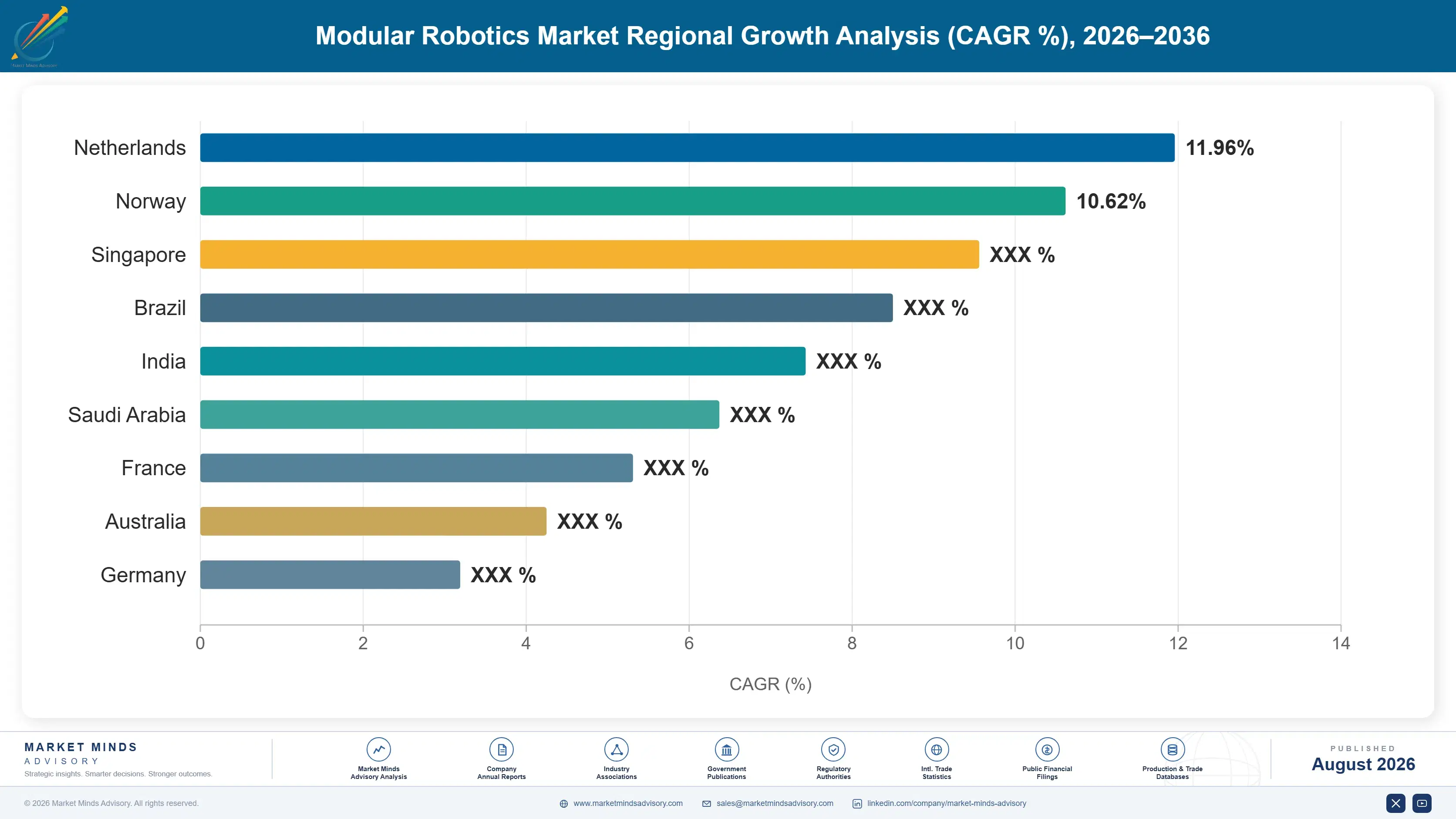
China: 19.8% CAGR
Fastest Growth Region
South Asia and Pacific: 17.3% CAGR
Largest Region
East Asia: 30% of 2025 global value
Market Leaders
Universal Robots A/S, ABB Ltd, FANUC Corporation, KUKA AG, Boston Dynamics. Source: MMA Analysis based on company annual reports.
Primary Survey
n=3,800 procurement and R&D decision-makers, Q4 2025, six countries
Methodology
Demand-side build-up, cross-validated against public data, 47 expert interviews
Modular Robotics Market Forecast Scenarios

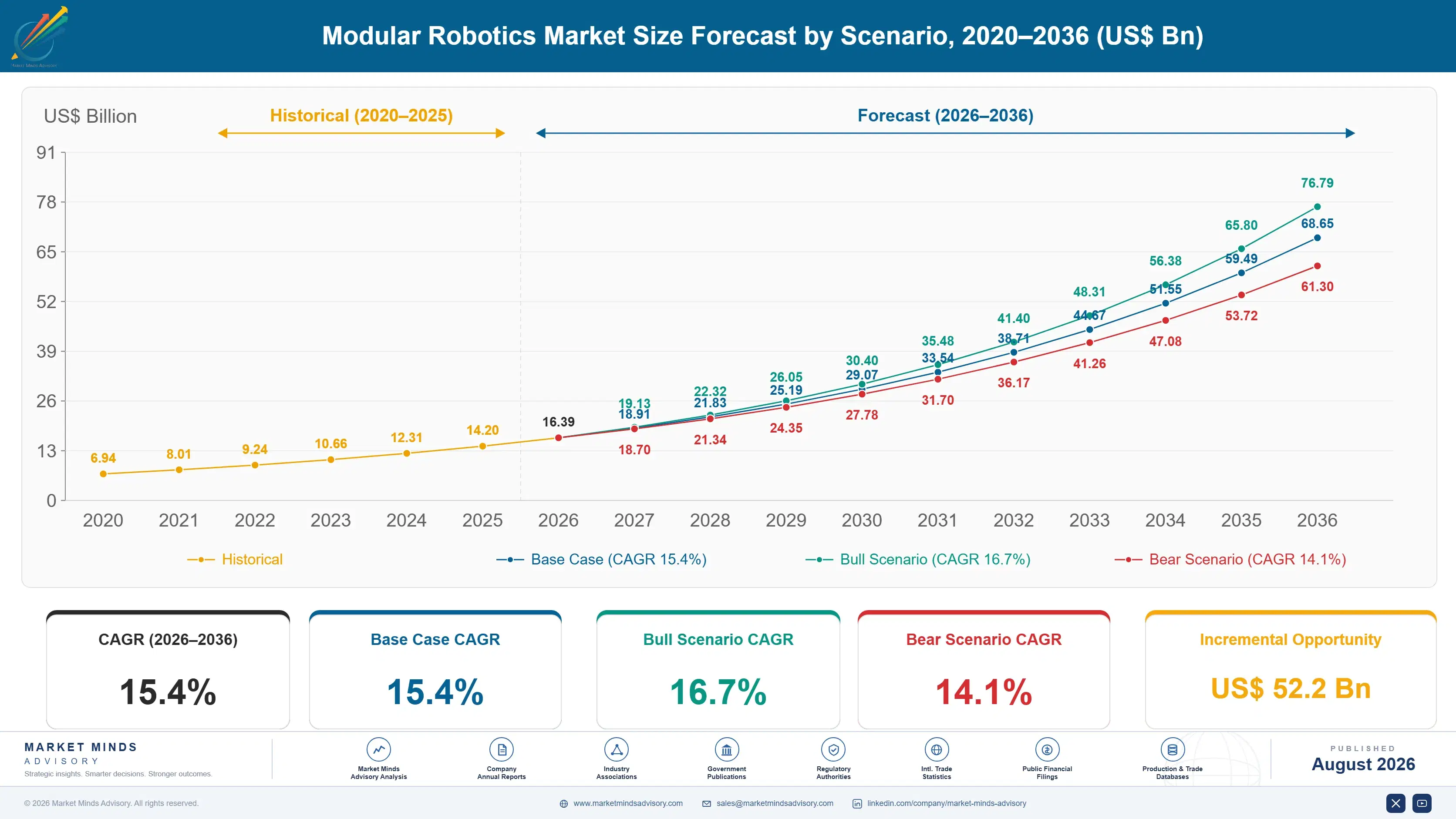
Between 2020 and 2025 the market grew at roughly 14.2% a year, propelled by manufacturers rethinking automation strategy after pandemic-era supply shocks exposed how costly single-purpose lines were to reconfigure. Labor shortages in electronics and automotive assembly accelerated adoption further, since modular cells let a single line absorb workforce gaps without a full capital replacement. Component cost declines in compute and sensing widened the addressable customer base.
The base case carries the market to 68.6 billion dollars by 2036 on three mechanisms. First, contract manufacturers serving multiple customers off shared floors need cells that reconfigure between orders rather than dedicated lines for each. Second, labor-constrained electronics and automotive assembly in China and India is pulling automation investment toward flexible platforms. Third, falling compute and sensor costs are letting mid-sized manufacturers afford control software once exclusive to large automotive plants.
The bull case reaches roughly 16.7% annual growth if control software standardizes enough that reconfiguration takes days rather than the weeks it still requires in most deployments today. The bear case falls near 14.1% if integration complexity keeps modular systems confined to large manufacturers with dedicated engineering teams, locking out the smaller factories that represent most of the addressable market.
The base case carries the market to 68.6 billion dollars by 2036 on three mechanisms. First, contract manufacturers serving multiple customers off shared floors need cells that reconfigure between orders rather than dedicated lines for each. Second, labor-constrained electronics and automotive assembly in China and India is pulling automation investment toward flexible platforms. Third, falling compute and sensor costs are letting mid-sized manufacturers afford control software once exclusive to large automotive plants.
The bull case reaches roughly 16.7% annual growth if control software standardizes enough that reconfiguration takes days rather than the weeks it still requires in most deployments today. The bear case falls near 14.1% if integration complexity keeps modular systems confined to large manufacturers with dedicated engineering teams, locking out the smaller factories that represent most of the addressable market.
Where Reconfiguration Speed Becomes the Product
Modular robotics used to mean a research lab demo; now it means a production line a contract manufacturer can rewire between customer orders without downtime measured in weeks. Every swappable gripper, mobile base, and control module installed exists to compress the time between deciding to change a product line and actually running it. That reconfiguration speed, not raw payload or precision, is what buyers are purchasing today.
MARKET CONCENTRATION (CR5)29%Top five vendors hold well under one third
AVERAGE SELLING PRICEUSD 38,000 per cellBlended price across arm, mobile, and tooling classes
TOP PRODUCING COUNTRY SHAREChina, 26% of global shipmentsLargest single national source of modular robot volume
RECONFIGURATION CYCLE TIME3.5 days averageTypical time to redeploy a cell for new tasks
TRADE INTENSITY48% cross-borderNearly half of hardware volume crosses a border
INSTALLED BASE PENETRATION9% of eligible linesEarly-stage adoption across the addressable factory floor base
Commercially the market behaves like an industrial platform business wearing a robotics label. Hardware still generates most revenue today, but control software and reconfiguration-as-a-service revenue is growing faster and carries far higher margins. Manufacturers rarely switch platform vendors once a plant standardizes on one control architecture, since retraining technicians and rewriting task programs for a new vendor's system is its own multi-month project few managers want to repeat.
The next decade turns on three forces: contract manufacturers demanding multi-customer flexibility from a single production floor, labor-constrained assembly work in China and India pulling automation investment toward flexible platforms, and falling compute costs finally making control software affordable for mid-sized factories that could never justify it before. Vendors positioned across all three will set the pace industry-wide.
"Buyers stopped asking how fast the arm moves and started asking how fast we can rewire the whole cell. That question, not payload capacity, is what wins contracts now."
Market Trends
Industry consortia including the Association for Advancing Automation have begun publishing interoperability standards for modular gripper and mobile-base connectors, letting a manufacturer mix components from different vendors within a reconfigurable cell rather than committing to one vendor's closed hardware line. Early adopters report standardized connectors cut integration engineering time meaningfully compared with proprietary systems, since technicians no longer need vendor-specific training for every new module added to a line. The standards remain incomplete and adoption uneven, but the direction is clear enough that several major vendors now publish compatibility specifications rather than guarding proprietary interfaces as before.
Market Impact: Lifts line utilization 25 to 35%
AI Task Reprogramming Cuts Redeployment Time
Machine learning-based task reprogramming lets a modular cell learn a new pick-and-place or assembly sequence from a handful of demonstrated examples rather than requiring an engineer to write task code line by line for every product variant. Vendors including Universal Robots and several software startups have shipped commercial versions of this capability over the past two years, compressing what used to be a multi-week reprogramming project into a task a technician completes in a single shift. That shift is pulling purchasing decisions away from pure hardware specification and toward evaluating which vendor's software learns fastest.
Market Impact: Cuts unfilled labor positions by 40%
Market Opportunities and Growth Drivers
Contract Manufacturers Need Real Multi-Customer Flexibility
Electronics and consumer goods contract manufacturers increasingly serve several customers off the same production floor within a single quarter, and a fixed single-purpose line dedicated to one customer's product sits idle whenever that customer's order volume dips. Modular cells that reconfigure between customer orders in days rather than months let contract manufacturers keep utilization high across their entire customer roster instead of building excess fixed capacity for every account. Major contract manufacturers in China, Vietnam, and Mexico have begun specifying reconfiguration capability as a contract requirement in new equipment purchases, converting a nice-to-have feature into a baseline procurement specification.
Market Impact: Adds 3 to 6 month delay
Labor Shortages Push Automation Toward Flexible Cells
Persistent labor shortages in electronics and automotive assembly across China, the United States, and parts of Europe are pushing manufacturers to automate tasks previously considered too variable for fixed robotics to handle economically. Modular cells absorb that variability because a single reconfigurable platform can be redeployed across several different tasks as workforce availability shifts, rather than sitting idle waiting for workers who never show up. Automotive suppliers in particular have cited labor availability, not cost, as the primary driver behind recent modular cell purchases, a reversal from a decade ago when automation was justified almost entirely on direct labor savings.
Market Impact: Raises switching cost 2 to 3x
Market Restraints and Challenges
Integration Complexity Limits Small Manufacturer Adoption
Deploying a genuinely reconfigurable cell still requires integration engineering that most small and mid-sized manufacturers do not have on staff, since combining arms, mobile bases, tooling, and control software from multiple vendors into a working system remains a specialized skill despite emerging standards. The root cause is that reconfiguration software has not reached the plug-and-play maturity marketing materials imply, leaving a genuine gap between vendor demonstrations and real deployment timelines. That gap keeps modular robotics concentrated among large manufacturers with dedicated automation engineering teams. Some vendors are responding with managed integration services that shift the engineering burden onto the vendor.
Market Impact: Cuts integration engineering time 35%
Component Standardization Gaps Raise Vendor Lock-In
Despite emerging interoperability efforts, most modular robotic components still use proprietary mechanical and electrical connectors that prevent genuinely mixing hardware across vendors in practice, regardless of published compatibility claims. The root cause is that vendors have limited commercial incentive to standardize connectors when proprietary interfaces protect their own tooling and software attach rates from competitors. That lock-in raises switching costs high enough that manufacturers often stay with an underperforming vendor's full hardware line rather than mixing in a competitor's superior component. Some large manufacturers now mitigate the risk by writing open-connector requirements directly into procurement specifications for new purchases.
Market Impact: Cuts reprogramming time to 1 day
4 additional market trends, 3 additional growth drivers, and 4 additional restraints and challenges are covered in the full report. Contact sales@marketmindsadvisory.com to access the complete intelligence.
Segment CAGR and Growth Architecture
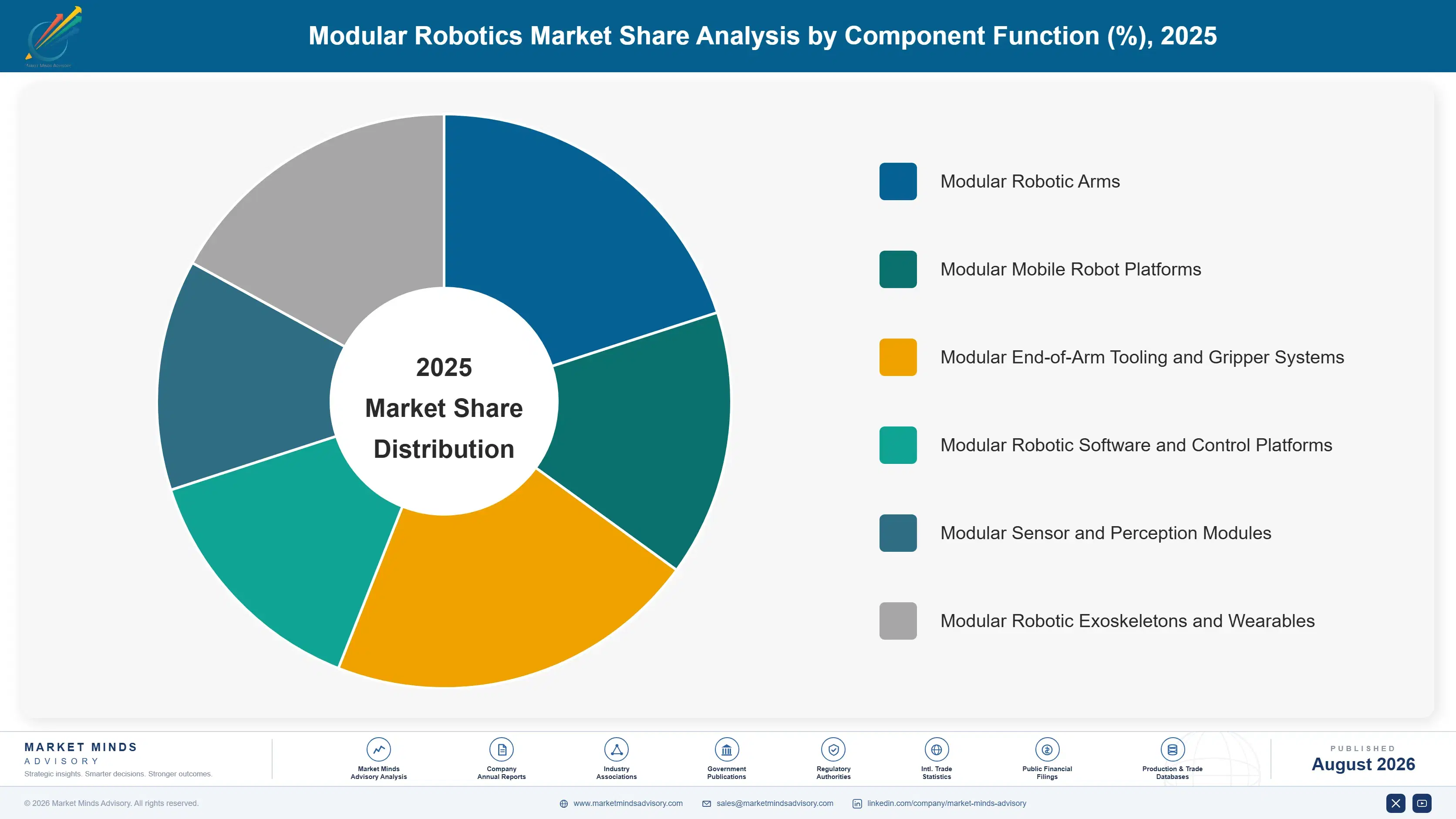
Segmentation follows component function, a single systems-architecture logic that groups modular robotics by the role each plays within a reconfigurable cell rather than by end industry served. Each function carries its own vendor landscape, integration complexity, and margin profile, so commercial position tracks the component layer rather than the factory that eventually deploys it.

Modular Robotic Software and Control Platforms
Modular robotic software and control platforms grow fastest at 19.0%, about 1.23 times the overall market rate, as manufacturers shift spending from reconfigurable hardware toward systems that let a cell learn and redeploy for a new task without an engineer rewriting code line by line. Hardware alone gives a factory an arm that can accept different tooling; control software gives it the ability to use that flexibility on a timeline measured in days rather than weeks. Machine learning-based task reprogramming has moved from research demonstration to commercial product over the past three years, and vendors including Universal Robots and robotics software specialists compete hardest here because software margins run well above hardware margins on the same platform.
CAGR 19.0%
Modular Sensor and Perception Modules
Modular sensor and perception modules grow second-fastest at 17.5%, driven directly by the reality that a reconfigurable cell cannot actually reconfigure safely without vision and force sensing that adapts to whatever task it currently performs. Swappable camera, force-torque, and proximity sensor modules let a single cell verify part placement, detect collisions, and adjust grip force across dramatically different products without a hardware swap of the sensing layer itself. Falling machine vision camera and compute costs have pulled this capability down from expensive dedicated vision systems to modules mid-sized manufacturers can genuinely afford. The segment sits upstream of the control software layer in the value chain, since perception data is a primary input task-reprogramming software depends on to actually work.
CAGR 17.5%
Full segment breakdown across 6 segments available in the complete report.
Regional Architecture and Country Demand Map
Demand concentrates where labor-constrained assembly work and contract manufacturing scale intersect with automation investment capacity, which increasingly means East Asia rather than the historically dominant North American installed base. China's electronics and automotive automation push is pulling deployment volume east even as North America retains the deepest per-plant technology spend.
North America
North America holds 25% of global value, still commanding the deepest per-plant technology spend anywhere even as East Asia has overtaken it on total deployment volume. Automotive and aerospace manufacturers across the United States and Mexico have driven demand for genuinely flexible cells that can absorb model changeovers without a full line rebuild, a capability increasingly written into new plant specifications. Universal Robots, Boston Dynamics, and a deep bench of robotics software startups all run core development from domestic operations, giving American manufacturers direct access to vendor engineering teams during integration. Growth of 15.0% tracks steady replacement of aging fixed automation installed during the 2000s and 2010s, converting single-purpose lines into reconfigurable platforms as that equipment reaches end of life.
Share: 25% | CAGR: 15.0% (2026 to 2036)
Western Europe
Western Europe accounts for 19% of value, a mature automation base built on Germany's automotive and industrial machinery manufacturing depth but now growing more slowly than the global rate. KUKA, Festo, and Staubli all run substantial engineering operations domestically, and German automotive suppliers have been among the earliest adopters of genuinely reconfigurable assembly cells anywhere in the world. Regulatory pressure around workplace safety for human-robot collaboration is unusually well developed here, giving collaborative modular systems a clearer compliance pathway than in less-regulated markets. Growth of 13.8% trails the global rate directly because the region's largest manufacturers already automated the easiest use cases years ago, leaving mostly harder, more specialized reconfiguration problems for the current investment cycle to solve.
Share: 19% | CAGR: 13.8% (2026 to 2036)
Regional intelligence for 5 additional markets available in the complete report: East Asia, South Asia and Pacific, Latin America, Middle East and Africa, Eastern Europe. Contact sales@marketmindsadvisory.com.

How Vendors Can Defend Software Margin
Selling reconfigurable hardware once and walking away leaves the highest-margin part of this market on the table. The four moves below shift revenue toward positions that pay every year rather than once: control software subscriptions, managed integration services, open connectors that widen addressable deployments, and reconfiguration-as-a-service models that lower the barrier for smaller manufacturers.
Convert Hardware Sales Into Software Subscriptions
Vendors that bundle a multi-year control software subscription into every arm and mobile-platform sale convert a one-time hardware transaction into a recurring revenue stream worth roughly 18% to 25% of the original hardware value each year for the contract's life. Manufacturers prefer this structure too, since it shifts software update and reprogramming-model responsibility onto the vendor rather than an internal team that may lack specialized machine learning skills. Universal Robots and several software-focused entrants have restructured commercial terms around this model over the past two years, and the shift is now visible in reported recurring-revenue mix relative to hardware-only competitors.
Market Impact: Adds 18% to 25% of hardware value annually
Offer Managed Integration To Remove Adoption Barriers
Bundling integration engineering as a managed service, rather than selling hardware and software separately and leaving integration to the customer, removes the single biggest barrier keeping small and mid-sized manufacturers out of the market entirely. Vendors absorb more delivery risk under this model but typically charge a premium of 20% to 30% over the equivalent unbundled hardware and software price, capturing margin the customer would otherwise have paid a third-party systems integrator to earn instead. In practice the approach has cut deployment timelines from an average of five months down to under eight weeks in several documented mid-sized factory deployments.
Market Impact: Charges a 20% to 30% integration service premium
Champion Open Connectors To Widen Addressable Deployments
Vendors that support open connector standards rather than proprietary interfaces can sell components into cells already built around a competitor's arm or mobile base, since open-standard tooling and sensors layer onto an existing platform without a full system replacement. That approach roughly doubles, to 2x, the addressable base of any given tooling or sensor vendor, since it no longer requires winning the original arm contract to sell the higher-margin attachment layer. Several sensor and tooling specialists have built their commercial strategy around this interoperability, avoiding proprietary hardware so they can sell into any cell regardless of which vendor won that deployment.
Market Impact: Expands addressable tooling customer base by roughly 2x
Price Reconfiguration As A Recurring Data Service
Rather than selling task-reprogramming software as a flat annual license, vendors are pricing reconfiguration as a per-changeover data service tied to how often a customer actually redeploys a cell, capturing a share of the flexibility value they create rather than a fixed subscription regardless of usage. Early adopters of this pricing report capturing 15% to 25% more total contract value over a three-year deployment than under flat-fee licensing, since high-changeover customers pay for the flexibility they use most. The structure also deepens switching costs, since a manufacturer tied to a vendor's pipeline rarely wants to disrupt that integration.
Market Impact: Captures 15% to 25% more total contract value
Who Controls the Margin Pool
Concentration sits at a low CR5 of 29%, reflecting a market still young enough that no vendor has consolidated the hardware, software, and integration layers under one roof. The gap between the top five and the next tier is real but narrow: leaders combine hardware scale with growing software capability, while challengers hold only one. All participants here are assessed on one basis: disclosed modular robotics segment revenue.
Competition today runs across three dimensions. First, control software intelligence, since a vendor whose reprogramming software learns fastest from the fewest examples wins the decision regardless of hardware specification. Second, connector openness, as manufacturers favor vendors who let them mix components rather than lock into one closed line. Third, integration service depth, since vendors able to bundle managed integration capture manufacturers shut out of self-integrated deployment.
Pressure is building from Chinese domestic vendors who have closed much of the hardware quality gap with Japanese and Western incumbents while undercutting them sharply on price. Boston Dynamics and other mobility-first entrants are pushing into fixed-cell territory from the mobile robot side, blurring category lines that used to separate vendors cleanly. Rankings will shift toward vendors who control both hardware breadth and software intelligence, since either alone is now commoditized.

Competitive Moat and Risk Dimensions
Moat: Collaborative Robot Category Pioneer
Universal Robots essentially created the collaborative robot category and has spent over a decade building the largest third-party developer and integrator network in the industry, giving it software and accessory compatibility breadth few competitors can match. That installed base and developer network make it the default platform manufacturers evaluate first when specifying a new reconfigurable cell.
Risk: Exposure To Low-End Price Competition
Chinese collaborative robot manufacturers now offer functionally comparable hardware at prices thirty to forty percent below Universal Robots, and that gap is narrowing the company's traditional mid-market position from below. Universal Robots is responding by emphasizing software and integration capability over hardware specification, but that repositioning takes time competitors are using to build price-sensitive customer relationships first.
Moat: Deep Automotive Manufacturing Relationships
FANUC's decades-long relationships with global automotive manufacturers give it design-in access to the highest-value reconfiguration contracts before they even reach open bidding, a commercial advantage newer entrants cannot replicate quickly. That embedded position across automotive plants worldwide provides a stable revenue base while the company builds out modular and collaborative product lines.
Risk: Slower Software Platform Development Pace
FANUC's engineering culture remains hardware-first, and its control software and reprogramming capability has developed more slowly than software-native competitors who started from a machine learning foundation rather than retrofitting it onto existing hardware. That pace gap risks ceding the highest-margin software layer to competitors as customers increasingly weigh reprogramming intelligence as heavily as hardware reliability.
Key Players
Universal Robots A/S
ABB Ltd
FANUC Corporation
KUKA AG
Boston Dynamics
Others
Yaskawa Electric Corporation
Kawasaki Heavy Industries Ltd.
Omron Corporation
Techman Robot Inc.
Doosan Robotics Inc.
AUBO Robotics Inc.
Franka Emika GmbH
Hahn Group GmbH
Robotnik Automation S.L.L.
Clearpath Robotics Inc.
Locus Robotics Corp.
inVia Robotics Inc.
Agility Robotics Inc.
Festo SE & Co. KG
Staubli International AG
Recent Developments
Teradyne Expands Universal Robots Software Team Through Acquisition
Teradyne's Universal Robots division completed the acquisition of a robotics software startup specializing in machine learning-based task reprogramming for an undisclosed sum. The deal adds reprogramming capability Universal Robots previously accessed only through third-party software integration partnerships, accelerating its shift toward a combined hardware-software platform provider.
Signal: Signals that established hardware vendors are buying software intelligence outright rather than building it internally over years.
FANUC Opens Modular Cell Development Center in China
FANUC opened a dedicated modular and collaborative cell development center in China, adding engineering capacity focused specifically on reconfigurable systems for the domestic electronics and automotive assembly market. The organic expansion, not a joint venture or acquisition, followed two years of rising demand from Chinese contract manufacturers for flexible capability.
Signal: Signals established vendors are localizing modular robotics engineering directly inside China rather than exporting from Japan alone.
Doosan Robotics and a Logistics Firm Form Modular Cell Joint Venture
Doosan Robotics and a Korean logistics automation firm formed a joint venture to develop modular robotic cells combining collaborative arms with mobile platforms for warehouse and light assembly applications. The partnership targets deployment across dozens of logistics facilities within three years, combining Doosan's arm technology with its partner's mobility software.
Signal: Signals arm manufacturers increasingly partner with mobility specialists rather than build mobile platforms from scratch internally.
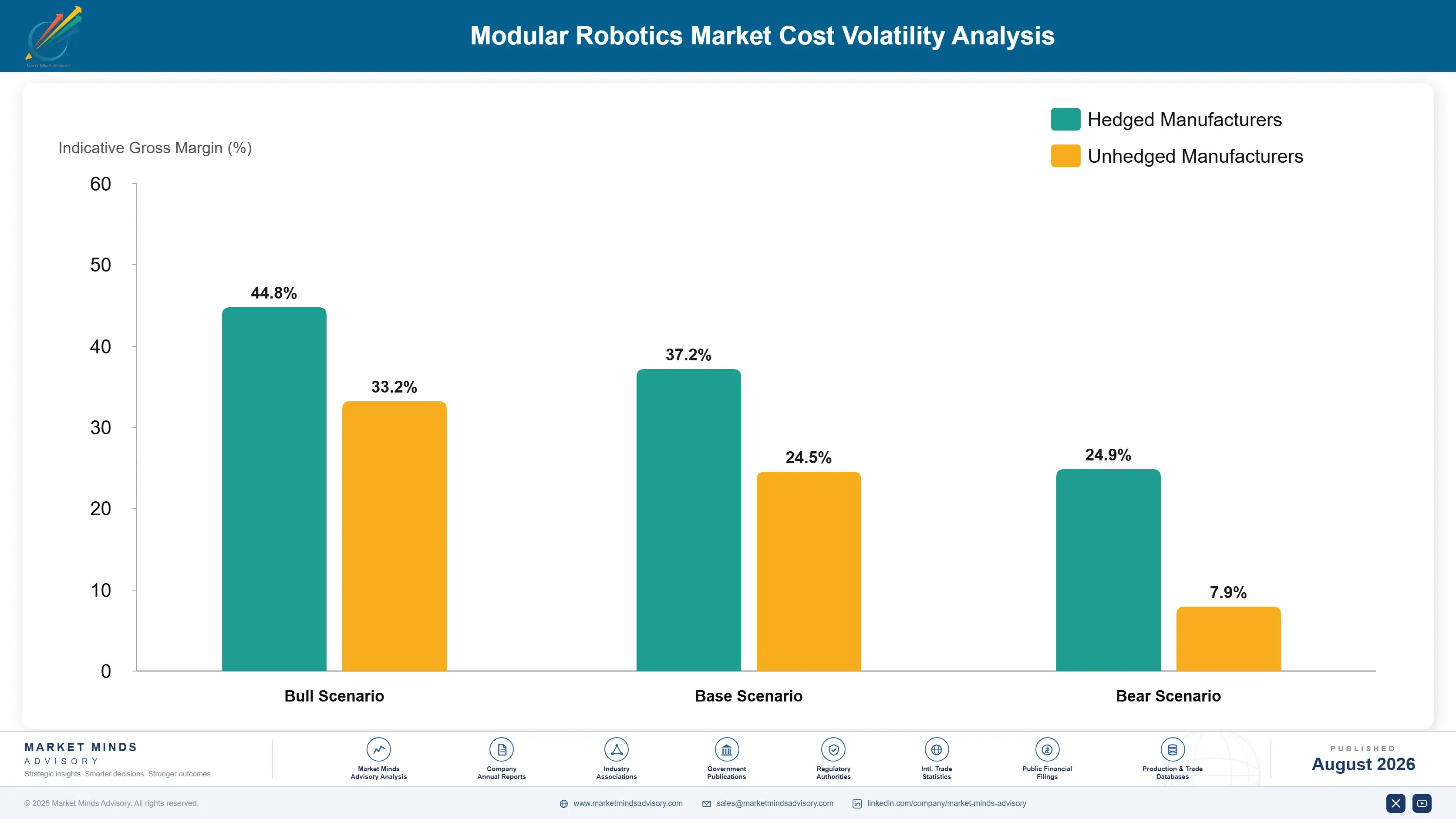
Compute, Sensor, and Actuator Cost Exposure
Precision actuators, force-torque sensors, and onboard compute modules make up roughly 42% to 50% of cost of goods sold across modular robotic hardware, since every joint requires its own motor, encoder, and increasingly an edge-compute module. Those components trace to a concentrated group of Japanese, Taiwanese, and American precision manufacturers, with harmonic drive gearing supply particularly concentrated among very few qualified producers.
The 2021 to 2022 semiconductor and precision component shortage illustrated the exposure directly. Multiple vendors including Teradyne disclosed extended lead times on servo drives and compute modules in their 2022 annual reports, attributing delays specifically to component allocation constraints rather than demand weakness. Teradyne's 2022 Annual Report cited supply chain constraints as a driver of delays across its Universal Robots and automation segments, with some deployments pushed by one to two quarters awaiting allocation.
Smaller modular robotics vendors without long-term component supply agreements absorbed the shortage hardest, since their volumes were too small to secure priority allocation the way FANUC or ABB could through direct relationships. That gap compounds: large vendors pre-purchase harmonic drives and servo components years ahead using balance sheet capacity smaller competitors do not have, leaving specialists exposed every shortage cycle.

Secure Multi-Year Precision Component Supply Agreements
Negotiating multi-year supply agreements directly with harmonic drive and servo motor manufacturers, rather than buying through distributors on shorter terms, secures priority allocation during shortage cycles and smooths input cost volatility. The approach requires committing to volume forecasts years in advance, a real forecasting risk, but it has protected larger vendors' delivery schedules through two shortage cycles since 2020.
Diversify Compute Module Sourcing Across Suppliers
Qualifying edge-compute modules from more than one chip supplier, rather than relying on a single processor architecture, reduces exposure to any single company's production disruption or allocation decision during a shortage. Requalification takes real engineering and validation time, so vendors are prioritizing it for their highest-volume lines first before extending diversified sourcing across their full catalog.
Redesign Joints Around More Available Actuators
Engineering modular joints to accept a wider range of interchangeable servo motor and gearing families, rather than designing around one specific part number, lets vendors substitute components during a shortage without a full mechanical redesign. Several vendors adopted this flexible-design approach after the 2021 shortage specifically to avoid repeating the multi-quarter delays it caused across the industry.
Portfolio Architecture for Margin Defence
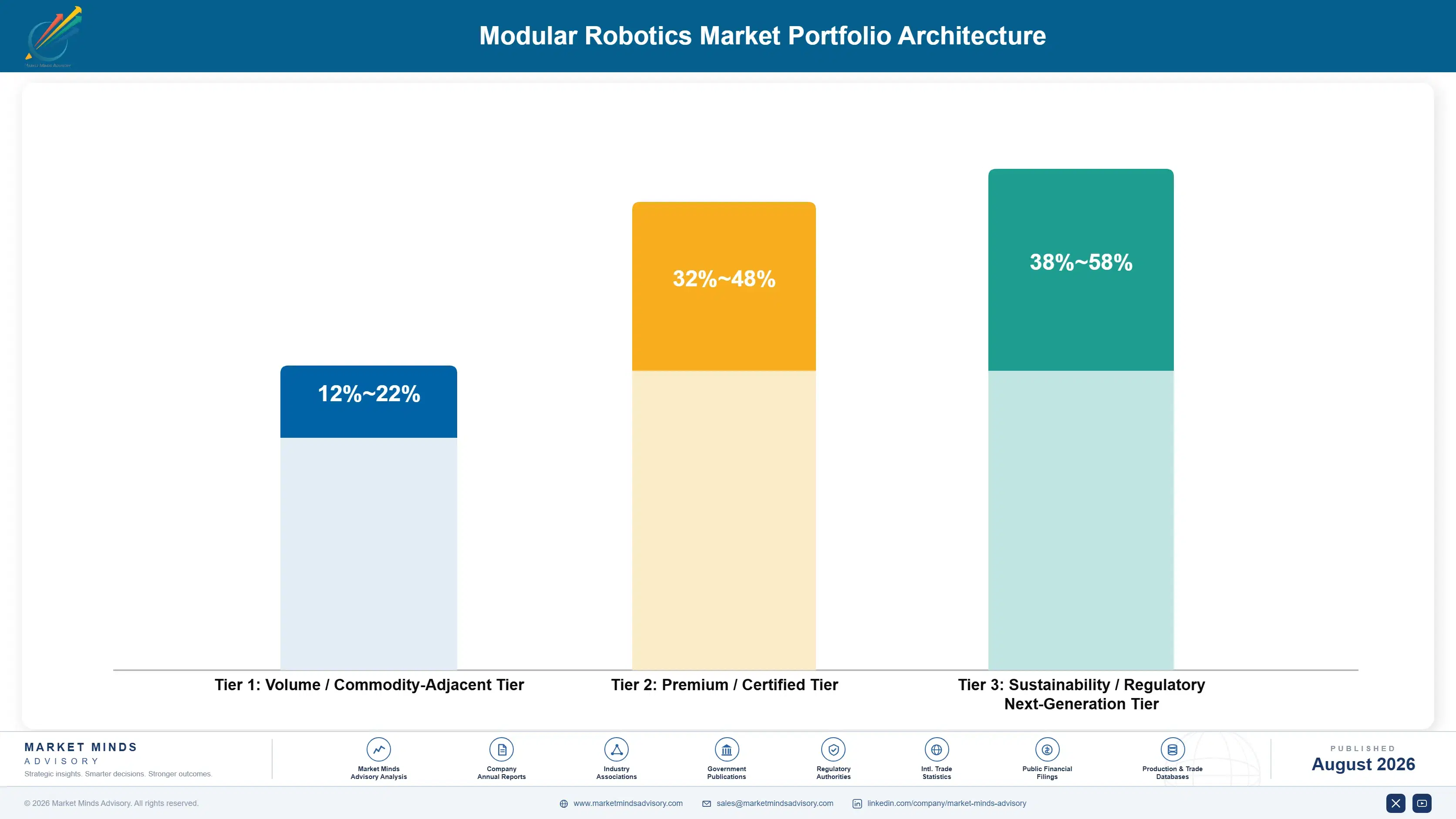
The portfolio splits into three tiers with wide margin separation tied to how much software and integration sits on top of the hardware. Commodity modular arms and mobile bases sold on price and delivery reliability carry thin margins. Certified platforms combining hardware, control software, and vendor-supported integration carry the strongest margins. A third tier of next-generation autonomous reconfiguration and reconfiguration-as-a-service offerings is still scaling toward proven, repeatable
The tension between hardware volume and software premium shapes how vendors allocate engineering investment: hardware sales fund the manufacturing scale and installed base that make software attractive to sell against in the first place, while control software platforms fund the machine learning and integration expertise that create genuine competitive protection. Vendors that lean too far toward hardware risk commoditization; those that lean too far toward software risk lacking the installed base to sell into.
High-value pools concentrate specifically in control software and managed integration services, where recurring revenue and genuine switching costs both run highest. Commodity modular arms and mobile bases generate volume but thin, price-competitive margins, since multiple vendors can supply functionally similar hardware against the same specification with limited real differentiation.
Volume / Commodity-Adjacent Tier
Standard modular arms and mobile bases sold against several qualified vendors competing primarily on unit price, payload specification, and delivery reliability across large multi-unit factory orders placed each year by manufacturers.
Gross Margin: 12-22%
Premium / Certified Tier
Integrated hardware, control software, and vendor-supported integration platforms carrying multi-year service contracts and genuine switching costs once a factory standardizes its full system on one vendor's chosen platform.
Gross Margin: 32-48%
Sustainability / Regulatory / Next-Generation Tier
Autonomous reconfiguration and usage-based reconfiguration-as-a-service offerings still scaling toward proven, repeatable commercial economics across a broad and varied manufacturer customer base of very different sizes and needs.
Gross Margin: 38-58%

High-value Sub-segments and Strategic Watch-out
Modular Robotic Software and Control Platforms
The fastest-growing and highest-margin segment, converting reconfigurable hardware into a genuinely flexible production tool that manufacturers increasingly cannot build themselves, commanding subscription pricing well above the underlying hardware value it runs on, and deepening steadily over the life of the customer relationship as usage grows.
Gross Margin: 40-58%
Modular Sensor and Perception Modules
High value with steadier growth than control software, directly enabling the safe reconfiguration that regulators and factory safety teams increasingly require before approving a cell for human-collaborative work on any production floor at all.
Gross Margin: 32-48%
Modular Robotic Arms
The volume core of the market, supplying reconfigurable arm hardware against several qualified vendors competing primarily on price, payload, and precision across large multi-unit factory replacement orders placed by manufacturers each fiscal year.
Gross Margin: 15-26%
Modular Robotic Exoskeletons and Wearables
The strategic watch-out, an early-stage category facing genuine uncertainty over ergonomic and regulatory standards even as logistics and manufacturing labor shortages create real underlying commercial demand for the category going forward.
Gross Margin: 18-32%
Why Platform Choice Locks In Decades
Demand here behaves like an annuity once a manufacturer standardizes on a vendor's control software and connector architecture, because replacing an entire cell fleet mid-deployment means retraining technicians and rewriting task programs across every line that uses it. A vendor that wins the original platform decision typically supplies that manufacturer for eight to twelve years, the working life of a production line, converting an initial hardware sale into a multi-year recurring software and
Adoption depth varies sharply by manufacturer size. Large automotive and electronics manufacturers build custom integration capability in-house and treat vendors primarily as hardware suppliers, giving them real negotiating leverage and lower stickiness. Small and mid-sized contract manufacturers, which make up the large majority of factories globally, depend entirely on vendor-supplied integration and software since they lack the technical staff to build anything themselves, making them the stickiest customer segment in the market.
Buyer profiles are shifting generationally too. A newer cohort of plant managers, trained under mounting labor-availability and multi-customer flexibility pressure, now weighs a vendor's software and reconfiguration speed as heavily as hardware payload specification, a shift that favors vendors with genuine software capability over hardware-only suppliers competing purely on arm price.

What Factories Will Pay For Next
These are among the four positions where our research anticipates prominent divergence between winners and laggards over the coming forecast period. Each is grounded in the demand model, the regulatory perimeter, and the announced capacity pipeline.
Reprogramming speed will separate winners from hardware-only vendors
Vendors whose control software genuinely learns a new task from the fewest demonstrated examples will keep winning purchasing decisions regardless of hardware specification, because reconfiguration speed is now the primary criterion plant managers evaluate first, ahead of price. Vendors without that software depth will increasingly compete only on commoditized hardware price against Chinese manufacturers who already undercut on cost. Expect continued acquisition of software and perception startups as hardware incumbents race to close the intelligence gap before it becomes permanent.
East Asia's share keeps growing as China automates assembly
East Asia already holds the largest regional share at 30% and grows near the top of its band as China's labor-constrained electronics and automotive assembly lines pull deployment volume east at real, sustained scale. Domestic Chinese vendors are closing the hardware quality gap with Japanese and Western incumbents faster than most industry observers expected just a few years ago. Multinationals that fail to build direct China manufacturing relationships risk losing the single largest volume opportunity in the entire global market.
Managed integration will open adoption among smaller manufacturers
Integration complexity remains the single biggest barrier keeping small and mid-sized manufacturers out of this market, and vendors who bundle managed integration as a service will capture that underserved segment before competitors ever build the capability themselves in-house. The approach commands real premium pricing precisely because it removes risk customers would otherwise bear internally with staff they do not have. Expect integration-as-a-service to become a standard offering across the top vendor tier within the forecast window, not a differentiator.
Open connector standards will erode proprietary hardware lock-in
Interoperability standards for modular connectors remain incomplete today, but manufacturer procurement teams are increasingly writing open-connector requirements directly into new equipment specifications to avoid single-vendor lock-in going forward across their entire fleets. That pressure will keep building as more large manufacturers standardize procurement language across their global plant networks rather than negotiating vendor by vendor. Expect vendors who resist open standards to lose ground steadily to competitors who embrace interoperability as a genuine selling point rather than a threat.
Engagement Snapshot From the Field
A live engagement with an industry participant carrying material or product regulatory and market exposure ahead of a defining policy shift, showing how our research translates into a defensible multi-year portfolio strategy.
MARKET MINDS ADVISORY · CLIENT ENGAGEMENT SUMMARY
Modular Robotics Producer Strategic Portfolio Review and Transition Roadmap 2026·Investment Scenario on Modular Robotics Exposure Evaluation 2025-26
CLIENT PROFILE
A contract electronics manufacturer serving several consumer device brands from a single Southeast Asian production campus approached MMA while evaluating a shift from dedicated fixed lines to modular reconfigurable cells. The client reported annual revenue near USD 410 million, with utilization on several dedicated customer lines running below 55% during off-peak order cycles (client-reported, unverified by MMA).
STRATEGIC CHALLENGE
Management knew dedicated fixed lines were wasting capital during customer order troughs but faced real uncertainty over whether reconfigurable cells could actually hit the changeover speed vendors promised in demonstrations. The operations team wanted to convert immediately; the finance team worried about integration risk and unproven vendor claims; and the general manager needed a pilot that would prove the case before committing capital fleet-wide.
MMA APPROACH
MMA benchmarked changeover time claims from three modular robotics vendors against actual factory-floor deployments at comparable contract manufacturers, modeled utilization gains from pooling customer lines onto shared reconfigurable capacity, and quantified the integration risk each vendor's managed-service offering would actually absorb. We also assessed a phased pilot approach that would validate vendor claims before a fleet-wide commitment.
KEY FINDINGS
- Actual changeover time across benchmarked deployments ran close to vendor claims, averaging 4.2 days rather than the 3.5 days marketed, a smaller gap than the finance team had feared (client-reported, unverified by MMA).
- Pooling three dedicated customer lines onto shared reconfigurable capacity could lift blended utilization from 55% to a modeled 78%, freeing capital for new customer wins instead.
- Only one of three vendors evaluated offered a managed integration service mature enough to meet the client's changeover speed requirements without additional in-house engineering headcount.
- A phased pilot converting one line before the full fleet reduced integration risk substantially and gave the operations team real data to present to the board.
CLIENT PROFILE
A contract electronics manufacturer serving several consumer device brands from a single Southeast Asian production campus approached MMA while evaluating a shift from dedicated fixed lines to modular reconfigurable cells. The client reported annual revenue near USD 410 million, with utilization on several dedicated customer lines running below 55% during off-peak order cycles (client-reported, unverified by MMA).
STRATEGIC CHALLENGE
Management knew dedicated fixed lines were wasting capital during customer order troughs but faced real uncertainty over whether reconfigurable cells could actually hit the changeover speed vendors promised in demonstrations. The operations team wanted to convert immediately; the finance team worried about integration risk and unproven vendor claims; and the general manager needed a pilot that would prove the case before committing capital fleet-wide.
MMA APPROACH
MMA benchmarked changeover time claims from three modular robotics vendors against actual factory-floor deployments at comparable contract manufacturers, modeled utilization gains from pooling customer lines onto shared reconfigurable capacity, and quantified the integration risk each vendor's managed-service offering would actually absorb. We also assessed a phased pilot approach that would validate vendor claims before a fleet-wide commitment.
KEY FINDINGS
- Actual changeover time across benchmarked deployments ran close to vendor claims, averaging 4.2 days rather than the 3.5 days marketed, a smaller gap than the finance team had feared (client-reported, unverified by MMA).
- Pooling three dedicated customer lines onto shared reconfigurable capacity could lift blended utilization from 55% to a modeled 78%, freeing capital for new customer wins instead.
- Only one of three vendors evaluated offered a managed integration service mature enough to meet the client's changeover speed requirements without additional in-house engineering headcount.
- A phased pilot converting one line before the full fleet reduced integration risk substantially and gave the operations team real data to present to the board.
RECOMMENDED STRATEGY
Phase 1: Phase 1 (0 to 6 months): Convert one dedicated customer line to a reconfigurable cell using the selected vendor's managed integration service. Phase 2: Phase 2 (6 to 14 months): Validate changeover speed and utilization gains against the pilot, then extend to two additional customer lines. Phase 3: Phase 3 (14 to 24 months): Complete fleet-wide conversion, pooling remaining dedicated lines into shared reconfigurable capacity across the campus.
OUTCOME
The client converted its pilot line within five months and achieved a blended utilization gain from 55% to a reported 74% within the first year, ahead of the original modeled target range. Based on those results the client approved fleet-wide conversion, a program reported to be worth roughly USD 18 million in avoided capital spending (client-reported, unverified by MMA).
Frequently Asked Questions
Foundational context covering the market sizes, CAGR, scope, country, region and competition that inform every finding below. This section is provided to cover basics and most often pre-purchase conversations, answered from the MMA Primary Research Dataset.
What is the current size of the Modular Robotics Market?
The market stood at USD 14.2 billion in 2025, spanning arms, mobile platforms, tooling, and software. Modular robotic software and control platforms are the fastest-growing layer within that base.
How large will the Modular Robotics Market be by 2036?
The market is projected to reach USD 68.6 billion by 2036 under the base case scenario. That represents roughly 4.19 times the 2026 value of USD 16.4 billion.
What is the CAGR for the Modular Robotics Market 2026 to 2036?
The base case CAGR is 15.4% annually through 2036. The bull case reaches 16.7% on faster software standardization, while the bear case falls to 14.1%.
Which segment is growing fastest?
Modular robotic software and control platforms grow fastest at 19.0% annually, well ahead of hardware categories. That is roughly 1.23 times the overall market growth rate.
Who are the major companies in the Modular Robotics Market?
Universal Robots A/S, ABB Ltd, FANUC Corporation, KUKA AG, and Boston Dynamics lead the market. Together the top five vendors hold a CR5 of 29%.
Which country is growing fastest?
China grows fastest among all countries at 19.8% annually, ahead of India and other Asian manufacturing hubs. Growth is driven by labor-constrained electronics and automotive assembly lines automating at real scale.
Report Segmentation Architecture
The full report scope spans multiple orthogonal segmentation dimensions, with cross-tabulated demand data provided for each dimension pair. Coverage extends further to regional breakdowns, trend trajectories, and the competitive detail needed to support segment-level decision-making.
By Component Function
- Modular Robotic Arms
- Modular Mobile Robot Platforms
- Modular End-of-Arm Tooling and Gripper Systems
- Modular Robotic Software and Control Platforms
- Modular Sensor and Perception Modules
- Modular Robotic Exoskeletons and Wearables
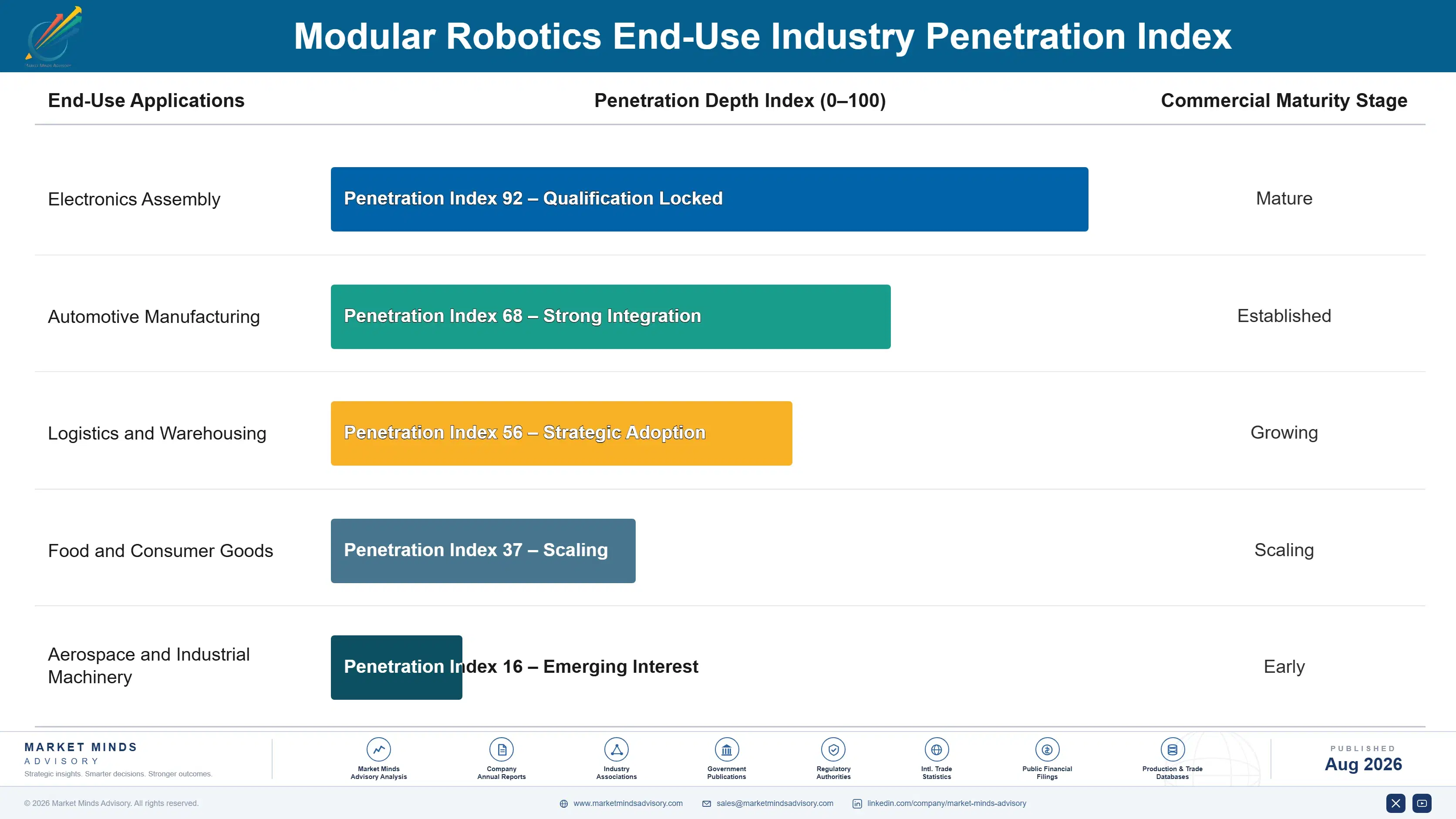
By End-Use Industry
- Electronics Assembly
- Automotive Manufacturing
- Logistics and Warehousing
- Food and Consumer Goods
- Aerospace and Industrial Machinery
By Commercial Dimension
- Direct Manufacturer Procurement
- Systems Integrator Channel
- Reconfiguration-as-a-Service Models
- Managed Integration Contracts
By Region
- North America
- Western Europe
- East Asia
- South Asia and Pacific
- Latin America
- Middle East and Africa
- Eastern Europe
Scope, Methodology, and Coverage
Every figure in this report is reproducible from documented input assumptions. The scope below maps the historical period, the forecast horizon, the segmentation dimensions, and the countries covered, alongside the underlying primary and qualitative methodology.
Historical Period
2020 to 2025
Forecast Period
2026 to 2036
Base Year
2025 (USD billions; MMA Primary Research Dataset, August 2026)
Market Definition
The modular robotics market covers reconfigurable robotic hardware, exchangeable tooling, and the control software that lets a single robotic platform be redeployed across multiple tasks or product lines without replacement. It includes modular arms, mobile robot platforms, swappable end-of-arm tooling, and the perception and control software specific to reconfiguration. Fixed single-purpose industrial robots, robots sold without reconfiguration capability, and consumer or toy robotics are excluded.
Quantitative Units
USD billions (current prices); thousand modular robotic units shipped where applicable
Segmentation Dimensions
By Component Function; By End-Use Industry; By Commercial Dimension; By Region
Regions Covered
North America, Western Europe, East Asia, South Asia and Pacific, Latin America, Middle East and Africa, Eastern Europe
Countries Covered
USA, China, Germany, France, UK, Japan, South Korea, India, Australia, Canada, Brazil, Mexico, Indonesia, Vietnam, Thailand, Malaysia, UAE, Saudi Arabia, South Africa, Nigeria, Turkey, Poland, Netherlands, Italy, Spain, Sweden, Switzerland, Argentina, Colombia, Singapore, and additional markets relevant to this sector
Key Companies Profiled
Universal Robots A/S, ABB Ltd, FANUC Corporation, KUKA AG, Boston Dynamics, Yaskawa Electric Corporation, Kawasaki Heavy Industries Ltd., Omron Corporation, Techman Robot Inc., Doosan Robotics Inc., AUBO Robotics Inc., Franka Emika GmbH, Hahn Group GmbH, Robotnik Automation S.L.L., Clearpath Robotics Inc., Locus Robotics Corp., inVia Robotics Inc., Agility Robotics Inc., Festo SE & Co. KG, Staubli International AG
Quantitative Methodology
Primary survey, n=3,800 respondents, Q4 2025, six countries; demand-side model with trade association cross-validation
Qualitative Methodology
47 expert interviews, Q4 2025; applied to validate demand model assumptions, identify emerging dynamics, and assess competitive positioning
Report Format
PDF and XLSX data workbook (Word format preview document)
Publisher
Market Minds Advisory
Report Code
MMA-2026-CON-142
Published
August 2026
Contact
sales@marketmindsadvisory.com | www.marketmindsadvisory.com
Purchase the full Modular Robotics Market Report (2026 to 2036).
The full MMA Modular Robotics report sizes the market across six component functions, five end-use industries, four commercial models, and seven regions through 2036. It profiles 20 vendors on a consistent basis of disclosed modular robotics segment revenue, scoring each on hardware breadth, software intelligence, and integration service depth. Scenario models quantify how connector standardization, Chinese manufacturing automation investment, and precision component supply conditions move both demand and realizable pricing. The report also includes delivered-cost modeling by component function, an interoperability standards timeline across major vendor consortia, and a reconfiguration-as-a-service feasibility framework built for automation strategy, vendor management, and manufacturing investment teams.
Six-function segmentation with cross-tabulated regional demand data
Twenty-company competitive benchmarking on consistent revenue basis
Interoperability standards timeline across major vendor consortia
Precision component supply and cost exposure modeling by function
Scenario forecasts through 2036 under bull and bear cases
Case study on multi-customer line flexibility conversion
Built For The People Who Decide
From boardroom strategy to bench-side execution, this report is read cover-to-cover by leaders shaping the next decade of their industry, turning demand scenarios, market dynamics and valuation benchmarks into decisions.
CXOs/ Presidents/ VPs/ Managers
M&A and Corporate Development
Strategy Teams and R&D Heads
Procurement and Product Directors
Regulatory and Compliance Leaders
Investor Relations and Equity Analysts