Market Minds Advisory
Mobile Wallet Market

Mobile Wallet Market: Person-to-Person, In-Store, and Cross-Border Payment Platforms Worldwide.

Cryptocurrency integration and cross-border remittance corridors are pulling mobile wallets beyond simple in-store payment substitution into full financial services platforms competing directly with traditional banking relationships in several major emerging markets.

Lead Analyst

Published

September 2026

Make Smarter Decisions with Customized Research Insights

Request a free sample report and evaluate market opportunities, growth trends, and competitive dynamics relevant to your business needs.

2025 MARKET VALUE$18.0BMarket Size 2025
2036 FORECAST VALUE$54.0BBase Case , 2026 to 2036
CAGR 2026 TO 203610.5 %Bull 11.8% / Bear 9.2%
INCREMENTAL OPPORTUNITY$34.1BNet 10- year value creation
EXPANSION MULTIPLE2.71x2036 value over 2026 base
Strategic Levers
M&A Pipeline
Regional Outlook
Country Rankings
Competitive Intelligence
Segmental Deep-dive
Call-Us : 91 93563 13602

Executive Snapshot and Market Trajectory.

Mobile wallets are expanding beyond simple in-store payment substitution into comprehensive financial services platforms, as cryptocurrency integration and cross-border remittance capability increasingly compete directly with traditional banking relationships across several major emerging markets. This shift is redefining how platforms prioritize product development across every major user segment and competitive category.
Cryptocurrency and digital asset wallets are absorbing the largest share of new user growth as mainstream platforms add trading capability, while cross-border remittance wallets grow nearly as fast on the strength of migrant worker transfer volume. East Asia and South Asia concentrate the bulk of transaction volume, reflecting both China's mobile payment penetration and India's rapidly expanding digital payment infrastructure. Platforms serving both segments increasingly report cross-selling opportunities between these two distinct financial services categories.
Competitive intensity remains high among established payment platforms, with PayPal, Apple, and Google holding durable advantages from decades of payment infrastructure investment and device platform integration. Regional super-app platforms are gaining share in specific markets where established global platforms' broader feature sets fit less precisely into local payment habits and regulatory requirements. Users increasingly weigh a platform's financial services breadth alongside traditional payment convenience when choosing a primary wallet.
Market Definition
The market covers mobile applications enabling person-to-person transfers, in-store contactless payments, cross-border remittances, and integrated financial services accessed primarily through smartphone devices. It excludes traditional online banking applications without wallet-specific payment functionality, physical prepaid cards, and cryptocurrency exchanges operating independently of wallet applications.
Base Year Value
$18.0B in 2025 (MMA Primary Research Dataset, September 2026)
Forecast Period
2026 to 2036, eleven discrete annual values
CAGR
10.5% base case. Bull 11.8%. Bear 9.2%.
Fastest Growth Segment
Cryptocurrency and Digital Asset Wallets: 16.0% CAGR
Fastest Growth Country
India: 12.8% CAGR
Fastest Growth Region
South Asia and Pacific: 12.5% CAGR
Largest Region
East Asia: 29% of 2025 global value
Market Leaders
PayPal, Apple, Google, Alipay (Ant Group), WeChat Pay (Tencent). Source: MMA Analysis based on company annual reports and digital payments industry disclosures.
Primary Survey
n=3,800 procurement and R&D decision-makers, Q4 2025, six countries
Methodology
Demand-side build-up, cross-validated against public data, 47 expert interviews

Mobile Wallet Market Forecast Scenarios

mobile-wallet-market-size-forecast-scenario-1790003820493
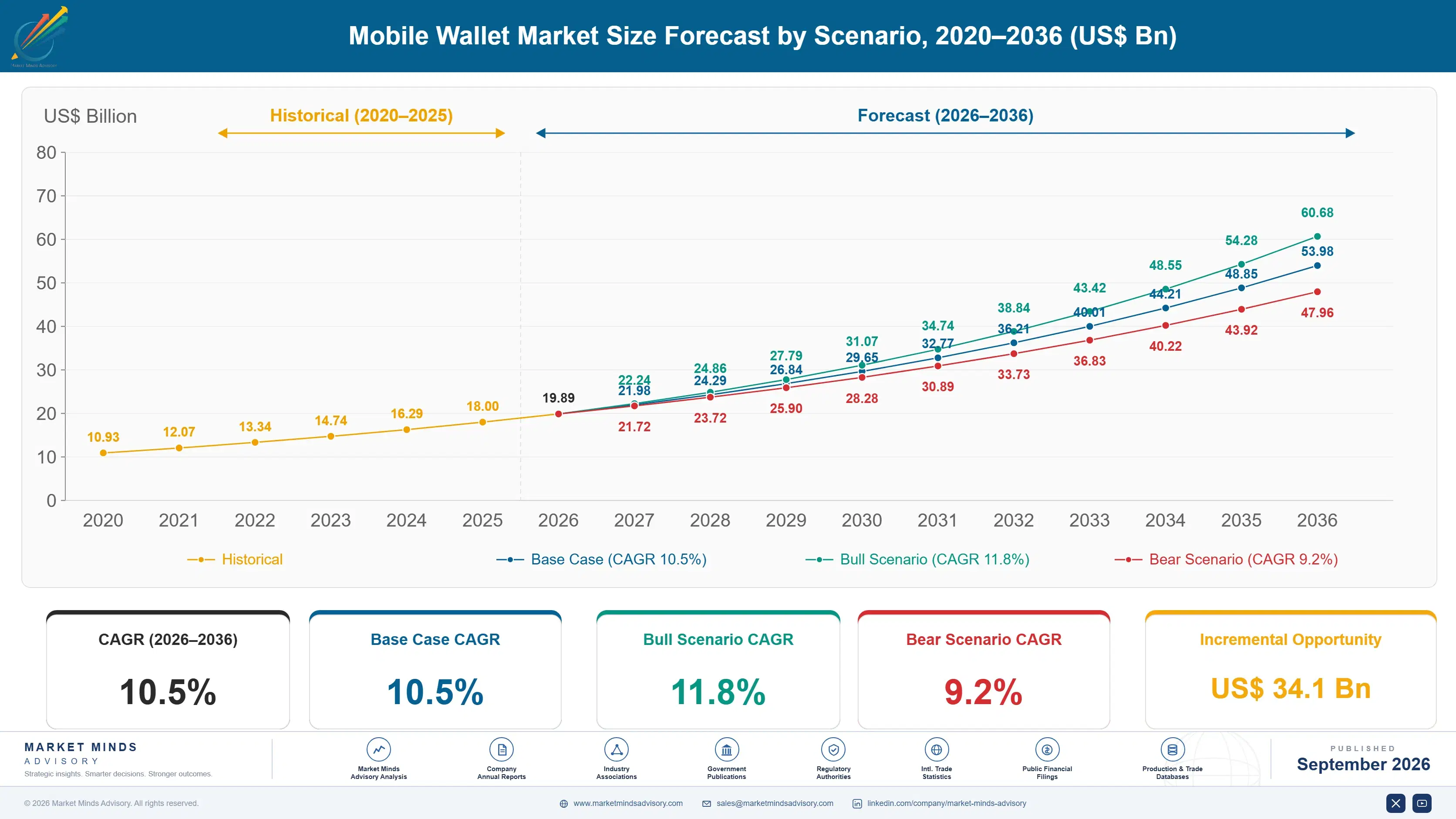
Between 2020 and 2025 mobile wallet adoption grew at an estimated 9.5% historical annual rate as pandemic-driven contactless payment preference accelerated adoption considerably, while cryptocurrency integration and comprehensive financial services features remained comparatively limited until platforms scaled beyond basic payment functionality. Platforms investing early in cryptocurrency integration during this period report steadier user engagement growth than late-moving competitors.
The base case assumes accelerating expansion through 2036 as three mechanisms compound: cross-border remittance corridors digitizing as migrant worker populations increasingly prefer mobile transfer over traditional money transfer operators, cryptocurrency integration expanding as regulatory clarity improves across major markets, and emerging market financial inclusion programs bringing previously unbanked populations directly into mobile-first payment networks. Platforms integrating buy now pay later functionality illustrate how wallets increasingly compete for broader consumer credit relationships beyond simple payment processing.
The bull case centers on cryptocurrency integration accelerating faster than currently modeled as regulatory frameworks mature across major economies, pulling forward digital asset wallet adoption considerably. The bear case hinges on central bank digital currencies potentially disintermediating private mobile wallet providers in markets where governments pursue direct digital currency issuance and distribution. Platforms slow to diversify face growing margin pressure as central bank digital currencies gain traction.

Payment Infrastructure Economics and Platform Scaling

Mobile wallets sit at the intersection of consumer payment convenience and rapidly expanding financial services capability, converting what was once a simple contactless payment substitute into a considerably broader platform spanning remittances, credit, and digital asset management. Cryptocurrency integration is increasingly the dominant near-term growth driver across the broader wallet category. This shift keeps accelerating.
MARKET CONCENTRATION (CR5)52%Reflects established global payment platform incumbency across major markets
AVERAGE TRANSACTION FEE REVENUE1.8%Typical merchant transaction processing fee charged per payment
TOP TRANSACTING COUNTRY SHAREChinaLargest single-country mobile wallet transaction volume currently recorded
ACTIVE USER PENETRATION RATE68%Share of smartphone owners actively using mobile wallet applications
AVERAGE USER RETENTION PERIOD4 yearsTypical duration users maintain an active primary wallet relationship
COGS PAYMENT PROCESSING SHARE44%Network and banking fees as unit cost share
Commercial character today increasingly favors platforms offering integrated financial services spanning payments, credit, and investment rather than users maintaining separate applications for each function. Merchants increasingly involve both payment operations and customer experience teams jointly in platform integration decisions that previously sat with payment operations departments largely alone. This joint approach increasingly requires platforms to speak credibly to both customer experience and total integration cost considerations.
Over the next decade, expect continued consolidation around comprehensive financial services platforms as users tire of managing multiple separate payment and financial applications, while cryptocurrency and digital asset capability becomes the primary new value proposition justifying continued platform investment well beyond the initial contactless payment substitution that established the category. Platforms slow to build this narrative risk losing renewal conversations to competitors offering clearer measurable engagement evidence.
"Nobody opens a wallet app anymore just to tap and pay. They open it because it's becoming their bank, their broker, and their remittance service all at once, and that shift changed who's actually competing here."
Director, Digital Payments and Financial Technology Practice · MMA Technology / Digital Payments and Financial Technology Practice · September 2026

Market Trends

Cryptocurrency Integration Expands Mainstream Wallet Functionality

Major mobile wallet platforms are increasingly integrating cryptocurrency trading and custody capability directly into mainstream consumer applications, reflecting growing regulatory clarity across major markets that has reduced the compliance uncertainty previously discouraging broader platform adoption of digital asset functionality. PayPal, Cash App, and several regional platforms have each expanded cryptocurrency capability considerably over the past two years, moving beyond simple buy-and-hold functionality toward integrated spending and transfer capability. Platforms report cryptocurrency-enabled users generating meaningfully higher engagement and transaction frequency than users limited to traditional payment functionality alone. Regulatory clarity continues expanding as governments finalize digital asset oversight frameworks.
Market Impact: Adds 200 million newly banked users

Cross-Border Remittance Corridors Digitize at Scale

Migrant worker remittance corridors are digitizing rapidly as mobile wallet-based transfer services increasingly displace traditional money transfer operators that historically charged considerably higher fees for comparable cross-border transfer services. Major remittance corridors connecting the United States, Gulf states, and Europe to South Asia, Southeast Asia, and Latin America have seen mobile wallet-based transfer volume grow considerably faster than traditional money transfer operator volume over the past several years. Platforms report cross-border remittance transaction volume growing considerably faster than domestic payment volume across most major corridor markets. Settlement times have improved considerably relative to traditional multi-day operator processing windows.
Market Impact: Grows revenue per user by 40%

Market Opportunities and Growth Drivers

Financial Inclusion Programs Expand Addressable User Base

Government and development organization financial inclusion programs across India, Sub-Saharan Africa, and Southeast Asia are directing considerable resources toward bringing previously unbanked populations directly into mobile-first payment systems, bypassing traditional banking infrastructure entirely in many underserved regions. India's national digital payment infrastructure has enabled hundreds of millions of previously unbanked citizens to access mobile financial services for the first time, creating a template other emerging markets increasingly seek to replicate domestically. Platforms report financial inclusion-driven user growth representing one of the fastest-growing acquisition channels across emerging market operations. This template increasingly shapes other governments' financial inclusion program design.
Market Impact: Adds 30% to market entry cost

Buy Now Pay Later Integration Expands Credit Relationships

Mobile wallet platforms are increasingly integrating buy now pay later credit functionality directly into core payment applications, expanding beyond simple transaction processing toward broader consumer credit relationships that generate meaningfully higher revenue per active user than payment processing fees alone. Major platforms across North America, Europe, and Australia have each launched integrated buy now pay later functionality within the past several years, capturing credit relationship revenue that previously flowed entirely to specialized standalone lending providers. Platforms report buy now pay later-enabled users generating considerably higher lifetime value than payment-only users.
Market Impact: Threatens 15% of transaction volume

Market Restraints and Challenges

Regulatory Fragmentation Complicates Global Platform Expansion

Mobile wallet regulatory requirements vary considerably across jurisdictions, complicating platform expansion into new markets since compliance, licensing, and data residency requirements differ meaningfully by country and sometimes by sub-national jurisdiction within a single country. The root cause is that financial services regulation historically developed independently across different countries, leaving platforms managing a genuinely fragmented compliance landscape rather than a single harmonized international standard. This raises market entry costs and timelines considerably for platforms pursuing multi-country expansion strategies. Platforms are mitigating the burden by partnering with local licensed financial institutions rather than pursuing independent licensing in every target market.
Market Impact: Lifts user engagement rates by 35%

Central Bank Digital Currency Development Threatens Disintermediation

Central banks across China, the European Union, and several other major economies are developing digital currency initiatives that could potentially disintermediate private mobile wallet providers in markets where governments pursue direct digital currency issuance and distribution to consumers. The root cause traces to central banks viewing private payment platform dominance as a monetary policy and financial stability concern worth addressing through direct government-issued digital currency alternatives. This creates strategic uncertainty for private providers in markets pursuing aggressive rollout timelines. Platforms mitigate the risk by positioning as complementary infrastructure rather than direct competitors to government initiatives.
Market Impact: Cuts remittance transfer fees by 60%
3 additional market trends, 4 additional growth drivers, and 3 additional restraints and challenges are covered in the full report. Contact sales@marketmindsadvisory.com to access the complete intelligence.

Segment CAGR and Growth Architecture

Mobile wallets are segmented by primary use case rather than by underlying technology or geography, since user adoption patterns and monetization models differ considerably by application category. This lens separates payment substitution from remittance, credit, and digital asset categories serving distinct user needs. Regulatory requirements also differ meaningfully across these use case categories. Buyer needs differ too.
mobile-wallet-market-market-share-analysis-1790003821051

Cryptocurrency and Digital Asset Wallets

Cryptocurrency and digital asset wallets represent the fastest-growing segment as mainstream payment platforms increasingly integrate trading and custody capability directly into consumer applications, reflecting growing regulatory clarity across major markets that has reduced compliance uncertainty previously discouraging broader adoption. This segment covers cryptocurrency purchase, custody, and transfer functionality integrated within broader payment platforms rather than standalone cryptocurrency exchange applications operating independently. PayPal, Cash App, and several regional platforms have each expanded cryptocurrency capability considerably over the past two years, moving beyond simple buy-and-hold functionality toward integrated spending capability. Platforms report cryptocurrency-enabled users generating meaningfully higher engagement than users limited to traditional payment functionality alone. This segment continues expanding as regulatory clarity broadens platform confidence in offering digital asset features.
CAGR 16.0%

Cross-Border Remittance Wallets

Cross-border remittance wallets represent the second-fastest-growing segment as migrant worker transfer corridors digitize rapidly, with mobile wallet-based services increasingly displacing traditional money transfer operators that historically charged considerably higher fees for comparable cross-border transfer services. This segment covers dedicated remittance functionality connecting major sending markets including the United States, Gulf states, and Europe to receiving markets across South Asia, Southeast Asia, and Latin America. Major remittance corridors have seen mobile wallet-based transfer volume grow considerably faster than traditional operator volume over the past several years. Platforms report this segment commanding considerably higher transaction volume growth than domestic payment categories across most major corridors. This segment continues expanding as more corridors digitize across major sending and receiving markets worldwide.
CAGR 13.0%
Full segment breakdown across 6 segments available in the complete report.

Regional Architecture and Country Demand Map

East Asia holds the largest share of transaction volume, reflecting China's exceptional mobile payment penetration alongside Japan and South Korea's established digital payment infrastructure, while South Asia shows the fastest growth from continued financial inclusion expansion. Latin America and Eastern Europe trail but grow steadily as adoption extends regionally.

North America

United States mobile wallet platforms including PayPal, Apple Pay, and Cash App lead regional transaction volume, supported by high smartphone penetration and increasingly sophisticated integrated financial services offerings spanning payments, credit, and investment. American buy now pay later integration has expanded considerably faster than in most other developed markets, reflecting strong consumer demand for flexible payment options. Canadian mobile wallet adoption follows a broadly similar trajectory at smaller absolute scale given the country's considerably smaller population relative to its southern neighbor, though growth rates remain broadly comparable across both markets currently underway. Vendors report bidding activity from both consumer and merchant-facing buyers growing steadily each quarter across major accounts. This activity increasingly shapes vendor market share across the broader base.
Share: 24% | CAGR: 10.5% (2026 to 2036)

Western Europe

United Kingdom and German mobile wallet adoption anchors regional transaction volume, supported by strong contactless payment infrastructure and increasingly sophisticated open banking integration enabling fast account-to-account transfers. France and Southern European markets are pursuing gradually expanding adoption, generally following broader European Union payment services regulatory frameworks rather than developing independent national standards. Regional demand growth generally lags North American and East Asian markets, reflecting the region's somewhat more mature existing card payment infrastructure relative to faster-scaling emerging markets elsewhere. Nordic countries generally lead the region's cashless payment adoption, often cited as a benchmark for peers pursuing comparable programs. Italy and Spain are pursuing comparable but smaller-scale modernization programs across their retail banking sectors.
Share: 18% | CAGR: 9.0% (2026 to 2036)
Regional intelligence for 5 additional markets available in the complete report: East Asia, South Asia and Pacific, Latin America, Middle East and Africa, Eastern Europe. Contact sales@marketmindsadvisory.com.
mobile-wallet-market-country-cagr-analysis-1790003821567

Where Platforms Capture Value Beyond Transaction Fees

Beyond standard transaction processing fees, platforms are building recurring income through integrated lending products, premium subscription tiers, and merchant analytics services that convert one-time payment transactions into multi-year recurring user relationships worth considerably more over time. This pattern mirrors how enterprise technology vendors monetize installed customer bases well after the initial transaction closes. Terms vary.

Integrated Lending and Buy Now Pay Later Revenue

Platforms increasingly offer integrated lending products including buy now pay later credit and small personal loans directly within core payment applications, capturing interest and fee revenue that scales with user credit relationship depth rather than depending entirely on transaction processing fees alone. This lending layer typically carries considerably higher margins than payment processing, since it monetizes user trust and transaction history data that platforms already possess through existing payment relationships. Lending revenue now represents roughly 25% of total revenue among platforms offering integrated credit products. Adoption continues expanding across most major platform categories worldwide.
Market Impact: Lifts lending revenue share to roughly 25% overall

Premium Subscription Tier Revenue Growth Program

Platforms increasingly offer premium subscription tiers providing enhanced features including higher transaction limits, premium customer support, and exclusive rewards programs, capturing recurring subscription revenue that scales with user engagement rather than depending entirely on per-transaction fees. This subscription layer requires minimal incremental cost once the underlying platform infrastructure exists, since it monetizes existing user relationships more fully rather than requiring new customer acquisition. Subscription revenue now represents roughly 12% of total revenue among platforms offering this premium tier structure. Adoption continues expanding across user segments seeking enhanced platform features. Growth remains steady.
Market Impact: Adds roughly $4.20 in average monthly revenue overall

Merchant Analytics and Marketing Services Revenue

Platforms increasingly offer merchant analytics and targeted marketing services using transaction data to help merchants understand customer behavior and optimize promotional campaigns, capturing services revenue that scales with merchant marketing budget allocation rather than depending entirely on transaction processing fees. This analytics layer typically carries considerably higher margins than payment processing alone, since it monetizes data infrastructure that platforms already maintain for core payment functionality. Analytics services revenue now represents roughly 8% of total revenue among platforms offering this merchant-facing service. Adoption continues expanding among merchants pursuing data-driven marketing strategies.
Market Impact: Expands merchant services revenue by nearly 18% overall

Cross-Border Remittance Fee Expansion Growth Programs

Platforms increasingly expand cross-border remittance capability specifically to capture fee revenue from migrant worker transfer corridors, where mobile wallet-based transfers typically charge considerably lower fees than traditional money transfer operators while still generating meaningful per-transaction revenue at scale. This remittance layer captures transaction volume that previously flowed entirely to specialized standalone remittance providers, expanding platforms' addressable revenue pool considerably beyond domestic payment processing alone. Remittance revenue now represents roughly 10% of total revenue among platforms offering dedicated cross-border transfer functionality. Adoption continues expanding among platforms pursuing dedicated corridor coverage. Growth remains steady.
Market Impact: Adds roughly $2.80 in average revenue per transaction

Who Controls the Margin Pool

Concentration is high at a CR5 of 52%, reflecting decades of established payment infrastructure investment and device platform integration that create meaningful switching costs and a wide gap between the five leading platforms and smaller, regional super-app competitors focused on narrower geographic markets. No single platform commands the overwhelming incumbency advantage that concentrated telecom or defense equipment markets sometimes exhibit.
Current competitive activity centers on three fronts: expanding cryptocurrency and digital asset capability to capture growing user demand, integrating buy now pay later credit functionality to deepen user financial relationships, and building cross-border remittance capability to capture migrant worker transfer fee revenue. Platforms increasingly compete on integrated financial services breadth rather than standalone payment processing convenience alone. Financing and bundling flexibility increasingly serve as a tiebreaker between comparable platform proposals evaluated by budget-conscious merchants.

Emerging pressure comes from regional super-app platforms offering superior localized functionality within narrow geographic markets, challenging global platforms on local payment habit fit even without comparable worldwide scale. Rankings could shift meaningfully if a major technology company enters mobile payments directly through acquisition, or if central bank digital currencies capture meaningful transaction volume in markets pursuing aggressive government digital currency rollout.
mobile-wallet-market-company-positioning-matrix-1790003822105

Competitive Moat and Risk Dimensions

PAYPAL

Moat: Broad Merchant Acceptance Network

PayPal's extensive merchant acceptance network built over decades gives it considerable transaction volume advantages that newer entrants struggle to replicate quickly across comparable merchant coverage. Its established brand trust among both consumers and merchants also reduces the adoption friction newer platforms typically face entering new markets.
PAYPAL

Risk: Slower Cryptocurrency Innovation Pace

PayPal's broad, established platform focus means its cryptocurrency and digital asset innovation pace sometimes lags smaller, specialized competitors focused purely on optimizing digital asset functionality for crypto-native user segments. Users prioritizing pure crypto sophistication over broad platform trust may increasingly favor these more focused competitors instead.
ALIPAY (ANT GROUP)

Moat: Deep Chinese Super-App Integration

Alipay's integration within China's broader digital platform spanning payments, lending, insurance, and lifestyle services gives it considerable user engagement advantages that pure payment-focused competitors cannot match. Its dominant position within China's mobile payment infrastructure remains particularly durable given the platform's comprehensive service breadth. This positioning has helped it retain user engagement even as competitors expand comparable service breadth.
ALIPAY (ANT GROUP)

Risk: Regulatory Concentration Risk in China

Alipay's considerable dependence on the Chinese regulatory environment exposes it more directly to domestic policy shifts than more geographically diversified competitors serving multiple markets with different regulatory frameworks. A broader Chinese regulatory shift affecting fintech operations would disproportionately affect Alipay relative to more diversified global competitors.

Players Tracked

Prominent Players

PayPal
Apple
Google
Alipay (Ant Group)
WeChat Pay (Tencent)

Other Key Players

Samsung Pay
PhonePe
Paytm
Cash App (Block)
Zelle
Amazon Pay
Grab (GrabPay)
M-Pesa (Safaricom)
MTN Mobile Money
Line Pay
Kakao Pay
Toss (Viva Republica)
GCash (Mynt)
Revolut
Skrill

Recent Developments

JANUARY 2025

PayPal Expands Cryptocurrency Trading and Spending Integration

PayPal announced expanded cryptocurrency trading and spending integration allowing users to spend digital assets directly at merchant checkout without manual conversion steps. The update builds on earlier cryptocurrency features introduced across the broader PayPal platform. Financial terms of this platform update were not disclosed publicly.
Signal: Established payment platforms continue integrating cryptocurrency capability directly rather than ceding the category to specialized providers.
MAY 2025

PhonePe Expands Integrated Lending Product Portfolio

PhonePe announced an expanded integrated lending product portfolio covering small personal loans and merchant working capital financing, building on its existing payment infrastructure relationships across India. The expansion targets both individual consumers and small business merchants. Financial terms of the expansion were not publicly disclosed.
Signal: Regional platforms continue building integrated financial services to deepen user relationships across the regional fintech sector.
SEPTEMBER 2025

Revolut Expands Cross-Border Remittance Corridor Coverage

Revolut announced expanded cross-border remittance corridor coverage connecting European markets to additional receiving countries across Africa and Asia. The expansion addresses growing migrant worker transfer demand across newly covered corridor routes. Financial terms of the corridor expansion agreement were not disclosed publicly by either party involved.
Signal: Cross-border remittance capability continues becoming a standard platform feature rather than a specialized standalone service category.

Payment Processing and Compliance Infrastructure Cost Exposure

Card network interchange fees and banking infrastructure processing costs together represent roughly 44% of unit cost of goods sold for platforms, with fees set predominantly by major card networks and banking partners concentrated in the United States and a handful of other financial infrastructure hub countries. Platforms relying more heavily on direct bank partnerships face a somewhat different exposure profile than those using standard card networks.
Payment processing costs rose meaningfully during periods of regulatory scrutiny between 2023 and 2024, with several platform annual reports documenting increased compliance infrastructure investment required to meet expanding anti-money laundering and know-your-customer requirements across multiple jurisdictions simultaneously during that period. Platforms without pre-existing compliance infrastructure experienced comparatively higher costs than those holding standing systems already in place. These infrastructure investments require multi-year planning cycles that smaller platforms often cannot accelerate quickly enough.

Smaller regional platforms carry disproportionately higher exposure since they lack the transaction volume to negotiate favorable interchange rates the way large global platforms like PayPal or Apple can. This dynamic compounds during periods of regulatory tightening, since smaller platforms cannot as easily absorb compliance cost increases across their comparatively smaller overall transaction revenue base relative to diversified larger competitors.
mobile-wallet-market-cost-volatility-analysis-1790003822303

Direct Bank Partnership Fee Negotiation

Larger platforms increasingly negotiate direct partnerships with banking infrastructure providers, reducing dependency on standard card network interchange rates during periods of rising processing costs. Smaller platforms often cannot access comparable terms. These agreements typically span multiple years and include negotiated fee ceilings tied to transaction volume. Terms vary considerably by partner. Costs remain notable.

Shared Compliance Infrastructure Investment

Platforms increasingly pool compliance technology investment through industry consortia, allowing smaller participants to access better compliance infrastructure than any single small platform could negotiate independently on its own. Smaller platforms often cannot secure comparable pooled infrastructure access given limited transaction volume. Adoption remains growing across the industry currently. Costs remain notable across most participating platforms overall.

Alternative Payment Rail Integration

Platforms increasingly integrate directly with account-to-account payment rails bypassing traditional card networks entirely, reducing interchange fee exposure. This approach requires considerable technical integration investment upfront. This approach has become increasingly common among platforms seeking to differentiate on cost efficiency. Customers increasingly favor platforms offering this capability. Costs remain notable across most participating platforms currently.

Portfolio Architecture for Margin Defence

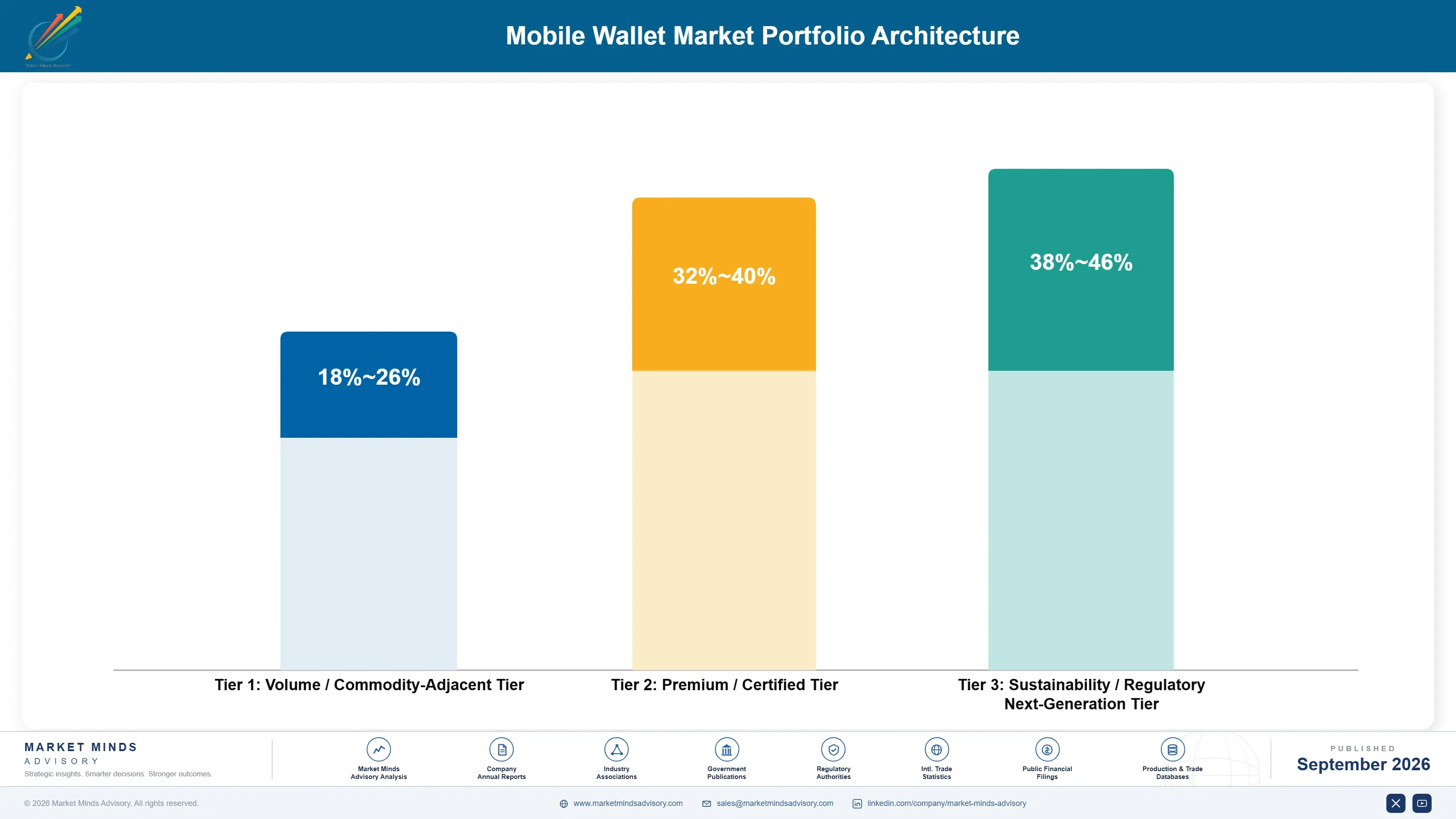
The market organizes into three tiers reflecting platform sophistication and revenue durability. Volume-tier standard payment processing carries thinner margins driven by price competition among several similarly capable platforms, while premium integrated financial services platforms bundling lending and investment products command considerably better economics for platforms positioned there. This tiering reflects both platform sophistication and how much of a given user relationship's value is recurring rather than one-time.
Tension between commoditizing standard transaction processing and premium recurring lending and subscription revenue defines platform strategy today, as pure payment processors face continuous margin pressure while those successfully building lending and analytics revenue construct more durable, higher-margin recurring income streams over time. Platforms making this shift successfully report meaningfully steadier revenue than peers still dependent on transaction-only fee cycles.

High-value pools concentrate in integrated lending products, premium subscription tiers, and merchant analytics services, where platforms capture recurring revenue well beyond the initial transaction processing fee itself. Next-generation cryptocurrency and digital asset platforms serving users pursuing comprehensive financial services represent the newest and fastest-growing high-margin pool available currently. Platforms positioned early in cryptocurrency and lending capture the largest share of this expanding high-margin opportunity.

Volume / Commodity-Adjacent Tier

Standard payment processing sold primarily on transaction fee competitiveness into basic in-store and person-to-person payment applications. Replacement cycles here are rare given the continuous, recurring nature of payment processing relationships.
Gross Margin: 18%-26%

Premium / Certified Tier

Integrated financial services platforms bundling lending, subscription tiers, and merchant analytics sold to large user and merchant bases. Renewal rates on these bundled relationships run considerably higher than volume-tier accounts alone.
Gross Margin: 32%-40%

Sustainability / Regulatory / Next-Generation Tier

Cryptocurrency and digital asset platforms, cross-border remittance services, and comprehensive financial services for underbanked populations. Demand keeps rising. Margins benefit from limited direct competition and considerable specialized financial engineering expertise required.
Gross Margin: 38%-46%
mobile-wallet-market-portfolio-architecture-1790003822814

High-value Sub-segments and Strategic Watch-out

Integrated Lending Product Revenue

Recurring lending and buy now pay later revenue growing fastest as platforms deepen user credit relationships beyond baseline payment functionality. Margins remain attractive. Source: MMA Estimate, July 2026. Growth here outpaces every other tracked category. Adoption keeps rising quickly. Vendor count here remains relatively small.
Gross Margin: 36%-44%

Cross-Border Remittance Fee Revenue

Migrant worker transfer fee revenue growing steadily as mobile wallets displace traditional money transfer operators across major corridor markets. Margins remain solid. Source: MMA Estimate, July 2026. Contract renewal rates remain notably strong. Adoption keeps accelerating steadily. Adoption keeps expanding across most corridors. Margins remain quite solid.
Gross Margin: 30%-38%

Standard In-Store Payment Processing

The volume core of the market, sold primarily on transaction fee competitiveness where price competition among established platforms keeps margins comparatively thinner overall. Pricing pressure persists across most competing platform tiers. Vendor count here remains high. Vendor count here remains the highest overall. Competition stays intense throughout.
Gross Margin: 20%-26%

Legacy Prepaid Card Top-Up Services

Declining prepaid card top-up functionality facing sustained pressure as users increasingly migrate toward direct bank-linked and cryptocurrency-integrated wallet alternatives. Platforms are exiting this category gradually over time. Decline pace varies by market. Platforms with diversified portfolios face less exposure. Decline pace varies notably. Platforms exit steadily.
Gross Margin: 12%-20%

Recurring User Financial Relationships Over Time

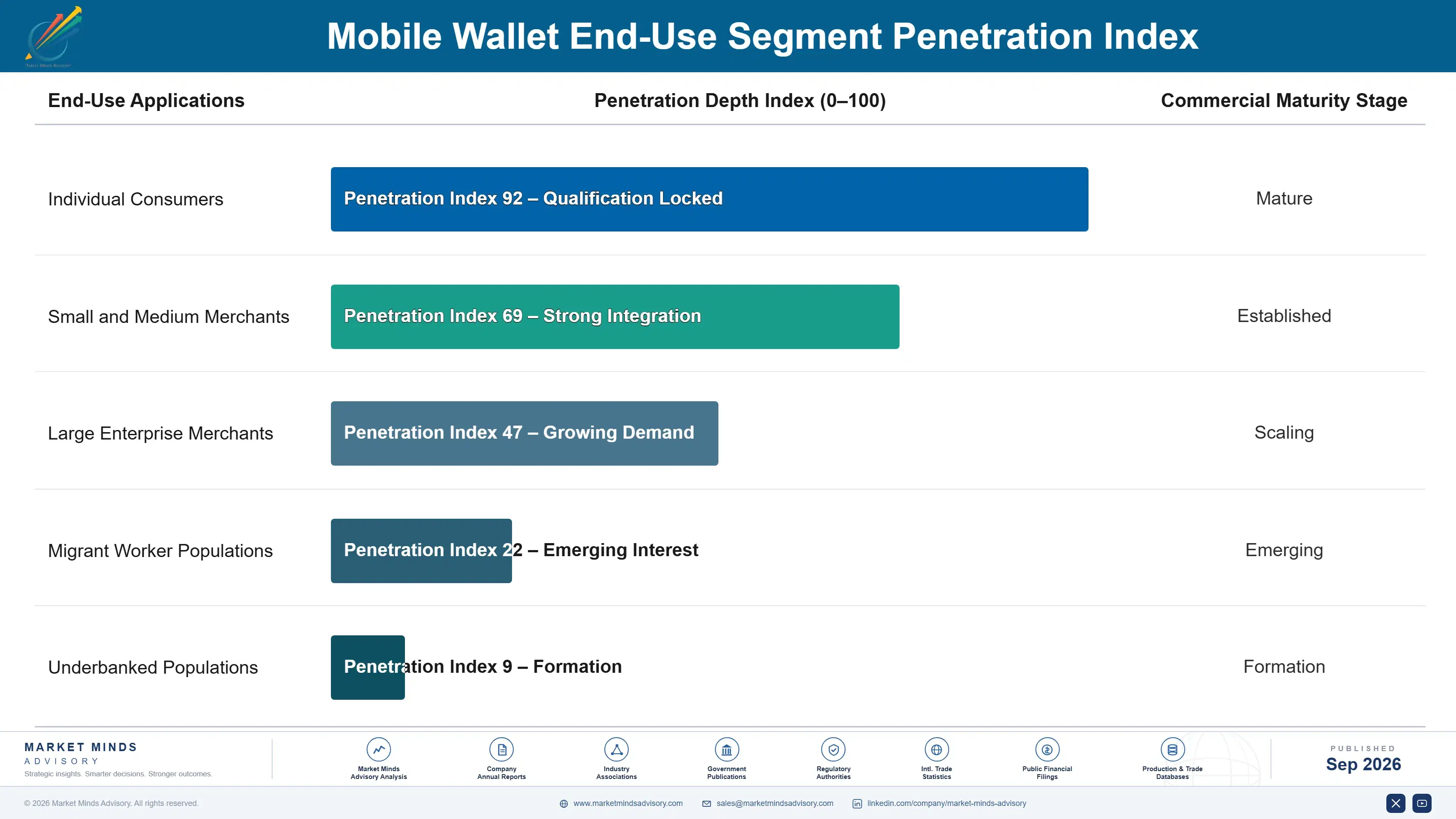
Demand increasingly behaves like an annuity rather than a one-time transaction fee, since active user relationships generate continuous transaction, lending, and subscription revenue for the life of a user's engagement, which typically continues for several years once a wallet becomes a primary payment method. Platforms that let this relationship lapse risk losing the user at the next major financial services decision point.
Adoption depth varies meaningfully by user segment: users in emerging markets with limited traditional banking access tend toward comprehensive financial services adoption once they commit to a platform, while users in developed markets with existing banking relationships often adopt only payment functionality initially, adding lending and investment features incrementally over time. This uneven pattern means platforms must maintain both comprehensive financial services capability and lightweight payment-only functionality simultaneously.

Buyer profiles are shifting generationally as younger, digitally native users, rather than purely traditional banking customers, increasingly drive platform selection decisions, favoring platforms that can demonstrate comprehensive financial services capability rather than pure payment convenience that older user segments historically prioritized. Platforms slow to build this commercial fluency risk being sidelined in user selection conversations increasingly led by younger, digitally native segments.
mobile-wallet-market-end-use-penetration-index-1790003823311

Where MMA Sees the Real Opportunity

These are among the four positions where our research anticipates prominent divergence between winners and laggards over the coming forecast period. Each is grounded in the demand model, the regulatory perimeter, and the announced capacity pipeline.
01 / FINANCIAL SERVICES EXPANSION

Build integrated lending capability ahead of competitors

Platforms should build integrated lending capability now, since users increasingly evaluate wallets on comprehensive financial services breadth rather than pure payment processing convenience alone. Platforms offering credit and lending products can capture considerably higher revenue per user than payment processing fees alone provide, while also deepening user retention through broader financial relationship depth. Platforms slow to build this capability risk losing user engagement to competitors who can present a more compelling comprehensive financial services value proposition, particularly as younger users increasingly expect banking-adjacent functionality as standard, non-negotiable platform features.
02 / CRYPTOCURRENCY INTEGRATION STRATEGY

Accelerate digital asset capability development now

The platforms capturing the most durable new user growth are those investing in cryptocurrency and digital asset capability now rather than waiting for regulatory clarity to force reactive development later. Building this capability early positions platforms to capture premium engagement from digitally sophisticated users increasingly seeking integrated crypto functionality. Platforms without credible cryptocurrency roadmaps risk being excluded from the fastest-growing user segment entirely, a gap that widens further as digital asset adoption continues accelerating rapidly across major consumer markets worldwide today.
03 / CROSS-BORDER REMITTANCE FOCUS

Expand remittance corridor coverage aggressively

Cross-border remittance represents one of the fastest-growing revenue categories, and platforms with credible corridor coverage stand to capture disproportionate share of migrant worker transfer fee revenue that traditional money transfer operators currently dominate. This remittance expansion increasingly differentiates platforms beyond domestic payment processing, particularly among users evaluating which platform offers the most competitive cross-border transfer fees and fastest settlement times available. Platforms building this coverage early gain meaningful lead time over competitors still limited entirely to domestic-only transfer functionality today.
04 / EMERGING MARKET FINANCIAL INCLUSION

Deepen financial inclusion program partnerships broadly

Financial inclusion-driven user growth represents one of the fastest-growing acquisition channels, and platforms partnering credibly with government and development organization programs stand to capture considerable new user relationships in previously underbanked populations. Platforms slow to build these partnerships risk ceding the fastest-growing addressable user base entirely to competitors already embedded in national financial inclusion infrastructure across major emerging markets. This gap widens further with every additional program cycle as competitors already embedded nationally deepen their government-backed infrastructure relationships over time.

Engagement Snapshot From the Field

A live engagement with an industry participant carrying material or product regulatory and market exposure ahead of a defining policy shift, showing how our research translates into a defensible multi-year portfolio strategy.
MARKET MINDS ADVISORY · CLIENT ENGAGEMENT SUMMARY
Mobile Wallet Producer Strategic Portfolio Review and Transition Roadmap 2026·Investment Scenario on Mobile Wallet Exposure Evaluation 2025-26
CLIENT PROFILE
The client is a regional mobile wallet platform serving approximately 45 million active users across Southeast Asia, primarily offering basic payment and person-to-person transfer functionality, seeking to expand into integrated lending and cross-border remittance services to deepen user financial relationships and revenue per user. Platform leadership had previously deferred financial services expansion for several years given other competing priorities.
STRATEGIC CHALLENGE
The platform needed to launch integrated lending and remittance capability within a twelve-month timeline to compete with regional super-app competitors already offering comprehensive financial services, while managing regulatory licensing requirements across multiple jurisdictions simultaneously. Regulatory licensing timelines across the region also created additional planning complexity requiring careful sequencing. Timing mattered considerably.
MMA APPROACH
MMA's team benchmarked integrated financial services expansion options against the client's specific user base demographics and existing regulatory licensing position, evaluating both build-in-house and partnership-based expansion approaches. MMA modeled revenue per user impact across a three-year horizon and structured a phased rollout plan prioritizing the highest-demand financial services first. MMA also benchmarked competitor rollout timelines against comparable regional platform launches.
KEY FINDINGS
  1. Launching integrated lending capability was projected to increase average revenue per user by approximately 45% (client-reported, unverified by MMA) relative to payment-only functionality.
  2. Roughly 32% of the platform's existing user base expressed strong interest in cross-border remittance functionality when initial market research surveys were conducted last year.
  3. A phased ten-month rollout plan, completed well ahead of the platform's original internal timeline projection, was expected to meet competitive timeline pressure overall.
  4. Platform leadership had significantly underestimated how quickly, during the early months of rollout, lending adoption would generate measurable revenue per user improvement.
CLIENT PROFILE
The client is a regional mobile wallet platform serving approximately 45 million active users across Southeast Asia, primarily offering basic payment and person-to-person transfer functionality, seeking to expand into integrated lending and cross-border remittance services to deepen user financial relationships and revenue per user. Platform leadership had previously deferred financial services expansion for several years given other competing priorities.
STRATEGIC CHALLENGE
The platform needed to launch integrated lending and remittance capability within a twelve-month timeline to compete with regional super-app competitors already offering comprehensive financial services, while managing regulatory licensing requirements across multiple jurisdictions simultaneously. Regulatory licensing timelines across the region also created additional planning complexity requiring careful sequencing. Timing mattered considerably.
MMA APPROACH
MMA's team benchmarked integrated financial services expansion options against the client's specific user base demographics and existing regulatory licensing position, evaluating both build-in-house and partnership-based expansion approaches. MMA modeled revenue per user impact across a three-year horizon and structured a phased rollout plan prioritizing the highest-demand financial services first. MMA also benchmarked competitor rollout timelines against comparable regional platform launches.
KEY FINDINGS
  1. Launching integrated lending capability was projected to increase average revenue per user by approximately 45% (client-reported, unverified by MMA) relative to payment-only functionality.
  2. Roughly 32% of the platform's existing user base expressed strong interest in cross-border remittance functionality when initial market research surveys were conducted last year.
  3. A phased ten-month rollout plan, completed well ahead of the platform's original internal timeline projection, was expected to meet competitive timeline pressure overall.
  4. Platform leadership had significantly underestimated how quickly, during the early months of rollout, lending adoption would generate measurable revenue per user improvement.
RECOMMENDED STRATEGY
Phase 1: Phase 1 (Months 1-4): Launch integrated lending capability through a licensed banking partnership covering the platform's highest-engagement user segments., coordinating closely with the licensed banking partner throughout Phase 2: Phase 2 (Months 5-8): Expand cross-border remittance functionality covering the highest-demand corridor routes identified through user research., prioritizing corridors with the highest transfer volume Phase 3: Phase 3 (Months 9-10): Scale both services platform-wide while finalizing additional regulatory licensing across remaining target markets., while documenting lessons learned for future expansion phases
OUTCOME
The platform approved the phased expansion plan and began Phase 1 rollout in early 2026, with full platform-wide completion targeted for late 2026 (client-reported, unverified by MMA). Projected annual revenue per user improvement was estimated at approximately 40% (client-reported, unverified by MMA) once both services reach full operational scale.

Frequently Asked Questions

Foundational context covering the market sizes, CAGR, scope, country, region and competition that inform every finding below. This section is provided to cover basics and most often pre-purchase conversations, answered from the MMA Primary Research Dataset.

What is the current size of the Mobile Wallet Market?

The global Mobile Wallet Market was valued at approximately $18.0 billion in 2025. Growth reflects both cryptocurrency integration and expanding cross-border remittance capability across most global regions today.

How large will the Mobile Wallet Market be by 2036?

MMA projects the market will reach approximately $54.10 billion by 2036, nearly triple its 2026 value. Financial inclusion and integrated lending both contribute meaningfully to this growth.

What is the CAGR for the Mobile Wallet Market 2026 to 2036?

The market is projected to grow at a 10.5% compound annual growth rate over the forecast period. This places it within the technology-enabled, transitioning growth band.

Which segment is growing fastest?

Cryptocurrency and Digital Asset Wallets lead growth at a 16.0% CAGR. This is roughly 1.52 times the overall market growth rate across the forecast period.

Who are the major companies in the Mobile Wallet Market?

Leading companies include PayPal, Apple, Google, Alipay, and WeChat Pay. Together these five hold an estimated 52% combined global market presence measured on transaction volume.

Which country is growing fastest?

India leads global growth at an estimated 12.8% CAGR, driven by national digital payment infrastructure bringing previously unbanked citizens into mobile financial services across the entire country today.

Report Segmentation Architecture

The full report scope spans multiple orthogonal segmentation dimensions, with cross-tabulated demand data provided for each dimension pair. Coverage extends further to regional breakdowns, trend trajectories, and the competitive detail needed to support segment-level decision-making.

By Use Case

  • Person-to-Person Payment Wallets
  • In-Store Contactless Payment Wallets
  • Cross-Border Remittance Wallets
  • Buy Now Pay Later Integrated Wallets
  • Cryptocurrency and Digital Asset Wallets
  • Loyalty and Rewards Integrated Wallets

By End-Use Segment

  • Individual Consumers
  • Small and Medium Merchants
  • Large Enterprise Merchants
  • Migrant Worker Populations
  • Underbanked Populations

By Commercial Dimension

  • Transaction Processing Fees
  • Integrated Lending Revenue
  • Premium Subscription Tiers
  • Merchant Analytics Services

By Region

  • North America
  • Western Europe
  • East Asia
  • South Asia and Pacific
  • Latin America
  • Middle East and Africa
  • Eastern Europe

Scope, Methodology, and Coverage

Every figure in this report is reproducible from documented input assumptions. The scope below maps the historical period, the forecast horizon, the segmentation dimensions, and the countries covered, alongside the underlying primary and qualitative methodology.
Historical Period
2020 to 2025
Forecast Period
2026 to 2036
Base Year
2025 (USD billions; MMA Primary Research Dataset, September 2026)
Market Definition
The market covers mobile applications enabling person-to-person transfers, in-store contactless payments, cross-border remittances, and integrated financial services accessed primarily through smartphone devices. It excludes traditional online banking applications without wallet-specific payment functionality, physical prepaid cards, and cryptocurrency exchanges operating independently of wallet applications.
Quantitative Units
USD billions (current prices); active user counts; transaction volume counts
Segmentation Dimensions
By Use Case; By End-Use Segment; By Commercial Dimension; By Region
Regions Covered
North America, Western Europe, East Asia, South Asia and Pacific, Latin America, Middle East and Africa, Eastern Europe
Countries Covered
USA, China, Germany, France, UK, Japan, South Korea, India, Australia, Canada, Brazil, Mexico, Indonesia, Vietnam, Thailand, Malaysia, UAE, Saudi Arabia, South Africa, Nigeria, Turkey, Poland, Netherlands, Italy, Spain, Sweden, Switzerland, Argentina, Colombia, Singapore, and additional markets relevant to this sector
Key Companies Profiled
PayPal, Apple, Google, Alipay (Ant Group), WeChat Pay (Tencent), Samsung Pay, PhonePe, Paytm, Cash App (Block), Zelle, Amazon Pay, Grab (GrabPay), M-Pesa (Safaricom), MTN Mobile Money, Line Pay, Kakao Pay, Toss (Viva Republica), GCash (Mynt), Revolut, Skrill
Quantitative Methodology
Primary survey, n=3,800 respondents, Q4 2025, six countries; demand-side model with trade association cross-validation
Qualitative Methodology
47 expert interviews, Q4 2025; applied to validate demand model assumptions, identify emerging dynamics, and assess competitive positioning
Report Format
PDF and XLSX data workbook (Word format preview document)
Publisher
Market Minds Advisory
Report Code
MMA-2026-TEC-239
Published
September 2026
Contact
sales@marketmindsadvisory.com | www.marketmindsadvisory.com

Purchase the full Mobile Wallet Market Report (2026 to 2036).

The full report provides detailed market sizing, ten-year forecasts, and competitive benchmarking across the mobile wallet category worldwide. It includes country-level financial inclusion tracking, platform financial services capability comparisons, and segment-level growth analysis across payment, remittance, and lending categories. Buyers receive access to MMA's proprietary user adoption tracker updated quarterly throughout the subscription period. The report also includes detailed input-cost analysis for payment processing and compliance infrastructure. Subscribers can request a customized briefing call to discuss findings relevant to their specific investment or product strategy questions.
Country-level financial inclusion tracking dashboard updates
Platform financial services capability scorecards included
Segment-level ten-year growth forecasts by category
Competitive benchmarking covering every profiled platform
User adoption tracker updated each quarter
Input-cost and compliance infrastructure risk analysis

Built For The People Who Decide

From boardroom strategy to bench-side execution, this report is read cover-to-cover by leaders shaping the next decade of their industry, turning demand scenarios, market dynamics and valuation benchmarks into decisions.
CXOs/ Presidents/ VPs/ Managers
M&A and Corporate Development
Strategy Teams and R&D Heads
Procurement and Product Directors
Regulatory and Compliance Leaders
Investor Relations and Equity Analysts