Market Minds Advisory
Mobile Robots Market

Mobile Robots Market: Mobile Robots Market. Navigation Flexibility, Orchestration Depth, and Deployment Economics.

Warehouse and manufacturing operators are deploying autonomous mobile robots at scale to offset persistent labour shortages, even as fleet orchestration complexity and integration cost with legacy systems keep many mid-size facilities on manual handling.

Lead Analyst

Published

September 2026

Make Smarter Decisions with Customized Research Insights

Request a free sample report and evaluate market opportunities, growth trends, and competitive dynamics relevant to your business needs.

2025 MARKET VALUE$8.5BMarket Size 2025
2036 FORECAST VALUE$41.5BBase Case , 2026 to 2036
CAGR 2026 TO 203615.5 %Bull 16.9% / Bear 14.2%
INCREMENTAL OPPORTUNITY$31.7BNet 10- year value creation
EXPANSION MULTIPLE4.22x2036 value over 2026 base
Strategic Levers
M&A Pipeline
Regional Outlook
Country Rankings
Competitive Intelligence
Segmental Deep-dive
Call-Us : 91 93563 13602

Executive Snapshot and Market Trajectory.

Mobile robots are shifting from fixed-path automated guided vehicles toward autonomous mobile robots that navigate dynamically using AI-driven perception, letting warehouse and manufacturing operators redeploy robots across changing facility layouts without repainting guide paths or laying new infrastructure. Operators increasingly treat this shift as an operational necessity for daily operations.
Demand concentrates around large-scale warehouse and manufacturing operators facing persistent labour shortages, with East Asian manufacturers and logistics operators the largest buyers as domestic robotics manufacturing scale continues outpacing other markets by a meaningful margin. AI-driven fleet orchestration is increasingly displacing manual material handling across these flagship large-facility operations. That concentration is unlikely to loosen soon given how deeply embedded these robotics deployments already are within the largest logistics operations.
Competitive character splits between established industrial automation vendors defending decades-long manufacturing customer relationships and newer AI-native robotics specialists built specifically for dynamic warehouse navigation that legacy fixed-path architectures were never designed to support at comparable flexibility. This divide shapes nearly every competitive deployment decision now underway, and tightening labour cost pressure reinforces how buyers weigh fleet flexibility against newer integration complexity Buyers weigh this closely.
Market Definition
This report covers hardware and software for robots capable of independent facility movement, spanning automated guided vehicles, autonomous mobile robots, delivery platforms, and AI-driven orchestration software. Fixed robotic arms, consumer robots, and aerial drones are excluded.
Base Year Value
$8.5B in 2025 (MMA Primary Research Dataset, September 2026)
Forecast Period
2026 to 2036, eleven discrete annual values
CAGR
15.5% base case. Bull 16.9%. Bear 14.2%.
Fastest Growth Segment
AI-Driven Fleet Orchestration and Navigation Software: 19.6% CAGR
Fastest Growth Country
Vietnam: 19.0% CAGR
Fastest Growth Region
South Asia and Pacific: 17.5% CAGR
Largest Region
East Asia: 30% of 2025 global value
Market Leaders
KUKA AG, ABB Ltd, FANUC Corporation, Geek+ Inc, Locus Robotics Corp. Source: MMA Analysis based on company annual reports.
Primary Survey
n=3,800 procurement and R&D decision-makers, Q4 2025, six countries
Methodology
Demand-side build-up, cross-validated against public data, 47 expert interviews

Mobile Robots Market Forecast Scenarios

mobile-robots-market-size-forecast-scenario-1788677967148
Between 2020 and 2025, mobile robots grew rapidly as persistent warehouse and manufacturing labour shortages pushed operators toward automation investment alongside continued AI perception model quality improvement across most major logistics and manufacturing facility segments. Fleet orchestration software maturity and expanding sensor cost reduction both reinforced this rapid multi-year adoption curve across most large-facility operator segments.
The base case assumes continued momentum from three mechanisms: warehouse operators expanding autonomous mobile robot adoption to replace fixed-path automated guided vehicles, manufacturers integrating AI-driven fleet orchestration to coordinate larger robot deployments efficiently, and persistent labour shortages increasingly demanding automation that manual material handling cannot practically sustain at scale. These three mechanisms reinforce each other, since flexibility needs justify perception investment, and perception investment in turn makes AI-driven orchestration economically practical to deploy broadly.
A bull scenario assumes faster AI perception adoption pulls forward robot value considerably beyond current large-facility-focused deployment into broader mid-size facility adoption, while the principal bear risk is persistent integration complexity deterring operators from replacing functional manual material handling despite clear labour cost advantages. Both scenarios hinge on how quickly integration frameworks mature across major warehouse management system environments.

Navigation Flexibility and Orchestration Economics

Mobile robots sit downstream of both warehouse labour cost pressure and evolving facility automation requirements, and pricing increasingly reflects AI-driven navigation flexibility rather than raw payload capacity or mechanical durability alone across most large-facility buyer purchases. Integration negotiations increasingly reference validated payback benchmarks directly rather than treating them as a secondary consideration. Manufacturers that can demonstrate both capabilities together increasingly set the pricing benchmark other robot lines are measured against.
MARKET CONCENTRATION34%share held by five largest global robotics manufacturers
AVERAGE ROBOT PRICE$32,000typical average robot price per configured unit deployed
DYNAMIC NAVIGATION SHARE52%share of deployed robots using dynamic AI navigation
INTEGRATION TEAM UTILISATION90%integration engineering teams booked above normal capacity this cycle
AI-ORCHESTRATED FLEET SHARE36%share of fleets managed through AI orchestration software
PAYBACK PERIOD14 monthsmonths typical payback period after facility deployment typically now
Operators increasingly specify AI-driven dynamic navigation and fleet orchestration as standard for new robot procurement, pushing fixed-path manufacturers toward smaller specialty segments while AI-native robotics manufacturers hold pricing power on flagship large-facility deployments. Integration engineering teams report sustained deployment demand well above typical delivery capacity, reflecting the pace of this shift across large logistics and manufacturing operations.
Over the next decade, expect continued AI navigation expansion and tightening labour cost pressure to keep integrated robot demand elevated, favouring manufacturers who can deliver navigation flexibility as reliably as they win large-facility deployment contracts. Manufacturers lagging on AI-driven orchestration risk losing consideration on the largest facility automation contracts entirely. Operators increasingly reference orchestration depth directly as a procurement scoring criterion.
"Nobody buys a mobile robot because the demo video looks impressive. They buy it because the third-shift picking team quit again last week, and that staffing math is what is reshaping which manufacturers win the largest warehouse automation contracts."
Director, Robotics and Warehouse Automation Practice · MMA Construction and Industrial Equipment Practice · September 2026

Market Trends

AI-Driven Fleet Orchestration Extends Robots Beyond Single Units

Robot deployments are increasingly coordinated through AI-driven fleet orchestration software that manages hundreds of robots simultaneously across shared facility space, extending automation value considerably beyond the single-robot deployment role earlier generation automated guided vehicles provided to warehouse and manufacturing operations. Manufacturers report orchestration software adoption growing meaningfully across large-facility accounts, reflecting operator demand for tools that actively coordinate large fleets rather than passively managing individual robots on isolated fixed paths. That gap is widening each quarter as coordinated fleet deployment becomes standard operating practice across most large facility operations. That gap is widening each quarter as coordination becomes central.
Market Impact: Cuts labour-dependent tasks 33pts

Dynamic Navigation Displaces Fixed-Path Guided Vehicles

Robots using AI-driven dynamic navigation can be redeployed across changing facility layouts without infrastructure modification, converting what was previously a multi-week guide-path installation process into an increasingly standard same-day redeployment capability across most major warehouse and manufacturing facilities. Manufacturers report dynamic navigation adoption growing meaningfully faster than the broader fixed-path guided vehicle market, reflecting operator demand positioning early for facility flexibility advantage before competitors achieve comparable redeployment speed across the industry. This dynamic is expected to intensify as facility layout changes continue accelerating across most major logistics operations. Manufacturers report this shift accelerating faster than most planning teams originally anticipated.
Market Impact: Raises robot demand 22pts

Market Opportunities and Growth Drivers

Persistent Labour Shortages Accelerate Automation Adoption

Warehouse and manufacturing operators facing persistent difficulty filling material handling positions face considerably higher operational risk from unfilled roles than periods of stable labour availability historically presented, converting what was previously a discretionary efficiency upgrade into an increasingly central operational continuity priority across most large-facility logistics programmes. Operators report robot procurement increasingly tied to broader workforce planning strategy, giving manufacturers a demand driver linked to labour market conditions rather than discretionary automation budget alone. This dynamic is expected to persist as labour shortages continue affecting most major logistics and manufacturing labour markets.
Market Impact: Delays deployment 6 to 12 months

E-Commerce Fulfilment Growth Elevates Facility Throughput Requirements

E-commerce fulfilment operators managing rising order volume increasingly require throughput capacity that manual picking and material handling cannot economically scale to match, increasing the addressable facility base requiring robotic automation across most large distribution centre programmes. Operators report robot procurement increasingly tied to broader fulfilment capacity planning, giving manufacturers a demand driver linked to e-commerce volume growth rather than discretionary efficiency spending alone. This dynamic is expected to persist as e-commerce order volume continues growing faster than manual fulfilment capacity can economically scale. This dynamic is expected to intensify as e-commerce order volume continues expanding across most markets.
Market Impact: Leaves 26pts of roles unfilled

Market Restraints and Challenges

Integration Complexity Delays Legacy System Displacement

Facilities with deeply embedded legacy warehouse management systems face considerably more complex integration challenges than newly built facilities deploying robots from the ground up, often extending deployment timelines well beyond what manufacturers plan around when pursuing competitive displacement opportunities at established facility accounts. The commercial impact shows up as delayed revenue recognition for manufacturers who have invested competitive displacement sales effort well ahead of any confirmed integration completion at prospective facility customers. Manufacturers are responding by building standardised integration middleware to compress the effective deployment timeline before full facility automation is achieved.
Market Impact: Lifts orchestrated fleet share by 20pts

Specialised Robotics Integration Talent Shortage Constrains Capacity

Robot manufacturers face a persistent shortage of engineers with combined expertise in AI perception systems and warehouse operations integration, constraining how quickly manufacturers can support new facility deployments or provide ongoing fleet optimisation even as operator demand continues expanding across most major facility accounts. Smaller regional manufacturers without established integration engineering pipelines carry the largest exposure to this constraint, while larger manufacturers increasingly acquire smaller integration specialist firms specifically to secure deployment talent rather than pursuing pure hardware sales volume alone. That gap is widening each hiring cycle as demand continues to outpace available specialist supply.
Market Impact: Expands dynamic-nav share 24pts
3 additional market trends, 4 additional growth drivers, and 2 additional restraints and challenges are covered in the full report. Contact sales@marketmindsadvisory.com to access the complete intelligence.

Segment CAGR and Growth Architecture

Segmentation follows core robot type and navigation technology, from fixed-path guided vehicles through autonomous mobile robots and delivery platforms to AI-driven orchestration software, keeping hardware distinct from the services layered around it. Commercial services around integration and deployment sit apart as a distinct dimension entirely, never blended into the core technology categories above fully.
mobile-robots-market-market-share-analysis-1788677967793

AI-Driven Fleet Orchestration and Navigation Software

AI-driven orchestration software that coordinates large robot fleets and manages dynamic navigation continuously is capturing an expanding share of total robotics spending as operators shift budget from single-robot deployment toward coordinated fleet-wide automation across most large-facility logistics and manufacturing programmes. Manufacturers report software deployment timelines running considerably faster than legacy fixed-path installation given the reduced infrastructure modification effort AI-driven navigation architecture requires, delivering stronger recurring revenue once deployed since subscription pricing generates predictable multi-year customer relationships. Adoption remains concentrated among operators with the facility scale to justify orchestration investment, but the addressable market is expanding as manufacturers build simplified orchestration packages suited to smaller mid-size facility budgets. Expect this segment to keep outpacing the broader market as fleet coordination.
CAGR 19.6%

Autonomous Mobile Robots

Autonomous mobile robots that navigate dynamically without fixed guide paths are growing as operators increasingly value facility layout flexibility over the rigid infrastructure legacy automated guided vehicles historically required across most large logistics and manufacturing operations. This segment benefits from the same coordination trend driving broader orchestration adoption, since dynamic navigation infrastructure typically provides the perception foundation fleet orchestration requires more efficiently than fixed-path robots can economically support at comparable facility scale. Manufacturers require sophisticated AI perception and sensor engineering expertise to serve this segment at qualified large-facility scale, a capability barrier that favours established robotics manufacturers with dedicated perception engineering investment over smaller providers lacking comparable technical depth. Growth here trails orchestration software slightly since autonomous robot adoption.
CAGR 17.9%
Full segment breakdown across 6 segments available in the complete report.

Regional Architecture and Country Demand Map

East Asia leads on concentrated robotics manufacturing scale and warehouse automation deployment, with North America following closely behind on large-scale e-commerce fulfilment investment. South Asia and Pacific and Western Europe fill out the remaining meaningful share behind these two anchor regions across most markets today.

East Asia

China's exceptionally large robotics manufacturing base and expanding domestic warehouse automation deployment anchor the largest regional demand pool, with domestic manufacturers scaling production capacity at a pace no other regional market currently matches given the sheer scale of the country's logistics and manufacturing sectors. Japan and South Korea contribute substantial additional demand tied to their own advanced manufacturing automation programmes and established robotics engineering expertise across the region's technology sectors. Domestic Chinese robotics manufacturers are scaling rapidly behind this manufacturing investment wave, though international manufacturers retain meaningful share given established AI perception expertise domestic competitors are still developing at comparable depth. Continued regional manufacturing investment keeps demand elevated well ahead of the pace seen across most other established robotics.
Share: 30% | CAGR: 16.8% (2026 to 2036)

North America

United States e-commerce fulfilment operators and manufacturing facilities anchor substantial regional demand, with continued venture capital and enterprise investment in warehouse automation expanding the addressable base of facilities requiring autonomous mobile robots across both large distribution centre and manufacturing accounts. Major robotics manufacturers headquartered in the region sustain deep engineering relationships with logistics operators that smaller international competitors have struggled to displace despite years of competitive effort. Canadian manufacturing facilities sustain steady robot demand tied to established industrial automation comparable to the broader North American market. Average robot pricing stays firm given established manufacturer relationships and the deployment track record leading vendors have built across multiple facility automation generations. This scale advantage keeps the region well ahead of most.
Share: 28% | CAGR: 16.5% (2026 to 2036)
Regional intelligence for 5 additional markets available in the complete report: Western Europe, South Asia and Pacific, Latin America, Middle East and Africa, Eastern Europe. Contact sales@marketmindsadvisory.com.
mobile-robots-market-country-cagr-analysis-1788677968319

Navigation Flexibility, Orchestration Depth, and Integration Speed

Manufacturers hold pricing power where AI navigation flexibility, deep fleet orchestration capability, and fast legacy integration combine, letting qualified players capture margin beyond standard fixed-path automation that commodity robots cannot easily replicate across large facilities Manufacturers combining all three consistently outperform single-capability rivals on renewal terms on every major purchase decision and expansion cycle.

Building AI-Driven Dynamic Navigation Perception Capability

Building AI-driven dynamic navigation perception that adapts to changing facility layouts positions manufacturers to capture the fastest-growing flexibility-enabled segment that standard fixed-path robots cannot address without comparable sensor and machine learning investment across the required perception expertise. Manufacturers who have already built this capability report winning a growing share of large-facility deployments specifically because dynamic navigation delivers measurable redeployment flexibility that fixed-path automation alone cannot match, with AI-navigation robots commanding roughly 26 to 32 percent pricing premium over standard fixed-path equivalents. This premium has held steady across the past several deployment cycles.
Market Impact: Commands roughly a 26 to 32 percent premium

Building Deep Multi-Robot Fleet Orchestration Software

Building deep fleet orchestration software that coordinates hundreds of robots across shared facility space directly addresses the sector's central competitive dynamic where coordination depth increasingly determines which manufacturers can compete for the largest facility automation contracts across distribution centre and manufacturing accounts. Manufacturers who have already built this capability report winning a growing share of large-facility contracts specifically because deep orchestration removes a meaningful coordination barrier customers value highly, with orchestrated fleets commanding roughly 2 to 3 times the deployed robot volume of comparable unorchestrated deployments. This gap continues widening as orchestration expertise becomes harder to replicate quickly.
Market Impact: Handles 2 to 3 times unorchestrated deployment volume

Building Standardised Legacy System Integration Middleware

Investing in standardised integration middleware that compresses the timeline required to connect robots with entrenched legacy warehouse management systems positions manufacturers to capture displacement opportunities that competitors relying on custom integration processes cannot address competitively against facilities operating complex multi-system infrastructure. Manufacturers who have already built this capability report winning a growing share of displacement contracts specifically because faster integration reduces the operational disruption risk customers weigh heavily during deployment decisions, with standardised middleware reducing integration timelines by roughly 3 to 5 months relative to standard custom approaches. This approach has already proven effective at several major manufacturers.
Market Impact: Cuts integration timeline by 3 to 5 months

Who Controls the Margin Pool

Concentration sits moderate at a cr5 near 34 percent measured on global qualified robot shipment revenue, with a meaningful gap separating established industrial automation manufacturers holding deep manufacturing customer relationships from a fragmented tail of smaller AI-native robotics specialists competing mainly within narrower application or regional segments. That gap has held steady across the past several years of competitive activity.
Current competitive activity centres on three dimensions: building AI-driven dynamic navigation perception to capture the fastest-growing flexibility-enabled segment, developing deep fleet orchestration software to coordinate large robot deployments across major facility accounts, and investing in standardised integration middleware to accelerate displacement of legacy manual material handling at established facility accounts. Manufacturers weak in any one of these three dimensions are increasingly losing consideration on the largest contracts.

Emerging pressure comes from major warehouse management software vendors expanding native fleet orchestration functionality previously the exclusive domain of specialist robotics manufacturers, which could compress margins on standard hardware sales while established robotics specialists defend share through deeper AI perception and orchestration specialisation these newer entrants have not yet matched. How quickly software vendors close the perception expertise gap will determine whether rankings shift meaningfully over the next several years.
mobile-robots-market-company-positioning-matrix-1788677968846

Competitive Moat and Risk Dimensions

KUKA AG

Moat: Deep manufacturing integration breadth

KUKA has built decades of accumulated manufacturing automation integration expertise across successive industrial generations, letting its mobile robots connect natively into existing manufacturing execution systems that large-scale manufacturers already operate across their production infrastructure. This integration depth gives KUKA an advantage in contracts specifically where customers increasingly value platform compatibility with existing manufacturing infrastructure over standalone robot functionality alone.
KUKA AG

Risk: Slower AI-native perception development pace

KUKA's origins in fixed-path industrial automation mean its AI-driven dynamic navigation development moves more slowly than robotics specialists built natively around AI perception architecture, potentially disadvantaging it in competitive evaluations where customers increasingly prioritise navigation flexibility over deep existing manufacturing infrastructure integration alone. This dynamic is already reshaping product roadmap priorities across the team.
GEEK+ INC

Moat: Cloud-native fleet orchestration advantage

Geek+ was built from inception as a cloud-native fleet orchestration platform rather than retrofitting coordination software onto legacy fixed-path infrastructure, giving it deployment speed and multi-robot scalability advantages that competitors with older architectures have struggled to match within comparable coordination and reliability standards. This speed advantage compounds with every new facility deployment cycle.
GEEK+ INC

Risk: Narrower Western manufacturing track record

Geek+'s comparatively concentrated Asian market presence means it has a narrower Western manufacturing integration track record than competitors who have served large Western manufacturing accounts for several decades, potentially disadvantaging it in the largest, most conservative Western manufacturing contracts where established integration history carries meaningful weight in vendor selection.

Players Tracked

Prominent Players

KUKA AG
ABB Ltd
FANUC Corporation
Geek+ Inc
Locus Robotics Corp

Other Key Players

Omron Corporation
Hai Robotics Co Ltd
inVia Robotics Inc
Fetch Robotics Inc
6 River Systems Inc
Vecna Robotics Inc
Seegrid Corporation
Mobile Industrial Robots AS
AutoStore AS
Exotec SAS
GreyOrange Inc
Boston Dynamics Inc
Agility Robotics Inc
Zebra Technologies Corporation
Teradyne Inc

Recent Developments

MARCH 2026

KUKA Launches AI-Driven Dynamic Navigation Module for Fleet Robots

KUKA AG launched a new AI-driven dynamic navigation module integrated into its mobile robot platform, targeting large-facility customers seeking to redeploy robots across changing layouts without infrastructure modification. The module draws on statistical models trained across a large library of prior validated navigation and layout records.
Signal: Confirms established manufacturers are prioritising navigation investment specifically to defend large-facility contract share against newer challengers.
DECEMBER 2025

Geek+ Signs Multi-Year Fleet Agreement With Global E-Commerce Operator

Geek+ Inc signed a multi-year fleet deployment agreement with a global e-commerce fulfilment operator, securing qualified deployment position across the operator's expanding distribution centre network spanning multiple regional facilities. Terms were not disclosed, though the agreement covers deployment across several regional distribution centres over the contract term.
Signal: Shows AI-native manufacturers are winning large enterprise contracts against established incumbent industrial automation vendors, a notable shift in buyer preference.
AUGUST 2025

Locus Robotics Expands AI Perception Engineering Team Capacity

Locus Robotics Corp expanded its AI perception engineering team capacity across its global research organisation, responding to rising demand from large-facility customers seeking faster dynamic navigation deployment amid persistent talent constraints. The expansion follows sustained demand growth from customers pursuing faster dynamic navigation deployment timelines.
Signal: Signals established manufacturers are investing in engineering capacity to defend contract share from newer competitors, a defensive move.

Sensor Component and Perception Talent Cost Exposure

Sensor hardware components and specialised AI perception talent together typically account for a meaningful share of manufacturer operating cost, with sensor cost weighted heavily toward LiDAR and camera systems and talent cost weighted toward combined perception engineering and warehouse operations expertise. Manufacturers serving the largest facility deployments face the highest sensor cost given the scale of navigation regulatory.
Sensor and semiconductor component pricing shifted meaningfully during a 2024 supply chain tightening cycle tracked across major manufacturer and industry annual reports, compressing margins within a single fiscal year and prompting several manufacturers to restructure customer pricing models around usage-based rather than flat equipment pricing tiers. Several manufacturers publicly disclosed the resulting margin pressure in subsequent quarterly filings covering the affected period. Several smaller manufacturers reported the sharpest margin impact given their limited negotiating leverage with sensor suppliers.

Smaller manufacturers without negotiated enterprise sensor supply agreements or established perception engineering pipelines carry the largest exposure to this pressure, while larger manufacturers with established supplier relationships and predictable engineering pipelines can better absorb these cost pressures across a broader robot line. Manufacturers serving primarily smaller regional facility customers on thin equipment margins face the sharpest relative exposure to this pressure.
mobile-robots-market-cost-volatility-analysis-1788677969046

Multi-Year Sensor Component Supply Agreements

Larger manufacturers are negotiating multi-year sensor and semiconductor component agreements with favourable committed-volume pricing rather than relying on standard spot market rates, smoothing cost volatility and protecting margin on fixed-price equipment contracts signed years in advance of delivery across most contract tiers negotiated and geographic segments overall served across the manufacturer's full customer base.

Perception Engineering Pipeline Investment for Talent

Manufacturers are building dedicated university perception engineering pipelines targeting graduates with combined AI and robotics expertise, reducing reliance on costly lateral hiring and building sustainable delivery capacity across successive graduating engineering cohorts, helping stabilise recruiting costs each cycle while retaining the flexibility competitors lack across peak demand periods each hiring season overall across successive graduating cohorts served.

Usage-Based Pricing Models Passing Through Costs

Several manufacturers are restructuring equipment pricing around usage-based service tiers that pass through underlying sensor cost variability directly to customers, reducing manufacturer exposure to component pricing volatility while maintaining predictable margin across the facility customer base served across every equipment category offered while protecting predictable margin overall across every geography and account tier served.

Portfolio Architecture for Margin Defence

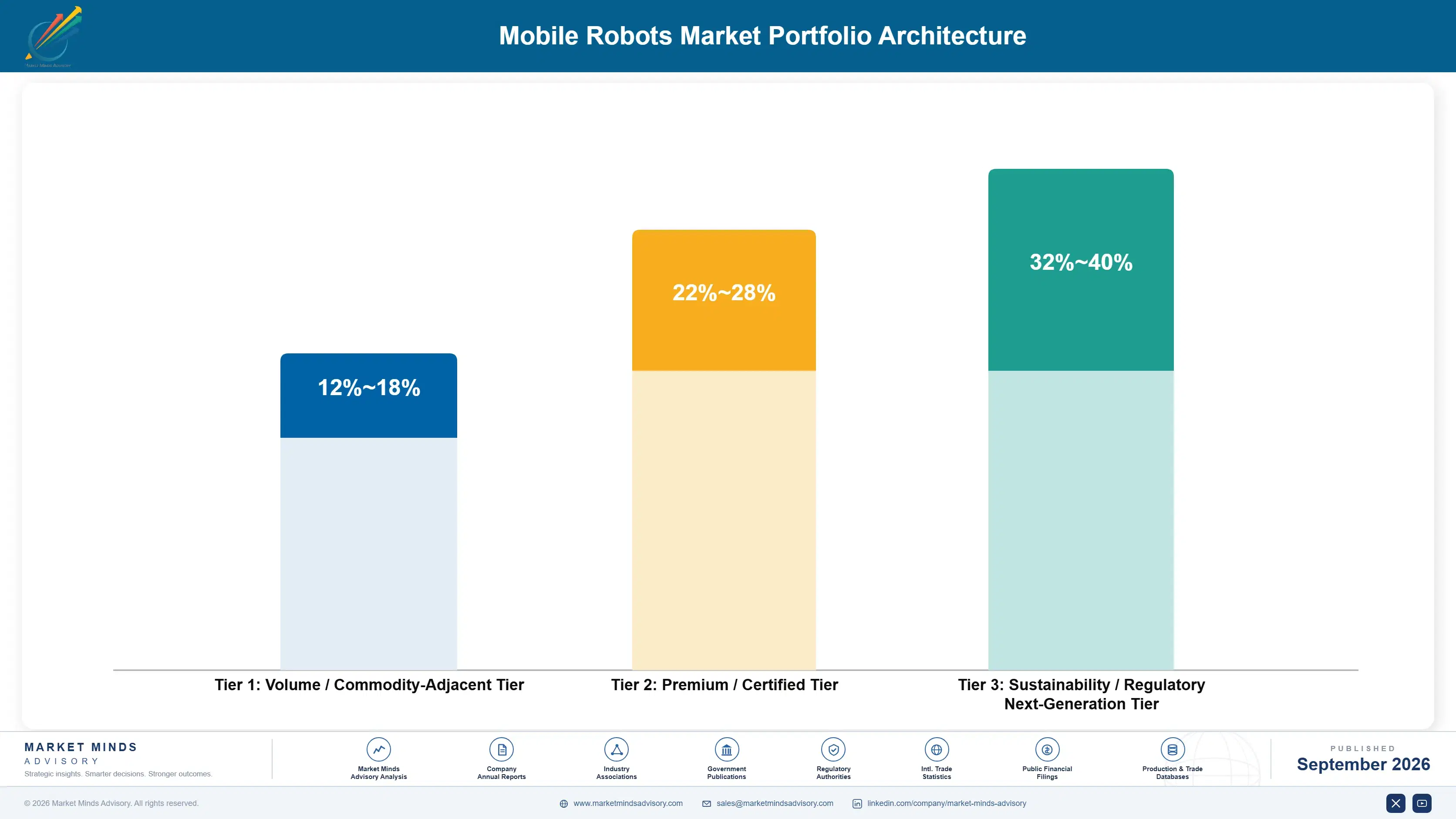
Portfolio economics split across three tiers running from commodity-adjacent standard fixed-path robots through certified AI-navigation-validated equipment to next-generation orchestration-integrated platforms, with gross margin widening meaningfully at each successive tier as navigation flexibility and coordination complexity increase across the range. Manufacturers typically enter through the certified tier and expand upward as they build AI navigation and orchestration engineering depth. This progression mirrors patterns seen across other industrial automation categories.
Volume still concentrates in the certified AI-navigation-validated tier where most current large-facility deployments sit today, but the orchestration-integrated platform tier is growing faster and increasingly determines which manufacturers win the largest multi-year facility agreements across major logistics and manufacturing accounts. This tension between defending volume and chasing premium contracts increasingly shapes manufacturer product roadmaps. Manufacturers that can move customers up this tier structure over time capture.

High-value margin pools concentrate specifically around orchestration-integrated platforms and AI-navigation-validated deployments, where perception complexity and coordination expertise keep standard fixed-path competitors from competing effectively on price alone across the largest large-facility accounts. Building presence in both pools simultaneously is increasingly the strategy leading manufacturers pursue. Manufacturers without meaningful presence in either pool increasingly struggle to defend pricing on renewal.

Volume / Commodity-Adjacent Tier

Standard fixed-path robots meeting baseline smaller-facility specifications, sold mainly on price into smaller deployment contracts without extensive navigation requirements. Renewal rates here run lower than higher tiers given weaker switching costs.
Gross Margin: 12%-18%

Premium / Certified Tier

Certified AI-navigation-validated equipment meeting large-facility flexibility standards, commanding meaningful price premiums over standard robots given the perception barrier competitors must clear first. Buyers in this tier weigh deployment track record heavily during manufacturer selection.
Gross Margin: 22%-28%

Sustainability / Regulatory / Next-Generation Tier

Orchestration-integrated platforms sold into flagship large-facility contracts, carrying the widest margins given coordination complexity and scarce qualified engineering capacity. This tier is growing fastest as buyers prioritise fleet-wide orchestration over standard individual robot deployment.
Gross Margin: 32%-40%
mobile-robots-market-portfolio-architecture-1788677969552

High-value Sub-segments and Strategic Watch-out

Orchestration-Integrated Large-Facility Platforms

Orchestration-integrated platforms serving flagship large-facility contracts command the widest margins in the category as operators shift toward coordinated fleet-wide automation, though the qualified manufacturer pool remains small given the technology investment this segment requires today. Manufacturers here can charge substantially more given the scarcity of rivals.
Gross Margin: 34%-40%

AI-Navigation-Validated Dynamic Deployment Platforms

AI-navigation-validated platforms serving dynamic facility deployment grow steadily as operators continue expanding layout flexibility requirements, commanding solid premiums over standard equipment though not yet matching orchestration platform margins across most current contracts. This pool is expected to expand steadily as more facilities complete navigation transitions.
Gross Margin: 24%-30%

Standard Certified Mid-Size Facility Robots

Standard certified robots serving mainstream mid-size facility operations remain the largest volume pool by a wide margin, carrying moderate but stable margins as continued automation investment guarantees multi-year equipment sales visibility across established relationships. This remains the segment most manufacturers depend on for predictable near-term revenue.
Gross Margin: 16%-22%

Legacy Fixed-Path Automated Guided Vehicles

Legacy fixed-path vehicles sold into smaller facility contracts without dynamic navigation or orchestration requirements face the greatest margin compression risk as AI-driven platforms gradually displace standalone fixed-path equipment across new procurement decisions industry-wide. Manufacturers still selling exclusively into this segment face a shrinking addressable customer base.
Gross Margin: 6%-12%

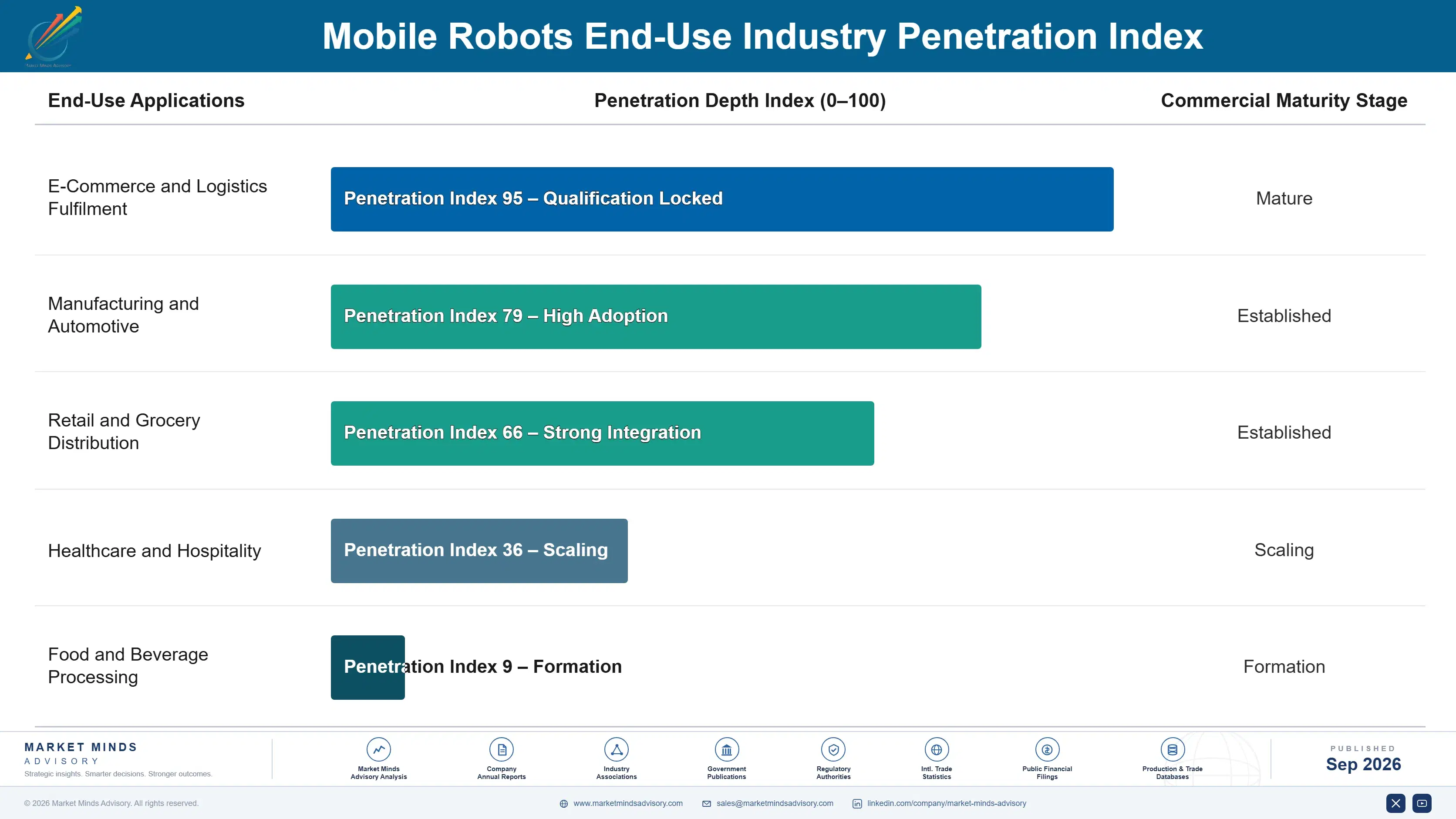
Adoption Depth and Facility Renewal Cycles

Mobile robot revenue behaves like a multi-year annuity tied to facility automation renewal cycles, since a deployed fleet typically retains its position across the full multi-year contract term once initial integration and operations team training clears successfully within a given facility's automation programme. Multi-year contract terms are increasingly standard across the largest large-facility accounts today. Multi-year contract terms are increasingly standard across.
Adoption depth varies meaningfully by facility tier: large distribution centres and manufacturing plants integrate qualified manufacturers deeply into multi-year automation relationships spanning several fleet generations, while smaller regional facilities often switch providers more frequently based on equipment pricing competitiveness alone without comparable long-term partnership commitments established. Mid-size facilities sit somewhere between these two extremes, valuing deployment flexibility over the deepest possible integration. This flexibility preference is expected.

A generational shift is underway as operations managers who managed manual material handling for decades give way to teams expecting AI-driven fleet orchestration by default, accelerating robot adoption faster than the underlying renewal cycle alone would suggest across most established large-facility organisations today. This generational change is reinforcing the broader shift toward dynamic navigation already underway. Manufacturer marketing strategies increasingly reflect this generational shift directly.
mobile-robots-market-end-use-penetration-index-1788677970048

Where Manufacturers Should Focus Investment Next

These are among the four positions where our research anticipates prominent divergence between winners and laggards over the coming forecast period. Each is grounded in the demand model, the regulatory perimeter, and the announced capacity pipeline.
01 / NAVIGATION CAPABILITY INVESTMENT

Build AI-Driven Dynamic Navigation Now

Large-facility operators increasingly treat dynamic navigation as a baseline procurement expectation rather than a differentiator, and manufacturers without this capability risk losing competitive bids regardless of mechanical build quality offered against better-integrated alternatives already available in the market. Manufacturers who have already built dynamic navigation report winning a growing share of large-facility contracts specifically because it delivers measurable redeployment flexibility that fixed-path automation alone cannot match. MMA advises treating navigation investment as a near-term competitive prerequisite, not a future roadmap item.
02 / ORCHESTRATION DEPTH PRIORITY

Build Fleet Orchestration Software Ahead of Demand

Expanding fleet coordination complexity is raising orchestration demand faster than most manufacturers have prepared for, meaning demand for deep orchestration capability will keep expanding regardless of near-term fluctuations in overall facility automation budget cycles. Manufacturers who invest in orchestration ahead of this expansion are positioned to win contracts that unorchestrated competitors simply cannot serve, a durable coordination advantage rather than a temporary pricing edge. MMA recommends treating orchestration as a multi-year commitment justified by clear fleet complexity trends already underway.
03 / INTEGRATION MIDDLEWARE INVESTMENT

Build Legacy Integration Capability for Displacement

Legacy manual material handling displacement represents a meaningfully larger addressable opportunity than new facility acquisition alone, but integration complexity keeps many established facilities locked into manual processes regardless of demonstrated advantages competing automated alternatives could otherwise deliver. Manufacturers who have already built standardised integration middleware report winning a growing share of displacement contracts specifically because faster integration reduces the operational disruption risk customers weigh heavily during deployment decisions. MMA sees integration capability as an increasingly important prerequisite for winning the largest displacement opportunities going forward.
04 / SENSOR COST MANAGEMENT

Negotiate Multi-Year Sensor Agreements Before the Next Cycle

Sensor and semiconductor component cost volatility has already compressed margins at manufacturers without favourable committed-volume agreements, and this exposure grows as more manufacturers sign fixed-price multi-year contracts without matching cost protection built into contract terms from the outset. Negotiating multi-year sensor agreements ahead of the next pricing cycle protects margin through the full contract term regardless of subsequent component cost swings. MMA sees sensor cost management as a prerequisite for manufacturers pursuing the largest large-facility framework agreements, not merely a defensive measure.

Engagement Snapshot From the Field

A live engagement with an industry participant carrying material or product regulatory and market exposure ahead of a defining policy shift, showing how our research translates into a defensible multi-year portfolio strategy.
MARKET MINDS ADVISORY · CLIENT ENGAGEMENT SUMMARY
Mobile Robots Producer Strategic Portfolio Review and Transition Roadmap 2026·Investment Scenario on Mobile Robots Exposure Evaluation 2025-26
CLIENT PROFILE
The client is a global e-commerce fulfilment operator managing multiple distribution centre automation programmes and approached MMA following persistent throughput constraints across its legacy manual picking operations, reportedly costing over 7 million dollars in delayed order fulfilment annually (client-reported, unverified by MMA) tied to labour shortages and inconsistent picking accuracy. The organisation operates across six regional distribution centres and had grown substantially through recent acquisition activity.
STRATEGIC CHALLENGE
Leadership needed an evidence-based business case justifying investment in AI-driven mobile robot fleets across multiple regional distribution centres, but internal operations and finance teams disagreed sharply on realistic throughput improvement assumptions and appropriate deployment timeline expectations for the transition. Leadership also needed confidence that deployment would not disrupt active fulfilment operations already underway across centres.
MMA APPROACH
MMA benchmarked comparable e-commerce fulfilment fleet deployment programmes, modelled throughput improvement against historical labour shortage and accuracy costs, and built a phased deployment framework prioritising the highest-value distribution centres by both order volume and labour constraint severity. The framework explicitly sequenced deployment to minimise disruption to active fulfilment operations throughout the transition.
KEY FINDINGS
  1. Distribution centres with the highest labour constraint severity accounted for a disproportionate share of documented fulfilment delays relative to their share of overall order volume.
  2. AI-driven fleet deployment reduced modelled picking inaccuracy substantially based on comparable e-commerce fulfilment deployment data reviewed across similar distribution centre structures across the operator's full distribution network.
  3. Prioritising deployment by labour constraint severity rather than centre size alone improved the projected throughput return meaningfully within the proposed phased deployment structure.
  4. Bundling AI-driven fleet orchestration with the deployment contract shortened projected value realisation timeline versus a traditional separately procured hardware and software approach.
CLIENT PROFILE
The client is a global e-commerce fulfilment operator managing multiple distribution centre automation programmes and approached MMA following persistent throughput constraints across its legacy manual picking operations, reportedly costing over 7 million dollars in delayed order fulfilment annually (client-reported, unverified by MMA) tied to labour shortages and inconsistent picking accuracy. The organisation operates across six regional distribution centres and had grown substantially through recent acquisition activity.
STRATEGIC CHALLENGE
Leadership needed an evidence-based business case justifying investment in AI-driven mobile robot fleets across multiple regional distribution centres, but internal operations and finance teams disagreed sharply on realistic throughput improvement assumptions and appropriate deployment timeline expectations for the transition. Leadership also needed confidence that deployment would not disrupt active fulfilment operations already underway across centres.
MMA APPROACH
MMA benchmarked comparable e-commerce fulfilment fleet deployment programmes, modelled throughput improvement against historical labour shortage and accuracy costs, and built a phased deployment framework prioritising the highest-value distribution centres by both order volume and labour constraint severity. The framework explicitly sequenced deployment to minimise disruption to active fulfilment operations throughout the transition.
KEY FINDINGS
  1. Distribution centres with the highest labour constraint severity accounted for a disproportionate share of documented fulfilment delays relative to their share of overall order volume.
  2. AI-driven fleet deployment reduced modelled picking inaccuracy substantially based on comparable e-commerce fulfilment deployment data reviewed across similar distribution centre structures across the operator's full distribution network.
  3. Prioritising deployment by labour constraint severity rather than centre size alone improved the projected throughput return meaningfully within the proposed phased deployment structure.
  4. Bundling AI-driven fleet orchestration with the deployment contract shortened projected value realisation timeline versus a traditional separately procured hardware and software approach.
RECOMMENDED STRATEGY
Phase 1: Phase 1 (Months 1 to 3): Deploy the highest-labour-constraint distribution centres first, bundled with AI-driven fleet orchestration included from the outset. Phase 2: Phase 2 (Months 4 to 9): Extend deployment across remaining priority centres identified through the constraint-based prioritisation framework developed during scoping. Phase 3: Phase 3 (Months 10 to 14): Retire the legacy manual picking operations entirely once all distribution centres complete the deployment transition successfully.
OUTCOME
The client approved a fourteen-month deployment programme following the engagement, with Phase 1 centre deployment reportedly reducing order fulfilment delay by roughly 40 percent against the prior baseline (client-reported, unverified by MMA), supporting the case for full network deployment continuation. Leadership credited the phased structure with maintaining fulfilment continuity throughout the transition period.

Frequently Asked Questions

Foundational context covering the market sizes, CAGR, scope, country, region and competition that inform every finding below. This section is provided to cover basics and most often pre-purchase conversations, answered from the MMA Primary Research Dataset.

What is the current size of the Mobile Robots Market?

The global mobile robots market reached approximately 8.5 billion dollars in 2025. East Asian manufacturers and logistics operators anchor a substantial share of global demand within this total.

How large will the Mobile Robots Market be by 2036?

MMA projects the market reaching approximately 41.48 billion dollars by 2036 under the base case scenario. AI-driven navigation adoption and persistent labour shortages both support this trajectory.

What is the CAGR for the Mobile Robots Market 2026 to 2036?

The base case CAGR is 15.5 percent across the forecast period. Bull and bear scenarios range between roughly 14.2 and 16.9 percent depending on AI adoption pace and integration complexity.

Which segment is growing fastest?

AI-driven fleet orchestration and navigation software leads at 19.6 percent CAGR, well above the overall market rate. Operators shifting budget toward coordinated fleet-wide automation is the primary driver behind this growth.

Who are the major companies in the Mobile Robots Market?

Leading manufacturers include KUKA AG, ABB Ltd, FANUC Corporation, Geek+ Inc, and Locus Robotics Corp. Combined, the top five hold roughly 34 percent of global qualified robot shipment revenue.

Which country is growing fastest?

Vietnam leads among major markets at approximately 19.0 percent CAGR, driven by its rapidly expanding manufacturing sector. Continued production facility relocation reinforces this pace across the country.

Report Segmentation Architecture

The full report scope spans multiple orthogonal segmentation dimensions, with cross-tabulated demand data provided for each dimension pair. Coverage extends further to regional breakdowns, trend trajectories, and the competitive detail needed to support segment-level decision-making.

By Core Robot Type and Navigation Technology

  • Automated Guided Vehicles
  • Autonomous Mobile Robots
  • Robotic Process Picking and Sortation Systems
  • Last-Mile and Outdoor Delivery Robots
  • AI-Driven Fleet Orchestration and Navigation Software
  • Mobile Robot Integration and Deployment Services

By End-Use Industry

  • E-Commerce and Logistics Fulfilment
  • Manufacturing and Automotive
  • Retail and Grocery Distribution
  • Healthcare and Hospitality
  • Food and Beverage Processing

By Commercial Dimension

  • New Equipment Purchase Agreements
  • Robots-as-a-Service Subscription Contracts
  • Fleet Financing and Lease Programmes
  • Integration and Deployment Service Fees

By Region

  • North America
  • Western Europe
  • East Asia
  • South Asia and Pacific
  • Latin America
  • Middle East and Africa
  • Eastern Europe

Scope, Methodology, and Coverage

Every figure in this report is reproducible from documented input assumptions. The scope below maps the historical period, the forecast horizon, the segmentation dimensions, and the countries covered, alongside the underlying primary and qualitative methodology.
Historical Period
2020 to 2025
Forecast Period
2026 to 2036
Base Year
2025 (USD billions; MMA Primary Research Dataset, September 2026)
Market Definition
This report covers hardware and software for robots capable of independent movement within facility environments, including automated guided vehicles, autonomous mobile robots, delivery platforms, and AI-driven fleet orchestration software. It excludes fixed robotic arms and manipulators without mobility functionality, consumer and household robots not used in commercial or industrial settings, and drones and aerial robots operating outside ground-based facility environments.
Quantitative Units
USD billions (current prices); robot units shipped across major deployment regions
Segmentation Dimensions
By Core Robot Type and Navigation Technology; By End-Use Industry; By Commercial Dimension; By Region
Regions Covered
North America, Western Europe, East Asia, South Asia and Pacific, Latin America, Middle East and Africa, Eastern Europe
Countries Covered
China, USA, Japan, South Korea, Germany, France, UK, Vietnam, India, Canada, Australia, Brazil, Mexico, Chile, Argentina, UAE, Saudi Arabia, South Africa, Nigeria, Turkey, Poland, Czech Republic, Netherlands, Italy, Spain, Sweden, Switzerland, Thailand, Indonesia, Singapore, and additional markets relevant to this sector
Key Companies Profiled
KUKA AG, ABB Ltd, FANUC Corporation, Geek+ Inc, Locus Robotics Corp, Omron Corporation, Hai Robotics Co Ltd, inVia Robotics Inc, Fetch Robotics Inc, 6 River Systems Inc, Vecna Robotics Inc, Seegrid Corporation, Mobile Industrial Robots AS, AutoStore AS, Exotec SAS, GreyOrange Inc, Boston Dynamics Inc, Agility Robotics Inc, Zebra Technologies Corporation, Teradyne Inc
Quantitative Methodology
Primary survey, n=3,800 respondents, Q4 2025, six countries; demand-side model with trade association cross-validation
Qualitative Methodology
47 expert interviews, Q4 2025; applied to validate demand model assumptions, identify emerging dynamics, and assess competitive positioning
Report Format
PDF and XLSX data workbook (Word format preview document)
Publisher
Market Minds Advisory
Report Code
MMA-2026-CON-101
Published
September 2026
Contact
sales@marketmindsadvisory.com | www.marketmindsadvisory.com

Purchase the full Mobile Robots Market Report (2026 to 2036).

The full MMA report delivers granular segmentation across six robot type and technology tiers, seven-region demand and pricing forecasts through 2036, and a detailed competitive assessment of twenty profiled manufacturers including AI navigation capability and orchestration depth positioning. It includes a dedicated facility automation adoption tracker covering major logistics and manufacturing markets, plus quarterly sensor and component cost pass-through analysis. Buyers receive editable data tables supporting internal capacity planning and manufacturer evaluation models across their full deployment portfolio. A dedicated appendix profiles labour regulation timelines across major jurisdictions, with commentary on how requirements are expected to evolve through the forecast period.
Seven-region demand and pricing forecasts to 2036
Twenty-manufacturer AI navigation status tracker table
Facility automation adoption pipeline tracker tool
Quarterly sensor and component cost pass-through model
Segment-level margin benchmarking across all tiers
Editable capacity planning and manufacturer evaluation tables

Built For The People Who Decide

From boardroom strategy to bench-side execution, this report is read cover-to-cover by leaders shaping the next decade of their industry, turning demand scenarios, market dynamics and valuation benchmarks into decisions.
CXOs/ Presidents/ VPs/ Managers
M&A and Corporate Development
Strategy Teams and R&D Heads
Procurement and Product Directors
Regulatory and Compliance Leaders
Investor Relations and Equity Analysts