Market Minds Advisory
Mobile Payment Data Protection Market

Mobile Payment Data Protection Market: Security Infrastructure for Mobile Transaction Networks.

Real-time payment rails demand fraud scoring within milliseconds, pushing mobile payment security past static tokenization into continuous risk assessment as regulatory mandates and rising fraud losses reward vendors who score risk faster than rivals.

Lead Analyst

Published

September 2026

Make Smarter Decisions with Customized Research Insights

Request a free sample report and evaluate market opportunities, growth trends, and competitive dynamics relevant to your business needs.

2025 MARKET VALUE$6.8BMarket Size 2025
2036 FORECAST VALUE$27.4BBase Case , 2026 to 2036
CAGR 2026 TO 203613.5 %Bull 14.8% / Bear 12.2%
INCREMENTAL OPPORTUNITY$19.7BNet 10- year value creation
EXPANSION MULTIPLE3.55x2036 value over 2026 base
Strategic Levers
M&A Pipeline
Regional Outlook
Country Rankings
Competitive Intelligence
Segmental Deep-dive
Call-Us : 91 93563 13602

Executive Snapshot and Market Trajectory.

Mobile payment data protection has shifted from a compliance checkbox into a genuine competitive differentiator, as tokenization and biometric authentication increasingly determine which payment platforms merchants and consumers trust with high-value transactions at meaningful scale across most digital commerce categories worldwide today, from retail checkout through instant peer transfer.
Rising mobile transaction fraud and expanding regulatory mandates are the two dominant commercial forces, concentrating volume in East Asia, where mobile wallet transaction density and QR code payment penetration both outpace most other regions of the world today. Tokenization solutions for mobile wallet and in-app payments absorb a rapidly growing share of spend, since replacing raw card data with single-use tokens meaningfully reduces breach exposure across the entire payment chain.
Competitive intensity spans established card network security divisions alongside specialized cybersecurity vendors competing on biometric authentication accuracy and fraud detection speed, a dynamic reshaping vendor selection criteria across large merchant and bank accounts worldwide today. Expanding real-time payment rail adoption is pulling advanced fraud prevention into transaction categories that previously relied on slower, less sophisticated batch-based screening approaches entirely across most of the industry's largest markets.
Market Definition
The Mobile Payment Data Protection Market covers tokenization, encryption, biometric authentication, and fraud detection technologies used to secure mobile wallet, in-app, and QR code transactions. It excludes general enterprise cybersecurity software, physical point-of-sale hardware, and card issuance services not directly tied to mobile transaction security.
Base Year Value
$6.8B in 2025 (MMA Primary Research Dataset, September 2026)
Forecast Period
2026 to 2036, eleven discrete annual values
CAGR
13.5% base case. Bull 14.8%. Bear 12.2%.
Fastest Growth Segment
Tokenization Solutions for Mobile Wallet and In-App Payments: 20.0% CAGR
Fastest Growth Country
India: 17.5% CAGR
Fastest Growth Region
South Asia and Pacific: 16.0% CAGR
Largest Region
East Asia: 29% of 2025 global value
Market Leaders
Visa, Mastercard, Thales, Entrust, and RSA Security lead the global Mobile Payment Data Protection Market. Source: MMA Primary Research Dataset, July 2026, and company disclosures.
Primary Survey
n=3,800 procurement and R&D decision-makers, Q4 2025, six countries
Methodology
Demand-side build-up, cross-validated against public data, 47 expert interviews

Mobile Payment Data Protection Market Forecast Scenarios

mobile-payment-data-protection-market-size-forecast-scenario-1790007603117
Mobile payment data protection grew rapidly across 2020 to 2025, as pandemic-driven contactless payment adoption and expanding mobile wallet penetration forced merchants and financial institutions to invest heavily in fraud prevention and tokenization infrastructure that many had previously treated as a lower-priority compliance concern rather than genuinely core transaction infrastructure demanding sustained annual investment across every payment channel.
The base case assumes continued mobile wallet transaction volume growth, expanding regulatory mandates requiring strong customer authentication across major markets, and gradual industry-wide migration from static card data toward single-use tokenization standards. These three mechanisms together sustain strong double-digit growth even as mature markets approach saturation in basic tokenization adoption, shifting incremental spend toward more sophisticated behavioral biometric and real-time fraud scoring capabilities that increasingly command meaningfully higher unit pricing overall.
A bull scenario centers on accelerated real-time payment rail adoption globally pulling advanced fraud prevention investment well beyond current forecasts across both developed and emerging mobile payment markets alike. A bear scenario centers on slower-than-expected regulatory enforcement combined with payment industry consolidation reducing the number of independent security technology buyers across major markets worldwide over time.

Fraud Speed Now Outpaces Static Defense

Mobile payment security demand now tracks transaction volume and fraud sophistication more than raw merchant count, since a single high-volume wallet provider processing billions of transactions annually generates far more security infrastructure spend than thousands of small merchants combined. This volume concentration shapes vendor pricing models and product roadmap priorities far more than headline merchant adoption figures ever could, reorienting sales strategy toward a handful of dominant platform accounts.
MARKET CONCENTRATIONCR5 46%Moderately concentrated among a handful of established card network vendors
AVERAGE SELLING PRICE$0.02-$0.08Priced per transaction rather than as flat fixed fee
TOP PRODUCING REGIONEast Asia 41%Transaction volume concentrated among the highest-density mobile wallet markets
CAPACITY UTILIZATION72-80%Fraud detection infrastructure scales with peak transaction volume
INPUT COST SHARE28% of COGSCloud computing and machine learning infrastructure dominate cost
REPLACEMENT CYCLE3-5 YearsSecurity platforms typically refreshed as underlying fraud patterns evolve
Commercial character has shifted from point-in-time compliance certification toward continuous, real-time risk scoring, where fraud detection latency increasingly determines which security vendors merchants and banks are willing to trust with live transaction authorization decisions. Vendors unable to score risk within milliseconds increasingly lose contracts to rivals whose infrastructure processes decisions considerably faster, since even modest added latency degrades checkout conversion rates measurably.
Expanding real-time payment rail adoption, tightening strong customer authentication mandates, and growing behavioral biometric sophistication will shape mobile payment security demand through the next decade, with vendors solving sub-second fraud scoring best positioned to capture the largest transaction volumes across both developed and rapidly digitizing emerging markets where mobile-first payment adoption continues accelerating well beyond earlier industry projections.
"Fraud used to move at the speed of a stolen card number. Now it moves at the speed of a compromised API, and most legacy security stacks simply cannot keep up."
Director, Payment Security and Fraud Prevention Practice · MMA Technology Practice · September 2026

Market Trends

Behavioral Biometrics Replace Static Password Authentication

Mobile payment providers increasingly deploy behavioral biometric authentication, analyzing typing rhythm, device handling patterns, and touchscreen pressure to verify user identity continuously rather than at a single login moment. This shift directly addresses the vulnerability of static passwords and even one-time codes to phishing and SIM-swap attacks that have compromised millions of accounts across major markets in recent years. Several leading mobile wallet providers have disclosed plans to make behavioral biometric authentication a standard feature across their platforms within the next two years, a timeline several security executives privately consider ambitious but achievable.
Market Impact: Compliance-driven spend up 28%

Real-Time Payment Rails Demand Sub-Second Fraud Scoring

The expansion of real-time payment rail infrastructure across multiple countries requires fraud detection systems capable of scoring transaction risk within milliseconds, since real-time settlement leaves no window for the batch-based fraud review processes that traditional card payment systems historically relied upon. This latency requirement has pushed considerable vendor investment into machine learning infrastructure optimized for sub-second inference speed. Multiple central banks have disclosed real-time payment rail expansion plans that directly increase demand for this specialized fraud scoring capability across their respective national payment infrastructure roadmaps over the next several years of planned rollout.
Market Impact: Mobile fraud losses up 22%

Market Opportunities and Growth Drivers

Regulatory Mandates Require Strong Customer Authentication

Financial regulators across multiple major markets have implemented strong customer authentication mandates requiring multi-factor verification for mobile payment transactions above defined value thresholds, directly driving tokenization and biometric authentication adoption across the payment industry. These regulatory requirements apply uniformly across banks, payment processors, and mobile wallet providers operating within covered jurisdictions, creating consistent baseline demand independent of individual company risk appetite or competitive positioning. Several additional markets have disclosed plans to introduce comparable authentication requirements within the coming years, extending the addressable compliance-driven market considerably further across both developed and emerging economies alike.
Market Impact: Integration takes 12 to 18 months

Rising Mobile Transaction Fraud Losses Drive Investment

Documented mobile payment fraud losses have grown considerably faster than transaction volume itself in several major markets, driven by increasingly sophisticated social engineering and account takeover techniques that exploit gaps in legacy authentication systems. This gap between fraud loss growth and transaction volume growth directly pressures merchants and financial institutions to increase security technology spending beyond historical baseline levels. Several major card networks have disclosed fraud loss figures reaching billions of dollars annually across their combined mobile payment networks over the most recently reported fiscal year across their combined global transaction networks.
Market Impact: Cart abandonment rises 8% with friction

Market Restraints and Challenges

Legacy Bank Infrastructure Slows Integration Timelines

Many financial institutions still operate core banking infrastructure built decades before mobile payment technology existed, whose root cause traces to the enormous cost and operational risk of replacing systems that process critical financial transactions continuously without acceptable downtime. The commercial impact extends security technology integration timelines considerably beyond vendor sales cycle expectations, frustrating both security vendors and bank technology teams alike. Vendors are pursuing mitigation through modular integration approaches that layer new security capability atop existing infrastructure rather than requiring full core banking system replacement across the institution's entire technology estate.
Market Impact: Behavioral biometric adoption up 35% yearly

Consumer Friction Concerns Limit Authentication Strictness

Merchants and mobile wallet providers resist authentication measures that add meaningful friction to checkout flow, whose root cause lies in documented cart abandonment increases whenever transaction completion requires additional verification steps beyond a single tap or biometric scan. The commercial impact limits how aggressively merchants deploy the strongest available fraud prevention measures despite clear security benefits. Vendors are pursuing mitigation through invisible risk scoring that operates in the background without requiring explicit additional customer action for transactions the underlying risk model already classifies as genuinely low risk based on historical behavior patterns.
Market Impact: Real-time rail transactions up 40% annually
4 additional market trends, 4 additional growth drivers, and 4 additional restraints and challenges are covered in the full report. Contact sales@marketmindsadvisory.com to access the complete intelligence.

Segment CAGR and Growth Architecture

The Mobile Payment Data Protection Market segments by security technology function, since tokenization, authentication, and fraud detection address distinct risk points across the transaction chain and require fundamentally different technical infrastructure and vendor expertise, rather than by underlying payment rail or transaction channel alone, which matters far less to how buyers actually evaluate and procure these tools.
mobile-payment-data-protection-market-market-share-analysis-1790007603715

Tokenization Solutions for Mobile Wallet and In-App Payments

Tokenization solutions replace sensitive card and account data with single-use or device-bound tokens, meaningfully reducing breach exposure across mobile wallet and in-app payment transactions. Demand here grows fastest because regulatory mandates and card network requirements increasingly push tokenization from an optional security enhancement toward a baseline transaction requirement across major markets. Vendors with proven tokenization infrastructure at scale increasingly capture new mobile wallet provider relationships over smaller competitors lacking equivalent transaction volume handling experience and network reliability track records built up across multiple years of continuous high-volume production operation without significant service disruption, transaction failure, or any publicly disclosed breach incident affecting customer trust across the vendor's entire installed base of mobile wallet and banking clients.
CAGR 20.0%

Biometric Authentication for High-Value Transaction Verification

Biometric authentication solutions verify user identity through fingerprint, facial recognition, or behavioral pattern analysis for high-value mobile transactions requiring strong customer authentication. This segment grows quickly as regulatory mandates expand across major markets and consumers increasingly expect frictionless authentication that does not require memorizing passwords or carrying separate hardware tokens. Vendors with proven authentication accuracy and low false rejection rates increasingly win bank and wallet provider contracts over competitors with less mature biometric technology stacks and comparatively higher false rejection rates in live production environments handling large, geographically diverse transaction volumes across varied device hardware, camera quality, and ambient lighting conditions found across the full range of real-world consumer device usage scenarios worldwide.
CAGR 16.5%
Full segment breakdown across 6 segments available in the complete report.

Regional Architecture and Country Demand Map

Mobile payment security demand concentrates wherever mobile wallet transaction density is greatest, with East Asia leading on QR code and super-app payment volume while North America anchors substantial card network security infrastructure investment worldwide today across nearly every major transaction category, from card-present retail through fully digital in-app checkout.

North America

North American demand centers on card network security infrastructure investment and bank tokenization deployment, with the United States hosting the headquarters and primary engineering operations of Visa, Mastercard, and several leading cybersecurity vendors serving the payment industry. Rising mobile wallet adoption through major technology platform payment services continues driving tokenization infrastructure investment across banks and merchants nationwide, particularly among large regional and national banks investing heavily in fraud infrastructure modernization. Regulatory attention to payment fraud, combined with growing real-time payment rail adoption through domestic instant payment networks, sustains demand well above legacy card-present transaction security spending across most major financial institutions nationwide, particularly among large regional and national banks investing heavily in fraud infrastructure modernization.
Share: 27% | CAGR: 13.0% (2026 to 2036)

Western Europe

Western European demand draws heavily on strong customer authentication regulatory mandates that require multi-factor verification for mobile payment transactions above defined value thresholds across the region. Germany, France, and the United Kingdom anchor most regional security technology spending, driven by both regulatory compliance requirements and growing instant payment scheme adoption across the broader European banking system. European banks continue investing in biometric authentication and fraud detection infrastructure to meet both regulatory requirements and rising consumer fraud protection expectations across an increasingly cashless retail environment where consumer trust in digital payment security carries real commercial weight for every participating bank, payment processor, and merchant operating across the region's tightly regulated market.
Share: 19% | CAGR: 11.5% (2026 to 2036)
Regional intelligence for 5 additional markets available in the complete report: East Asia, South Asia and Pacific, Latin America, Middle East and Africa, Eastern Europe. Contact sales@marketmindsadvisory.com.
mobile-payment-data-protection-market-country-cagr-analysis-1790007604234

How Security Vendors Actually Capture Margin

Mobile payment security vendors capture value beyond baseline licensing fees through four commercial mechanisms that reward transaction volume depth and regulatory expertise over one-time software sale margin. Per-transaction pricing models, fraud liability shift agreements, managed detection services, and premium biometric accuracy tiers all matter considerably more here than flat licensing fees ever really did.

Charging Per-Transaction Fees Tied to Volume Growth

Vendors that price fraud detection and tokenization services on a per-transaction basis capture revenue that scales directly with customer transaction volume growth, rather than negotiating flat annual licensing fees that leave money on the table as customers scale. This pricing model typically generates 0.02 to 0.08 cents per transaction, compounding meaningfully as mobile wallet adoption expands across a customer's user base. Vendors with proven infrastructure reliability at massive transaction scale increasingly win this pricing structure over smaller rivals lacking comparable throughput track records at genuinely massive production scale across billions of transactions processed each year.
Market Impact: Per-transaction pricing scales directly with 40% annual growth

Offering Fraud Liability Shift Guarantee Programs

Vendors that offer fraud liability shift guarantees, assuming financial responsibility for fraud losses occurring despite proper use of their security technology, capture premium pricing from merchants and banks seeking to transfer fraud risk exposure. This guarantee structure typically commands 30 to 45% higher pricing than standard detection-only services, reflecting the vendor's own confidence in detection accuracy and their willingness to absorb residual fraud risk. Vendors offering these guarantees increasingly win risk-averse enterprise banking accounts over competitors unwilling to accept meaningful liability exposure on their own balance sheet without adequate reserve capital or actuarial modeling in place.
Market Impact: Liability shift programs command 30 to 45% premium

Providing Managed Fraud Detection Monitoring Services

Vendors offering fully managed fraud detection monitoring services, including dedicated analyst teams reviewing flagged transactions and tuning detection models continuously, capture recurring service revenue equal to 25 to 35% of contract value beyond the underlying software license itself. This service layer matters particularly to mid-sized banks and merchants lacking dedicated internal fraud teams capable of managing detection systems around the clock. Vendors with proven managed service delivery capability increasingly win preferred-vendor status over software-only competitors lacking equivalent operational support infrastructure and dedicated round-the-clock analyst staffing capable of responding within minutes rather than hours during genuinely active fraud incidents.
Market Impact: Managed services add 25 to 35% of contract value

Expanding Premium Biometric Accuracy Product Tiers

Vendors expanding their premium biometric authentication tier, featuring lower false rejection rates and faster processing speed beyond standard offerings, capture incremental margin from banks willing to pay for reduced customer friction on high-value transactions. This tier typically commands 20 to 30% higher pricing than standard authentication products, reflecting the additional machine learning model training and testing investment involved. Vendors investing early in these premium accuracy tiers increasingly capture the highest-margin enterprise banking contracts across major markets where transaction volume and customer expectations both continue rising steadily year after year across nearly every mobile-first consumer demographic.
Market Impact: Premium accuracy tier commands 20 to 30% more

Who Controls the Margin Pool

Five firms hold roughly 46% of global mobile payment security revenue, a moderately concentrated market structure reflecting the transaction-scale advantages that card networks bring alongside genuine innovation from specialized cybersecurity vendors. Visa and Mastercard lead through their embedded position across the payment rail itself, while the gap to specialized fraud detection vendors remains meaningful on transaction volume handled, though narrower on detection sophistication and biometric accuracy where nimble specialists frequently outperform larger incumbents.
Current competitive activity centers on behavioral biometric authentication development, real-time fraud scoring infrastructure investment, and fraud liability shift program expansion, as vendors race to meet tightening regulatory authentication mandates. Card networks increasingly acquire specialized fraud detection and biometric authentication startups rather than building comparable capability entirely in-house, accelerating consolidation among smaller technical specialists across the industry over the past several years.

Emerging pressure comes from cloud hyperscalers offering fraud detection and identity verification services directly to merchants, potentially disintermediating traditional payment security vendors on smaller merchant accounts. Rankings shift fastest in real-time fraud scoring, where vendors with genuine sub-second inference infrastructure increasingly out-compete legacy batch-based competitors lacking comparable machine learning deployment capability at genuine production scale and reliability.
mobile-payment-data-protection-market-company-positioning-matrix-1790007604771

Competitive Moat and Risk Dimensions

VISA

Moat: Embedded Payment Rail Position

Visa's ownership of the underlying payment rail itself gives it privileged access to transaction data and network effects that standalone security vendors cannot replicate, letting Visa embed tokenization and fraud detection directly into transaction processing rather than bolting security on as a separate integration layer requiring additional merchant implementation effort.
VISA

Risk: Slower Innovation Cycle Pace

Visa's scale and regulatory scrutiny as critical payment infrastructure make it slower to deploy experimental fraud detection techniques than nimble specialized startups, risking share loss in newer behavioral biometric categories to competitors unencumbered by comparable operational risk tolerance constraints or the regulatory scrutiny that comes with critical payment infrastructure status.
THALES

Moat: Deep Cryptographic Hardware Expertise

Thales's decades of cryptographic hardware and secure element manufacturing expertise give it credibility with banks and governments requiring the highest security assurance levels, particularly for hardware-based tokenization and secure biometric enrollment that software-only competitors cannot fully replicate at comparable assurance levels or regulatory certification depth.
THALES

Risk: Higher Cost Than Software Rivals

Thales's hardware-centric business model carries meaningfully higher cost structure than software-only competitors, risking share loss among smaller merchants and banks seeking lower-cost, cloud-based security solutions that do not require dedicated hardware security module deployment, maintenance, and the specialized technical staff required to properly support it long-term.

Players Tracked

Prominent Players

Visa
Mastercard
Thales
Entrust
RSA Security

Other Key Players

IBM Security
Fiserv
FIS
ACI Worldwide
Feedzai
Kount
Signifyd
Ekata
Ping Identity
Okta
IDEMIA
Gemalto Legacy Products
Bottomline Technologies
Featurespace
BioCatch

Recent Developments

JANUARY 2026

Visa Expands Tokenization Infrastructure for Real-Time Payment Rails

Visa announced expanded tokenization infrastructure specifically designed for real-time payment rail transactions, addressing the sub-second fraud scoring requirements that instant settlement systems demand today across major payment markets worldwide. The expansion includes new dedicated data centers processing tokenization requests with latency well below existing infrastructure benchmarks.
Signal: Signals card networks are investing heavily ahead of accelerating real-time payment rail adoption around the world.
AUGUST 2025

Mastercard Acquires Behavioral Biometric Authentication Startup

Mastercard completed the acquisition of a behavioral biometric authentication startup with established typing rhythm and device handling pattern analysis technology, adding engineering talent and existing bank customer relationships to its broader identity verification product roadmap, extending its identity verification portfolio well beyond its traditional card network security offerings.
Signal: Signals card networks increasingly prefer acquiring specialized biometric technology rather than building it internally over time.
MARCH 2025

Thales Forms Strategic Partnership With Major Regional Bank Group

Thales entered a strategic partnership with a major regional bank group covering hardware-based tokenization and secure biometric enrollment infrastructure across the bank's mobile wallet platform, including committed multi-year deployment milestones across several countries where the bank group operates significant retail and mobile banking customer bases.
Signal: Signals banks increasingly favor established hardware security vendors for their highest-assurance deployment needs and compliance requirements.

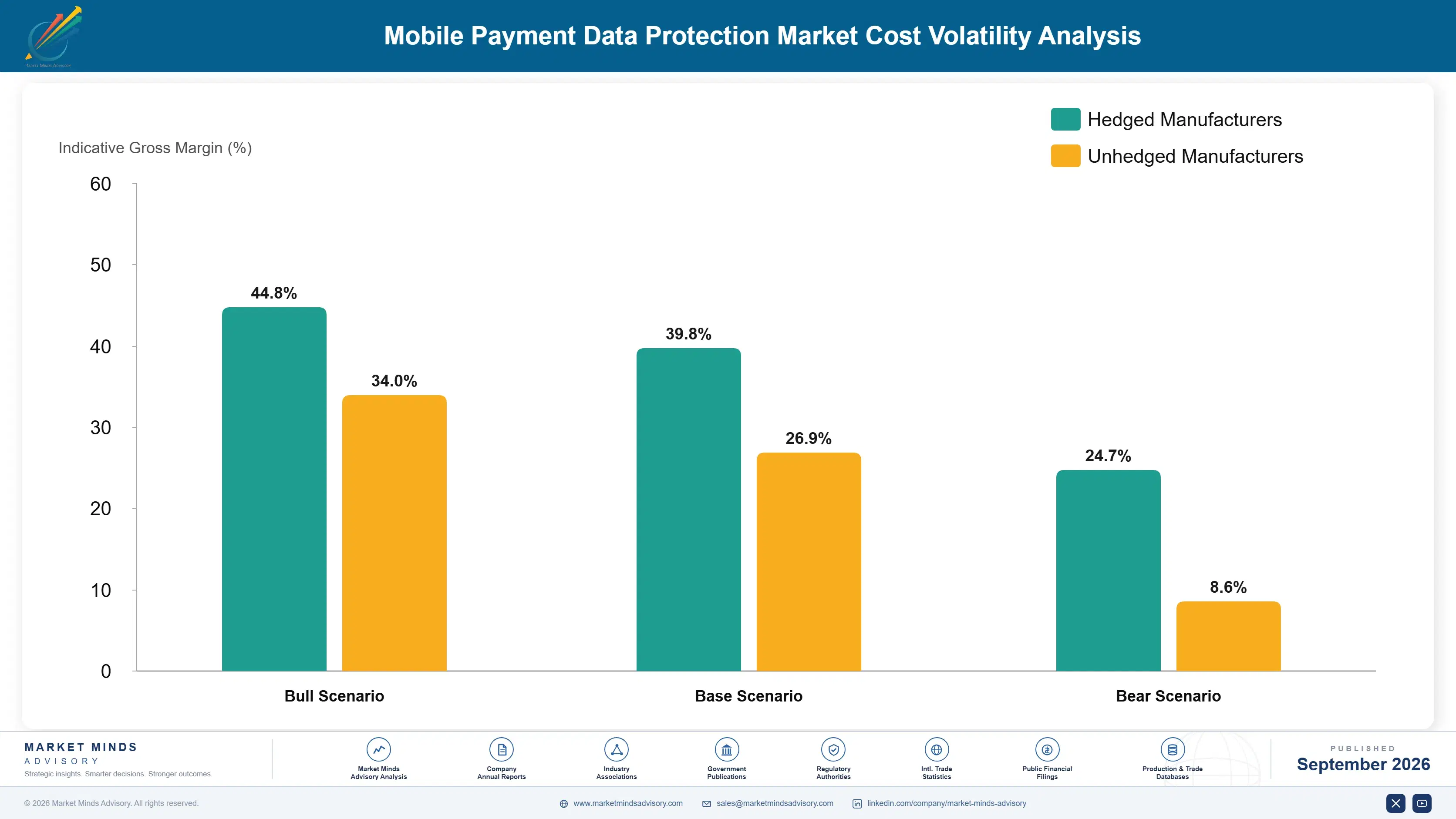
Cloud Machine Learning Infrastructure Drives Cost

Cloud computing and machine learning infrastructure together account for roughly 28% of mobile payment security vendor operating cost, sourced primarily from a handful of major cloud infrastructure providers concentrated in North America. This dependence on a limited number of hyperscale cloud platforms means most security vendors, regardless of their own headquarters location, rely on the same narrow global infrastructure supply base for compute capacity.
A documented cloud compute capacity constraint during 2024 pushed machine learning training costs up by roughly 25% and extended provisioning lead times, according to major cloud provider capacity disclosures referenced in industry analyst reporting, as demand for large-scale artificial intelligence model training pulled compute capacity away from fraud detection model development. Several security vendors delayed model retraining cycles as a direct consequence, temporarily degrading fraud detection accuracy during the affected period.

Smaller security vendors face a genuine competitive disadvantage here since they lack the purchase volume needed to secure preferential cloud computing pricing and priority capacity allocation, unlike larger vendors with enterprise-scale cloud infrastructure agreements. This dynamic favors companies like IBM Security with substantial internal infrastructure, while smaller specialized vendors increasingly pursue multi-cloud strategies and reserved capacity commitments as mitigation against recurring compute cost volatility.
mobile-payment-data-protection-market-cost-volatility-analysis-1790007604969

Negotiating Multi-Cloud Reserved Capacity Agreements

Larger security vendors are negotiating reserved capacity agreements across multiple cloud infrastructure providers rather than concentrating spend with a single provider, reducing exposure to any one platform's capacity constraints while also securing preferential pricing tied to committed long-term usage volume commitments spanning multiple years of projected consumption growth across their entire full customer transaction volume base worldwide.

Optimizing Machine Learning Models for Lower Compute Cost

Vendors are investing in model optimization techniques that reduce the computational cost of fraud detection inference without meaningfully sacrificing detection accuracy, allowing them to serve growing transaction volumes without proportionally increasing cloud infrastructure spending each year, freeing budget for other strategic priorities like expanding into new geographic markets, product lines, and customer verticals over time.

Building Hybrid On-Premises and Cloud Infrastructure

Some larger vendors are building hybrid infrastructure combining owned on-premises compute capacity with cloud infrastructure for peak demand periods, reducing dependence on cloud provider pricing while maintaining the elastic scalability needed during unpredictable transaction volume spikes across major shopping seasons, promotional events, and other periods of unusually elevated transaction demand that recur predictably each calendar year.

Portfolio Architecture for Margin Defence

Margin architecture in mobile payment security splits between commoditized basic tokenization services and premium biometric authentication and fraud liability shift products. Basic tokenization runs thin margins given competitive bidding among established card network vendors, while premium biometric authentication and liability shift programs command substantially richer margins tied to detection accuracy and vendor confidence in their own technology.
Volume basic tokenization services still generate meaningful revenue today, but margin economics increasingly favor premium biometric authentication and managed detection service tiers as regulatory mandates expand and fraud sophistication grows. Vendors positioned only in commoditized tokenization services face genuine margin pressure as card networks push pricing down through standardized offerings, forcing many smaller vendors to pursue premium authentication capability as a defensive necessity rather than a pure growth choice they would otherwise prefer.

High-value margin pools concentrate in behavioral biometric authentication, fraud liability shift programs, and managed detection services, where detection accuracy and vendor risk appetite command premium pricing that commodity tokenization competitors simply cannot match today. Vendors building genuine detection sophistication alongside real fraud liability appetite increasingly capture the richest margin pools within the entire mobile payment security industry.

Volume / Commodity-Adjacent

Basic tokenization services for standard mobile wallet transactions, priced competitively among established card network vendors with limited differentiation beyond processing reliability, integration ease, and total cost of ownership across most competing offerings.
Gross Margin: 22-30%

Premium / Certified

Behavioral biometric authentication and fraud liability shift programs priced for detection accuracy and vendor risk appetite that commodity tokenization competitors cannot match at comparable cost or confidence level or willingness to absorb residual fraud risk on their own balance sheet.
Gross Margin: 38-48%

Sustainability / Regulatory / Next-Generation

Real-time payment rail fraud scoring and managed detection service tiers positioned ahead of expanding regulatory authentication mandates, commanding premium early-mover pricing before wider competitive entry compresses these margins across the broader security technology market.
Gross Margin: 30-40%
mobile-payment-data-protection-market-portfolio-architecture-1790007605483

High-value Sub-segments and Strategic Watch-out

Tokenization Solutions for Mobile Wallet and In-App Payments

The fastest-growing and highest-value segment, combining a 20.0% forecast CAGR with premium margins tied to regulatory mandate expansion. Vendors with proven tokenization infrastructure at massive transaction scale capture the richest growth and margin combination across the entire security market today, well ahead of every other application category tracked.
Gross Margin: 40-48%

Biometric Authentication for High-Value Transaction Verification

A high-value segment growing at 16.5% annually, tied to expanding strong customer authentication mandates worldwide. Margin economics here rival tokenization though overall deployment volume remains smaller across most established mobile wallet markets, sustained by continued regulatory pressure toward stronger authentication standards across most major banking and payment markets worldwide.
Gross Margin: 35-45%

Basic Fraud Screening for Standard Mobile Wallet Transactions

The volume core of the market, generating steady but lower-margin revenue through standard fraud screening services, though intensifying commoditization pressure is compressing segment margins toward the market's lower end over the coming forecast period across most established, mature mobile payment markets found in developed economies worldwide.
Gross Margin: 20-28%

Legacy Card-Present Point-of-Sale Security Infrastructure

A strategic watch-out segment where declining card-present transaction volume relative to mobile and in-app payments faces gradual pressure from shifting consumer payment channel preferences over the coming decade, a category facing gradual but steady decline relative to the broader mobile-first, contactless payment market gaining share every year.
Gross Margin: 18-26%

Why Payment Security Revenue Compounds

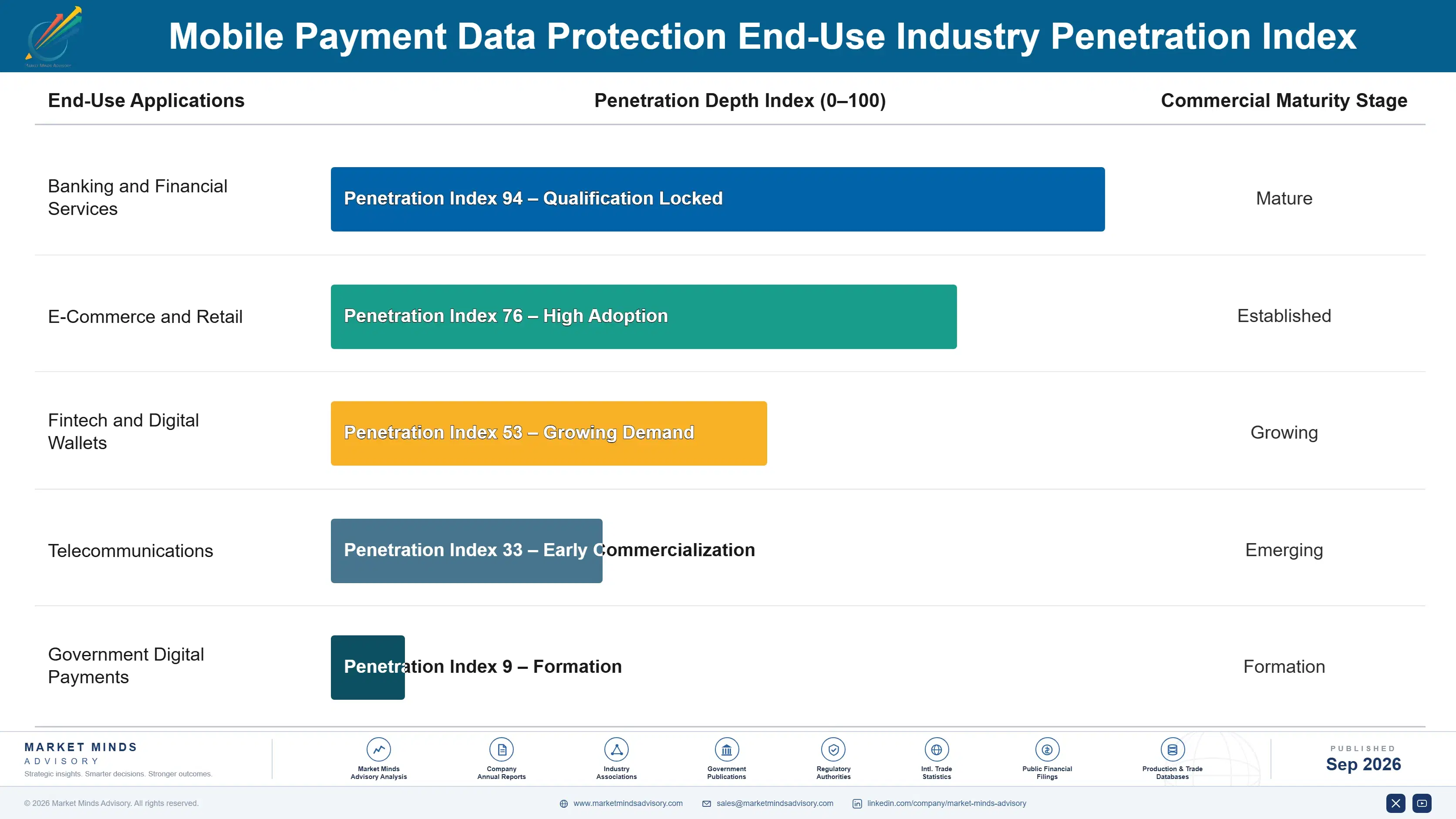
Mobile payment security revenue builds annuity-like characteristics through per-transaction pricing tied to customer volume growth, rather than through one-time software licensing fees. Banks and merchants rarely switch security vendors once integrated into live transaction processing, since replacing an established provider requires re-certifying fraud detection accuracy and tokenization reliability across the entire payment chain at real cost, operational risk, and potential temporary degradation in detection accuracy during the transition window.
Adoption stickiness varies meaningfully by end-use vertical: large bank and card network customers show the deepest lock-in, since mission-critical transaction infrastructure cannot tolerate vendor transition risk once operational, while smaller merchants show comparatively shallower stickiness given simpler integration requirements and lower switching costs. Mid-sized payment processors sit in between, with switching costs tied closely to transaction volume and integration depth.

A generational shift in buyer profile is underway as chief risk officers and fraud operations teams, not just technology procurement staff, increasingly drive mobile payment security purchasing decisions. These newer buyers evaluate vendors on detection accuracy metrics and liability shift willingness rather than pure feature checklists, reshaping how vendors must position, sell, and structure ongoing account relationships with risk and fraud leadership teams.
mobile-payment-data-protection-market-end-use-penetration-index-1790007606004

Where to Compete in Payment Security

These are among the four positions where our research anticipates prominent divergence between winners and laggards over the coming forecast period. Each is grounded in the demand model, the regulatory perimeter, and the announced capacity pipeline.
01 / TOKENIZATION INFRASTRUCTURE SCALE

Build tokenization capacity ahead of regulatory mandate expansion

Tokenization solutions for mobile wallet and in-app payments are growing at 20.0% annually, nearly one and a half times the market's average pace, yet many mid-tier vendors still lack proven infrastructure at genuinely massive transaction scale. Vendors that invest in tokenization reliability and throughput now will capture disproportionate share as regulatory mandates push adoption from optional to baseline requirement over the next several years. Waiting until mandates fully mature cedes this position to already-scaled competitors that moved first and now hold established transaction volume relationships.
02 / SUB-SECOND FRAUD SCORING

Invest in real-time inference to serve instant payment rails

Real-time payment rail expansion requires fraud detection systems capable of scoring risk within milliseconds, a requirement legacy batch-based fraud screening systems simply cannot meet. Vendors without sub-second inference infrastructure face genuine disadvantages against rivals whose machine learning platforms already process decisions at the speed instant settlement demands. Firms still relying on batch-based screening should prioritize real-time infrastructure investment now, before central bank payment rail expansion accelerates further across additional countries currently still in the earliest planning and pilot testing stages of rollout.
03 / FRAUD LIABILITY RISK APPETITE

Offer liability shift guarantees to win risk-averse accounts

Vendors offering fraud liability shift guarantees capture premium pricing from banks and merchants seeking to transfer fraud risk exposure, yet many vendors remain unwilling to accept this financial responsibility. Vendors confident in their detection accuracy should pursue liability shift programs to differentiate from detection-only competitors unwilling to accept comparable risk. Smaller vendors lacking balance sheet capacity should pursue reinsurance partnerships rather than conceding this entire premium segment to larger, better-capitalized rivals with considerably deeper balance sheets and much larger reserve capital positions overall.
04 / BEHAVIORAL BIOMETRIC DEPTH

Deploy behavioral biometrics before password authentication fully fades

Behavioral biometric authentication adoption is growing at roughly 35% yearly as static passwords and even one-time codes prove increasingly vulnerable to phishing and SIM-swap attacks. Vendors without behavioral biometric capability face disadvantages against rivals already embedding continuous authentication into their platforms. Vendors still relying solely on static authentication methods should prioritize behavioral biometric development now, before mobile wallet providers standardize around already-established competitors that moved first into this authentication category and now hold established platform integration relationships across major banks.

Engagement Snapshot From the Field

A live engagement with an industry participant carrying material or product regulatory and market exposure ahead of a defining policy shift, showing how our research translates into a defensible multi-year portfolio strategy.
MARKET MINDS ADVISORY · CLIENT ENGAGEMENT SUMMARY
Mobile Payment Data Protection Producer Strategic Portfolio Review and Transition Roadmap 2026·Investment Scenario on Mobile Payment Data Protection Exposure Evaluation 2025-26
CLIENT PROFILE
The client is a regional mobile wallet provider serving several million active users across multiple countries, with annual transaction volume reportedly exceeding $8 billion (client-reported, unverified by MMA). The client's fraud detection infrastructure was originally built for a much smaller user base and had not scaled proportionally as transaction volume grew rapidly over the preceding three years.
STRATEGIC CHALLENGE
The client faced rising fraud losses that grew faster than transaction volume itself, driven by increasingly sophisticated account takeover attempts that its legacy rule-based fraud detection system could not reliably catch. Leadership needed an objective evaluation of modern machine learning-based fraud detection vendors capable of scaling with continued rapid user growth.
MMA APPROACH
MMA conducted a structured vendor capability assessment across six candidate fraud detection providers, evaluating detection accuracy, false positive rates, and infrastructure scalability under simulated peak transaction load conditions. The engagement combined primary interviews with the client's fraud operations and engineering teams alongside comparative benchmarking against the client's existing system performance.
KEY FINDINGS
  1. Only two of six candidate vendors demonstrated detection accuracy improvements exceeding 40% over the client's existing legacy fraud system during the comparative testing phase of the engagement.
  2. Machine learning-based vendors showed meaningfully lower false positive rates, reducing legitimate transaction declines by roughly 25% during the evaluation period across all tested transaction categories.
  3. Simulated peak load testing revealed the client's existing infrastructure would require complete replacement within eighteen months at the current growth rates observed across the platform.
  4. The selected vendor's sub-second inference architecture could support projected transaction volume growth for at least five additional years going forward without additional infrastructure investment.
CLIENT PROFILE
The client is a regional mobile wallet provider serving several million active users across multiple countries, with annual transaction volume reportedly exceeding $8 billion (client-reported, unverified by MMA). The client's fraud detection infrastructure was originally built for a much smaller user base and had not scaled proportionally as transaction volume grew rapidly over the preceding three years.
STRATEGIC CHALLENGE
The client faced rising fraud losses that grew faster than transaction volume itself, driven by increasingly sophisticated account takeover attempts that its legacy rule-based fraud detection system could not reliably catch. Leadership needed an objective evaluation of modern machine learning-based fraud detection vendors capable of scaling with continued rapid user growth.
MMA APPROACH
MMA conducted a structured vendor capability assessment across six candidate fraud detection providers, evaluating detection accuracy, false positive rates, and infrastructure scalability under simulated peak transaction load conditions. The engagement combined primary interviews with the client's fraud operations and engineering teams alongside comparative benchmarking against the client's existing system performance.
KEY FINDINGS
  1. Only two of six candidate vendors demonstrated detection accuracy improvements exceeding 40% over the client's existing legacy fraud system during the comparative testing phase of the engagement.
  2. Machine learning-based vendors showed meaningfully lower false positive rates, reducing legitimate transaction declines by roughly 25% during the evaluation period across all tested transaction categories.
  3. Simulated peak load testing revealed the client's existing infrastructure would require complete replacement within eighteen months at the current growth rates observed across the platform.
  4. The selected vendor's sub-second inference architecture could support projected transaction volume growth for at least five additional years going forward without additional infrastructure investment.
RECOMMENDED STRATEGY
Phase 1: Phase 1 (Migration): Migrate fraud detection to the selected vendor's platform in parallel with the legacy system over one full quarter. Phase 2: Phase 2 (Optimization): Tune detection models using the client's historical transaction data to minimize false positive rates further still across all transaction categories monitored. Phase 3: Phase 3 (Scale): Fully decommission the legacy system and expand coverage to new markets as user growth continues rapidly across the region.
OUTCOME
The client completed the migration within the recommended timeframe and began model optimization immediately afterward. Fraud losses reportedly declined by 38% within six months of full deployment (client-reported, unverified by MMA), while false positive rates dropped enough to measurably improve customer transaction completion rates across the platform.

Frequently Asked Questions

Foundational context covering the market sizes, CAGR, scope, country, region and competition that inform every finding below. This section is provided to cover basics and most often pre-purchase conversations, answered from the MMA Primary Research Dataset.

What is the current size of the Mobile Payment Data Protection Market?

The Mobile Payment Data Protection Market reached $6.8 billion in 2025, driven by rising mobile transaction fraud and expanding regulatory authentication mandates across major markets.

How large will the Mobile Payment Data Protection Market be by 2036?

The market is projected to reach $27.39 billion by 2036, roughly 3.55 times its 2026 level, as tokenization and biometric authentication become standard transaction infrastructure.

What is the CAGR for the Mobile Payment Data Protection Market 2026 to 2036?

The market is forecast to grow at a 13.5% compound annual rate between 2026 and 2036, with tokenization solutions growing considerably faster than legacy fraud screening categories.

Which segment is growing fastest?

Tokenization solutions for mobile wallet and in-app payments lead at 20.0% CAGR, roughly 1.48 times the overall market's average growth pace through the forecast period.

Who are the major companies in the Mobile Payment Data Protection Market?

Visa, Mastercard, Thales, Entrust, and RSA Security lead the market, together holding roughly 46% of global mobile payment security revenue across all product categories tracked worldwide.

Which country is growing fastest?

India leads country-level growth at roughly 17.5% CAGR, driven by explosive Unified Payments Interface transaction volume and expanding digital payment infrastructure investment across the country.

Report Segmentation Architecture

The full report scope spans multiple orthogonal segmentation dimensions, with cross-tabulated demand data provided for each dimension pair. Coverage extends further to regional breakdowns, trend trajectories, and the competitive detail needed to support segment-level decision-making.

By Security Technology

  • Tokenization
  • Biometric Authentication
  • Fraud Detection and Scoring
  • Encryption
  • Secure Element Hardware
  • Identity Verification

By End-Use Industry

  • Banking and Financial Services
  • E-Commerce and Retail
  • Fintech and Digital Wallets
  • Telecommunications
  • Government Digital Payments

By Commercial Dimension

  • Direct Bank Sales
  • Card Network Integration
  • Merchant Platform Sales
  • Managed Security Services

By Region

  • North America
  • Western Europe
  • East Asia
  • South Asia and Pacific
  • Latin America
  • Middle East and Africa
  • Eastern Europe

Scope, Methodology, and Coverage

Every figure in this report is reproducible from documented input assumptions. The scope below maps the historical period, the forecast horizon, the segmentation dimensions, and the countries covered, alongside the underlying primary and qualitative methodology.
Historical Period
2020 to 2025
Forecast Period
2026 to 2036
Base Year
2025 (USD billions; MMA Primary Research Dataset, September 2026)
Market Definition
The Mobile Payment Data Protection Market covers tokenization, encryption, biometric authentication, and fraud detection technologies used to secure mobile wallet, in-app, and QR code transactions. It excludes general enterprise cybersecurity software, physical point-of-sale hardware, and card issuance services not directly tied to mobile transaction security.
Quantitative Units
USD billions (current prices); transaction volume secured where applicable
Segmentation Dimensions
By Security Technology; By End-Use Industry; By Commercial Dimension; By Region
Regions Covered
North America, Western Europe, East Asia, South Asia and Pacific, Latin America, Middle East and Africa, Eastern Europe
Countries Covered
USA, China, Germany, France, UK, Japan, South Korea, India, Australia, Canada, Brazil, Mexico, Indonesia, Vietnam, Thailand, Malaysia, UAE, Saudi Arabia, South Africa, Nigeria, Turkey, Poland, Netherlands, Italy, Spain, Sweden, Switzerland, Argentina, Colombia, Singapore, and additional markets relevant to this sector
Key Companies Profiled
Visa, Mastercard, Thales, Entrust, RSA Security, IBM Security, Fiserv, FIS, ACI Worldwide, Feedzai, Kount, Signifyd, Ekata, Ping Identity, Okta, IDEMIA, Gemalto Legacy Products, Bottomline Technologies, Featurespace, BioCatch
Quantitative Methodology
Primary survey, n=3,800 respondents, Q4 2025, six countries; demand-side model with trade association cross-validation
Qualitative Methodology
47 expert interviews, Q4 2025; applied to validate demand model assumptions, identify emerging dynamics, and assess competitive positioning
Report Format
PDF and XLSX data workbook (Word format preview document)
Publisher
Market Minds Advisory
Report Code
MMA-2026-TEC-104
Published
September 2026
Contact
sales@marketmindsadvisory.com | www.marketmindsadvisory.com

Purchase the full Mobile Payment Data Protection Market Report (2026 to 2036).

This report delivers a comprehensive analysis of the global Mobile Payment Data Protection Market, covering sizing, segmentation, regional dynamics, and competitive positioning through 2036. It profiles the twenty leading security vendors. The analysis examines regulatory authentication barriers shaping adoption economics, and it quantifies input cost exposure tied to cloud computing infrastructure concentration across the industry's global operations. Readers gain access to detailed regional demand mechanisms across all seven global regions, alongside forward-looking scenario analysis spanning bull, base, and bear growth cases through the full ten-year 2026 to 2036 forecast period covered in this report.
Ten-year market sizing and forecast model
Twenty-company competitive benchmarking and profiling analysis
Seven-region demand and CAGR breakdown tables
Regulatory authentication mandate and compliance analysis
Input cost and cloud infrastructure risk assessment
Revenue lever and margin architecture framework

Built For The People Who Decide

From boardroom strategy to bench-side execution, this report is read cover-to-cover by leaders shaping the next decade of their industry, turning demand scenarios, market dynamics and valuation benchmarks into decisions.
CXOs/ Presidents/ VPs/ Managers
M&A and Corporate Development
Strategy Teams and R&D Heads
Procurement and Product Directors
Regulatory and Compliance Leaders
Investor Relations and Equity Analysts