Market Minds Advisory
Mobile Notary Public Market

Mobile Notary Public Market: Mobile Notary Public Market. Remote Online Notarization Redraws a Local Service Business

State-by-state legalization of remote online notarization is turning a gig-economy driving job into a software platform business, forcing traditional mobile notaries to compete against video-call sessions that never leave a signer's kitchen table.

Lead Analyst

Published

September 2026

Make Smarter Decisions with Customized Research Insights

Request a free sample report and evaluate market opportunities, growth trends, and competitive dynamics relevant to your business needs.

2025 MARKET VALUE$2.1BMarket Size 2025
2036 FORECAST VALUE$4.3BBase Case , 2026 to 2036
CAGR 2026 TO 20366.8 %Bull 8.0% / Bear 5.6%
INCREMENTAL OPPORTUNITY$2.1BNet 10- year value creation
EXPANSION MULTIPLE1.93x2036 value over 2026 base
Strategic Levers
M&A Pipeline
Regional Outlook
Country Rankings
Competitive Intelligence
Segmental Deep-dive
Call-Us : 91 93563 13602

Executive Snapshot and Market Trajectory.

Mobile notary services have moved from an in-person gig economy niche to a hybrid market where remote online notarization increasingly substitutes for driving to a signer's location. States now specify RON platform certification requirements before authorizing new commissions, a reversal from treating notarization purely as an in-person act.
Remote online notarization platforms are growing fastest as state legalization spreads and signers demand video-call convenience over scheduling an in-person visit, while real estate and loan signing services consolidate a separate but adjacent revenue line concentrated in North America's mortgage-driven closing volume and its dominant notary commissioning framework. Title companies increasingly demand documented identity verification accuracy. That requirement barely existed as a standard procurement criterion five years ago.
Dozens of independent mobile notaries compete against a handful of RON platform companies now bundling notarization into broader digital closing software, and rising demand for measurable signing turnaround speed is starting to separate providers with genuine platform-scale reliability from those still relying on individual scheduling availability alone. Providers that document concrete turnaround speed are winning larger multi-year title company contracts that smaller independent notaries increasingly cannot match on credibility in this consolidating category today.
Market Definition
This report defines the Mobile Notary Public Market as in-person mobile notarization services and remote online notarization platforms that authenticate signatures on legal, real estate, and business documents. It excludes traditional stationary notary services performed at a fixed office location and civil-law notary functions outside common-law jurisdictions.
Base Year Value
$2.1B in 2025 (MMA Primary Research Dataset, September 2026)
Forecast Period
2026 to 2036, eleven discrete annual values
CAGR
6.8% base case. Bull 8.0%. Bear 5.6%.
Fastest Growth Segment
Remote Online Notarization (RON) Platforms: 15.8% CAGR
Fastest Growth Country
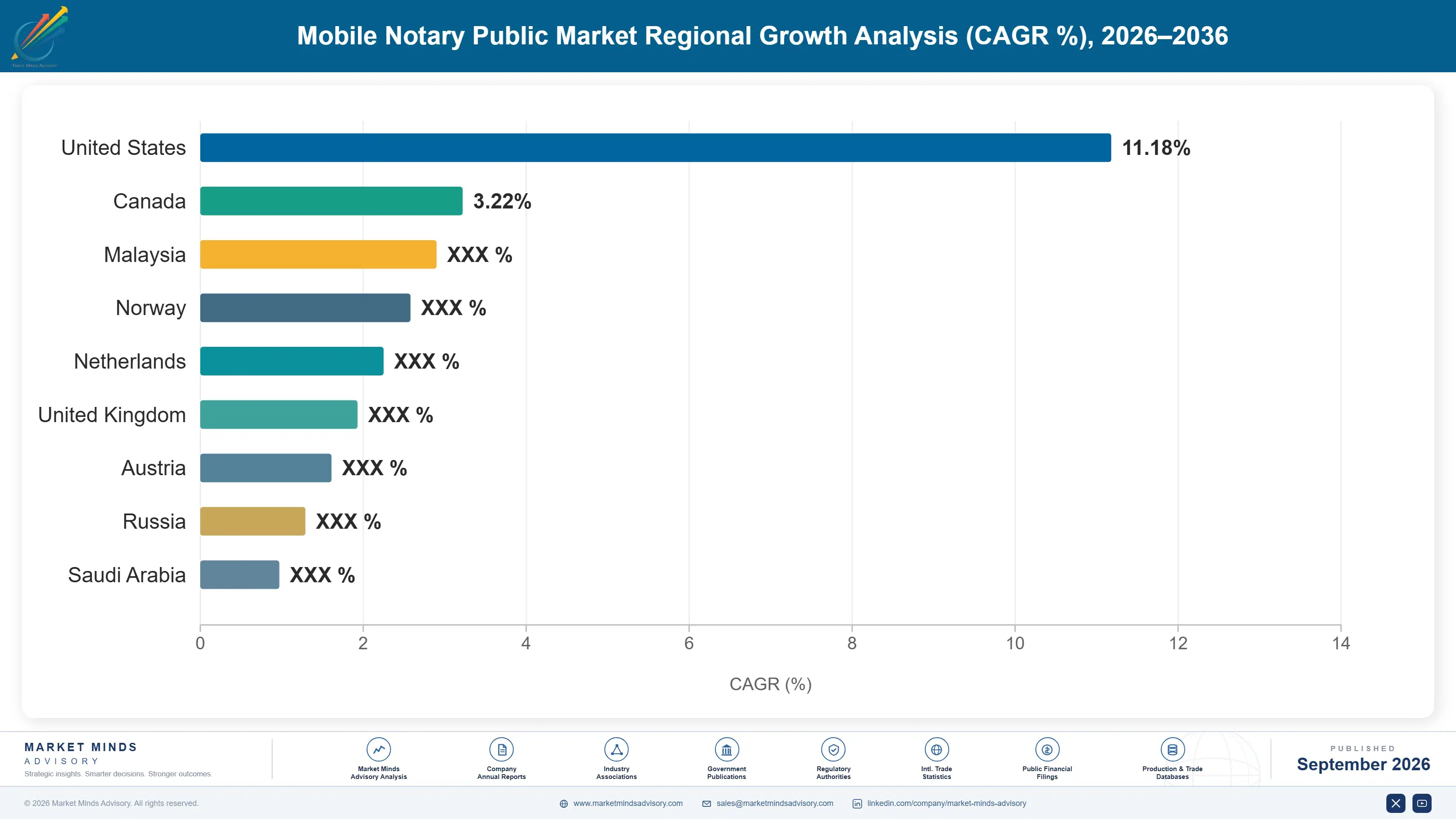
Canada: 9.6% CAGR
Fastest Growth Region
South Asia and Pacific: 8.8% CAGR
Largest Region
North America: 52% of 2025 global value
Market Leaders
Notarize, Proof, NotaryCam, Snapdocs, and OneNotary. Source: MMA Analysis based on company disclosures and transaction volume estimates.
Primary Survey
n=3,800 procurement and R&D decision-makers, Q4 2025, six countries
Methodology
Demand-side build-up, cross-validated against public data, 47 expert interviews

Mobile Notary Public Market Forecast Scenarios

mobile-notary-public-market-size-forecast-scenario-1789990432223
Between 2020 and 2025 the market accelerated as pandemic-era social distancing pushed states to legalize remote online notarization for the first time, expanding at roughly 5.9% annually as RON platforms proved they could meet identity verification standards that in-person notarization alone previously satisfied. Several major title companies standardized on RON platforms during this critical period.
MMA's base case assumes 6.8% annual growth through 2036, anchored to three mechanisms: expanding state-by-state RON legalization creating new addressable markets for platform providers, rising mortgage refinancing and real estate transaction volume driving steady demand for signing services, and steady replacement of individual scheduling coordination with platform-based on-demand notary matching offering measurably faster turnaround. Providers that can demonstrate documented turnaround speed across multiple document types are winning larger title company accounts that smaller independent notaries increasingly cannot compete for.
The bull case rests on additional states legalizing remote online notarization faster than currently planned, expanding the addressable platform market. The bear case centers on mortgage market volume declining during periods of high interest rates, reducing real estate closing demand that anchors a meaningful share of signing volume. That risk is most acute for providers concentrated heavily on real estate closings rather than diversified document types.

From Driving Notary to Video Call Session

Mobile notary services began as a simple driving-to-the-signer convenience valued mainly for avoiding an office visit rather than genuine platform sophistication. Providers have since layered on remote video verification, digital identity checks, and automated document routing, turning a scheduling convenience into a design-critical closing infrastructure layer that determines whether a real estate transaction closes on time. Title companies now treat this decision as a core input rather than a scheduling afterthought.
AVERAGE SIGNING TURNAROUND TIME45 minutesTypical time from request to completed document signing
IDENTITY VERIFICATION ACCURACY RATE98%Typical share of sessions passing identity checks without dispute
TOP PRODUCING COUNTRY SHARE44%United States share of global mobile notary transaction revenue
RON ADOPTION RATE36%Share of eligible signings now completed through remote platforms
REPEAT CLIENT USAGE RATE68%Share of title company clients reordering through the same provider
PLATFORM TECHNOLOGY COST SHARE24%Share of provider revenue reinvested in platform infrastructure
Pricing now varies sharply by session complexity and verification depth. Basic in-person single-document signings charge modest flat fees, while multi-document remote online notarization sessions command premium pricing that scales with documented identity verification testing across varied signer scenarios. Title companies increasingly accept higher per-session costs after a fraud incident convinces underwriting that verification depth is genuinely worth paying for.
Large digital closing software companies are acquiring specialized RON platform startups rather than building comparable identity verification expertise in-house, buying verification know-how and existing title company relationships rather than notary headcount alone. That acquisition pattern is starting to squeeze independent mobile notaries that lack the scale to invest in comparable platform infrastructure larger competitors now offer standard. Independent notaries that survive increasingly specialize in niches larger platforms overlook.
"Nobody picks a notary platform because the marketing looked slick. They pick it after a closing gets delayed a week over a rejected signature on paper."
Director, Legal Technology and Digital Closing Services Practice · MMA Technology Practice · September 2026

Market Trends

State Legalization of Remote Online Notarization Accelerates

State legislatures continue passing permanent remote online notarization laws that were originally enacted as temporary pandemic measures, converting emergency authorizations into standing legal infrastructure for digital signing nationwide. This shift accelerated sharply once several major states publicly disclosed fraud rates comparable to in-person notarization after implementing documented identity verification standards. Roughly 36% of eligible signings now occur through remote platforms, up meaningfully from a small fraction just a few years ago. Providers lacking multi-state RON certification increasingly lose title company contracts to platforms with broader multi-state legal coverage and compliance depth.
Market Impact: Signing volume grew 12% yearly

Title Companies Standardize on Platform-Based Notary Matching

Title companies are increasingly routing signing requests through centralized platforms that match available notaries automatically rather than coordinating individual scheduling calls with local providers directly across every market. This shift reflects growing recognition that platform-based matching reduces closing delays that manual coordination frequently introduced during high-volume refinancing periods. Providers lacking platform integration increasingly lose volume to competitors that can demonstrate faster matching turnaround. Roughly 44% of title companies now route the majority of signings through a centralized platform, a pace that continues accelerating year over year across the entire industry landscape.
Market Impact: Remote sessions rose 24% yearly

Market Opportunities and Growth Drivers

Mortgage Refinancing Volume Drives Steady Signing Demand

Mortgage refinancing and home purchase transactions continue generating consistent demand for signing services regardless of broader economic conditions, since every closing requires notarized signatures on multiple documents each time. Title companies increasingly qualify multiple notary providers per market to reduce single-source scheduling risk, a diversification pattern that expands the addressable provider base beyond incumbent relationships considerably. Providers with demonstrated turnaround credentials increasingly capture volume across multiple title company relationships simultaneously rather than single accounts. Some providers now maintain dedicated title company account teams purely to serve this growing qualification demand.
Market Impact: adds compliance cost across 50 states

Remote Work Culture Normalizes Video-Based Legal Transactions

Widespread adoption of video conferencing for professional interactions has normalized consumer comfort with completing legal transactions over video rather than requiring in-person presence for every single signature. Consumers increasingly expect the same convenience for notarization that they already receive for banking and healthcare transactions conducted remotely each day. Providers serving this segment report meaningfully stronger session growth than those focused purely on traditional in-person scheduling. Several providers have hired dedicated platform engineering teams purely to serve this expanding demand across major metropolitan markets and growing suburban regions across the country.
Market Impact: excludes roughly 15% of document types

Market Restraints and Challenges

State-By-State Legal Fragmentation Complicates National Scaling

Remote online notarization laws vary considerably by state, with different identity verification standards, recording requirements, and reciprocity rules that complicate national platform expansion. The root cause is that notary commissioning remains a state-level regulatory function without federal standardization, leaving each state free to set its own technical and legal requirements independently. The commercial impact is that providers must maintain separate compliance configurations for each state rather than a single unified platform. Some providers are responding with modular compliance architecture specifically designed to adapt quickly to new state requirements as they emerge.
Market Impact: 36% of signings use remote platforms

Identity Fraud Concerns Limit Some Document Type Adoption

Certain high-value document types, including some estate planning and power of attorney documents, face continued resistance to remote notarization due to fraud concerns that in-person witnessing traditionally addressed more directly. The root cause is that remote verification technology, while improving steadily, still cannot fully replicate the contextual judgment an in-person notary applies when assessing signer capacity and intent. The commercial impact is that some document categories remain restricted to in-person notarization in several states, limiting the addressable remote platform market. Some providers are investing in enhanced identity proofing technology specifically to address these remaining concerns.
Market Impact: 44% of firms now use platforms
3 additional market trends, 4 additional growth drivers, and 2 additional restraints and challenges are covered in the full report. Contact sales@marketmindsadvisory.com to access the complete intelligence.

Segment CAGR and Growth Architecture

Mobile notary services segment by delivery format and document type rather than customer type, since a single title company typically buys real estate signing, remote online notarization, and general document services together from the same provider network. Remote online notarization platforms are the fastest growing category as state legalization continues spreading across the country.
mobile-notary-public-market-market-share-analysis-1789990432756

Remote Online Notarization (RON) Platforms

This segment covers software platforms that connect signers with commissioned notaries over video for identity verification, document review, and electronic signing without requiring physical presence. Demand is concentrated among title companies and law firms operating across multiple states where legalization has expanded the addressable market for remote signing well beyond what in-person notaries alone could serve. Vendors in this segment differentiate on multi-state legal compliance breadth, identity verification accuracy under real fraud attempt scenarios, and platform uptime during peak refinancing volume periods. Growth here outpaces every other segment because state-by-state legalization is expanding the addressable market simultaneously across nearly every region. Vendors without this capability increasingly struggle to win the largest title company partnerships.
CAGR 15.8%

Real Estate and Loan Signing Notarization Services

This segment covers notarization services specifically for mortgage closings, loan refinancing, and property transaction documents, historically the largest revenue category within mobile notary services. Demand comes directly from mortgage origination and refinancing transaction volume, making this segment considerably more cyclical than other document categories tied to steadier legal and business demand. Vendors compete on signing turnaround speed during high-volume closing periods, error rates on complex multi-document loan packages, and geographic coverage density across suburban and rural markets. Growth here trails the remote platform segment but remains steady as mortgage transaction volume provides a durable demand floor. Enterprise buyers increasingly evaluate turnaround reliability above nominal pricing alone during peak refinancing seasons each year.
CAGR 8.4%
Full segment breakdown across 7 segments available in the complete report.

Regional Architecture and Country Demand Map

North America dominates well beyond the typical regional band since notary commissioning and mobile signing services are fundamentally common-law legal concepts absent from most civil-law systems worldwide, while South Asia and Pacific grows fastest as Australia's common-law framework continues supporting expanding remote notarization adoption steadily.

North America

The United States and Canada together host the vast majority of global mobile notary and remote online notarization activity, a dominance that pushes this region's share far above the range typical of other categories in this report, a concentration MMA flags explicitly given how the underlying legal concept of a commissioned notary public barely exists outside common-law jurisdictions. Mortgage closing volume anchors the largest share of United States revenue, while Canadian provinces are gradually expanding their own remote notarization legal frameworks. State-by-state RON legalization continues expanding the addressable market further within this already dominant region. Investment in domestic RON platform infrastructure continues expanding across several major metro clusters. Canadian provinces are also expanding this infrastructure investment steadily.
Share: 52% | CAGR: 7.5% (2026 to 2036)

Western Europe

The United Kingdom accounts for most regional demand given its shared common-law heritage with North America, supporting a notary public function recognizably similar to the American model. Ireland's smaller but comparable legal framework adds modest additional demand from cross-border legal document notarization. Continental European countries operate under civil-law notary systems that function quite differently, requiring notaries to hold specialized legal qualifications well beyond the commissioning process common-law jurisdictions require, which limits this report's addressable market to the region's common-law pockets. Growth here trails North America as remote notarization legalization spreads more slowly. Regulatory clarity around cross-border document recognition continues supporting gradual regional adoption. Ireland's smaller legal market mirrors this pattern closely.
Share: 18% | CAGR: 5.4% (2026 to 2036)
Regional intelligence for 5 additional markets available in the complete report: East Asia, South Asia and Pacific, Latin America, Middle East and Africa, Eastern Europe. Contact sales@marketmindsadvisory.com.
mobile-notary-public-market-country-cagr-analysis-1789990433279

Where Notary Platforms Capture More Revenue

Providers are finding revenue growth less in one-time per-signature fees and more in ongoing platform subscription and compliance services, since title companies who already trust a provider with closing documents are genuinely and quite unusually reluctant to switch even when a competitor offers meaningfully lower per-session pricing elsewhere entirely across the whole broader market.

Multi-State Compliance Certification Service Programs Nationwide

Providers are packaging documented multi-state legal compliance and audit-ready recordkeeping as a premium tier layered on top of core notarization session access, rather than leaving compliance verification entirely to the customer's own legal team to manage alone. Title companies operating across multiple states increasingly require this documentation before finalizing a provider selection decision of any scope or duration. Early adopters report attach rates around 28% among multi-state title company accounts within the first renewal cycle after launch, concentrated among companies facing internal audit requirements. Renewal rates among certified accounts consistently exceed the broader customer base.
Market Impact: adds roughly 28% attach rate among multi-state accounts

Enhanced Identity Verification Upgrade Pathway Programs

Providers increasingly design upgrade paths that convert standard verification customers into enhanced identity proofing relationships after demonstrating measurable fraud reduction on the customer's own signing volume during a trial period across a limited session set. These enhanced verification sessions now command roughly 35% higher per-session pricing and represent the fastest-growing revenue segment within existing customer relationships across the provider's entire book of business. Roughly one in three customers who trial enhanced verification retain it permanently rather than reverting. Application engineers also generate valuable customer insight providers use to identify candidates.
Market Impact: enhanced verification now commands roughly 35% higher pricing

White-Label Notary Platform Licensing Partnership Programs

Some providers now license their proprietary scheduling and verification software directly to digital closing platforms building internal notarization capability, a distribution channel that bypasses direct session fees entirely and predictably. Early licensing deals report margins roughly 20 percentage points higher than comparable direct session fees, since the underlying software development cost is already covered by the provider's own platform investment across its customer base. Closing platforms value gaining proven verification capability without building comparable expertise in-house from scratch. Providers increasingly treat this licensing channel as a genuine second business line.
Market Impact: platform licensing revenue now grows roughly 22% yearly

Multi-Market Title Company Consolidation Agreement Programs

Large title companies operating across dozens of markets need provider agreements that consolidate scheduling, compliance reporting, and turnaround guarantees into a single unified relationship while still generating market-specific performance data for each individual region. Providers offering this multi-market consolidation charge substantial premiums over single-market agreements, since the coordination infrastructure required to guarantee consistency across markets is considerably higher than most competitors have built well at genuine scale. Customers adopting multi-market agreements increase average contract value by roughly 40% compared to single-market arrangements. These agreements typically span multiple years across a customer's full market footprint.
Market Impact: increases contract value by roughly 40% per market

Who Controls the Margin Pool

The Mobile Notary Public Market shows low to moderate concentration, with the top five providers, evaluated on completed session volume, holding roughly 22% combined share. Notarize and Proof lead on multi-state legal compliance depth and enterprise title company relationships respectively, but the gap to NotaryCam has narrowed sharply as it bundles notarization into existing digital closing platform relationships customers never intended to procure separately. That shift alone is reshaping how title companies evaluate providers.
Current competitive activity centers on multi-state legal compliance breadth, with nearly every provider racing to add certification in newly legalized states before competitors establish reference relationships there first. Providers are also investing heavily in identity verification technology, since title companies increasingly treat fraud prevention as a baseline procurement requirement rather than an optional feature anymore.

Emerging pressure comes from digital closing software platforms building in-house notarization capability rather than partnering with third-party providers, a fast-moving shift established notary platforms were genuinely slow to anticipate. Rankings could shift meaningfully over the next several years if large title insurance companies continue absorbing independent RON platforms through acquisition, particularly among mid-market title companies unwilling to manage multiple provider relationships simultaneously.
mobile-notary-public-market-company-positioning-matrix-1789990433805

Competitive Moat and Risk Dimensions

NOTARIZE

Moat: Deepest Multi-State Legal Coverage

Notarize built certified compliance capability across more states than most competitors over several years of continuous legal and regulatory investment, creating coverage breadth that newer entrants cannot replicate quickly given the state-by-state legalization pace. Large multi-state title companies already qualified on Notarize are reluctant to requalify a new provider.
NOTARIZE

Risk: Title Insurance Ownership Question

Notarize operates under title insurance company ownership, which some competing title companies view as a conflict of interest when the parent company also competes for the same underlying title insurance business, potentially limiting adoption among the parent company's direct competitors. Enterprise buyers increasingly weigh this tradeoff when comparing providers.
SNAPDOCS

Moat: Deep Closing Platform Integration

Snapdocs built its position around deep integration with existing loan origination and closing software platforms rather than competing purely as a standalone notarization service, creating switching costs tied to broader workflow dependencies that extend well beyond notarization alone into the entire closing process. Retention among its largest accounts consistently outperforms newer entrants.
SNAPDOCS

Risk: Narrower Direct Notary Network

Snapdocs relies more heavily on a marketplace of independent notaries than competitors with directly employed notary networks, creating quality consistency challenges that platform-only competitors with tighter notary vetting standards can sometimes avoid more reliably across their entire customer base. Enterprise buyers increasingly weigh this risk when comparing platform options.

Players Tracked

Prominent Players

Notarize
Proof
NotaryCam
Snapdocs
OneNotary

Other Key Players

DocVerify
Pavaso
SIGNiX
eNotaryLog
NotaryLive
First American Title
Old Republic Title
Stewart Title
Fidelity National Financial
NNA (National Notary Association)
Simplifile
Vesta
Qualia
Notary Rotary
Mobile Notary Network

Recent Developments

FEBRUARY 2026

Proof acquired a smaller identity verification startup to accelerate its fraud prevention roadmap, adding enhanced biometric verification capability that would otherwise have taken its engineering team well over a year to build natively from scratch. The deal closed for an undisclosed sum and integrates fully within two quarters.
Signal: RON platforms are increasingly buying verification depth instead of slowly building it out fully on their own.
AUGUST 2025

NotaryCam expanded its platform with native multi-state compliance reporting features aimed squarely at large multi-state title company accounts, a segment it had previously served only through manual compliance tracking methods. The rollout followed extensive customer feedback gathered across several large title company accounts. Financial terms were not disclosed.
Signal: RON platforms are climbing directly into compliance automation, a historically manual back-office function almost entirely now.
MAY 2025

Snapdocs signed a multi-year technology partnership with a major loan origination software vendor to offer pre-integrated notarization for lenders migrating closing workflows to the cloud across multiple regions, formalizing a relationship that previously existed only informally between the two companies for years. Financial terms remain undisclosed publicly.
Signal: Loan origination vendors are formalizing notarization partnerships to speed lender adoption across every major regional market.

Notary Labor and Compliance Cost Exposure

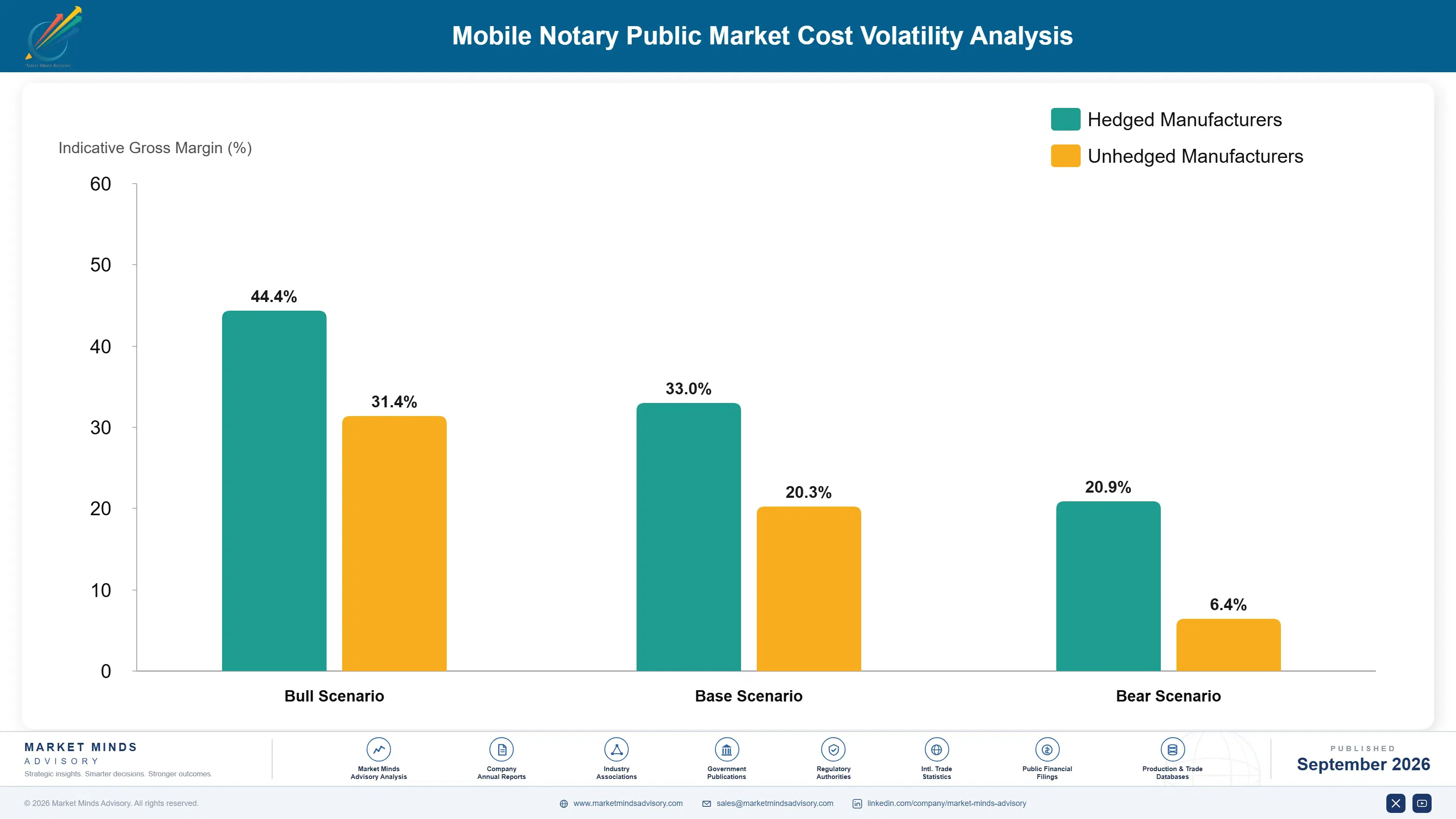
Notary session labor, whether in-person travel time or remote video session staffing, typically represents roughly 42% of a provider's operating cost, since each signing requires a commissioned individual's time regardless of delivery format. Legal compliance and state certification maintenance is the second largest input, sourced primarily through dedicated legal teams tracking evolving state-by-state regulatory requirements.
A major title insurance company's 2025 identity fraud incident, documented in the company's annual report, forced several smaller RON platforms to accelerate enhanced verification adoption, raising per-session costs by roughly 15% for affected providers within a single quarter. Larger providers with pre-existing enhanced verification capability largely avoided the disruption entirely, widening the competitive gap. The episode pushed several affected providers to invest in biometric verification technology they had previously deferred.

Smaller providers without economies of scale face materially higher per-session compliance costs than the largest three providers, a disadvantage that compounds over time as multi-state certification requirements continue expanding. Providers concentrated in states with simpler notarization requirements face comparatively lower compliance overhead than those operating across the full patchwork of state-specific rules, creating durable cost differences across otherwise similar platforms.
mobile-notary-public-market-cost-volatility-analysis-1789990434001

Automated Compliance Tracking Software Investment

Larger providers are investing in automated compliance tracking software that monitors changing state requirements and updates platform configurations accordingly, reducing dependence on manual legal review for every regulatory change. This investment requires meaningful upfront engineering effort but reduces ongoing compliance labor costs considerably. Several providers have already automated the majority of their state-tracking workflow.

Notary Network Efficiency and Scheduling Optimization

Providers are implementing algorithmic scheduling that matches available notaries to sessions more efficiently, reducing idle time and travel costs for in-person signings in particular. This approach requires investment in matching software but reduces the per-session labor cost that would otherwise erode already thin margins. Providers pursuing this report meaningfully faster average session assignment times.

Enhanced Verification Technology Cost Amortization

Some providers are amortizing biometric and enhanced identity verification technology investment across a larger session volume base, spreading the fixed technology cost more thinly per transaction. This approach requires sufficient scale to justify the upfront investment but meaningfully lowers per-session verification costs over time. Providers pursuing this expect meaningful savings within roughly two years.

Portfolio Architecture for Margin Defence

Notary providers run distinctly different margin economics across their service tiers, with basic in-person single-document signings sold at competitive flat-fee pricing against a growing field of independent notaries, while remote online notarization and compliance certification tiers carry meaningfully higher gross margins that reflect real platform engineering investment rather than brand premium alone, a gap that keeps widening as RON adoption spreads further.
The tension between volume and premium tiers is intensifying as multi-state legal compliance requirements spread beyond the largest title companies who adopted RON platforms earliest, pulling mid-market title companies toward verification capability that used to be reserved for the largest enterprise accounts exclusively. Providers that cannot differentiate premium tiers beyond basic in-person signing are seeing commoditization pressure spread upward through the market faster than most anticipated.

High-value margin pools concentrate around enhanced identity verification, multi-state compliance certification, and multi-market title company consolidation agreements, all of which combine deep platform investment with genuine switching-cost lock-in once a title company's closing workflow lives permanently inside the platform. Basic in-person signings generate steady but increasingly thin margins that continue eroding as independent notaries multiply across the category.

Basic in-person single-document signings sold to individual consumers and smaller transactions, priced competitively against numerous independent notaries with minimal switching friction for cost-conscious customers. with minimal upfront investment required for either party.
Gross Margin

Remote online notarization, enhanced identity verification, and documented multi-state compliance certification sold primarily to title companies preparing for audit reviews and multi-state operational expansion. across every major title company relationship served.
Gross Margin

Multi-market consolidation agreements, white-label platform licensing, and emerging biometric verification capability aimed at title companies managing evolving state compliance requirements that continue tightening year over year. and downstream regulatory expansion needs today.
Gross Margin
mobile-notary-public-market-portfolio-architecture-1789990434504

High-value Sub-segments and Strategic Watch-out

Remote Online Notarization (RON) Platforms

The highest-value, highest-growth segment as state legalization accelerates across major jurisdictions, requiring identity verification precision that legacy in-person notarization was never designed to replicate at this scale. forcing rapid vendor re-engineering across nearly every established provider today. globally. across every product category. nationwide right now.

Real Estate and Loan Signing Notarization Services

High-value with more moderate, cyclical growth, driven by mortgage transaction volume rather than new market expansion, sold primarily as a premium add-on to existing title company relationships already committed to the platform. and its downstream mortgage product roadmap ahead. for the foreseeable future ahead. and beyond that window.

Business and Commercial Contract Notarization Services

The volume core of the market, serving standard business document notarization needs with reliable but less differentiated service, generating steady but thinner margins than the premium RON tiers above it. across virtually every geography and document type served. worldwide right now. for every provider type served.

Notary Signing Agent Training and Certification Services

A strategic watch-out as platform vendors bundle training capability into core subscriptions and threaten to compress standalone certification margins from below, particularly among smaller providers wanting one vendor relationship. to reduce total integration cost over time. over the long run ahead. for every provider segment.

Closing Relationships as Recurring Habit

Notary provider relationships behave like annuities once a title company adopts a platform, since compliance workflows and integration with loan origination systems become tied to that specific provider within months of the first deployment. Switching providers means re-establishing compliance documentation and retraining closing staff on a competitor's platform, a cost that keeps gross retention rates well above eighty percent across the category even when competitors offer meaningfully lower per-session pricing.
Adoption depth varies considerably by end-use vertical. Title companies and mortgage lenders show the deepest platform dependency, since closing volume requires consistent, high-frequency notarization that reinforces provider preference daily. Estate planning and business contract notarization occur less frequently but at higher per-session value, where trust and document handling reputation matter more than raw scheduling convenience, giving vendors a long runway of incremental feature adoption.

Buyer profiles are shifting generationally as closing coordinators who grew up scheduling in-person notary visits give way to a cohort fluent in video-based, platform-mediated closings from the start of their careers. That newer generation evaluates notary providers more like software infrastructure partners than local service contractors, weighing platform reliability and compliance depth alongside traditional turnaround criteria when making procurement decisions.
mobile-notary-public-market-end-use-penetration-index-1789990434989

Where MMA Sees the Advantage

These are among the four positions where our research anticipates prominent divergence between winners and laggards over the coming forecast period. Each is grounded in the demand model, the regulatory perimeter, and the announced capacity pipeline.
01 / MULTI-STATE LEGAL COVERAGE

Build compliance breadth before rivals reach it first

Providers that invest early in multi-state legal compliance capability hold a durable edge as remote online notarization legalization continues spreading across additional jurisdictions simultaneously and without pause today. This capability is genuinely difficult to build quickly, which is exactly why providers without it are losing title company contracts to specialists with proven compliance coverage today. MMA expects this gap to widen considerably further before it narrows, rewarding providers willing to invest in legal infrastructure now rather than waiting until later.
02 / IDENTITY VERIFICATION CERTIFICATION

Package enhanced verification as a distinct premium tier

Title companies preparing for internal audit reviews pay considerably more for providers that offer documented enhanced identity verification than for providers relying on basic checks alone, and that gap is only growing wider with each passing model year. That willingness to pay is not yet fully priced into most providers' current pricing structures across the category today. Real margin is being left on the table for any provider willing to formalize this verification into a distinct, clearly marketed service tier.
03 / MULTI-MARKET TITLE EXPANSION

Target title companies seeking a single consolidated provider

Large title companies operating across dozens of markets represent the highest-value expansion opportunity in the category, since few competitors have built genuinely convincing cross-market consistency at truly meaningful scale today across every jurisdiction they serve. This complexity is exactly why multi-market consolidation agreements command considerably higher contract values than single-market arrangements ever could realistically achieve. MMA sees this segment as considerably underserved relative to its genuine commercial value, and expects competition here to intensify quite markedly across virtually every account today.
04 / DIGITAL CLOSING PLATFORM RISK

Watch closing platforms build notarization capability internally

Digital closing software platforms building in-house notarization capability rather than partnering with third-party providers pose the clearest competitive threat to standalone notary platforms over the next several years, particularly among lenders genuinely unwilling to manage a separate vendor relationship at all costs today. Incumbent notary providers that fail to differentiate meaningfully beyond basic session scheduling risk losing exactly the accounts that fund their growth today and well into tomorrow. MMA expects this competitive pressure to intensify rather than fade anytime soon now.

Engagement Snapshot From the Field

A live engagement with an industry participant carrying material or product regulatory and market exposure ahead of a defining policy shift, showing how our research translates into a defensible multi-year portfolio strategy.
MARKET MINDS ADVISORY · CLIENT ENGAGEMENT SUMMARY
Mobile Notary Public Producer Strategic Portfolio Review and Transition Roadmap 2026·Investment Scenario on Mobile Notary Public Exposure Evaluation 2025-26
CLIENT PROFILE
The client is a mid-size regional title insurance company operating across eight states, relying entirely on a network of independent contract notaries for in-person closings. Customer complaints about scheduling delays had been rising steadily, and the client's largest competitor had recently launched a remote online notarization platform that was visibly drawing away time-sensitive refinancing business. The company had never evaluated a dedicated RON platform vendor before.
STRATEGIC CHALLENGE
Operations leadership needed to select and deploy a RON platform across eight states without deep internal legal expertise to evaluate competing multi-state compliance claims independently. A wrong choice risked locking the company into a costly multi-year contract that failed to meet varying state legal requirements. Board members were also concerned about losing further market share during any prolonged vendor transition process.
MMA APPROACH
MMA analysts benchmarked five leading RON platform vendors against a consistent commercially relevant basis covering documented multi-state legal compliance, identity verification accuracy, and existing title company reference deployments of comparable scale. Analysts also interviewed reference clients directly to validate vendor marketing claims independently before finalizing a recommendation. This cross-referencing surfaced meaningful discrepancies between vendor-reported compliance coverage and what comparable title companies had actually experienced.
KEY FINDINGS
  1. Only two of the five evaluated vendors had verified compliance coverage across all eight of the client's operating states with real confidence.
  2. Identity verification accuracy varied enormously across vendors, with the strongest candidate showing meaningfully fewer disputed signings during pilot testing this year overall.
  3. Vendor pricing models diverged sharply between flat per-session licensing and volume-tiered subscription structures, with tiered subscriptions proving more cost-effective given the client's transaction volume.
  4. Two vendors lacked prior experience integrating with the client's existing title production software, requiring a longer integration period before either could deploy reliably.
CLIENT PROFILE
The client is a mid-size regional title insurance company operating across eight states, relying entirely on a network of independent contract notaries for in-person closings. Customer complaints about scheduling delays had been rising steadily, and the client's largest competitor had recently launched a remote online notarization platform that was visibly drawing away time-sensitive refinancing business. The company had never evaluated a dedicated RON platform vendor before.
STRATEGIC CHALLENGE
Operations leadership needed to select and deploy a RON platform across eight states without deep internal legal expertise to evaluate competing multi-state compliance claims independently. A wrong choice risked locking the company into a costly multi-year contract that failed to meet varying state legal requirements. Board members were also concerned about losing further market share during any prolonged vendor transition process.
MMA APPROACH
MMA analysts benchmarked five leading RON platform vendors against a consistent commercially relevant basis covering documented multi-state legal compliance, identity verification accuracy, and existing title company reference deployments of comparable scale. Analysts also interviewed reference clients directly to validate vendor marketing claims independently before finalizing a recommendation. This cross-referencing surfaced meaningful discrepancies between vendor-reported compliance coverage and what comparable title companies had actually experienced.
KEY FINDINGS
  1. Only two of the five evaluated vendors had verified compliance coverage across all eight of the client's operating states with real confidence.
  2. Identity verification accuracy varied enormously across vendors, with the strongest candidate showing meaningfully fewer disputed signings during pilot testing this year overall.
  3. Vendor pricing models diverged sharply between flat per-session licensing and volume-tiered subscription structures, with tiered subscriptions proving more cost-effective given the client's transaction volume.
  4. Two vendors lacked prior experience integrating with the client's existing title production software, requiring a longer integration period before either could deploy reliably.
RECOMMENDED STRATEGY
Phase 1: Select the vendor with the strongest verified eight-state compliance coverage and negotiate a volume-tiered pricing structure immediately and quite firmly. Phase 2: Launch a limited pilot across two states before committing to the full eight-state rollout that was originally planned last quarter. Phase 3: Require monthly compliance and accuracy reporting and build a formal replacement clause into the contract if targets are not met.
OUTCOME
The company selected its preferred vendor and launched a pilot deployment in early 2026, reporting a 40% reduction in scheduling-related complaints within the first quarter of live operation (client-reported, unverified by MMA). Leadership credited the independent vendor comparison with avoiding a costly commitment to a less proven competitor.

Frequently Asked Questions

Foundational context covering the market sizes, CAGR, scope, country, region and competition that inform every finding below. This section is provided to cover basics and most often pre-purchase conversations, answered from the MMA Primary Research Dataset.

What is the current size of the Mobile Notary Public Market?

The Mobile Notary Public Market reached approximately $2.1 billion in 2025. This figure covers in-person mobile notarization services and remote online notarization platforms authenticating legal and real estate documents.

How large will the Mobile Notary Public Market be by 2036?

MMA projects the market will reach approximately $4.33 billion by 2036 under the base case scenario. That represents nearly double its 2026 starting value over the forecast period.

What is the CAGR for the Mobile Notary Public Market 2026 to 2036?

The base case CAGR is 6.8% across the 2026 to 2036 forecast period. Bull and bear scenarios range from roughly 5.6% to 8.0% depending on state legalization pace.

Which segment is growing fastest?

Remote Online Notarization (RON) Platforms is growing fastest at a 15.8% CAGR, roughly 2.32 times the overall market rate. Demand is concentrated among title companies operating across multiple states.

Who are the major companies in the Mobile Notary Public Market?

Notarize, Proof, NotaryCam, Snapdocs, and OneNotary are the five leading providers evaluated on completed session volume. The top five collectively hold roughly 22% combined share.

Which country is growing fastest?

Canada is growing fastest at a 9.6% CAGR, driven by its provinces gradually expanding remote notarization legal frameworks comparable to established United States practice today.

Report Segmentation Architecture

The full report scope spans multiple orthogonal segmentation dimensions, with cross-tabulated demand data provided for each dimension pair. Coverage extends further to regional breakdowns, trend trajectories, and the competitive detail needed to support segment-level decision-making.

By Primary Market Dimension

  • Real Estate and Loan Signing Notarization Services
  • Remote Online Notarization (RON) Platforms
  • Legal Document and Estate Planning Notarization Services
  • Business and Commercial Contract Notarization Services
  • Immigration and Government Document Notarization Services
  • Notary Signing Agent Training and Certification Services

By End-Use Industry

  • Title Insurance and Real Estate
  • Mortgage Lending
  • Legal Services
  • Financial Services
  • Government and Immigration

By Commercial Dimension

  • Title Companies and Lenders
  • Individual Consumers
  • Direct Platform Channel
  • Notary Marketplace Channel

By Region

  • North America
  • Western Europe
  • East Asia
  • South Asia and Pacific
  • Latin America
  • Middle East and Africa
  • Eastern Europe

Scope, Methodology, and Coverage

Every figure in this report is reproducible from documented input assumptions. The scope below maps the historical period, the forecast horizon, the segmentation dimensions, and the countries covered, alongside the underlying primary and qualitative methodology.
Historical Period
2020 to 2025
Forecast Period
2026 to 2036
Base Year
2025 (USD billions; MMA Primary Research Dataset, September 2026)
Market Definition
This report defines the Mobile Notary Public Market as in-person mobile notarization services and remote online notarization platforms that authenticate signatures on legal, real estate, and business documents. It excludes traditional stationary notary services performed at a fixed office location and civil-law notary functions outside common-law jurisdictions.
Quantitative Units
USD billions, percentage CAGR
Segmentation Dimensions
By Primary Market Dimension, By End-Use Industry, By Commercial Dimension, By Region
Regions Covered
North America, Western Europe, East Asia, South Asia and Pacific, Latin America, Middle East and Africa, Eastern Europe
Countries Covered
United States, Canada, United Kingdom, Ireland, Australia, New Zealand, India, Hong Kong, Singapore, Brazil, Mexico, South Africa, United Arab Emirates, Saudi Arabia, Poland, Nigeria
Key Companies Profiled
Notarize, Proof, NotaryCam, Snapdocs, OneNotary, and 15 additional named competitors
Quantitative Methodology
Primary survey, n=3,800 respondents, Q4 2025, six countries; demand-side model with trade association cross-validation
Qualitative Methodology
47 expert interviews, Q4 2025; applied to validate demand model assumptions, identify emerging dynamics, and assess competitive positioning
Report Format
PDF and XLSX data workbook (Word format preview document)
Publisher
Market Minds Advisory
Report Code
MMA-2026-TEC-245
Published
September 2026
Contact
sales@marketmindsadvisory.com | www.marketmindsadvisory.com

Purchase the full Mobile Notary Public Market Report (2026 to 2036).

This report provides a comprehensive analysis of the global Mobile Notary Public Market through 2036, covering market sizing and segmentation trends. It maps regional demand patterns across all seven major world regions and examines competitive dynamics among leading notarization providers. The analysis also covers input cost exposure and revenue diversification strategies available to market participants. It draws on primary survey data from 3,800 respondents and 47 expert interviews conducted in the fourth quarter of 2025. Readers gain a structured view of where remote online notarization adoption is heading and which commercial strategies are working.
Detailed market sizing and ten-year forecast
Segment-level growth and market share analysis
Regional demand and competitive intensity mapping
Profiles of twenty leading notarization providers
Revenue diversification and pricing strategy insights
Primary survey and expert interview data

Built For The People Who Decide

From boardroom strategy to bench-side execution, this report is read cover-to-cover by leaders shaping the next decade of their industry, turning demand scenarios, market dynamics and valuation benchmarks into decisions.
CXOs/ Presidents/ VPs/ Managers
M&A and Corporate Development
Strategy Teams and R&D Heads
Procurement and Product Directors
Regulatory and Compliance Leaders
Investor Relations and Equity Analysts