Market Minds Advisory
Mobile LiDAR Scanner Market

Mobile LiDAR Scanner Market: Mobile LiDAR Scanner Market. Autonomous Mapping Forces a Sensor Cost Reckoning

Solid-state sensor costs are falling fast enough that mobile mapping and autonomous vehicle developers are redesigning entire platforms around scanners that were priced out of reach just two product cycles ago.

Lead Analyst

Published

September 2026

Make Smarter Decisions with Customized Research Insights

Request a free sample report and evaluate market opportunities, growth trends, and competitive dynamics relevant to your business needs.

2025 MARKET VALUE$2.9BMarket Size 2025
2036 FORECAST VALUE$13.2BBase Case , 2026 to 2036
CAGR 2026 TO 203614.8 %Bull 16.1% / Bear 13.5%
INCREMENTAL OPPORTUNITY$9.9BNet 10- year value creation
EXPANSION MULTIPLE3.98x2036 value over 2026 base
Strategic Levers
M&A Pipeline
Regional Outlook
Country Rankings
Competitive Intelligence
Segmental Deep-dive
Call-Us : 91 93563 13602

Executive Snapshot and Market Trajectory.

Solid-state LiDAR costs have fallen far enough to open mobile mapping and autonomous vehicle applications that mechanical scanning systems priced out of reach for most commercial deployments just a few years ago, reshaping who can afford to compete on perception system quality alone rather than price alone.
Autonomous vehicle developers and mobile mapping survey companies are driving the bulk of new sensor purchases as perception system requirements tighten around resolution and range performance. Adoption is fastest among automotive and surveying companies across East Asia and North America racing to scale autonomous platforms and infrastructure mapping programs simultaneously. Drone-mounted LiDAR is emerging as a distinct, fast-growing application category drawing dedicated vendor investment from both established sensor makers and new entrants alike.
Sensor manufacturers and mapping software vendors are converging on the same commercial accounts, each building integrated hardware-software packages that reduce point cloud processing time from days to hours. Rising infrastructure digitization mandates are accelerating adoption of mobile scanning tools that capture as-built conditions faster than traditional static survey methods across large-scale construction and transportation infrastructure projects nationwide that demand faster turnaround than static survey crews can deliver.
Market Definition
This report defines the Mobile LiDAR Scanner Market as vehicle-mounted, drone-mounted, and handheld light detection and ranging systems used for mobile mapping, autonomous vehicle perception, and infrastructure surveying applications. It excludes stationary terrestrial LiDAR scanners, satellite-based remote sensing systems, and general camera-based perception sensors without LiDAR ranging capability.
Base Year Value
$2.9B in 2025 (MMA Primary Research Dataset, September 2026)
Forecast Period
2026 to 2036, eleven discrete annual values
CAGR
14.8% base case. Bull 16.1%. Bear 13.5%.
Fastest Growth Segment
Solid-State Mobile LiDAR Scanners: 22.4% CAGR
Fastest Growth Country
China: 19.8% CAGR
Fastest Growth Region
South Asia and Pacific: 17.0% CAGR
Largest Region
East Asia: 29% of 2025 global value
Market Leaders
Hesai Group, Velodyne Lidar, RoboSense, Ouster, and Livox Technology lead the competitive field. Source: MMA Primary Research Dataset, July 2026.
Primary Survey
n=3,800 procurement and R&D decision-makers, Q4 2025, six countries
Methodology
Demand-side build-up, cross-validated against public data, 47 expert interviews

Mobile LiDAR Scanner Market Forecast Scenarios

mobile-lidar-scanner-market-size-forecast-scenario-1790000659585
Between 2020 and 2025, mobile LiDAR scanner adoption grew rapidly at a 13.6% historical CAGR as autonomous vehicle developers and mapping companies proved out early solid-state sensor deployments at meaningful scale. Growth was concentrated among large automotive and technology companies, while smaller surveying firms relied on rented equipment instead of purchasing outright given high upfront sensor costs at the time.
The base case assumes continued strong growth through 2036 as three mechanisms compound: solid-state sensor manufacturing costs keep declining with production scale, autonomous vehicle programs keep expanding perception system deployment volume, and infrastructure digitization mandates keep generating demand for faster mobile mapping capability. Sensor manufacturer consolidation around integrated hardware and software packages further supports sustained enterprise adoption across most application categories through the middle years of the forecast window ahead.
The bull case centers on accelerated autonomous vehicle commercial deployment across major automotive markets, which could push growth toward 16.1%. The bear case assumes autonomous vehicle program delays and capital expenditure compression during a macroeconomic downturn slow sensor procurement, pulling growth toward 13.5% as developers extend existing sensor generations instead of upgrading their sensor fleets.

From Mechanical Scanning to Solid-State Scale

Mobile LiDAR scanning has moved from a specialized, expensive survey tool into an increasingly standard perception and mapping component as solid-state manufacturing brought unit costs down to levels commercial fleets can justify at scale across nearly every application category tracked in this analysis, from automotive perception to infrastructure mapping to drone-based surveying and handheld field data capture alike.
MARKET CONCENTRATIONCR5: 41%Top five vendors together hold under half of global share
AVERAGE SENSOR COST$450 per solid-state unitTypical cost per solid-state mobile LiDAR sensor unit today
SOLID-STATE SHARE48% of new shipmentsShare of new shipments using solid-state rather than mechanical scanning
POINT CLOUD PROCESSING TIME2 to 4 hoursTypical time from capture through processed point cloud delivery
RANGE PERFORMANCE150 to 250 metersTypical maximum detection range for commercial mobile scanning sensors
AUTOMOTIVE DESIGN WINS34% of new contractsShare of new sensor contracts tied to automotive perception programs
Vendors are racing to shrink sensor form factors while improving range and resolution simultaneously, a combination that mechanical scanning architectures struggle to deliver cost-effectively at comparable production volumes and unit economics that automotive buyers now expect as standard. Automotive perception programs are gaining share fastest as autonomous vehicle developers standardize sensor suites across expanding vehicle fleets and multiple vehicle model generations spanning several years of continuous platform development.
Pricing is shifting from per-unit hardware sales toward bundled hardware-plus-software packages that include point cloud processing and mapping analytics, extending vendor revenue capture beyond the initial sensor purchase significantly. Consolidation pressure is building as smaller sensor specialists merge with broader perception software vendors seeking integrated hardware-software offerings across automotive, surveying, and infrastructure mapping markets alike simultaneously across most major geographic regions.
"Two years ago a scanner this capable would have cost ten times as much. Vendors that cannot follow the cost curve down are watching automotive design wins go to whoever can hit the price point instead."
Senior Analyst, Sensor Technology Practice · MMA Technology Practice · September 2026

Market Trends

Solid-State Architecture Displaces Mechanical Scanning Systems

Solid-state LiDAR architectures eliminating moving mechanical parts are rapidly displacing traditional spinning mechanical scanners across automotive and mobile mapping applications, driven by superior reliability and dramatically lower manufacturing cost at scale. This architectural shift favors semiconductor-style manufacturing processes over precision mechanical assembly, fundamentally changing which companies can compete on production cost. Several major sensor manufacturers have announced expanded solid-state product lines within the past year specifically targeting automotive design win competitions across multiple vehicle platform categories worldwide and diverse geographic markets spanning both established and rapidly emerging automotive manufacturing economies alike.
Market Impact: Automotive orders up 52% yearly

Drone-Mounted LiDAR Expands Infrastructure Mapping Reach

Compact, lightweight LiDAR sensors mounted on commercial drones are opening infrastructure mapping applications in terrain too dangerous or remote for ground-based mobile scanning vehicles to access safely. This capability is proving particularly valuable for power line, pipeline, and mining infrastructure inspection where ground access is limited or hazardous for survey personnel. Several sensor vendors have launched dedicated drone-optimized LiDAR products this past year targeting infrastructure inspection service providers specifically operating across utility, energy, and telecommunications sector accounts globally that previously relied entirely on manual field crews for this inspection work entirely.
Market Impact: Mapping programs add 29% demand

Market Opportunities and Growth Drivers

Autonomous Vehicle Scaling Drives Sensor Volume Demand

Autonomous vehicle developers scaling from pilot fleets toward commercial deployment are placing sensor orders at volumes that dwarf prior years of demonstration and testing purchases, fundamentally changing the production economics that sensor manufacturers plan around. Multiple automotive manufacturers have committed to standardizing LiDAR perception across upcoming vehicle model lines rather than treating it as an optional premium feature. Sensor vendors report automotive commercial deployment volume as the single fastest-growing driver of order volume this year, outpacing every other application category tracked across this entire analysis by a wide and growing margin.
Market Impact: Weather cuts effective range 40%

Infrastructure Digitization Mandates Fund Mapping Programs

Government infrastructure digitization initiatives across major economies are funding systematic mobile mapping programs to create digital twins of roads, bridges, and utility networks, directly driving mobile LiDAR equipment and service purchases. Transportation agencies increasingly require as-built documentation captured through mobile scanning rather than accepting traditional as-designed drawings for infrastructure asset management purposes. Survey and engineering firms report government digitization contracts as an increasingly important revenue category alongside traditional private commercial survey work that firms previously relied on exclusively before government infrastructure digitization contracts expanded so significantly across most regions worldwide today.
Market Impact: Processing costs add 18% to projects

Market Restraints and Challenges

Adverse Weather Conditions Degrade Sensor Performance

Heavy rain, fog, and snow scatter LiDAR laser pulses in ways that meaningfully reduce detection range and accuracy, creating reliability gaps that limit year-round deployment in regions with challenging weather patterns. The root cause is the fundamental physics of laser light scattering off airborne water particles rather than a solvable engineering limitation within current sensor generations. The commercial impact shows up as reduced operational uptime and continued reliance on complementary radar and camera sensors for redundancy. Vendors are mitigating the gap through sensor fusion algorithms that blend LiDAR data with radar during adverse conditions.
Market Impact: Solid-state costs down 60% since 2022

Point Cloud Data Volume Strains Processing Infrastructure

Mobile LiDAR scanners generate enormous point cloud data volumes that strain storage and processing infrastructure, particularly for continuous mapping operations covering large geographic areas over extended periods. The root cause is the sheer density of data points modern high-resolution sensors capture per second of operation. The commercial impact includes elevated cloud computing costs and delayed data delivery timelines for time-sensitive projects. Vendors are mitigating the problem through edge-processing capability that reduces raw data volume before transmission to cloud storage, reducing bandwidth requirements considerably during field operations across remote and connectivity-limited project sites.
Market Impact: Drone LiDAR deployments up 41% yearly
3 additional market trends, 4 additional growth drivers, and 3 additional restraints and challenges are covered in the full report. Contact sales@marketmindsadvisory.com to access the complete intelligence.

Segment CAGR and Growth Architecture

The market splits across six categories spanning sensor architecture, mounting platform, and application type. Solid-state mobile scanners and drone-mounted LiDAR systems are growing fastest as autonomous vehicle developers and infrastructure inspection companies replace mechanical scanning with lighter, cheaper, more reliable sensor technology that legacy mechanical systems cannot match on cost or long-term operational reliability.
Section default visual

Solid-State Mobile LiDAR Scanners

Solid-state mobile LiDAR scanners eliminate moving mechanical parts entirely, using semiconductor-style beam steering to achieve comparable range and resolution at manufacturing costs mechanical scanners cannot match at comparable production volumes. Growth is concentrated among automotive perception programs and technology companies scaling autonomous vehicle fleets that require sensors reliable enough for years of continuous vehicle operation. Vendors in this category compete primarily on range performance under adverse weather conditions, manufacturing yield at scale, and automotive-grade reliability certification that most mechanical scanning vendors have never had to pursue given their limited automotive market ambitions relative to solid-state specialists focused exclusively on automotive design win competitions across multiple vehicle programs and geographic markets simultaneously each year.
CAGR 22.4%

Drone-Mounted LiDAR Systems

Drone-mounted LiDAR systems combine lightweight sensor packages with commercial drone platforms to access infrastructure mapping applications that ground-based mobile scanning vehicles cannot reach safely or economically. Adoption is accelerating fastest inside utility, pipeline, and mining infrastructure inspection where ground access is limited, hazardous, or prohibitively expensive for traditional survey crews. Vendors differentiate on payload weight reduction, flight-time battery efficiency, and their track record delivering usable point cloud data from challenging terrain conditions spanning mountainous, forested, and remote geographic areas far from established road networks and reachable ground vehicle access points across most inspection territories these specialized service providers cover across their entire operating footprint annually and every seasonal weather window available.
CAGR 18.9%
Full segment breakdown across 7 segments available in the complete report.

Regional Architecture and Country Demand Map

Regional adoption tracks autonomous vehicle program scale and sensor manufacturing concentration closely across the seven markets covered here. East Asia and North America lead on absolute spend, while South Asia and Pacific posts the fastest growth as infrastructure mapping expands rapidly across the region's largest emerging economies.

East Asia

China's dominant LiDAR manufacturing base, hosting the world's largest sensor producers, drives the region's position as the largest mobile LiDAR market globally by both production and consumption volume. Domestic autonomous vehicle programs backed by major technology companies are placing sensor orders at a scale few other markets can match. Japan's precision manufacturing sector is adopting mobile scanning for quality control applications, while South Korea's automotive suppliers are integrating LiDAR perception across expanding domestic vehicle production lines that increasingly target export markets abroad across Southeast Asia, the Middle East, and increasingly Latin America as well over the coming decade as domestic manufacturers pursue global expansion strategies into markets across Europe and the Americas.
Share: 29% | CAGR: 16.1% (2026 to 2036)

North America

Autonomous vehicle developers headquartered across the United States continue to set the pace for sensor specification requirements that global vendors design products to meet before other markets adopt comparable standards. Infrastructure digitization mandates at the federal and state level are funding systematic mobile mapping programs across aging transportation networks. Canada's mining and resources sector is adopting drone-mounted LiDAR for remote site inspection given the country's vast, sparsely populated operating territories spanning both eastern and western provinces across the entire country and its diverse resource extraction regions spanning multiple climate zones and terrain types across the continent, from arctic conditions to arid deserts across every operating province, state, and territory nationwide.
Share: 27% | CAGR: 16.3% (2026 to 2036)
Regional intelligence for 5 additional markets available in the complete report: Western Europe, South Asia and Pacific, Latin America, Middle East and Africa, Eastern Europe. Contact sales@marketmindsadvisory.com.
mobile-lidar-scanner-market-market-share-analysis-1790000660120

Turning Sensor Sales Into Recurring Revenue

Vendors are expanding revenue beyond one-time sensor sales through point cloud processing subscriptions, mapping analytics services, and firmware update programs offered directly to commercial and automotive customers. These layered revenue streams generate materially higher lifetime value per account than standalone hardware sales while deepening customer retention across multiple product renewal cycles rather than a single upfront transaction.

Expand Point Cloud Processing Subscription Services

Vendors bundling cloud-based point cloud processing alongside sensor sales capture materially higher recurring revenue than hardware-only transactions, since processing subscriptions typically add 22 to 32% on top of base sensor pricing annually. Survey firms lacking in-house processing infrastructure are the fastest-growing buyer segment for these bundled offerings, since they eliminate the need to build and maintain expensive computing resources internally. Vendors that built processing capability early are now winning renewal decisions against competitors selling raw sensor hardware alone without accompanying processing infrastructure or ongoing analytics support built into the platform from day one.
Market Impact: Processing subscriptions add 22 to 32% revenue overall

Offer Sensor Fleet Firmware Update Programs

Vendor-run firmware update subscriptions that continuously improve detection algorithms and range performance generate high-margin recurring revenue equal to 15 to 20% of base hardware price annually, independent of new hardware sales while extending the useful life of deployed sensor fleets. Automotive customers increasingly expect over-the-air performance improvements matching consumer software update expectations, pushing vendors to invest in continuous algorithm development. Vendors with established update programs are winning competitive displacement deals against hardware-only competitors lacking comparable software investment made over multiple product generations of continuous algorithm refinement across each deployed vehicle fleet generation and every major software update cycle released.
Market Impact: Firmware update programs add 15 to 20% revenue

Monetize Aggregated Mapping Data Licensing Fully

Vendors are packaging anonymized, aggregated mapping and infrastructure condition data collected across their customer base into licensed datasets sold to government agencies and infrastructure asset managers, generating high-margin revenue independent of individual sensor subscriptions, at premium pricing roughly 16 to 21% above base platform fees. This revenue stream requires no additional hardware deployment and scales directly with existing installed sensor base size, making it highly attractive to vendors with the largest customer accounts already collecting comparable mapping data across thousands of individual survey and infrastructure inspection projects nationwide across multiple geographic markets simultaneously.
Market Impact: Data licensing agreements add 16 to 21% margin

Extend Calibration Services Into Ongoing Contracts

Initial sensor calibration services are increasingly being converted into ongoing quarterly recalibration contracts that keep sensor accuracy compliant with evolving industry standards and reduce measurement drift by roughly 17% over time. This shift converts a one-time services fee into a recurring revenue stream with gross margins comparable to core hardware sales. Customers operating large sensor fleets show the highest willingness to pay for ongoing calibration, since uncalibrated sensors risk failing accuracy audits during routine regulatory review cycles conducted by national safety authorities across every operating jurisdiction the customer's fleet actually serves.
Market Impact: Ongoing calibration cuts measurement drift by 17% overall

Who Controls the Margin Pool

The market remains fragmented with a CR5 of 41%, reflecting the diversity of sensor manufacturers spanning solid-state specialists, mechanical scanning veterans, and vertically integrated automotive suppliers. Hesai Group and Velodyne Lidar lead through broad automotive design win portfolios, while smaller challengers like RoboSense compete on cost efficiency rather than portfolio breadth. The gap between the top two vendors and the broader field remains moderate rather than commanding.
Current competitive activity centers on solid-state architecture development and automotive design win competition, as vendors race to prove range and reliability performance against real-world driving conditions rather than controlled laboratory tests. Several vendors have announced expanded solid-state product lines within the past year, while others pursue acquisition of specialized processing software firms to accelerate integrated hardware-software development timelines.

Emerging pressure is coming from camera and radar sensor vendors expanding perception capability, threatening to commoditize standalone LiDAR as one component within broader sensor fusion suites rather than the primary perception technology. Rankings could shift meaningfully if a major automotive manufacturer vertically integrates sensor manufacturing internally, pressuring independent sensor vendors to prove differentiated value beyond basic hardware supply at commodity pricing levels.
mobile-lidar-scanner-market-country-cagr-analysis-1790000660646

Competitive Moat and Risk Dimensions

HESAI GROUP

Moat: Automotive Design Win Portfolio Scale

Hesai's extensive portfolio of automotive design wins across multiple vehicle manufacturers gives it manufacturing scale advantages that smaller competitors cannot easily replicate, lowering per-unit production costs meaningfully. This installed automotive relationship advantage extends well beyond any single vehicle program or regional market segment the company currently competes in.
HESAI GROUP

Risk: Geopolitical Trade Policy Exposure

Hesai's Chinese manufacturing base exposes it to trade policy risk in markets imposing tariffs or restrictions on Chinese-made automotive components, which could disrupt design win relationships with manufacturers serving those affected markets. Competitors manufacturing outside China may be perceived as more stable long-term suppliers by risk-averse automotive customers.
VELODYNE LIDAR

Moat: Pioneer Brand Recognition and IP

Velodyne's early market entry and extensive patent portfolio covering foundational LiDAR scanning techniques give it licensing leverage and brand recognition that newer entrants lack, particularly among conservative industrial and government buyers familiar with its long track record dating back to the technology's earliest commercial deployment.
VELODYNE LIDAR

Risk: Slower Solid-State Transition Pace

Velodyne's heritage in mechanical scanning architecture has historically slowed its transition toward solid-state technology relative to newer entrants built solid-state from inception, potentially ceding automotive design wins to competitors with more mature solid-state product lines already in volume production across multiple vehicle platforms and geographic markets simultaneously.

Players Tracked

Prominent Players

Hesai Group
Velodyne Lidar
RoboSense
Ouster
Livox Technology

Other Key Players

Luminar Technologies
Innoviz Technologies
Cepton
Aeva Technologies
Valeo
Continental AG
Denso Corporation
LeddarTech
AEye
Quanergy Systems
Neptec Technologies
Seyond
Benewake
SICK AG
Faro Technologies

Recent Developments

FEBRUARY 2026

Hesai Group acquired a specialized point cloud processing software startup to accelerate development of integrated hardware-software packages for automotive perception customers. The acquisition adds engineering talent with deep expertise in real-time point cloud analysis specifically tuned for autonomous vehicle and mobile mapping applications alike across diverse deployment environments.
Signal: Signals that major vendors are racing to close hardware-software integration gaps quickly and decisively across the industry.
OCTOBER 2025

Velodyne Lidar entered a multi-year supply agreement with a major infrastructure survey firm to provide mobile mapping sensors across the firm's national project portfolio. The agreement expands Velodyne's addressable reach into ongoing service revenue beyond the initial sensor sale across the firm's multi-year contract term.
Signal: Shows sensor vendors expanding aggressively into recurring service revenue models across their entire national customer base.
JUNE 2025

RoboSense expanded manufacturing capacity for its solid-state sensor line following sustained demand growth across automotive design win accounts in East Asia and North America. The expansion includes new regional support centers designed to reduce sensor delivery timelines substantially across mid-size regional customer accounts across multiple continents.
Signal: Reflects sustained enterprise demand growth pulling new capacity investment directly into solid-state production facilities overall today.

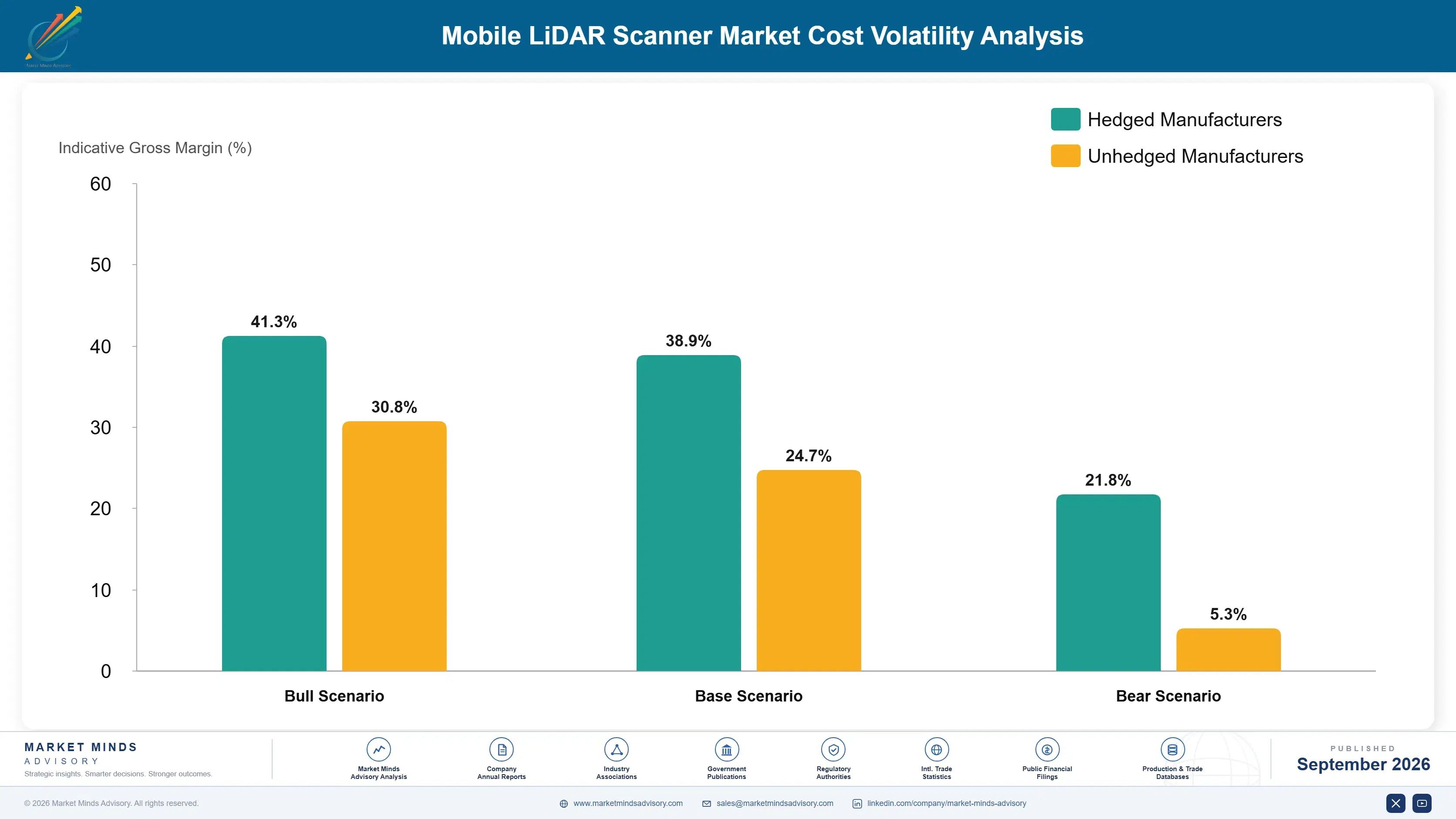
Semiconductor and Optics Cost Exposure

Semiconductor laser diodes and photodetector arrays represent roughly 35% of vendor cost of goods sold, sourced primarily from specialized optoelectronics manufacturers concentrated in Taiwan, Japan, and the United States. Precision optical lenses and beam-steering components represent a further 20% of hardware cost, sourced from a smaller group of specialized optics suppliers spread across multiple manufacturing regions worldwide.
A 2025 semiconductor laser diode supply constraint tied to a major optoelectronics foundry capacity limitation, reported in company annual filings, raised component costs by an estimated 16% for vendors without long-term supply agreements in place. Smaller sensor vendors lacking direct foundry relationships absorbed the increase directly, delaying some product shipments during the affected quarter, with several noting the disruption directly in quarterly earnings commentary shared with investors and analysts.

Vendors dependent on spot-market laser diode purchasing face greater cost exposure than those with long-term supply agreements directly with optoelectronics foundries, since spot-market dependency removes negotiating leverage during periods of constrained capacity. Larger vendors with dedicated procurement teams and committed volume agreements can absorb these cost shifts more easily than smaller competitors buying components through distributors without similar arrangements.
mobile-lidar-scanner-market-company-positioning-matrix-1790000660843

Negotiate Long-Term Foundry Supply Agreements Directly

Larger vendors are securing multi-year supply agreements directly with optoelectronics foundries rather than purchasing through distributors, locking in pricing and allocation priority during periods of constrained manufacturing capacity. This approach shields margins from spot-market price volatility that smaller competitors remain exposed to fully during comparable periods of industry-wide capacity tightness that smaller rivals cannot navigate as effectively.

Diversify Laser Diode Sourcing Across Suppliers

Vendors are qualifying multiple laser diode and photodetector suppliers for the same sensor components, reducing single-source dependency risk and improving negotiating leverage during supply disruptions, though it adds testing and qualification overhead that smaller vendors sometimes struggle to absorb given limited engineering resources available across their smaller engineering teams already stretched thin on other priorities.

Redesign Sensors Around More Available Components

Vendors are redesigning sensor optical assemblies to use more widely available laser diode and detector families rather than specialized components subject to concentrated foundry risk, trading some performance optimization for meaningfully improved supply chain resilience during periods of industry-wide capacity constraint affecting the broader optoelectronics industry and its downstream component buyers across every sensor category served.

Portfolio Architecture for Margin Defence

Portfolio economics split across three tiers running from commodity mechanical scanners to premium certified solid-state systems and forward-looking automotive-grade autonomous perception platforms. Gross margins widen considerably moving up the tier structure, reflecting the specialized semiconductor and software engineering effort required to build reliable solid-state sensors that hold up across diverse automotive operating environments spanning extreme heat, cold, and weather conditions.
Volume-tier mechanical scanners face persistently lower long-term returns as commoditization pressure intensifies from low-cost manufacturers entering the market aggressively on price alone. Premium solid-state systems retain pricing power because customers cannot easily replicate proprietary beam-steering technology and detection algorithms built over years of accumulated field testing across diverse operating conditions and geographic climates accumulated over many years of refinement.

High-value revenue pools concentrate in automotive accounts requiring certified reliability and firmware update services layered atop core sensor hardware, where switching costs run highest and renewal rates stay strongest. Vendors positioning purely on price compete for shrinking margin in the volume tier, while those investing in solid-state technology and proprietary algorithm development capture disproportionate value as the market matures further over the coming decade of continued automotive adoption.

Mechanical scanning sensors competing primarily on price against low-cost manufacturers, with gross margins in the 20 to 30% range across most vendors in this segment of the market across most geographic regions.
Gross Margin

Solid-state sensor systems with proprietary beam-steering technology and formal automotive reliability certifications, carrying gross margins between 45 and 55% across the premium vendor base overall, well above commodity-tier sensor pricing.
Gross Margin

Automotive-grade autonomous perception platforms purpose-built for commercial vehicle deployment, commanding gross margins above 55% given specialized engineering investment required to build and continuously maintain them against evolving automotive safety standards.
Gross Margin
mobile-lidar-scanner-market-cost-volatility-analysis-1790000661351

High-value Sub-segments and Strategic Watch-out

Solid-State Mobile LiDAR Scanners

The highest-value, fastest-growing segment as automotive perception programs replace mechanical scanners with reliable, lower-cost solid-state architecture, with margins and growth rates both leading the broader market across nearly every region tracked in this report, a lead vendors expect to persist through most of the forecast window ahead.

Drone-Mounted LiDAR Systems

A high-value segment growing steadily as infrastructure inspection companies adopt aerial scanning for remote and hazardous terrain, drawing dedicated vendor investment separate from established ground-based mobile mapping vendor relationships built around traditional survey equipment sales across established, non-aerial customer accounts entirely rather than newer aerial specialists.

Mechanical Scanning LiDAR Systems

The volume core of the market, generating steady revenue from installed base renewals even as growth decelerates relative to newer solid-state and drone-mounted categories entering the field and capturing an increasing share of new automotive budget allocation away from legacy mechanical scanning product lines toward newer sensor categories overall.

Handheld and Backpack LiDAR Systems

A strategic watch-out segment as indoor mapping and forensic applications demand compact scanning tools, a category still underserved by most mainstream vehicle-focused vendors today despite growing demand from law enforcement and construction accounts across most developed economies with active law enforcement modernization programs and evidence documentation requirements.

Sensors as a Platform Annuity

Mobile LiDAR sensors generate durable, multi-year revenue because automotive design wins lock in sensor specifications across an entire vehicle platform lifecycle, making mid-cycle vendor switches costly and operationally disruptive for manufacturers already deep into production tooling and validation. This design-in advantage extends across every subsequent model year built on the same platform.
Adoption stickiness varies by end-use vertical: automotive manufacturers show the deepest platform dependence given multi-year vehicle program commitments locked in at the design phase, while survey and mapping companies show comparatively higher willingness to switch vendors as newer sensor generations become available in the broader market. Drone operators adopt more cautiously but retain equipment longer once integrated, given the complexity and cost of payload requalification against original flight certification standards.

Buyer profiles are shifting generationally as younger engineering teams increasingly favor cloud-connected, software-defined sensor platforms over the hardware-first procurement processes that defined earlier generations of perception system purchasing decisions. Younger engineers entering decision-making roles show stronger preference for over-the-air update capability and consumption-based pricing over the long-term hardware contracts that previously anchored purchasing decisions across most large manufacturing organizations of the prior engineering generation.
Section default visual

Where MMA Sees the Advantage

These are among the four positions where our research anticipates prominent divergence between winners and laggards over the coming forecast period. Each is grounded in the demand model, the regulatory perimeter, and the announced capacity pipeline.
01 / SOLID-STATE SENSOR INVESTMENT

Prioritize solid-state architecture over mechanical scanning systems

Sensor manufacturers and automotive buyers should direct new product development budget toward solid-state mobile LiDAR scanners rather than incremental mechanical scanning upgrades, since this is the fastest-growing segment in the market today. It expands at 22.4% CAGR, roughly 1.51 times the overall market rate, concentrated heavily among automotive perception programs in East Asia and North America. Vendors slow to shift investment risk ceding this growth to faster-moving specialized competitors already capturing this growth across every major producing region tracked in this report's full geographic coverage.
02 / PROCESSING SUBSCRIPTION BUNDLING

Bundle point cloud processing to capture higher recurring revenue

Vendors should expand point cloud processing subscription tiers rather than competing purely on sensor hardware pricing, since processing subscriptions add 22 to 32% incremental recurring revenue while addressing survey firms' persistent need for computing infrastructure. Companies with in-house processing capability are already winning renewal decisions against hardware-only competitors. Vendors without comparable processing capability risk losing renewal accounts to better-resourced rivals over time as survey firms increasingly demand deeper support rather than raw sensor hardware alone, a preference reshaping renewal negotiations industry-wide.
03 / EAST ASIAN MARKET CONCENTRATION

Concentrate expansion investment across East Asia and China specifically

East Asia holds 29% of global market share and remains the largest single region given China's dominant LiDAR manufacturing base and massive domestic autonomous vehicle program investment. Vendors should prioritize localized product development and manufacturing partnership investment there before other regions. Cost economics favor vendors able to price aggressively given the region's concentration of domestic component supply chains that global competitors often find too costly to match given thin margins on individual sensor units sold at high volume and low unit price.
04 / WEATHER PERFORMANCE RISK

Address adverse weather performance gaps before scaling further

Heavy rain, fog, and snow conditions threaten to limit year-round deployment reliability in exactly the markets where infrastructure mapping and autonomous vehicle demand runs highest if left unaddressed by vendors racing to ship new capability. The root cause is the fundamental physics of laser light scattering off airborne water particles. Vendors investing in sensor fusion algorithms blending LiDAR with radar will outcompete rivals relying on LiDAR data alone during adverse weather conditions that occur across most operating regions annually and cannot be engineered away entirely.

Engagement Snapshot From the Field

A live engagement with an industry participant carrying material or product regulatory and market exposure ahead of a defining policy shift, showing how our research translates into a defensible multi-year portfolio strategy.
MARKET MINDS ADVISORY · CLIENT ENGAGEMENT SUMMARY
Mobile LiDAR Scanner Producer Strategic Portfolio Review and Transition Roadmap 2026·Investment Scenario on Mobile LiDAR Scanner Exposure Evaluation 2025-26
CLIENT PROFILE
The client is an autonomous vehicle developer preparing to scale from a limited pilot fleet toward commercial deployment across multiple metropolitan markets, requiring sensor procurement volumes far exceeding its prior demonstration-scale purchasing. Facing pressure to lock in a primary sensor supplier ahead of production tooling commitments, leadership sought an independent assessment of which vendor could deliver the reliability, cost, and volume commitments the scaling plan required.
STRATEGIC CHALLENGE
The developer's engineering team lacked a consistent framework for evaluating sensor vendors across reliability, weather performance, and manufacturing scalability dimensions simultaneously, since prior sensor decisions had been made primarily on demonstration-stage performance benchmarks. Competing internal engineering groups favored different vendors based on incomplete testing data, creating internal disagreement ahead of a critical supplier lock-in decision.
MMA APPROACH
MMA evaluated five leading solid-state LiDAR vendors against a standardized scoring framework covering detection accuracy across weather conditions, manufacturing capacity scalability, and total cost of ownership across a five-year vehicle program horizon. The engagement combined vendor field testing across representative driving conditions, reference customer interviews within the automotive industry, and supplier capacity commitment negotiations.
KEY FINDINGS
  1. Two of five evaluated vendors demonstrated meaningfully higher detection accuracy during adverse weather field testing, reversing the developer's prior vendor shortlist based on controlled laboratory data.
  2. Consolidating around a single primary vendor rather than a dual-sourcing strategy reduced projected five-year unit cost by an estimated 19% given committed volume pricing.
  3. Manufacturing capacity commitments varied considerably across vendors, with only two able to guarantee the production volume the developer's aggressive scaling timeline actually required.
  4. Firmware update cadence and over-the-air improvement track record proved a stronger predictor of long-term sensor performance than initial specification sheets alone during procurement evaluation.
CLIENT PROFILE
The client is an autonomous vehicle developer preparing to scale from a limited pilot fleet toward commercial deployment across multiple metropolitan markets, requiring sensor procurement volumes far exceeding its prior demonstration-scale purchasing. Facing pressure to lock in a primary sensor supplier ahead of production tooling commitments, leadership sought an independent assessment of which vendor could deliver the reliability, cost, and volume commitments the scaling plan required.
STRATEGIC CHALLENGE
The developer's engineering team lacked a consistent framework for evaluating sensor vendors across reliability, weather performance, and manufacturing scalability dimensions simultaneously, since prior sensor decisions had been made primarily on demonstration-stage performance benchmarks. Competing internal engineering groups favored different vendors based on incomplete testing data, creating internal disagreement ahead of a critical supplier lock-in decision.
MMA APPROACH
MMA evaluated five leading solid-state LiDAR vendors against a standardized scoring framework covering detection accuracy across weather conditions, manufacturing capacity scalability, and total cost of ownership across a five-year vehicle program horizon. The engagement combined vendor field testing across representative driving conditions, reference customer interviews within the automotive industry, and supplier capacity commitment negotiations.
KEY FINDINGS
  1. Two of five evaluated vendors demonstrated meaningfully higher detection accuracy during adverse weather field testing, reversing the developer's prior vendor shortlist based on controlled laboratory data.
  2. Consolidating around a single primary vendor rather than a dual-sourcing strategy reduced projected five-year unit cost by an estimated 19% given committed volume pricing.
  3. Manufacturing capacity commitments varied considerably across vendors, with only two able to guarantee the production volume the developer's aggressive scaling timeline actually required.
  4. Firmware update cadence and over-the-air improvement track record proved a stronger predictor of long-term sensor performance than initial specification sheets alone during procurement evaluation.
RECOMMENDED STRATEGY
Phase 1: Phase one negotiates a primary supply agreement with the highest-scoring vendor, securing committed capacity ahead of production tooling deadlines for the first vehicle generation. Phase 2: Phase two maintains a smaller secondary vendor relationship as a supply chain hedge without full production commitment during the initial rollout phase. Phase 3: Phase three establishes ongoing field performance monitoring to validate vendor claims against real-world fleet data continuously across every deployed market.
OUTCOME
The developer approved a primary supply agreement with the top-scoring vendor covering its full scaling program with a projected five-year sensor spend of approximately $95 million (client-reported, unverified by MMA). Internal engineering reporting credited the standardized framework with resolving prior interdepartmental vendor disagreements ahead of the production deadline.

Frequently Asked Questions

Foundational context covering the market sizes, CAGR, scope, country, region and competition that inform every finding below. This section is provided to cover basics and most often pre-purchase conversations, answered from the MMA Primary Research Dataset.

What is the current size of the Mobile LiDAR Scanner Market?

The global Mobile LiDAR Scanner market reached $2.9 billion in 2025. Growth is driven primarily by falling solid-state sensor costs and expanding autonomous vehicle programs.

How large will the Mobile LiDAR Scanner Market be by 2036?

The market is projected to reach $13.24 billion by 2036. This reflects sustained demand for LiDAR perception across automotive, mapping, and infrastructure inspection applications worldwide.

What is the CAGR for the Mobile LiDAR Scanner Market 2026 to 2036?

The market is forecast to grow at a 14.8% CAGR between 2026 and 2036. This accelerates from the 13.6% historical CAGR recorded over 2020 to 2025.

Which segment is growing fastest?

Solid-State Mobile LiDAR Scanners is the fastest-growing segment, expanding at 22.4% CAGR, roughly 1.51 times the overall market rate. Automotive design wins concentrate demand in this category.

Who are the major companies in the Mobile LiDAR Scanner Market?

Hesai Group, Velodyne Lidar, RoboSense, Ouster, and Livox Technology lead the competitive landscape, together holding an estimated 41% combined share. Each competes on cost and reliability.

Which country is growing fastest?

China is the fastest-growing country market, expanding at 19.8% CAGR. Massive sensor manufacturing scale is driving accelerated adoption across domestic autonomous vehicle programs across the entire country.

Report Segmentation Architecture

The full report scope spans multiple orthogonal segmentation dimensions, with cross-tabulated demand data provided for each dimension pair. Coverage extends further to regional breakdowns, trend trajectories, and the competitive detail needed to support segment-level decision-making.

By Sensor Architecture (Solid-State, Mechanical, Hybrid Scanning)

    By End-Use Application (Automotive, Mapping, Infrastructure Inspection)

      By Commercial Dimension (Direct Sale, Subscription, Integrated Service)

        By Region

        • East Asia
        • North America
        • Western Europe
        • South Asia and Pacific
        • Latin America
        • Middle East and Africa
        • Eastern Europe

        Scope, Methodology, and Coverage

        Every figure in this report is reproducible from documented input assumptions. The scope below maps the historical period, the forecast horizon, the segmentation dimensions, and the countries covered, alongside the underlying primary and qualitative methodology.
        Historical Period
        2020 to 2025
        Forecast Period
        2026 to 2036
        Base Year
        2025 (USD billions; MMA Primary Research Dataset, September 2026)
        Market Definition
        This report defines the Mobile LiDAR Scanner Market as vehicle-mounted, drone-mounted, and handheld light detection and ranging systems used for mobile mapping, autonomous vehicle perception, and infrastructure surveying applications. It excludes stationary terrestrial LiDAR scanners, satellite-based remote sensing systems, and general camera-based perception sensors without LiDAR ranging capability.
        Quantitative Units
        USD billions, market share percentages, CAGR percentages
        Segmentation Dimensions
        Sensor architecture, end-use application, commercial dimension, region
        Regions Covered
        East Asia, North America, Western Europe, South Asia and Pacific, Latin America, Middle East and Africa, Eastern Europe
        Countries Covered
        United States, China, Germany, Japan, South Korea, India, Brazil, United Arab Emirates, and 22 additional markets
        Key Companies Profiled
        Hesai Group, Velodyne Lidar, RoboSense, Ouster, Livox Technology, and 15 additional participants
        Quantitative Methodology
        Primary survey, n=3,800 respondents, Q4 2025, six countries; demand-side model with trade association cross-validation
        Qualitative Methodology
        47 expert interviews, Q4 2025; applied to validate demand model assumptions, identify emerging dynamics, and assess competitive positioning
        Report Format
        PDF and XLSX data workbook (Word format preview document)
        Publisher
        Market Minds Advisory
        Report Code
        MMA-2026-TEC-204
        Published
        September 2026
        Contact
        sales@marketmindsadvisory.com | www.marketmindsadvisory.com

        Purchase the full Mobile LiDAR Scanner Market Report (2026 to 2036).

        This report examines the global mobile LiDAR scanner market across solid-state, mechanical, and drone-mounted categories through the year 2036, covering both established automotive buyers and emerging mid-market segments. It quantifies demand shifts driven by autonomous vehicle scaling and falling sensor costs. Profiles of five leading vendors sit alongside fifteen additional participants, assessed on a common concentration and capability basis. Regional adoption patterns are detailed across all seven geographies in the underlying dataset. Coverage also includes forecast scenarios, cost exposure, and portfolio margin economics across three equipment tiers.
        Ten-year demand forecast by sensor architecture category
        Vendor reliability and pricing benchmarking analysis
        Regional adoption pattern analysis across seven geographies
        Semiconductor cost exposure and mitigation pathway assessment
        Portfolio margin economics across three product tiers
        Competitive positioning and moat durability assessment

        Built For The People Who Decide

        From boardroom strategy to bench-side execution, this report is read cover-to-cover by leaders shaping the next decade of their industry, turning demand scenarios, market dynamics and valuation benchmarks into decisions.
        CXOs/ Presidents/ VPs/ Managers
        M&A and Corporate Development
        Strategy Teams and R&D Heads
        Procurement and Product Directors
        Regulatory and Compliance Leaders
        Investor Relations and Equity Analysts