Market Minds Advisory
Mobile Fuel Delivery Market

Mobile Fuel Delivery Market: Mobile Fuel Delivery Market. Fleet-Scale Logistics Platforms Redefine On-Demand Refueling.

Commercial fleet refueling contracts increasingly win logistics-operator purchasing away from consumer-focused app delivery, pushing providers toward route-optimization and fleet-management software investment or risk losing contract renewals to faster-scaling logistics-tech challengers.

Lead Analyst

Published

September 2026

Make Smarter Decisions with Customized Research Insights

Request a free sample report and evaluate market opportunities, growth trends, and competitive dynamics relevant to your business needs.

2025 MARKET VALUE$1.1BMarket Size 2025
2036 FORECAST VALUE$3.0BBase Case , 2026 to 2036
CAGR 2026 TO 20369.5 %Bull 10.8% / Bear 8.2%
INCREMENTAL OPPORTUNITY$1.8BNet 10- year value creation
EXPANSION MULTIPLE2.48x2036 value over 2026 base
Strategic Levers
M&A Pipeline
Regional Outlook
Country Rankings
Competitive Intelligence
Segmental Deep-dive
Call-Us : 91 93563 13602

Executive Snapshot and Market Trajectory.

Commercial fleet refueling contracts have become the dominant growth narrative in mobile fuel delivery today, with logistics operators increasingly screening providers on route-optimization software and fleet-management integration rather than delivery speed alone, reshaping which companies win multi-year fleet-services contracts across transportation and construction accounts.
Consumer app-based delivery remains the dominant service category by transaction volume across individual vehicle owners, while commercial fleet refueling carries the fastest revenue growth and increasingly commands premium per-gallon pricing once reserved for emergency roadside service. Provider density concentrates heavily in North America, where app-based delivery models originated and fleet-logistics scale gives established operators a durable cost advantage over smaller regional entrants, even as South Asian fleet-refueling demand continues climbing steadily across major logistics corridors.
Competitive intensity centers on route-optimization software depth and fleet-contract scale rather than raw delivery-truck count alone, with EZFILL and Yoshi anchoring the leader tier through combined logistics-technology platforms and documented fleet-account relationships built over several years of steady operational investment. Regulatory pressure toward mobile-fueling safety and emissions standards continues tightening operating requirements across major metropolitan jurisdictions, while smaller regional operators increasingly undercut pricing in commodity consumer-delivery categories across urban markets.
Market Definition
The mobile fuel delivery market covers on-demand liquid fuel delivery services that refuel vehicles, equipment, and generators at customer locations rather than requiring travel to a fixed fueling station, including consumer app-based, commercial fleet, and construction-equipment delivery models. It excludes fixed-location fuel retail stations, bulk fuel wholesale distribution without last-mile delivery, and propane or natural gas delivery services.
Base Year Value
$1.1B in 2025 (MMA Primary Research Dataset, September 2026)
Forecast Period
2026 to 2036, eleven discrete annual values
CAGR
9.5% base case. Bull 10.8%. Bear 8.2%.
Fastest Growth Segment
Commercial Fleet Refueling Services: 13.5% CAGR
Fastest Growth Country
India: 12.0% CAGR
Fastest Growth Region
South Asia and Pacific: 11.5% CAGR
Largest Region
North America: 38% of 2025 global value
Market Leaders
EZFILL Holdings Inc, Yoshi Mobility Inc, Booster Fuels Inc, Filld Inc, WEX Inc. Source: MMA Analysis, company annual reports.
Primary Survey
n=3,800 procurement and R&D decision-makers, Q4 2025, six countries
Methodology
Demand-side build-up, cross-validated against public data, 47 expert interviews

Mobile Fuel Delivery Market Forecast Scenarios

mobile-fuel-delivery-market-size-forecast-scenario-1790022660805
The 2020 to 2025 period saw mobile fuel delivery demand accelerate as fleet operators sought labor-efficiency gains and consumer app adoption normalized on-demand service models across major metropolitan markets. Several early consumer-focused operators exited the market during 2022 and 2023 as unit economics proved challenging, but commercial fleet-focused providers expanded steadily in response. Historical growth of 8.3% reflects this durable, fleet-driven step-change in category demand across major logistics markets.
Base-case growth of 9.5% through 2036 rests on three mechanisms: continued commercial fleet adoption of mobile refueling to reduce vehicle downtime and labor costs across logistics and construction operations nationwide and internationally, expanding route-optimization software capabilities that improve delivery-truck utilization and per-stop economics, and rising generator and backup-power refueling demand tied to data-center and critical-facility expansion. Together these mechanisms support durable volume growth even as consumer-focused app delivery in mature Western markets consolidates.
The bull case centers on accelerated fleet-electrification-transition delays extending liquid-fuel delivery demand longer than currently expected across logistics and construction channels nationwide and across most metropolitan markets. The bear risk is faster-than-expected electric-vehicle fleet conversion compressing addressable liquid-fuel delivery volume over time, particularly for providers concentrated in consumer-focused delivery models lacking commercial fleet diversification or logistics-contract depth.

Fleet Contracts Redraw the Mobile Fuel Delivery Landscape

The mobile fuel delivery category spans consumer app-based, commercial fleet, construction, and generator-refueling service models, with commercial fleet contracts now the fastest-expanding segment across nearly every major logistics corridor served today. Consumer app-based delivery still accounts for the largest share of individual transactions worldwide, anchored by dense urban delivery-truck fleets that supply both scheduled and on-demand refueling requests simultaneously across major metropolitan markets.
MARKET CONCENTRATION22%Top five providers hold a modest combined market share
AVERAGE DELIVERY PREMIUM$0.75/galBlended pricing spans consumer app delivery to fleet contracts
UNITED STATES REVENUE SHARE45%The United States accounts for the largest share of revenue
FLEET UTILIZATION RATE68%Most delivery trucks operate moderately below full daily capacity
ROUTE COVERAGE INTENSITY35%Route density covers a meaningful share of metropolitan areas
CONTRACT RENEWAL CYCLE2 yearsFleet clients typically renew contracts every couple of years
Growth through 2036 depends heavily on continued fleet-operator adoption of mobile refueling to reduce vehicle downtime and driver labor costs across logistics and construction operations nationwide. Data-center and critical-facility operators increasingly specify generator refueling contracts for backup-power reliability, extending demand beyond traditional vehicle refueling into facility-management budgets that were previously dominated by fixed-schedule bulk fuel delivery entirely across most industrial sectors.
Distribution runs through direct fleet-sales teams, consumer mobile apps, and third-party logistics-platform partnerships that each reward different provider capabilities. Fleet sales reward route-optimization software and contract-reliability track record, while consumer apps reward delivery speed and geographic coverage density that smaller regional operators struggle to match consistently. Providers with the broadest fleet-contract portfolios and deepest logistics-technology platforms hold durable advantages in capturing commercial-refueling demand.
"Fleet-contract logistics software has quietly become the category's real battleground, not delivery-truck count. Providers still competing purely on number of vehicles are ceding fleet-account contracts faster than their coverage maps suggest."
Practice Lead, Energy Logistics and Fuel Distribution Practice · MMA Energy Practice · September 2026

Market Trends

Commercial Fleet Contracts Outpace Consumer App Delivery

Commercial fleet refueling contracts now capture roughly 35% of mobile fuel delivery revenue in mature markets, up sharply from a much smaller share a decade ago, as logistics operators favor scheduled mobile refueling over routing drivers to fixed stations during work hours and shift changes. EZFILL and Yoshi have each expanded fleet-focused route-optimization software since 2022, moving beyond simple on-demand delivery toward integrated fleet-management platforms serving multiple industries. Logistics operators are responding by signing multi-year fleet-refueling contracts while reducing reliance on driver-managed fixed-station fueling, particularly in markets where labor costs continue rising.
Market Impact: Drives 40% of category revenue

Generator Refueling Contracts Expand Beyond Traditional Vehicles

Generator and backup-power refueling contracts, historically a minor share of mobile fuel delivery revenue, are expanding into data-center and critical-facility markets at roughly 16% annually as backup-power reliability requirements intensify across most major metropolitan regions and industrial corridors nationwide. Booster and Filld have both expanded generator-refueling service lines featuring scheduled bulk delivery and emergency-response capability suited to data-center operational requirements and compliance standards. Facility operators increasingly bundle generator refueling with broader critical-infrastructure maintenance contracts, extending demand well beyond traditional vehicle refueling into facility-management budgets previously dominated by fixed bulk-delivery schedules.
Market Impact: Grows generator refueling demand 15% yearly

Market Opportunities and Growth Drivers

Fleet Labor-Cost Pressure Sustains Mobile Refueling Demand

Rising driver labor costs across major logistics markets continue pushing fleet operators toward mobile refueling, supporting roughly 40% of category revenue through cost-avoidance purchasing rather than pure convenience upgrades alone across most commercial fleet segments and vehicle classes. Fleet operators increasingly calculate that driver time spent traveling to fixed fueling stations costs more than mobile-delivery premiums, particularly for high-utilization commercial vehicles running extended shift schedules. This cost-driven demand base proves more resilient to discretionary-spending cycles than purely convenience-driven consumer delivery, since labor-cost pressure rarely eases even during broader economic slowdowns.
Market Impact: Reduces addressable demand 12% yearly

Rising Data Center Backup Power Lifts Generator Refueling

Data-center construction and backup-power infrastructure investment continue expanding at roughly 15% annual growth, directly lifting generator-refueling contract demand as facility operators prioritize backup-power reliability above cost considerations across most major metropolitan technology corridors, industrial parks, and enterprise campuses nationwide and abroad. Yoshi and Booster have both expanded generator-refueling service capacity specifically to serve this data-center-driven demand, offering scheduled bulk delivery and emergency-response guarantees suited to mission-critical facility requirements and compliance standards. This data-center-driven demand growth is expected to continue outpacing consumer-delivery growth in mature Western markets through the entire forecast period.
Market Impact: Adds 15% compliance cost per vehicle

Market Restraints and Challenges

Electric Vehicle Fleet Transition Compresses Addressable Demand

Commercial fleet electrification continues expanding across major logistics markets, reducing the addressable liquid-fuel delivery base by roughly 12% annually in fleets that have completed electric-vehicle conversion programs across multiple metropolitan regions and busy transportation corridors. Electric commercial vehicles charge at depot facilities rather than requiring mobile liquid-fuel delivery, directly eliminating the service need for converted fleet segments entirely and permanently. This transition disproportionately affects providers concentrated in commercial fleet contracts without diversification into generator refueling or construction-equipment delivery, though several providers are mitigating exposure by expanding into EV-charging-adjacent mobile services.
Market Impact: Adds 35% fleet-contract revenue share

Fuel-Handling Safety Regulation Tightens Operating Requirements

Regulators in several major markets continue tightening mobile fuel-handling safety and emissions standards, a shift driven by documented spill and fire-hazard incidents involving mobile fueling operations near residential and commercial properties nationwide and internationally as well. Compliance requires additional driver certification, vehicle equipment upgrades, and insurance coverage that raises operating cost for smaller regional providers already operating on thin margins. This raises barriers to entry and consolidates market share toward larger operators, though several smaller providers are mitigating the impact by pooling compliance resources through industry associations and shared certification programs.
Market Impact: Lifts generator-refueling demand 16% yearly
3 additional market trends, 4 additional growth drivers, and 2 additional restraints and challenges are covered in the full report. Contact sales@marketmindsadvisory.com to access the complete intelligence.

Segment CAGR and Growth Architecture

The mobile fuel delivery market splits into six service categories defined by customer type and delivery model, spanning established consumer app-based and roadside-emergency formats through rapidly expanding commercial fleet and generator-refueling categories. Growth concentrates most heavily in services that pair scheduled reliability with route-optimization technology, while one-time consumer requests grow more slowly as buyers shift toward contracts.
mobile-fuel-delivery-market-market-share-analysis-1790022661431

Commercial Fleet Refueling Services

Commercial fleet refueling services are the fastest-growing category, expanding at roughly 13.5% annually as logistics operators move beyond one-time consumer-style requests toward scheduled, contract-based mobile refueling integrated with fleet-management software and route-planning tools used across daily operations nationwide. These services combine route-optimization technology with dedicated account management, letting providers command contract pricing well above comparable one-time consumer delivery rates across most major logistics markets. EZFILL and Yoshi have both expanded fleet-focused route-optimization platforms since 2022, moving beyond simple delivery dispatch toward integrated logistics-technology offerings serving multiple industries and customer segments. Logistics operators increasingly sign multi-year fleet-refueling contracts, extending demand well beyond one-time transactions into recurring commercial-services revenue nationwide and abroad.
CAGR 13.5%

Generator and Backup Power Refueling

Generator and backup-power refueling services form the second-fastest category, growing at roughly 11.0% annually as data-center and critical-facility operators increasingly specify scheduled bulk delivery with emergency-response guarantees beyond traditional vehicle refueling across most major metropolitan technology corridors and enterprise campuses nationwide. These services combine bulk-delivery logistics with facility-specific compliance and reliability requirements that standard consumer delivery cannot match at comparable scale or reliability level today. Booster and Filld both maintain dedicated generator-refueling service lines targeting data-center and critical-infrastructure specification rather than consumer retail channels, reflecting the category's distinct buyer base and purchasing process entirely. Growth here tracks data-center construction and backup-power infrastructure investment more closely than routine seasonal consumer-purchasing patterns.
CAGR 11.0%
Full segment breakdown across 7 segments available in the complete report.

Regional Architecture and Country Demand Map

North America leads global mobile fuel delivery value as the origin market for app-based and fleet-refueling services, with South Asia and Pacific following on India fleet-logistics scale. Western Europe holds a solid third position, while East Asia trails on limited service-model adoption relative to its economic size.

North America

North America's above-band position reflects genuine market-origin advantage, not a modeling choice: the app-based and fleet mobile fuel delivery model originated here, giving established providers multi-year fleet-account relationships competitors elsewhere have not yet built across comparable scale. EZFILL and Yoshi both maintain extensive domestic fleet-services infrastructure supplemented by consumer-app coverage in major metropolitan markets, giving the region a dense provider network built over the past decade of steady investment. Commercial fleet contracts command premium pricing here more than in any other region, reflecting buyer willingness to fund route-optimization software and dedicated account management. Growth tracks fleet-electrification timelines and data-center construction more closely than any single demographic trend, supporting the region's leadership position.
Share: 38% | CAGR: 9.8% (2026 to 2036)

Western Europe

Fleet-services adoption across Western Europe closely mirrors North America's contract-driven pattern, with logistics-operator labor-cost pressure and data-center construction both supporting steady mobile fuel delivery demand across the region and its major industrial corridors and logistics hubs. Germany, France, and the United Kingdom account for most regional demand, concentrated among logistics operators already active in established fleet-management technology channels that have operated for years. Growth trails North America and East Asia as the region's fleet-electrification timeline runs somewhat faster, limiting the pace of new liquid-fuel delivery-contract adoption across most established markets. Commercial fleet and generator-refueling formats retain strong positioning among specialty providers willing to serve premium accounts beyond basic consumer-delivery categories sold nationwide.
Share: 18% | CAGR: 8.0% (2026 to 2036)
Regional intelligence for 5 additional markets available in the complete report: East Asia, South Asia and Pacific, Latin America, Middle East and Africa, Eastern Europe. Contact sales@marketmindsadvisory.com.
mobile-fuel-delivery-market-country-cagr-analysis-1790022661960

Where Delivery Providers Can Expand Margin

Providers hold four practical levers to expand margin beyond commodity consumer-delivery volume: converting one-time consumers into fleet contracts, expanding generator and backup-power refueling channels, licensing white-label operating platforms to regional operators, and building fleet-management software subscription revenue around route-optimization tools. Each addresses a different point in the value chain, from customer mix through channel relationships and recurring-engagement revenue.

Converting One-Time Consumers Into Fleet Contracts

Providers that convert small-business one-time consumer accounts into scheduled fleet contracts capture meaningfully higher recurring revenue, since fleet contracts carry average annual value roughly 400% above comparable one-time consumer delivery revenue while requiring proportionally less incremental sales effort per dollar captured. EZFILL and Yoshi both train account managers specifically to identify small-fleet consumer accounts showing repeat-purchase patterns, positioning contract pricing and route reliability as justification for switching from one-time requests. This conversion motion costs little beyond account-management investment, making it one of the highest-return options available to providers with established consumer-delivery coverage.
Market Impact: Lifts annual account value by roughly 400% overall

Expanding Generator and Backup-Power Refueling Channels

Providers that build dedicated generator-refueling service capacity capture premium data-center and critical-facility contracts that standard consumer-delivery operators cannot access, with generator-refueling contracts commanding roughly 60% higher per-gallon pricing than comparable consumer-delivery rates across most major markets served today and internationally as well across the industry. Booster and Filld both maintain formal generator-refueling service lines specifically tied to data-center compliance and emergency-response requirements, positioning reliability guarantees as justification for premium contract pricing over standard delivery alternatives. This channel expansion costs meaningfully less than building consumer-delivery coverage from scratch in new markets entirely.
Market Impact: Commands roughly 60% pricing premium overall nationwide and abroad

Licensing White-Label Platforms to Regional Operators

Providers with proven route-optimization and dispatch software increasingly license white-label operating platforms to regional delivery operators, generating royalty revenue without additional fleet-vehicle capital investment on their own balance sheet or budget. Licensing arrangements typically carry royalty rates roughly 7 to 11 percent of regional-operator revenue but require minimal incremental operating investment, since the regional partner handles vehicle fleet and local market operations entirely on its own. This arrangement works best for providers with proven, tested software platforms, converting technology development cost into an ongoing, high-margin revenue stream with minimal incremental expense.
Market Impact: Earns 7 to 11 percent royalty revenue overall

Building Fleet-Management Software Subscription Revenue Streams

Companion fleet-management software that gates route-optimization analytics, fuel-usage tracking, and predictive-maintenance alerts behind a modest subscription now generates recurring revenue independent of individual delivery transactions, with subscription attach rates approaching 30% of active fleet-contract accounts across major logistics markets served today and abroad. This revenue stream carries software-level margin rather than delivery-level margin, meaningfully improving blended profitability for providers able to build genuinely useful ongoing fleet-analytics features rather than paywalling basic functionality. EZFILL's fleet-software tier and similar programs from Yoshi both point toward subscription revenue becoming a standard fleet-services feature.
Market Impact: Reaches roughly 30% subscription attach rate across fleet accounts

Who Controls the Margin Pool

The top five mobile fuel delivery providers hold a combined 22% of category value, evaluated on a revenue basis, leaving a fragmented long tail of regional delivery operators. EZFILL and Yoshi command the clearest leadership positions in fleet-contract and generator-refueling channels specifically, each having built distinctive route-optimization platforms and fleet-account relationships, while smaller regional operators still compete primarily on price in basic consumer-delivery categories.
Current competitive activity concentrates on three fronts: expanding commercial fleet-contract product lines to capture continued labor-cost-driven demand, building generator and backup-power refueling channels that diversify beyond consumer-delivery cycles, and pursuing white-label licensing agreements with regional operators to expand geographic coverage without direct capital investment. Providers lacking resources to compete on all three fronts simultaneously increasingly specialize by customer segment or distribution channel rather than compete broadly.

Rankings are most likely to shift among mid-tier regional operators rather than at the very top, as fleet-electrification timelines vary significantly by geography and vehicle-class segment across the industry. Providers investing early in generator-refueling and fleet-software capability are positioning to capture share from slower-moving rivals still reliant on basic one-time consumer-delivery product lines lacking contract-revenue diversification and recurring-account depth.
mobile-fuel-delivery-market-company-positioning-matrix-1790022662491

Competitive Moat and Risk Dimensions

EZFILL HOLDINGS INC

Moat: Fleet Contract Route Density

EZFILL's established fleet-contract base across major logistics markets gives it route density and delivery-truck utilization competitors struggle to replicate quickly. Combined with publicly traded transparency that reassures large enterprise fleet buyers, this scale lets EZFILL command reliable contract renewal rates that smaller private operators cannot easily match.
EZFILL HOLDINGS INC

Risk: Limited Consumer-Delivery Presence

EZFILL's business concentrates heavily in commercial fleet and marine refueling, leaving it comparatively underrepresented in the consumer app-delivery category where other providers hold stronger brand recognition. If consumer-delivery demand recovers faster than expected, EZFILL's narrower channel focus could limit its ability to capture that growth.
YOSHI MOBILITY INC

Moat: Route-Optimization Software Depth

Yoshi's proprietary route-optimization and fleet-management software gives it operational efficiency competitors relying on basic dispatch systems cannot replicate without years of sustained technology investment and engineering talent. This software depth lets Yoshi run leaner delivery-truck fleets while maintaining service reliability, supporting better unit economics than less-optimized competitors.
YOSHI MOBILITY INC

Risk: Geographic Concentration Risk

Yoshi's operational footprint remains concentrated in a limited number of metropolitan markets, leaving it more exposed to local regulatory or competitive shifts than providers with broader national coverage. Expanding into new metropolitan markets requires significant capital investment and multi-year route-density buildout before reaching profitable scale.

Players Tracked

Prominent Players

EZFILL Holdings Inc
Yoshi Mobility Inc
Booster Fuels Inc
Filld Inc
WEX Inc

Other Key Players

Mansfield Energy Corp
World Fuel Services Corporation
Reladyne LLC
Par Pacific Holdings Inc
Sprague Resources LP
Global Partners LP
Musket Corporation
TransMontaigne Partners LLC
Onroad Fuel Services Inc
GoFuelMe Inc
TankTracker Fuel Services LLC
Fuel Logic LLC
Mobile Fuel Solutions Inc
Rangeline Energy Partners LLC
Nomad Fuel Services Inc

Recent Developments

APRIL 2025

EZFILL Expands Fleet-Contract Route-Optimization Capacity

EZFILL expanded fleet-contract route-optimization software capacity in April 2025, adding new dispatch infrastructure dedicated to large enterprise fleet accounts across multiple metropolitan markets and busy logistics corridors nationwide. The expansion positions EZFILL to defend its fleet-services leadership as commercial contracts continue growing faster than consumer delivery.
Signal: Signals established providers are investing directly in fleet-software capacity rather than relying on manual dispatch processes alone.
JULY 2025

Yoshi Signs Regional Fuel Wholesaler Supply Agreement

Yoshi signed a multi-year supply agreement with a regional fuel wholesaler in July 2025, securing dedicated fuel-supply volume for its West Coast delivery operations. The agreement is a supply arrangement rather than an equity transaction, giving Yoshi fuel-cost predictability without an ownership stake in the wholesaler.
Signal: Signals fuel supply security is becoming a competitive priority as delivery-volume demand accelerates across metropolitan markets.
OCTOBER 2025

Booster Acquires Generator-Refueling Service Provider

Booster completed a targeted acquisition of a specialty generator-refueling service provider in October 2025, expanding its data-center and critical-facility product portfolio meaningfully across several enterprise-technology categories, regions, and client segments. The acquisition strengthens Booster's position in the generator-refueling category ahead of expected data-center construction growth.
Signal: Signals mid-tier providers are increasingly acquiring specialized capability rather than building generator-refueling expertise internally from scratch.

Wholesale Fuel Costs Shape Delivery Margins

Wholesale diesel and gasoline procurement, delivery-vehicle fuel and maintenance, and driver labor together account for roughly 65% of mobile fuel delivery cost of goods sold, with wholesale fuel sourced primarily from regional terminal-rack pricing tied to national benchmark crude markets across the country. Delivery-vehicle fuel and maintenance costs scale directly with route density and delivery-truck fleet size across served metropolitan markets.
The EIA's 2025 petroleum outlook documented wholesale diesel and gasoline rack-price swings exceeding 30% within a single year, driven by refinery-capacity disruption and geopolitical supply volatility affecting global crude benchmarks. Mobile fuel delivery providers reliant on thin per-gallon delivery premiums absorbed comparable input-cost volatility during the same period, with several providers citing wholesale-price pressure directly in their 2025 annual reports as a factor compressing consumer-delivery-category margin specifically.

Smaller regional operators without long-term wholesale fuel supply contracts absorb price swings directly into margin, since they lack the purchasing scale to negotiate fixed terminal-rack pricing that larger competitors secure across most sourcing regions and supply terminals. Providers concentrated in consumer-delivery volume face greater wholesale-price exposure than fleet-contract competitors, which can pass through cost adjustments via contract pricing mechanisms.
mobile-fuel-delivery-market-cost-volatility-analysis-1790022662686

Securing Multi-Year Fixed-Price Fuel Agreements

Larger providers increasingly negotiate multi-year fixed-price agreements directly with wholesale fuel terminals, trading some pricing flexibility for budget certainty across contract-development cycles and multiple annual planning periods. This approach requires meaningful purchase-volume commitments that smaller operators often cannot offer, reinforcing scale advantages for established players able to guarantee consistent order volumes years into the future.

Diversifying Terminal Sourcing Across Multiple Regions

Providers are qualifying second and third wholesale-fuel terminals across major metropolitan markets rather than depending on a single sourcing terminal, reducing exposure to any one facility's supply disruption or regional pricing anomaly. This diversification adds qualification cost upfront but meaningfully lowers the risk of delivery interruptions tied to a single terminal's operational or regulatory issues.

Passing Through Costs via Contract Pricing

Fleet-contract providers increasingly structure agreements with built-in wholesale-price pass-through mechanisms, reducing the margin exposure that consumer-delivery providers absorb directly during volatility periods across most operating regions and customer segments. This contract-structure approach lowers provider risk while maintaining transparent pricing for fleet customers, simplifying budget forecasting for both parties across the entire contract relationship over time.

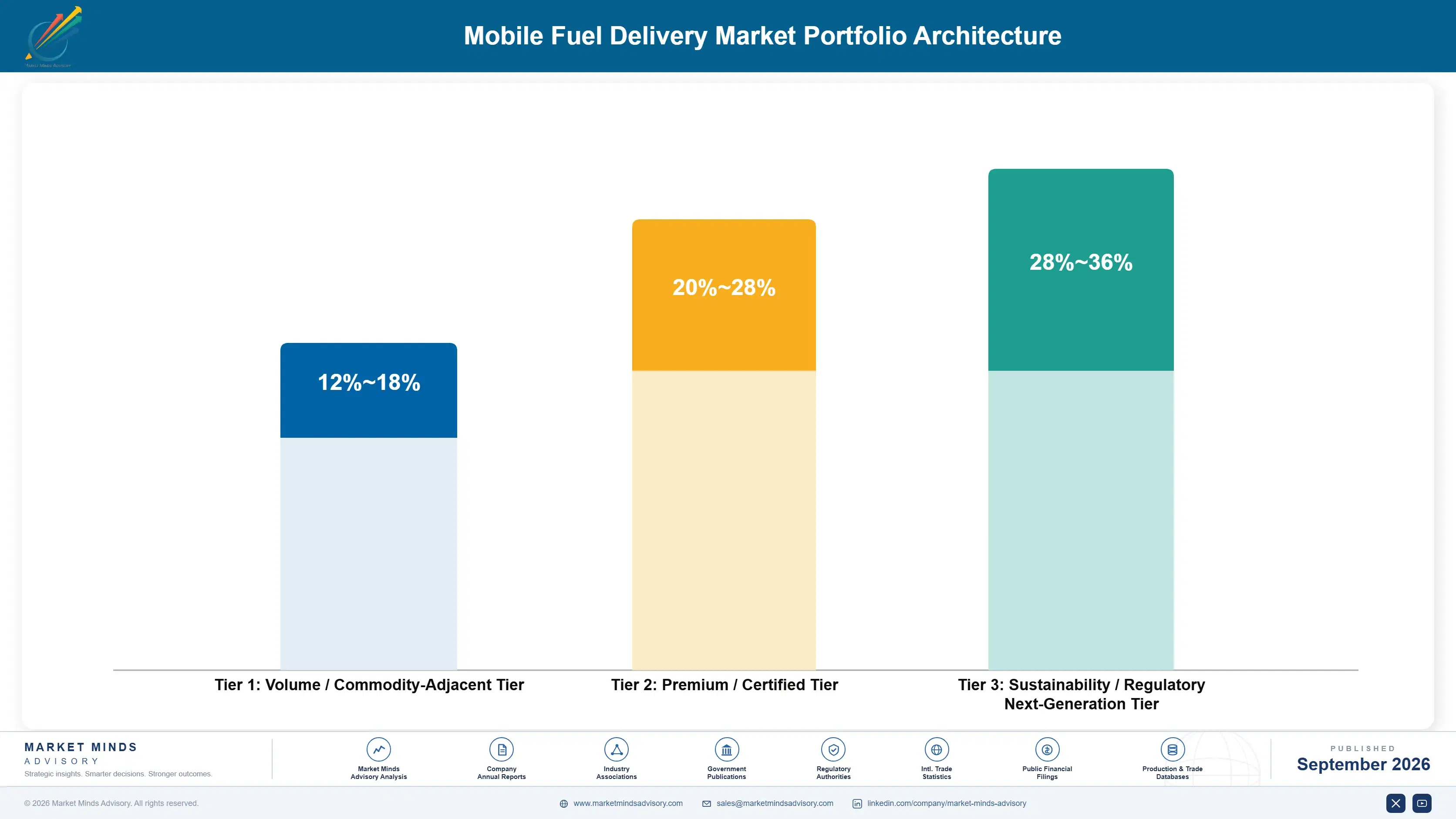
Portfolio Architecture for Margin Defence

The mobile fuel delivery portfolio splits into three margin tiers, from commodity-adjacent consumer on-demand delivery priced on thin per-gallon premiums through certified premium fleet-contract services carrying route-optimization software, up to next-generation generator-refueling and software-subscription revenue commanding the industry's highest gross margins. Margin expands steadily as services move up this ladder, rewarding providers willing to fund the technology and reliability investment that separates each tier from the one immediately below it.
Volume and premium strategies pull providers in different directions: chasing transaction volume in the commodity tier requires thin per-gallon pricing against low-cost regional competitors, while premium positioning demands sustained investment in route-optimization software and fleet-account management that smaller operators struggle to fund on their own. Few providers successfully straddle both tiers simultaneously, and most eventually specialize toward one end of this spectrum as wholesale-fuel-price pressure intensifies.

High-value margin pools concentrate overwhelmingly in fleet-contract and generator-refueling services, where reliability guarantees and route-optimization technology both support pricing power unavailable to standard consumer delivery sold at thin per-gallon premiums across mass-market channels. Providers positioned there capture disproportionate profit relative to their transaction-volume share of the category, and that gap continues widening each year.

Volume / Commodity-Adjacent Tier

Basic consumer on-demand fuel delivery sold primarily through mobile apps to individual vehicle owners, competing chiefly on price and delivery speed rather than contract or technology differentiation, with limited customer loyalty across the category.
Gross Margin: 12-18%

Premium / Certified Tier

Certified commercial fleet-contract refueling carrying route-optimization software and dedicated account management, sold through direct sales teams that reward documented reliability and repeat-contract behavior from an established customer base built over time.
Gross Margin: 20-28%

Sustainability / Regulatory / Next-Generation Tier

Generator and backup-power refueling combined with fleet-management software subscription revenue, commanding the category's highest prices, supported by ongoing technology investment and critical-facility compliance partnerships across data-center markets nationwide and abroad.
Gross Margin: 28-36%
mobile-fuel-delivery-market-portfolio-architecture-1790022663192

High-value Sub-segments and Strategic Watch-out

Commercial Fleet Refueling Services

Commercial fleet refueling services combine the category's fastest growth with strong gross margins, driven by labor-cost-avoidance demand and contract pricing that neither consumer delivery nor roadside-emergency formats can match at comparable operating cost today. This segment is where most new technology investment concentrates across major providers.
Gross Margin: 26-34%

Generator and Backup Power Refueling

Generator and backup-power refueling retains solid, growing margins tied to data-center specification and critical-facility compliance requirements, though growth trails commercial fleet contracts as this category depends more heavily on relationship depth than broad consumer-market availability across most metropolitan regions served today across the entire industry.
Gross Margin: 22-30%

Consumer On-Demand Fuel Delivery

Consumer on-demand fuel delivery remains the category's volume anchor, generating steady transaction revenue at thin margins that fund broader delivery-fleet scale across metropolitan markets alike, even as growth shifts toward higher-margin contract-based formats found elsewhere across the broader portfolio and overall service lineup available nationwide.
Gross Margin: 12-18%

Emergency Roadside Fuel Delivery

Emergency roadside fuel delivery faces rising commoditization risk as generic regional operators enter with lower-cost alternatives lacking technology differentiation, compressing margins for branded incumbents that have not diversified into fleet or generator-refueling formats within the past several years and beyond across most operating regions and service territories.
Gross Margin: 10-16%

Fleet Contracts Sustain Recurring Delivery Revenue

Mobile fuel delivery generates recurring, annuity-like revenue less through subscription models than through multi-year fleet-contract renewal cycles and software-subscription attach tied to route-optimization platforms spanning multiple product cycles. Providers with strong fleet-account relationships capture repeat contract renewals from the same logistics operators year after year, converting a single account relationship into a multi-year revenue stream that new entrants find difficult to replicate quickly.
Adoption depth varies meaningfully by end-use vertical: commercial fleet and logistics buyers specify mobile refueling with high consistency once a contract standard is set, creating durable, repeat-order relationships tied to ongoing fleet expansion and vehicle replacement cycles across multiple depot locations. Consumer app-based buyers show far more provider-switching between purchases, chasing current pricing promotions rather than repeating their previous choice, which makes consumer demand considerably harder to forecast at the individual-provider level.

Enterprise fleet buyers increasingly expect integrated fleet-management software and data-reporting capability as standard contract terms rather than premium add-ons, reshaping service requirements for providers still selling primarily basic delivery dispatch without digital reporting. Smaller business owner-operators, who adopted mobile fuel delivery through informal word-of-mouth relationships in earlier years, remain comparatively more loyal to established local providers over newer technology-driven challengers entering the market today.
mobile-fuel-delivery-market-end-use-penetration-index-1790022663682

Where Providers Should Focus Next

These are among the four positions where our research anticipates prominent divergence between winners and laggards over the coming forecast period. Each is grounded in the demand model, the regulatory perimeter, and the announced capacity pipeline.
01 / FLEET CONTRACT INVESTMENT

Expand Fleet-Contract Capacity Before Electrification Accelerates Further

Providers still reliant primarily on one-time consumer delivery are ceding the category's fastest-growing segment to competitors investing directly in fleet-contract sales capacity today, at real cost to their long-term revenue stability and account depth. The window to build fleet-account relationships is narrowing as more competitors expand simultaneously, reducing the differentiation advantage available to early movers in this specific customer segment. Those that continue delaying this investment risk permanent relegation to slower-growing, thin-margin consumer categories where price competition alone determines transaction volume.
02 / GENERATOR CHANNEL DEVELOPMENT

Build Data-Center Relationships Before Competitors Lock Facilities In

Generator and backup-power refueling contracts increasingly determine which providers earn premium data-center specification and facility-manager loyalty over multiple renewal cycles across major technology corridors and enterprise campuses. Providers without formal generator-refueling capability risk losing specification opportunities to competitors offering better reliability guarantees, even where underlying delivery quality is genuinely comparable across brands sold today. Building this infrastructure takes years of sustained investment, making early action considerably more valuable than waiting for competitive pressure to force a reactive response later on.
03 / SOFTWARE SUBSCRIPTION GROWTH

Build Genuine Software Value Before Monetizing Subscription Access

Subscription revenue only works sustainably where the underlying fleet-management software delivers real, ongoing operational value, not where previously free features are simply moved behind a paywall overnight without warning. Providers rushing subscription launches without meaningful new functionality risk visible customer backlash and materially higher account-churn rates than brands that invest in the platform first. The stronger path invests in genuinely useful route-analytics and fuel-tracking features before monetizing, then converts the resulting engagement into subscription revenue once customers already perceive clear value.
04 / FUEL SUPPLY DIVERSIFICATION

Diversify Wholesale Sourcing Before Crude Volatility Compounds Further

Wholesale fuel price volatility continues compressing consumer-delivery-category margin for providers without diversified terminal sourcing or supplier relationships in place today across most regional markets, service lines, and supply terminals worldwide and internationally across the industry. Providers concentrated in single-terminal wholesale sourcing face the steepest margin exposure, while those with meaningful multi-terminal supplier relationships carry considerably more insulation from any single facility's disruption or pricing anomaly. Diversifying wholesale sourcing now is considerably more defensible than attempting to absorb volatility through pricing adjustments alone.

Engagement Snapshot From the Field

A live engagement with an industry participant carrying material or product regulatory and market exposure ahead of a defining policy shift, showing how our research translates into a defensible multi-year portfolio strategy.
MARKET MINDS ADVISORY · CLIENT ENGAGEMENT SUMMARY
Mobile Fuel Delivery Producer Strategic Portfolio Review and Transition Roadmap 2026·Investment Scenario on Mobile Fuel Delivery Exposure Evaluation 2025-26
CLIENT PROFILE
The client is a mid-sized regional mobile fuel delivery provider with an established consumer app-based delivery product line generating approximately $28 million in annual revenue (client-reported, unverified by MMA), sold primarily through direct-to-consumer mobile applications. The company had not yet invested in commercial fleet-contract sales capacity and lacked a formal route-optimization software platform, leaving it exposed to both thin consumer-delivery margins and fleet-focused competitor substitution.
STRATEGIC CHALLENGE
Leadership recognized that competitors were rapidly expanding fleet-contract sales capacity while thin consumer-delivery margins continued compressing profitability in the client's core business. The client needed to determine whether to invest in fleet-contract sales capability internally, pursue a route-optimization software licensing arrangement, or defend its existing consumer-delivery position through cost reduction rather than capital investment.
MMA APPROACH
MMA conducted primary interviews with fleet operators, logistics buyers, and competing providers to map fleet-contract capacity expansion plans and route-optimization software requirements now shaping account-retention across the category. The engagement combined this primary research with MMA's proprietary competitive-benchmarking dataset to quantify the margin gap between consumer and fleet-contract categories, then modeled three distinct capital-allocation paths against the client's existing balance-sheet capacity.
KEY FINDINGS
  1. Regional fleet operators confirmed that route-optimization software availability had become a formal vendor-selection requirement at three major accounts within the past eighteen months.
  2. Licensing validated route-optimization technology from an established platform owner would cost less over five years than building equivalent capability from scratch internally.
  3. The client's existing consumer-delivery relationships showed strong willingness to expand into small-fleet contracts if the client could guarantee consistent supply and pricing.
  4. Competitors that delayed fleet-contract investment by more than one product cycle lost measurable account share to faster-moving rivals during the same period.
CLIENT PROFILE
The client is a mid-sized regional mobile fuel delivery provider with an established consumer app-based delivery product line generating approximately $28 million in annual revenue (client-reported, unverified by MMA), sold primarily through direct-to-consumer mobile applications. The company had not yet invested in commercial fleet-contract sales capacity and lacked a formal route-optimization software platform, leaving it exposed to both thin consumer-delivery margins and fleet-focused competitor substitution.
STRATEGIC CHALLENGE
Leadership recognized that competitors were rapidly expanding fleet-contract sales capacity while thin consumer-delivery margins continued compressing profitability in the client's core business. The client needed to determine whether to invest in fleet-contract sales capability internally, pursue a route-optimization software licensing arrangement, or defend its existing consumer-delivery position through cost reduction rather than capital investment.
MMA APPROACH
MMA conducted primary interviews with fleet operators, logistics buyers, and competing providers to map fleet-contract capacity expansion plans and route-optimization software requirements now shaping account-retention across the category. The engagement combined this primary research with MMA's proprietary competitive-benchmarking dataset to quantify the margin gap between consumer and fleet-contract categories, then modeled three distinct capital-allocation paths against the client's existing balance-sheet capacity.
KEY FINDINGS
  1. Regional fleet operators confirmed that route-optimization software availability had become a formal vendor-selection requirement at three major accounts within the past eighteen months.
  2. Licensing validated route-optimization technology from an established platform owner would cost less over five years than building equivalent capability from scratch internally.
  3. The client's existing consumer-delivery relationships showed strong willingness to expand into small-fleet contracts if the client could guarantee consistent supply and pricing.
  4. Competitors that delayed fleet-contract investment by more than one product cycle lost measurable account share to faster-moving rivals during the same period.
RECOMMENDED STRATEGY
Phase 1: Phase 1 (Months 1 to 6): License validated route-optimization technology from an established platform partner rather than building capability from scratch. Phase 2: Phase 2 (Months 7 to 12): Launch a limited fleet-contract sales program through existing consumer relationships, prioritizing current accounts over new-account acquisition. Phase 3: Phase 3 (Months 13 to 20): Build formal fleet-account sales infrastructure using pilot performance data to support expanded contract specification commitments.
OUTCOME
Within twenty months of implementing the phased licensing and pilot approach, the client reported securing fleet-contract commitments at two additional major logistics accounts (client-reported, unverified by MMA). Fleet-contract revenue reportedly generated a meaningfully higher per-account value than the client's existing consumer-delivery portfolio, supporting continued fleet-focused strategic investment.

Frequently Asked Questions

Foundational context covering the market sizes, CAGR, scope, country, region and competition that inform every finding below. This section is provided to cover basics and most often pre-purchase conversations, answered from the MMA Primary Research Dataset.

What is the current size of the Mobile Fuel Delivery Market?

The mobile fuel delivery market reached approximately $1.1 billion in 2025, driven by rising commercial fleet adoption and growing generator-refueling demand across major logistics and technology markets.

How large will the Mobile Fuel Delivery Market be by 2036?

The market is projected to reach approximately $3.0 billion by 2036, nearly tripling from its 2025 base as commercial fleet and generator-refueling formats continue gaining share of total demand.

What is the CAGR for the Mobile Fuel Delivery Market 2026 to 2036?

The mobile fuel delivery market is projected to grow at a 9.5% CAGR between 2026 and 2036, reflecting continued fleet-contract adoption and data-center-driven generator-refueling demand across major markets.

Which segment is growing fastest?

Commercial fleet refueling services are the fastest-growing segment, expanding at roughly 13.5% annually, about 1.4 times the overall market's growth rate through the entire forecast period.

Who are the major companies in the Mobile Fuel Delivery Market?

Major companies include EZFILL Holdings Inc, Yoshi Mobility Inc, Booster Fuels Inc, Filld Inc, and WEX Inc, competing chiefly on route-optimization technology and fleet-contract scale.

Which country is growing fastest?

India is the fastest-growing country, expanding at roughly 12.0% annually, supported by a massive commercial fleet and logistics sector combined with favorable labor-cost economics for delivery services.

Report Segmentation Architecture

The full report scope spans multiple orthogonal segmentation dimensions, with cross-tabulated demand data provided for each dimension pair. Coverage extends further to regional breakdowns, trend trajectories, and the competitive detail needed to support segment-level decision-making.

By Primary Market Dimension

  • Consumer On-Demand Fuel Delivery
  • Commercial Fleet Refueling Services
  • Construction and Heavy Equipment Refueling
  • Emergency Roadside Fuel Delivery
  • Marine and Off-Road Fuel Delivery
  • Generator and Backup Power Refueling

By End-Use Industry

  • Logistics and Transportation Fleets
  • Construction and Heavy Equipment
  • Data Centers and Critical Facilities
  • Marine and Recreational Vehicle Operators
  • Individual Consumer Vehicle Owners

By Commercial Dimension

  • Direct Fleet Sales Contracts
  • Consumer Mobile Application Delivery
  • White-Label and Licensed Regional Operators
  • Third-Party Logistics-Platform Partnerships

By Region

  • North America
  • Western Europe
  • East Asia
  • South Asia and Pacific
  • Latin America
  • Middle East and Africa
  • Eastern Europe

Scope, Methodology, and Coverage

Every figure in this report is reproducible from documented input assumptions. The scope below maps the historical period, the forecast horizon, the segmentation dimensions, and the countries covered, alongside the underlying primary and qualitative methodology.
Historical Period
2020 to 2025
Forecast Period
2026 to 2036
Base Year
2025 (USD billions; MMA Primary Research Dataset, September 2026)
Market Definition
The mobile fuel delivery market covers on-demand liquid fuel delivery services that refuel vehicles, equipment, and generators at customer locations rather than requiring travel to a fixed fueling station, including consumer app-based, commercial fleet, and construction-equipment delivery models. It excludes fixed-location fuel retail stations, bulk fuel wholesale distribution without last-mile delivery, and propane or natural gas delivery services.
Quantitative Units
USD billions (current prices); gallons delivered where applicable
Segmentation Dimensions
Service/Customer Type; End-Use Industry; Commercial Dimension; By Region
Regions Covered
North America, Western Europe, East Asia, South Asia and Pacific, Latin America, Middle East and Africa, Eastern Europe
Countries Covered
USA, China, Germany, France, UK, Japan, South Korea, India, Australia, Canada, Brazil, Mexico, Indonesia, Vietnam, Thailand, Malaysia, UAE, Saudi Arabia, South Africa, Nigeria, Turkey, Poland, Netherlands, Italy, Spain, Sweden, Switzerland, Argentina, Colombia, Singapore, and additional markets relevant to this sector
Key Companies Profiled
EZFILL Holdings Inc, Yoshi Mobility Inc, Booster Fuels Inc, Filld Inc, WEX Inc, Mansfield Energy Corp, World Fuel Services Corporation, Reladyne LLC, Par Pacific Holdings Inc, Sprague Resources LP, Global Partners LP, Musket Corporation, TransMontaigne Partners LLC, Onroad Fuel Services Inc, GoFuelMe Inc, TankTracker Fuel Services LLC, Fuel Logic LLC, Mobile Fuel Solutions Inc, Rangeline Energy Partners LLC, Nomad Fuel Services Inc
Quantitative Methodology
Primary survey, n=3,800 respondents, Q4 2025, six countries; demand-side model with trade association cross-validation
Qualitative Methodology
47 expert interviews, Q4 2025; applied to validate demand model assumptions, identify emerging dynamics, and assess competitive positioning
Report Format
PDF and XLSX data workbook (Word format preview document)
Publisher
Market Minds Advisory
Report Code
MMA-2026-ENE-196
Published
September 2026
Contact
sales@marketmindsadvisory.com | www.marketmindsadvisory.com

Purchase the full Mobile Fuel Delivery Market Report (2026 to 2036).

The full report provides a comprehensive assessment of the global mobile fuel delivery market, covering sizing, segmentation, and detailed forecasts through 2036 across all major service categories and customer segments available today. It profiles twenty providers in depth, benchmarking route-optimization technology, fleet-contract scale, and generator-refueling investment across the industry. Regional analysis spans all seven world regions, with country-level detail for thirty markets and their respective fleet-logistics cultures. The report also includes revenue-lever analysis, input-cost exposure, and a strategic verdict section designed for direct use in capital-allocation decisions.
Ten-Year Global Market Sizing and Forecast Model
Segment-Level CAGR and Market Share Breakdown
Seven-Region Demand, Share, and Growth Analysis
Twenty-Company Competitive Benchmarking and Profile Set
Input-Cost Exposure and Supply Mitigation Guidance
Strategic Verdict and Revenue-Lever Recommendations Summary

Built For The People Who Decide

From boardroom strategy to bench-side execution, this report is read cover-to-cover by leaders shaping the next decade of their industry, turning demand scenarios, market dynamics and valuation benchmarks into decisions.
CXOs/ Presidents/ VPs/ Managers
M&A and Corporate Development
Strategy Teams and R&D Heads
Procurement and Product Directors
Regulatory and Compliance Leaders
Investor Relations and Equity Analysts