Market Minds Advisory
Mobile Data Protection Market

Mobile Data Protection Market: Mobile Data Protection Market. Trends and Forecast 2026 to 2036

Rising smartphone-targeted phishing and corporate bring-your-own-device policies are forcing enterprises toward dedicated mobile threat defense platforms, pushing traditional endpoint security vendors to defend renewal contracts against mobile-first challengers moving faster.

Lead Analyst

Published

September 2026

Make Smarter Decisions with Customized Research Insights

Request a free sample report and evaluate market opportunities, growth trends, and competitive dynamics relevant to your business needs.

2025 MARKET VALUE$5.4BMarket Size 2025
2036 FORECAST VALUE$16.2BBase Case , 2026 to 2036
CAGR 2026 TO 203610.5 %Bull 11.8% / Bear 9.2%
INCREMENTAL OPPORTUNITY$10.2BNet 10- year value creation
EXPANSION MULTIPLE2.71x2036 value over 2026 base
Strategic Levers
M&A Pipeline
Regional Outlook
Country Rankings
Competitive Intelligence
Segmental Deep-dive
Call-Us : 91 93563 13602

Executive Snapshot and Market Trajectory.

Mobile data protection adoption is accelerating as enterprises confront a rapidly expanding attack surface created by employee-owned devices accessing corporate networks and sensitive data outside traditional perimeter security controls across distributed, increasingly remote workforces worldwide today and well beyond current adoption levels.
Demand concentrates around mobile threat defense and anti-phishing platforms, where enterprises value proactive attack detection over the reactive device wipe and basic encryption capability that legacy mobile device management solutions historically provided as their primary security control. North America and East Asia anchor much of current platform revenue given concentrated enterprise mobile adoption and regulatory data protection pressure, while small and medium business adoption grows steadily behind large enterprise deployment as a secondary demand channel.
Competitive intensity centers on artificial intelligence-driven anomaly detection and zero-trust mobile access architecture, as vendors race to differentiate through capability that traditional signature-based mobile antivirus tools cannot replicate against increasingly sophisticated, targeted mobile phishing campaigns. Legacy mobile device management vendors are responding with threat defense feature bolt-ons, pushing pure-play mobile security specialists toward vertical-specific compliance certification to avoid direct feature competition against better-resourced incumbents entering their territory aggressively.
Market Definition
This report covers software platforms and services designed to protect corporate and personal data on smartphones and tablets, including mobile threat defense, mobile device management, and mobile application security tools. It excludes general endpoint security software for desktop and laptop computers and network-level security infrastructure not specific to mobile device protection.
Base Year Value
$5.4B in 2025 (MMA Primary Research Dataset, September 2026)
Forecast Period
2026 to 2036, eleven discrete annual values
CAGR
10.5% base case. Bull 11.8%. Bear 9.2%.
Fastest Growth Segment
Mobile Threat Defense and Anti-Phishing Platforms: 16.0% CAGR
Fastest Growth Country
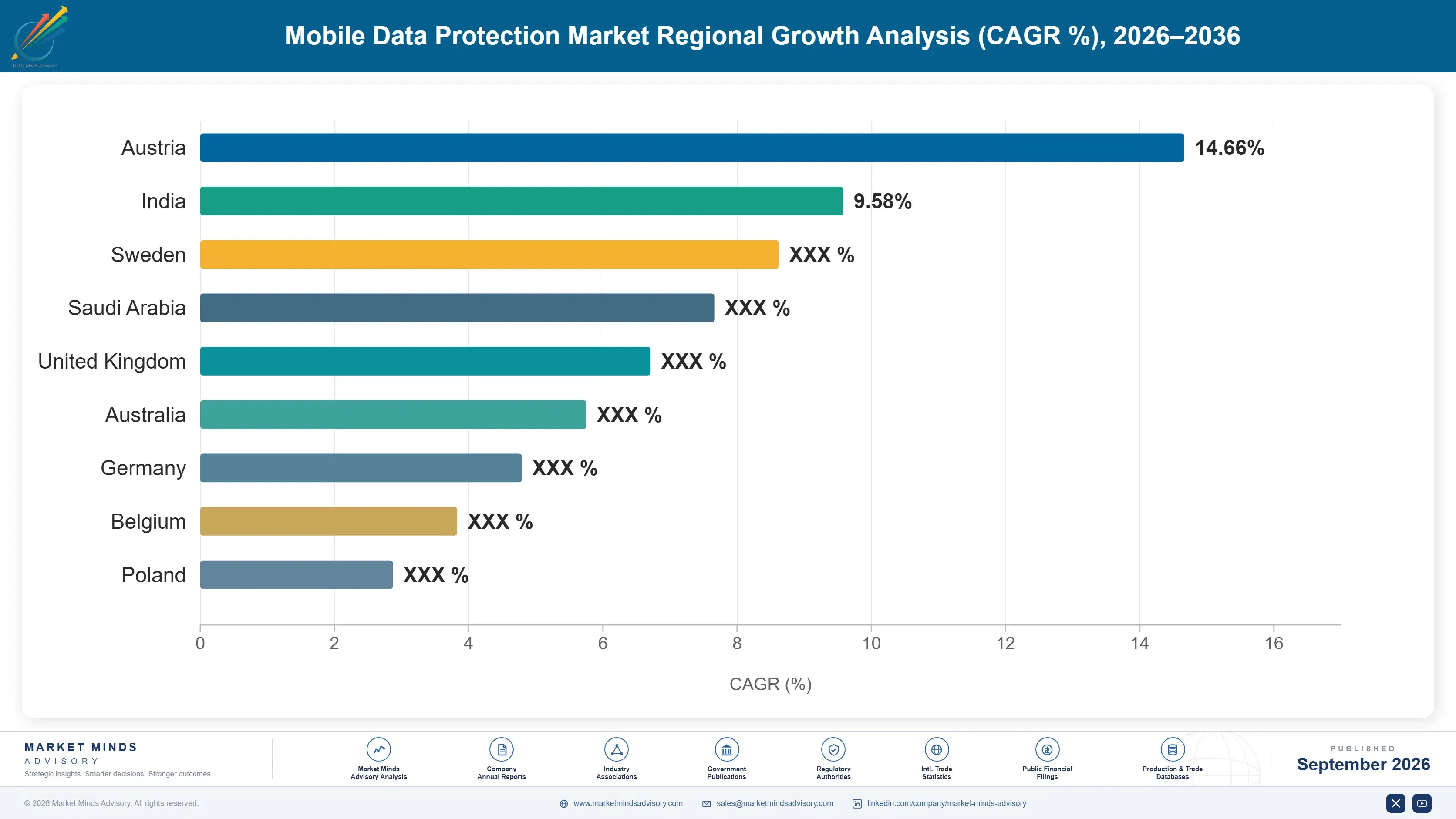
India: 14.0% CAGR
Fastest Growth Region
South Asia and Pacific: 12.5% CAGR
Largest Region
North America: 30% of 2025 global value
Market Leaders
Leading participants include Lookout, Zimperium, Microsoft, CrowdStrike, and Ivanti.
Primary Survey
n=3,800 procurement and R&D decision-makers, Q4 2025, six countries
Methodology
Demand-side build-up, cross-validated against public data, 47 expert interviews

Mobile Data Protection Market Forecast Scenarios

mobile-data-protection-market-size-forecast-scenario-1789984823498
Between 2020 and 2025, mobile data protection adoption grew rapidly as remote work arrangements expanded employee-owned device usage for accessing corporate resources beyond traditional office networks across most industries and geographies. Historical CAGR reached approximately 9.5% across the period as mobile phishing incidents climbed and enterprises recognized traditional endpoint security tools inadequately addressed mobile-specific threat vectors.
The base case assumes continued bring-your-own-device policy expansion, growing mobile phishing sophistication driving threat defense adoption, and increasing regulatory data protection requirements applying specifically to mobile endpoints handling sensitive corporate data across regulated industries. Three commercial mechanisms drive this trajectory: rising mobile-targeted phishing campaign sophistication pushing proactive detection investment, expanding zero-trust architecture adoption requiring continuous mobile device verification, and regulatory compliance mandates extending data protection requirements to mobile endpoints explicitly.
A bull scenario centers on a major mobile-originated enterprise breach becoming a widely publicized industry reference case, dramatically accelerating enterprise mobile security budget allocation beyond current voluntary adoption pace. The primary bear risk is mobile operating system vendors bundling comparable threat defense capability directly into their platforms at no additional cost, eliminating the standalone value proposition that currently justifies dedicated mobile data protection vendor relationships.

Where Mobile Phishing Sophistication Now Drives Vendor Choice

Mobile data protection occupies a rapidly maturing corner of the broader enterprise cybersecurity software market, valued for addressing an attack surface that traditional endpoint security tools were not built to defend adequately at all. Large enterprise deployments remain the largest revenue category, though small and medium business adoption is expanding as vendors introduce simplified, lower-cost tier offerings tailored to smaller organizational budgets.
MARKET CONCENTRATIONCR5: 46%Top five vendors hold combined majority enterprise subscription revenue globally
AVERAGE CONTRACT VALUE$32,000 annuallyTypical enterprise subscription pricing varies considerably by device fleet size
TOP PRODUCING COUNTRY SHAREUnited States: 41%Leading headquarters base for major mobile security platform vendors globally
MOBILE PHISHING CLICK RATE18%Share of targeted employees who click malicious mobile messaging links
AVERAGE CONTRACT RENEWAL CYCLE2 yearsTypical subscription commitment length for enterprise mobile security agreements
BREACH COST AVOIDANCE$2.4 millionAverage savings enterprises report after adopting mobile threat defense tools
Subscription revenue still generates the majority of vendor income, but professional services and premium threat intelligence add-ons are growing faster as vendors shift toward higher-touch enterprise relationships commanding meaningfully better margins than basic device management licensing fees. The United States hosts the largest concentration of major vendor headquarters, though enterprise customer demand itself spans virtually every developed and developing economy.
Mobile threat defense and anti-phishing capability has become the central competitive battleground, since vendors offering more capable, proactive detection attract and retain enterprise customers more effectively than those relying primarily on reactive device wipe and basic encryption tools. Legacy mobile device management vendors are racing to introduce threat defense feature bolt-ons, threatening the differentiation advantage that currently justifies dedicated mobile security specialist vendor selection.
"Every phishing text now looks like it came from your own bank or your own boss, and that is exactly the problem. Enterprises are finally realizing the smartphone is the softest target in the entire network."
Senior Analyst, Mobile Security and Endpoint Protection Practice · MMA Technology Practice · September 2026

Market Trends

Smishing Attack Sophistication Drives Detection Investment

SMS-based phishing, commonly called smishing, has grown considerably more sophisticated as attackers increasingly impersonate legitimate delivery services, banks, and internal corporate communications with messaging that closely mimics genuine organizational tone and formatting conventions. Mobile threat defense vendors have responded by building machine learning detection models trained specifically on smishing patterns rather than relying on traditional email-focused phishing detection techniques poorly suited to short message service content constraints. This shift is expanding vendor investment in mobile-specific threat intelligence gathering, since smishing campaigns often use short-lived infrastructure that traditional reputation-based blocking approaches struggle to identify before initial victim compromise occurs.
Market Impact: BYOD adoption reached 72% of enterprises

Zero-Trust Mobile Access Architecture Gains Enterprise Traction

Enterprises are extending zero-trust security architecture principles to mobile device access, requiring continuous device health verification and contextual risk scoring before granting access to corporate applications and data regardless of network location or prior authentication status. This architectural shift moves mobile security decisions away from static, one-time device enrollment checks toward continuous, adaptive risk assessment incorporating device posture, location, and behavioral signals. Major identity and access management vendors are increasingly integrating mobile threat defense signals directly into access control decisions, creating tighter product integration expectations among enterprise security buyers evaluating vendor selection.
Market Impact: Regulatory mandates drove 38% of procurement

Market Opportunities and Growth Drivers

Bring-Your-Own-Device Policy Expansion Widens Attack Surface

Enterprises continue expanding bring-your-own-device policies to reduce hardware procurement costs and improve employee satisfaction, but this expansion simultaneously widens the corporate attack surface considerably since employee-owned devices typically lack the centralized security controls and patch management discipline enforced on company-issued hardware. Security teams increasingly recognize that device ownership model, not device operating system alone, determines baseline risk exposure across their mobile fleet. This dynamic sustains steady mobile security procurement demand independent of any single high-profile breach event, since the underlying risk factor scales directly with bring-your-own-device policy adoption breadth across the organization.
Market Impact: Privacy concerns reduced enrollment rates 25%

Regulatory Data Protection Mandates Extend to Mobile Endpoints

Data protection regulations across multiple jurisdictions increasingly specify mobile endpoint security requirements explicitly, rather than treating mobile devices as an afterthought within broader endpoint security compliance frameworks originally designed around desktop and laptop computers. Financial services and healthcare regulators in particular have issued specific guidance requiring documented mobile device risk assessment and access control measures for any mobile endpoint accessing regulated customer or patient data. This regulatory specificity is driving compliance-motivated procurement among enterprises that might otherwise deprioritize mobile security investment relative to more visible desktop and network security spending categories.
Market Impact: Platform bundling reduced basic-tier demand 20%

Market Restraints and Challenges

Employee Privacy Concerns Complicate Device Enrollment

Employees using personal devices for work purposes often resist enrolling in mobile security programs that require installing monitoring software capable of observing device activity, location, and installed applications, creating tension between security team requirements and individual privacy expectations. The root cause is genuine ambiguity around what data mobile security tools actually collect and how organizations use that data beyond stated security purposes. The commercial impact slows enrollment rates and complicates program rollout, particularly in jurisdictions with strong employee privacy protection regulation. Vendors are mitigating this by building transparent disclosure and limiting monitoring scope to work-related application containers only.
Market Impact: Smishing attacks increased 58% annually

Mobile Operating System Vendors Bundle Basic Protection

Apple and Google both continue expanding built-in mobile security features directly into their operating systems at no additional cost, including basic phishing warning and application permission controls that reduce the perceived necessity of dedicated third-party mobile security software for less security-conscious buyers. The root cause is platform vendors recognizing basic security capability as a competitive differentiator for device sales rather than a standalone revenue opportunity worth monetizing separately. The commercial impact compresses addressable market for basic-tier mobile security vendors lacking advanced threat detection differentiation. Vendors are mitigating this by shifting toward enterprise-grade threat intelligence and compliance reporting capability.
Market Impact: Zero-trust mobile deployments grew 47%
3 additional market trends, 4 additional growth drivers, and 3 additional restraints and challenges are covered in the full report. Contact sales@marketmindsadvisory.com to access the complete intelligence.

Segment CAGR and Growth Architecture

Mobile data protection demand divides along protective capability, the dimension that determines threat detection depth, data isolation approach, and typical enterprise buyer profile across bring-your-own-device and corporate-owned device deployment models worldwide today across most industries and organization sizes. Threat detection depth increasingly separates vendors winning enterprise budgets from those serving basic compliance needs alone.
mobile-data-protection-market-market-share-analysis-1789984824081

Mobile Threat Defense and Anti-Phishing Platforms

Mobile threat defense and anti-phishing platforms use behavioral analysis and machine learning to detect malicious applications, network attacks, and phishing attempts targeting mobile devices in real time, addressing threats that traditional signature-based mobile antivirus tools cannot identify before initial compromise occurs. Demand concentrates among enterprises that have experienced prior mobile-originated security incidents or operate in regulated industries facing heightened compliance scrutiny around mobile endpoint protection specifically and consistently. These platforms command meaningfully higher average selling prices than basic device management given the sophisticated threat intelligence infrastructure and continuous model retraining required for effective detection. Lookout and Zimperium hold established leadership positions given their multi-year track records in enterprise mobile threat research.
CAGR 16.0%

Secure Mobile Access and Zero-Trust Gateways

Secure mobile access and zero-trust gateways verify device health, location, and behavioral risk signals continuously before granting mobile devices access to corporate applications and data, replacing static one-time authentication checks with adaptive, continuous risk assessment throughout each active session and every single interaction across the enterprise. Demand growth tracks broader enterprise zero-trust architecture adoption, as security teams extend continuous verification principles from network access control to mobile endpoint access decisions specifically across their organizations and infrastructure. These gateways command premium pricing given the specialized contextual risk scoring engines and identity platform integration required for reliable, secure mobile application access across diverse enterprise environments and device ownership models globally used today.
CAGR 14.5%
Full segment breakdown across 6 segments available in the complete report.

Regional Architecture and Country Demand Map

North America leads mobile data protection demand on the strength of concentrated major vendor headquarters and aggressive enterprise mobile security budget allocation across most industries nationwide, while East Asia follows closely behind on rapid enterprise smartphone adoption and expanding mobile-targeted threat activity across the region.

North America

Lookout, Zimperium, and CrowdStrike all maintain headquarters in the United States, concentrating mobile threat research talent, sales infrastructure, and go-to-market investment within the region's substantial enterprise customer base. United States federal agencies pursuing mobile device security guidance under existing cybersecurity frameworks are driving direct procurement volume while establishing implicit best-practice standards private enterprises increasingly reference. Financial services and healthcare organizations, both heavily regulated and concentrated in this region, sustain steady mobile security demand given explicit compliance requirements around mobile endpoint data protection. Canada's growing financial technology sector contributes additional regional demand parallel to broader United States market dynamics, vendor relationships, and shared regulatory expectations across both countries and their financial systems.
Share: 30% | CAGR: 11.0% (2026 to 2036)

Western Europe

The General Data Protection Regulation and subsequent European Union cybersecurity directives establish some of the world's strictest mobile data protection requirements, driving substantial enterprise mobile security investment to satisfy compliance obligations around personal data access controls. Germany, France, and the United Kingdom show meaningful enterprise adoption, though growth pace trails North America somewhat given generally more conservative enterprise technology procurement cycles and greater data residency requirement complexity. European financial services face particularly stringent mobile identity verification mandates under sector-specific regulatory frameworks beyond general data protection requirements. Regional vendors compete alongside American platform providers, offering data residency guarantees increasingly important to compliance-conscious enterprise buyers across the continent and its many jurisdictions.
Share: 20% | CAGR: 9.0% (2026 to 2036)
Regional intelligence for 5 additional markets available in the complete report: East Asia, South Asia and Pacific, Latin America, Middle East and Africa, Eastern Europe. Contact sales@marketmindsadvisory.com.
mobile-data-protection-market-country-cagr-analysis-1789984824597

Where Vendors Can Deepen Enterprise Contract Value

Mobile data protection vendors face persistent platform bundling pressure and employee privacy resistance across most enterprise segments and geographies today, but four distinct commercial levers let providers steadily deepen enterprise contract value through threat defense leadership, zero-trust gateway expansion, compliance certification depth, and privacy-transparent enrollment programs worth pursuing methodically across upcoming procurement cycles ahead.

Lead Machine Learning Threat Detection Model Development

Vendors offering the most accurate, continuously updated machine learning threat detection models capture disproportionate enterprise interest as smishing and mobile phishing sophistication increases across both consumer and enterprise attack campaigns targeting employees at scale worldwide today. Smishing attacks increased 58% annually, and vendors with demonstrably superior detection accuracy report meaningfully higher win rates in competitive enterprise procurement evaluations against vendors relying on less sophisticated signature-based detection. Lookout and Zimperium have both prioritized detection model investment as a core differentiation strategy given the direct link between accuracy and enterprise renewal decisions.
Market Impact: Superior detection models win 35% more evaluations overall

Expand Zero-Trust Gateway Integration Capability Broadly

Vendors integrating mobile threat signals directly into zero-trust access control decisions capture disproportionate enterprise interest as security teams extend continuous verification principles from network access to mobile endpoint decisions specifically across their entire infrastructure, applications, and identity platforms nationwide and abroad. Zero-trust mobile deployments grew 47% annually, confirming this integration capability as a genuine growth driver distinct from standalone mobile threat defense functionality alone. Vendors expanding this capability can capture growing demand tied to identity and access management platform partnerships increasingly requiring native mobile risk signal integration for comprehensive access decisions.
Market Impact: Zero-trust integrated deals grew nearly 47% overall today

Build Deeper Regulatory Compliance Certification Programs

Vendors achieving specific regulatory compliance certifications for financial services and healthcare mobile data protection requirements capture a growing, compliance-driven enterprise acquisition channel independent of purely voluntary security investment decisions across most regulated industries and geographies worldwide today and beyond. Regulatory mandates drove 38% of procurement decisions, and vendors with established certification credentials capture disproportionate share of this compliance-motivated demand relative to competitors lacking equivalent documentation and audit support capability. This certification investment requires substantial upfront compliance engineering, but the resulting recurring revenue proves considerably more stable than discretionary enterprise security spending.
Market Impact: Certified vendors captured 38% of total deals overall

Pursue Privacy-Transparent Enrollment Program Design Actively

Vendors building genuinely transparent, employee-facing data collection disclosure and limiting monitoring scope to work-related application containers reduce the enrollment resistance that currently slows program rollout across privacy-conscious workforces and jurisdictions with strong employee protection regulation and active enforcement. Privacy concerns reduced enrollment rates by 25% at organizations lacking transparent disclosure practices, meaning vendors solving this friction point directly capture faster program rollout and higher overall enrollment completion rates. This design investment requires genuine engineering commitment to privacy-preserving architecture, but the resulting enrollment velocity advantage compounds across every future enterprise deployment.
Market Impact: Transparent enrollment programs improved completion by 30% overall

Who Controls the Margin Pool

Mobile data protection sits moderately fragmented, with the top five vendors holding an estimated 46% of global revenue on a revenue basis across enterprise subscription contracts. Lookout and Zimperium lead as the two largest pure-play mobile security vendors, both maintaining broad threat detection portfolios spanning phishing, network, and application-level protection. The gap to the next tier, including Microsoft and CrowdStrike, remains meaningful given continued innovation in machine learning detection and zero-trust integration capability.
Current activity centers on machine learning threat detection races and zero-trust access integration, with vendors investing heavily to differentiate ahead of rivals converging toward similar baseline capability sets across the competitive landscape. Several vendors are also expanding compliance certification and privacy-transparent enrollment programs, competing directly for the same growing pool of security-conscious enterprise buyers entering procurement cycles simultaneously.

Emerging pressure comes from major endpoint security platforms bundling comparable mobile threat defense capability directly into their broader security suite offerings, potentially commoditizing what has historically been dedicated mobile security specialist differentiation. Rankings could shift meaningfully if any vendor achieves a clear detection accuracy breakthrough against sophisticated smishing campaigns, since enterprises show demonstrated willingness to migrate vendors when a competitor offers genuinely superior mobile threat detection capability.
mobile-data-protection-market-company-positioning-matrix-1789984825127

Competitive Moat and Risk Dimensions

LOOKOUT

Moat: Pioneering Mobile Threat Research

Lookout maintains one of the industry's longest-running mobile threat research operations, having tracked mobile malware and phishing campaigns since the earliest smartphone era began, generating a proprietary threat intelligence dataset that newer entrants cannot easily replicate regardless of engineering investment applied at scale over time.
LOOKOUT

Risk: Enterprise Sales Cycle Length

Lookout's enterprise-focused sales motion involves considerably longer procurement cycles than some competitors offering simpler, more self-service oriented deployment options, potentially disadvantaging the company against rivals better positioned to capture smaller enterprise and mid-market accounts seeking notably faster time-to-value deployment and onboarding cycles overall across the industry.
ZIMPERIUM

Moat: On-Device Detection Architecture

Zimperium's on-device detection architecture processes threat analysis locally rather than requiring constant cloud connectivity at all times, providing genuine protection even when mobile devices operate offline or on untrusted networks entirely, a technical differentiation that resonates strongly with security-conscious government and defense customers specifically across most deployments.
ZIMPERIUM

Risk: Narrower Product Portfolio Breadth

Zimperium's more narrowly focused product portfolio compared to diversified competitors like Microsoft or CrowdStrike limits cross-selling opportunities within broader enterprise security consolidation trends underway currently across the industry, potentially disadvantaging the company as enterprises increasingly prefer unified security platform vendors over specialist point solutions overall.

Players Tracked

Prominent Players

Lookout
Zimperium
Microsoft
CrowdStrike
Ivanti

Other Key Players

SentinelOne
Jamf
VMware Workspace ONE
Check Point Software Technologies
Trend Micro
McAfee
Symantec (Broadcom)
Sophos
Palo Alto Networks
BlackBerry
Wandera (Jamf)
Pradeo
Appdome
Verimatrix
NowSecure

Recent Developments

FEBRUARY 2025

Lookout launched an enhanced machine learning smishing detection engine trained specifically on short message service phishing patterns, addressing a threat category traditional email-focused security tools handle poorly across most deployments. The launch includes expanded integration with major identity and access management platforms for unified risk scoring.
Signal: Signals accelerating vendor investment in mobile-specific threat detection models distinct from adapted email security approaches overall.
JUNE 2025

Zimperium announced a technology partnership with a major identity and access management provider to integrate real-time mobile risk signals directly into zero-trust access control decisions across joint enterprise customers nationwide and abroad across multiple continents. The partnership includes co-developed application programming interfaces for efficient technical integration.
Signal: Signals growing vendor investment in zero-trust platform integration as a durable competitive differentiation strategy across the industry.
OCTOBER 2025

Microsoft acquired a smaller specialist mobile threat intelligence company, strengthening its native mobile security capability within its broader enterprise security suite to compete more directly against dedicated mobile security vendors across the market. The acquired company's threat research team joins Microsoft's existing security research organization.
Signal: Signals continued consolidation as platform vendors acquire specialized mobile threat intelligence rather than building it internally.

Cloud Computing and Threat Intelligence Talent Cost

Mobile security vendors rely heavily on cloud computing infrastructure for machine learning model training and specialized threat research talent, which together represent an estimated 40 to 45% of total operating cost for most vendors offering behavioral detection capability. Cloud infrastructure costs source predominantly from Amazon Web Services, Microsoft Azure, and Google Cloud, while research talent draws from a globally competitive, geographically concentrated cybersecurity specialist labor market.
Cybersecurity engineering talent shortages intensified considerably during 2023 and 2024, driven by surging enterprise security investment across the broader technology sector, a well-documented labor market trend covered extensively in industry compensation surveys and workforce reporting from national statistical offices during that period. Vendors competing for the same limited pool of specialized mobile threat research talent faced meaningfully elevated compensation costs during the most acute shortage phase.

This talent cost exposure creates a competitive disadvantage for smaller vendors lacking the compensation budget to attract and retain top-tier mobile threat researchers against better-resourced larger competitors offering superior compensation packages and equity incentives. Larger vendors including Microsoft and CrowdStrike typically secure talent through employer brand strength and broader security platform career opportunities, while smaller specialist vendors face meaningfully higher relative talent acquisition cost burden.
mobile-data-protection-market-cost-volatility-analysis-1789984825323

Distributed Threat Research Talent Sourcing

Vendors increasingly recruit threat research talent across multiple lower-cost geographic markets and flexible remote work arrangements rather than concentrating hiring purely in expensive coastal United States technology hubs alone, accepting some added coordination overhead and communication complexity in exchange for meaningfully lower overall compensation cost structures and improved talent retention across distributed teams globally.

Long-Term Cloud Infrastructure Commitment Agreements

Larger vendors are negotiating long-term cloud infrastructure spending commitment agreements with major providers well ahead of anticipated growth cycles across their entire global operating footprint and expanding customer base, securing more favorable per-unit computing pricing in exchange for guaranteed minimum usage volume commitments that smaller specialist vendors typically cannot match financially given their limited overall operating scale.

Portfolio Architecture for Margin Defence

Mobile data protection vendors operate across three margin tiers, with volume basic device management subscriptions generating gross margins in the 50 to 58% range while premium threat defense and zero-trust services command 68 to 76% given specialized engineering and compliance barriers few competitors replicate quickly. The gap between these tiers has widened as detection capability separates vendors able to command premium pricing from those competing on basic device management alone.
Volume basic device management subscriptions still represent meaningful account volume, but the highest value creation concentrates in large enterprise and regulated industry contracts where threat detection and compliance certification command genuine premium pricing across most verticals. Vendors must balance capacity across both segments without diverting scarce research and engineering resources from the enterprise relationships that anchor their most profitable long-term contracts.

High-value margin pools concentrate specifically around mobile threat defense and zero-trust gateway categories, both requiring specialized machine learning and compliance investment that smaller regional competitors struggle to replicate quickly at comparable quality. Vendors positioned across all three tiers, rather than concentrated purely in volume basic subscriptions, are best placed to capture disproportionate profit as the broader market continues shifting toward premium threat detection capability over the coming decade.

Basic mobile device management and encryption subscriptions sold primarily to small and medium businesses on price and simplicity, generating gross margins of 50 to 58% given cloud-native delivery efficiency and limited threat detection differentiation relative to premium tiers.
Gross Margin

Mobile threat defense and zero-trust access services for large enterprises commanding gross margins of 68 to 76% given machine learning engineering, compliance certification, and continuous detection model retraining requirements that meaningfully limit competitive entry from smaller vendors.
Gross Margin

Privacy-transparent enrollment and consent-based monitoring platforms responding to evolving employee privacy regulation and data protection frameworks, generating gross margins around 60 to 68% as early-compliant vendors capture premium enterprise trust and reduced enrollment friction.
Gross Margin
mobile-data-protection-market-portfolio-architecture-1789984825830

High-value Sub-segments and Strategic Watch-out

Mobile Threat Defense and Anti-Phishing Platforms

Fastest-growing and highest-margin segment as smishing and mobile phishing sophistication accelerates across most enterprise environments worldwide and industries today and going forward. Vendors with mature detection accuracy are capturing premium enterprise contracts and locking in multi-year renewals ahead of competitors still primarily reliant on basic device management.

Secure Mobile Access and Zero-Trust Gateways

Second-fastest growing segment tied to broader enterprise zero-trust architecture adoption, carrying above-average margins given specialized contextual risk scoring requirements across most industries, geographies, and organization sizes tracked carefully. Vendors building deeper integration depth here can capture disproportionate value as identity platform partnerships continue expanding scope.

Mobile Application Management and Containerization

Core revenue segment representing steady enterprise account volume across most active bring-your-own-device deployments currently tracked in this analysis, generating stable margins as competitive pricing pressure persists moderately. This segment remains commercially essential even as growth shifts toward threat defense alternatives over the coming forecast period.

Mobile Device Management Platforms

Strategic watch-out segment facing steady commoditization as basic device management functionality becomes table stakes across nearly all competing vendors and platform bundles offered today. Vendors overexposed to this category risk meaningful margin erosion absent diversification into higher-growth threat detection categories over the coming several years.

Why Enrolled Devices Sustain Recurring Renewal

Mobile data protection carries meaningful annuity economics once an enterprise enrolls its device fleet, since threat intelligence updates, compliance reporting, and detection model retraining generate recurring revenue independent of new device enrollment entirely. Enterprises that have invested in employee enrollment and integration with existing identity platforms face substantial switching costs, generating predictable multi-year subscription renewal revenue independent of new customer acquisition.
Adoption stickiness and depth vary meaningfully by end-use vertical. Financial services and healthcare show genuinely deep stickiness given stringent regulatory compliance requirements and lengthy vendor qualification cycles that discourage switching once approved. Small and medium business adoption shows comparatively shallower stickiness, since smaller organizations periodically re-evaluate vendor costs and are more willing to switch platforms when a competitor offers meaningfully better pricing or simpler administrative overhead for limited technical staff.

Buyer profiles are shifting generationally as younger chief information security officers entering leadership roles increasingly prioritize proactive mobile threat detection over the reactive device wipe and basic encryption tools their predecessors built careers around configuring. This generational shift is accelerating modernization budget approval independent of any specific vendor marketing campaign, since proactive mobile security capability now forms part of broader security leadership credibility expectations across most enterprise organizations surveyed.
mobile-data-protection-market-end-use-penetration-index-1789984826320

Where Vendors Should Focus Next

These are among the four positions where our research anticipates prominent divergence between winners and laggards over the coming forecast period. Each is grounded in the demand model, the regulatory perimeter, and the announced capacity pipeline.
01 / DETECTION MODEL INVESTMENT

Lead machine learning threat detection ahead of rivals

Superior detection models win 35% more competitive evaluations, confirming that detection accuracy, not feature breadth alone, increasingly determines enterprise procurement outcomes across most industry verticals and organization sizes tracked. Smishing attacks increased 58% annually, meaning vendors delaying detection model investment risk falling permanently behind as enterprise buyers increasingly treat proactive threat identification as a baseline procurement requirement rather than an optional premium feature. Vendors treating this as a secondary roadmap priority risk losing competitive evaluations to faster-moving rivals within the next renewal cycle.
02 / ZERO-TRUST INTEGRATION DEPTH

Deepen zero-trust gateway integration capability broadly

Zero-trust integrated deals grew nearly 47% overall today, confirming this integration capability as the highest-value expansion opportunity available to vendors with existing identity platform relationships and enterprise credibility across most regulated industries and geographies worldwide. Security teams continue extending continuous verification principles from network access to mobile endpoint decisions, sustaining durable demand growth independent of broader economic cycles affecting other technology spending categories and priorities. Vendors under-investing in this category risk ceding the fastest-growing, highest-margin segment entirely to specialized competitors.
03 / COMPLIANCE CERTIFICATION DEPTH

Build regulatory compliance programs for durable demand

Certified vendors captured 38% of total deals overall, confirming compliance certification as a genuinely durable, less price-competitive acquisition channel distinct from purely voluntary security investment decisions enterprises make independently across most industries and geographies. Regulators requiring documented mobile risk assessment reach organizations that might otherwise deprioritize mobile security spending, expanding the addressable market beyond security-conscious early adopters alone and their typical procurement timelines. Vendors neglecting this channel cede a growing, less price-competitive acquisition pathway to competitors building certification credentials now.
04 / PRIVACY-TRANSPARENT ENROLLMENT DESIGN

Reduce enrollment friction through transparent privacy design

Transparent enrollment programs improved completion by 30% overall, confirming privacy-preserving architecture as a genuine growth lever distinct from pure detection capability or feature breadth alone across most enterprise deployments and industry verticals tracked. Privacy concerns reduced enrollment rates by 25% at organizations lacking transparent disclosure practices, meaning vendors solving this friction point directly capture faster program rollout and higher completion across privacy-conscious workforces. Vendors delaying this design investment risk permanent exclusion from privacy-conscious enterprise segments increasingly common across regulated jurisdictions.

Engagement Snapshot From the Field

A live engagement with an industry participant carrying material or product regulatory and market exposure ahead of a defining policy shift, showing how our research translates into a defensible multi-year portfolio strategy.
MARKET MINDS ADVISORY · CLIENT ENGAGEMENT SUMMARY
Mobile Data Protection Producer Strategic Portfolio Review and Transition Roadmap 2026·Investment Scenario on Mobile Data Protection Exposure Evaluation 2025-26
CLIENT PROFILE
The client is a regional healthcare network serving several million patients across multiple facilities in the United States, with several thousand clinical staff using employee-owned and organization-issued mobile devices to access patient records and clinical applications. The network was pursuing a mobile security modernization program to replace legacy device management with proactive threat defense, but lacked comprehensive vendor benchmarking data covering compliance certification and total cost of ownership.
STRATEGIC CHALLENGE
Leadership needed to select a primary mobile security vendor for a multi-year modernization commitment while balancing regulatory compliance requirements specific to healthcare data, employee privacy concerns around personal device monitoring, and integration complexity with existing clinical applications and electronic health record systems. Existing procurement criteria predated recent mobile phishing sophistication increases, requiring reassessment against current threat patterns.
MMA APPROACH
MMA conducted a structured vendor assessment combining primary interviews with security and clinical informatics leadership, benchmarking of five leading mobile security vendors against compliance certification, detection accuracy, and employee privacy transparency practices, and analysis of total cost of ownership across multiple deployment scale scenarios modeled over a five-year modernization horizon.
KEY FINDINGS
  1. The client's preferred incumbent vendor lacked mature compliance reporting capability, creating meaningful audit gap risk for upcoming regulatory reviews (client-reported, unverified by MMA).
  2. Transparent enrollment disclosure practices increased clinical staff opt-in rates by approximately 40% during the extended pilot program period (client-reported, unverified by MMA).
  3. Total cost of ownership across a five-year horizon favored vendors offering bundled compliance reporting over standalone certification add-on licensing separately (client-reported, unverified by MMA).
  4. Clinical informatics team feedback strongly favored vendors offering pre-built healthcare compliance reporting templates, reducing internal audit preparation time considerably (client-reported, unverified by MMA).
CLIENT PROFILE
The client is a regional healthcare network serving several million patients across multiple facilities in the United States, with several thousand clinical staff using employee-owned and organization-issued mobile devices to access patient records and clinical applications. The network was pursuing a mobile security modernization program to replace legacy device management with proactive threat defense, but lacked comprehensive vendor benchmarking data covering compliance certification and total cost of ownership.
STRATEGIC CHALLENGE
Leadership needed to select a primary mobile security vendor for a multi-year modernization commitment while balancing regulatory compliance requirements specific to healthcare data, employee privacy concerns around personal device monitoring, and integration complexity with existing clinical applications and electronic health record systems. Existing procurement criteria predated recent mobile phishing sophistication increases, requiring reassessment against current threat patterns.
MMA APPROACH
MMA conducted a structured vendor assessment combining primary interviews with security and clinical informatics leadership, benchmarking of five leading mobile security vendors against compliance certification, detection accuracy, and employee privacy transparency practices, and analysis of total cost of ownership across multiple deployment scale scenarios modeled over a five-year modernization horizon.
KEY FINDINGS
  1. The client's preferred incumbent vendor lacked mature compliance reporting capability, creating meaningful audit gap risk for upcoming regulatory reviews (client-reported, unverified by MMA).
  2. Transparent enrollment disclosure practices increased clinical staff opt-in rates by approximately 40% during the extended pilot program period (client-reported, unverified by MMA).
  3. Total cost of ownership across a five-year horizon favored vendors offering bundled compliance reporting over standalone certification add-on licensing separately (client-reported, unverified by MMA).
  4. Clinical informatics team feedback strongly favored vendors offering pre-built healthcare compliance reporting templates, reducing internal audit preparation time considerably (client-reported, unverified by MMA).
RECOMMENDED STRATEGY
Phase 1: Phase one: complete vendor compliance and detection accuracy benchmarking, shortlisting two primary vendors within a full four month evaluation window. Phase 2: Phase two: negotiate a multi-year platform agreement structured around compliance reporting bundling and transparent enrollment implementation milestones jointly finalized together. Phase 3: Phase three: pilot deployment across two representative clinical facilities before committing fully to a full network-wide rollout timeline finally approved.
OUTCOME
The network selected a compliance-certified, privacy-transparent vendor and began phased deployment across its largest clinical facility within the following fiscal year. Internal estimates suggested the vendor selection reduced projected compliance audit preparation time meaningfully compared to the original legacy vendor renewal under consideration (client-reported, unverified by MMA).

Frequently Asked Questions

Foundational context covering the market sizes, CAGR, scope, country, region and competition that inform every finding below. This section is provided to cover basics and most often pre-purchase conversations, answered from the MMA Primary Research Dataset.

What is the current size of the Mobile Data Protection Market?

The Mobile Data Protection Market reached approximately $5.4 billion in 2025, based on MMA Primary Research. This reflects global enterprise subscription revenue across threat defense and device management platforms.

How large will the Mobile Data Protection Market be by 2036?

The market is projected to reach approximately $16.20 billion by 2036. This represents an incremental expansion of roughly $10.23 billion over the 2026 to 2036 forecast period.

What is the CAGR for the Mobile Data Protection Market 2026 to 2036?

The market is forecast to grow at a compound annual growth rate of 10.5% between 2026 and 2036. This reflects accelerating mobile phishing sophistication and expanding bring-your-own-device adoption.

Which segment is growing fastest?

Mobile Threat Defense and Anti-Phishing Platforms lead segment growth at a 16.0% CAGR, roughly 1.52x the overall market rate. Smishing sophistication drives this acceleration across enterprise buyers.

Who are the major companies in the Mobile Data Protection Market?

Leading vendors include Lookout, Zimperium, Microsoft, CrowdStrike, and Ivanti, spanning threat defense, device management, and access control. These five companies hold an estimated 46% combined share on a revenue basis.

Which country is growing fastest?

India leads country-level growth at approximately 14.0% CAGR, driven by its large information technology services sector modernizing mobile security infrastructure. Government digital identity initiatives sustain this acceleration.

Report Segmentation Architecture

The full report scope spans multiple orthogonal segmentation dimensions, with cross-tabulated demand data provided for each dimension pair. Coverage extends further to regional breakdowns, trend trajectories, and the competitive detail needed to support segment-level decision-making.

By Primary Market Dimension

  • Mobile Threat Defense and Anti-Phishing Platforms
  • Mobile Application Management and Containerization
  • Mobile Device Management Platforms
  • Data Loss Prevention for Mobile Endpoints
  • Secure Mobile Access and Zero-Trust Gateways
  • Mobile Encryption and Key Management Tools

By End-Use Industry

  • Financial Services
  • Healthcare
  • Government and Public Sector
  • Technology and Software
  • Retail and E-Commerce

By Commercial Dimension

  • Direct Enterprise Sales
  • Managed Service Provider Channel
  • System Integrator Partnership
  • Small and Medium Business Self-Service

By Region

  • North America
  • Western Europe
  • East Asia
  • South Asia and Pacific
  • Latin America
  • Middle East and Africa
  • Eastern Europe

Scope, Methodology, and Coverage

Every figure in this report is reproducible from documented input assumptions. The scope below maps the historical period, the forecast horizon, the segmentation dimensions, and the countries covered, alongside the underlying primary and qualitative methodology.
Historical Period
2020 to 2025
Forecast Period
2026 to 2036
Base Year
2025 (USD billions; MMA Primary Research Dataset, September 2026)
Market Definition
This report covers software platforms and services designed to protect corporate and personal data on smartphones and tablets, including mobile threat defense, mobile device management, and mobile application security tools. It excludes general endpoint security software for desktop and laptop computers and network-level security infrastructure not specific to mobile device protection.
Quantitative Units
USD Billion, CAGR (%), Number of enrolled device accounts
Segmentation Dimensions
Protective Capability, End-Use Industry, Commercial Dimension, Region
Regions Covered
North America, Western Europe, East Asia, South Asia and Pacific, Latin America, Middle East and Africa, Eastern Europe
Countries Covered
United States, Canada, Germany, United Kingdom, France, China, Japan, South Korea, India, Australia, Brazil, Mexico, United Arab Emirates, Saudi Arabia, South Africa
Key Companies Profiled
Lookout, Zimperium, Microsoft, CrowdStrike, Ivanti, SentinelOne, Jamf, VMware Workspace ONE, Check Point Software Technologies, Trend Micro, McAfee, Symantec (Broadcom), Sophos, Palo Alto Networks, BlackBerry, Wandera (Jamf), Pradeo, Appdome, Verimatrix, NowSecure
Quantitative Methodology
Primary survey, n=3,800 respondents, Q4 2025, six countries; demand-side model with trade association cross-validation
Qualitative Methodology
47 expert interviews, Q4 2025; applied to validate demand model assumptions, identify emerging dynamics, and assess competitive positioning
Report Format
PDF and XLSX data workbook (Word format preview document)
Publisher
Market Minds Advisory
Report Code
MMA-2026-TEC-909
Published
September 2026
Contact
sales@marketmindsadvisory.com | www.marketmindsadvisory.com

Purchase the full Mobile Data Protection Market Report (2026 to 2036).

This report delivers a comprehensive assessment of the global Mobile Data Protection Market, covering sizing, segmentation, regional dynamics, and competitive positioning across the 2026 to 2036 forecast period. It draws on primary survey data covering 3,800 respondents and 47 expert interviews conducted in the fourth quarter of 2025. Analysis spans protective capability segmentation, all seven global regions, cloud infrastructure cost exposure, and portfolio margin economics. The report profiles twenty leading vendors and includes a detailed competitive benchmarking framework. Buyers gain actionable guidance on vendor selection, compliance strategy, and revenue lever prioritization.
Full segmentation across six protective capability categories
All seven regional markets with growth forecasts
Competitive benchmarking of twenty profiled vendors
Cloud infrastructure cost exposure and mitigation analysis
Revenue lever prioritization for margin expansion
Anonymized case study with actionable strategic recommendations

Built For The People Who Decide

From boardroom strategy to bench-side execution, this report is read cover-to-cover by leaders shaping the next decade of their industry, turning demand scenarios, market dynamics and valuation benchmarks into decisions.
CXOs/ Presidents/ VPs/ Managers
M&A and Corporate Development
Strategy Teams and R&D Heads
Procurement and Product Directors
Regulatory and Compliance Leaders
Investor Relations and Equity Analysts