Market Minds Advisory
Mobile CRM Market

Mobile CRM Market: Mobile CRM Market. Field Sales Teams Push Vendors Toward Offline-First Architecture and Voice Data Entry

Field sales and service teams working in low-connectivity environments are forcing CRM vendors to rebuild mobile applications around offline-first architecture and voice-driven data entry rather than desktop-derived interfaces ported to smaller screens.

Lead Analyst

Published

September 2026

Make Smarter Decisions with Customized Research Insights

Request a free sample report and evaluate market opportunities, growth trends, and competitive dynamics relevant to your business needs.

2025 MARKET VALUE$9.8BMarket Size 2025
2036 FORECAST VALUE$31.5BBase Case , 2026 to 2036
CAGR 2026 TO 203611.2 %Bull 12.5% / Bear 10.0%
INCREMENTAL OPPORTUNITY$20.6BNet 10- year value creation
EXPANSION MULTIPLE2.89x2036 value over 2026 base
Strategic Levers
M&A Pipeline
Regional Outlook
Country Rankings
Competitive Intelligence
Segmental Deep-dive
Call-Us : 91 93563 13602

Executive Snapshot and Market Trajectory.

Field sales and service organizations are rejecting mobile CRM apps that merely shrink desktop interfaces, forcing vendors toward offline-first architecture and voice-driven data entry that actually work in the warehouses and rural territories where reps spend most of their working days.
Voice-to-CRM data entry is the clearest growth driver, since reps who once skipped logging visits entirely because typing on a phone felt like a chore are now dictating notes that sync automatically once connectivity returns. Field service and inspection use cases remain the largest deployed category by installed base, even as sales-focused voice capture tools capture a growing share of new purchasing budget across mid-market and enterprise accounts alike.
Salesforce holds the deepest installed base through its dominant desktop CRM franchise extending naturally into mobile, but HubSpot and newer mobile-first entrants are winning share among smaller field teams that never adopted a desktop-first platform to begin with at all. Offline sync reliability has become the decisive purchasing criterion in field-heavy verticals, since a mobile CRM that loses data during a connectivity gap creates more distrust among reps than one that simply lacks a feature.
Market Definition
The mobile CRM market covers smartphone and tablet applications used to capture, sync, and act on customer relationship data at the point of field engagement, including offline-capable sales, service, and inspection tools. It excludes desktop-only CRM platforms without a native mobile application, generic productivity apps without CRM data integration, and standalone field service dispatch software sold without CRM data capture.
Base Year Value
$9.8B in 2025 (MMA Primary Research Dataset, September 2026)
Forecast Period
2026 to 2036, eleven discrete annual values
CAGR
11.2% base case. Bull 12.5%. Bear 10.0%.
Fastest Growth Segment
Voice-to-CRM Data Capture Tools: 16.8% CAGR
Fastest Growth Country
India: 14.5% CAGR
Fastest Growth Region
South Asia and Pacific: 13.6% CAGR
Largest Region
North America: 32% of 2025 global value
Market Leaders
Salesforce, HubSpot, Microsoft, Zoho, and Pipedrive lead the competitive landscape.
Primary Survey
n=3,800 procurement and R&D decision-makers, Q4 2025, six countries
Methodology
Demand-side build-up, cross-validated against public data, 47 expert interviews

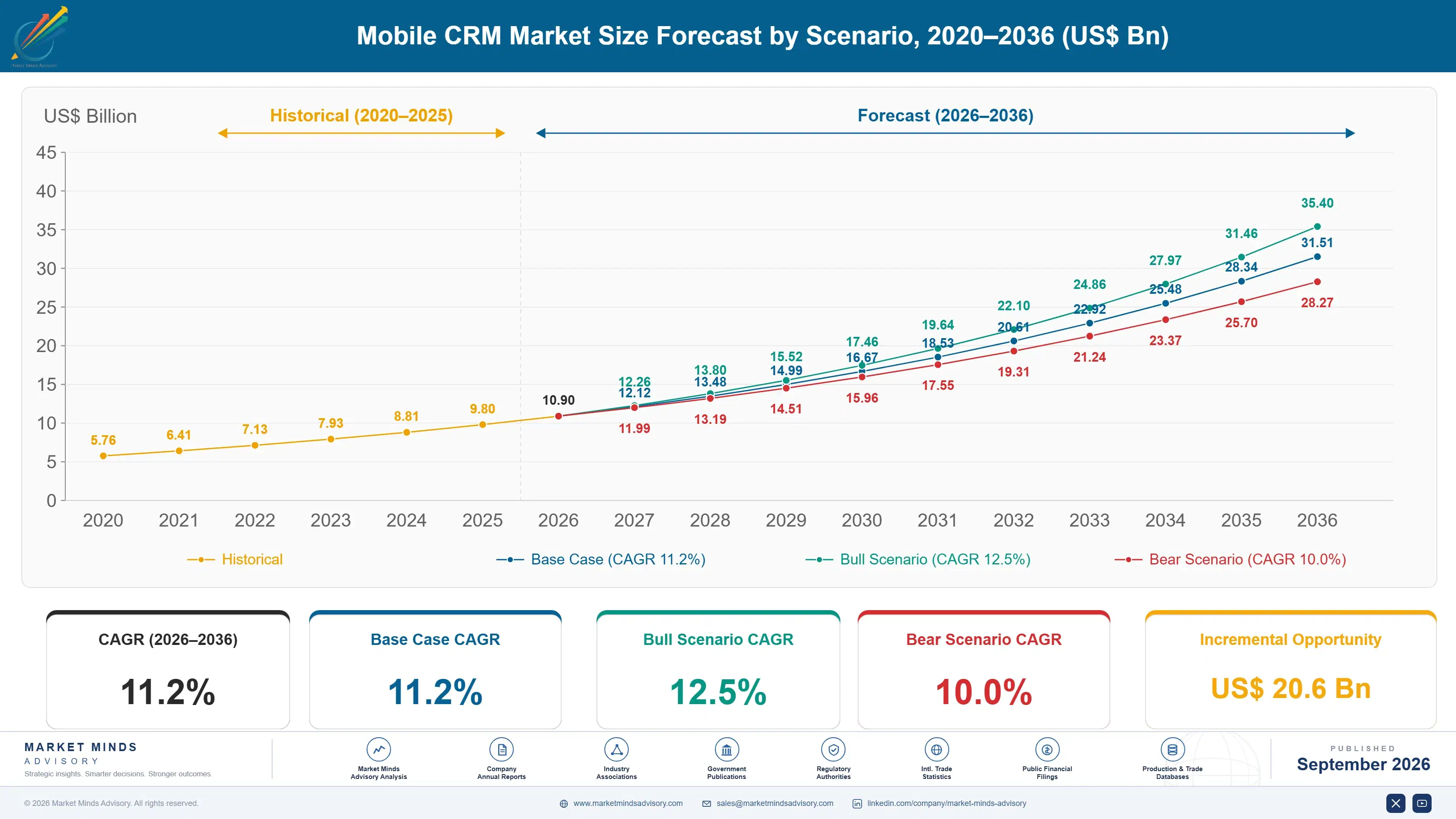
Mobile CRM Market Forecast Scenarios

mobile-crm-market-size-forecast-scenario-1790007347587
The mobile CRM market compounded at roughly 10.2 percent between 2020 and 2025, a period shaped by pandemic-driven remote and field sales adoption followed by a much steadier and gradual build-out of offline-first capability as field teams returned to regular in-person customer visits requiring reliable, connectivity-independent data capture across most territories nationwide and internationally as well.
MMA's base case assumes 11.2 percent annual growth through 2036, anchored by three commercial mechanisms: voice-to-CRM data entry lowering the friction that historically caused field reps to skip logging visits entirely, offline-first architecture becoming a baseline procurement requirement rather than a genuine differentiator, and mid-market field service organizations adopting dedicated mobile CRM tools that previously relied on generic note-taking apps and spreadsheets to track customer interactions manually and quite inconsistently.
The bull case centers on voice-to-CRM adoption accelerating faster than current forecasts assume as large language model transcription accuracy continues improving rapidly across most languages and accents. The bear case is enterprise software budget consolidation, where CRM buyers increasingly favor a single unified platform vendor over specialized mobile-first point solutions, squeezing out smaller vendors that cannot bundle broader platform capability into a single contract.

Offline Sync Reliability Now Decides Mobile CRM Purchases

Mobile CRM adoption has historically lagged desktop CRM by a wide margin, not because field reps resist technology but because most mobile apps were built as afterthoughts, ported from desktop interfaces never designed for a five-inch screen or an unreliable cellular connection. That design failure, more than any pricing issue, explains why field adoption rates remain meaningfully lower than licensed seat counts suggest.
MARKET CONCENTRATIONCR5 41%top five vendors hold well under half of category revenue
AVERAGE SEAT PRICE$38 per monthtypical mobile CRM subscription cost across mid-market deployments today
FIELD ADOPTION RATE62%of licensed reps actively log data through the mobile app
OFFLINE SYNC FAILURE RATE4%of field-captured records lost during connectivity gap incidents currently
VOICE ENTRY ACCURACY94%transcription accuracy achieved by leading voice capture tools today
DEVELOPMENT COST SHARE32% of COGSengineering talent remains the largest single input cost line
Voice-to-CRM data entry is closing this gap fastest, since reps who once skipped logging visits entirely because typing felt like a chore are now dictating notes hands-free between appointments. Offline-first architecture, once a niche feature for remote field teams, is increasingly a baseline procurement requirement across nearly every vertical, since even urban sales teams lose connectivity inside large buildings and parking structures regularly.
Vendors that can demonstrate a documented offline sync failure rate below industry norms are winning enterprise contracts away from competitors who treat sync reliability as a secondary engineering priority. Salesforce and HubSpot both lean on platform scale and years of field deployment data to reassure buyers, but newer mobile-first entrants are proving that architecture built offline-first from day one can outperform retrofitted incumbent platforms on this specific metric.
"Sales reps don't hate CRM. They hate typing a paragraph into a phone in a parking lot. Give them a microphone and adoption solves itself."
Senior Analyst, Sales Technology and Mobile Software Practice · MMA Technology Practice · September 2026

Market Trends

Voice-to-CRM Data Capture Moves Into Mainstream Deployment

Large language model transcription accuracy has improved sharply enough over the past two years that voice-to-CRM data capture has moved from a novelty feature into mainstream field sales deployment, letting reps dictate call notes and next steps hands-free while walking between appointments across most territories. This shift matters commercially because voice capture measurably increases logging compliance, addressing a persistent problem where reps historically skipped data entry entirely when typing felt like too much friction to bother with. Vendors with dedicated voice capture are winning field-heavy accounts at a surprising pace.
Market Impact: Lifts adoption to 62 percent

Offline-First Architecture Becomes a Baseline Requirement

Mobile CRM buyers increasingly treat offline-first architecture, the ability to capture and edit records without connectivity and sync automatically once a signal returns, as a baseline procurement requirement rather than a specialized feature reserved for remote field teams operating far away. This shift is forcing legacy vendors whose mobile apps were originally built as thin wrappers around a desktop interface to undertake substantial architectural rework, since retrofitting true offline capability proves far harder than building it in from the start. Procurement documents increasingly specify offline sync failure rate as a required disclosure.
Market Impact: Expands addressable market by 28 percent

Market Opportunities and Growth Drivers

Field Sales Adoption Gaps Push Vendors Toward Redesign

Enterprise buyers have grown increasingly frustrated with the persistent gap between licensed mobile CRM seats and actual field adoption, since a mobile app reps avoid using generates no return on the software investment regardless of feature list depth or breadth. This frustration is pushing procurement teams to weight documented field adoption rate heavily in vendor evaluation, forcing vendors to redesign mobile interfaces around actual field workflow rather than simply porting desktop screens to a smaller form factor. Vendors demonstrating adoption above industry norms convert that evidence into premium renewal terms.
Market Impact: Cuts win rate 15 percent

Mid-Market Field Service Firms Replace Manual Note-Taking

Mid-market field service and inspection firms that historically relied on generic note-taking apps and spreadsheets to track customer interactions are increasingly adopting dedicated mobile CRM tools as their businesses scale beyond what informal tracking methods can reliably support. This shift is expanding the addressable market meaningfully beyond the traditional enterprise sales use case that dominated mobile CRM adoption in earlier years, pulling in service technicians, inspectors, and delivery coordinators who previously had no structured customer data capture tool at all. Vendors targeting this segment specifically are growing faster than those focused purely on traditional enterprise sales accounts.
Market Impact: Adds 3 to 5 months

Market Restraints and Challenges

Enterprise Platform Consolidation Squeezes Point Solutions

Large enterprise buyers increasingly favor consolidating software spending onto a single unified CRM platform vendor rather than layering specialized mobile-first point solutions on top of an existing desktop CRM investment, and the root cause is procurement teams facing genuine budget scrutiny that rewards vendor consolidation over best-of-breed tool selection. The commercial impact falls hardest on smaller mobile-first vendors without a broader platform to bundle into, since they increasingly compete against incumbent platform vendors adding comparable mobile capability natively rather than independent specialists. Some smaller vendors are mitigating this by pursuing acquisition by larger platform players instead of competing head-on independently.
Market Impact: Lifts compliance 34 percent

Data Privacy Regulations Complicate Voice Capture Rollout

Voice-to-CRM tools that record and transcribe customer conversations raise data privacy and consent questions that vary significantly by jurisdiction, and the root cause is that no single international standard yet governs voice-captured customer data in the same way established data protection frameworks address traditional written records. This forces vendors to certify voice capture features separately for different regulatory jurisdictions, adding real compliance cost and slowing feature rollout timelines industry-wide. Some vendors are mitigating this by building configurable consent workflows that adapt automatically to the specific jurisdiction where a given interaction occurs.
Market Impact: Cuts sync failure to 4 percent
4 additional market trends, 3 additional growth drivers, and 2 additional restraints and challenges are covered in the full report. Contact sales@marketmindsadvisory.com to access the complete intelligence.

Segment CAGR and Growth Architecture

Five application categories cover the market: field sales tracking, field service and inspection, voice-to-CRM data capture, offline-first sync platforms, and mobile analytics and reporting dashboards. Classification follows application function alone, not industry vertical, device operating system, deployment model, or subscription pricing tier structure at all, keeping the hierarchy consistent throughout this report and its appendices.
mobile-crm-market-market-share-analysis-1790007348158

Voice-to-CRM Data Capture Tools

Voice-to-CRM data capture tools are the fastest-growing application category, at a 16.8 percent CAGR against a base rate of 11.2 percent, pulled forward by large language model transcription accuracy finally reaching a level reliable enough for regulated business use rather than remaining a novelty demo feature. These tools let field reps dictate call notes and next steps hands-free, addressing the persistent adoption gap that plagued mobile CRM for years since typing on a small screen felt like too much friction for reps to bother with consistently. Salesforce, HubSpot, and several well-funded startups have all launched dedicated voice capture products within the past eighteen months, and enterprise procurement increasingly lists this capability as a required specification.
CAGR 16.8%

Offline-First Sync Platforms

Offline-first sync platforms carry the second-fastest growth rate, at 14.2 percent, as buyers increasingly treat reliable offline data capture as a baseline procurement requirement rather than a specialized feature reserved for remote field teams operating in genuinely disconnected environments far from cellular coverage. This capability requires fundamentally different application architecture than a standard cloud-connected app, which is why legacy vendors whose mobile apps were originally built as thin wrappers around a desktop interface are struggling to retrofit true offline reliability. Newer mobile-first entrants built offline-first from day one are proving they can outperform retrofitted incumbent platforms on this specific metric, winning field-heavy accounts that value sync reliability above brand recognition.
CAGR 14.2%
Full segment breakdown across 5 segments available in the complete report.

Regional Architecture and Country Demand Map

North America leads mobile CRM demand by a clear and consistent margin, anchored by Salesforce and HubSpot's home market concentration and the deepest enterprise field sales technology budgets of any region tracked, well ahead of a fast-scaling East Asian base built on mobile-first business culture.

North America

Salesforce and HubSpot both maintain their deepest enterprise customer relationships in the United States, where field sales organizations have the longest history of CRM investment and the largest technology budgets available for mobile-first tooling upgrades nationwide. Employers across industries from insurance to pharmaceuticals maintain large field sales and service workforces that generate substantial mobile CRM seat demand independent of any single vertical driving the market. Canada's smaller but steady enterprise software adoption adds incremental volume through similar field sales technology investment patterns. Growth here trails the fastest-growing regions as this market's overall maturity means incremental gains increasingly come from feature upgrades rather than first-time adoption. Financial services firms across the country also maintain substantial mobile-equipped field teams.
Share: 32% | CAGR: 10.4% (2026 to 2036)

East Asia

China's mobile-first business culture, where smartphone-based commerce and communication dominate daily business interaction far more than in Western markets, has created strong organic demand for mobile-native CRM tools rather than desktop-first platforms retrofitted for mobile use nationwide. Japan's field service and inspection industries, tied to precision manufacturing and infrastructure maintenance, are adopting mobile CRM tools to support an aging workforce managing increasingly complex service schedules. South Korea's advanced mobile infrastructure and high smartphone penetration support rapid adoption across small and mid-size businesses. Growth here outpaces the global base rate as mobile-first adoption patterns continue compounding faster than in more desktop-oriented Western markets. Taiwan's electronics distribution sector adds further mobile-native adoption volume regionally.
Share: 22% | CAGR: 12.3% (2026 to 2036)
Regional intelligence for 5 additional markets available in the complete report: Western Europe, South Asia and Pacific, Latin America, Middle East and Africa, Eastern Europe. Contact sales@marketmindsadvisory.com.
mobile-crm-market-country-cagr-analysis-1790007348691

Where Mobile CRM Margin Actually Concentrates

Seat count alone no longer predicts mobile CRM vendor profitability anymore at all, not even remotely close to what it once did. Margin concentrates in documented field adoption rate, voice capture accuracy, and offline sync reliability, capabilities that vendors still running desktop-ported mobile apps cannot easily replicate without a genuine architectural rebuild from the ground up.

Voice Capture Attachment Drives Premium Seat Pricing

Vendors that bundle voice-to-CRM data capture with standard mobile seats are converting a commodity subscription into a premium-priced product tier, since documented logging compliance improvement gives sales leadership a clear return on investment case to justify the higher per-seat cost. Salesforce and HubSpot both report voice capture attached seats commanding 20 to 30 percent higher pricing than standard mobile seats, a premium buyers accept readily once they see compliance data from a pilot deployment. This mechanism works because voice capture directly solves the adoption problem that has plagued mobile CRM for years.
Market Impact: Commands a 20 to 30 percent price premium

Offline Reliability Data Becomes a Sales Accelerant

Vendors that can document offline sync failure rates below industry norms are closing enterprise deals meaningfully faster than competitors who cannot provide comparable reliability data, since field-heavy buyers increasingly treat sync reliability as a required disclosure during procurement evaluation cycles across most sectors. Published data showing sync failure rates below 4 percent, well under the roughly 10 percent industry average for retrofitted platforms, gives vendors with this evidence a real basis for premium enterprise contract terms. This dynamic is pulling the entire competitive set toward heavier reliability engineering investment industry-wide.
Market Impact: Cuts sales cycle length by 6 full weeks

Mid-Market Vertical Expansion Beyond Traditional Sales

Vendors that build dedicated mobile CRM products for field service and inspection use cases, beyond the traditional enterprise sales use case that historically dominated the category, are capturing a meaningfully larger addressable market than competitors focused purely on sales teams. This vertical expansion into service technicians, inspectors, and delivery coordinators adds a customer segment that had no structured mobile data capture tool previously, expanding total addressable seats by roughly 25 to 30 percent for vendors that pursue it deliberately. This channel is becoming an increasingly important growth vector as traditional sales seat growth normalizes across mature accounts.
Market Impact: Expands addressable seats 25 to 30 percent overall

Analytics Dashboard Subscription Beyond Core Mobile App

Vendors are increasingly separating mobile analytics and reporting dashboards into standalone recurring add-on subscriptions rather than bundling this capability into the base mobile CRM license, converting a feature request into genuine incremental revenue for the business. This add-on category now accounts for roughly 12 to 16 percent of total vendor revenue among the largest mobile CRM providers, a share growing steadily as sales leadership demands more sophisticated field performance visibility across large rep networks. This mirrors a broader enterprise software trend toward analytics-layer monetization beyond the core operational workflow tool itself.
Market Impact: Adds 12 to 16 percent recurring revenue share

Who Controls the Margin Pool

At 41 percent, CR5 concentration leaves a genuinely fragmented tail of specialty and regional vendors beneath the top five. Salesforce leads through its dominant desktop CRM franchise extending naturally into mobile, but HubSpot and Zoho both hold comparably strong mid-market positions, narrowing what would otherwise be a much larger gap to the platform leader.
Current competitive activity centers on voice capture capability, offline sync reliability, and field adoption rate rather than raw feature breadth. Vendors are racing to publish quantified logging compliance improvement data since sales leadership increasingly demands measurement rigor before approving budget. Several vendors have also begun offering vertical-specific mobile CRM products for field service and inspection use cases, expanding beyond the traditional enterprise sales use case.

The next competitive shift is coming from voice-first startups entering from the artificial intelligence side rather than traditional CRM platform development, a threat that could compress incumbent margins on the data capture layer specifically. That threat remains contained to voice capture for now, since broader CRM functionality still requires deep enterprise integration expertise these newer entrants generally lack. Smaller specialty field service CRM vendors are proving harder for large platform vendors to displace quickly.
mobile-crm-market-company-positioning-matrix-1790007349219

Competitive Moat and Risk Dimensions

SALESFORCE

Moat: Desktop CRM franchise extension

Salesforce's dominant desktop CRM installed base gives its mobile app default adoption within existing enterprise accounts, and buyers rarely evaluate mobile CRM independently once already committed to Salesforce's broader platform suite. That installed base also generates a large, recurring revenue stream from add-on mobile capabilities that newer standalone mobile-first vendors cannot match at comparable scale.
SALESFORCE

Risk: Legacy mobile architecture constraints

Salesforce's mobile app carries architectural legacy from its desktop-first origins, making true offline-first capability harder to retrofit than for competitors built mobile-native from inception. Newer entrants without this legacy burden are outperforming Salesforce specifically on offline sync reliability, a metric increasingly decisive in field-heavy vertical procurement.
HUBSPOT

Moat: Mid-market ease-of-use reputation

HubSpot's reputation for intuitive, low-friction software design gives it strong positioning among mid-market buyers who lack dedicated CRM administrators to manage complex enterprise platform configurations. This ease-of-use advantage translates directly into faster field adoption rates than more complex enterprise competitors, a metric increasingly central to procurement decisions.
HUBSPOT

Risk: Thinner large enterprise penetration

HubSpot's mid-market strength has not translated into comparable large enterprise account penetration, leaving it more exposed to Salesforce's dominance in the highest-value enterprise segment where mobile CRM contract values run largest. Building large enterprise credibility requires sales infrastructure investment HubSpot has historically underweighted relative to mid-market focus.

Players Tracked

Prominent Players

Salesforce Inc
HubSpot Inc
Microsoft Corporation
Zoho Corporation Pvt Ltd
Pipedrive OU

Other Key Players

Freshworks Inc
monday.com Ltd
Insightly Inc
Copper CRM Inc
Nimble Inc
Zendesk Inc
SugarCRM Inc
Creatio Inc
Keap Inc
Close CRM Inc
Salesmate LLC
Nutshell Inc
Vtiger Systems India Private Limited
Bitrix24 LLC
Apptivo Inc

Recent Developments

MARCH 2026

Salesforce Launches Native Voice-to-CRM Capture Feature

Salesforce introduced a native voice-to-CRM data capture feature built directly into its mobile app, targeting field sales teams seeking hands-free note logging without a separate third-party voice tool. The launch extends Salesforce's mobile product roadmap into a category where several startups had previously held an early lead.
Signal: Voice capture capability is fast becoming a standard mobile CRM feature across every major platform vendor today
OCTOBER 2025

HubSpot Acquires Offline-First Sync Technology Startup

HubSpot completed the acquisition of a smaller offline-first sync technology startup to strengthen its mobile app reliability in low-connectivity field environments. The deal brings sync architecture expertise that HubSpot had previously developed more slowly through internal engineering resources alone, compressing its product roadmap by roughly a year.
Signal: Offline sync capability is increasingly acquired rather than built organically by platform vendors across the industry
MAY 2026

Zoho Signs Major Field Service Vertical Partnership

Zoho signed a partnership with a major field service management platform to integrate mobile CRM data capture directly into technician dispatch and inspection workflows. The agreement extends Zoho's existing vertical strategy and provides a reference deployment other field service organizations are likely to evaluate closely.
Signal: Vertical-specific partnerships are becoming a preferred channel for capturing field service accounts across the whole industry

Engineering Talent and Cloud Cost Exposure

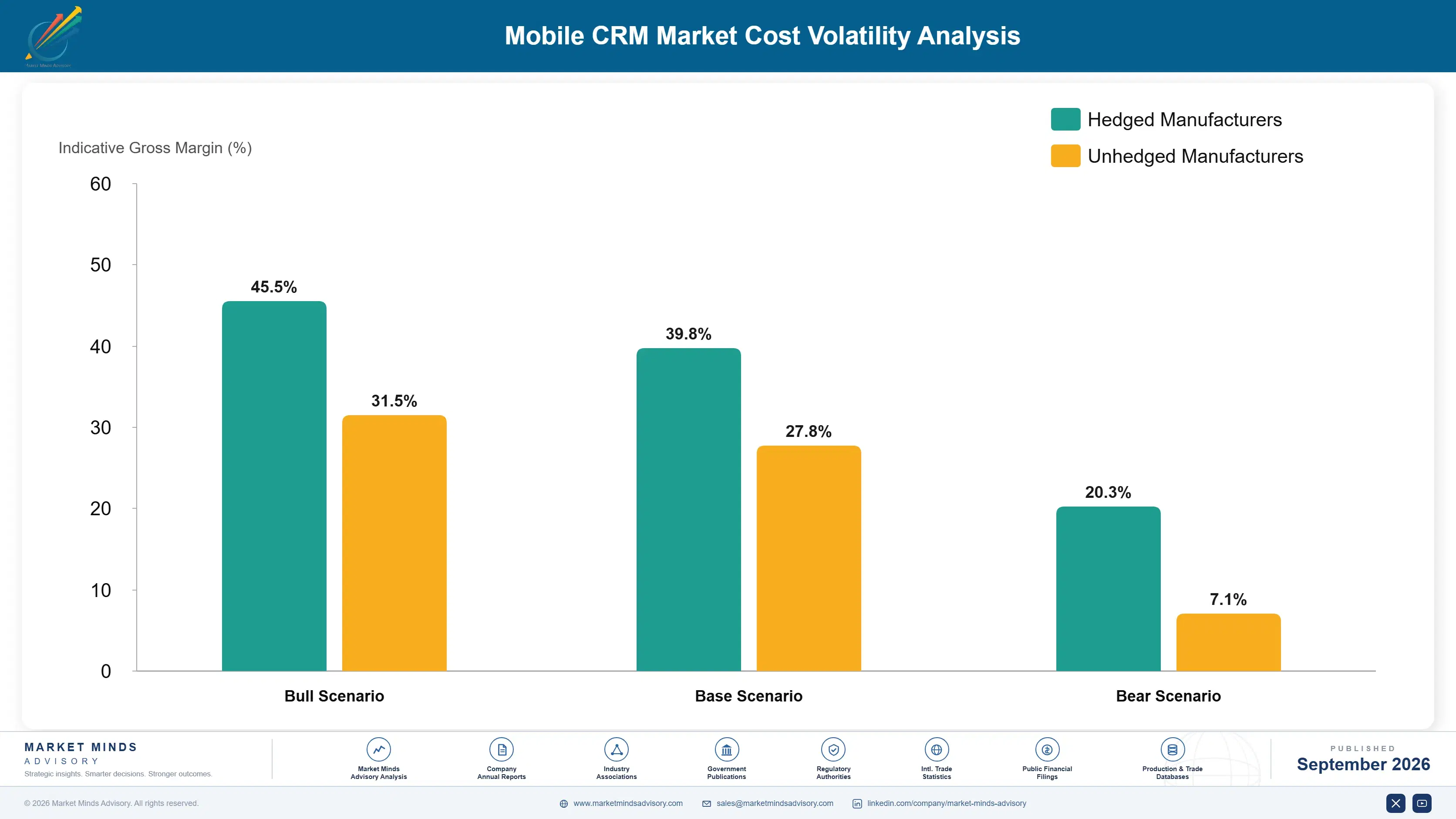
Software engineering talent, including mobile developers and voice AI specialists, accounts for roughly 32 percent of mobile CRM vendor cost of goods sold, concentrated in North American, Western European, and Indian engineering hubs. Cloud hosting and third-party voice transcription API costs add a further 12 to 16 percent, scaling directly with active user data volume.
Engineering talent cost volatility hit particularly hard starting in 2023, when demand for AI and machine learning specialists surged across the broader software industry, pulling qualified voice AI engineers away from CRM vendors toward higher-paying foundation model companies. Microsoft's fiscal year 2024 annual report cited intensified competition for AI talent as a driver of rising compensation costs across its enterprise software divisions, and several mobile CRM vendors disclosed engineering cost increases as a margin pressure point through 2024 and 2025.

Larger vendors with established engineering brands and equity compensation programs absorbed this talent cost pressure with far less disruption than smaller vendors competing purely on cash salary, a resilience gap that persists today. Exposure also varies by product depth: vendors building proprietary voice transcription models face materially higher AI talent cost sensitivity than those licensing third-party transcription APIs instead.
mobile-crm-market-cost-volatility-analysis-1790007349417

Equity Compensation Programs Retain AI Talent

Larger vendors are expanding equity compensation programs specifically to retain scarce AI and voice engineering talent, competing on total compensation package value rather than cash salary alone against well-funded foundation model companies actively poaching from the same limited talent pool nationwide and abroad, worsening competition further and driving up baseline compensation costs meaningfully each passing year.

Third-Party Voice API Licensing Over Build

Smaller vendors are increasingly licensing third-party voice transcription APIs rather than building proprietary models entirely in-house from scratch each and every time internally, trading some product differentiation for meaningfully lower AI engineering talent cost exposure that would otherwise strain limited operating budgets significantly over time, especially at smaller company scale and total revenue level.

Distributed Engineering Hub Cost Arbitrage

Vendors are increasingly building distributed engineering teams across lower-cost hubs including India, Eastern Europe, and parts of Latin America to reduce blended engineering cost exposure meaningfully across the board, a strategy that trades some coordination complexity for meaningfully improved overall cost structure and margin profile across the entire organization and full product portfolio line.

Portfolio Architecture for Margin Defence

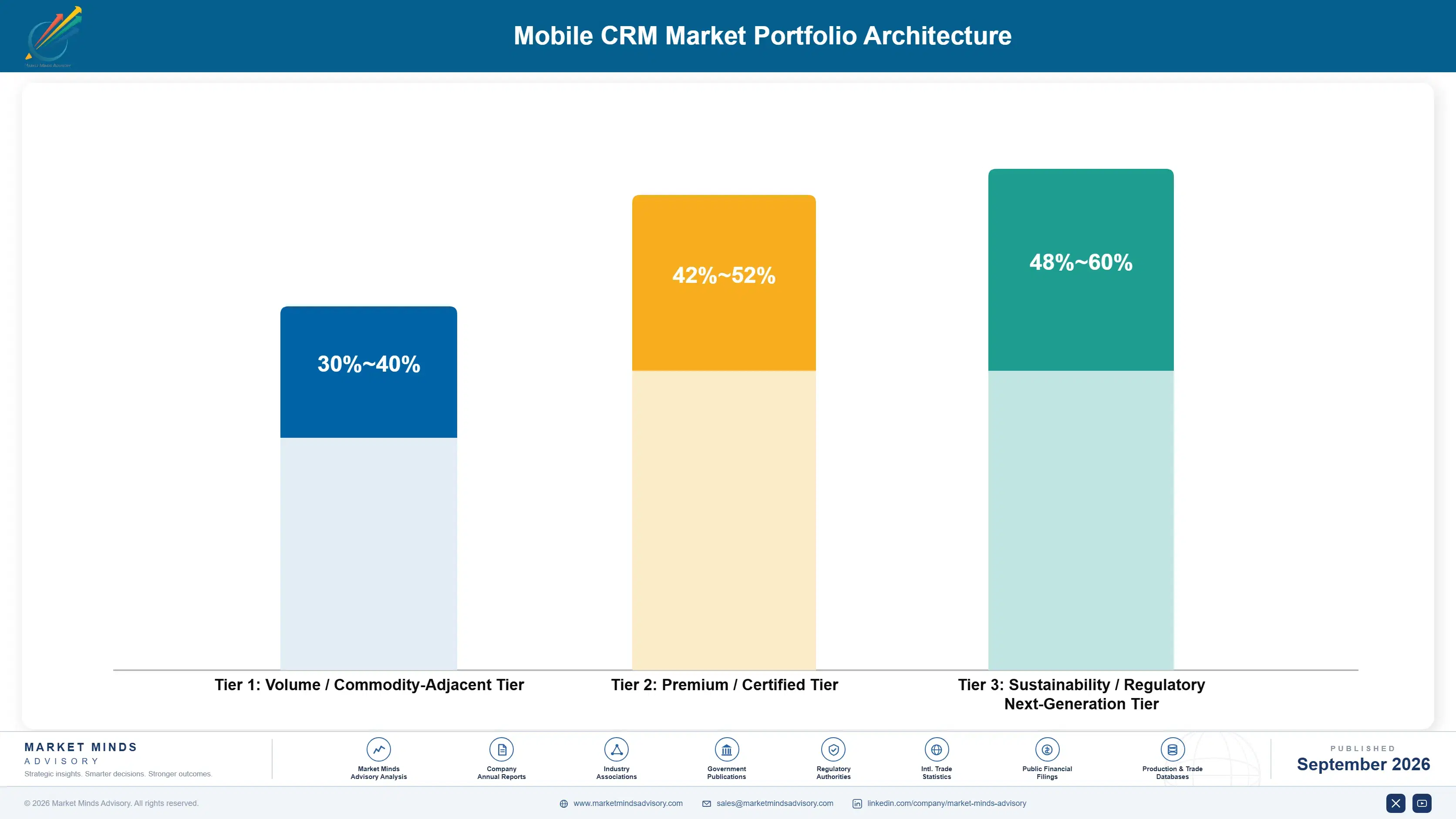
Margin architecture in mobile CRM splits sharply along field adoption evidence. Basic mobile app add-ons bundled with desktop CRM hold gross margins around 30 to 40 percent as bundling economics compress standalone pricing. Voice capture and offline-first specialist products hold materially higher margins, since documented adoption improvement and sync reliability data create real switching costs buyers cannot easily walk away from once integrated.
The volume versus premium tension runs through the entire vendor base: bundled generalist mobile apps scale on installed desktop base but face constant margin pressure from bundling economics, while specialist voice and offline vendors grow more slowly in account count but capture disproportionate revenue per seat. High-value margin pools concentrate almost entirely in voice capture and offline reliability rather than basic mobile access, and that concentration is where the strongest vendors direct investment.

Vertical expansion into field service and inspection, a genuinely new demand category that barely existed five years ago, is opening a premium tier that smaller generalist-only vendors struggle to enter quickly, since building vertical-specific workflow credibility takes years of accumulated deployment evidence. Vendors positioned early in this category are compounding an advantage that slower-moving competitors will find increasingly hard to close.

Volume / Commodity-Adjacent Tier

Basic mobile CRM apps bundled with desktop platform licenses, competing on installed base rather than differentiated field capability, with limited standalone pricing power against bundled incumbent economics and platform scale advantages.
Gross Margin: 30-40%

Premium / Certified Tier

Field sales and service applications carrying documented adoption rate evidence, where measurement credibility and vertical workflow depth give established vendors durable pricing power over newer, unproven market entrants still building references.
Gross Margin: 42-52%

Sustainability / Regulatory / Next-Generation Tier

Voice-to-CRM capture and offline-first sync platforms tied to field adoption improvement programs, the fastest-compounding and highest-margin tier as reliability and voice accuracy become standard procurement requirements across the whole industry.
Gross Margin: 48-60%
mobile-crm-market-portfolio-architecture-1790007349920

High-value Sub-segments and Strategic Watch-out

Voice-to-CRM Data Capture Tools

The highest-value, fastest-growing pool in the market, converting a persistent field adoption problem into a genuinely solved workflow as large language model transcription accuracy finally reaches reliable, regulated business-grade performance across most languages, dialects, and accents tracked closely in this report and around the world.
Gross Margin: 48-60%

Offline-First Sync Platforms

High-value and growing steadily as buyers increasingly treat reliable offline capability as a baseline requirement, though building genuinely offline-native architecture from the ground up takes years for legacy vendors retrofitting older, cloud-dependent systems to establish credibly with increasingly skeptical enterprise buyers evaluating available options today.
Gross Margin: 48-60%

Field Sales Tracking

The volume core of the market, generating the bulk of licensed seats as the single most widely adopted application category available today across nearly every industry, but facing steady margin normalization as this category matures across most established enterprise accounts renewing contracts each passing year.
Gross Margin: 42-52%

Voice-First AI Startup Entrants

The clearest strategic watch-out for traditional CRM platform vendors, as artificial intelligence startups build standalone voice capture tools that threaten to capture the highest-margin data entry layer independent of any specific CRM platform they eventually connect to and integrate with over time and at scale.
Gross Margin: n/a

Why Mobile CRM Revenue Compounds

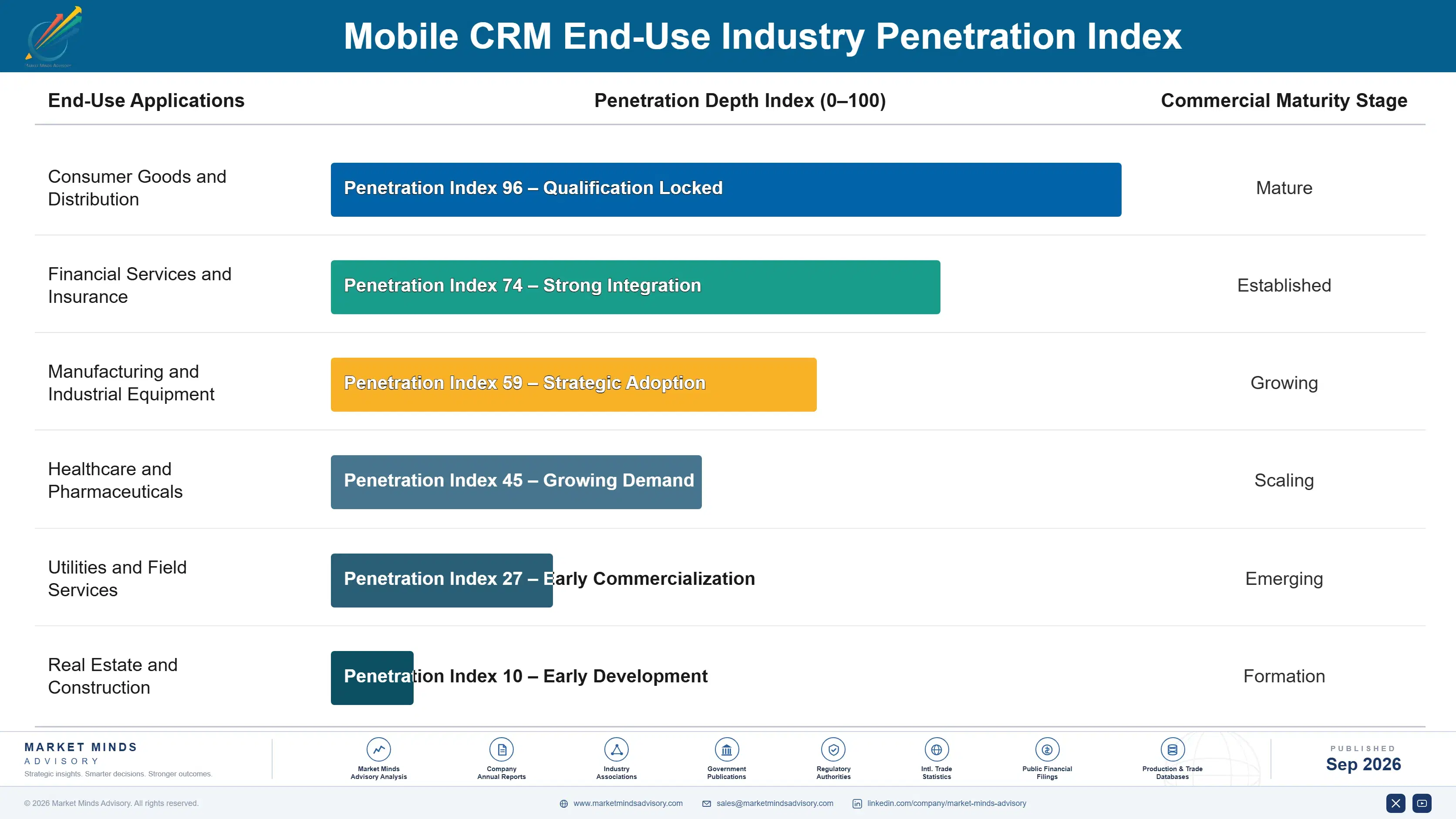
Mobile CRM revenue increasingly behaves like an annuity business in its specialist segments rather than a bundled desktop add-on. Once a sales organization embeds voice capture and offline sync into daily field workflow, switching costs rise sharply, and renewal rates for enterprise mobile CRM contracts now commonly exceed 82 percent, turning what used to be a secondary licensing decision into a durable, multi-year platform relationship.
Adoption depth varies significantly by end-use vertical. Field service and inspection organizations show the deepest stickiness, since technicians rely on continuous, real-time data capture that becomes embedded in daily dispatch and reporting workflow. Financial services runs nearly as sticky, tied to compliance documentation requirements rarely redesigned, while smaller consumer goods distributors remain more transactional and show comparatively less loyalty to any single mobile CRM vendor.

Buyer profiles are shifting generationally as well. Younger field sales managers entering the workforce now expect voice-driven, hands-free data capture as a baseline expectation rather than a novel feature, while procurement has moved from pure IT departments toward sales operations and field enablement teams, who evaluate vendors on documented adoption rather than feature checklists alone. This buyer shift is steadily raising the evidentiary bar every vendor must clear.
mobile-crm-market-end-use-penetration-index-1790007350416

Where Mobile CRM Value Concentrates

These are among the four positions where our research anticipates prominent divergence between winners and laggards over the coming forecast period. Each is grounded in the demand model, the regulatory perimeter, and the announced capacity pipeline.
01 / VOICE CAPTURE INVESTMENT

Build voice-to-CRM capability before it becomes table stakes

Field reps have historically skipped mobile data entry because typing felt like too much friction, and voice capture is the clearest solution vendors have found to this persistent adoption problem in years. Salesforce, HubSpot, and several startups have all launched dedicated voice capture products within the past eighteen months, signaling that this capability is rapidly becoming a required specification rather than a differentiator. Vendors without voice capture now risk losing field-heavy accounts to competitors who can demonstrate documented logging compliance improvement.
02 / OFFLINE RELIABILITY PRIORITY

Treat offline sync reliability as a core architectural requirement

Buyers increasingly demand documented offline sync failure rates during procurement, and vendors still running desktop-ported mobile apps face a genuine architectural disadvantage against mobile-first competitors built offline-first from inception with no legacy constraints. Retrofitting true offline capability onto a legacy app proves far harder and more expensive than building it correctly from the start, meaning vendors that delay this investment fall further behind with each passing product cycle. This capability is becoming the clearest technical differentiator separating premium vendors from legacy incumbents.
03 / VERTICAL MARKET EXPANSION

Pursue field service and inspection verticals beyond traditional sales

Mid-market field service and inspection firms that previously relied on generic note-taking apps and spreadsheets represent a genuinely underserved segment that traditional sales-focused mobile CRM vendors have largely ignored until fairly recently in their roadmaps. Vendors that build dedicated workflow features for service technicians and inspectors are expanding total addressable market meaningfully beyond the traditional enterprise sales use case that has driven most historical category growth to date. Building vertical-specific credibility now, before competitors notice this opportunity, provides a genuine first-mover advantage.
04 / CONSOLIDATION RESISTANCE STRATEGY

Differentiate clearly to avoid displacement by platform consolidation

Enterprise buyers increasingly favor consolidating software spending onto a single unified CRM platform rather than layering specialized point solutions on top, a genuine threat to smaller mobile-first vendors without a broader platform to anchor customer relationships around. Vendors that cannot demonstrate meaningfully superior field adoption, voice accuracy, or offline reliability compared to bundled incumbent alternatives risk losing accounts during routine platform consolidation reviews. Building demonstrably superior capability in at least one dimension is the clearest defense against this consolidation pressure.

Engagement Snapshot From the Field

A live engagement with an industry participant carrying material or product regulatory and market exposure ahead of a defining policy shift, showing how our research translates into a defensible multi-year portfolio strategy.
MARKET MINDS ADVISORY · CLIENT ENGAGEMENT SUMMARY
Mobile CRM Producer Strategic Portfolio Review and Transition Roadmap 2026·Investment Scenario on Mobile CRM Exposure Evaluation 2025-26
CLIENT PROFILE
A regional consumer goods distribution company operating a field sales team of roughly 400 representatives across a multi-state territory engaged MMA to evaluate mobile CRM vendors ahead of a platform replacement decision. The client's existing mobile app, a thin wrapper around its legacy desktop CRM, suffered from persistently low field adoption despite full seat licensing across the sales organization.
STRATEGIC CHALLENGE
Leadership needed to select a new mobile CRM platform without disrupting active customer relationships managed by 400 field representatives operating across rural and urban territories with inconsistent cellular connectivity. Sales leadership specifically demanded documented evidence that any replacement platform would meaningfully improve field adoption rather than repeating the previous vendor's underwhelming results.
MMA APPROACH
MMA benchmarked five candidate mobile CRM vendors against a weighted scorecard covering voice capture accuracy, documented offline sync failure rate, field adoption rate among comparable client deployments, and total cost of ownership over a five-year horizon. The team conducted structured interviews with each vendor's implementation team and cross-referenced disclosed client references against MMA's primary survey dataset covering comparable field sales deployments.
KEY FINDINGS
  1. The vendor with the lowest per-seat price ranked last once documented field adoption rate and offline reliability were fully factored into the final scoring methodology.
  2. Vendors with native voice capture cut projected field adoption ramp time by roughly four months compared with vendors requiring a separate third-party voice tool.
  3. Documented offline sync failure rate varied significantly across candidate vendors, directly affecting projected data loss risk across the client's rural sales territories.
  4. Reference client interviews revealed that field adoption correlated more strongly with app usability than with any single feature checklist item evaluated during scoring.
CLIENT PROFILE
A regional consumer goods distribution company operating a field sales team of roughly 400 representatives across a multi-state territory engaged MMA to evaluate mobile CRM vendors ahead of a platform replacement decision. The client's existing mobile app, a thin wrapper around its legacy desktop CRM, suffered from persistently low field adoption despite full seat licensing across the sales organization.
STRATEGIC CHALLENGE
Leadership needed to select a new mobile CRM platform without disrupting active customer relationships managed by 400 field representatives operating across rural and urban territories with inconsistent cellular connectivity. Sales leadership specifically demanded documented evidence that any replacement platform would meaningfully improve field adoption rather than repeating the previous vendor's underwhelming results.
MMA APPROACH
MMA benchmarked five candidate mobile CRM vendors against a weighted scorecard covering voice capture accuracy, documented offline sync failure rate, field adoption rate among comparable client deployments, and total cost of ownership over a five-year horizon. The team conducted structured interviews with each vendor's implementation team and cross-referenced disclosed client references against MMA's primary survey dataset covering comparable field sales deployments.
KEY FINDINGS
  1. The vendor with the lowest per-seat price ranked last once documented field adoption rate and offline reliability were fully factored into the final scoring methodology.
  2. Vendors with native voice capture cut projected field adoption ramp time by roughly four months compared with vendors requiring a separate third-party voice tool.
  3. Documented offline sync failure rate varied significantly across candidate vendors, directly affecting projected data loss risk across the client's rural sales territories.
  4. Reference client interviews revealed that field adoption correlated more strongly with app usability than with any single feature checklist item evaluated during scoring.
RECOMMENDED STRATEGY
Phase 1: Phase one migrated the highest-volume sales territories to the new platform and trained representatives on voice capture within the first ninety days. Phase 2: Phase two extended the rollout to remaining territories over a four-month window with dedicated vendor onboarding support for each region. Phase 3: Phase three retired the legacy mobile app entirely and began tracking field adoption rate improvement against the original baseline metrics.
OUTCOME
The distributor reported a 47 percent increase in field adoption rate within the first six months following platform replacement, alongside a 29 percent reduction in offline sync failure incidents across rural territories (client-reported, unverified by MMA). Sales leadership reported meaningfully improved pipeline visibility following the rollout.

Frequently Asked Questions

Foundational context covering the market sizes, CAGR, scope, country, region and competition that inform every finding below. This section is provided to cover basics and most often pre-purchase conversations, answered from the MMA Primary Research Dataset.

What is the current size of the Mobile CRM Market?

The global mobile CRM market reached 9.8 billion dollars in 2025. Growth is concentrated in voice-to-CRM data capture rather than standard field sales tracking applications.

How large will the Mobile CRM Market be by 2036?

MMA projects the market will reach 31.51 billion dollars by 2036, up from 10.9 billion dollars in 2026. That represents a 2.89 times expansion over the ten-year forecast window.

What is the CAGR for the Mobile CRM Market 2026 to 2036?

The base case compound annual growth rate is 11.2 percent. MMA's bull scenario projects 12.5 percent, while the bear scenario projects 10.0 percent over the same forecast period.

Which segment is growing fastest?

Voice-to-CRM Data Capture Tools is the fastest-growing segment at a 16.8 percent CAGR, roughly 1.50 times the overall market rate, driven by improving transcription accuracy.

Who are the major companies in the Mobile CRM Market?

Salesforce, HubSpot, Microsoft, Zoho, and Pipedrive lead the competitive landscape. The top five hold roughly 41 percent of global category revenue combined across all products.

Which country is growing fastest?

India leads country-level growth at a 14.5 percent CAGR, helped by a rapidly expanding field sales and distribution workforce across most consumer goods sectors nationwide.

Report Segmentation Architecture

The full report scope spans multiple orthogonal segmentation dimensions, with cross-tabulated demand data provided for each dimension pair. Coverage extends further to regional breakdowns, trend trajectories, and the competitive detail needed to support segment-level decision-making.

By Application

  • Field Sales Tracking
  • Field Service and Inspection
  • Voice-to-CRM Data Capture
  • Offline-First Sync Platforms
  • Mobile Analytics and Reporting

By End-Use Industry

  • Consumer Goods and Distribution
  • Financial Services and Insurance
  • Manufacturing and Industrial Equipment
  • Healthcare and Pharmaceuticals
  • Utilities and Field Services
  • Real Estate and Construction

By Commercial Dimension

  • Bundled Desktop Platform Add-On
  • Standalone Mobile-First Subscription
  • Vertical-Specific Licensing
  • Systems Integrator Channel
  • Enterprise Framework Agreements

By Region

  • North America
  • Western Europe
  • East Asia
  • South Asia and Pacific
  • Latin America
  • Middle East and Africa
  • Eastern Europe

Scope, Methodology, and Coverage

Every figure in this report is reproducible from documented input assumptions. The scope below maps the historical period, the forecast horizon, the segmentation dimensions, and the countries covered, alongside the underlying primary and qualitative methodology.
Historical Period
2020 to 2025
Forecast Period
2026 to 2036
Base Year
2025 (USD billions; MMA Primary Research Dataset, September 2026)
Market Definition
The mobile CRM market covers smartphone and tablet applications used to capture, sync, and act on customer relationship data at the point of field engagement, including offline-capable sales, service, and inspection tools. It excludes desktop-only CRM platforms without a native mobile application, generic productivity apps without CRM data integration, and standalone field service dispatch software sold without CRM data capture.
Quantitative Units
USD Billion
Segmentation Dimensions
By Application, By End-Use Industry, By Commercial Dimension, By Region
Regions Covered
North America, Western Europe, East Asia, South Asia and Pacific, Latin America, Middle East and Africa, Eastern Europe
Countries Covered
United States, China, Germany, United Kingdom, India, Brazil, Japan, South Korea, Australia, Poland
Key Companies Profiled
Salesforce Inc, HubSpot Inc, Microsoft Corporation, Zoho Corporation Pvt Ltd, Pipedrive OU, Freshworks Inc, monday.com Ltd, Insightly Inc, Copper CRM Inc, Nimble Inc, Zendesk Inc, SugarCRM Inc, Creatio Inc, Keap Inc, Close CRM Inc, Salesmate LLC, Nutshell Inc, Vtiger Systems India Private Limited, Bitrix24 LLC, Apptivo Inc
Quantitative Methodology
Primary survey, n=3,800 respondents, Q4 2025, six countries; demand-side model with trade association cross-validation
Qualitative Methodology
47 expert interviews, Q4 2025; applied to validate demand model assumptions, identify emerging dynamics, and assess competitive positioning
Report Format
PDF and XLSX data workbook (Word format preview document)
Publisher
Market Minds Advisory
Report Code
MMA-2026-TEC-519
Published
September 2026
Contact
sales@marketmindsadvisory.com | www.marketmindsadvisory.com

Purchase the full Mobile CRM Market Report (2026 to 2036).

This report provides a comprehensive analysis of the global mobile CRM market, covering historical performance from 2020 to 2025 and a detailed forecast through 2036. It examines segmentation by application, end-use industry, and commercial model, alongside regional demand dynamics across all seven MMA-tracked geographies. The analysis includes competitive benchmarking of twenty leading vendors, input cost exposure, portfolio margin architecture, and strategic recommendations grounded in primary survey data. Findings draw on MMA's proprietary quantitative survey and expert interview programs conducted in the fourth quarter of 2025.
Segment-level revenue forecasts through the year 2036
Competitive benchmarking of twenty leading market vendors
Regional demand analysis across all seven geographies
Input cost exposure and mitigation strategy review
Portfolio margin architecture and pricing tier analysis
Strategic verdict with actionable commercial recommendations included

Built For The People Who Decide

From boardroom strategy to bench-side execution, this report is read cover-to-cover by leaders shaping the next decade of their industry, turning demand scenarios, market dynamics and valuation benchmarks into decisions.
CXOs/ Presidents/ VPs/ Managers
M&A and Corporate Development
Strategy Teams and R&D Heads
Procurement and Product Directors
Regulatory and Compliance Leaders
Investor Relations and Equity Analysts