Market Minds Advisory
Mixed Xylene Market

Mixed Xylene Market: Mixed Xylene Market: Chinese self-sufficiency, gasoline arbitrage and recycled polyester displacement to 2036

China built its own way out of importing paraxylene almost entirely, which destroyed the trade flows and destroyed the margins that Korean and Japanese producers had built whole businesses around.

Lead Analyst

Bilal Shaikh

Published

September 2026

Make Smarter Decisions with Customized Research Insights

Request a free sample report and evaluate market opportunities, growth trends, and competitive dynamics relevant to your business needs.

2025 MARKET VALUE$34.8BMarket Size 2025
2036 FORECAST VALUE$52.5BBase Case , 2026 to 2036
CAGR 2026 TO 20363.8 %Bull 5.0% / Bear 2.6%
INCREMENTAL OPPORTUNITY$16.3BNet 10- year value creation
EXPANSION MULTIPLE1.45x2036 value over 2026 base
Strategic Levers
M&A Pipeline
Regional Outlook
Country Rankings
Competitive Intelligence
Segmental Deep-dive
Call-Us : 91 93563 13602

Executive Snapshot and Market Trajectory.

Chinese paraxylene self-sufficiency reached roughly 96% from a position of enormous import dependence, and the integrated plants that achieved it make their own mixed xylene from their own reformers. Merchant demand shrank rather than grew. Everybody built for the old trade flow. Nobody planned for the customer becoming the competitor.
Metaxylene feedstock grows at 5.7%, half again the market rate of 3.8%, on isophthalic acid for bottle resin modification and unsaturated polyester resins that the larger isomer routes cannot serve. East Asia holds 32% of value, above the usual band, on polyester manufacture concentrated there. Feedstock accounts for 79% of production cost. Adsorptive separation is required because the isomers boil within a few degrees of each other, which narrows the field.
Five producers hold 32% of supply and concentration matters less here than integration does, since a producer inside a paraxylene complex never sells a tonne into the merchant market. The price mechanism outsiders consistently miss is gasoline: this stream blends at 108 research octane, so chemical buyers must outbid the fuel pool rather than each other. Petrochemical demand sets very little. Everybody models this backwards.
Market Definition
This report covers mixed xylene supplied from catalytic reforming and pyrolysis gasoline for onward conversion and direct use, spanning paraxylene feedstock, orthoxylene feedstock, metaxylene feedstock, solvent applications, gasoline blending, and ethylbenzene and other derivative routes. Value is measured at producer level on tonnage supplied. Excluded are separated pure isomers sold as finished products, purified terephthalic acid and downstream polyester, benzene and toluene streams, and refinery gasoline blending operations themselves.
Base Year Value
$34.8B in 2025 (MMA Primary Research Dataset, August 2026)
Forecast Period
2026 to 2036, eleven discrete annual values
CAGR
3.8% base case. Bull 5.0%. Bear 2.6%.
Fastest Growth Segment
Metaxylene Feedstock: 5.7% CAGR
Fastest Growth Country
India: 6.4% CAGR
Fastest Growth Region
South Asia and Pacific: 5.8% CAGR
Largest Region
East Asia: 32% of 2025 global value
Market Leaders
Sinopec, ExxonMobil, Reliance Industries, SK Innovation and BP lead the market. Source: MMA Primary Research Dataset, July 2026.
Primary Survey
n=3,800 procurement and R&D decision-makers, Q4 2025, six countries
Methodology
Demand-side build-up, cross-validated against public data, 47 expert interviews

Mixed Xylene Market Forecast Scenarios

mixed-xylene-market-trends-size-forecast-scenario-1787555658624
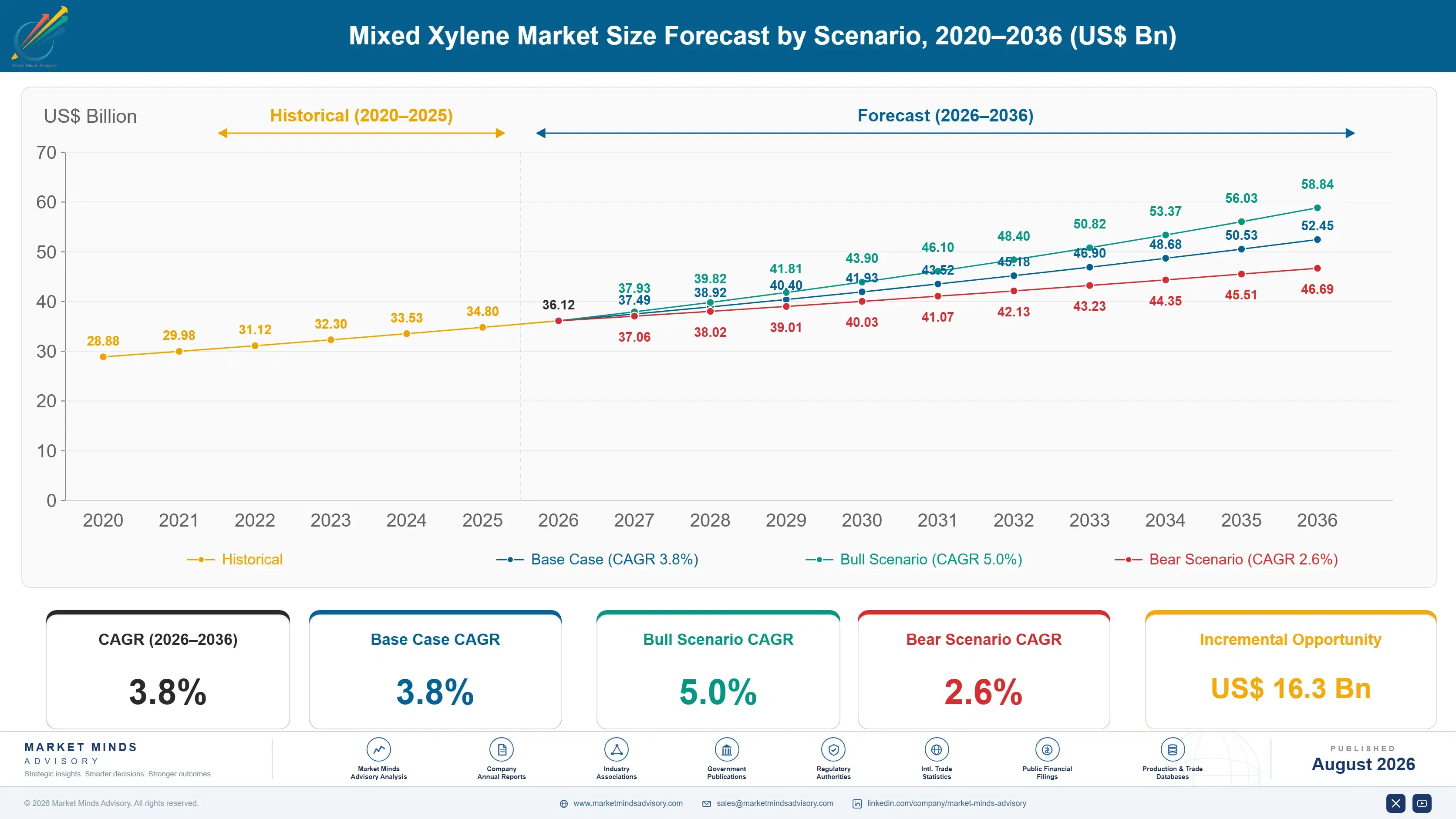
Growth ran at 3.0% between 2020 and 2025 and one country reshaped the whole chain. Chinese integrated paraxylene and polyester capacity commissioned across the period took domestic self-sufficiency to roughly 96% from heavy import dependence, collapsing the trade flows that Korean, Japanese and Southeast Asian producers had relied on. Merchant mixed xylene demand fell as integrated complexes supplied themselves from their own reformers.
The 3.8% base case rests on three mechanisms. Indian and Southeast Asian polyester capacity keeps expanding, which is where the remaining growth in paraxylene feedstock demand now sits. Metaxylene demand keeps rising at 5.7% on isophthalic acid for bottle resin and unsaturated polyester applications. And gasoline demand across developing markets keeps supporting the blending outlet that competes with chemical use for the same barrel. That competition sets the price rather than any chemical fundamental does.
The 5.0% bull case is gasoline cracks strengthening enough to pull volume into the fuel pool persistently, which would raise the price chemical buyers must pay across the whole chain. The 2.6% bear case is recycled polyester content requirements reaching 30% in European packaging and spreading, since every tonne of recycled resin displaces virgin polyester and the paraxylene chain underneath it.

When The Importer Stopped Importing

The defining event in this chain over the past decade was a decision taken in Beijing rather than anything happening in the market. China imported paraxylene at enormous scale for years, and then built integrated refinery to polyester complexes at Hengli, Zhoushan and elsewhere that took domestic self-sufficiency to roughly 96%. Producers who built businesses supplying that import demand found the customer had become a competitor, and merchant demand shrank since integrated complexes feed themselves.
TOP-FIVE CONCENTRATION32%Combined position across global mixed xylene supply held by leaders
PARAXYLENE ROUTE SHARE81%Portion of volume converted onward into paraxylene for polyester
CHINESE PARAXYLENE SELF-SUFFICIENCY96%Share of domestic requirement Chinese producers now supply themselves
GASOLINE BLENDING OCTANE108Research octane number the aromatic stream contributes to blending
FEEDSTOCK COST SHARE79%Portion of production cost attributable to the reformate feed
RECYCLED POLYESTER CONTENT TARGET30%Level European packaging rules will require from bottle resin
The price mechanism confuses people who approach this as a petrochemical market. Mixed xylene blends into gasoline at around 108 research octane, which makes it valuable to a refiner regardless of what any chemical buyer wants to do with it. When gasoline cracks are strong the barrel goes into the fuel pool, and a paraxylene producer must outbid that alternative rather than negotiate with other chemical buyers. The gasoline arbitrage sets most of the price.
The long-term demand question is recycled polyester. European packaging rules requiring 30% recycled content in bottle resin displace virgin polyester directly, and every tonne displaced removes paraxylene demand and mixed xylene beneath it in sequence.
"People model this as a polyester derivative and then wonder why the price ignores polyester. It is a gasoline component that happens to be useful to chemists, and until you price the blending alternative you have not understood the market at all."
Director, Aromatics and Petrochemical Feedstocks Practice · MMA Chemicals and Materials Practice · August 2026

Market Trends

Chinese integration removed the largest merchant demand pool

Chinese paraxylene self-sufficiency reached roughly 96% through integrated refinery to polyester complexes commissioned over recent years, which is a complete reversal from the import dependence that shaped regional trade for two decades. Those complexes produce mixed xylene from their own reformers and consume it internally, which removes them from the merchant market entirely rather than merely reducing their purchases. Korean, Japanese and Southeast Asian producers who built capacity to serve Chinese import demand now compete for a considerably smaller pool. Commercially this destroyed margins across the region and the capacity has nowhere else obvious to go.
Market Impact: Contributes 108 research octane
Recycled polyester content targets displace the virgin chain

European packaging rules requiring 30% recycled content in beverage bottle resin displace virgin polyester tonne for tonne, and that displacement passes back through purified terephthalic acid to paraxylene and mixed xylene beneath it. The mechanism is direct and the timetable is published, which distinguishes it from most demand threats this industry worries about. Similar requirements are appearing across other jurisdictions and brand owner commitments frequently exceed regulatory minimums. Commercially this caps the largest outlet for this stream in developed markets, though collection and recycling capacity constrain how quickly the displacement actually occurs in practice.
Market Impact: Drives 6.4% Indian growth

Market Opportunities and Growth Drivers

Gasoline blending competes directly for the same barrel

Mixed xylene contributes around 108 research octane to a gasoline pool, which makes it genuinely valuable to a refiner independently of any chemical application. That creates a continuous arbitrage where the stream flows toward whichever outlet pays more, and gasoline cracks rather than polyester demand frequently decide the answer. Developing market gasoline demand keeps growing while developed market demand declines with vehicle electrification, which keeps the blending outlet substantial. Commercially this puts a floor under mixed xylene value that chemical demand alone would not support, and it is why chemical buyers must outbid rather than negotiate.
Market Impact: Consumes 79% of production cost

Indian and Southeast Asian polyester capacity keeps expanding

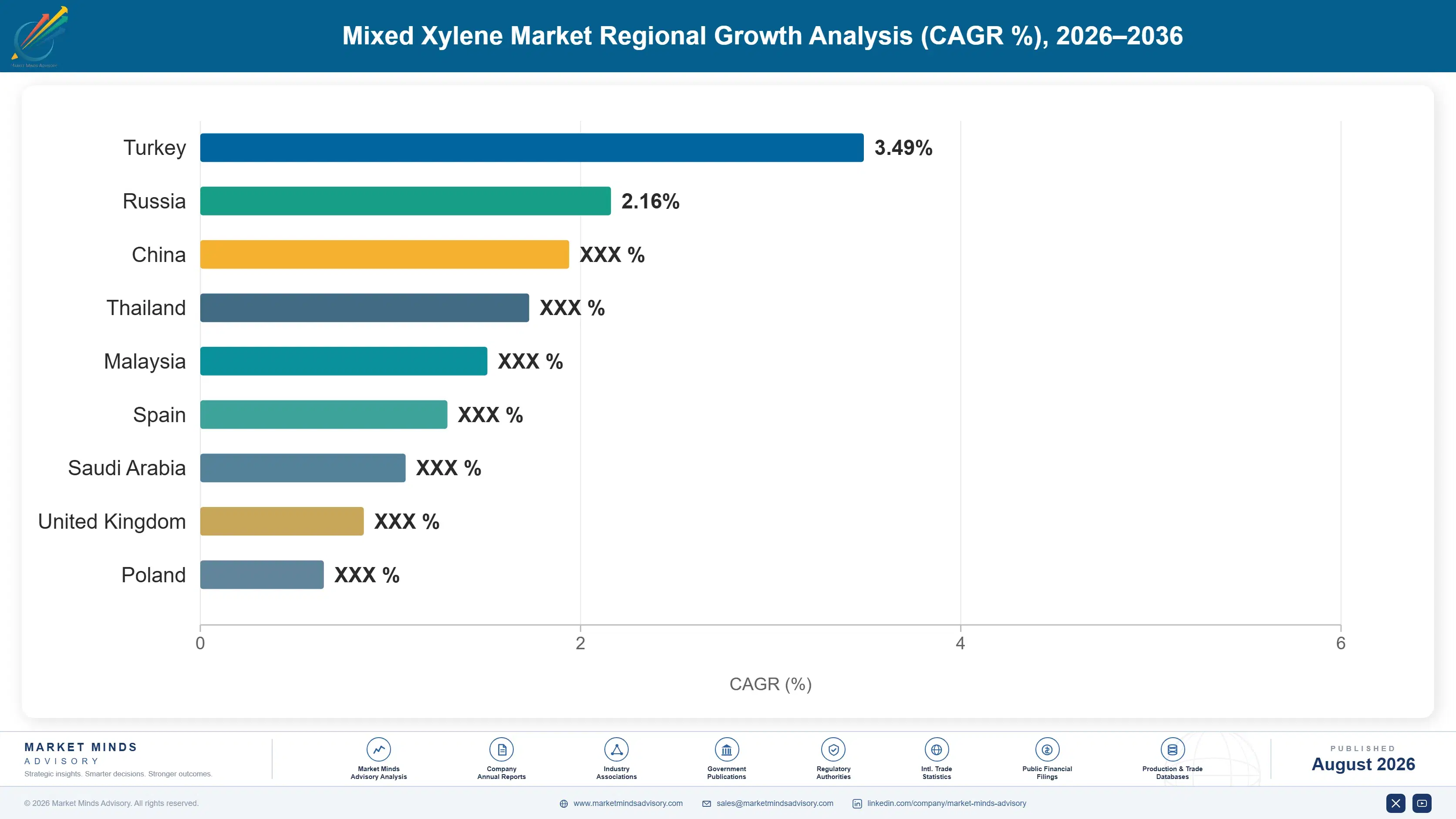
Indian polyester and purified terephthalic acid capacity continues expanding on domestic textile demand and export manufacture, which is where the remaining growth in paraxylene feedstock consumption now sits following Chinese self-sufficiency. Indian growth at 6.4% is the fastest of any country here. Southeast Asian capacity across Thailand, Indonesia and Vietnam adds further demand as textile manufacture relocates from China. That relocation is happening for labour cost and trade reasons rather than anything petrochemical, which makes the demand more durable than a purely commercial expansion would be. Nothing petrochemical drives that relocation.
Market Impact: Contracts solvent demand to 1.6%

Market Restraints and Challenges

Feedstock dominates cost and leaves almost no margin

Reformate and pyrolysis gasoline feed accounts for around 79% of production cost, which leaves conversion margin thin enough that any feedstock movement passes almost entirely through to the product. The root cause is that this is a separation and conversion business rather than a synthesis one, adding modest value to a stream a refinery already produces. Commercially this means producers make money on integration and scale rather than on any process advantage. Producers are responding by integrating downstream into paraxylene and polyester, which is exactly what Chinese complexes did and what removed the merchant market.
Market Impact: Reaches 96% Chinese self-sufficiency

Solvent applications shrink under volatile compound regulation

Aromatic solvent use in coatings, inks and adhesives is declining steadily as volatile organic compound limits tighten across developed markets and formulators reformulate toward waterborne and high-solids systems. The root cause is regulatory and it applies to the aromatic character itself rather than to any specific impurity, which means no reformulation of the solvent addresses it. Commercially this outlet is contracting at 1.6% and will continue doing so. Producers treating solvent demand as a stable base are relying on a market that regulation is deliberately shrinking on a published timetable.
Market Impact: Displaces 30% of bottle resin
3 additional market trends, 4 additional growth drivers, and 2 additional restraints and challenges are covered in the full report. Contact sales@marketmindsadvisory.com to access the complete intelligence.

Segment CAGR and Growth Architecture

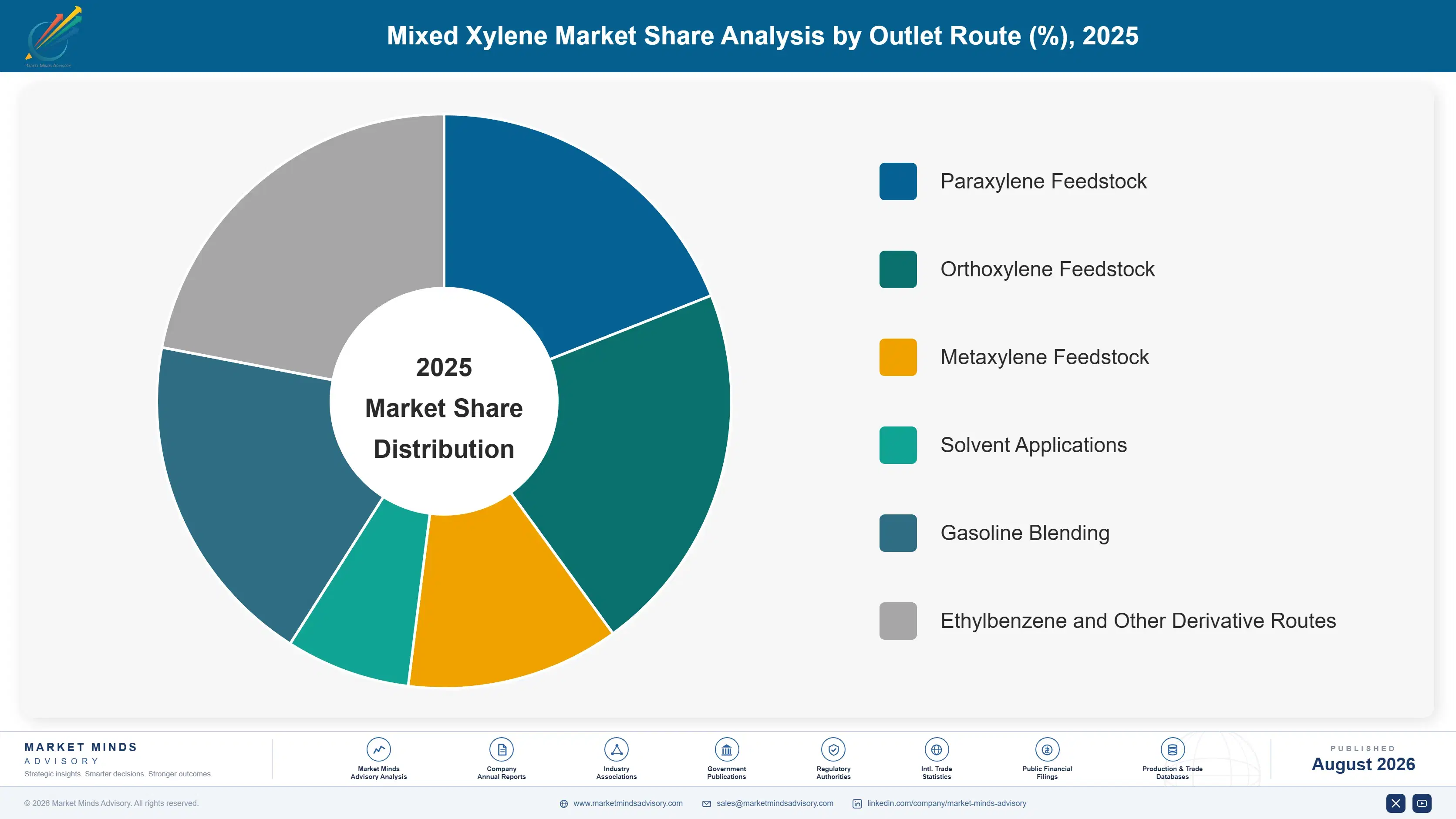
Volume is classified here by outlet route, since that determines the purity required, the price mechanism applying and the demand driver behind each stream. Production technology, producer integration and contract arrangement are handled separately in the framework, because one stream reaches several outlets depending purely on relative pricing. Relative pricing directs the stream between them constantly.
mixed-xylene-market-trends-market-share-analysis-1787555659162

Metaxylene Feedstock

Growing at 5.7%, half again the market rate, metaxylene is the smallest of the three isomers by demand and the fastest growing by a clear margin. Isophthalic acid produced from it modifies bottle resin to improve clarity and processing, and it forms the backbone of unsaturated polyester resins used across construction, marine and automotive composites. Separating metaxylene is technically harder than separating paraxylene, since the isomers boil within a few degrees of each other and adsorptive separation is required rather than crystallisation. That difficulty narrows the producer field considerably and supports pricing the paraxylene route never achieves at any point in a cycle. Very few producers hold it. Capital rather than skill decides it.
CAGR 5.7%

Gasoline Blending

This outlet is what actually prices the market and most petrochemical analysis treats it as a residual. Mixed xylene contributes around 108 research octane to a gasoline pool, which makes it directly valuable to a refiner regardless of chemical demand, and the stream flows toward whichever outlet pays more at any moment. Growth at 4.6% follows developing market gasoline demand while developed market consumption declines with vehicle electrification. The commercially important consequence is that a paraxylene producer competes against the fuel pool rather than against other chemical buyers, which puts a floor under the price that petrochemical fundamentals would not. Petrochemical fundamentals would never support that floor alone. Most analysis treats it as residual.
CAGR 4.6%
Full segment breakdown across 6 segments available in the complete report.

Regional Architecture and Country Demand Map

East Asia holds 32% of value, above the usual band, because polyester manufacture and paraxylene capacity are concentrated there more heavily than in almost any other petrochemical chain. North America follows at 22% on refining scale. Polyester geography decides this map. Nothing else explains the concentration.

East Asia

At 32% this region sits above the usual band ceiling, and the reason is that polyester manufacture and the paraxylene capacity feeding it are concentrated here more heavily than in almost any other petrochemical chain. Chinese integrated complexes took domestic paraxylene self-sufficiency to roughly 96%, which removed the region's largest merchant demand pool and left Korean, Japanese and Taiwanese producers competing for a much smaller market. Those producers built capacity specifically to serve Chinese imports that no longer exist. Growth at 4.8% reflects continued polyester consumption rather than any recovery in the trade flows that vanished. This share sits above the usual ceiling because no other petrochemical chain concentrates its consumption this heavily anywhere in the world.
Share: 32% | CAGR: 4.8% (2026 to 2036)

North America

Refining scale rather than polyester manufacture defines this region, with mixed xylene produced as part of reformate streams that would exist regardless of chemical demand. Gasoline blending is a substantial and frequently preferred outlet given octane value and the size of the domestic fuel pool. Paraxylene and polyester capacity is modest relative to refining output, and much of the aromatics stream is exported or blended rather than converted. Recycled polyester content commitments from brand owners are advancing ahead of any federal requirement. Growth at 3.2% sits below the market average and reflects a market where fuel demand matters more than chemistry does. Fuel demand matters considerably more than chemistry does here.
Share: 22% | CAGR: 3.2% (2026 to 2036)
Regional intelligence for 5 additional markets available in the complete report: Western Europe, South Asia and Pacific, Latin America, Middle East and Africa, Eastern Europe. Contact sales@marketmindsadvisory.com.
mixed-xylene-market-trends-country-cagr-analysis-1787555659673

Where Xylene Margin Actually Sits

Four moves matter in a chain where the largest customer became self-sufficient, feedstock is nearly four fifths of cost and the price is set by gasoline rather than by chemistry. Two are about the outlets that still pay, and two are about integration and pricing discipline. Competing for merchant paraxylene feedstock is not among them.

Price against the gasoline pool, not chemical demand

Mixed xylene contributes around 108 research octane to gasoline, which makes the fuel pool a genuine competing outlet rather than a residual disposal route. Producers pricing against petrochemical demand fundamentals are ignoring the alternative buyer who sets the floor, and chemical customers who understand the arbitrage exploit sellers who do not. Tracking gasoline cracks alongside paraxylene margins and directing volume accordingly captures value that a purely petrochemical view leaves on the table every time fuel markets strengthen. This is basic in trading and remarkably absent in producer commercial planning. Traders do this routinely.
Market Impact: Captures value at a full 108 research octane

Move into metaxylene where separation is difficult

Metaxylene compounds at 5.7% on isophthalic acid demand for bottle resin modification and unsaturated polyester resins, and separating it requires adsorptive technology rather than the crystallisation that serves paraxylene, because the isomers boil within a few degrees of one another. That difficulty narrows the producer field considerably and supports pricing the paraxylene route never achieves at any point in a cycle. Producers holding only paraxylene capability compete in the most contested and lowest margin outlet available. The capital requirement is real and the competitive shelter it buys is genuine. Capital buys genuine shelter.
Market Impact: Enters a segment now compounding at 5.7% annually

Follow polyester capacity to India and Southeast Asia

Chinese self-sufficiency at roughly 96% removed the demand pool that regional producers built capacity to serve, and the remaining growth in paraxylene feedstock consumption sits in India and Southeast Asia where polyester capacity keeps expanding on textile manufacture relocation. Indian growth at 6.4% is the fastest of any country here. Producers still organised around Chinese export demand are serving a customer that has become a competitor. Commercial and logistical positions in the growing markets take time to establish and they are the only genuine demand growth remaining anywhere in this chain.
Market Impact: Serves demand markets now growing at 6.4% annually

Integrate downstream or accept commodity margins

Feedstock accounts for around 79% of production cost, which leaves conversion margin thin enough that feedstock movement passes straight through and no process improvement changes the arithmetic meaningfully. The producers earning acceptable returns in this chain are integrated from refining through to polyester, which is exactly what Chinese complexes built and what removed the merchant market. Standalone conversion is a commodity position with no defensible advantage available. Producers unable to integrate should recognise they are running a spread business and manage it as trading rather than as manufacturing. Manage it as trading instead.
Market Impact: Addresses a 79% feedstock cost dominance problem directly

Who Controls the Margin Pool

Five producers hold 32% of mixed xylene supply, measured on tonnage supplied at producer level, the basis used throughout this section. Concentration matters considerably less here than integration does, since a producer inside a paraxylene and polyester complex never offers a tonne to the merchant market and its capacity is invisible to anybody buying. The gap between leaders and everybody else is downstream integration rather than any production scale or technology advantage. Integration decides everything here.
Competition runs on three dimensions. Integration depth, which decides whether a producer captures derivative margin or sells a commodity stream. Isomer separation capability, particularly for metaxylene where adsorptive technology narrows the field. And logistics position relative to remaining demand growth in India and Southeast Asia. Price competes on the gasoline arbitrage rather than between chemical sellers. Freight position decides the rest.

Rankings shifted permanently when Chinese self-sufficiency removed the largest import demand, which stranded Korean, Japanese and Taiwanese capacity built specifically to serve it. Gulf producers face a similar problem from a different starting point. Indian integrated producers are the clearest beneficiaries of where demand growth actually remains. Indian producers benefit most clearly.
mixed-xylene-market-trends-company-positioning-matrix-1787555660193

Competitive Moat and Risk Dimensions

SINOPEC

Moat: Refining to polyester integration

Sinopec operates integrated positions running from crude through reforming and aromatics into paraxylene and downstream derivatives, which captures margin at every stage rather than selling a commodity stream at the thinnest point. In a chain where feedstock is 79% of conversion cost, integration is the only durable source of return available to anybody.
SINOPEC

Risk: Domestic overcapacity exposure

Chinese paraxylene and polyester capacity was built faster than domestic demand grew, which has produced poor derivative margins across the whole chain and left the country exporting rather than importing. Integration protects against feedstock margin compression and not against derivative oversupply. Producers in growing markets face considerably better utilisation.
RELIANCE INDUSTRIES

Moat: Indian integrated position scale

Reliance operates refining, aromatics and polyester integration at scale within the market holding the fastest remaining demand growth in this chain, which combines the cost advantage of integration with the commercial advantage of location. Indian polyester demand grows at rates no other significant market approaches, and the capacity sits inside it rather than shipping toward it.
RELIANCE INDUSTRIES

Risk: Recycled content displacement ahead

Recycled polyester content requirements are advancing across export markets and brand owner commitments frequently exceed regulatory minimums, which displaces virgin polyester and the paraxylene chain beneath it directly. Domestic Indian demand is less exposed than export volumes. Producers weighted toward markets without recycled content pressure carry less of that particular risk.

Players Tracked

Prominent Players

Sinopec
ExxonMobil
Reliance Industries
SK Innovation
BP

Other Key Players

Chevron Phillips Chemical
TotalEnergies
Shell
Formosa Chemicals
CPC Corporation
S-Oil
GS Caltex
Hanwha TotalEnergies
Idemitsu Kosan
ENEOS Holdings
Hengli Petrochemical
Zhejiang Petrochemical
Indian Oil Corporation
Saudi Aramco
Petro Rabigh

Recent Developments

FEBRUARY 2025

A Korean producer reduced paraxylene operating rates

A Korean aromatics producer reduced paraxylene operating rates citing Chinese self-sufficiency removing the export demand the capacity was built to serve. This was an operating decision rather than any transaction, and it reflects capacity stranded by a customer that became a competitor within a few years.
Signal: Capacity built for Chinese imports has nowhere to go, and rate cuts are the first stage of a longer adjustment
JULY 2025

A brand owner committed to recycled content above regulatory minimums

A global beverage brand owner committed to recycled polyester content in bottle resin exceeding the levels European packaging rules will require, displacing virgin polyester and the paraxylene chain beneath it. This was a corporate commitment rather than any transaction between chemical producers. Regulatory minimums were exceeded deliberately.
Signal: Brand commitments are running ahead of regulation, which pulls the demand displacement timetable forward for everybody upstream
DECEMBER 2025

An Indian producer commissioned additional aromatics separation capacity

An Indian integrated producer commissioned additional aromatics separation capacity serving expanding domestic polyester and derivative demand. This was organic capital investment rather than any partnership or acquisition, and it sits inside the market holding the fastest remaining demand growth in this chain. Domestic demand keeps expanding.
Signal: Investment is following demand growth into India while stranded Asian capacity elsewhere continues seeking outlets that no longer exist

What Moves Producer Cost

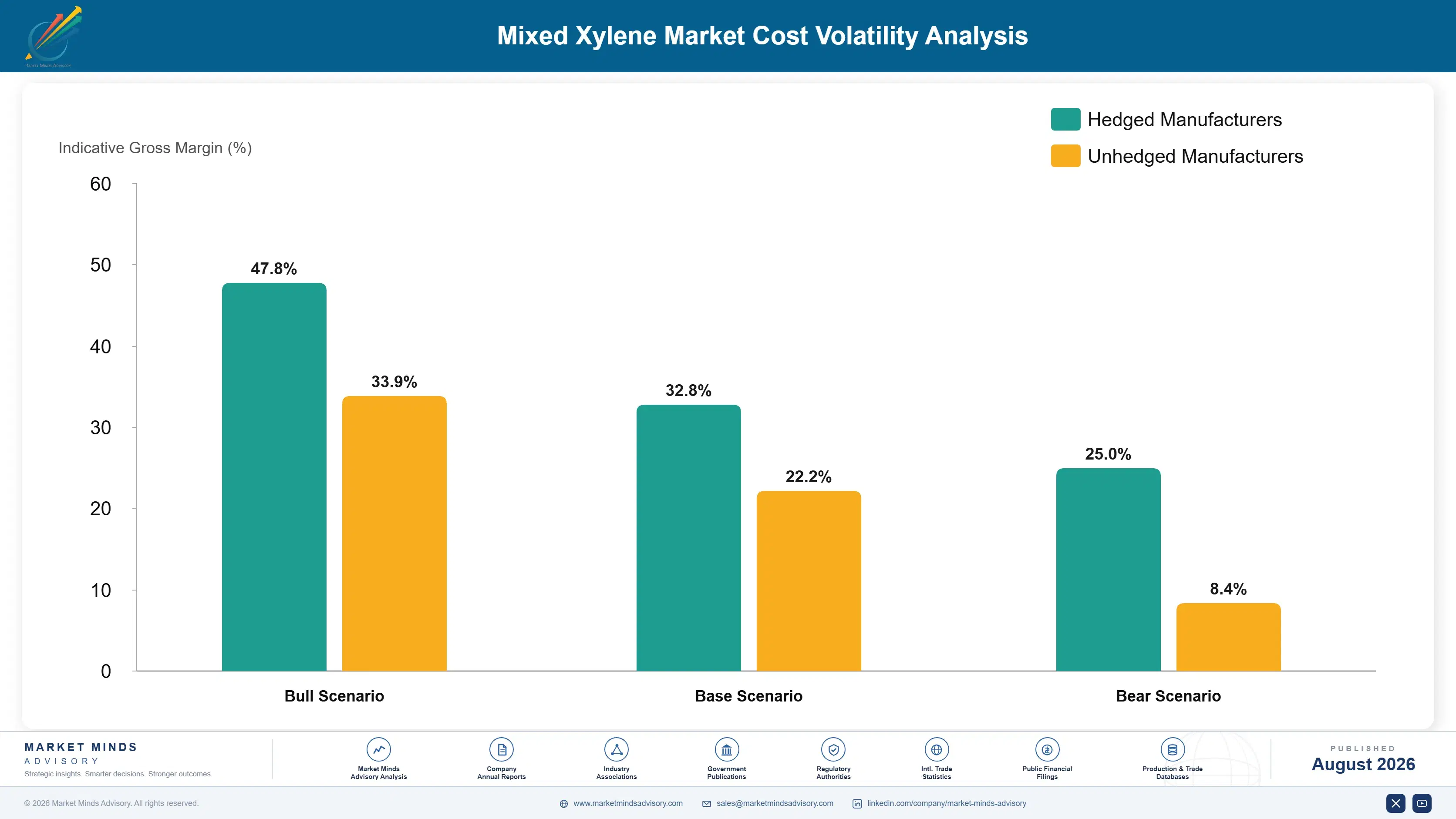
Reformate and pyrolysis gasoline feed accounts for around 79% of production cost, which is unusually high and reflects a separation business adding modest value to a stream refining already produces. Energy for distillation, adsorption and isomerisation makes up most of the remainder. Catalyst and adsorbent replacement is periodic and material. Conversion margin is thin enough that feedstock movement passes almost entirely through.
Crude and naphtha prices moved violently through 2021 and 2022 on supply disruption and demand recovery, and IEA oil market data record the movement across that period. SK Innovation recorded feedstock and margin pressure across its petrochemical operations in its Annual Report 2022. Producers holding term contracts with derivative customers absorbed movement where contract structures lagged spot feedstock, which is common in a chain where formula pricing rarely tracks perfectly.

The gasoline arbitrage is a cost consideration rather than merely a pricing one, which most analysis misses. When fuel cracks strengthen, a refiner's opportunity cost for the aromatics stream rises whether or not any chemical customer wants to pay more, and integrated producers face the same internal choice. Effective feedstock cost for a chemical route therefore moves with gasoline markets, and producers modelling only naphtha miss it.
mixed-xylene-market-trends-cost-volatility-analysis-1787555660388

Model feedstock cost against gasoline opportunity value

The aromatics stream carries 108 research octane and a refiner's opportunity cost rises whenever fuel cracks strengthen, regardless of what any chemical buyer wants to pay for it. Producers modelling only naphtha or crude are missing the variable that sets the real economics. Tracking gasoline cracks alongside petrochemical margins shows when a chemical route stops paying.

Contract catalyst and adsorbent supply across cycles

Adsorbents for isomer separation come from a very small number of qualified suppliers and replacement is periodic, expensive and impossible to defer indefinitely once performance degrades. Contracting across replacement cycles secures availability and pricing that spot purchasing at the point of need never achieves. Discovering a lead time problem during a turnaround costs more than any procurement saving.

Direct volume between chemical and fuel outlets actively

The same stream serves chemical conversion and gasoline blending, and relative value between them moves continuously with fuel cracks and derivative margins. Producers committing volume entirely to one outlet forgo the arbitrage that flexible producers capture routinely. Maintaining the physical and contractual ability to switch costs some contract premium and earns considerably more than it costs across a full cycle.

Portfolio Architecture for Margin Defence

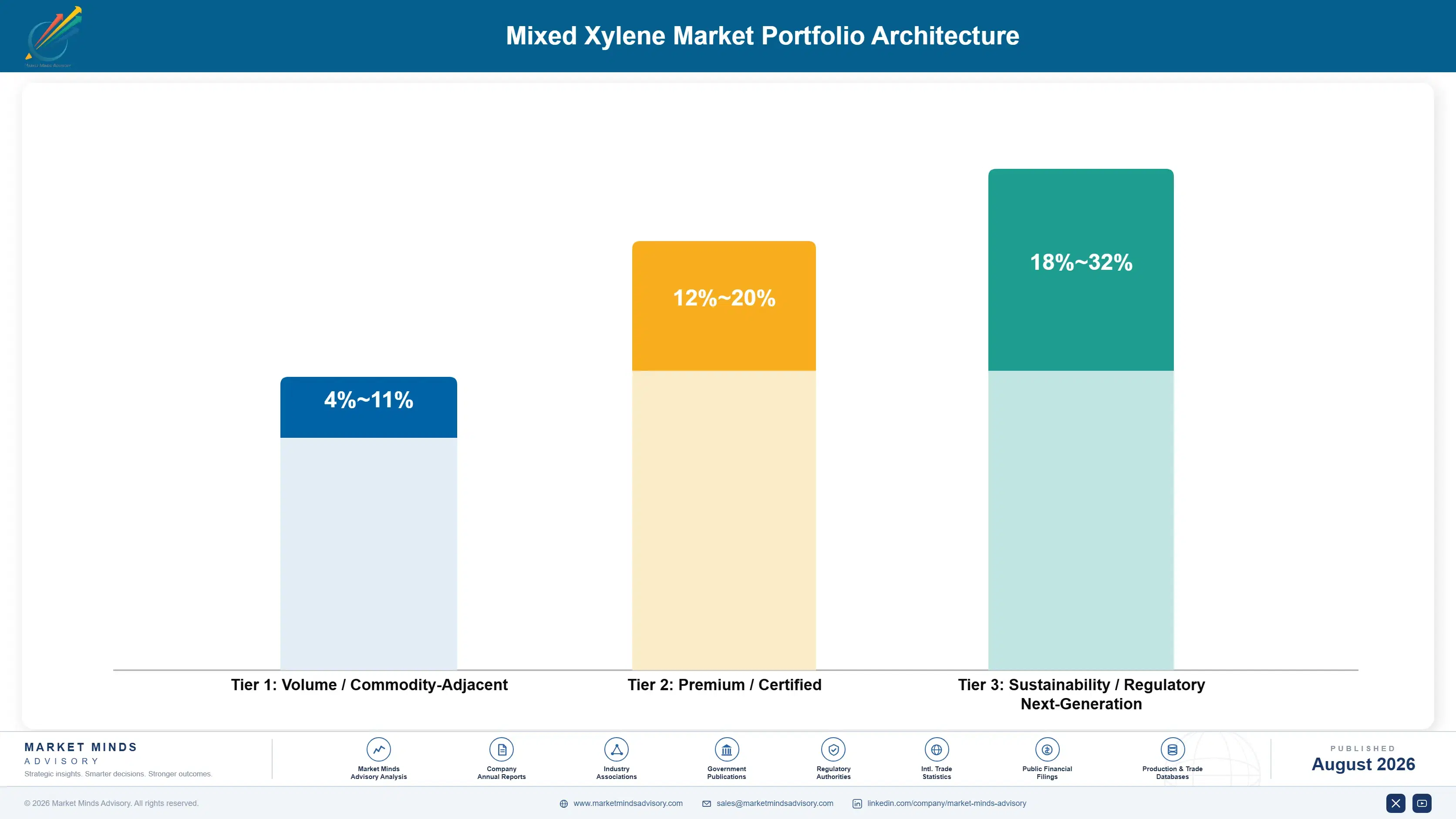
Margin here tracks integration and separation difficulty rather than production scale, because producing mixed xylene is a refining consequence rather than an achievement. Merchant paraxylene feedstock runs at gross margins in the mid single digits against a contested market that Chinese self-sufficiency shrank considerably. Gasoline blending runs better whenever fuel cracks are strong and worse when they are not. Metaxylene and high-purity isomer grades run considerably higher, because adsorptive separation narrows the producer field genuinely.
The tension is that paraxylene feedstock carries the volume while metaxylene and integration carry the returns, and moving between them requires capital that a thin-margin business struggles to fund. Producers stranded by Chinese self-sufficiency face exactly that problem: the returns to reposition are attractive and the cash flow to do it has already been destroyed by the change that made repositioning necessary. That sequencing problem is why capacity sits idle rather than converting.

High-value pools sit in metaxylene separation, downstream integration and flexible outlet direction. None of the three is available to a standalone merchant producer without capital. Production capacity by itself defends nothing where the customer built their own.

Volume / Commodity-Adjacent

Merchant paraxylene and orthoxylene feedstock sold into a market Chinese self-sufficiency shrank substantially, competing on delivered cost alone. The seven-point range separates producers with feedstock integration from those buying reformate at market on thin conversion spreads.
Gross Margin: 4%-11%

Premium / Certified

Gasoline blending supply and solvent grades where octane value or specification purity provides an alternative to petrochemical outlets. The eight-point spread reflects flexibility, since producers able to direct volume between outlets capture arbitrage that committed producers cannot.
Gross Margin: 12%-20%

Sustainability / Regulatory / Next-Generation

Metaxylene separation, high-purity isomer grades and integrated derivative positions. The fourteen-point range is wide because adsorptive separation capability and downstream integration both create positions that capital rather than operating skill establishes.
Gross Margin: 18%-32%
mixed-xylene-market-trends-portfolio-architecture-1787555660885

High-value Sub-segments and Strategic Watch-out

Metaxylene Separation Capability

Compounding at 5.7% on isophthalic acid for bottle resin and unsaturated polyester, and defended by adsorptive separation that boiling point differences make genuinely difficult. Very few producers hold the capability at all. Capital rather than skill establishes the position, which makes timing the whole question.
Gross Margin: 20%-32%

Outlet Direction Flexibility

The same stream serves chemistry and gasoline at 108 octane, and relative value moves continuously with fuel cracks. Producers committed entirely to one outlet forgo arbitrage that flexible producers capture as routine. Contractual and physical switching ability costs a premium and earns considerably more. Flexibility pays here.
Gross Margin: 14%-24%

Merchant Paraxylene Feedstock

The volume that Chinese self-sufficiency at 96% shrank permanently, leaving stranded Asian capacity competing for a much smaller pool. Manage for utilisation and feedstock cost, because margin recovery is not coming. Stranded capacity has nowhere obvious left to go at all. Margin recovery is not coming back to it.
Gross Margin: 4%-11%

Indian Demand Positioning

Indian polyester capacity growth at 6.4% is where genuine demand expansion remains in this chain, and producers organised around Chinese export flows are serving a competitor instead of a customer. Serving a competitor instead of a customer is a poor commercial arrangement. Positions there take years to establish properly.
Gross Margin: 10%-20%

How Xylene Demand Renews

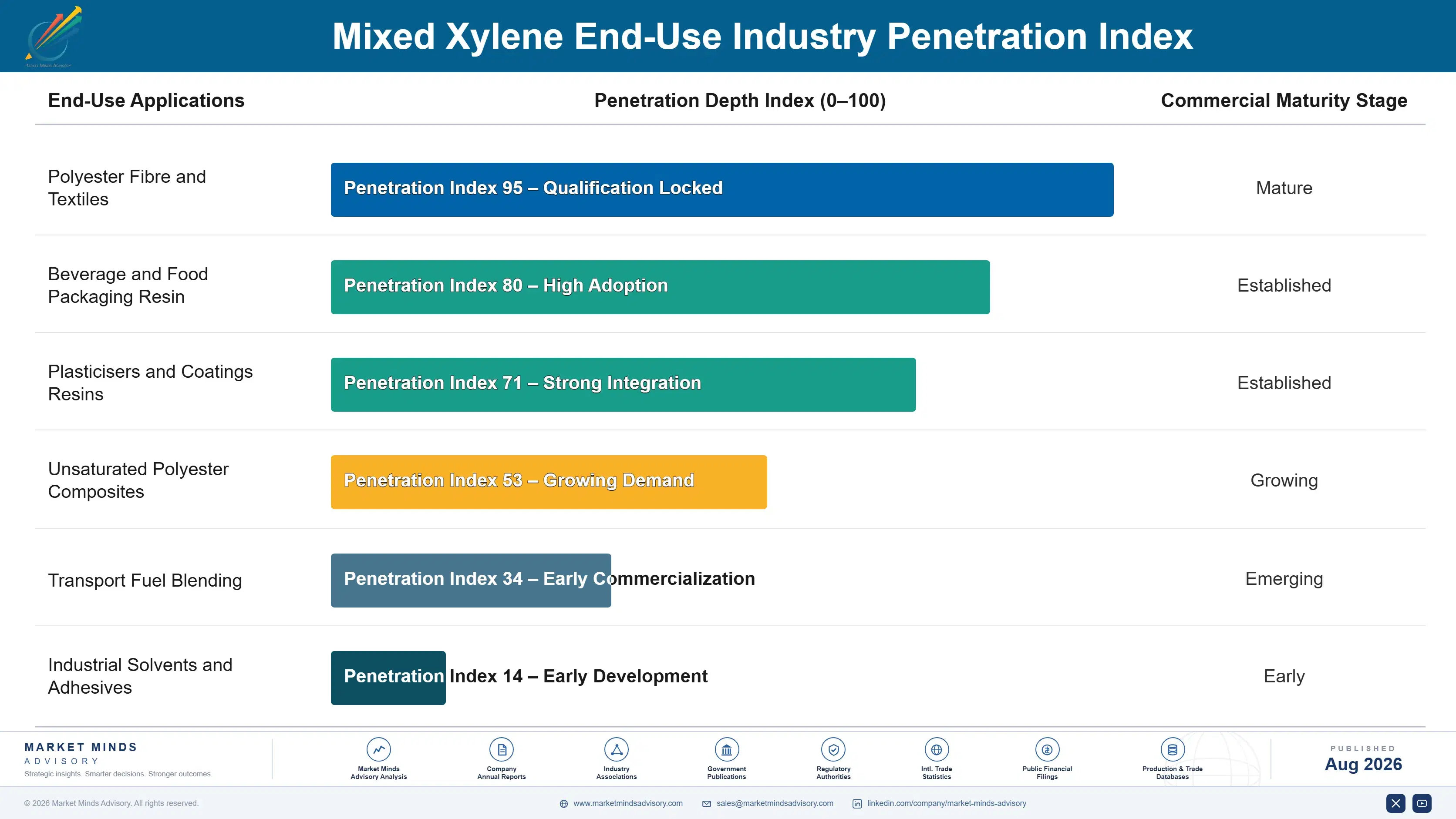
Demand renews continuously against derivative plant operating rates rather than through any purchasing decision. A paraxylene unit consumes mixed xylene every hour it runs and stops entirely when margins close it, which makes demand binary at the plant level and smooth only in aggregate. Contracts renew annually on formula pricing referencing published assessments. Nobody chooses a supplier for any reason but delivered cost.
Stickiness is close to absent and everybody involved understands that. Mixed xylene is a specification commodity where one producer's tonne is identical to another's, and the only genuine differentiation is delivered cost including freight. Integrated producers have removed themselves from the question by consuming internally. What passes for stickiness is logistics, since a plant configured around a particular supply route does not readily switch origins.

The buyer has consolidated into the seller across much of this chain, which is the most important architectural change in twenty years. Chinese complexes that were the largest customers now produce their own, and the merchant market that remains is smaller, more contested and populated by non-integrated buyers with worse economics than the integrated producers they compete against.
mixed-xylene-market-trends-end-use-penetration-index-1787555661376

Where To Place The Bet

These are among the four positions where our research anticipates prominent divergence between winners and laggards over the coming forecast period. Each is grounded in the demand model, the regulatory perimeter, and the announced capacity pipeline.
01 / ARBITRAGE PRICING DISCIPLINE

Track gasoline cracks, not polyester margins

Mixed xylene contributes around 108 research octane to a gasoline pool, which makes the fuel pool a genuine competing outlet rather than any residual disposal route for surplus material. Producers pricing against petrochemical demand fundamentals are ignoring the alternative buyer who actually sets the floor, and chemical customers who understand the arbitrage properly exploit sellers who do not. Tracking gasoline cracks alongside derivative margins and directing volume accordingly captures value that a purely petrochemical view surrenders every time fuel markets strengthen.
02 / SEPARATION CAPABILITY INVESTMENT

Go where the isomers are hard to separate

Metaxylene compounds at 5.7% on isophthalic acid demand for bottle resin modification and unsaturated polyester resins across construction, marine and automotive composites. Separating it requires adsorptive technology rather than the crystallisation serving paraxylene, because the isomers boil within a few degrees of each other and simple distillation cannot resolve them. That technical difficulty narrows the producer field considerably and supports pricing the paraxylene route never achieves at any point in a cycle, which is exactly why the capital is worth committing.
03 / DEMAND GEOGRAPHY REPOSITIONING

Follow polyester to India and Southeast Asia

Chinese paraxylene self-sufficiency at roughly 96% eliminated the demand pool that Korean, Japanese and Taiwanese producers built capacity specifically to serve, and that capacity now competes for a substantially smaller market with nowhere obvious to go. The remaining genuine growth in paraxylene feedstock consumption sits in India and Southeast Asia, where polyester capacity keeps expanding as textile manufacture relocates for labour and trade reasons. Indian growth at 6.4% is the fastest anywhere, and commercial positions there take years to establish properly.
04 / INTEGRATION OR TRADING CHOICE

Integrate downstream or run it as trading

Reformate feed accounts for around 79% of production cost, which leaves conversion margin thin enough that feedstock movement passes almost entirely through and no process improvement changes that arithmetic meaningfully at all. The producers earning acceptable returns across this chain are integrated from refining through to polyester, which is precisely what Chinese complexes built and what removed the merchant market everybody else served. Producers unable to integrate should recognise they run a spread business and manage it as trading rather than as manufacturing.

Engagement Snapshot From the Field

A live engagement with an industry participant carrying material or product regulatory and market exposure ahead of a defining policy shift, showing how our research translates into a defensible multi-year portfolio strategy.
MARKET MINDS ADVISORY · CLIENT ENGAGEMENT SUMMARY
Mixed Xylene Producer Strategic Portfolio Review and Transition Roadmap 2026·Investment Scenario on Mixed Xylene Exposure Evaluation 2025-26
CLIENT PROFILE
An Asian aromatics producer with annual revenue around USD 1.4 billion (client-reported, unverified by MMA), operating reforming and paraxylene capacity built substantially to serve Chinese import demand. Downstream integration ended at paraxylene with no polyester position. Gasoline blending was treated as a disposal route rather than a commercial outlet. Metaxylene separation capability was absent. Outlet flexibility was never valued.
STRATEGIC CHALLENGE
Utilisation had fallen sharply as Chinese self-sufficiency removed export demand (client-reported, unverified by MMA), and management proposed further operating rate reductions to match a shrinking market. Nobody had assessed whether alternative outlets or products could use the capacity, which made the proposal a managed decline rather than any commercial response.
MMA APPROACH
MMA assessed the client's stream against every available outlet rather than accepting paraxylene as the only route, valuing gasoline blending on octane contribution and modelling metaxylene separation investment against isophthalic acid demand. Indian and Southeast Asian demand growth was mapped against the client's logistics position. Integration options were evaluated against available capital.
KEY FINDINGS
  1. Gasoline blending had been valued as disposal rather than at octane contribution, which understated the outlet substantially whenever fuel cracks strengthened during the period reviewed.
  2. Metaxylene separation investment showed acceptable returns against isophthalic acid demand growth, and no regional competitor currently held the capability at any meaningful scale.
  3. Indian and Southeast Asian polyester demand growth was reachable from the client's location on freight terms competitive with domestic supply, and had never been commercially targeted.
  4. Downstream polyester integration required capital the client could not raise given current earnings, which removed the option that would otherwise have been most attractive.
CLIENT PROFILE
An Asian aromatics producer with annual revenue around USD 1.4 billion (client-reported, unverified by MMA), operating reforming and paraxylene capacity built substantially to serve Chinese import demand. Downstream integration ended at paraxylene with no polyester position. Gasoline blending was treated as a disposal route rather than a commercial outlet. Metaxylene separation capability was absent. Outlet flexibility was never valued.
STRATEGIC CHALLENGE
Utilisation had fallen sharply as Chinese self-sufficiency removed export demand (client-reported, unverified by MMA), and management proposed further operating rate reductions to match a shrinking market. Nobody had assessed whether alternative outlets or products could use the capacity, which made the proposal a managed decline rather than any commercial response.
MMA APPROACH
MMA assessed the client's stream against every available outlet rather than accepting paraxylene as the only route, valuing gasoline blending on octane contribution and modelling metaxylene separation investment against isophthalic acid demand. Indian and Southeast Asian demand growth was mapped against the client's logistics position. Integration options were evaluated against available capital.
KEY FINDINGS
  1. Gasoline blending had been valued as disposal rather than at octane contribution, which understated the outlet substantially whenever fuel cracks strengthened during the period reviewed.
  2. Metaxylene separation investment showed acceptable returns against isophthalic acid demand growth, and no regional competitor currently held the capability at any meaningful scale.
  3. Indian and Southeast Asian polyester demand growth was reachable from the client's location on freight terms competitive with domestic supply, and had never been commercially targeted.
  4. Downstream polyester integration required capital the client could not raise given current earnings, which removed the option that would otherwise have been most attractive.
RECOMMENDED STRATEGY
Phase 1: Phase one: reprice gasoline blending at octane contribution and direct volume actively between outlets rather than treating fuel as disposal. Phase 2: Phase two: commit capital to metaxylene separation capacity, targeting isophthalic acid demand where no regional competitor currently holds meaningful capability. Phase 3: Phase three: build commercial and logistics positions into Indian and Southeast Asian polyester demand rather than awaiting a Chinese recovery.
OUTCOME
Gasoline outlet repricing improved realised margins immediately without any volume change. Metaxylene separation investment is approved with commissioning expected in 2028. Indian commercial positions are established with two customers, and the client reports utilisation recovering (client-reported, unverified by MMA). Chinese demand never returned at all.

Frequently Asked Questions

Foundational context covering the market sizes, CAGR, scope, country, region and competition that inform every finding below. This section is provided to cover basics and most often pre-purchase conversations, answered from the MMA Primary Research Dataset.

What is the current size of the Mixed Xylene Market?

The market was valued at USD 34.8 billion in 2025, rising to an estimated USD 36.12 billion in 2026. East Asia holds the largest regional share at 32% of value.

How large will the Mixed Xylene Market be by 2036?

MMA forecasts USD 52.45 billion by 2036 under the base case, an expansion multiple of 1.45 times the 2026 value. That represents USD 16.33 billion of incremental value.

What is the CAGR for the Mixed Xylene Market 2026 to 2036?

The base case runs at 3.8% compound annual growth between 2026 and 2036, with a bull case at 5.0% and a bear case at 2.6%. Historical growth from 2020 to 2025 was 3.0%.

Which segment is growing fastest?

Metaxylene feedstock leads at 5.7%, half again the market rate, on isophthalic acid for bottle resin and unsaturated polyester composites. Gasoline blending follows at 4.6%.

Who are the major companies in the Mixed Xylene Market?

Sinopec, ExxonMobil, Reliance Industries, SK Innovation and BP hold 32% of global supply between them. Downstream integration rather than any production scale sustains those positions.

Which country is growing fastest?

India leads at 6.4%, driven by polyester and purified terephthalic acid capacity expanding on domestic textile demand and on export manufacture that keeps growing steadily.

Report Segmentation Architecture

The full report scope spans multiple orthogonal segmentation dimensions, with cross-tabulated demand data provided for each dimension pair. Coverage extends further to regional breakdowns, trend trajectories, and the competitive detail needed to support segment-level decision-making.

By Outlet Route

  • Paraxylene Feedstock
  • Orthoxylene Feedstock
  • Metaxylene Feedstock
  • Solvent Applications
  • Gasoline Blending
  • Ethylbenzene and Other Derivative Routes

By End-Use Industry

  • Polyester Fibre and Textiles
  • Beverage and Food Packaging Resin
  • Plasticisers and Coatings Resins
  • Unsaturated Polyester Composites
  • Transport Fuel Blending
  • Industrial Solvents and Adhesives

By Contract Arrangement

  • Integrated Internal Transfer
  • Term Formula Contract
  • Spot Cargo Trading
  • Refinery Blending Allocation
  • Toll Conversion Arrangement

By Region

  • North America
  • Western Europe
  • East Asia
  • South Asia and Pacific
  • Latin America
  • Middle East and Africa
  • Eastern Europe

Scope, Methodology, and Coverage

Every figure in this report is reproducible from documented input assumptions. The scope below maps the historical period, the forecast horizon, the segmentation dimensions, and the countries covered, alongside the underlying primary and qualitative methodology.
Historical Period
2020 to 2025
Forecast Period
2026 to 2036
Base Year
2025 (USD billions; MMA Primary Research Dataset, August 2026)
Market Definition
The market comprises mixed xylene supplied from catalytic reforming and pyrolysis gasoline streams for onward conversion and direct use across polyester, packaging, coatings, composites, fuel and solvent applications, covering paraxylene feedstock, orthoxylene feedstock, metaxylene feedstock, solvent applications, gasoline blending, and ethylbenzene and other derivative routes. Value is measured at producer level on tonnage supplied through integrated, term, spot and blending channels. Separated pure isomers sold as finished products, purified terephthalic acid and downstream polyester, benzene and toluene streams, and refinery gasoline blending operations fall outside scope.
Quantitative Units
USD billions (current prices); million tonnes supplied annually; USD per tonne by outlet route
Segmentation Dimensions
By Outlet Route; By End-Use Industry; By Contract Arrangement; By Region
Regions Covered
North America, Western Europe, East Asia, South Asia and Pacific, Latin America, Middle East and Africa, Eastern Europe
Countries Covered
China, South Korea, Japan, Taiwan, Singapore, India, Thailand, Indonesia, Vietnam, Malaysia, United States, Canada, Mexico, Netherlands, Belgium, Germany, France, United Kingdom, Spain, Italy, Poland, Hungary, Romania, Czechia, Brazil, Argentina, Colombia, Saudi Arabia, United Arab Emirates, South Africa
Key Companies Profiled
Sinopec, ExxonMobil, Reliance Industries, SK Innovation, BP, Chevron Phillips Chemical, TotalEnergies, Shell, Formosa Chemicals, CPC Corporation, S-Oil, GS Caltex, Hanwha TotalEnergies, Idemitsu Kosan, ENEOS Holdings, Hengli Petrochemical, Zhejiang Petrochemical, Indian Oil Corporation, Saudi Aramco, Petro Rabigh
Quantitative Methodology
Primary survey, n=3,800 respondents, Q4 2025, six countries; demand-side model with trade association cross-validation
Qualitative Methodology
47 expert interviews, Q4 2025; applied to validate demand model assumptions, identify emerging dynamics, and assess competitive positioning
Report Format
PDF and XLSX data workbook (Word format preview document)
Publisher
Market Minds Advisory
Report Code
MMA-2026-CHM-668
Published
August 2026
Contact
sales@marketmindsadvisory.com | www.marketmindsadvisory.com

Purchase the full Mixed Xylene Market Report (2026 to 2036).

The full report sizes the global mixed xylene market to 2036 across six outlet routes and seven regions, measured on tonnage supplied at producer level. It prices the stream against gasoline blending alongside chemical conversion, since octane value rather than petrochemical demand sets the floor that most analysis omits entirely. Competitive analysis covers 20 participants evaluated on tonnage supplied, with moat and risk assessment for the two leaders. Chinese self-sufficiency is quantified as a permanent removal of merchant demand rather than a cyclical shift. Four quantified revenue levers close the analysis.
Six-route segment sizing with segment-level growth rates
Seven-region share and growth breakdown to 2036
Twenty-participant competitive map on one tonnage basis
Gasoline blending valued at octane contribution against chemical outlets
Chinese self-sufficiency quantified as permanent merchant demand removal
Four quantified revenue levers with commercial impact ranges

Built For The People Who Decide

From boardroom strategy to bench-side execution, this report is read cover-to-cover by leaders shaping the next decade of their industry, turning demand scenarios, market dynamics and valuation benchmarks into decisions.
CXOs/ Presidents/ VPs/ Managers
M&A and Corporate Development
Strategy Teams and R&D Heads
Procurement and Product Directors
Regulatory and Compliance Leaders
Investor Relations and Equity Analysts