Market Minds Advisory
Mini Refrigerator Market

Mini Refrigerator Market: Mini Refrigerator Market. Smart Connectivity Redraws Compact Appliance Economics.

Appliance manufacturers are expanding smart-connected and dual-zone mini refrigerator lineups as compact living trends and dorm culture push compact cooling demand beyond traditional single-function beverage coolers. Retailers are reassessing category strategy.

Lead Analyst

Published

September 2026

Make Smarter Decisions with Customized Research Insights

Request a free sample report and evaluate market opportunities, growth trends, and competitive dynamics relevant to your business needs.

2025 MARKET VALUE$5.8BMarket Size 2025
2036 FORECAST VALUE$11.6BBase Case , 2026 to 2036
CAGR 2026 TO 20366.5 %Bull 7.7% / Bear 5.3%
INCREMENTAL OPPORTUNITY$5.4BNet 10- year value creation
EXPANSION MULTIPLE1.88x2036 value over 2026 base
Strategic Levers
M&A Pipeline
Regional Outlook
Country Rankings
Competitive Intelligence
Segmental Deep-dive
Call-Us : 91 93563 13602

Executive Snapshot and Market Trajectory.

Appliance manufacturers are expanding smart-connected and dual-zone mini refrigerator lineups as compact living trends and dorm culture push compact cooling demand beyond traditional single-function coolers. Manufacturers are responding accordingly across most segments. Legacy single-function coolers are responding accordingly across most retail categories. Momentum continues broadly. Investment continues.
Smart connected mini refrigerators are absorbing the fastest-growing share of new product launches as manufacturers pursue app-based temperature control and inventory tracking beyond basic cooling functionality. China concentrates the largest share of new manufacturing demand, driven by expanding domestic compact living and dorm culture adoption. Compressor-based mini refrigerators remain a steady revenue base given their entrenched position across mass retail appliance shelves. Growth continues.
Competitive intensity centers on five established manufacturers holding well under half the market between them, leaving considerable share fragmented among specialist niche and direct-to-consumer entrants. Rising steel and refrigerant cost pressure and tightening energy efficiency regulation are reshaping design criteria across nearly every major retailer currently renegotiating supplier contracts. Several manufacturers are also renegotiating multi-year exclusivity terms to secure better shelf placement. Several manufacturers are expanding joint manufacturing partnerships to secure better steel pricing terms.
Market Definition
This report covers compact refrigeration appliances under 4.5 cubic feet marketed for dorm, office, bar, and secondary household cooling use, including compressor-based, thermoelectric, and smart-connected formats. It excludes full-size household refrigerators and commercial-grade beverage display coolers.
Base Year Value
$5.8B in 2025 (MMA Primary Research Dataset, August 2026)
Forecast Period
2026 to 2036, eleven discrete annual values
CAGR
6.5% base case. Bull 7.7%. Bear 5.3%.
Fastest Growth Segment
Smart Connected Mini Refrigerators: 11.0% CAGR
Fastest Growth Country
China: 9.0% CAGR
Fastest Growth Region
South Asia and Pacific: 8.5% CAGR
Largest Region
East Asia: 30% of 2025 global value
Market Leaders
Haier, Midea Group, Whirlpool Corporation, Danby Products, Igloo Products Corp. Source: MMA Primary Research Dataset, July 2026.
Primary Survey
n=3,800 procurement and R&D decision-makers, Q4 2025, six countries
Methodology
Demand-side build-up, cross-validated against public data, 47 expert interviews

Mini Refrigerator Market Forecast Scenarios

mini-refrigerator-market-size-forecast-scenario-1788165072952
Mini refrigerator revenue grew at an estimated 5.7 percent historical pace between 2020 and 2025, accelerating as compact living and dorm culture expanded category visibility across mainstream retail channels. Growth broadened further once smart-connected models entered mainstream distribution. Several manufacturers also expanded dedicated shelf space. These retailers are speeding new product line reviews considerably across the category.
The base case assumes 6.5 percent annual growth through 2036, driven by three commercial mechanisms. First, smart-connected model investment is accelerating as manufacturers pursue app-based temperature control beyond basic cooling functionality. Second, dual-zone and multi-compartment formats are scaling rapidly as consumers pursue versatile storage over single-function coolers. Third, growing compact living infrastructure expansion requires steady manufacturing investment, adding a durable baseline of contract revenue that persists regardless of near-term retail cycle fluctuations.
The bull case centers on faster-than-expected smart-connected adoption pulling forward category growth across multiple retail channels simultaneously. The bear case centers on prolonged steel and refrigerant cost pressure limiting discretionary product innovation spending, which could meaningfully slow revenue growth across the newest premium smart launches specifically. Either scenario depends on how quickly manufacturers commit to smart-connected adoption industrywide across the category.

Smart Connectivity Redraws Compact Appliance Economics

The mini refrigerator industry sits at a point where compact living demand and appliance connectivity expectations are colliding with a smart technology transition. App-connected models displacing basic single-function coolers is the single largest determinant of how manufacturer innovation budgets are being reallocated across nearly every major product line today, reshaping long-held retail relationships. Manufacturers that misjudge this reallocation risk outdated single-function-only assumptions.
MARKET CONCENTRATION (CR5)42%Top five manufacturers hold well under half combined
AVERAGE PRODUCT DEVELOPMENT CYCLE16 monthsTypical duration required from concept to retail launch
SMART CONNECTED REVENUE SHARE23%Total category revenue currently derived from app-connected models
DUAL-ZONE ADOPTION RATE31%New product launches currently featuring dual-zone compartment designs
TOP PRODUCING COUNTRY SHARE34%China share of global mini refrigerator manufacturing output
STEEL COST SHARE33%Steel and refrigerant compressor input cost portion of expense
Beneath the smart connectivity story, the industry is absorbing genuine versatility demand. Manufacturers increasingly demand dual-zone and multi-compartment designs that serve varied storage needs, letting product teams plan portfolio expansion around predictable consumer preference windows rather than reactive single-purpose redesigns. Manufacturers slower to offer comparable versatility risk losing shelf renewals to rivals already demonstrating proven storage flexibility. Manufacturers increasingly build storage flexibility into new product proposals.
Distribution economics are shifting too. Direct-to-consumer niche brands are steadily capturing retail volume that traditional mass appliance chains once claimed by default, particularly on premium segments nearing the end of exclusive multi-year distribution agreements. Manufacturers offering more competitive online partnership structures are converting this competitive pressure into genuine multi-year contract wins across multiple retail relationships. This favors manufacturers who invested early in online partnerships.
"Every manufacturer now pitches smart features, but the ones actually winning repeat purchases are the ones who can prove reliable cooling performance, not just a flashy app interface."
Director, Consumer Appliances Practice · MMA Construction and Industrial Equipment Practice · August 2026

Market Trends

Smart Connected Models Displace Basic Manual Controls

Manufacturers are increasingly launching app-connected mini refrigerators rather than exclusively relying on basic manual temperature dial controls, reflecting genuine convenience and monitoring gains that manual-only formats cannot easily match given rising consumer expectations for connected home appliances. Haier and Midea have both expanded dedicated smart connectivity programmes specifically to meet rising consumer demand, recognizing that shoppers increasingly specify app control as a standard purchase consideration rather than an optional feature across new product launches. Retailers increasingly build connectivity requirements into listing specifications, converting a cost center into a competitive differentiator for well-positioned manufacturers.
Market Impact: Adds 6% category adoption demand growth
Dual-Zone Storage Design Gains Retail Priority

Manufacturers are increasingly designing dual-zone and multi-compartment mini refrigerators rather than exclusively relying on single-temperature storage formats, since versatile compartments meaningfully improve storage flexibility relative to traditional single-zone products facing rising consumer demand for varied storage. Whirlpool has used its dual-zone design expertise to expand retail listings meaningfully, while manufacturers without comparable capability risk losing shelf space to better-positioned rivals. Retailers increasingly build versatility requirements directly into new product listing specifications and category reviews. Retailers increasingly build versatility compliance into category review requirements, converting a design obligation into a competitive priority across major listing decisions.
Market Impact: Adds 4% efficiency-driven demand growth

Market Opportunities and Growth Drivers

Expanding Compact Living Drives Category Adoption

Growing compact living and dorm culture adoption continues driving steady category demand, directly increasing available revenue for both smart-connected model expansion and expanded manufacturing investment across major markets. This adoption growth is particularly pronounced among younger consumers rapidly normalizing small-space living arrangements, creating durable new demand that extends well beyond typical replacement-cycle patterns these consumers historically followed. Manufacturers with strong existing retail relationships in this fast-expanding market are capturing this durable demand more efficiently than competitors entering later in the cycle. This durable demand base gives manufacturers meaningful revenue planning confidence across most retail formats currently available.
Market Impact: Cuts margins by 3 points

Rising Energy Efficiency Standards Accelerate Redesign

Regulators are increasingly enforcing tightening energy efficiency standards that mandate improved compressor performance, directly increasing manufacturer demand for redesigned cooling technology investment across expanding product categories. This preference represents genuine incremental demand beyond typical replacement-cycle procurement patterns, since manufacturers are actively specifying efficiency-optimized components in new product designs rather than simply tolerating legacy compressor standards at prior tolerance levels. Manufacturers with strong engineering capability are capturing this durable preference more efficiently than competitors relying purely on legacy design channels. Manufacturers increasingly build efficiency guarantees directly into new product proposals and retailer selection criteria across most product tiers.
Market Impact: Delays international launch by 5 months

Market Restraints and Challenges

Rising Steel Cost Limits Margin Expansion Broadly

Many smaller manufacturers continue struggling to absorb rising steel and refrigerant compressor costs fast enough to preserve margin at competitive retail price points, creating genuine cost bottlenecks that extend product repricing timelines considerably beyond original targets. The root cause is genuine supply chain complexity in sourcing consistent quality steel across a concentrated global supplier base facing simultaneous demand from multiple appliance categories. The commercial impact pressures manufacturers to renegotiate retail pricing more frequently than retailers prefer. Manufacturers are mitigating this through expanded steel hedging and multi-supplier sourcing programmes currently underway.
Market Impact: Lifts connected share to 23%

Fragmented Energy Standards Complicate Global Expansion

Manufacturers continue struggling to reconcile fragmented national energy efficiency standards fast enough to support genuine cross-border retail expansion, creating genuine compliance bottlenecks that extend international launch timelines considerably beyond original service targets. The root cause is genuine institutional complexity in harmonizing efficiency frameworks across a fragmented national regulatory base facing simultaneous pressure from retailer efficiency demands and consumer protection mandates alike. Manufacturers are mitigating this through expanded regulatory compliance partnerships and standardized certification programmes currently underway. Manufacturers unable to close this compliance gap risk ceding international opportunities to better-aligned competitors.
Market Impact: Lifts dual-zone adoption rate to 31%
4 additional market trends, 3 additional growth drivers, and 3 additional restraints and challenges are covered in the full report. Contact sales@marketmindsadvisory.com to access the complete intelligence.

Segment CAGR and Growth Architecture

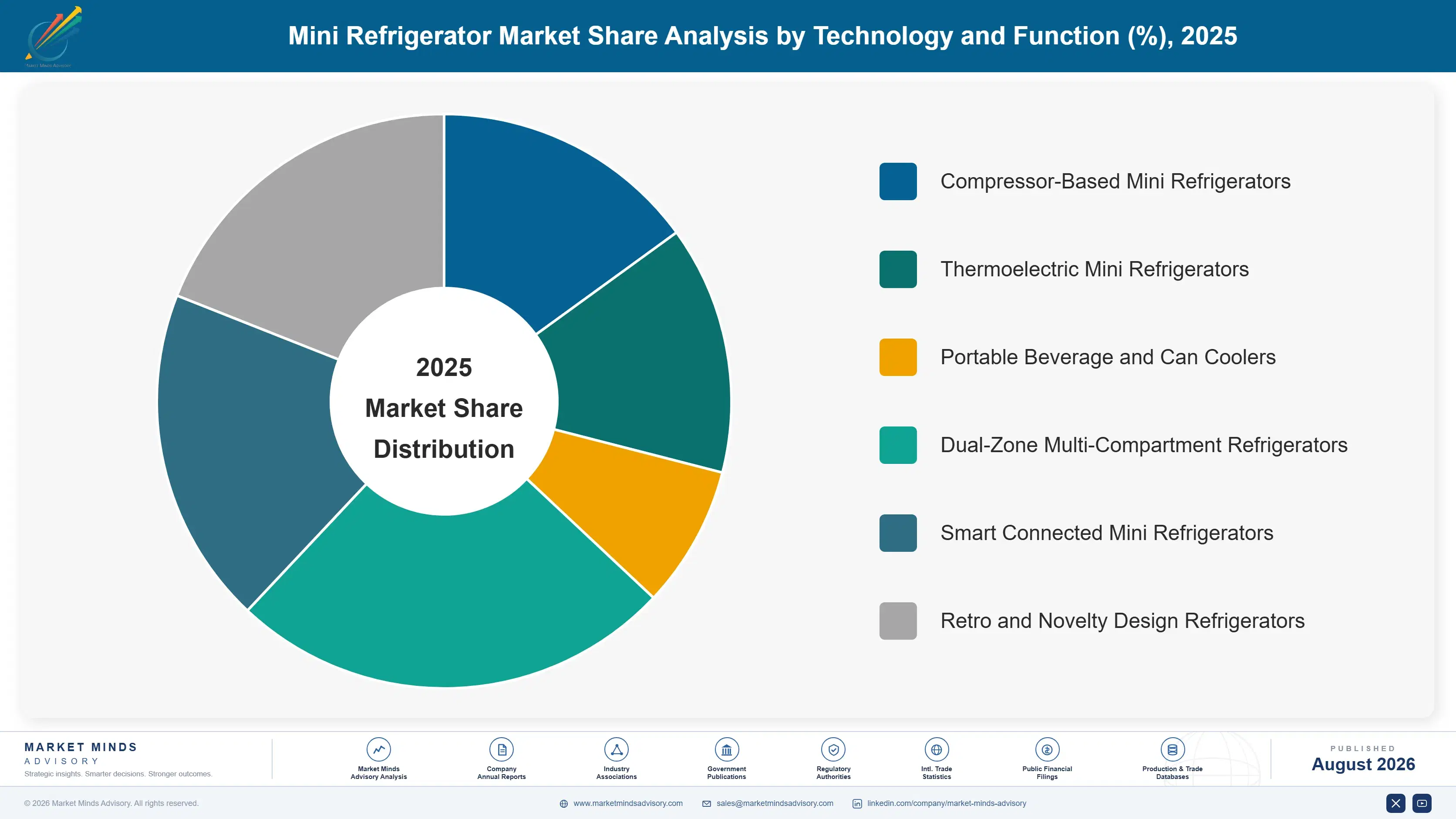
The mini refrigerator market segments most usefully by technology and function, spanning compressor-based, thermoelectric, portable beverage, dual-zone, smart-connected, and retro design categories, rather than by capacity size or retail channel alone. This lens keeps upstream cooling technology distinct from downstream connectivity and design functions consistently across every category and appliance size. This approach applies broadly.
mini-refrigerator-market-market-share-analysis-1788165073509

Smart Connected Mini Refrigerators

Smart connected mini refrigerators are growing fastest, expanding at roughly 1.69 times the market's overall pace as consumers increasingly specify app-based temperature control and inventory tracking to fit connected smart-home networks. Haier and Midea have both expanded dedicated smart connectivity programmes specifically to compete for this growing product category, recognizing that consumers increasingly demand connected functionality rather than basic manual controls alone. This segment particularly benefits manufacturers with strong software engineering capability, since legacy manual-only offerings carry an increasingly unfavorable convenience profile against newer connected designs. Manufacturers without demonstrated connectivity capability risk losing this category to better-positioned rivals. Consumers increasingly treat connected functionality as a core purchase criterion across most demographic segments.
CAGR 11.0%

Dual-Zone and Multi-Compartment Mini Refrigerators

Dual-zone and multi-compartment mini refrigerators form the second-fastest growing segment, propelled by consumers pursuing versatile storage that pairs beverage cooling with food storage in a single compact unit. Whirlpool and Danby Products have both expanded dedicated dual-zone production specifically to capture this growing category, recognizing that consumers increasingly demand storage versatility as a standard specification. Manufacturers with strong existing design credibility track records are capturing disproportionate share of this expanding category, since consumers increasingly demand demonstrated reliability before committing to premium multi-compartment purchases. Manufacturers without demonstrated capability risk losing this category to better-proven competitors. Consumers increasingly treat storage versatility as a baseline premium requirement rather than an optional feature. Momentum builds accordingly.
CAGR 9.0%
Full segment breakdown across 6 segments available in the complete report.

Regional Architecture and Country Demand Map

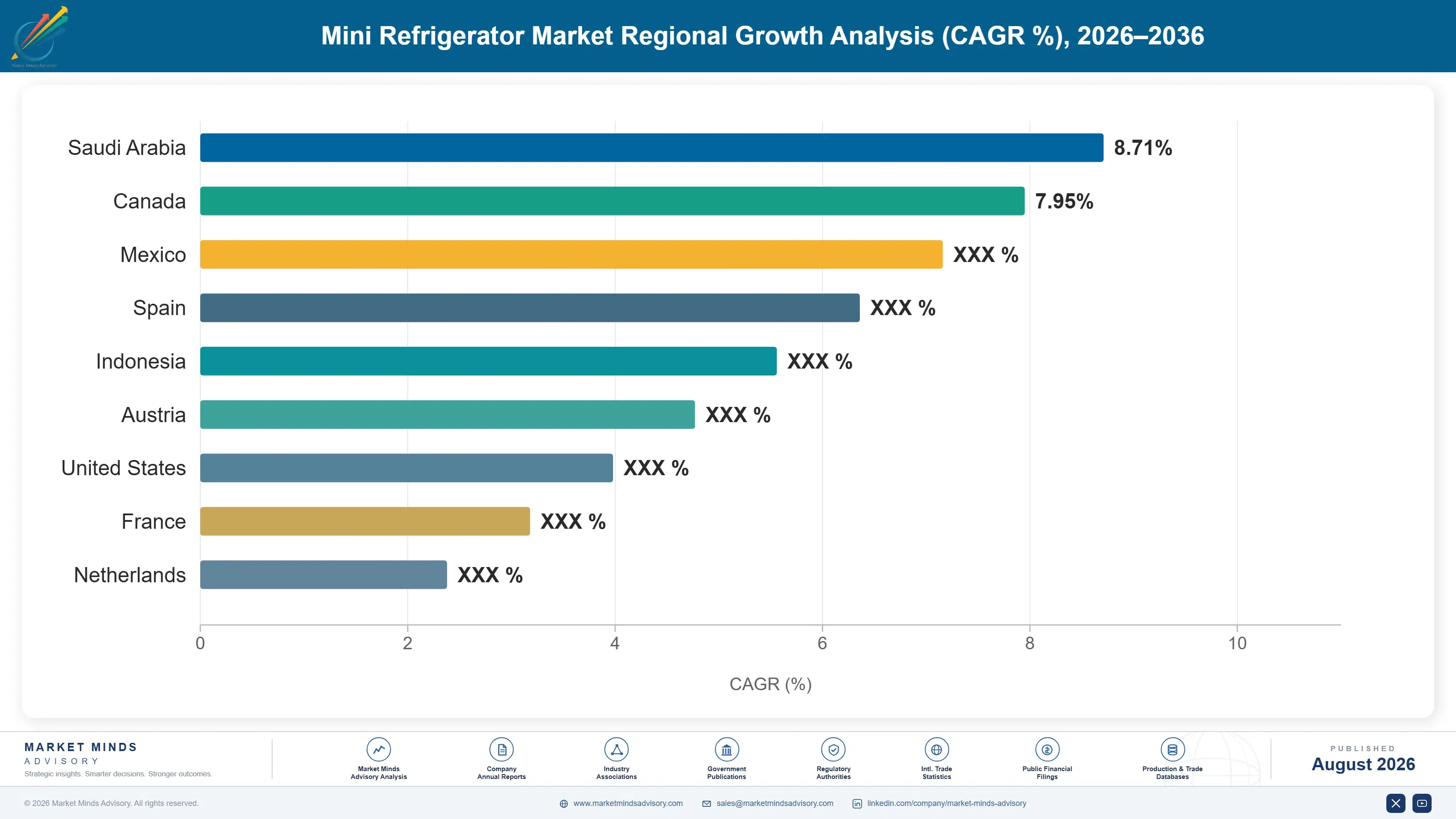
East Asia holds the largest regional share, reflecting China's dominant compact appliance manufacturing base and rising domestic compact living adoption. North America and Western Europe follow given established retail infrastructure. South Asia and Pacific shows the fastest growth given rising urbanization trends across the region overall.

East Asia

East Asia leads with a 30% share, reflecting China's dominant compact appliance manufacturing infrastructure and rapidly expanding domestic compact living and dorm culture adoption. Haier and Midea dominate regional production given their headquarters presence and established manufacturing relationships across multiple retail categories simultaneously. Japan and South Korea contribute meaningful additional volume through established consumer electronics traditions. The region's growth rate sits modestly above the global average, reflecting continued manufacturing investment and rising domestic demand across multiple regional markets simultaneously. No other region approaches this scale of combined manufacturing depth and consumer adoption. Regional manufacturers also benefit from proximity to expanding domestic steel and compressor supply chains supporting faster production timelines.
Share: 30% | CAGR: 7.5% (2026 to 2036)

North America

North America holds a substantial 26% share, reflecting the region's dense concentration of established appliance retailers and dorm culture demand across the United States and Canada. Whirlpool and Danby Products dominate domestic retail given decades-long incumbent relationships with major appliance and mass retail chains. Canada contributes meaningfully smaller but genuine volume through regional retail operations. The region's growth rate sits close to the global average, reflecting continued category growth even as smart-connected adoption expands across multiple retail channels simultaneously. No other region approaches this scale of combined retail infrastructure and brand depth. Digital-native niche brand startups also continue attracting significant venture investment supporting rapid national expansion. This scale compounds over time.
Share: 26% | CAGR: 6.5% (2026 to 2036)
Regional intelligence for 5 additional markets available in the complete report: Western Europe, South Asia and Pacific, Latin America, Middle East and Africa, Eastern Europe. Contact sales@marketmindsadvisory.com.
mini-refrigerator-market-country-cagr-analysis-1788165074036

Winning Share In A Connectivity-First Category

Revenue growth for mini refrigerator manufacturers increasingly depends on winning share in a connectivity-first product mix, since consumers increasingly favor smart-connected and dual-zone designs alongside traditional single-function coolers across most purchase categories. Manufacturers that recognize this dynamic early are repositioning product strategies around connectivity rather than legacy single-function sales alone. Product roadmaps are adapting fast.

Building Proprietary App Connectivity Platforms Early

Manufacturers that built proprietary app connectivity platforms ahead of competitors are capturing retail listings that manual-only entrants would otherwise claim entirely. Haier's connectivity platform has reportedly grown retail listings 17 to 22 percent faster than its manual-only competitors over the past several years. This approach converts a former competitive vulnerability into a genuine strategic priority for manufacturers willing to invest in software engineering talent early. Manufacturers without comparable capability increasingly cede this expanding category to earlier-moving specialists building comparable connectivity depth today. Retailers increasingly treat this connectivity as a baseline expectation.
Market Impact: Grows listings 17 to 22 percent faster overall

Embedding Dual-Zone Design Into Standard Product Lines

Manufacturers that systematically embedded dual-zone design into standard product lines are capturing disproportionate share of new customer acquisition ahead of competitors offering only single-zone alternatives. Whirlpool's dual-zone models reportedly win 15 to 19 percent more new customers than comparable offerings lacking embedded versatility features. Manufacturers without comparable design capability increasingly cede these versatility-driven purchase competitions to better-instrumented rivals over time as consumers demand embedded versatility across nearly every new product launch. Regional retailers increasingly cite versatility depth as a decisive factor in listing decisions, further reinforcing this competitive advantage across upcoming category review cycles.
Market Impact: Wins 15 to 19 percent more customers annually

Expanding Direct-To-Consumer Distribution Infrastructure Ahead Fast

Manufacturers that expanded direct-to-consumer distribution infrastructure ahead of competitors are capturing disproportionate share of urgent consumer demand that constrained legacy retail-only distribution otherwise cannot fulfill quickly. Early movers reportedly capture 13 to 17 percent more retail volume than competitors relying purely on legacy retail-only sales alone. This capability increasingly determines which manufacturers win the largest long-term customer relationships as consumers seek convenience over marginal cost savings across their purchase decisions. Consumers increasingly favor manufacturers offering guaranteed convenience over those competing purely on initial price alone across the full range of purchase decisions.
Market Impact: Captures 13 to 17 percent more volume overall

Securing Long-Term Steel Supplier Agreements Early

Manufacturers that secured long-term steel supplier agreements are capturing cost stability that spot-market-only competitors otherwise cannot access at all. Midea's supplier partnership has reportedly expanded its addressable production capacity by 12 to 16 percent among premium component categories facing tighter supply constraints. This approach converts a former cost volatility barrier into a genuine revenue opportunity for manufacturers willing to build supplier partnership infrastructure early across the full range of manufacturing categories. Smaller manufacturers increasingly cite supply access as a decisive factor when comparing otherwise similar supplier proposals. Retention rates improve accordingly.
Market Impact: Expands addressable capacity 12 to 16 percent overall

Who Controls the Margin Pool

The mini refrigerator market is moderately concentrated, with a CR5 of 42 percent on a revenue basis held across Haier, Midea Group, Whirlpool Corporation, Danby Products, and Igloo Products Corp. Haier and Midea lead given their broad manufacturing portfolios spanning compressor-based, smart-connected, and dual-zone categories, while independent niche challengers compete on niche design and direct-to-consumer capability specifically.
Current competitive activity centers on smart connectivity investment, dual-zone design expansion, and direct-to-consumer infrastructure investment. Manufacturers are also racing to secure long-term retail contracts as consumers increasingly prioritize demonstrated reliability over unproven legacy alternatives. Manufacturers are also expanding joint development partnerships with regional distributors specifically to secure early market access on new product category launches. This coordination reflects mounting pressure to demonstrate category-wide reach.

Emerging pressure comes from two directions. Specialist smart-connectivity entrants are expanding aggressively into purchase competitions previously dominated by legacy manual-only suppliers, while independent design makers could reshape competitive rankings if single-zone-only incumbents unable to match versatility positioning lose ground to nimbler, better-differentiated competitors. Manufacturers unable to demonstrate reliable cooling performance risk losing customer confidence entirely, ceding future purchase opportunities to competitors with stronger track records.
mini-refrigerator-market-company-positioning-matrix-1788165074557

Competitive Moat and Risk Dimensions

HAIER

Moat: Broadest Manufacturing Scale Depth

Haier benefits from the broadest compact appliance manufacturing scale among manufacturers, spanning compressor-based, smart-connected, and dual-zone categories simultaneously, giving it cross-selling advantages and product diversification that narrower competitors cannot easily replicate. Competitors concentrated in a single format category struggle to match this comprehensive retail relationship depth.
HAIER

Risk: Legacy Manual-Only Margin Pressure

Haier's revenue remains partly concentrated in legacy manual-only categories facing margin pressure from smart-connected-only entrants, making it disproportionately exposed to pricing competition relative to pure-connectivity competitors with lighter manufacturing cost structures. Extended pricing pressure could meaningfully compress overall segment profitability over time. This dynamic could compress overall growth.
MIDEA GROUP

Moat: Deepest Global Distribution Network

Midea Group benefits from extensive global distribution and manufacturing experience across its diversified appliance portfolio, giving it demonstrated operational credibility that competitors relying purely on regional distribution cannot easily replicate. This documented track record gives Midea a durable advantage in global tender competitions against manufacturers offering only regionally limited alternatives.
MIDEA GROUP

Risk: Steel Cost Sensitivity Exposure

Midea Group's manufacturing costs remain heavily exposed to volatile steel and refrigerant compressor pricing, making it disproportionately vulnerable to raw material cost swings relative to competitors with more diversified sourcing structures. Extended cost volatility can meaningfully compress overall segment margins and near-term profitability. Diversification investment remains a strategic priority.

Players Tracked

Prominent Players

Haier
Midea Group
Whirlpool Corporation
Danby Products
Igloo Products Corp

Other Key Players

Cooluli
hOmeLabs
Frigidaire
GE Appliances
Black+Decker
Emerson Radio
Magic Chef
Avanti Products
Costway
NewAir
Ivation
Chefman
Galanz
Koolatron
Whynter

Recent Developments

MARCH 2026

Haier Expands Smart Connectivity Platform Capacity

Haier expanded its smart connectivity software engineering capacity, adding new development resources specifically targeting the growing app-connected category as retailers increasingly specify connected functionality on new listing agreements. The expansion reflects growing confidence that ceding this category entirely risks permanent loss of future retail revenue. Analysts welcomed the platform investment.
Signal: Signals leading manufacturers are now directly and actively responding to connectivity competitive pressure more broadly today
JANUARY 2026

Whirlpool Launches Expanded Dual-Zone Product Line

Whirlpool launched a new expanded dual-zone product line, formally offering consumers versatile storage compartments across multiple capacity categories to differentiate against single-zone competitors. The launch reflects growing industry recognition that design versatility increasingly determines retail outcomes across the sector. Retailers welcomed the expanded range. Consumers welcomed the expanded range.
Signal: Signals manufacturers are now formally packaging versatility for competitive advantage across every category overall across every category
OCTOBER 2025

Midea Signs Long-Term Steel Supplier Agreement

Midea signed a long-term steel supplier agreement covering multiple manufacturing categories, reflecting the company's continued position as a leading compact appliance provider across premium retail categories. The agreement reinforces Midea's position as one of the most entrenched manufacturers in the broader industry. Analysts noted the agreement's scale.
Signal: Signals leading manufacturers are now continuing to lock in long-term material contracts across the whole industry

Steel And Compressor Cost Exposure

Steel and refrigerant compressors together represent the largest cost input for mini refrigerator manufacturers, running roughly 33 percent of production cost combined. Steel is sourced predominantly from a small number of qualified regional mills, while compressors increasingly depend on concentrated specialty component manufacturing supply chains. Both inputs carry meaningful geographic concentration risk for manufacturers lacking diversified supplier relationships, particularly across global regions.
The clearest recent volatility event was the 2022 to 2023 steel price spike affecting appliance manufacturers broadly, which extended margin compression meaningfully across the sector during the period. Several manufacturers' 2025 annual reports disclosed materially higher steel procurement costs during this period, attributing much of the increase directly to competition for constrained mill capacity amid simultaneously rising construction and appliance demand. Manufacturers with diversified supplier relationships weathered this spike meaningfully better than those dependent on single sources alone.

The competitive disadvantage mechanism falls disproportionately on smaller manufacturers without long-term steel agreements, since they must compete for constrained steel and compressor capacity at spot market pricing rather than locked-in contract rates. This exposure varies by manufacturer scale too, since larger incumbents with multi-year steel agreements secured meaningfully more favorable terms than smaller competitors purchasing at smaller volumes.
mini-refrigerator-market-cost-volatility-analysis-1788165074752

Securing Multi-Year Steel Supply Agreements

Larger manufacturers are securing multi-year steel supply agreements directly with qualified regional mills, locking in predictable pricing and delivery priority that insulates production costs from short-term spot market volatility while guaranteeing mills stable long-term commitments in return. Smaller manufacturers without comparable scale struggle to secure similar terms. This has already meaningfully improved cost predictability for several major manufacturers.

Diversifying Compressor Sourcing Across Suppliers

Manufacturers are diversifying compressor sourcing across multiple qualified component manufacturers spanning different geographic regions, reducing dependence on any single source following recent shortages and building redundancy into critical supply chains going forward. Manufacturers lacking this redundancy remain exposed to sudden component shortfalls. This diversification has proven valuable for manufacturers navigating recent shortages more smoothly overall.

Investing In Modular Compressor Design Standards

Some manufacturers are investing in modular compressor design standards that allow component substitution across supplier options, reducing manufacturer exposure to single-source shortages while maintaining sufficient production flexibility for demanding product categories over time. Several manufacturers report meaningful progress toward deploying these design standards across their broader product lines. Retailers have broadly welcomed this efficiency approach.

Portfolio Architecture for Margin Defence

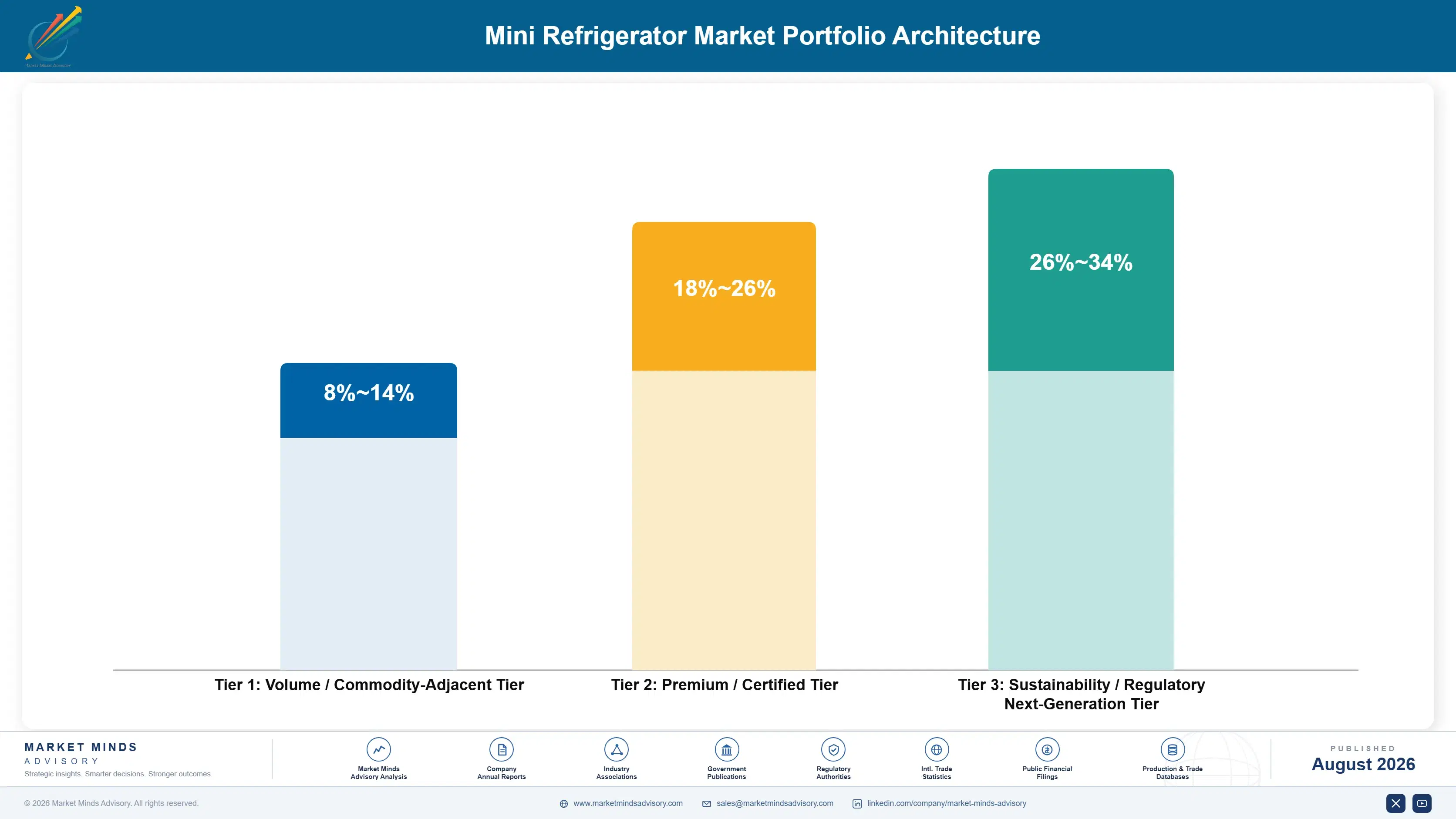
Mini refrigerator portfolios span three distinct economic tiers separated primarily by connectivity sophistication and consumer commitment depth rather than capacity size alone. Standard legacy manual-only formats sold on competitive rate alone carry thinner margins as retailer bargaining power intensifies. Manufacturers competing purely on unit price in this tier face shrinking margins as competitive tender processes increasingly commoditize basic format delivery.
Certified and premium tiers, including smart-connected and dual-zone designs, command materially better economics because they require demonstrated engineering credibility and specialized software access competitors cannot replicate quickly. The highest value pool concentrates in direct-to-consumer premium relationships, where genuine advantage through design depth and relationship strength drives the industry's widest margins. Manufacturers building this expertise early are converting former commodity positioning into a durable, defensible competitive position.

Volume-tier legacy format sales remain necessary for maintaining overall installed base and consumer acquisition funnel, even though margin contribution lags behind premium and next-generation tiers substantially, creating an ongoing tension between defending broad market presence and reallocating investment toward higher-margin connected products. The manufacturers managing this balance most effectively will likely define industry leadership over the next several product cycles.

Volume / Commodity-Adjacent Tier

Standard legacy manual-only formats sold primarily on unit price, with limited differentiation beyond capacity. Margins compress further as competitive tender processes commoditize basic format delivery. Manufacturers here focus primarily on cost efficiency and production scale.
Gross Margin: 8-14%

Premium / Certified Tier

Smart-connected and dual-zone designs requiring demonstrated engineering credibility smaller competitors struggle to replicate quickly. These products carry lower price sensitivity given embedded relationships. These systems carry lower price sensitivity given embedded design trust and certification.
Gross Margin: 18-26%

Sustainability / Regulatory / Next-Generation Tier

Direct-to-consumer premium relationships with exclusive terms commanding the industry's highest margins through genuine design differentiation. Manufacturers investing here early are building capability competitors will struggle to replicate quickly. This tier increasingly defines long-term industry leadership positioning.
Gross Margin: 26-34%
mini-refrigerator-market-portfolio-architecture-1788165075249

High-value Sub-segments and Strategic Watch-out

Smart Connected With Subscription Bundles

Smart-connected models bundled with maintenance subscription programmes combine strong margin economics with the fastest growth in the market, converting a former competitive vulnerability into a genuine durable revenue opportunity for well-positioned manufacturers. Manufacturers still focused purely on manual controls risk missing this increasingly lucrative bundled opportunity.
Gross Margin: 22-30%

Direct-To-Consumer Premium Relationships

Direct-to-consumer premium relationships pair solid margins with strong growth from expanding niche budgets, offering a dependable combination without the volatility risk carried by pure retail-only sales. Early movers building this documentation are establishing trust later competitors will struggle to displace quickly. Early movers gain a lasting advantage.
Gross Margin: 18-26%

Standard Manual-Only Format Volume

Standard manual-only formats remain the volume core of the industry, generating dependable long-term revenue even as margins stay compressed by intensifying competition for routine mass retail placement. Manufacturers should defend this base carefully even while shifting investment toward higher-margin connected products. Volume alone no longer secures leadership.
Gross Margin: 10-16%

Manufacturers Without Digital Complement

Legacy manufacturers without a clear digital connectivity complement represent the industry's clearest strategic watch-out, since convenience pressure is steadily proving manual-only strategies are not commercially defensible without modernization investment. Manufacturers should modernize quickly rather than assume manual-only positioning remains commercially viable indefinitely. Investment here should accelerate over coming product cycles.
Gross Margin: 6-12%

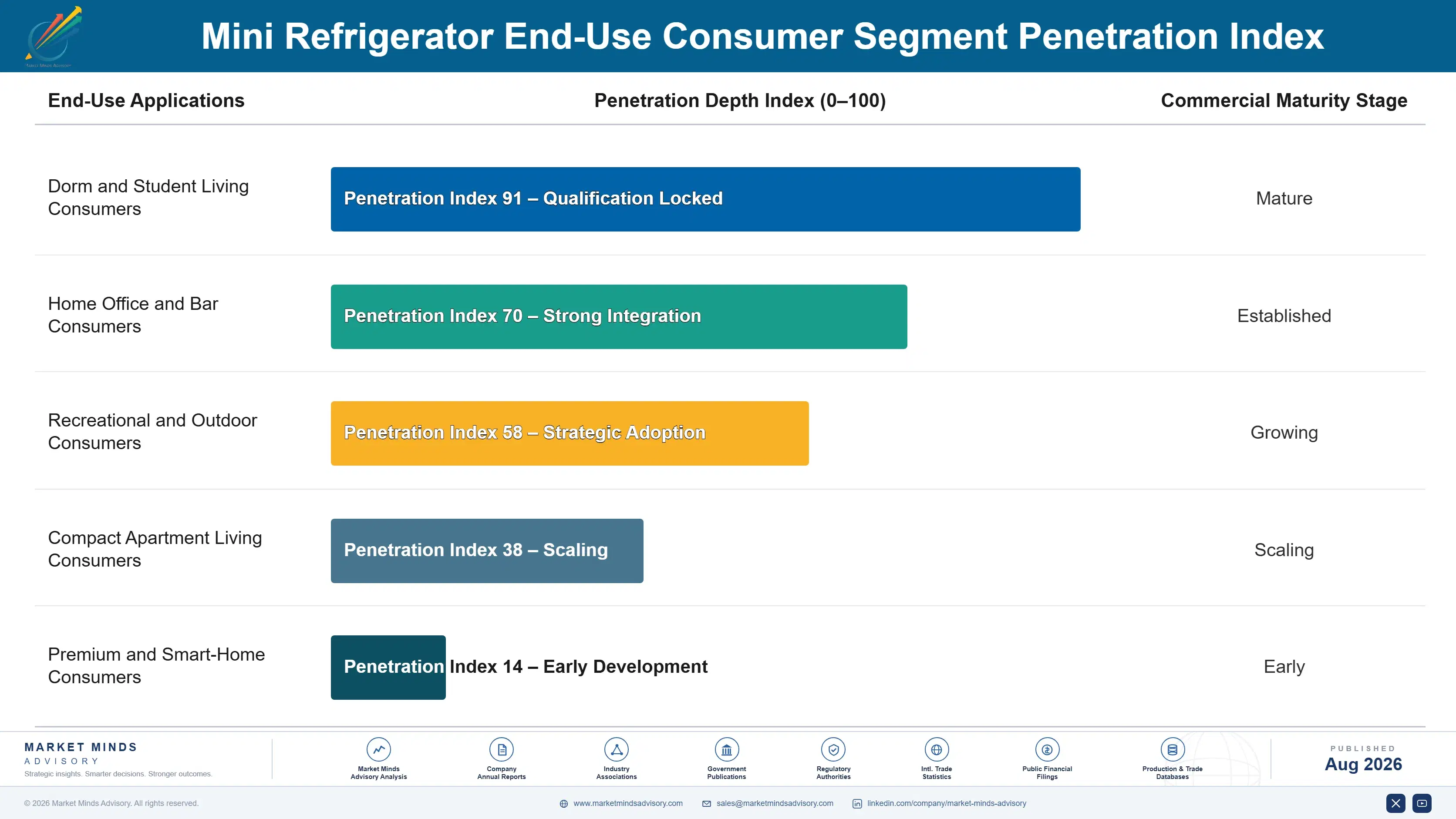
Replacement-Anchored Recurring Appliance Demand

Mini refrigerator demand carries strong annuity characteristics because ongoing appliance lifecycle replacement and scheduled upgrade intervals generate predictable recurring purchase and accessory revenue once a consumer relationship is established, giving established manufacturers unusually stable recurring revenue streams tied to specialized brand loyalty and connected platform preferences that competitors cannot easily replicate. Manufacturers benefit from this loyalty especially once specialized customer service infrastructure is established locally.
Stickiness varies meaningfully by end-use vertical, though. Established repeat consumer relationships show the deepest retention since switching manufacturers requires trialing new connected platforms and adjusting design preferences, while emerging first-time buyers show comparatively shallower loyalty, actively comparing competing offers including price, connectivity, and design versatility before committing to a specific manufacturer relationship. First-time consumers also show meaningfully more price sensitivity before switching costs meaningfully increase over subsequent replacement cycles.

A generational buyer shift is also underway. Younger consumer segments increasingly prioritize connected platform flexibility and demonstrated design versatility over the purely brand-recognition metrics that dominated purchase decisions for prior generations of appliance buyers. Manufacturers slow to build comparable digital-native and versatility-driven capability risk losing favor with this newer generation of customer decision-makers.
mini-refrigerator-market-end-use-penetration-index-1788165075736

Where Manufacturers Should Invest Next

These are among the four positions where our research anticipates prominent divergence between winners and laggards over the coming forecast period. Each is grounded in the demand model, the regulatory perimeter, and the announced capacity pipeline.
01 / SMART CONNECTIVITY INVESTMENT

Build proprietary app platforms before specialists claim the category

Smart connectivity platforms are capturing retail listings that manual-only manufacturers cannot easily defend, and the manufacturers moving first with dedicated software investment are locking in loyalty that later entrants will struggle to unwind across multiple consumer segments and long-term subscription relationships spanning the category. Haier already shows meaningfully faster listing growth through its connectivity platform than through manual-only competitors, reflecting genuine convenience advantages consumers increasingly demand. Manufacturers without a credible connectivity roadmap by 2028 risk permanent share loss to better-instrumented rivals already building comparable software depth today.
02 / DUAL-ZONE DESIGN RELIABILITY

Prioritize demonstrated versatility over marginal price competition

Consumers increasingly select manufacturers based on documented storage versatility rather than purely on unit price, making design flexibility a genuine differentiator rather than a background specification detail buried in routine product listings. Manufacturers that can prove reliable dual-zone temperature control are winning multi-year retail contracts that competitors relying purely on price cutting cannot easily match or replicate quickly. This shift rewards sustained design discipline over aggressive short-term price competition, and it is reshaping how retailers evaluate long-term manufacturer relationships overall.
03 / STEEL COST HEDGING STRATEGY

Secure multi-year material agreements ahead of the next volatility cycle

Steel and compressors together account for roughly 33 percent of production cost, and manufacturers without locked-in supply agreements remain exposed to spot market spikes that erode already thin operating margins considerably across the category. The 2022 to 2023 volatility event demonstrated how quickly unhedged manufacturers can lose ground to better-prepared competitors holding multi-year steel agreements with qualified regional mills and processors. Securing multi-year agreements now protects margin through the next inevitable price cycle, while also improving delivery priority for demanding retail customers.
04 / PREMIUM PLATFORM MONETIZATION

Systematize connected accessory bundles across the entire product line

Connected platforms convert previously transactional retail sales into meaningful recurring accessory revenue, and Haier has already demonstrated the scale of advantage available to manufacturers running mature connectivity platforms across diverse consumer customer segments spanning the category. Competitors relying on one-time retail sales are leaving measurable revenue on the table every single purchase cycle, ceding this expanding category to better-instrumented rivals building deeper customer relationships. Building this capability now positions manufacturers well ahead of the next wave of connectivity-driven customer demand entering the broader market.

Engagement Snapshot From the Field

A live engagement with an industry participant carrying material or product regulatory and market exposure ahead of a defining policy shift, showing how our research translates into a defensible multi-year portfolio strategy.
MARKET MINDS ADVISORY · CLIENT ENGAGEMENT SUMMARY
Mini Refrigerator Producer Strategic Portfolio Review and Transition Roadmap 2026·Investment Scenario on Mini Refrigerator Exposure Evaluation 2025-26
CLIENT PROFILE
The client is a mid-sized North American appliance retailer managing a mini refrigerator product line sourced primarily from legacy manual-only manufacturers sold through mass retail channels. The retailer had grown steadily through incremental shelf space expansion but lacked a formal smart-connectivity sourcing strategy, leaving it exposed to competitive pressure from retailers offering app-connected differentiation. Regional competition had intensified.
STRATEGIC CHALLENGE
Management needed to determine whether to pivot sourcing toward smart-connected manufacturers immediately or phase the transition over several buying cycles, while also facing pressure to modernize product mix to meet rising consumer connectivity expectations without overextending procurement budgets during a period of elevated steel costs. The board also wanted clarity on peer retailer sequencing before committing capital.
MMA APPROACH
MMA conducted structured interviews with the retailer's category and procurement teams and benchmarked connectivity sourcing economics against four comparable regional retailers, drawing on primary survey data and expert interviews. The engagement modeled sourcing scenarios against projected consumer adoption and steel cost trajectories. Findings were validated against manufacturer annual report disclosures to ground recommendations in verifiable industry benchmarks.
KEY FINDINGS
  1. The client's manual-only product mix showed measurably lower conversion rates than smart-connected-equipped competitors on comparable retail shelves, raising executive concern about growth limits.
  2. Full immediate sourcing pivot strained available procurement budget significantly, while phased transition risked losing competitive ground to faster-moving retailers during the shift period.
  3. Direct manufacturer partnerships reportedly (client-reported, unverified by MMA) reduced projected sourcing transition cost by roughly 21 percent versus managing multiple fragmented supplier relationships.
  4. Competitors with dual-zone product assortments reported measurably higher basket sizes than the client's single-zone-only assortment currently in stores., widening the competitive gap on shelf performance considerably.
CLIENT PROFILE
The client is a mid-sized North American appliance retailer managing a mini refrigerator product line sourced primarily from legacy manual-only manufacturers sold through mass retail channels. The retailer had grown steadily through incremental shelf space expansion but lacked a formal smart-connectivity sourcing strategy, leaving it exposed to competitive pressure from retailers offering app-connected differentiation. Regional competition had intensified.
STRATEGIC CHALLENGE
Management needed to determine whether to pivot sourcing toward smart-connected manufacturers immediately or phase the transition over several buying cycles, while also facing pressure to modernize product mix to meet rising consumer connectivity expectations without overextending procurement budgets during a period of elevated steel costs. The board also wanted clarity on peer retailer sequencing before committing capital.
MMA APPROACH
MMA conducted structured interviews with the retailer's category and procurement teams and benchmarked connectivity sourcing economics against four comparable regional retailers, drawing on primary survey data and expert interviews. The engagement modeled sourcing scenarios against projected consumer adoption and steel cost trajectories. Findings were validated against manufacturer annual report disclosures to ground recommendations in verifiable industry benchmarks.
KEY FINDINGS
  1. The client's manual-only product mix showed measurably lower conversion rates than smart-connected-equipped competitors on comparable retail shelves, raising executive concern about growth limits.
  2. Full immediate sourcing pivot strained available procurement budget significantly, while phased transition risked losing competitive ground to faster-moving retailers during the shift period.
  3. Direct manufacturer partnerships reportedly (client-reported, unverified by MMA) reduced projected sourcing transition cost by roughly 21 percent versus managing multiple fragmented supplier relationships.
  4. Competitors with dual-zone product assortments reported measurably higher basket sizes than the client's single-zone-only assortment currently in stores., widening the competitive gap on shelf performance considerably.
RECOMMENDED STRATEGY
Phase 1: Phase one: partner directly with an established smart-connectivity manufacturer to accelerate product mix transition quickly. and align procurement planning proactively. Phase 2: Phase two: prioritize dual-zone assortment expansion ahead of the competitive shelf-space window closing soon. to strengthen basket size growth. promptly. Phase 3: Phase three: negotiate a long-term steel-linked pricing agreement to lock in predictable procurement costs across the retailer's expanding product mix.
OUTCOME
Within twelve months of implementation, the client reported (client-reported, unverified by MMA) a measurable improvement in conversion rates and basket size. Procurement costs stabilized modestly, and the retailer began evaluating further connectivity assortment expansion funded partly by realized margin gains. Customer satisfaction also improved noticeably across surveyed store locations.

Frequently Asked Questions

Foundational context covering the market sizes, CAGR, scope, country, region and competition that inform every finding below. This section is provided to cover basics and most often pre-purchase conversations, answered from the MMA Primary Research Dataset.

What is the current size of the Mini Refrigerator Market?

The Mini Refrigerator Market reached an estimated 5.8 billion dollars overall in 2025. This reflects steady category growth alongside expanding smart-connected and dual-zone product demand.

How large will the Mini Refrigerator Market be by 2036?

The market is projected to reach approximately 11.6 billion dollars by 2036. This reflects sustained connectivity investment and expanding compact living adoption across major markets.

What is the CAGR for the Mini Refrigerator Market 2026 to 2036?

The market is forecast to grow at a 6.5 percent compound annual rate between 2026 and 2036. This pace reflects durable category growth alongside connectivity adoption.

Which segment is growing fastest?

Smart connected mini refrigerators lead growth, expanding at roughly 1.69 times the market's overall pace. Rising demand for app-based temperature control drives this segment's expansion.

Who are the major companies in the Mini Refrigerator Market?

Leading manufacturers include Haier, Midea Group, Whirlpool, Danby Products, and Igloo Products Corp. Together they hold a combined CR5 of 42 percent on a revenue basis.

Which country is growing fastest?

China leads country-level growth overall at an estimated 9.0 percent annual pace. Rapidly expanding compact living and dorm culture adoption continue driving this trajectory forward.

Report Segmentation Architecture

The full report scope spans multiple orthogonal segmentation dimensions, with cross-tabulated demand data provided for each dimension pair. Coverage extends further to regional breakdowns, trend trajectories, and the competitive detail needed to support segment-level decision-making.

By Technology and Function

  • Compressor-Based Mini Refrigerators
  • Thermoelectric Mini Refrigerators
  • Portable Beverage and Can Coolers
  • Dual-Zone Multi-Compartment Refrigerators
  • Smart Connected Mini Refrigerators
  • Retro and Novelty Design Refrigerators

By End-Use Consumer Segment

  • Dorm and Student Living Consumers
  • Home Office and Bar Consumers
  • Recreational and Outdoor Consumers
  • Compact Apartment Living Consumers
  • Premium and Smart-Home Consumers

By Commercial Dimension

  • Mass Retail and Appliance Sales
  • Direct-To-Consumer E-Commerce Sales
  • Marketplace and Online Retail Sales

By Region

  • North America
  • Western Europe
  • East Asia
  • South Asia and Pacific
  • Latin America
  • Middle East and Africa
  • Eastern Europe

Scope, Methodology, and Coverage

Every figure in this report is reproducible from documented input assumptions. The scope below maps the historical period, the forecast horizon, the segmentation dimensions, and the countries covered, alongside the underlying primary and qualitative methodology.
Historical Period
2020 to 2025
Forecast Period
2026 to 2036
Base Year
2025 (USD billions; MMA Primary Research Dataset, August 2026)
Market Definition
This report defines the mini refrigerator market as revenue from compact refrigeration appliances under 4.5 cubic feet marketed for dorm, office, bar, and secondary household cooling use, including compressor-based, thermoelectric, and smart-connected formats. It excludes full-size household refrigerators and commercial-grade beverage display coolers.
Quantitative Units
USD billions (current prices); units sold annually
Segmentation Dimensions
By Technology and Function; By End-Use Consumer Segment; By Commercial Dimension; By Region
Regions Covered
North America, Western Europe, East Asia, South Asia and Pacific, Latin America, Middle East and Africa, Eastern Europe
Countries Covered
USA, China, Germany, France, UK, Japan, South Korea, India, Australia, Canada, Brazil, Mexico, Indonesia, Vietnam, Thailand, Malaysia, UAE, Saudi Arabia, South Africa, Nigeria, Turkey, Poland, Netherlands, Italy, Spain, Sweden, Switzerland, Argentina, Colombia, Singapore, and additional markets relevant to this sector
Key Companies Profiled
Haier, Midea Group, Whirlpool Corporation, Danby Products, Igloo Products Corp, Cooluli, hOmeLabs, Frigidaire, GE Appliances, Black+Decker, Emerson Radio, Magic Chef, Avanti Products, Costway, NewAir, Ivation, Chefman, Galanz, Koolatron, Whynter
Quantitative Methodology
Primary survey, n=3,800 respondents, Q4 2025, six countries; demand-side model with trade association cross-validation
Qualitative Methodology
47 expert interviews, Q4 2025; applied to validate demand model assumptions, identify emerging dynamics, and assess competitive positioning
Report Format
PDF and XLSX data workbook (Word format preview document)
Publisher
Market Minds Advisory
Report Code
MMA-2026-CON-107
Published
August 2026
Contact
sales@marketmindsadvisory.com | www.marketmindsadvisory.com

Purchase the full Mini Refrigerator Market Report (2026 to 2036).

This report provides a comprehensive analysis of the global mini refrigerator market, covering market sizing, segmentation, regional dynamics, and competitive positioning through 2036. It examines the shift toward smart connectivity, dual-zone design, and direct-to-consumer distribution shaping manufacturer strategy. The analysis draws on MMA's primary survey of 3,800 respondents and 47 expert interviews conducted in the fourth quarter of 2025. Readers gain a structured view of where revenue growth, margin expansion, and competitive risk concentrate across the forecast period. It is designed for manufacturers, investors, and category leaders evaluating where to allocate capital next.
Ten-year market sizing and forecast model
Seven-region demand and growth pattern breakdown
Competitive benchmarking across twenty named manufacturers
Segment-level growth rate and margin analysis
Steel cost exposure and mitigation strategies
Strategic verdict with actionable investment priorities

Built For The People Who Decide

From boardroom strategy to bench-side execution, this report is read cover-to-cover by leaders shaping the next decade of their industry, turning demand scenarios, market dynamics and valuation benchmarks into decisions.
CXOs/ Presidents/ VPs/ Managers
M&A and Corporate Development
Strategy Teams and R&D Heads
Procurement and Product Directors
Regulatory and Compliance Leaders
Investor Relations and Equity Analysts