Market Minds Advisory
Mini POS Terminals Market

Mini POS Terminals Market: Mini POS Terminals Market. Global Forecast and Competitive Analysis 2026 to 2036

Compact card and mobile payment terminals are displacing cash registers across small merchants worldwide as Android-based smart devices and tap-to-phone software converge, compressing hardware margins while expanding unit volume reflecting steady merchant adoption.

Lead Analyst

Published

September 2026

Make Smarter Decisions with Customized Research Insights

Request a free sample report and evaluate market opportunities, growth trends, and competitive dynamics relevant to your business needs.

2025 MARKET VALUE$4.2BMarket Size 2025
2036 FORECAST VALUE$12.0BBase Case , 2026 to 2036
CAGR 2026 TO 203610.0 %Bull 11.3% / Bear 8.7%
INCREMENTAL OPPORTUNITY$7.4BNet 10- year value creation
EXPANSION MULTIPLE2.59x2036 value over 2026 base
Strategic Levers
M&A Pipeline
Regional Outlook
Country Rankings
Competitive Intelligence
Segmental Deep-dive
Call-Us : 91 93563 13602

Executive Snapshot and Market Trajectory.

Android-based smart terminals are replacing dumb card readers as small merchants demand app support, inventory tools, and receipt printing in a single compact device reflecting steady merchant adoption across major retail segments as digital payment acceptance continues expanding across small merchants supporting consistent transaction volume growth across regional markets reinforcing.
Adoption concentrates among small and micro retailers, food service vendors, and mobile merchants who previously relied on cash or basic card readers. China and India together account for a large share of unit shipments given their vast small-merchant populations rapidly digitizing payment acceptance under national fintech pushes reflecting steady merchant adoption across major retail segments as digital payment acceptance continues expanding across small merchants supporting consistent transaction volume growth across regional.
Competition remains fragmented between hardware specialists like PAX and Newland and software-first entrants like SumUp and Square, whose tap-to-phone offerings threaten to erode dedicated hardware demand. Card network certification requirements and evolving contactless payment standards continue to reshape which vendors can compete credibly at scale reflecting steady merchant adoption across major retail segments as digital payment acceptance continues expanding across small merchants supporting consistent.
Market Definition
This report defines the Mini POS Terminals market as compact, portable point-of-sale hardware devices, including countertop, handheld, mobile card reader, and smart Android-based terminals, used to accept card and digital payments at the point of transaction. It excludes full-scale enterprise POS systems, standalone payment gateway software, and general-purpose smartphones not bundled with dedicated payment acceptance hardware or certified card-reading peripherals.
Base Year Value
$4.2B in 2025 (MMA Primary Research Dataset, September 2026)
Forecast Period
2026 to 2036, eleven discrete annual values
CAGR
10.0% base case. Bull 11.3%. Bear 8.7%.
Fastest Growth Segment
Smart Android-Based Mini POS Terminals: 15.0% CAGR
Fastest Growth Country
India: 12.5% CAGR
Fastest Growth Region
South Asia and Pacific: 12.5% CAGR
Largest Region
East Asia: 30% of 2025 global value
Market Leaders
PAX Technology, Verifone Inc, Ingenico (Worldline), Newland Payment Technology, Sunmi. Source: MMA Analysis, company disclosures, July 2026.
Primary Survey
n=3,800 procurement and R&D decision-makers, Q4 2025, six countries
Methodology
Demand-side build-up, cross-validated against public data, 47 expert interviews

Mini POS Terminals Market Forecast Scenarios

mini-pos-terminals-market-size-forecast-scenario-1789982196131
Between 2020 and 2025 the market grew steadily as small merchants worldwide shifted away from cash acceptance, accelerated by pandemic-era contactless payment preferences that persisted well after mobility restrictions lifted across most major economies reflecting steady merchant adoption across major retail segments as digital payment acceptance continues expanding across small merchants supporting consistent transaction volume growth across regional markets reinforcing demand.
The base case assumes continued Android terminal penetration, expanding national digital payment mandates across emerging markets, and steady replacement cycles as merchants upgrade aging hardware. These three mechanisms together sustain double-digit growth through the decade even as average selling prices decline under competitive pricing pressure from software-first entrants reflecting steady merchant adoption across major retail segments as digital payment acceptance continues expanding across small merchants supporting consistent transaction volume growth across regional markets reinforcing demand visibility for.
The bull case assumes faster-than-expected mandated digital payment adoption across South Asian and African informal retail sectors. The bear case assumes accelerating tap-to-phone software cannibalization that reduces dedicated hardware unit demand faster than new merchant onboarding can offset reflecting steady merchant adoption across major retail segments as digital payment acceptance continues expanding across small merchants supporting consistent transaction volume growth.

Hardware Margins Compress as Software Terminals Gain Ground

Mini POS terminals sit at the intersection of retail hardware and payment software, a position that increasingly favors vendors who can bundle app marketplaces rather than those selling hardware alone reflecting steady merchant adoption across major retail segments as digital payment acceptance continues expanding across small merchants supporting consistent transaction volume growth across regional markets reinforcing demand visibility for hardware vendors planning capacity ahead reflecting.
MARKET CONCENTRATIONCR5 42%Top vendors hold considerable but not dominant global share.
AVERAGE SELLING PRICE$145Reflects steady decline amid intensifying vendor price competition reflecting.
TOP PRODUCING COUNTRY SHAREChina 48%Shows heavy manufacturing concentration among domestic hardware specialists reflecting.
CAPACITY UTILIZATION76%Indicates moderate headroom before major manufacturers add capacity reflecting.
TRADE INTENSITY61%Reflects considerable cross-border shipment volume relative to domestic consumption.
COMPONENT COST SHARE58%Shows semiconductor and display components dominating total production expense.
Small merchants across emerging markets are the primary growth engine, replacing cash boxes and basic card readers with Android-based devices that also handle inventory and loyalty programs. Certification requirements from card networks remain a meaningful barrier for new entrants lacking established compliance relationships reflecting steady merchant adoption across major retail segments as digital payment acceptance continues expanding across small merchants supporting consistent transaction volume growth.
Vendors increasingly compete on software marketplace depth rather than raw hardware specification, since merchants value app availability and update support more than marginal processing speed improvements reflecting steady merchant adoption across major retail segments as digital payment acceptance continues expanding across small merchants supporting consistent transaction volume growth across regional markets reinforcing demand visibility for hardware vendors planning capacity ahead.
"Hardware is becoming the least defensible layer in this market. The vendors winning share are the ones who treat the terminal as a distribution channel for software and payment processing fees, not a product to sell once and forget."
Director, Payment Hardware and Retail Technology Practice · MMA Technology: Payment Hardware and Point-of-Sale Devices Practice · September 2026

Market Trends

Android Terminals Displace Dumb Card Readers

Merchants increasingly reject single-function card readers in favor of Android-based smart terminals capable of running loyalty apps, inventory tracking, and receipt printing from one device. PAX and Sunmi have both expanded Android terminal shipments considerably as certified app marketplaces mature and payment processors bundle software licensing into hardware contracts. This shift raises average unit price for smart terminals even as basic card reader prices continue falling under competitive pressure. Vendors unable to offer credible app marketplaces increasingly lose shelf space to competitors bundling software and hardware together reflecting steady merchant adoption across major retail segments as.
Market Impact: Adds 18 million merchants to coverage.
Tap-to-Phone Software Threatens Dedicated Hardware Demand

Tap-to-phone software that turns an ordinary smartphone into a payment acceptance device is gaining traction among the smallest merchants who previously could not justify dedicated hardware purchases. SumUp and Square have both expanded tap-to-phone offerings considerably, letting merchants accept contactless payments without buying separate terminal hardware at all. This trend threatens unit volume growth for dedicated hardware vendors even as overall payment acceptance expands, since fewer merchants need to purchase physical terminals when their existing phones already serve the same function reflecting steady merchant adoption across major retail segments as digital payment acceptance continues expanding across.
Market Impact: Shortens replacement cycles by 9 months.

Market Opportunities and Growth Drivers

National Digital Payment Mandates Expand Merchant Coverage

Governments across South Asia and Latin America continue expanding mandates requiring small merchants above defined revenue thresholds to accept digital payments, directly expanding the addressable merchant base for mini POS hardware vendors. India's digital payment infrastructure push has brought millions of previously cash-only merchants into formal payment acceptance over the past several years. Brazil has pursued similar policy direction, requiring broader digital payment acceptance among small retailers nationwide. These mandates create predictable multi-year demand visibility that vendors increasingly build regional distribution partnerships around reflecting steady merchant adoption across major retail segments as digital payment acceptance continues.
Market Impact: Compresses gross margin 8 percentage points.

Card Network Contactless Standards Drive Replacement Cycles

Updated contactless payment standards from major card networks are forcing merchants running older terminal hardware into replacement cycles sooner than their equipment's natural lifespan would otherwise dictate. Terminals lacking updated near-field communication certification risk losing transaction authorization entirely once older standards sunset, creating urgency among merchants who might otherwise delay hardware upgrades for additional years. This compliance pressure consistently drives incremental replacement demand independent of underlying merchant count growth, giving vendors a second demand channel beyond new merchant onboarding alone reflecting steady merchant adoption across major retail segments as digital payment acceptance continues expanding across small.
Market Impact: Delays shipments by 5 to 7.

Market Restraints and Challenges

Software Terminal Cannibalization Compresses Hardware Margins

Tap-to-phone software alternatives are compressing the addressable market for dedicated hardware, forcing terminal vendors into aggressive pricing to defend unit volume against software-first competitors with minimal hardware manufacturing cost. The root cause is that smartphone processing power and near-field communication hardware now match what dedicated terminals once offered exclusively, eliminating the technical differentiation hardware vendors relied on. This compresses gross margin across the hardware segment broadly. Several vendors are pursuing hybrid strategies bundling terminal hardware with software subscription revenue to offset declining device margin over time reflecting steady merchant adoption across major retail segments as digital.
Market Impact: Lifts smart terminal share 14 points.

Component Shortages Delay Manufacturing Output Periodically

Semiconductor component shortages periodically delay terminal manufacturing output, particularly for secure element chips required for payment card certification compliance. The root cause traces to concentrated global secure element chip production capacity among a small number of specialized semiconductor foundries unable to flex output quickly during demand surges. This creates periodic revenue recognition delays for vendors unable to secure guaranteed allocation. Larger vendors including PAX have pursued multi-year supply agreements with chip foundries to guarantee capacity ahead of demand spikes, a mitigation path smaller vendors generally cannot access reflecting steady merchant adoption across major retail segments as.
Market Impact: Cuts hardware unit growth 6 percent.
3 additional market trends, 4 additional growth drivers, and 3 additional restraints and challenges are covered in the full report. Contact sales@marketmindsadvisory.com to access the complete intelligence.

Segment CAGR and Growth Architecture

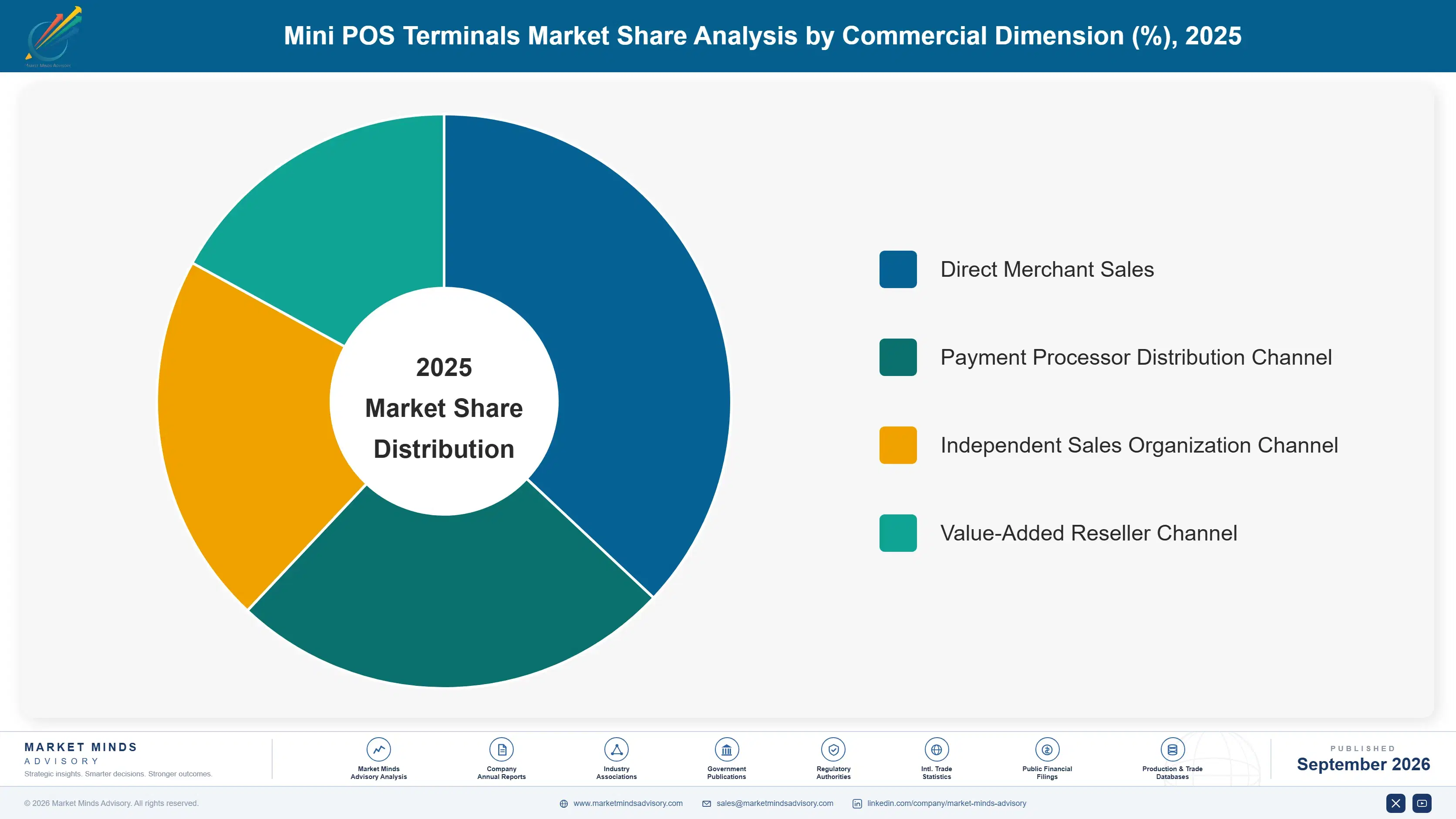
MMA segments the Mini POS Terminals market by product and technology type, since this dimension best explains where margin and growth concentrate as merchants shift from dumb card readers toward Android-based smart devices and software-driven acceptance methods reflecting steady merchant adoption across major retail segments as digital payment acceptance continues expanding across small merchants supporting consistent transaction.
mini-pos-terminals-market-market-share-analysis-1789982196744

Smart Android-Based Mini POS Terminals

Android-based smart terminals run full operating systems capable of hosting loyalty apps, inventory management, and receipt printing alongside core payment acceptance, replacing single-function card readers across small and mid-sized merchants worldwide. Sunmi and PAX have both expanded Android terminal shipments considerably as certified app marketplaces mature and processors increasingly bundle software licensing into hardware sales contracts. Growth here runs at roughly 1.50 times the overall market rate because merchants increasingly value the terminal as a business management tool rather than a single-purpose payment device, and vendors capturing app marketplace loyalty retain merchants through multiple hardware refresh cycles reflecting steady merchant adoption across major retail segments as digital payment acceptance continues expanding across small merchants supporting.
CAGR 15.0%

Soft POS and Tap-to-Phone Software Terminals

Soft POS solutions turn ordinary smartphones into certified payment acceptance devices through software alone, eliminating the need for dedicated hardware among the smallest and most mobile merchants. Square and SumUp have both expanded tap-to-phone offerings considerably, capturing merchants who previously found dedicated terminal hardware too expensive to justify for occasional or low-volume transaction needs. Growth trails smart Android terminals only because certification and processor partnership requirements still limit which markets soft POS providers can operate in legally. Providers charge meaningfully higher per-transaction fees to offset the absence of hardware revenue entirely reflecting steady merchant adoption across major retail segments as digital payment acceptance continues expanding across small merchants supporting consistent transaction volume growth across regional.
CAGR 13.5%
Full segment breakdown across 6 segments available in the complete report.

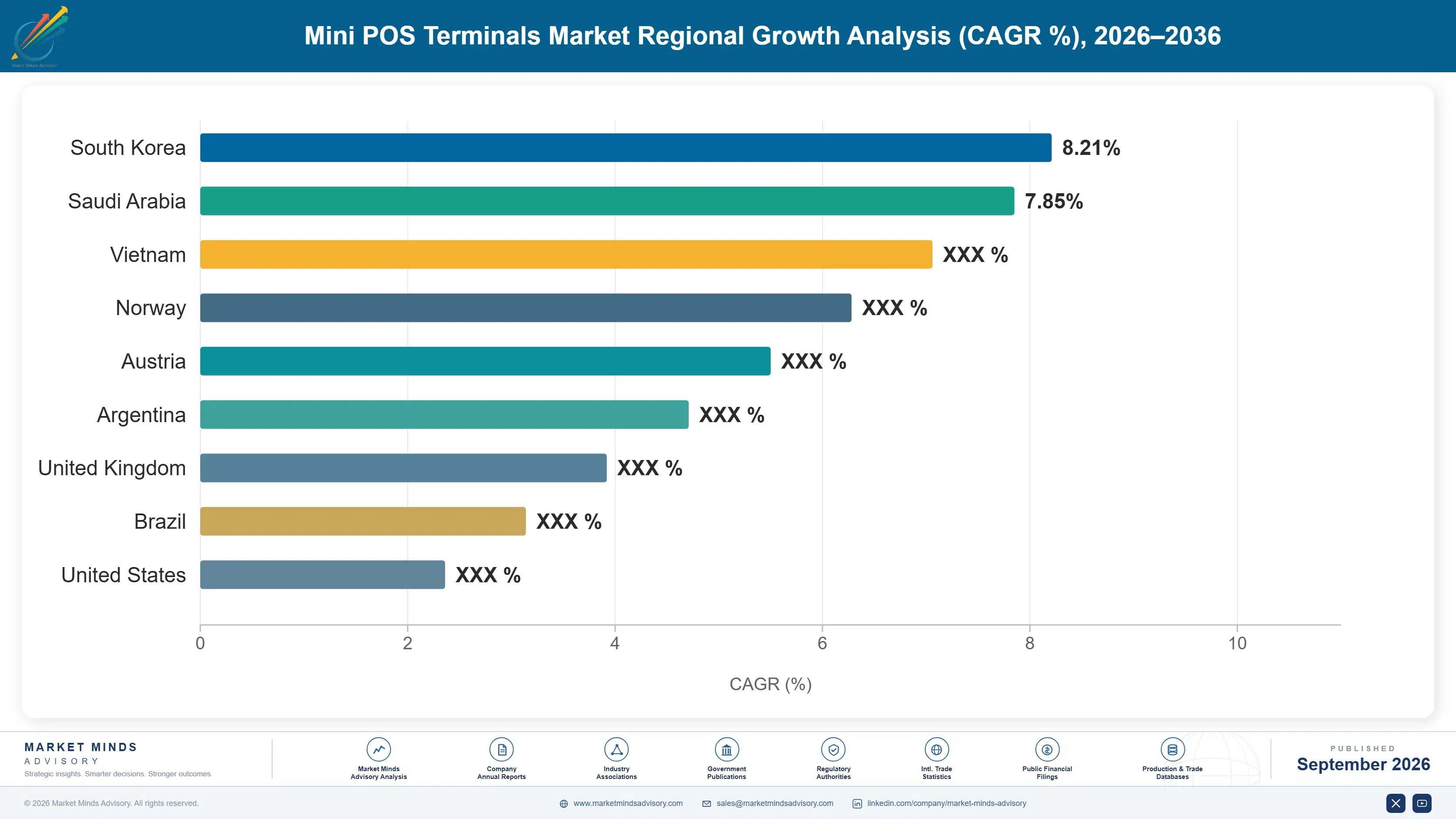
Regional Architecture and Country Demand Map

Demand concentrates where small-merchant density and manufacturing capacity intersect most directly. East Asia and South Asia together account for the majority of global unit shipments, reflecting both hardware production scale and rapid digital payment mandate expansion reflecting steady merchant adoption across major retail segments as digital payment.

North America

Small business card acceptance mandates and steady terminal replacement cycles anchor demand across the United States, where Square and Clover both hold considerable installed base among independent retailers and food service merchants. Canada contributes meaningful additional demand tied to its own steadily digitizing small merchant base. Growth here runs close to the global average since card acceptance is already broadly established, leaving hardware refresh and software upsell as the primary near-term growth mechanisms rather than net new merchant onboarding at scale across the region reflecting steady merchant adoption across major retail segments as digital payment acceptance continues expanding across small merchants supporting consistent transaction volume growth across regional markets reinforcing demand visibility for hardware vendors.
Share: 26% | CAGR: 9.5% (2026 to 2036)

Western Europe

Regulatory requirements mandating card acceptance among small merchants across the European Union continue expanding the addressable base, with Germany, France, and the United Kingdom together representing the bulk of regional demand. Contactless payment adoption reached considerable maturity years ago across most Western European markets, leaving hardware replacement cycles as the dominant demand driver rather than new merchant acquisition. Vendors increasingly compete on software marketplace breadth rather than raw certification credentials, since most eligible merchants already accept some form of digital payment today reflecting steady merchant adoption across major retail segments as digital payment acceptance continues expanding across small merchants supporting consistent transaction volume growth across regional markets reinforcing demand visibility for hardware vendors planning capacity.
Share: 20% | CAGR: 8.5% (2026 to 2036)
Regional intelligence for 5 additional markets available in the complete report: East Asia, South Asia and Pacific, Latin America, Middle East and Africa, Eastern Europe. Contact sales@marketmindsadvisory.com.
mini-pos-terminals-market-country-cagr-analysis-1789982197266

Converting Hardware Sales Into Software Annuities

Vendors increasingly expand revenue by attaching recurring software and payment processing fees to one-time hardware sales, since dedicated hardware alone faces continuous price erosion from software-first competitors entering the same merchant base reflecting steady merchant adoption across major retail segments as digital payment acceptance continues expanding across small merchants supporting consistent transaction volume growth across regional markets.

Bundling App Marketplace Access Into Hardware Sales

Vendors increasingly bundle certified app marketplace access directly into terminal hardware sales, capturing recurring software licensing revenue from merchants who previously generated a single hardware purchase and nothing further. Sunmi and PAX both report that merchants adopting bundled app subscriptions generate roughly 30 percent higher total revenue per unit over a three-year period compared with hardware-only sales. This bundling motion converts a one-time transaction into a recurring annuity relationship, meaningfully improving lifetime value per merchant considerably faster than pursuing net new hardware unit growth alone reflecting steady merchant adoption across major retail segments as digital payment.
Market Impact: Lifts three-year revenue per unit 30 percent reflecting steady.

Embedding Payment Processing Fee Sharing Agreements

Terminal vendors are negotiating fee-sharing agreements with payment processors, earning a small percentage of ongoing transaction volume processed through hardware they sold rather than relying solely on the upfront device sale for revenue. This expansion strategy lets hardware vendors participate in the considerably larger and more durable transaction processing revenue pool instead of remaining confined to device margin alone. Square and Clover have both expanded this model considerably, and MMA estimates vendors with processing fee arrangements generate roughly 45 percent higher total merchant lifetime value reflecting steady merchant adoption across major retail segments as digital payment.
Market Impact: Raises merchant lifetime value 45 percent reflecting steady.

Who Controls the Margin Pool

The mini POS terminals market is moderately concentrated, with the top five vendors together holding an estimated 42 percent of the market measured on annual unit shipment volume, leaving considerable share distributed across regional specialists and software-first entrants reflecting steady merchant adoption across major retail segments as digital payment acceptance continues expanding across small merchants supporting consistent transaction volume growth across regional.
PAX and Newland lead among traditional hardware specialists manufacturing at scale from China, while Verifone and Ingenico compete more broadly across established markets in North America and Europe with deeper processor relationships. Sunmi holds a distinct position built around Android smart terminal leadership specifically. Competitive activity currently centers on expanding app marketplace breadth and processor partnership depth rather than aggressive unit price competition alone reflecting.

Emerging pressure comes from software-first entrants including SumUp and Square, whose tap-to-phone offerings target the smallest merchants who never previously purchased dedicated hardware at all. Rankings could shift meaningfully over the next several years if these software-first vendors successfully expand upmarket into larger merchants currently served by dedicated hardware specialists reflecting steady merchant adoption across major retail segments as digital payment acceptance continues.
mini-pos-terminals-market-company-positioning-matrix-1789982197807

Competitive Moat and Risk Dimensions

PAX TECHNOLOGY

Moat: Global Certification Breadth

PAX holds certification approvals across more national payment networks than most competitors, a considerable barrier for new entrants since each certification requires lengthy compliance testing and processor relationship building that can take years to complete across multiple jurisdictions simultaneously reflecting steady merchant adoption across major retail segments as digital payment acceptance continues.
PAX TECHNOLOGY

Risk: Software Marketplace Gap

PAX's app marketplace remains less developed than Android-native competitors like Sunmi, leaving it more exposed than software-forward rivals as merchants increasingly select terminals based on application availability rather than hardware certification breadth alone going forward reflecting steady merchant adoption across major retail segments as digital payment acceptance continues expanding across small merchants.
SUNMI (SHANGHAI SUNMI TECHNOLOGY)

Moat: Android Marketplace Leadership

Sunmi built its position specifically around Android smart terminals with a mature developer marketplace, giving merchants access to a considerably broader app selection than most hardware-first competitors can currently offer through their own more limited software platforms reflecting steady merchant adoption across major retail segments as digital payment acceptance continues expanding across.
SUNMI (SHANGHAI SUNMI TECHNOLOGY)

Risk: Limited Processor Relationships

Sunmi holds fewer direct processor partnerships in North America and Europe than established incumbents like Verifone, leaving it more dependent on third-party distribution relationships that offer less control over merchant-facing certification and support quality reflecting steady merchant adoption across major retail segments as digital payment acceptance continues expanding across small merchants supporting.

Players Tracked

Prominent Players

PAX Technology
Verifone Inc
Ingenico (Worldline)
Newland Payment Technology
Sunmi (Shanghai Sunmi Technology)

Other Key Players

Castles Technology
BBPOS Limited
Spectra Technologies
SZZT Electronics
Feitian Technologies
Bitel Co Ltd
Elavon Inc
Block Inc (Square)
SumUp Limited
Clover Network (Fiserv)
Toast Inc
Poynt (GoTo)
Wiseasy Inc
Urovo Technology
Telpo Electronics

Recent Developments

FEBRUARY 2026

PAX Technology: Product Launch

PAX launched an expanded Android terminal line with enhanced app marketplace integration, targeting small merchants seeking combined payment acceptance and inventory management in a single certified device across multiple emerging market regions simultaneously reflecting steady merchant adoption across major retail segments as digital payment acceptance continues expanding.
Signal: Signals accelerating vendor investment in software marketplace depth as a core differentiator reflecting steady merchant adoption across major.
SEPTEMBER 2025

SumUp Limited: Acquisition

SumUp acquired a smaller regional tap-to-phone software provider to strengthen its European merchant coverage, adding certified near-field communication acceptance capability across additional national payment network jurisdictions previously unserved reflecting steady merchant adoption across major retail segments as digital payment acceptance continues expanding across small merchants supporting consistent.
Signal: Signals consolidation pressure on smaller regional software-first payment acceptance vendors reflecting steady merchant adoption across major retail segments.

Semiconductor Component Cost Exposure

Semiconductor components including processors, secure elements, and displays together represent the largest cost input for terminal manufacturers, commonly running 55 to 62 percent of cost of goods sold. Components are sourced primarily from foundries concentrated in Taiwan and South Korea, creating dependency on a small supplier base for critical parts reflecting steady merchant adoption across major retail segments as digital payment acceptance.
Secure element chip prices rose noticeably through 2025 as automotive and consumer electronics demand strained specialized semiconductor foundry capacity, based on IEA-adjacent supply chain reporting and named annual reports from major semiconductor foundries. Terminal manufacturers without guaranteed allocation agreements absorbed higher component costs during this period, compressing margin for vendors unable to pass increases through under fixed distributor pricing agreements reflecting steady merchant adoption across major retail segments as digital payment acceptance.

Smaller vendors face a meaningfully worse cost position than the largest manufacturers, since they lack the purchase volume to secure guaranteed foundry allocation during shortage periods. This leaves smaller regional vendors more exposed to component price volatility than PAX or Newland, which can negotiate multi-year supply agreements unavailable to competitors ordering smaller volumes reflecting steady merchant adoption across major retail segments as.
mini-pos-terminals-market-cost-volatility-analysis-1789982198015

Multi-Year Foundry Allocation Agreements

Larger vendors increasingly sign multi-year guaranteed allocation agreements directly with semiconductor foundries, securing priority access to secure element chips during shortage periods and reducing exposure to spot market pricing volatility that smaller competitors remain fully exposed to reflecting steady merchant adoption across major retail segments as digital payment acceptance continues expanding across small merchants supporting consistent transaction.

Component Standardization Across Product Lines

Vendors are standardizing component specifications across multiple terminal product lines, increasing order volume per component and improving negotiating leverage with foundries while simplifying inventory management across geographically distributed manufacturing facilities reflecting steady merchant adoption across major retail segments as digital payment acceptance continues expanding across small merchants supporting consistent transaction volume growth across regional markets reinforcing demand.

Portfolio Architecture for Margin Defence

Mini POS vendors organize portfolios across three distinct tiers separated primarily by software marketplace depth rather than simple hardware specification. Volume tier offerings serve basic card acceptance needs with thinner margins, while premium certified tiers targeting merchants wanting Android app marketplaces command considerably higher margin given the software development investment competitors must match reflecting steady merchant adoption across major retail segments as digital payment acceptance.
The tension between volume and premium positioning shows clearly in how vendors price app marketplace access: basic hardware buyers pay comparatively little beyond the device itself, while merchants wanting full software marketplaces pay substantially more for ongoing licensing wrapped around the same underlying payment acceptance technology. High-value margin pools concentrate specifically around Android smart terminals and processing fee-sharing arrangements reflecting steady merchant adoption across major.

Sustainability and next-generation tier offerings, including tap-to-phone software and unattended self-service terminals, currently represent a smaller revenue share but carry meaningful margin given limited competitive supply. Vendors positioning here early are building a considerable pricing advantage over slower-moving hardware-only competitors reflecting steady merchant adoption across major retail segments as digital payment acceptance continues expanding across small merchants supporting consistent transaction.

Volume / Commodity-Adjacent

Basic countertop and handheld card readers for small merchants without app marketplace needs, priced primarily on unit hardware cost alone reflecting steady merchant adoption across major retail segments as digital payment acceptance continues expanding across small merchants supporting.
Gross Margin: 20-28%

Premium / Certified

Android-based smart terminals with certified app marketplace access and multi-network payment certification for merchants wanting integrated business management tools reflecting steady merchant adoption across major retail segments as digital payment acceptance continues expanding across small merchants supporting consistent.
Gross Margin: 35-45%

Sustainability / Regulatory / Next-Generation

Tap-to-phone software terminals and unattended self-service devices representing the newest and highest margin portfolio segment for vendors reflecting steady merchant adoption across major retail segments as digital payment acceptance continues expanding across small merchants supporting consistent transaction volume.
Gross Margin: 48-58%
mini-pos-terminals-market-portfolio-architecture-1789982198522

High-value Sub-segments and Strategic Watch-out

Smart Android-Based Mini POS Terminals

The fastest-growing segment in this report, combining strong margin with expanding small merchant adoption as app marketplaces mature and vendors prove measurable revenue uplift from bundled software licensing reflecting steady merchant adoption across major retail segments as digital payment acceptance continues expanding across small merchants supporting consistent.
Gross Margin: 40-50%

Soft POS and Tap-to-Phone Software Terminals

A strong margin segment expanding steadily as software-first vendors capture merchants who never previously purchased dedicated hardware, capturing budget from an entirely new addressable base reflecting steady merchant adoption across major retail segments as digital payment acceptance continues expanding across small merchants supporting consistent transaction volume growth.
Gross Margin: 50-60%

Traditional Countertop Mini POS Terminals

The largest segment by installed base, providing steady recurring replacement revenue but facing margin pressure as basic card acceptance increasingly becomes a commoditized baseline expectation reflecting steady merchant adoption across major retail segments as digital payment acceptance continues expanding across small merchants supporting consistent transaction volume growth.
Gross Margin: 20-28%

Mobile Card Reader Dongles

Growth trails the overall market as standalone dongle readers lose ground to integrated Android terminals and software-only tap-to-phone alternatives among mobile and occasional merchants reflecting steady merchant adoption across major retail segments as digital payment acceptance continues expanding across small merchants supporting consistent transaction volume growth across.
Gross Margin: 22-30%

Merchant Replacement Cycle Economics

Mini POS terminals behave increasingly like an annuity business once a merchant adopts a vendor's software marketplace, since switching to a competitor terminal means abandoning accumulated app data, loyalty program history, and staff training on a familiar interface. This creates multi-year revenue visibility considerably more stable than a pure hardware replacement business alone reflecting steady merchant adoption across major retail segments as digital payment acceptance.
Stickiness varies meaningfully by end-use vertical. Food service and retail merchants running inventory-integrated Android terminals show the deepest lock-in given operational dependency on bundled software, while occasional and mobile merchants using basic card readers show comparatively shallower stickiness since switching costs remain low across those customer segments reflecting steady merchant adoption across major retail segments as digital payment acceptance continues expanding across small merchants supporting.

Buyer profiles are shifting generationally as younger small business owners increasingly expect app-based business management tools bundled with payment acceptance rather than treating the terminal as a single-purpose device. This shift is pushing procurement conversations toward software marketplace breadth over raw processing speed or certification count alone reflecting steady merchant adoption across major retail segments as digital payment acceptance continues.
mini-pos-terminals-market-end-use-penetration-index-1789982199016

Where Mini POS Vendors Focus Next

These are among the four positions where our research anticipates prominent divergence between winners and laggards over the coming forecast period. Each is grounded in the demand model, the regulatory perimeter, and the announced capacity pipeline.
01 / SOFTWARE MARKETPLACE INVESTMENT

Prioritize app marketplace depth over hardware specification

Smart Android-based terminals are growing at roughly 1.50 times the overall market rate, making app marketplace depth the single highest priority investment area for vendors competing for small merchant accounts. Merchants increasingly evaluate terminals on available business management applications rather than raw processing specification, a shift that rewards vendors who invest early in developer relationships. Providers that delay this investment risk losing shelf space to competitors already offering mature app marketplaces reflecting steady merchant adoption across major retail segments as digital payment acceptance continues expanding.
02 / PROCESSING FEE PARTICIPATION

Negotiate fee-sharing agreements before processors consolidate

Vendors with processing fee-sharing arrangements generate meaningfully higher lifetime merchant value than those relying solely on upfront hardware margin, making processor partnership negotiation a priority before major payment processors consolidate further and reduce vendor negotiating leverage. This expansion path requires considerably less investment than building proprietary processing infrastructure from scratch. Vendors ignoring this opportunity leave meaningful recurring revenue on the table indefinitely reflecting steady merchant adoption across major retail segments as digital payment acceptance continues expanding across small merchants supporting consistent transaction volume growth across.
03 / COMPONENT SUPPLY SECURITY

Lock in multi-year foundry agreements before next shortage

Rising secure element chip pricing is compressing margin for vendors without guaranteed foundry allocation agreements secured ahead of demand surges. Multi-year supply agreements give procurement teams considerably better negotiating leverage while reducing exposure to spot market volatility that smaller competitors remain fully exposed to. Vendors that delay securing supply agreements risk production delays during the next component shortage cycle, whenever it arrives reflecting steady merchant adoption across major retail segments as digital payment acceptance continues expanding across small merchants supporting consistent transaction volume growth across.
04 / REGIONAL GROWTH POSITIONING

Build India distribution capacity ahead of competitors

India shows the fastest regional growth rate in this report as national digital payment programs bring millions of previously cash-only merchants into formal card acceptance annually. Vendors establishing local distribution and certification capacity now will capture disproportionate share before competitors recognize the opportunity's full scale. This window will not stay open indefinitely, since larger vendors typically respond once regional growth becomes visible in quarterly shipment data reflecting steady merchant adoption across major retail segments as digital payment acceptance continues expanding across small merchants supporting consistent.

Engagement Snapshot From the Field

A live engagement with an industry participant carrying material or product regulatory and market exposure ahead of a defining policy shift, showing how our research translates into a defensible multi-year portfolio strategy.
MARKET MINDS ADVISORY · CLIENT ENGAGEMENT SUMMARY
Mini POS Terminals Producer Strategic Portfolio Review and Transition Roadmap 2026·Investment Scenario on Mini POS Terminals Exposure Evaluation 2025-26
CLIENT PROFILE
The client is a regional payment processor serving small and mid-sized merchants across a mid-sized emerging market economy, operating a terminal fleet accumulated over more than a decade through several distributor relationships, running a mix of legacy dumb card readers and early-generation Android terminals with inconsistent software support across the fleet reflecting steady merchant adoption across major retail segments as digital payment.
STRATEGIC CHALLENGE
The client faced rising support costs servicing an aging and fragmented terminal fleet while losing merchant accounts to competitors offering modern Android terminals bundled with business management applications the client's older hardware simply could not run reflecting steady merchant adoption across major retail segments as digital payment acceptance continues expanding across small merchants supporting consistent transaction volume.
MMA APPROACH
MMA conducted a structured vendor evaluation comparing fleet modernization options against the cost and merchant attrition risk of continued fragmented operation, incorporating primary interviews with processors who had already completed similar fleet modernization projects across comparable merchant bases reflecting steady merchant adoption across major retail segments as digital payment acceptance continues expanding across small merchants supporting consistent.
KEY FINDINGS
  1. Modernizing to a single Android terminal platform reduced projected annual support costs by an estimated 28 percent (client-reported, unverified by MMA) across the full merchant fleet reflecting steady.
  2. Merchant attrition to competitors offering modern app-enabled terminals had reached a meaningful share of annual account losses before the modernization program began (client-reported, unverified by MMA) reflecting steady.
  3. Comparable processors completing similar modernizations reported meaningfully faster merchant onboarding once field technicians trained on only one terminal platform instead of several reflecting steady merchant adoption across major.
  4. Bundled app marketplace access increased average revenue per merchant considerably, offsetting a portion of the upfront fleet replacement investment within the first operating year reflecting steady merchant adoption.
CLIENT PROFILE
The client is a regional payment processor serving small and mid-sized merchants across a mid-sized emerging market economy, operating a terminal fleet accumulated over more than a decade through several distributor relationships, running a mix of legacy dumb card readers and early-generation Android terminals with inconsistent software support across the fleet reflecting steady merchant adoption across major retail segments as digital payment.
STRATEGIC CHALLENGE
The client faced rising support costs servicing an aging and fragmented terminal fleet while losing merchant accounts to competitors offering modern Android terminals bundled with business management applications the client's older hardware simply could not run reflecting steady merchant adoption across major retail segments as digital payment acceptance continues expanding across small merchants supporting consistent transaction volume.
MMA APPROACH
MMA conducted a structured vendor evaluation comparing fleet modernization options against the cost and merchant attrition risk of continued fragmented operation, incorporating primary interviews with processors who had already completed similar fleet modernization projects across comparable merchant bases reflecting steady merchant adoption across major retail segments as digital payment acceptance continues expanding across small merchants supporting consistent.
KEY FINDINGS
  1. Modernizing to a single Android terminal platform reduced projected annual support costs by an estimated 28 percent (client-reported, unverified by MMA) across the full merchant fleet reflecting steady.
  2. Merchant attrition to competitors offering modern app-enabled terminals had reached a meaningful share of annual account losses before the modernization program began (client-reported, unverified by MMA) reflecting steady.
  3. Comparable processors completing similar modernizations reported meaningfully faster merchant onboarding once field technicians trained on only one terminal platform instead of several reflecting steady merchant adoption across major.
  4. Bundled app marketplace access increased average revenue per merchant considerably, offsetting a portion of the upfront fleet replacement investment within the first operating year reflecting steady merchant adoption.
RECOMMENDED STRATEGY
Phase 1: Phase one involved selecting a single Android terminal vendor and piloting deployment across a representative sample of merchant accounts first reflecting steady merchant adoption. Phase 2: Phase two extended deployment to the remaining merchant fleet in stages, prioritizing highest-attrition-risk accounts for earliest replacement reflecting steady merchant adoption across major retail. Phase 3: Phase three activated bundled app marketplace subscriptions across the full fleet once core hardware migration stabilized and support staff completed training reflecting steady merchant.
OUTCOME
The client completed fleet modernization across its full merchant base within the planned timeline, reporting meaningfully reduced support costs and lower merchant attrition (client-reported, unverified by MMA) compared with the prior fragmented fleet arrangement, while field technicians reported improved efficiency servicing a single standardized platform reflecting steady merchant adoption across major retail.

Frequently Asked Questions

Foundational context covering the market sizes, CAGR, scope, country, region and competition that inform every finding below. This section is provided to cover basics and most often pre-purchase conversations, answered from the MMA Primary Research Dataset.

What is the current size of the Mini POS Terminals Market?

The Mini POS Terminals market is valued at approximately 4.2 billion dollars in 2025. This reflects steady demand from small merchants worldwide replacing cash acceptance and basic card readers with connected payment.

How large will the Mini POS Terminals Market be by 2036?

MMA projects the market will reach approximately 11.98 billion dollars by 2036. This growth reflects sustained Android terminal adoption and expanding national digital payment mandates across emerging markets worldwide reflecting steady merchant.

What is the CAGR for the Mini POS Terminals Market 2026 to 2036?

The market is projected to grow at a compound annual growth rate of 10.0 percent between 2026 and 2036. Bull and bear scenarios range from roughly 8.7 to 11.3 percent depending on.

Which segment is growing fastest?

Smart Android-Based Mini POS Terminals is the fastest-growing segment, expanding at roughly 1.50 times the overall market rate as merchants prioritize app marketplace access over basic card acceptance alone reflecting steady merchant.

Who are the major companies in the Mini POS Terminals Market?

Leading vendors include PAX Technology, Verifone, Ingenico, Newland Payment Technology, and Sunmi. Together these five companies hold an estimated 42 percent of the market on a unit shipment volume basis reflecting steady.

Which country is growing fastest?

India shows the fastest national growth rate as national digital payment infrastructure programs bring millions of previously cash-only merchants into formal card acceptance annually reflecting steady merchant adoption across major retail segments.

Report Segmentation Architecture

The full report scope spans multiple orthogonal segmentation dimensions, with cross-tabulated demand data provided for each dimension pair. Coverage extends further to regional breakdowns, trend trajectories, and the competitive detail needed to support segment-level decision-making.

By Product and Technology Type

  • Traditional Countertop Mini POS Terminals
  • Portable and Handheld Mini POS Terminals
  • Mobile Card Reader Dongles
  • Smart Android-Based Mini POS Terminals
  • Soft POS and Tap-to-Phone Software Terminals
  • Unattended and Self-Service Mini POS Terminals

By End-Use Industry

  • Retail and General Merchandise
  • Food Service and Hospitality
  • Transportation and Logistics
  • Healthcare and Personal Services
  • Field Service and Mobile Vendors

By Commercial Dimension

  • Direct Merchant Sales
  • Payment Processor Distribution Channel
  • Independent Sales Organization Channel
  • Value-Added Reseller Channel

By Region

  • North America
  • Western Europe
  • East Asia
  • South Asia and Pacific
  • Latin America
  • Middle East and Africa
  • Eastern Europe

Scope, Methodology, and Coverage

Every figure in this report is reproducible from documented input assumptions. The scope below maps the historical period, the forecast horizon, the segmentation dimensions, and the countries covered, alongside the underlying primary and qualitative methodology.
Historical Period
2020 to 2025
Forecast Period
2026 to 2036
Base Year
2025 (USD billions; MMA Primary Research Dataset, September 2026)
Market Definition
This report defines the Mini POS Terminals market as compact, portable point-of-sale hardware devices, including countertop, handheld, mobile card reader, and smart Android-based terminals, used to accept card and digital payments at the point of transaction. It excludes full-scale enterprise POS systems, standalone payment gateway software, and general-purpose smartphones not bundled with dedicated payment acceptance hardware or certified card-reading peripherals.
Quantitative Units
USD billions (current prices); unit shipment volume where applicable
Segmentation Dimensions
By Product and Technology Type; By End-Use Industry; By Commercial Dimension; By Region
Regions Covered
North America, Western Europe, East Asia, South Asia and Pacific, Latin America, Middle East and Africa, Eastern Europe
Countries Covered
USA, China, Germany, France, UK, Japan, South Korea, India, Australia, Canada, Brazil, Mexico, Indonesia, Vietnam, Thailand, Malaysia, UAE, Saudi Arabia, South Africa, Nigeria, Turkey, Poland, Netherlands, Italy, Spain, Sweden, Switzerland, Argentina, Colombia, Singapore, and additional markets relevant to this sector
Key Companies Profiled
PAX Technology, Verifone Inc, Ingenico (Worldline), Newland Payment Technology, Sunmi (Shanghai Sunmi Technology), Castles Technology, BBPOS Limited, Spectra Technologies, SZZT Electronics, Feitian Technologies, Bitel Co Ltd, Elavon Inc, Block Inc (Square), SumUp Limited, Clover Network (Fiserv), Toast Inc, Poynt (GoTo), Wiseasy Inc, Urovo Technology, Telpo Electronics
Quantitative Methodology
Primary survey, n=3,800 respondents, Q4 2025, six countries; demand-side model with trade association cross-validation
Qualitative Methodology
47 expert interviews, Q4 2025; applied to validate demand model assumptions, identify emerging dynamics, and assess competitive positioning
Report Format
PDF and XLSX data workbook (Word format preview document)
Publisher
Market Minds Advisory
Report Code
MMA-2026-TEC-505
Published
September 2026
Contact
sales@marketmindsadvisory.com | www.marketmindsadvisory.com

Purchase the full Mini POS Terminals Market Report (2026 to 2036).

The complete Mini POS Terminals report provides detailed segment-level forecasts, regional breakdowns across all seven regions, and in-depth competitive profiles covering pricing strategy, product roadmap, and certification credentials for every major vendor. It includes primary survey data from three thousand eight hundred respondents alongside forty-seven expert interviews conducted across six countries. Subscribers receive full access to underlying data tables and detailed methodology notes covering every stage of the research process. Quarterly market updates continue through the full forecast period covered by this analysis, keeping subscribers current as conditions evolve reflecting steady merchant adoption across major.
Full segment and regional forecast tables
Detailed competitive vendor profiles for every player
Primary survey and interview data access
Quarterly market update subscription included throughout
Methodology and derivation notes fully provided
Custom data cuts available on request

Built For The People Who Decide

From boardroom strategy to bench-side execution, this report is read cover-to-cover by leaders shaping the next decade of their industry, turning demand scenarios, market dynamics and valuation benchmarks into decisions.
CXOs/ Presidents/ VPs/ Managers
M&A and Corporate Development
Strategy Teams and R&D Heads
Procurement and Product Directors
Regulatory and Compliance Leaders
Investor Relations and Equity Analysts