Market Minds Advisory
Mineral Yeast Market

Mineral Yeast Market: Strain-Specific Authorisation, Bioavailability Evidence and Feed Volume Funding Human Supplement Margin

Regulatory authorisation attaches to defined production strains rather than to the mineral itself, which quietly excludes newcomers with chemically similar products and keeps incumbent positions durable for years without any commercial defence at all.

Lead Analyst

Lisa Gevelber

Published

September 2026

Make Smarter Decisions with Customized Research Insights

Request a free sample report and evaluate market opportunities, growth trends, and competitive dynamics relevant to your business needs.

2025 MARKET VALUE$0.8BMarket Size 2025
2036 FORECAST VALUE$1.7BBase Case , 2026 to 2036
CAGR 2026 TO 20367.2 %Bull 8.4% / Bear 6.0%
INCREMENTAL OPPORTUNITY$0.9BNet 10- year value creation
EXPANSION MULTIPLE2.00x2036 value over 2026 base
Strategic Levers
M&A Pipeline
Regional Outlook
Country Rankings
Competitive Intelligence
Segmental Deep-dive
Call-Us : 91 93563 13602

Executive Snapshot and Market Trajectory

Authorisation in mineral yeast attaches to a defined production strain and process rather than to the mineral, which is a detail with enormous commercial consequences. A competitor arriving with a chemically identical product does not inherit the approval and cannot simply sell against it. It starts again from the beginning.
Selenium yeast carries the growth on the strongest clinical and regulatory position in the category, built through feed additive evaluation and later carried into human supplementation. Human supplement grades of zinc, chromium and iron yeast grow nearly as fast on bioavailability evidence formulators pay for. East Asia holds the largest share on Chinese feed manufacturing scale and on domestic production that supplies both its own converters and export markets.
Concentration reads at 63% for the top five, high because strain-specific authorisation narrows the credible supplier base long before price enters any conversation. Animal feed carries the tonnage and human supplementation carries the margin, and the businesses that work best run both, using feed volume to justify fermentation capacity that supplement demand alone could never fill. Chinese producers now pursuing authorisation rather than undercutting on price are the single development most worth watching here.
Market Definition
This market covers minerals bound into yeast biomass through fermentation, spanning selenium yeast, human supplement grade mineral yeasts, animal feed grade mineral yeasts, yeast-derived mineral premixes, and organic mineral yeast for organic-certified applications. Inorganic mineral salts, chelated minerals produced without fermentation, yeast extracts sold for flavour, nutritional yeast sold as a food, and probiotic yeast are excluded.
Base Year Value
$0.8B in 2025 (MMA Primary Research Dataset, August 2026)
Forecast Period
2026 to 2036, eleven discrete annual values
CAGR
7.2% base case. Bull 8.4%. Bear 6.0%.
Fastest Growth Segment
Selenium Yeast: 10.8% CAGR
Fastest Growth Country
India: 10.1% CAGR
Fastest Growth Region
South Asia and Pacific: 9.5% CAGR
Largest Region
East Asia: 31% of 2025 global value
Market Leaders
Alltech, Lallemand, Lesaffre, Angel Yeast and Associated British Foods lead on mineral yeast revenue. Source: MMA Primary Research Dataset, July 2026.
Primary Survey
n=3,800 procurement and R&D decision-makers, Q4 2025, six countries
Methodology
Demand-side build-up, cross-validated against public data, 47 expert interviews

Mineral Yeast Market Forecast Scenarios

mineral-yeast-market-trends-forecast-size-forecast-scenario-1787375266920
Growth ran at 6.2% annually between 2020 and 2025, and animal feed set the pace for most of it. European restrictions on inorganic mineral inclusion levels pushed feed formulators toward organic mineral forms with better retention, which favoured yeast-bound minerals directly. Human supplementation grew more slowly and more profitably underneath that, contributing far less tonnage and considerably more margin.
The base case at 7.2% rests on three mechanisms. Feed formulators keep substituting yeast-bound minerals for inorganic salts as environmental limits on excreted minerals tighten across European and North American livestock production. Human supplement formulation expands as bioavailability evidence accumulates and formulators accept the ingredient cost. And Indian and Southeast Asian feed manufacturing grows quickly as commercial poultry and aquaculture production scales beyond smallholder systems. None of the three depends on a new technology arriving.
The bull case at 8.4% turns on additional mineral yeast authorisations clearing European evaluation, which would open feed applications currently served only by inorganic salts. The bear case at 6.0% reflects feed cost pressure pushing formulators back toward cheaper inorganic forms, since yeast-bound minerals are among the more visible line items when a feed mill is defending margin.

Strain Authorisation Decides Who Can Compete

The commercially decisive fact about mineral yeast is procedural rather than technical. European feed additive authorisation attaches to a named production strain and a defined process, not to selenium yeast as a category, which means a competitor with a chemically indistinguishable product has to run its own evaluation from the beginning. That takes around 41 months and considerable money.
TOP FIVE CONCENTRATION63%High, since strain authorisation narrows the credible supplier base severely
FEED VOLUME SHARE71%Portion of tonnage entering animal feed rather than human supplementation
SUPPLEMENT MARGIN SHARE48%Portion of category profit generated by human supplement grades
BIOAVAILABILITY ADVANTAGE2.3 timesTissue retention against comparable inorganic mineral salt forms
AUTHORISATION TIMELINE41 monthsTypical duration for a European feed additive authorisation process
FERMENTATION COST SHARE37% of COGSFermentation and downstream processing contribution to manufactured cost
Bioavailability is the argument that got the category adopted in the first place. Minerals bound into yeast protein are incorporated into tissue rather than largely excreted, with retention running near 2.3 times inorganic salt equivalents in the applications where it has been measured properly. Environmental limits on excreted minerals from livestock production turned that from a nutritional nicety into a compliance mechanism across European feed formulation.
The business works as two halves that need each other. Animal feed carries roughly 71% of tonnage at modest margin, and human supplementation generates roughly 48% of category profit on a fraction of the volume. Fermentation capacity is expensive and needs filling, so feed tonnage justifies the plant while supplement grades pay for it. Companies holding only one half find the economics considerably harder.
"People look at mineral yeast and see a bioavailability story. The actual moat is that somebody spent four years and a lot of money getting one particular yeast strain authorised, and nobody inherits that by making the same molecule."
Director, Specialty Ingredients and Animal Nutrition Practice · MMA Specialty Ingredients Practice · August 2026

Market Trends

Environmental Mineral Limits Convert Bioavailability Into Compliance

Regulators across European and North American livestock production have tightened limits on minerals excreted into soil and water, particularly copper and zinc, which turned retention from a nutritional argument into a compliance requirement. Yeast-bound minerals retain near 2.3 times inorganic salt equivalents, so a formulator can meet nutritional targets at lower inclusion and lower excretion simultaneously. That reframing did more for adoption than a decade of trial data had managed. Feed formulators now substitute on regulatory grounds rather than on performance alone. Compliance moves formulators that nutritional argument never did.
Market Impact: Authorisation takes 41 months typically
Human Supplement Grades Carry Margin Feed Tonnage Cannot

Animal feed takes roughly 71% of tonnage while human supplementation generates roughly 48% of category profit, which tells you most of what matters about how this business works. Supplement formulators pay considerable premiums for bioavailability and the ingredient rarely appears on a front label, so the cost sits inside a formulation rather than in front of a consumer. Fermentation capacity is expensive and needs filling. Feed volume justifies the plant and supplement grades pay for it. Companies holding only one half of that find the arithmetic considerably harder to make work.
Market Impact: India grows at 10.1% annually

Market Opportunities and Growth Drivers

Strain-Specific Authorisation Excludes Chemically Identical Competitors

European feed additive authorisation attaches to a named production strain and defined process rather than to the mineral form as a category, which means a competitor with an indistinguishable product must run its own evaluation from the start. That process takes around 41 months and substantial expenditure with no guarantee at the end of it. The effect is a supplier base narrowed by procedure rather than by capability, and incumbent positions that stay durable for years without any commercial defence. Capability was never really the barrier in this category. Procedure narrowed the field, not capability.
Market Impact: Costs run 6 times inorganic salts

Asian Commercial Feed Production Scales Beyond Smallholder Systems

Indian and Southeast Asian poultry and aquaculture production is consolidating from smallholder operations into commercial integrations that formulate feed properly rather than mixing on farm, which creates demand for specialty additives that simply did not exist in those systems before. Indian demand grows near 10.1% annually as a result. Aquaculture is particularly important, since mineral nutrition affects survival rates directly and the economics of that are immediately visible to any producer. Domestic fermentation capacity is developing alongside that demand rather than trailing well behind it. Survival rate economics are immediately visible to any producer.
Market Impact: Adds 18 months per jurisdiction

Market Restraints and Challenges

Feed Cost Pressure Pushes Formulators Back Toward Inorganic Salts

Yeast-bound minerals cost several times inorganic salt equivalents per unit of mineral, and they are among the more visible line items when a feed mill is defending margin against grain and energy inflation. The root cause is that fermentation is inherently more expensive than mining and refining a salt. Commercially this makes feed volume cyclical in a way supplement demand is not. Participants are responding with inclusion-rate optimisation, blended premixes combining both forms, and evidence linking retention to measurable production outcomes. Fermentation will never compete with mining on cost. Mills defend margin by cutting visible lines.
Market Impact: Retention runs 2.3 times inorganic

Jurisdictional Divergence Fragments Human Supplement Market Access

Regulatory treatment of mineral yeasts in human supplementation varies sharply by jurisdiction and by individual mineral, so a chromium yeast cleared in one market may require entirely separate work before it can be sold in another. The root cause is that supplement frameworks developed independently with no mutual recognition. Commercially this multiplies regulatory cost across markets and delays launches considerably. Participants are responding with parallel dossier submissions, prioritised market sequencing, and partnerships with formulators holding local regulatory capability. Evidence generated in one market rarely transfers cleanly into another. Launch timelines stretch across years as a result.
Market Impact: Supplements generate 48% of profit
4 additional market trends, 2 additional growth drivers, and 3 additional restraints and challenges are covered in the full report. Contact sales@marketmindsadvisory.com to access the complete intelligence.

Segment CAGR and Growth Architecture

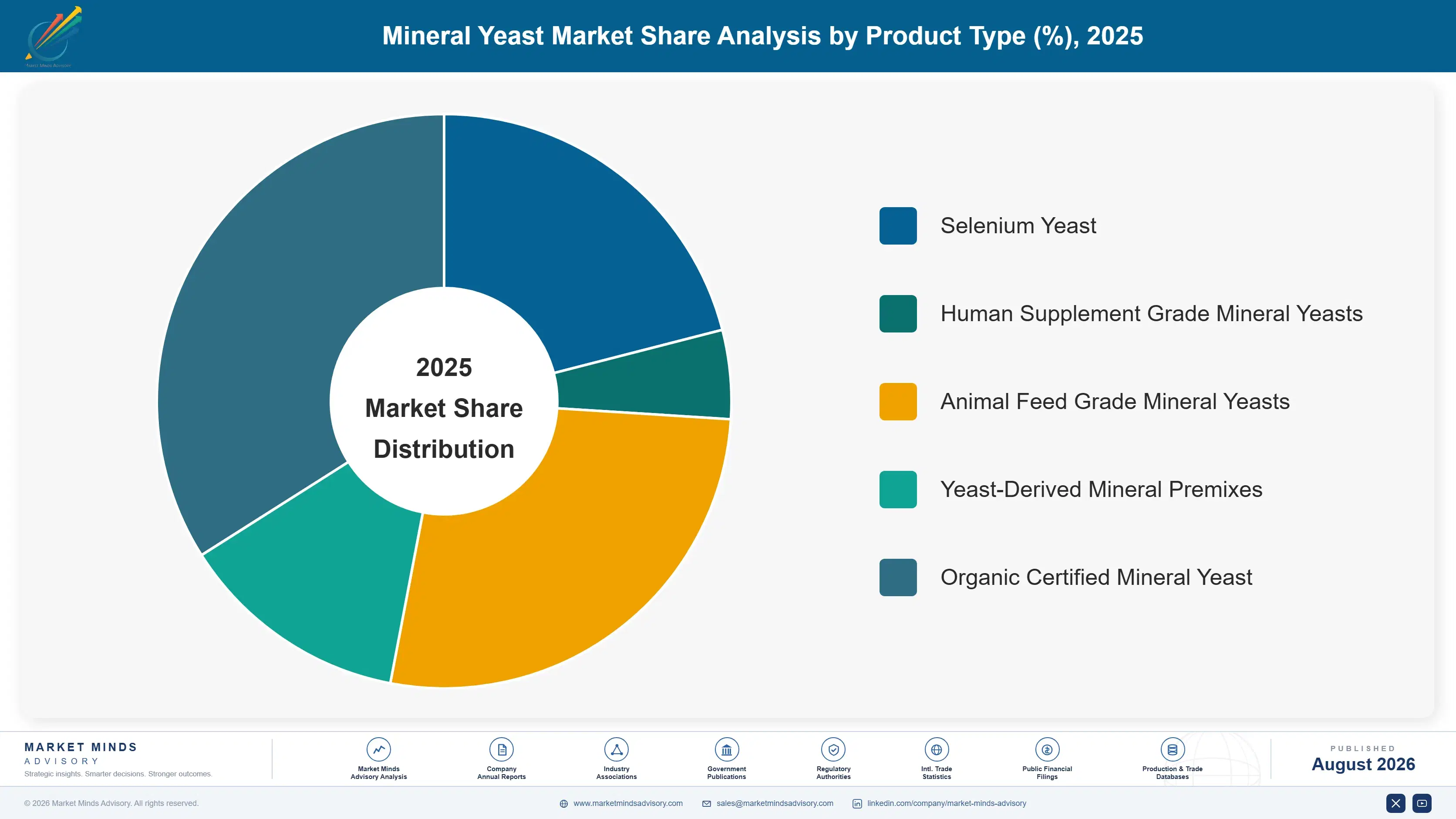
Five product categories divide this market on mineral form and application grade rather than on the yeast strain behind them. That reflects how buyers actually purchase, since a feed formulator and a supplement formulator apply entirely different specifications, regulatory requirements and price expectations to what is fundamentally the same fermentation process. The fermentation itself barely differs between them.
mineral-yeast-market-trends-forecast-market-share-analysis-1787375267450

Selenium Yeast

Growing at 10.8% and the fastest part of this market. Selenium yeast is the segment with the strongest clinical and regulatory position by a wide margin, having been the subject of European Food Safety Authority evaluation and holding authorised feed additive status that competing selenium forms have struggled to match. Selenomethionine is the active form, and its incorporation into tissue protein rather than simple excretion is the technical argument that convinced nutritionists first in animal feed and later in human supplementation. Poultry and swine feed carry most of the tonnage. What protects the segment commercially is that regulatory authorisation is specific to defined production strains and processes, which excludes anybody arriving with a similar product.
CAGR 10.8%

Human Supplement Grade Mineral Yeasts

Growing at 9.2% on zinc, chromium, iron and copper yeasts supplied into human supplement formulation rather than animal feed. Bioavailability is the selling argument and it is genuinely supportable, since minerals bound into yeast protein absorb differently from inorganic salts and the difference shows in serum measurement. Supplement formulators pay considerable premiums for that, and the ingredient rarely appears on a front label so the cost sits inside a formulation rather than in front of a consumer. Regulatory treatment varies sharply by jurisdiction and by mineral, which means a product cleared in one market may need entirely separate work before it can be sold in another. Sequencing entry by regulatory proximity matters more than market size.
CAGR 9.2%
Full segment breakdown across 5 segments available in the complete report.

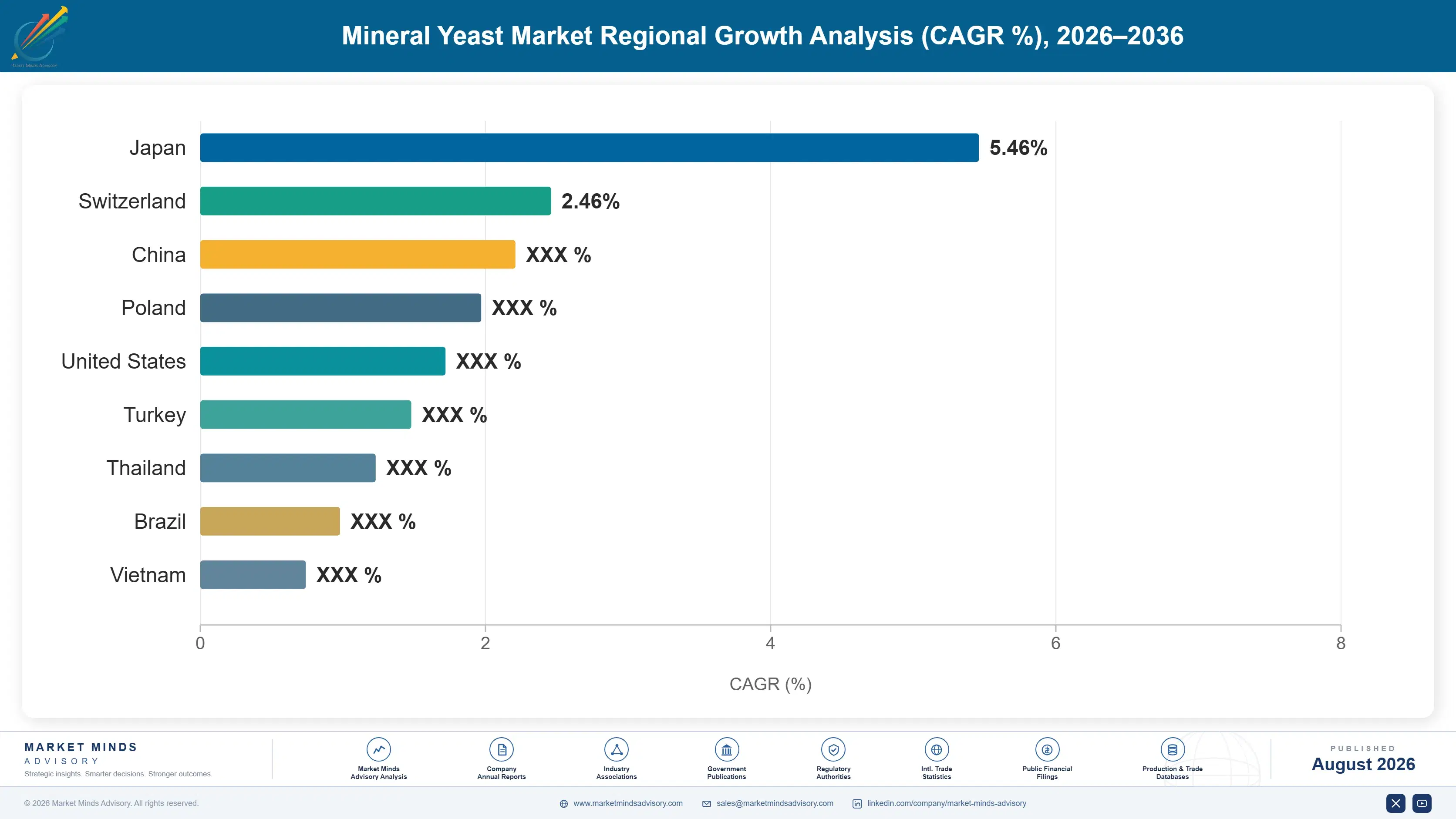
Regional Architecture and Country Demand Map

East Asia holds 31% of global value on Chinese feed manufacturing scale and domestic yeast production serving both its own converters and export markets. North America follows at 23% on livestock production, while South Asia and Pacific grows fastest on commercial feed consolidation. Authorisation shapes Western Europe throughout.

East Asia

Chinese feed manufacturing operates at a scale nothing else approaches and domestic yeast producers have built fermentation capacity serving both that demand and considerable export volume, which is a combination no other region holds. Angel Yeast in particular has become a genuine international competitor rather than a domestic supplier alone. Aquaculture is proportionally more important here than anywhere, and mineral nutrition affects survival rates in ways producers can measure directly against feed cost. Japanese and Korean demand is smaller and weighted toward human supplementation where quality expectations are demanding. Regulatory frameworks differ across the three markets and shape which products reach each one. Angel Yeast now competes internationally rather than domestically alone.
Share: 31% | CAGR: 8.3% (2026 to 2036)

Western Europe

Regulation defines this region more than demand does, and European feed additive authorisation is both the barrier and the protection that shapes every commercial position here. Authorisation attaches to named strains and processes, which means the suppliers holding it face a narrower competitive field than the chemistry alone would suggest. Environmental limits on excreted copper and zinc from livestock production have driven substitution toward yeast-bound forms on compliance grounds rather than nutritional preference. Germany, France and the Netherlands carry most of the feed volume. Human supplement regulation under European rules is separate again and considerably more restrictive than American practice. Excretion limits rather than nutritional preference drive most substitution decisions here.
Share: 24% | CAGR: 5.8% (2026 to 2036)
Regional intelligence for 5 additional markets available in the complete report: North America, South Asia and Pacific, Latin America, Middle East and Africa, Eastern Europe. Contact sales@marketmindsadvisory.com.
mineral-yeast-market-trends-forecast-country-cagr-analysis-1787375267962

Where Mineral Yeast Returns Are Made

Four positions separate producers earning durable returns from those selling fermentation capacity by the tonne: holding strain-specific authorisations, running feed and supplement grades together, funding retention evidence tied to production outcomes, and sequencing supplement market entry against regulatory divergence rather than against demand. Only the first is genuinely closed to any newcomer. Everything else can be bought.

Hold Strain-Specific Authorisations Competitors Cannot Inherit

European feed additive authorisation attaches to a named production strain and process rather than to the mineral form, so a competitor with a chemically identical product must run its own evaluation from the beginning at around 41 months and considerable cost. Holders realise 34% to 42% higher pricing than unauthorised equivalents in the same applications. The barrier is procedural rather than technical, which makes it far more durable than any formulation advantage a producer could actually build. Capability was never the barrier here and it still is not. Procedure did the excluding here.
Market Impact: Realises up to 42% higher pricing than unauthorised

Run Feed And Supplement Grades Through One Plant

Fermentation capacity is expensive and needs filling, and feed tonnage at roughly 71% of volume justifies a plant that supplement demand alone could never fill. Supplement grades then generate roughly 48% of category profit on a fraction of that volume. Producers running both halves achieve 25% to 33% better asset utilisation than single-market operators and absorb feed cyclicality without idling capacity. Holding only one half makes the economics considerably harder than the headline margins suggest. Idle fermentation capacity is the most damaging cost in this whole business. Utilisation decides the whole return.
Market Impact: Improves asset utilisation by as much as 33%

Fund Retention Evidence Tied To Production Outcomes

Feed formulators substitute on compliance and measurable outcomes rather than on general nutritional argument, and retention near 2.3 times inorganic salts only converts when it is linked to something a producer can see in a harvest or a growth curve. Trials tying retention to survival, growth rate or excretion compliance move formulation decisions that bioavailability data alone leaves stalled. The studies cost less than a season of commercial argument and the evidence does not expire afterwards. Formulators want to see it in a harvest, not a serum panel. Serum measurement convinces almost nobody.
Market Impact: Demonstrates retention at 2.3 times inorganic salt equivalents

Sequence Supplement Market Entry Against Regulatory Divergence

Human supplement frameworks developed independently with no mutual recognition, so a chromium yeast cleared in one market may need entirely separate work costing around 18 months before another will accept it. Entering markets in order of regulatory proximity rather than market size cuts total time to multi-market presence by 30% to 40%. Producers sequencing by demand alone spend years discovering that the largest opportunity carries the longest dossier and the least transferable evidence. The largest opportunity frequently carries the longest dossier of all. Proximity beats market size every time here.
Market Impact: Cuts multi-market entry timeline by up to 40%

Who Controls the Margin Pool

Concentration reads at 63% for the top five measured on mineral yeast revenue, the basis used throughout this section, and it reflects authorisation holdings rather than fermentation capacity. Alltech and Lallemand hold the deepest positions across feed and supplement grades together. Lesaffre and Associated British Foods bring yeast fermentation scale from adjacent businesses. Angel Yeast competes internationally from a Chinese cost base.
Competition runs on three fronts. Authorisation holdings are the first and by a wide margin the most decisive, since a producer without them is not selling into regulated feed applications at all. Retention evidence tied to production outcomes is the second, and it converts formulators that bioavailability data alone does not. Plant utilisation across feed and supplement grades is the third.

Pressure arrives from two directions. Chinese producers have built fermentation capacity at costs European operators cannot match and are pursuing authorisations rather than competing on price alone, which is a considerably more serious position. Separately, chelated mineral producers compete on similar bioavailability arguments without fermentation cost. Rankings will shift toward producers holding authorisations across multiple minerals and jurisdictions. Holding a single authorisation is no longer a durable position.
mineral-yeast-market-trends-forecast-company-positioning-matrix-1787375268483

Competitive Moat and Risk Dimensions

ALLTECH

Moat: Authorisation depth across minerals

Authorisations held across several mineral forms and jurisdictions, built over decades of evaluation work, give the business access to regulated feed applications that competitors must spend years and considerable money entering. Research capability tying retention to measurable production outcomes also converts formulators that generic bioavailability data leaves entirely unmoved.
ALLTECH

Risk: Feed cyclicality and cost pressure

Heavy weighting toward animal feed exposes the business to formulator cost discipline whenever grain and energy inflation squeeze mill margins, since yeast-bound minerals are a visible line item. Chinese producers building comparable authorisations from a considerably lower cost base also compress the pricing that authorisation holdings have historically protected.
LALLEMAND

Moat: Fermentation platform and breadth

Deep fermentation capability across yeast and bacterial platforms supports mineral yeast production alongside adjacent products, which spreads plant and technical cost across far more volume than a single-product operation manages. Positions in both animal nutrition and human health also let feed tonnage justify capacity that supplement grades then pay for properly.
LALLEMAND

Risk: Fragmented supplement regulatory access

Human supplement frameworks vary sharply by jurisdiction and by individual mineral, which multiplies regulatory cost and slows market entry in exactly the half of the business carrying the margin. Competing chelated mineral producers making similar bioavailability arguments without fermentation cost also pressure supplement pricing directly.

Players Tracked

Prominent Players

Alltech
Lallemand
Lesaffre
Angel Yeast
Associated British Foods

Other Key Players

Cargill
Archer Daniels Midland
Kemin Industries
Novus International
Zinpro Corporation
Chr. Hansen
Leiber GmbH
Ohly
Diamond V
Phileo by Lesaffre
Biorigin
Nutreco
DSM-Firmenich
Orffa
Pancosma

Recent Developments

JANUARY 2025

Feed additive authorisation granted for selenium yeast production strain

European authorities granted feed additive authorisation to a selenium yeast produced from a specific named strain and process, completing an evaluation that had run for over three years and giving the holder access to regulated applications competitors must now enter separately. Competitors must now file separately.
Signal: Authorisation attaches to the strain and process rather than to the mineral form as a category
MAY 2025

Aquaculture trial links mineral retention to measurable survival rates

A controlled aquaculture trial linked yeast-bound mineral retention to survival and growth outcomes rather than to serum measurement alone, giving feed formulators the production-level evidence that general bioavailability data had never quite supplied to them. Feed formulators had asked for exactly this evidence. Results were published openly.
Signal: Formulators substitute on outcomes they can measure rather than on bioavailability arguments made in complete isolation
SEPTEMBER 2025

Chinese producer pursues European authorisation rather than price competition

A Chinese yeast producer submitted a European feed additive authorisation dossier for its own mineral yeast strain, moving from price-led export supply toward the regulated positions that have protected incumbent European and North American producers for years. A decision is expected during 2027. Pricing protection erodes accordingly.
Signal: Chinese producers pursuing authorisation is a far more serious threat than any amount of price competition alone

What Drives Mineral Yeast Cost

Fermentation and downstream processing account for roughly 37% of manufactured cost, covering media, vessel time, separation and drying across a process that is inherently more expensive than mining and refining a salt. Mineral feedstock adds around 19% and varies enormously by element. Energy contributes about 14%, packaging and freight roughly 12%, and regulatory maintenance, testing and quality documentation close to 13%.
Selenium and chromium feedstock pricing moved sharply through 2023 and 2024 on refining capacity and industrial demand unrelated to nutrition, with United States Geological Survey mineral commodity data showing the movement, while European fermentation energy costs remained above the previous decade's baseline according to International Energy Agency figures. Producers passed some through and absorbed the rest against feed formulator resistance. Feed formulators resisted most of the increase.

The disadvantage mechanism is that fermentation cost cannot be competed down against inorganic salts, and it falls on every producer in the category equally. A yeast-bound mineral costs several times its inorganic equivalent per unit of mineral and always will. Exposure varies by market half, since feed formulators revisit that gap annually while supplement formulators treat it as a cost buried inside a finished product.
mineral-yeast-market-trends-forecast-cost-volatility-analysis-1787375268678

Fill fermentation capacity with feed volume before supplement grades

Fermentation assets are expensive and idle capacity is the most damaging cost in this business, which is why feed tonnage matters even at modest margin. Filling the plant with feed volume and running supplement grades on top spreads fixed cost across far more output. The commitment is that feed pricing is cyclical, so capacity planning must survive a bad year.

Contract mineral feedstock separately by element

Selenium, chromium, zinc and iron price on entirely different industrial dynamics with almost no correlation between them, so a single procurement approach across all four leaves exposure nobody actually intended. Contracting each element on its own terms and timing reflects how those markets genuinely behave. The administrative burden is real and the alternative is discovering that assumption was wrong mid-spike.

Recover regulatory cost across authorisation portfolio breadth

Regulatory maintenance runs near 13% of cost and much of it is fixed per authorisation rather than per tonne, which punishes producers holding one or two positions. Widening the portfolio spreads that burden while also broadening market access. Each authorisation costs years and money before returning anything, so sequencing matters as much as the decision itself.

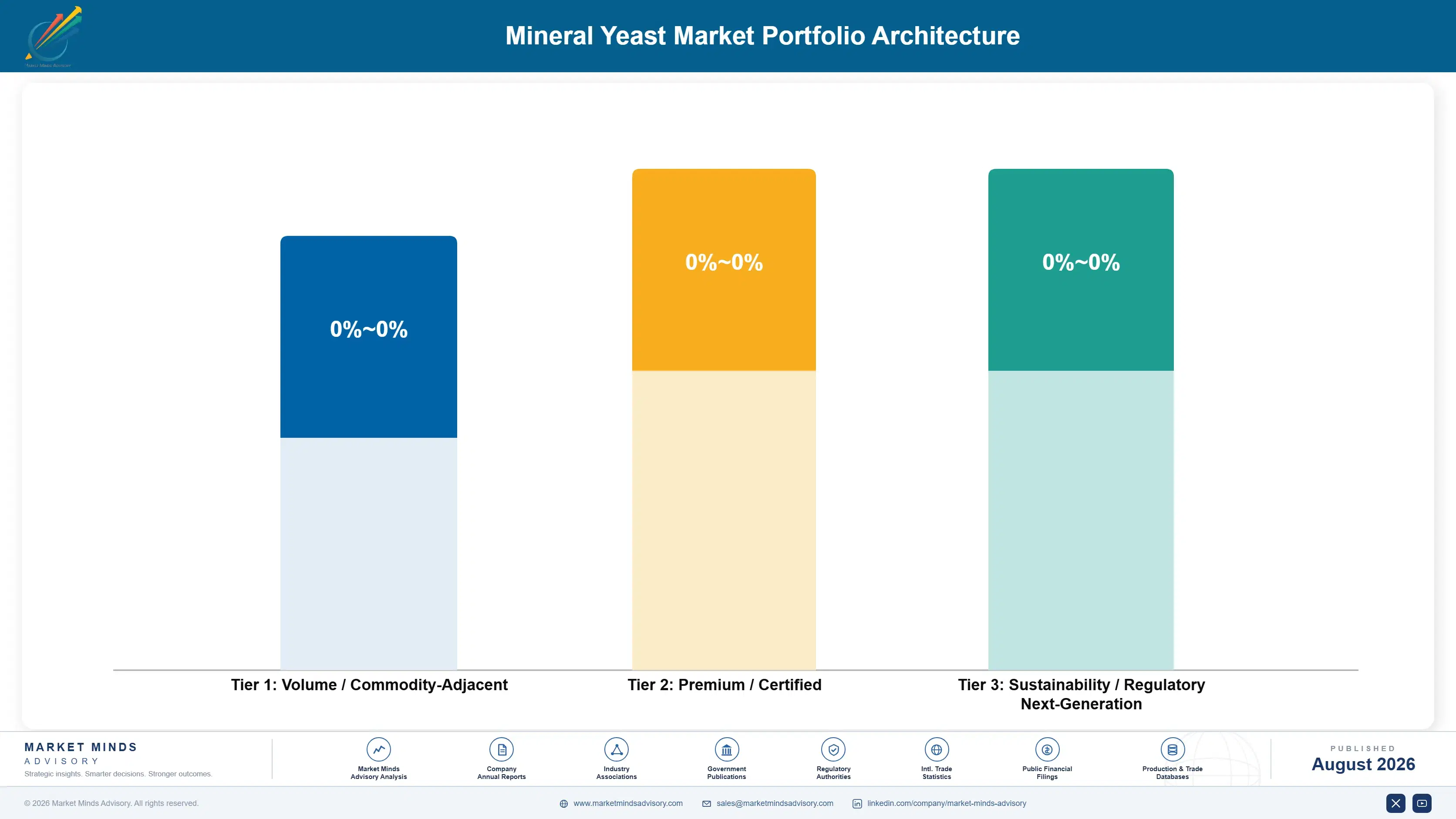
Portfolio Architecture for Margin Defence

Portfolio economics here divide on authorisation status rather than on mineral chemistry. Unauthorised feed grade sold into unregulated applications competes directly against inorganic salts costing a fraction as much, and that is a contest fermentation cost guarantees the yeast producer loses on price whatever the retention data shows. Retention data does not close a price gap of that size.
The middle tier is authorised feed grade in regulated applications. Authorisation excludes chemically identical competitors who have not completed their own evaluation, environmental limits on excreted minerals push formulators toward retention, and margins reach the high twenties. The volume is cyclical with feed mill margins, which is the cost of a business built on tonnage. Authorisation is what keeps identical competitors out.

Above both sits human supplement grade with cleared regulatory status. Formulators pay considerable premiums for bioavailability, the ingredient rarely appears on a front label so the cost sits inside a formulation, and margins reach the high forties. The position requires jurisdiction-by-jurisdiction regulatory work with no mutual recognition anywhere, which is precisely why so few producers hold broad supplement access. Very few producers hold broad supplement access.

Volume / Commodity-Adjacent

Unauthorised feed grade competing against inorganic salts on delivered cost. The range reflects mineral feedstock and fermentation cost rather than commercial skill, and fermentation guarantees losing any price contest. Price is the whole conversation.
Gross Margin: 11 to 18%

Premium / Certified

Authorised feed grade supplied into regulated applications with excretion limits. The range reflects which authorisations are held and whether retention evidence links to outcomes formulators can actually measure themselves. Feed cyclicality applies here.
Gross Margin: 25 to 33%

Sustainability / Regulatory / Next-Generation

Human supplement grade with cleared regulatory status in the target market. The wide range reflects how many jurisdictions the producer has cleared and whether the mineral carries permitted claim language there.
Gross Margin: 42 to 52%
mineral-yeast-market-trends-forecast-portfolio-architecture-1787375269179

High-value Sub-segments and Strategic Watch-out

Human Supplement Grade Mineral Yeasts

High value and high growth together, generating roughly 48% of category profit on a fraction of the tonnage. The wide range reflects how many jurisdictions a producer has cleared and whether permitted claim language accompanies the mineral there. No mutual recognition exists anywhere. Regulatory work is the entry cost.
Gross Margin: 42 to 52%

Authorised Selenium Yeast Supply

High value on the strongest regulatory position in the category. Selenomethionine incorporation into tissue protein is the technical argument that convinced nutritionists. The range reflects feedstock cost against feed contract pricing, which moves independently of nutrition. Regulatory position protects this segment. Authorisation protects the pricing here.
Gross Margin: 33 to 41%

Authorised Feed Grade Volume

The tonnage core of this market and what actually fills fermentation capacity. The range reflects authorisation holdings and whether retention evidence ties to production outcomes formulators can measure directly in their own operations. Cyclicality follows feed mill margin directly across seasons. Authorisation holdings decide who competes.
Gross Margin: 25 to 33%

Unauthorised Commodity Feed Supply

The strategic watch-out. Competing against inorganic salts costing a fraction as much is a contest fermentation cost guarantees losing, whatever the retention data shows. The range reflects feedstock and fermentation cost rather than any commercial decision. Fermentation cost guarantees losing this contest. Retention data changes nothing at all.
Gross Margin: 11 to 18%

How Mineral Yeast Demand Repeats

Two repeat mechanisms operate here and they carry entirely different reliability. A human supplement formulation names a specific ingredient in a validated product, and that volume repeats for as long as the product is manufactured because reformulation triggers regulatory and stability work the brand gains nothing from. Feed inclusion repeats annually only while the formulator's cost calculation continues to favour it.
Stickiness varies sharply by application. Supplement formulations hold best by a wide margin, since the ingredient is named in filings and changing it can require notification in several markets at once. Authorised feed applications governed by excretion limits hold well, because the regulatory driver survives cost pressure. Aquaculture holds well where survival outcomes are measurable. General livestock feed inclusion holds worst, revisited at every formulation review.

The buyer profile has changed considerably. Feed purchasing once sat with nutritionists arguing bioavailability and now sits with formulation teams balancing compliance obligations against mill margin, which is a colder conversation. On the supplement side the buyer has moved from marketing-led brand teams toward regulatory and technical functions, which rewards producers with cleared jurisdictional status and disadvantages those selling on a bioavailability story alone.
mineral-yeast-market-trends-forecast-end-use-penetration-index-1787375269664

Where To Compete And Why

These are among the four positions where our research anticipates prominent divergence between winners and laggards over the coming forecast period. Each is grounded in the demand model, the regulatory perimeter, and the announced capacity pipeline.
01 / AUTHORISATION PORTFOLIO BUILDING

Nobody inherits somebody else's approval

European feed additive authorisation attaches to a named production strain and process rather than to the mineral form, so a competitor with a chemically identical product must run its own evaluation from the very beginning. That takes around 41 months and considerable money with no guarantee at the end of it. Holders realise 34% to 42% higher pricing than unauthorised equivalents, and the barrier is procedural rather than technical, which makes it far more durable than any formulation advantage could ever be.
02 / DUAL MARKET CAPACITY FILLING

Feed fills the plant, supplements pay

Fermentation capacity is expensive and idle assets are the most damaging cost in this business, which is why feed tonnage at roughly 71% of volume matters even at genuinely modest margin. Supplement grades then generate roughly 48% of category profit on a fraction of that volume without needing any additional capacity. Producers running both halves achieve 25% to 33% better asset utilisation and absorb feed cyclicality without ever idling a vessel, which is where the real money is made or lost.
03 / OUTCOME EVIDENCE GENERATION

Serum data does not move formulators

Feed formulators substitute on compliance obligations and outcomes they can measure rather than on general nutritional argument, so retention near 2.3 times inorganic salts converts only when it is linked to something visible. Trials tying retention to survival rates, growth curves or excretion compliance move decisions that bioavailability data alone leaves stalled for years. The studies cost less than a season of commercial argument and the evidence does not expire afterwards the way a commercial relationship with a formulator eventually does.
04 / REGULATORY ENTRY SEQUENCING

Largest market, longest dossier

Human supplement frameworks developed independently with no mutual recognition anywhere, so a mineral yeast cleared in one market may need entirely separate work costing around 18 months before another accepts it at all. Entering in order of regulatory proximity rather than market size cuts total time to multi-market presence by 30% to 40%. Producers sequencing by demand alone discover that the biggest opportunity carries the longest dossier and the least transferable evidence of all, which is an expensive thing to learn late.

Engagement Snapshot From the Field

A live engagement with an industry participant carrying material or product regulatory and market exposure ahead of a defining policy shift, showing how our research translates into a defensible multi-year portfolio strategy.
MARKET MINDS ADVISORY · CLIENT ENGAGEMENT SUMMARY
Mineral Yeast Producer Strategic Portfolio Review and Transition Roadmap 2026·Investment Scenario on Mineral Yeast Exposure Evaluation 2025-26
CLIENT PROFILE
A European specialty fermentation ingredient producer with annual revenue near $142 million (client-reported, unverified by MMA), roughly 82% of it from animal feed grade mineral yeasts supplied across nine countries. The business held two European feed authorisations and modern fermentation capacity, but almost no human supplement presence and no cleared supplement status outside its home market.
STRATEGIC CHALLENGE
Feed formulators had pushed back hard on pricing across two seasons of grain and energy inflation, compressing margins on volume that fills most of the plant. Chinese producers were pursuing authorisations rather than competing on price. Management needed to decide between defending feed share, expanding the authorisation portfolio, or building human supplement access.
MMA APPROACH
MMA modelled contribution by grade and authorisation status across four years of the client's own data, benchmarked cost position against Chinese and North American producers, and assessed supplement regulatory pathways by jurisdiction and mineral. Twenty-two expert interviews with feed formulators, supplement brand technical leads and regulatory consultants tested where the client could genuinely compete.
KEY FINDINGS
  1. Feed contribution had fallen for eight consecutive quarters while supplement grade contribution per tonne ran roughly five times higher, on volume the client had never seriously pursued outside its home market.
  2. Both existing authorisations covered minerals where Chinese producers had submitted their own dossiers, which would erode the pricing protection within roughly three years on current timelines.
  3. Supplement regulatory pathways clustered by proximity rather than by market size, and the client's home market clearance transferred more readily to three neighbouring jurisdictions than anybody had assessed.
  4. Fermentation capacity utilisation ran at 71%, and supplement volume could have been added without any capital investment at all had the regulatory access existed to sell it.
CLIENT PROFILE
A European specialty fermentation ingredient producer with annual revenue near $142 million (client-reported, unverified by MMA), roughly 82% of it from animal feed grade mineral yeasts supplied across nine countries. The business held two European feed authorisations and modern fermentation capacity, but almost no human supplement presence and no cleared supplement status outside its home market.
STRATEGIC CHALLENGE
Feed formulators had pushed back hard on pricing across two seasons of grain and energy inflation, compressing margins on volume that fills most of the plant. Chinese producers were pursuing authorisations rather than competing on price. Management needed to decide between defending feed share, expanding the authorisation portfolio, or building human supplement access.
MMA APPROACH
MMA modelled contribution by grade and authorisation status across four years of the client's own data, benchmarked cost position against Chinese and North American producers, and assessed supplement regulatory pathways by jurisdiction and mineral. Twenty-two expert interviews with feed formulators, supplement brand technical leads and regulatory consultants tested where the client could genuinely compete.
KEY FINDINGS
  1. Feed contribution had fallen for eight consecutive quarters while supplement grade contribution per tonne ran roughly five times higher, on volume the client had never seriously pursued outside its home market.
  2. Both existing authorisations covered minerals where Chinese producers had submitted their own dossiers, which would erode the pricing protection within roughly three years on current timelines.
  3. Supplement regulatory pathways clustered by proximity rather than by market size, and the client's home market clearance transferred more readily to three neighbouring jurisdictions than anybody had assessed.
  4. Fermentation capacity utilisation ran at 71%, and supplement volume could have been added without any capital investment at all had the regulatory access existed to sell it.
RECOMMENDED STRATEGY
Phase 1: Phase one: pursue supplement clearance in the three jurisdictions where home market evidence transfers most readily, since capacity already exists and only access is missing. Phase 2: Phase two: submit authorisation dossiers for two additional minerals where no Chinese competitor has yet filed, extending the protected position before it erodes. Phase 3: Phase three: hold feed share on service and evidence rather than price, accepting some volume loss where formulators are buying purely on cost.
OUTCOME
The client cleared supplement status in two of the three target jurisdictions within thirteen months and lifted supplement grades from 18% to 34% of revenue (client-reported, unverified by MMA). Capacity utilisation reached 89% without capital investment, blended gross margin improved by roughly eleven points, and both additional authorisation dossiers were filed during 2026.

Frequently Asked Questions

Foundational context covering the market sizes, CAGR, scope, country, region and competition that inform every finding below. This section is provided to cover basics and most often pre-purchase conversations, answered from the MMA Primary Research Dataset.

What is the current size of the Mineral Yeast Market?

The global mineral yeast market was valued at $0.80 billion in 2025, reaching an estimated $0.86 billion in 2026. That covers minerals bound into yeast biomass through fermentation for feed and supplement use.

How large will the Mineral Yeast Market be by 2036?

MMA forecasts the market reaching $1.72 billion by 2036, an increase of $0.86 billion over the 2026 base. That represents an expansion multiple of 2.00 times across the forecast period.

What is the CAGR for the Mineral Yeast Market 2026 to 2036?

The base case compound annual growth rate is 7.2%, with a bull case of 8.4% and a bear case of 6.0%. Historical growth between 2020 and 2025 ran at 6.2% annually.

Which segment is growing fastest?

Selenium yeast grows at 10.8%, a full 1.50 times the market rate, on the strongest clinical and regulatory position in the category. Human supplement grade mineral yeasts follow at 9.2%.

Who are the major companies in the Mineral Yeast Market?

Alltech, Lallemand, Lesaffre, Angel Yeast and Associated British Foods lead on mineral yeast revenue. Together they account for roughly 63%, high because authorisation narrows the supplier base.

Which country is growing fastest?

India grows fastest at 10.1% annually as poultry and aquaculture production consolidates from smallholder operations into commercial integrations that formulate feed properly. China follows closely.

Report Segmentation Architecture

The full report scope spans multiple orthogonal segmentation dimensions, with cross-tabulated demand data provided for each dimension pair. Coverage extends further to regional breakdowns, trend trajectories, and the competitive detail needed to support segment-level decision-making.

By Product Type

  • Selenium Yeast
  • Human Supplement Grade Mineral Yeasts
  • Animal Feed Grade Mineral Yeasts
  • Yeast-Derived Mineral Premixes
  • Organic Certified Mineral Yeast

By End-Use Industry

  • Poultry Feed
  • Swine and Ruminant Feed
  • Aquaculture Feed
  • Human Dietary Supplements
  • Functional Food and Beverage
  • Pet and Companion Animal Nutrition

By Commercial Dimension

  • Direct Supply to Feed Manufacturers
  • Premix and Blender Channel
  • Supplement Contract Manufacturer Supply
  • Brand Owner Direct Supply
  • Distributor and Trading Channel

By Region

  • North America
  • Western Europe
  • East Asia
  • South Asia and Pacific
  • Latin America
  • Middle East and Africa
  • Eastern Europe

Scope, Methodology, and Coverage

Every figure in this report is reproducible from documented input assumptions. The scope below maps the historical period, the forecast horizon, the segmentation dimensions, and the countries covered, alongside the underlying primary and qualitative methodology.
Historical Period
2020 to 2025
Forecast Period
2026 to 2036
Base Year
2025 (USD billions; MMA Primary Research Dataset, August 2026)
Market Definition
This report covers minerals bound into yeast biomass through controlled fermentation, spanning selenium yeast, human supplement grade mineral yeasts including zinc, chromium, iron and copper, animal feed grade mineral yeasts, yeast-derived mineral premixes, and organic certified mineral yeast, across direct feed supply, premix, contract manufacturing, brand owner and distribution channels. Inorganic mineral salts, chelated and proteinated minerals produced without fermentation, yeast extracts sold for flavour, nutritional yeast sold as a food, and probiotic yeast strains are excluded from the sizing.
Quantitative Units
USD billions at producer realised value; volume in thousand tonnes; realised pricing in USD per kilogram.
Segmentation Dimensions
By product type; by end-use industry; by commercial dimension; by region.
Regions Covered
North America, Western Europe, East Asia, South Asia and Pacific, Latin America, Middle East and Africa, Eastern Europe
Countries Covered
China, Japan, South Korea, India, Thailand, Vietnam, Indonesia, Australia, United States, Canada, Mexico, Brazil, Chile, Germany, France, Netherlands, Spain, Poland, Turkey, South Africa.
Key Companies Profiled
Alltech, Lallemand, Lesaffre, Angel Yeast, Associated British Foods, Cargill, Archer Daniels Midland, Kemin Industries, Novus International, Zinpro Corporation, Chr. Hansen, Leiber GmbH, Diamond V, DSM-Firmenich and others.
Quantitative Methodology
Primary survey, n=3,800 respondents, Q4 2025, six countries; demand-side model with trade association cross-validation
Qualitative Methodology
47 expert interviews, Q4 2025; applied to validate demand model assumptions, identify emerging dynamics, and assess competitive positioning
Report Format
PDF and XLSX data workbook (Word format preview document)
Publisher
Market Minds Advisory
Report Code
MMA-2026-CHM-152
Published
August 2026
Contact
sales@marketmindsadvisory.com | www.marketmindsadvisory.com

Purchase the full Mineral Yeast Market Report (2026 to 2036).

The full report sizes the mineral yeast market across five product types, six end-use categories and seven regions, with tonnage and per kilogram pricing detail behind every value estimate. It profiles twenty companies on authorisation holdings, fermentation capacity and supplement regulatory access. Regional chapters cover feed formulation practice, excretion limits and supplement frameworks by market. Cost analysis quantifies fermentation, mineral feedstock and regulatory maintenance exposure by portfolio breadth. Authorisation analysis maps which strains and processes are cleared in each jurisdiction and by which producer holds them.
Tonnage and per kilogram pricing by product type
Feed additive authorisations mapped by strain and jurisdiction
Supplement regulatory pathways compared across major markets
Retention and bioavailability evidence assessed by application
Competitive position assessments across twenty companies
Fermentation capacity utilisation and dual market economics analysed

Built For The People Who Decide

From boardroom strategy to bench-side execution, this report is read cover-to-cover by leaders shaping the next decade of their industry, turning demand scenarios, market dynamics and valuation benchmarks into decisions.
CXOs/ Presidents/ VPs/ Managers
M&A and Corporate Development
Strategy Teams and R&D Heads
Procurement and Product Directors
Regulatory and Compliance Leaders
Investor Relations and Equity Analysts