Market Minds Advisory
Milking Robots Market

Milking Robots Market: Milking Robots Market. Labor Scarcity Accelerates Dairy Automation Adoption

Dairy farms are replacing scarce, costly milking labor with voluntary robotic systems as herd sizes grow and rural workforce availability shrinks, pushing equipment vendors toward software-driven herd analytics as the real product.

Lead Analyst

Published

September 2026

Make Smarter Decisions with Customized Research Insights

Request a free sample report and evaluate market opportunities, growth trends, and competitive dynamics relevant to your business needs.

2025 MARKET VALUE$3.1BMarket Size 2025
2036 FORECAST VALUE$7.6BBase Case , 2026 to 2036
CAGR 2026 TO 20368.5 %Bull 9.7% / Bear 7.3%
INCREMENTAL OPPORTUNITY$4.2BNet 10- year value creation
EXPANSION MULTIPLE2.26x2036 value over 2026 base
Strategic Levers
M&A Pipeline
Regional Outlook
Country Rankings
Competitive Intelligence
Segmental Deep-dive
Call-Us : 91 93563 13602

Executive Snapshot and Market Trajectory.

Dairy farms are finally replacing scarce, costly milking labor with voluntary robotic systems as herd sizes consolidate onto fewer, larger operations while rural workforce availability continues shrinking across nearly every major dairy-producing country worldwide, forcing a genuine technology transition industry-wide.
Herd management software and analytics drive fastest adoption, since converting raw milking data into actionable breeding, health, and feeding decisions delivers meaningfully more value than the automated milking hardware alone ever could in isolation. Western Europe leads deployment given the region's dense dairy farming culture and earliest robotic milking commercialization history, while mobile and modular robotic units increasingly extend automation into smaller and mid-size farms that fixed rotary installations previously priced entirely out of reach.
A moderately concentrated group of established milking equipment manufacturers competes alongside specialized dairy technology vendors, with software analytics depth increasingly separating winners from vendors offering hardware alone without meaningful herd insight capability built into the platform. Financing structures across jurisdictions continue to reshape which vendors can make robotic systems accessible to mid-size farms without requiring the substantial upfront capital that historically limited adoption to only the largest dairy operations and cooperatives.
Market Definition
The milking robots market covers automated voluntary milking systems, robotic teat cleaning and attachment modules, and integrated herd management software purpose-built for dairy farms. It excludes conventional manual milking parlors, generic feed distribution equipment, and dairy processing machinery unrelated to the milking process itself.
Base Year Value
$3.1B in 2025 (MMA Primary Research Dataset, September 2026)
Forecast Period
2026 to 2036, eleven discrete annual values
CAGR
8.5% base case. Bull 9.7%. Bear 7.3%.
Fastest Growth Segment
Robotic Milking Herd Management Software and Analytics: 13.0% CAGR
Fastest Growth Country
India: 12.0% CAGR
Fastest Growth Region
South Asia and Pacific: 10.5% CAGR
Largest Region
Western Europe: 30% of 2025 global value
Market Leaders
Lely, DeLaval, GEA Group, Fullwood Packo, BouMatic
Primary Survey
n=3,800 procurement and R&D decision-makers, Q4 2025, six countries
Methodology
Demand-side build-up, cross-validated against public data, 47 expert interviews

Milking Robots Market Forecast Scenarios

milking-robots-market-size-forecast-scenario-1789988075940
Milking robot adoption grew steadily through 2020 to 2023 as dairy farms facing pandemic-era labor shortages accelerated automation investment that many operations had previously deferred for years, then continued expanding from 2024 as financing programs made robotic systems accessible to smaller farms, lifting the historical growth rate to roughly 7.5 percent annually across the category.
Base case growth to 2036 rests on three commercial mechanisms: rural dairy labor scarcity intensifying as agricultural workforces age and younger generations decline farm work, herd management software maturing enough to deliver measurable breeding and health outcomes that justify capital investment beyond labor savings alone, and dairy cooperative financing programs expanding to make robotic systems accessible to mid-size farms previously priced entirely out of the category. These mechanisms reinforce each other across different farm sizes, sustaining steady growth without depending on any single dominant catalyst.
A bull scenario centers on a major dairy-producing country mandating minimum wage increases that make manual milking labor commercially unsustainable, which would compress adoption timelines across the industry within a single planning cycle. The bear risk is sustained low milk pricing that constrains farm capital budgets, which has historically delayed robotic system purchase decisions industry-wide for a year or more.

Where Herd Analytics Determine Farm Profitability

Herd analytics depth has become the primary purchasing criterion, since farms cannot justify the substantial capital investment in robotic milking hardware without software that converts raw data into actionable breeding, health, and feeding decisions. Vendors that once competed narrowly on milking throughput speed now compete on data platform sophistication, which shifts engineering investment toward analytics and connectivity rather than mechanical hardware alone.
MARKET CONCENTRATIONCR5 55%a moderately concentrated base of established milking equipment manufacturers
AVERAGE SYSTEM COST$180K per robotic stalltypical installed cost for a single voluntary milking system stall
TOP ADOPTING COUNTRY SHARENetherlands 18%concentrated robotic milking penetration reflecting the technology's commercialization origin
LABOR COST REDUCTION35% lower with robotsmilking-related labor cost versus conventional parlor operations at comparable scale
MILK YIELD IMPROVEMENT8-12% higher per cowaverage yield increase attributed to more frequent voluntary milking visits
FINANCING PENETRATION RATE42% of new installationsnew robotic system purchases now using dairy cooperative financing programs
Financing accessibility remains a significant barrier for mid-size farms, since the substantial upfront capital robotic systems require historically limited adoption to only the largest, best-capitalized dairy operations able to absorb multi-year payback periods. Milk yield improvement from more frequent voluntary milking visits meaningfully strengthens the investment case, since cows visiting milking stations more often than twice-daily parlor schedules typically produce measurably more milk over comparable lactation periods.
Integration with broader farm management software is becoming a baseline expectation rather than a differentiator, concentrating advantage among vendors who can demonstrate reliable data exchange with feed management and breeding record systems already in use. Meanwhile several vendors are extending analytics capability into predictive health monitoring that flags developing illness before visible symptoms emerge, which could meaningfully expand the addressable value proposition within the next several product cycles.
"Every manufacturer sells the robot as a labor replacement; the smart ones sell the data platform underneath it. The farms getting real payback are the ones using the herd insights to cull unproductive cows, not just the ones who stopped waking up at four in the morning."
Director, Agricultural Technology and Automation Practice · MMA Automated Robotic Milking Systems and Herd Management Technology for Dairy Farms Practice · September 2026

Market Trends

Predictive Health Monitoring Becomes Standard Analytics Layer

Robotic milking vendors are increasingly embedding predictive health monitoring capability that flags developing illness, lameness, and fertility issues before visible symptoms emerge, using milk composition, activity, and rumination data collected automatically during every voluntary milking visit throughout the day. This capability has meaningfully reduced veterinary intervention costs at farms running mature analytics deployments, since earlier detection allows treatment before conditions worsen into more expensive emergency interventions requiring specialist care. Roughly 45 percent of new robotic system installations now include predictive health analytics as a standard feature, up sharply from a much smaller share just three years earlier.
Market Impact: 70% cite labor scarcity

Modular and Mobile Units Reach Smaller Farms

Equipment manufacturers are introducing modular, lower-cost robotic milking units designed for smaller herds that previously found fixed multi-stall installations commercially unjustifiable given their substantial upfront capital requirements relative to smaller operation revenue. These modular systems let farms start with a single robotic stall and expand incrementally as herd size grows, spreading capital investment across multiple purchasing decisions rather than requiring one large upfront commitment. Roughly 30 percent of new robotic installations in 2025 went to farms with fewer than 150 cows, a segment that barely participated in the category five years earlier.
Market Impact: 8-12% higher milk yield per cow

Market Opportunities and Growth Drivers

Rural Labor Scarcity Makes Manual Milking Unsustainable

Dairy farms across most major producing countries face persistent difficulty hiring reliable milking labor, since the early-morning and late-evening shift schedule conventional parlors require has become increasingly unattractive to available rural workforce populations that continue shrinking and aging across generations. This labor scarcity has pushed farms that once considered robotic milking a luxury investment to treat it as an operational necessity for maintaining consistent herd management without depending on labor availability that has become genuinely unreliable in many regions. Roughly 70 percent of dairy farms surveyed cite labor availability as their primary reason for considering robotic milking investment.
Market Impact: Systems cost $150-220K per stall

Milk Yield Gains Strengthen the Investment Case

Cows visiting voluntary milking stations more frequently than the twice-daily schedule conventional parlors impose typically produce measurably more milk over comparable lactation periods, since more frequent milking better matches natural udder physiology and reduces the discomfort that can suppress production during extended intervals between milkings. This yield improvement provides a direct revenue justification for robotic system investment beyond pure labor cost savings, meaningfully improving the return on investment calculation that farm financial decision-makers evaluate before committing capital. Farms report yield improvements of roughly 8 to 12 percent following robotic milking adoption compared to prior conventional parlor operations.
Market Impact: Downtime often costs $2-4K per incident

Market Restraints and Challenges

High Upfront Capital Cost Limits Smaller Farms

A single robotic milking stall typically costs well over a hundred thousand dollars installed, a capital commitment difficult for smaller farms to justify even accounting for labor savings and yield gains accumulated over a multi-year payback period. The root cause is that robotic hardware combines precision mechanical components, sensors, and software into a complex system costing considerably more to manufacture than simpler conventional parlor equipment. The commercial impact is that adoption remains concentrated among larger, better-capitalized farms able to absorb the upfront investment. Vendors mitigate this by expanding financing programs and introducing modular systems that spread capital investment across purchases.
Market Impact: 45% of installs now analytics-equipped

Technical Expertise Requirements Strain Farm Staff

Robotic milking systems require ongoing technical maintenance and troubleshooting expertise that many traditional dairy farm staff lack, since diagnosing sensor malfunctions and software issues demands skills considerably different from the mechanical and animal husbandry expertise conventional parlor operation historically required. The root cause is that the technology has evolved faster than the training infrastructure needed to develop broadly available technical support skills across rural farming communities. This has caused some farms to experience costly downtime while awaiting service technicians for issues staff cannot resolve independently. Vendors are mitigating this by expanding remote diagnostic capability and investing in farmer training programs.
Market Impact: 30% of installs at smaller farms
3 additional market trends, 4 additional growth drivers, and 3 additional restraints and challenges are covered in the full report. Contact sales@marketmindsadvisory.com to access the complete intelligence.

Segment CAGR and Growth Architecture

Segmentation follows system function within robotic milking operations, spanning herd management software and analytics, mobile and modular robotic units, multi-stall and rotary systems, single-stall systems, and automated teat cleaning and attachment modules, each addressing a genuinely distinct functional role rather than overlapping farm size, herd category, or ownership structure segments within this entire market.
milking-robots-market-market-share-analysis-1789988076500

Robotic Milking Herd Management Software and Analytics

Robotic milking herd management software and analytics leads growth as farms finally treat data platforms as the primary value driver rather than treating milking hardware as a standalone labor-replacement tool with limited additional benefit. These platforms combine milk composition analysis, activity monitoring, and predictive health flagging to help farm managers make breeding, culling, and feeding decisions that meaningfully improve herd productivity beyond what automated milking mechanics alone could ever deliver on their own. Large commercial dairy operations are adopting this segment fastest, since their herd scale generates enough data volume to make sophisticated analytics investment genuinely worthwhile relative to smaller operations lacking comparable scale. Vendors combining deep analytics with intuitive dashboards are capturing disproportionate share of this expanding software investment.
CAGR 13.0%

Mobile and Modular Robotic Milking Units

Mobile and modular robotic units are the second-fastest growing segment, driven by equipment manufacturers finally offering entry points for smaller and mid-size farms that fixed multi-stall installations previously priced entirely out of the robotic milking category due to substantial upfront capital requirements relative to smaller operation revenue. These systems let farms start with a single robotic stall and expand incrementally as herd size grows and cash flow allows, spreading capital investment across multiple purchasing decisions over several years rather than requiring one large upfront commitment. Small and mid-size family farms are adopting this segment fastest, since modular expansion finally makes robotic milking commercially accessible. Vendors offering flexible financing alongside modular hardware win share fastest.
CAGR 12.0%
Full segment breakdown across 5 segments available in the complete report.

Regional Architecture and Country Demand Map

Western Europe leads on the region's dense dairy farming culture and earliest robotic milking commercialization history, while North America follows closely behind on large-scale commercial dairy consolidation, and South Asia and Pacific posts the fastest regional growth on expanding dairy mechanization investment across the region today.

Western Europe

The Netherlands and Sweden pioneered commercial robotic milking technology decades ago through Lely and DeLaval respectively, giving the region unusually mature adoption density and farmer familiarity relative to markets where the technology remains newer. This region's share sits above the standard regional band precisely because robotic milking originated and commercialized here first, producing a uniquely dense, multi-decade installed base that no other region can match at comparable scale. Germany, France, and Denmark account for a substantial share of regional demand, reflecting dense dairy farming populations and strong cooperative financing infrastructure. Growth going forward centers more on software upgrades and modular expansion than new farm-level adoption, keeping expansion below the fastest-growing markets despite the considerable installed base.
Share: 30% | CAGR: 7.0% (2026 to 2036)

North America

US dairy operations have consolidated substantially onto fewer, larger farms over the past two decades, and these larger operations increasingly view robotic milking as essential infrastructure for managing herd scale without proportional labor force growth. Major equipment manufacturers maintain strong dealer networks across the country's dense dairy-producing regions, particularly in the upper Midwest and California, supporting rapid installation and service response. Canadian dairy farms are following a similar consolidation and automation trajectory under comparable labor market pressures. Large commercial dairy operations continue driving a substantial share of near-term robotic system demand as herd sizes expand and rural labor availability tightens further. Mexican dairy operations are following a comparable consolidation curve closely behind.
Share: 26% | CAGR: 8.5% (2026 to 2036)
Regional intelligence for 5 additional markets available in the complete report: East Asia, South Asia and Pacific, Latin America, Middle East and Africa, Eastern Europe. Contact sales@marketmindsadvisory.com.
milking-robots-market-country-cagr-analysis-1789988077020

Where Milking Robot Vendors Should Expand Next

Beyond core hardware sales, vendors are building adjacent commercial layers around herd analytics subscription fees, financing and leasing programs, extended service contracts, and predictive health data licensing, each extending overall contract value well past the initial system installation into sustained multi-year farm relationships across large and mid-sized dairy operations located everywhere across the globe.

Recurring Herd Analytics Subscription Fee Programs

Vendors are converting one-time analytics software sales into recurring subscription fees, since herd management insight requires continuous data processing and model updates rather than a single point-in-time software license that becomes stale as herd composition evolves. These subscriptions now generate roughly 20 percent of total contract value at several leading vendors, well above the negligible share subscriptions represented when analytics remained a bundled hardware feature rather than a standalone offering. Farmers value the ongoing insight enough to accept recurring fees, and vendors report meaningfully higher retention when analytics are delivered as a continuous service.
Market Impact: 20% of contract value now from subscriptions today

Farm Financing and Leasing Program Structures

Financing and leasing programs are opening access to mid-size farms that could not otherwise justify the substantial upfront capital robotic systems require, converting what was once a binary purchase decision into a more manageable ongoing operating expense that fits within existing farm cash flow cycles. These financing arrangements now cover roughly 42 percent of new system installations, reflecting genuine demand among farms that would otherwise remain priced out of the category entirely. Vendors offering flexible financing report meaningfully higher win rates than those requiring full upfront payment from prospective customers.
Market Impact: 42% of new installs now use financing programs

Extended Preventive Maintenance Service Contract Programs

Extended service contracts covering preventive maintenance and rapid technical response are commanding meaningful incremental revenue beyond hardware sales, since farms consistently underestimate the technical expertise required to diagnose sensor and software issues robotic systems occasionally experience during operation. These contracts now represent roughly 26 percent of total revenue at several leading vendors, reflecting genuine willingness to pay for guaranteed uptime given how costly missed milking cycles become for dairy operations. Vendors offering this service report meaningfully higher customer retention than those leaving farms without dedicated support. Larger vendors increasingly prefer offering this service directly.
Market Impact: 26% of revenue now from service contract programs

Predictive Health Data Licensing Program Structures

Predictive health data licensing agreements letting veterinary networks and animal health companies access aggregated, anonymized herd health insights are opening a new recurring data revenue stream distinct from traditional hardware and software fees entirely, without requiring vendors to build veterinary-facing sales capability internally. These data licensing arrangements have expanded average platform revenue by roughly 12 percent for vendors pursuing this model, reflecting genuine demand from animal health companies seeking better population-level insight than traditional veterinary records provide. Vendors lacking data licensing capability increasingly struggle to compete for the largest farm accounts against those offering this differentiated revenue stream.
Market Impact: 12% larger revenue via data licensing deals now

Who Controls the Margin Pool

Milking robots remain moderately concentrated, with the top five vendors holding an estimated 55 percent of the market on an installed-unit basis. Lely and DeLaval lead on breadth across global dealer networks and decades of commercialization history, while a gap separates them from smaller specialist challengers competing mainly on niche regional presence rather than platform scale.
Current competitive activity centers on three fronts: vendors racing to deepen herd management analytics to close the value gap with data-focused agricultural technology startups, larger equipment manufacturers acquiring specialized dairy software companies rather than building comparable capability internally, and several vendors expanding modular product lines to capture smaller farms previously priced out entirely. Pricing pressure has intensified modestly among mid-tier vendors competing for mid-size farm accounts larger players consider too small to prioritize.

Emerging pressure comes from agricultural technology startups entering herd analytics through software-only platforms compatible with multiple equipment brands, betting data insight can substitute for the deep hardware relationships established manufacturers have built over decades of dealer network investment. Rankings could shift meaningfully if a major dairy cooperative mandates a specific analytics standard across member farms, since that would compress the addressable market for standalone hardware vendors currently commanding premium equipment pricing.
milking-robots-market-company-positioning-matrix-1789988077548

Competitive Moat and Risk Dimensions

LELY

Moat: Deepest global dealer network

Lely's decades of investment in a global dealer and service network give it installation and maintenance response capability that specialized software-only entrants cannot match, letting it win farm accounts prioritizing rapid service response over pure analytics sophistication across every major dairy region and export market.
LELY

Risk: Slower software iteration pace

As a hardware-centric manufacturer, Lely's analytics software iterates more slowly than venture-backed agricultural technology specialists focused purely on data platform capability, risking share loss among farms prioritizing the most advanced herd insight over established equipment reliability and long-standing dealer relationships built over many decades of investment.
DELAVAL

Moat: Strong dairy cooperative relationships

DeLaval's long-standing relationships with dairy cooperatives across major producing regions give it privileged access to financing program partnerships that individual farms cannot easily replicate independently, letting it win accounts where cooperative-backed financing determines equipment vendor selection more than product features alone or price comparisons made.
DELAVAL

Risk: Premium pricing limits smaller farms

DeLaval's premium positioning across its product portfolio limits its competitiveness among smaller farms prioritizing lower upfront cost over brand reputation and comprehensive analytics depth, ceding volume share in cost-conscious smaller farm segments to lower-cost regional manufacturers focused narrowly on price and basic functionality alone today.

Players Tracked

Prominent Players

Lely
DeLaval
GEA Group
Fullwood Packo
BouMatic

Other Key Players

Afimilk
Dairymaster
Waikato Milking Systems
Milkline
Interpuls
Nedap
Datamars
Trioliet
CRV
Hokofarm Group
SAC Christensen
Insentec
Fabdec
Hanskamp
Schauer Agrotronic

Recent Developments

FEBRUARY 2026

Lely Acquires Predictive Health Analytics Startup

Lely acquired a small predictive health analytics startup specializing in early illness detection using milk composition and activity data, folding the technology directly into its herd management platform rather than continuing to rely on third-party analytics partners for advanced health monitoring capability across its global customer base.
Signal: Large equipment manufacturers are increasingly securing analytics capability through direct acquisition rather than external software partnerships.
OCTOBER 2025

DeLaval Signs Dairy Cooperative Financing Partnership

DeLaval signed a multi-year financing partnership with a major dairy cooperative network to expand access to robotic milking systems for mid-size member farms, replacing a previously limited financing option that had restricted adoption to larger, better-capitalized cooperative members exclusively for many years across the industry.
Signal: Manufacturers are increasingly partnering directly with dairy cooperatives to expand financing access for these mid-size farms.
MAY 2025

GEA Group Launches Modular Entry-Tier System

GEA Group launched a modular entry-tier robotic milking system aimed at smaller farms previously priced out of the category, allowing incremental expansion from a single stall as herd size grows rather than requiring the full upfront investment traditional multi-stall installations historically demanded from most customers.
Signal: Vendors are increasingly launching modular products to capture smaller farms previously excluded entirely from this category.

Precision Component Costs Shape Vendor Margins

Precision sensors, robotic actuators, and stainless steel components together represent roughly 60 percent of cost of goods sold for milking robot manufacturers, notably higher than conventional parlor equipment cost structures face today. Sensor and actuator components alone account for close to 38 percent, reflecting the precision engineering required for reliable automated teat attachment and cleaning.
Precision sensor and actuator component pricing rose sharply during 2022 and 2023, following broader industrial automation component supply constraints documented in major manufacturing industry supply chain reports published during that period across the entire industry. Manufacturers serving high-volume production programs absorbed meaningfully higher component costs for several consecutive quarters before securing improved supplier allocation terms roughly a year later at considerably more favorable pricing terms.

Smaller manufacturers lacking scale to negotiate favorable component supply contracts face a real cost disadvantage against larger vendors like Lely, who can spread sensor and actuator sourcing costs across a broader product portfolio and negotiate volume discounts unavailable to smaller specialists entirely. This dynamic increasingly pushes smaller vendors toward niche regional markets where larger vendors see insufficient contract value to compete aggressively on price alone.
milking-robots-market-cost-volatility-analysis-1789988077747

Multi-Source Component Supply Agreements

Manufacturers are qualifying second and third-source precision sensor and actuator suppliers across multiple geographies and continents to reduce dependence on any single component manufacturer, using competitive bidding among qualified suppliers to keep component cost growth well below customer pricing expectations during periods of industry-wide supply tightness and unexpected constraint across the entire global sector.

Design Standardization Across Product Lines

Vendors are standardizing sensor and actuator components across multiple product tiers rather than designing unique components for each system variant, meaningfully reducing per-unit tooling and procurement costs while still allowing meaningful feature differentiation through software rather than proprietary hardware alone across every product line, price tier, and geographic market segment served worldwide today consistently.

Vertical Integration Into Component Manufacturing

Larger manufacturers are acquiring or building in-house precision component manufacturing capability to reduce reliance on third-party suppliers entirely, a capital-intensive strategy that smaller manufacturers cannot easily replicate without significant outside investment or a strategic partnership arrangement with a component specialist willing to share proprietary designs, manufacturing know-how, and dedicated fabrication capacity for the long term.

Portfolio Architecture for Margin Defence

Milking robots span three commercial tiers: basic single-stall systems at the volume end, certified multi-stall and rotary systems meeting reliability benchmarks in the middle, and integrated herd analytics platforms at the premium top, with gross margins expanding meaningfully from the commodity tier through to next-generation systems that command significantly higher recurring revenue per farm relationship and herd scale.
Volume-tier single-stall systems face persistent price pressure from farms treating basic automated milking as commoditized equipment, while premium analytics platforms increasingly capture disproportionate margin as farms pay for herd insight rather than milking mechanics alone. Vendors straddling both tiers face internal tension allocating engineering resources between defending existing hardware accounts and building the next-generation analytics capability premium farms now demand.

High-value margin pools concentrate heavily around herd management analytics and predictive health monitoring, where large commercial dairy operations pay meaningfully more for measurable reductions in veterinary cost and improved breeding decisions. Smaller vendors without analytics depth remain confined to lower-margin hardware work, ceding the fastest-growing and most profitable segment entirely to larger, better-capitalized competitors with deeper software and dealer network budgets. This margin gap widens further each year.

Volume / Commodity-Adjacent Tier

Basic single-stall robotic milking systems serving smaller farms with minimal analytics capability beyond simple milking scheduling and basic yield tracking functionality without deeper herd insight or any predictive capability whatsoever.
Gross Margin: 22-30%

Premium / Certified Tier

Certified multi-stall and rotary systems meeting reliability benchmarks, offering integrated herd tracking that meaningfully reduces the manual record-keeping burden larger operations otherwise face across every shift, season, and lactation cycle.
Gross Margin: 36-44%

Sustainability / Regulatory / Next-Generation Tier

Integrated herd analytics platforms combining predictive health monitoring, breeding recommendations, and feed optimization, commanding the highest per-farm pricing among the largest commercial dairy operations across every major dairy-producing region worldwide.
Gross Margin: 48-58%
milking-robots-market-portfolio-architecture-1789988078255

High-value Sub-segments and Strategic Watch-out

Robotic Milking Herd Management Software and Analytics

This segment combines the fastest unit growth in the market with the highest per-farm pricing, as operations pay premium rates for analytics that reduce veterinary cost and improve breeding decisions, making it the clearest priority for vendor R&D investment over the next several years across farms.
Gross Margin: 52-60%

Mobile and Modular Robotic Milking Units

Growing quickly on manufacturers finally reaching smaller farms, this segment carries strong margins though slightly below the analytics leader, as vendors increasingly bundle modular hardware with financing to justify premium pricing over fixed installations sold widely today, quite consistently, reliably, predictably, and repeatedly overall across the market.
Gross Margin: 40-48%

Multi-Stall and Rotary Robotic Systems

A large installed-base segment growing at a moderate pace today, this category remains the anchor product most large commercial farms purchase first before considering broader analytics investment, anchoring overall category volume even as growth increasingly and consistently shifts toward newer software products each year overall.
Gross Margin: 32-40%

Single-Stall Robotic Milking Systems

Growth here trails the fastest segments today, and vendors risk this category commoditizing further as basic single-stall hardware becomes a standard feature bundled into broader financing packages rather than sold separately as a distinct standalone product for most farms today and going forward each year.
Gross Margin: 20-28%

Why Farm Contracts Compound Over Decades

Milking robot relationships increasingly function as annuity products rather than one-time equipment purchases, since analytics subscriptions, financing fees, and service contracts attach to the initial installation and recur across a farm's typical ten to fifteen year equipment replacement cycle and beyond. Vendors capturing this attached recurring revenue build customer lifetime value multiples well above the original hardware purchase price.
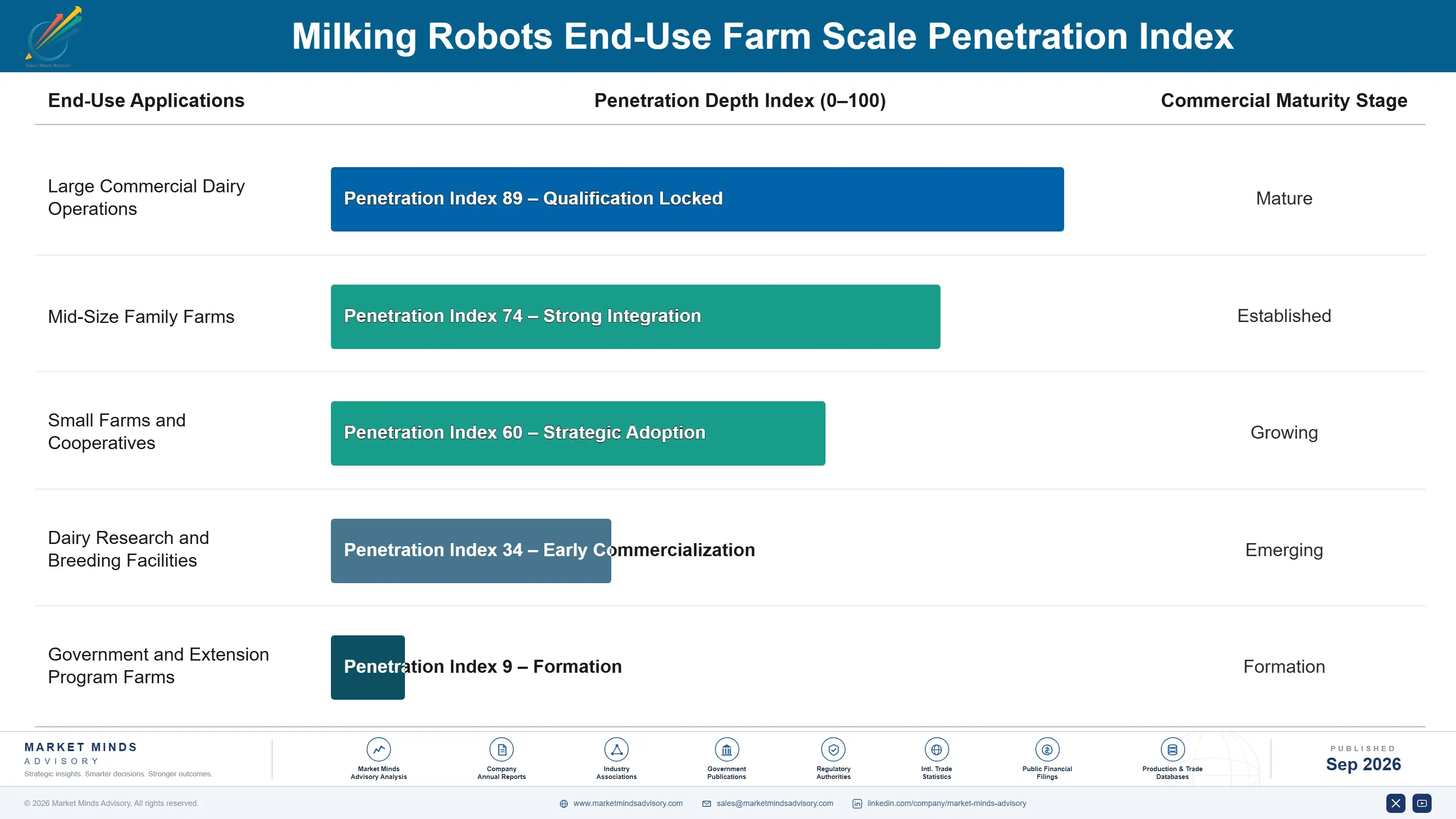
Adoption depth varies meaningfully by farm scale: smaller operations adopt shallowly, using basic milking automation without deep analytics integration, while large commercial dairy operations integrate vendor relationships deeply into breeding, feeding, and veterinary decision workflows, creating switching costs that keep those operations within a single vendor's product family across multiple equipment generations, herd expansion cycles, and successive farm ownership transitions.

Buyer profiles are shifting generationally as dairy operations increasingly include dedicated farm technology managers who evaluate vendor selection through analytics accuracy and financing flexibility criteria rather than pure equipment reliability comparisons alone. Younger farm operators entering these roles expect measurable proof of yield improvement and cost reduction before purchase, favoring vendors who can demonstrate quantified outcomes over long-standing incumbent relationships built on legacy brand familiarity and tenure.
milking-robots-market-end-use-penetration-index-1789988078751

Priorities for Milking Robot Vendors

These are among the four positions where our research anticipates prominent divergence between winners and laggards over the coming forecast period. Each is grounded in the demand model, the regulatory perimeter, and the announced capacity pipeline.
01 / HERD ANALYTICS INVESTMENT

Build Insight Platforms, Not Just Hardware

Farms increasingly evaluate robotic milking investment on the analytics capability layered on top of the hardware rather than milking mechanics alone, and vendors who lead with documented herd insight outcomes during procurement evaluations close larger farm contracts meaningfully faster than those emphasizing mechanical reliability alone across their sales conversations and proposals. Genuine analytics depth, not milking throughput specifications, wins the largest commercial dairy accounts today. Vendors treating software as an afterthought rather than a core product are losing ground steadily.
02 / FINANCING ACCESSIBILITY EXPANSION

Build Financing Programs Before Rivals Do

The substantial upfront capital robotic systems require has historically limited adoption to only the largest, best-capitalized farms, making financing and leasing program development a durable competitive advantage that expands the addressable market meaningfully beyond what pure hardware sales could ever reach on their own across every single farm segment. Vendors that build flexible financing early capture disproportionate share among mid-size farms that competitors without comparable programs simply cannot serve. Financing capability is becoming as commercially valuable as equipment reliability itself.
03 / MODULAR PRODUCT DEVELOPMENT

Build Entry Tiers for Smaller Farms

Smaller farms represent a substantial addressable market that fixed multi-stall installations have historically priced entirely out of the category, and vendors offering modular systems that let farms start small and expand incrementally are winning accounts that competitors requiring full upfront installation simply cannot reach at all across most regional markets. Building this capability now positions vendors ahead of the smaller-farm adoption wave that shows no signs of slowing across major dairy-producing regions. Modular design is becoming a genuine competitive differentiator.
04 / SERVICE NETWORK DEVELOPMENT

Invest in Rapid Technical Response Capability

Farms cannot tolerate extended downtime on equipment central to daily milking operations, and vendors lacking rapid technical response capability will increasingly lose accounts to competitors who can credibly guarantee fast service response regardless of farm location or system complexity involved in the diagnosis. Vendors investing in expanded dealer networks and remote diagnostic capability now will avoid the customer trust erosion that slow service response has historically caused across the industry. Service reliability is becoming as valuable as the equipment itself.

Engagement Snapshot From the Field

A live engagement with an industry participant carrying material or product regulatory and market exposure ahead of a defining policy shift, showing how our research translates into a defensible multi-year portfolio strategy.
MARKET MINDS ADVISORY · CLIENT ENGAGEMENT SUMMARY
Milking Robots Producer Strategic Portfolio Review and Transition Roadmap 2026·Investment Scenario on Milking Robots Exposure Evaluation 2025-26
CLIENT PROFILE
The client is a mid-size family dairy farm milking roughly 220 cows through a conventional parlor requiring two full-time employees for early-morning and evening milking shifts each day. Annual labor costs for milking-related staffing exceeded $95,000 (client-reported, unverified by MMA), a cost the family had struggled to sustain given persistent difficulty finding reliable rural labor.
STRATEGIC CHALLENGE
The farm's owners faced a choice between continuing to rely on increasingly scarce and unreliable hired labor or investing substantial capital in robotic milking equipment they had never operated before. Leadership needed a transition strategy that would minimize herd disruption during the changeover while providing confidence that the capital investment would generate adequate returns within a reasonable payback period.
MMA APPROACH
MMA benchmarked the farm's labor costs and milk yield against comparable robotic milking case data from similarly sized operations, modeling expected payback period under conservative and optimistic adoption scenarios. The engagement combined financial modeling with a phased herd transition plan that introduced robotic milking gradually rather than converting the entire herd simultaneously.
KEY FINDINGS
  1. Comparable farms of similar herd size reported labor cost reductions substantial enough to justify the capital investment within a five to seven year payback period.
  2. A phased herd transition reduced the risk of widespread milk production disruption compared to converting the entire herd to robotic milking simultaneously.
  3. Financing options available through the farm's dairy cooperative meaningfully reduced the upfront capital burden compared to a full outright cash purchase entirely.
  4. Cows generally adapted to voluntary milking within two to three weeks, with only a small minority requiring extended transition support and encouragement.
CLIENT PROFILE
The client is a mid-size family dairy farm milking roughly 220 cows through a conventional parlor requiring two full-time employees for early-morning and evening milking shifts each day. Annual labor costs for milking-related staffing exceeded $95,000 (client-reported, unverified by MMA), a cost the family had struggled to sustain given persistent difficulty finding reliable rural labor.
STRATEGIC CHALLENGE
The farm's owners faced a choice between continuing to rely on increasingly scarce and unreliable hired labor or investing substantial capital in robotic milking equipment they had never operated before. Leadership needed a transition strategy that would minimize herd disruption during the changeover while providing confidence that the capital investment would generate adequate returns within a reasonable payback period.
MMA APPROACH
MMA benchmarked the farm's labor costs and milk yield against comparable robotic milking case data from similarly sized operations, modeling expected payback period under conservative and optimistic adoption scenarios. The engagement combined financial modeling with a phased herd transition plan that introduced robotic milking gradually rather than converting the entire herd simultaneously.
KEY FINDINGS
  1. Comparable farms of similar herd size reported labor cost reductions substantial enough to justify the capital investment within a five to seven year payback period.
  2. A phased herd transition reduced the risk of widespread milk production disruption compared to converting the entire herd to robotic milking simultaneously.
  3. Financing options available through the farm's dairy cooperative meaningfully reduced the upfront capital burden compared to a full outright cash purchase entirely.
  4. Cows generally adapted to voluntary milking within two to three weeks, with only a small minority requiring extended transition support and encouragement.
RECOMMENDED STRATEGY
Phase 1: Phase 1 (Months 1-2): Install new robotic milking equipment for a subset of the herd while still maintaining parlor operations. Phase 2: Phase 2 (Months 3-6): Gradually transition the remaining herd to full robotic milking as cows adapt to voluntary station visits. Phase 3: Phase 3 (Months 7-9): Fully decommission the old conventional parlor and optimize herd management using the newly collected analytics data.
OUTCOME
Within nine months of completing the full transition, the farm reported milking-related labor costs declining by roughly 68 percent (client-reported, unverified by MMA), alongside a measured milk yield increase of approximately 9 percent (client-reported, unverified by MMA) attributed to more frequent voluntary daily station visits.

Frequently Asked Questions

Foundational context covering the market sizes, CAGR, scope, country, region and competition that inform every finding below. This section is provided to cover basics and most often pre-purchase conversations, answered from the MMA Primary Research Dataset.

What is the current size of the Milking Robots Market?

The milking robots market was valued at $3.1 billion in 2025. It is projected to reach $3.36 billion in 2026 as labor scarcity accelerates automation adoption.

How large will the Milking Robots Market be by 2036?

The market is projected to reach $7.60 billion by 2036, up from $3.36 billion in 2026. That represents a 2.26 times expansion over the forecast decade.

What is the CAGR for the Milking Robots Market 2026 to 2036?

The market is projected to grow at an 8.5 percent CAGR between 2026 and 2036. This is up from a historical CAGR of roughly 7.5 percent between 2020 and 2025.

Which segment is growing fastest?

Robotic milking herd management software and analytics leads growth at a 13.0 percent CAGR, roughly 1.53 times the overall market rate. Farms increasingly value data insight over milking mechanics alone.

Who are the major companies in the Milking Robots Market?

Lely, DeLaval, GEA Group, Fullwood Packo, and BouMatic are the five largest participants by installed-unit basis. Together they hold an estimated 55 percent of the global market.

Which country is growing fastest?

India is the fastest-growing country at a 12.0 percent CAGR, driven by the world's largest dairy sector scaling up and seeking mechanization. Persistent rural labor challenges reinforce this trajectory further.

Report Segmentation Architecture

The full report scope spans multiple orthogonal segmentation dimensions, with cross-tabulated demand data provided for each dimension pair. Coverage extends further to regional breakdowns, trend trajectories, and the competitive detail needed to support segment-level decision-making.

By System Function Type

  • Robotic Milking Herd Management Software and Analytics
  • Mobile and Modular Robotic Milking Units
  • Multi-Stall and Rotary Robotic Systems
  • Single-Stall Robotic Milking Systems
  • Automated Teat Cleaning and Attachment Modules
  • Predictive Health Monitoring Systems

By End-Use Farm Scale

  • Large Commercial Dairy Operations
  • Mid-Size Family Farms
  • Small Farms and Cooperatives
  • Dairy Research and Breeding Facilities
  • Government and Extension Program Farms

By Commercial Dimension

  • Direct Manufacturer Sales
  • Dealer and Distributor Channel Sales
  • Financing and Leasing Programs
  • Extended Service Contract Bundles

By Region

  • North America
  • Western Europe
  • East Asia
  • South Asia and Pacific
  • Latin America
  • Middle East and Africa
  • Eastern Europe

Scope, Methodology, and Coverage

Every figure in this report is reproducible from documented input assumptions. The scope below maps the historical period, the forecast horizon, the segmentation dimensions, and the countries covered, alongside the underlying primary and qualitative methodology.
Historical Period
2020 to 2025
Forecast Period
2026 to 2036
Base Year
2025 (USD billions; MMA Primary Research Dataset, September 2026)
Market Definition
The milking robots market covers automated voluntary milking systems, robotic teat cleaning and attachment modules, and integrated herd management software purpose-built for dairy farms. It excludes conventional manual milking parlors, generic feed distribution equipment, and dairy processing machinery unrelated to the milking process itself.
Quantitative Units
USD billions (current prices); installed unit count where applicable
Segmentation Dimensions
By System Function Type; By End-Use Farm Scale; By Commercial Dimension; By Region
Regions Covered
North America, Western Europe, East Asia, South Asia and Pacific, Latin America, Middle East and Africa, Eastern Europe
Countries Covered
USA, China, Germany, France, UK, Japan, South Korea, India, Australia, Canada, Brazil, Mexico, Indonesia, Vietnam, Thailand, Malaysia, UAE, Saudi Arabia, South Africa, Nigeria, Turkey, Poland, Netherlands, Italy, Spain, Sweden, Switzerland, Argentina, Colombia, Singapore, and additional markets relevant to this sector
Key Companies Profiled
Lely, DeLaval, GEA Group, Fullwood Packo, BouMatic, Afimilk, Dairymaster, Waikato Milking Systems, Milkline, Interpuls, Nedap, Datamars, Trioliet, CRV, Hokofarm Group, SAC Christensen, Insentec, Fabdec, Hanskamp, Schauer Agrotronic
Quantitative Methodology
Primary survey, n=3,800 respondents, Q4 2025, six countries; demand-side model with trade association cross-validation
Qualitative Methodology
47 expert interviews, Q4 2025; applied to validate demand model assumptions, identify emerging dynamics, and assess competitive positioning
Report Format
PDF and XLSX data workbook (Word format preview document)
Publisher
Market Minds Advisory
Report Code
MMA-2026-CON-658
Published
September 2026
Contact
sales@marketmindsadvisory.com | www.marketmindsadvisory.com

Purchase the full Milking Robots Market Report (2026 to 2036).

This report delivers a comprehensive analysis of the global milking robots market, spanning system function segmentation, regional demand dynamics, and competitive positioning across twenty profiled companies worldwide. It includes ten-year forecasts through 2036, detailed input cost and margin analysis across three commercial tiers, and revenue diversification strategies for vendors navigating the shift toward herd analytics platforms. The analysis draws on primary survey data, expert interviews, and company disclosures to support procurement, investment, and product strategy decisions. It closes with an anonymized client transition case study illustrating measured labor and yield outcomes.
System function segmentation with detailed growth forecasts
Seven-region demand analysis through the 2036 forecast
Competitive benchmarking of twenty profiled global vendors
Input cost and gross margin tier breakdown analysis
Revenue diversification and recurring pricing lever analysis
Anonymized client transition case study with outcomes

Built For The People Who Decide

From boardroom strategy to bench-side execution, this report is read cover-to-cover by leaders shaping the next decade of their industry, turning demand scenarios, market dynamics and valuation benchmarks into decisions.
CXOs/ Presidents/ VPs/ Managers
M&A and Corporate Development
Strategy Teams and R&D Heads
Procurement and Product Directors
Regulatory and Compliance Leaders
Investor Relations and Equity Analysts