Market Minds Advisory
Military Microgrid Market

Military Microgrid Market: Military Microgrid Market: Fourteen Days, Not Cheaper Electricity

Nobody here is buying cheaper electricity. They are buying fourteen days of operation after the grid fails, and the price per kilowatt hour barely enters the conversation at any point.

Lead Analyst

Published

September 2026

Make Smarter Decisions with Customized Research Insights

Request a free sample report and evaluate market opportunities, growth trends, and competitive dynamics relevant to your business needs.

2025 MARKET VALUE$2.2BMarket Size 2025
2036 FORECAST VALUE$8.0BBase Case , 2026 to 2036
CAGR 2026 TO 203612.4 %Bull 13.7% / Bear 11.1%
INCREMENTAL OPPORTUNITY$5.5BNet 10- year value creation
EXPANSION MULTIPLE3.22x2036 value over 2026 base
Strategic Levers
M&A Pipeline
Regional Outlook
Country Rankings
Competitive Intelligence
Segmental Deep-dive
Call-Us : 91 93563 13602

Executive Snapshot and Market Trajectory.

The specification here is a duration rather than a cost. A base must sustain its critical mission for 14 days with the utility gone, and every design decision follows from that number rather than from any comparison of levelised generation cost. Nobody here is optimising a tariff.
Mobile command and vehicle-integrated systems grow at 18.6%, half again the market rate of 12.4%, because a deployed headquarters needs power that arrives with it and sets up in hours rather than power somebody builds. North America holds 47% of demand, far outside any normal band, because United States legislation requires installations to sustain critical missions through utility failure and funds it directly. No other country has legislated that requirement quite so explicitly.
Concentration is moderate at 41% of contracted capacity, because integration rather than equipment is what gets bought and several kinds of firm can do it. The genuine barrier is certification: a microgrid controller is an operational technology system connected to critical infrastructure, and authorising one takes 26 months before anything switches on. That timeline excludes almost every commercial supplier who has not already started the process.
Market Definition
The military microgrid market covers islandable electrical systems integrating generation, storage, distribution and control to sustain defence operations independently of external utility supply, spanning fixed installation resilience microgrids, expeditionary and tactical microgrids, naval shore power and port microgrids, airfield and flightline microgrids, remote and arctic outpost systems, and mobile command and vehicle-integrated systems. Scope is measured as contracted microgrid capacity including integration and control. Excluded are conventional standby generators supplied without islanding control, utility grid infrastructure serving bases, vehicle propulsion systems, deployed generators sold as individual units, and civilian critical infrastructure microgrids.
Base Year Value
$2.2B in 2025 (MMA Primary Research Dataset, September 2026)
Forecast Period
2026 to 2036, eleven discrete annual values
CAGR
12.4% base case. Bull 13.7%. Bear 11.1%.
Fastest Growth Segment
Mobile Command and Vehicle-Integrated Systems: 18.6% CAGR
Fastest Growth Country
India: 14.6% CAGR
Fastest Growth Region
South Asia and Pacific: 14.6% CAGR
Largest Region
North America: 47% of 2025 global value
Market Leaders
Ameresco, Schneider Electric, Honeywell, Caterpillar and Siemens Energy. Source: MMA Analysis, July 2026.
Primary Survey
n=3,800 procurement and R&D decision-makers, Q4 2025, six countries
Methodology
Demand-side build-up, cross-validated against public data, 47 expert interviews

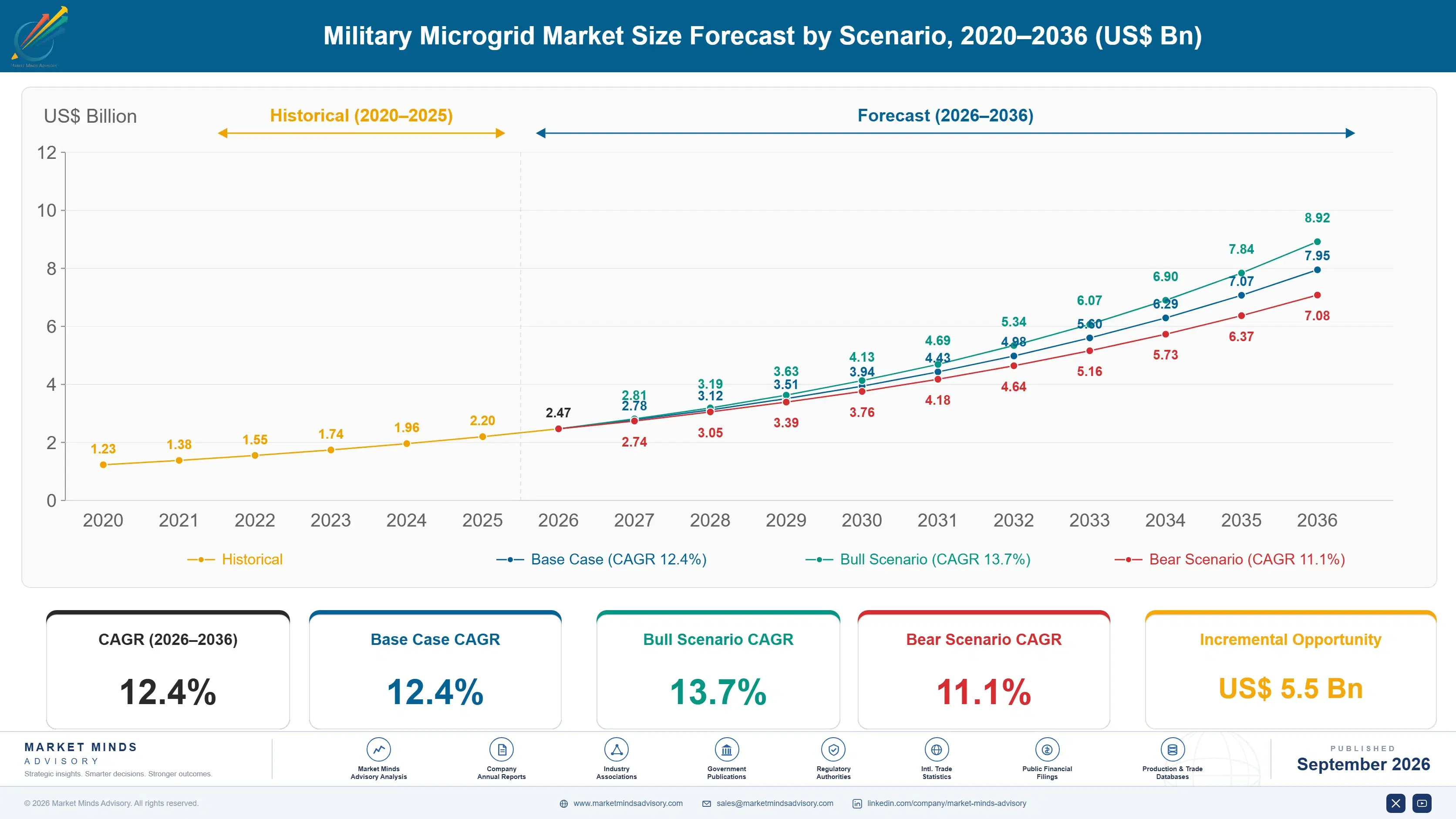
Military Microgrid Market Forecast Scenarios

military-microgrid-market-size-forecast-scenario-1788410830377
Between 2020 and 2025 the sector compounded at 11.0% and legislation rather than technology drove it. Energy resilience requirements written into United States defence authorisation converted an aspiration into an obligation with a funding line attached, and installations began contracting islandable systems rather than adding standby generators. Expeditionary programmes advanced separately on fuel logistics reasoning that had nothing to do with any grid.
The 12.4% base case rests on three mechanisms. Resilience mandates continue to apply across a very large installed base of fixed sites, most of which have not yet been addressed at all. Threat assessments of utility infrastructure have hardened rather than softened, which sustains the budget line through political cycles. And expeditionary requirements are being written into new platform and formation designs rather than retrofitted. None of the three depends on energy prices doing anything.
The bull case at 13.7% turns on European and allied programmes adopting comparable resilience mandates, which would multiply the addressable installation count well beyond the United States base. The bear case at 11.1% is procurement pace: defence acquisition cycles and cyber authorisation timelines are slow enough that funded requirements convert to contracts considerably more slowly than the budget line suggests.

A Duration, Not A Tariff

This is a readiness purchase written as an energy contract, which changes every assumption a commercial supplier brings to it. The requirement is that a base sustains its critical mission for 14 days without the utility, and the design follows from that duration and the threat behind it rather than from generation cost. A proposal leading with levelised cost is answering a question nobody asked.
TOP FIVE CONCENTRATION41%Share of contracted microgrid capacity held by five integrators
ISLANDED DURATION REQUIRED14 daysPeriod a base must sustain critical mission without utility
CYBER CERTIFICATION TIME26 monthsTime to obtain authorisation for a connected control system
EXPEDITIONARY FUEL DEMAND22 litresDaily fuel consumed per deployed person at a forward base
CONTRACT AWARD DURATION9 yearsTypical term of an energy resilience performance contract
SOLAR CONTRIBUTION SHARE31%Portion of installed generation from renewable sources on bases
Certification rather than engineering is the barrier that keeps most suppliers out. A microgrid controller supervising generation and switching on a defence installation is an operational technology system connected to critical infrastructure, and obtaining authorisation to operate takes around 26 months of documentation, testing and assessment before anything is energised. That timeline sits entirely outside the commercial world's experience and it excludes anybody who has not already begun.
The expeditionary side is a different business wearing the same name. A forward base consumes around 22 litres of fuel per person per day and every litre arrives by convoy through terrain somebody may be contesting, which makes generation efficiency a force protection question rather than an economic one. Weight, transportability and setup time dominate specifications that have nothing to do with a fixed installation.
"The commercial energy people who wander into this market keep presenting payback periods to customers who are buying insurance against losing a mission. It is not a hard adjustment to make and remarkably few of them make it."
Director, Defence Energy Systems Practice · MMA Energy Practice · September 2026

Market Trends

Resilience became a legislated obligation with funding attached

United States defence authorisation converted energy resilience from an efficiency aspiration into a requirement that installations sustain critical missions through utility failure, with a duration specified and a funding mechanism behind it. That single change moved the conversation from cost saving to mission assurance and made islandable systems a compliance item rather than a discretionary investment. Very large numbers of fixed installations remain unaddressed against that requirement. Allied countries are examining comparable mandates without having legislated them yet, which is where the next expansion of this market comes from. Legislation elsewhere is the next expansion.
Market Impact: Cuts convoys carrying 22 litres daily

Threat assessment hardened rather than softening

Assessments of physical and cyber threats to utility infrastructure serving defence installations have become more rather than less serious across recent years, which sustains resilience funding through political cycles that would otherwise reprioritise it. Substation attacks, ransomware against utility operational technology and grid failures during extreme weather have each provided concrete evidence rather than hypothetical scenarios. That evidence makes the budget line unusually durable, and it also means the specification keeps extending as assessments identify longer outages and more sophisticated attacks as credible. Assessments keep identifying longer outages and more sophisticated attacks as credible scenarios.
Market Impact: Funds across 9 year terms

Market Opportunities and Growth Drivers

Fuel logistics is a force protection problem

A forward operating base consumes around 22 litres of fuel per deployed person each day and every litre arrives by road convoy through terrain that an adversary may contest, which makes each percentage point of generation efficiency or solar contribution a reduction in convoy exposure rather than a saving on a fuel bill. That reasoning has driven expeditionary microgrid development for two decades and it has nothing whatever to do with energy economics. Weight, setup time and transportability dominate the resulting specifications entirely. Nothing about it is an energy economics argument at all.
Market Impact: Delays energisation by 26 months

Performance contracts fund what budgets cannot

Energy savings performance contracts and utility energy service arrangements let installations procure resilience infrastructure against future energy savings rather than against a capital appropriation, on terms typically running around nine years. That mechanism has funded a substantial share of installed capacity and it suits integrators willing to carry project risk and finance. It also means the commercial competition is partly about balance sheet and contracting capability rather than about microgrid engineering at all. That means part of this competition is balance sheet and contracting capability rather than microgrid engineering, which suits a very different kind of firm. Several have noticed.
Market Impact: Delays awards beyond 9 years

Market Restraints and Challenges

Cyber authorisation takes longer than construction

A microgrid controller supervising generation and switching on a defence installation is an operational technology system connected to critical infrastructure, and obtaining authorisation to operate requires documentation, testing and assessment running around 26 months before energisation. The root cause is that the control system is a potential attack surface on exactly the infrastructure it exists to protect. Commercial impact is a barrier that excludes suppliers unfamiliar with the process entirely. Participants are responding with pre-authorised control platforms, reusable documentation packages, early engagement with authorising officials and architectures that limit connectivity deliberately.
Market Impact: Requires 14 days of islanded operation

Procurement converts requirements to contracts slowly

Defence acquisition processes, competition requirements and appropriation timing mean a funded and validated requirement can take years to reach a contract award, and the number of installations awaiting resilience solutions substantially exceeds the number under contract. The root cause is a procurement system designed for accountability rather than for pace. Commercial impact is a pipeline far larger than the revenue it converts into. Mitigation runs through multiple award contract vehicles, performance contract mechanisms that bypass appropriation timing, and positioning on frameworks well before requirements are validated. The pipeline exceeds what converts.
Market Impact: Sustains funding across 3 cycles
3 additional market trends, 4 additional growth drivers, and 2 additional restraints and challenges are covered in the full report. Contact sales@marketmindsadvisory.com to access the complete intelligence.

Segment CAGR and Growth Architecture

Segmentation follows deployment type, the dimension on which duration requirement, transportability and certification burden all move together. Fixed installation systems carry the contracted capacity on multi-year resilience programmes. Mobile and expeditionary systems carry the growth, because both answer a logistics and force protection problem rather than any question about a utility connection. Certification gates both of them.
military-microgrid-market-market-share-analysis-1788410830922

Mobile Command and Vehicle-Integrated Systems

Mobile command and vehicle-integrated systems grow at 18.6%, half again the market rate of 12.4%, because a deployed headquarters requires power that travels with the formation and reaches operation within hours rather than infrastructure somebody constructs. Command posts now carry computing, communications and sensor loads that a decade of digitisation added without anybody revisiting the generation that supports them, and those loads are both larger and considerably less tolerant of interruption. Vehicle-integrated generation, storage and distribution answers that directly. Weight and volume constrain every design decision, and the certification burden is lighter than fixed installations face because the system is not connected to any external infrastructure at all. The lighter certification helps.
CAGR 18.6%

Remote and Arctic Outpost Systems

Remote and arctic outpost systems at 16.8% serve locations where resupply is seasonal, expensive and occasionally impossible, which makes generation autonomy a matter of whether the position remains occupied rather than of what power costs. Arctic and high latitude presence is expanding as strategic attention moves there, and those sites face temperatures that degrade batteries, defeat conventional diesel starting and complicate every maintenance operation. Solar contributes almost nothing for months at a time. The engineering is genuinely difficult, the volumes are small, and very few suppliers have equipment qualified for sustained operation at those temperatures anywhere in their range. Strategic attention has moved north considerably faster than the equipment qualification behind it, which leaves a genuinely narrow field of bidders.
CAGR 16.8%
Full segment breakdown across 6 segments available in the complete report.

Regional Architecture and Country Demand Map

North America takes 47%, far outside any normal band, because United States legislation mandates installation energy resilience and funds it directly. No allied country has matched that yet. A legislated mandate rather than any threat assessment or energy price decides where this market currently sits.

North America

A 47% share far outside any normal band rests on legislation that no other country has passed. United States defence authorisation requires installations to sustain critical missions through utility failure for a specified duration, with funding mechanisms and performance contract authorities behind it, which converted resilience from an aspiration into a compliance obligation with money attached. The installed base of fixed sites awaiting solutions is very large and the contracted portion remains small. Canadian requirements are smaller and follow arctic and remote considerations rather than grid threat. Cyber authorisation processes originating here now shape control system design worldwide. Contracted capacity remains a small fraction of the requirement. Authorisation processes originating here shape design worldwide.
Share: 47% | CAGR: 11.8% (2026 to 2036)

Western Europe

Allied resilience thinking here is genuine and considerably less codified than across the Atlantic, which produces demand driven by individual base decisions rather than by any legislated programme. Elevated threat assessments following events in Eastern Europe have raised attention to base energy security substantially, and several countries are examining mandates comparable to the American model without having legislated them. Nordic and Baltic installations face specific concerns about grid dependence and interconnection. European integrators hold strong positions on their own national programmes. Growth at 11.0% reflects a market where the requirement is understood and the funding mechanism is not yet settled. The requirement is understood and the funding mechanism is not yet settled anywhere.
Share: 18% | CAGR: 11.0% (2026 to 2036)
Regional intelligence for 5 additional markets available in the complete report: East Asia, South Asia and Pacific, Latin America, Middle East and Africa, Eastern Europe. Contact sales@marketmindsadvisory.com.
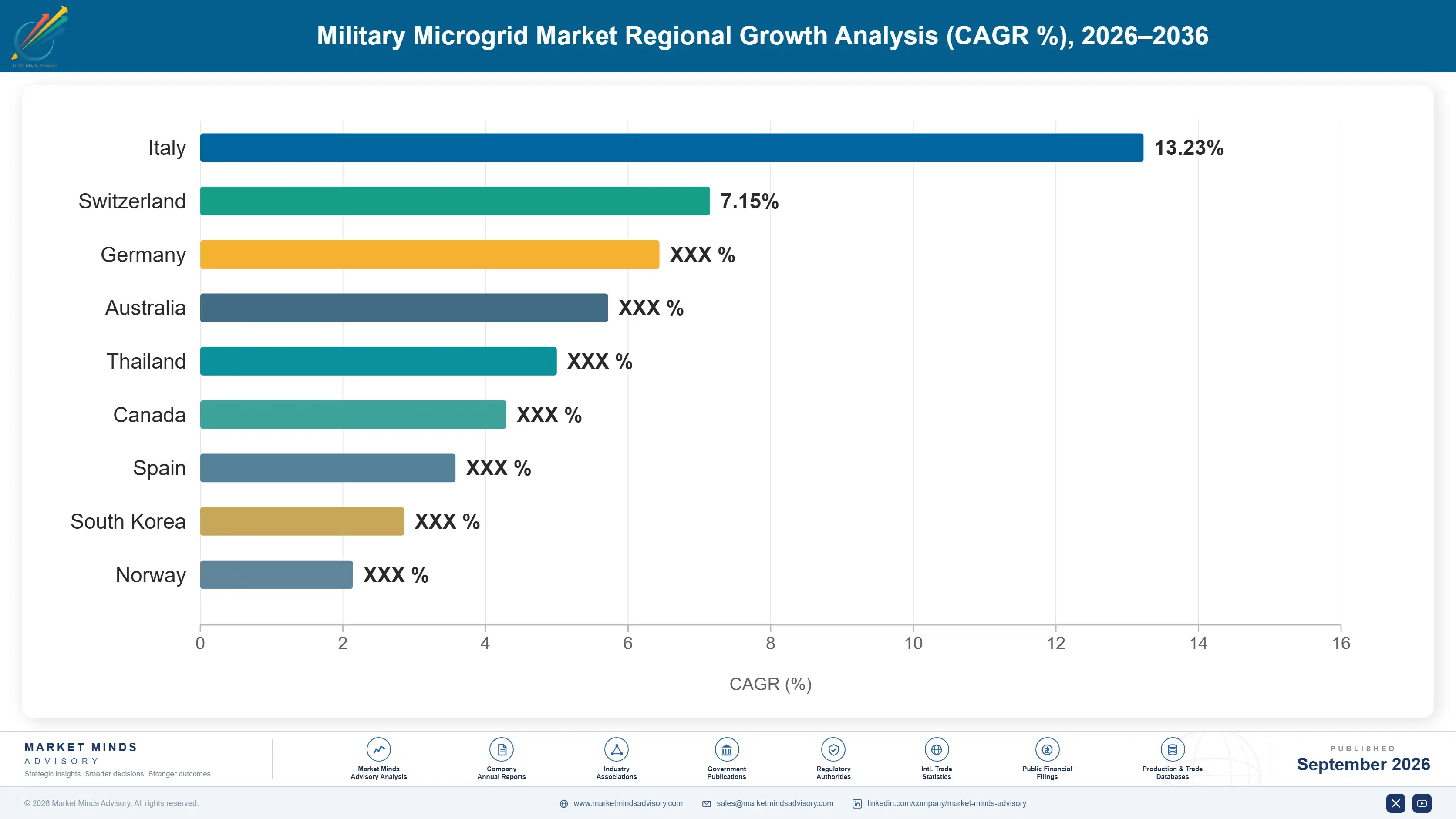
military-microgrid-market-country-cagr-analysis-1788410831442

Four Moves Inside Defence Procurement

None of these four is about microgrid engineering, because integrating generation, storage and switching is well understood and several kinds of firm do it competently. Each works on what actually gates this market: an authorisation process, a procurement system and a customer buying something other than electricity. None of it is engineering. These are procurement problems.

Get the control platform authorised in advance

Cyber authorisation for a control system connected to critical infrastructure takes around 26 months of documentation, testing and assessment before anything energises, and that timeline applies per platform rather than per project if the architecture is consistent. A supplier holding a pre-authorised platform can offer schedules competitors cannot approach, because they are starting the clock while the competitor is starting the paperwork. The investment is documentation and engagement rather than engineering. Very few commercial suppliers have completed it at all. Very few commercial suppliers have completed it at all. Documentation, not engineering.
Market Impact: Removes 26 months from every project that follows

Use performance contracts to bypass appropriation

Energy savings performance contracts and utility energy service arrangements fund resilience infrastructure against future savings rather than against a capital appropriation, on terms running around 9 years, which sidesteps the budget timing that delays conventional procurement by years. Using them requires balance sheet capacity and contracting capability rather than any technical advantage. A supplier able to carry that risk reaches installations that cannot otherwise fund anything. It is a financing competence competing in an engineering market. It is a financing competence winning inside an engineering market, which is unusual. Several firms have noticed.
Market Impact: Funds projects across a full 9 year term

Sell mission assurance, never cost savings

The requirement is 14 days of critical mission operation with the utility unavailable, and the customer is buying insurance against losing capability rather than a reduction in an energy bill they do not personally control. A proposal leading with levelised cost is answering a question nobody asked and signalling that the supplier has misunderstood the customer entirely. Reframing around threat scenarios, mission continuity and duration costs nothing but a different narrative. Commercial energy suppliers make this mistake with remarkable consistency. Commercial suppliers make this mistake consistently. It costs a different narrative and nothing else at all.
Market Impact: Assures a full 14 days of mission continuity

Qualify equipment for the conditions nobody tests

Remote and arctic systems grow at 16.8% and the constraint is equipment qualified for sustained operation at temperatures that degrade batteries, defeat diesel starting and complicate every maintenance action. Very few suppliers hold anything qualified for those conditions across their range, which leaves the ones that do facing genuinely limited competition. Qualification costs testing and engineering rather than any new product. Strategic attention is moving toward high latitude presence and the supplier base has not followed it. Qualification is testing rather than development, and the supplier base has not followed the strategy north.
Market Impact: Enters a segment now growing at 16.8% annually

Who Controls the Margin Pool

CR5 stands at 41% of contracted microgrid capacity, which is the only comparable basis since this activity sits inside far larger energy services, industrial and defence reporting for every participant. Concentration is moderate because integration rather than equipment is what gets contracted, and energy services firms, industrial groups and defence primes all compete for the same work from different starting positions.
Competition runs on cyber authorisation status, contracting vehicle access and financing capability. Authorisation decides who can offer a credible schedule. Vehicle access decides who can bid at all, since much of this work flows through multiple award frameworks positioned on years in advance. Financing decides who can use performance contracts where appropriations are unavailable. Microgrid engineering differentiates considerably less than any proposal suggests.

Rankings will move on allied programmes adopting resilience mandates, because the addressable installation count outside the United States is very large and almost entirely unaddressed. Whoever holds authorised platforms and national partnerships when those mandates arrive will be positioned as the American incumbents were. The pressure comes from legislation elsewhere rather than from competitors, and it is genuinely difficult to time.
military-microgrid-market-company-positioning-matrix-1788410831961

Competitive Moat and Risk Dimensions

AMERESCO

Moat: Performance contract capability and vehicles

Deep experience with energy savings performance contracts and access to the contracting vehicles through which much of this work flows lets the company fund and deliver projects that installations cannot otherwise appropriate for. That combination of financing capacity and procurement positioning took years to assemble. Competitors with better technology and no vehicle access cannot bid the work at all.
AMERESCO

Risk: Capital tied in long contracts

Carrying project financing across nine year performance contracts commits substantial balance sheet against government payment streams, which constrains how many projects can run concurrently regardless of demand. Growth requires capital rather than capability. A competitor with a larger balance sheet and equivalent vehicle access could take work the company simply cannot fund at the same time.
SCHNEIDER ELECTRIC

Moat: Control platform and authorisation status

Microgrid control platforms already carrying authorisation for connected operation on defence infrastructure let the company offer schedules that a supplier beginning the process cannot match, since the 26 month assessment applies per platform rather than per project. That documentation asset compounds across every subsequent installation. It is accumulated administrative work that no amount of engineering substitutes for.
SCHNEIDER ELECTRIC

Risk: Commercial pricing habits misfit

A commercial energy organisation optimising for cost and efficiency approaches a customer buying mission assurance with the wrong argument, and defence buyers notice when a supplier leads with payback rather than with duration and threat. The habit is organisational rather than technical. Competitors from the defence side make that adjustment naturally and win proposals on framing alone.

Players Tracked

Prominent Players

Ameresco
Schneider Electric
Honeywell
Caterpillar
Siemens Energy

Other Key Players

Eaton
Rolls-Royce
Cummins
Generac
PowerSecure
Tesla
Fluence
Hitachi Energy
Emerson
ABB
Leidos
Lockheed Martin
BAE Systems
Bechtel
Black and Veatch

Recent Developments

JANUARY 2025

Resilience requirements extended across additional installation categories

Energy resilience requirements were extended to cover additional categories of defence installation beyond the critical sites previously specified, substantially enlarging the population of bases required to demonstrate sustained operation without utility supply. The funded requirement now considerably exceeds the contracting capacity available to deliver against it.
Signal: The requirement here has grown considerably faster than anybody's actual ability to contract properly against it.
MAY 2025

Allied nations examined comparable resilience mandates

Several allied defence ministries began examining installation energy resilience requirements comparable to the American model, following threat assessments that hardened after sustained attacks on civilian electrical infrastructure elsewhere. None of them has yet legislated any duration requirement or attached a dedicated funding mechanism to it.
Signal: The next expansion of this market is a legislative decision taken in several capitals at once.
SEPTEMBER 2025

Arctic basing requirements exposed equipment qualification gaps

High latitude installation programmes identified that very few suppliers hold generation, storage and control equipment qualified for sustained operation at the temperatures involved, which narrowed the field of credible bidders considerably on several procurements. Qualification is a testing programme rather than any new development work.
Signal: Strategic attention has moved north and the supplier base has still not followed it up there.

Generation, Storage And Documentation

Generation equipment including engines, turbines and photovoltaic arrays accounts for roughly 34% of project cost, energy storage around 22%, and switchgear with distribution a further 16%. Control systems, integration engineering and cyber authorisation documentation make up most of the remainder, and that last item is far larger than any commercial project would carry because the assessment process itself consumes substantial engineering time.
Battery cell pricing fell substantially through recent years while defence project budgets were set years in advance, which produced the unusual situation of contracted projects delivering storage well below the assumed cost. Energy Information Administration reporting tracked the underlying movement. Suppliers holding firm-price contracts retained that benefit and those on cost-reimbursement terms returned it. The direction happened to favour suppliers, which is not the usual pattern in this sector.

The disadvantage falls on authorisation documentation rather than on equipment purchasing. A supplier maintaining an authorised control platform amortises that work across every project while one starting fresh carries 26 months of assessment on a single installation, which shows up as schedule rather than as a line in a cost model. No procurement advantage compensates for a competitor being able to energise two years earlier than you can.
military-microgrid-market-cost-volatility-analysis-1788410832156

Maintain one authorised control platform across projects

Cyber authorisation takes around 26 months and applies per platform rather than per project where the architecture stays consistent, which makes platform discipline the single largest schedule lever available. Varying the control architecture between installations forfeits that entirely and restarts the assessment. Suppliers maintaining one authorised platform quote schedules competitors cannot match at any price.

Reuse documentation packages across installations

Assessment documentation consumes substantial engineering time and most of it addresses the platform rather than the site, which means a properly structured package transfers between installations with site-specific supplements rather than being rewritten. Building it that way costs discipline at the first project and returns on every one afterwards. Most suppliers treat each authorisation as a fresh exercise.

Contract storage with pricing that follows cells

Battery pricing has moved substantially in both directions while defence project budgets are set years ahead, which exposes whoever holds the fixed side of that contract. Pricing storage against an index rather than a fixed figure protects both parties and removes an argument at delivery. Suppliers fixing prices through a falling market kept a windfall a rising one would reverse.

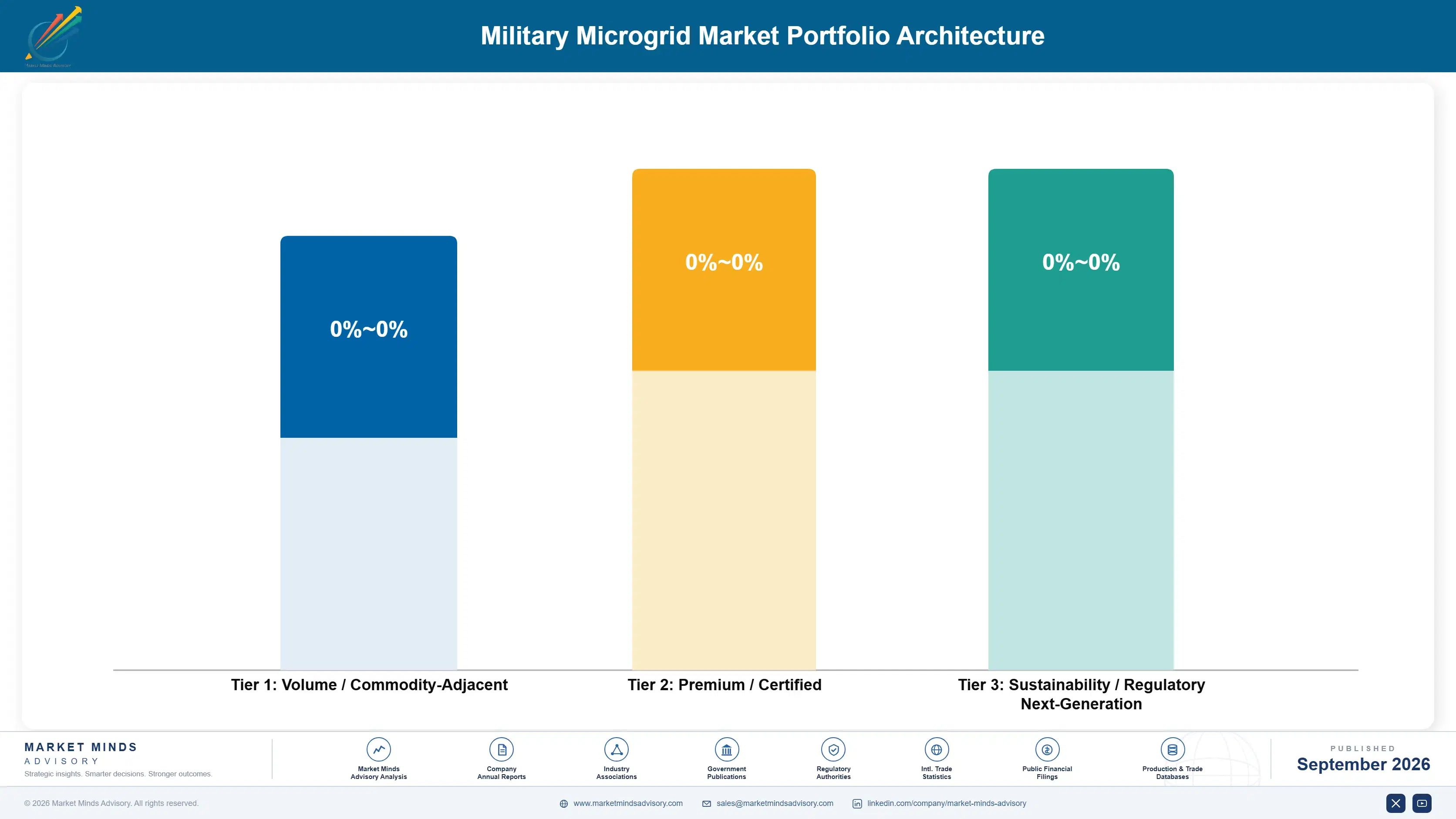
Portfolio Architecture for Margin Defence

Margin here follows authorisation and contracting position rather than equipment content, which no capability statement reflects. An integrator holding an authorised control platform and framework access delivers on a schedule competitors cannot offer and prices accordingly, using generation and storage equipment anybody can buy. Participants managing by position rather than by technical content run a completely different business from those still competing on system design.
Volume and premium pull against each other through the contracting vehicle rather than the factory. Fixed installation resilience work carries the contracted capacity that justifies maintaining authorisation, framework positions and cleared personnel, and that infrastructure is what makes the specialised expeditionary and arctic work reachable at all. A supplier holding only the difficult segments cannot sustain the overhead that defence contracting requires.

High-value pools sit in expeditionary systems, in arctic qualified equipment and in authorisation as a service, which nobody offers. The third is genuinely unclaimed: many capable equipment suppliers cannot enter this market because they will not spend 26 months on assessment, and a party willing to carry authorised platforms on their behalf would occupy a position nobody currently holds.

Volume / Commodity-Adjacent

Generation and storage equipment supplied into microgrid projects integrated by somebody else, competing on price against equivalent commercial hardware. No defence-specific position is involved at this level. The 9 point spread reflects whether the supplier holds any framework access at all.
Gross Margin: 9 to 18%

Premium / Certified

Integrated fixed installation microgrids delivered under performance contracts with authorised control platforms and framework positions. Authorisation and contracting access rather than engineering support the margin. The 9 point spread reflects whether project financing is carried by the integrator.
Gross Margin: 22 to 31%

Sustainability / Regulatory / Next-Generation

Expeditionary, mobile and arctic qualified systems where equipment qualification and mission requirements limit the credible supplier field severely. Margins are high because very few can bid at all. The 18 point spread separates qualified hardware supply from integrated deployed system delivery.
Gross Margin: 30 to 48%
military-microgrid-market-portfolio-architecture-1788410832657

High-value Sub-segments and Strategic Watch-out

Mobile Command and Vehicle-Integrated Systems

High value and high growth at 18.6%. Digitised command posts added loads nobody revisited the generation for, and the system must travel and start within hours. The 8 point spread reflects whether the supplier integrates with the vehicle platform or supplies equipment separately. Certification is lighter here.
Gross Margin: 36 to 44%

Remote and Arctic Outpost Systems

High value with strong growth at 16.8%. Temperatures degrade batteries and defeat diesel starting, and very few suppliers hold anything qualified for sustained operation there. The 8 point spread reflects how much of the range is genuinely temperature qualified rather than merely rated. Very few qualify at all.
Gross Margin: 34 to 42%

Fixed Installation Resilience Microgrids

The volume core. It earns modestly and it carries the contracted capacity that justifies maintaining authorisation, frameworks and cleared personnel between the specialised projects. The 8 point spread reflects whether the integrator carries project financing under a performance contract. It carries the overhead that defence contracting requires from anybody.
Gross Margin: 20 to 28%

Airfield and Flightline Microgrids

The strategic watch-out. Requirements vary enormously between installations and the specification frequently overlaps with general base resilience rather than standing separately. The 20 point spread separates genuinely distinct flightline requirements from work absorbed into wider installation programmes. Requirements vary enormously between installations and frequently overlap with base resilience.
Gross Margin: 14 to 34%

Nine Years Once Awarded

The annuity here runs the length of a performance contract and it is unusually secure. An energy resilience contract typically runs around nine years with operation, maintenance and measured performance obligations attached, which produces revenue that continues without further selling and cannot readily be displaced mid-term. Displacing an incumbent means recompeting a contract that already delivers against its measured obligations, which installations rarely initiate.
Stickiness varies enormously by whether the control platform is the supplier's own. An installation running an integrator's authorised control platform faces reauthorisation if it changes supplier, which costs 26 months and a great deal of documentation nobody wants to repeat. An installation where the control platform is government owned or separately authorised can change integrator far more readily. That distinction is settled at the original architecture decision.

Buyer profiles have shifted from installation facilities engineers toward mission assurance and cyber authorities, and commercial suppliers have not adjusted. A facilities engineer compared generation options and maintenance requirements. A mission assurance officer asks what fails at day eleven of an outage, and a cyber authority asks what the control system exposes. Neither question appears anywhere in a commercial energy proposal.
military-microgrid-market-end-use-penetration-index-1788410833141

What Gates This Market

These are among the four positions where our research anticipates prominent divergence between winners and laggards over the coming forecast period. Each is grounded in the demand model, the regulatory perimeter, and the announced capacity pipeline.
01 / PLATFORM AUTHORISATION INVESTMENT

Spend the twenty six months before the tender

Cyber authorisation for a control system connected to critical defence infrastructure takes around 26 months of documentation, testing and formal assessment before anything can be energised, and that timeline applies per control platform rather than per project wherever the architecture stays consistent. A supplier holding a pre-authorised platform offers schedules a competitor beginning the process simply cannot approach, because one is starting the clock while the other starts the paperwork. The investment is documentation and engagement rather than any engineering at all.
02 / PERFORMANCE CONTRACT FINANCING

Fund it when the appropriation cannot

Energy savings performance contracts and utility energy service arrangements fund resilience infrastructure against future savings rather than against a capital appropriation, on terms typically running around 9 years, which sidesteps the budget timing that delays conventional defence procurement by years at a time. Using them requires balance sheet capacity and contracting capability rather than any technical advantage whatsoever. A supplier able to carry that risk reaches installations that cannot otherwise fund anything at all, which is a financing competence winning an engineering market.
03 / MISSION ASSURANCE FRAMING

Never put a payback period in the proposal

The requirement is 14 days of critical mission operation with the utility unavailable, and the customer is purchasing insurance against losing capability rather than a reduction in an energy bill that nobody in the room personally controls or is measured against. A proposal leading with levelised cost answers a question nobody asked and signals that the supplier has misunderstood the customer completely. Reframing around threat scenarios, mission continuity and outage duration costs nothing except a different narrative, and commercial suppliers get this wrong consistently.
04 / COLD WEATHER QUALIFICATION

Test the equipment where the strategy is going

Remote and arctic outpost systems grow at 16.8% against a market rate of 12.4%, and the binding constraint is equipment genuinely qualified for sustained operation at temperatures that degrade battery chemistry, defeat conventional diesel starting and complicate every maintenance action performed there. Very few suppliers hold anything properly qualified across their range, which leaves those that do facing limited competition on procurements. Qualification is a testing programme rather than new development, and strategic attention has moved north faster than the supplier base.

Engagement Snapshot From the Field

A live engagement with an industry participant carrying material or product regulatory and market exposure ahead of a defining policy shift, showing how our research translates into a defensible multi-year portfolio strategy.
MARKET MINDS ADVISORY · CLIENT ENGAGEMENT SUMMARY
Military Microgrid Producer Strategic Portfolio Review and Transition Roadmap 2026·Investment Scenario on Military Microgrid Exposure Evaluation 2025-26
CLIENT PROFILE
A commercial energy services integrator with a substantial industrial and municipal microgrid portfolio attempting to enter defence installation work, with three years of bidding and no award (client-reported, unverified by MMA). Technical evaluations had consistently rated the company's proposals competitively on engineering merit. Bid costs had accumulated with nothing at all to show for any of them.
STRATEGIC CHALLENGE
The company scored well technically and lost every competition, and management could not identify what separated its proposals from the winning ones. Bid costs were accumulating with nothing to show, and the board was questioning whether the defence market was accessible to a commercial organisation at all. The board was losing patience.
MMA APPROACH
MMA reviewed every unsuccessful bid against the evaluation criteria actually applied and against the winning proposals where information was available. Forty-seven expert interviews with contracting officers, installation energy managers, cyber authorising officials, competing integrators and defence energy specialists established what determined awards and where the client's proposals failed. The pattern was unambiguous.
KEY FINDINGS
  1. The client held no authorised control platform, and every winning bid offered schedules assuming authorisation the client would have needed 26 months to obtain.
  2. Proposals led with levelised cost and payback in all 3 years reviewed, against evaluation criteria weighted toward mission assurance and outage duration.
  3. The client held no position on the multiple award frameworks through which most of this work flows, and had bid only open competitions as a result.
  4. No competitor lacking an authorised platform had won any award in the period examined, which the client had never established before bidding repeatedly.
CLIENT PROFILE
A commercial energy services integrator with a substantial industrial and municipal microgrid portfolio attempting to enter defence installation work, with three years of bidding and no award (client-reported, unverified by MMA). Technical evaluations had consistently rated the company's proposals competitively on engineering merit. Bid costs had accumulated with nothing at all to show for any of them.
STRATEGIC CHALLENGE
The company scored well technically and lost every competition, and management could not identify what separated its proposals from the winning ones. Bid costs were accumulating with nothing to show, and the board was questioning whether the defence market was accessible to a commercial organisation at all. The board was losing patience.
MMA APPROACH
MMA reviewed every unsuccessful bid against the evaluation criteria actually applied and against the winning proposals where information was available. Forty-seven expert interviews with contracting officers, installation energy managers, cyber authorising officials, competing integrators and defence energy specialists established what determined awards and where the client's proposals failed. The pattern was unambiguous.
KEY FINDINGS
  1. The client held no authorised control platform, and every winning bid offered schedules assuming authorisation the client would have needed 26 months to obtain.
  2. Proposals led with levelised cost and payback in all 3 years reviewed, against evaluation criteria weighted toward mission assurance and outage duration.
  3. The client held no position on the multiple award frameworks through which most of this work flows, and had bid only open competitions as a result.
  4. No competitor lacking an authorised platform had won any award in the period examined, which the client had never established before bidding repeatedly.
RECOMMENDED STRATEGY
Phase 1: Phase one: begin control platform authorisation immediately and stop bidding until it completes, since no unauthorised supplier won anything in the period. Phase 2: Phase two: pursue positions on the multiple award frameworks through which most work flows, rather than continuing to bid open competitions alone. Phase 3: Phase three: rewrite the proposal approach around mission assurance and outage duration, removing every payback analysis from defence submissions entirely.
OUTCOME
Within six quarters the client had begun platform authorisation and secured a position on one framework, and had stopped bidding work it could not schedule (client-reported, unverified by MMA). No award has yet been made. Bid costs fell substantially. The first authorised bid is expected next year.

Frequently Asked Questions

Foundational context covering the market sizes, CAGR, scope, country, region and competition that inform every finding below. This section is provided to cover basics and most often pre-purchase conversations, answered from the MMA Primary Research Dataset.

What is the current size of the Military Microgrid Market?

The global military microgrid market was valued at USD 2.2 billion in 2025, covering islandable systems sustaining defence operations without utility supply. The 2026 figure reaches USD 2.47 billion.

How large will the Military Microgrid Market be by 2036?

MMA forecasts USD 7.95 billion by 2036, an increase of USD 5.48 billion over the 2026 base. That represents an expansion multiple of 3.22 times across the forecast period.

What is the CAGR for the Military Microgrid Market 2026 to 2036?

The base case compound annual growth rate is 12.4%, with a bull case at 13.7% and a bear case at 11.1%. Historical growth between 2020 and 2025 ran at 11.0%.

Which segment is growing fastest?

Mobile command and vehicle-integrated systems grow at 18.6%, half again the market rate of 12.4%, because digitised command posts added loads nobody planned generation for. Arctic systems follow at 16.8%.

Who are the major companies in the Military Microgrid Market?

Ameresco, Schneider Electric, Honeywell, Caterpillar and Siemens Energy lead on contracted microgrid capacity, with combined CR5 of 41%. Energy services firms, industrial groups and defence primes all compete.

Which country is growing fastest?

India grows fastest at 14.6%, on forward posture in high altitude and remote regions requiring genuine generation autonomy. South Asia and Pacific leads regionally at 14.6%.

Report Segmentation Architecture

The full report scope spans multiple orthogonal segmentation dimensions, with cross-tabulated demand data provided for each dimension pair. Coverage extends further to regional breakdowns, trend trajectories, and the competitive detail needed to support segment-level decision-making.

By Deployment Type

  • Fixed Installation Resilience Microgrids
  • Expeditionary and Tactical Microgrids
  • Naval Shore Power and Port Microgrids
  • Airfield and Flightline Microgrids
  • Remote and Arctic Outpost Systems
  • Mobile Command and Vehicle-Integrated Systems

By End-Use Industry

  • Army Installations and Garrisons
  • Naval Bases and Port Facilities
  • Air Force Installations
  • Forward Operating Bases
  • Training Ranges and Test Facilities
  • Command and Intelligence Facilities

By Commercial Dimension

  • Energy Savings Performance Contracts
  • Direct Capital Procurement
  • Multiple Award Framework Vehicles
  • Utility Energy Service Contracts
  • Operations and Maintenance Agreements
  • Foreign Military Sales Channels

By Region

  • North America
  • Western Europe
  • East Asia
  • South Asia and Pacific
  • Latin America
  • Middle East and Africa
  • Eastern Europe

Scope, Methodology, and Coverage

Every figure in this report is reproducible from documented input assumptions. The scope below maps the historical period, the forecast horizon, the segmentation dimensions, and the countries covered, alongside the underlying primary and qualitative methodology.
Historical Period
2020 to 2025
Forecast Period
2026 to 2036
Base Year
2025 (USD billions; MMA Primary Research Dataset, September 2026)
Market Definition
The military microgrid market covers islandable electrical systems integrating generation, storage, distribution and control to sustain defence operations independently of external utility supply, spanning fixed installation resilience microgrids, expeditionary and tactical microgrids, naval shore power and port microgrids, airfield and flightline microgrids, remote and arctic outpost systems, and mobile command and vehicle-integrated systems. Scope is measured as contracted microgrid capacity including integration and control. Excluded are conventional standby generators supplied without islanding control, utility grid infrastructure serving bases, vehicle propulsion systems, deployed generators sold as individual units, and civilian critical infrastructure microgrids.
Quantitative Units
USD billion, 2025 base year, 2026 to 2036 forecast period
Segmentation Dimensions
Deployment type, service branch application, contracting model, region
Regions Covered
North America, Western Europe, East Asia, South Asia and Pacific, Latin America, Middle East and Africa, Eastern Europe
Countries Covered
United States, Canada, United Kingdom, Germany, France, Norway, Poland, Romania, Japan, South Korea, Taiwan, India, Australia, Brazil, Chile, Saudi Arabia, United Arab Emirates, Kenya
Key Companies Profiled
20 companies across energy services integrators, industrial groups and defence primes
Quantitative Methodology
Primary survey, n=3,800 respondents, Q4 2025, six countries; demand-side model with trade association cross-validation
Qualitative Methodology
47 expert interviews, Q4 2025; applied to validate demand model assumptions, identify emerging dynamics, and assess competitive positioning
Report Format
PDF and XLSX data workbook (Word format preview document)
Publisher
Market Minds Advisory
Report Code
MMA-2026-ENE-471
Published
September 2026
Contact
sales@marketmindsadvisory.com | www.marketmindsadvisory.com

Purchase the full Military Microgrid Market Report (2026 to 2036).

The full MMA report on the military microgrid market runs to detailed deployment and regional models across the 2026 to 2036 forecast period, with project cost benchmarks separated by generation mix and authorisation burden. It profiles 20 companies on a consistent contracted capacity basis, covering energy services integrators, industrial groups and defence primes. Cyber authorisation status is mapped by control platform alongside framework vehicle positions by supplier. Regional chapters cover the seven MMA regions with country-level detail on the eighteen markets surveyed. Primary research draws on a quantitative survey of 3,800 respondents across six countries and 47 expert interviews conducted in Q4 2025.
Project cost benchmarks by generation mix and authorisation burden
Cyber authorisation status mapped by control platform and supplier
Framework vehicle positions analysed across major contracting routes
Twenty company profiles on consistent contracted capacity basis
Allied resilience mandate development tracked across surveyed defence ministries
Seven regional chapters with eighteen country detail tables

Built For The People Who Decide

From boardroom strategy to bench-side execution, this report is read cover-to-cover by leaders shaping the next decade of their industry, turning demand scenarios, market dynamics and valuation benchmarks into decisions.
CXOs/ Presidents/ VPs/ Managers
M&A and Corporate Development
Strategy Teams and R&D Heads
Procurement and Product Directors
Regulatory and Compliance Leaders
Investor Relations and Equity Analysts