Market Minds Advisory
Military Helmet And Helmet Mounted Display Systems Market

Military Helmet And Helmet Mounted Display Systems Market: Military Helmet And Helmet Mounted Display Systems: Head-Supported Mass, Fitting Discipline And The Display Nobody Can Wear All Day

Every capability added to a helmet is weight on somebody's neck, and the limit that decides what gets fielded is measured in grams rather than in anything about the display itself.

Lead Analyst

Published

September 2026

Make Smarter Decisions with Customized Research Insights

Request a free sample report and evaluate market opportunities, growth trends, and competitive dynamics relevant to your business needs.

2025 MARKET VALUE$4.9BMarket Size 2025
2036 FORECAST VALUE$11.2BBase Case , 2026 to 2036
CAGR 2026 TO 20367.8 %Bull 9.0% / Bear 6.6%
INCREMENTAL OPPORTUNITY$5.9BNet 10- year value creation
EXPANSION MULTIPLE2.12x2036 value over 2026 base
Strategic Levers
M&A Pipeline
Regional Outlook
Country Rankings
Competitive Intelligence
Segmental Deep-dive
Call-Us : 91 93563 13602

Executive Snapshot and Market Trajectory.

The engineering constraint here is not optical and never was. Every sensor, display and battery added to a helmet loads a neck that has to carry it for hours, and head-supported mass decides what gets fielded far more reliably than capability does. Grams decide this market.
Dismounted soldier display systems grow fastest at 11.7%, driven by programmes putting augmented imagery in front of infantry rather than aircrew. Aircrew displays have thirty years of development behind them and a seated user. A dismounted soldier moves, falls, carries a weapon and wears the thing all day, which is a different problem and has already produced one very public programme failure. Aircrew engineering does not transfer easily across that particular gap.
Concentration sits at 56% and rests on fitting infrastructure as much as on technology. A display aligned to one wearer's eyes needs individual fitting, and armies fielding at scale need that done thousands of times. Suppliers who solved fitting logistics hold positions that better optics alone has never displaced. Better optics has repeatedly lost to a competitor who could fit an entire brigade considerably faster than it could.
Market Definition
Revenue from military head protection and head-mounted display systems, covering ballistic combat helmets, aircrew and rotorcraft helmets, aircrew mounted display systems, dismounted soldier mounted display systems, night vision and sensor mounting integration, and helmet fitting, sustainment and support services. Excludes hand-held or weapon-mounted optics, body armour beyond helmet-attached components, civil and law enforcement helmets procured outside defence, and standalone sensors not integrated to a helmet.
Base Year Value
$4.9B in 2025 (MMA Primary Research Dataset, August 2026)
Forecast Period
2026 to 2036, eleven discrete annual values
CAGR
7.8% base case. Bull 9.0%. Bear 6.6%.
Fastest Growth Segment
Dismounted Soldier Mounted Display Systems: 11.7% CAGR
Fastest Growth Country
India: 10.0% CAGR
Fastest Growth Region
South Asia and Pacific: 10.0% CAGR
Largest Region
North America: 29% of 2025 global value
Market Leaders
Elbit Systems, Thales, Collins Aerospace, Gentex Corporation and BAE Systems lead on defence helmet and display system revenue. Source: company annual reports and MMA Primary Research Dataset, July 2026.
Primary Survey
n=3,800 procurement and R&D decision-makers, Q4 2025, six countries
Methodology
Demand-side build-up, cross-validated against public data, 47 expert interviews

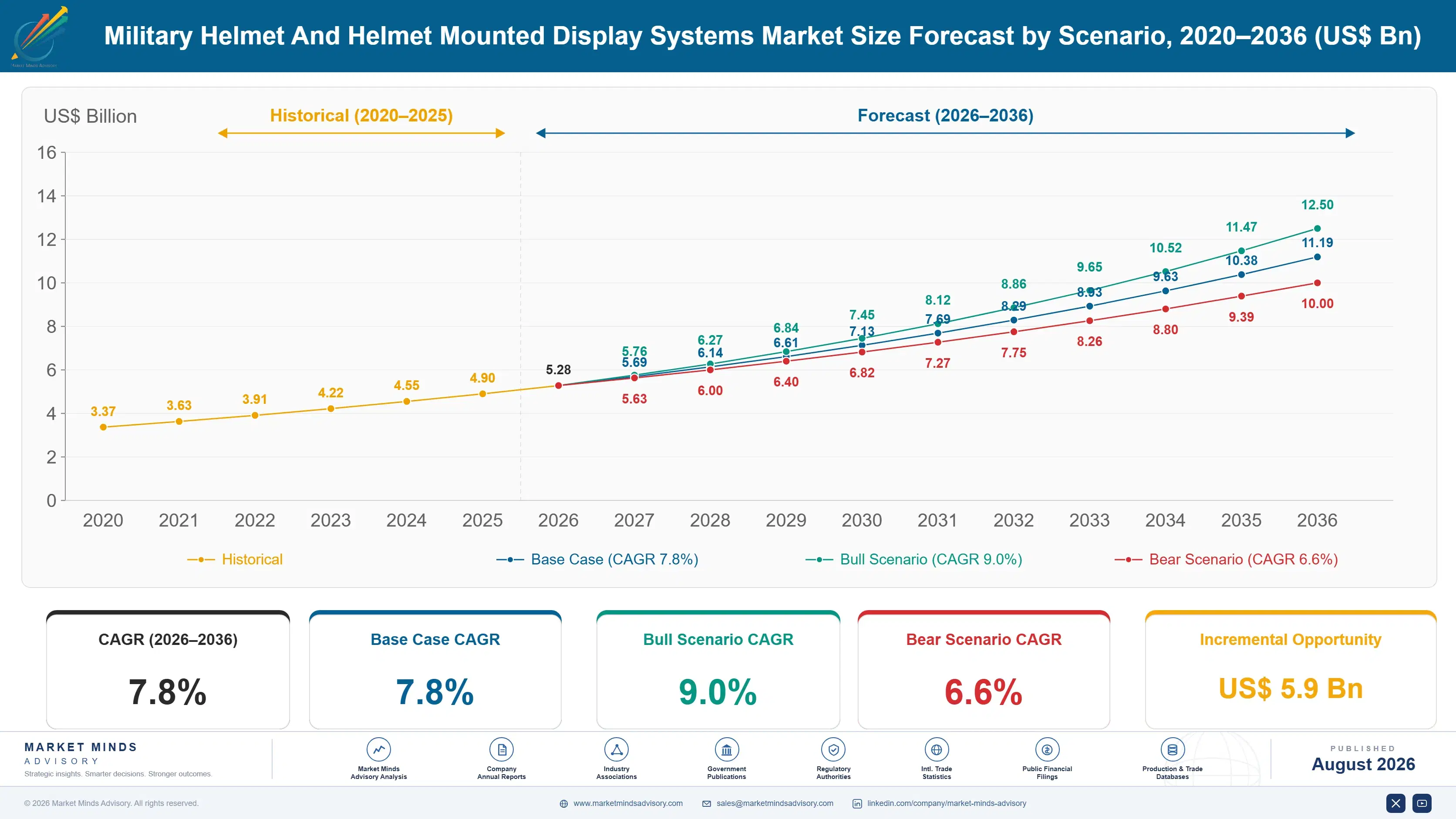
Military Helmet And Helmet Mounted Display Systems Market Forecast Scenarios

military-helmet-and-helmet-mounted-display-systems-size-forecast-scenario-1788023805519
The 2020 to 2025 period was shaped by one programme's difficulties more than by any market condition. A large dismounted display programme encountered weight, field of view and user acceptance problems that reset expectations across the industry and slowed procurement everywhere. Ballistic helmet replacement continued steadily throughout. Revenue compounded near 6.5%, held up by protection and aircrew work rather than by the dismounted display ambition.
Three mechanisms carry the base case. Aircrew display refresh continues across combat aircraft and rotorcraft fleets on a cycle tied to platform upgrades. Dismounted display procurement is resuming with weight and field of view requirements written far more realistically than before. And ballistic helmet replacement proceeds on its own schedule as materials improve and older shells reach the end of their service life. None of the three depends on a technical breakthrough.
The bull catalyst is a dismounted display system passing user acceptance at fielded scale, which would open programmes across several allied armies simultaneously. The bear risk is head-supported mass limits proving harder than expected again, since neck loading injuries produce medical evidence that stops procurement in a way no technical difficulty ever does. The evidence accumulates slowly.

Grams On Somebody's Neck

Everything in this market runs into the same wall. A helmet carrying a display, sensors, battery and counterweight sits on a neck that has to bear it through a patrol or a shift, and above roughly 2.1 kilograms the medical evidence on neck loading starts constraining what anybody will approve. Capability arguments lose to it consistently, and suppliers treating it as a design target do better.
MARKET CONCENTRATION CR556%Share of defence helmet and display revenue held by leaders
HEAD SUPPORTED MASS LIMIT2.1 kgTypical ceiling before neck loading concerns constrain extended wear
DISPLAY FIELD OF VIEW42 degreesTypical binocular coverage on current fielded soldier systems
INDIVIDUAL FITTING TIME95 minutesAverage per wearer for alignment on display equipped helmets
HELMET REPLACEMENT CYCLE9 yearsTypical service life before ballistic shell replacement becomes necessary
SUSTAINMENT REVENUE SHARE39%Portion of revenue from support and spares rather than supply
Aircrew displays are the mature part. Thirty years of development, a seated user, a headrest and a controlled environment make the engineering tractable, and field of view around 42 degrees with full symbology is routine. The dismounted case is different in every respect. A soldier moves, falls, shoulders a weapon and wears the system through a full day, which has already produced one public programme reset.
Fitting is the part nobody outside the industry appreciates. A display aligned to one wearer's eyes takes roughly 95 minutes per person to set up properly, and an army fielding at brigade scale needs that repeated thousands of times with trained staff and equipment. Suppliers who built that logistics capability hold positions that superior optics has repeatedly failed to displace, and sustainment at 39% follows it.
"The dismounted display programmes that struggled did not fail on optics. They failed because somebody had to wear the thing for fourteen hours and then had to be fitted for it in the first place, and neither problem is solved in a laboratory."
Director, Soldier Systems Practice · MMA Defence Equipment and Soldier Systems Practice · August 2026

Market Trends

Head Supported Mass Has Become The Governing Requirement

Neck loading evidence has moved weight from a design preference to a hard requirement, with roughly 2.1 kilograms functioning as a practical ceiling for extended wear across most programmes. Every sensor, battery and counterweight competes for that allocation, which forces genuine trade-offs rather than feature accumulation. Suppliers designing to the mass budget first and adding capability within it are winning competitions against technically superior systems that arrive heavier. The constraint has reshaped requirements documents across several armies. Feature accumulation stopped being a viable bidding strategy in this market some time ago.
Market Impact: Delivers 42 degree display baseline
Dismounted Requirements Rewritten After Programme Difficulties

A large soldier display programme encountering weight, field of view and user acceptance problems produced something more useful than a fielded system: requirements written by people who had watched one fail. Current procurement specifies wear duration, fitting throughput and rejection rates alongside optical performance, which earlier documents largely omitted. That has slowed procurement and improved it considerably. Suppliers who treated the earlier specification as achievable are now competing against requirements they helped make more demanding. Watching a programme fail turns out to be the most productive requirements exercise available to anybody.
Market Impact: Replaces shells every 9 years

Market Opportunities and Growth Drivers

Aircrew Display Refresh Follows Platform Upgrade Cycles

Combat aircraft and rotorcraft upgrade programmes carry helmet display refresh with them, since symbology, cueing and sensor fusion capability have to match the aircraft they serve. That gives this segment a predictable demand pattern tied to platform schedules rather than to any independent procurement decision. Field of view near 42 degrees with full symbology is now the baseline expectation. The work is technically demanding, commercially stable and considerably less contested than the dismounted opportunity. Refresh demand arrives on the platform's schedule rather than on any procurement officer's preference at all.
Market Impact: Holds mass under 2.1 kilograms

Ballistic Helmet Replacement Proceeds On Its Own Schedule

Shells reach the end of useful service life around nine years and get replaced regardless of what any display programme is doing, which gives this market a steady volume base independent of the technology cycle. Material improvements in ultra high molecular weight polyethylene have reduced weight while maintaining protection, freeing mass allocation for mounted equipment. Armies replacing at scale generate large, predictable procurement. This is the least discussed part of the market and among the most reliable. Nobody writes press releases about shell replacement, and it pays for a great deal.
Market Impact: Requires 95 minutes per wearer

Market Restraints and Challenges

Neck Loading Evidence Constrains Every Capability Addition

Medical evidence on cervical injury from extended head-supported mass has made roughly 2.1 kilograms a practical ceiling that capability arguments do not overcome. The root cause is cumulative physiological loading over years of service rather than any single event, which means the evidence accumulates slowly and then stops programmes decisively. Commercially it caps what can be fielded regardless of technical merit. Mitigation runs through mass redistribution toward the head's centre of gravity, off-helmet processing and power, and lighter shell materials. None of those pathways raises the ceiling, and each moves it only a little.
Market Impact: Caps head-supported mass at 2.1 kg

Individual Fitting Logistics Defeat Fielding At Scale

Aligning a display to one wearer's eyes takes roughly 95 minutes with trained staff and equipment, which becomes an enormous logistical burden when an army fields across a brigade or larger. The root cause is that binocular display alignment is anatomical rather than adjustable in the field. Commercially it means a technically superior system can lose to one that fits faster. Mitigation runs through automated fitting equipment, anthropometric size families, and self-adjusting optical arrangements reducing individual setup entirely. Fielding throughput has become a competitive dimension that procurement documents now specify explicitly.
Market Impact: Resets specifications across 5 programmes
4 additional market trends, 3 additional growth drivers, and 2 additional restraints and challenges are covered in the full report. Contact sales@marketmindsadvisory.com to access the complete intelligence.

Segment CAGR and Growth Architecture

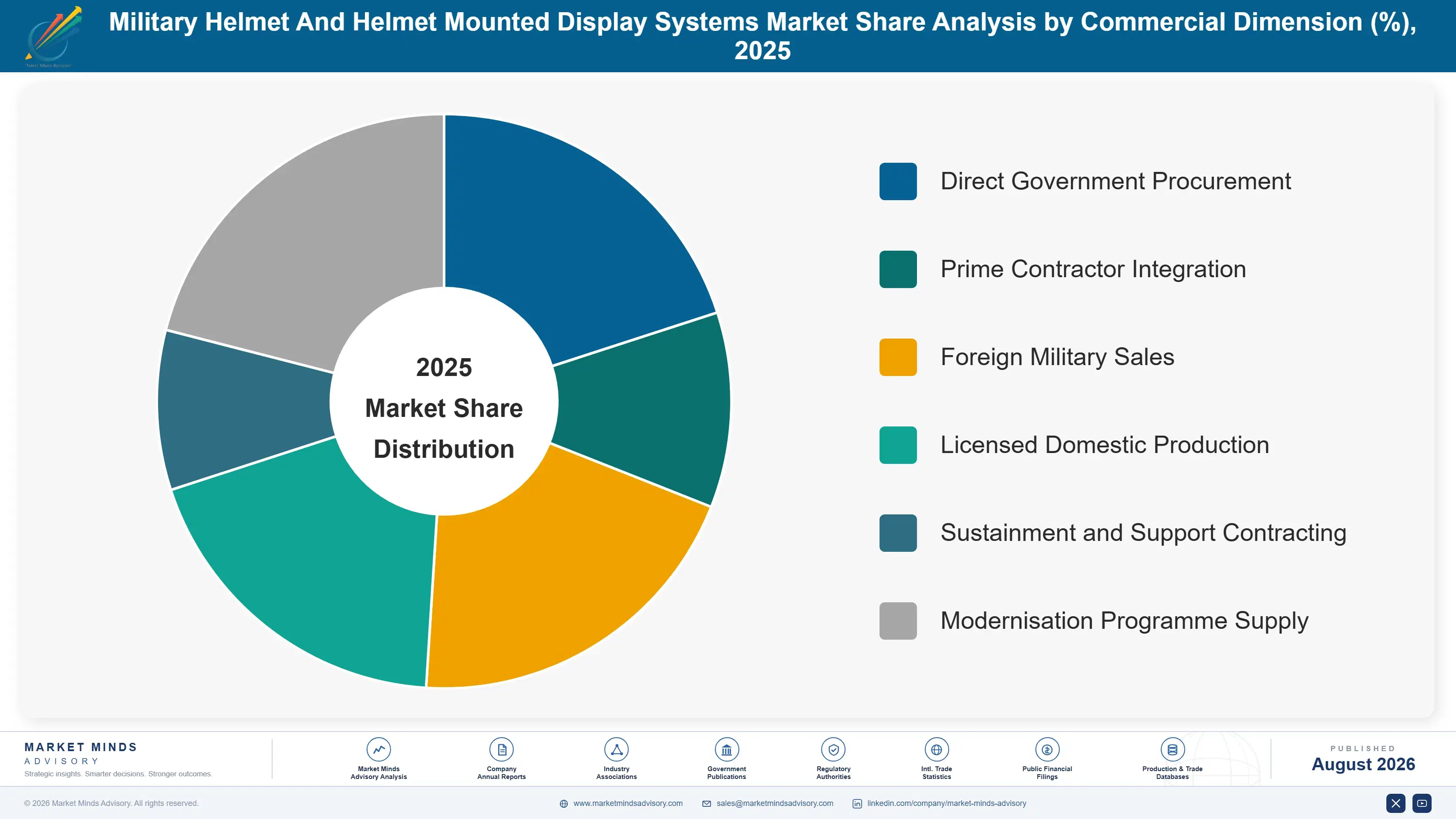
Segmentation follows system type, because protection, aircrew display and dismounted display are different engineering problems solved by different suppliers under different qualification regimes. Six categories describe the market completely, from ballistic shells replaced on their own steady cycle through to dismounted display systems where the difficulty and the growth both quite clearly sit at present.
military-helmet-and-helmet-mounted-display-systems-market-share-analysis-1788023806121

Dismounted Soldier Mounted Display Systems

The fastest category grows at 11.7%, half again the market rate of 7.8%, and it grows from a low base after a very public setback rather than from any smooth adoption curve. Putting augmented imagery in front of infantry means a system worn through a full day by someone who moves, falls and shoulders a weapon, all within a head-supported mass ceiling near 2.1 kilograms. Current requirements specify wear duration, fitting throughput and rejection rates alongside optical performance because earlier ones did not. Suppliers who found the previous specification achievable are now bidding against documents that a failed programme made considerably more demanding. The setback improved the requirement documents considerably afterward.
CAGR 11.7%

Aircrew and Rotorcraft Mounted Display Systems

Aircrew displays grow at 9.3% on refresh cycles tied to combat aircraft and rotorcraft upgrade programmes rather than to independent procurement. This is the mature end of the market: thirty years of development, a seated user, a headrest sharing the load and a controlled environment together make field of view around 42 degrees with full symbology and sensor fusion entirely routine. Qualification is demanding and the supplier base is narrow, which keeps competitive pressure modest and positions durable. Sustainment revenue follows the fitting and support infrastructure, and it arrives reliably for as long as the platform keeps flying. Positions here tend to outlast most of the people who originally won them.
CAGR 9.3%
Full segment breakdown across 6 segments available in the complete report.

Regional Architecture and Country Demand Map

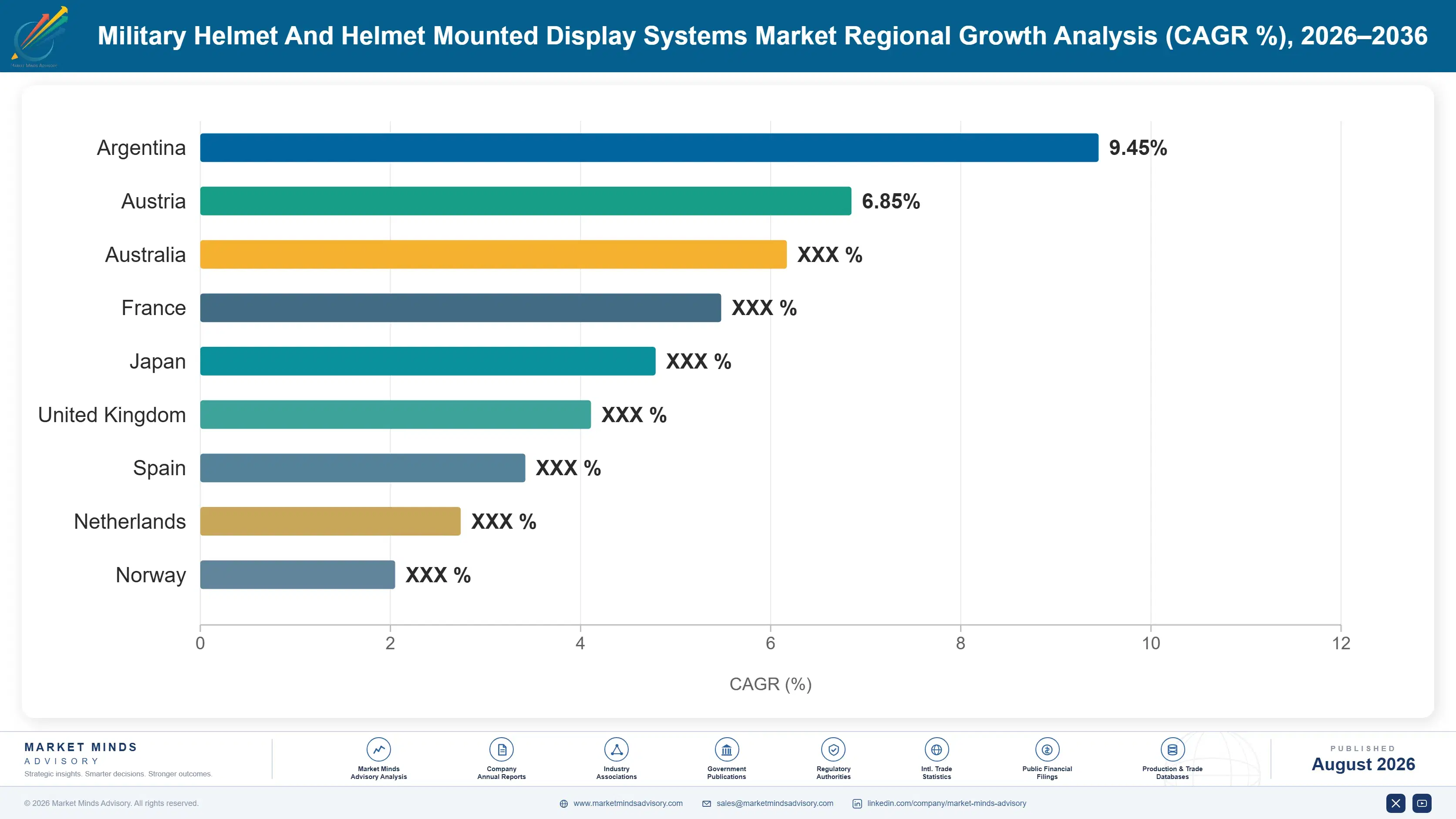
Procurement follows force size, modernisation funding and domestic industrial policy together. North America leads on programme scale and display development, with Western Europe and East Asia holding substantial positions and South Asia growing fastest as indigenous soldier programmes expand. Industrial policy shapes more of it than capability does.

North America

The largest share at 29% follows force size, aircrew display development history and the dismounted programme that reset expectations for everybody. Ballistic helmet replacement across a very large force generates steady volume on a nine year cycle independent of any display decision. Aircrew display capability developed here across three decades remains the reference standard internationally. The dismounted difficulties were expensive and public, and the requirements written afterward have improved procurement across allied armies considerably. Programme scale here is what makes the ballistic volume so attractive, since a single replacement cycle across a force of this size moves more shells than most national armies will procure in a generation, by some distance.
Share: 29% | CAGR: 7.6% (2026 to 2036)

East Asia

Force modernisation across several countries drives procurement at a pace that few other regions match, with domestic suppliers taking increasing shares of both protection and display work. Japanese and Korean programmes emphasise aircrew display integration with indigenous aircraft. Chinese production is extensive and closed to external suppliers, which limits the addressable portion considerably below the headline share. Taiwanese soldier modernisation has accelerated alongside wider defence spending, generating demand for both ballistic and display equipment. The addressable portion of this region is therefore well below the headline share, and external suppliers who plan around the full figure consistently overestimate what is actually available to them here in commercial terms at all.
Share: 23% | CAGR: 8.8% (2026 to 2036)
Regional intelligence for 5 additional markets available in the complete report: Western Europe, South Asia and Pacific, Latin America, Middle East and Africa, Eastern Europe. Contact sales@marketmindsadvisory.com.
military-helmet-and-helmet-mounted-display-systems-country-cagr-analysis-1788023806664

Where Helmet System Margin Sits

Four levers work on mass budget discipline, fitting logistics and sustainment capture rather than on optical performance, which decides fewer competitions than suppliers assume. Weight-first design, fitting infrastructure, sustainment position and off-helmet architecture each address something a supplier controls right now. None of the four turns on building a better display than anybody else has.

Design To The Mass Budget Before Adding Capability

A head-supported mass ceiling near 2.1 kilograms is now a hard requirement rather than a preference, and suppliers designing within it from the start beat technically superior systems that arrive heavier. Every sensor, battery and counterweight competes for the same allocation, which forces honest trade-offs early instead of painful subtraction late. Programmes have been lost over perhaps 200 grams. Treating mass as the primary requirement rather than as a constraint to be managed changes which competitions a supplier can realistically win. The trade-offs are unpleasant and the alternative is not winning at all.
Market Impact: Designs within a strict 2.1 kg mass ceiling

Build Fitting Infrastructure As A Product

Individual display alignment takes roughly 95 minutes per wearer, which becomes a fielding obstacle at brigade scale that procurement officers now examine closely. Suppliers offering fitting equipment, trained teams and throughput commitments alongside the system win competitions that optical performance alone would have lost. The capability costs comparatively little to build and is rarely replicated by competitors. Most participants still treat fitting as a customer problem rather than as the part of the offer that decides outcomes. Fitting equipment and trained teams cost perhaps 2 million dollars to establish properly.
Market Impact: Reduces the 95 minute individual fitting time considerably

Secure Sustainment Position At Original Selection

Sustainment produces 39% of revenue and follows the same fitting and support infrastructure that fielding requires, yet suppliers still accept supply-only awards that hand it to somebody else. Negotiating both at selection is considerably easier than recovering the position afterward, when the customer has already established a support arrangement. A 9 year helmet replacement cycle means sustainment revenue accumulates for most of a decade. Conceding it removes the revenue that actually recovers development cost. Support arrangements established with somebody else are rarely reopened before the next programme comes around again.
Market Impact: Captures the whole 39% sustainment revenue stream outright

Move Processing And Power Off The Helmet

Batteries and processing hardware consume mass allocation that display and sensor capability needs, and relocating both to the body relieves the 2.1 kilogram ceiling directly. Cable management and connector reliability become the engineering problem instead, which is considerably more tractable than making optics lighter. Suppliers pursuing this architecture field more capability within the same mass budget than competitors optimising components individually. The approach is well understood and adopted surprisingly slowly across the industry. Relocating 400 grams of battery and processing buys back capability that component optimisation alone cannot ever match.
Market Impact: Frees roughly 400 grams of mass allocation directly

Who Controls the Margin Pool

Concentration sits around 56% across the five largest participants measured on defence helmet and display system revenue, and it rests on qualification and fitting infrastructure rather than on any technology position. Ballistic helmet manufacture is considerably more fragmented than display work, where the supplier base narrows sharply. Several capable optics firms participate only as subcontractors, because the system-level requirements extend well beyond optical performance.
Competition runs on mass budget, fitting throughput and qualification history. Mass comes first and settles more competitions than anything else, since a system exceeding the ceiling cannot be fielded whatever it offers. Fitting throughput has become the second dimension as armies confront brigade-scale fielding. Qualification history matters because a supplier with a fielded system carries evidence a laboratory demonstration cannot match.

Pressure is arriving from consumer display technology rather than from defence entrants. Waveguide and micro-display development funded at consumer volumes has produced components no defence programme could justify developing, and they are entering through subcontract supply. Meanwhile armies are specifying fitting and wear requirements far more rigorously. Rankings will shift toward suppliers combining light system architecture with fitting logistics, since very few hold both properly.
military-helmet-and-helmet-mounted-display-systems-company-positioning-matrix-1788023807185

Competitive Moat and Risk Dimensions

ELBIT SYSTEMS

Moat: Aircrew display depth internationally

Elbit Systems holds aircrew helmet display positions across combat aircraft and rotorcraft programmes internationally, supported by qualification history that laboratory demonstration cannot replicate. Export reach across many customer nations spreads development cost in a way single-market suppliers cannot approach. Its dismounted work draws directly on aircrew engineering experience with weight distribution and alignment.
ELBIT SYSTEMS

Risk: Dismounted requirements differ fundamentally

Aircrew engineering assumes a seated user, a headrest sharing load and a controlled environment, and none of those assumptions survive contact with a dismounted soldier wearing the system all day. Transferring capability across that gap has defeated capable suppliers before. Fitting logistics at brigade scale is a different problem from aircrew fitting entirely.
GENTEX CORPORATION

Moat: Protection and fitting infrastructure

Gentex combines ballistic and aircrew helmet manufacture with the fitting, sizing and sustainment infrastructure that fielding at scale actually requires, which is capability competitors consistently underestimate. Sustainment at 39% of revenue follows that infrastructure directly. Nine year replacement cycles across large forces produce predictable volume that supports investment display specialists cannot match.
GENTEX CORPORATION

Risk: Display technology dependence on partners

Display and sensor content is increasingly where value concentrates, and depending on partners for it leaves the position exposed if those partners pursue system-level competition themselves. Protection and fitting are defensible but slower-growing than display work. Consumer-funded display components may also erode the technical barrier that currently protects specialist suppliers.

Players Tracked

Prominent Players

Elbit Systems
Thales
Collins Aerospace
Gentex Corporation
BAE Systems

Other Key Players

Revision Military
Avon Protection
3M Ceradyne
Galvion
Honeywell Aerospace
Safran Electronics and Defense
Rheinmetall
Leonardo
MKU Limited
Hindustan Aeronautics
SK Chemicals
Ulbrichts Protection
ArmorSource
L3Harris Technologies
Teledyne FLIR

Recent Developments

MARCH 2024

Army restructured dismounted display programme around weight requirements

A land force restructured a soldier display programme, rewriting requirements around head-supported mass, wear duration and fitting throughput after earlier specifications proved unachievable at acceptable weight. This was a programme restructuring decision by the customer rather than any acquisition, merger or joint venture between suppliers.
Signal: Requirements written after a programme fails are considerably better than those written before it ever happened.
SEPTEMBER 2024

Helmet manufacturer acquired display integration capability

A ballistic and aircrew helmet manufacturer acquired a display integration business, seeking system-level capability rather than continued dependence on partners for the content where value increasingly concentrates. This was an acquisition rather than a merger or joint venture, and the acquired operations retained their existing customer relationships.
Signal: Protection manufacturers buying display capability confirms where value in this market has actually moved in recent years.
JANUARY 2025

Allied forces adopted common helmet fitting throughput standards

Several allied land forces adopted common requirements for fitting time, throughput and rejection rates on display equipped helmets, formalising a fielding constraint that procurement documents had previously left entirely unaddressed. This was a procurement standards decision rather than any commercial arrangement between the suppliers concerned.
Signal: Fitting throughput entering formal requirements makes logistics capability a competitive dimension rather than an afterthought entirely.

What A Fielded Helmet System Costs

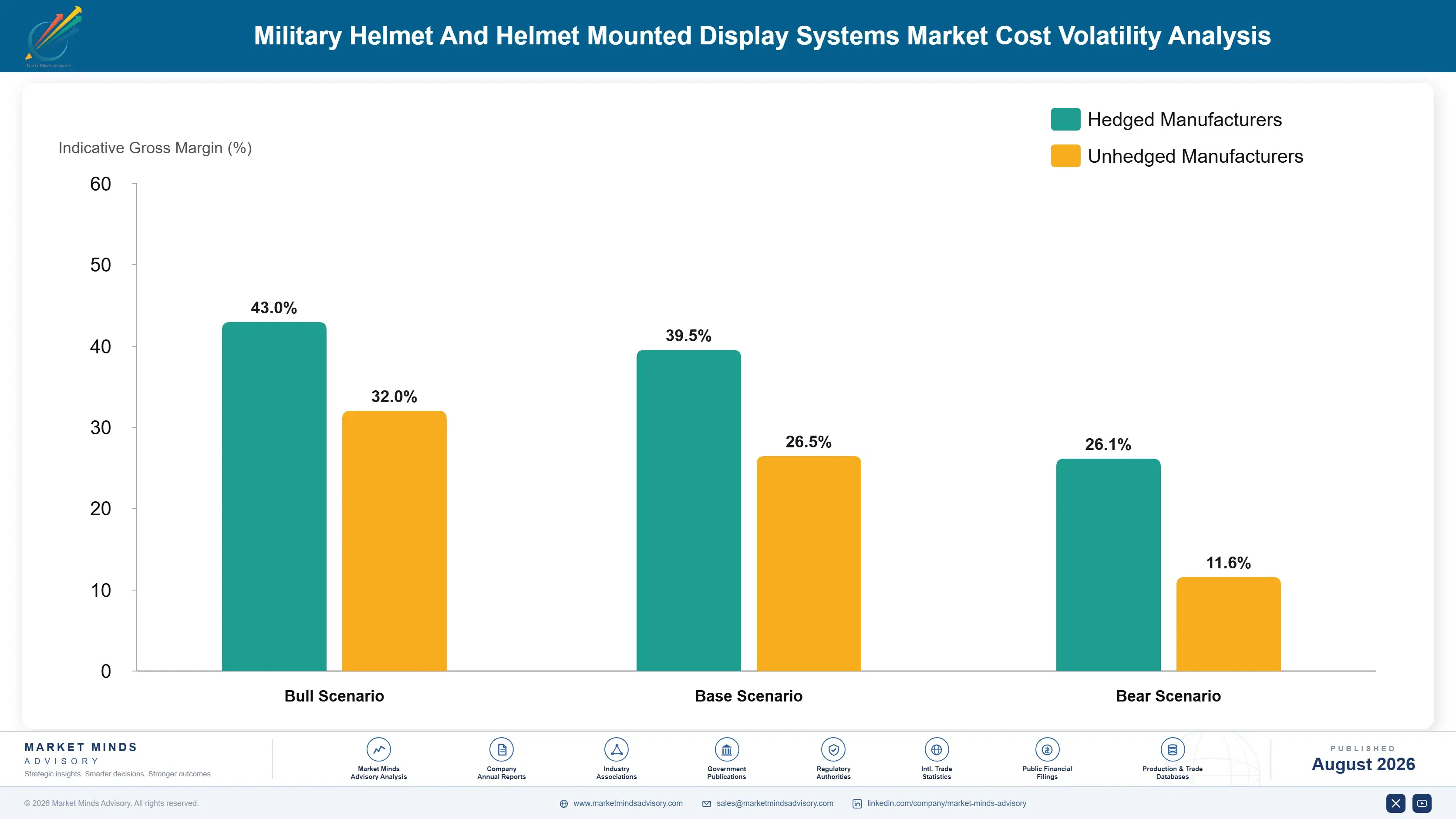
Cost divides four ways and the display is only part of it. Optical and display components absorb roughly 31% of system cost, sensors, processing and power near 26%, shell materials and mechanical integration near 24%, and fitting with sustainment infrastructure the remaining 19%. Suppliers pricing on component content alone miss the last category entirely and then discover it during fielding, when it is far too late to recover.
Ultra high molecular weight polyethylene pricing has moved considerably across recent years and moved shell economics with it, since the material is produced by very few suppliers at aerospace grade. Avon Protection and Gentex have both discussed material cost and supply conditions across recent reporting periods. Micro-display and waveguide component supply remains a separate constraint, since defence volumes never command priority from suppliers serving consumer demand.

Exposure varies by supplier type rather than by geography. Protection manufacturers carry material price exposure directly and pass very little of it through under fixed-price awards. Display specialists carry component supply risk without the volume to secure allocation. Suppliers holding sustainment positions recover cost across a nine year replacement cycle, while supply-only participants absorb development against a single delivery period with nothing behind it.
military-helmet-and-helmet-mounted-display-systems-cost-volatility-analysis-1788023807380

Shell material qualification across multiple suppliers

Aerospace grade polyethylene comes from very few producers and prices accordingly, which leaves shell economics outside any manufacturer's control under fixed-price awards. Qualifying alternative material sources before pricing moves costs comparatively little against the exposure carried. Most manufacturers qualify a second source only after a price increase has already been absorbed, which is the expensive sequence.

Display component allocation secured ahead of demand

Defence volumes never command priority from micro-display and waveguide suppliers serving consumer markets at far larger scale. Securing allocation commitments before programme demand arrives costs little and prevents delivery schedules stalling on components nobody will prioritise. Suppliers who assume availability discover otherwise at exactly the point when a programme milestone actually depends on having it.

Fitting infrastructure costed into original programme pricing

Fitting and sustainment infrastructure absorbs roughly 19% of system cost and is routinely omitted from bids priced on component content alone. Costing it properly at bid raises price and wins competitions, because customers now examine fielding throughput explicitly. Suppliers who omit it win on price and then discover the obligation during fielding at their own expense.

Portfolio Architecture for Margin Defence

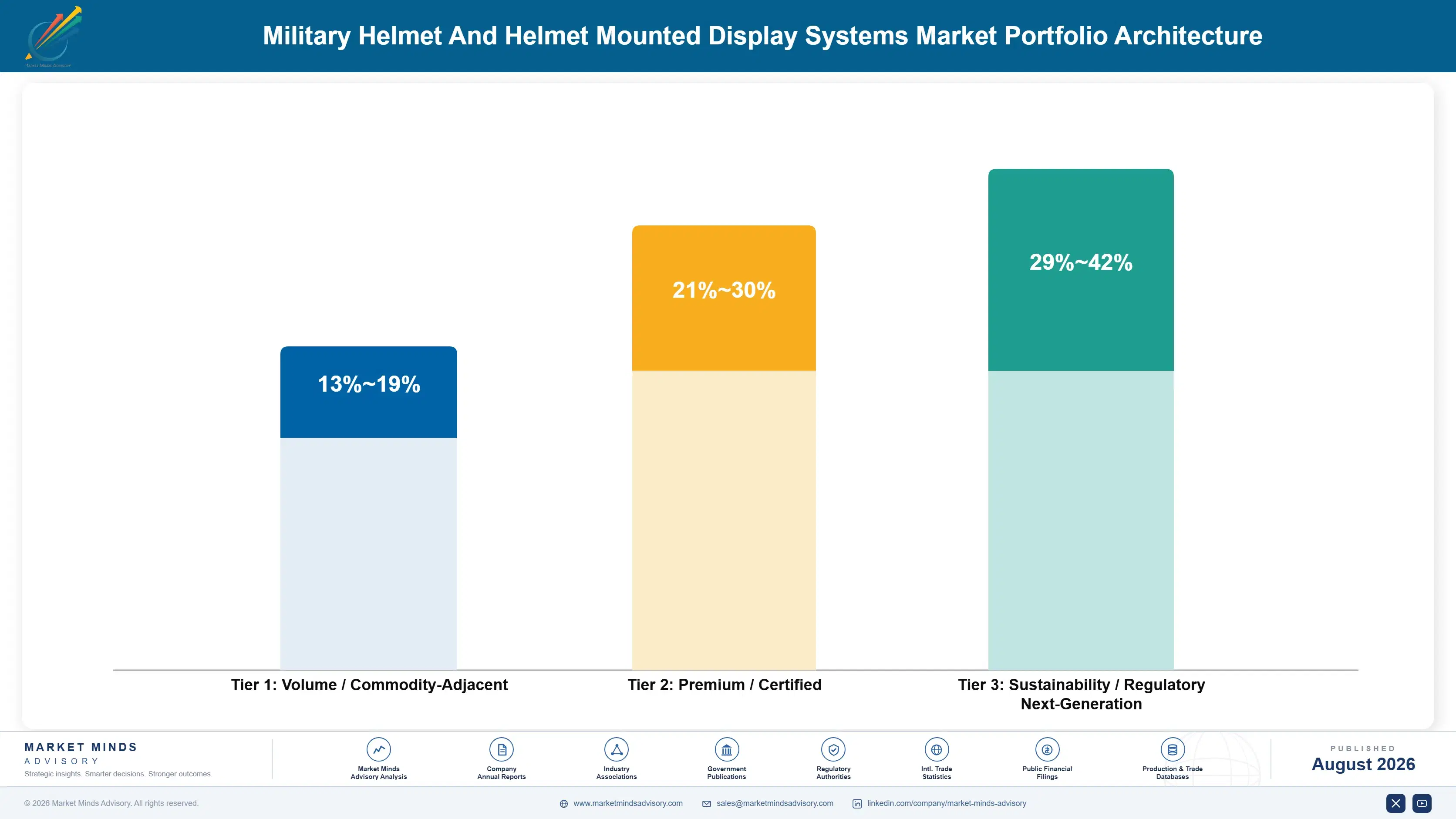
The portfolio separates by whether the product carries a display. Ballistic helmets are the volume core: large procurement quantities, a nine year replacement cycle, competition on material performance and price, and margins reflecting exactly that. The volume is genuinely large and steady, and nobody builds a defensible technical position on shells alone. Volume alone has never protected anybody here.
Margin concentrates in display systems, where qualification history, mass discipline and fitting infrastructure create barriers that component capability alone never overcomes. Aircrew displays are the mature and durable end. Dismounted displays carry higher growth and considerably more risk, since one programme has already demonstrated what happens when specification exceeds what a wearer will actually tolerate over a full day. The risk is real and so is the growth.

The overlooked pool is fitting and sustainment services. Together they reach 39% of revenue, follow the same infrastructure fielding requires, and are routinely conceded at selection by suppliers pricing on hardware. Customers now examine fitting throughput explicitly. The suppliers who built that capability find it wins competitions that better optics repeatedly failed to win. Hardware pricing misses the point entirely.

Volume / Commodity-Adjacent

Ballistic combat helmet shells, suspension systems and mounting hardware procured in large quantities. Range spans six points because material pricing and award structure decide outcomes far more than any manufacturing capability does.
Gross Margin: 13-19%

Premium / Certified

Aircrew and rotorcraft helmets with display integration, plus night vision mounting systems. Range spans nine points because sustainment position varies considerably between suppliers who secured it at selection and those who conceded it.
Gross Margin: 21-30%

Sustainability / Regulatory / Next-Generation

Dismounted soldier display systems and fitting and sustainment services. Range spans thirteen points because programme risk and service infrastructure economics differ so sharply within a single tier. Very few participants hold both.
Gross Margin: 29-42%
military-helmet-and-helmet-mounted-display-systems-portfolio-architecture-1788023807876

High-value Sub-segments and Strategic Watch-out

Dismounted Soldier Mounted Display Systems

High value and high growth at 11.7%, recovering from a public programme reset with requirements written far more realistically. The twelve point range separates suppliers designing within the mass ceiling from those still subtracting weight late in development. The requirement documents are considerably more honest now.
Gross Margin: 30-42%

Aircrew and Rotorcraft Mounted Display Systems

High value with moderate growth at 9.3%, tied to platform refresh cycles rather than independent procurement decisions. The eight point range reflects whether sustainment position was secured at selection, which decides whether development cost is properly recovered. Platform schedules make this demand unusually predictable indeed.
Gross Margin: 26-34%

Ballistic Combat Helmets

The volume core, replaced on a nine year cycle regardless of what any display programme is doing anywhere. Competition runs on material performance and price, and the margin reflects a market where technical differentiation earns comparatively little. The volume is large, steady and entirely reliable.
Gross Margin: 13-19%

Head Supported Mass Ceiling

The strategic watch-out rather than a growth pool. Neck loading evidence caps what any system can weigh regardless of capability, and medical findings stop programmes in a way that technical difficulties never quite manage to. No supplier controls what a neck will carry all day.
Gross Margin: Variable

Why Fielded Systems Stay Fielded

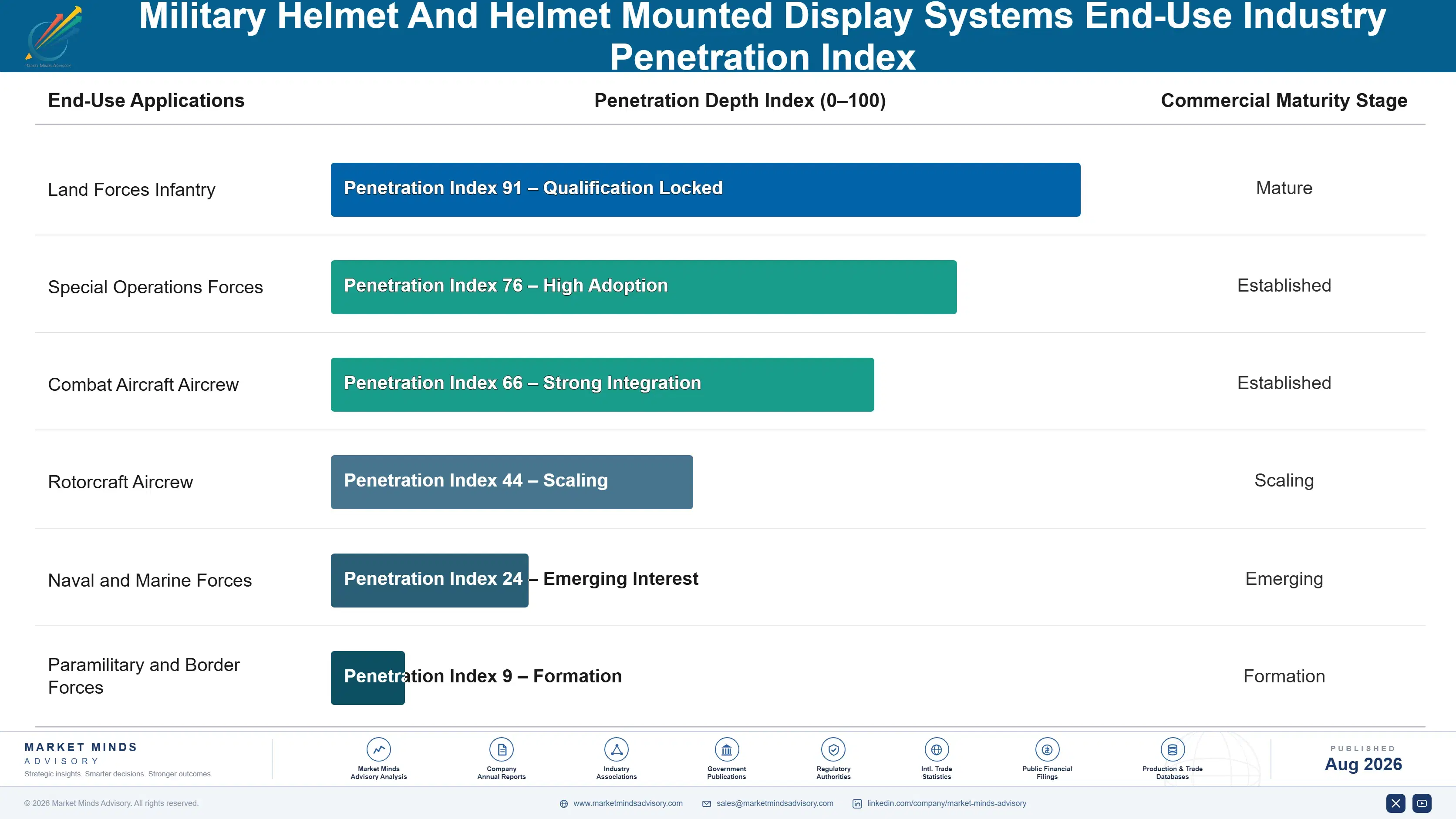
A fielded helmet system produces annuity economics across a long replacement cycle. Shells last around nine years, display systems considerably longer with refresh, and sustainment at 39% of revenue arrives steadily throughout on part numbers with a single qualified supplier. Replacing a fielded system means requalification, refitting every wearer at roughly 95 minutes each, and retraining support staff, which no army undertakes without a genuine reason to.
Stickiness varies by product type. Aircrew display positions are close to permanent, since qualification against a specific aircraft and its symbology is programme-specific and expensive to repeat. Fitting and sustainment positions are stickier still, because the infrastructure and trained staff sit inside the customer's own organisation. Ballistic shells are the most contestable, competed on material performance and price at each replacement cycle.

The buyer has changed in one important way. Earlier procurement was led by capability staff specifying what a system should do. Current programmes involve occupational health advisers, fielding logisticians and human factors specialists asking what a soldier can actually carry and how long fitting will take. Suppliers whose commercial approach was built for the first audience find the second considerably harder to satisfy.
military-helmet-and-helmet-mounted-display-systems-end-use-penetration-index-1788023808376

Where Helmet Suppliers Should Commit

These are among the four positions where our research anticipates prominent divergence between winners and laggards over the coming forecast period. Each is grounded in the demand model, the regulatory perimeter, and the announced capacity pipeline.
01 / MASS BUDGET DISCIPLINE

Design to the weight ceiling before anything else

A head-supported mass ceiling near 2.1 kilograms functions as a hard requirement now rather than as a design preference, and suppliers who design within it from the beginning routinely beat technically superior systems arriving noticeably heavier. Every sensor, battery and counterweight competes for the same one allocation, which forces honest trade-offs early rather than painful subtraction late in a development programme. Programmes have been lost over roughly two hundred grams, which is a margin no capability argument has ever managed to recover afterward.
02 / FITTING LOGISTICS CAPABILITY

Fielding throughput now decides these competitions

Individual display alignment still takes roughly 95 minutes per wearer, which becomes a serious fielding obstacle at brigade scale that procurement officers examine explicitly in current requirements documents across several armies. Suppliers offering fitting equipment, trained teams and throughput commitments alongside the system itself win competitions that optical performance alone would have lost outright on its own. The capability costs comparatively little to build properly and competitors have proved oddly reluctant to replicate any of it, for reasons nobody explains.
03 / SUSTAINMENT POSITION RETENTION

Never concede support at original system selection

Sustainment produces fully 39% of revenue and follows exactly the same fitting and support infrastructure that fielding at scale requires, yet suppliers still accept supply-only awards that hand all of it to somebody else entirely for the whole cycle. Negotiating both together at selection is considerably easier than recovering the position later, once the customer has established a support arrangement with another party altogether. A nine year replacement cycle means that support revenue accumulates steadily across most of a decade.
04 / OFF HELMET ARCHITECTURE

Move the batteries and processing to the body

Batteries and processing hardware consume mass allocation that display and sensor capability urgently needs for itself, and relocating both to the body relieves the weight ceiling directly rather than merely incrementally. Cable management and connector reliability become the engineering problem to solve instead, which is considerably more tractable than making optical assemblies lighter by any means currently available. Suppliers pursuing this approach field more capability within the same mass budget than competitors optimising individual components alone ever will manage to.

Engagement Snapshot From the Field

A live engagement with an industry participant carrying material or product regulatory and market exposure ahead of a defining policy shift, showing how our research translates into a defensible multi-year portfolio strategy.
MARKET MINDS ADVISORY · CLIENT ENGAGEMENT SUMMARY
Military Helmet And Helmet Mounted Display Systems Producer Strategic Portfolio Review and Transition Roadmap 2026·Investment Scenario on Military Helmet And Helmet Mounted Display Systems Exposure Evaluation 2025-26
CLIENT PROFILE
A soldier systems supplier manufacturing ballistic helmets at scale with a display integration capability acquired three years earlier, holding protection contracts across two allied armies and no fielded display position. Protection revenue was stable and the display business had lost three consecutive competitions on programmes the company had expected its optical performance to win comfortably.
STRATEGIC CHALLENGE
The board needed to establish why a technically competitive display system kept losing, and whether continuing to invest in optical performance or redirecting toward weight and fitting capability offered the better return. It also had to decide whether to bid a large dismounted programme with requirements that engineering leadership considered achievable and business development considered risky.
MMA APPROACH
MMA reconstructed all three lost competitions from customer interviews and evaluation records, isolating the actual deciding factors against those the client believed had applied. It modelled the cost of mass reduction and fitting infrastructure against competitive position. Expert interviews with army fielding staff, human factors specialists and competing suppliers established what current requirements genuinely demand.
KEY FINDINGS
  1. All three losses were decided on head-supported mass and fitting throughput, and optical performance was not raised as a differentiating factor in any evaluation reviewed.
  2. The client's system exceeded the practical mass ceiling by roughly 240 grams, a margin that no capability argument had recovered in any competition it entered.
  3. Fitting infrastructure had been omitted from all three bids entirely, while two of the three winning suppliers had costed and offered it explicitly upfront.
  4. Moving batteries and processing to the body would have brought the system inside the ceiling at development cost well below what optical refinement had already consumed.
CLIENT PROFILE
A soldier systems supplier manufacturing ballistic helmets at scale with a display integration capability acquired three years earlier, holding protection contracts across two allied armies and no fielded display position. Protection revenue was stable and the display business had lost three consecutive competitions on programmes the company had expected its optical performance to win comfortably.
STRATEGIC CHALLENGE
The board needed to establish why a technically competitive display system kept losing, and whether continuing to invest in optical performance or redirecting toward weight and fitting capability offered the better return. It also had to decide whether to bid a large dismounted programme with requirements that engineering leadership considered achievable and business development considered risky.
MMA APPROACH
MMA reconstructed all three lost competitions from customer interviews and evaluation records, isolating the actual deciding factors against those the client believed had applied. It modelled the cost of mass reduction and fitting infrastructure against competitive position. Expert interviews with army fielding staff, human factors specialists and competing suppliers established what current requirements genuinely demand.
KEY FINDINGS
  1. All three losses were decided on head-supported mass and fitting throughput, and optical performance was not raised as a differentiating factor in any evaluation reviewed.
  2. The client's system exceeded the practical mass ceiling by roughly 240 grams, a margin that no capability argument had recovered in any competition it entered.
  3. Fitting infrastructure had been omitted from all three bids entirely, while two of the three winning suppliers had costed and offered it explicitly upfront.
  4. Moving batteries and processing to the body would have brought the system inside the ceiling at development cost well below what optical refinement had already consumed.
RECOMMENDED STRATEGY
Phase 1: Phase one: redirect development from optical refinement toward off-helmet power and processing architecture, targeting the mass ceiling within twelve months. Phase 2: Phase two: build fitting equipment, trained teams and throughput commitments as a costed part of every subsequent bid the company submits. Phase 3: Phase three: bid the dismounted programme only after the mass target is demonstrated, and never on optical performance claims alone again.
OUTCOME
The client reported bringing the system inside the mass ceiling within three quarters and winning its first display competition (client-reported, unverified by MMA). Fitting capability was cited by the customer as a deciding factor. Protection revenue remained stable throughout, and the dismounted bid proceeded on a demonstrated weight figure.

Frequently Asked Questions

Foundational context covering the market sizes, CAGR, scope, country, region and competition that inform every finding below. This section is provided to cover basics and most often pre-purchase conversations, answered from the MMA Primary Research Dataset.

What is the current size of the Military Helmet And Helmet Mounted Display Systems Market?

The market is valued at USD 4.9 billion in 2025, measured as revenue from military head protection and head-mounted display systems including fitting and sustainment.

How large will the Military Helmet And Helmet Mounted Display Systems Market be by 2036?

MMA forecasts USD 11.19 billion by 2036, up from USD 5.28 billion in 2026. That represents incremental revenue of USD 5.91 billion and an expansion multiple of 2.12 times.

What is the CAGR for the Military Helmet And Helmet Mounted Display Systems Market 2026 to 2036?

The base case CAGR is 7.8%, with a bull case of 9.0% and a bear case of 6.6%. Dismounted soldier display procurement supplies most of that growth.

Which segment is growing fastest?

Dismounted soldier mounted display systems grow at 11.7%, half again the market rate of 7.8%, recovering from a public programme reset with far more realistic requirements.

Who are the major companies in the Military Helmet And Helmet Mounted Display Systems Market?

Elbit Systems, Thales, Collins Aerospace, Gentex Corporation and BAE Systems lead on defence helmet and display revenue, holding around 56% between them across the market.

Which country is growing fastest?

India grows fastest at 10.0%, driven by soldier modernisation programmes and production policy directing helmet and display content toward domestic manufacturers wherever that is possible at all.

Report Segmentation Architecture

The full report scope spans multiple orthogonal segmentation dimensions, with cross-tabulated demand data provided for each dimension pair. Coverage extends further to regional breakdowns, trend trajectories, and the competitive detail needed to support segment-level decision-making.

By System Type

  • Ballistic Combat Helmets
  • Aircrew and Rotorcraft Helmets
  • Aircrew Mounted Display Systems
  • Dismounted Soldier Mounted Display Systems
  • Night Vision and Sensor Mounting Systems
  • Fitting, Sustainment and Support Services

By End-Use Industry

  • Land Forces Infantry
  • Special Operations Forces
  • Combat Aircraft Aircrew
  • Rotorcraft Aircrew
  • Naval and Marine Forces
  • Paramilitary and Border Forces

By Commercial Dimension

  • Direct Government Procurement
  • Prime Contractor Integration
  • Foreign Military Sales
  • Licensed Domestic Production
  • Sustainment and Support Contracting
  • Modernisation Programme Supply

By Region

  • North America
  • Western Europe
  • East Asia
  • South Asia and Pacific
  • Latin America
  • Middle East and Africa
  • Eastern Europe

Scope, Methodology, and Coverage

Every figure in this report is reproducible from documented input assumptions. The scope below maps the historical period, the forecast horizon, the segmentation dimensions, and the countries covered, alongside the underlying primary and qualitative methodology.
Historical Period
2020 to 2025
Forecast Period
2026 to 2036
Base Year
2025 (USD billions; MMA Primary Research Dataset, August 2026)
Market Definition
Revenue from military head protection and head-mounted display systems, spanning ballistic combat helmets, aircrew and rotorcraft helmets, aircrew mounted display systems, dismounted soldier mounted display systems, night vision and sensor mounting integration, and fitting, sustainment and support services. Direct government procurement, prime contractor integration, foreign military sales, licensed domestic production, sustainment contracting and modernisation programme supply are all included. Hand-held and weapon-mounted optics, body armour beyond helmet-attached components, civil and law enforcement helmets procured outside defence, and standalone sensors not integrated to a helmet are excluded.
Quantitative Units
USD billions, defence helmet and display system revenue
Segmentation Dimensions
System type, force branch, commercial procurement model, region
Regions Covered
North America, Western Europe, East Asia, South Asia and Pacific, Latin America, Middle East and Africa, Eastern Europe
Countries Covered
United States, United Kingdom, France, Germany, Israel, Italy, China, Japan, South Korea, India, Australia, Brazil, Poland, Czechia
Key Companies Profiled
Elbit Systems, Thales, Collins Aerospace, Gentex Corporation, BAE Systems, Revision Military, Avon Protection, Galvion, MKU Limited, Rheinmetall
Quantitative Methodology
Primary survey, n=3,800 respondents, Q4 2025, six countries; demand-side model with trade association cross-validation
Qualitative Methodology
47 expert interviews, Q4 2025; applied to validate demand model assumptions, identify emerging dynamics, and assess competitive positioning
Report Format
PDF and XLSX data workbook (Word format preview document)
Publisher
Market Minds Advisory
Report Code
MMA-2026-CON-381
Published
August 2026
Contact
sales@marketmindsadvisory.com | www.marketmindsadvisory.com

Purchase the full Military Helmet And Helmet Mounted Display Systems Market Report (2026 to 2036).

The full report treats this market as the weight problem it actually is rather than the display competition it is usually presented as. It quantifies head-supported mass ceilings against system content, examines fitting throughput as the fielding constraint procurement now specifies explicitly, and separates protection volume from display value across every participant. Segment analysis covers all six system types, with particular attention to dismounted displays where a public programme reset produced considerably better requirements than any specification written beforehand. Competitive assessment ranks twenty participants on defence helmet and display system revenue.
Six system type segmentation with growth rates
Head-supported mass ceilings mapped against system content
Twenty participant assessment on defence helmet revenue
Fitting throughput requirements traced across allied programmes
Sustainment revenue separated from original system supply
Off-helmet architecture assessed by mass allocation freed

Built For The People Who Decide

From boardroom strategy to bench-side execution, this report is read cover-to-cover by leaders shaping the next decade of their industry, turning demand scenarios, market dynamics and valuation benchmarks into decisions.
CXOs/ Presidents/ VPs/ Managers
M&A and Corporate Development
Strategy Teams and R&D Heads
Procurement and Product Directors
Regulatory and Compliance Leaders
Investor Relations and Equity Analysts