Market Minds Advisory
Military Cyber Security Market

Military Cyber Security Market: Military Cyber Security Market. Weapons Platform Threats Redefine Defense Budgets

Defense ministries are redirecting cybersecurity budgets from network perimeter defense toward embedded weapons platform protection as adversaries increasingly target onboard systems directly, forcing primes to rebuild decades-old avionics and control software from scratch.

Lead Analyst

Published

September 2026

Make Smarter Decisions with Customized Research Insights

Request a free sample report and evaluate market opportunities, growth trends, and competitive dynamics relevant to your business needs.

2025 MARKET VALUE$25.5BMarket Size 2025
2036 FORECAST VALUE$76.5BBase Case , 2026 to 2036
CAGR 2026 TO 203610.5 %Bull 11.8% / Bear 9.2%
INCREMENTAL OPPORTUNITY$48.3BNet 10- year value creation
EXPANSION MULTIPLE2.71x2036 value over 2026 base
Strategic Levers
M&A Pipeline
Regional Outlook
Country Rankings
Competitive Intelligence
Segmental Deep-dive
Call-Us : 91 93563 13602

Executive Snapshot and Market Trajectory.

Defense ministries are redirecting cybersecurity budgets from perimeter network defense toward embedded weapons platform protection as adversaries increasingly target onboard avionics and control systems directly, rather than administrative networks alone, across the entire joint force structure, every domain of modern warfare, and each allied coalition partner.
Weapons systems and platform cybersecurity drives fastest adoption, since a compromised targeting or navigation system carries far greater consequence than a breached administrative network, and defense budgets increasingly reflect that priority shift. North America leads deployment given concentrated defense prime headquarters and the largest single military cyber budget of any government, while cloud and data security spending increasingly extends beyond weapons platforms into classified data handling that legacy on-premise systems could never scale to match.
A moderately concentrated group of defense primes competes alongside specialized cybersecurity contractors and intelligence-derived pure-play vendors, with security clearance depth and classified contract history increasingly separating winners from commercial cybersecurity firms lacking defense-specific certification and clearance infrastructure. Export control and allied interoperability requirements across jurisdictions continue to reshape which vendors can supply identical cyber architectures across multi-nation defense coalitions without extensive per-country customization work.
Market Definition
The military cyber security market covers cybersecurity software, hardware, and services purpose-built for defense networks, weapons platforms, command and control infrastructure, and military supply chains. It excludes general enterprise or civilian government cybersecurity products without defense-specific certification or deployment.
Base Year Value
$25.5B in 2025 (MMA Primary Research Dataset, September 2026)
Forecast Period
2026 to 2036, eleven discrete annual values
CAGR
10.5% base case. Bull 11.8%. Bear 9.2%.
Fastest Growth Segment
Weapons Systems and Platform Cybersecurity: 13.5% CAGR
Fastest Growth Country
India: 13.0% CAGR
Fastest Growth Region
South Asia and Pacific: 13.0% CAGR
Largest Region
North America: 32% of 2025 global value
Market Leaders
Lockheed Martin, Northrop Grumman, RTX, BAE Systems, General Dynamics
Primary Survey
n=3,800 procurement and R&D decision-makers, Q4 2025, six countries
Methodology
Demand-side build-up, cross-validated against public data, 47 expert interviews

Military Cyber Security Market Forecast Scenarios

military-cyber-security-market-size-forecast-scenario-1789986310373
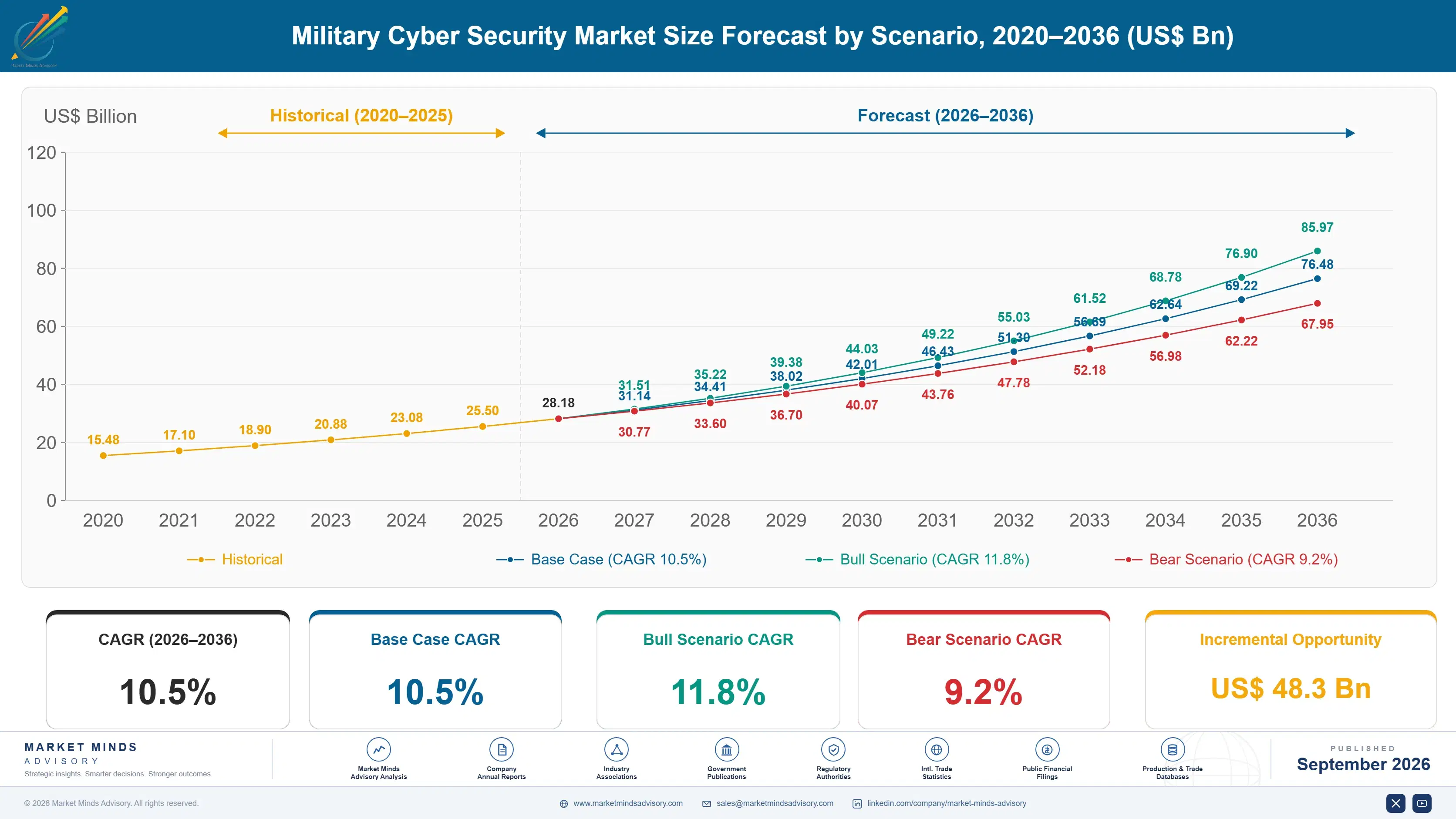
Military cyber security spending grew steadily through 2020 to 2023 as defense ministries prioritized network perimeter hardening following high-profile state-sponsored intrusion disclosures affecting multiple allied governments during that period. Momentum built sharply from 2024 as weapons platform vulnerabilities became a documented procurement concern, lifting the historical growth rate to roughly 9.5 percent annually across the category.
Base case growth to 2036 rests on three commercial mechanisms: rising defense budgets across NATO member states meeting the alliance's spending targets that increasingly earmark dedicated cyber allocations, weapons platform programs mandating embedded cybersecurity certification before fielding rather than retrofitting it afterward, and allied coalitions standardizing interoperable cyber architectures across joint operations. These mechanisms reinforce each other across different defense budget lines, sustaining above-average growth without depending on any single dominant catalyst or government.
A bull scenario centers on a major state-sponsored cyberattack successfully compromising an operational weapons platform, which would compress procurement timelines across allied defense ministries within a single budget cycle. The bear risk is a prolonged defense budget freeze tied to broader fiscal constraints, which has historically delayed major cybersecurity modernization programs by a year or more.

Where Clearance Depth Determines Vendor Access

Security clearance depth has become the primary vendor differentiator, since defense ministries cannot legally award classified contracts to firms lacking sufficient cleared personnel regardless of technical capability or pricing advantage available elsewhere. Vendors that once competed narrowly on commercial cybersecurity credentials now compete on cleared workforce scale and classified contract history, which shifts investment toward personnel security infrastructure rather than product features alone.
MARKET CONCENTRATIONCR5 45%a moderately concentrated base of cleared defense contractors
AVERAGE PROGRAM VALUE$85M multi-year contracttypical weapons platform cybersecurity certification and integration program size
TOP SPENDING COUNTRY SHAREUS 38%concentrated defense cyber budget allocation across a single government
CLEARED WORKFORCE UTILIZATION72% at capacityavailable cleared cybersecurity personnel currently allocated to active programs
WEAPONS PLATFORM CERTIFICATION LAG3-5 years typicalaverage timeline from vulnerability discovery to fielded platform remediation
CYBER SPEND SHARE31% of defense IT budgetcybersecurity allocation versus broader defense information technology spending overall
Cleared cybersecurity personnel remain a significant bottleneck across the industry, with available talent running near full utilization at most established defense contractors and driving compensation sharply higher for professionals holding top-tier clearances. Weapons platform certification timelines remain lengthy, often exceeding three years from vulnerability discovery to fielded remediation, which keeps legacy platforms exposed far longer than commercial software patch cycles would ever tolerate.
Interoperability across allied coalition cyber architectures is becoming a baseline procurement expectation rather than a differentiator, concentrating advantage among vendors who can demonstrate certified compatibility across multiple NATO member defense networks simultaneously. Meanwhile several governments are extending cyber certification requirements to legacy platforms previously exempted, which could meaningfully expand the addressable retrofit market within the next several budget cycles.
"Every defense ministry says weapons platform cybersecurity is a top priority; most still can't tell you which onboard systems can be updated without flying the aircraft back to the depot. The vendors winning now are the ones solving that boring logistics problem first."
Director, Defense and National Security Technology Practice · MMA Defense-Grade Cybersecurity Software Practice · September 2026

Market Trends

Weapons Platform Cybersecurity Becomes Mandatory Requirement

Defense ministries in the United States, United Kingdom, and increasingly other NATO members now require embedded cybersecurity certification before fielding new weapons platforms, converting what was once a discretionary engineering practice into a mandatory acquisition gate that program managers cannot skip. The US Department of Defense's cybersecurity maturity model certification framework now applies to a rapidly expanding share of weapons systems contracts, forcing primes to rebuild decades-old avionics and control software architectures never designed with network connectivity or cyber threats in mind. This regulatory tailwind guarantees a growing addressable retrofit and certification opportunity regardless of broader defense budget cycle swings.
Market Impact: 2%+ of GDP defense target
State-Sponsored Threats Target Onboard Systems Directly

Intelligence agencies across multiple allied governments have documented an increasing number of state-sponsored attempts to compromise onboard weapons platform systems directly, rather than administrative networks, since a successful intrusion into a targeting or navigation system carries far greater operational consequence than a breached email server. This shift in adversary targeting has forced defense ministries to reallocate cybersecurity budgets from network perimeter defense toward embedded platform protection at a pace that surprised even experienced program managers. Roughly 40 percent of new weapons platform cybersecurity budget now targets embedded systems specifically, up sharply from a much smaller share just three years earlier.
Market Impact: 60% of fielded platforms need retrofit

Market Opportunities and Growth Drivers

NATO Defense Spending Targets Include Cyber Allocations

NATO member states meeting the alliance's defense spending target as a share of GDP are increasingly earmarking dedicated cybersecurity allocations within that broader budget, converting cyber security from a discretionary line item competing against conventional weapons procurement into a protected funding category with its own growth trajectory. Several member states have publicly committed to increasing cyber-specific defense spending meaningfully over the coming years, following alliance-wide guidance encouraging standardized cyber resilience benchmarks across all member militaries. This budget protection is insulating military cybersecurity spending from the broader defense budget volatility that affects conventional procurement programs during fiscal tightening periods.
Market Impact: Delays add 6-12 months

Legacy Platform Retrofit Mandates Expand Addressable Base

Defense ministries are extending cybersecurity certification requirements to legacy weapons platforms previously exempted from modern cyber standards, since aging aircraft, ships, and vehicles remain in active service for decades after their original design predates meaningful network connectivity considerations entirely. This retrofit mandate is creating a substantial addressable market beyond new-build programs, since most operational fleets skew considerably older than the newest platforms entering service each year. Roughly 60 percent of currently fielded weapons platforms across major militaries predate modern cybersecurity design standards, representing a multi-decade retrofit opportunity for certified vendors.
Market Impact: Retrofits often run 2-4 years over

Market Restraints and Challenges

Cleared Workforce Shortage Constrains Program Delivery

Defense contractors face a persistent shortage of cybersecurity professionals holding the top-tier security clearances required for classified program work, since obtaining clearance itself takes many months and the pool of qualified candidates willing to undergo the process remains limited relative to expanding program demand. The root cause is that clearance processing timelines have not scaled alongside rapidly growing classified cybersecurity program volume across the industry. The commercial impact is delayed program staffing that pushes delivery timelines beyond original contract schedules. Vendors are mitigating this by investing in internal clearance sponsorship programs and expanding recruitment from adjacent cleared talent pools.
Market Impact: CMMC Level 2 now mandatory

Legacy Platform Architecture Resists Modern Retrofit

Weapons platforms designed decades ago often use proprietary communication protocols and hardware architectures that were never intended to support modern encryption or intrusion detection capability, making cybersecurity retrofit substantially more complex than adding equivalent protection to commercial IT systems. The root cause is that these platforms were engineered under threat assumptions that predate meaningful cyber warfare consideration entirely. This has caused several retrofit programs to run years over their original timeline, delaying anticipated risk reduction substantially. Leading vendors now mitigate this by developing platform-specific retrofit kits rather than attempting generic commercial security solutions.
Market Impact: 40% of budget targets embedded systems
3 additional market trends, 4 additional growth drivers, and 3 additional restraints and challenges are covered in the full report. Contact sales@marketmindsadvisory.com to access the complete intelligence.

Segment CAGR and Growth Architecture

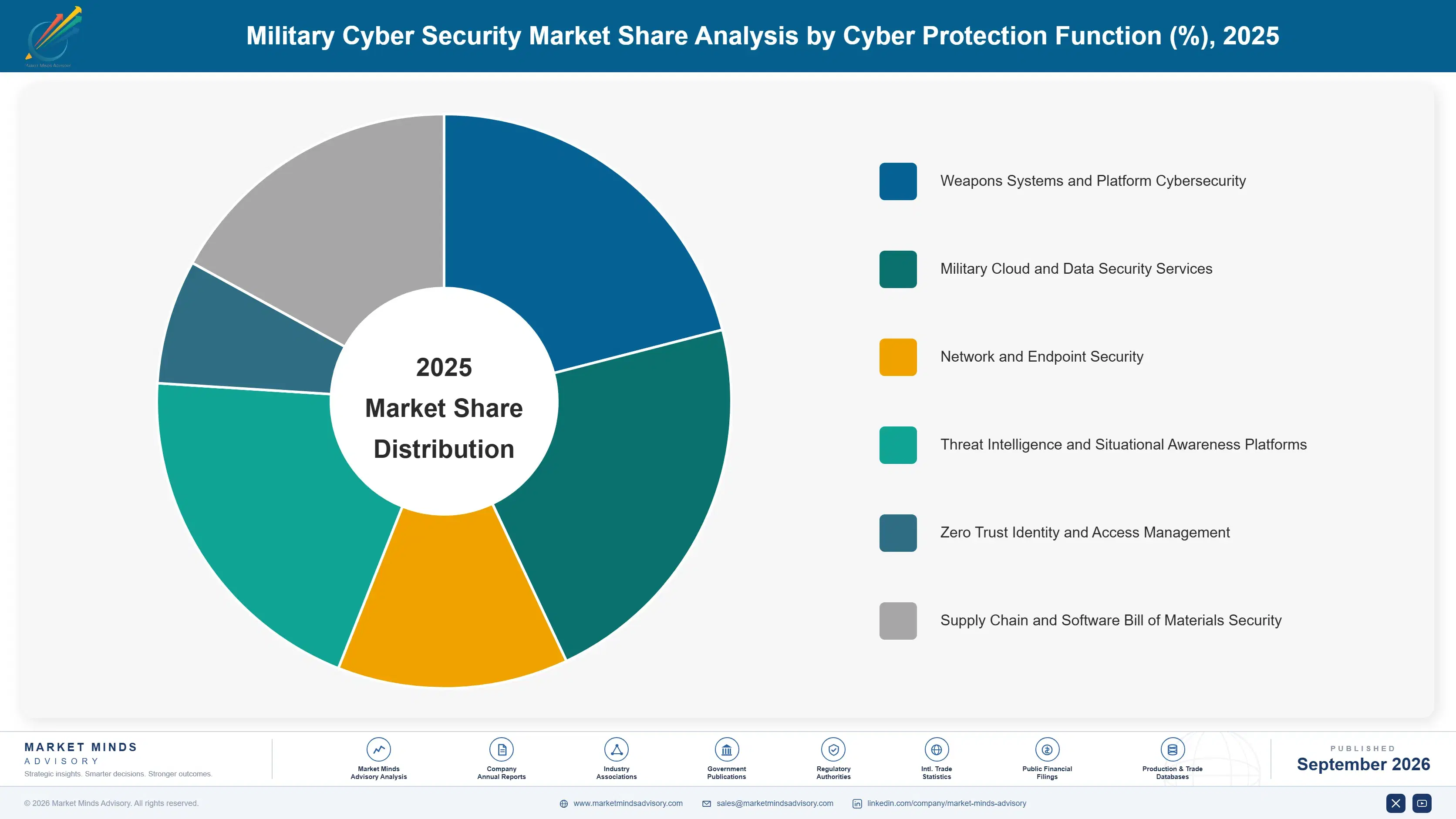
Segmentation follows cyber protection function within defense operations, spanning weapons systems and platform cybersecurity, military cloud and data security services, network and endpoint security, threat intelligence and situational awareness, and zero trust identity management, each addressing a genuinely distinct protection layer rather than overlapping customer type, contract vehicle, or classification level categories within the market.
military-cyber-security-market-market-share-analysis-1789986310966

Weapons Systems and Platform Cybersecurity

Weapons systems and platform cybersecurity leads growth as defense ministries finally treat onboard system protection with the same urgency as conventional platform survivability, following documented state-sponsored attempts to compromise targeting and navigation systems directly rather than administrative networks alone. This segment covers embedded software hardening, secure boot architecture, and intrusion detection built directly into avionics, fire control, and vehicle control systems rather than bolted on as separate network appliances. Aircraft and naval platform programs are adopting this segment fastest, since the operational consequence of a compromised weapons system justifies certification investment that budget-constrained ground vehicle programs sometimes still defer to later procurement cycles. Vendors combining embedded software expertise with defense-grade certification are capturing disproportionate share of this expanding budget line.
CAGR 13.5%

Military Cloud and Data Security Services

Military cloud and data security services are the second-fastest growing segment, driven by defense ministries migrating classified data handling and intelligence processing workloads onto government-certified cloud infrastructure rather than maintaining aging on-premise data centers indefinitely. These services increasingly incorporate zero trust access architecture and continuous authentication to meet the stringent classification handling requirements that distinguish defense cloud deployments from commercial equivalents. Intelligence agencies and joint command organizations are adopting fastest, since their data processing volume and multi-agency data sharing requirements make cloud migration considerably more valuable than for single-service administrative functions with narrower data sharing needs. Vendors with the deepest government cloud certification are winning share fastest from legacy on-premise incumbents.
CAGR 12.5%
Full segment breakdown across 5 segments available in the complete report.

Regional Architecture and Country Demand Map

North America leads on the world's largest single military cyber budget and concentrated defense prime headquarters, while Western Europe and East Asia follow closely behind on NATO cyber allocation growth, and South Asia and Pacific posts the fastest regional growth on rising indigenous defense investment.

North America

The US Department of Defense operates the single largest military cybersecurity budget of any government, and its cybersecurity maturity model certification framework increasingly sets the de facto global standard that allied nations' defense contractors must also meet to participate in joint programs. Major defense primes headquartered domestically, including Lockheed Martin and Northrop Grumman, maintain the deepest classified program experience and cleared workforce scale of any regional competitor. Canadian defense cybersecurity programs are following comparable certification frameworks under close alliance coordination with US standards. Legacy platform retrofit programs across the country's extensive fielded fleet continue driving a substantial share of near-term cybersecurity modernization spending industry-wide. Mexican defense modernization is following a similar trajectory more gradually.
Share: 32% | CAGR: 11.5% (2026 to 2036)

Western Europe

NATO member states across the region are increasingly earmarking dedicated cybersecurity allocations within broader defense spending increases driven by the alliance's spending target commitments following recent geopolitical tensions. Germany, France, and the United Kingdom account for the largest share of regional defense cyber demand, reflecting both larger defense budgets and more mature domestic cybersecurity industrial bases relative to smaller member states. Growth going forward centers more on legacy platform retrofit and coalition interoperability certification than genuinely new program creation, since most major European militaries already run some dedicated cyber defense program. This keeps the region's expansion rate below the fastest-growing markets despite its considerable scale. Nordic countries are moving somewhat faster given heightened regional threat perception.
Share: 22% | CAGR: 9.0% (2026 to 2036)
Regional intelligence for 5 additional markets available in the complete report: East Asia, South Asia and Pacific, Latin America, Middle East and Africa, Eastern Europe. Contact sales@marketmindsadvisory.com.
military-cyber-security-market-country-cagr-analysis-1789986311505

Where Defense Cyber Vendors Should Expand Next

Beyond core program contracts, vendors are building adjacent commercial layers around managed security operations services, retrofit certification programs, cleared workforce staffing augmentation, and coalition interoperability licensing, each extending overall contract value well past the initial program award into sustained multi-year defense relationships spanning many allied governments, defense agencies, and larger multi-nation joint procurement organizations.

Managed Security Operations Center Service Programs

Vendors are bundling managed security operations center services alongside core program delivery, since defense ministries increasingly want continuous monitoring rather than point-in-time certification that leaves platforms unmonitored between periodic assessment cycles. These managed services now generate roughly 24 percent of total contract value at several leading vendors, well above the negligible share managed operations represented when the category was dominated by one-time certification engagements. Defense customers value the reduced operational risk enough to accept premium recurring pricing on this layer, and vendors report meaningfully higher contract renewal rates when managed services are bundled with certification work.
Market Impact: 24% of contract value now from managed services

Legacy Platform Retrofit Certification Programs Overall

Legacy platform retrofit certification programs are commanding substantial incremental revenue beyond new-build contracts, since defense ministries extending cybersecurity requirements to aging fleets consistently underestimate the engineering complexity involved in retrofitting decades-old proprietary architectures across their operational fleets and platforms. These programs now represent roughly 30 percent of total addressable program value at several leading vendors, reflecting the sheer scale of legacy fleets still awaiting certification across major militaries. Vendors offering platform-specific retrofit kits report meaningfully higher win rates than those attempting generic commercial security solutions poorly suited to defense-specific hardware constraints.
Market Impact: 30% of program value now from retrofits today

Cleared Workforce Staffing Augmentation Service Programs

Cleared workforce staffing augmentation services are generating meaningful incremental revenue as defense contractors face persistent shortages of personnel holding top-tier security clearances required for classified program work across the industry. Vendors with established clearance sponsorship pipelines are increasingly leasing cleared talent to competitors and prime contractors facing staffing gaps on time-sensitive programs, turning what was once an internal cost center into a standalone revenue stream. This staffing model now accounts for roughly 15 percent of revenue at several specialized defense cybersecurity firms, a meaningful diversification beyond pure program delivery work.
Market Impact: 15% of revenue from cleared staffing services now

Coalition Interoperability Licensing Agreement Structures Overall

Coalition interoperability licensing agreements are opening access to allied government contracts that individual national certification alone cannot open, since NATO and other coalition frameworks increasingly require demonstrated cross-border architecture compatibility before awarding joint procurement contracts across member nations and partner governments. These licensing arrangements have expanded addressable contract value by roughly 20 percent for vendors pursuing multi-nation certification simultaneously, without requiring proportional growth in per-country sales and compliance infrastructure. Vendors lacking coalition-wide certification increasingly struggle to compete for the largest joint procurement programs against those with established multi-nation compliance credentials already secured.
Market Impact: 20% larger addressable value via coalition licensing deals

Who Controls the Margin Pool

Military cyber security remains moderately concentrated, with the top five vendors holding an estimated 45 percent of the market on a cleared-program-revenue basis. Lockheed Martin and Northrop Grumman lead on breadth across classified program history, while a meaningful gap separates them from smaller specialist challengers competing mainly on niche technical depth rather than broad prime contractor relationships.
Current competitive activity centers on three fronts: primes racing to embed cybersecurity certification into new weapons platform development rather than retrofitting it afterward, larger contractors acquiring specialized cybersecurity boutiques to close classified capability gaps rather than building expertise internally, and several vendors expanding coalition interoperability certification to capture allied joint procurement contracts. Pricing pressure has intensified modestly among mid-tier vendors competing for retrofit contracts larger primes consider too small to prioritize.

Emerging pressure comes from commercial cybersecurity firms pursuing defense certification to enter the market through acquisition of cleared subsidiaries rather than organic classified program development, betting that commercial cyber innovation speed can substitute for decades of defense program relationships. Rankings could shift meaningfully if a government mandates a coalition interoperability standard favoring one vendor's architecture, since allied governments facing forced migration tend to consolidate around whichever platform already meets the requirement natively.
military-cyber-security-market-company-positioning-matrix-1789986312046

Competitive Moat and Risk Dimensions

LOCKHEED MARTIN

Moat: Deepest classified program history

Lockheed Martin's decades of classified weapons platform development across nearly every major aircraft and missile program give its cybersecurity division embedded program access and cleared workforce scale that specialized boutiques take years of relationship-building to replicate, letting it win the largest platform certification contracts across multiple military services simultaneously.
LOCKHEED MARTIN

Risk: Slower boutique innovation pace

As a large diversified defense conglomerate, Lockheed Martin's cybersecurity innovation pace trails smaller specialized boutiques focused purely on emerging threat detection techniques, risking share loss on advanced technical evaluations where agencies prioritize the most advanced capability over established prime contractor relationships and program scale built over many decades.
NORTHROP GRUMMAN

Moat: Strong space and missile ties

Northrop Grumman's dominant position in space and missile defense programs gives its cybersecurity offerings privileged access to some of the most sensitive and highest-budget classified programs in the defense portfolio, letting it capture cybersecurity revenue that flows naturally from its existing platform relationships and long-standing customer trust.
NORTHROP GRUMMAN

Risk: Narrower conventional platform presence

Northrop Grumman's comparatively narrower presence in conventional ground vehicle and naval platform programs limits its addressable cybersecurity retrofit opportunity relative to primes with broader legacy fleet relationships, ceding some retrofit certification contracts to competitors with deeper conventional platform program history and long-established customer relationships across the military services.

Players Tracked

Prominent Players

Lockheed Martin
Northrop Grumman
RTX
BAE Systems
General Dynamics

Other Key Players

Leidos
Booz Allen Hamilton
CACI International
SAIC
Palantir Technologies
L3Harris Technologies
Thales
Elbit Systems
Leonardo
Saab AB
ManTech International
Peraton
ICF International
Parsons Corporation
V2X Inc

Recent Developments

JANUARY 2026

Lockheed Martin Acquires Threat Detection Boutique

Lockheed Martin acquired a small classified cybersecurity boutique specializing in embedded threat detection for avionics systems, folding the technology directly into its weapons platform certification programs rather than continuing to rely on subcontracted specialist firms for advanced embedded threat detection capability across major fielded weapons platform programs.
Signal: Large defense primes are increasingly securing specialized technical capability through targeted acquisition rather than external subcontracting arrangements.
SEPTEMBER 2025

Northrop Grumman Signs Coalition Certification Agreement

Northrop Grumman signed a multi-year agreement with several allied defense ministries to certify its cybersecurity architecture for coalition interoperability, replacing a patchwork of nationally certified systems that previously required separate compliance work for each participating member government's distinct regulatory and technical requirements across the alliance.
Signal: Defense primes are increasingly pursuing multi-nation certification to access much larger coalition procurement contracts across allied governments.
APRIL 2025

RTX Expands Cleared Workforce Sponsorship Program

RTX announced an expanded internal security clearance sponsorship program aimed at addressing the persistent cleared cybersecurity talent shortage constraining program delivery timelines across the industry, following several major program delays attributed directly to staffing gaps that competitors also reported experiencing broadly across their own classified programs.
Signal: Primes are investing directly in clearance sponsorship programs to address the persistent industry-wide cleared talent shortage.

Cleared Talent Costs Shape Program Margins

Cleared personnel compensation and classified facility overhead together represent roughly 52 percent of cost of goods sold for military cybersecurity vendors, notably higher than commercial cybersecurity categories operating without classification requirements entirely. Cleared personnel compensation alone accounts for close to 34 percent, reflecting the significant salary premium required to attract and retain top-tier clearance holders.
Cleared talent compensation rose sharply during 2022 and 2023, following surging classified program demand across multiple defense agencies simultaneously, as documented in the US Government Accountability Office's defense workforce assessments during that period across the entire defense industrial base. Vendors serving high-volume classified programs absorbed meaningfully higher personnel costs for several consecutive quarters before adjusting program pricing to reflect the new competitive labor market reality facing the entire industry.

Smaller vendors lacking scale to sponsor and retain large cleared workforces face a real cost disadvantage against larger primes like Lockheed Martin, who can spread cleared personnel costs across a broader classified program portfolio and rotate staff between programs as demand fluctuates. This dynamic increasingly pushes smaller specialists toward niche technical subcontracting roles where larger primes see insufficient contract value to compete aggressively for cleared talent.
military-cyber-security-market-cost-volatility-analysis-1789986312254

Internal Clearance Sponsorship Programs

Vendors are sponsoring security clearances for promising cybersecurity talent internally rather than competing exclusively for the limited pool of already-cleared professionals, expanding their addressable hiring pool considerably even though clearance processing itself takes many months before a new hire can begin any classified program work on active contracts across the entire organization each and every year.

Cross-Program Staff Rotation Models

Larger vendors are rotating cleared personnel across multiple classified programs based on fluctuating demand rather than dedicating staff permanently to a single program, meaningfully improving cleared workforce utilization and reducing the idle capacity cost that smaller vendors serving only one or two programs simply cannot avoid or absorb easily over time and budget cycles.

Adjacent Talent Pool Recruitment

Vendors are expanding recruitment from adjacent cleared talent pools, including military veterans transitioning to civilian careers and intelligence community alumni, who already hold active clearances and require meaningfully less onboarding time than recruiting cleared talent entirely from the commercial cybersecurity sector without any prior government or defense experience whatsoever to draw upon at all.

Portfolio Architecture for Margin Defence

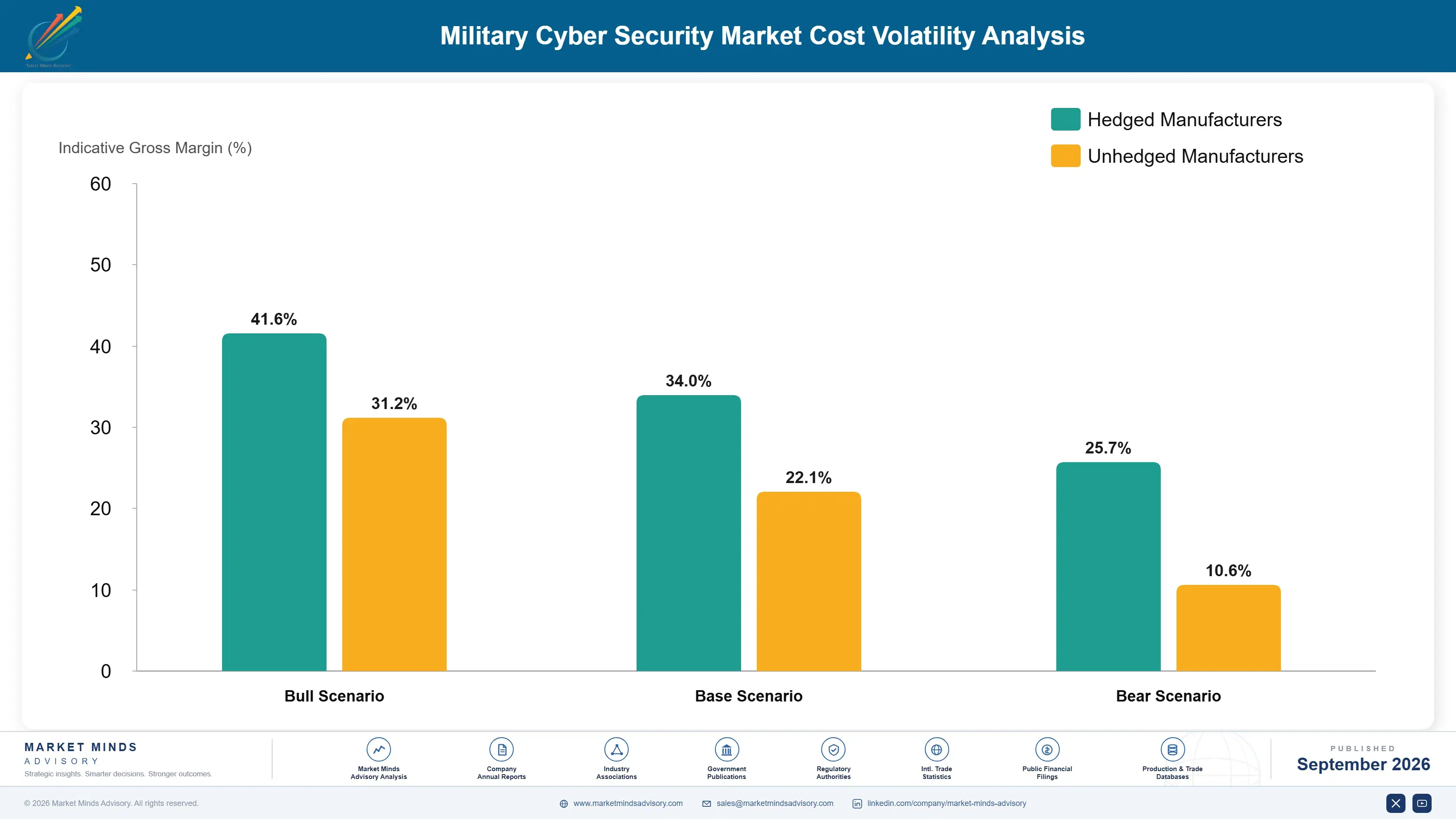
Military cyber security spans three commercial tiers: basic network and endpoint security at the volume end, certified weapons platform cybersecurity meeting classified benchmarks in the middle, and fully integrated coalition-interoperable defense cyber suites at the premium top, with gross margins expanding meaningfully from the commodity tier through to next-generation programs that command significantly higher recurring revenue per classified contract.
Volume-tier network security faces persistent price pressure from defense ministries treating basic endpoint protection as commoditized infrastructure, while premium platform cybersecurity increasingly captures disproportionate margin as ministries pay for embedded certification and cleared program delivery rather than commercial-grade software alone. Vendors straddling both tiers face internal tension allocating cleared workforce resources between defending existing network contracts and building the next-generation platform capability premium programs now demand.

High-value margin pools concentrate heavily around weapons platform certification and coalition interoperability licensing, where allied governments pay meaningfully more for measurable reductions in platform vulnerability and joint operational risk. Smaller vendors without cleared program depth remain confined to lower-margin network security work, ceding the fastest-growing and most profitable segment entirely to larger, better-capitalized primes with deeper classified program and clearance sponsorship budgets.

Volume / Commodity-Adjacent Tier

Basic network and endpoint security software serving administrative networks and lower-classification systems with minimal certification beyond standard commercial cybersecurity compliance frameworks, baseline encryption requirements, and routine scheduled patch management practices overall.
Gross Margin: 20-28%

Premium / Certified Tier

Certified weapons platform cybersecurity meeting classified defense benchmarks, providing embedded protection architecture that meaningfully reduces the vulnerability exposure legacy platforms carried before modern certification requirements existed across the entire fleet.
Gross Margin: 38-46%

Sustainability / Regulatory / Next-Generation Tier

Fully integrated coalition-interoperable defense cyber suites combining platform certification, cloud security, and joint operational compatibility, commanding the highest per-program pricing among allied government customers across nearly every major military alliance worldwide.
Gross Margin: 52-62%
military-cyber-security-market-portfolio-architecture-1789986312783

High-value Sub-segments and Strategic Watch-out

Weapons Systems and Platform Cybersecurity

This segment combines the fastest unit growth in the market with the highest per-program pricing, as defense ministries pay premium rates for embedded certification that reduces platform vulnerability, making it the clearest priority for vendor R&D investment over the next several years across all programs.
Gross Margin: 55-64%

Military Cloud and Data Security Services

Growing quickly on defense ministries migrating classified data workloads to certified cloud infrastructure, this segment carries strong margins though slightly below the platform leader, as vendors increasingly bundle cloud security with zero trust access to justify premium pricing today, rather consistently, reliably, and predictably overall.
Gross Margin: 46-54%

Network and Endpoint Security

A large installed-base segment growing at a moderate pace, this network security category remains the anchor product most defense ministries purchase first before considering broader platform-level investment, anchoring overall category volume even as growth increasingly shifts elsewhere each and every year consistently and reliably overall.
Gross Margin: 30-38%

Threat Intelligence and Situational Awareness Platforms

Growth here trails the rest of the market, and vendors risk this segment commoditizing further as basic threat feeds become a standard feature bundled into broader platforms rather than sold separately as a distinct standalone intelligence product line today, sold globally across most defense markets.
Gross Margin: 26-34%

Why Cyber Programs Compound Over Decades

Military cyber security contracts increasingly function as annuity products rather than one-time program awards, since managed security services, retrofit certification, and coalition licensing fees attach to the base program and recur across a weapons platform's typical thirty to forty year operational life. Vendors capturing this attached recurring revenue build customer lifetime value multiples well above the original program contract price.
Adoption depth varies meaningfully by platform type: administrative networks adopt shallowly, deploying commercial-grade security without deep classified integration, while weapons platforms and command and control systems integrate cybersecurity deeply into every phase of operational planning and maintenance, creating switching costs that keep those programs within a single vendor's product family across multiple decades of platform service life, modernization cycles, and periodic recertification reviews.

Buyer profiles are shifting generationally as defense ministries increasingly include dedicated cyber acquisition officers who evaluate vendor selection through classified certification and coalition interoperability criteria rather than pure cost comparisons alone. Younger acquisition leaders entering these roles expect measurable proof of vulnerability reduction before program approval, favoring vendors who can demonstrate quantified outcomes over long-standing prime contractor relationships built on legacy program ties.
military-cyber-security-market-end-use-penetration-index-1789986313279

Priorities for Defense Cyber Vendors

These are among the four positions where our research anticipates prominent divergence between winners and laggards over the coming forecast period. Each is grounded in the demand model, the regulatory perimeter, and the announced capacity pipeline.
01 / EMBEDDED PLATFORM CERTIFICATION

Build Platform Security In, Not Bolt It On

Defense ministries increasingly mandate embedded cybersecurity certification before fielding new weapons platforms, converting what was once a discretionary engineering practice into a mandatory acquisition gate that program managers cannot skip regardless of budget pressure or program schedule constraints across every branch of service. Vendors who design certification into platform architecture from the outset win larger new-build contracts meaningfully faster than those attempting retrofit approaches after fielding is already complete. Embedded design, not bolt-on remediation, wins the largest new-build programs today.
02 / RECURRING REVENUE EXPANSION

Build Managed Services Before Rivals Do

Program-based contract revenue alone undervalues the ongoing monitoring burden that defense ministries face across every fielded platform they operate, making managed security operations and retrofit certification the more durable profit pools within this category over the coming decade of sustained legacy fleet modernization across every allied military. Vendors that build this layer early capture meaningfully higher customer lifetime value and materially better retention than those still selling one-time certification engagements alone. Waiting cedes the most profitable accounts to faster-moving, better-prepared competitors.
03 / CLEARED WORKFORCE INVESTMENT

Sponsor Clearances Before the Talent Gap Widens

The persistent shortage of cleared cybersecurity professionals constrains program delivery timelines across the entire defense industry, and vendors relying exclusively on already-cleared hires will increasingly lose bids to competitors with internal clearance sponsorship pipelines that expand their addressable hiring pool considerably beyond the limited existing cleared talent base. Building this capability now positions vendors ahead of a talent gap that shows no signs of narrowing given rising classified program volume across the industry. Workforce investment is becoming as commercially valuable as technical capability itself.
04 / COALITION CERTIFICATION EXPANSION

Secure Multi-Nation Certification Before Competitors Do

Allied coalition frameworks increasingly require demonstrated cross-border architecture compatibility before awarding joint procurement contracts, and vendors lacking multi-nation certification will increasingly lose access to the largest coalition programs regardless of their underlying technical capability or single-nation certification depth already achieved over many years of effort. Pursuing coalition-wide certification now positions vendors ahead of the interoperability mandates that several alliance frameworks are actively drafting for the coming several years across member governments. This is a near-term strategic priority, not optional roadmap work.

Engagement Snapshot From the Field

A live engagement with an industry participant carrying material or product regulatory and market exposure ahead of a defining policy shift, showing how our research translates into a defensible multi-year portfolio strategy.
MARKET MINDS ADVISORY · CLIENT ENGAGEMENT SUMMARY
Military Cyber Security Producer Strategic Portfolio Review and Transition Roadmap 2026·Investment Scenario on Military Cyber Security Exposure Evaluation 2025-26
CLIENT PROFILE
The client is a mid-size allied defense ministry operating a mixed fleet of aircraft and ground vehicles, with the majority of platforms fielded before modern cybersecurity design standards existed at all. Annual budget allocated to legacy platform cybersecurity retrofit exceeded $180 million (client-reported, unverified by MMA), spread thinly across dozens of aging platform types and generations.
STRATEGIC CHALLENGE
The ministry's legacy fleet included proprietary communication protocols across multiple platform generations, making a unified retrofit approach technically impractical without extensive per-platform engineering work. Leadership needed a retrofit prioritization strategy that would address the highest-risk platforms first without requiring the full multi-year budget cycle to retrofit the entire fleet simultaneously.
MMA APPROACH
MMA analyzed vulnerability exposure and operational criticality across the ministry's full platform inventory to identify which systems generated the highest cyber risk score, then modeled a phased retrofit sequence balancing risk reduction against available annual budget. The engagement combined vendor technical capability benchmarking with certification timeline analysis specific to each platform generation to select the fastest-to-deploy retrofit approach.
KEY FINDINGS
  1. The highest-risk 15 percent of platforms accounted for a disproportionate share of the ministry's total assessed cyber vulnerability exposure across the entire fleet.
  2. Vendors offering platform-specific retrofit kits reduced the projected certification timeline substantially compared to vendors requiring fully bespoke, per-platform custom engineering work entirely.
  3. Platforms retrofitted first under the phased approach showed measurably improved vulnerability assessment scores within the first several months following full installation work.
  4. The selected vendor's coalition interoperability certification provided compatibility with allied partner systems that a purely domestic vendor simply could not have offered.
CLIENT PROFILE
The client is a mid-size allied defense ministry operating a mixed fleet of aircraft and ground vehicles, with the majority of platforms fielded before modern cybersecurity design standards existed at all. Annual budget allocated to legacy platform cybersecurity retrofit exceeded $180 million (client-reported, unverified by MMA), spread thinly across dozens of aging platform types and generations.
STRATEGIC CHALLENGE
The ministry's legacy fleet included proprietary communication protocols across multiple platform generations, making a unified retrofit approach technically impractical without extensive per-platform engineering work. Leadership needed a retrofit prioritization strategy that would address the highest-risk platforms first without requiring the full multi-year budget cycle to retrofit the entire fleet simultaneously.
MMA APPROACH
MMA analyzed vulnerability exposure and operational criticality across the ministry's full platform inventory to identify which systems generated the highest cyber risk score, then modeled a phased retrofit sequence balancing risk reduction against available annual budget. The engagement combined vendor technical capability benchmarking with certification timeline analysis specific to each platform generation to select the fastest-to-deploy retrofit approach.
KEY FINDINGS
  1. The highest-risk 15 percent of platforms accounted for a disproportionate share of the ministry's total assessed cyber vulnerability exposure across the entire fleet.
  2. Vendors offering platform-specific retrofit kits reduced the projected certification timeline substantially compared to vendors requiring fully bespoke, per-platform custom engineering work entirely.
  3. Platforms retrofitted first under the phased approach showed measurably improved vulnerability assessment scores within the first several months following full installation work.
  4. The selected vendor's coalition interoperability certification provided compatibility with allied partner systems that a purely domestic vendor simply could not have offered.
RECOMMENDED STRATEGY
Phase 1: Phase 1 (Months 1-6): Retrofit the highest-risk 15 percent of platforms identified through the vulnerability and criticality assessment conducted earlier. Phase 2: Phase 2 (Months 7-16): Extend retrofit to the remaining legacy fleet during scheduled depot maintenance visits already planned in advance. Phase 3: Phase 3 (Months 17-22): Integrate coalition interoperability certification and expand fleet-wide continuous monitoring capability across the entire allied defense network.
OUTCOME
Within twenty-two months of completing the phased retrofit, the ministry reported assessed vulnerability exposure declining by roughly 42 percent (client-reported, unverified by MMA) across retrofitted platforms, alongside coalition interoperability approval enabling participation in previously restricted joint alliance exercises and broader multinational training programs overall today.

Frequently Asked Questions

Foundational context covering the market sizes, CAGR, scope, country, region and competition that inform every finding below. This section is provided to cover basics and most often pre-purchase conversations, answered from the MMA Primary Research Dataset.

What is the current size of the Military Cyber Security Market?

The military cyber security market was valued at $25.5 billion in 2025. It is projected to reach $28.18 billion in 2026 as weapons platform certification accelerates.

How large will the Military Cyber Security Market be by 2036?

The market is projected to reach $76.48 billion by 2036, up from $28.18 billion in 2026. That represents a 2.71 times expansion over the forecast decade.

What is the CAGR for the Military Cyber Security Market 2026 to 2036?

The market is projected to grow at a 10.5 percent CAGR between 2026 and 2036. This is up from a historical CAGR of roughly 9.5 percent between 2020 and 2025.

Which segment is growing fastest?

Weapons systems and platform cybersecurity leads growth at a 13.5 percent CAGR, roughly 1.29 times the overall market rate. Defense ministries are finally prioritizing embedded platform protection over network perimeter defense alone.

Who are the major companies in the Military Cyber Security Market?

Lockheed Martin, Northrop Grumman, RTX, BAE Systems, and General Dynamics are the five largest participants by cleared program revenue. Together they hold an estimated 45 percent of the global market.

Which country is growing fastest?

India is the fastest-growing country at a 13.0 percent CAGR, driven by rapidly expanding defense budgets and indigenous defense manufacturing initiatives. The country's growing cybersecurity talent pool reinforces this trajectory further.

Report Segmentation Architecture

The full report scope spans multiple orthogonal segmentation dimensions, with cross-tabulated demand data provided for each dimension pair. Coverage extends further to regional breakdowns, trend trajectories, and the competitive detail needed to support segment-level decision-making.

By Cyber Protection Function

  • Weapons Systems and Platform Cybersecurity
  • Military Cloud and Data Security Services
  • Network and Endpoint Security
  • Threat Intelligence and Situational Awareness Platforms
  • Zero Trust Identity and Access Management
  • Supply Chain and Software Bill of Materials Security

By End-Use Military Branch

  • Army and Ground Forces
  • Navy and Maritime Forces
  • Air Force and Aerospace Forces
  • Joint Command and Intelligence Agencies
  • Space and Cyber Commands

By Commercial Dimension

  • Prime Contractor Direct Award
  • Subcontracted Specialist Services
  • Managed Security Operations Contracts
  • Coalition Interoperability Licensing

By Region

  • North America
  • Western Europe
  • East Asia
  • South Asia and Pacific
  • Latin America
  • Middle East and Africa
  • Eastern Europe

Scope, Methodology, and Coverage

Every figure in this report is reproducible from documented input assumptions. The scope below maps the historical period, the forecast horizon, the segmentation dimensions, and the countries covered, alongside the underlying primary and qualitative methodology.
Historical Period
2020 to 2025
Forecast Period
2026 to 2036
Base Year
2025 (USD billions; MMA Primary Research Dataset, September 2026)
Market Definition
The military cyber security market covers cybersecurity software, hardware, and services purpose-built for defense networks, weapons platforms, command and control infrastructure, and military supply chains. It excludes general enterprise or civilian government cybersecurity products without defense-specific certification or deployment.
Quantitative Units
USD billions (current prices); classified program contract value where applicable
Segmentation Dimensions
By Cyber Protection Function; By End-Use Military Branch; By Commercial Dimension; By Region
Regions Covered
North America, Western Europe, East Asia, South Asia and Pacific, Latin America, Middle East and Africa, Eastern Europe
Countries Covered
USA, China, Germany, France, UK, Japan, South Korea, India, Australia, Canada, Brazil, Mexico, Indonesia, Vietnam, Thailand, Malaysia, UAE, Saudi Arabia, South Africa, Nigeria, Turkey, Poland, Netherlands, Italy, Spain, Sweden, Switzerland, Argentina, Colombia, Singapore, and additional markets relevant to this sector
Key Companies Profiled
Lockheed Martin, Northrop Grumman, RTX, BAE Systems, General Dynamics, Leidos, Booz Allen Hamilton, CACI International, SAIC, Palantir Technologies, L3Harris Technologies, Thales, Elbit Systems, Leonardo, Saab AB, ManTech International, Peraton, ICF International, Parsons Corporation, V2X Inc
Quantitative Methodology
Primary survey, n=3,800 respondents, Q4 2025, six countries; demand-side model with trade association cross-validation
Qualitative Methodology
47 expert interviews, Q4 2025; applied to validate demand model assumptions, identify emerging dynamics, and assess competitive positioning
Report Format
PDF and XLSX data workbook (Word format preview document)
Publisher
Market Minds Advisory
Report Code
MMA-2026-TEC-188
Published
September 2026
Contact
sales@marketmindsadvisory.com | www.marketmindsadvisory.com

Purchase the full Military Cyber Security Market Report (2026 to 2036).

This report delivers a comprehensive analysis of the global military cyber security market, spanning protection function segmentation, regional demand dynamics, and competitive positioning across twenty profiled companies worldwide. It includes ten-year forecasts through 2036, detailed input cost and margin analysis across three commercial tiers, and revenue diversification strategies for vendors navigating the shift toward embedded weapons platform protection. The analysis draws on primary survey data, expert interviews, and company disclosures to support procurement, investment, and product strategy decisions. It closes with an anonymized client retrofit case study illustrating measured vulnerability and interoperability outcomes.
Cyber protection function segmentation with growth forecasts
Seven-region demand analysis through the 2036 forecast
Competitive benchmarking of twenty profiled global vendors
Input cost and gross margin tier breakdown analysis
Revenue diversification and recurring pricing lever analysis
Anonymized client retrofit case study with outcomes

Built For The People Who Decide

From boardroom strategy to bench-side execution, this report is read cover-to-cover by leaders shaping the next decade of their industry, turning demand scenarios, market dynamics and valuation benchmarks into decisions.
CXOs/ Presidents/ VPs/ Managers
M&A and Corporate Development
Strategy Teams and R&D Heads
Procurement and Product Directors
Regulatory and Compliance Leaders
Investor Relations and Equity Analysts