Market Minds Advisory
Military Biometrics Market

Military Biometrics Market: Military Biometrics: Watchlist Databases, Contested Environment Capture And The Identity Records Nobody Wants To Own

Two decades of battlefield enrolment produced identity databases of extraordinary sensitivity, and the hard problem now is matching in seconds without a network rather than collecting anything new from anybody at all.

Lead Analyst

Published

September 2026

Make Smarter Decisions with Customized Research Insights

Request a free sample report and evaluate market opportunities, growth trends, and competitive dynamics relevant to your business needs.

2025 MARKET VALUE$1.6BMarket Size 2025
2036 FORECAST VALUE$4.5BBase Case , 2026 to 2036
CAGR 2026 TO 20369.8 %Bull 11.0% / Bear 8.5%
INCREMENTAL OPPORTUNITY$2.7BNet 10- year value creation
EXPANSION MULTIPLE2.55x2036 value over 2026 base
Strategic Levers
M&A Pipeline
Regional Outlook
Country Rankings
Competitive Intelligence
Segmental Deep-dive
Call-Us : 91 93563 13602

Executive Snapshot and Market Trajectory.

Collection stopped being the problem some years ago. Two decades of enrolment built identity holdings of extraordinary size and sensitivity. What defence customers now buy is the ability to match against them in seconds, at the edge, with no network available. Collection was never the hard part.
Edge matching and contested environment capture grow fastest at 14.7%, because the operational requirement has moved from checkpoints with connectivity to dispersed teams without any. A device that holds a watchlist locally and matches offline is a different product from one that queries a server. Base access control remains the volume business and generates almost none of the technical difficulty or the margin. The difference between them is architectural rather than merely incremental.
Concentration sits at 49% and reflects who holds accredited system integration positions rather than who makes sensors. Algorithm performance has commoditised faster than most participants expected. What has not commoditised is accreditation, records custody and the willingness to hold data that carries real political consequences. A supplier no accreditation authority will approve has nothing to sell, whatever its false match rate happens to be. That is a slow business.
Market Definition
Revenue from biometric identification systems procured for military and defence security purposes, covering multimodal enrolment and capture devices, edge matching hardware and software, identity database and watchlist management systems, base and facility access control, forensic and exploitation analysis, and the integration and accreditation services required to field them. Excludes civil identity programmes, commercial access control, law enforcement systems outside defence procurement, and consumer device authentication.
Base Year Value
$1.6B in 2025 (MMA Primary Research Dataset, August 2026)
Forecast Period
2026 to 2036, eleven discrete annual values
CAGR
9.8% base case. Bull 11.0%. Bear 8.5%.
Fastest Growth Segment
Edge Matching and Contested Environment Capture: 14.7% CAGR
Fastest Growth Country
India: 12.0% CAGR
Fastest Growth Region
South Asia and Pacific: 12.0% CAGR
Largest Region
North America: 30% of 2025 global value
Market Leaders
Leidos, Thales, IDEMIA, BAE Systems and Northrop Grumman lead on accredited defence biometric system revenue. Source: company annual reports and MMA Primary Research Dataset, July 2026.
Primary Survey
n=3,800 procurement and R&D decision-makers, Q4 2025, six countries
Methodology
Demand-side build-up, cross-validated against public data, 47 expert interviews

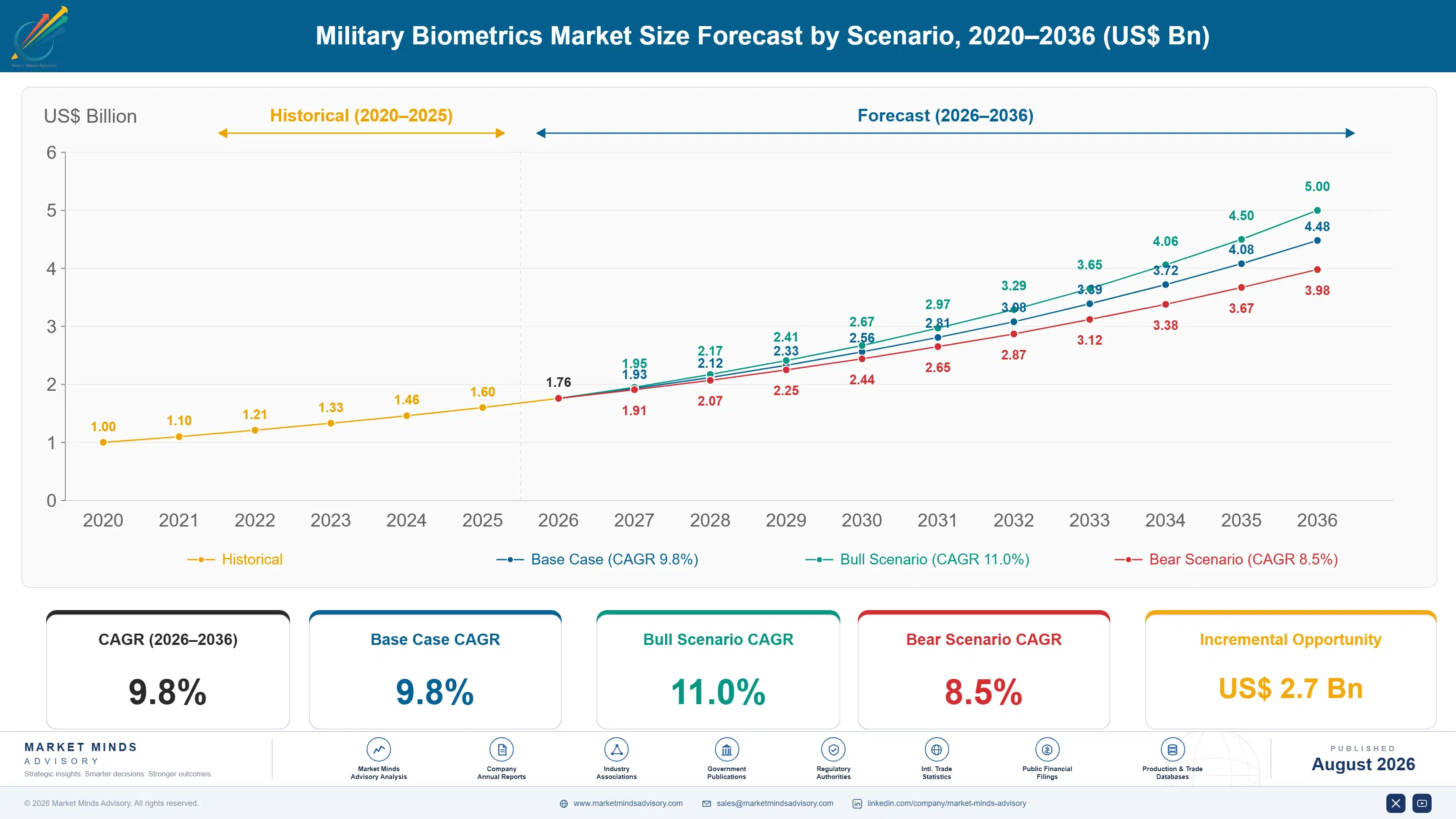
Military Biometrics Market Forecast Scenarios

military-biometrics-market-size-forecast-scenario-1788023780523
The 2020 to 2025 period was defined by withdrawal and its consequences. Large enrolment programmes wound down as deployments ended, and the databases they produced became a custody problem rather than a collection asset. Procurement shifted toward base access, force protection and maritime interdiction. Revenue compounded near 8.4%, held up by records management and system sustainment rather than by any new field collection at scale.
Three mechanisms carry the base case. Edge matching requirements are replacing networked architectures as operations disperse, and that means new hardware and new software rather than upgrades. Base and installation access control is being rebuilt around biometric credentials across allied forces. And allied identity data sharing arrangements are driving accreditation and interoperability work that has been deferred for years across several partner nations. None of the three depends on a new deployment anywhere.
The bull catalyst is a formal allied interoperability standard for identity data sharing, which would oblige system replacement across several partner nations simultaneously. The bear risk is a serious data custody failure: these holdings carry consequences for identified individuals that no commercial breach approaches, and one incident would slow procurement everywhere for years. The exposure is unusually personal.

Matching Without A Network

Twenty years of enrolment left allied forces holding around 94 million identity records, and the operational question has changed completely since they were gathered. Nobody is short of data. What field units need is a match returned in under two seconds by a device carrying its own watchlist, because the connectivity assumed by earlier architectures does not exist where dispersed teams now operate.
MARKET CONCENTRATION CR549%Share of accredited defence biometric revenue held by leading integrators
EDGE MATCH LATENCY1.8 secondsTypical offline identification time on current fielded devices
ENROLLED RECORDS HELD94 millionIdentity records under active defence custody across allied holdings
MULTIMODAL CAPTURE SHARE71%Proportion of procurement specifying more than one modality
ACCREDITATION TIMELINE22 monthsTypical time from award to authority approving operational use
SUSTAINMENT REVENUE SHARE44%Portion of revenue from support rather than initial system supply
That requirement rewrites the product. A networked capture device sending a query to a server is a straightforward engineering problem solved years ago. A handheld holding an encrypted watchlist subset, matching offline at 1.8 seconds, and reconciling when connectivity returns is a different system entirely. Around 71% of procurement now specifies multimodal capture, because a single modality fails too often in field conditions.
Custody is the uncomfortable part nobody markets. These holdings identify individuals whose exposure carries consequences no commercial data breach approaches, and the accreditation regimes around them take roughly 22 months from award to operational approval. That timeline is the real barrier to entry. Sustainment at 44% of revenue follows accreditation, which is why incumbents rarely lose positions they have properly established.
"The algorithms stopped being the differentiator around the time everyone's false match rates converged. What separates participants now is whether an accreditation authority will let their system touch the records at all, and that is a much slower business."
Director, Defence Identity Systems Practice · MMA Defence Technology Practice · August 2026

Market Trends

Edge Matching Replaces Networked Query Architectures Entirely

Dispersed operations without reliable connectivity have made server-based identification unusable in exactly the situations it matters most, so procurement has moved toward devices holding encrypted watchlist subsets and matching locally at around 1.8 seconds. That is not an upgrade to existing systems but a different architecture, requiring new hardware, new key management and new reconciliation logic. Suppliers built around networked query models are finding their installed base harder to defend than the market share suggests. Replacement rather than upgrade is what defence customers are now actually buying in this category.
Market Impact: Specifies multimodal capture in 71%
Algorithm Performance Has Commoditised Faster Than Expected

Independent evaluation has narrowed the performance gap between leading matching algorithms to margins that no longer decide procurement outcomes, which has shifted competition toward integration, accreditation and custody arrangements instead. Suppliers who invested heavily in proprietary matching now find that capability priced closer to a component than to a differentiator. The commercial position has moved to whoever holds accredited integration and the authority relationships that take years to build. Investment in proprietary matching that once looked like a durable advantage now reads as money spent on a component nobody scores separately.
Market Impact: Adds 22 months per nation

Market Opportunities and Growth Drivers

Installation Access Control Rebuilding Around Biometric Credentials

Allied forces are replacing card and PIN access at bases and sensitive facilities with biometric credentials, driven by credential compromise incidents rather than by any technology enthusiasm. The programmes are large, unglamorous and generate sustained sustainment revenue at 44% of the total once fielded. Around 71% of these procurements specify multimodal capture because gloved hands, cold weather and industrial environments defeat single modality systems reliably. This is the volume business underneath everything else. Programme durations run long, and the sustainment tail behind each of them runs considerably longer again after that.
Market Impact: Covers roughly 94 million individuals

Allied Identity Data Sharing Forces Interoperability Work

Partner nations sharing identity holdings need compatible formats, matching thresholds and accreditation regimes, and most currently have none of those aligned. The work is expensive, slow and politically delicate, which is exactly why it has been deferred repeatedly across a decade. Renewed alliance activity has now made it unavoidable. Systems fielded to national standards require modification or replacement, and the accreditation timeline of roughly 22 months applies to each nation separately rather than once. Deferred work does not become cheaper by being deferred, as several partner nations are now discovering.
Market Impact: Delays revenue by 22 months

Market Restraints and Challenges

Records Custody Carries Consequences Nobody Wants To Own

Holdings covering around 94 million individuals carry exposure risk for identified people that no commercial data breach approaches, and defence customers are acutely aware of it. The root cause is that these records were collected under operational conditions from populations who never consented and often cannot be traced. Commercially it makes customers cautious, slows procurement and deters some suppliers entirely. Mitigation runs through data minimisation, partitioned holdings, sovereign hosting requirements and retention policies that finally delete rather than archive. None of those mitigations reduces the consequence of a failure by very much.
Market Impact: Matches offline in 1.8 seconds

Accreditation Timelines Deter Capable New Entrants

Roughly 22 months from award to operational approval means a supplier funds development, delivery and support long before revenue arrives, which smaller firms with genuine technical capability simply cannot finance. The root cause is that accreditation examines the whole system and its handling of the most sensitive data any government holds. Commercially it protects incumbents more effectively than any technology position. Mitigation runs through subcontracting under accredited primes, pre-accredited component reuse and framework agreements shortening subsequent approvals. Every one of those routes still runs through somebody else's accreditation position first.
Market Impact: Narrows algorithm gaps below 2%
4 additional market trends, 3 additional growth drivers, and 2 additional restraints and challenges are covered in the full report. Contact sales@marketmindsadvisory.com to access the complete intelligence.

Segment CAGR and Growth Architecture

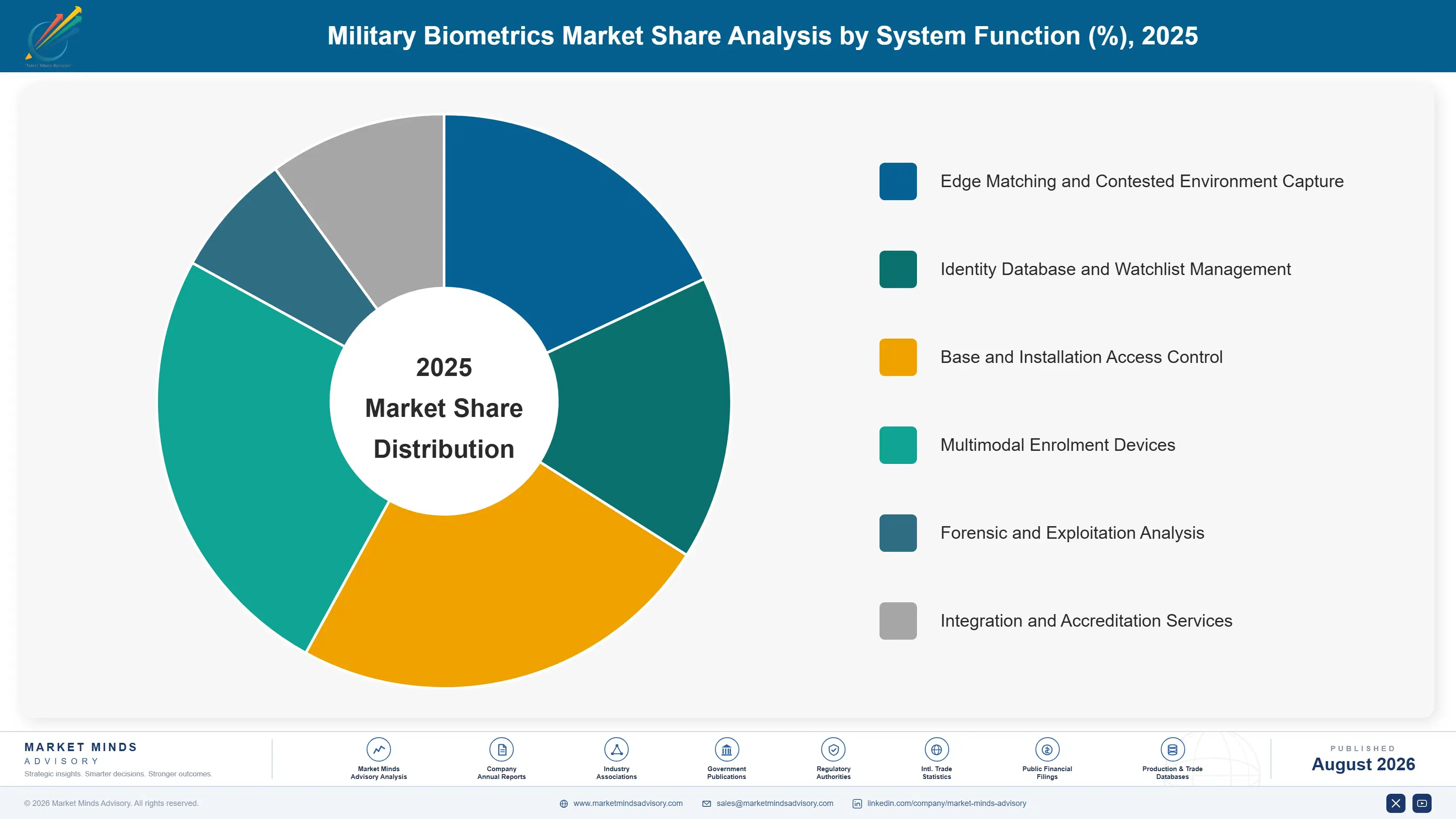
Segmentation follows system function, since that determines the accreditation regime, the operating environment and whether the product is a device, a database or a service. Six categories describe the market completely, from base access control that generates the volume through to contested environment matching where the technical difficulty and the growth both plainly sit at present.
military-biometrics-market-market-share-analysis-1788023781054

Edge Matching and Contested Environment Capture

The fastest category grows at 14.7%, half again the market rate of 9.8%, and it grows because the operational assumption underneath earlier systems has failed. Dispersed teams without connectivity cannot query a server, so identification has to happen on the device against an encrypted watchlist subset carried locally, returning a result in about 1.8 seconds. That demands new hardware, key management and reconciliation logic rather than a software update to anything existing. Suppliers built around networked architectures hold installed bases considerably less defensible than their market position suggests, and the customers have already worked this out for themselves. The installed base counts for considerably less than it normally would in this business.
CAGR 14.7%

Identity Database and Watchlist Management

Database and watchlist systems grow at 12.1% on holdings covering roughly 94 million individuals that nobody quite knows what to do with. The work involves partitioning, retention enforcement, sovereign hosting and the reconciliation logic that keeps distributed edge devices synchronised with authoritative records. Allied sharing arrangements are driving interoperability work that has been deferred for a decade and is now unavoidable. It is the least visible part of this market and among the most consequential, since custody failures here would carry consequences for identified individuals that no commercial breach could reasonably be compared against. Retention policy that actually deletes rather than archives is the part customers ask about most and suppliers discuss least.
CAGR 12.1%
Full segment breakdown across 6 segments available in the complete report.

Regional Architecture and Country Demand Map

Defence biometric procurement follows alliance structures and operational history rather than population or economy. North America leads on installed holdings and accredited integration capability, with East Asia expanding fastest among large programmes and South Asia growing quickest overall. Alliance membership shapes the pattern more than any economic measure.

North America

The largest share at 30% follows two decades of enrolment programmes that produced most of the allied identity holdings now under custody. Accredited integration capability concentrates here because the accreditation regimes themselves originated here and suppliers have spent years working inside them. Installation access control programmes across a very large base network generate steady sustainment volume. The custody question is also debated most openly here, which has slowed some procurement and improved retention policy considerably. Sustainment against those holdings produces revenue for as long as the systems operate, which is why accredited positions established here a decade ago are still generating work that no competitor has found a way to contest.
Share: 30% | CAGR: 9.4% (2026 to 2036)

East Asia

Border security, maritime interdiction and installation protection drive procurement across a region where several forces have expanded biometric capability rapidly from a low base. Japanese and Korean programmes emphasise installation access and personnel management rather than field enrolment, reflecting different operational histories. Chinese domestic capability is extensive and largely closed to external suppliers, which limits the addressable portion of the region considerably. Taiwanese and Southeast Asian procurement has accelerated alongside wider defence spending increases. The addressable portion of this region is therefore considerably smaller than its share implies, since a large share of regional activity sits inside a domestic supply arrangement that external participants cannot enter on any terms at all.
Share: 23% | CAGR: 10.8% (2026 to 2036)
Regional intelligence for 5 additional markets available in the complete report: Western Europe, South Asia and Pacific, Latin America, Middle East and Africa, Eastern Europe. Contact sales@marketmindsadvisory.com.
military-biometrics-market-country-cagr-analysis-1788023781574

Where Defence Biometric Margin Sits

Four levers work on accreditation position, architecture timing and sustainment capture rather than on matching performance, which has commoditised and no longer decides much. Edge architecture, accreditation reuse, custody services and interoperability positioning each address something a supplier can act on now. None of the four turns on having a better matching algorithm than anybody else.

Build For Offline Matching Before Customers Ask

Networked query architectures fail exactly where identification matters most, and procurement has already moved toward devices matching locally in around 1.8 seconds against carried watchlists. Suppliers whose installed base assumes connectivity hold a position considerably weaker than market share implies, because replacement rather than upgrade is what customers now require. Building offline capability costs perhaps 8 to 12 million dollars in development. The alternative is defending an architecture the customer has already decided against. Losing an accredited position outright costs considerably more than the development programme itself ever will do.
Market Impact: Defends the position against 14.7% segment growth annually

Reuse Accreditation Evidence Across Programmes Deliberately

Accreditation runs roughly 22 months from award to operational approval and has to be funded before revenue arrives, which is the single largest barrier in this market. Suppliers who structure evidence for reuse across programmes and nations shorten subsequent approvals substantially rather than repeating the whole exercise. Framework agreements formalise that reuse where customers will sign them. Firms treating each accreditation as a standalone project pay several times over for work they have already completed once. Reuse across 3 or more programmes changes the economics of every subsequent bid entirely.
Market Impact: Shortens the 22 month accreditation timeline quite substantially

Sell Custody As A Service Not A Liability

Holdings covering around 94 million individuals create obligations customers find genuinely uncomfortable, and most suppliers treat that discomfort as a reason to stay away from records management entirely. Partitioning, retention enforcement, sovereign hosting and audit capability are services customers need and few will provide. Sustainment revenue already runs at 44% of the total, and custody services carry margins above system supply. The discomfort is precisely what keeps competition out of this work. Custody contracts typically run 5 years or longer because moving records between providers creates exposure nobody authorises lightly.
Market Impact: Serves custody obligations across 94 million record holdings

Position Early On Allied Interoperability Standards

Partner nations sharing identity holdings need aligned formats, thresholds and accreditation regimes that currently do not exist, and the standards work deciding them is underway now rather than later. Suppliers inside those discussions shape requirements their systems already satisfy. Each participating nation then runs its own accreditation of roughly 22 months, which multiplies the addressable work considerably. Firms waiting for published standards will spend 2 years catching up to whoever helped write them. Standards work of this kind happens roughly once a decade and then then closes quietly to latecomers.
Market Impact: Multiplies work across separate 22 month approval cycles

Who Controls the Margin Pool

Concentration sits around 49% across the five largest participants measured on accredited defence biometric system revenue, which is moderate and reflects a market where integration position rather than component capability decides outcomes. Large defence integrators hold most of it. Specialist biometric firms participate substantially as subcontractors under accredited primes, which is where much of the actual technology originates. That split is worth understanding properly.
Competition runs on accreditation position, architecture fit and custody willingness. Accreditation comes first, since a system that no authority will approve cannot be fielded whatever its performance. Architecture fit has become decisive as edge matching displaces networked query models. Custody willingness is the quietest dimension and increasingly the most commercially useful, because many capable suppliers will not touch records management at all. The order matters.

Pressure is arriving from two directions. Civil identity suppliers with deep capture and matching capability are entering defence procurement through accredited primes rather than directly. Meanwhile algorithm commoditisation has removed the differentiator several participants built their positions on. Rankings will shift toward suppliers holding accredited edge architecture and records custody capability together, since almost nobody currently holds both properly.
military-biometrics-market-company-positioning-matrix-1788023782092

Competitive Moat and Risk Dimensions

LEIDOS

Moat: Accredited integration and records custody

Leidos holds accredited integration positions across large identity holdings and has demonstrated willingness to carry records custody obligations that many capable competitors decline outright. That combination is rare and takes years of authority relationship building to establish. Sustainment revenue follows accreditation, which is why positions properly established here are so seldom lost to competitors.
LEIDOS

Risk: Architecture built on connectivity assumptions

Substantial parts of the installed base assume network availability that dispersed operations no longer provide, and customers are replacing rather than upgrading those systems. Defending an architecture the customer has already decided against is a poor commercial position. Rebuilding for offline matching requires investment competing against other priorities inside a large portfolio.
IDEMIA

Moat: Multimodal capture and matching depth

IDEMIA brings capture hardware and matching capability developed at civil identity scale that few defence-only suppliers can match on cost or performance, and around 71% of defence procurement now specifies multimodal capture. Its technology reaches defence programmes through accredited primes as well as directly. Scale across adjacent markets funds development that defence volumes alone would never support.
IDEMIA

Risk: Algorithm advantage eroding through commoditisation

Independent evaluation has narrowed performance differences between leading algorithms to margins that no longer decide procurement, which erodes an advantage built over many years of investment. Competition is moving toward accreditation and custody, where defence integrators hold stronger positions. Civil identity association also raises political sensitivities in some defence procurement contexts.

Players Tracked

Prominent Players

Leidos
Thales
IDEMIA
BAE Systems
Northrop Grumman

Other Key Players

Aware
NEC Corporation
Fujitsu
HID Global
Crossmatch Technologies
Innovatrics
Neurotechnology
Cognitec Systems
Precise Biometrics
SITA
Veridos
Suprema
Elbit Systems
General Dynamics Information Technology
Booz Allen Hamilton

Recent Developments

FEBRUARY 2024

Defence customer awarded edge matching device programme

A defence procurement authority awarded a programme for handheld devices performing offline biometric matching against locally held encrypted watchlists, replacing systems that required network connectivity to return any identification result. This was a competitive contract award rather than any acquisition, merger or joint venture between the suppliers involved.
Signal: Replacement rather than upgrade confirms that networked identification architectures have reached the end of their commercial life.
AUGUST 2024

Allied nations agreed identity data sharing framework arrangements

Several allied nations agreed framework arrangements for sharing biometric identity holdings, requiring aligned data formats, matching thresholds and accreditation recognition across participating forces. This was an intergovernmental framework arrangement rather than any commercial transaction, and each participating nation retains its own separate accreditation process throughout.
Signal: Interoperability agreements multiply accreditation work rather than reducing it, since each nation still approves separately anyway.
APRIL 2025

Integrator expanded records custody and retention capability

A defence integrator expanded partitioned hosting, retention enforcement and audit capability for identity holdings, responding directly to customer obligations around records covering populations enrolled under operational conditions. This was organic investment in service capability rather than any corporate transaction with another participant in this market.
Signal: Custody work most suppliers avoid is becoming a commercial position rather than merely an unwelcome obligation.

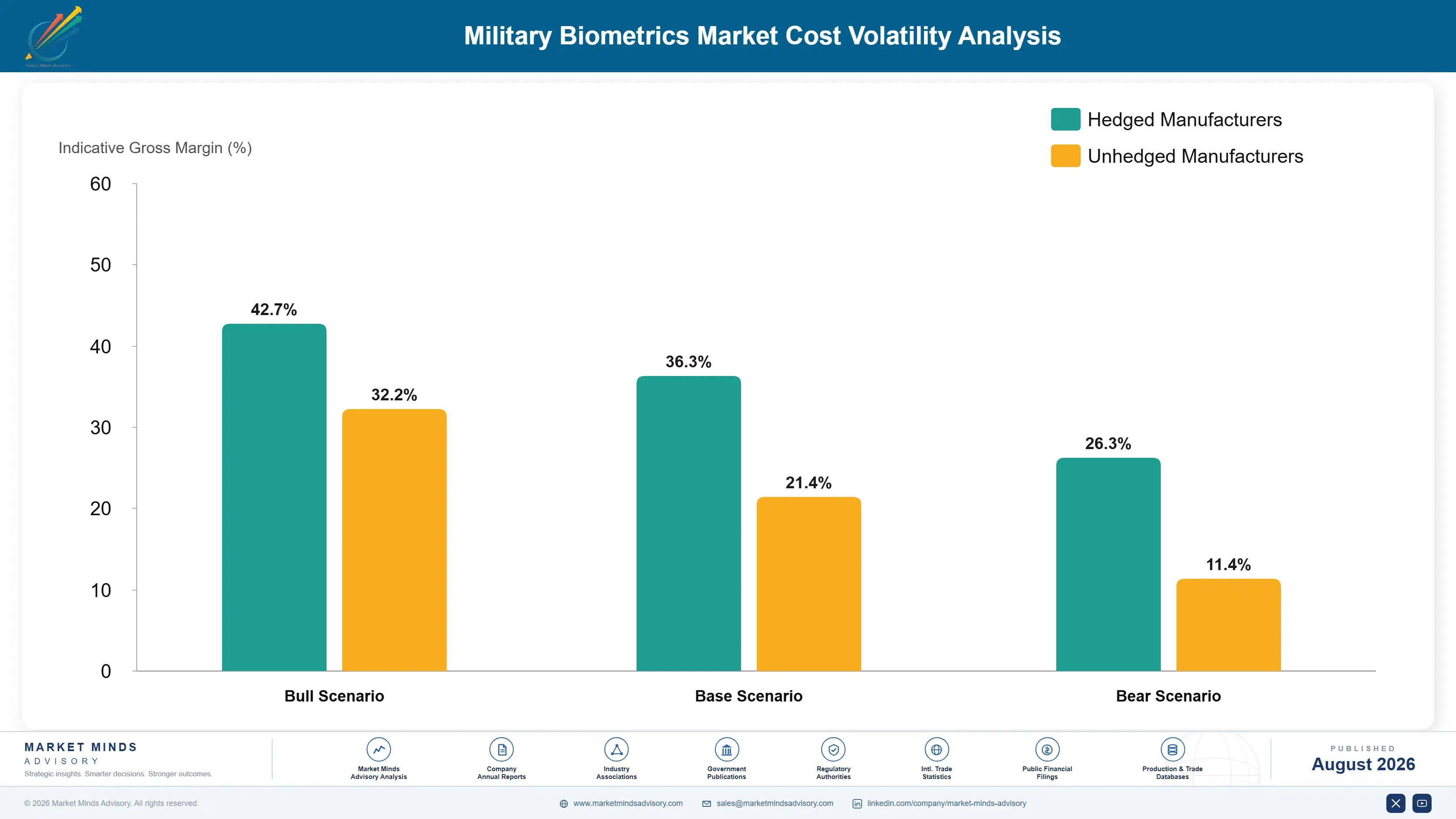
What Accredited Biometric Systems Cost

Cost divides four ways and hardware is the smallest part. Accreditation, security engineering and evidence production absorb roughly 34% of programme cost, software development and integration near 29%, sustainment and support near 22%, and capture hardware the remaining 15%. Suppliers entering from commercial biometrics consistently underestimate the first category by a wide margin and discover it after they have already bid.
Semiconductor supply disruption through the recent period raised capture device cost and lengthened lead times considerably, since defence volumes are too small to command priority allocation from any component supplier. Thales and NEC both discussed component availability and supply chain conditions across recent reporting periods. Secure element and sensor availability remains the specific constraint rather than general chip supply, and qualified alternatives take months to approve.

Exposure varies sharply by supplier type. Firms with accreditation evidence reusable across programmes carry that 34% burden once rather than repeatedly. Commercial entrants carry it fully on every programme and price uncompetitively without understanding why. Suppliers holding sustainment positions absorb development cost against 44% recurring revenue, while those winning supply-only contracts have no such recovery available to them.
military-biometrics-market-cost-volatility-analysis-1788023782287

Accreditation evidence reuse across programmes and nations

Accreditation and security engineering absorb roughly 34% of programme cost, and most of that evidence applies to more than the single programme it was produced for. Structuring it for reuse from the outset, and negotiating framework recognition with authorities, shortens later approvals substantially. Suppliers treating each accreditation as standalone pay repeatedly for work already completed once.

Secure element qualification ahead of supply disruption

Defence volumes never command priority allocation, so secure elements and sensors become unavailable at exactly the wrong moment and qualified alternatives take months to approve. Qualifying second sources before disruption arrives costs comparatively little against a stalled delivery schedule. Most suppliers begin qualification only after supply has already failed, which is the expensive way round.

Sustainment contracting alongside initial system supply

Sustainment produces 44% of revenue and is where development cost actually gets recovered, yet suppliers still bid supply-only contracts that leave support to somebody else entirely. Contracting both together changes programme economics fundamentally. Customers often prefer it, since accredited support from the system designer avoids a second approval process that nobody wants to run.

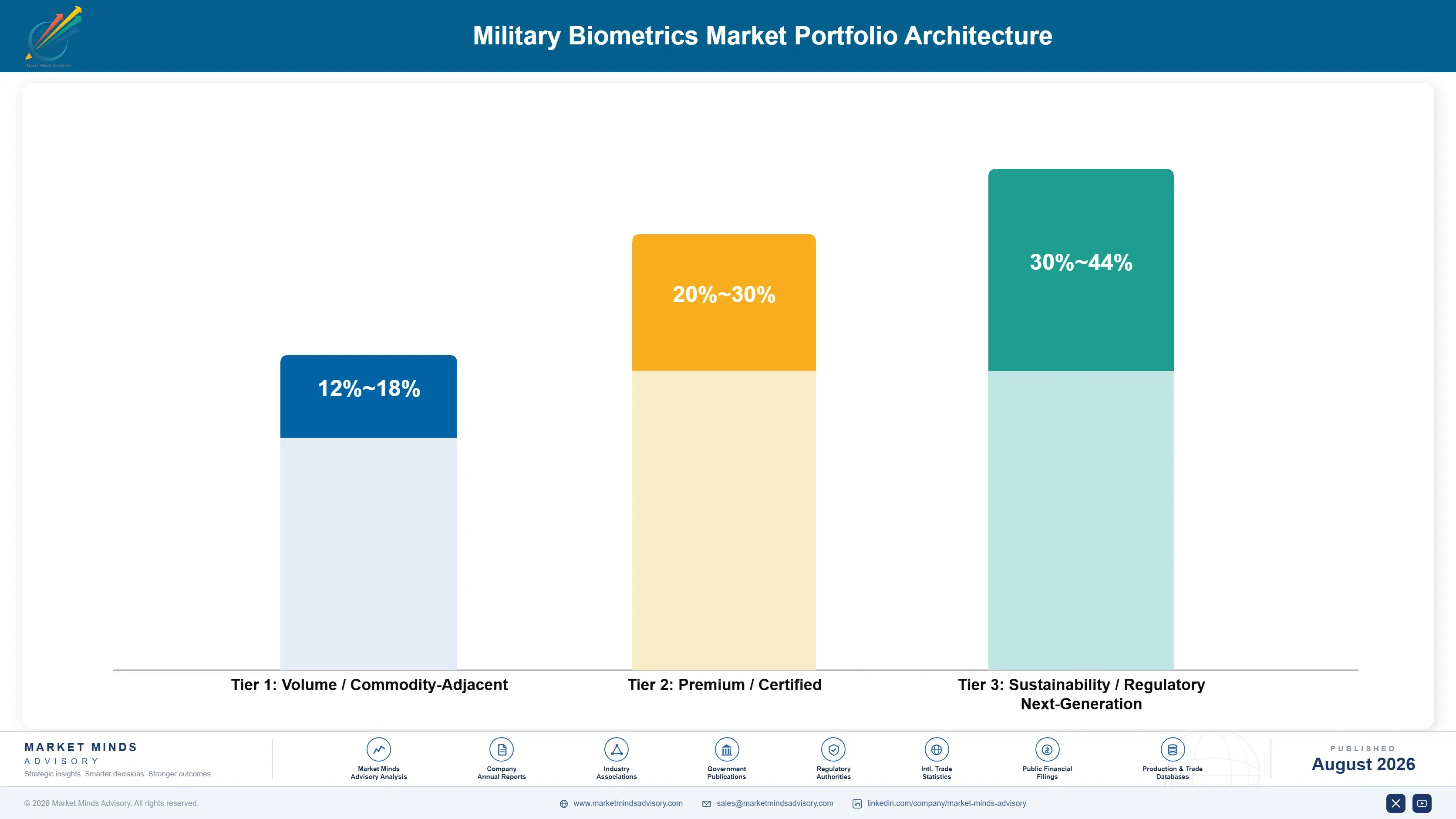
Portfolio Architecture for Margin Defence

The portfolio separates by accreditation weight rather than by technology. Base and installation access control is the volume core: large programmes, familiar requirements, competition from commercial suppliers, and margins reflecting all three. It generates steady sustainment revenue and almost none of the technical difficulty, which suits some participants perfectly well and bores others considerably. The volume is real and the difficulty is not.
Margin concentrates where accreditation and custody create genuine barriers. Edge matching for contested environments, identity database management and forensic exploitation all require approvals that take roughly 22 months and evidence that commercial entrants have not produced before. That is why sustainment reaches 44% of revenue: once a supplier is accredited into a holding, replacing it means repeating an approval process nobody wants to run twice.

The overlooked pool is records custody. Most suppliers treat holdings covering 94 million individuals as a liability to be avoided, which leaves partitioning, retention enforcement and audit services underserved by anyone credible. Customers need the work done and have few willing providers. The discomfort that keeps competitors away is exactly what makes the position defensible. Discomfort is a barrier to entry like any other.

Volume / Commodity-Adjacent

Base and installation access control, personnel verification and standard capture hardware supply. Range spans six points because commercial suppliers compete directly here and programme scale varies enormously between national forces.
Gross Margin: 12-18%

Premium / Certified

Accredited system integration, multimodal capture programmes and sustainment support. Range spans ten points because accreditation evidence reuse separates suppliers carrying that cost once from those repeating it every time. Evidence reuse decides margin.
Gross Margin: 20-30%

Sustainability / Regulatory / Next-Generation

Edge matching architecture, identity database custody and forensic exploitation analysis. Range spans fourteen points because custody willingness and accredited edge capability are held together by very few suppliers. Custody willingness is the scarcer half.
Gross Margin: 30-44%
military-biometrics-market-portfolio-architecture-1788023782785

High-value Sub-segments and Strategic Watch-out

Edge Matching and Contested Environment Capture

High value and high growth at 14.7%, replacing networked architectures rather than upgrading them. The twelve point range separates suppliers with accredited offline capability from those adapting connectivity-dependent systems that customers have already decided against. Architecture rather than matching performance is what decides these competitions now.
Gross Margin: 32-44%

Identity Database and Watchlist Management

High value with moderate growth at 12.1%, covering holdings of roughly 94 million individuals under genuine custody obligation. The ten point range reflects how differently suppliers price sovereign hosting against straightforward database management and reconciliation work. Moving records between accredited providers is something nobody authorises lightly.
Gross Margin: 28-38%

Base and Installation Access Control

The volume core, competing directly against commercial access control suppliers on familiar requirements with well understood specifications. Steady sustainment revenue and modest margin, and the part of this market that most resembles ordinary security procurement. Programme scale varies enormously between forces and so does the margin.
Gross Margin: 12-18%

Records Custody Obligations

The strategic watch-out rather than a growth pool. Holdings identify individuals whose exposure carries consequences no commercial breach approaches, and one serious custody failure would slow procurement across every allied nation for years. No supplier here controls the incident that would remove their own market.
Gross Margin: Variable

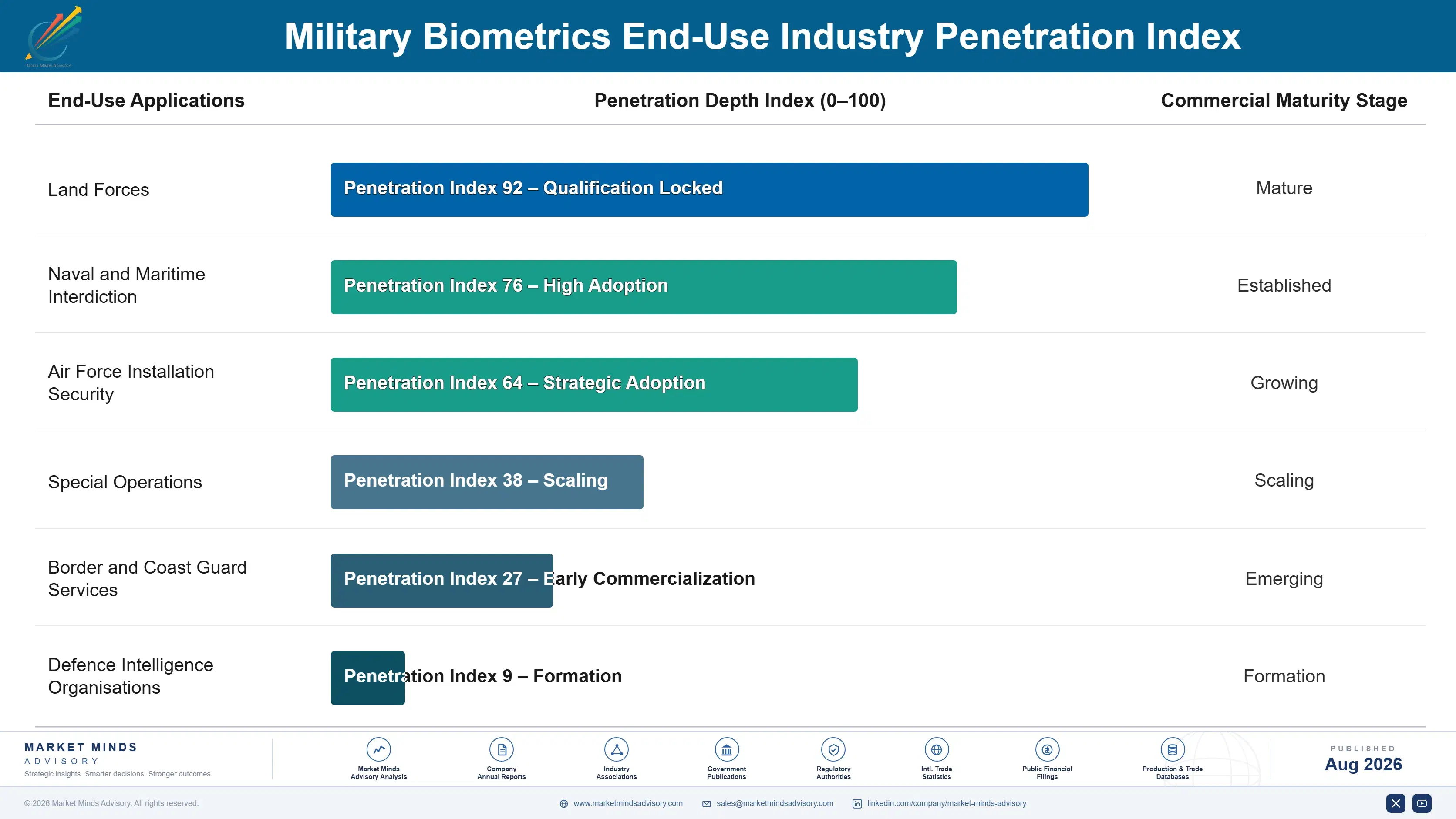
Why Accredited Positions Hold

Accreditation produces annuity economics more reliably than technology ever does here. A supplier approved into an identity holding sees sustainment, modification and expansion revenue for as long as the system operates, and displacing it means repeating an approval process running roughly 22 months that no customer undertakes without cause. Sustainment at 44% of revenue is the visible result. The position is administrative rather than technical, and considerably more durable for it.
Stickiness varies by function more than by customer. Database and custody positions are close to permanent, since moving records between accredited providers creates exposure nobody wants to authorise. Edge device positions are more contestable now precisely because the architecture is changing, which is why installed base is worth less here than usual. Access control is the most contestable of all, competing against commercial suppliers on familiar ground.

Buyers are changing in one important respect. Early programmes were specified by operational requirement staff focused on capability. Current procurement increasingly involves data protection authorities, legal advisers and records officers with obligations rather than requirements. Suppliers whose commercial approach was built for the first audience are finding the second asks entirely different questions and accepts considerably fewer assurances.
military-biometrics-market-end-use-penetration-index-1788023783271

Where Suppliers Should Commit Now

These are among the four positions where our research anticipates prominent divergence between winners and laggards over the coming forecast period. Each is grounded in the demand model, the regulatory perimeter, and the announced capacity pipeline.
01 / OFFLINE ARCHITECTURE INVESTMENT

Connectivity assumptions have already cost suppliers their positions

Dispersed operations without reliable networks have made server-based identification unusable in precisely the situations where identification matters most, and procurement has moved decisively toward devices matching locally within roughly two seconds of capture. Suppliers whose installed base assumes connectivity hold positions considerably weaker than their market share suggests, because customers are replacing rather than upgrading those systems entirely rather than extending them. Building offline capability costs perhaps eight to twelve million dollars, which is far less than the accredited position is worth.
02 / ACCREDITATION EVIDENCE REUSE

Stop paying twice for approval work already completed

Accreditation and security engineering absorb roughly 34% of programme cost and run around 22 months from award to operational approval, all of which has to be funded well before any programme revenue arrives at all. Suppliers structuring that evidence for reuse across programmes and partner nations shorten subsequent approvals substantially rather than repeating the entire exercise each time from the beginning. Firms treating every accreditation as a standalone project pay several times over for identical work they have already completed once.
03 / RECORDS CUSTODY POSITIONING

The liability everyone avoids is the defensible position

Holdings covering roughly 94 million individuals create obligations that most capable suppliers treat as a good reason to stay well away from records management entirely, which leaves partitioning, retention enforcement and audit services genuinely underserved by anyone credible at all. Customers plainly need that work done and have very few willing providers to choose between anywhere. Sustainment already runs at 44% of revenue, and custody services carry margins above system supply while facing almost no competition for the work at all.
04 / INTEROPERABILITY STANDARDS INFLUENCE

Help write the standard or spend years catching up

Partner nations sharing identity holdings need aligned formats, matching thresholds and accreditation recognition that do not yet exist anywhere at all, and the standards work deciding all of it is underway right now. Suppliers inside those discussions shape requirements their systems already satisfy, while each participating nation then runs a separate approval of roughly 22 months on its own account. Firms waiting for published standards will spend two years catching up to whoever helped to write them in the first place.

Engagement Snapshot From the Field

A live engagement with an industry participant carrying material or product regulatory and market exposure ahead of a defining policy shift, showing how our research translates into a defensible multi-year portfolio strategy.
MARKET MINDS ADVISORY · CLIENT ENGAGEMENT SUMMARY
Military Biometrics Producer Strategic Portfolio Review and Transition Roadmap 2026·Investment Scenario on Military Biometrics Exposure Evaluation 2025-26
CLIENT PROFILE
A defence biometric supplier holding accredited positions on two national identity programmes, supplying networked capture devices and matching software with sustainment contracts attached. Revenue was stable while competitive win rates had fallen sharply across three consecutive procurement cycles, and management attributed the decline to pricing rather than to anything about the product or its underlying architecture.
STRATEGIC CHALLENGE
The board needed to establish whether declining win rates reflected price, performance or architecture, and whether investing in offline edge matching capability justified diverting development from planned algorithm improvements. It also faced a records custody opportunity that engineering leadership wanted to decline outright on liability grounds without any commercial assessment being made.
MMA APPROACH
MMA reconstructed the last twelve competitive losses from procurement documentation and customer interviews, isolating the stated and actual reasons for each decision. It modelled offline architecture development cost against defendable installed base value. Expert interviews with accreditation authorities, procurement staff and competing suppliers established what customers now specify and why.
KEY FINDINGS
  1. Nine of twelve losses cited offline matching capability the client did not offer, and price featured as a deciding factor in only two of them.
  2. Algorithm performance was raised in no procurement decision reviewed, having converged across leading suppliers to differences that evaluation could no longer meaningfully distinguish.
  3. Accreditation evidence produced for two programmes was roughly 60% reusable and had been rebuilt from scratch each time at considerable and entirely avoidable cost.
  4. The custody opportunity carried genuine liability but faced almost no competition, and the customer had approached only two suppliers because the rest had already declined.
CLIENT PROFILE
A defence biometric supplier holding accredited positions on two national identity programmes, supplying networked capture devices and matching software with sustainment contracts attached. Revenue was stable while competitive win rates had fallen sharply across three consecutive procurement cycles, and management attributed the decline to pricing rather than to anything about the product or its underlying architecture.
STRATEGIC CHALLENGE
The board needed to establish whether declining win rates reflected price, performance or architecture, and whether investing in offline edge matching capability justified diverting development from planned algorithm improvements. It also faced a records custody opportunity that engineering leadership wanted to decline outright on liability grounds without any commercial assessment being made.
MMA APPROACH
MMA reconstructed the last twelve competitive losses from procurement documentation and customer interviews, isolating the stated and actual reasons for each decision. It modelled offline architecture development cost against defendable installed base value. Expert interviews with accreditation authorities, procurement staff and competing suppliers established what customers now specify and why.
KEY FINDINGS
  1. Nine of twelve losses cited offline matching capability the client did not offer, and price featured as a deciding factor in only two of them.
  2. Algorithm performance was raised in no procurement decision reviewed, having converged across leading suppliers to differences that evaluation could no longer meaningfully distinguish.
  3. Accreditation evidence produced for two programmes was roughly 60% reusable and had been rebuilt from scratch each time at considerable and entirely avoidable cost.
  4. The custody opportunity carried genuine liability but faced almost no competition, and the customer had approached only two suppliers because the rest had already declined.
RECOMMENDED STRATEGY
Phase 1: Phase one: redirect development from algorithm work toward offline edge matching capability, targeting accreditation on the next available programme cycle. Phase 2: Phase two: restructure accreditation evidence for cross-programme reuse and negotiate framework recognition with the two most relevant approval authorities directly involved. Phase 3: Phase three: pursue the custody opportunity with liability terms negotiated properly rather than declining work that faces almost no competition.
OUTCOME
The client reported winning two of the next four competitions and sustainment revenue rising 12% (client-reported, unverified by MMA). Offline capability reached accreditation in nineteen months. The custody contract was signed with negotiated liability caps, and accreditation cost on the subsequent programme fell substantially as a result.

Frequently Asked Questions

Foundational context covering the market sizes, CAGR, scope, country, region and competition that inform every finding below. This section is provided to cover basics and most often pre-purchase conversations, answered from the MMA Primary Research Dataset.

What is the current size of the Military Biometrics Market?

The market is valued at USD 1.6 billion in 2025, measured as revenue from biometric identification systems procured for military and defence security purposes worldwide.

How large will the Military Biometrics Market be by 2036?

MMA forecasts USD 4.47 billion by 2036, up from USD 1.76 billion in 2026. That represents incremental revenue of USD 2.72 billion and an expansion multiple of 2.55 times.

What is the CAGR for the Military Biometrics Market 2026 to 2036?

The base case CAGR is 9.8%, with a bull case of 11.0% and a bear case of 8.5%. Edge matching architecture replacement supplies most of that growth.

Which segment is growing fastest?

Edge matching and contested environment capture grows at 14.7%, half again the market rate of 9.8%, because dispersed operations cannot query a server for identification results.

Who are the major companies in the Military Biometrics Market?

Leidos, Thales, IDEMIA, BAE Systems and Northrop Grumman lead on accredited defence biometric system revenue, holding around 49% between them across allied defence procurement programmes worldwide.

Which country is growing fastest?

India grows fastest at 12.0%, driven by border and installation programmes alongside indigenous development building on unusually deep civil identity engineering capability built at population scale.

Report Segmentation Architecture

The full report scope spans multiple orthogonal segmentation dimensions, with cross-tabulated demand data provided for each dimension pair. Coverage extends further to regional breakdowns, trend trajectories, and the competitive detail needed to support segment-level decision-making.

By System Function

  • Edge Matching and Contested Environment Capture
  • Identity Database and Watchlist Management
  • Base and Installation Access Control
  • Multimodal Enrolment Devices
  • Forensic and Exploitation Analysis
  • Integration and Accreditation Services

By End-Use Industry

  • Land Forces
  • Naval and Maritime Interdiction
  • Air Force Installation Security
  • Special Operations
  • Border and Coast Guard Services
  • Defence Intelligence Organisations

By Commercial Dimension

  • Prime Contract Award
  • Subcontract Under Accredited Prime
  • Framework Agreement Supply
  • Sustainment and Support Contracting
  • Custody and Hosting Services
  • Foreign Military Sales

By Region

  • North America
  • Western Europe
  • East Asia
  • South Asia and Pacific
  • Latin America
  • Middle East and Africa
  • Eastern Europe

Scope, Methodology, and Coverage

Every figure in this report is reproducible from documented input assumptions. The scope below maps the historical period, the forecast horizon, the segmentation dimensions, and the countries covered, alongside the underlying primary and qualitative methodology.
Historical Period
2020 to 2025
Forecast Period
2026 to 2036
Base Year
2025 (USD billions; MMA Primary Research Dataset, August 2026)
Market Definition
Revenue from biometric identification systems procured for military and defence security purposes, spanning edge matching and contested environment capture, identity database and watchlist management, base and installation access control, multimodal enrolment devices, forensic and exploitation analysis, and the integration and accreditation services required to field them. Prime awards, subcontracting under accredited primes, framework supply, sustainment contracting, custody and hosting services and foreign military sales are included. Civil identity programmes, commercial access control, law enforcement procurement outside defence, and consumer device authentication are excluded.
Quantitative Units
USD billions, accredited defence biometric system revenue
Segmentation Dimensions
System function, force branch, commercial contracting model, region
Regions Covered
North America, Western Europe, East Asia, South Asia and Pacific, Latin America, Middle East and Africa, Eastern Europe
Countries Covered
United States, United Kingdom, France, Germany, Israel, Japan, South Korea, India, Australia, Poland, Brazil, Saudi Arabia, United Arab Emirates, Canada
Key Companies Profiled
Leidos, Thales, IDEMIA, BAE Systems, Northrop Grumman, NEC Corporation, Aware, Elbit Systems, General Dynamics Information Technology, Innovatrics
Quantitative Methodology
Primary survey, n=3,800 respondents, Q4 2025, six countries; demand-side model with trade association cross-validation
Qualitative Methodology
47 expert interviews, Q4 2025; applied to validate demand model assumptions, identify emerging dynamics, and assess competitive positioning
Report Format
PDF and XLSX data workbook (Word format preview document)
Publisher
Market Minds Advisory
Report Code
MMA-2026-TEC-451
Published
August 2026
Contact
sales@marketmindsadvisory.com | www.marketmindsadvisory.com

Purchase the full Military Biometrics Market Report (2026 to 2036).

The full report addresses a market where the technical differentiator disappeared and almost nobody adjusted their commercial position accordingly. It quantifies the shift from networked query to offline edge matching, sizes the accreditation burden that protects incumbents more effectively than any algorithm ever did, and assesses records custody as a commercial position rather than as a liability. Segment analysis covers all six system functions, with particular attention to contested environment capture where architecture replacement rather than upgrade is now driving procurement. Competitive assessment ranks twenty participants on accredited defence biometric system revenue.
Six system function segmentation with growth rates
Accreditation cost and timeline quantified by programme
Twenty participant assessment on accredited defence revenue
Edge architecture transition mapped against installed base
Records custody obligations assessed as commercial position
Allied interoperability standards work traced across nations

Built For The People Who Decide

From boardroom strategy to bench-side execution, this report is read cover-to-cover by leaders shaping the next decade of their industry, turning demand scenarios, market dynamics and valuation benchmarks into decisions.
CXOs/ Presidents/ VPs/ Managers
M&A and Corporate Development
Strategy Teams and R&D Heads
Procurement and Product Directors
Regulatory and Compliance Leaders
Investor Relations and Equity Analysts