Market Minds Advisory
Wood Flooring Market

Wood Flooring Market: Humidity constraints, project specification and resilient flooring competition to 2036

Air conditioning holds Gulf interiors far drier than most solid hardwood can possibly survive, which settles the whole product question before any commercial argument about quality or origin even begins.

Lead Analyst

Bilal Shaikh

Published

September 2026

Make Smarter Decisions with Customized Research Insights

Request a free sample report and evaluate market opportunities, growth trends, and competitive dynamics relevant to your business needs.

2025 MARKET VALUE$38.6BMarket Size 2025
2036 FORECAST VALUE$64.7BBase Case , 2026 to 2036
CAGR 2026 TO 20364.8 %Bull 6.0% / Bear 3.6%
INCREMENTAL OPPORTUNITY$24.2BNet 10- year value creation
EXPANSION MULTIPLE1.60x2036 value over 2026 base
Strategic Levers
M&A Pipeline
Regional Outlook
Country Rankings
Competitive Intelligence
Segmental Deep-dive
Call-Us : 91 93563 13602

Executive Snapshot and Market Trajectory

Air conditioned Gulf interiors hold around 28% relative humidity year round, which is drier than solid hardwood tolerates without shrinking, gapping and cupping. That physical fact puts 87% of regional installation into engineered construction before anybody discusses price, species or origin. Physics decides first. Commerce follows.
High-density fibreboard core engineered flooring grows at 7.2%, half again the market rate of 4.8%, because it is the most dimensionally stable construction available and among the cheapest, which is what this climate and this price competition both demand. East Asia holds 27% of global value on Chinese production and consumption together. Regional demand runs 79% through project specification. That single channel fact defeats manufacturers built for European or American retail distribution.
Five manufacturers hold just 18% of global supply and the fragmentation reflects a product that is heavy, bulky and expensive to ship relative to value. The competitive problem nobody in this industry addresses honestly is resilient flooring, which costs roughly a third as much, ignores humidity entirely and is taking mid-market volume while wood manufacturers argue about authenticity. Authenticity persuades nobody costing a residential tower per square metre.
Market Definition
This report covers wood and wood-based flooring supplied for residential, hospitality, commercial and retail interiors, spanning solid hardwood flooring, multi-layer engineered flooring, three-layer engineered flooring, high-density fibreboard core engineered flooring, parquet and decorative formats, and bamboo and alternative fibre flooring. The Middle East market is the analytical centre, with global demand covered for context. Excluded are laminate flooring, luxury vinyl tile and resilient flooring, stone and ceramic, carpet, and subfloor and installation materials.
Base Year Value
$38.6B in 2025 (MMA Primary Research Dataset, August 2026)
Forecast Period
2026 to 2036, eleven discrete annual values
CAGR
4.8% base case. Bull 6.0%. Bear 3.6%.
Fastest Growth Segment
High-Density Fibreboard Core Engineered: 7.2% CAGR
Fastest Growth Country
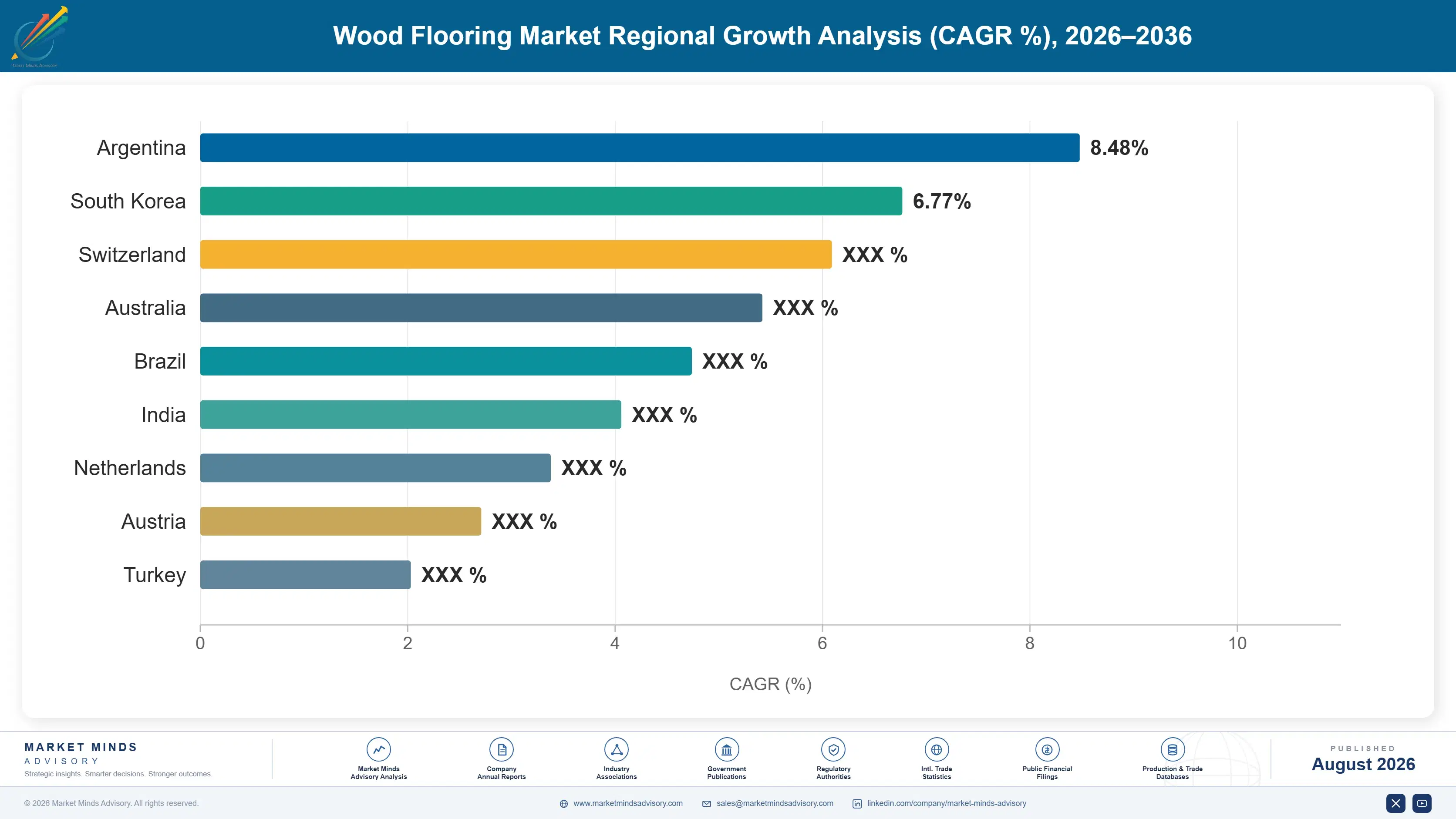
Saudi Arabia: 8.2% CAGR
Fastest Growth Region
South Asia and Pacific: 6.8% CAGR
Largest Region
East Asia: 27% of 2025 global value
Market Leaders
Mohawk Industries, Shaw Industries, Kahrs Group, Tarkett and Nature Home Holding lead the market. Source: MMA Primary Research Dataset, July 2026.
Primary Survey
n=3,800 procurement and R&D decision-makers, Q4 2025, six countries
Methodology
Demand-side build-up, cross-validated against public data, 47 expert interviews

Wood Flooring Market Forecast Scenarios

middle-east-wood-flooring-market-trends-size-forecast-scenario-1787555987010
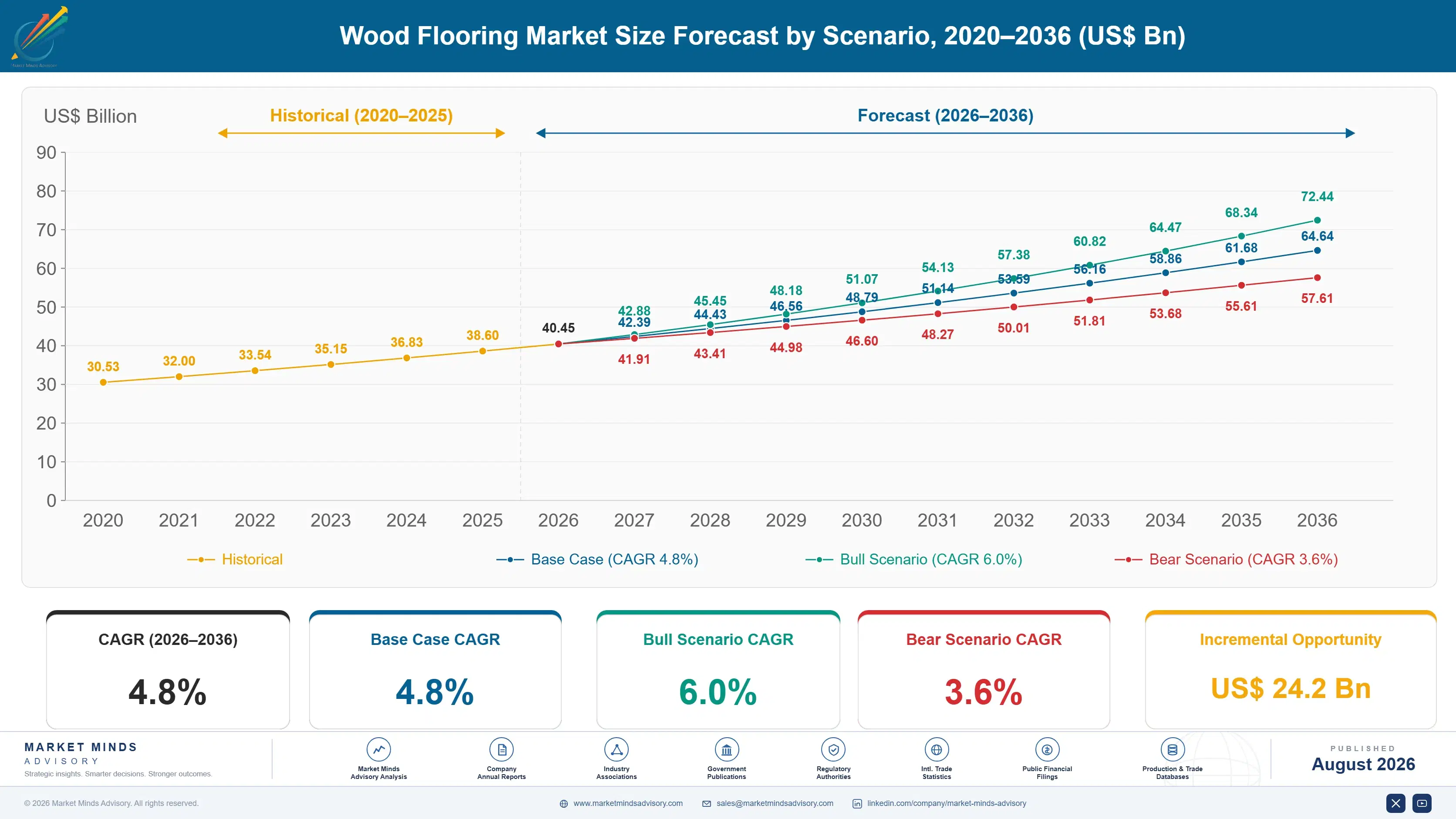
Growth ran at 3.8% between 2020 and 2025 and construction cycles explain most of the variation. Regional project activity paused through 2020 and resumed strongly as Gulf development programmes accelerated. Resilient flooring took mid-market share steadily throughout the period on price and water resistance, and wood manufacturers responded with authenticity arguments that specifiers costing a tower block found entirely unpersuasive.
The 4.8% base case rests on three mechanisms. Gulf development programmes keep funding hospitality, residential and retail construction at a scale that generates specification demand regardless of any consumer preference. Engineered constructions keep taking share from solid wood at 7.2% because dimensional stability is a physical requirement rather than a preference in this climate. And Asian residential construction keeps consuming wood flooring in volume as urban housing quality expectations rise.
The 6.0% bull case is Gulf giga-project specification converting at the pace announced, which would generate demand concentrated enough to reshape regional supply arrangements entirely. The 3.6% bear case is resilient flooring continuing to take mid-market volume at a 2.3 times price advantage, since nothing in wood flooring's technical case addresses a specifier optimising cost per square metre across a residential tower.

Physics Decides Before Commerce

Wood moves with moisture and air conditioning removes moisture, which is the whole story of this market in the Gulf. Interiors near 28% relative humidity are drier than solid hardwood survives without shrinking, gapping and cupping. Around 87% of regional installation is therefore engineered construction, where a plywood or fibreboard core holds dimensional stability that solid timber cannot. That is a physical constraint rather than a commercial preference, and it excludes the premium product from a market that would otherwise want it.
TOP-FIVE CONCENTRATION18%Combined position across wood flooring supply held by leading manufacturers
INDOOR RELATIVE HUMIDITY28%Level air conditioned Gulf interiors typically hold year round
ENGINEERED CONSTRUCTION SHARE87%Portion of regional installation using engineered rather than solid board
PROJECT CHANNEL SHARE79%Portion of regional demand specified through developers rather than retail
TIMBER COST SHARE46%Portion of manufacturer cost attributable to the wood itself
VINYL TILE PRICE ADVANTAGE2.3xHow much less resilient flooring costs than an engineered board
The commercial structure is equally distinctive and manufacturers built elsewhere consistently misread it. Around 79% of regional demand is specified through developers, architects and contractors rather than bought by homeowners in retail, which means the sale is technical, project-based and won years before installation. Sample libraries, specification relationships and balance sheet capacity matter more than any consumer brand. European retail models arrive with the wrong capabilities.
Resilient flooring is the competitive fact this industry avoids discussing. Luxury vinyl tile costs roughly a third as much, resists water completely and ignores humidity entirely, and it is taking mid-market volume while wood manufacturers argue about authenticity to buyers costing a tower.
"Wood flooring people keep telling specifiers that vinyl is not real wood, and the specifier already knows that and is costing eight hundred apartments. The argument has to be lifecycle, replacement and residual value, and almost nobody makes it that way."
Director, Interior Products and Building Materials Practice · MMA Construction and Industrial Practice · August 2026

Market Trends

Air conditioning humidity excludes solid wood construction

Gulf interiors held near 28% relative humidity year round sit well below the range solid hardwood tolerates, and wood at equilibrium in that condition shrinks across the grain enough to open visible gaps and cup at board edges. Engineered construction with a plywood or fibreboard core resists that movement because the cross-laminated structure restrains it mechanically. Around 87% of regional installation is consequently engineered rather than solid, and the share keeps rising as failures on earlier solid installations become widely known among specifiers. Manufacturers promoting solid hardwood into this region are selling a product the climate reliably destroys.
Market Impact: Drives 8.2% Saudi growth
Resilient flooring takes mid-market volume on price and stability

Luxury vinyl tile costs roughly a third of an engineered wood board, resists water completely, ignores humidity entirely and installs faster with less skilled labour. Against a developer costing eight hundred apartments those advantages are decisive and the visual difference at two metres is smaller than wood manufacturers pretend. Commercially this has taken substantial mid-market residential and commercial volume across the region. The wood industry's response has been authenticity arguments that specifiers find irrelevant, when the credible case is replacement cycle, refinishing capability and residual property value that resilient flooring genuinely cannot match.
Market Impact: Reinforces 87% engineered preference

Market Opportunities and Growth Drivers

Gulf development programmes generate specification demand at scale

Saudi giga-projects alongside continuing Emirati and Qatari development are funding hospitality, residential and retail construction at volumes that generate flooring specification demand independent of any consumer preference or economic cycle. Those projects specify years ahead through architects and consultants, which rewards manufacturers holding specification relationships and sample presence rather than distribution reach. Saudi growth at 8.2% is the fastest of any country here. The commercial requirements are unusual: long lead times, substantial quantities of matched material and payment terms that demand a balance sheet most flooring manufacturers do not carry comfortably.
Market Impact: Affects 79% of regional demand

Termite pressure favours engineered and treated constructions

Subterranean termites are a genuine and expensive problem across the Gulf and North Africa, attacking timber in ways that repair rarely addresses satisfactorily once established. Engineered constructions using resin-bonded cores present a considerably less attractive food source than solid timber, and treated products add further protection. That consideration reinforces the humidity argument toward the same conclusion, which is unusual and commercially convenient. Specifiers and facilities managers who have dealt with a termite failure specify accordingly afterwards and tell colleagues, which spreads the preference faster than any technical marketing achieves. Repair rarely helps afterwards.
Market Impact: Imports 100% of regional supply

Market Restraints and Challenges

Project payment terms strain manufacturer balance sheets

Around 79% of regional demand runs through project specification where payment follows construction milestones, retention is withheld for extended periods and delays are routine rather than exceptional. The root cause is that flooring is installed late in a build programme and gets paid after everything preceding it, which places the supplier at the end of a long queue. Commercially this excludes manufacturers without balance sheet capacity from exactly the projects generating the most demand. Participants are responding with distributor arrangements that intermediate the risk, credit insurance and staged delivery tied to payment rather than to programme.
Market Impact: Drives 87% engineered construction share

Import dependence exposes pricing to freight and currency

Regional wood flooring production is effectively absent, since the region has no commercial timber resource and manufacturing without local raw material offers no advantage. The root cause is climate and land rather than any industrial policy failure. Commercially this means every board arrives by sea from Europe, China or Southeast Asia, carrying freight cost, transit time and currency exposure that project pricing must absorb across long specification lead times. Participants respond with regional stockholding, longer forward cover and specification of species and constructions available from multiple origins. Multiple origins are the only real protection.
Market Impact: Costs 2.3 times less than wood
3 additional market trends, 4 additional growth drivers, and 2 additional restraints and challenges are covered in the full report. Contact sales@marketmindsadvisory.com to access the complete intelligence.

Segment CAGR and Growth Architecture

Flooring is classified here by board construction, since that determines dimensional stability, cost and whether a product survives the climate it is installed into. Wood species, application sector and supply arrangement are handled separately in the framework, because one construction carries several species and serves several sectors without any change. Construction decides survival here.
middle-east-wood-flooring-market-trends-market-share-analysis-1787555987549

High-Density Fibreboard Core Engineered

Growing at 7.2%, half again the market rate, this construction wins on the two things that decide this market. A high-density fibreboard core is the most dimensionally stable option available, which matters enormously at the 28% interior humidity air conditioning produces, and it is among the cheapest engineered constructions to manufacture, which matters against resilient flooring costing a third as much. The compromise is that the core cannot be sanded and refinished as many times as a plywood equivalent, which shortens useful life in high traffic hospitality. Specifiers costing residential towers accept that trade readily, and hospitality specifiers frequently do not. Hospitality specifiers weigh that trade quite differently from residential developers.
CAGR 7.2%

Bamboo and Alternative Fibre Flooring

Bamboo grows in years rather than decades and delivers hardness exceeding most timber species, which gives it a sustainability argument and a durability argument at once. Growth at 6.4% follows hospitality and commercial specification where environmental credentials appear in tender documents and where traffic demands surface hardness. Strand woven construction in particular is exceptionally hard and dimensionally stable, which suits this climate well. The commercial difficulty is perception rather than performance, since specifiers and end clients frequently regard bamboo as a compromise material despite technical properties that beat the oak they preferred. That gap is closing slowly and unevenly. Technical properties beat the oak specifiers preferred, which the market has been slow to accept.
CAGR 6.4%
Full segment breakdown across 6 segments available in the complete report.

Regional Architecture and Country Demand Map

East Asia holds 27% of global value on Chinese production and consumption together. The Middle East holds 5%, importing every board it installs and running 79% of demand through project specification. Climate and construction cycles decide this market entirely. Consumer preference explains almost nothing at all.

Middle East and Africa

This region is the analytical centre and its conditions are genuinely unlike any other flooring market. Air conditioning holds interiors near 28% relative humidity year round, which excludes solid hardwood and puts 87% of installation into engineered construction on physical grounds rather than commercial ones. Around 79% of demand runs through developer and architect specification rather than retail, which makes this a technical project business. Every board is imported since the region has no timber resource. Saudi giga-project programmes generate specification demand at 8.2% growth alongside continuing Emirati and Qatari development activity. Long lead times and payment terms demand a balance sheet most flooring manufacturers do not carry. Few carry it.
Share: 5% | CAGR: 5.2% (2026 to 2036)

East Asia

Chinese production capacity is the largest anywhere and supplies both an enormous domestic market and export volumes into every other region on this table including the Middle East. Urban housing quality expectations have risen considerably, which has moved Chinese residential specification from basic finishes toward engineered wood at scale. Japanese consumption is smaller, higher specification and heavily engineered given similar humidity management in modern housing. Korean apartment construction consumes wood flooring in volume through developer specification. Growth at 5.8% combines domestic consumption expansion with production capacity that shapes pricing globally. Chinese production capacity shapes pricing across every other market listed on this table. Domestic expectations keep rising steadily with housing quality.
Share: 27% | CAGR: 5.8% (2026 to 2036)
Regional intelligence for 5 additional markets available in the complete report: North America, Western Europe, South Asia and Pacific, Latin America, Eastern Europe. Contact sales@marketmindsadvisory.com.
middle-east-wood-flooring-market-trends-country-cagr-analysis-1787555988061

Where Flooring Margin Actually Sits

Four moves matter in a market where physics settles the product question and a developer settles the commercial one. Two are about competing against resilient flooring on arguments that actually work, and two are about the project channel that most manufacturers arrive here unequipped to serve. Discussing authenticity is not among them. It settles nothing.

Argue lifecycle cost rather than authenticity

Resilient flooring costs roughly a third as much, ignores humidity and installs faster, and telling a specifier that it is not real wood addresses nothing he is deciding. The credible argument is replacement cycle, refinishing capability and residual property value, since an engineered wood floor can be sanded and recoated while a worn vinyl plank can only be replaced. Across a twenty year hotel or residential holding period that arithmetic favours wood considerably. Almost nobody in this industry presents it that way, which leaves the strongest available case entirely unmade. Refinishing 3 times across twenty years changes the comparison entirely.
Market Impact: Answers a 2.3 times unit price disadvantage directly

Build specification presence, not retail distribution

Around 79% of regional demand is specified through developers, architects and consultants years before installation, which makes sample libraries, technical support and specification relationships the commercial infrastructure that matters. Retail distribution reaches a fifth of the market and manufacturers built for European or American retail arrive with exactly the wrong capabilities. Getting written into a specification at design stage effectively decides the order before any competitor is asked to quote. That position takes years to build and defends itself far better than any pricing advantage could. Years of work, permanently defended.
Market Impact: Reaches a full 79% of all regional demand

Carry the balance sheet project payment demands

Flooring installs late in a construction programme and gets paid after everything preceding it, with retention withheld and delays routine across regional projects. That excludes manufacturers without working capital capacity from exactly the largest opportunities, which is why several strong products never appear on major schemes at all. Distributor arrangements intermediating the risk, credit insurance and delivery staged against payment rather than programme all make participation possible. Manufacturers treating this as a finance problem rather than a commercial one are declining business their product would otherwise win. Retention on 5% of contract value is routine here.
Market Impact: Enables access to the 79% project channel demand

Specify constructions that survive 28% humidity

Air conditioned interiors held near 28% relative humidity destroy solid hardwood through shrinkage and cupping, and specifiers who have seen a failure never repeat it and tell colleagues. Recommending constructions that survive the climate rather than the ones carrying the best margin builds specification credibility that outlasts any individual project. Manufacturers promoting solid hardwood into this region are selling failures that damage their own reputation with the small community of people who decide regional specification. Engineered constructions at 87% of installation exist for a reason worth respecting. Reputation travels fast here.
Market Impact: Survives 28% interior relative humidity all year round

Who Controls the Margin Pool

Five manufacturers hold just 18% of global wood flooring supply, measured on floor area supplied at manufacturer level, the basis used throughout this section. That fragmentation follows from freight economics, since flooring is heavy and bulky relative to its value and travels badly, which favours regional manufacture and local brands over global scale everywhere except into markets with no production at all. Only markets with no production import at scale.
Competition runs on three dimensions in this region and none resembles retail flooring markets. Specification presence with architects and consultants, which decides orders years before tendering. Balance sheet capacity to carry project payment terms. And construction suitability for the climate, since failures spread quickly through a small specifying community. Price competes hardest against resilient flooring rather than against other wood suppliers. Failures spread through a small community very quickly.

Rankings shift as Gulf project programmes concentrate demand among manufacturers able to supply matched quantities on long lead times. Chinese and Southeast Asian producers hold cost positions European manufacturers cannot match on mid-market specification. Resilient flooring is taking share from the whole wood category rather than from any individual participant within it.
middle-east-wood-flooring-market-trends-company-positioning-matrix-1787555988578

Competitive Moat and Risk Dimensions

KAHRS GROUP

Moat: Engineered construction technical depth

Kahrs pioneered multi-layer engineered construction and holds dimensional stability engineering developed across decades in Scandinavian conditions that transfer directly into climates imposing similar stresses for opposite reasons. Specifiers who have seen solid wood fail in Gulf interiors value that engineering specifically, and the technical credibility carries into project conversations that price alone never wins.
KAHRS GROUP

Risk: European cost base exposure

European manufacturing costs sit well above Chinese and Southeast Asian equivalents on comparable engineered constructions, which limits participation in mid-market residential specification where developers optimise cost per square metre across hundreds of units. Technical depth commands a premium on hospitality and premium residential and considerably less below that. Volume specification increasingly goes elsewhere.
NATURE HOME HOLDING

Moat: Asian manufacturing cost position

Chinese engineered flooring manufacture operates at costs European producers cannot approach on comparable constructions, which matters decisively in a region importing every board and where 79% of demand comes from developers costing projects per square metre. Freight from Asia into the Gulf is also shorter and cheaper than from Northern Europe.
NATURE HOME HOLDING

Risk: Specification credibility gap

Premium hospitality and high-end residential specification still favours European manufacturers on perceived quality and technical reputation, regardless of comparable construction and performance. That perception costs access to the highest value projects in the region. Closing it requires specification relationships and reference projects that take years to accumulate rather than any product change.

Players Tracked

Prominent Players

Mohawk Industries
Shaw Industries
Kahrs Group
Tarkett
Nature Home Holding

Other Key Players

AHF Products
Bauwerk Boen
Barlinek
Egger Group
Kronospan
Power Dekor
Der Floor
Junckers
Ter Hurne
Hamberger Flooring
Woodpecker Flooring
Havwoods
Unilin
Panaget
Armstrong Flooring

Recent Developments

MARCH 2025

A Gulf developer standardised engineered flooring across a residential programme

A Gulf property developer standardised engineered wood flooring specification across a multi-tower residential programme, citing dimensional stability failures on earlier solid hardwood installations in air conditioned interiors. This was a specification decision rather than any commercial transaction between manufacturers or suppliers. Earlier failures had been expensive.
Signal: Failures on earlier installations drive specification far more effectively than any technical marketing has ever managed
AUGUST 2025

A hospitality group specified resilient flooring across mid-tier properties

A regional hospitality group specified luxury vinyl tile rather than engineered wood across its mid-tier property portfolio, citing cost per square metre, water resistance and installation speed. This was a procurement specification rather than any transaction, and it displaced wood from a substantial volume. Wood lost the volume.
Signal: Resilient flooring is winning on the arguments specifiers actually weigh, while wood suppliers keep arguing about authenticity
DECEMBER 2025

A European manufacturer opened regional stockholding and sample facilities

A European engineered flooring manufacturer established regional warehousing and a specification sample facility in the Gulf, shortening lead times and placing physical samples with architects and consultants at the design stage. This was organic investment rather than any acquisition or partnership. Lead times shortened materially.
Signal: Specification presence at design stage decides orders years ahead, which manufacturers serving from Europe reach far too late

What Moves Manufacturer Cost

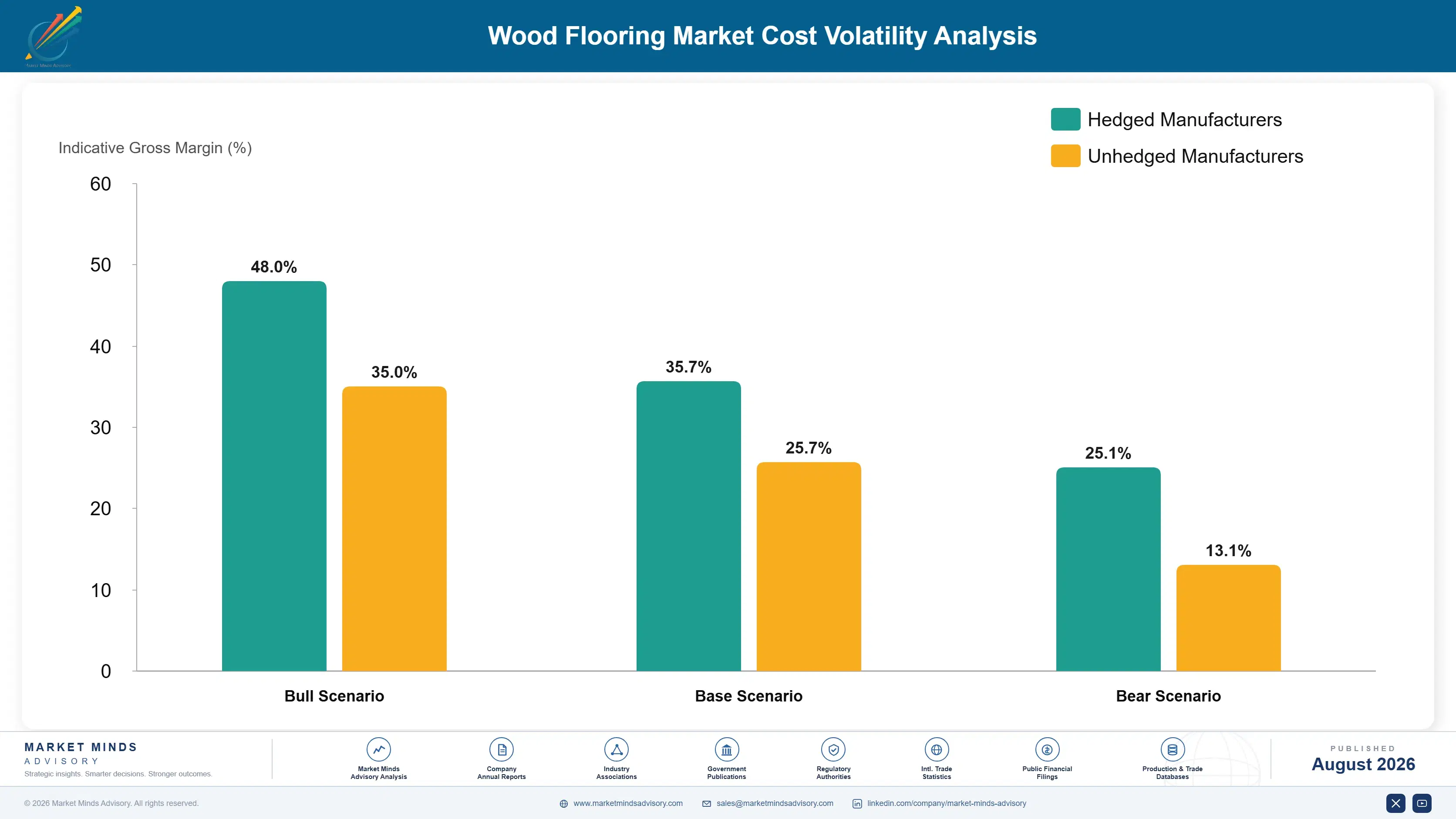
Timber accounts for around 46% of manufacturer cost, split between wear layer hardwood and core material which may be plywood, fibreboard or softwood depending on construction. Adhesives, lacquers and finishing systems make up a substantial further share. Kiln drying and pressing energy is meaningful. Ocean freight into the Middle East adds significantly given the weight and volume involved per square metre supplied.
Hardwood and plywood prices moved sharply through 2021 and 2022 on construction demand and shipping disruption, and USDA and national forestry data record the availability and price movements across those years. Kahrs noted raw material and energy cost pressure across its operations in its Annual Report 2022. Manufacturers holding project specifications priced years earlier absorbed most of the movement, since a specification agreed at design stage rarely permits repricing at delivery.

Specification lead time is what makes this cost exposure unusual rather than merely uncomfortable. A project specified in 2025 and delivered in 2028 locks a price against timber, freight and currency that will all have moved considerably by installation. Manufacturers pricing project work without escalation are quoting markets three years out, and very few carry the hedging capability required.
middle-east-wood-flooring-market-trends-cost-volatility-analysis-1787555988775

Write escalation into project specification pricing

A specification agreed at design stage and delivered three years later locks price against timber, freight and currency that will all have moved considerably. Escalation clauses tied to published timber and freight indices remove that exposure and developers accept them where the alternative is a padded fixed price. Manufacturers quoting flat three years forward hedge markets they cannot hedge.

Hold regional stock to shorten specification lead times

Ocean freight from Europe or Asia into the Gulf adds weeks that a construction programme frequently cannot accommodate when installation dates move, which loses orders to whoever can deliver. Regional warehousing costs working capital and turns lead time into advantage where programme certainty outweighs price. Origin supply arrives too late. Programme certainty is what these buyers actually pay for.

Specify constructions available from several origins

Species and construction combinations available only from one region expose a project to freight disruption, currency movement and export policy affecting that origin alone. Specifying constructions producible in Europe, China and Southeast Asia preserves sourcing flexibility across a three year programme. That flexibility costs nothing at design stage and matters enormously when a route closes.

Portfolio Architecture for Margin Defence

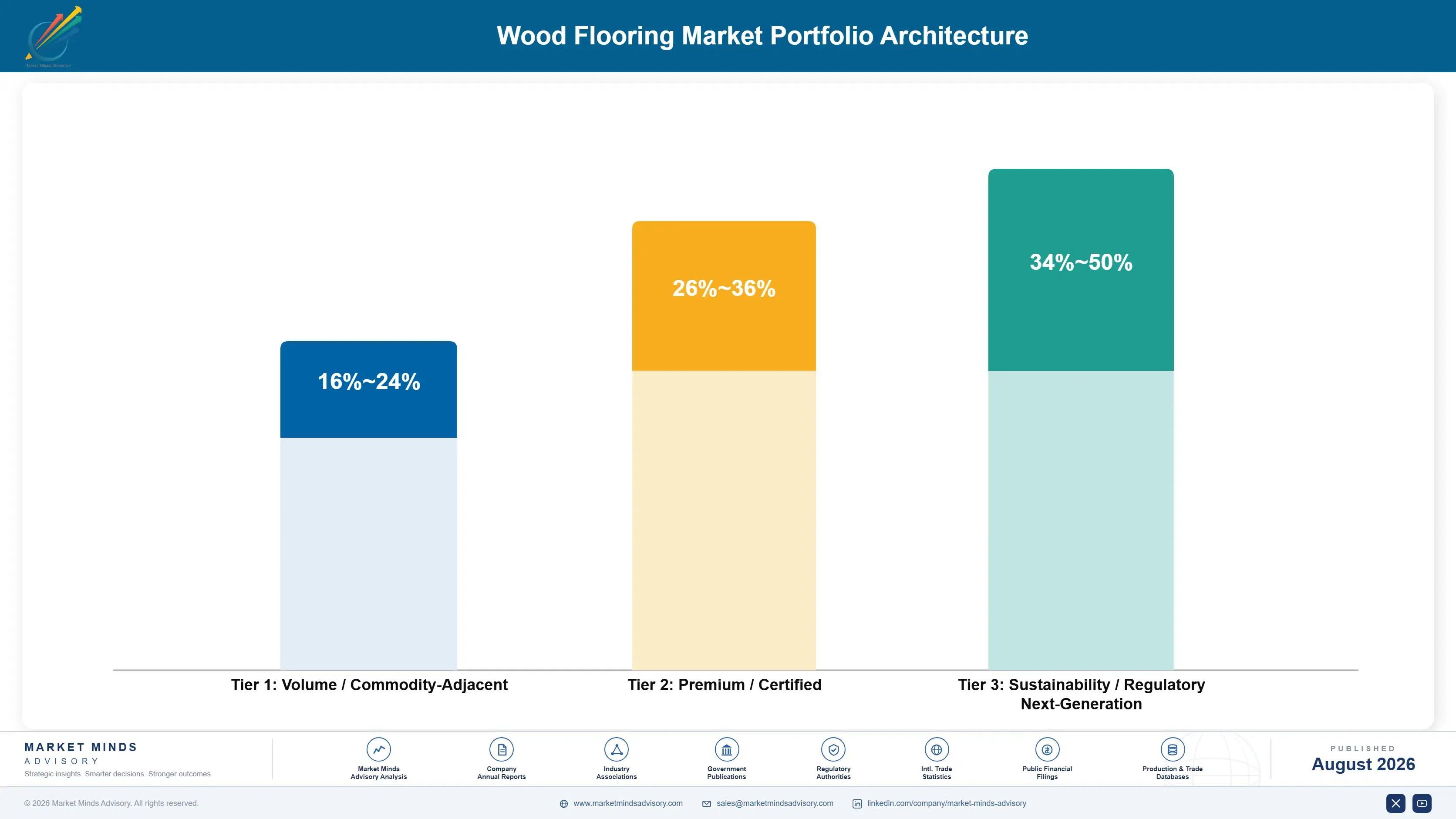
Margin here tracks specification position rather than manufacturing efficiency, because engineered flooring construction is widely available and getting written into a project is not. Mid-market engineered flooring for residential towers runs at gross margins in the high teens against Asian producers and resilient flooring simultaneously. Premium engineered and wide-plank formats run considerably better on specification and appearance. Hospitality specification, matched large-quantity supply and decorative parquet run higher again, because delivery certainty and design service matter more than unit price.
The tension is that mid-market residential volume fills production while hospitality and premium specification earn the returns, and the two require entirely different commercial capabilities. A developer costing eight hundred apartments and a hotel designer selecting a signature floor share no decision criteria whatsoever. Manufacturers serving both from one organisation have generally found volume tendering consuming the specification and design resource that premium projects require, which shows up as lost hospitality work.

High-value pools sit in hospitality specification, decorative formats and any position established at design stage rather than at tender. None of the three is won on price. Manufacturing capacity by itself defends very little where the order was decided two years earlier.

Volume / Commodity-Adjacent

Mid-market engineered flooring for residential tower specification, competing against Asian producers and resilient flooring at a 2.3 times price disadvantage simultaneously. The eight-point range separates manufacturers with regional stock and short lead times from those quoting from origin.
Gross Margin: 16%-24%

Premium / Certified

Premium engineered constructions, wide plank formats and certified sustainable supply where appearance and documentation carry the specification. The ten-point spread reflects specification presence, since the same board earns differently depending on when it entered the conversation.
Gross Margin: 26%-36%

Sustainability / Regulatory / Next-Generation

Hospitality specification, matched large-quantity supply and decorative parquet formats requiring design service. The sixteen-point range is wide because these price against delivery certainty and design capability rather than against any comparable board.
Gross Margin: 34%-50%
middle-east-wood-flooring-market-trends-portfolio-architecture-1787555989271

High-value Sub-segments and Strategic Watch-out

Hospitality Specification Supply

Design service, matched quantity and delivery certainty matter far more than unit price, and Gulf development programmes are funding hospitality construction at considerable scale. Volume tendering consumes exactly the resource these projects require from a supplier. Volume tendering consumes exactly what these projects need most.
Gross Margin: 36%-50%

Design Stage Specification Position

Around 79% of regional demand is decided by architects and consultants years before tendering, which means the order is settled before competitors are asked to quote anything at all. That position defends itself remarkably well. Competitors never see the decision happen at all. Tendering comes later.
Gross Margin: 32%-46%

Mid-Market Residential Volume

The tonnage that fills production, competed against Asian producers and resilient flooring at a 2.3 times price disadvantage at the same time. Manage for lead time and stock position rather than for margin recovery. Two competitors at once, and neither is another wood supplier. Margin is not available.
Gross Margin: 16%-24%

Lifecycle Cost Argument

An engineered wood floor sands and recoats while a worn vinyl plank can only be replaced entirely, which favours wood across a twenty year holding period. Almost nobody in this industry presents that arithmetic to specifiers. It is the strongest available case and nobody makes it.
Gross Margin: 28%-44%

How Flooring Demand Renews

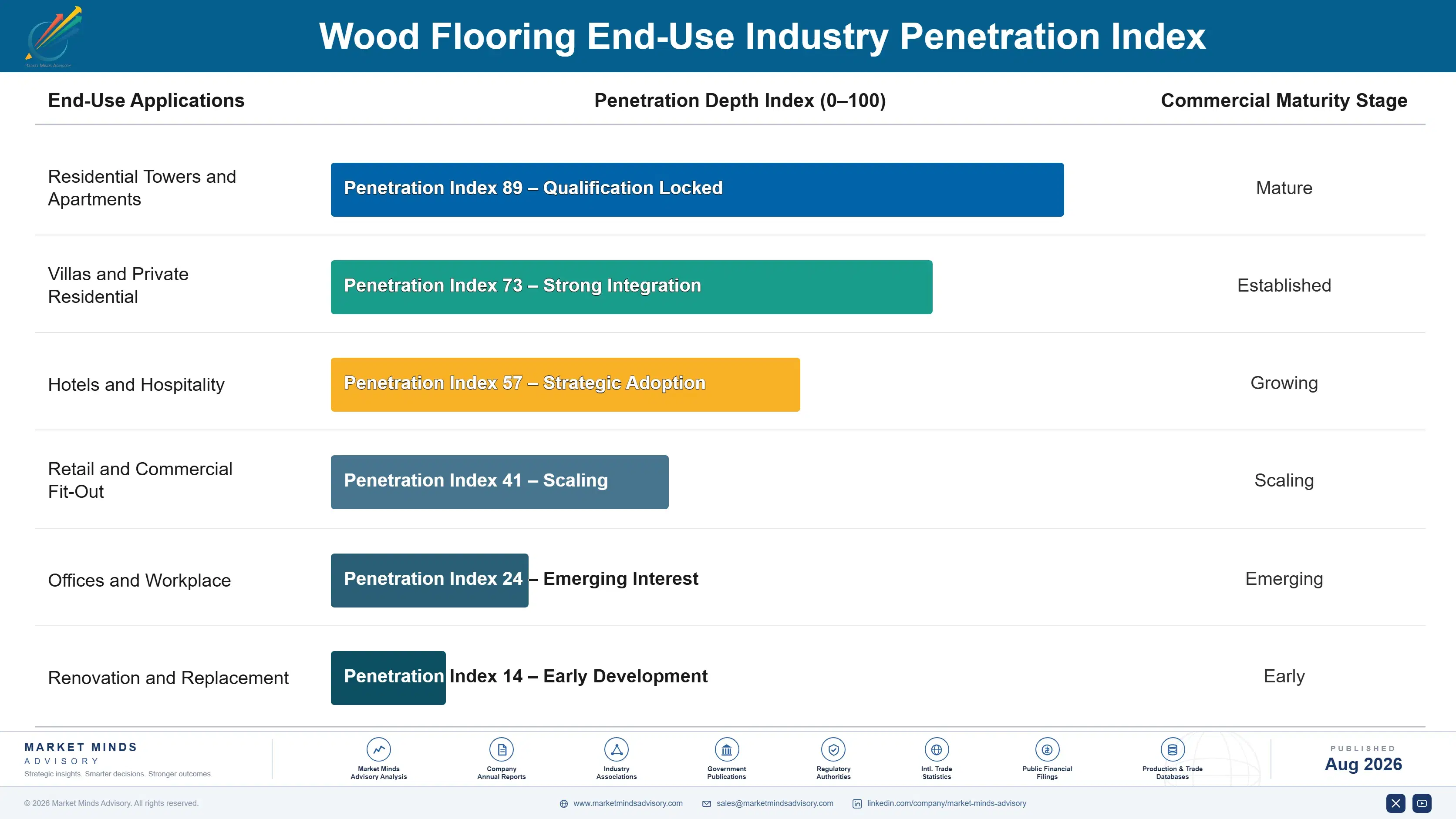
Demand renews on the construction cycle and the refurbishment cycle, and in this region the first dominates almost completely. A floor specified into a development is supplied once, installed and then untouched for fifteen to twenty five years depending on traffic and construction. There is no replacement business worth pursuing within that period, which makes specification the only commercial moment that matters and makes the relationship with architects and consultants considerably more valuable than any customer relationship.
Stickiness runs through the specifier rather than the buyer. An architect who has used a product across three schemes without a callback specifies it again without comparing anything, and a single dimensional failure removes a manufacturer from that practice permanently. Hospitality groups standardising across portfolios are stickier still. Mid-market residential tenders reset entirely every time with nothing surviving from the previous project.

The decision sits further from the purchase than manufacturers accustomed to retail expect. An architect selects, a quantity surveyor costs, a contractor procures and a developer pays, and those four have different priorities and frequently disagree. A manufacturer who reaches only the contractor arrives after the decision that mattered was already made by somebody else entirely.
middle-east-wood-flooring-market-trends-end-use-penetration-index-1787555989757

Where To Place The Bet

These are among the four positions where our research anticipates prominent divergence between winners and laggards over the coming forecast period. Each is grounded in the demand model, the regulatory perimeter, and the announced capacity pipeline.
01 / LIFECYCLE ARGUMENT ADOPTION

Cost twenty years, not the square metre

Resilient flooring costs roughly a third as much, ignores humidity completely and installs faster with less skilled labour, and telling a specifier that it is not genuine wood addresses absolutely nothing he is actually deciding. The credible argument is replacement cycle and refinishing capability, since an engineered wood floor can be sanded and recoated several times while a worn vinyl plank can only ever be lifted and replaced. Across a twenty year hotel or residential holding period that arithmetic favours wood considerably, and almost nobody makes the case.
02 / SPECIFICATION CHANNEL BUILD

Reach architects, not flooring retailers

Around 79% of regional demand is specified through developers, architects and consultants years before any installation occurs, which makes sample libraries, technical support and design stage relationships the commercial infrastructure that genuinely matters here. Retail distribution reaches barely a fifth of the market, and manufacturers built around European or American retail models arrive with exactly the wrong capabilities entirely. Getting written into a specification at design stage effectively settles the order before any competitor is invited to quote a price.
03 / PROJECT FINANCE CAPABILITY

Carry the terms or decline the projects

Flooring is installed late in a construction programme and paid after everything preceding it, with retention withheld for extended periods and programme delays routine rather than exceptional across regional development. That working capital requirement excludes manufacturers without balance sheet capacity from precisely the largest opportunities available, which is why strong products regularly fail to appear on major schemes at all. Distributor arrangements, credit insurance and delivery staged against payment rather than against construction programme all make participation genuinely possible for anybody willing.
04 / CLIMATE SUITABILITY DISCIPLINE

Never specify what the climate will destroy

Air conditioned Gulf interiors held near 28% relative humidity year round are drier than solid hardwood tolerates, producing shrinkage across the grain, visible gaps between boards and cupping at the edges within a season or two. Specifiers who have witnessed such a failure never repeat it and tell colleagues throughout a small professional community that decides most regional specification. Manufacturers promoting solid construction into this region are selling failures that damage their own reputation far more expensively than the margin ever justified.

Engagement Snapshot From the Field

A live engagement with an industry participant carrying material or product regulatory and market exposure ahead of a defining policy shift, showing how our research translates into a defensible multi-year portfolio strategy.
MARKET MINDS ADVISORY · CLIENT ENGAGEMENT SUMMARY
Wood Flooring Producer Strategic Portfolio Review and Transition Roadmap 2026·Investment Scenario on Wood Flooring Exposure Evaluation 2025-26
CLIENT PROFILE
A European engineered flooring manufacturer with annual revenue around EUR 190 million (client-reported, unverified by MMA), supplying premium engineered oak into European retail and contract markets. Middle Eastern sales ran through two importing distributors. No regional stock or sample presence existed. Project payment terms were declined as a matter of policy. Specification presence was entirely absent.
STRATEGIC CHALLENGE
Regional revenue had stagnated despite substantial Gulf construction activity (client-reported, unverified by MMA) and management proposed appointing additional distributors. Nobody had established how regional specification actually happened, which meant the proposal assumed a distribution model in a market that decides through architects years before any distributor is involved. Nobody had checked that assumption.
MMA APPROACH
MMA mapped how flooring specification occurs across regional projects, tracing decisions from architect selection through quantity surveying to contractor procurement rather than assuming a distribution sequence. The client's absence at design stage was quantified against won and lost projects. Payment term requirements were benchmarked, and resilient flooring displacement was assessed across the client's target sectors.
KEY FINDINGS
  1. Specification was decided by architects and consultants an average of two years before tender, and the client had no presence at that stage on any project examined.
  2. Both existing distributors engaged at contractor procurement stage, by which point the specified product had already been chosen and the client was quoting against a decision already made.
  3. The client's policy of declining project payment terms had excluded it from every major scheme in the region, regardless of how competitive its product or pricing was.
  4. Resilient flooring had displaced wood on three of five mid-market schemes reviewed, and no wood supplier had presented lifecycle or refinishing arguments to any of those specifiers.
CLIENT PROFILE
A European engineered flooring manufacturer with annual revenue around EUR 190 million (client-reported, unverified by MMA), supplying premium engineered oak into European retail and contract markets. Middle Eastern sales ran through two importing distributors. No regional stock or sample presence existed. Project payment terms were declined as a matter of policy. Specification presence was entirely absent.
STRATEGIC CHALLENGE
Regional revenue had stagnated despite substantial Gulf construction activity (client-reported, unverified by MMA) and management proposed appointing additional distributors. Nobody had established how regional specification actually happened, which meant the proposal assumed a distribution model in a market that decides through architects years before any distributor is involved. Nobody had checked that assumption.
MMA APPROACH
MMA mapped how flooring specification occurs across regional projects, tracing decisions from architect selection through quantity surveying to contractor procurement rather than assuming a distribution sequence. The client's absence at design stage was quantified against won and lost projects. Payment term requirements were benchmarked, and resilient flooring displacement was assessed across the client's target sectors.
KEY FINDINGS
  1. Specification was decided by architects and consultants an average of two years before tender, and the client had no presence at that stage on any project examined.
  2. Both existing distributors engaged at contractor procurement stage, by which point the specified product had already been chosen and the client was quoting against a decision already made.
  3. The client's policy of declining project payment terms had excluded it from every major scheme in the region, regardless of how competitive its product or pricing was.
  4. Resilient flooring had displaced wood on three of five mid-market schemes reviewed, and no wood supplier had presented lifecycle or refinishing arguments to any of those specifiers.
RECOMMENDED STRATEGY
Phase 1: Phase one: establish regional sample and specification presence with architects and consultants, entering conversations two years before tender rather than at procurement. Phase 2: Phase two: accept project payment terms through a distributor arrangement or credit insurance, since declining them excludes the business entirely. Phase 3: Phase three: build a lifecycle cost argument against resilient flooring and present it at design stage, where the comparison is actually decided.
OUTCOME
A regional specification office opened during 2026 with samples placed across eleven practices. Project terms are now accepted through an insured distributor arrangement. Lifecycle presentations have been made on four schemes, and the client reports specification inclusion on two projects it would previously have missed (client-reported, unverified by MMA).

Frequently Asked Questions

Foundational context covering the market sizes, CAGR, scope, country, region and competition that inform every finding below. This section is provided to cover basics and most often pre-purchase conversations, answered from the MMA Primary Research Dataset.

What is the current size of the Wood Flooring Market?

The market was valued at USD 38.6 billion in 2025, rising to an estimated USD 40.45 billion in 2026. East Asia holds the largest regional share at 27% of value.

How large will the Wood Flooring Market be by 2036?

MMA forecasts USD 64.65 billion by 2036 under the base case, an expansion multiple of 1.60 times the 2026 value. That represents USD 24.20 billion of incremental value.

What is the CAGR for the Wood Flooring Market 2026 to 2036?

The base case runs at 4.8% compound annual growth between 2026 and 2036, with a bull case at 6.0% and a bear case at 3.6%. Historical growth from 2020 to 2025 was 3.8%.

Which segment is growing fastest?

High-density fibreboard core engineered flooring leads at 7.2%, half again the market rate, on dimensional stability and low cost together. Bamboo flooring follows at 6.4%.

Who are the major companies in the Wood Flooring Market?

Mohawk, Shaw Industries, Kahrs Group, Tarkett and Nature Home Holding hold just 18% between them. Freight economics favour regional manufacture over any global scale advantage.

Which country is growing fastest?

Saudi Arabia leads at 8.2%, driven by giga-project development programmes that generate flooring specification demand independent of any consumer preference or of the wider economic cycle.

Report Segmentation Architecture

The full report scope spans multiple orthogonal segmentation dimensions, with cross-tabulated demand data provided for each dimension pair. Coverage extends further to regional breakdowns, trend trajectories, and the competitive detail needed to support segment-level decision-making.

By Board Construction

  • Solid Hardwood Flooring
  • Multi-Layer Engineered Flooring
  • Three-Layer Engineered Flooring
  • High-Density Fibreboard Core Engineered
  • Parquet and Decorative Formats
  • Bamboo and Alternative Fibre Flooring

By End-Use Industry

  • Residential Towers and Apartments
  • Villas and Private Residential
  • Hotels and Hospitality
  • Retail and Commercial Fit-Out
  • Offices and Workplace
  • Renovation and Replacement

By Supply Arrangement

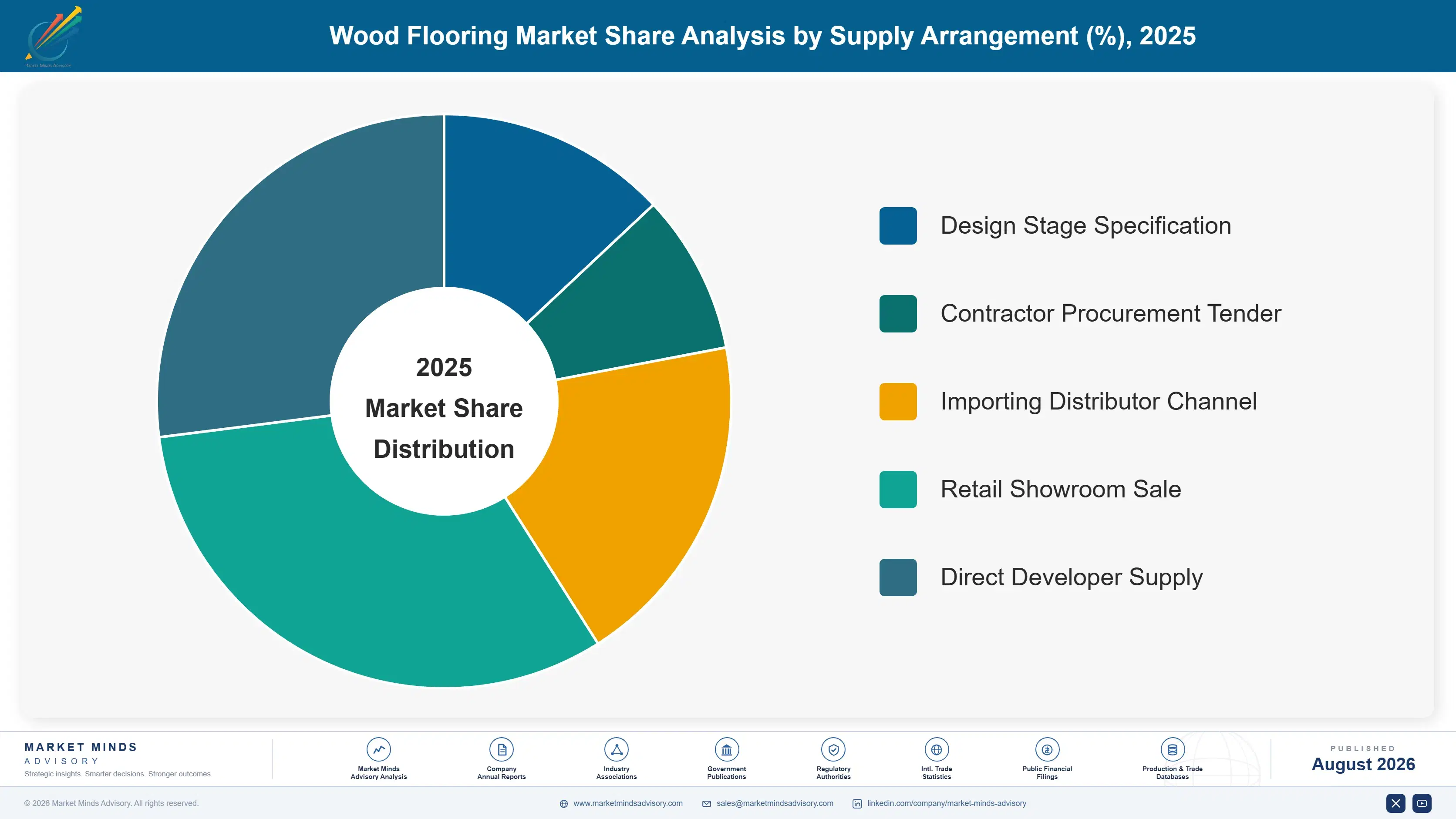
  • Design Stage Specification
  • Contractor Procurement Tender
  • Importing Distributor Channel
  • Retail Showroom Sale
  • Direct Developer Supply

By Region

  • North America
  • Western Europe
  • East Asia
  • South Asia and Pacific
  • Latin America
  • Middle East and Africa
  • Eastern Europe

Scope, Methodology, and Coverage

Every figure in this report is reproducible from documented input assumptions. The scope below maps the historical period, the forecast horizon, the segmentation dimensions, and the countries covered, alongside the underlying primary and qualitative methodology.
Historical Period
2020 to 2025
Forecast Period
2026 to 2036
Base Year
2025 (USD billions; MMA Primary Research Dataset, August 2026)
Market Definition
The market comprises wood and wood-based flooring supplied for residential, hospitality, commercial and retail interiors, covering solid hardwood flooring, multi-layer engineered flooring, three-layer engineered flooring, high-density fibreboard core engineered flooring, parquet and decorative formats, and bamboo and alternative fibre flooring. The Middle East market is treated as the analytical centre, with global demand and supply covered for comparative context. Value is measured at manufacturer level on floor area supplied. Laminate flooring, luxury vinyl tile and resilient flooring, stone and ceramic tiling, carpet, and subfloor and installation materials fall outside scope.
Quantitative Units
USD billions (current prices); million square metres of flooring supplied annually; USD per square metre by board construction
Segmentation Dimensions
By Board Construction; By End-Use Industry; By Supply Arrangement; By Region
Regions Covered
North America, Western Europe, East Asia, South Asia and Pacific, Latin America, Middle East and Africa, Eastern Europe
Countries Covered
United Arab Emirates, Saudi Arabia, Qatar, Kuwait, Oman, Bahrain, Egypt, Morocco, Turkey, Israel, China, Japan, South Korea, Vietnam, Malaysia, India, Australia, United States, Canada, Mexico, Germany, Sweden, Austria, France, United Kingdom, Netherlands, Poland, Romania, Brazil, Chile
Key Companies Profiled
Mohawk Industries, Shaw Industries, Kahrs Group, Tarkett, Nature Home Holding, AHF Products, Bauwerk Boen, Barlinek, Egger Group, Kronospan, Power Dekor, Der Floor, Junckers, Ter Hurne, Hamberger Flooring, Woodpecker Flooring, Havwoods, Unilin, Panaget, Armstrong Flooring
Quantitative Methodology
Primary survey, n=3,800 respondents, Q4 2025, six countries; demand-side model with trade association cross-validation
Qualitative Methodology
47 expert interviews, Q4 2025; applied to validate demand model assumptions, identify emerging dynamics, and assess competitive positioning
Report Format
PDF and XLSX data workbook (Word format preview document)
Publisher
Market Minds Advisory
Report Code
MMA-2026-CON-312
Published
August 2026
Contact
sales@marketmindsadvisory.com | www.marketmindsadvisory.com

Purchase the full Wood Flooring Market Report (2026 to 2036).

The full report sizes the global wood flooring market to 2036 across six board constructions and seven regions, with the Middle East as the analytical centre and global demand covered for context. It treats interior humidity as a physical constraint determining product mix rather than a commercial preference, and quantifies engineered penetration accordingly. Competitive analysis covers 20 participants evaluated on floor area supplied, with moat and risk assessment for the two leaders. Resilient flooring displacement is quantified by sector, since the price gap decides mid-market specification more than any wood argument does. Four quantified revenue levers close the analysis.
Six-construction segment sizing with segment-level growth rates
Seven-region share and growth breakdown to 2036
Twenty-participant competitive map on one area basis
Interior humidity modelled against board construction survival
Resilient flooring displacement quantified by application sector
Four quantified revenue levers with commercial impact ranges

Built For The People Who Decide

From boardroom strategy to bench-side execution, this report is read cover-to-cover by leaders shaping the next decade of their industry, turning demand scenarios, market dynamics and valuation benchmarks into decisions.
CXOs/ Presidents/ VPs/ Managers
M&A and Corporate Development
Strategy Teams and R&D Heads
Procurement and Product Directors
Regulatory and Compliance Leaders
Investor Relations and Equity Analysts