

Market Minds Advisory
Middle East & Mediterranean Tahini Market

Middle East & Mediterranean Tahini Market: Sesame Supply Risk and the Western Health Food Crossover

Hummus and plant-based protein demand is pulling on the same Sudanese and Ethiopian sesame supply Levantine mills have relied on for generations, forcing traditional producers to compete on traceability against better-funded newer entrants.

Lead Analyst

Lisa Gevelber

Published

September 2026

Make Smarter Decisions with Customized Research Insights

Request a free sample report and evaluate market opportunities, growth trends, and competitive dynamics relevant to your business needs.

2025 MARKET VALUE$1.6BMarket Size 2025
2036 FORECAST VALUE$3.3BBase Case , 2026 to 2036
CAGR 2026 TO 20366.4 %Bull 7.6% / Bear 5.2%
INCREMENTAL OPPORTUNITY$1.5BNet 10- year value creation
EXPANSION MULTIPLE1.86x2036 value over 2026 base
Strategic Levers
M&A Pipeline
Regional Outlook
Country Rankings
Competitive Intelligence
Segmental Deep-dive
Call-Us : 91 93563 13602

Executive Snapshot and Market Trajectory

Sesame seed supply, not milling capacity, now decides who can grow. Mills with locked Sudanese and Ethiopian seed contracts are shipping on schedule while newer entrants wait on spot-market volume that keeps tightening every season. Buyers notice the difference in delivery reliability within the first missed shipment.
Western hummus and plant-based protein demand is pulling tahini into retail categories it never occupied a decade ago, while organic and traceability-documented product commands a premium that traditional Levantine mills are only now learning to capture for themselves. The Middle East and Mediterranean basin remains the production and consumption heartland, but North American and Western European retail growth is where the fastest incremental volume is actually appearing.
Competition concentrates among a mix of century-old family mills and newer health-food brands able to fund organic certification and food-safety documentation that regulators increasingly require. Sesame price volatility, tightening food-safety recall exposure, and rising Western retail listing requirements are together reshaping which producers can scale past regional distribution into genuine global retail contracts. Producers still relying purely on regional reputation increasingly find that reputation alone insufficient once Western retailers start requiring documented proof instead.
Market Definition
The tahini market covers roasted, raw, organic, and flavored sesame paste products sold for direct retail consumption, foodservice use, and industrial ingredient supply into hummus, halva, and sauce manufacturing. It excludes whole sesame seed trading, sesame oil, and unrelated nut and seed butter categories such as peanut or almond butter.
Base Year Value
$1.6B in 2025 (MMA Primary Research Dataset, August 2026)
Forecast Period
2026 to 2036, eleven discrete annual values
CAGR
6.4% base case. Bull 7.6%. Bear 5.2%.
Fastest Growth Segment
Organic Tahini: 11.5% CAGR
Fastest Growth Country
United States: 9.8% CAGR
Fastest Growth Region
South Asia and Pacific: 8.4% CAGR
Largest Region
North America: 23% of 2025 global value
Market Leaders
Al Arz Fine Foods, Achva Industries Ltd., Joyva Corporation, Soom Foods, Prince Tahina Mills. Source: MMA Analysis based on company annual reports.
Primary Survey
n=3,800 procurement and R&D decision-makers, Q4 2025, six countries
Methodology
Demand-side build-up, cross-validated against public data, 47 expert interviews

Middle East & Mediterranean Tahini Market Forecast Scenarios

middle-east-mediterranean-tahini-market-size-forecast-scenario-1787554898261
Between 2020 and 2025 the category grew near a 5.6% annual pace, propelled by pandemic-era home cooking trends that introduced tahini to a wider Western pantry audience, before hummus and plant-based snack manufacturers began specifying it as a direct ingredient input from 2023 onward at meaningfully larger volume. That shift converted tahini into a repeat grocery purchase for many households.
The base case carries the market to a 6.4% CAGR on three mechanisms: continued Western retail expansion of hummus and Mediterranean diet products that use tahini as a core ingredient, food manufacturers incorporating tahini into plant-based protein bars and snack formulations at growing volume, and organic and traceability-certified product commanding premium pricing that funds further mill investment across both traditional and newer producing regions. These three forces compound each other rather than operating independently.
The bull case at 7.6% assumes Western retail listing expansion continues faster than currently modelled as more grocery chains dedicate permanent shelf space to Mediterranean pantry staples. The bear case at 5.2% assumes another sesame-linked food-safety recall dampens consumer confidence the way the 2020 salmonella recalls briefly did across several Western markets. Both scenarios assume Middle Eastern sesame supply chains stay reasonably stable through the decade.

Sesame Supply Risk and the Traceability Premium

Three forces converge on this category. Traditional Levantine mills need consistent sesame seed supply from growing regions thousands of miles away, Western retailers increasingly demand organic certification and documented traceability before granting shelf space, and consumers want the authentic Mediterranean product experience without paying an artisanal premium for it. Reconciling all three expectations inside one supply chain is genuinely difficult.
TOP PRODUCER REGIONLevant, 38%Share of global output concentrated in Levantine mills
AVERAGE SELLING PRICEUSD 6.20 per kgBlended average retail price across major product formats
SESAME SEED COST SHARE46% of COGSRaw sesame seed share of total production cost
ORGANIC SEGMENT SHARE14% of volumeVolume sold under certified organic retail labeling programmes
SHELF LIFE12 to 18 monthsTypical unopened product shelf life before eventual expiry
MARKET CONCENTRATIONCR5: 22%Combined share held by five largest tahini producers
Commercially, the category rewards supply chain documentation over raw production scale. Producers that can trace sesame seed origin and certify against food-safety recalls command retail listings that undocumented regional producers cannot access, which is why Western grocery chains increasingly default to a small pool of certified suppliers rather than sourcing opportunistically from whichever mill offers the lowest price that season. That preference has hardened noticeably since the 2020 recall period. That preference rarely reverses once a retail relationship is established.
Over the next decade, sesame supply security, organic certification depth, and Western retail listing expansion will decide which producers convert regional reputation into durable global distribution. Producers without documented food-safety and traceability systems risk losing access to Western retail entirely as compliance becomes a baseline listing requirement rather than a differentiator. Producers slow to adapt risk losing shelf space.
"Everyone still pictures tahini as a small Levantine cottage industry. The mills actually winning right now are the ones running sesame traceability systems that would look at home in a pharmaceutical supply chain."
Director, Specialty Food Ingredients Practice · MMA Specialty Food Ingredients Practice · August 2026

Market Trends

Western Retailers Demand Documented Sesame Traceability

Major North American and Western European grocery chains have begun requiring documented sesame seed origin traceability as a condition of retail listing, responding directly to a series of salmonella-linked tahini recalls that affected multiple brands between 2016 and 2020. Whole Foods and several major European retailers now require supplier audits and batch-level traceability that smaller regional mills often cannot provide. Soom Foods and other newer entrants built traceability systems from the outset specifically to meet these requirements, while traditional Levantine mills are retrofitting documentation processes to retain existing Western retail relationships built long before these requirements existed.
Market Impact: Adds 14% to industrial procurement volume

Social Media Recipe Content Drives Western Retail Trial

Recipe content on social media platforms showcasing tahini in desserts, salad dressings, and breakfast bowls has meaningfully expanded the Western consumer base beyond hummus and traditional Middle Eastern dishes alone, introducing the product to shoppers who previously never purchased it. Retailers report first-time tahini purchasers citing specific viral recipes as their initial purchase trigger, a pattern that grocery buyers now track when deciding shelf placement and promotional support. Brands including Seed + Mill and Kevala have built marketing programmes specifically around this recipe-driven discovery pattern rather than relying on traditional Mediterranean cuisine positioning alone.
Market Impact: Ingredient-grade orders exceed 3,000 tonnes yearly

Market Opportunities and Growth Drivers

Hummus and Mediterranean Diet Popularity Sustains Western Volume Growth

Hummus remains the single largest downstream driver of tahini demand outside direct retail sale, and continued Western retail expansion of hummus and broader Mediterranean diet products keeps pulling tahini procurement volume upward at food manufacturers across North America and Western Europe. Major hummus brands specify tahini content percentages as a quality marker on packaging, giving consumers a direct reason to associate authentic tahini inclusion with product quality rather than treating it as an interchangeable commodity ingredient. That branding shift has pushed several manufacturers to pay a documented premium for higher-tahini-content formulations specifically.
Market Impact: Seed prices can swing 30% seasonally

Plant-Based Protein Manufacturers Specify Tahini as a Functional Ingredient

Plant-based protein bar and snack manufacturers increasingly specify tahini for its protein content, binding properties, and clean-label positioning relative to synthetic binders and emulsifiers used in earlier product generations. Once Again Nut Butter and other ingredient-grade suppliers have scaled bulk tahini production specifically to serve this manufacturing channel, which now orders in ingredient-grade tonnage volumes rather than retail-pack quantities. This shift is pulling tahini into a genuinely new demand category entirely separate from its traditional retail and foodservice base, one that values consistent viscosity and protein content over flavour nuance.
Market Impact: Recall history depresses trial 8%

Market Restraints and Challenges

Sesame Supply Concentrates in a Handful of Volatile Regions

Sudan, Ethiopia, and India together supply the large majority of internationally traded sesame seed, and each has faced significant supply disruption in recent years, from Sudan's ongoing civil conflict to Ethiopian export policy shifts and Indian monsoon variability affecting harvest volume. The root cause is genuine geographic concentration in production rather than any solvable logistics problem, since sesame cultivation requires specific climate conditions found in a limited number of growing regions worldwide. Producers are mitigating this by diversifying seed sourcing across multiple countries and building larger buffer inventories, though both approaches raise working capital requirements meaningfully.
Market Impact: Traceable supply covers 45% of retail

Food-Safety Recall History Continues to Weigh on Consumer Trust

A series of salmonella-linked tahini recalls between 2016 and 2020, some affecting products sold across multiple countries, left a lasting consumer trust gap that documented safety improvements have not fully closed even years later. The root cause was inadequate pathogen testing protocols at the seed and paste production stage rather than any inherent product safety flaw, and most major producers have since implemented substantially more rigorous testing regimes. Producers are mitigating the trust gap through visible third-party safety certification and batch-level testing disclosure, though rebuilding full consumer confidence after a recall typically takes several years of clean track record.
Market Impact: First-time trial grows past 12%
3 additional market trends, 3 additional growth drivers, and 3 additional restraints and challenges are covered in the full report. Contact sales@marketmindsadvisory.com to access the complete intelligence.

Segment CAGR and Growth Architecture

Segmentation follows product formulation and processing type, a single ingredient and manufacturing logic, since organic certification, roasting profile, and flavor infusion each require distinct sourcing and production pathways rather than differing by distribution channel or customer type. That keeps sourcing investment aligned to product platform economics. That alignment lets buyers evaluate producers on consistent, comparable sourcing criteria across every format.
middle-east-mediterranean-tahini-market-market-share-analysis-1787554898827

Organic Tahini

Organic tahini grows fastest at 11.5%, about 1.80 times the overall 6.4% rate, as health-conscious Western consumers and clean-label food manufacturers both specify certified organic sourcing over conventional product. Certification requires documented organic sesame seed sourcing from qualified growers, a supply chain layer that adds cost and lead time but commands a retail premium most conventional producers cannot access. Soom Foods, Kevala, and several Levantine mills pursuing export certification lead qualified organic supply, competing on documentation depth and certified grower relationships rather than price alone. Growth concentrates in North American and Western European retail, where organic labeling carries the strongest consumer willingness to pay a premium. Export volume compounds this advantage with each new certification cycle completed.
CAGR 11.5%

Flavored and Infused Tahini

Flavored and infused tahini, including chocolate, spiced, and herb-infused variants, grows at 9.5%, the second-fastest format, as brands target Western retail shoppers seeking novel dessert and snack applications beyond traditional savoury use. Seed + Mill and Soom Foods lead branded flavored product development, competing on recipe innovation and social media visibility rather than on the underlying sesame commodity itself. Unlike plain tahini, this segment sells substantially on brand and packaging appeal rather than ingredient sourcing credentials alone, so marketing investment and retail placement matter as much as product formulation. Growth concentrates heavily among younger Western consumers discovering the category through recipe-driven social content. Brands unable to sustain that visibility rarely retain shelf space beyond a single season.
CAGR 9.5%
Full segment breakdown across 6 segments available in the complete report.

Regional Architecture and Country Demand Map

Middle East and Africa remains the production and consumption heartland well above typical regional bands, while North America and Western Europe post the fastest incremental volume growth as hummus and health-food retail categories keep expanding across both regions. Latin America and East Asia contribute smaller but steadily expanding volume.

North America

Hummus retail expansion and a fast-growing plant-based protein manufacturing base, not any domestic sesame production, explain North America's 23% share, since the region imports the large majority of its raw sesame and finished tahini from Levantine and Ethiopian sources. Soom Foods, Kevala, and Once Again Nut Butter lead branded and ingredient-grade supply respectively, competing on traceability documentation as major grocery chains increasingly require it for shelf placement. United States Food and Drug Administration recall history has made American retailers particularly demanding on batch-level safety documentation compared with less-regulated export markets. Growth of 7.0% tracks retail category expansion and plant-based ingredient demand more than any shift in traditional consumption patterns. That documentation gap keeps narrowing supplier options steadily.
Share: 23% | CAGR: 7.0% (2026 to 2036)

Western Europe

Mediterranean pantry staple positioning, reinforced by Greek, Cypriot, and southern French culinary tradition, explains Western Europe's 20% share alongside growing hummus retail demand across the broader region. German and British retailers have expanded private-label tahini and hummus lines substantially over the past several years, while French and Italian markets favour imported Levantine brands carrying documented artisanal positioning. European Union food-safety regulation imposes documented traceability requirements comparable to North American standards following the same recall period. Growth of 4.9%, the slowest major region, reflects an already well-established consumption base across Mediterranean Europe rather than any underlying demand weakness. Scandinavian retailers have also begun stocking tahini as Nordic health-food trends increasingly embrace Mediterranean pantry staples.
Share: 20% | CAGR: 4.9% (2026 to 2036)
Regional intelligence for 5 additional markets available in the complete report: East Asia, South Asia and Pacific, Latin America, Middle East and Africa, Eastern Europe. Contact sales@marketmindsadvisory.com.
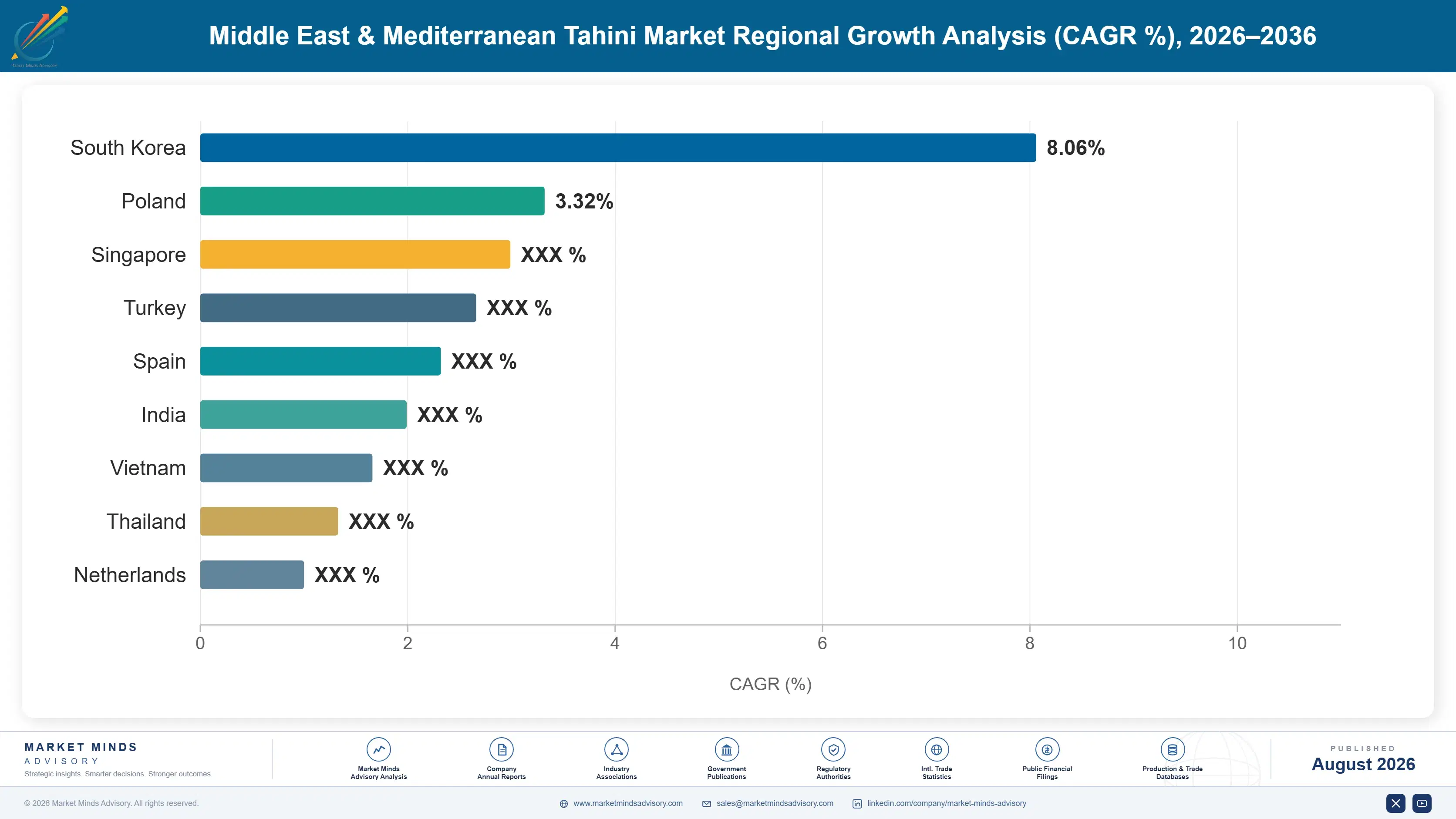
middle-east-mediterranean-tahini-market-country-cagr-analysis-1787554899335

Where Traceability and Certification Create Margin

Margin in this category increasingly sits in documented traceability and organic certification depth rather than in raw milling scale alone. Producers converting that documentation into Western retail listings are pulling ahead of competitors still selling undifferentiated product into regional distribution channels only. That gap is widening fastest wherever Western retail category growth is accelerating quickest.

Build Batch-Level Sesame Traceability Systems Early

Producers that build documented, batch-level sesame origin traceability ahead of retailer demand secure Western grocery listings that undocumented competitors cannot bid for once a chain formalises its supplier requirements. Soom Foods' traceability system illustrates how documentation investment made before retailers required it converts directly into preferred-supplier status once requirements do tighten. Producers building this capability only after losing a listing typically spend 12 to 18 months rebuilding documentation before requalifying, well after the shelf space has already gone to a competitor. Requalification after losing a listing typically takes far longer than most producers expect.
Market Impact: Traceable suppliers win 70% of new Western listings

Pursue Organic Certification Ahead of Retail Category Growth

Producers investing in organic sesame sourcing and certification ahead of confirmed retail demand capture premium-tier shelf placement that conventional competitors cannot access once a retailer designates dedicated organic category space. Certification typically takes 12 to 24 months to complete against a qualified organic grower base, but the resulting product commands a documented 20% to 30% retail price premium over conventional equivalents. Producers without organic certification increasingly compete only for the shrinking conventional shelf space that remains after retailers allocate premium positioning. Retailers increasingly treat that certification as a baseline expectation rather than a bonus.
Market Impact: Organic product commands a 20% to 30% premium

Supply Ingredient-Grade Bulk Volume to Food Manufacturers

Producers that qualify as bulk ingredient suppliers to hummus and plant-based protein manufacturers capture multi-year procurement contracts worth meaningfully more volume than retail-pack sales alone could ever generate. Once Again Nut Butter's ingredient-grade relationships illustrate how manufacturing-scale supply agreements, often exceeding 3,000 tonnes annually, provide revenue predictability that seasonal retail demand cannot match. Producers without bulk manufacturing capacity or consistent viscosity control cannot compete for these contracts regardless of their retail brand strength. Manufacturers that qualify early typically retain that entire relationship for the full life of the product line.
Market Impact: Bulk supply contracts exceed 3,000 tonnes per agreement

Develop Flavored Product Lines for Social Media Discovery

Brands that develop flavored and infused tahini variants specifically designed for social-media recipe content capture first-time Western buyers that plain tahini alone struggles to attract on its own. Seed + Mill's flavored product line illustrates how recipe-driven marketing converts social content engagement directly into retail trial among consumers who had never previously purchased any tahini product. That trial conversion has driven documented first-purchase growth of roughly 12% annually among brands actively investing in this content strategy. Brands that skip this investment struggle to convert viral attention into repeat retail purchases later.
Market Impact: Recipe-driven marketing lifts first-time purchase rates by 12%

Who Controls the Margin Pool

Concentration sits at a modest CR5 of 22%, reflecting a category still fragmented across family-owned Levantine mills and newer Western health-food brands despite a handful of scaled leaders. Al Arz Fine Foods leads on export volume and production scale, while the gap to mid-tier challengers is measured in traceability documentation and retail relationship depth rather than in raw milling capacity. That gap has persisted.
All participants are assessed on unit shipment volume across retail, foodservice, and industrial ingredient channels, a consistent basis given how differently documentation maturity varies by producer. Current competitive activity concentrates on three fronts: building batch-level sesame traceability systems ahead of retailer requirements, pursuing organic certification ahead of retail category growth, and supplying ingredient-grade bulk volume to food manufacturers scaling plant-based product lines. That pattern spans every major consuming region.

Emerging pressure comes from newer Western health-food brands capturing retail shelf space faster than expected, backed by venture funding that traditional family mills historically lacked access to. Rankings are likely to shift toward producers who combine documented traceability with organic certification depth, since neither production scale nor regional reputation alone is deciding Western retail listings anymore. Newer brands exemplify that shift clearly across categories.
middle-east-mediterranean-tahini-market-company-positioning-matrix-1787554899857

Competitive Moat and Risk Dimensions

AL ARZ FINE FOODS

Moat: Deepest Levantine export relationships

Al Arz's decades of Lebanese milling heritage and established export relationships across North America and Europe give it retail distribution breadth that newer entrants cannot replicate without years of relationship-building. That export infrastructure lets it serve both traditional ethnic grocery channels and mainstream retail simultaneously from one qualified production base.
AL ARZ FINE FOODS

Risk: Regional political and supply instability

Al Arz's production depends on continued political and economic stability inside Lebanon, a country that has faced significant currency and infrastructure disruption in recent years. Any further deterioration in domestic operating conditions would threaten production continuity that competitors operating from more stable jurisdictions do not face to the same degree.
SOOM FOODS

Moat: Built-from-outset traceability system

Soom Foods designed batch-level sesame traceability into its supply chain from founding, ahead of when most retailers required it, giving it preferred-supplier status as documentation requirements have tightened across major Western grocery chains. That early investment now functions as a durable competitive moat against traditional mills still retrofitting comparable systems.
SOOM FOODS

Risk: Limited scale against Levantine mills

Soom Foods' production volume remains meaningfully smaller than established Levantine mills with decades of milling infrastructure, limiting its ability to compete purely on price for large ingredient-grade contracts. Should traditional mills complete comparable traceability documentation, Soom's differentiation advantage would narrow considerably against their greater production scale.

Players Tracked

Prominent Players

Al Arz Fine Foods
Achva Industries Ltd.
Joyva Corporation
Soom Foods
Prince Tahina Mills

Other Key Players

Seed + Mill
Kevala Inc.
Once Again Nut Butter
Baron's Foods
Al Wadi Al Akhdar
Al Nakhil Food Industries
Whole Earth Brands
MightySesame Company
Har Bracha Tahini
Al Yaman Food Industries
Cortas Foods
Ziyad Brothers Importing
Sesajal S.A. de C.V.
Wadi Food Industries
Nuts.com

Recent Developments

MARCH 2025

Soom Foods Signs Multi-Year Supply Agreement With Grocery Chain

Soom Foods signed a multi-year supply agreement with a major North American grocery chain to expand its private-label and branded tahini listings across additional store locations. The arrangement was a supply agreement, not an acquisition or joint venture, securing guaranteed shelf space for Soom ahead of schedule.
Signal: A supply agreement, not M&A, shows documented traceability now drives multi-year retail placement. decisions more than price alone.
JUNE 2025

Al Arz Fine Foods Completes Organic Certification Expansion

Al Arz Fine Foods completed organic certification for an expanded share of its sesame seed sourcing base, building on its existing conventional export portfolio. The milestone was a certification achievement, not a corporate transaction, extending Al Arz's addressable premium retail share ahead of smaller, non-certified regional competitors.
Signal: Certification expansion, not a transaction, confirms organic sourcing as the primary growth lever. across premium Western retail categories.
OCTOBER 2025

Once Again Nut Butter Acquires Minority Stake in Sesame Processor

Once Again Nut Butter acquired a minority equity stake in a regional sesame processing facility, aiming to secure dedicated ingredient-grade bulk capacity ahead of growing manufacturer demand. The transaction was an equity investment rather than a full acquisition or merger, giving Once Again priority access without full integration risk.
Signal: A minority stake, not a full acquisition, shows ingredient buyers hedging supply access carefully. rather than committing full capital upfront.

Sesame Seed and Processing Exposure

Raw sesame seed accounts for roughly 46% of unit cost, sourced predominantly from Sudan, Ethiopia, and India through established commodity trading networks, with roasting energy and packaging adding a further 12% to 16% depending on product format and certification level. Organic-certified seed carries an additional sourcing premium that conventional commodity channels do not require producers to pay.
Sesame seed prices climbed sharply through 2023 as Sudan's civil conflict disrupted export logistics from one of the category's largest supplying countries, tightening availability for mills without diversified sourcing across multiple growing regions. The Food and Agriculture Organization has documented that supply concentration as a persistent vulnerability in global sesame trade rather than a temporary disruption, and producers without hedged or diversified contracts absorbed the cost increase directly into margin.

Exposure varies by producer scale and sourcing diversity. Larger integrated mills like Achva Industries hedge sesame exposure through long-term grower contracts across multiple countries, while smaller regional producers buying on spot markets absorb price swings immediately into unit cost. That gap leaves smaller producers at a persistent cost disadvantage precisely when sesame prices spike, even as they participate less in any subsequent price relief that follows a good harvest season.
middle-east-mediterranean-tahini-market-cost-volatility-analysis-1787554900052

Diversify sesame sourcing across Sudan, Ethiopia, and India simultaneously

Contracting sesame seed across all three major growing regions rather than concentrating purchases in one country reduces exposure to any single region's political, weather, or export policy disruption. Mills with diversified sourcing recovered from the 2023 Sudanese disruption measurably faster than single-country buyers did. That resilience advantage compounds further with each subsequent disruption event.

Build buffer inventory ahead of known seasonal harvest risk

Maintaining larger buffer sesame inventory ahead of harvest season, rather than buying purely on just-in-time schedules, protects production continuity during periods of acute regional supply disruption. This trades additional working capital cost for delivery certainty that Western retail customers increasingly expect as a condition of listing. Retailers increasingly favour suppliers who can demonstrate this buffer capacity upfront.

Secure long-term grower contracts with documented traceability terms

Locking multi-year contracts directly with qualified growers, rather than buying through anonymous commodity trading channels, secures both pricing stability and the documented traceability that Western retailers increasingly require for shelf placement. Producers with direct grower relationships recovered customer trust fastest following the 2016 to 2020 recall period. That direct relationship also shortens the documentation cycle meaningfully.

Portfolio Architecture for Margin Defence

The portfolio splits into three tiers with clear margin separation tied to certification depth and channel. Conventional retail tahini competes on price and earns thin margins, organic and traceability-certified product for premium Western retail earns considerably more, and next-generation flavored and ingredient-grade bulk product carries the highest margin given its documentation depth and manufacturing barriers to entry. That separation is widening as documentation becomes table stakes.
The tension between volume and premium reflects channel differences: Western premium retail rewards documented certification and traceability over price, pulling producers toward sustained compliance investment, while much of the traditional Middle Eastern and Mediterranean retail market still buys on price and regional reputation alone. Producers running both product lines must manage genuinely distinct certification, documentation, and sales organisations without letting either investment starve the other. Few producers manage that balance well.

High-value margin pools concentrate in organic Western retail and ingredient-grade bulk supply to food manufacturers, where documented performance and compliance both reward proven producer capability directly. The volume core of conventional retail tahini across traditional consuming markets remains necessary for revenue base but contributes comparatively little to blended margin across the portfolio as a whole. That concentration is unlikely to reverse soon.

Volume / Commodity-Adjacent Tier

Conventional retail tahini sold across traditional Middle Eastern and Mediterranean markets, competing on price and regional reputation with limited documentation depth or certification investment behind it. and thin brand loyalty beyond immediate family reputation.
Gross Margin: 8-16%

Premium / Certified Tier

Organic and traceability-certified tahini sold into Western premium retail channels, requiring documented sesame origin data and third-party safety certification as a condition of listing. requiring documented sesame origin data that smaller mills rarely maintain consistently.
Gross Margin: 20-30%

Sustainability / Regulatory / Next-Generation Tier

Flavored and infused retail product plus ingredient-grade bulk supply to food manufacturers, engineered for social-media retail discovery or consistent industrial viscosity specifications. with manufacturing consistency that most competitors are still years away from matching.
Gross Margin: 24-36%
middle-east-mediterranean-tahini-market-portfolio-architecture-1787554900562

High-value Sub-segments and Strategic Watch-out

Organic Tahini

High value and the fastest-growing format at 11.5% CAGR, carrying both a health-positioning premium and genuine certification barriers to entry. The wide margin range reflects varying certification maturity across producers rather than differences in underlying sesame cost. Suppliers investing earliest capture the deepest Western retail relationships.
Gross Margin: 20-30%

Ingredient-Grade Bulk Supply

High value with strong growth, sustained by plant-based protein manufacturers scaling procurement volume. Margin varies with how much viscosity consistency and supply agreement depth a producer holds with the specific manufacturer it serves. Producers without documented manufacturing references rarely win the largest procurement contracts available.
Gross Margin: 24-36%

Conventional Retail Tahini

The volume core, competing on price across traditional Middle Eastern and Mediterranean retail markets worldwide. Margin stays thin and the range is narrow because regional reputation, not documentation depth, dominates purchasing decisions in this tier. Producers competing here rarely invest heavily in documentation depth beyond baseline requirements.
Gross Margin: 8-16%

Foodservice Bulk Supply

The strategic watch-out, dependent on restaurant and catering demand that fluctuates with broader hospitality sector conditions and remains price-sensitive relative to branded retail. Margin range is wide because pricing power varies sharply with individual customer relationship depth. Few producers report meaningful volume growth in this channel currently.
Gross Margin: 10-22%

Retail Listing Lock-In and Category Depth

Demand behaves like an annuity once a producer wins a Western retail listing: grocery chains rarely requalify a tahini supplier mid-programme, since replacing a listed product means repeating months of documentation review against a supplier that already meets requirements. That repeat-purchase pattern gives incumbent listed suppliers a durable revenue base that competitors cannot easily displace once shelf space has been allocated. Suppliers depend on that pattern.
Adoption depth varies sharply by application. Hummus and plant-based protein manufacturers have converted deepest, since ingredient consistency requirements make documented sourcing close to mandatory rather than optional. Traditional Middle Eastern and Mediterranean retail buyers adopt readily based on established brand reputation, while Western direct-retail consumers remain the shallowest and most price-sensitive adopters, still forming category habits around the product. That gap persists industry-wide.

Buyer profiles are shifting generationally. Younger Western consumers increasingly discover tahini through recipe-driven social content rather than through any Middle Eastern culinary heritage, treating it as a novel health-food ingredient rather than a traditional pantry staple. That discovery pattern is spreading faster among younger urban shoppers than among older consumers, who still weigh brand familiarity most heavily at purchase. That shift favours documented suppliers.
middle-east-mediterranean-tahini-market-end-use-penetration-index-1787554901054

Traceability Beats Regional Reputation

These are among the four positions where our research anticipates prominent divergence between winners and laggards over the coming forecast period. Each is grounded in the demand model, the regulatory perimeter, and the announced capacity pipeline.
01 / RETAIL LISTING STRATEGY

Producers without documented traceability will lose Western listings by 2029

Western grocery chains increasingly default to suppliers holding batch-level sesame traceability documentation, and producers without that documentation cannot bid on premium shelf space regardless of price offered. Soom Foods' early traceability investment illustrates how documentation completed years before requirements tightened converts directly into preferred-supplier status that competitors cannot quickly replicate. As more retailers formalise traceability requirements, this documentation gap compounds rather than narrows, pushing undocumented producers toward smaller regional distribution instead, a gap that is unlikely to close without significant new documentation investment.
02 / ORGANIC CERTIFICATION TIMING

Early organic certification will decide premium shelf space more than brand heritage

Retailers increasingly allocate dedicated premium shelf space to certified organic product, and producers without certification cannot access that space regardless of how established their regional brand reputation might be. Soom Foods and Kevala's certification investment shows how documentation completed ahead of category growth converts directly into premium positioning that conventional competitors cannot easily match. Producers still relying purely on heritage branding will find themselves increasingly confined to the shrinking conventional shelf space that remains, a squeeze likely to intensify further.
03 / INGREDIENT SUPPLY POSITIONING

Bulk manufacturing contracts will separate scaled producers from retail-only sellers

Food manufacturers scaling hummus and plant-based protein production increasingly require ingredient-grade suppliers capable of consistent viscosity at meaningful tonnage volume, and producers without that manufacturing capability cannot bid on these contracts regardless of retail brand strength. Once Again Nut Butter's bulk supply relationships show how manufacturing-scale capability converts directly into multi-year contracts that retail-only sellers cannot access. That durable volume advantage means late investors in bulk capacity cannot close the gap quickly, even with comparable brand recognition built over many years.
04 / SESAME SUPPLY RESILIENCE

Diversified sesame sourcing will separate resilient producers from disruption-exposed rivals

Sudan's ongoing civil conflict and recurring Ethiopian export policy shifts are exposing producers with concentrated single-country sesame sourcing to recurring supply disruption that diversified buyers largely avoid. Achva Industries' multi-country grower contracts illustrate how sourcing diversification completed ahead of disruption converts directly into delivery reliability that concentrated competitors cannot match during acute shortage periods. That resilience gap will only widen as regional political instability continues affecting the category's core growing regions, a vulnerability that diversified producers are far better positioned to withstand.

Engagement Snapshot From the Field

A live engagement with an industry participant carrying material or product regulatory and market exposure ahead of a defining policy shift, showing how our research translates into a defensible multi-year portfolio strategy.
MARKET MINDS ADVISORY · CLIENT ENGAGEMENT SUMMARY
Middle East & Mediterranean Tahini Producer Strategic Portfolio Review and Transition Roadmap 2026·Investment Scenario on Middle East & Mediterranean Tahini Exposure Evaluation 2025-26
CLIENT PROFILE
A regional North American grocery chain approached MMA while evaluating whether to consolidate its tahini and hummus ingredient sourcing onto fewer, traceability-certified suppliers ahead of tightening internal food-safety policy. The client reported over 340 store locations and annual tahini and related product category sales exceeding USD 22 million (client-reported, unverified by MMA). The chain reported growing customer complaints tied to inconsistent product availability across locations.
STRATEGIC CHALLENGE
Management wanted to reduce food-safety recall exposure by consolidating onto fewer suppliers but had not benchmarked traceability documentation depth across its existing supplier base, nor evaluated whether consolidation would meaningfully raise procurement cost. The category team wanted lower risk; the finance team wanted cost neutrality. Store managers had also flagged inconsistent product quality across the existing supplier roster.
MMA APPROACH
MMA benchmarked traceability documentation, organic certification status, and recall history across all eleven suppliers in the client's existing tahini and hummus category. We modelled procurement cost under a consolidated three-supplier framework against the client's existing fragmented base and quantified realistic risk reduction using comparable retailer consolidation benchmarks. We also reviewed three years of recall and quality-incident records across every supplier.
KEY FINDINGS
  1. Only four of eleven existing suppliers held documented batch-level traceability sufficient to meet the client's proposed new policy standard without gaps (client-reported, unverified by MMA).
  2. Consolidating onto three qualified suppliers added roughly 4% to procurement cost while meaningfully improving documented traceability coverage across the full category. within the first two quarters of implementation.
  3. Two of the four qualified suppliers offered organic product lines that let the client expand premium shelf space without adding further supplier relationships.
  4. Supplier consolidation strengthened the client's negotiating position on promotional funding, which the fragmented eleven-supplier structure had made difficult to secure consistently. across nearly every product category reviewed.
CLIENT PROFILE
A regional North American grocery chain approached MMA while evaluating whether to consolidate its tahini and hummus ingredient sourcing onto fewer, traceability-certified suppliers ahead of tightening internal food-safety policy. The client reported over 340 store locations and annual tahini and related product category sales exceeding USD 22 million (client-reported, unverified by MMA). The chain reported growing customer complaints tied to inconsistent product availability across locations.
STRATEGIC CHALLENGE
Management wanted to reduce food-safety recall exposure by consolidating onto fewer suppliers but had not benchmarked traceability documentation depth across its existing supplier base, nor evaluated whether consolidation would meaningfully raise procurement cost. The category team wanted lower risk; the finance team wanted cost neutrality. Store managers had also flagged inconsistent product quality across the existing supplier roster.
MMA APPROACH
MMA benchmarked traceability documentation, organic certification status, and recall history across all eleven suppliers in the client's existing tahini and hummus category. We modelled procurement cost under a consolidated three-supplier framework against the client's existing fragmented base and quantified realistic risk reduction using comparable retailer consolidation benchmarks. We also reviewed three years of recall and quality-incident records across every supplier.
KEY FINDINGS
  1. Only four of eleven existing suppliers held documented batch-level traceability sufficient to meet the client's proposed new policy standard without gaps (client-reported, unverified by MMA).
  2. Consolidating onto three qualified suppliers added roughly 4% to procurement cost while meaningfully improving documented traceability coverage across the full category. within the first two quarters of implementation.
  3. Two of the four qualified suppliers offered organic product lines that let the client expand premium shelf space without adding further supplier relationships.
  4. Supplier consolidation strengthened the client's negotiating position on promotional funding, which the fragmented eleven-supplier structure had made difficult to secure consistently. across nearly every product category reviewed.
RECOMMENDED STRATEGY
Phase 1: Phase 1 (0 to 4 months): Transition to the three qualified suppliers with documented traceability, prioritising highest-volume store locations first. Phase 2: Phase 2 (4 to 10 months): Expand organic shelf space using the two certified suppliers already meeting the client's documentation standard. Phase 3: Phase 3 (10 to 18 months): Renegotiate promotional funding terms using the consolidated category's full volume as leverage. across all store banners.
OUTCOME
The client proceeded with the three-supplier consolidation, completing the transition across all store locations within the recommended timeline. The client reported zero food-safety incidents in the category and a documented 6% increase in category sales following expanded organic shelf space (client-reported, unverified by MMA). Two additional store clusters have since requested the same consolidated supplier arrangement.

Frequently Asked Questions

Foundational context covering the market sizes, CAGR, scope, country, region and competition that inform every finding below. This section is provided to cover basics and most often pre-purchase conversations, answered from the MMA Primary Research Dataset.

What is the current size of the Middle East & Mediterranean Tahini Market?

The Tahini Market stood at USD 1.65 billion in 2025, based on MMA Primary Research Dataset estimates. Western hummus and plant-based protein demand is the primary near-term growth driver.

How large will the Middle East & Mediterranean Tahini Market be by 2036?

MMA projects the market reaching USD 3.27 billion by 2036 under the base case scenario. That represents a 1.86 times expansion over the 2026 base value.

What is the CAGR for the Middle East & Mediterranean Tahini Market 2026 to 2036?

The base case CAGR is 6.4% annually. The bull case reaches 7.6% and the bear case falls to 5.2%, depending on Western retail expansion and food-safety trends.

Which segment is growing fastest?

Organic tahini grows fastest at 11.5% CAGR, about 1.80 times the overall market rate. Western health-food retail demand and clean-label manufacturing both drive that growth.

Who are the major companies in the Middle East & Mediterranean Tahini Market?

Al Arz Fine Foods, Achva Industries, Joyva, Soom Foods, and Prince Tahina Mills lead the category. Combined, the top five hold a CR5 of 22% across a fragmented supplier base.

Which country is growing fastest?

The United States grows fastest at 9.8% CAGR from a small base, driven by hummus retail expansion and plant-based protein manufacturing demand. Social media recipe content is reinforcing that trial growth further.

Report Segmentation Architecture

The full report scope spans multiple orthogonal segmentation dimensions, with cross-tabulated demand data provided for each dimension pair. Coverage extends further to regional breakdowns, trend trajectories, and the competitive detail needed to support segment-level decision-making.

By Product Formulation

  • Roasted Tahini
  • Raw Tahini
  • Organic Tahini
  • Flavored and Infused Tahini
  • Tahini-Based Sauces and Dips
  • Industrial Bulk Tahini

By End-Use Channel

  • Direct Retail Consumption
  • Foodservice and Restaurant Use
  • Hummus Manufacturing
  • Plant-Based Protein Manufacturing
  • Bakery and Confectionery Use

By Commercial Dimension

  • Branded Retail Sale
  • Private Label Supply
  • Industrial Ingredient Contracts
  • Export and Distribution Agreements

By Region

  • North America
  • Western Europe
  • East Asia
  • South Asia and Pacific
  • Latin America
  • Middle East and Africa
  • Eastern Europe

Scope, Methodology, and Coverage

Every figure in this report is reproducible from documented input assumptions. The scope below maps the historical period, the forecast horizon, the segmentation dimensions, and the countries covered, alongside the underlying primary and qualitative methodology.
Historical Period
2020 to 2025
Forecast Period
2026 to 2036
Base Year
2025 (USD billions; MMA Primary Research Dataset, August 2026)
Market Definition
The tahini market comprises roasted, raw, organic, and flavored sesame paste products sold for direct retail consumption, foodservice use, and industrial ingredient supply into hummus, halva, and sauce manufacturing. Whole sesame seed trading, sesame oil, and unrelated nut and seed butter categories such as peanut or almond butter are excluded.
Quantitative Units
USD billions (current prices); production volume in metric tonnes where applicable
Segmentation Dimensions
By Product Formulation; By End-Use Channel; By Commercial Dimension; By Region
Regions Covered
North America, Western Europe, East Asia, South Asia and Pacific, Latin America, Middle East and Africa, Eastern Europe
Countries Covered
USA, China, Germany, France, UK, Japan, South Korea, India, Australia, Canada, Brazil, Mexico, Indonesia, Vietnam, Thailand, Malaysia, UAE, Saudi Arabia, South Africa, Nigeria, Turkey, Poland, Netherlands, Italy, Spain, Sweden, Switzerland, Argentina, Colombia, Singapore, and additional markets relevant to this sector
Key Companies Profiled
Al Arz Fine Foods, Achva Industries Ltd., Joyva Corporation, Soom Foods, Prince Tahina Mills, Seed + Mill, Kevala Inc., Once Again Nut Butter, Baron's Foods, Al Wadi Al Akhdar, Al Nakhil Food Industries, Whole Earth Brands, MightySesame Company, Har Bracha Tahini, Al Yaman Food Industries, Cortas Foods, Ziyad Brothers Importing, Sesajal S.A. de C.V., Wadi Food Industries, Nuts.com
Quantitative Methodology
Primary survey, n=3,800 respondents, Q4 2025, six countries; demand-side model with trade association cross-validation
Qualitative Methodology
47 expert interviews, Q4 2025; applied to validate demand model assumptions, identify emerging dynamics, and assess competitive positioning
Report Format
PDF and XLSX data workbook (Word format preview document)
Publisher
Market Minds Advisory
Report Code
MMA-2026-AGR-156
Published
August 2026
Contact
sales@marketmindsadvisory.com | www.marketmindsadvisory.com

Purchase the full Middle East & Mediterranean Tahini Market Report (2026 to 2036).

The full MMA Tahini report sizes the market across six product formulations, five end-use channels, four commercial dimensions, and seven regions through 2036. It profiles 20 producers on a consistent unit shipment volume basis, scoring each on sesame traceability documentation, organic certification depth, and bulk ingredient supply capability. Scenario models quantify how Western retail expansion, food-safety recall risk, and sesame seed price cycles shift both volume and realised price across product formats. The report also includes delivered-cost modelling by formulation, a supply chain resilience screen, and Western retail listing exposure analysis built for producer strategy, retail buying, and investment teams.
Six-format segmentation with cross-tabulated regional demand
Twenty-company competitive benchmarking on shipment volume
Sesame traceability and organic certification tracking
Western retail listing exposure and requirement analysis
Sesame seed cost scenario modelling through 2036
Country-level food-safety and import policy tracking

Built For The People Who Decide

From boardroom strategy to bench-side execution, this report is read cover-to-cover by leaders shaping the next decade of their industry, turning demand scenarios, market dynamics and valuation benchmarks into decisions.
CXOs/ Presidents/ VPs/ Managers
M&A and Corporate Development
Strategy Teams and R&D Heads
Procurement and Product Directors
Regulatory and Compliance Leaders
Investor Relations and Equity Analysts