Middle East and Africa Airport Baggage Handling Systems Market
Middle East and Africa Airport Baggage Handling Systems Market: Gulf Megahub Expansion Drives Automation Investment
Gulf megahub expansion and IATA's bag-tracking mandate are pushing airports across the Middle East and Africa toward automated sortation and RFID tracking, even as African terminals lag Gulf carriers by a full technology generation.
2025 MARKET VALUE$2.4BMarket Size 2025
2036 FORECAST VALUE$4.8BBase Case , 2026 to 2036
CAGR 2026 TO 20366.5 %Bull 7.8% / Bear 5.2%
INCREMENTAL OPPORTUNITY$2.2BNet 10- year value creation
EXPANSION MULTIPLE1.88x2036 value over 2026 base
Strategic Levers
M&A Pipeline
Regional Outlook
Country Rankings
Competitive Intelligence
Segmental Deep-dive
Executive Snapshot and Market Trajectory
Gulf carriers are funding a genuine technology upgrade cycle in airport baggage handling as new megahub terminals open, while African airports still run largely manual sortation systems that leave the continent a full generation behind on automation investment. Regulatory compliance deadlines are adding pressure across both ends of this divide.
Robotic and automated loading systems are growing fastest of six product categories as terminal operators chase labor savings, while RFID tracking adoption accelerates following IATA's Resolution 753 bag-tracking mandate. Dubai and Doha concentrate the bulk of regional automation spending given their status as the world's busiest international transfer hubs. Fixed-route terminal design increasingly dictates exactly which automation technology suppliers prioritize for near-term deployment.
Five suppliers hold roughly sixty-eight percent of regional revenue, led by Vanderlande and BEUMER Group's deep integration expertise on complex hub-and-spoke terminal designs. Security screening integration requirements are tightening across the region, while African airport operators increasingly explore financing partnerships to fund automation upgrades they cannot afford outright. Smaller regional integrators without comparable purchasing scale increasingly struggle on price for standardized retrofit contracts, and that gap widens with every new Gulf megaproject.
Market Definition
This report covers revenue from conveyor, sortation, tracking, screening integration, self-service, and robotic loading systems sold for airport baggage handling applications across the Middle East and Africa. It excludes general cargo warehouse automation, passenger security screening equipment sold independently of baggage integration, and airport construction revenue unrelated to baggage systems specifically.
Base Year Value
$2.4B in 2025 (MMA Primary Research Dataset, August 2026)
Forecast Period
2026 to 2036, eleven discrete annual values
CAGR
6.5% base case. Bull 7.8%. Bear 5.2%.
Fastest Growth Segment
Robotic and Automated Loading Systems: 11.0% CAGR
Fastest Growth Country
China: 9.5% CAGR
Fastest Growth Region
South Asia and Pacific: 8.5% CAGR
Largest Region
East Asia: 29% of 2025 global value
Market Leaders
Vanderlande Industries, BEUMER Group, Siemens Logistics, Daifuku, Fives Group. Source: MMA Analysis based on company annual reports and airport procurement disclosures.
Primary Survey
n=3,800 procurement and R&D decision-makers, Q4 2025, six countries
Methodology
Demand-side build-up, cross-validated against public data, 47 expert interviews
Middle East and Africa Airport Baggage Handling Systems Market Forecast Scenarios

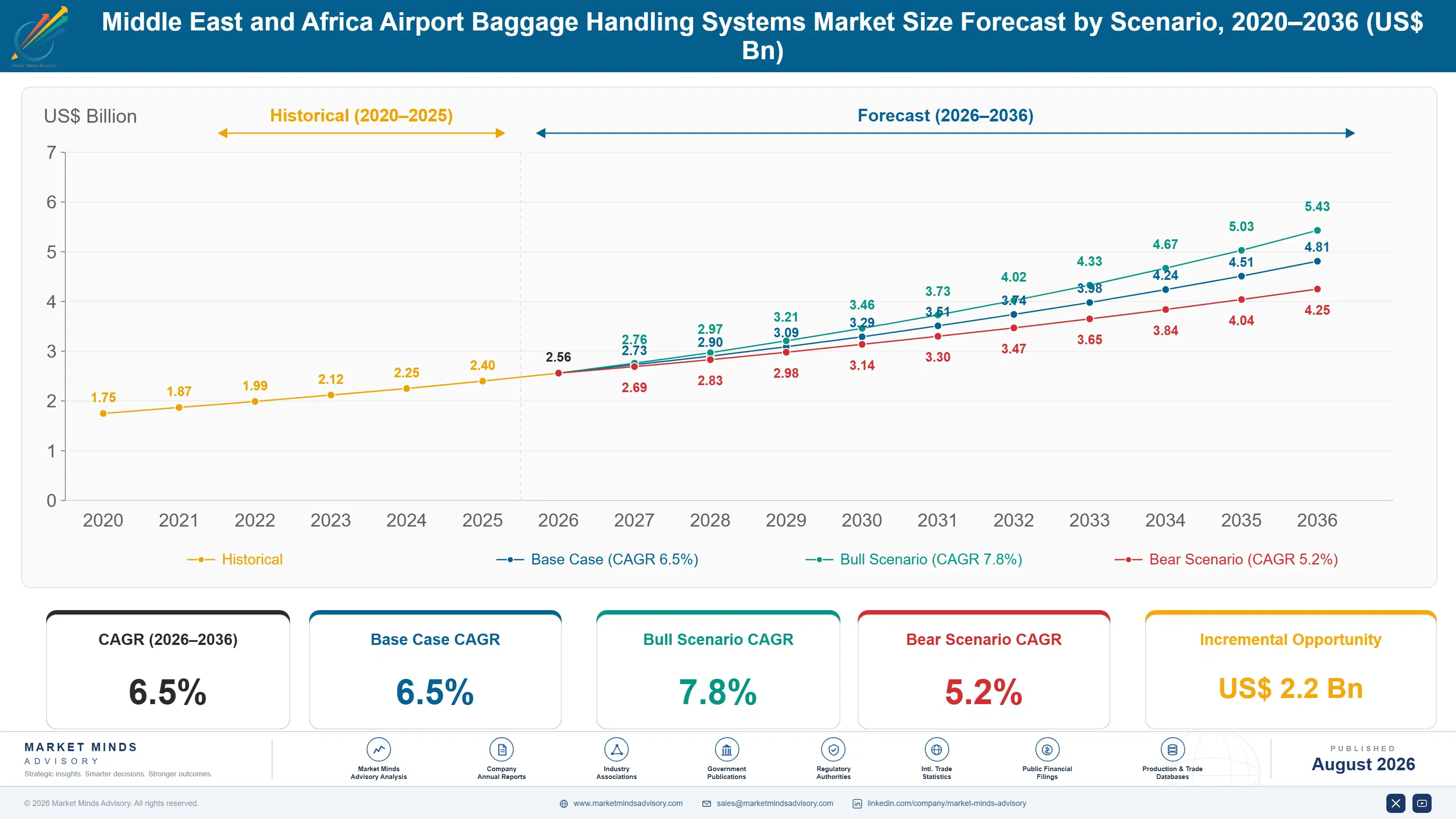
Between 2020 and 2025 the regional market grew at roughly 5.5 percent annually, recovering from pandemic-era terminal construction delays as Gulf carriers resumed megahub expansion programs and African airports gradually restored deferred maintenance and equipment procurement budgets. Suppliers with diversified Gulf and African customer bases weathered this period more comfortably than regionally concentrated competitors. Compliance deadlines added further pressure late in the period.
The base case assumes 6.5 percent annual growth through 2036, anchored in three mechanisms: continued Gulf megahub terminal expansion requiring newbuild baggage system integration at unprecedented transfer-passenger scale, IATA Resolution 753 compliance pushing airports toward RFID and automated tracking investment regardless of terminal age, and gradual African airport modernization funded increasingly through international financing partnerships rather than constrained national budgets alone. Suppliers with megahub reference installations are best placed to capture this combined growth.
A bull scenario built on faster Gulf megaproject completion and accelerating African financing deals could push growth toward 7.8 percent. A bear scenario tied to delayed terminal construction and continued African budget constraint could instead pull growth down toward 5.2 percent. Steel and semiconductor component costs remain a secondary swing factor either way. Regional financing deal pace matters almost as much.
The base case assumes 6.5 percent annual growth through 2036, anchored in three mechanisms: continued Gulf megahub terminal expansion requiring newbuild baggage system integration at unprecedented transfer-passenger scale, IATA Resolution 753 compliance pushing airports toward RFID and automated tracking investment regardless of terminal age, and gradual African airport modernization funded increasingly through international financing partnerships rather than constrained national budgets alone. Suppliers with megahub reference installations are best placed to capture this combined growth.
A bull scenario built on faster Gulf megaproject completion and accelerating African financing deals could push growth toward 7.8 percent. A bear scenario tied to delayed terminal construction and continued African budget constraint could instead pull growth down toward 5.2 percent. Steel and semiconductor component costs remain a secondary swing factor either way. Regional financing deal pace matters almost as much.
Megahub Automation and Compliance-Driven Upgrade Cycles
The regional baggage handling market splits sharply between Gulf carriers building some of the world's most technically advanced terminals and African airports still running largely manual sortation, a gap wide enough that suppliers effectively operate two entirely different sales conversations within the same regional market. This bifurcation is unusual for a single regional market classification, and it is exactly what makes near-term supplier strategy so difficult to generalize.
TOP-5 SUPPLIER CONCENTRATION68%Revenue share held by five largest system integrators
GULF HUB REVENUE SHARE54%Regional revenue originating from Gulf megahub terminals directly
RFID TRACKING ADOPTION RATE41%Regional airports currently compliant with bag-tracking mandate rules
RETROFIT VERSUS NEWBUILD SPLIT62% newbuildShare of installations tied to new terminal construction
AVERAGE MISHANDLED BAG RATE4.8 per 1,000Typical bags mishandled per thousand passengers across region
AFRICAN AUTOMATION PENETRATION19%African airports operating fully automated sortation systems currently
Gulf megahub operators buy the newest automation technology available because their transfer-passenger volumes and connection-time targets simply cannot function on manual sortation at the scale involved, while African airport procurement decisions weigh automation against far more basic infrastructure priorities competing for the same constrained capital. African airport operators, by contrast, weigh every automation dollar against far more urgent basic infrastructure needs competing for the same limited capital.
Two forces will reshape the next decade. IATA's bag-tracking mandate will keep pushing every airport toward RFID investment regardless of terminal age, while international financing partnerships increasingly let African airports leapfrog directly to modern automated systems rather than incrementally upgrading manual infrastructure first. Suppliers positioned to serve both ends of this divide simultaneously carry a genuine advantage as financing partnerships gradually close the gap.
"Walk through Dubai's terminal and then a mid-sized African airport on the same trip and you would think you are looking at two different decades of technology, which is exactly the opportunity suppliers who can serve both ends profitably are chasing."
Market Trends
The International Air Transport Association's Resolution 753 requires airlines to track checked baggage at four key points from check-in to arrival, a requirement that effectively forces ground handlers and airport operators to invest in RFID or equivalent tracking infrastructure regardless of how modern their existing conveyor and sortation systems already are. Regional compliance sits well below full adoption, meaning a considerable installed base still requires tracking upgrades even at well-equipped Gulf hub terminals. African airports face a steeper compliance gap given lower automation baselines, and several national carriers are pressuring home airports to accelerate tracking investment ahead of the deadline.
Market Impact: Cuts connection time 20 percent
Gulf Megahub Terminals Push Automation to New Scale
Dubai, Doha, and Abu Dhabi are each operating or expanding terminals designed around transfer-passenger volumes that would overwhelm manual baggage sortation entirely, forcing these airports toward the most advanced automated sortation and robotic loading technology currently commercially available anywhere in the world. These megahub projects function as global reference installations that suppliers use to demonstrate capability to airport operators elsewhere, meaning the technology proven in Gulf terminals today increasingly defines what other regions expect to purchase within a few years. Qatar's ongoing Hamad International expansion specifically incorporates next-generation robotic loading systems still considered experimental in most other global markets.
Market Impact: Grows 19 percent penetration total
Market Opportunities and Growth Drivers
Gulf Carrier Transfer-Passenger Growth Demands Faster Sortation
Gulf carriers have built their entire business model around connecting passengers through their home hubs between origin and destination pairs that would otherwise require multiple stops, a strategy that only works if baggage transfer between connecting flights happens within an increasingly tight minimum connection time window. As transfer-passenger volumes keep growing, airports must handle considerably more bags per hour without extending minimum connection times that would erode the competitive advantage the entire hub strategy depends on. This pushes continuous investment in faster, more reliable automated sortation regardless of broader capital budget constraints affecting other airport infrastructure priorities.
Market Impact: Limits penetration to 19 percent
International Financing Partnerships Enable African Modernization
African airport operators have historically lacked the capital to fund automation upgrades independently, but international development finance institutions and equipment manufacturers are increasingly structuring financing partnerships that let airports pay for automated systems through operational savings rather than large upfront capital outlays. This financing innovation opens a considerably larger addressable market than African capital budgets alone could support, letting national airports leapfrog directly from manual sortation to modern automated systems without the incremental upgrade path Gulf and Western airports historically followed. Several African national carriers have publicly endorsed this financing approach as the most realistic path toward meaningful modernization.
Market Impact: Adds 15 percent to project cost
Market Restraints and Challenges
Limited Capital Budgets Constrain African Automation Adoption
Most African national airports operate under considerably tighter capital budget constraints than Gulf carriers, forcing automation investment to compete directly against more basic infrastructure priorities like runway maintenance and terminal capacity expansion for the same limited funding. The root cause is broader national fiscal constraint rather than any lack of recognized need for automation specifically, since airport operators generally understand the labor-cost and mishandled-bag benefits automation would deliver. International financing partnerships and phased implementation approaches are helping some airports overcome this constraint gradually, though full regional parity with Gulf terminals remains a considerably distant prospect.
Market Impact: Affects 41 percent compliant airports
Security Screening Integration Complexity Raises Project Cost
Integrating baggage screening security requirements directly into automated sortation systems requires considerably more complex engineering than either system would need independently, since screened bags must be tracked, rerouted for secondary screening when flagged, and reconciled with passenger records without introducing processing delays. The root cause is the genuine technical difficulty of merging security and logistics requirements within a single automated workflow rather than any regulatory overreach. Suppliers are mitigating this through modular screening-integration packages that reduce customization requirements for airports with broadly similar terminal layouts and security protocols. Airports adopting these modular packages report meaningfully shorter integration timelines overall.
Market Impact: Adds 54 percent of regional revenue
3 additional market trends, 4 additional growth drivers, and 3 additional restraints and challenges are covered in the full report. Contact sales@marketmindsadvisory.com to access the complete intelligence.
Segment CAGR and Growth Architecture
Segmentation follows product technology, the dimension airport operators and system integrators use to plan terminal upgrades. Six categories cover the market: conveyor and sortation, RFID tracking, screening integration, self-service bag drop, control software, and robotic loading systems. This mirrors how airport operators themselves budget and plan terminal upgrade cycles. Regulators reference this same breakdown when issuing compliance guidance.

Robotic and Automated Loading Systems
Robotic and automated loading systems are growing fastest because Gulf megahub terminals are proving that robotic arms can load bags into aircraft cargo holds faster and more consistently than manual baggage handlers, particularly for the tight turnaround times these hubs depend on to maintain competitive minimum connection windows. Qatar's Hamad International expansion incorporates next-generation robotic loading technology still considered experimental in most other global airports, giving regional suppliers genuine reference installations to showcase elsewhere. This segment remains smallest by installed base given its relative newness and cost, but Gulf carriers view early adoption as a differentiator worth the premium given how central connection reliability is to their business model. Regional operators view this trend closely.
CAGR 11.0%
RFID and Automated Tracking Systems
RFID and automated tracking systems are the second-fastest segment as IATA's Resolution 753 mandate effectively forces airports and ground handlers toward tracking infrastructure investment regardless of how modern their existing sortation systems already are. This creates unusually broad demand across both Gulf hub terminals seeking full compliance and African airports starting from a considerably lower existing automation baseline, since tracking compliance does not require replacing the entire baggage handling system, only adding compatible tracking infrastructure on top of it. Suppliers offering tracking systems that integrate with legacy conveyor infrastructure without requiring full sortation system replacement are capturing disproportionate share of this compliance-driven demand specifically. Compliance deadlines are pulling forward decisions operators might otherwise have deferred for years.
CAGR 9.0%
Full segment breakdown across 6 segments available in the complete report.
Regional Architecture and Country Demand Map
East Asia leads on unprecedented new airport construction pace, particularly in China. Middle East and Africa sits at the top of its own band on Gulf megahub investment, while South Asia and Pacific posts the fastest regional growth as airport construction accelerates broadly across the wider region.
Middle East and Africa
Dubai, Doha, and Abu Dhabi anchor this region's outsized automation spending, with Gulf carriers funding some of the world's most technically advanced terminal baggage systems to support transfer-passenger volumes that would overwhelm manual sortation entirely. Qatar's ongoing Hamad International expansion and Saudi Arabia's Riyadh airport program both incorporate next-generation robotic loading technology alongside conventional automated sortation at unprecedented regional scale. African airports sit at the opposite end of this same region, with most national carriers still operating largely manual sortation systems given considerably tighter capital budgets than Gulf operators enjoy. International financing partnerships are gradually closing this gap, letting African airports leapfrog directly to modern systems rather than following the incremental path Gulf airports historically took.
Share: 6% | CAGR: 7.0% (2026 to 2036)
East Asia
China's unprecedented pace of new airport construction, including mega-hubs like Beijing Daxing designed around some of the highest passenger throughput targets anywhere in the world, gives East Asia the largest regional share through genuine newbuild demand rather than retrofit activity. Japan's Daifuku holds a leading global position in baggage handling system integration, giving the region deep domestic supplier capability alongside its own substantial demand base. South Korean and Chinese airports are increasingly specifying RFID tracking and robotic loading systems directly into new terminal designs from the outset rather than retrofitting them later, reflecting the region's comparative newbuild advantage over the mostly retrofit-driven markets found in North America and Western Europe.
Share: 29% | CAGR: 7.5% (2026 to 2036)
Regional intelligence for 5 additional markets available in the complete report: North America, Western Europe, South Asia and Pacific, Latin America, Eastern Europe. Contact sales@marketmindsadvisory.com.

Where Baggage System Suppliers Can Capture Growth
Four levers stand out for suppliers navigating a regional market split between advanced Gulf megahubs and capital-constrained African airports. Each trades project complexity for either reference-installation credibility, compliance-driven volume, or financing-enabled market access. Each requires different capabilities, but all four are available to suppliers already operating profitably today. These suppliers understand both ends of this market well.
Win Gulf Megahub Reference Installations First
Gulf megahub projects like Qatar's Hamad International expansion represent 54 percent of regional revenue and function as global reference installations that suppliers use to demonstrate advanced capability to airport operators worldwide, not just regionally. Suppliers that win these flagship contracts gain considerably more sales credibility than competitors whose portfolio consists mainly of smaller retrofit projects, since airport operators evaluating major automation investments specifically seek suppliers with proven megahub-scale delivery experience. This does require accepting the technical risk and tight delivery timelines these prestige projects typically demand, a tradeoff that pays off considerably in subsequent sales conversations elsewhere.
Market Impact: Captures fully 54 percent of all regional revenue
Offer Modular RFID Retrofit Packages for Compliance
Only 41 percent of regional airports currently meet IATA Resolution 753 tracking compliance, leaving considerable retrofit demand that does not require full sortation system replacement, only compatible tracking infrastructure layered onto existing conveyor infrastructure. Suppliers offering modular RFID packages that integrate with legacy systems can capture this compliance-driven demand considerably faster than competitors requiring full system replacement, since airport operators facing compliance deadlines need the fastest, least disruptive path to meeting requirements. This approach also opens a sales relationship that can later expand into broader automation upgrades once compliance is achieved.
Market Impact: Captures the full 41 percent of the compliance gap
Structure Financing Partnerships for African Airports
African airports represent only 19 percent automation penetration currently, a considerably larger addressable opportunity than African capital budgets alone could ever fund given persistent fiscal constraints across most national airport authorities. Suppliers that structure financing partnerships letting airports pay through operational savings rather than large upfront capital outlays can access this underserved market considerably faster than competitors waiting for African capital budgets to expand organically. This requires genuine financial structuring capability beyond core engineering expertise, a capability gap that currently limits how many suppliers can pursue this opportunity effectively. Gulf carriers value this differentiation highly.
Market Impact: Grows share within the fast 11 percent segment
Develop Robotic Loading Technology for Premium Positioning
Robotic and automated loading systems are growing at 11.0 percent annually against a 6.5 percent market average, and suppliers with genuine robotic loading capability can command premium pricing from Gulf carriers viewing early adoption as a competitive differentiator for their entire hub strategy. Building this capability requires considerably deeper engineering investment than conventional conveyor and sortation technology demands, but the handful of suppliers with proven robotic loading references are winning disproportionate share of the highest-value megahub contracts specifically. This technology also transfers relatively cleanly to other regions once proven at Gulf scale.
Market Impact: Reaches fully 19 percent of African penetration total
Who Controls the Margin Pool
Five suppliers control roughly sixty-eight percent of regional revenue, a concentration level typical of complex industrial integration markets where megaproject delivery track record matters more than price competition alone. Vanderlande and BEUMER Group lead on deep hub-and-spoke terminal integration expertise, with a meaningful gap separating them from smaller regional specialists lacking comparable megaproject references. No single business model has proven definitively superior across both Gulf and African markets.
Current competitive activity centers on three fronts: Gulf megahub contract competition as Qatar, Saudi Arabia, and the UAE continue major terminal expansion programs, RFID retrofit package development aimed at IATA Resolution 753 compliance across both Gulf and African airports, and financing partnership structuring aimed at reaching African automation demand that traditional capital budgets alone cannot support.
Emerging pressure comes from Asian suppliers, particularly Daifuku, bringing newbuild-scale manufacturing efficiency gained from China's unprecedented airport construction pace into competition for Gulf megahub contracts historically dominated by European integrators. Rankings could shift meaningfully as African financing partnerships mature, since suppliers building early financing capability now may capture disproportionate share once that underserved market opens more broadly. Suppliers slow to build financing capability risk permanent exclusion from that emerging opportunity.

Competitive Moat and Risk Dimensions
Moat: Megahub Integration Track Record
Vanderlande's decades of experience delivering complex hub-and-spoke terminal baggage systems for some of the world's busiest airports gives it a credibility advantage in Gulf megahub bidding that smaller regional specialists cannot match, letting it win the highest-complexity contracts other suppliers cannot credibly pursue. This edge grows more valuable as terminal complexity keeps increasing region-wide.
Risk: High Project Delivery Cost
Vanderlande's premium positioning and deep customization capability come with meaningfully higher project cost than regional integrators offering standardized packages, leaving it vulnerable to losing price-sensitive African contracts to lower-cost competitors willing to accept simpler system designs. Losing these contracts would meaningfully dent its regional revenue base over time.
Moat: Screening Integration Expertise
BEUMER's deep expertise integrating security screening requirements directly into automated sortation workflows gives it an advantage on the increasingly complex security-integrated projects that pure conveyor specialists lacking comparable screening expertise struggle to deliver without a technology partnership. Airports increasingly value this integrated approach over separately sourced components.
Risk: German Cost Base Exposure
BEUMER's German engineering and manufacturing cost base leaves it less price-competitive on standardized African contracts than Asian suppliers benefiting from lower domestic manufacturing costs, a disadvantage that grows more pronounced as African financing partnerships open more price-sensitive contract opportunities. This exposure grows as African financing partnerships open more price-sensitive deals.
Players Tracked
Prominent Players
Vanderlande Industries
BEUMER Group
Siemens Logistics
Daifuku
Fives Group
Other Key Players
Pteris Global
G&S Airport Conveyor
Glidepath Group
Alstef Group
Grenzebach
Interroll Group
SITA
MHS Global
Bagport
Logplan
ICM Airport Technics
Nexeya
Fenix Group
Babcock International
Bygging Uddemann
Recent Developments
Vanderlande Wins Riyadh Airport Expansion Contract
Vanderlande secured a major contract to design and install baggage handling systems for Saudi Arabia's Riyadh airport expansion program, covering conveyor, sortation, and RFID tracking infrastructure across the terminal's new capacity. The contract includes a multi-year maintenance and software support agreement covering the full installation.
Signal: Confirms that European integrators remain competitive for the region's largest megaproject contracts despite growing Asian pressure.
BEUMER Group Launches Modular RFID Retrofit Package
BEUMER Group launched a modular RFID tracking retrofit package designed to integrate with legacy conveyor infrastructure, aimed specifically at airports facing IATA Resolution 753 compliance deadlines without budget for full sortation system replacement. The package is designed for rapid installation without requiring extended terminal shutdown periods.
Signal: Shows that suppliers are building compliance-specific products rather than relying solely on full replacement sales now.
Daifuku Announces African Financing Partnership Program
Daifuku announced a financing partnership program with an international development finance institution aimed at letting African airports fund automation upgrades through operational savings rather than upfront capital outlays. The partnership covers an initial group of airports across multiple African countries. Financing terms were not disclosed by either party.
Signal: Signals that suppliers increasingly view financing structuring as a genuine competitive differentiator in these markets now.
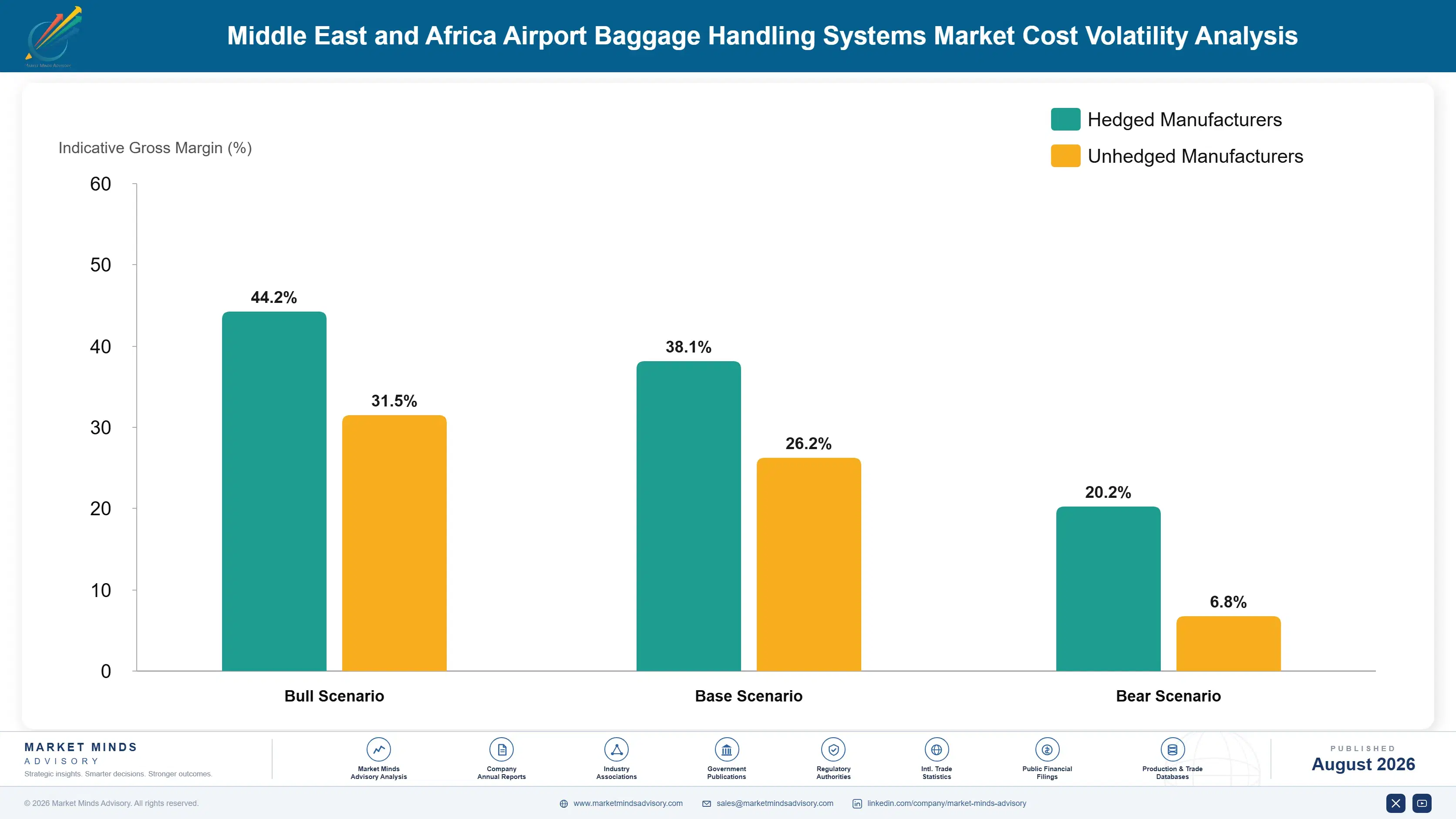
Steel, Sensor, and Integration Cost Pressures
Structural steel, conveyor motors, and sensor and control hardware together represent the largest cost-to-serve components for baggage system suppliers, running roughly forty-eight to fifty-three percent of total project cost, with software integration and commissioning labor adding a further sixteen percent on top. Nearly all specialized sensor and RFID hardware originates from a concentrated group of suppliers in the United States, Japan, and Germany.
Global steel price volatility during 2022 and 2023 pushed conveyor system component costs higher across major infrastructure projects worldwide, a pressure Vanderlande's 2024 Annual Report specifically cited as a factor affecting project margin on fixed-price megahub contracts signed before the price increases took effect. Suppliers with variable-price contract structures navigated this period considerably more comfortably than those locked into fixed pricing agreed years earlier. Suppliers with variable-price contracts absorbed the increase more comfortably than fixed-price bidders.
Smaller regional integrators face proportionally heavier exposure to this cost pressure because they lack the purchasing volume and long-term supplier contracts that Vanderlande, BEUMER, and Siemens Logistics can secure more easily through global procurement scale. Regional specialists without comparable purchasing leverage are consequently paying meaningfully higher per-unit component costs, compressing margin on price-sensitive African contracts specifically.

Negotiate Variable-Price Contracts Where Possible
Structuring contracts with variable rather than fixed pricing for major steel and component inputs reduces exposure to commodity price spikes during multi-year megaproject delivery timelines, shifting some volatility risk back to project owners better positioned to absorb it across their broader capital budget. Suppliers negotiating this way typically preserve stronger margin protection across multi-year project timelines.
Consolidate Component Purchasing Across Regional Projects
Pooling sensor, motor, and control hardware purchasing across multiple regional projects rather than procuring independently for each contract lets smaller integrators approach the purchasing scale that larger global suppliers already enjoy, improving per-unit component pricing meaningfully. Several smaller integrators have pursued exactly this kind of consolidation successfully in recent years. Both parties benefit from this arrangement considerably.
Standardize Modular Designs Across Terminal Types
Designing conveyor and sortation modules that work across multiple terminal layouts rather than customizing extensively for each project reduces engineering cost and shortens delivery timelines, letting suppliers absorb component cost volatility more comfortably across a broader project base. This approach also shortens the overall engineering and certification process meaningfully. Suppliers report meaningfully faster delivery timelines as a direct result.
Portfolio Architecture for Margin Defence
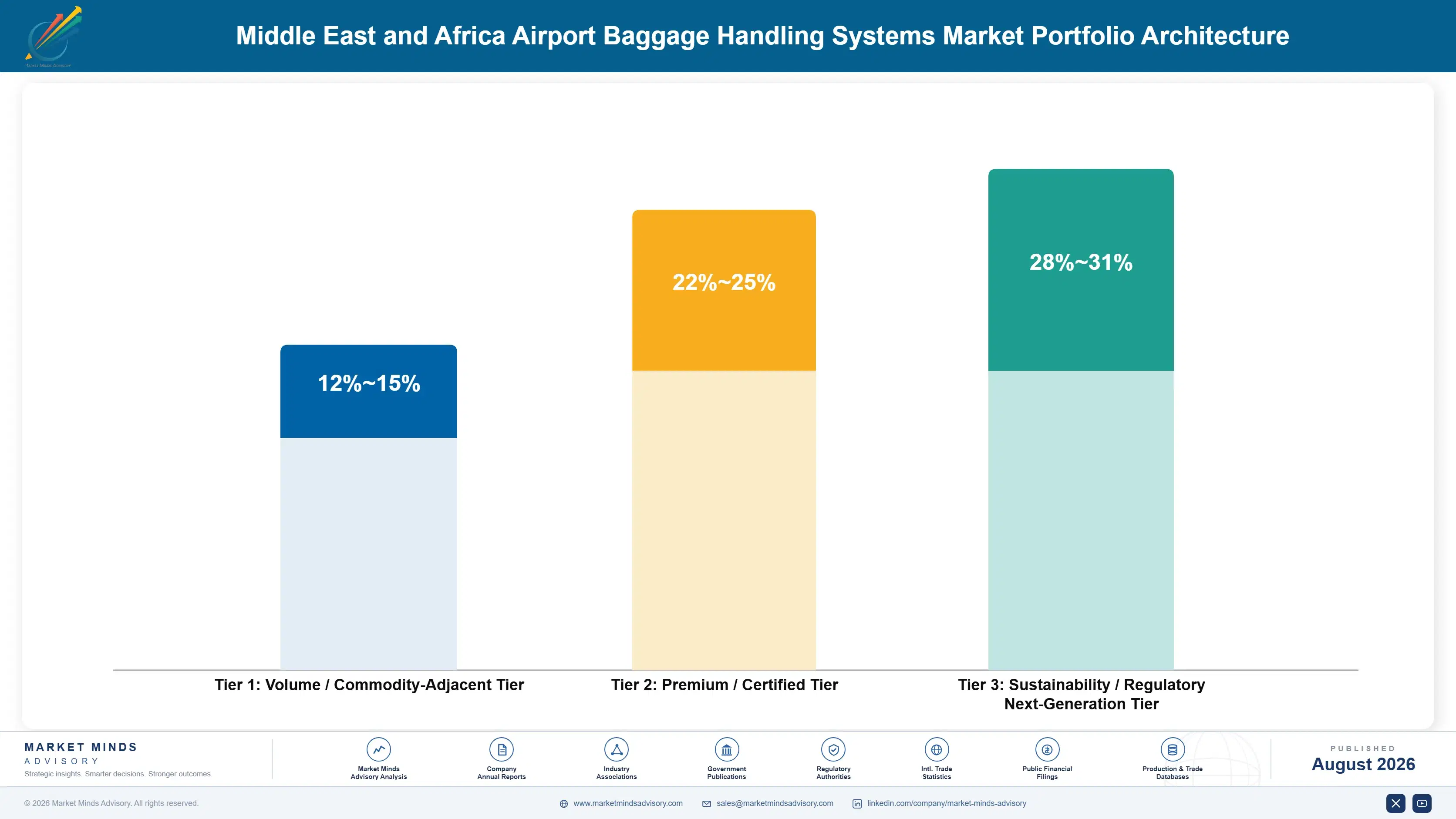
Baggage system suppliers architect their offering across three tiers that trade project complexity for margin in fairly predictable steps. Standard conveyor and sortation systems anchor the volume tier at thin margin, RFID tracking and screening-integrated systems occupy a premium middle tier, and robotic loading and fully automated megahub systems sit at the top as the smallest but fastest-expanding category. No single tier alone determines a supplier's overall profitability across its full project portfolio.
The tension between volume and premium tiers reflects genuine technical difficulty rather than positioning alone: standard conveyor systems require comparatively straightforward mechanical engineering and generate steady but thin-margin revenue, while fully automated systems require considerably deeper software and robotics investment that only the most capable suppliers can deliver, which is why margin concentrates so heavily at the top of this hierarchy. This dynamic mirrors how technology companies price entry-level versus enterprise-grade offerings.
The highest-value pools concentrate in Gulf megahub robotic loading contracts and screening-integrated systems, both benefiting from genuine technical barriers that smaller, less capitalized regional integrators cannot easily replicate without years of dedicated engineering investment. Suppliers lacking either specialty risk drifting toward the thin-margin volume tier by default.
Volume / Commodity-Adjacent Tier
Standard conveyor and sortation systems requiring comparatively straightforward mechanical engineering, sold widely across smaller regional airports and retrofit projects with limited automation ambition. Most smaller regional airports operate primarily within this entry-level tier today.
Gross Margin: 12-15%
Premium / Certified Tier
RFID tracking and security screening-integrated systems requiring deeper software integration and compliance expertise than standard conveyor systems demand, sold mainly to compliance-driven airport upgrades. This tier attracts steady demand from compliance-driven upgrade cycles across the region.
Gross Margin: 22-25%
Sustainability / Regulatory / Next-Generation Tier
Robotic loading and fully automated megahub systems built on years of engineering investment that smaller, less capitalized regional integrators cannot quickly replicate without significant capital. Only a handful of suppliers worldwide currently operate confidently within this top tier.
Gross Margin: 28-31%

High-value Sub-segments and Strategic Watch-out
Robotic and Automated Loading Systems
Fastest-growing and highest-margin pool in the portfolio, driven by Gulf megahub demand for competitive differentiation, with margin concentrated among the handful of suppliers holding proven robotic loading reference installations. Suppliers here also benefit from tolerance for technical complexity that price-sensitive contracts elsewhere will not accept.
Gross Margin: 28-31%
RFID and Automated Tracking Systems
High-value segment growing steadily on IATA compliance requirements, with margin concentrated among suppliers offering modular packages that integrate with legacy conveyor infrastructure without full replacement. Suppliers offering modular retrofit packages are winning disproportionate share of this compliance-driven demand. These suppliers are winning compliance-driven contracts fastest across the region overall.
Gross Margin: 22-25%
Conveyor and Sortation Systems
Largest volume core segment by installed base, serving smaller regional airports and retrofit projects broadly, with margin staying thin due to competitive standardized pricing pressure across nearly every regional integrator. Suppliers here compete on installation speed and total lifecycle cost of ownership, with pricing pressure showing little sign of easing.
Gross Margin: 12-15%
African Airport Modernization Contracts
Strategic watch-out tied closely to international financing partnership availability, where a slowdown in development finance commitments could compress volume for suppliers dependent on financing-enabled deals specifically. A slowdown in development finance commitments could meaningfully compress volume across this segment. Suppliers dependent on this financing channel face the most exposure here.
Gross Margin: 18-21%
Project Cycles and Compliance-Driven Depth
Baggage handling automation runs on long, lumpy project cycles rather than steady annuity revenue: megahub contracts involve multi-year design and delivery timelines followed by decades of maintenance and software support revenue, while compliance-driven retrofit projects generate faster but smaller recurring service relationships once installed. This lumpiness makes revenue forecasting genuinely harder than for comparable recurring-revenue businesses.
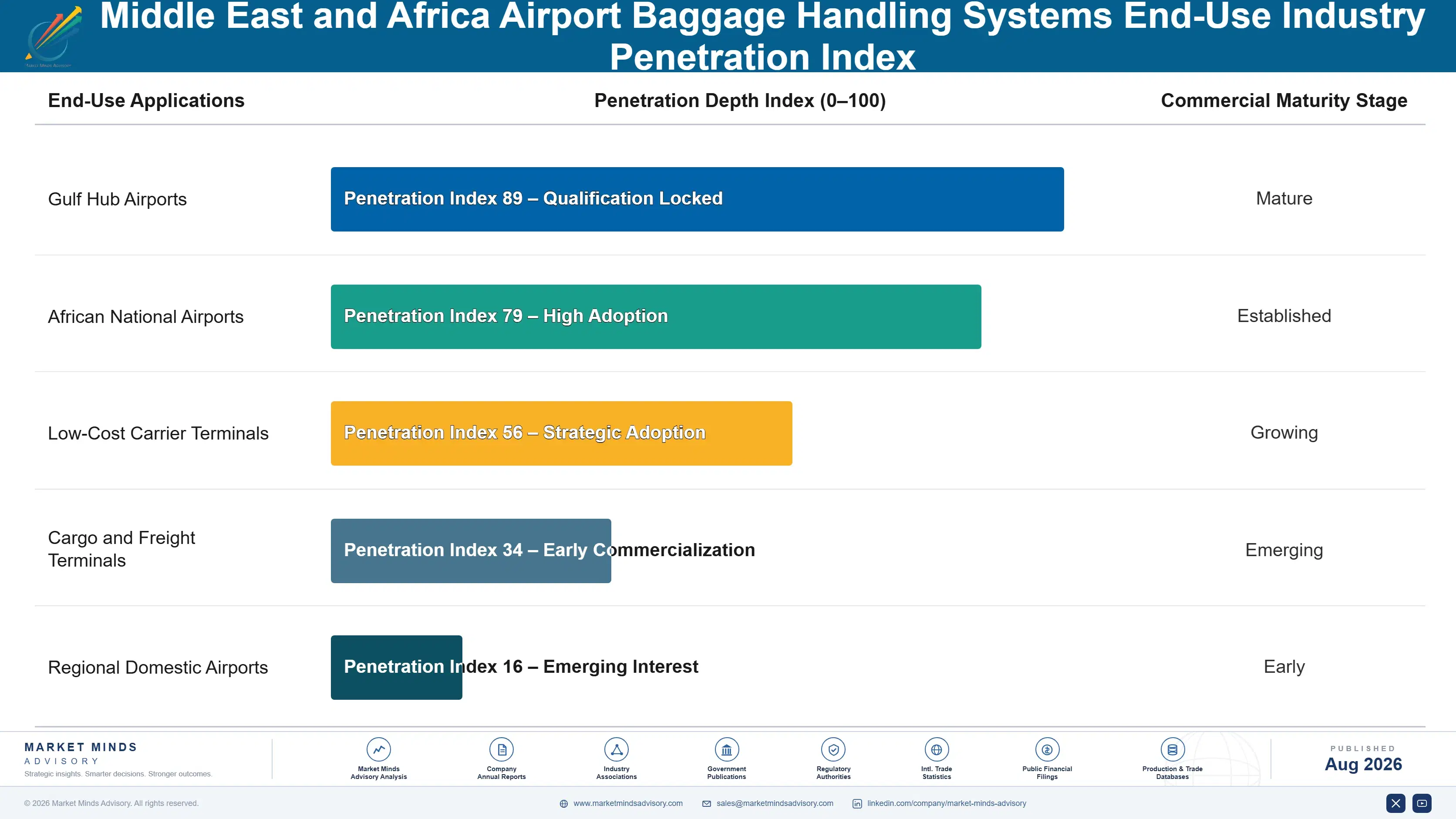
Adoption depth varies sharply by vertical. Gulf megahub terminals sit at the frontier of available technology given their extreme transfer-passenger volume requirements, while African airports remain earliest in their adoption curve, with most operators still evaluating financing partnerships before committing to their first meaningful automation investment. Suppliers serving both ends of this spectrum need genuinely different sales and engineering organizations entirely. Bridging this gap well is what separates the strongest suppliers from everyone else.
A generational shift is underway as newer airport executives increasingly expect automation and compliance-driven tracking as standard planning assumptions rather than optional upgrades, in contrast to veteran airport operators who historically treated baggage handling as a purely mechanical function rather than a genuine technology investment category. Suppliers slow to build credibility with this newer generation risk losing relevance over the coming decade.

Where Baggage System Suppliers Should Focus
These are among the four positions where our research anticipates prominent divergence between winners and laggards over the coming forecast period. Each is grounded in the demand model, the regulatory perimeter, and the announced capacity pipeline.
Prioritize Gulf megahub reference installations over smaller retrofit contracts
Gulf megahub projects represent fifty-four percent of regional revenue and function as global reference installations that meaningfully ease sales conversations everywhere else the supplier subsequently competes. Suppliers that win these flagship contracts gain considerably more credibility than competitors whose portfolio consists mainly of smaller retrofit work, since airport operators evaluating major automation investments specifically seek proven megahub-scale delivery experience. Suppliers that avoid this segment entirely, treating it as too risky or too complex to pursue, risk permanent exclusion from the highest-value contracts in the region.
Build modular RFID retrofit packages ahead of compliance deadlines
Only forty-one percent of regional airports currently meet IATA Resolution 753 compliance, leaving considerable retrofit demand that does not require full sortation replacement, only compatible tracking infrastructure layered onto existing systems. Suppliers offering modular packages that integrate with legacy conveyor infrastructure capture this compliance-driven demand considerably faster than competitors requiring full system replacement, since operators facing deadlines need the fastest possible path to compliance. This approach also opens a relationship that can expand later into broader automation upgrades once trust and delivery credibility are established.
Structure financing partnerships to access underserved African demand
African airports represent only nineteen percent automation penetration currently, a considerably larger opportunity than African capital budgets alone could ever fund given persistent fiscal constraints across most national airport authorities. Suppliers structuring financing partnerships that let airports pay through operational savings rather than upfront capital outlays can access this underserved market considerably faster than competitors waiting for African budgets to expand organically. This requires genuine financial structuring capability beyond core engineering expertise, a skill set that currently limits how many competitors can pursue this opportunity effectively at all.
Develop robotic loading capability to command premium megahub pricing
Robotic and automated loading systems are growing at eleven percent annually against a 6.5 percent market average, and suppliers with genuine robotic capability can command premium pricing from Gulf carriers viewing early adoption as a competitive differentiator. Building this capability requires considerably deeper engineering investment than conventional sortation technology demands, but suppliers with proven robotic references are winning disproportionate share of the highest-value contracts. This technology also transfers relatively cleanly to other regions once proven at Gulf scale, extending its value beyond the initial megahub contract that funded its development.
Engagement Snapshot From the Field
A live engagement with an industry participant carrying material or product regulatory and market exposure ahead of a defining policy shift, showing how our research translates into a defensible multi-year portfolio strategy.
MARKET MINDS ADVISORY · CLIENT ENGAGEMENT SUMMARY
Middle East and Africa Airport Baggage Handling Systems Producer Strategic Portfolio Review and Transition Roadmap 2026·Investment Scenario on Middle East and Africa Airport Baggage Handling Systems Exposure Evaluation 2025-26
CLIENT PROFILE
The client is a national airport authority operating the primary international gateway for an East African country, handling roughly four million annual passengers through a terminal still running largely manual baggage sortation. Annual authority revenue was approximately 95 million dollars (client-reported, unverified by MMA) at engagement start. The client sought an independent assessment of financing options for automation upgrades it could not fund from its own capital budget.
STRATEGIC CHALLENGE
The client faced rising mishandled-bag rates and growing passenger complaints as traffic volume outgrew its manual sortation capacity, but leadership lacked the capital budget to fund a full automation upgrade independently and was uncertain which financing structures international partners might realistically offer. The board needed a clear-eyed assessment before approaching potential development finance partners.
MMA APPROACH
MMA benchmarked the client's traffic and mishandled-bag data against comparable African and Gulf airports, modeled projected operational savings from automation investment against several financing structures, and facilitated introductory conversations with two development finance institutions active in African infrastructure financing. The engagement combined this financial modeling with a technical review of the terminal's physical capacity for retrofit installation.
KEY FINDINGS
- The client's mishandled-bag rate ran meaningfully above comparable regional airports of similar passenger volume (client-reported, unverified by MMA). The gap was widest during peak seasonal travel periods.
- Projected operational savings from automation would cover financing costs within approximately six years under conservative traffic growth assumptions. This projection assumed no further traffic growth acceleration beyond current trends.
- The terminal's existing physical layout could accommodate a phased automation retrofit without requiring costly structural modification. No major structural work would be required beyond standard installation preparation.
- Two development finance institutions expressed preliminary interest in structuring an operational-savings-based repayment arrangement. Formal terms would follow completion of the technical feasibility review.
CLIENT PROFILE
The client is a national airport authority operating the primary international gateway for an East African country, handling roughly four million annual passengers through a terminal still running largely manual baggage sortation. Annual authority revenue was approximately 95 million dollars (client-reported, unverified by MMA) at engagement start. The client sought an independent assessment of financing options for automation upgrades it could not fund from its own capital budget.
STRATEGIC CHALLENGE
The client faced rising mishandled-bag rates and growing passenger complaints as traffic volume outgrew its manual sortation capacity, but leadership lacked the capital budget to fund a full automation upgrade independently and was uncertain which financing structures international partners might realistically offer. The board needed a clear-eyed assessment before approaching potential development finance partners.
MMA APPROACH
MMA benchmarked the client's traffic and mishandled-bag data against comparable African and Gulf airports, modeled projected operational savings from automation investment against several financing structures, and facilitated introductory conversations with two development finance institutions active in African infrastructure financing. The engagement combined this financial modeling with a technical review of the terminal's physical capacity for retrofit installation.
KEY FINDINGS
- The client's mishandled-bag rate ran meaningfully above comparable regional airports of similar passenger volume (client-reported, unverified by MMA). The gap was widest during peak seasonal travel periods.
- Projected operational savings from automation would cover financing costs within approximately six years under conservative traffic growth assumptions. This projection assumed no further traffic growth acceleration beyond current trends.
- The terminal's existing physical layout could accommodate a phased automation retrofit without requiring costly structural modification. No major structural work would be required beyond standard installation preparation.
- Two development finance institutions expressed preliminary interest in structuring an operational-savings-based repayment arrangement. Formal terms would follow completion of the technical feasibility review.
RECOMMENDED STRATEGY
Phase 1: Phase 1 (Months 1 to 4): Finalize traffic and savings projections and formally approach development finance partners while preparing technical documentation. Phase 2: Phase 2 (Months 5 to 12): Negotiate financing terms and select a supplier for the phased retrofit, prioritizing the highest-traffic terminal zones first. Phase 3: Phase 3 (Months 13 to 24): Complete phased installation across terminal zones while training staff on the new automated systems.
OUTCOME
Within twenty-four months, the client secured financing and completed the first phase of automation retrofit, reducing its mishandled-bag rate meaningfully below the regional average (client-reported, unverified by MMA). The client's financing structure has since been referenced by two other regional airports exploring comparable upgrades. Passenger complaint volume also declined meaningfully during the same period.
Frequently Asked Questions
Foundational context covering the market sizes, CAGR, scope, country, region and competition that inform every finding below. This section is provided to cover basics and most often pre-purchase conversations, answered from the MMA Primary Research Dataset.
What is the current size of the Middle East and Africa Airport Baggage Handling Systems Market?
The market generated approximately 2.4 billion dollars in revenue in 2025. Growth is steady, reflecting the sharp divide between advanced Gulf megahub spending and constrained African budgets.
How large will the Middle East and Africa Airport Baggage Handling Systems Market be by 2036?
MMA projects the market will reach approximately 4.8 billion dollars by 2036. Most of that growth comes from Gulf megahub expansion and gradual African financing-enabled modernization.
What is the CAGR for the Middle East and Africa Airport Baggage Handling Systems Market 2026 to 2036?
The base-case compound annual growth rate is 6.5 percent. Bull and bear scenarios range from 5.2 to 7.8 percent depending on Gulf megaproject completion and African financing deal pace.
Which segment is growing fastest?
Robotic and automated loading systems lead at an 11.0 percent CAGR, driven by Gulf megahub demand for competitive differentiation. RFID and automated tracking systems follow at 9.0 percent.
Who are the major companies in the Middle East and Africa Airport Baggage Handling Systems Market?
Vanderlande Industries, BEUMER Group, Siemens Logistics, Daifuku, and Fives Group lead the market, together holding roughly sixty-eight percent of revenue with no single company dominating across Gulf and African contracts.
Which country is growing fastest?
China leads globally at a 9.5 percent CAGR given its unprecedented new airport construction pace. Within this region specifically, Gulf states drive the fastest automation investment growth.
Report Segmentation Architecture
The full report scope spans multiple orthogonal segmentation dimensions, with cross-tabulated demand data provided for each dimension pair. Coverage extends further to regional breakdowns, trend trajectories, and the competitive detail needed to support segment-level decision-making.
By Primary Market Dimension
- Conveyor and Sortation Systems
- RFID and Automated Tracking Systems
- Baggage Screening Integration Systems
- Self-Service Bag Drop Systems
- Baggage Handling Control Software
- Robotic and Automated Loading Systems
By End-Use Industry
- Gulf Hub Airports
- African National Airports
- Low-Cost Carrier Terminals
- Cargo and Freight Terminals
- Regional Domestic Airports
By Commercial Dimension
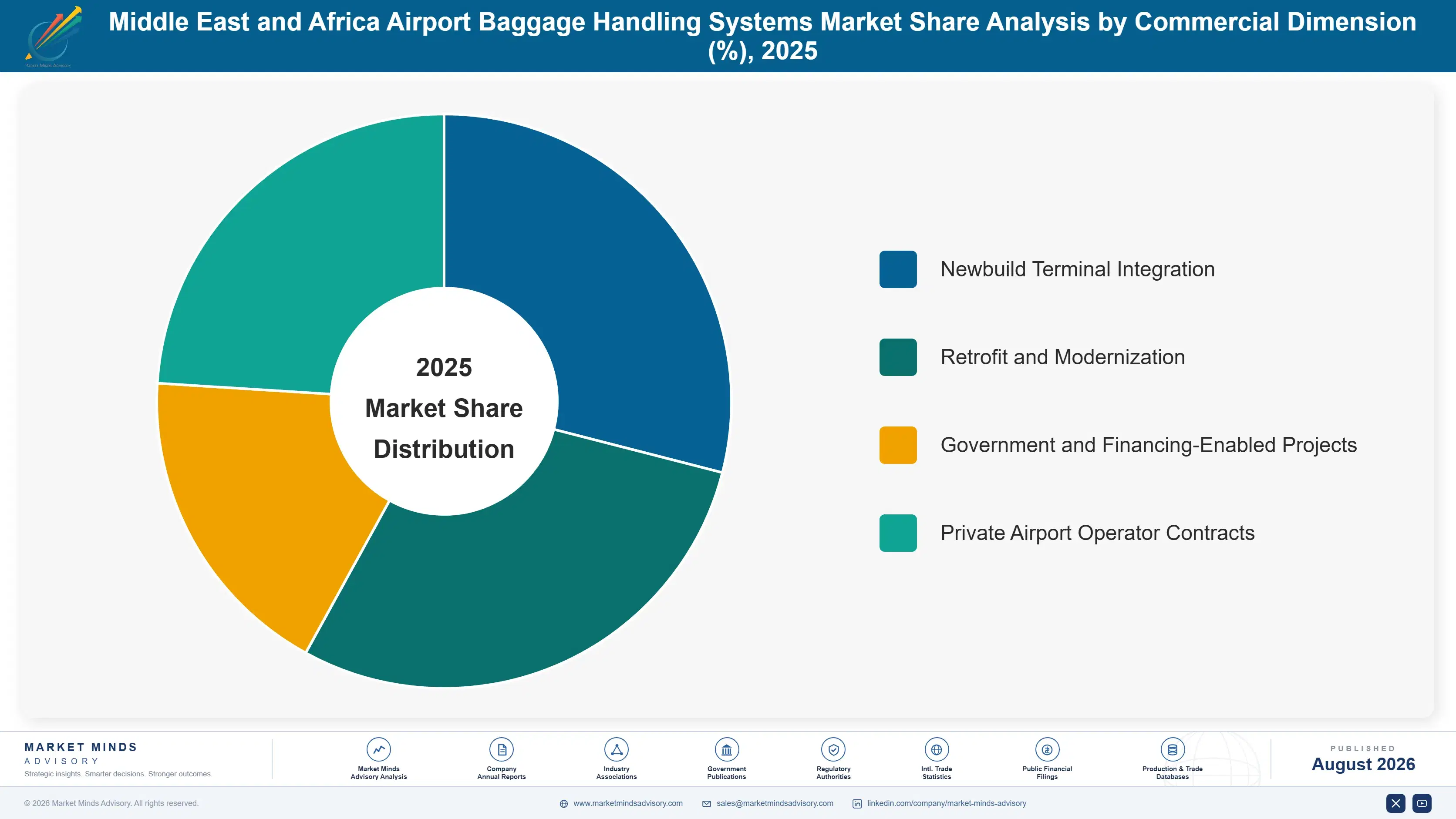
- Newbuild Terminal Integration
- Retrofit and Modernization
- Government and Financing-Enabled Projects
- Private Airport Operator Contracts
By Region
- North America
- Western Europe
- East Asia
- South Asia and Pacific
- Latin America
- Middle East and Africa
- Eastern Europe
Scope, Methodology, and Coverage
Every figure in this report is reproducible from documented input assumptions. The scope below maps the historical period, the forecast horizon, the segmentation dimensions, and the countries covered, alongside the underlying primary and qualitative methodology.
Historical Period
2020 to 2025
Forecast Period
2026 to 2036
Base Year
2025 (USD billions; MMA Primary Research Dataset, August 2026)
Market Definition
This report defines the Middle East and Africa Airport Baggage Handling Systems Market as revenue from conveyor, sortation, tracking, screening integration, self-service, and robotic loading systems sold for airport baggage handling applications across the Middle East and Africa. It excludes general cargo warehouse automation, passenger security screening equipment sold independently of baggage integration, and airport construction revenue unrelated to baggage systems.
Quantitative Units
USD billions (current prices); revenue basis
Segmentation Dimensions
By Product Technology; By End-Use Airport Type; By Commercial Dimension; By Region
Regions Covered
North America, Western Europe, East Asia, South Asia and Pacific, Latin America, Middle East and Africa, Eastern Europe
Countries Covered
UAE, Qatar, Saudi Arabia, South Africa, Egypt, Nigeria, Kenya, Ethiopia, China, Japan, South Korea, Germany, Netherlands, United States, India, and additional markets relevant to global baggage system supply
Key Companies Profiled
Vanderlande Industries, BEUMER Group, Siemens Logistics, Daifuku, Fives Group, Pteris Global, G&S Airport Conveyor, Glidepath Group, Alstef Group, Grenzebach, Interroll Group, SITA, MHS Global, Bagport, Logplan, ICM Airport Technics, Nexeya, Fenix Group, Babcock International, Bygging Uddemann
Quantitative Methodology
Primary survey, n=3,800 respondents, Q4 2025, six countries; demand-side model with trade association cross-validation
Qualitative Methodology
47 expert interviews, Q4 2025; applied to validate demand model assumptions, identify emerging dynamics, and assess competitive positioning
Report Format
PDF and XLSX data workbook (Word format preview document)
Publisher
Market Minds Advisory
Report Code
MMA-2026-CON-109
Published
August 2026
Contact
sales@marketmindsadvisory.com | www.marketmindsadvisory.com
Purchase the full Middle East and Africa Airport Baggage Handling Systems Market Report (2026 to 2036).
The full report delivers a complete quantitative and qualitative assessment of the Middle East and Africa airport baggage handling systems market, spanning ten years of forecast detail across all six product technology segments. It includes company-level competitive profiling of all twenty tracked suppliers and regulatory analysis of IATA Resolution 753 compliance timelines across the region. Buyers also receive detailed Gulf megaproject pipeline analysis and African financing partnership landscape assessment not available in the summary version. A dedicated appendix walks through the primary survey and expert interview methodology underlying every forecast figure in detail. Regional benchmarking against comparable Asian and Western European baggage handling markets rounds out the deliverable.
Ten-year segment-level revenue forecast detail included
Full twenty-company competitive profiling and benchmarking
IATA compliance timeline impact analysis included
Gulf megaproject pipeline tracking and sizing
African financing partnership landscape review included
Robotic loading technology adoption assessment included
Built For The People Who Decide
From boardroom strategy to bench-side execution, this report is read cover-to-cover by leaders shaping the next decade of their industry, turning demand scenarios, market dynamics and valuation benchmarks into decisions.
CXOs/ Presidents/ VPs/ Managers
M&A and Corporate Development
Strategy Teams and R&D Heads
Procurement and Product Directors
Regulatory and Compliance Leaders
Investor Relations and Equity Analysts