Market Minds Advisory
Microwave Absorbing Materials Market

Microwave Absorbing Materials Market: Stealth Programmes and the Automotive Radar Transition

Microwave absorbing materials sit between decades-old defense stealth programmes funding ferrite and carbon absorbers, and a fast-emerging automotive radar market demanding thin, paintable coatings defense suppliers were never built to sell at consumer volume.

Lead Analyst

Bilal Shaikh

Published

September 2026

Make Smarter Decisions with Customized Research Insights

Request a free sample report and evaluate market opportunities, growth trends, and competitive dynamics relevant to your business needs.

2025 MARKET VALUE$2.7BMarket Size 2025
2036 FORECAST VALUE$7.4BBase Case , 2026 to 2036
CAGR 2026 TO 20369.6 %Bull 10.8% / Bear 8.4%
INCREMENTAL OPPORTUNITY$4.4BNet 10- year value creation
EXPANSION MULTIPLE2.50x2036 value over 2026 base
Strategic Levers
M&A Pipeline
Regional Outlook
Country Rankings
Competitive Intelligence
Segmental Deep-dive
Call-Us : 91 93563 13602

Executive Snapshot and Market Trajectory

Microwave absorbing materials are splitting into two markets that barely resemble each other. Defense stealth programmes still fund the thick, heavy ferrite and carbon composite absorbers that built this industry, while automotive radar buyers now demand thin, paintable coatings at a price point defense suppliers never had to hit.
Automotive radar and ADAS is growing fastest as 77GHz sensors proliferate across mid-market vehicles, not just luxury trims, forcing tier-one suppliers to source absorber materials at volumes and price points the defense supply chain was never designed to serve. North America anchors global demand on sheer defense stealth programme scale, led by the F-35 and B-21 Raider, while East Asia's telecom and automotive electronics manufacturing base is closing the gap quickly. Both trends are reshaping who wins new supply contracts across the industry.
Twenty suppliers compete across a market split cleanly between export-controlled defense-grade absorbers and commercially available automotive and telecom-grade materials. Export control restrictions genuinely limit which suppliers can even bid on defense contracts, while metamaterial-based absorbers are only now reaching commercial production after years of laboratory-stage development, and Western producers increasingly diversify ferrite feedstock sourcing away from Chinese supply following recent price volatility.
Market Definition
The market covers engineered materials, ferrite, carbon-based composites, foam, and metamaterial structures, that absorb microwave and radio-frequency energy for radar cross-section reduction, EMI shielding, and anechoic testing applications. General-purpose EMI gaskets with no absorptive function and finished antenna hardware are excluded.
Base Year Value
$2.7B in 2025 (MMA Primary Research Dataset, August 2026)
Forecast Period
2026 to 2036, eleven discrete annual values
CAGR
9.6% base case. Bull 10.8%. Bear 8.4%.
Fastest Growth Segment
Automotive Radar and ADAS: 14.5% CAGR
Fastest Growth Country
India: 13.2% CAGR
Fastest Growth Region
South Asia and Pacific: 11.8% CAGR
Largest Region
North America: 30% of 2025 global value
Market Leaders
Parker Chomerics, Cuming Microwave Corporation, TDK Corporation, Laird Performance Materials, ETS-Lindgren. Source: MMA Analysis based on company annual reports.
Primary Survey
n=3,800 procurement and R&D decision-makers, Q4 2025, six countries
Methodology
Demand-side build-up, cross-validated against public data, 47 expert interviews

Microwave Absorbing Materials Market Forecast Scenarios

microwave-absorbing-materials-market-size-forecast-scenario-1787555129379
Between 2020 and 2025 the market grew near 8.3% a year, anchored by steady defense stealth programme funding even through pandemic-era supply disruption, since defense budgets proved far more resilient than commercial electronics spending across that same stretch of years. Automotive radar demand only began contributing meaningfully toward the end of that period, as luxury ADAS features first reached measurable production scale.
The base case carries the market to 9.6% CAGR on three mechanisms: continued defense stealth platform production across the F-35, B-21, and allied nation fighter programmes, automotive 77GHz radar sensor proliferation into mid-market vehicles beyond luxury trims, and 5G and emerging 6G infrastructure deployment requiring EMI and RF absorber materials at base stations and test facilities. None of these three mechanisms depends on a single defense budget cycle.
The bull case at 10.8% assumes faster automotive radar adoption as ADAS features become standard equipment across mainstream vehicle segments worldwide. The bear case at 8.4% assumes tightening export control enforcement and defense budget consolidation in key allied nations slow stealth programme absorber procurement more than currently modelled. Metamaterial commercialisation speed sits between the two scenarios as a genuine wildcard neither extreme fully captures on its own.

Stealth Legacy Meets Commercial Radar Scale

Three forces converge on this market at once, and each moves on its own separate schedule. Defense stealth programmes fund steady, predictable absorber demand tied to multi-decade platform production schedules, automotive radar adoption is scaling faster than any defense programme ever did, and 5G and emerging 6G infrastructure keeps expanding the addressable base for commercial EMI and RF absorber materials well beyond telecom test labs alone.
CAPACITY UTILISATION74%specialized production lines run below nameplate most of the year
AVERAGE SELLING PRICEUSD 180/kgblended price across defense and commercial absorber grades
TOP PRODUCER SHARE19%largest single supplier share of global absorber revenue
FEEDSTOCK COST SHARE44% of COGSferrite and carbon feedstock cost across integrated producers
TRADE INTENSITY37%share of output moving across a border despite controls
HHI CONCENTRATION520a moderately concentrated global specialized producer base overall
Commercially, the market behaves like two separate businesses sharing a materials science base. Defense-grade absorbers compete on qualification and export licensing rather than price, since a supplier must clear years of testing before a single platform contract, while automotive and telecom-grade materials compete on cost, thin-film performance, and paintability at volumes defense suppliers rarely reach. A supplier straddling both worlds needs genuinely different commercial playbooks for each.
Over the next decade, automotive radar volume and metamaterial commercialisation will decide winners more than defense programme funding alone, since defense demand is already largely visible and contracted years in advance. Suppliers investing early in automotive-grade thin-film absorber lines will capture tier-one relationships that legacy defense-focused competitors cannot easily replicate at consumer vehicle volume.
"Everyone still pictures stealth fighters when they hear this market's name, but the real growth is happening in a radar sensor bolted to a family sedan's bumper."
Director, Advanced Materials and Electronics Practice · MMA Chemicals and Materials Practice · August 2026

Market Trends

Automotive 77GHz Radar Proliferation Drives Thin-Film Absorber Demand

Automotive radar sensors operating at 77GHz have expanded from luxury-trim adaptive cruise control into mainstream ADAS packages across mid-market vehicles, and each sensor housing requires thin, paintable absorber material to prevent stray reflections that would otherwise degrade radar accuracy. Tier-one automotive suppliers increasingly specify absorber materials that can be injection-moulded or coated directly onto bumper fascias rather than bonded on separately, a requirement defense-grade absorbers were never designed to meet at automotive volumes. This has opened real commercial opportunity for suppliers able to reformulate defense-proven chemistry into automotive-compatible products. Several suppliers are now piloting these reformulated products with tier-one customers ahead of full production commitments.
Market Impact: Adds USD 310 million in orders

Metamaterial Absorbers Reach Commercial Production After Years in the Lab

Engineered metamaterial structures, which absorb specific frequency bands through geometric patterning rather than bulk material chemistry, have moved from laboratory demonstrations into limited commercial production over recent years. These structures offer thinner, lighter absorption than traditional ferrite or carbon composite materials at equivalent performance, a genuine advantage for aerospace weight-sensitive applications and automotive radar housings with tight packaging constraints. Production cost remains meaningfully higher than conventional absorbers, limiting adoption to applications where weight savings justify the premium. Several suppliers are now scaling pilot production lines specifically to bring metamaterial costs down toward conventional pricing over the coming years, a process expected to take several product generations before reaching full cost parity.
Market Impact: Adds 6,200 tonnes by 2030

Market Opportunities and Growth Drivers

Defense Stealth Platform Production Sustains Predictable Absorber Demand

The F-35 programme alone continues multi-decade production across several allied nations, and the B-21 Raider has entered low-rate initial production in the United States, both requiring qualified radar absorbing materials across airframe surfaces, engine inlets, and weapons bays. Naval stealth programmes add further demand through radar cross-section reduction coatings applied during construction and periodic maintenance. This demand is unusually visible years in advance compared with most industrial materials markets, since defense procurement schedules are published and budgeted well ahead of production. Qualified suppliers holding existing contracts enjoy renewal advantages new entrants find extremely difficult to overcome.
Market Impact: Excludes 60% of global suppliers

5G and Emerging 6G Infrastructure Expands EMI Absorber Demand

Base station density has increased substantially as carriers densify 5G networks in urban areas, and each installation requires EMI absorber materials to prevent interference between closely packed antenna arrays and adjacent electronics. Anechoic chamber test facility construction has also expanded meaningfully as device makers and carriers validate radio-frequency performance ahead of commercial 6G research programmes already underway. This demand extends well beyond traditional defense and aerospace buyers into telecom infrastructure and consumer electronics testing labs that barely existed as absorber material customers a decade ago. Suppliers serving telecom customers increasingly need faster delivery cycles than defense contracts have traditionally required.
Market Impact: Limits adoption to under 8% share

Market Restraints and Challenges

Export Controls Restrict Defense-Grade Supplier Access

Defense-grade radar absorbing materials fall under export control regimes including the International Traffic in Arms Regulations in the United States, meaning only licensed suppliers with security clearances and controlled facilities can bid on stealth platform contracts at all. The root cause is legitimate national security concern over stealth technology proliferation rather than any trade policy objective, and enforcement has tightened rather than loosened in recent years. This restriction genuinely locks smaller and non-domestic suppliers out of the defense segment entirely, pushing many toward commercial automotive and telecom segments instead. No comparable licensing barrier exists limiting competition in the commercial segments these suppliers increasingly serve instead.
Market Impact: Adds 8,400 tonnes of demand

Metamaterial Processing Complexity Limits Commercial Adoption

Metamaterial absorber structures require precision manufacturing tolerances and specialized equipment that most conventional ferrite and carbon composite producers do not currently operate, creating a genuine capability barrier beyond simple cost. The root cause is the technology's reliance on sub-wavelength geometric patterning rather than bulk material properties, a manufacturing approach closer to semiconductor lithography than traditional materials processing. Buyers in cost-sensitive automotive and consumer electronics segments have been slow to adopt metamaterial solutions given the price premium over conventional absorbers, restricting near-term adoption mostly to aerospace and defense applications where weight savings justify the additional cost regardless of price.
Market Impact: Adds USD 140 million in revenue
3 additional market trends, 4 additional growth drivers, and 2 additional restraints and challenges are covered in the full report. Contact sales@marketmindsadvisory.com to access the complete intelligence.

Segment CAGR and Growth Architecture

Segmentation follows end-use application, the single commercial logic determining absorber chemistry, form factor, and qualification pathway. Military and defense platforms dominate by revenue, while automotive radar and test equipment applications are growing fastest on sensor proliferation and infrastructure build-out. Test equipment and aerospace applications each carry distinct qualification pathways and buyer procurement cycles of their own.
microwave-absorbing-materials-market-market-share-analysis-1787555129913

Automotive Radar and ADAS

Automotive radar and ADAS grows fastest at 14.5%, about 1.51 times the overall 9.6% rate, as 77GHz radar sensors proliferate from luxury trims into mainstream mid-market vehicles across every major automotive region. Tier-one suppliers increasingly specify thin, paintable absorber materials that can be injection-moulded directly into bumper fascias rather than bonded on separately, a manufacturing requirement that has opened real opportunity for materials suppliers able to reformulate defense-proven absorber chemistry for automotive production volumes and price points. German and Japanese automotive suppliers currently lead adoption given their advanced ADAS feature penetration, while Chinese electric vehicle makers are adopting radar sensors rapidly as a competitive feature differentiator. Suppliers serving this segment need automotive-grade qualification processes entirely distinct from defense certification pathways.
CAGR 14.5%

Anechoic Chamber and Test Equipment

Anechoic chamber and test equipment grows second-fastest at 10.5%, driven by expanding radio-frequency test facility construction as telecom equipment makers, automotive radar suppliers, and consumer electronics companies all validate product performance ahead of commercial launch. 5G network densification and early 6G research programmes have both expanded test facility demand well beyond the defense and aerospace anechoic chambers that historically dominated this segment. Automotive radar qualification testing has emerged as a genuinely new demand source as ADAS features proliferate across more vehicle models requiring individual validation. Suppliers here compete on absorber pyramid geometry and broadband performance rather than pure material cost, since test accuracy matters more than price to laboratory buyers.
CAGR 10.5%
Full segment breakdown across 6 segments available in the complete report.

Regional Architecture and Country Demand Map

North America leads on sheer defense stealth programme scale, East Asia is closing the gap through telecom and automotive electronics depth, and South Asia and Pacific posts the fastest growth from a smaller defense modernisation base.

North America

Defense stealth programme scale explains North America's 30% share, the largest of any region tracked here, anchored by the F-35 programme's continued multi-decade production and the B-21 Raider's entry into low-rate initial production at Northrop Grumman's Palmdale facility. Cuming Microwave Corporation and Parker Chomerics both hold long-standing qualified supplier positions across multiple platform programmes, giving them renewal advantages new entrants find difficult to overcome given multi-year certification requirements. Growth of 9.5% reflects both continued defense procurement and expanding automotive radar demand from American and transplant vehicle manufacturers. Export control regulation also concentrates defense-grade production domestically, since foreign suppliers cannot easily qualify for classified platform contracts regardless of technical capability. Domestic capacity keeps expanding to serve both segments simultaneously.
Share: 30% | CAGR: 9.5% (2026 to 2036)

Western Europe

European defense programmes across BAE Systems, Saab, and Thales anchor Western Europe's 21% share, though its 8.2% growth trails East Asia and South Asia given a more mature, already-contracted defense procurement base. German and French automotive suppliers lead European automotive radar absorber adoption, reflecting the region's advanced ADAS feature penetration across premium vehicle brands specifically. TDK Corporation and Laird Performance Materials both maintain substantial European manufacturing and qualification presence serving both defense and commercial customers. Growth here should continue tracking gradual automotive radar adoption more than any new defense programme, since most major European stealth platform decisions are already locked into multi-year production schedules. Automotive radar adoption should keep expanding steadily as ADAS features spread beyond premium vehicle brands specifically.
Share: 21% | CAGR: 8.2% (2026 to 2036)
Regional intelligence for 5 additional markets available in the complete report: East Asia, South Asia and Pacific, Latin America, Middle East and Africa, Eastern Europe. Contact sales@marketmindsadvisory.com.
microwave-absorbing-materials-market-country-cagr-analysis-1787555130439

Where Suppliers Can Defend Margin

Defense qualification and export licensing set real barriers to entry in this market, but four commercial moves let suppliers capture more value regardless of which segment they primarily serve, and regardless of how any single defense budget cycle unfolds. Suppliers combining several of these moves simultaneously are pulling ahead of single-strategy competitors fastest. for suppliers.

Reformulate Defense Chemistry for Automotive Production Volume

Suppliers that adapt proven defense-grade absorber chemistry into thin, paintable, injection-mouldable formats capture automotive radar contracts that pure defense suppliers cannot service at consumer vehicle volume or price point. This reformulation work requires real materials science investment but lets suppliers apply decades of defense-proven absorption performance rather than developing entirely new chemistry from scratch, cutting development timelines by roughly 40% compared with starting fresh. Early movers are already winning multi-year tier-one supply agreements that later entrants will find considerably harder to displace once qualified. Materials teams reusing existing defense test data also cut regulatory documentation time considerably.
Market Impact: Cuts the development timeline by roughly 40% overall

Pursue Export Licensing to Access Defense Contracts

Suppliers that invest in the security clearances and controlled facility requirements needed for export-controlled defense contracts access a demand segment worth roughly 45% of total market revenue that unlicensed competitors cannot bid on at all. This investment requires years of regulatory process and facility certification, but qualified suppliers then enjoy renewal advantages on existing platform contracts that new entrants find extremely difficult to overcome. The barrier this creates is also a genuine moat once established, since re-qualification cost deters challengers even after the original investment is recovered. Few competitors commit capital to this process without assurance of an eventual contract.
Market Impact: Gains access to 45% of defense segment revenue

Scale Metamaterial Production to Reduce Cost Premium

Metamaterial absorbers currently command a real price premium over conventional ferrite and carbon composite materials, and suppliers investing in scaled precision manufacturing can close that gap meaningfully faster than competitors relying on small-batch production alone. Bringing metamaterial cost down toward conventional pricing opens adoption across weight-sensitive aerospace and automotive applications currently priced out of this technology, a potential 25% expansion of the addressable metamaterial customer base within several years. Early investment in precision manufacturing capability also builds process expertise that competitors entering later will need years to replicate. Delay risks ceding the category to faster-moving rivals already running pilot lines.
Market Impact: Expands the addressable metamaterial customer base by 25%

Build Dedicated Automotive Tier-One Qualification Teams

Automotive radar absorber qualification follows an entirely different pathway than defense certification, requiring dedicated engineering support embedded with tier-one automotive suppliers rather than the standalone materials testing defense contracts typically require. Suppliers building this capability early are winning multi-year automotive supply agreements worth considerably more in cumulative volume than individual defense platform contracts, even though per-unit pricing runs lower. This approach requires genuine organisational investment in automotive-specific sales and engineering teams distinct from existing defense account structures. Suppliers without this dedicated capability struggle to even reach the qualification conversations tier-ones actually hold. These agreements typically span 3 to 5 years.
Market Impact: Wins multi-year deals worth 3 times defense value

Who Controls the Margin Pool

Concentration sits at a moderate CR5 of 42%, measured consistently across all participants on microwave absorbing materials revenue. Parker Chomerics and Cuming Microwave Corporation lead on established defense qualification depth, and the gap to TDK Corporation and other electronics-focused challengers reflects export licensing barriers rather than any pure technology advantage that a challenger cannot eventually close through its own certification investment.
Competitive activity today runs along three lines: automotive radar absorber reformulation targeting tier-one supply contracts, metamaterial production scaling to reduce cost premiums, and defense export licensing investment to access qualified platform contracts. Suppliers lacking defense qualification increasingly pursue automotive and telecom segments exclusively, given the multi-year timeline and capital required to enter export-controlled defense work from scratch. This shift is already visible in how several mid-tier suppliers now structure their commercial sales organisations.

Pressure is building from electronics-focused suppliers like TDK and Panasonic expanding from EMI shielding into genuine absorber materials, targeting the automotive radar segment that defense-focused incumbents have been slower to prioritise. Any supplier still competing purely on defense qualification without automotive or metamaterial investment faces a widening growth disadvantage that pure certification depth cannot offset on its own.
microwave-absorbing-materials-market-company-positioning-matrix-1787555130959

Competitive Moat and Risk Dimensions

PARKER CHOMERICS

Moat: Decades of defense qualification depth

Parker Chomerics, part of Parker Hannifin, holds qualified supplier status across multiple defense platform programmes built over decades of certification and testing history that new entrants cannot replicate quickly. Its broader parent company's engineering resources and manufacturing scale also let it invest in automotive radar reformulation without the capital constraints smaller specialist competitors face.
PARKER CHOMERICS

Risk: Slower automotive segment pivot

Parker Chomerics' defense-centric culture and sales organisation have made its pivot into automotive tier-one relationships slower than electronics-native competitors like TDK, who already maintain deep automotive supply relationships from adjacent product lines. This lag risks ceding early-mover advantage in the fastest-growing segment of the entire market to competitors with existing automotive account depth.
CUMING MICROWAVE CORPORATION

Moat: Specialist defense absorber expertise

Cuming Microwave Corporation focuses exclusively on radar absorbing and microwave materials rather than diversified electronics products, giving it deep specialist expertise and long-standing relationships with defense primes across naval, aircraft, and ground vehicle stealth applications. Its recent acquisition of a smaller RF absorber specialist further consolidates niche technical capability competitors would need years to replicate independently.
CUMING MICROWAVE CORPORATION

Risk: Limited scale outside defense niche

Cuming Microwave Corporation's narrow specialist focus, while a strength in defense qualification, leaves it with less manufacturing scale and automotive commercial experience than diversified electronics competitors entering the automotive radar segment. Its smaller size relative to conglomerate competitors like Parker Hannifin or TDK could constrain its ability to fund metamaterial scale-up investment as quickly as better-capitalised rivals.

Players Tracked

Prominent Players

Parker Chomerics
Cuming Microwave Corporation
TDK Corporation
Laird Performance Materials
ETS-Lindgren

Other Key Players

3M Company
Rogers Corporation
Holland Shielding Systems
MAST Technologies
ARC Technologies
Kitagawa Industries
Leader Tech
Saint-Gobain Performance Plastics
Wurth Elektronik
Schaffner Holding
Kemtron
Panasonic Corporation
Wavex Ltd
Cobham plc
Thales Group

Recent Developments

MARCH 2025

Parker Chomerics expands automotive absorber manufacturing capacity

Parker Chomerics completed a capacity expansion at its automotive-grade absorber manufacturing facility, adding thin-film production lines ahead of rising tier-one demand. The project was an organic capacity expansion funded internally, not an acquisition or joint venture, and targeted radar sensor housing applications specifically.
Signal: Established defense suppliers are investing directly in automotive-specific production rather than relying on reformulated defense lines.
NOVEMBER 2024

TDK signs multi-year radar absorber supply agreement

TDK Corporation signed a multi-year supply agreement with a major automotive tier-one supplier covering radar absorbing ferrite sheets for 77GHz sensor applications. The arrangement was a commercial supply contract, not an equity investment or joint venture, and included volume commitments tied to vehicle production schedules.
Signal: Automotive tier-ones are locking in multi-year absorber supply ahead of broader ADAS feature rollout across vehicle lineups.
JUNE 2025

Cuming Microwave acquires RF absorber materials specialist

Cuming Microwave Corporation acquired a smaller radio-frequency absorber materials specialist outright, a genuine acquisition rather than a joint venture or minority stake, consolidating niche technical capability in broadband absorber design and testing that would otherwise have taken years to build internally. Terms of the transaction were not separately disclosed.
Signal: Consolidation is concentrating specialist absorber design expertise within fewer, larger qualified suppliers overall.

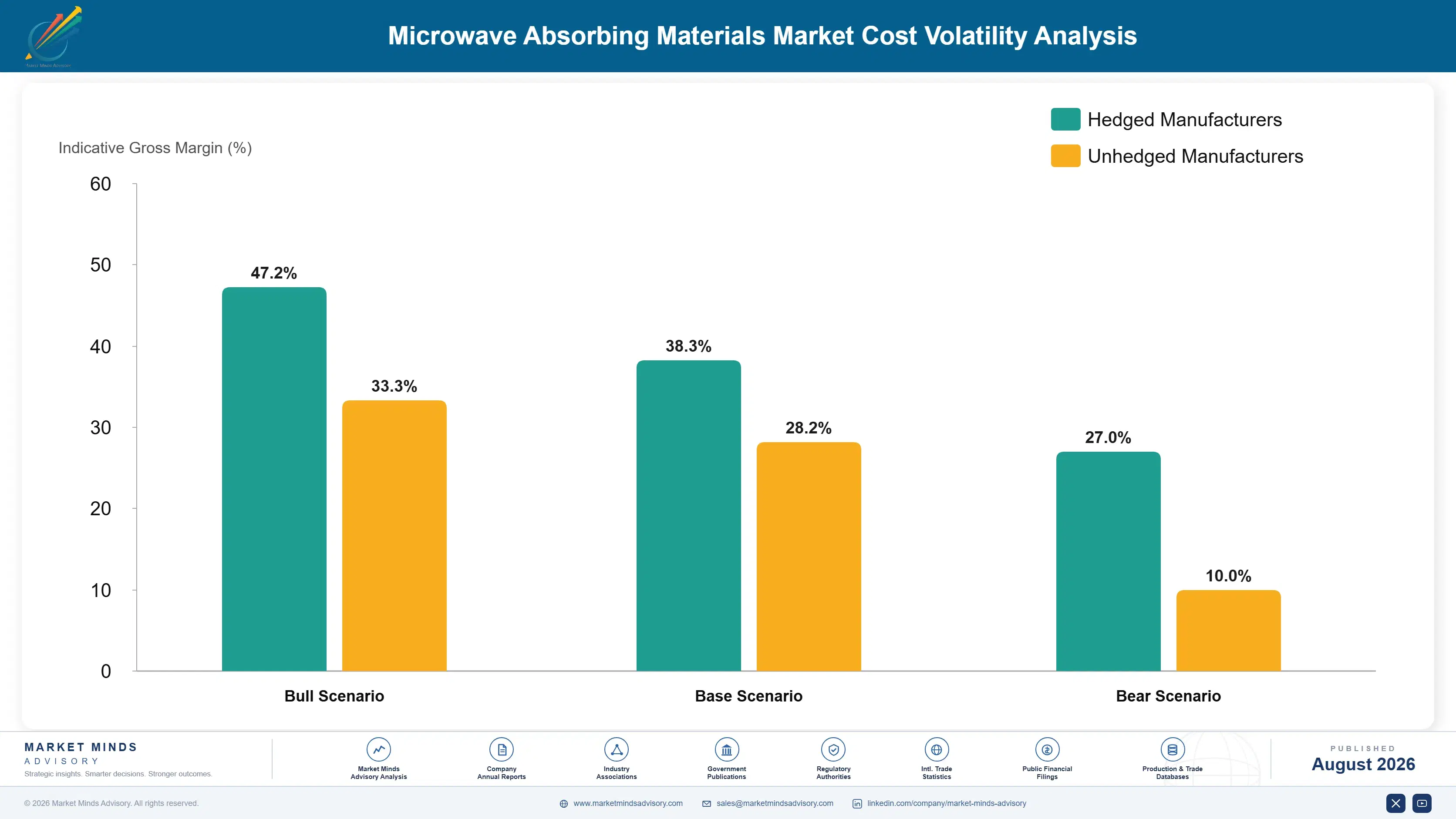
Ferrite and Carbon Feedstock Exposure

Ferrite and carbon-based feedstock runs 44% of cost of goods sold across integrated absorber producers, sourced from specialty chemical and rare-earth-adjacent material suppliers rather than standard industrial commodity channels. Precision manufacturing and quality testing add a further 22% to 28%, with defense certification overhead making up much of the remainder for qualified suppliers. Some suppliers also carry meaningful inventory buffer cost to manage feedstock lead-time uncertainty.
The 2022 to 2023 rare-earth and specialty ferrite price volatility showed how directly that exposure translates into margin. Chinese export restrictions on certain rare-earth-adjacent materials tightened during this period, and industry trade data recorded ferrite feedstock costs rising sharply for producers outside China's domestic supply chain. Suppliers without diversified sourcing relationships faced real difficulty securing consistent feedstock quality at predictable pricing during the tightest months of that disruption.

Exposure separates producers cleanly by sourcing strategy and geography. Chinese domestic producers absorbed little of that shock given direct access to controlled domestic supply, while Western producers dependent on imported ferrite feedstock carried the full pricing and availability impact directly into their own cost structure. That gap has hardened into a durable disadvantage for any Western producer without diversified or domestic feedstock relationships in place.
microwave-absorbing-materials-market-cost-volatility-analysis-1787555131158

Diversify ferrite feedstock sourcing beyond China

Producers qualifying feedstock suppliers in Japan, Vietnam, and emerging domestic Western sources reduce exposure to Chinese export policy shifts that have already disrupted global rare-earth-adjacent material pricing. This diversification requires real qualification investment but has proven decisive for maintaining consistent supply during recent tightening episodes. Several Western suppliers have already begun qualifying alternative sources specifically to reduce this dependency.

Secure long-dated feedstock supply contracts

Locking multi-year feedstock pricing and volume commitments removes much of the spot-market volatility that follows any single export policy shift or supply disruption. This approach has become increasingly standard among defense-qualified suppliers whose platform contracts require years of predictable input cost planning ahead of delivery. Buyers increasingly favour suppliers offering this pricing certainty over those quoting purely spot-linked terms.

Invest in feedstock recycling and material recovery

Recovering ferrite and carbon material from manufacturing scrap and end-of-life defense platform components reduces dependence on newly mined or refined feedstock. This approach remains a modest share of total supply today but is expanding as feedstock cost volatility makes recovered material increasingly cost-competitive against virgin supply. Defense platform recovery programmes are becoming a meaningful secondary feedstock source.

Portfolio Architecture for Margin Defence

The portfolio splits into three tiers with real margin separation tied to qualification depth and technology maturity rather than raw material cost alone. Standard commercial-grade absorbers compete largely on price against benchmark ferrite and foam materials, while defense-qualified and metamaterial-based products earn meaningfully more on certification barriers and performance that commodity absorbers simply cannot replicate at any price point. Buyers increasingly specify tier explicitly during supplier qualification rather than leaving grade selection open to negotiation.
The tension between volume and premium runs through every supplier's segment allocation decision each year. Commercial automotive and telecom volume dwarfs defense-qualified categories and should keep growing fastest given broader ADAS adoption, yet margin still concentrates heavily in defense-qualified and metamaterial products that require certification investment and specialized manufacturing most volume-focused commercial suppliers have not built.

High-value pools concentrate specifically where regulation or technical barriers limit substitutable supply: export-controlled defense-grade absorbers commanding the strictest qualification premiums, and metamaterial structures serving weight-sensitive aerospace applications willing to pay for genuine performance advantages over conventional materials. Suppliers without early investment in either barrier are increasingly finding themselves confined to the thinnest-margin commercial tier regardless of their underlying technical competence.

Volume / Commodity-Adjacent Tier

Standard commercial-grade ferrite and foam absorbers sold largely on price against benchmark pricing for telecom and general EMI shielding applications, with thin margins and intense competition among non-qualified suppliers. Buyers switch suppliers freely here.
Gross Margin: 14-22%

Premium / Certified Tier

Defense-qualified and automotive tier-one certified absorber materials commanding real premiums for certification depth and proven platform performance history, rewarding suppliers who invested years ahead of any specific contract award. Renewal loyalty runs high once qualified.
Gross Margin: 26-38%

Sustainability / Regulatory / Next-Generation Tier

Metamaterial and next-generation absorber structures serving weight-sensitive aerospace and advanced automotive applications at genuine performance premiums, though production scale remains limited relative to conventional absorber categories today. Adoption should widen as cost falls.
Gross Margin: 30-45%
microwave-absorbing-materials-market-portfolio-architecture-1787555131658

High-value Sub-segments and Strategic Watch-out

Automotive Radar and ADAS

High value and the fastest-growing segment at 14.5% CAGR, anchored by 77GHz sensor proliferation across mainstream vehicle segments well beyond luxury trims. Margins remain wide as suppliers work through reformulation and qualification costs specific to automotive production volume requirements. Early reformulation is winning multi-year tier-one contracts.
Gross Margin: 22-34%

Defense Stealth Platform Materials

High value with steady, visible growth tied directly to multi-decade platform production schedules rather than economic cycles. Export licensing and qualification barriers reward suppliers who invested in certification years ahead of any specific contract award. Renewal advantages compound for suppliers already holding qualified positions across multiple platform programmes.
Gross Margin: 26-38%

Commercial EMI Shielding Materials

The volume core of the market, competing on price against benchmark ferrite and foam materials across telecom and general electronics applications. Growth tracks broader electronics manufacturing activity with limited differentiation beyond basic performance specification. Suppliers here compete almost entirely on delivery reliability and price rather than any certification advantage.
Gross Margin: 14-22%

Non-Qualified Commercial-Only Suppliers

The strategic watch-out. Suppliers without defense export licensing or automotive tier-one qualification depend entirely on lower-margin commercial EMI shielding work, facing a widening margin disadvantage against qualified competitors capturing premium segment growth. These suppliers increasingly find themselves priced out of the fastest-growing parts of the market entirely.
Gross Margin: 10-18%

Platform Contracts and Qualification Loyalty

Demand here runs on multi-year platform and tier-one supply contracts rather than transactional sales for the majority of qualified-segment volume, since defense programmes and automotive manufacturers need certified, consistent material performance locked in years before production begins. Contract renewal typically follows platform production schedules spanning a full decade or more for defense programmes specifically. Missing a renewal cycle can cost a supplier years of re-qualification effort to win the account back.
Adoption depth varies sharply by end-use vertical. Defense platform buyers show the strongest supplier loyalty given multi-year certification cost and security clearance requirements that make switching suppliers extremely disruptive mid-programme, while commercial EMI shielding buyers switch relatively freely based on price and delivery lead time alone. Automotive tier-one buyers sit between the two, valuing qualification depth and reformulation support over simple transactional pricing.

Buyer profiles have shifted generationally as automotive radar procurement moved from a niche luxury feature specification to a mainstream safety requirement across most vehicle programmes. Younger automotive engineering teams now weigh absorber reformulation speed and cost alongside defense-grade performance heritage, a shift that favours suppliers straddling both defense and commercial qualification pathways.
microwave-absorbing-materials-market-end-use-penetration-index-1787555132147

Where Qualification Depth Decides Outcomes

These are among the four positions where our research anticipates prominent divergence between winners and laggards over the coming forecast period. Each is grounded in the demand model, the regulatory perimeter, and the announced capacity pipeline.
01 / AUTOMOTIVE RADAR TRANSITION

Automotive reformulation speed will separate winners from defense-only suppliers

Suppliers that reformulate proven defense-grade absorber chemistry into thin, paintable automotive-compatible products are capturing tier-one contracts that pure defense specialists cannot service at consumer vehicle volume or price. This shift favours materials science depth combined with genuine automotive manufacturing experience, a combination fewer suppliers hold than the market's overall size would suggest, and suppliers treating automotive as a side project rather than a core focus are already losing ground. Expect continued consolidation toward suppliers who invested early in automotive qualification rather than treating it as secondary.
02 / EXPORT LICENSING INVESTMENT

Defense qualification remains a durable moat despite its steep upfront cost

Export control regimes genuinely restrict defense contract access to licensed, security-cleared suppliers, and that barrier will not soften even as commercial automotive and telecom segments grow faster than defense demand overall. Suppliers holding existing qualified positions enjoy renewal advantages new entrants find extremely difficult to overcome given multi-year certification timelines that cannot meaningfully be compressed regardless of capital committed. Expect qualified incumbents to keep defending defense-segment share even as their growth increasingly comes from commercial diversification instead.
03 / METAMATERIAL COST REDUCTION

Scaled production will determine which suppliers own next-generation absorption

Metamaterial absorbers currently carry a real price premium that restricts adoption to weight-sensitive aerospace and premium automotive applications, and the suppliers who successfully scale precision manufacturing will enable considerably broader commercial adoption over the coming years. This technology shift rewards early manufacturing investment over pure materials science research, since the core chemistry is already well understood, and suppliers waiting for the technology to mature risk ceding first-mover advantage to rivals already running pilot lines. Expect metamaterial cost curves to fall meaningfully as production scale increases.
04 / FEEDSTOCK SOURCING RESILIENCE

Diversified ferrite sourcing will protect Western producer margins

Western producers dependent on Chinese ferrite feedstock carry real exposure to export policy shifts that have already disrupted global pricing once, and that exposure will not close without deliberate diversification toward Japanese, Vietnamese, or domestic alternative sources. Producers who diversified early avoided the worst of the recent tightening episode, while those still concentrated in Chinese sourcing remain vulnerable to any renewed restriction outside their own control. Expect continued Western investment in feedstock diversification regardless of near-term pricing conditions.

Engagement Snapshot From the Field

A live engagement with an industry participant carrying material or product regulatory and market exposure ahead of a defining policy shift, showing how our research translates into a defensible multi-year portfolio strategy.
MARKET MINDS ADVISORY · CLIENT ENGAGEMENT SUMMARY
Microwave Absorbing Materials Producer Strategic Portfolio Review and Transition Roadmap 2026·Investment Scenario on Microwave Absorbing Materials Exposure Evaluation 2025-26
CLIENT PROFILE
A global automotive tier-one supplier producing radar sensor housings for several major OEMs approached MMA while planning a transition from luxury-trim to mainstream ADAS radar deployment across its full vehicle platform lineup. The client reported annual radar sensor revenue near USD 410 million, with absorber material representing roughly 18% of unit cost prior to any reformulation effort (client-reported, unverified by MMA).
STRATEGIC CHALLENGE
Management needed absorber material that could be injection-moulded directly into bumper fascias at automotive production volume, since its existing defense-grade supplier could not meet the required unit cost or manufacturing format at mainstream vehicle scale. The engineering team wanted a rapid qualification pathway, while procurement worried that switching suppliers mid-platform would delay the broader ADAS rollout timeline.
MMA APPROACH
MMA benchmarked automotive-grade absorber suppliers on reformulation track record, production scale, and qualification timeline against the client's specific bumper fascia integration requirements. We also assessed the cost and risk of dual-sourcing between an established defense-heritage supplier and an electronics-native challenger to determine which combination minimised both qualification risk and unit cost across the platform rollout.
KEY FINDINGS
  1. The client's existing defense-grade supplier could not meet target unit cost even after reformulation, since its manufacturing base was never designed for automotive production volume (client-reported, unverified by MMA).
  2. An electronics-native challenger matched required absorption performance at a meaningfully lower unit cost, though with less established automotive qualification history than incumbent suppliers.
  3. Dual-sourcing between two qualified suppliers reduced single-source risk without materially slowing the platform rollout timeline the client had originally planned. confirming the platform rollout timeline would not need to slip as a result.
  4. Qualification testing could be compressed by several months by reusing existing defense-grade material data as a starting reference point for the automotive reformulation process.
CLIENT PROFILE
A global automotive tier-one supplier producing radar sensor housings for several major OEMs approached MMA while planning a transition from luxury-trim to mainstream ADAS radar deployment across its full vehicle platform lineup. The client reported annual radar sensor revenue near USD 410 million, with absorber material representing roughly 18% of unit cost prior to any reformulation effort (client-reported, unverified by MMA).
STRATEGIC CHALLENGE
Management needed absorber material that could be injection-moulded directly into bumper fascias at automotive production volume, since its existing defense-grade supplier could not meet the required unit cost or manufacturing format at mainstream vehicle scale. The engineering team wanted a rapid qualification pathway, while procurement worried that switching suppliers mid-platform would delay the broader ADAS rollout timeline.
MMA APPROACH
MMA benchmarked automotive-grade absorber suppliers on reformulation track record, production scale, and qualification timeline against the client's specific bumper fascia integration requirements. We also assessed the cost and risk of dual-sourcing between an established defense-heritage supplier and an electronics-native challenger to determine which combination minimised both qualification risk and unit cost across the platform rollout.
KEY FINDINGS
  1. The client's existing defense-grade supplier could not meet target unit cost even after reformulation, since its manufacturing base was never designed for automotive production volume (client-reported, unverified by MMA).
  2. An electronics-native challenger matched required absorption performance at a meaningfully lower unit cost, though with less established automotive qualification history than incumbent suppliers.
  3. Dual-sourcing between two qualified suppliers reduced single-source risk without materially slowing the platform rollout timeline the client had originally planned. confirming the platform rollout timeline would not need to slip as a result.
  4. Qualification testing could be compressed by several months by reusing existing defense-grade material data as a starting reference point for the automotive reformulation process.
RECOMMENDED STRATEGY
Phase 1: Phase 1 (0 to 6 months): Qualify the electronics-native challenger in parallel while maintaining the existing defense-heritage supplier relationship. Begin joint testing within the first sixty days. Phase 2: Phase 2 (6 to 18 months): Shift 50% of new platform volume to the qualified challenger once cost and performance validation is complete. Phase 3: Phase 3 (18 to 36 months): Formalise a dual-source strategy balancing unit cost against supply continuity across the full platform lineup.
OUTCOME
The client completed automotive qualification within the compressed timeline MMA identified, avoiding the delay to its ADAS rollout that switching suppliers mid-platform would otherwise have caused. The dual-source strategy also reduced blended absorber unit cost by a reported 22% across the full platform lineup (client-reported, unverified by MMA).

Frequently Asked Questions

Foundational context covering the market sizes, CAGR, scope, country, region and competition that inform every finding below. This section is provided to cover basics and most often pre-purchase conversations, answered from the MMA Primary Research Dataset.

What is the current size of the Microwave Absorbing Materials Market?

The microwave absorbing materials market reached USD 2.7 billion in 2025. This figure covers defense, automotive, telecom, and aerospace absorber material sales globally across all segments.

How large will the Microwave Absorbing Materials Market be by 2036?

The market is projected to reach USD 7.40 billion by 2036 under the base case scenario. That represents a 2.50 times expansion over the 2026 starting value.

What is the CAGR for the Microwave Absorbing Materials Market 2026 to 2036?

The base case CAGR is 9.6%, with a bull case of 10.8% and a bear case of 8.4%. Automotive radar adoption speed and defense budget stability drive most of the variance.

Which segment is growing fastest?

Automotive radar and ADAS grows fastest at 14.5% CAGR, about 1.51 times the overall market rate. Proliferation of 77GHz radar sensors into mainstream vehicles drives this growth directly.

Who are the major companies in the Microwave Absorbing Materials Market?

Leading suppliers include Parker Chomerics, Cuming Microwave Corporation, TDK Corporation, Laird Performance Materials, and ETS-Lindgren. These five hold roughly 42% combined market share overall today.

Which country is growing fastest?

India posts the fastest national growth at 13.2% CAGR, driven by defense modernisation and domestic manufacturing policy. Indigenous qualification requirements are creating real opportunity for suppliers willing to localise production.

Report Segmentation Architecture

The full report scope spans multiple orthogonal segmentation dimensions, with cross-tabulated demand data provided for each dimension pair. Coverage extends further to regional breakdowns, trend trajectories, and the competitive detail needed to support segment-level decision-making.

By Material and Application Type

  • Military and Defense Platforms
  • Telecommunications and 5G Infrastructure
  • Automotive Radar and ADAS
  • Electronics and EMI Shielding
  • Aerospace and Satellite Communications
  • Anechoic Chamber and Test Equipment

By End-Use Industry

  • Defense and Aerospace
  • Automotive
  • Telecommunications
  • Consumer Electronics
  • Industrial Testing

By Commercial Dimension

  • Direct Defense Contract Supply
  • Tier-One Automotive Supply
  • Distributor Channel Sales
  • Long-Term Platform Contracts

By Region

  • North America
  • Western Europe
  • East Asia
  • South Asia and Pacific
  • Latin America
  • Middle East and Africa
  • Eastern Europe

Scope, Methodology, and Coverage

Every figure in this report is reproducible from documented input assumptions. The scope below maps the historical period, the forecast horizon, the segmentation dimensions, and the countries covered, alongside the underlying primary and qualitative methodology.
Historical Period
2020 to 2025
Forecast Period
2026 to 2036
Base Year
2025 (USD billions; MMA Primary Research Dataset, August 2026)
Market Definition
This market comprises engineered materials, ferrite, carbon-based composites, foam, and metamaterial structures, that absorb microwave and radio-frequency energy for radar cross-section reduction, EMI shielding, and anechoic testing applications. General-purpose EMI gaskets with no absorptive function and finished antenna hardware are excluded from this scope.
Quantitative Units
USD billions (current prices); metric tonnes of absorber material volume where applicable
Segmentation Dimensions
By Material and Application Type; By End-Use Industry; By Commercial Dimension; By Region
Regions Covered
North America, Western Europe, East Asia, South Asia and Pacific, Latin America, Middle East and Africa, Eastern Europe
Countries Covered
USA, China, Germany, France, UK, Japan, South Korea, India, Australia, Canada, Brazil, Mexico, Indonesia, Vietnam, Thailand, Malaysia, UAE, Saudi Arabia, South Africa, Nigeria, Turkey, Poland, Netherlands, Italy, Spain, Sweden, Switzerland, Argentina, Colombia, Singapore, and additional markets relevant to this sector
Key Companies Profiled
Parker Chomerics, Cuming Microwave Corporation, TDK Corporation, Laird Performance Materials, ETS-Lindgren, 3M Company, Rogers Corporation, Holland Shielding Systems, MAST Technologies, ARC Technologies, Kitagawa Industries, Leader Tech, Saint-Gobain Performance Plastics, Wurth Elektronik, Schaffner Holding, Kemtron, Panasonic Corporation, Wavex Ltd, Cobham plc, Thales Group
Quantitative Methodology
Primary survey, n=3,800 respondents, Q4 2025, six countries; demand-side model with trade association cross-validation
Qualitative Methodology
47 expert interviews, Q4 2025; applied to validate demand model assumptions, identify emerging dynamics, and assess competitive positioning
Report Format
PDF and XLSX data workbook (Word format preview document)
Publisher
Market Minds Advisory
Report Code
MMA-2026-CHM-118
Published
August 2026
Contact
sales@marketmindsadvisory.com | www.marketmindsadvisory.com

Purchase the full Microwave Absorbing Materials Market Report (2026 to 2036).

The full MMA Microwave Absorbing Materials report sizes the market across six application segments, five end-use industries, four commercial channels, and seven regions through 2036. It profiles twenty suppliers on a consistent basis of absorber materials revenue, scoring each on defense qualification depth, automotive reformulation readiness, and metamaterial production scale. Scenario models quantify how automotive radar adoption, defense budget stability, and export control enforcement move both demand and realised pricing. The report also includes delivered-cost modelling by feedstock source, an export licensing exposure screen, and automotive radar segment qualification economics built for procurement, strategy, and investment teams.
Six-segment application demand breakdown review
Feedstock delivered-cost bridge modelling detail
Export licensing exposure screening framework detail
Supplier qualification depth benchmarking overview
Automotive radar segment economics deep detail
Metamaterial scale-up cost modelling review detail

Built For The People Who Decide

From boardroom strategy to bench-side execution, this report is read cover-to-cover by leaders shaping the next decade of their industry, turning demand scenarios, market dynamics and valuation benchmarks into decisions.
CXOs/ Presidents/ VPs/ Managers
M&A and Corporate Development
Strategy Teams and R&D Heads
Procurement and Product Directors
Regulatory and Compliance Leaders
Investor Relations and Equity Analysts