Market Minds Advisory
Microwavable Barrier Films Market

Microwavable Barrier Films Market: Recyclability requirements, susceptor function and shrinking material options to 2036

Every requirement added to this packaging removes a material rather than adding an option, and converters are running out of chemistry that satisfies barrier, microwave and recycling demands at once.

Lead Analyst

Bilal Shaikh

Published

September 2026

Make Smarter Decisions with Customized Research Insights

Request a free sample report and evaluate market opportunities, growth trends, and competitive dynamics relevant to your business needs.

2025 MARKET VALUE$4.6BMarket Size 2025
2036 FORECAST VALUE$9.3BBase Case , 2026 to 2036
CAGR 2026 TO 20366.6 %Bull 7.8% / Bear 5.4%
INCREMENTAL OPPORTUNITY$4.4BNet 10- year value creation
EXPANSION MULTIPLE1.89x2036 value over 2026 base
Strategic Levers
M&A Pipeline
Regional Outlook
Country Rankings
Competitive Intelligence
Segmental Deep-dive
Call-Us : 91 93563 13602

Executive Snapshot and Market Trajectory

Barrier needs an oxygen blocking layer, microwave use rules out foil, recyclability rules out the multilayer structures that recover at about 4%, and fluorochemical grease resistance is being withdrawn. Each requirement subtracts a material. Nobody is adding any. Converters are running out of chemistry that satisfies all of it together.
Mono-material coated barrier films grow at 9.9%, half again the market rate of 6.6%, because silicon and aluminium oxide coatings deliver barrier inside a structure that actually recycles. East Asia holds 29% of value on Japanese convenience packaging sophistication and Chinese prepared meal volume together. Susceptor layers reach around 220 degrees to brown food surfaces. Too much metal arcs and too little does nothing at all, which makes the deposition control genuinely difficult.
Five converters hold 33% of film supply and the concentration follows structural design capability rather than extrusion scale, since anybody can run a film line and very few can make one satisfy contradictory requirements simultaneously. European packaging regulation sets the clock that everybody else eventually works to. The chemistry that satisfies all current demands at once does not comfortably exist yet. Somebody will have to compromise.
Market Definition
This report covers barrier films and laminates supplied for food packaging intended for microwave heating, spanning EVOH multilayer barrier films, metallised susceptor structures, self-venting valve films, mono-material coated barrier films, dual-ovenable polyester structures, and paper-based barrier laminates. Value is measured at converter level on film area supplied. Excluded are rigid microwavable containers, conventional packaging without microwave function, retort pouches for shelf-stable sterilisation, films for non-food applications, and packaging machinery.
Base Year Value
$4.6B in 2025 (MMA Primary Research Dataset, August 2026)
Forecast Period
2026 to 2036, eleven discrete annual values
CAGR
6.6% base case. Bull 7.8%. Bear 5.4%.
Fastest Growth Segment
Mono-Material Coated Barrier Films: 9.9% CAGR
Fastest Growth Country
India: 9.6% CAGR
Fastest Growth Region
South Asia and Pacific: 8.8% CAGR
Largest Region
East Asia: 29% of 2025 global value
Market Leaders
Amcor, Sealed Air, Berry Global, Constantia Flexibles and Toppan Holdings lead the market. Source: MMA Primary Research Dataset, July 2026.
Primary Survey
n=3,800 procurement and R&D decision-makers, Q4 2025, six countries
Methodology
Demand-side build-up, cross-validated against public data, 47 expert interviews

Microwavable Barrier Films Market Forecast Scenarios

microwavable-barrier-films-market-size-forecast-scenario-1787555596770
Growth ran at 5.2% between 2020 and 2025 and prepared meal consumption carried it. Lockdown home eating expanded chilled and frozen ready meals sharply and much of that behaviour persisted afterwards, supported by single-person household formation across developed markets. Underneath the volume, structural requirements tightened as European recyclability rules and fluorochemical restrictions began removing materials converters had relied on for decades without replacement.
The 6.6% base case rests on three mechanisms. Prepared meal consumption keeps expanding at around 7% annually on convenience, household size and the continuation of habits formed during lockdown. Recyclability requirements keep forcing conversion toward mono-material coated structures at 9.9%, which price above the multilayer films they replace. And Asian convenience food retail keeps growing with urbanisation across markets where prepared meal penetration remains well below developed norms. Consumers notice none of it.
The 7.8% bull case is mono-material coatings reaching barrier parity with EVOH multilayers, which would remove the performance compromise that currently slows conversion. The 5.4% bear case is recycled content requirements applying to food contact films faster than approved recycled polymer supply becomes available, since food safety approval for recyclate is considerably harder than for other applications.

Every Rule Removes A Material

This is a packaging problem defined by subtraction. Keeping food fresh requires an oxygen barrier, and the materials that provide one well are ethylene vinyl alcohol between polyolefin layers, metallised polyester or aluminium foil. Foil arcs in a microwave and is therefore excluded outright. Multilayer EVOH structures recover at roughly 4% into any recycling stream, which European rules increasingly treat as unacceptable. Fluorochemical grease resistance, which handled the oily foods this packaging contains, is being withdrawn across major markets.
TOP-FIVE CONCENTRATION33%Combined position across microwavable barrier film supply held by leaders
MULTILAYER RECYCLABILITY RATE4%Portion of EVOH structures accepted into any recycling stream
OXYGEN BARRIER REQUIREMENT1 ccTransmission ceiling per square metre daily for shelf stability
SUSCEPTOR SURFACE TEMPERATURE220 CHeat a metallised layer reaches to brown food surfaces
RESIN COST SHARE54%Portion of film cost attributable to the polymer substrate
READY MEAL CATEGORY GROWTH7%Annual expansion in chilled and frozen prepared meal sales
What remains is a narrow and expensive set of options. Silicon and aluminium oxide coatings applied to polyethylene or polypropylene deliver useful barrier inside a structure that genuinely recycles, which is why that segment compounds at 9.9%. They cost more than the multilayers they replace and perform slightly worse, which converters must explain to brand owners who did not ask for either. No structure satisfies barrier, microwave use, recyclability and grease resistance together without compromise.
The interesting technical exception is the susceptor. A precisely controlled thin metallisation absorbs microwave energy and reaches around 220 degrees, browning and crisping food that would otherwise emerge pale and soft. It is the only way to brown anything in a microwave.
"Packaging technologists in this category have spent five years being handed requirements that each delete a material from the list. Nobody has added one. At some point the brand owner has to accept either a shorter shelf life or a structure nobody can recycle, and neither conversation has happened yet."
Director, Flexible Packaging and Food Barrier Systems Practice · MMA Packaging Practice · August 2026

Market Trends

Recyclability rules force conversion off multilayer barrier structures

Multilayer films combining ethylene vinyl alcohol between polyolefin layers deliver excellent oxygen barrier and recover at roughly 4% into any recycling stream, because the layers cannot be separated and the mixture contaminates mono-material recovery. European packaging regulation is applying recyclability criteria that these structures fail, with recycled content obligations following behind. Commercially this forces conversion toward coated mono-material films at 9.9%, which cost more and deliver slightly less barrier. Brand owners are absorbing both the cost and the shelf life discussion, and neither of them asked for the change or benefits from it commercially.
Market Impact: Category expands 7% annually

Fluorochemical withdrawal removes the grease resistance tool

Fluorochemical treatments provided grease and oil resistance across microwave popcorn bags, sandwich wraps and prepared meal packaging for decades, and health restrictions across North America and Europe are removing them from food contact applications entirely. The materials that replace them, including silicone treatments and specific coating chemistries, cost more and work less well against hot oil under microwave conditions. Commercially this matters most in exactly the applications this packaging serves, since microwaved food is frequently oily and always hot. Paper-based laminates growing at 8.8% face the constraint most acutely of any structure.
Market Impact: Reaches 220 degree surface temperature

Market Opportunities and Growth Drivers

Prepared meal consumption keeps expanding on household change

Chilled and frozen prepared meal sales grow at around 7% annually across developed markets, driven by single-person household formation, working hours and eating habits that lockdown established and did not reverse afterwards. Every one of those meals requires packaging that survives freezing, chilling, transport and microwave heating while keeping oxygen out for the stated shelf life. The demand is unglamorous, tracks demographics rather than any technology development, and shows very little price sensitivity because the packaging is a small fraction of a meal that competes against takeaway rather than against raw ingredients.
Market Impact: Exceeds 1 cc barrier limits

Susceptor technology delivers browning microwaves cannot otherwise achieve

A microwave heats water and produces steam, which leaves food pale, soft and disappointing in ways that limited what prepared meals could credibly offer for decades. A susceptor is a precisely controlled thin metallisation that absorbs microwave energy rather than reflecting it, reaching around 220 degrees at the food surface and browning it properly. Too much metal arcs and too little does nothing, which makes the deposition control genuinely difficult. Growth at 7.2% follows premium prepared meals, pizza and sandwich products where texture decides repeat purchase and nothing else delivers it.
Market Impact: Constrains 100% of food contact use

Market Restraints and Challenges

Mono-material coatings deliver less barrier at higher cost

Silicon and aluminium oxide coatings on polyethylene or polypropylene recycle in mono-material streams and deliver oxygen barrier that falls short of what multilayer ethylene vinyl alcohol achieves, particularly after the flexing and creasing that packaging endures in distribution. The root cause is that a thin inorganic coating cracks under strain while a polymer layer does not. Commercially this shortens shelf life or requires thicker coating that costs more still. Converters are responding with hybrid structures, improved coating adhesion and primer layers, all of which narrow the gap without closing it entirely yet.
Market Impact: Recovers only 4% into recycling

Food contact approval limits recycled polymer availability

Recycled content obligations are arriving across packaging regulation while approved food contact recyclate remains scarce, because recycled polymer entering food packaging requires decontamination validation that most mechanical recycling cannot demonstrate. The root cause is that food safety authorities apply migration standards which post-consumer material struggles to satisfy without chemical recycling or rigorous source control. Commercially this creates obligations converters cannot always meet regardless of willingness. Suppliers are pursuing chemically recycled polymer, closed-loop collection and mass balance certification, all of which carry premiums over virgin material rather than savings. Nobody expected recycled content to cost more.
Market Impact: Removes 100% of fluorochemical grease barriers
3 additional market trends, 4 additional growth drivers, and 2 additional restraints and challenges are covered in the full report. Contact sales@marketmindsadvisory.com to access the complete intelligence.

Segment CAGR and Growth Architecture

Films are classified here by structural construction, since that determines barrier performance, microwave behaviour, recyclability and what a converter can actually produce. Food category, pack format and supply arrangement are handled separately in the framework, because one structure serves chilled, frozen and ambient products without any change to the film itself. Structure decides what is possible.
microwavable-barrier-films-market-market-share-analysis-1787555597334

Mono-Material Coated Barrier Films

Growing at 9.9%, half again the market rate, this segment exists because regulation demanded a recyclable structure rather than because anybody found a better one. Silicon or aluminium oxide deposited onto polyethylene or polypropylene delivers useful oxygen barrier inside a film that mono-material recovery streams accept, which multilayer alternatives recovering at 4% cannot claim at all. The compromise is genuine: an inorganic coating cracks under the flexing and creasing that distribution imposes, which degrades barrier in ways a polymer layer does not. Converters manage that with primers, hybrid structures and thicker deposition, all of which cost more. Brand owners are paying for a property their consumers cannot perceive. Nobody asked for this.
CAGR 9.9%

Paper-Based Barrier Laminates

Paper carries consumer recyclability perception that no plastic structure can match, which makes it commercially attractive well beyond what its technical performance justifies. Growth at 8.8% follows brand owner preference and retailer pressure rather than any functional advantage. The difficulties are considerable and underdiscussed: paper needs a barrier coating that survives microwave steam, needs grease resistance now that fluorochemicals are withdrawn, and loses structural integrity when wet under exactly the conditions this application creates. Converters solving those problems with dispersion coatings and specific fibre selection are earning genuine premiums, and the segment carries more failed product launches than any other here. Consumer perception rather than technical merit is driving the whole segment, which converters find frustrating.
CAGR 8.8%
Full segment breakdown across 6 segments available in the complete report.

Regional Architecture and Country Demand Map

East Asia holds 29% of value on Japanese convenience packaging sophistication alongside Chinese prepared meal volume expanding quickly. North America follows at 26% on frozen meal consumption. Regulation sets the pace in Europe and volume sets it everywhere else. Both eventually converge on the same structures.

East Asia

Japanese convenience store food packaging is the most technically sophisticated anywhere and has been for decades, with steam venting, susceptor browning and portion engineering solved to a standard Western markets are still approaching. That capability supplies domestic retail at enormous volume and exports both product and design thinking widely. Chinese prepared meal consumption is expanding rapidly with urban delivery platforms and convenience retail, from a base where penetration remains far below developed norms. Korean convenience food packaging is similarly advanced. Growth at 7.6% combines Japanese technical depth with Chinese volume expansion happening simultaneously and largely independently of one another. Western markets are still approaching a standard Japan reached decades ago.
Share: 29% | CAGR: 7.6% (2026 to 2036)

North America

Frozen and chilled prepared meal consumption is the largest anywhere and the packaging follows American retail preferences for large formats, freezer-to-microwave convenience and visible product. Susceptor use is well established across pizza, sandwiches and snack products where browning decides whether a consumer buys again. Fluorochemical withdrawal has hit this market directly, since the applications most affected are exactly the ones American consumers buy most. Recyclability requirements are state-level and inconsistent rather than federal. Growth at 6.2% sits close to the market average and follows meal category expansion rather than any regulatory forcing. Fluorochemical withdrawal hits hardest here because the affected applications are exactly what American consumers buy most, which nobody planned for.
Share: 26% | CAGR: 6.2% (2026 to 2036)
Regional intelligence for 5 additional markets available in the complete report: Western Europe, South Asia and Pacific, Latin America, Middle East and Africa, Eastern Europe. Contact sales@marketmindsadvisory.com.
microwavable-barrier-films-market-country-cagr-analysis-1787555597854

Where Film Margin Actually Sits

Four moves matter for a converter watching every new requirement delete a material from the available list. Two are about the structures regulation is forcing everybody toward, and two are about functions that command a premium because they are genuinely difficult. Defending multilayer barrier films is not among them. Those structures are being eliminated rather than discouraged.

Move to coated mono-material before customers demand it

Multilayer barrier structures recover at roughly 4% and European recyclability criteria are rejecting them, which makes conversion to coated mono-material films inevitable rather than optional. Those structures compound at 9.9%, cost more and deliver slightly less barrier, and the converter who has solved coating adhesion and flex resistance is the one a brand owner calls when the deadline arrives. Developing that capability ahead of demand costs development budget and buys a position competitors reach two years later. The technical difficulty is real and it is precisely what makes the position worth holding.
Market Impact: Escapes a dismal 4% recycling recovery rate entirely

Own susceptor deposition where browning decides repurchase

A susceptor reaches around 220 degrees and browns food a microwave otherwise leaves pale and soft, and getting there requires metallisation control precise enough that too much arcs and too little does nothing at all. That difficulty is the whole commercial argument, since brand owners in pizza, sandwich and premium prepared meal categories know texture decides repeat purchase directly. Converters holding genuine deposition capability price against the absence of an alternative rather than against another film. Growth at 7.2% follows premium meal development, and the capability is not available to anybody who merely runs a metalliser.
Market Impact: Delivers 220 degree browning nothing else can achieve

Solve grease resistance now fluorochemicals are withdrawn

Fluorochemical treatments handled grease and oil in microwave packaging for decades and are being removed across North America and Europe on health grounds, leaving alternatives that cost more and work less well against hot oil. Microwaved food is frequently oily and always hot, which makes this the application where the withdrawal bites hardest of anywhere in packaging. Paper laminates at 8.8% face it most acutely. Converters who solve it with dispersion coatings or fibre selection hold a functional advantage in a category where several product launches have already failed on exactly this problem.
Market Impact: Replaces a full 100% of the withdrawn fluorochemicals

Design for hot climate distribution deliberately

Barrier requirements in Gulf, South Asian and African distribution are considerably more demanding than temperate markets, since heat and humidity accelerate oxygen transmission and moisture ingress across a supply chain that may not be reliably chilled. Structures designed for European or North American conditions underperform there in ways brand owners discover after launch rather than before. Converters specifying deliberately for those conditions rather than exporting temperate designs hold positions in markets growing at 8.8% where local capability remains limited. Very few international suppliers have engineered specifically for it. Local capability stays limited.
Market Impact: Serves export markets now growing at 8.8% annually

Who Controls the Margin Pool

Five converters hold 33% of microwavable barrier film supply, measured on film area supplied at converter level, the basis used throughout this section. That concentration follows structural design capability rather than extrusion or lamination scale, since running a film line is straightforward and making one structure satisfy barrier, microwave behaviour, recyclability and grease resistance together is genuinely not. The gap between leaders and everybody else is coating and deposition capability rather than converting capacity. Anybody can laminate.
Competition runs on three dimensions. Structural design capability under contradictory requirements, which is where the difficulty concentrates. Coating and metallisation control, since susceptors and oxide barriers both depend on deposition precision. And regulatory anticipation, because European requirements arrive elsewhere eventually and preparation beats reaction. Price competes hardest in conventional structures where regulation has not yet forced change. Preparation consistently beats reaction here.

Rankings shift as recyclability requirements eliminate structures rather than merely disadvantaging them, which redistributes positions toward converters holding coating capability. Japanese converters hold technical depth Western competitors are still approaching. Paper laminate positions are unusually volatile because several launches have failed on grease and moisture performance. Failures cluster in paper.
microwavable-barrier-films-market-company-positioning-matrix-1787555598370

Competitive Moat and Risk Dimensions

AMCOR

Moat: Recyclable structure development scale

Amcor committed early and publicly to recyclable structure development across its portfolio, which gave it coated mono-material capability before regulation made that capability compulsory. Brand owners facing recyclability deadlines call the converter who already solved the problem rather than one starting development now, and the two year head start converts directly into specification positions across multiple categories.
AMCOR

Risk: Legacy multilayer volume exposure

A substantial installed base of multilayer barrier business faces elimination rather than gradual decline as recyclability criteria reject those structures outright. Conversion carries the volume across only where the customer stays, and some will move to whoever offers the recyclable structure most cheaply. Specialist coating converters without legacy volume face none of that transition risk.
TOPPAN HOLDINGS

Moat: Barrier coating technical depth

Toppan developed transparent barrier coating technology over decades serving a Japanese convenience food market that demanded performance Western retail never asked for, and that capability transfers directly into the mono-material structures regulation now requires everywhere. The deposition and adhesion knowledge involved took years to accumulate and cannot be purchased as equipment.
TOPPAN HOLDINGS

Risk: Western commercial presence limits

The strongest coating capability sits with a converter whose commercial presence outside Japan and Asia is modest relative to the technology it holds, which means it reaches a fraction of the brand owners now needing that solution. Western converters with weaker technology and better relationships win specifications regularly. Turning technical advantage into position needs commercial investment nobody has made.

Players Tracked

Prominent Players

Amcor
Sealed Air
Berry Global
Constantia Flexibles
Toppan Holdings

Other Key Players

Mondi
Huhtamaki
Winpak
ProAmpac
Coveris
Uflex
Toray Industries
Mitsubishi Chemical
Dai Nippon Printing
Sonoco
Sabert
Graphic Packaging
TC Transcontinental
Wipak
Schur Flexibles

Recent Developments

MARCH 2025

A brand owner converted a chilled meal range to mono-material film

A European chilled prepared meal manufacturer converted an entire range to coated mono-material barrier film ahead of recyclability requirements, accepting a shorter stated shelf life and higher packaging cost. This was a packaging specification change rather than any transaction between converters or suppliers. Consumers were never consulted.
Signal: Brand owners are accepting shelf life reduction to meet recyclability, which nobody expected them to do voluntarily
AUGUST 2025

A converter withdrew fluorochemical treated grease resistant grades

A flexible packaging converter withdrew fluorochemical treated grease resistant products across North American and European markets, replacing them with dispersion coating alternatives that perform less well against hot oil under microwave conditions. This was regulatory compliance rather than any commercial transaction. Hot oily food is where replacements struggle most.
Signal: Replacement chemistry performs worse in exactly the hot oily applications this packaging serves, which will produce failures
JANUARY 2026

A Japanese converter licensed barrier coating technology into Europe

A Japanese packaging converter licensed transparent barrier coating technology to a European converter, providing mono-material barrier capability that European recyclability requirements demand. This was a technology licensing arrangement rather than any acquisition or joint venture between the parties. Development timescales drove it. Building it internally proved too slow.
Signal: Coating capability is being licensed rather than built, which suggests European converters cannot develop it fast enough themselves

What Moves Converter Cost

Polymer substrate accounts for around 54% of film cost, principally polyethylene, polypropylene and polyester depending on structure. Barrier materials including ethylene vinyl alcohol, oxide coating precursors and metallisation targets make up a substantial further share. Coating and metallising energy is meaningful and lamination adhesive cost is modest. Approved food contact recycled polymer prices well above virgin material where it is available at all.
Polymer prices moved sharply through 2021 and 2022 on petrochemical feedstock and European energy costs, and IEA data show European industrial gas far above American and Asian levels through the period. Amcor recorded raw material and energy cost pressure across its flexibles operations in its Annual Report 2022. Converters on annual brand owner contracts absorbed most of it, since a food manufacturer prices retail products for a period.

Coating capability rather than substrate purchasing is what separates converter economics now. A metalliser or oxide coater is expensive capital that runs at a utilisation the converter must fill, and the deposition control that makes susceptors and mono-material barriers work is process knowledge rather than equipment specification. Converters buying film to laminate carry lower capital and cannot participate where regulation is growing the market.
microwavable-barrier-films-market-cost-volatility-analysis-1787555598566

Index brand owner contracts to published polymer benchmarks

Substrate at 54% of cost prices on petrochemical feedstock moving for reasons unconnected to food demand, and annual fixed packaging contracts transfer that exposure entirely to the converter. Indexing to published polyethylene and polyester benchmarks with quarterly reset removes it cleanly. Food manufacturers resist because retail pricing is fixed by negotiation, which makes this a real argument.

Load coating capacity across multiple barrier applications

Oxide coaters and metallisers are expensive capital requiring utilisation the converter must find, and microwavable packaging alone rarely fills one. Loading the same asset across other barrier applications spreads that fixed cost considerably and makes specialty deposition economically viable at volumes this category alone would not support. Converters running coaters for one application carry capital competitors spread across several.

Secure food contact recyclate ahead of the obligations

Recycled content requirements are arriving while approved food contact recyclate remains scarce, because migration standards are difficult for post-consumer material to satisfy. Converters contracting chemically recycled or closed-loop supply ahead of the deadlines secure availability that latecomers will find unobtainable. The material prices above virgin rather than below, which surprises brand owners expecting recycled content to save money.

Portfolio Architecture for Margin Defence

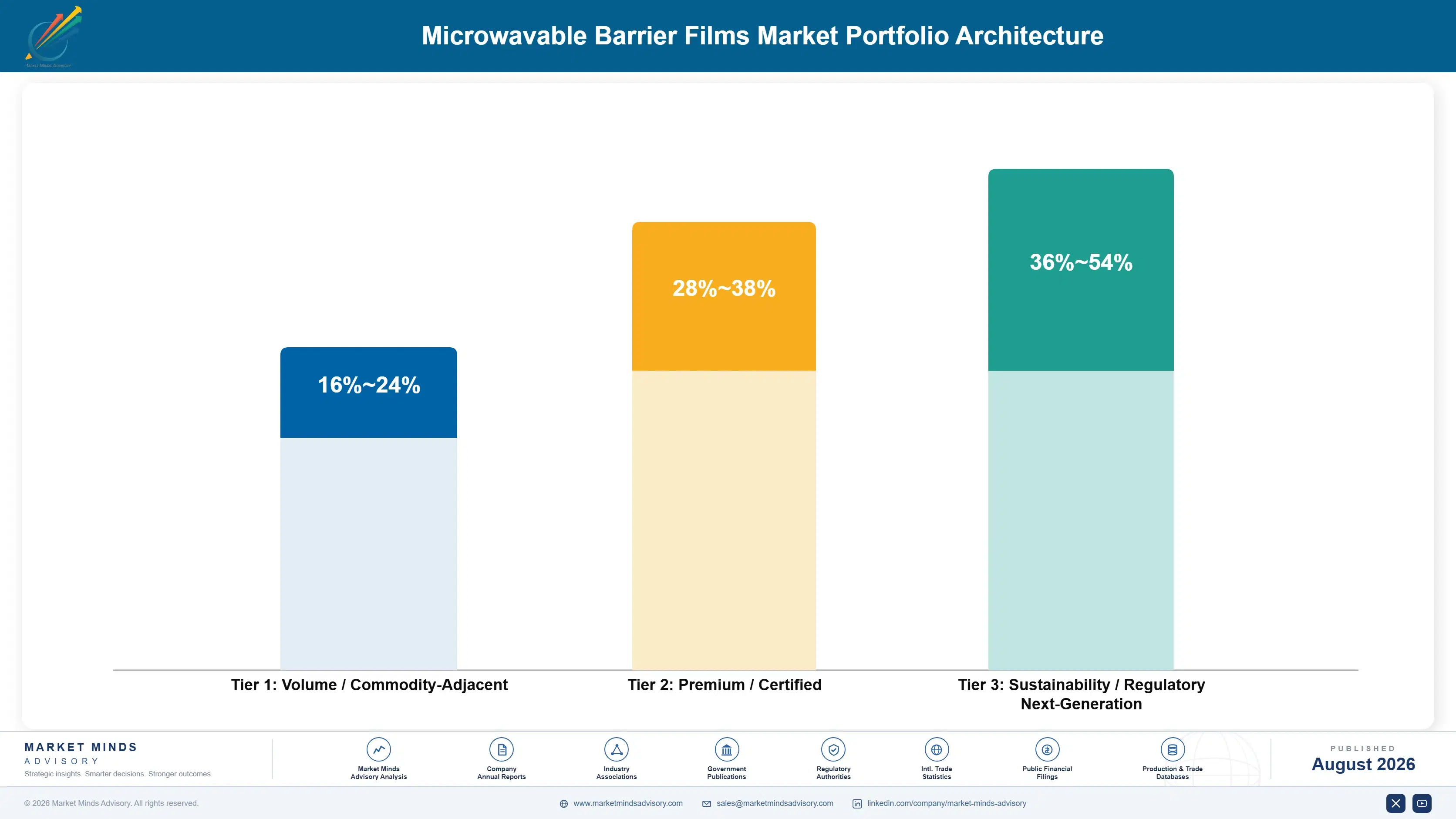
Margin here tracks structural difficulty rather than film area, because extruding and laminating are widely available and satisfying contradictory requirements is not. Conventional multilayer and simple structures run at gross margins in the high teens against every converter with a lamination line. Self-venting and dual-ovenable structures run better on functional engineering. Susceptors, mono-material coated barriers and successful paper laminates run considerably higher, because deposition control and coating chemistry exclude most competitors outright.
The tension is that conventional structures still carry the volume while the difficult ones carry the future, and the difficult ones require coating capital most converters do not hold. Buying films from a coater and laminating them is cheaper and leaves the converter unable to participate where regulation is growing the market. Several have discovered that lamination capability alone increasingly qualifies them for nothing that brand owners now specify, which is an uncomfortable position to notice late.

High-value pools sit in mono-material coated barrier, susceptor deposition and grease resistant paper laminates. All three depend on coating capability rather than converting. Lamination capacity by itself defends very little as regulation eliminates the structures it was built to produce.

Volume / Commodity-Adjacent

Conventional multilayer and simple barrier structures where any converter with a lamination line can meet the specification. The eight-point range separates converters with indexed polymer contracts from those absorbing petrochemical movement on annual fixed brand owner pricing.
Gross Margin: 16%-24%

Premium / Certified

Self-venting valve films and dual-ovenable polyester structures where functional engineering and seal control narrow the field. The ten-point spread reflects process capability, since venting pressure consistency separates competent converters from struggling ones.
Gross Margin: 28%-38%

Sustainability / Regulatory / Next-Generation

Susceptor structures, mono-material coated barriers and grease resistant paper laminates. The eighteen-point range is wide because deposition control and coating chemistry exclude most converters entirely, and brand owners facing deadlines have limited alternatives.
Gross Margin: 36%-54%
microwavable-barrier-films-market-portfolio-architecture-1787555599063

High-value Sub-segments and Strategic Watch-out

Mono-Material Coated Barrier

Compounding at 9.9% because regulation rejects the multilayer structures recovering at 4%, and coating adhesion under flex is genuinely hard to solve. Converters who developed it early hold positions competitors reach two years behind them. That head start is worth defending carefully. Nobody catches up quickly.
Gross Margin: 38%-54%

Susceptor Deposition Capability

Metallisation precise enough to reach 220 degrees without arcing is process knowledge rather than equipment, and browning decides repeat purchase in premium meals. Anybody who merely operates a metalliser cannot do it at all. Brand owners know browning decides repeat purchase directly. Equipment alone achieves nothing.
Gross Margin: 36%-50%

Conventional Multilayer Structures

Still the volume and the structures European regulation is eliminating rather than merely discouraging over time. Manage for utilisation while it lasts, because the conversion timetable is published and everybody can read it. The conversion timetable is published for anybody who cares to read it.
Gross Margin: 16%-24%

Grease Resistant Paper Laminates

Growing at 8.8% on consumer recyclability perception rather than performance, and facing fluorochemical withdrawal most acutely of any structure. More launches have failed here on grease and moisture than anywhere else. Solving grease and moisture together is the whole commercial question. Very few have managed it.
Gross Margin: 34%-48%

How Film Demand Renews

Demand renews continuously against a specification decided once. A film qualified into a food product ships for as long as that product sells, with volumes following retail performance and no repurchasing conversation happening at all. Changing means requalification covering shelf life testing, seal validation and frequently consumer trials, which brand owners avoid unless something forces them. Regulation is now forcing them, which is why a market with almost no natural switching is experiencing an unusual amount of it.
Stickiness depends on how much validation a change would require. Barrier structures determining stated shelf life are the stickiest, since altering them means repeating storage trials measured in months. Susceptor applications hold well because browning performance is difficult to replicate exactly. Simple structures without barrier or functional claims change converter on price at every contract with nothing at all protecting the incumbent.

The specifier has widened considerably and converters built for technical buyers have adapted slowly. Film selection sat with packaging technologists weighing barrier, seal integrity and machinability. It now includes sustainability functions checking recyclability criteria and procurement functions checking recycled content obligations, neither of which reads an oxygen transmission rate with any interest.
microwavable-barrier-films-market-end-use-penetration-index-1787555599552

Where To Place The Bet

These are among the four positions where our research anticipates prominent divergence between winners and laggards over the coming forecast period. Each is grounded in the demand model, the regulatory perimeter, and the announced capacity pipeline.
01 / COATING CAPABILITY INVESTMENT

Build deposition before the deadline arrives

Multilayer barrier structures recover at roughly 4% into any recycling stream and European recyclability criteria are rejecting them outright rather than merely discouraging their use going forward. Coated mono-material films compound at 9.9%, cost more and deliver slightly less barrier, and the converter who has already solved coating adhesion and flex resistance is the one a brand owner telephones when a compliance deadline arrives. Developing that capability ahead of demand costs development budget now and buys a specification position that competitors will reach roughly two years later.
02 / SUSCEPTOR POSITION DEFENCE

Own the only way to brown food

A microwave heats water and produces steam, which leaves food pale and soft unless a susceptor absorbs energy at the surface and reaches around 220 degrees to brown it properly instead. Achieving that requires metallisation control precise enough that excess metal arcs dangerously and insufficient metal does nothing whatsoever, which is process knowledge rather than equipment specification. Brand owners in pizza, sandwich and premium prepared meals know browning decides repeat purchase directly, and converters holding genuine deposition capability price against the absence of any alternative.
03 / GREASE RESISTANCE DEVELOPMENT

Solve what fluorochemical withdrawal took away

Fluorochemical treatments provided grease and oil resistance across microwave packaging for decades and are being withdrawn across North America and Europe on health grounds, leaving replacements that cost more and perform noticeably worse against hot oil. Microwaved food is frequently oily and invariably hot, which makes this the packaging application where the withdrawal bites hardest anywhere in the industry. Paper laminates growing at 8.8% face it most acutely, and several product launches have already failed on precisely this problem rather than on any other.
04 / HOT CLIMATE ENGINEERING

Specify for heat rather than exporting temperate designs

Barrier requirements across Gulf, South Asian and African distribution are considerably more demanding than temperate markets impose, since heat and humidity accelerate both oxygen transmission and moisture ingress along supply chains that may not be reliably chilled throughout. Structures engineered for European or North American conditions underperform there in ways brand owners tend to discover after a launch rather than before one. Converters specifying deliberately for those conditions hold positions in markets growing at 8.8% where local technical capability remains genuinely limited.

Engagement Snapshot From the Field

A live engagement with an industry participant carrying material or product regulatory and market exposure ahead of a defining policy shift, showing how our research translates into a defensible multi-year portfolio strategy.
MARKET MINDS ADVISORY · CLIENT ENGAGEMENT SUMMARY
Microwavable Barrier Films Producer Strategic Portfolio Review and Transition Roadmap 2026·Investment Scenario on Microwavable Barrier Films Exposure Evaluation 2025-26
CLIENT PROFILE
A European flexible packaging converter with annual revenue around EUR 165 million (client-reported, unverified by MMA), producing multilayer barrier films and laminates for chilled and frozen prepared meal manufacturers. The business held lamination capacity and no coating or metallising assets. Barrier films were purchased from third parties. Roughly 60% of revenue sat in multilayer structures.
STRATEGIC CHALLENGE
Two brand owner customers had signalled conversion to recyclable structures (client-reported, unverified by MMA) and management proposed sourcing coated mono-material film from suppliers to laminate as before. Nobody had asked whether that arrangement would leave the client competing on lamination alone against converters holding the capability customers actually valued. That question had never been asked.
MMA APPROACH
MMA assessed which parts of the client's value proposition survived the conversion to coated structures, distinguishing lamination from the coating capability that determines barrier performance. Coating investment economics were modelled against realistic volumes across the client's applications and beyond them. Susceptor capability requirements were benchmarked, and the timetable for recyclability criteria was mapped across the customer base.
KEY FINDINGS
  1. Purchasing coated film to laminate would have left the client competing on conversion cost alone against converters who owned the capability that brand owners were actually specifying for.
  2. Recyclability criteria affected roughly 70% of the client's multilayer volume within four years, which was substantially more exposure than management had recognised at any point.
  3. A coating investment recovered acceptably only if loaded across barrier applications beyond microwavable packaging, which the client had never considered or costed.
  4. No competitor in the client's markets held susceptor deposition capability, and two brand owner customers were developing premium ranges that would require it.
CLIENT PROFILE
A European flexible packaging converter with annual revenue around EUR 165 million (client-reported, unverified by MMA), producing multilayer barrier films and laminates for chilled and frozen prepared meal manufacturers. The business held lamination capacity and no coating or metallising assets. Barrier films were purchased from third parties. Roughly 60% of revenue sat in multilayer structures.
STRATEGIC CHALLENGE
Two brand owner customers had signalled conversion to recyclable structures (client-reported, unverified by MMA) and management proposed sourcing coated mono-material film from suppliers to laminate as before. Nobody had asked whether that arrangement would leave the client competing on lamination alone against converters holding the capability customers actually valued. That question had never been asked.
MMA APPROACH
MMA assessed which parts of the client's value proposition survived the conversion to coated structures, distinguishing lamination from the coating capability that determines barrier performance. Coating investment economics were modelled against realistic volumes across the client's applications and beyond them. Susceptor capability requirements were benchmarked, and the timetable for recyclability criteria was mapped across the customer base.
KEY FINDINGS
  1. Purchasing coated film to laminate would have left the client competing on conversion cost alone against converters who owned the capability that brand owners were actually specifying for.
  2. Recyclability criteria affected roughly 70% of the client's multilayer volume within four years, which was substantially more exposure than management had recognised at any point.
  3. A coating investment recovered acceptably only if loaded across barrier applications beyond microwavable packaging, which the client had never considered or costed.
  4. No competitor in the client's markets held susceptor deposition capability, and two brand owner customers were developing premium ranges that would require it.
RECOMMENDED STRATEGY
Phase 1: Phase one: commit coating capacity rather than purchasing coated film, and load it across barrier applications beyond microwavable packaging to justify the capital. Phase 2: Phase two: develop susceptor deposition capability alongside the coater, targeting the premium ranges two existing customers are actively developing now. Phase 3: Phase three: approach every affected multilayer customer with a full conversion timetable before they run competitive processes of their own.
OUTCOME
Coating capacity is commissioned and loaded across three application groups. Susceptor development is running with one customer in trials. Conversion proposals have been made to four multilayer customers, and the client reports retaining volume that competitors had been actively pursuing (client-reported, unverified by MMA). Lamination alone would not have.

Frequently Asked Questions

Foundational context covering the market sizes, CAGR, scope, country, region and competition that inform every finding below. This section is provided to cover basics and most often pre-purchase conversations, answered from the MMA Primary Research Dataset.

What is the current size of the Microwavable Barrier Films Market?

The market was valued at USD 4.6 billion in 2025, rising to an estimated USD 4.90 billion in 2026. East Asia holds the largest regional share at 29% of value.

How large will the Microwavable Barrier Films Market be by 2036?

MMA forecasts USD 9.29 billion by 2036 under the base case, an expansion multiple of 1.89 times the 2026 value. That represents USD 4.39 billion of incremental value.

What is the CAGR for the Microwavable Barrier Films Market 2026 to 2036?

The base case runs at 6.6% compound annual growth between 2026 and 2036, with a bull case at 7.8% and a bear case at 5.4%. Historical growth from 2020 to 2025 was 5.2%.

Which segment is growing fastest?

Mono-material coated barrier films lead at 9.9%, half again the market rate, because multilayer structures recover at only 4%. Paper-based laminates follow closely at 8.8%.

Who are the major companies in the Microwavable Barrier Films Market?

Amcor, Sealed Air, Berry Global, Constantia Flexibles and Toppan hold 33% of supply between them. Coating and deposition capability rather than converting scale sustains those positions.

Which country is growing fastest?

India leads at 9.6%, driven by urban convenience retail and delivery platforms that are expanding rapidly from a very low base of prepared meal penetration.

Report Segmentation Architecture

The full report scope spans multiple orthogonal segmentation dimensions, with cross-tabulated demand data provided for each dimension pair. Coverage extends further to regional breakdowns, trend trajectories, and the competitive detail needed to support segment-level decision-making.

By Film Structure

  • EVOH Multilayer Barrier Films
  • Metallised Susceptor Structures
  • Self-Venting Valve Films
  • Mono-Material Coated Barrier Films
  • Dual-Ovenable Polyester Structures
  • Paper-Based Barrier Laminates

By End-Use Industry

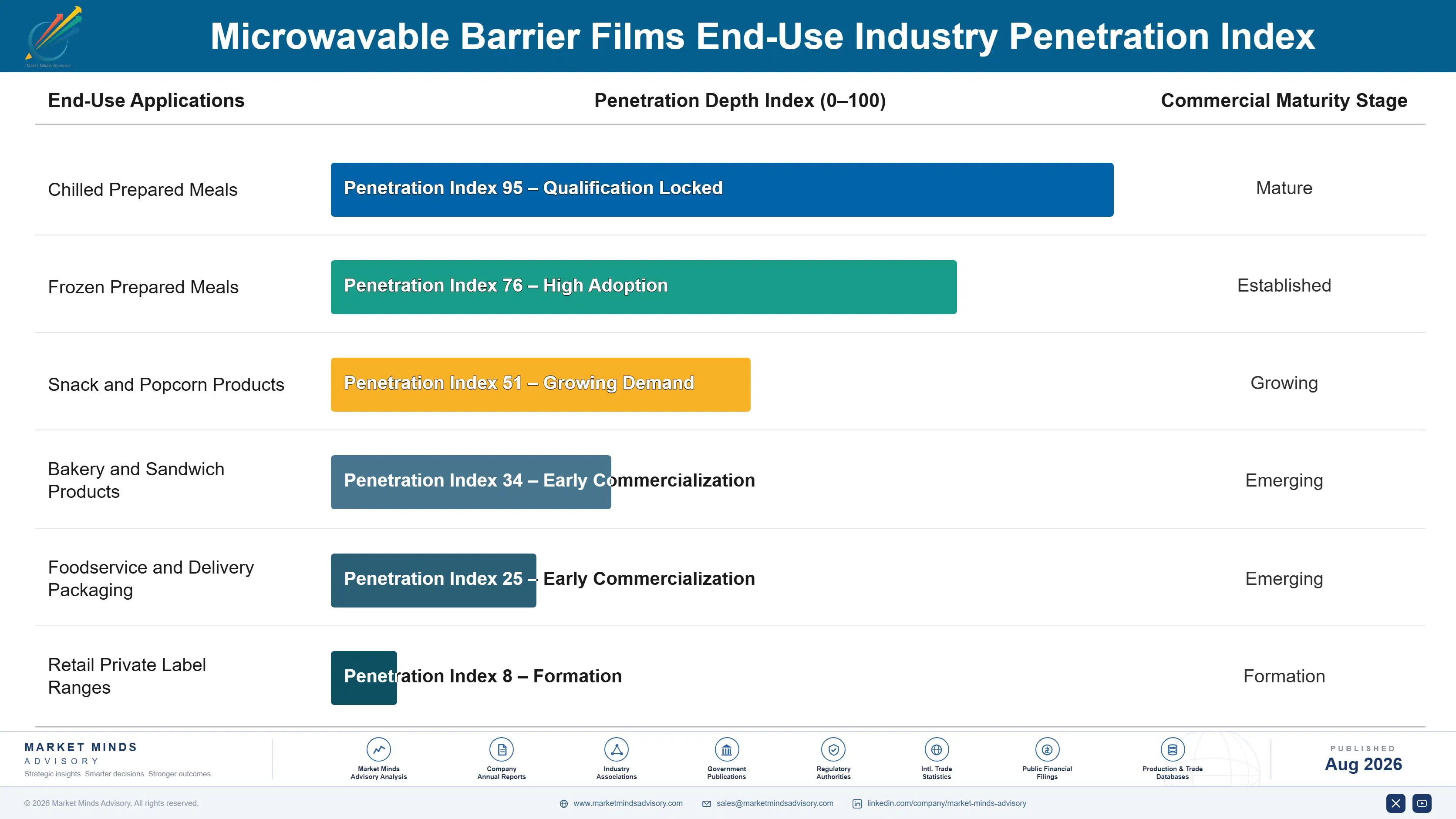
  • Chilled Prepared Meals
  • Frozen Prepared Meals
  • Snack and Popcorn Products
  • Bakery and Sandwich Products
  • Foodservice and Delivery Packaging
  • Retail Private Label Ranges

By Supply Arrangement

  • Direct Brand Owner Supply
  • Contract Packer Supply
  • Retailer Private Label Contract
  • Converter Distribution Channel
  • Development Partnership Supply

By Region

  • North America
  • Western Europe
  • East Asia
  • South Asia and Pacific
  • Latin America
  • Middle East and Africa
  • Eastern Europe

Scope, Methodology, and Coverage

Every figure in this report is reproducible from documented input assumptions. The scope below maps the historical period, the forecast horizon, the segmentation dimensions, and the countries covered, alongside the underlying primary and qualitative methodology.
Historical Period
2020 to 2025
Forecast Period
2026 to 2036
Base Year
2025 (USD billions; MMA Primary Research Dataset, August 2026)
Market Definition
The market comprises barrier films and laminates supplied for food packaging intended for microwave heating across chilled, frozen, snack, bakery, foodservice and private label applications, covering EVOH multilayer barrier films, metallised susceptor structures, self-venting valve films, mono-material coated barrier films, dual-ovenable polyester structures, and paper-based barrier laminates. Value is measured at converter level on film area supplied annually. Rigid microwavable containers, conventional packaging without microwave function, retort pouches for shelf-stable sterilisation, non-food films and packaging machinery fall outside scope.
Quantitative Units
USD billions (current prices); million square metres of film supplied annually; USD per thousand square metres by structure
Segmentation Dimensions
By Film Structure; By End-Use Industry; By Supply Arrangement; By Region
Regions Covered
North America, Western Europe, East Asia, South Asia and Pacific, Latin America, Middle East and Africa, Eastern Europe
Countries Covered
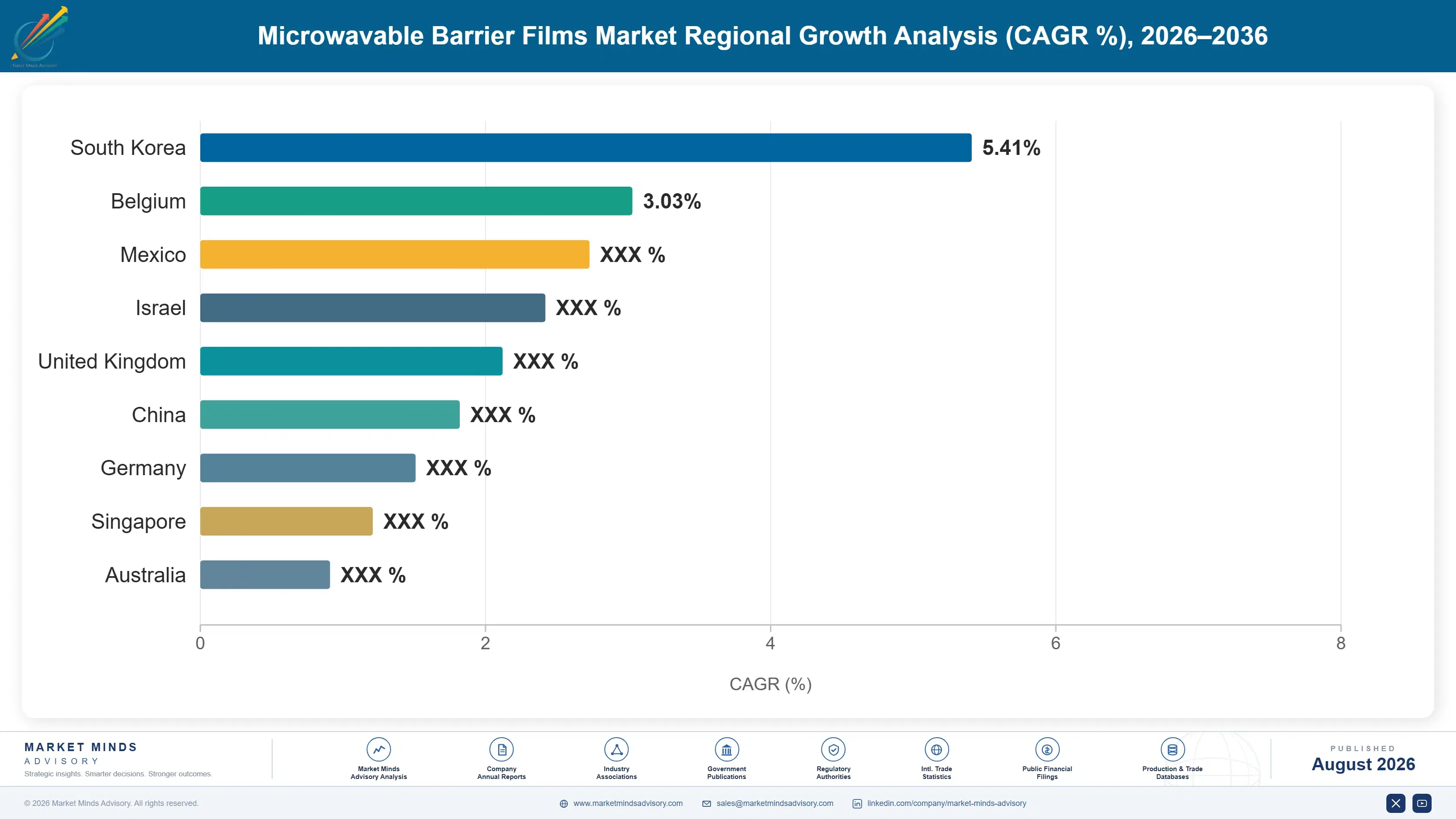
Japan, China, South Korea, Taiwan, India, Thailand, Indonesia, Vietnam, Australia, United States, Canada, Mexico, Germany, United Kingdom, France, Italy, Netherlands, Spain, Belgium, Sweden, Poland, Czechia, Romania, Hungary, Brazil, Argentina, Colombia, United Arab Emirates, Turkey, South Africa
Key Companies Profiled
Amcor, Sealed Air, Berry Global, Constantia Flexibles, Toppan Holdings, Mondi, Huhtamaki, Winpak, ProAmpac, Coveris, Uflex, Toray Industries, Mitsubishi Chemical, Dai Nippon Printing, Sonoco, Sabert, Graphic Packaging, TC Transcontinental, Wipak, Schur Flexibles
Quantitative Methodology
Primary survey, n=3,800 respondents, Q4 2025, six countries; demand-side model with trade association cross-validation
Qualitative Methodology
47 expert interviews, Q4 2025; applied to validate demand model assumptions, identify emerging dynamics, and assess competitive positioning
Report Format
PDF and XLSX data workbook (Word format preview document)
Publisher
Market Minds Advisory
Report Code
MMA-2026-PAC-195
Published
August 2026
Contact
sales@marketmindsadvisory.com | www.marketmindsadvisory.com

Purchase the full Microwavable Barrier Films Market Report (2026 to 2036).

The full report sizes the global microwavable barrier film market to 2036 across six film structures and seven regions, measured on film area supplied at converter level. It treats recyclability criteria as eliminating structures rather than discouraging them, and quantifies the barrier and cost consequences of every available alternative. Competitive analysis covers 20 participants evaluated on film area, with moat and risk assessment for the two leaders. Fluorochemical withdrawal is assessed as a functional loss in the applications where oily hot food makes it hardest to replace. Four quantified revenue levers close the analysis.
Six-structure segment sizing with segment-level growth rates
Seven-region share and growth breakdown to 2036
Twenty-participant competitive map on one area basis
Recyclability criteria mapped against every barrier structure available
Fluorochemical withdrawal assessed by application difficulty
Four quantified revenue levers with commercial impact ranges

Built For The People Who Decide

From boardroom strategy to bench-side execution, this report is read cover-to-cover by leaders shaping the next decade of their industry, turning demand scenarios, market dynamics and valuation benchmarks into decisions.
CXOs/ Presidents/ VPs/ Managers
M&A and Corporate Development
Strategy Teams and R&D Heads
Procurement and Product Directors
Regulatory and Compliance Leaders
Investor Relations and Equity Analysts