

Market Minds Advisory
Microlearning Platforms Market

Microlearning Platforms Market: Microlearning Platforms Market: Platform Classes, Frontline Delivery and Budget Location 2026 to 2036

Four fifths of the world's workers have no desk, no corporate email and no hour to spare. Enterprise learning software was built entirely for the other fifth, and it shows in every completion rate.

Lead Analyst

Published

September 2026

Make Smarter Decisions with Customized Research Insights

Request a free sample report and evaluate market opportunities, growth trends, and competitive dynamics relevant to your business needs.

2025 MARKET VALUE$2.9BMarket Size 2025
2036 FORECAST VALUE$11.8BBase Case , 2026 to 2036
CAGR 2026 TO 203613.6 %Bull 14.8% / Bear 12.4%
INCREMENTAL OPPORTUNITY$8.5BNet 10- year value creation
EXPANSION MULTIPLE3.58x2036 value over 2026 base
Strategic Levers
M&A Pipeline
Regional Outlook
Country Rankings
Competitive Intelligence
Segmental Deep-dive
Call-Us : 91 93563 13602

Executive Snapshot and Market Trajectory.

Roughly 80% of the global workforce is deskless, and almost every corporate learning system ever built assumed a laptop, a corporate login and an uninterrupted hour. Microlearning is what happens when somebody finally designs for four minutes on a shared phone instead, and the completion figures show it.
The market reaches USD 3.29 billion in 2026 and USD 11.78 billion by 2036, a 3.58 times expansion at 13.6%. Frontline and deskless worker training platforms grow at 20.4%, half again the market rate of 13.6%, because 78% of assigned modules actually get finished. East Asia holds 28% of revenue on frontline volume rather than on per-seat pricing, and India grows fastest at 19.2%. Three regions sit within a few points of each other.
Five suppliers hold 21% of subscription revenue, fragmented because building a four minute lesson is trivial and reaching a warehouse worker who has never held a corporate login is not. Axonify and SafetyCulture built for the frontline directly. Seismic and Mindtickle serve sales teams. Docebo and Cornerstone arrived from traditional learning management and have been retrofitting ever since. The retrofitting has gone about as well as expected.
Market Definition
This report covers subscription software delivering short-form workplace learning, typically in units of a few minutes: frontline and deskless worker training platforms, sales enablement and readiness platforms, compliance and safety micro-training, skills and reskilling micro-credential platforms, microlearning authoring and content tools, and learning modules embedded inside other enterprise software. It excludes full learning management systems, long-form online course marketplaces, academic and higher education platforms, and the classroom training services these products replace.
Base Year Value
$2.9B in 2025 (MMA Primary Research Dataset, September 2026)
Forecast Period
2026 to 2036, eleven discrete annual values
CAGR
13.6% base case. Bull 14.8%. Bear 12.4%.
Fastest Growth Segment
Frontline and Deskless Worker Training Platforms: 20.4% CAGR
Fastest Growth Country
India: 19.2% CAGR
Fastest Growth Region
South Asia and Pacific: 15.8% CAGR
Largest Region
East Asia: 28% of 2025 global value
Market Leaders
Axonify, Docebo, SafetyCulture, Seismic and Cornerstone OnDemand lead on microlearning subscription software revenue. Source: MMA Analysis.
Primary Survey
n=3,800 procurement and R&D decision-makers, Q4 2025, six countries
Methodology
Demand-side build-up, cross-validated against public data, 47 expert interviews

Microlearning Platforms Market Forecast Scenarios

microlearning-platforms-market-size-forecast-scenario-1789986999754
Between 2020 and 2025 the category compounded at 12.2% and remote working got the credit it did not deserve. What drove adoption was frontline turnover: retail, logistics and hospitality operators replacing much of their workforce yearly found that a two day induction nobody finishes is worse than nothing. Short modules on a personal phone finished at rates the old system never approached.
The base case holds 13.6% on three mechanisms. Frontline workforces are being reached by employers for the first time, because a phone-based module needs no corporate login and no desk, which puts 80% of the workforce inside an addressable market. Sales organisations buy readiness platforms on measurable quota attainment rather than on training hours. And safety regulators in several jurisdictions now accept micro-format evidence of competence, which turned a compliance obligation into a recurring software purchase.
The bull case at 14.8% assumes embedded learning inside operational software becomes standard, delivering training at the moment of work rather than as a separate destination. The bear case at 12.4% is the content problem: material goes stale in about 9 months, most buyers underestimate the authoring burden completely, and a platform full of outdated modules gets cancelled at the first review.

Built For The Other Fifth

Corporate learning software assumed a set of conditions that most workers do not have. A laptop, a corporate email address, a login, a quiet hour and a manager who scheduled it. That describes about a fifth of the global workforce. The other 80% work on a shop floor, in a warehouse, on a ward or in a vehicle, and none of those assumptions holds for any of them.
TOP FIVE CONCENTRATION21%Highly fragmented across enterprise and frontline learning suppliers
AVERAGE MODULE LENGTH4 minutesTypical single learning unit across most frontline deployments
FRONTLINE COMPLETION RATE78%Assigned modules finished against long form course rates
PER SEAT ANNUAL PRICEUSD 34Blended list rate across frontline and knowledge workers
DESKLESS WORKFORCE SHARE80%Portion of the global workforce without a fixed desk
CONTENT REFRESH INTERVAL9 monthsBefore assigned material stops matching actual operational reality
The completion figure is the whole commercial argument. A four minute module delivered on a personal phone between tasks finishes at around 78%, against rates for long-form courses that most buyers will not publish. That is not a pedagogical claim about how people learn, it is an observation about what people will actually do, and it is the only number in this category that has ever moved a procurement decision.
What keeps this market fragmented at 21% is that the easy half is genuinely easy. Anybody can build a four minute lesson. Reaching a warehouse worker who has never had a corporate login, on a device the company does not own, in a language the shift supervisor speaks, is a different problem and it is where the surviving companies actually compete.
"Every vendor in this category can show you a completion rate. Ask them how a new warehouse hire with no company email and a cracked personal phone receives the first module, and you find out very quickly who actually built for the frontline."
Director, Workforce Learning and Enablement Practice · MMA Technology Practice · September 2026

Market Trends

Employers Are Reaching Frontline Workers For The First Time

An employer with fifty thousand warehouse, retail or care staff historically had no software route to any of them. No corporate email, no assigned device, no scheduled desk time and turnover high enough that provisioning accounts was pointless. Phone-based modules delivered by text link or a simple application removed every one of those obstacles at once. That opened roughly 80% of the global workforce to a category of software that had never touched it, and frontline platforms compound at 20.4% against 13.6% for the market as a whole. The addressable population changed rather than the product.
Market Impact: Completion reaches 78% assigned

Sales Enablement Sold On Quota, Not Training Hours

Sales training was bought for decades on activity measures nobody believed and cancelled whenever budgets tightened. Readiness platforms changed the argument by tying short-form coaching and certification to quota attainment, ramp time for new hires and win rates on specific deal types, which a revenue leader will defend because those are the numbers they are already measured on. Sales enablement platforms compound at 17.2%, and the buyer sits in revenue operations rather than in human resources, which is a different budget and a different sales cycle entirely. Very few learning vendors reach that buyer at all.
Market Impact: Compliance compounds at 10.8% yearly

Market Opportunities and Growth Drivers

Frontline Turnover Makes Induction A Continuous Problem

Retail, logistics, hospitality and care operators replace a large share of their frontline workforce every year, which means induction is not an annual event but a continuous process running every week in every location. A two day classroom course does not scale to that and a long online module does not get finished. Short phone-delivered units finish at around 78% and can be assigned the day somebody starts, without provisioning anything. The economics work because the training cost per hire falls while the number of hires keeps rising. That combination is unusual and very durable.
Market Impact: Content stales within 9 months

Safety Regulators Now Accept Micro-Format Competence Evidence

Occupational safety authorities in several jurisdictions have moved from requiring documented training hours toward accepting demonstrated competence, which a short assessed module evidences better than an attendance sheet ever did. That converts a compliance obligation into a recurring software purchase with an audit trail attached, bought by a safety function rather than by learning and development. The distinction matters commercially because safety budgets survive cost reviews that training budgets do not. Compliance micro-training compounds at 10.8%, slower than the market but on demand that does not depend on anybody's enthusiasm.
Market Impact: Concentration sits at 21%

Market Restraints and Challenges

Content Goes Stale Faster Than Anybody Budgets For

Assigned material stops matching operational reality in about 9 months, because processes change, products change and the store layout changes, and a module describing last year's procedure is worse than no module at all. The root cause is that buyers purchase a platform and assume content maintenance is somebody else's job, which nobody costed at the point of sale. Commercially this produces cancellations at the first budget review after the library ages. Mitigation runs through managed content services and authoring workflows that let a district manager update a module in an afternoon.
Market Impact: Opens 80% of the workforce

Building A Short Lesson Is Trivially Easy

Any competent team can produce a four minute learning module, which is why this market carries a 21% top five concentration rather than the concentration typical of enterprise software. The root cause is that the visible product looks like the whole product, so buyers compare demonstrations rather than delivery infrastructure and price accordingly. Commercially this compresses pricing at the low end continuously, with blended per-seat rates around USD 34 a year. Mitigation runs through the difficult half, meaning frontline device reach, multilingual delivery and shift-pattern scheduling that small entrants cannot fund.
Market Impact: Platforms compound at 17.2% annually
3 additional market trends, 4 additional growth drivers, and 2 additional restraints and challenges are covered in the full report. Contact sales@marketmindsadvisory.com to access the complete intelligence.

Segment CAGR and Growth Architecture

Segmentation follows platform class, since the workforce a product reaches determines who buys it, which budget pays and what it can charge. Six classes cover the market: frontline and deskless worker training, sales enablement and readiness, skills and reskilling micro-credentials, embedded learning modules, compliance and safety micro-training, and authoring and content tools. Industry vertical and deployment model are separate dimensions.
microlearning-platforms-market-market-share-analysis-1789987000318

Frontline and Deskless Worker Training Platforms

Frontline platforms grow at 20.4%, half again the market rate of 13.6%, and the change was access rather than pedagogy. An employer with fifty thousand warehouse or retail staff previously had no software route to any of them, because there was no corporate email, no assigned device and turnover high enough that provisioning accounts made no sense. A module delivered by text link to a personal phone removes all of that and finishes at around 78%. The difficult part is not the lesson: it is multilingual delivery, shift-pattern scheduling and reaching somebody on a device the employer does not own or control. That is where the surviving companies actually compete.
CAGR 20.4%

Sales Enablement and Readiness Platforms

Sales enablement and readiness platforms grow at 17.2% and got there by changing who signs. Sales training was bought for decades on activity measures nobody believed and cancelled at the first sign of budget pressure. Readiness platforms tie short coaching and certification to quota attainment, new hire ramp time and win rates on named deal types, which a revenue leader defends because those are already the numbers on their own scorecard. That moves the purchase out of human resources and into revenue operations, a different budget with a shorter cycle and considerably less price sensitivity. Most learning vendors have never met that buyer and cannot easily reach them at all. The gap is organisational.
CAGR 17.2%
Full segment breakdown across 6 segments available in the complete report.

Regional Architecture and Country Demand Map

Three regions sit within a few points of each other and East Asia leads at 28%, on frontline workforce volume rather than on per-seat pricing. South Asia and Pacific sits above its band at 15% on the same argument, since Indian deskless employment has no comparison anywhere.

East Asia

East Asia holds 28% of revenue and leads on frontline volume rather than on what anybody pays per seat. Chinese retail, logistics and food delivery operators run training across workforces measured in millions, on phones, in short units, at price points a Western vendor would find impossible, and domestic platforms serve almost all of it. Japanese and Korean enterprises buy Western-style products for knowledge workers and behave much like European buyers do. Manufacturing safety training across the region is substantial and increasingly regulated. Growth at 14.6% sits above the global rate on that frontline volume, and the gap between users reached and revenue collected is wide. Nobody has closed that gap profitably yet.
Share: 28% | CAGR: 14.6% (2026 to 2036)

North America

Sales enablement rather than frontline training accounts for a disproportionate share of North America's 26%. American revenue organisations buy readiness platforms on quota attainment and ramp time at price points nothing else in this category approaches, and Seismic, Mindtickle and Highspot all built here on that budget. Frontline adoption is real but concentrated in large retail and logistics operators rather than spread across the employer base. Compliance training carries steady volume on regulatory obligation. Growth at 12.6% sits below the global rate because the knowledge worker base is already well served and the frontline opportunity is being taken more slowly than elsewhere. Sales enablement pricing is what holds the share up.
Share: 26% | CAGR: 12.6% (2026 to 2036)
Regional intelligence for 5 additional markets available in the complete report: Western Europe, South Asia and Pacific, Latin America, Middle East and Africa, Eastern Europe. Contact sales@marketmindsadvisory.com.
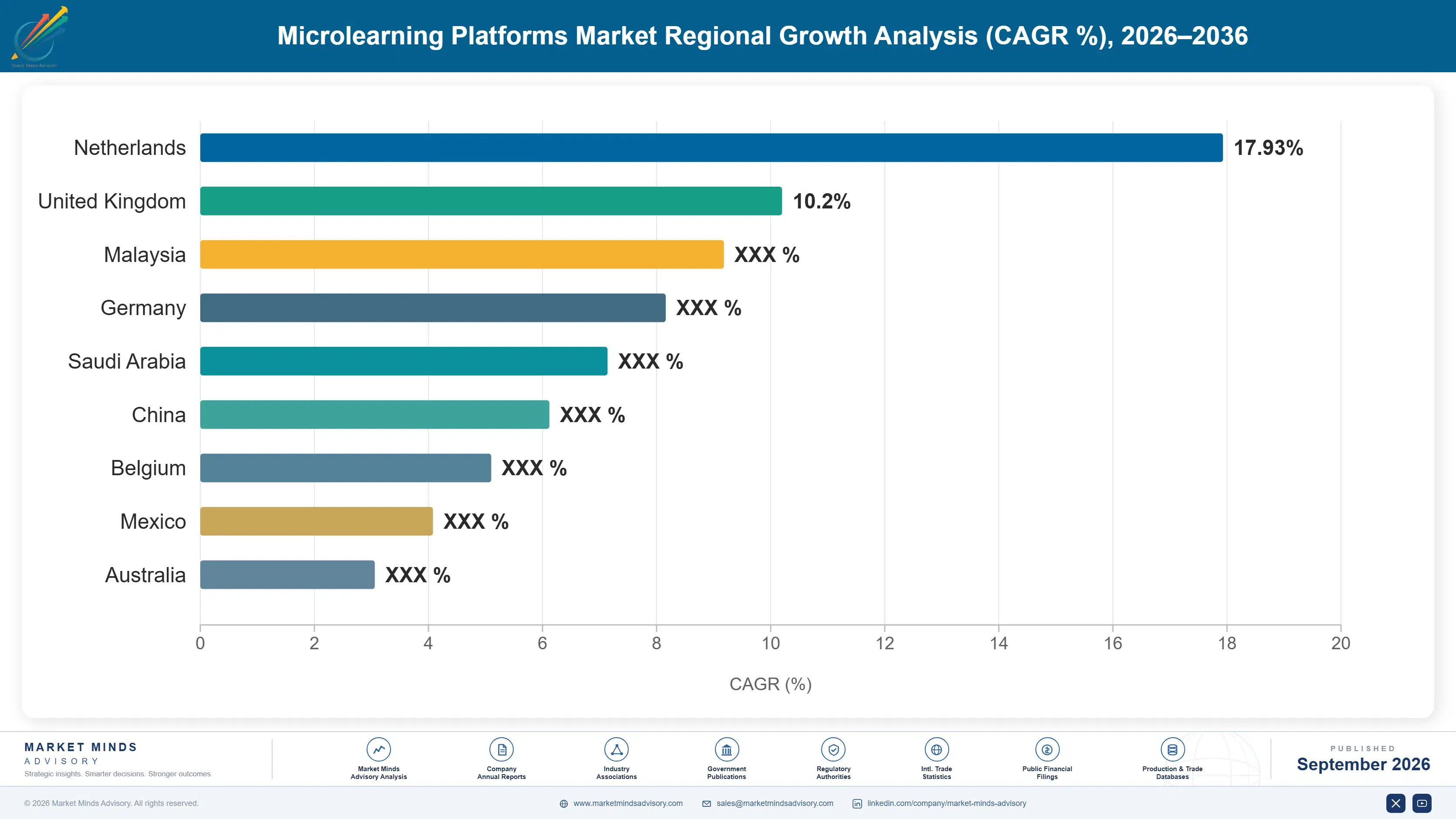
microlearning-platforms-market-country-cagr-analysis-1789987000840

How To Reach The Frontline

Anybody can build a four minute lesson, which is why this market is fragmented and priced accordingly. What separates a business that grows from one that does not is whether it can reach a worker with no corporate login, keep the content current, and find a budget that survives a cost review. The levers below address those three.

Solve Delivery, Because Nobody Else Bothers To

The lesson is the visible half of the product and the easy one. Reaching a warehouse hire on their first shift, with no corporate email, on a personal device the employer does not own, in whichever of six languages the shift runs in, is the part that takes years to build. Frontline platforms compound at 20.4% against 13.6% for the market and the ones winning are the ones that solved delivery rather than content. Buyers compare demonstrations and then discover the difference during rollout, which is when a vendor either keeps the account or loses it.
Market Impact: Frontline platforms compound at 20.4% against 13.6% overall

Sell Sales Enablement To Revenue Operations

Sales training bought by human resources on activity measures was always the first line cut in a difficult quarter. Readiness platforms tied to quota attainment, new hire ramp time and win rates on named deal types get defended by a revenue leader instead, because those numbers already sit on their scorecard. Sales enablement platforms compound at 17.2% and command per-seat pricing several times the blended USD 34 this market averages. The obstacle is organisational rather than technical: a vendor whose sales motion runs through learning and development never meets the person who signs.
Market Impact: Enablement seats price above the USD 34 average

Sell Content Maintenance, Not Just A Platform

Assigned material stops matching operational reality in about 9 months and almost no buyer budgets for that at the point of sale. A platform full of outdated modules gets cancelled at the first budget review, which is how most churn in this category actually happens. Vendors offering managed content refresh, or authoring workflows simple enough that a district manager updates a module in an afternoon, convert a one-off software sale into a recurring service relationship. The margin is lower than pure software and the retention is considerably better, which most vendors have not yet accepted.
Market Impact: Content stales in 9 months and drives churn

Build Language Depth Where Vendors Are Thin

A single European employer routinely operates across five or six languages and a Gulf one requires Arabic with right-to-left delivery, while Latin American frontline training needs Portuguese and Spanish depth that most international products simply do not have. Language coverage limits vendors in those regions far more than pricing does, and it is a content and engineering investment rather than a feature request. India grows at 19.2% and runs on a dozen languages nobody in this category serves properly. Whoever builds that depth reaches volume the price-competitive vendors cannot follow into.
Market Impact: India compounds at 19.2% across a dozen languages

Who Controls the Margin Pool

Five suppliers hold 21% of subscription revenue, fragmented because the visible product is easy to build and the delivery infrastructure underneath it is not. Axonify and SafetyCulture built for frontline workforces directly. Seismic serves revenue organisations at pricing nothing else here approaches. Docebo and Cornerstone arrived from learning management and have been retrofitting short-format delivery since. All participants are assessed on microlearning subscription software revenue.
Competition happens inside segments and almost never across them, which is unusual for enterprise software. Frontline vendors compete on device reach, language coverage and shift-pattern scheduling. Sales enablement vendors compete on integration with revenue tooling and on evidence of quota impact. Compliance vendors compete on audit documentation. A company excellent at one of these is generally irrelevant in the others.

Rankings shift where content maintenance decides renewals. Vendors selling a platform and leaving the customer to fill it lose accounts at the first budget review once the library ages past 9 months, and the ones offering managed refresh retain them. The other pressure is geographic: Chinese and Indian domestic platforms are taking frontline volume at price points international vendors cannot match or reach.
microlearning-platforms-market-company-positioning-matrix-1789987001380

Competitive Moat and Risk Dimensions

AXONIFY

Moat: Frontline Delivery Infrastructure

Axonify built for warehouse, retail and care workforces from the beginning, which means device reach without corporate accounts, shift-pattern scheduling and multilingual delivery are architecture rather than features bolted on afterwards. Competitors demonstrating a comparable lesson discover the difference during rollout, when a customer tries to reach fifty thousand people who have never held a company login.
AXONIFY

Risk: Frontline Pricing Ceiling

Frontline seats price near the blended USD 34 a year this market averages, while sales enablement seats command several times that from a revenue budget. A vendor specialised in the largest population at the lowest price per head runs a volume business where the margin sits elsewhere. Reaching that buyer requires a sales motion it does not have.
SEISMIC

Moat: Revenue Operations Integration

Seismic sits inside the revenue technology stack rather than the learning one, integrated with customer relationship management and content workflows that sales teams use daily. That places the purchase in a revenue operations budget defended on quota attainment, at per-seat pricing several times what frontline learning commands. A learning vendor approaching the same customer never reaches that budget holder.
SEISMIC

Risk: Narrow Population Served

Sales teams are a small and expensive population, and the growth in this market sits with the 80% of workers who have no desk at all. A vendor optimised for quota-carrying professionals is well positioned in a segment that cannot expand much and absent from the one that can. Frontline platforms compound at 20.4% and Seismic does not compete there.

Players Tracked

Prominent Players

Axonify
Docebo
SafetyCulture
Seismic
Cornerstone OnDemand

Other Key Players

360Learning
Kahoot
Gnowbe
Qstream
Mindtickle
Highspot
Showpad
Litmos
Absorb Software
LearnUpon
iSpring Solutions
Attensi
Continu
WorkRamp
TalentCards

Recent Developments

APRIL 2025

SafetyCulture Extends Frontline Training Across Operational Workflows

SafetyCulture extended its frontline training capability deeper into operational inspection and reporting workflows, an organic product development rather than an acquisition. The approach delivers learning at the moment of work rather than as a separate destination, which addresses the completion and relevance problems that separate training platforms have never solved.
Signal: Learning embedded in the tool somebody already uses beats a destination they have to visit separately.
NOVEMBER 2024

Docebo Adds Managed Content Refresh Service For Enterprise Customers

Docebo added a managed content refresh service alongside its platform subscription, an organic service extension rather than a transaction. The offering addresses the churn pattern that dominates this category, where a library ageing past its useful life produces cancellation at the first budget review regardless of platform quality.
Signal: Vendors are finally accepting that content maintenance decides renewals far more than any platform capability does.
JULY 2025

Seismic Deepens Revenue Platform Integration For Readiness Products

Seismic deepened integration between its readiness products and customer relationship management platforms, an organic development rather than a partnership or acquisition. The work reinforces a position inside the revenue technology stack, where the buyer is a revenue operations leader with a budget defended on quota attainment rather than training hours.
Signal: Which budget a product sits inside decides its pricing far more than its actual capability does.

What A Learning Platform Costs

Content production and localisation account for roughly 35% of vendor cost, which surprises buyers who assume a learning platform is software. Engineering and product headcount adds about 29%, drawn from markets including Poland, Romania and India as much as from Western Europe. Customer success and implementation carry around 18%, and cloud infrastructure the balance across a workload that is light by enterprise standards.
Docebo Annual Report 2024 records content and personnel costs as the dominant variables across its learning platform operations. Cornerstone OnDemand disclosures describe a comparable structure with a heavier implementation weighting. Localisation cost rose materially through 2023 and 2024 as employers demanded delivery in languages their frontline workforces actually speak rather than in the corporate language, and vendors who priced multilingual delivery as a feature found it a recurring production obligation.

The competitive disadvantage mechanism is content reuse rather than any input price. A vendor whose library serves many customers across an industry spreads production cost very widely, while one building bespoke material per account carries it per contract and never escapes. Language depth compounds the same way, since Portuguese content built once serves every Brazilian customer afterwards. Scale in content rather than engineering decides margin here.
microlearning-platforms-market-cost-volatility-analysis-1789987001576

Build Reusable Industry Libraries Rather Than Bespoke Content

Content production and localisation run about 35% of vendor cost and behave completely differently depending on reuse. A library built for retail frontline operations serves every retail customer afterwards at no additional production cost, while bespoke material per account is carried per contract permanently. Vertical depth is the discipline and most vendors default to bespoke because customers ask for it.

Price Localisation As Recurring Production, Not A Feature

Employers increasingly demand delivery in the languages their frontline workforces actually speak, which is a recurring production obligation rather than a one-off translation. Vendors who priced it as a feature absorbed rising cost through 2023 and 2024 with no contractual ability to recover it. Charging per language per year is a straightforward change most contracts have never carried.

Distribute Engineering Beyond The Highest Cost Markets

Engineering and product headcount runs about 29% of vendor cost and this category has no technical requirement that justifies concentrating it in the most expensive labour markets. Polish, Romanian and Indian engineering centres deliver comparable capability at a materially different cost, and several competitors already operate that way. The constraint is coordination across time zones, which is genuinely manageable.

Portfolio Architecture for Margin Defence

Margin architecture separates on which budget signs the contract. Authoring and content tools earn least, sold to learning teams at low price points against many near-identical competitors. Frontline platforms sit in the middle on volume rather than pricing. Sales enablement, compliance and embedded learning earn most, because each reaches a budget outside learning and development, where the buyer compares against a business outcome rather than against another training vendor.
The volume versus premium tension is a go-to-market problem rather than a product one. The same platform serves a warehouse worker at the blended USD 34 a year and a sales professional at several times that, but reaching the second requires a revenue operations sales motion that a learning vendor does not have and cannot easily build. Almost every attempt to serve both leaves one under-resourced.

High-value pools sit in sales enablement and in embedded operational learning, and neither is where the learning industry historically built. Enablement rewards revenue tooling integration and a sales motion learning vendors lack. Embedded learning rewards a position inside software people already use daily. Both are reached from outside the learning category rather than from within it, which is why the incumbents keep losing them.

Volume / Commodity-Adjacent

Microlearning authoring and content tools sold to learning teams at low price points against many near-identical competitors. The eight point spread separates vendors reusing library content across customers from those producing bespoke material per account.
Gross Margin: 56% to 64%

Premium / Certified

Frontline and deskless training platforms plus skills and reskilling credentials, sold on volume across large workforces at modest per-seat pricing. The ten point spread tracks content reuse and language depth rather than any platform capability.
Gross Margin: 68% to 78%

Sustainability / Regulatory / Next-Generation

Sales enablement, compliance micro-training and embedded operational learning, each reaching a budget outside learning and development entirely. The ten point spread reflects how deeply each vendor integrates with the systems that budget already owns.
Gross Margin: 76% to 86%
microlearning-platforms-market-portfolio-architecture-1789987002082

High-value Sub-segments and Strategic Watch-out

Frontline And Deskless Worker Training

Grows at 20.4% because phone-delivered modules reached 80% of the global workforce that corporate learning software never touched. The ten point spread reflects content reuse and language depth. Delivery infrastructure rather than lesson quality is what decides who actually wins these accounts almost every time.
Gross Margin: 68% to 78%

Sales Enablement And Readiness Platforms

Grows at 17.2% by moving the purchase into a revenue operations budget defended on quota attainment rather than training hours. The ten point spread reflects revenue tooling integration depth. Per-seat pricing runs several times the blended USD 34 this market averages across every seat sold.
Gross Margin: 76% to 86%

Compliance And Safety Micro-Training

Grows at 10.8%, slower than the market, on demand that does not depend on anybody's enthusiasm because a regulator requires it. The ten point spread reflects audit documentation depth. Safety budgets consistently survive the cost reviews that training budgets do not survive at all, anywhere.
Gross Margin: 76% to 86%

Microlearning Authoring And Content Tools

Grows at 8.4%, slowest of the six classes, because building a four minute lesson is trivial and buyers want finished content rather than a tool to make it with. The eight point spread reflects library reuse. Vendors keep this business because customers expect a complete range.
Gross Margin: 56% to 64%

How These Contracts Survive

The annuity is not the platform, it is the content library staying current. A frontline deployment renews for years while modules match what people actually do on shift, and gets cancelled the year after the library ages past about 9 months of drift. That makes content maintenance the retention mechanism rather than a service line, which most vendors priced as an afterthought and several are now repricing.
Adoption depth varies by workforce type more than by geography. High-turnover frontline operations adopt deeply because induction never stops and the alternative does not scale. Sales organisations adopt intensively for a small population at high price. Regulated industrial workforces adopt because a regulator requires evidence. Professional services and knowledge workers adopt least, because they already have a laptop and a calendar and nobody has proved short modules beat what exists.

The buyer has fragmented rather than moved. A learning director used to sign for everything in this category. Now frontline training is signed by operations, sales readiness by revenue operations, and compliance by a safety function, each with separate budgets and completely different evaluation criteria. Vendors organised around a single learning relationship are calling on one door of three.
microlearning-platforms-market-end-use-penetration-index-1789987002575

Where This Category Actually Earns

These are among the four positions where our research anticipates prominent divergence between winners and laggards over the coming forecast period. Each is grounded in the demand model, the regulatory perimeter, and the announced capacity pipeline.
01 / DELIVERY INFRASTRUCTURE PRIORITY

Build The Hard Half, Not The Lesson

Anybody can produce a four minute learning module, which is exactly why this market carries a 21% top five concentration rather than the concentration typical of enterprise software categories. Reaching a warehouse hire on their first shift, with no corporate email, on a device the employer does not own, in whichever of six languages the shift actually runs in, takes years to build properly. Frontline platforms compound at 20.4% against 13.6% for the market and the ones winning solved delivery rather than content, which buyers discover during rollout instead.
02 / BUDGET LOCATION STRATEGY

Find A Budget Outside Learning And Development

Learning budgets are cut first in a difficult quarter and defended by nobody with real authority, which is an ordinary fact about corporate finance rather than a comment on training. Sales enablement platforms compound at 17.2% and command per-seat pricing several times the blended USD 34 this market averages, because a revenue operations leader defends quota attainment rather than training hours. Compliance micro-training grows slower and never gets cut, because a safety function buys it against a regulatory obligation, and the pattern across both is that the budget matters most.
03 / CONTENT CURRENCY DISCIPLINE

Sell Maintenance, Because Stale Libraries Cancel

Assigned material stops matching operational reality in about 9 months, and almost no buyer budgets for that at the point of sale or understands what it will take. A platform full of outdated modules gets cancelled at the first budget review afterwards, which is how most churn in this category actually happens rather than through competitive displacement. Managed content refresh, or authoring simple enough that a district manager updates a module in an afternoon, converts a one-off software sale into a recurring service relationship at better retention.
04 / LANGUAGE DEPTH INVESTMENT

Serve The Languages Workers Actually Speak

A single European employer routinely operates across five or six languages, a Gulf one needs Arabic with right-to-left delivery, and Latin American frontline training needs Portuguese and Spanish depth most international products lack. Language coverage limits vendors in those regions far more than pricing does, and India compounds at 19.2% on a dozen languages nobody in this category serves properly at all. It is a recurring content production obligation rather than a feature, so it should be priced per language per year, and whoever builds it reaches volume others cannot.

Engagement Snapshot From the Field

A live engagement with an industry participant carrying material or product regulatory and market exposure ahead of a defining policy shift, showing how our research translates into a defensible multi-year portfolio strategy.
MARKET MINDS ADVISORY · CLIENT ENGAGEMENT SUMMARY
Microlearning Platforms Producer Strategic Portfolio Review and Transition Roadmap 2026·Investment Scenario on Microlearning Platforms Exposure Evaluation 2025-26
CLIENT PROFILE
A global logistics operator employing around ninety thousand warehouse and delivery staff across twenty-two countries, with annual frontline turnover well above half. Induction was delivered by local supervisors with no consistency and no record, and a safety incident review had recommended a documented competence process. Nobody had a system that could reach a worker without a company email address.
STRATEGIC CHALLENGE
Three shortlisted vendors demonstrated near-identical short-format lessons and quoted within a narrow price band, so procurement was preparing to select on cost. Operations warned that none of the demonstrations had shown a worker being reached on day one without provisioning, which was the entire requirement. The selection was due before the next peak season began.
MMA APPROACH
MMA ran a structured delivery test rather than a feature comparison, requiring each vendor to reach twenty real new hires at three sites on their first shift, in four languages, without any account provisioning. We modelled content maintenance cost across the twenty-two country estate, and drew on 47 expert interviews conducted in Q4 2025 with comparable operators, vendors and site management teams.
KEY FINDINGS
  1. Only 1 of the 3 vendors reached workers on day one without provisioning, and the other two required an account process taking several days (client-reported, unverified by MMA).
  2. Content maintenance across twenty-two countries was modelled at roughly 4 times what any vendor had quoted, and no proposal had costed it at all.
  3. The cheapest vendor supported 6 of the 11 languages the workforce actually used, which the price comparison had entirely obscured from procurement.
  4. Completion at the sites in the delivery test ran close to 78% with the capable vendor and well under half with the others (client-reported, unverified by MMA).
CLIENT PROFILE
A global logistics operator employing around ninety thousand warehouse and delivery staff across twenty-two countries, with annual frontline turnover well above half. Induction was delivered by local supervisors with no consistency and no record, and a safety incident review had recommended a documented competence process. Nobody had a system that could reach a worker without a company email address.
STRATEGIC CHALLENGE
Three shortlisted vendors demonstrated near-identical short-format lessons and quoted within a narrow price band, so procurement was preparing to select on cost. Operations warned that none of the demonstrations had shown a worker being reached on day one without provisioning, which was the entire requirement. The selection was due before the next peak season began.
MMA APPROACH
MMA ran a structured delivery test rather than a feature comparison, requiring each vendor to reach twenty real new hires at three sites on their first shift, in four languages, without any account provisioning. We modelled content maintenance cost across the twenty-two country estate, and drew on 47 expert interviews conducted in Q4 2025 with comparable operators, vendors and site management teams.
KEY FINDINGS
  1. Only 1 of the 3 vendors reached workers on day one without provisioning, and the other two required an account process taking several days (client-reported, unverified by MMA).
  2. Content maintenance across twenty-two countries was modelled at roughly 4 times what any vendor had quoted, and no proposal had costed it at all.
  3. The cheapest vendor supported 6 of the 11 languages the workforce actually used, which the price comparison had entirely obscured from procurement.
  4. Completion at the sites in the delivery test ran close to 78% with the capable vendor and well under half with the others (client-reported, unverified by MMA).
RECOMMENDED STRATEGY
Phase 1: Phase one: select on the delivery test result rather than on price, since only one vendor met the requirement that started the project. Phase 2: Phase two: contract managed content maintenance from the outset at a realistic rate, rather than discovering the cost during the second year. Phase 3: Phase three: require language coverage against the workforce register rather than against a vendor list, and price additional languages per year.
OUTCOME
The operator selected the vendor that passed the delivery test rather than the cheapest quote (client-reported, unverified by MMA). Documented induction completion rose sharply across the estate within two peak seasons, and the safety review recommendation was closed. Language coverage against the workforce register now appears in every learning procurement the group runs.

Frequently Asked Questions

Foundational context covering the market sizes, CAGR, scope, country, region and competition that inform every finding below. This section is provided to cover basics and most often pre-purchase conversations, answered from the MMA Primary Research Dataset.

What is the current size of the Microlearning Platforms Market?

Global value reaches USD 3.29 billion in 2026, measured as microlearning subscription software revenue across all platform classes. The 2025 base is USD 2.9 billion.

How large will the Microlearning Platforms Market be by 2036?

Subscription revenue reaches USD 11.78 billion by 2036, an increase of USD 8.49 billion over the forecast period. That represents 3.58 times expansion from the 2026 base.

What is the CAGR for the Microlearning Platforms Market 2026 to 2036?

The base case runs at 13.6% annually, with a bull case at 14.8% if embedded operational learning becomes standard and a bear case at 12.4% if stale content keeps driving cancellations.

Which segment is growing fastest?

Frontline and deskless worker training platforms grow at 20.4%, half again the market rate of 13.6%. Phone-delivered modules reached the 80% of workers that corporate learning software never touched.

Who are the major companies in the Microlearning Platforms Market?

Axonify, Docebo, SafetyCulture, Seismic and Cornerstone OnDemand lead on microlearning subscription revenue, together holding 21%. Mindtickle, Highspot, 360Learning and Kahoot hold meaningful positions below them.

Which country is growing fastest?

India leads at 19.2%, on frontline workforces in retail, logistics and banking correspondent networks measured in millions and reached almost entirely by phone. China and Brazil follow behind.

Report Segmentation Architecture

The full report scope spans multiple orthogonal segmentation dimensions, with cross-tabulated demand data provided for each dimension pair. Coverage extends further to regional breakdowns, trend trajectories, and the competitive detail needed to support segment-level decision-making.

By Platform Class

  • Frontline And Deskless Worker Training Platforms
  • Sales Enablement And Readiness Platforms
  • Skills And Reskilling Micro-Credential Platforms
  • Embedded Learning Modules In Enterprise Software
  • Compliance And Safety Micro-Training
  • Microlearning Authoring And Content Tools

By End-Use Industry

  • Retail And Consumer Services
  • Transport And Logistics
  • Manufacturing And Industrial
  • Healthcare And Care Services
  • Financial Services
  • Hospitality And Food Service

By Commercial Dimension

  • Direct Enterprise Subscription
  • Learning Management System Channel
  • Systems Integrator Resale
  • Industry Association Programmes
  • Managed Content Service Bundling
  • Self-Service Team Purchase

By Region

  • North America
  • Western Europe
  • East Asia
  • South Asia and Pacific
  • Latin America
  • Middle East and Africa
  • Eastern Europe

Scope, Methodology, and Coverage

Every figure in this report is reproducible from documented input assumptions. The scope below maps the historical period, the forecast horizon, the segmentation dimensions, and the countries covered, alongside the underlying primary and qualitative methodology.
Historical Period
2020 to 2025
Forecast Period
2026 to 2036
Base Year
2025 (USD billions; MMA Primary Research Dataset, September 2026)
Market Definition
This report covers subscription software delivering short-form workplace learning, typically in units of a few minutes: frontline and deskless worker training platforms, sales enablement and readiness platforms, compliance and safety micro-training, skills and reskilling micro-credential platforms, microlearning authoring and content tools, and learning modules embedded inside other enterprise software. It excludes full learning management systems, long-form online course marketplaces, academic and higher education platforms, and the classroom training services these products replace.
Quantitative Units
USD millions, subscription software revenue basis; licensed seats; module completion rate as a percentage; average module length in minutes; annual price per seat in USD.
Segmentation Dimensions
Platform class; end-use industry; commercial channel; geography across seven regions.
Regions Covered
North America, Western Europe, East Asia, South Asia and Pacific, Latin America, Middle East and Africa, Eastern Europe
Countries Covered
China, Japan, South Korea, India, Indonesia, Australia, Singapore, United States, Canada, Mexico, Brazil, Chile, Germany, France, United Kingdom, Netherlands, Poland, Romania, Saudi Arabia, South Africa.
Key Companies Profiled
Axonify, Docebo, SafetyCulture, Seismic, Cornerstone OnDemand, 360Learning, Kahoot, Gnowbe, Qstream, Mindtickle, Highspot, Showpad, Litmos, Absorb Software, Attensi.
Quantitative Methodology
Primary survey, n=3,800 respondents, Q4 2025, six countries; demand-side model with trade association cross-validation
Qualitative Methodology
47 expert interviews, Q4 2025; applied to validate demand model assumptions, identify emerging dynamics, and assess competitive positioning
Report Format
PDF and XLSX data workbook (Word format preview document)
Publisher
Market Minds Advisory
Report Code
MMA-2026-TEC-401
Published
September 2026
Contact
sales@marketmindsadvisory.com | www.marketmindsadvisory.com

Purchase the full Microlearning Platforms Market Report (2026 to 2036).

This report sizes the global microlearning platforms market from 2026 to 2036 across six platform classes, six end-use industries and seven regions. It explains why 80% of the workforce was unreachable by corporate learning software and what changed, and why delivery infrastructure rather than lesson design decides who wins. Cost composition is sourced to company annual reports, with content production and localisation at 35% of vendor cost. Regional analysis explains why East Asia leads at 28% on frontline volume rather than per-seat pricing. Competitive assessment covers 20 named vendors with four revenue lever analyses and an anonymised logistics selection engagement.
Frontline delivery tested against feature comparison claims
Six platform classes sized through to 2036
Content and localisation cost composition from filings
Twenty named vendors assessed on subscription revenue
Four revenue levers with quantified commercial impact
Anonymised logistics platform selection engagement included in full

Built For The People Who Decide

From boardroom strategy to bench-side execution, this report is read cover-to-cover by leaders shaping the next decade of their industry, turning demand scenarios, market dynamics and valuation benchmarks into decisions.
CXOs/ Presidents/ VPs/ Managers
M&A and Corporate Development
Strategy Teams and R&D Heads
Procurement and Product Directors
Regulatory and Compliance Leaders
Investor Relations and Equity Analysts