

Market Minds Advisory
Microfibre-Optimised Laundry Detergent & Additive Formulation Substrates Market

Microfibre-Optimised Laundry Detergent & Additive Formulation Substrates Market: Microfibre-Optimised Laundry Detergent and Additive Formulation Substrates: Shedding Reduction, Enzyme Contradiction and Test Method Divergence, 2026 to 2036

Detergent chemistry is being asked to solve a problem largely decided before the garment ever reaches the machine, while most premium detergents still carry an enzyme designed to cut fibres.

Lead Analyst

Published

September 2026

Make Smarter Decisions with Customized Research Insights

Request a free sample report and evaluate market opportunities, growth trends, and competitive dynamics relevant to your business needs.

2025 MARKET VALUE$0.5BMarket Size 2025
2036 FORECAST VALUE$2.5BBase Case , 2026 to 2036
CAGR 2026 TO 203615.2 %Bull 16.5% / Bear 13.9%
INCREMENTAL OPPORTUNITY$1.9BNet 10- year value creation
EXPANSION MULTIPLE4.17x2036 value over 2026 base
Strategic Levers
M&A Pipeline
Regional Outlook
Country Rankings
Competitive Intelligence
Segmental Deep-dive
Call-Us : 91 93563 13602

Executive Snapshot and Market Trajectory.

This category carries an internal contradiction nobody advertises. Cellulase enzymes keep cotton looking new by cutting away pilled surface fibres, and about 74% of premium detergents contain them. Cutting fibres is exactly what shedding is. The two claims sit on the same pack and nobody reconciles them.
Enzyme-modulating and cellulase-control systems grow at 22.8%, half again the market rate of 15.2%, precisely because that contradiction has to be resolved before any other additive matters much. Fibre-lubricating polymer substrates follow at 18.4%. Formulation chemistry alone cuts shedding by around 28% in controlled testing, which is real and considerably less than the problem requires. Encapsulated actives depositing late in the wash cycle follow behind both of them,.
Garment construction explains roughly 63% of shedding variance, which sits entirely outside detergent control. France mandated filters on new washing machines rather than waiting for chemistry, and that legislative choice tells you what regulators concluded. Six competing laboratory protocols produce results nobody can compare, so verifying any claim is currently close to impossible. Brands assert reduction percentages meaning different things depending on the laboratory, and retailers cannot challenge any of it. Nobody verifies anything.
Market Definition
This market covers formulation substrates and additive systems supplied to laundry detergent manufacturers specifically to reduce textile microfibre release during washing, including fibre-lubricating polymer substrates, cationic deposition and anti-friction polymers, modified silicone and polysiloxane emulsions, enzyme-modulating and cellulase-control systems, low-mechanical-stress surfactant substrates, and encapsulated fibre-protection actives. It excludes washing machine filters and laundry bags, textile finishes applied during manufacture, commodity surfactant supply, standalone consumer fabric conditioners, and wastewater treatment technology.
Base Year Value
$0.5B in 2025 (MMA Primary Research Dataset, September 2026)
Forecast Period
2026 to 2036, eleven discrete annual values
CAGR
15.2% base case. Bull 16.5%. Bear 13.9%.
Fastest Growth Segment
Enzyme-Modulating And Cellulase-Control Systems: 22.8% CAGR
Fastest Growth Country
China: 19.6% CAGR
Fastest Growth Region
South Asia and Pacific: 17.3% CAGR
Largest Region
East Asia: 31% of 2025 global value
Market Leaders
BASF, Dow, Evonik Industries, Clariant, and Croda International lead the field. Source: MMA Primary Research Dataset, July 2026.
Primary Survey
n=3,800 procurement and R&D decision-makers, Q4 2025, six countries
Methodology
Demand-side build-up, cross-validated against public data, 47 expert interviews

Microfibre-Optimised Laundry Detergent & Additive Formulation Substrates Market Forecast Scenarios

microfibre-optimised-laundry-detergent-additive-fo-size-forecast-scenario-1790013425171
Between 2020 and 2025 the category grew at 13.8% from almost nothing, driven by brand commitments made well ahead of any chemistry capable of delivering them. Detergent makers announced fibre-protection positions, then went looking for additives that would support the claim. Supplier development ran to catch up with marketing, which is an unusual sequence and it shaped what got commercialised first.
The base case at 15.2% rests on three mechanisms. Enzyme-modulating systems grow because the cellulase contradiction has to be resolved before any other additive contributes meaningfully. Regulatory attention broadens beyond France toward other European markets and Korea. And Chinese and Indian detergent makers adopt fibre-protection positioning as a premium differentiator in ranges where conventional performance claims have largely exhausted themselves. None of the three depends on a harmonised test protocol arriving during the period.
The bull case at 16.5% depends on a harmonised test protocol arriving, since verifiable claims would let brands price the benefit rather than merely assert it. The bear case at 13.9% is the hardware route: France chose filters over chemistry, and if other jurisdictions follow that precedent the commercial case for formulation additives weakens considerably regardless of what the chemistry can actually achieve.

The Enzyme Nobody Mentions

Cellulase does exactly what the label implies. It hydrolyses cellulose, removing the fuzzed surface fibres that make cotton look tired, and it has been standard in premium detergent for decades because the result is visible on a garment after twenty washes. It is present in roughly 74% of premium products. It is also, mechanically, a fibre-cutting agent, which places it in direct opposition to anything sold as fibre protection.
TOP FIVE CONCENTRATION41%Share of category revenue held by the leading suppliers
ADDITIVE SHEDDING REDUCTION28%Typical fibre release cut achieved by formulation chemistry alone
CELLULASE PENETRATION PREMIUM74%Premium detergents containing enzymes that actively cut fibres
TEST METHOD DIVERGENCE6 protocolsCompeting laboratory methods producing results nobody can compare
CLEANING PERFORMANCE COST4 pointsWash efficacy given up for meaningful fibre protection gains
GARMENT CONSTRUCTION SHARE63%Shedding variance explained by fabric rather than by washing
The additives that do work face a second problem. Deposition polymers and silicone emulsions reduce inter-fibre friction and cut measured shedding by around 28%, but the same deposition that protects fibres also interferes slightly with soil removal. Formulators give up roughly four points of cleaning performance to gain meaningful fibre protection, and consumers notice cleaning failures far more readily than they notice fibre counts.
Then there is the measurement question, which undermines everything else. Six laboratory protocols compete, differing in agitation, load ratio, water hardness, and whether results are reported as fibre counts or mass. Two products tested under different methods cannot be compared at all. That is why France legislated hardware rather than waiting for chemistry: a filter is verifiable and a formulation claim currently is not.
"The industry is being asked to fix something that is roughly two thirds decided by how the garment was knitted, using additives that cost a few points of cleaning, while most premium detergents still contain an enzyme whose whole purpose is cutting fibres off fabric. That is the honest picture."
Practice Director, Home Care and Detergent Formulation · MMA Chemicals and Materials Practice · September 2026

Market Trends

Cellulase Contradiction Drives Enzyme System Redesign

Around 74% of premium detergents contain cellulase, an enzyme whose function is cutting away pilled surface fibres to keep cotton looking new. That is mechanically the same action as shedding, which places the anti-pilling benefit in direct opposition to any fibre-protection claim on the same pack. Enzyme-modulating systems grow at 22.8%, the fastest rate here, because reformulating around that contradiction has to happen before any other additive contributes anything measurable to the result. Detergent makers have been slow to acknowledge the conflict publicly, since the anti-pilling benefit is decades old and consumers understand it.
Market Impact: Mandate began January 2025

Six Test Protocols Make Claims Impossible To Verify

Competing laboratory methods differ on agitation energy, load ratio, water hardness, and whether shedding is reported as fibre count or as mass, so two products tested under different protocols simply cannot be compared. Brands consequently assert reduction percentages that mean different things, and retailers have no basis for challenging any of them. Harmonisation work is underway through several standards bodies, and none of it has produced a method the whole industry accepts yet. Until one arrives, the commercial advantage sits with suppliers willing to publish full method conditions alongside their figures, which technical buyers reward and marketing departments generally resist.
Market Impact: Country grows at 19.6%

Market Opportunities and Growth Drivers

European Regulation Broadens Beyond The French Precedent

France required microfibre filters on new domestic washing machines sold from January 2025, and other European jurisdictions are examining comparable measures alongside broader textile shedding rules. That attention pulls detergent makers toward fibre-protection positioning even where the regulation itself targets hardware, since brands prefer to arrive with an answer rather than be seen without one. Regulatory momentum has done more for additive demand than any demonstrated chemistry performance managed on its own. Whether that momentum converts into formulation demand depends entirely on whether future rules address chemistry or repeat the French preference for hardware.
Market Impact: Explains 63% of variance

Chinese Detergent Makers Adopt Fibre Protection As Premium Claim

Chinese growth of 19.6% leads every country covered, driven by domestic detergent brands seeking premium differentiation in ranges where conventional whiteness and stain claims have largely exhausted their commercial value. Fibre protection is new, technical, and difficult for a consumer to disprove, which makes it attractive positioning. The domestic textile industry has also promoted the shedding narrative, giving the claim a supporting context that Western markets developed only through regulation. Substantiation rules are enforced less actively there than in North America, which lowers the barrier to making the claim and raises the volume of additive demand accordingly.
Market Impact: Costs 4 efficacy points

Market Restraints and Challenges

Garment Construction Decides Most Of The Outcome

Roughly 63% of shedding variance traces to fabric construction, yarn twist, and fibre type rather than to anything happening in the wash, and the root cause is that loosely knitted staple-fibre fabrics simply release more material regardless of chemistry. Commercially it caps what any additive can claim honestly. Suppliers respond by quantifying performance against defined fabric types, by targeting the worst-shedding constructions specifically, and by working directly with textile producers upstream. None of that changes the underlying arithmetic, which is that chemistry addresses a minority of the problem. Textile producers are the more promising partner.
Market Impact: Affects 74% of products

Fibre Protection Costs Measurable Cleaning Performance

Deposition polymers and silicone emulsions that reduce inter-fibre friction also interfere with soil removal, costing roughly four points of wash efficacy for meaningful protection. The root cause is that both mechanisms compete for the same fabric surface during the wash cycle. Commercially it matters because consumers detect cleaning failures immediately and fibre counts never. Suppliers respond with encapsulated actives that deposit late in the cycle and with polymers engineered for selective surface affinity. Selective affinity engineering is the direction that would resolve the trade-off properly, and nobody has fully achieved it yet.
Market Impact: Spans 6 competing protocols
3 additional market trends, 4 additional growth drivers, and 2 additional restraints and challenges are covered in the full report. Contact sales@marketmindsadvisory.com to access the complete intelligence.

Segment CAGR and Growth Architecture

Segmentation follows additive function across six categories: fibre-lubricating polymer substrates, cationic deposition and anti-friction polymers, modified silicone and polysiloxane emulsions, enzyme-modulating and cellulase-control systems, low-mechanical-stress surfactant substrates, and encapsulated fibre-protection actives. Detergent format, wash temperature, and regional regulation are treated as separate dimensions entirely. Test protocol and substantiation requirement are also treated separately from this hierarchy.
microfibre-optimised-laundry-detergent-additive-fo-market-share-analysis-1790013426246

Enzyme-Modulating And Cellulase-Control Systems

Enzyme-modulating systems grow at 22.8%, half again the market rate of 15.2%, because they address the contradiction sitting at the centre of this whole category. Cellulase removes pilled surface fibres to keep cotton looking new and is present in roughly 74% of premium detergents, yet cutting fibres is mechanically identical to shedding them. Controlled-activity variants, targeted inhibitors, and enzyme systems tuned to act on already-detached material rather than attached fibres all address the same problem. None of it works unless the base enzyme package is reconsidered first, which is why this segment leads. Detergent makers resist the reformulation because the anti-pilling benefit is decades old and consumers recognise it. Consumers recognise the benefit immediately.
CAGR 22.8%

Fibre-Lubricating Polymer Substrates

Fibre-lubricating polymers grow at 18.4% by reducing the friction between fibres during mechanical agitation, which is the mechanism most directly responsible for release. Measured reduction sits around 28% in controlled testing on defined fabric types, and considerably less on the loosely knitted constructions that shed worst. The polymers deposit onto fabric surfaces, which is also where they interfere with soil removal, costing several points of cleaning efficacy. Selective affinity engineering is the technical direction that would resolve that trade-off, and no supplier has fully solved it yet. Encapsulation that delays deposition until late in the cycle is the current workaround, and it costs formulation complexity in exchange for recovering part of the cleaning performance surrendered.
CAGR 18.4%
Full segment breakdown across 6 segments available in the complete report.

Regional Architecture and Country Demand Map

Regional shares here reflect where detergent formulation and manufacture actually happen rather than where regulatory pressure originates, since the two diverge sharply in this category. One region sits outside the standard share band, for the reason named in its own paragraph and summarised for operator review.

East Asia

At 31% this region sits above the standard band, and the justification is that China and Japan between them formulate and manufacture more laundry detergent than any other region by a considerable margin. Chinese growth of 19.6% leads every country covered as domestic brands adopt fibre protection for premium differentiation. Japanese formulators hold particular depth in silicone and polysiloxane chemistry that transfers directly into this application. Korean regulatory attention to textile shedding has been building steadily and looks likely to follow the European direction. Substantiation rules across most of the region are enforced less actively than in North America, which lowers the barrier to making a claim and raises additive volume accordingly.
Share: 31% | CAGR: 16.2% (2026 to 2036)

Western Europe

Regulatory pressure originates here, with France requiring microfibre filters on new domestic washing machines from January 2025 and other jurisdictions examining comparable measures. Growth of 13.7% is the slowest of the seven regions, which is a genuinely odd outcome given the region generated the concern. The explanation is that legislation targeted hardware rather than chemistry, so brands face less commercial pressure to reformulate than the regulatory noise would suggest to anybody reading it from outside. German and Dutch formulators hold the deepest technical positions in the region, and several have published fabric-segmented data ahead of any requirement to do so. Retailer own brand programmes have adopted the theme more slowly than branded ranges.
Share: 25% | CAGR: 13.7% (2026 to 2036)
Regional intelligence for 5 additional markets available in the complete report: North America, South Asia and Pacific, Latin America, Middle East and Africa, Eastern Europe. Contact sales@marketmindsadvisory.com.
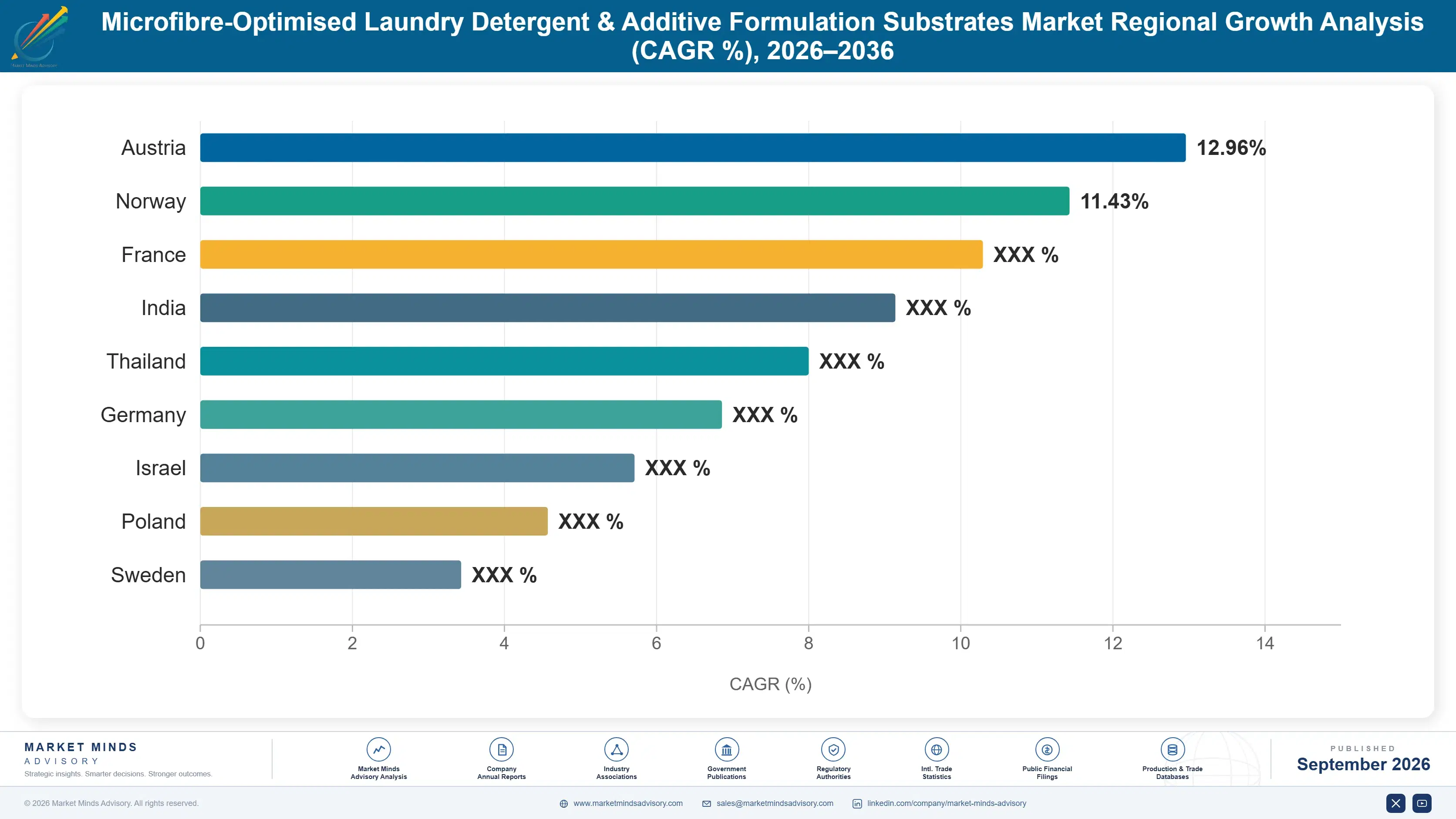
microfibre-optimised-laundry-detergent-additive-fo-country-cagr-analysis-1790013427312

Where Suppliers Win Formulation Positions

Four commercial moves separate suppliers building durable positions from those selling a polymer against an unverifiable claim. Each addresses one of the honest weaknesses in this category: the enzyme contradiction, the measurement problem, the cleaning trade-off, and the fact that fabric decides most of the outcome anyway. Two of them require laboratory capability rather than a commercial decision.

Resolve The Enzyme Package Before Anything Else

Cellulase is present in roughly 74% of premium detergents and cuts fibres by design, which cancels much of what any protection additive achieves in the same formulation. Suppliers offering enzyme-modulated packages alongside protection chemistry report measured shedding reduction 2.4 times greater than protection additives added to unchanged enzyme systems. Selling the additive without addressing the enzyme produces a disappointing result that the brand then attributes to the additive. Very few suppliers hold both enzyme and polymer chemistry, which is what makes this position defensible rather than merely sensible. That scarcity is the whole defence.
Market Impact: Raises measured shedding reduction to 2.4 times greater

Publish Results Against A Named Protocol

Six competing test methods produce numbers that cannot be compared, so a reduction percentage quoted without its protocol tells a formulator almost nothing at all. Suppliers publishing full method conditions alongside results report specification win rates 1.8 times higher with technical buyers who already understand the problem. It costs nothing beyond disclosure, and it distinguishes a supplier from competitors quoting a bare percentage that could mean almost anything. Marketing departments generally resist the disclosure while technical buyers reward it. Technical buyers already understand the protocol problem and treat a bare percentage as evidence of nothing at all.
Market Impact: Raises specification win rates to 1.8 times higher

Engineer Selective Affinity Into Deposition Chemistry

Protection additives cost around four points of cleaning efficacy because deposition and soil removal compete for the same fabric surface during the cycle. Suppliers delivering selective affinity polymers and late-cycle encapsulated actives report efficacy losses of 1.2 to 1.8 points instead. Consumers detect cleaning failures immediately and fibre counts never, so recovering that performance is worth considerably more commercially than a further increment of shedding reduction. Cleaning failures cost a brand more than any fibre count ever will. Late-cycle release is the current workaround, and it costs formulation complexity in exchange for recovering the cleaning performance.
Market Impact: Cuts cleaning efficacy loss to 1.2 points only

Quantify Performance By Fabric Construction Type

About 63% of shedding variance traces to fabric construction rather than to washing, so a single headline reduction figure misrepresents performance across the range of garments a household actually washes. Suppliers quantifying results by construction type report claim substantiation challenges 3.1 times lower in markets where such rules are actively enforced. Honest segmentation of the data also identifies which fabrics the chemistry genuinely helps, which is useful selling information. It also tells the detergent maker which garments the chemistry genuinely helps, which is information no headline percentage conveys and which shapes how the claim should be worded.
Market Impact: Cuts substantiation challenges to 3.1 times lower overall

Who Controls the Margin Pool

Concentration is moderate. Five suppliers hold 41% of category revenue, measured consistently on that basis across all participants, and the gap between the diversified specialty chemical majors and smaller polymer houses is wide in both scale and formulation service depth. Enzyme capability sits with a very small number of participants, which shapes the field considerably. Barriers to entry are low on deposition polymers and very high on anything requiring enzyme development capability.
Competition currently turns on three dimensions: enzyme system capability, which decides whether protection chemistry works at all in a premium formulation; measurement credibility, where publishing full protocol conditions separates serious suppliers from the rest; and cleaning performance preservation, which is what the detergent maker is actually anxious about. Fabric-segmented test data has become a fourth dimension entirely.

Pressure builds from two directions. Washing machine filter hardware competes for the same regulatory attention and delivers verifiable results. Meanwhile textile producers are addressing construction upstream. Rankings will shift toward suppliers holding enzyme capability alongside deposition chemistry, since the two must be resolved together rather than separately. Coordination across two supplier relationships slows adoption more than cost does in several markets.
microfibre-optimised-laundry-detergent-additive-fo-company-positioning-matrix-1790013428192

Competitive Moat and Risk Dimensions

BASF

Moat: Breadth Across Detergent Chemistry

Positions across surfactants, polymers, enzymes, and chelants let the business reformulate a whole detergent system rather than adding one additive to somebody else's package. That matters uniquely here, since fibre protection fails unless the enzyme package is addressed alongside it, and few competitors can influence both parts of the formulation.
BASF

Risk: Legacy Cellulase Business Conflict

Established positions in the enzyme chemistry that causes part of the problem create an awkward commercial conflict when selling the remedy. Customers reformulating away from conventional cellulase reduce revenue in one part of the portfolio to grow another, which is a difficult internal conversation rather than a simple product substitution.
EVONIK INDUSTRIES

Moat: Interface And Deposition Expertise

Deep competence in interfacial chemistry and controlled deposition addresses the trade-off formulators care most about, which is protecting fibres without surrendering cleaning performance. That capability was built across unrelated applications over many years and cannot be assembled quickly by a competitor entering this specific application from outside.
EVONIK INDUSTRIES

Risk: No Enzyme Capability Held

Without enzyme chemistry in the portfolio, the business depends on the detergent maker resolving the cellulase contradiction independently, and many do not. Protection additives added to unchanged enzyme packages underperform, and the disappointing result is generally attributed to the additive rather than to the enzyme left in place.

Players Tracked

Prominent Players

BASF
Dow
Evonik Industries
Clariant
Croda International

Other Key Players

Solvay
Nouryon
Stepan Company
Novonesis
Kao Corporation
Shin-Etsu Chemical
Wacker Chemie
Momentive Performance Materials
Elementis
Lubrizol
Ashland
Innospec
Sasol Chemicals
Huntsman Corporation
Milliken and Company

Recent Developments

MARCH 2026

Evonik Launches Fibre-Lubricating Polymer With Published Protocol Data

Evonik Industries released a fibre-lubricating polymer substrate supplied with full test method conditions alongside reduction figures, including results segmented by fabric construction rather than a single headline percentage covering everything. Results were reported across six fabric constructions, with reduction figures ranging widely between them rather than averaged into one number.
Signal: Disclosure of method conditions becomes a competitive position rather than a liability. Technical buyers reward it while marketing resists.
AUGUST 2025

BASF Expands Cationic Deposition Polymer Capacity

BASF completed an organic capacity expansion for cationic deposition polymer production, funded internally with no partner involved, after detergent reformulation demand across premium ranges outran available reactor and finishing throughput at existing sites. Output serves both branded and retailer own brand formulation programmes across several regions.
Signal: Reformulation activity is running ahead of demonstrated consumer demand here. Capacity is being built ahead of proven consumer pull.
MAY 2025

Croda International Acquires Fibre-Care Polymer Specialist

Croda International completed an acquisition of a fibre-care polymer specialist, adding selective affinity deposition chemistry and fabric-specific performance data to a portfolio previously weighted toward conditioning rather than protection applications. The acquired business brings fabric-specific test data across a wide construction set, which would have taken years to accumulate independently.
Signal: Selective affinity chemistry is being bought rather than developed internally. Test data itself is now an acquirable asset here.

What Protection Chemistry Costs

Three input groups dominate cost. Monomer and polymer feedstock runs 36% to 44% of cost of goods sold, and the eight-point range separates commodity acrylate chemistry from engineered selective affinity polymers. Enzyme and biological actives take 16% to 24%, with modulated systems at the upper end. Silicone and polysiloxane intermediates add 12% to 18%, and their pricing follows an entirely separate industrial chain.
Acrylic acid and ethylene oxide derivative pricing moved through 2024 and 2025 alongside energy costs at the cracker and oxidation stages, and several specialty chemical producers described the resulting margin pressure in their annual reports for those years. EIA energy price series document the underlying movement. Enzyme production costs followed fermentation capacity utilisation rather than petrochemical feedstock, which behaves independently in most years. Silicone intermediates moved on a third track again.

The competitive disadvantage mechanism runs through formulation service rather than through unit cost. A supplier selling a polymer against a specification competes on price with every equivalent polymer, while one reformulating the enzyme package alongside it is solving a problem nobody else in the room can address. Exposure varies sharply by capability: single-chemistry suppliers carry full price exposure, while integrated houses convert it into service revenue.
microfibre-optimised-laundry-detergent-additive-fo-cost-volatility-analysis-1790013428556

Sell Reformulated Systems Rather Than Single Additives

Protection chemistry underperforms badly when added to an unchanged enzyme package, and the disappointing result gets attributed to the additive rather than to the cellulase left in place. Supplying a reformulated system removes that failure mode entirely and moves the commercial conversation away from price per kilogram toward measured performance. Very few suppliers can offer the reformulated system at all.

Contract Enzyme Supply Separately From Polymer Feedstock

Enzyme production costs track fermentation capacity utilisation while polymer feedstock follows petrochemical energy pricing, and the two move independently across most years. Managing these exposures on separate contracting cycles avoids renewing both at a moment that happens to suit neither input at all. Enzyme supply is also concentrated among few producers, which makes contract timing consequential.

Amortise Test Programme Cost Across Fabric Sets

Credible performance data requires testing across multiple fabric constructions rather than one, since 63% of shedding variance sits there. That programme cost is close to fixed per chemistry, so suppliers testing one product carry it alone while those building a range spread it sensibly across the whole portfolio. Single-product testing rarely justifies the programme cost.

Portfolio Architecture for Margin Defence

Margin follows whether the supplier reformulates or merely supplies. Commodity deposition polymers compete on price against equivalent chemistry from several producers. Silicone emulsions earn moderately on manufacturing complexity. Enzyme-modulated systems and selective affinity polymers earn most, because both address problems the detergent maker cannot solve internally and neither is available from more than a handful of suppliers. The margin spread across those groups is unusually wide for a detergent input.
The tension between volume and premium runs through the detergent maker's own positioning. A mass brand adding a modest claim buys the cheapest polymer that supports it and reformulates nothing. A premium brand defending a substantiated claim needs enzyme work, fabric-segmented data, and preserved cleaning performance, and it pays for all three because the claim would otherwise fail challenge.

High-value pools concentrate where substantiation is enforced or the technical problem is genuinely hard: markets with active claim challenge rules, premium ranges carrying cellulase that must be reworked, and formulations where cleaning performance cannot be surrendered. Where the claim is decorative and unchallenged, price decides and any deposition polymer will serve. That divide follows enforcement rather than brand tier.

Volume / Commodity-Adjacent

Commodity cationic deposition polymers and standard silicone emulsions supplied against specification with no formulation support attached. The ten-point range reflects manufacturing scale and feedstock position rather than any capability the formulator would pay a premium for.
Gross Margin: 24% to 34%

Premium / Certified

Fibre-lubricating polymers and encapsulated actives supplied with fabric-segmented performance data under a named protocol. The twelve-point range separates suppliers publishing full method conditions from those quoting a single headline reduction percentage.
Gross Margin: 38% to 50%

Sustainability / Regulatory / Next-Generation

Enzyme-modulated systems and selective affinity polymers that resolve the cellulase contradiction while preserving cleaning performance. The fourteen-point range reflects whether enzyme capability is held internally or the detergent maker must arrange it separately.
Gross Margin: 54% to 68%
microfibre-optimised-laundry-detergent-additive-fo-portfolio-architecture-1790013429403

High-value Sub-segments and Strategic Watch-out

Enzyme-Modulated Protection Systems

Highest value in the category, growing at 22.8% because the cellulase contradiction blocks everything else from performing. The fourteen-point range reflects whether enzyme chemistry sits inside the supplier or has to be coordinated with a third party. Coordination burden is the practical obstacle to adoption.
Gross Margin: 56% to 70%

Selective Affinity Deposition Polymers

High value where cleaning performance is preserved rather than surrendered for protection. The fourteen-point range reflects genuine affinity engineering against products described as selective while behaving like conventional deposition chemistry in practice. Nobody has fully solved the trade-off yet. Cleaning performance recovery is the real selling point.
Gross Margin: 44% to 58%

Encapsulated Fibre-Protection Actives

Volume core depositing late in the cycle to reduce interference with soil removal during the main wash. The twelve-point range reflects encapsulation quality, which determines whether release timing actually works as the specification promises. Formulation complexity rises in exchange for recovered cleaning. Release timing decides whether it works.
Gross Margin: 36% to 48%

Commodity Deposition Polymers

The strategic watch-out. The chemistry is widely available, the claim it supports is generally unchallenged, and mass brands buy on price alone with no reformulation. The ten-point range reflects feedstock position and manufacturing scale only. Switching happens freely at every purchasing review. No reformulation accompanies the purchase.
Gross Margin: 22% to 32%

How This Demand Recurs

Recurring revenue follows detergent reformulation cycles, which run three to five years in Western markets and considerably shorter in China and Korea. Once a formulation is locked and its claim substantiated, the additive is specified for the life of that formulation without competitive review, because retesting to substantiate a replacement costs more than any raw material saving could recover across the volume involved.
Adoption depth varies sharply by brand position. Premium ranges carrying substantiated claims in enforced markets build deep supplier relationships involving enzyme work and fabric-segmented testing. Mass ranges adding a decorative claim buy the cheapest supporting polymer and switch freely at every review. Retailer own brand sits between, adopting the theme when a retailer sustainability programme requires it and dropping it when priorities move.

The specifier profile has shifted from procurement toward regulatory affairs and claims substantiation. Fibre protection began as a marketing request passed to purchasing and became a technical brief owned by people responsible for defending the claim, which changed both the conversation and what suppliers must bring to it. Method disclosure now matters more than price in exactly the accounts worth holding.
microfibre-optimised-laundry-detergent-additive-fo-end-use-penetration-index-1790013430273

Where This Market Rewards

These are among the four positions where our research anticipates prominent divergence between winners and laggards over the coming forecast period. Each is grounded in the demand model, the regulatory perimeter, and the announced capacity pipeline.
01 / ENZYME PACKAGE RESOLUTION

Fix the cellulase before adding anything

Cellulase sits in roughly 74% of premium detergents and cuts fibres by design, cancelling much of what any protection additive delivers in the same formulation alongside it. Suppliers offering enzyme-modulated packages alongside protection chemistry report measured shedding reduction 2.4 times greater than protection chemistry added to unchanged enzyme systems. Selling the additive alone produces a disappointing result that the brand then attributes to the additive rather than the enzyme, and very few suppliers hold both enzyme and polymer chemistry to offer it.
02 / METHOD DISCLOSURE PRACTICE

A percentage without a protocol means nothing

Six competing laboratory protocols differ on agitation, load ratio, and whether shedding is reported as count or mass, so bare reduction figures cannot be compared between products at all. Suppliers publishing full method conditions alongside their results report specification win rates 1.8 times higher among technical buyers who already understand the problem. Disclosure costs nothing and separates a serious supplier from competitors quoting numbers that could mean almost anything, and marketing departments resist the disclosure that technical buyers actively reward.
03 / CLEANING PERFORMANCE PRESERVATION

Consumers notice dirt, never fibre counts

Protection additives typically cost around four points of wash efficacy, because deposition and soil removal are competing for exactly the same fabric surface throughout the cycle. Suppliers delivering selective affinity polymers alongside late-cycle encapsulated actives report cleaning efficacy losses of only 1.2 to 1.8 points in the same formulations instead. Recovering that performance is worth more commercially than any further increment of shedding reduction, since cleaning failures are noticed immediately, while fibre counts are invisible to every consumer who ever buys the product.
04 / FABRIC SEGMENTED SUBSTANTIATION

The garment decides most of it

Around 63% of all shedding variance traces back to fabric construction and yarn twist rather than to anything occurring during the wash cycle itself. Suppliers quantifying their results by fabric construction type report claim substantiation challenges 3.1 times lower in jurisdictions where such rules are actively enforced against advertisers. Honest data segmentation also identifies precisely which fabrics the chemistry helps, which turns out to be useful selling information, and it shapes how the claim itself should be worded on pack.

Engagement Snapshot From the Field

A live engagement with an industry participant carrying material or product regulatory and market exposure ahead of a defining policy shift, showing how our research translates into a defensible multi-year portfolio strategy.
MARKET MINDS ADVISORY · CLIENT ENGAGEMENT SUMMARY
Microfibre-Optimised Laundry Detergent & Additive Formulation Substrates Producer Strategic Portfolio Review and Transition Roadmap 2026·Investment Scenario on Microfibre-Optimised Laundry Detergent & Additive Formulation Substrates Exposure Evaluation 2025-26
CLIENT PROFILE
A multinational detergent manufacturer with annual home care revenue near USD 3.1 billion (client-reported, unverified by MMA), selling premium and mass laundry ranges across twenty-four markets. A fibre-protection claim launched on the premium range had produced measured results well below the supplier's quoted reduction, and a regulator had opened a substantiation query. The board wanted the discrepancy explained before any supplier change.
STRATEGIC CHALLENGE
The formulation team assumed the additive had underperformed and had begun qualifying a replacement supplier. Nobody had tested whether the cellulase already present in the premium enzyme package was cancelling the additive's effect, or whether the supplier's quoted figure used a comparable test protocol at all. Both possibilities pointed away from the supplier being at fault at all.
MMA APPROACH
MMA tested the finished formulation against the additive supplier's protocol and against three alternative methods, ran matched trials with and without cellulase present, and assessed results across six fabric constructions rather than the single reference cloth the original substantiation had used. A competing additive was tested under identical conditions to establish whether supplier substitution would have changed anything.
KEY FINDINGS
  1. Removing cellulase from the enzyme package more than doubled the additive's measured effect, confirming the two chemistries were working directly against one another in the wash.
  2. The supplier's quoted reduction used a protocol with lower agitation energy than the client's own method, which accounted for most of the remaining gap between quoted and observed results.
  3. Measured reduction varied from 9% to 34% across the six fabric constructions tested, so any single headline figure misrepresented performance for most garments in a real load.
  4. Replacing the supplier would have changed nothing, since the competing additive tested identically once the enzyme package was held constant across both trials.
CLIENT PROFILE
A multinational detergent manufacturer with annual home care revenue near USD 3.1 billion (client-reported, unverified by MMA), selling premium and mass laundry ranges across twenty-four markets. A fibre-protection claim launched on the premium range had produced measured results well below the supplier's quoted reduction, and a regulator had opened a substantiation query. The board wanted the discrepancy explained before any supplier change.
STRATEGIC CHALLENGE
The formulation team assumed the additive had underperformed and had begun qualifying a replacement supplier. Nobody had tested whether the cellulase already present in the premium enzyme package was cancelling the additive's effect, or whether the supplier's quoted figure used a comparable test protocol at all. Both possibilities pointed away from the supplier being at fault at all.
MMA APPROACH
MMA tested the finished formulation against the additive supplier's protocol and against three alternative methods, ran matched trials with and without cellulase present, and assessed results across six fabric constructions rather than the single reference cloth the original substantiation had used. A competing additive was tested under identical conditions to establish whether supplier substitution would have changed anything.
KEY FINDINGS
  1. Removing cellulase from the enzyme package more than doubled the additive's measured effect, confirming the two chemistries were working directly against one another in the wash.
  2. The supplier's quoted reduction used a protocol with lower agitation energy than the client's own method, which accounted for most of the remaining gap between quoted and observed results.
  3. Measured reduction varied from 9% to 34% across the six fabric constructions tested, so any single headline figure misrepresented performance for most garments in a real load.
  4. Replacing the supplier would have changed nothing, since the competing additive tested identically once the enzyme package was held constant across both trials.
RECOMMENDED STRATEGY
Phase 1: Phase one: reformulate the premium enzyme package to a controlled-activity cellulase before making any change to the protection additive itself. Phase 2: Phase two: restate the claim using fabric-segmented data under a single named protocol, replacing the single headline percentage entirely. The single figure had misrepresented most garments. Phase 3: Phase three: require protocol disclosure from every additive supplier at quotation stage rather than accepting bare reduction figures. Bare percentages had proved worthless in practice.
OUTCOME
The regulatory query closed without enforcement once fabric-segmented data was submitted (client-reported, unverified by MMA). Measured reduction on the reformulated premium range rose to 31%. Supplier qualification now requires full protocol disclosure as a standing condition. The competing supplier qualification was halted once enzyme testing explained the gap.

Frequently Asked Questions

Foundational context covering the market sizes, CAGR, scope, country, region and competition that inform every finding below. This section is provided to cover basics and most often pre-purchase conversations, answered from the MMA Primary Research Dataset.

What is the current size of the Microfibre-Optimised Laundry Detergent & Additive Formulation Substrates Market?

The market was worth USD 0.5 billion in 2025 and reaches USD 0.6 billion in 2026. Value covers additive substrates supplied to detergent manufacturers for fibre protection.

How large will the Microfibre-Optimised Laundry Detergent & Additive Formulation Substrates Market be by 2036?

MMA forecasts USD 2.5 billion by 2036, an increase of USD 1.9 billion across the forecast period. That represents 4.17 times the 2026 base of USD 0.6 billion.

What is the CAGR for the Microfibre-Optimised Laundry Detergent & Additive Formulation Substrates Market 2026 to 2036?

The base case compound annual growth rate is 15.2%, with a bull case at 16.5% and a bear case at 13.9%. Historical growth from 2020 to 2025 ran at 13.8%.

Which segment is growing fastest?

Enzyme-modulating and cellulase-control systems grow at 22.8%, half again the market rate of 15.2%. Cellulase cuts fibres by design, which cancels much of what protection additives achieve.

Who are the major companies in the Microfibre-Optimised Laundry Detergent & Additive Formulation Substrates Market?

BASF, Dow, Evonik Industries, Clariant, and Croda International lead the category. Together they hold 41% of revenue, with enzyme capability concentrated in very few hands.

Which country is growing fastest?

China grows at 19.6%, driven by domestic detergent brands adopting fibre protection as premium differentiation where conventional whiteness and stain claims have largely exhausted their value.

Report Segmentation Architecture

The full report scope spans multiple orthogonal segmentation dimensions, with cross-tabulated demand data provided for each dimension pair. Coverage extends further to regional breakdowns, trend trajectories, and the competitive detail needed to support segment-level decision-making.

By Additive Function

  • Fibre-Lubricating Polymer Substrates
  • Cationic Deposition and Anti-Friction Polymers
  • Modified Silicone and Polysiloxane Emulsions
  • Enzyme-Modulating and Cellulase-Control Systems
  • Low-Mechanical-Stress Surfactant Substrates
  • Encapsulated Fibre-Protection Actives

By End-Use Industry

  • Premium Liquid Laundry Detergent
  • Mass Powder Laundry Detergent
  • Unit Dose and Capsule Formats
  • Fabric Conditioner Systems
  • Commercial and Institutional Laundry
  • Textile Care Specialty Products

By Commercial Dimension

  • Multinational Brand Direct Supply
  • Regional Brand Direct Supply
  • Retailer Own Brand Programmes
  • Contract Formulator Supply
  • Specialty Chemical Distribution
  • Formulation Development Contracts

By Region

  • East Asia
  • Western Europe
  • North America
  • South Asia and Pacific
  • Latin America
  • Middle East and Africa
  • Eastern Europe

Scope, Methodology, and Coverage

Every figure in this report is reproducible from documented input assumptions. The scope below maps the historical period, the forecast horizon, the segmentation dimensions, and the countries covered, alongside the underlying primary and qualitative methodology.
Historical Period
2020 to 2025
Forecast Period
2026 to 2036
Base Year
2025 (USD billions; MMA Primary Research Dataset, September 2026)
Market Definition
This market covers formulation substrates and additive systems supplied to laundry detergent manufacturers to reduce textile microfibre release during washing, across fibre-lubricating polymer substrates, cationic deposition and anti-friction polymers, modified silicone and polysiloxane emulsions, enzyme-modulating and cellulase-control systems, low-mechanical-stress surfactant substrates, and encapsulated fibre-protection actives. It excludes filtration hardware, textile manufacturing finishes, commodity surfactant supply, standalone fabric conditioners, and wastewater treatment technology.
Quantitative Units
USD billions, revenue at supplier selling price
Segmentation Dimensions
Additive function, end-use industry, commercial dimension, region
Regions Covered
East Asia, Western Europe, North America, South Asia and Pacific, Latin America, Middle East and Africa, Eastern Europe
Countries Covered
China, Japan, South Korea, Taiwan, France, Germany, United Kingdom, Italy, Spain, Netherlands, Sweden, Poland, Czechia, United States, Canada, Mexico, India, Indonesia, Vietnam, Thailand, Australia, Brazil, Colombia, Chile, Argentina, Saudi Arabia, United Arab Emirates, Egypt, Nigeria, South Africa
Key Companies Profiled
BASF, Dow, Evonik Industries, Clariant, Croda International, Solvay, Nouryon, Stepan Company, Novonesis, Kao Corporation, Shin-Etsu Chemical, Wacker Chemie, Momentive Performance Materials, Elementis, Lubrizol, Ashland, Innospec, Sasol Chemicals, Huntsman Corporation, Milliken and Company
Quantitative Methodology
Primary survey, n=3,800 respondents, Q4 2025, six countries; demand-side model with trade association cross-validation
Qualitative Methodology
47 expert interviews, Q4 2025; applied to validate demand model assumptions, identify emerging dynamics, and assess competitive positioning
Report Format
PDF and XLSX data workbook (Word format preview document)
Publisher
Market Minds Advisory
Report Code
MMA-2026-CHM-221
Published
September 2026
Contact
sales@marketmindsadvisory.com | www.marketmindsadvisory.com

Purchase the full Microfibre-Optimised Laundry Detergent & Additive Formulation Substrates Market Report (2026 to 2036).

The full report sizes the microfibre-optimised detergent substrate market across six additive functions, seven regions, and thirty countries, with forecasts to 2036 under base, bull, and bear cases. It sets out the cellulase contradiction sitting inside most premium detergent formulations, compares the six competing laboratory protocols and what their divergence does to claim substantiation, and quantifies the cleaning performance cost of meaningful fibre protection. Competitive analysis covers twenty participants evaluated consistently on category revenue, with detailed treatment of which suppliers hold enzyme capability. Cost structure, formulation service economics, and the regulatory preference for filtration hardware are analysed throughout. Primary research includes 3,800 survey responses and 47 expert interviews.
Six additive functions sized and forecast separately
Twenty participants evaluated on category revenue consistently
Six competing test protocols compared on conditions and outputs
Cleaning efficacy cost quantified by deposition chemistry type
Shedding variance attributed between fabric construction and wash conditions
Regulatory trajectory tracked across filtration hardware and formulation routes

Built For The People Who Decide

From boardroom strategy to bench-side execution, this report is read cover-to-cover by leaders shaping the next decade of their industry, turning demand scenarios, market dynamics and valuation benchmarks into decisions.
CXOs/ Presidents/ VPs/ Managers
M&A and Corporate Development
Strategy Teams and R&D Heads
Procurement and Product Directors
Regulatory and Compliance Leaders
Investor Relations and Equity Analysts