Market Minds Advisory
Microcontroller Socket Market

Microcontroller Socket Market: Microcontroller Socket Market. Advanced Packaging Complexity Reshapes Test Interconnect Design.

Rising automotive and IoT microcontroller volumes are pushing test socket makers toward finer pitch, higher cycle-life contact designs as package-on-package formats complicate final test and programming interconnect economics across the industry.

Lead Analyst

Published

September 2026

Make Smarter Decisions with Customized Research Insights

Request a free sample report and evaluate market opportunities, growth trends, and competitive dynamics relevant to your business needs.

2025 MARKET VALUE$1.1BMarket Size 2025
2036 FORECAST VALUE$2.4BBase Case , 2026 to 2036
CAGR 2026 TO 20366.8 %Bull 8.0% / Bear 5.5%
INCREMENTAL OPPORTUNITY$1.1BNet 10- year value creation
EXPANSION MULTIPLE1.93x2036 value over 2026 base
Strategic Levers
M&A Pipeline
Regional Outlook
Country Rankings
Competitive Intelligence
Segmental Deep-dive
Call-Us : 91 93563 13602

Executive Snapshot and Market Trajectory.

Package-on-package microcontroller formats are forcing socket makers to redesign contact geometries around finer pitch and lower insertion force requirements, a shift accelerating faster than most test equipment vendors anticipated even two full years ago, reshaping engineering priorities across the entire supplier base yet again this year.
Automotive and industrial microcontroller volume growth is the dominant commercial force, with package-on-package test sockets growing fastest as advanced packaging complicates final test interconnect design across nearly every major semiconductor test house globally, straining engineering resources at smaller specialist vendors lacking dedicated packaging teams entirely across their organizations today. East Asia dominates production through Taiwan, China, and Malaysia OSAT facilities, well beyond typical regional concentration given assembly and test capacity investment scale.
Competitive intensity remains fragmented across dozens of specialized socket makers, none commanding dominant overall share, since contact technology expertise varies considerably by package type and pitch requirement across different customer segments served. Rising MCU programming volume tied to IoT device proliferation continues shaping which socket designs semiconductor test houses standardize on, forcing smaller makers to specialize narrowly rather than compete broadly, a pattern unlikely to reverse soon.
Market Definition
The microcontroller socket market covers mechanical interconnect devices used to hold and electrically contact microcontroller packages during engineering validation, production test, burn-in, and programming operations without permanent solder attachment. It excludes production PCB solder sockets intended for end-product assembly and general IC test handlers sold as complete automated systems.
Base Year Value
$1.1B in 2025 (MMA Primary Research Dataset, September 2026)
Forecast Period
2026 to 2036, eleven discrete annual values
CAGR
6.8% base case. Bull 8.0%. Bear 5.5%.
Fastest Growth Segment
Package-on-Package (PoP) Test Sockets: 12.0% CAGR
Fastest Growth Country
Vietnam: 10.5% CAGR
Fastest Growth Region
South Asia and Pacific: 8.8% CAGR
Largest Region
East Asia: 33% of 2025 global value
Market Leaders
Yamaichi Electronics, Ironwood Electronics, Enplas Corporation, Aries Electronics, Advanced Interconnections Corp lead the field. Source: MMA Primary Research Dataset, July 2026.
Primary Survey
n=3,800 procurement and R&D decision-makers, Q4 2025, six countries
Methodology
Demand-side build-up, cross-validated against public data, 47 expert interviews

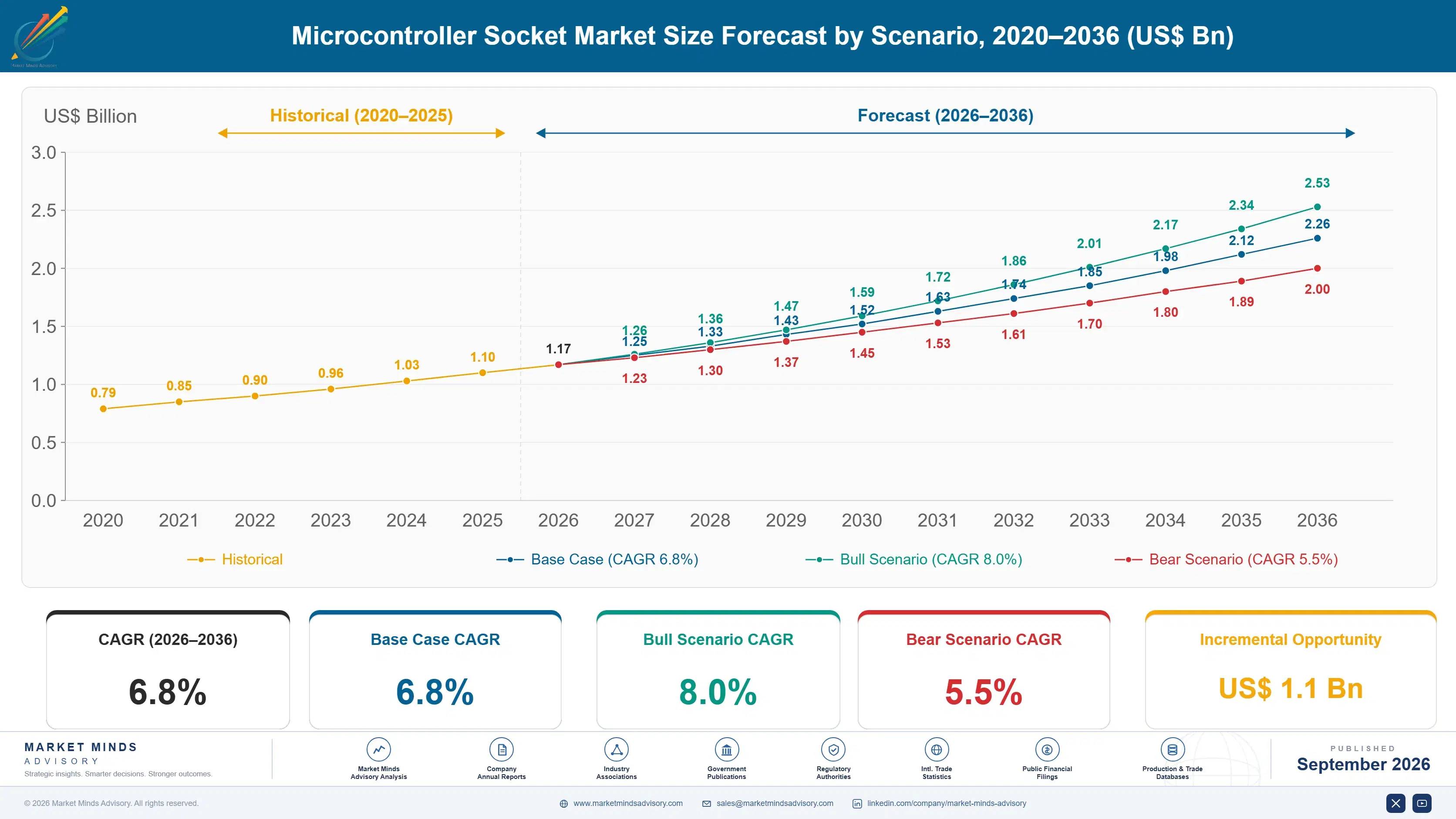
Microcontroller Socket Market Forecast Scenarios

microcontroller-socket-market-size-forecast-scenario-1788419228536
Between 2020 and 2025 the microcontroller socket market grew steadily as automotive electrification and IoT device proliferation expanded the underlying microcontroller unit volume these sockets serve, even as pandemic-era supply disruptions briefly slowed test equipment capital spending in 2021 and early 2022. The historical annual growth rate held near 5.8 percent across the full period.
The base case assumes automotive microcontroller content per vehicle keeps rising as electrification and driver assistance features expand, package-on-package formats become standard for a growing share of IoT and wearable microcontrollers, and semiconductor test houses continue outsourcing final test capacity to OSAT providers concentrated in East Asia. These three mechanisms together sustain a forecast compound annual growth rate near 6.8 percent through 2036, with advanced packaging complexity driving incremental socket redesign cycles.
The bull case assumes automotive MCU content growth accelerates faster than current forecasts anticipate, pushing growth toward 8.0 percent as package complexity rises in step across most vehicle platforms. The bear case assumes consolidation among test house customers reduces the number of distinct socket qualification programs needed, capping growth near 5.5 percent as fewer, larger buyers negotiate harder on price.

Contact Cycle Life Determines Socket Pricing Power

Socket economics hinge on contact cycle life against pin count and pitch, since test houses run the same socket thousands of insertion cycles before replacement becomes economical relative to yield loss risk. Makers who deliver longer cycle life at fine pitch capture premium pricing over commodity contact designs, even when raw material cost differences are minimal between competing socket architectures. Finance teams now track cycle life as a standard procurement decision criterion.
MARKET CONCENTRATION48% CR5Top five makers hold under half revenue overall
AVERAGE CONTACT CYCLE LIFE500,000 cyclesTypical insertion count before contact performance degrades quite meaningfully
TOP PRODUCING COUNTRY SHARE31%Taiwan accounts for largest single-country test volume share
QUALIFICATION CYCLE LENGTH9 monthsAverage months from design engagement to volume approval
CONTACT MATERIAL COST SHARE38%Precious metal plating costs as share of unit expense
SOCKET REPLACEMENT FREQUENCY18 monthsAverage months before test houses replace worn sockets
Market concentration remains moderate, with the top five makers controlling roughly 48 percent of revenue, reflecting a fragmented competitive landscape where contact technology expertise varies by package type and pitch requirement. Qualification cycles run considerably longer than typical component purchases because test houses validate socket performance against actual production yield data before committing to volume production use. This dynamic favors specialists over generalist component distributors entering the category.
Average selling prices vary enormously by contact technology and pin count, from simple low pin count sockets to complex package-on-package designs commanding prices many times higher per unit. Makers increasingly bundle custom engineering services into the sale, since package-specific socket design requires close collaboration with semiconductor customers well before volume production begins across a given product generation.
"Everyone thinks sockets are a commodity until a batch of them starts scrapping good die at final test, and then the customer suddenly cares enormously about cycle life. The makers who engineer for that failure mode win the long-term contracts."
Lead Analyst, Semiconductor Test Equipment Practice · MMA Technology Practice · September 2026

Market Trends

Package On Package Formats Complicate Socket Design

Package-on-package microcontroller formats, stacking logic and memory dies vertically to save board space, are forcing socket makers to design fine-pitch contact arrays capable of reaching interconnect points buried beneath a top-package layer. Vendors report package-on-package test socket revenue growing over 40 percent faster than conventional single-die socket revenue during 2025, confirming the segment's outsized momentum among automotive and IoT customers alike. This shift is reshaping engineering priorities across the industry, pulling research investment away from legacy single-die contact designs that once represented the bulk of new product development spending industry-wide.
Market Impact: Programming socket demand grew 28 percent
Automotive Electrification Expands Test Socket Demand

Rising microcontroller content per vehicle tied to electrification and driver assistance features is expanding automotive-qualified socket demand faster than the broader semiconductor test equipment market overall across most regions and platforms. Automotive customers now account for roughly 35 percent of total microcontroller socket revenue, up meaningfully from prior years, as vehicle electronics content keeps expanding across every major vehicle platform category and price tier. This shift is pushing socket makers to invest heavily in automotive-grade reliability qualification programs that consumer electronics customers historically did not require to the same rigorous degree.
Market Impact: OSAT capex commitments reached 6 billion

Market Opportunities and Growth Drivers

IoT Device Proliferation Drives Programming Socket Demand

Rising IoT device unit volumes require pre-programming a growing share of microcontrollers before board assembly, since many IoT product lines ship in configurations too varied for post-assembly programming to remain cost-effective at meaningful commercial scale. Programming socket demand grew roughly 28 percent in 2025 as contract manufacturers expanded pre-programming service offerings to serve this fragmented customer base across dozens of distinct product configurations. This shift is reshaping which socket features vendors prioritize, favoring rapid swap mechanisms over the pure electrical performance metrics that historically dominated test socket design decisions entirely.
Market Impact: Squeezes margins by 8 points

OSAT Capacity Expansion Sustains Baseline Socket Demand

Outsourced semiconductor assembly and test providers continued expanding final test capacity across Taiwan, China, and Malaysia throughout 2025, sustaining baseline demand for production test and burn-in sockets tied directly to this capacity growth trend. New OSAT facility announcements committed roughly 6 billion dollars in combined capital expenditure across the region, directly supporting incremental socket procurement as new test floors come online over the following two years. This baseline demand provides revenue stability that offsets some of the volatility in more cyclical automotive and consumer electronics end markets makers also serve.
Market Impact: Delays new entry by 9 months

Market Restraints and Challenges

Contact Material Cost Volatility Squeezes Maker Margins

Socket contacts rely heavily on precious metal plating, typically gold or palladium alloys, to maintain low contact resistance across thousands of insertion cycles, exposing makers directly to commodity metal price volatility. The root cause is that no lower-cost plating alternative currently matches precious metal conductivity and corrosion resistance at comparable cycle life performance levels required by demanding customers. Makers are mitigating this exposure through long-term metal hedging contracts and gradual adoption of thinner plating layers combined with improved base contact geometry, though these approaches only partially offset raw material cost swings.
Market Impact: PoP socket revenue grew 40 percent

Long Qualification Cycles Slow New Entrant Growth

Test houses require extensive reliability validation, often spanning six to twelve months, before approving a new socket design for volume production use, creating a substantial barrier that protects established makers from rapid new entrant displacement. The root cause is that a failed socket in production can scrap expensive known-good die, making test houses extremely risk-averse about switching suppliers without exhaustive validation. Newer makers are mitigating this barrier by partnering with established test houses on lower-risk engineering validation programs first, building a qualification track record before pursuing full production volume business.
Market Impact: Automotive revenue share reached 35 percent
4 additional market trends, 3 additional growth drivers, and 3 additional restraints and challenges are covered in the full report. Contact sales@marketmindsadvisory.com to access the complete intelligence.

Segment CAGR and Growth Architecture

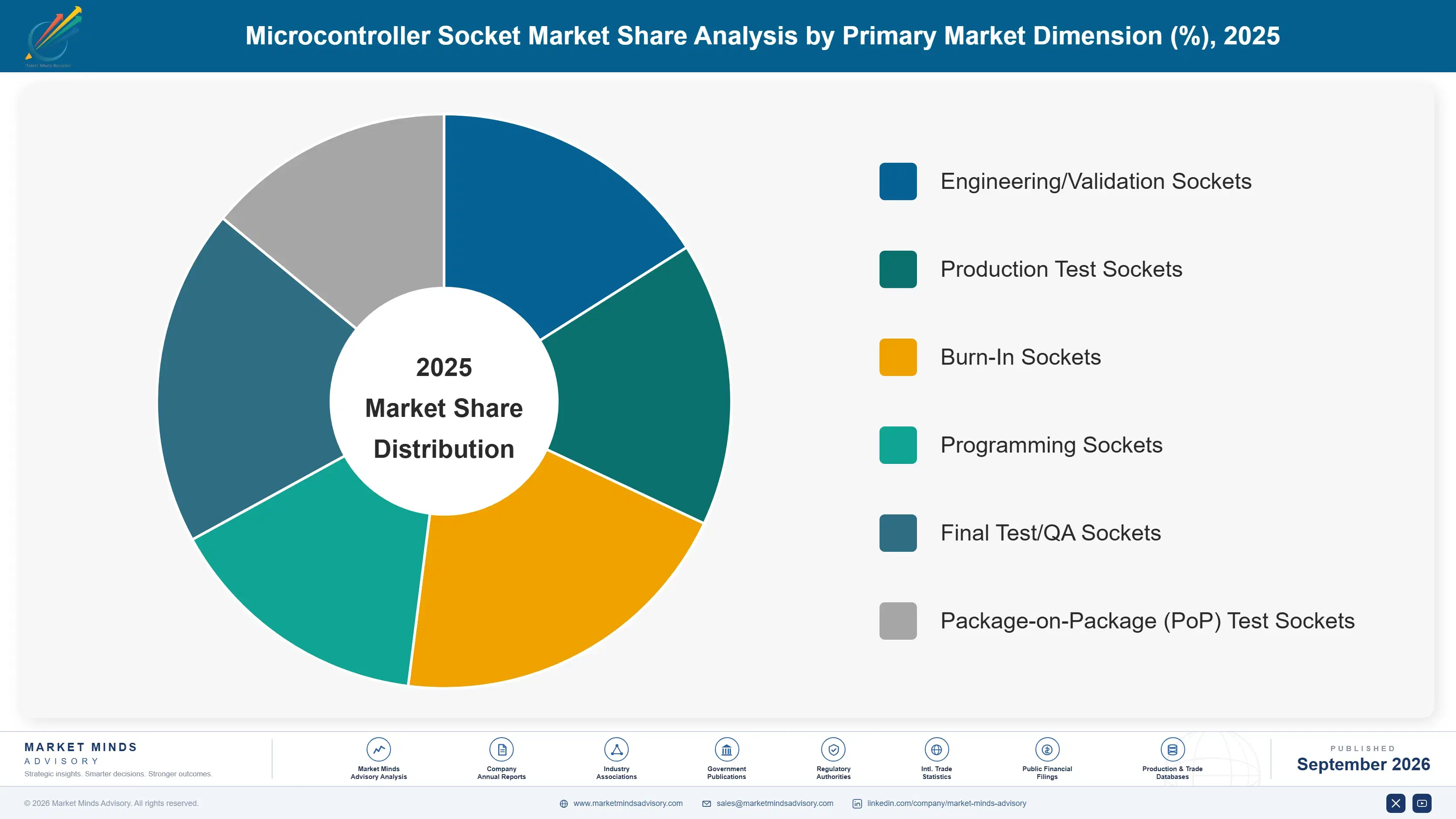
The microcontroller socket market segments by the operational stage each socket type serves in the semiconductor manufacturing flow, spanning engineering validation, production test, burn-in, programming, final test, and package-on-package test sockets, each requiring distinct contact geometries and cycle-life performance tailored to that specific production stage. Product life cycles vary considerably across all six categories tracked.
microcontroller-socket-market-market-share-analysis-1788419229064

Package-on-Package (PoP) Test Sockets

Package-on-package test sockets contact interconnect points buried beneath a top-package layer, requiring fine-pitch contact arrays capable of reaching pads that conventional sockets designed for single-die packages simply cannot access reliably. This segment is growing fastest because advanced packaging adoption is expanding across automotive and IoT applications simultaneously, unlike conventional test sockets serving a more mature, slower-growing single-die package base. Makers have struggled to keep pace with demand, and fine-pitch contact engineering expertise, not manufacturing capacity itself, is now the binding constraint limiting how quickly makers can qualify new socket designs for customers. Pricing for this segment carries a substantial premium over conventional single-die test sockets given the added contact engineering complexity required.
CAGR 12.0%

Programming Sockets

Programming sockets hold microcontrollers in place while automated programming equipment writes firmware before board assembly, prioritizing rapid insertion and removal cycles over the raw electrical performance metrics that matter most for production test applications. Growth is strong as IoT device proliferation pushes more manufacturers toward pre-programming rather than post-assembly programming, particularly for product lines with too many distinct configurations to program economically after final assembly. Contract manufacturers increasingly demand sockets optimized for rapid swap mechanisms that reduce programming station downtime between different microcontroller configurations handled. Several major contract manufacturers have already standardized on rapid-swap socket architectures for next-generation programming lines across their facilities. Adoption keeps broadening as programming volume scales meaningfully each year.
CAGR 9.5%
Full segment breakdown across 7 segments available in the complete report.

Regional Architecture and Country Demand Map

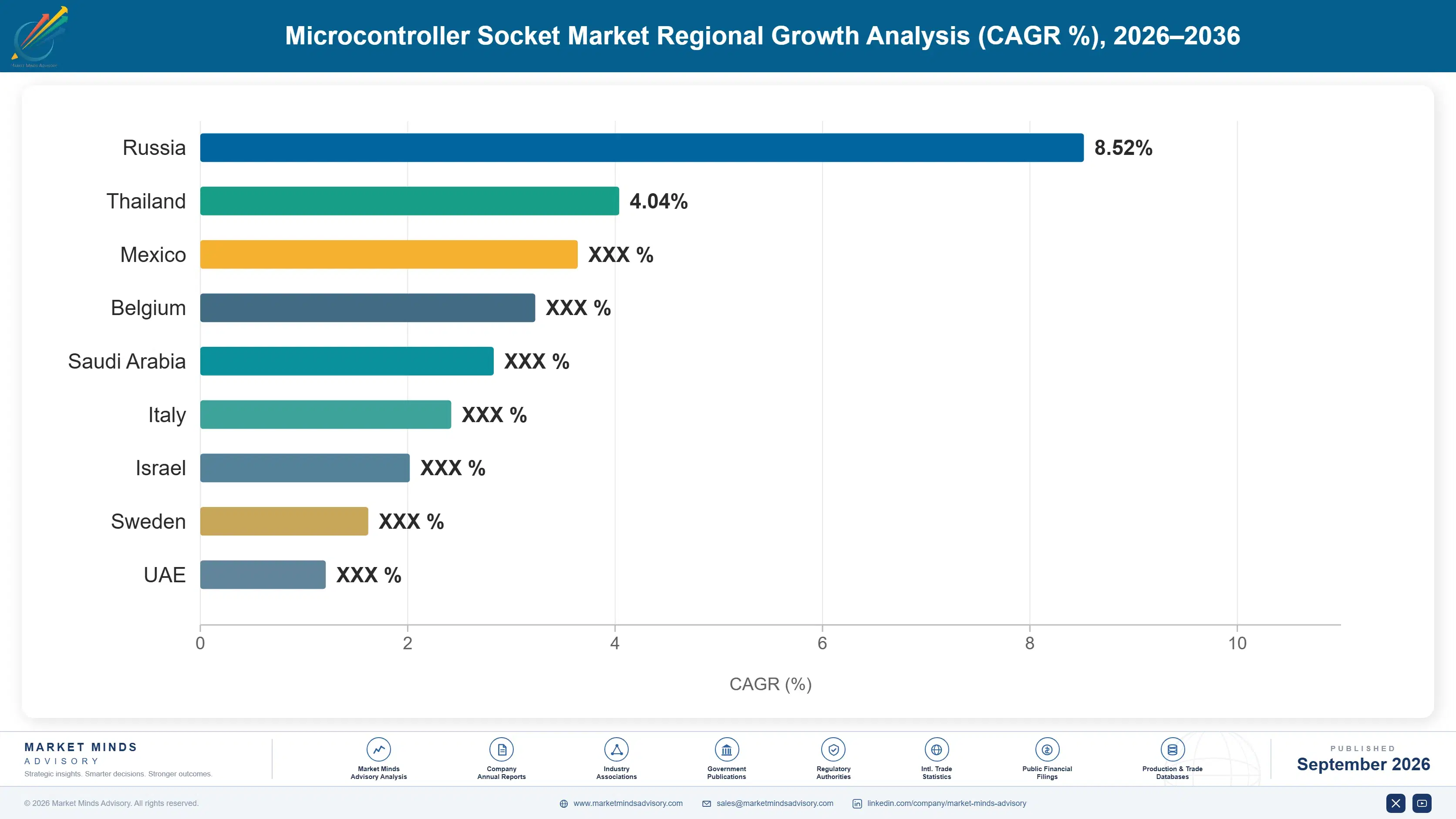
East Asia dominates microcontroller socket demand through Taiwan, China, and Malaysia OSAT test capacity concentration, well beyond typical regional bands given assembly and test facility investment scale, while South Asia and Pacific posts the fastest regional growth as Vietnam's semiconductor assembly investment expands rapidly nationwide.

East Asia

Taiwan's foundry and OSAT network, combined with Malaysia's established test and assembly hubs and China's growing domestic semiconductor manufacturing base, gives this region an outsized 33 percent share, exceeding the standard regional band because final test and burn-in capacity is so heavily concentrated in these three countries rather than distributed globally. This concentration genuinely reflects where semiconductor test operations physically occur, not merely where end-product demand originates, a distinction that matters more for socket demand than for many other component categories. South Korea contributes meaningful demand tied to its own domestic memory and logic manufacturing base as well. Japan's specialty analog and power semiconductor manufacturers add further steady demand tied to their own domestic test operations.
Share: 33% | CAGR: 7.8% (2026 to 2036)

North America

The United States hosts significant automotive and defense electronics test operations that drive this region's socket demand, even though the bulk of high-volume commercial semiconductor final test occurs offshore in Asian OSAT facilities. Domestic test house customers value close engineering collaboration with socket makers during automotive qualification programs, favoring suppliers with local application engineering support. Canada contributes a smaller test and validation presence tied closely to shared North American automotive supply chains. The region's growth rate slightly outpaces the global average as automotive electronics content keeps expanding across new vehicle platforms. Defense procurement across multiple federal programs continues adding steady baseline demand independent of the commercial cycle. This baseline demand remains steady each year.
Share: 24% | CAGR: 7.5% (2026 to 2036)
Regional intelligence for 5 additional markets available in the complete report: Western Europe, South Asia and Pacific, Latin America, Middle East and Africa, Eastern Europe. Contact sales@marketmindsadvisory.com.
microcontroller-socket-market-country-cagr-analysis-1788419229585

Where Socket Maker Margins Concentrate Fastest

Maker profitability increasingly concentrates in custom engineering design services and package-on-package specialty contact technology rather than commodity socket sales, as leading players bundle cycle-life warranties and application engineering support into multi-year customer relationships. This shift rewards makers with the deepest fine-pitch contact expertise available today. Fewer makers compete effectively across every one of these dimensions simultaneously, leaving room for specialists.

Charging Custom Engineering Fees For Package Designs

Makers that charge separate custom engineering design fees for package-specific socket development capture revenue independent of eventual unit volume, protecting against the risk that a customer's production ramp disappoints after design work is complete. This shifts maker economics away from pure volume dependency toward a more predictable engineering services revenue stream. Makers report custom engineering fees now averaging 12 percent of total contract value on complex package-on-package programs, a figure growing steadily as packaging complexity keeps increasing across customer programs. Makers extend this engineering-first model to smaller customers each year as fine-pitch expertise becomes more standardized.
Market Impact: Engineering fees now reach 12 percent of value

Offering Cycle-Life Warranties For Premium Pricing

Makers offering extended cycle-life warranties, guaranteeing a minimum insertion count before contact performance degrades, command meaningfully higher pricing than makers selling sockets without comparable performance guarantees attached. This warranty structure requires confidence in contact material and geometry quality that only makers with substantial engineering track records can credibly offer to skeptical automotive customers. Warrantied sockets command pricing premiums averaging 18 percent above unwarrantied equivalents, rewarding makers willing to invest in the reliability testing needed to support such guarantees confidently. Few competitors possess the track record needed to compete credibly here.
Market Impact: Warrantied sockets now command roughly 18 percent premium

Expanding Rapid-Swap Programming Socket Product Lines

Makers investing in rapid-swap programming socket mechanisms that reduce programming station downtime between different microcontroller configurations are capturing disproportionate share of the fast-growing IoT pre-programming customer segment. This mechanical innovation commands premium pricing over standard programming sockets since it directly improves contract manufacturer throughput economics on high-mix production lines. Makers report rapid-swap product line revenue growing at roughly 30 percent annually, outpacing growth in conventional programming socket sales considerably across the broader customer base served. This expands the addressable customer base meaningfully each year as IoT volumes keep rising. annually.
Market Impact: Rapid-swap revenue now grows roughly 30 percent annually

Building Automotive Qualification Certification For Premium Contracts

Makers achieving automotive-grade reliability qualification certification, a process requiring extensive multi-month validation testing, gain access to multi-year automotive supply contracts largely insulated from the price competition affecting consumer electronics socket sales. This certification barrier protects certified makers from new entrant competition for the life of a given vehicle platform generation, typically spanning five to seven years. Automotive-qualified sockets command pricing premiums averaging 22 percent above equivalent industrial-grade parts, rewarding makers willing to absorb the qualification investment required upfront. Few makers possess the certification history needed to compete in this segment.
Market Impact: Automotive-qualified sockets now command roughly 22 percent premium

Who Controls the Margin Pool

Competitive concentration sits at a moderate 48 percent CR5, reflecting a fragmented landscape where contact technology expertise varies by package type rather than one dominant architecture serving all applications. Participants are evaluated here on revenue, the most commercially consistent basis across makers with very different specialty focus areas. The gap between Yamaichi Electronics, the leading maker, and the fifth-ranked competitor remains narrower than in more concentrated component categories.
Current activity centers on package-on-package contact engineering, as makers race to qualify fine-pitch designs fast enough to meet automotive and IoT customer roadmap timelines already committed. Several makers have also expanded custom engineering service offerings, bundling design collaboration into the sale rather than selling standardized catalog parts alone. Cycle-life warranty programs have intensified as makers seek differentiation beyond pure price competition.

Emerging pressure is coming from contract manufacturers developing in-house socket capability for high-volume, standardized applications, threatening independent makers' share in the most commoditized segments of the market over time. This threatens established makers' pricing power in lower pin count, mature package categories specifically. Rankings are most likely to shift as fine-pitch package-on-package contact capability, not catalog breadth, increasingly determines which makers win automotive and IoT design wins.
microcontroller-socket-market-company-positioning-matrix-1788419230103

Competitive Moat and Risk Dimensions

YAMAICHI ELECTRONICS

Moat: Broadest Package Type Coverage

Yamaichi Electronics maintains the broadest catalog of contact technologies spanning nearly every package type in commercial use, letting it serve customers across automotive, consumer, and industrial applications with a single trusted supplier relationship. This breadth reduces qualification overhead for customers managing multiple product lines simultaneously across different package generations and pitch requirements.
YAMAICHI ELECTRONICS

Risk: Slower To Specialize Emerging Formats

Yamaichi's broad catalog approach sometimes leaves it slower to develop deeply specialized contact solutions for emerging package formats compared to smaller competitors focused narrowly on a single high-growth niche. This creates an opening for specialist makers to win early design wins on the newest package-on-package formats before Yamaichi's broader engineering teams catch up.
IRONWOOD ELECTRONICS

Moat: Deep Automotive Qualification Track Record

Ironwood Electronics has built an extensive automotive qualification track record over multiple vehicle platform generations, giving it credibility with risk-averse automotive customers that newer specialist entrants cannot easily replicate. This certification depth continues expanding as new automotive design wins renew under existing qualified product families each year.
IRONWOOD ELECTRONICS

Risk: Limited Scale Versus Larger Competitors

As a smaller specialist relative to broader catalog competitors, Ironwood faces real constraints scaling production capacity quickly enough to serve the largest automotive fleet contracts without straining its manufacturing operations meaningfully during peak periods. Competitors with larger manufacturing footprints can offer more aggressive volume pricing on the largest programs.

Players Tracked

Prominent Players

Yamaichi Electronics
Ironwood Electronics
Enplas Corporation
Aries Electronics
Advanced Interconnections Corp

Other Key Players

Smiths Interconnect
R&D Sockets Inc
Plastronics Socket Company
Wells-CTI LLC
ITT Cannon
3M Electronic Solutions
Tyco Electronics (TE Connectivity)
Multitest Elektronik
QA Technology Company
Cascade Microtech
Johnstech International
Antares Advanced Test Technologies
Sensata Technologies
Amphenol Corporation
Dai-Ichi Seiko

Recent Developments

APRIL 2026

Yamaichi Launches New Fine-Pitch PoP Socket Line

Yamaichi Electronics launched a new fine-pitch package-on-package socket product line targeting automotive and IoT customer applications, extending cycle-life performance meaningfully beyond its prior generation family sold previously. The launch responds directly to rising demand for contacts capable of reaching interconnect points buried beneath stacked package layers reliably.
Signal: Signals that leading makers are now accelerating product cycles to defend package-on-package market position broadly today.
NOVEMBER 2025

Ironwood Electronics Wins Automotive Qualification Contract

Ironwood Electronics secured a new multi-year qualification contract with a major automotive tier-one supplier to provide burn-in and final test sockets across a new electrification platform launching in 2027 across several regions. The contract covers multiple vehicle programs across the supplier's entire global manufacturing footprint.
Signal: Signals that automotive electrification is now steadily expanding the addressable customer base for socket makers everywhere.
JULY 2025

Enplas Corporation Expands Southeast Asia Production Capacity

Enplas Corporation announced capacity expansion at its Southeast Asian manufacturing facilities to serve growing OSAT customer demand across Vietnam and Malaysia test operations that keep expanding rapidly each quarter. The expansion supports rising programming and production test socket orders tied to regional semiconductor assembly investment growth.
Signal: Signals that makers are now expanding capacity closer to fast-growing Southeast Asian OSAT customer bases today.

Precious Metal Plating Cost Exposure

Gold and palladium alloy contact plating accounts for roughly 38 percent of total socket cost of goods sold, with pricing directly exposed to precious metal commodity markets that fluctuate independent of underlying socket demand. Housing plastics and precision-machined pin bodies make up most of the remainder, sourced primarily from Japanese and Taiwanese specialty material suppliers with established relationships.
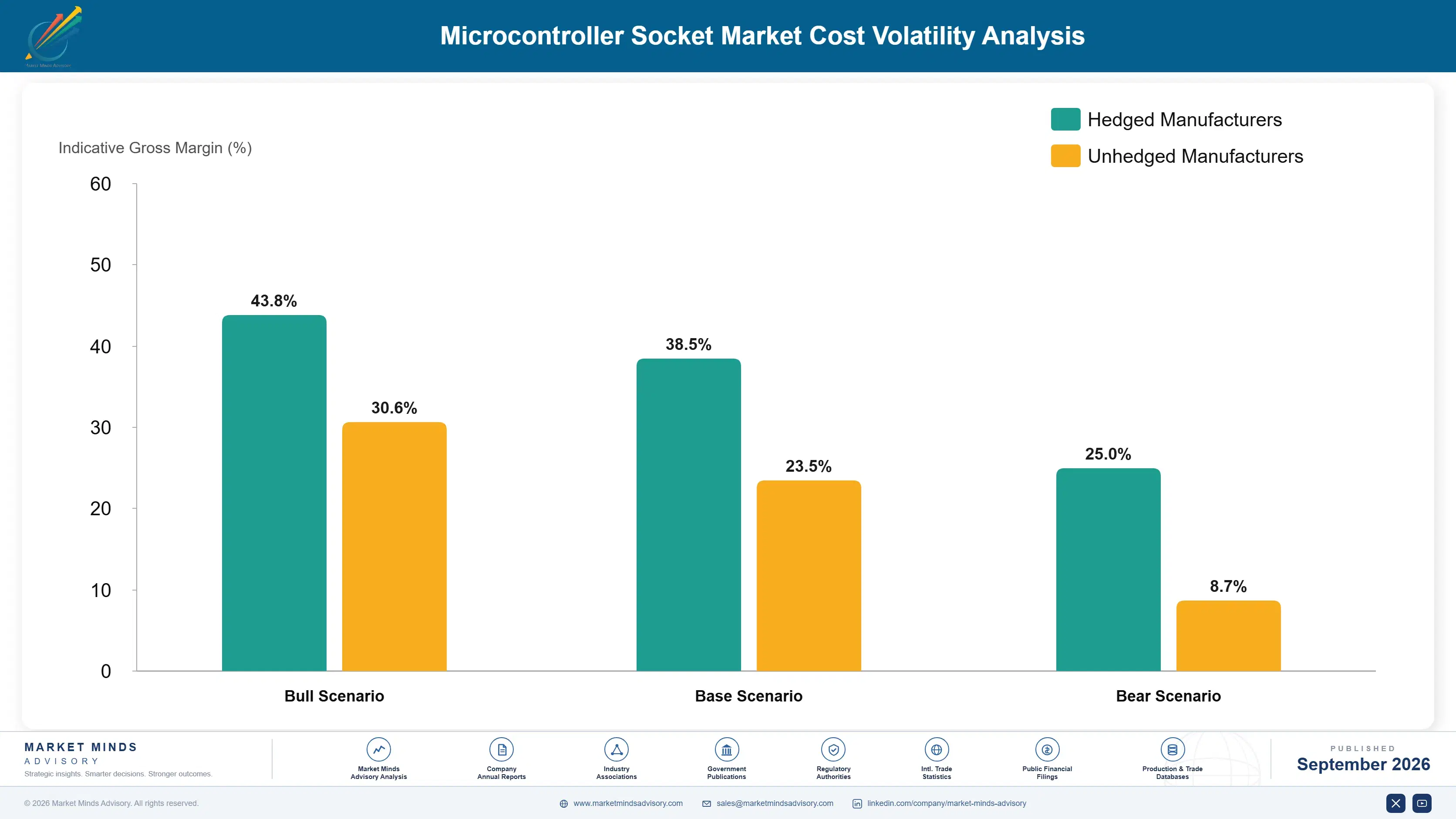
Gold prices surged over 40 percent during 2024 and into 2025, documented in reports referenced across maker annual disclosures, compressing gross margins meaningfully for socket makers unable to pass the full cost increase through to customers under existing contract pricing terms. Makers with long-term metal supply hedging arrangements weathered the spike considerably better than smaller competitors relying entirely on spot market purchasing for their plating material needs.

Makers without hedging arrangements or alternative plating chemistries face a meaningful competitive disadvantage during precious metal price spikes, since contract pricing typically locks in for twelve months regardless of underlying material cost movement. This exposure varies by maker scale: larger makers like Yamaichi Electronics can negotiate volume-based metal supply contracts that smaller specialists simply cannot access on comparable favorable terms.
microcontroller-socket-market-cost-volatility-analysis-1788419230298

Hedging Precious Metal Purchases Through Forward Contracts

Leading makers now lock in gold and palladium pricing through forward supply contracts spanning six to twelve months, insulating gross margin from short-term commodity price spikes that smaller competitors absorb directly. This hedging requires committing to purchase volumes ahead of confirmed customer orders, a trade-off only makers with strong balance sheets can consistently afford.

Developing Alternative Lower-Cost Plating Chemistries

Makers are researching alternative contact plating chemistries using less precious metal content while maintaining comparable conductivity and cycle-life performance, reducing long-term commodity exposure meaningfully across product lines. This research requires extensive reliability validation before customers will accept alternative platings, but meaningfully reduces the ongoing cost volatility tied to precious metal markets over time, once qualified.

Portfolio Architecture for Margin Defence

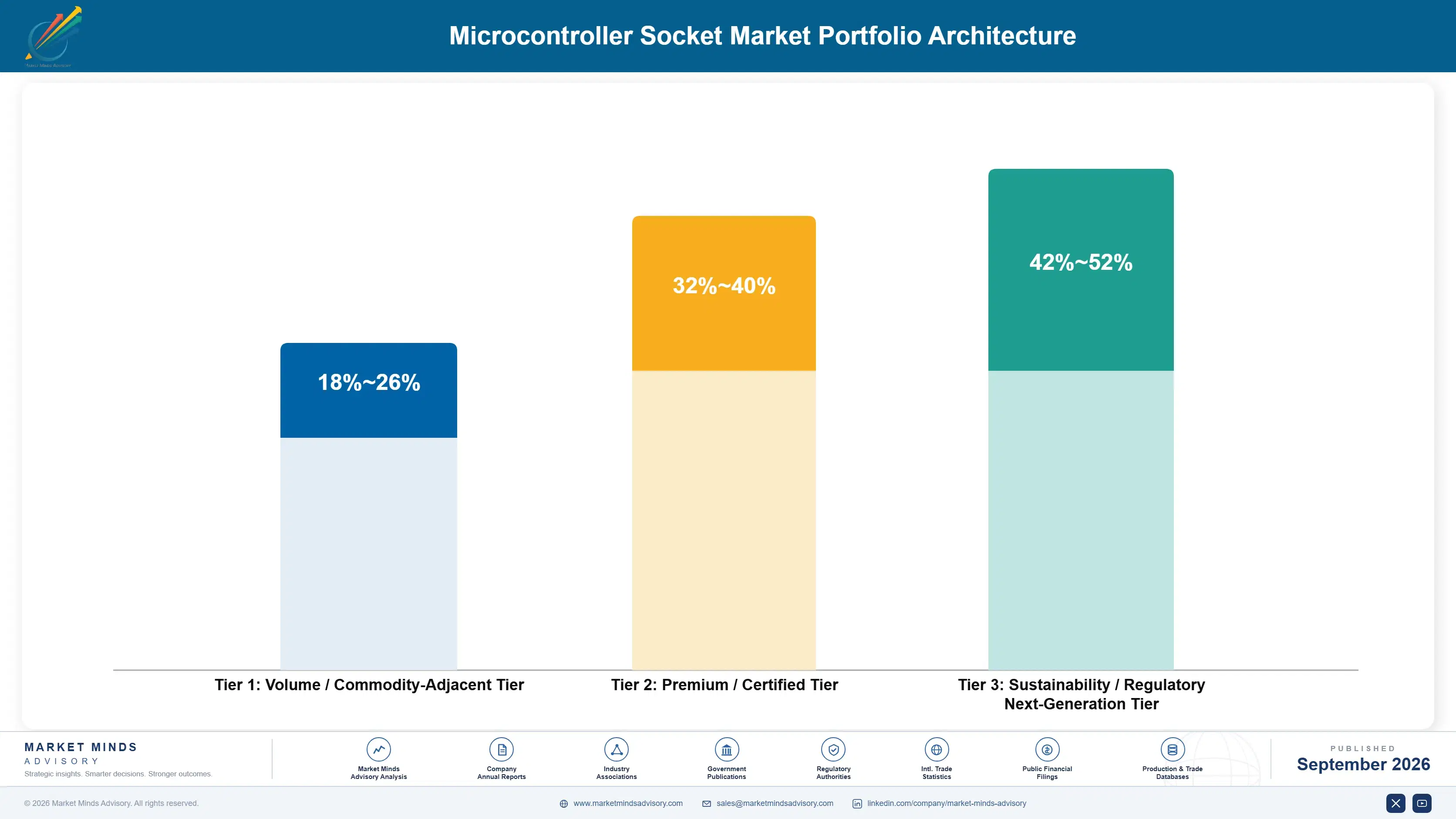
Portfolio economics split across three tiers running from commodity single-die test sockets sold near competitive catalog pricing up through automotive-qualified sockets and next-generation package-on-package designs bundled with custom engineering support. Gross margin widens considerably moving up this ladder, since certification barriers and fine-pitch contact engineering create defensibility that pure catalog breadth alone cannot provide. Investors increasingly value makers by their revenue mix across these three tiers.
Volume tier sockets compete almost entirely on unit price and catalog availability, leaving makers with thin margins that depend on scale to remain profitable across large consumer electronics contracts. Premium tier sockets instead compete on qualification credentials and cycle-life guarantees, letting makers charge meaningfully more per unit while facing far less price pressure during contract renewal. This tension shapes capital allocation across every maker's roadmap.

High-value margin pools concentrate almost entirely in the next-generation tier, where package-on-package sockets generate premium pricing unavailable to makers still selling standalone single-die designs. Makers positioned only in the volume tier face real profitability ceilings that next-generation-tier competitors do not share, regardless of unit volume shipped across any given fiscal year of operation. This concentration keeps becoming more pronounced each year.

Volume / Commodity-Adjacent Tier

Commodity single-die test sockets sold mainly into cost-sensitive consumer electronics and general industrial applications, competing largely on unit price and catalog availability against several large-scale global makers operating at scale.
Gross Margin: 18-26%

Premium / Certified Tier

Automotive-qualified sockets tested to stricter reliability and environmental standards than commercial parts, commanding premium pricing from customers requiring long product lifecycles and rigorous multi-year qualification testing and validation cycles today.
Gross Margin: 32-40%

Sustainability / Regulatory / Next-Generation Tier

Next-generation package-on-package test sockets bundled with custom engineering support, positioned for automotive and IoT customers prioritizing fine-pitch contact reliability well above pure catalog cost considerations entirely each product generation cycle.
Gross Margin: 42-52%
microcontroller-socket-market-portfolio-architecture-1788419230794

High-value Sub-segments and Strategic Watch-out

Package-on-Package (PoP) Test Sockets

Package-on-package test sockets sit in the high-value high-growth quadrant, combining the fastest unit growth rate tracked with the widest gross margin band once custom engineering premiums layer on top of catalog pricing, making this the clearest priority for maker capital allocation across this entire decade.
Gross Margin: 42-52%

Programming Sockets

Programming sockets occupy the high-value moderate-growth quadrant, generating strong per-unit margin from rapid-swap mechanical innovation even though growth trails package-on-package sockets, because IoT customer configurations vary considerably more than automotive customer programs typically do, slowing standardization efforts across the entire broader catalog offered to customers.
Gross Margin: 32-40%

Production Test Sockets

Production test sockets remain the volume core segment, generating the bulk of current unit shipments at thinner margins, still essential for maker scale economics even as growth slows relative to package-on-package alternatives entering the category more aggressively with each successive product generation released to market.
Gross Margin: 20-28%

Burn-In Sockets

Burn-in sockets form the strategic watch-out segment, facing real commoditization risk as production test sockets increasingly absorb combined test and burn-in functionality natively at comparable reliability today, threatening makers that never diversified beyond simple standalone burn-in product lines into richer, higher-margin categories over the years.
Gross Margin: 18-24%

Warranty Bundles Extend Socket Vendor Relationships

Socket makers increasingly bundle custom engineering design services and cycle-life warranties alongside hardware sales, converting what was once a simple component purchase into a longer-tail relationship spanning a customer's full production run and every subsequent replacement order. This bundled model gives makers recurring revenue visibility through replacement cycles rather than relying entirely on one-time initial qualification sales alone. Investors increasingly value makers on this recurring replacement revenue mix.
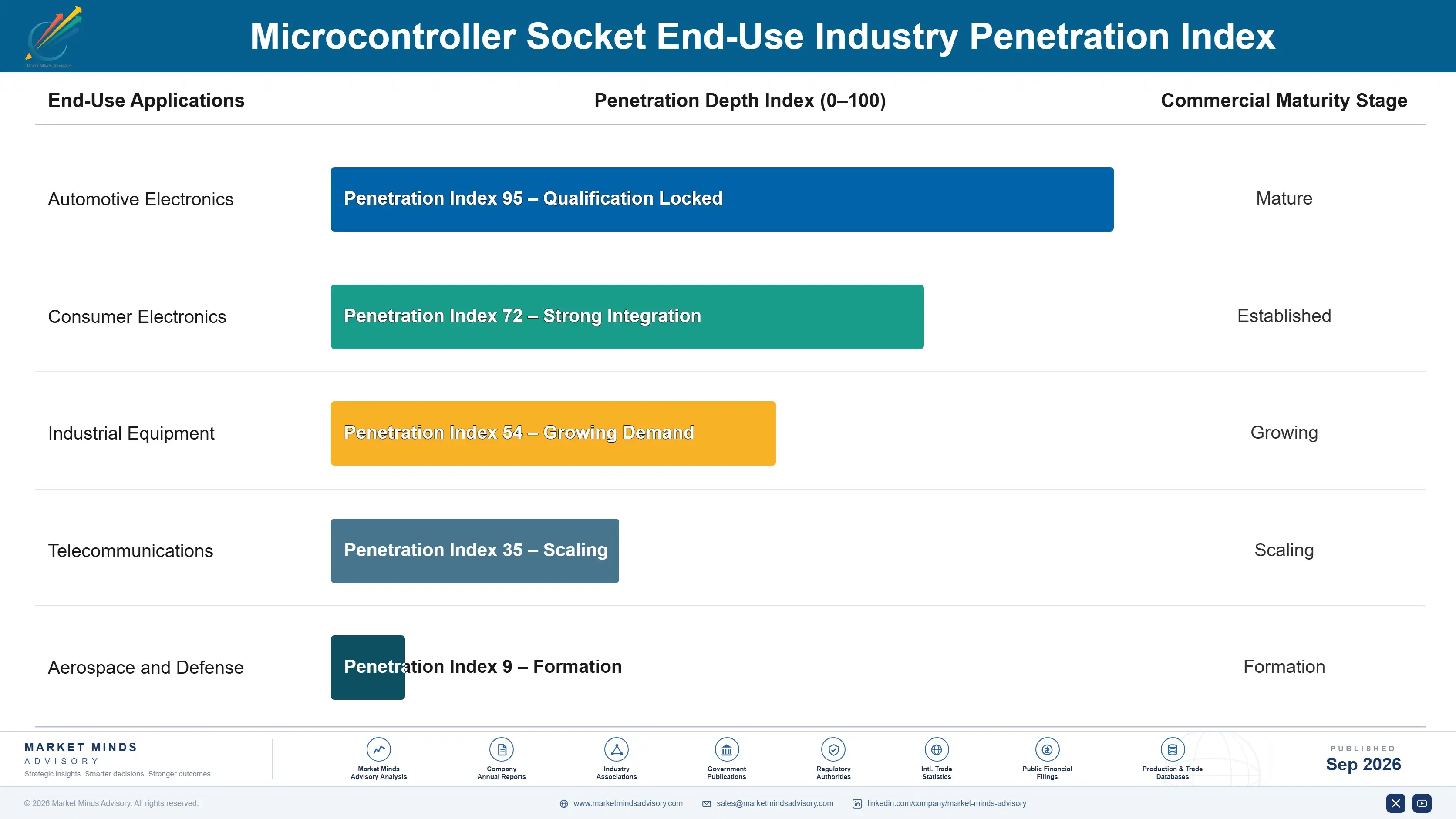
Adoption depth varies sharply by end-use vertical: automotive-qualified test houses commit to multi-year socket qualification programs and rarely switch suppliers once designs pass reliability validation, while consumer electronics test houses operate on shorter product cycles and remain more price-sensitive at each socket refresh cycle they undertake. Industrial customers sit between these extremes, valuing durability over pure unit cost considerations.

Buyer profiles are shifting generationally as automated test equipment programmers, rather than traditional mechanical design engineers, increasingly influence socket vendor selection given growing emphasis on programming throughput alongside pure electrical contact reliability across an expanding range of package types. This generational shift is reshaping which socket features vendors prioritize, favoring integrated programming interface compatibility over the pure mechanical robustness that historically dominated purchasing decisions.
microcontroller-socket-market-end-use-penetration-index-1788419231281

Where Socket Makers Should Focus Now

These are among the four positions where our research anticipates prominent divergence between winners and laggards over the coming forecast period. Each is grounded in the demand model, the regulatory perimeter, and the announced capacity pipeline.
01 / FINE-PITCH CONTACT INVESTMENT

Prioritize Package-on-Package Contact Engineering Over Catalog Breadth

Makers still investing primarily in broad catalog coverage for conventional single-die packages are missing the fastest-growing opportunity in the industry, since package-on-package socket revenue is growing over 40 percent faster than conventional product lines across every major customer segment tracked. Makers with early fine-pitch contact investment are capturing automotive and IoT design wins that competitors focused on legacy formats simply cannot match today. Makers slow to redirect engineering resources risk ceding the highest-growth customer segment entirely to faster-moving specialist competitors within the next two product cycles.
02 / AUTOMOTIVE CERTIFICATION POSITIONING

Pursue Automotive Qualification Before Programs Fully Consolidate

Makers without established automotive qualification credentials face a multi-year barrier entering a segment now accounting for roughly 35 percent of total microcontroller socket revenue, up meaningfully from prior years across nearly every vehicle platform category tracked. Automotive-qualified sockets already command pricing premiums averaging 22 percent above equivalent industrial-grade parts, rewarding makers willing to absorb the certification investment upfront now. Makers should begin qualification programs immediately, since the multi-year timeline means today's decisions determine which makers compete for the next decade of vehicle platform contracts.
03 / METAL COST HEDGING STRATEGY

Lock In Precious Metal Pricing Through Forward Contracts

Makers without long-term precious metal hedging arrangements face meaningfully compressed gross margins during commodity price spikes like the 40 percent gold price surge that hit the industry hard during 2024 and into 2025 across nearly every product category. Makers with forward supply contracts weathered that spike considerably better than smaller competitors relying entirely on spot market purchasing for plating material needs. Makers should establish hedging arrangements now, before the next commodity cycle catches unprepared competitors exposed again to sudden margin compression.
04 / RAPID-SWAP PRODUCT DEVELOPMENT

Expand Rapid-Swap Programming Socket Lines For IoT Growth

Makers without rapid-swap programming socket mechanisms are missing revenue growing at roughly 30 percent annually, outpacing conventional programming socket sales considerably across the broader customer base served by the industry today and every year going forward. Contract manufacturers increasingly demand sockets that reduce programming station downtime between different microcontroller configurations handled on high-mix production lines serving fragmented IoT customer bases everywhere. Makers should prioritize this mechanical innovation now, since IoT device proliferation shows no signs of slowing across major end markets.

Engagement Snapshot From the Field

A live engagement with an industry participant carrying material or product regulatory and market exposure ahead of a defining policy shift, showing how our research translates into a defensible multi-year portfolio strategy.
MARKET MINDS ADVISORY · CLIENT ENGAGEMENT SUMMARY
Microcontroller Socket Producer Strategic Portfolio Review and Transition Roadmap 2026·Investment Scenario on Microcontroller Socket Exposure Evaluation 2025-26
CLIENT PROFILE
The client designs and manufactures electronic control units for major automotive OEM customers, requiring microcontroller test and burn-in sockets meeting automotive-grade reliability standards across a new electrification platform launching in 2027. Facing rising component test volume as electrification expands microcontroller content per vehicle, leadership needed a clearer framework for vendor selection. Annual revenue was reported at approximately 2.4 billion dollars (client-reported, unverified by MMA).
STRATEGIC CHALLENGE
Leadership faced a choice between an established socket vendor with strong automotive credentials but longer lead times and a newer specialist vendor offering faster delivery but a shorter qualification track record overall. Internal quality teams worried about production yield risk from switching suppliers this close to the platform launch date.
MMA APPROACH
MMA conducted a comparative reliability and supply risk assessment across both vendors, incorporating primary interview data on each vendor's historical field failure rates and production capacity commitments during peak demand periods. The analysis modeled total production risk exposure across the platform's expected five-year manufacturing life. Findings were presented to the client's quality and procurement committee alongside a recommended qualification strategy.
KEY FINDINGS
  1. The established vendor's longer lead time was offset by meaningfully lower historical field failure rates across comparable automotive platform deployments over the past five years.
  2. The newer specialist vendor's faster delivery timeline carried real qualification risk given its limited automotive-grade production track record at the volumes this platform required.
  3. Dual-sourcing across both vendors for different platform variants reduced overall supply risk without meaningfully increasing blended qualification testing cost or engineering overhead.
  4. Field failure rate data correlated closely with each vendor's cycle-life warranty terms, confirming warranty depth as a meaningful proxy for underlying reliability confidence.
CLIENT PROFILE
The client designs and manufactures electronic control units for major automotive OEM customers, requiring microcontroller test and burn-in sockets meeting automotive-grade reliability standards across a new electrification platform launching in 2027. Facing rising component test volume as electrification expands microcontroller content per vehicle, leadership needed a clearer framework for vendor selection. Annual revenue was reported at approximately 2.4 billion dollars (client-reported, unverified by MMA).
STRATEGIC CHALLENGE
Leadership faced a choice between an established socket vendor with strong automotive credentials but longer lead times and a newer specialist vendor offering faster delivery but a shorter qualification track record overall. Internal quality teams worried about production yield risk from switching suppliers this close to the platform launch date.
MMA APPROACH
MMA conducted a comparative reliability and supply risk assessment across both vendors, incorporating primary interview data on each vendor's historical field failure rates and production capacity commitments during peak demand periods. The analysis modeled total production risk exposure across the platform's expected five-year manufacturing life. Findings were presented to the client's quality and procurement committee alongside a recommended qualification strategy.
KEY FINDINGS
  1. The established vendor's longer lead time was offset by meaningfully lower historical field failure rates across comparable automotive platform deployments over the past five years.
  2. The newer specialist vendor's faster delivery timeline carried real qualification risk given its limited automotive-grade production track record at the volumes this platform required.
  3. Dual-sourcing across both vendors for different platform variants reduced overall supply risk without meaningfully increasing blended qualification testing cost or engineering overhead.
  4. Field failure rate data correlated closely with each vendor's cycle-life warranty terms, confirming warranty depth as a meaningful proxy for underlying reliability confidence.
RECOMMENDED STRATEGY
Phase 1: Phase 1 (Months 1 to 4): Complete parallel qualification testing across both vendors for their respective assigned platform variants and lines. Phase 2: Phase 2 (Months 5 to 9): Finalize dual-sourcing volume allocation based on qualification results and specific platform variant requirements identified. Phase 3: Phase 3 (Months 10 to 18): Transition to full production, monitoring field failure data against contracted reliability benchmarks very closely.
OUTCOME
The client adopted the recommended dual-sourcing strategy, avoiding an estimated 3.2 million dollars (client-reported, unverified by MMA) in projected warranty and field failure costs compared to single-sourcing the newer vendor alone. Both qualification programs completed roughly on schedule, and the client reported improved production risk confidence heading into platform launch.

Frequently Asked Questions

Foundational context covering the market sizes, CAGR, scope, country, region and competition that inform every finding below. This section is provided to cover basics and most often pre-purchase conversations, answered from the MMA Primary Research Dataset.

What is the current size of the Microcontroller Socket Market?

The microcontroller socket market reached approximately 1.23 billion dollars in 2026, according to MMA Primary Research Dataset, July 2026. This figure covers engineering validation, production test, burn-in, and programming socket revenue combined globally.

How large will the Microcontroller Socket Market be by 2036?

MMA projects the market will reach approximately 2.37 billion dollars by 2036 under the base case scenario. That represents roughly a 1.93 times expansion over the ten-year forecast period from 2026 through 2036.

What is the CAGR for the Microcontroller Socket Market 2026 to 2036?

The base case compound annual growth rate is 6.8 percent through 2036. Bull and bear scenarios range from 8.0 percent to 5.5 percent depending on automotive MCU content and competitive conditions.

Which segment is growing fastest?

Package-on-package test sockets are growing fastest at 12.0 percent CAGR, roughly 1.76 times the overall market rate. Advanced packaging adoption in automotive and IoT applications is driving this segment's outsized expansion versus conventional sockets.

Who are the major companies in the Microcontroller Socket Market?

Leading companies include Yamaichi Electronics, Ironwood Electronics, Enplas Corporation, Aries Electronics, and Advanced Interconnections Corp. These five players hold a combined 48 percent share on a revenue basis.

Which country is growing fastest?

Vietnam is growing fastest at approximately 10.5 percent CAGR, driven by semiconductor assembly and test investment relocating from China. This outpaces East Asia's established production centers and other established test hubs considerably.

Report Segmentation Architecture

The full report scope spans multiple orthogonal segmentation dimensions, with cross-tabulated demand data provided for each dimension pair. Coverage extends further to regional breakdowns, trend trajectories, and the competitive detail needed to support segment-level decision-making.

By Primary Market Dimension

  • Engineering/Validation Sockets
  • Production Test Sockets
  • Burn-In Sockets
  • Programming Sockets
  • Final Test/QA Sockets
  • Package-on-Package (PoP) Test Sockets

By End-Use Industry

  • Automotive Electronics
  • Consumer Electronics
  • Industrial Equipment
  • Telecommunications
  • Aerospace and Defense

By Commercial Dimension

  • Direct OEM Sales
  • OSAT and Test House Sales
  • Distributor Channel
  • Custom Engineering Contract

By Region

  • North America
  • Western Europe
  • East Asia
  • South Asia and Pacific
  • Latin America
  • Middle East and Africa
  • Eastern Europe

Scope, Methodology, and Coverage

Every figure in this report is reproducible from documented input assumptions. The scope below maps the historical period, the forecast horizon, the segmentation dimensions, and the countries covered, alongside the underlying primary and qualitative methodology.
Historical Period
2020 to 2025
Forecast Period
2026 to 2036
Base Year
2025 (USD billions; MMA Primary Research Dataset, September 2026)
Market Definition
The microcontroller socket market covers mechanical interconnect devices used to hold and electrically contact microcontroller packages during engineering validation, production test, burn-in, and programming operations without permanent solder attachment. It excludes production PCB solder sockets intended for end-product assembly and general IC test handlers sold as complete automated systems.
Quantitative Units
USD billions (current prices); unit shipments where applicable
Segmentation Dimensions
By Socket Function Type; By End-Use Industry; By Commercial Dimension; By Region
Regions Covered
North America, Western Europe, East Asia, South Asia and Pacific, Latin America, Middle East and Africa, Eastern Europe
Countries Covered
USA, China, Germany, France, UK, Japan, South Korea, India, Australia, Canada, Brazil, Mexico, Indonesia, Vietnam, Thailand, Malaysia, UAE, Saudi Arabia, South Africa, Nigeria, Turkey, Poland, Netherlands, Italy, Spain, Sweden, Switzerland, Argentina, Colombia, Singapore, and additional markets relevant to this sector
Key Companies Profiled
Yamaichi Electronics, Ironwood Electronics, Enplas Corporation, Aries Electronics, Advanced Interconnections Corp, Smiths Interconnect, R&D Sockets Inc, Plastronics Socket Company, Wells-CTI LLC, ITT Cannon, 3M Electronic Solutions, Tyco Electronics (TE Connectivity), Multitest Elektronik, QA Technology Company, Cascade Microtech, Johnstech International, Antares Advanced Test Technologies, Sensata Technologies, Amphenol Corporation, Dai-Ichi Seiko
Quantitative Methodology
Primary survey, n=3,800 respondents, Q4 2025, six countries; demand-side model with trade association cross-validation
Qualitative Methodology
47 expert interviews, Q4 2025; applied to validate demand model assumptions, identify emerging dynamics, and assess competitive positioning
Report Format
PDF and XLSX data workbook (Word format preview document)
Publisher
Market Minds Advisory
Report Code
MMA-2026-TEC-604
Published
September 2026
Contact
sales@marketmindsadvisory.com | www.marketmindsadvisory.com

Purchase the full Microcontroller Socket Market Report (2026 to 2036).

This report delivers a comprehensive assessment of the global microcontroller socket market, covering historical performance from 2020 through 2025 and forecasts through 2036 across all seven major world regions. It profiles the twenty leading makers shaping engineering validation, production test, and package-on-package socket technology, including detailed competitive positioning and recent product launch developments. The analysis quantifies segment-level growth across six socket function categories and evaluates revenue diversification opportunities including custom engineering fees and cycle-life warranties. Primary research draws on a 3,800-respondent survey and 47 expert interviews conducted in Q4 2025.
Ten-year revenue forecast by segment and region
Competitive benchmarking of twenty profiled makers
Regional demand driver analysis across seven markets
Precious metal cost and supply risk assessment
Revenue diversification and cycle-life warranty lever analysis
Anonymized client case study with strategic recommendations

Built For The People Who Decide

From boardroom strategy to bench-side execution, this report is read cover-to-cover by leaders shaping the next decade of their industry, turning demand scenarios, market dynamics and valuation benchmarks into decisions.
CXOs/ Presidents/ VPs/ Managers
M&A and Corporate Development
Strategy Teams and R&D Heads
Procurement and Product Directors
Regulatory and Compliance Leaders
Investor Relations and Equity Analysts