Market Minds Advisory
Micro Robots Market

Micro Robots Market: Precision At Sub-Millimetre Scale Meets Industrial Demand

A commercial reading of sub-millimetre robotic systems, where medical in-vivo platforms and semiconductor micro-assembly are pulling a fragmented research field toward genuine industrial procurement, and component miniaturisation is now the binding constraint on scale.

Lead Analyst

Alice Ballenger

Published

September 2026

Make Smarter Decisions with Customized Research Insights

Request a free sample report and evaluate market opportunities, growth trends, and competitive dynamics relevant to your business needs.

2025 MARKET VALUE$1.4BMarket Size 2025
2036 FORECAST VALUE$6.8BBase Case , 2026 to 2036
CAGR 2026 TO 203615.5 %Bull 16.8% / Bear 14.2%
INCREMENTAL OPPORTUNITY$5.2BNet 10- year value creation
EXPANSION MULTIPLE4.22x2036 value over 2026 base
Strategic Levers
M&A Pipeline
Regional Outlook
Country Rankings
Competitive Intelligence
Segmental Deep-dive
Call-Us : 91 93563 13602

Executive Snapshot and Market Trajectory

Micro robots left the laboratory for good. Medical navigation platforms and semiconductor micro-assembly cells now buy sub-millimetre robotic systems as procured production equipment, not research tools sitting on a grant cycle, and that shift turns a niche academic field into a real commercial market with genuine repeat customers.
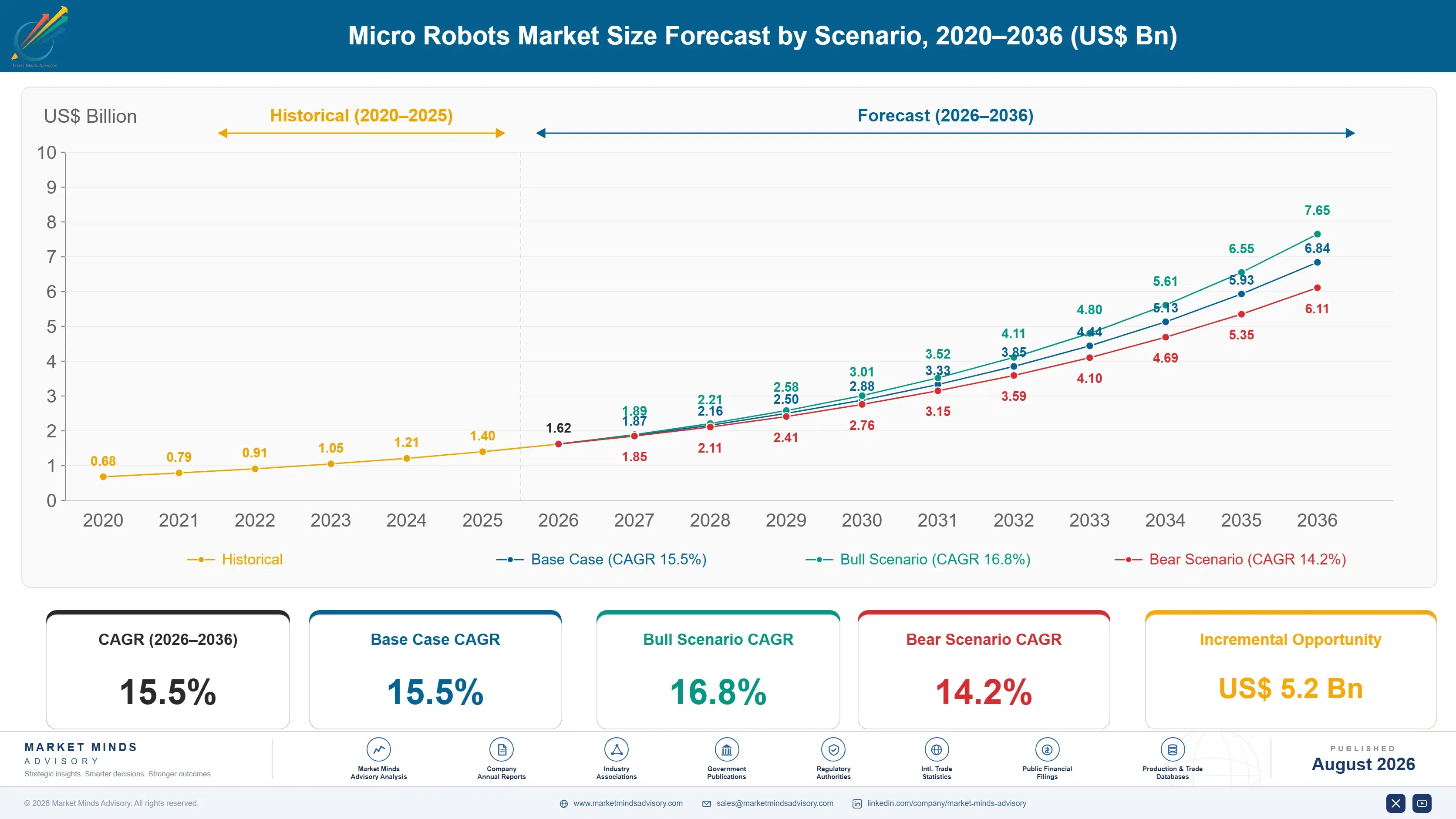
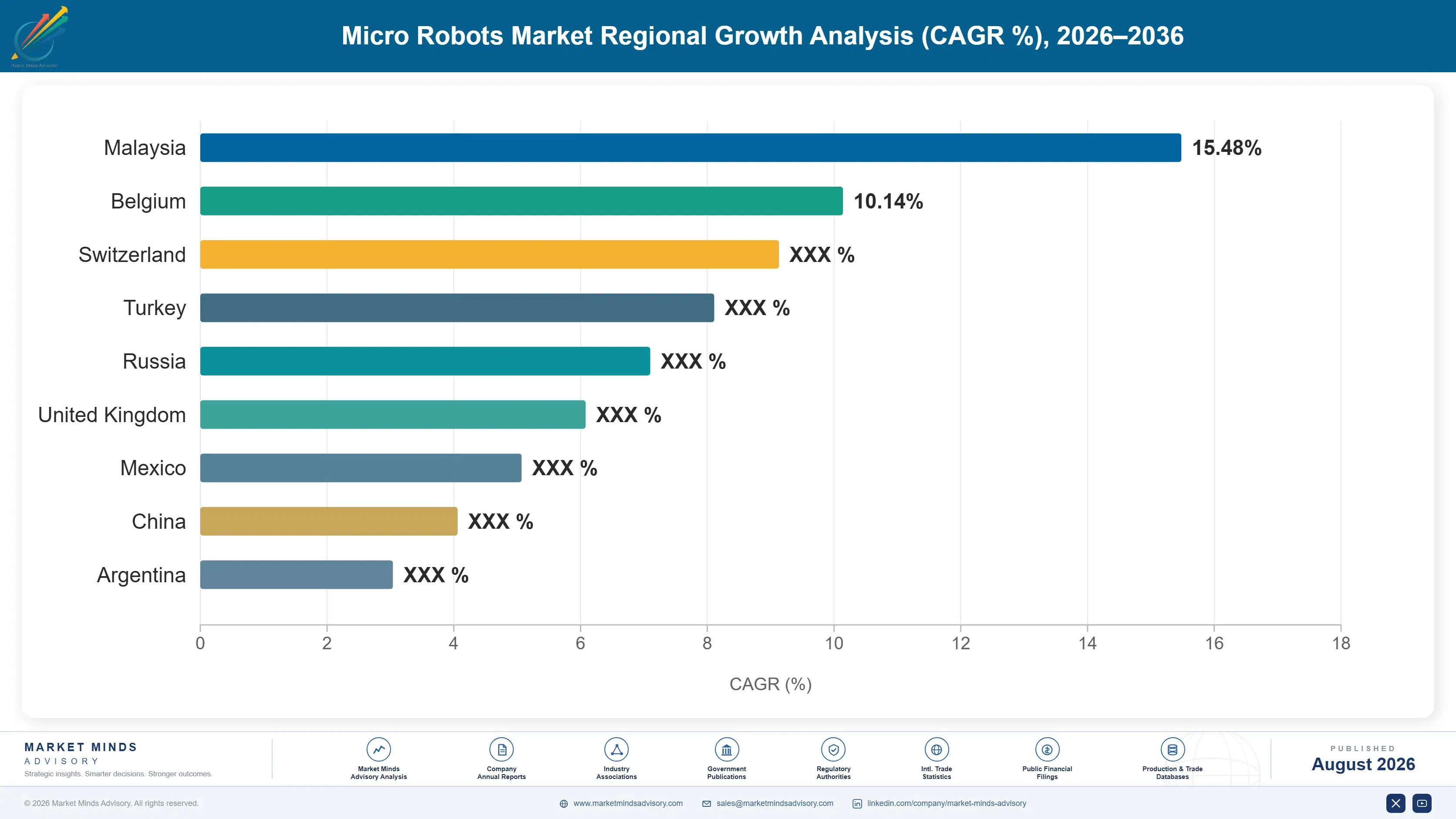
The market stands at USD 1.4 billion in 2025 and reaches USD 6.83 billion by 2036 at a 15.5% CAGR. Medical and in-vivo micro-robots grow fastest at 19.8%, about 1.28 times the overall rate, as targeted drug delivery and minimally invasive navigation move from clinical trial toward approved, reimbursed procedure. China posts the quickest national growth at 18.6% on manufacturing scale, state robotics funding, and a fast-expanding domestic packaging customer base.
Concentration sits at a moderate 34% for the top five, well below what a mature instrumentation category would show. Two forces are reshaping the field now. Actuator miniaturisation is finally catching up with control software maturity after years lagging behind it, and semiconductor packaging customers are placing repeat, multi-line orders that research grants never could have generated on their own, whatever the funding cycle looked like previously.
Market Definition
The micro robots market covers robotic systems and subsystems operating with characteristic dimensions or manipulation precision below one millimetre, spanning medical in-vivo devices, micro-assembly and micromanipulation platforms, swarm and micro-drone systems, and industrial inspection robots. General-purpose industrial robots, drones above micro scale, and consumer toys without precision actuation are excluded.
Base Year Value
$1.4B in 2025 (MMA Primary Research Dataset, August 2026)
Forecast Period
2026 to 2036, eleven discrete annual values
CAGR
15.5% base case. Bull 16.8%. Bear 14.2%.
Fastest Growth Segment
Medical and In-Vivo Micro-robots: 19.8% CAGR
Fastest Growth Country
China: 18.6% CAGR
Fastest Growth Region
South Asia and Pacific: 17.5% CAGR
Largest Region
East Asia: 28% of 2025 global value
Market Leaders
Festo SE and Co KG, Physik Instrumente, Bruker Corporation, Smaract, Percipio Robotics. Source: MMA Analysis based on company disclosures.
Primary Survey
n=3,800 procurement and R&D decision-makers, Q4 2025, six countries
Methodology
Demand-side build-up, cross-validated against public data, 47 expert interviews

Micro Robots Market Forecast Scenarios

micro-robots-market-size-forecast-scenario-1787332161679
Growth from 2020 to 2025 compounded near 13.7%, driven almost entirely by research funding and pilot programmes rather than repeat commercial orders that a production customer places without being asked twice. Medical navigation trials and semiconductor packaging pilots multiplied through the period, but few converted to standing procurement until late 2024, when qualification finally caught up with the underlying technical readiness.
Three mechanisms carry the base case to 15.5%. First, medical regulatory clearance: in-vivo navigation platforms are clearing approval pathways that convert single-trial revenue into repeat surgical volume across every hospital that adopts the technique. Second, semiconductor packaging demand, where advanced node assembly needs manipulation precision no conventional robot arm can deliver at production tolerance. Third, actuator cost decline, as piezoelectric and magnetic drive components fall in price with scaled manufacturing across several component suppliers.
The bull case at 16.8% assumes medical clearances arrive on schedule across multiple geographies and semiconductor customers standardise on micro-assembly cells broadly across entire fabrication fleets. The bear case at 14.2% assumes clinical trial delays push in-vivo revenue out several years and semiconductor capital spending contracts sharply during a downturn in chip demand that packaging equipment orders cannot survive.

Why Semiconductor Packaging Became The Volume Buyer

Three forces set demand. Semiconductor packaging provides the volume base, as advanced node assembly increasingly needs manipulation precision that conventional robot arms cannot deliver at production scale or repeatability. Medical navigation provides the value layer, since in-vivo platforms command prices far above industrial units once clinical clearance lands and procedure volume actually begins. And defence and inspection procurement adds a smaller but genuinely stable third revenue stream.
MARKET CONCENTRATIONCR5: 34%Moderately fragmented among specialist precision motion and micromanipulation firms
AVERAGE SELLING PRICEUSD 18,000 to 210,000Unit price spread across research, industrial, and medical grade platforms
TOP PRODUCING COUNTRY SHAREGermany: about 24%Share of global precision micro-actuation component output supplied
POSITIONING PRECISIONSub-100 nanometreTypical repeatability specification set for premium micromanipulation systems
COMPONENT COST SHAREAbout 48% of COGSPiezoelectric and magnetic actuator share of unit manufacturing cost
REPLACEMENT CYCLE6 to 9 yearsTypical service life before industrial customers replace a deployed unit
The commercial character is set by component cost more than by software sophistication. Piezoelectric and magnetic actuators account for roughly 48% of unit manufacturing cost, and the handful of firms able to manufacture these components at nanometre tolerance hold pricing power that assembly-only competitors simply cannot match. That is why German and Swiss precision-motion specialists still lead a field increasingly courted by larger, diversified robotics groups looking for an entry point.
The next decade turns on two things. Whether medical in-vivo platforms clear regulatory pathways on the timeline sponsors expect, since a single delayed approval can push years of forecast revenue out of the window entirely. And whether semiconductor capital spending sustains through the packaging transition that is currently pulling micro-assembly cells into standing procurement rather than pilot budgets.
"Everyone expected consumer robotics to pull this market forward, and instead it was a semiconductor packaging engineer who needed to place a component nobody's arm could reach. The volume showed up where the tolerance requirement was strictest, not where the marketing was loudest."
Director, Advanced Robotics and Precision Systems Practice · MMA Technology / Pr

Market Trends

Semiconductor Packaging Converts Pilots Into Standing Orders

Advanced node chip packaging increasingly requires component placement and bonding precision below what conventional pick-and-place robots can hold, and foundries are now specifying micro-manipulation cells as production equipment rather than evaluating them as pilot experiments. That shift matters because pilot budgets fund one purchase while production qualification funds a repeat order across every fabrication line a customer operates. Taiwanese and Korean packaging houses moved first, and equipment suppliers report multi-unit orders replacing the single evaluation units that defined the category through 2023. The transition from pilot to production line is what actually built this market's recent volume.
Market Impact: Costs fall roughly 8% per cycle
In-Vivo Navigation Platforms Approach Regulatory Clearance

Magnetically steered micro-robotic catheters and capsule platforms for targeted drug delivery and minimally invasive navigation have moved through clinical trials faster than the category expected, with several programmes now in late-stage regulatory review across the United States and Europe. Each clearance converts a single research grant into a device that hospitals purchase repeatedly across procedure volume, which is a fundamentally different revenue shape than the trial funding that built the segment through 2022. Bionaut Labs and Magnisity both advanced pipeline candidates through this period. Clearance timing, not technical readiness, is now the binding constraint on medical segment revenue.
Market Impact: Nodes require sub-100 nanometre pre

Market Opportunities and Growth Drivers

Actuator Cost Decline Finally Matches Control Software Maturity

Piezoelectric and magnetic drive components have fallen substantially in unit cost as production scales, closing a gap that had persisted for years between capable control software and actuators too expensive to deploy outside a laboratory. Physik Instrumente and Smaract have both expanded production capacity to meet industrial rather than research demand specifically. That cost decline changes the buyer conversation from a research grant justification to a return-on-investment calculation an operations manager can approve directly. Component suppliers now compete on manufacturing scale as much as on positioning accuracy, which was not true five years earlier.
Market Impact: Lead times exceed 6 months

Semiconductor Node Shrinkage Demands Sub-Micron Assembly

Each successive semiconductor process node reduces the tolerance available for component placement and wire bonding, and conventional robotic assembly equipment has run out of headroom at the most advanced nodes currently entering production. Micro-robotic manipulation cells fill that gap because they hold positioning repeatability below 100 nanometres where pick-and-place arms manage only micron-level precision at best. Packaging houses in Taiwan, South Korea, and increasingly the United States are qualifying these cells as standard production equipment rather than specialty tooling. Node shrinkage guarantees this demand continues rather than plateaus, since each future node tightens the same tolerance further.
Market Impact: Reviews run 1+ year past forecast

Market Restraints and Challenges

Component Supply Concentrates Among Few Precision Manufacturers

Piezoelectric and magnetic actuators capable of nanometre-scale repeatability are manufactured by a small number of German, Swiss, and Japanese specialists, and that concentration is the root cause of lead times that regularly exceed six months during demand surges. Commercially this caps how fast integrators can fulfil semiconductor and medical orders regardless of how strong end demand runs, since nobody can assemble a platform around a component that has not shipped yet. Larger customers respond by placing standing orders years ahead and by qualifying second-source suppliers where specification allows it, though second sources rarely match the leading manufacturer's tolerance.
Market Impact: Orders now scale to 5+ units

Medical Clearance Timelines Repeatedly Outrun Sponsor Forecasts

In-vivo navigation platforms face regulatory review processes calibrated for implantable and surgical devices generally, not for the specific manipulation and control claims micro-robotic systems make, and that mismatch is the root cause of review timelines that regularly run longer than sponsors model in public guidance. Commercially this means investment committed years ahead of revenue sits unproductive, and several programmes have needed additional funding rounds purely to bridge review delays rather than technical setbacks. Sponsors increasingly pursue staged indications, starting with lower-risk diagnostic uses before pursuing therapeutic delivery claims that invite closer regulatory scrutiny.
Market Impact: Several late-stage clearances near
3 additional market trends, 4 additional growth drivers, and 2 additional restraints and challenges are covered in the full report. Contact sales@marketmindsadvisory.com to access the complete intelligence.

Segment CAGR and Growth Architecture

Segmentation follows technology platform, a single engineering logic describing how the micro robot achieves manipulation or locomotion at sub-millimetre scale. Each platform carries its own precision specification, control approach, and buyer type, so commercial position tracks the underlying technology rather than the end application it eventually serves across industries. End-use industry and commercial channel appear separately within the framework.
micro-robots-market-market-share-analysis-1787332162212

Medical and In-Vivo Micro-robots

Medical and in-vivo micro-robots grow fastest at 19.8%, about 1.28 times the overall 15.5% rate, covering magnetically steered catheters, capsule endoscopy platforms, and targeted drug delivery capsules navigating within the body under external field control. Regulatory clearance is the defining commercial event, converting single-trial research revenue into repeat procedure volume that hospitals purchase continuously rather than once. Bionaut Labs and Magnisity both hold late-stage pipeline candidates moving through United States and European review processes concurrently. Pricing sits far above industrial micro-robots once clearance lands, since hospitals pay for clinical outcome rather than component cost. The segment remains revenue-light today relative to its eventual scale because so much value is still gated behind regulatory review rather than already realised.
CAGR 19.8%

Micro-manipulation and Assembly Robots

Micro-manipulation and assembly robots grow at 17.1%, the second-fastest platform, covering piezoelectric and magnetic-drive positioning systems used in semiconductor packaging, photonics alignment, and micro-electromechanical component assembly. Semiconductor packaging has become the dominant buyer as advanced node tolerance requirements exceed what conventional pick-and-place equipment can hold, and Physik Instrumente, Smaract, and Percipio Robotics all report qualification wins across Taiwanese and Korean production lines. Unit pricing scales with positioning repeatability, and sub-100 nanometre platforms command a substantial premium over micron-level systems used in less demanding photonics work. This segment converts research relationships into recurring production orders faster than any other platform in the category, which is why component manufacturers are expanding capacity specifically to serve it.
CAGR 17.1%
Full segment breakdown across 6 segments available in the complete report.

Regional Architecture and Country Demand Map

Component manufacturing capability and end-buyer concentration together set this distribution rather than research output alone. East Asia leads on semiconductor packaging demand, Western Europe holds the precision-actuator manufacturing base, and share elsewhere tracks where medical trial funding and defence procurement programmes are actually committed and sustained year over year.

North America

United States medical device sponsors and defence research programmes anchor North America's 27% share, with in-vivo navigation platforms clustering around Boston, the Bay Area, and San Diego medical technology corridors. DARPA and service-branch research funding has seeded several micro-robotics ventures that have since moved toward commercial semiconductor and defence inspection contracts. Canadian photonics and micro-electromechanical research adds a smaller but stable contribution concentrated around Waterloo and Montreal. Regulatory clearance through the Food and Drug Administration is the pacing factor for the region's largest value pool, and several sponsors have relocated trial administration domestically to shorten review cycles considerably. Growth of 16.5% reflects medical clearance progress steadily converting research spending into standing procurement across hospital systems nationwide.
Share: 27% | CAGR: 16.5% (2026 to 2036)

Western Europe

Germany and Switzerland supply a disproportionate share of the world's precision piezoelectric and magnetic actuator components, which anchors Western Europe's 21% share in manufacturing rather than in end-market consumption alone. Physik Instrumente, Smaract, and Attocube Systems all manufacture domestically and export globally to semiconductor and medical integrators. French research institutes have produced several micro-manipulation ventures including Percipio Robotics, commercialising academic precision-motion work directly. European medical device regulation under the current framework adds review time relative to comparable American pathways, which slows in-vivo platform revenue specifically across several pending programmes. Growth of 14.0%, the slowest of the seven, reflects that regulatory pacing against a component manufacturing base that is otherwise expanding at a steady, dependable rate.
Share: 21% | CAGR: 14.0% (2026 to 2036)
Regional intelligence for 5 additional markets available in the complete report: East Asia, South Asia and Pacific, Latin America, Middle East and Africa, Eastern Europe. Contact sales@marketmindsadvisory.com.
micro-robots-market-country-cagr-analysis-1787332162721

Where Micro-Robotics Platforms Actually Capture Value

Selling a research-grade platform on positioning specification alone leaves value on the table once a buyer moves from pilot to production line. The four moves below shift revenue toward positions a component shortage or a review delay cannot erase easily: component integration, regulatory staging, production-scale contracts, and service revenue attached to every deployed unit.

Integrate Actuator Manufacturing Rather Than Sourcing It

Component supply concentrates among a handful of German, Swiss, and Japanese manufacturers, and integrators dependent on that supply face lead times exceeding six months during demand surges that they cannot control. Firms manufacturing their own piezoelectric or magnetic actuators, as Physik Instrumente and Smaract both do, capture the roughly 48% of unit cost that component margin represents rather than paying it to a supplier. That integration also lets a firm quote delivery timelines competitors sourcing externally simply cannot promise. Vertical integration is becoming the clearest differentiator in a supply-constrained category.
Market Impact: Actuators represent 48% of unit cos

Stage Medical Indications To De-Risk Regulatory Timing

In-vivo platforms pursuing therapeutic delivery claims from the outset face the longest and least predictable review timelines in the category, often exceeding sponsor forecasts by 12 months or more. Sponsors that stage indications, starting with diagnostic or imaging uses before pursuing therapeutic delivery, generate revenue and clinical evidence during the review period rather than sitting idle waiting for a single approval decision. Bionaut Labs has pursued exactly this staged path across its full pipeline. Staged filing converts a binary revenue event into a graduated one spread across several years instead.
Market Impact: Staged filing recovers over 12 mont

Convert Semiconductor Pilots Into Multi-Line Production Contracts

A single evaluation unit at a packaging house generates a fraction of the revenue that qualification across every production line the customer operates eventually delivers, yet many suppliers treat the pilot sale as the commercial endpoint rather than the opening step. Suppliers who build qualification protocols and support capacity ahead of the pilot are the ones capturing orders across 5 or more production lines when Taiwanese and Korean packaging houses scale up, which several suppliers have already reported this year. Planning for the production order before the pilot even ships is what separates the winners here.
Market Impact: Production orders reach 5+ units pe

Attach Calibration And Service Contracts To Deployed Units

Sub-100 nanometre positioning systems drift out of specification over time and require periodic recalibration that most integrators still price as a one-off callout rather than a standing contract, leaving predictable revenue uncollected across a typical 6 to 9 year service life. Suppliers attaching calibration and preventive maintenance contracts at the point of sale convert a single hardware transaction into a recurring relationship that also generates the usage data needed to inform the next product generation properly. This is standard practice in adjacent precision instrumentation and remains underused across most of this category today.
Market Impact: Units serve 6 to 9 years, underpric

Who Controls the Margin Pool

Concentration is moderate: the top five hold roughly 34% of revenue, reflecting a field still led by specialist precision-motion firms rather than diversified robotics majors who have mostly stayed on the sidelines. The gap between leaders and challengers is component manufacturing capability rather than software sophistication, which is comparatively widely distributed. All participants are assessed on one basis here, revenue from micro-robotic systems operating below one millimetre characteris
Competition runs along three lines. First, actuator manufacturing capability, since firms producing their own piezoelectric or magnetic components capture margin and delivery certainty sourced-component competitors cannot match. Second, regulatory and qualification track record, particularly in medical and semiconductor segments where a customer's own approval process depends on supplier documentation. Third, application-specific integration depth, since a platform tuned for semiconductor packaging rarely transfers directly to medical navigation work.

Pressure is building from two directions. Diversified robotics groups are acquiring specialist micro-robotics ventures rather than building capability organically, compressing the timeline independent firms have to scale before being absorbed. Meanwhile Chinese state-funded manufacturers are building domestic actuator capability that could erode the German and Swiss advantage over the coming decade. Rankings should favour firms combining manufacturing with software depth.
micro-robots-market-company-positioning-matrix-1787332163243

Competitive Moat and Risk Dimensions

FESTO SE AND CO KG

Moat: Bionic research pipeline breadth

Festo has run a decades-long bionic robotics research programme feeding genuine commercial products rather than marketing, giving it design capability across pneumatic and electric micro-actuation few competitors match. Its global industrial automation customer base provides distribution new entrants must build from nothing. Manufacturing scale subsidises development costs a pure-play specialist cannot absorb.
FESTO SE AND CO KG

Risk: Core business scale dilutes focus

Micro-robotics remains a small fraction of Festo's overall automation revenue, and capital allocation is decided against much larger opportunities elsewhere, which can slow investment this category needs to match focused competitors. Smaller specialist firms including Physik Instrumente move faster on customisation. Medical segment credentials are comparatively underdeveloped.
PHYSIK INSTRUMENTE

Moat: Nanometre positioning manufacturing depth

Physik Instrumente manufactures its own piezoelectric actuators at the nanometre tolerance semiconductor packaging customers require, capturing margin assembly-only competitors pay away entirely. Decades of positioning-system deployment across photonics, semiconductor, and life science customers give it qualification history that shortens sales cycles. Its capacity expansion has kept pace with demand better than smaller rivals.
PHYSIK INSTRUMENTE

Risk: Narrow platform beyond core niche

The company's strength concentrates heavily in positioning hardware, with comparatively limited presence in medical in-vivo platforms where the fastest segment growth occurs industry-wide. Chinese domestic manufacturers are targeting the same packaging customers with lower pricing, even if tolerance still lags. Dependence on semiconductor capital cycles exposes revenue medical would not share.

Players Tracked

Prominent Players

Festo SE and Co KG
Physik Instrumente
Bruker Corporation
Smaract GmbH
Percipio Robotics

Other Key Players

Kleindiek Nanotechnik GmbH
FemtoTools AG
Xeryon
Aerotech Inc
Bionaut Labs
Magnisity Ltd
Piezomotor Uppsala AB
Sysmelec SA
Attocube Systems AG
Mad City Labs Inc
Klocke Nanotechnik GmbH
Faulhaber Group
Nanomotion Ltd
New Scale Technologies Inc
Standa Ltd

Recent Developments

FEBRUARY 2025

Physik Instrumente expands piezoelectric actuator production capacity

Physik Instrumente announced capacity expansion at its German manufacturing facility to meet semiconductor packaging demand for nanometre-precision positioning components. This was an organic capacity expansion rather than any acquisition or joint venture, adding production lines dedicated to actuators used in advanced node packaging equipment sold to Taiwanese and Korean customers.
Signal: Capacity investment ahead of confirmed dem
JUNE 2024

Bionaut Labs advances in-vivo navigation platform through late-stage trials

Bionaut Labs reported progress moving its magnetically steered micro-robotic platform through late-stage clinical evaluation for targeted neurological drug delivery. This was clinical trial progress rather than a regulatory approval or corporate transaction, advancing one of the category's most closely watched medical programmes toward eventual review submission.
Signal: Trial progress narrows the gap between res
NOVEMBER 2024

Smaract acquires micromanipulation software developer

Smaract completed an acquisition of a smaller software developer specialising in automated micromanipulation control algorithms, integrating the capability directly into its positioning hardware platform. This was a confirmed acquisition rather than a licensing agreement or joint venture, consolidating software and hardware capability under one roof for semiconductor customers.
Signal: Hardware manufacturers are increasingly bu

Actuators, Precision Manufacturing, Trial Costs

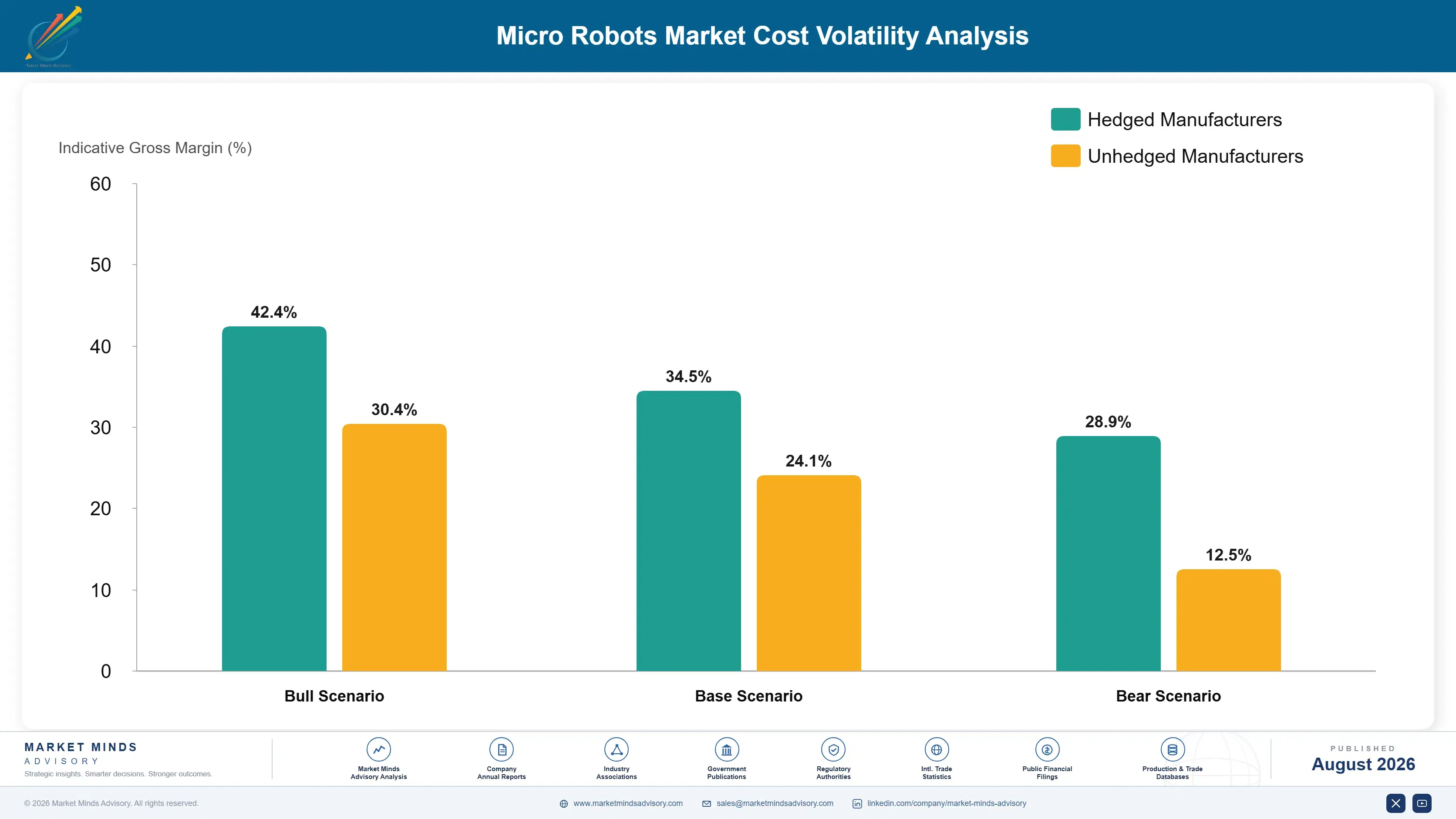
Piezoelectric and magnetic drive actuators dominate unit cost at roughly 48% of COGS, sourced overwhelmingly from German, Swiss, and Japanese specialist manufacturers who hold the metallurgical and ceramic processing expertise required at nanometre tolerance. Precision machining and clean-room assembly account for a further 20% to 26%. Control electronics and embedded software contribute 14% to 18%, with the remainder covering enclosure, calibration, and testing.
Rare earth element pricing volatility affected magnetic actuator costs sharply through 2022 and 2023, when Chinese export policy changes tightened supply of neodymium and dysprosium used in high-field micro-actuators. The IEA's critical minerals reporting documented price spikes exceeding 40% for some rare earth compounds during that period, and several manufacturers absorbed the cost rather than pass it through immediately, protecting semiconductor customer relationships at the expense of margin.

Exposure varies sharply by manufacturing integration. A firm producing its own actuators controls both cost and supply timing through volatility, while an assembly-only competitor sourcing externally faces both price risk and allocation risk simultaneously during shortages. Geographic exposure also differs, since firms dependent on Chinese rare earth supply chains carry policy risk that domestically sourced or recycled-material competitors increasingly avoid.
micro-robots-market-cost-volatility-analysis-1787332163439

Qualify alternative magnetic materials where tolerance allows

Rare earth dependence concentrates risk in a supply chain subject to export policy the industry cannot influence, and several manufacturers are qualifying reduced rare earth or ferrite-based alternatives for applications where field strength requirements permit the substitution without losing certification or measurable performance, a shift that is gradually spreading across the broader supplier base as qualification data accumulates.

Build long-term supply agreements with actuator manufacturers

Assembly-only integrators without their own component manufacturing capacity are negotiating multi-year supply agreements with Physik Instrumente, Smaract, and similar manufacturers to secure allocation priority during shortages, trading price flexibility for delivery certainty their semiconductor and medical customers require on committed production timelines that cannot simply slip without real consequence for the whole programme downstream.

Invest in recycled and recovered rare earth material streams

A handful of manufacturers have begun sourcing recovered neodymium and dysprosium from electronics recycling streams to reduce dependence on newly mined material, a nascent but growing mitigation that also carries sustainability positioning value with semiconductor and medical device customers who increasingly ask suppliers to document material provenance directly across the full component supply chain before signing new long-term contracts.

Portfolio Architecture for Margin Defence

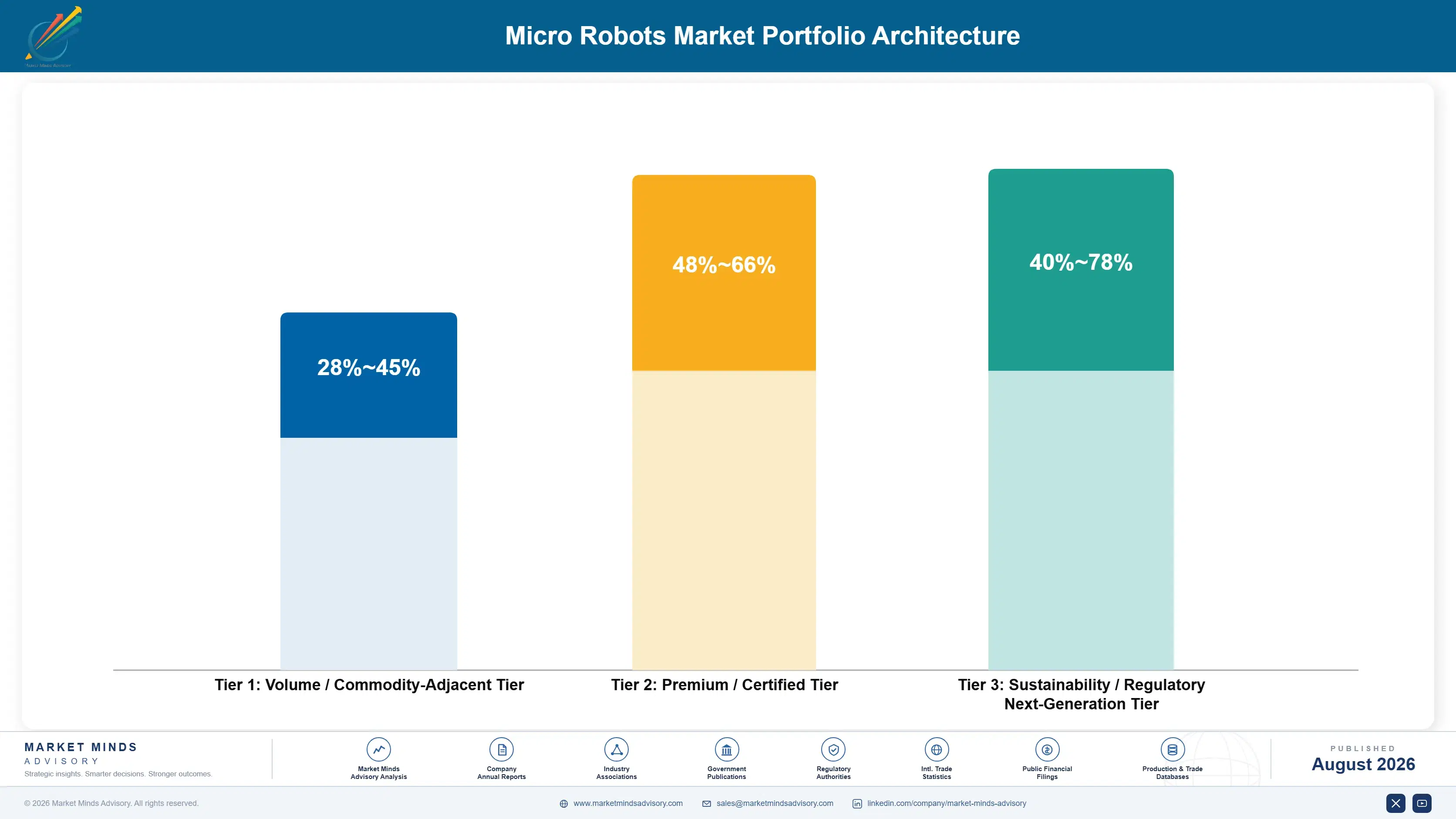
The portfolio splits into three tiers with sharply different economics. Research and evaluation-grade platforms form the volume tier, priced to win a first pilot sale with margin set largely by component cost. Production-qualified industrial and semiconductor systems earn more because qualification history and delivery certainty resist price competition once a customer commits a production line. Medical in-vivo platforms sit differently again, priced against clinical outcome once regulatory clea
The tension runs between winning today's pilot and building tomorrow's production relationship. A supplier who discounts heavily to win a semiconductor evaluation unit sets a price anchor that is difficult to raise once the customer scales to multiple production lines, yet refusing to discount can lose the pilot to a competitor entirely. Firms handling this well price the pilot as a loss leader deliberately rather than accidentally, with the production contract explicitly modelled from the outset.

High-value pools concentrate where qualification history, component manufacturing, or regulatory clearance limit competition: production-scale semiconductor contracts, cleared medical platforms generating repeat procedure revenue, and defence programmes requiring security clearance few firms hold. Research-grade evaluation units sit at the other end, competing almost entirely on specification and price against every academic-spinout competitor entering the field.

Volume / Commodity-Adjacent Tier

Research and evaluation-grade micro-manipulation platforms sold mainly to university and corporate research labs operating on tight, grant-funded budgets. Margin is set almost entirely by component cost and competitive first-pilot pricing pressure from rival specialists.
Gross Margin: 28-45%

Premium / Certified Tier

Production-qualified semiconductor and industrial micro-assembly systems with established customer qualification history across multiple fabrication lines and process nodes. Margin reflects delivery certainty and integration depth that customers pay for directly and repeatedly.
Gross Margin: 48-66%

Sustainability / Regulatory / Next-Generation Tier

Regulatory-cleared medical in-vivo platforms and defence-cleared inspection systems sold against clinical or mission outcome rather than component specification. The wide range reflects the gap between pre-clearance and post-clearance pricing power once approval lands.
Gross Margin: 40-78%
micro-robots-market-portfolio-architecture-1787332163934

High-value Sub-segments and Strategic Watch-out

Medical and In-Vivo Micro-robots

High value and high growth at 19.8%, the fastest platform, as regulatory clearance progressively converts trial funding into repeat procedure revenue across multiple pipeline candidates advancing at once. Staged indication filing is steadily shortening the path from initial approval to standing hospital purchase behaviour nationwide.
Gross Margin: 45-78%

Micro-manipulation and Assembly Robots

High value with strong growth at 17.1%, driven by semiconductor packaging qualification converting single pilot units into multi-line production orders across entire fabrication fleets simultaneously and repeatedly. Component manufacturers capturing actuator margin directly are pulling well ahead of assembly-only competitors across this entire segment today.
Gross Margin: 48-66%

Industrial Inspection Micro-robots

The volume core by unit count, growing at 12.6% as confined-space pipeline, tank, and structural inspection applications adopt micro-robotic platforms where larger equipment cannot physically operate at all safely or effectively. Steady demand rather than dramatic expansion characterises this segment across most buyer categories and geographies.
Gross Margin: 32-50%

Educational and Consumer Micro-robots

The strategic watch-out, growing at just 8.4% and constrained by limited willingness to pay for precision most consumer and classroom applications do not actually require in daily practice or use. Volume persists mainly through STEM education procurement rather than genuine mass-market consumer demand actually emerging.
Gross Margin: 20-36%

How Micro-Robotics Revenue Actually Repeats

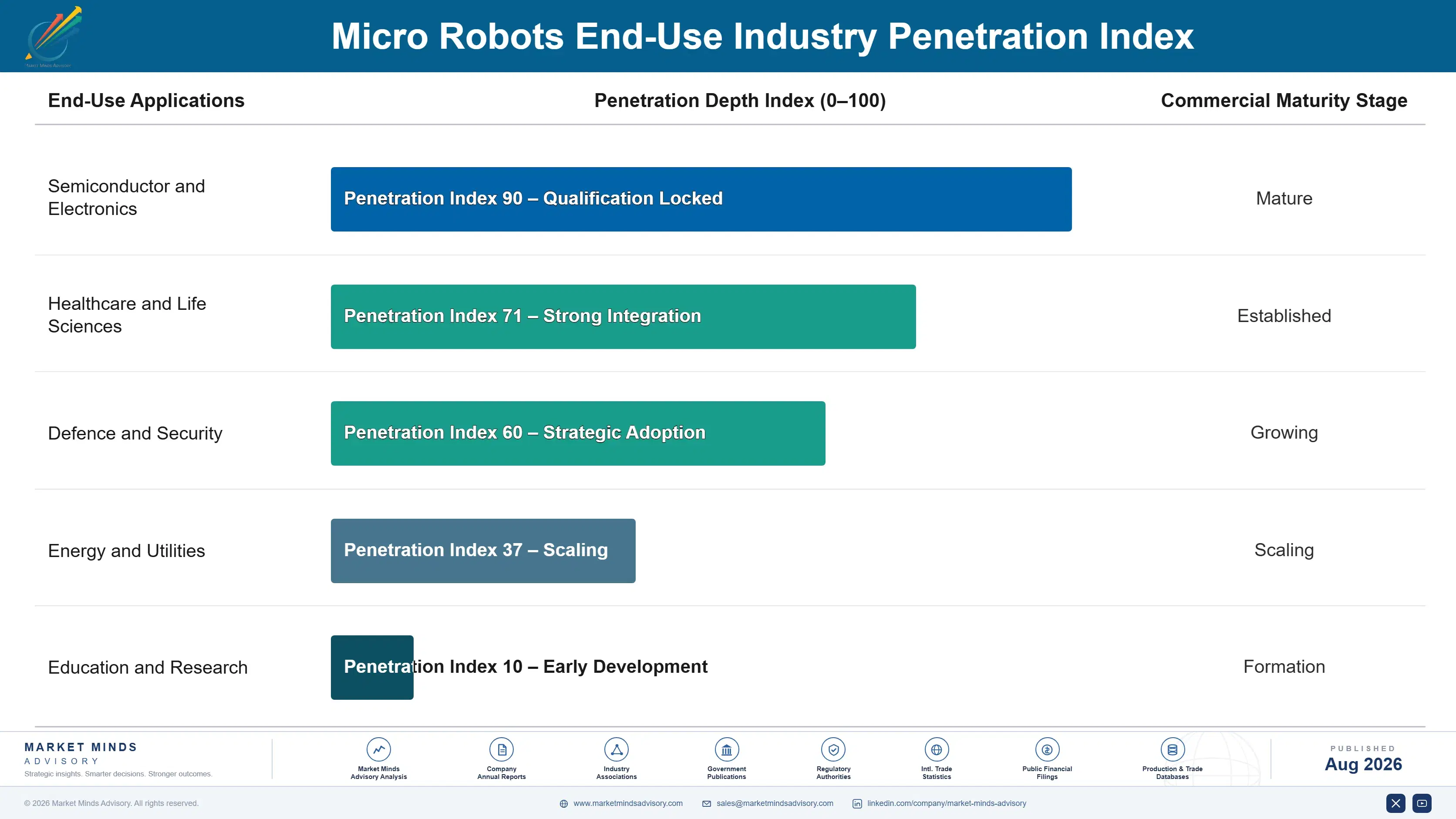
Revenue depends on converting a single evaluation sale into a standing relationship, and the gap between the two is enormous. A semiconductor customer qualifying a micro-manipulation cell on one production line eventually needs the same equipment across every line running that process node, so the qualification event is worth far more than the unit price of the machine that earned it. Medical platforms work similarly. Regulatory clearance converts one trial into procedure volume across every ado
Stickiness varies sharply by end-use vertical. Semiconductor packaging sticks hardest once a process is qualified, because requalifying an alternative supplier against a live production line carries cost and risk customers avoid unless forced. Medical adoption sticks even harder after clearance, since switching a surgical navigation platform requires retraining clinical staff. Research and educational buyers switch most readily, since specification and price dominate decisions with no qualification history to protect.

Buyer profiles are shifting generationally. Procurement that once sat with principal investigators writing grants now increasingly sits with operations managers evaluating return on capital, particularly in semiconductor buying. Hospital procurement committees rather than individual surgeons increasingly govern medical platform adoption too, weighing economics an individual clinician would not have considered a decade ago.
micro-robots-market-end-use-penetration-index-1787332164422

Our Call On Micro-Robotics

These are among the four positions where our research anticipates prominent divergence between winners and laggards over the coming forecast period. Each is grounded in the demand model, the regulatory perimeter, and the announced capacity pipeline.
01 / COMPONENT SUPPLY DECIDES SCALE

Whoever manufactures actuators controls delivery

Piezoelectric and magnetic actuators represent roughly 48% of unit cost and are manufactured by a small number of German, Swiss, and Japanese specialists whose lead times regularly exceed six months during demand surges nobody can fully predict. Firms manufacturing their own components, as Physik Instrumente and Smaract both do, capture that margin and can quote delivery timelines sourced-component competitors simply cannot promise. Integrators should treat vertical integration into actuator manufacturing as the single highest-leverage investment available in a supply-constrained category still expanding fast.
02 / SEMICONDUCTOR DEMAND SETS VOLUME

Packaging qualification converts pilots into fleets

Advanced semiconductor node tolerance requirements now exceed what conventional pick-and-place equipment can hold, and packaging houses in Taiwan and South Korea are qualifying micro-manipulation cells as standard production equipment across entire fabrication lines rather than single stations. A single qualification event is worth vastly more than its unit price once a customer scales the equipment fleet-wide. Suppliers should plan qualification protocols and support capacity ahead of every pilot sale, because the production order is the actual commercial prize being contested.
03 / MEDICAL CLEARANCE VALUE TRIGGER

Staged filing shortens the wait for revenue

In-vivo navigation platforms command pricing far above industrial units once regulatory clearance lands, but review timelines regularly outrun sponsor forecasts by a year or more, leaving years of committed investment unproductive while approval remains pending. Sponsors staging indications, starting with diagnostic uses before pursuing therapeutic delivery claims, generate revenue and clinical evidence during the review window rather than waiting on a single binary approval event. That staged approach is becoming the standard playbook across the medical segment for good reason.
04 / SERVICE REVENUE REMAINS UNDERPRICED

Calibration contracts capture value left on the table

Sub-100 nanometre positioning systems drift out of specification over a typical 6 to 9 year service life, yet most integrators still price recalibration as a one-off callout rather than a standing contract that captures predictable recurring revenue across the installed base. Attaching calibration and preventive maintenance agreements at the point of sale converts a single hardware transaction into a multi-year relationship, and generates usage data that genuinely improves the next product generation. This practice is standard in adjacent precision instrumentation categories already.

Engagement Snapshot From the Field

A live engagement with an industry participant carrying material or product regulatory and market exposure ahead of a defining policy shift, showing how our research translates into a defensible multi-year portfolio strategy.
MARKET MINDS ADVISORY · CLIENT ENGAGEMENT SUMMARY
Micro Robots Producer Strategic Portfolio Review and Transition Roadmap 2026·Investment Scenario on Micro Robots Exposure Evaluation 2025-26
CLIENT PROFILE
A mid-sized semiconductor packaging equipment integrator supplying assembly systems to Southeast Asian contract manufacturers engaged MMA as customers began requesting sub-100 nanometre micro-manipulation modules the client did not currently manufacture in-house. The client reported annual equipment revenue near USD 340 million, with micro-manipulation representing under 5% of that total and growing quickly (client-reported, unverified by MMA).
STRATEGIC CHALLENGE
Customers were increasingly specifying micro-manipulation precision the client could only deliver by sourcing actuators externally at margin-eroding prices and unpredictable lead times stretching past six months. Leadership needed to decide between continuing to source components, acquiring a specialist manufacturer, or building actuator manufacturing capability internally within a limited capital budget.
MMA APPROACH
MMA benchmarked component sourcing economics against vertically integrated competitors including Physik Instrumente and Smaract, modelling margin capture under each ownership structure. We assessed acquisition targets among smaller actuator specialists against the client's balance sheet capacity. We then sized the semiconductor qualification pipeline the client stood to lose without resolving its supply dependence.
KEY FINDINGS
  1. External actuator sourcing was costing the client roughly 22 percentage points of margin versus vertically integrated competitors on comparable units (client-reported, unverified by MMA).
  2. Two qualification opportunities worth a combined USD 40 million in potential annual revenue were at risk of being lost to Smaract due to lead-time uncertainty alone.
  3. A targeted acquisition of a smaller German actuator manufacturer was feasible within the client's stated capital budget and would close the tolerance gap within 18 months.
  4. Building actuator manufacturing internally would have required roughly three times the capital and five additional years to reach comparable tolerance (client-reported, unverified by MMA).
CLIENT PROFILE
A mid-sized semiconductor packaging equipment integrator supplying assembly systems to Southeast Asian contract manufacturers engaged MMA as customers began requesting sub-100 nanometre micro-manipulation modules the client did not currently manufacture in-house. The client reported annual equipment revenue near USD 340 million, with micro-manipulation representing under 5% of that total and growing quickly (client-reported, unverified by MMA).
STRATEGIC CHALLENGE
Customers were increasingly specifying micro-manipulation precision the client could only deliver by sourcing actuators externally at margin-eroding prices and unpredictable lead times stretching past six months. Leadership needed to decide between continuing to source components, acquiring a specialist manufacturer, or building actuator manufacturing capability internally within a limited capital budget.
MMA APPROACH
MMA benchmarked component sourcing economics against vertically integrated competitors including Physik Instrumente and Smaract, modelling margin capture under each ownership structure. We assessed acquisition targets among smaller actuator specialists against the client's balance sheet capacity. We then sized the semiconductor qualification pipeline the client stood to lose without resolving its supply dependence.
KEY FINDINGS
  1. External actuator sourcing was costing the client roughly 22 percentage points of margin versus vertically integrated competitors on comparable units (client-reported, unverified by MMA).
  2. Two qualification opportunities worth a combined USD 40 million in potential annual revenue were at risk of being lost to Smaract due to lead-time uncertainty alone.
  3. A targeted acquisition of a smaller German actuator manufacturer was feasible within the client's stated capital budget and would close the tolerance gap within 18 months.
  4. Building actuator manufacturing internally would have required roughly three times the capital and five additional years to reach comparable tolerance (client-reported, unverified by MMA).
RECOMMENDED STRATEGY
Phase 1: Phase 1 (0 to 6 months): Pursue acquisition due diligence on the identified German actuator manufacturer rather than internal development. Phase 2: Phase 2 (6 to 16 months): Integrate acquired manufacturing capability fully and requalify both at-risk semiconductor customer relationships before contracts lapse. Phase 3: Phase 3 (16 to 30 months): Expand actuator production capacity ahead of broader packaging demand to capture new qualification wins.
OUTCOME
The client completed the acquisition within the recommended window and requalified both at-risk semiconductor relationships before losing them to a competitor. Margin on micro-manipulation modules improved substantially within the first year of integrated production, validating the acquisition path over slower internal development (client-reported, unverified by MMA).

Frequently Asked Questions

Foundational context covering the market sizes, CAGR, scope, country, region and competition that inform every finding below. This section is provided to cover basics and most often pre-purchase conversations, answered from the MMA Primary Research Dataset.

What is the current size of the Micro Robots Market?

The global micro robots market is valued at USD 1.4 billion in 2025, covering medical in-vivo, micro-manipulation, swarm, and industrial inspection platforms below one millimetre scale. General industrial robots and consumer toys are excluded.

How large will the Micro Robots Market be by 2036?

The market is forecast to reach USD 6.83 billion by 2036 in the base case, about 4.23 times the 2026 level. That represents incremental value of roughly USD 5.22 billion across the decade.

What is the CAGR for the Micro Robots Market 2026 to 2036?

The market grows at a 15.5% CAGR in the base case, with bull and bear scenarios at 16.8% and 14.2%. The spread turns mainly on medical clearance timing and semiconductor capital spending.

Which segment is growing fastest?

Medical and in-vivo micro-robots grow fastest at 19.8%, about 1.28 times the overall rate, as targeted drug delivery and navigation platforms clear regulatory review. Micro-manipulation and assembly robots follow at 17.1%.

Who are the major companies in the Micro Robots Market?

Leading companies include Festo SE and Co KG, Physik Instrumente, Bruker Corporation, Smaract, and Percipio Robotics. Concentration is moderate, with the top five holding roughly 34% of revenue.

Which country is growing fastest?

China grows fastest at an 18.6% CAGR, on manufacturing scale and state robotics funding building domestic actuator and assembly capability. India follows on electronics manufacturing policy incentives.

Report Segmentation Architecture

The full report scope spans multiple orthogonal segmentation dimensions, with cross-tabulated demand data provided for each dimension pair. Coverage extends further to regional breakdowns, trend trajectories, and the competitive detail needed to support segment-level decision-making.

By Technology Platform

  • Medical and In-Vivo Micro-robots
  • Micro-manipulation and Assembly Robots
  • Swarm and Micro-drone Systems
  • Industrial Inspection Micro-robots
  • Educational and Consumer Micro-robots

By End-Use Industry

  • Semiconductor and Electronics
  • Healthcare and Life Sciences
  • Defence and Security
  • Energy and Utilities
  • Education and Research

By Commercial Dimension

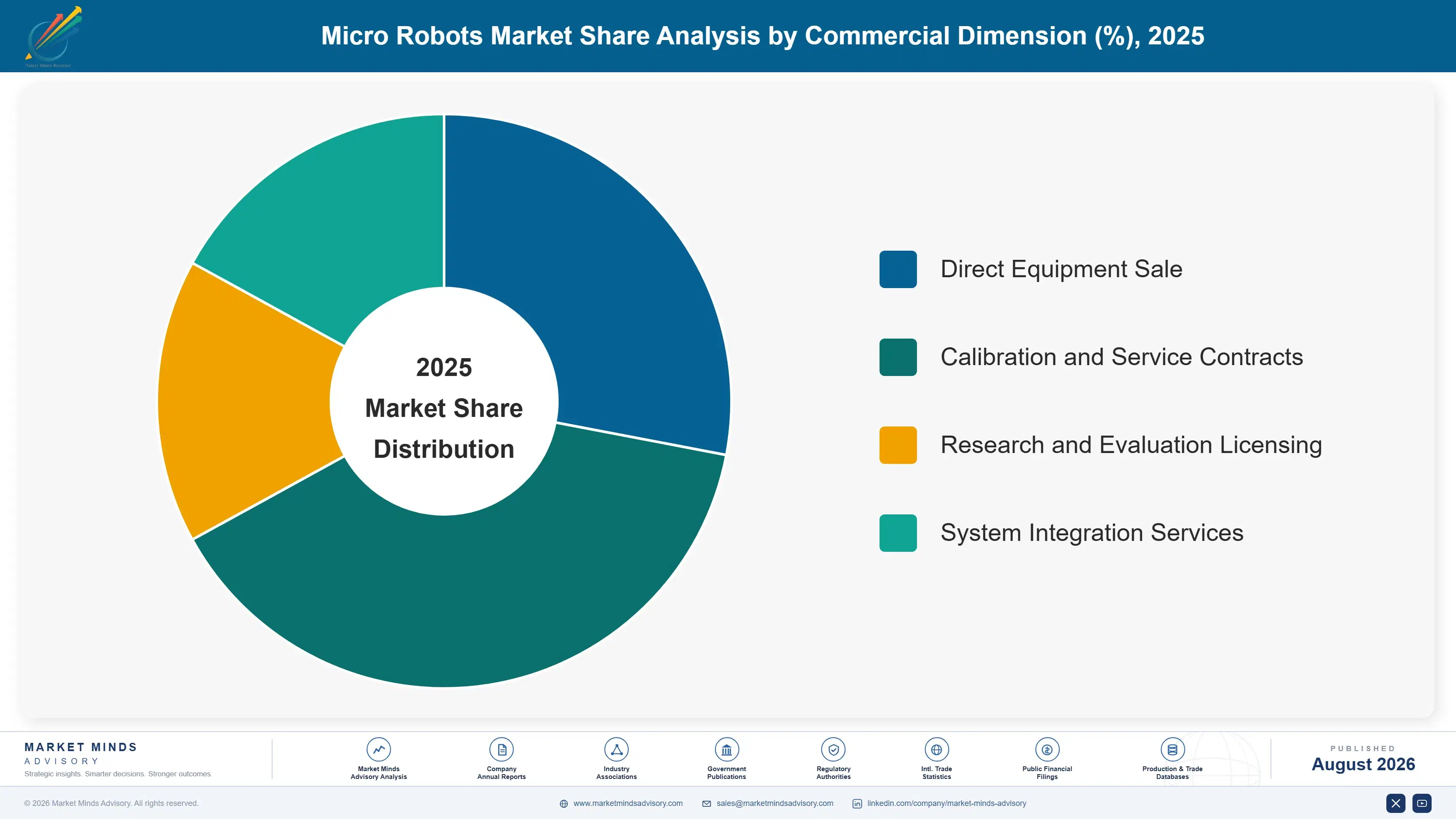
  • Direct Equipment Sale
  • Calibration and Service Contracts
  • Research and Evaluation Licensing
  • System Integration Services

By Region

  • North America
  • Western Europe
  • East Asia
  • South Asia and Pacific
  • Latin America
  • Middle East and Africa
  • Eastern Europe

Scope, Methodology, and Coverage

Every figure in this report is reproducible from documented input assumptions. The scope below maps the historical period, the forecast horizon, the segmentation dimensions, and the countries covered, alongside the underlying primary and qualitative methodology.
Historical Period
2020 to 2025
Forecast Period
2026 to 2036
Base Year
2025 (USD billions; MMA Primary Research Dataset, August 2026)
Market Definition
The micro robots market comprises robotic systems and subsystems achieving manipulation, locomotion, or positioning precision at sub-millimetre characteristic scale, valued at manufacturer and integrator revenue from equipment, components, and attached service contracts. It spans medical in-vivo navigation and drug delivery platforms, micro-manipulation and assembly systems for semiconductor and photonics production, swarm and micro-drone systems, industrial inspection robots for confined-space applications, and educational or consumer micro-robotic kits. General-purpose industrial robot arms, conventional drones above micro scale, software-only simulation tools, and non-robotic laboratory instrumentation are excluded.
Quantitative Units
USD billions (current prices); unit shipments where applicable
Segmentation Dimensions
By Technology Platform; By End-Use Industry; By Commercial Dimension; By Region
Regions Covered
North America, Western Europe, East Asia, South Asia and Pacific, Latin America, Middle East and Africa, Eastern Europe
Countries Covered
USA, China, Germany, Switzerland, Japan, South Korea, Taiwan, India, France, UK, Canada, Australia, Israel, UAE, Saudi Arabia, Brazil, Mexico, Poland, Czech Republic, Hungary, Singapore, Vietnam, Malaysia, and additional markets relevant to this sector
Key Companies Profiled
Festo SE and Co KG, Physik Instrumente, Bruker Corporation, Smaract GmbH, Percipio Robotics, Kleindiek Nanotechnik, FemtoTools, Xeryon, Aerotech, Bionaut Labs, Magnisity, Piezomotor Uppsala, Sysmelec, Attocube Systems, Mad City Labs, Klocke Nanotechnik, Faulhaber Group, Nanomotion, New Scale Technologies, Standa
Quantitative Methodology
Primary survey, n=3,800 respondents, Q4 2025, six countries; demand-side model with trade association cross-validation
Qualitative Methodology
47 expert interviews, Q4 2025; applied to validate demand model assumptions, identify emerging dynamics, and assess competitive positioning
Report Format
PDF and XLSX data workbook (Word format preview document)
Publisher
Market Minds Advisory
Report Code
MMA-2026-TEC-110
Published
August 2026
Contact
sales@marketmindsadvisory.com | www.marketmindsadvisory.com

Purchase the full Micro Robots Market Report (2026 to 2036).

The full MMA Micro Robots report sizes the market across five technology platforms, five end-use industries, four commercial dimensions, and seven regions through 2036. It profiles 20 companies on a consistent revenue basis, scoring each on actuator manufacturing capability, regulatory and qualification track record, and application-specific integration depth. Scenario models quantify how semiconductor qualification cycles, medical regulatory clearance timing, and rare earth input cost volatility move both revenue and margin by platform. The report also includes component supply chain mapping, calibration and service revenue benchmarking, and medical pipeline tracking for commercial and investment teams.
Five-platform and four-dimension market sizing to 2036
Twenty-company benchmark on consistent revenue basis
Component supply chain and actuator manufacturer mapping
Medical regulatory clearance pipeline tracking by programme
Semiconductor qualification cycle and production order modelling
Calibration and service contract revenue benchmarking

Built For The People Who Decide

From boardroom strategy to bench-side execution, this report is read cover-to-cover by leaders shaping the next decade of their industry, turning demand scenarios, market dynamics and valuation benchmarks into decisions.
CXOs/ Presidents/ VPs/ Managers
M&A and Corporate Development
Strategy Teams and R&D Heads
Procurement and Product Directors
Regulatory and Compliance Leaders
Investor Relations and Equity Analysts