Market Minds Advisory
Micro-electromechanical System (MEMS) Market

Micro-electromechanical System (MEMS) Market: Micro-electromechanical System (MEMS) Market. Trends and Forecast 2026 to 2036

Automotive safety mandates and foldable smartphone adoption are pushing MEMS sensor demand past traditional consumer electronics volume, forcing foundries to prove yield consistency as automakers qualify suppliers years ahead of vehicle production launches.

Lead Analyst

Published

September 2026

Make Smarter Decisions with Customized Research Insights

Request a free sample report and evaluate market opportunities, growth trends, and competitive dynamics relevant to your business needs.

2025 MARKET VALUE$16.8BMarket Size 2025
2036 FORECAST VALUE$43.4BBase Case , 2026 to 2036
CAGR 2026 TO 20369.0 %Bull 10.3% / Bear 7.8%
INCREMENTAL OPPORTUNITY$25.0BNet 10- year value creation
EXPANSION MULTIPLE2.37x2036 value over 2026 base
Strategic Levers
M&A Pipeline
Regional Outlook
Country Rankings
Competitive Intelligence
Segmental Deep-dive
Call-Us : 91 93563 13602

Executive Snapshot and Market Trajectory.

MEMS sensor demand is broadening beyond smartphones into automotive safety systems and industrial monitoring equipment, where longer qualification cycles and higher reliability standards reward foundries with proven automotive-grade manufacturing track records over consumer-electronics-focused competitors chasing volume alone across most product categories and applications.
Commercial demand concentrates around inertial sensors and microphones serving automotive advanced driver assistance systems and premium consumer devices, with automotive qualification increasingly determining which suppliers win multi-year design wins tied to specific vehicle platforms across most manufacturing programs and geographic markets. East Asia dominates manufacturing capacity given concentrated foundry and packaging infrastructure across Taiwan, China, and Japan, while automotive-grade demand growth is pulling new capacity investment toward facilities capable of meeting stricter reliability certification standards.
Competitive intensity remains moderate, with the top five suppliers controlling roughly 42% of global revenue given the capital intensity and process expertise required for high-yield MEMS fabrication at scale across the broader semiconductor industry. Rising demand for sensor fusion combining multiple MEMS types into single packages is reshaping competitive dynamics, favoring suppliers with broad sensor portfolios over specialists offering only single-sensor-type products competing purely on unit price.
Market Definition
The MEMS Market covers micro-electromechanical sensors, actuators, and system-in-package devices fabricated using microfabrication techniques, sold across automotive, consumer electronics, industrial, and healthcare applications. It excludes traditional macro-scale sensors and standalone integrated circuits without a mechanical microstructure component.
Base Year Value
$16.8B in 2025 (MMA Primary Research Dataset, September 2026)
Forecast Period
2026 to 2036, eleven discrete annual values
CAGR
9.0% base case. Bull 10.3%. Bear 7.8%.
Fastest Growth Segment
MEMS Microphones and Acoustic Sensors: 13.5% CAGR
Fastest Growth Country
China: 11.5% CAGR
Fastest Growth Region
South Asia and Pacific: 11.0% CAGR
Largest Region
East Asia: 30% of 2025 global value
Market Leaders
Leading participants include Bosch, STMicroelectronics, Texas Instruments, Broadcom, and TDK InvenSense. Source: MMA Analysis based on company annual reports.
Primary Survey
n=3,800 procurement and R&D decision-makers, Q4 2025, six countries
Methodology
Demand-side build-up, cross-validated against public data, 47 expert interviews

Micro-electromechanical System (MEMS) Market Forecast Scenarios

micro-electromechanical-system-mems-market-size-forecast-scenario-1789990250623
MEMS demand grew steadily through 2020 to 2025 as smartphone camera stabilization and voice-activated device features drove consistent consumer electronics volume across major device manufacturers worldwide and across most product tiers. Growth accelerated toward the end of the historical period as automotive advanced driver assistance system adoption expanded meaningfully, pushing the historical CAGR to 8.0% by the period's close.
The base case assumes automotive safety mandates and industrial automation adoption keep expanding MEMS demand beyond consumer electronics through the forecast decade and beyond. Three mechanisms drive this: automotive regulatory bodies mandating additional inertial and pressure sensors for advanced driver assistance features, industrial equipment manufacturers embedding condition monitoring sensors into predictive maintenance programs, and sensor fusion architecture combining multiple MEMS types into single packages expanding average selling price per device shipped.
The bull case centers on accelerated autonomous vehicle development pulling forward demand for redundant sensing systems well ahead of current regulatory requirements. The bear risk is consumer electronics demand softening: if smartphone replacement cycles lengthen further, the largest existing MEMS demand category could underperform the base case meaningfully, offsetting gains from automotive and industrial diversification across the broader portfolio.

Where Automotive Qualification Reshapes Supplier Selection

MEMS devices have moved from a supporting consumer electronics component into essential automotive safety infrastructure, since advanced driver assistance systems depend on precisely calibrated inertial and pressure sensors that cannot fail during vehicle operation. Automotive qualification testing, spanning multiple years, has become the primary gate separating suppliers who can serve this expanding demand category from smaller competitors focused purely on consumer electronics volume.
MARKET CONCENTRATION42% CR5Top five suppliers control global MEMS device revenue share
AVERAGE SELLING PRICE$0.85 per unitBlended average price across inertial, acoustic, and pressure sensor categories
TOP PRODUCING COUNTRY SHARE35%Taiwan and China combined share of global MEMS fabrication output
FAB CAPACITY UTILIZATION78%Average utilization across dedicated MEMS fabrication facilities worldwide currently
AUTOMOTIVE REVENUE SHARE34% of totalAutomotive application portion of total global MEMS device revenue
DESIGN WIN LIFECYCLE5 to 7 yearsTypical vehicle platform duration once a supplier wins qualification
Taiwan and China together host the majority of global MEMS fabrication capacity, reflecting decades of accumulated semiconductor manufacturing infrastructure investment that newer entrants elsewhere cannot easily replicate at comparable scale and cost. Automotive revenue now represents a substantial share of total MEMS demand, a meaningful shift from the historically consumer-electronics-dominated demand profile that characterized the industry through most of the previous decade of growth.
Fab capacity utilization remains healthy across most dedicated facilities, reflecting sustained demand growth rather than cyclical inventory restocking that characterized prior semiconductor market downturns and recoveries. Design win lifecycles running five to seven years, tied to vehicle platform production duration, create durable revenue visibility for suppliers who clear automotive qualification, a stability consumer-electronics-focused competitors facing annual re-tendering cycles cannot match.
"MEMS used to be a smartphone commodity part. Now it's a safety-critical automotive component, and that single shift has rewritten who gets to compete for the highest-margin design wins."
Director, Semiconductor and Sensor Technology Practice · MMA Technology Practice · September 2026

Market Trends

Sensor Fusion Packaging Expands Average Selling Price

Manufacturers are increasingly combining accelerometers, gyroscopes, and magnetometers into single sensor fusion packages rather than shipping discrete individual components, expanding average selling price per device while reducing the physical footprint and power consumption device makers require. This integration trend requires sophisticated packaging engineering combining multiple MEMS structures alongside processing silicon within a single package, a capability that favors established suppliers with deep process integration expertise over smaller competitors offering only single-sensor-type products. Sensor fusion packages are commanding meaningfully higher margin than discrete component sales, reshaping which suppliers capture the highest-value design wins across premium consumer electronics and automotive applications.
Market Impact: Expands sensor content by roughly 25%
Automotive Safety Regulation Mandates Additional Sensor Content

Regulatory bodies across multiple major automotive markets are mandating additional advanced driver assistance system features requiring inertial measurement units and pressure sensors that were previously optional equipment on most vehicle trim levels. This regulatory push is expanding average MEMS sensor content per vehicle meaningfully, creating a durable demand floor independent of overall vehicle production volume cyclicality that periodically affects the broader automotive supply chain. Suppliers with established automotive qualification are capturing this expanding content opportunity faster than newer entrants still navigating multi-year qualification processes required before shipping automotive-grade components at scale.
Market Impact: Expands industrial demand by roughly 18%

Market Opportunities and Growth Drivers

Advanced Driver Assistance Systems Expand Sensor Content

Vehicle manufacturers are equipping an expanding share of new models with advanced driver assistance features requiring multiple MEMS sensors for stability control, collision detection, and autonomous emergency braking functionality across most trim levels rather than premium options alone. This adoption pattern is driven partly by consumer safety rating programs that increasingly reward standard-equipment safety features over optional add-on packages available only on higher trim levels. Suppliers with established automotive qualification and proven reliability track records are capturing disproportionate share of this expanding demand category as vehicle manufacturers standardize sensor specifications across broader model lineups.
Market Impact: Delays revenue recognition by 3 years

Industrial IoT Adoption Drives Condition Monitoring Demand

Manufacturing facilities are embedding vibration and pressure sensors into industrial equipment to enable predictive maintenance programs that identify mechanical wear before catastrophic failure occurs, reducing unplanned downtime that costs manufacturers substantially more than proactive component replacement. This trend is accelerating as industrial internet of things platforms mature and sensor cost declines enough to justify widespread deployment across equipment fleets that previously lacked any continuous condition monitoring capability whatsoever. Suppliers offering ruggedized MEMS sensors suited to harsh industrial environments are capturing this expanding demand category ahead of consumer-electronics-focused competitors lacking comparable environmental durability certification.
Market Impact: New fab investment exceeds $500 million

Market Restraints and Challenges

Automotive Qualification Cycles Delay Revenue Recognition

Automotive-grade MEMS qualification requires multi-year reliability and durability testing before a supplier can book revenue against a specific vehicle platform design win, creating a substantial gap between initial development investment and eventual production revenue realization. The root cause is the inherent conservatism of automotive safety standards, which prioritize proven long-term reliability performance over speed to market given the safety-critical nature of the applications involved. Suppliers are mitigating this by pursuing parallel qualification across multiple vehicle programs simultaneously, spreading the multi-year investment cost across a broader eventual revenue base rather than depending on any single platform's production timeline.
Market Impact: Sensor fusion packages command 40% premium

Fabrication Capital Intensity Limits New Entrant Competition

Building dedicated MEMS fabrication capacity requires substantial upfront capital investment in specialized equipment and cleanroom infrastructure that smaller companies and new entrants generally cannot access without significant external financing or strategic partnership arrangements. The root cause is that MEMS fabrication processes differ meaningfully from standard semiconductor manufacturing, requiring specialized equipment that cannot be easily repurposed from other chip fabrication applications. Smaller players are mitigating this by pursuing fabless business models, outsourcing fabrication to specialized foundries rather than building owned manufacturing capacity, preserving capital for product design and go-to-market investment instead.
Market Impact: Adds sensor content worth $12
3 additional market trends, 4 additional growth drivers, and 2 additional restraints and challenges are covered in the full report. Contact sales@marketmindsadvisory.com to access the complete intelligence.

Segment CAGR and Growth Architecture

MEMS devices segment by sensing function and structural design across six categories spanning acoustic, inertial, pressure, optical, actuator, and environmental sensing types sold across most electronics categories worldwide. Each reflects a distinct microfabrication process and application requirement rather than overlapping capability tiers within a single sensor family, giving buyers a clear basis for comparison.
micro-electromechanical-system-mems-market-market-share-analysis-1789990251198

MEMS Microphones and Acoustic Sensors

MEMS microphones and acoustic sensors form the fastest-growing segment, expanding at 13.5% CAGR as smartphone manufacturers add multiple microphones per device for noise cancellation and voice assistant functionality, while premium wireless earbuds increasingly require sophisticated multi-microphone arrays for spatial audio and active noise cancellation features across most price tiers. This segment benefits from the proliferation of voice-activated smart home devices requiring far-field microphone arrays capable of picking up commands across larger room distances than earlier single-microphone designs could reliably support. Manufacturers with proprietary acoustic packaging technology reducing wind noise and vibration sensitivity are capturing disproportionate share as premium device manufacturers increasingly differentiate on audio quality rather than raw specification comparisons alone.
CAGR 13.5%

MEMS Inertial Sensors

MEMS inertial sensors form the second-fastest-growing segment at 10.5% CAGR, driven primarily by automotive advanced driver assistance system adoption requiring accelerometers and gyroscopes for stability control, rollover detection, and autonomous emergency braking functionality across expanding vehicle model lineups and trim levels worldwide and across most vehicle price segments today. This segment also benefits from wearable device proliferation, since fitness trackers and smartwatches require compact, low-power inertial sensors for motion tracking and step counting functionality that consumers increasingly expect as standard device capability today. Automotive-qualified inertial sensor suppliers are commanding meaningfully higher margin than consumer-electronics-focused competitors, given the multi-year qualification barrier and design win duration tied to vehicle platform production cycles.
CAGR 10.5%
Full segment breakdown across 6 segments available in the complete report.

Regional Architecture and Country Demand Map

East Asia dominates given concentrated foundry and packaging infrastructure across Taiwan, China, and Japan built over decades of accumulated investment, while South Asia and Pacific grows fastest as expanding electronics assembly operations and rising domestic smartphone production pull demand upward steadily across the wider region.

North America

Automotive advanced driver assistance system adoption across the American Midwest and Southern manufacturing corridor drives substantial regional demand, supported by domestic automakers rapidly expanding safety feature standardization across vehicle lineups. Silicon Valley remains the center of MEMS design innovation even though most fabrication occurs overseas, with American companies capturing disproportionate share of the highest-margin sensor fusion and system design work rather than raw device manufacturing. Canada's smaller electronics sector contributes modest additional demand, concentrated mainly around industrial monitoring applications tied to natural resource extraction operations. Growing federal semiconductor manufacturing incentive programs are beginning to attract domestic MEMS fabrication investment, though absolute capacity remains far smaller than East Asian foundry scale currently.
Share: 26% | CAGR: 9.5% (2026 to 2036)

Western Europe

Germany's automotive manufacturing base drives the largest share of regional demand, with automakers requiring extensive MEMS sensor content for advanced driver assistance features across premium and mass-market vehicle segments alike. Bosch's substantial domestic MEMS manufacturing presence anchors regional supply capability, reducing dependence on Asian fabrication for automotive-critical sensor components subject to stringent European safety certification requirements. France and the United Kingdom contribute meaningful additional demand tied to aerospace and industrial applications requiring specialized MEMS sensors beyond standard automotive and consumer electronics specifications. European Union industrial policy attention to semiconductor supply chain resilience is prompting modest new domestic fabrication investment, though capacity remains limited relative to Asian foundry scale. Automotive safety regulation continues tightening across the bloc.
Share: 20% | CAGR: 7.5% (2026 to 2036)
Regional intelligence for 5 additional markets available in the complete report: East Asia, South Asia and Pacific, Latin America, Middle East and Africa, Eastern Europe. Contact sales@marketmindsadvisory.com.
micro-electromechanical-system-mems-market-country-cagr-analysis-1789990251710

Where Suppliers Can Command Premium Pricing

MEMS suppliers face intense price pressure in commodity consumer electronics segments, but four commercial levers let disciplined suppliers defend margin and win the highest-value design wins across the coming forecast decade. Each requires different capital and process investment, and suppliers combining several simultaneously are pulling ahead of single-lever competitors across most application categories today.

Automotive Qualification and Design-In Program Investment

Suppliers investing in the multi-year reliability testing and certification process required for automotive-grade MEMS secure long design win commitments tied to specific vehicle platforms, a capability competitors without certification cannot offer regardless of unit pricing. This qualification barrier requires substantial upfront investment before revenue materializes, but suppliers who clear it earn pricing power that commodity producers competing purely on unit cost cannot access at all. Automotive-qualified suppliers are commanding roughly 35% higher average selling prices than equivalent consumer-electronics-grade parts sold into comparable sensing applications across most vehicle programs. Referral relationships also compound this pricing advantage.
Market Impact: Commands roughly 35% higher automotive selling prices overall

Sensor Fusion Packaging Integration and Design Capability

Suppliers investing in advanced packaging technology that combines multiple MEMS sensor types into a single integrated package capture premium pricing from device manufacturers seeking reduced footprint and simplified integration compared to discrete component sourcing arrangements. This capability requires sophisticated process engineering spanning multiple sensor structures within a single package, creating a durable technical barrier competitors cannot close quickly through capital investment alone. Sensor fusion packages are achieving gross margins roughly 20 percentage points above discrete single-sensor component sales, reflecting genuine technical differentiation rather than simple bundling premium. Fee structures also include ongoing royalty components tied to shipment volume.
Market Impact: Achieves gross margins 20 points above discrete sensors

Industrial-Grade Environmental Durability Certification and Testing

Suppliers achieving specialized environmental durability certification for extreme temperature, vibration, and humidity conditions capture premium-priced industrial equipment contracts that consumer-electronics-focused competitors without equivalent certification cannot access at comparable scale. This certification process requires substantial upfront investment in reliability testing infrastructure, but creates a durable competitive moat since industrial customers rarely switch suppliers once a certified component proves reliable in demanding operating conditions. Certified industrial-grade suppliers are winning contracts at price points roughly 45% above standard commercial-grade component offerings lacking comparable durability credentials. Contract terms also tend to run longer once certification credentials are established and validated by customers.
Market Impact: Wins contracts at prices roughly 45% above standard

Vertical Integration Into Foundry Capacity Ownership

Suppliers owning dedicated MEMS fabrication capacity, rather than depending entirely on third-party foundry relationships, capture more stable margin and faster time-to-market for new product introductions compared to fabless competitors managing external capacity allocation constraints across the industry. This requires substantial upfront capital investment in specialized fabrication equipment, but delivers meaningful supply chain control advantage during periods of tight foundry capacity that periodically constrain smaller fabless competitors' production planning. Vertically integrated suppliers report gross margin stability roughly 25% higher than fabless peers dependent on external foundry allocation. Ownership advantages also compound further during periods of severe industry-wide capacity shortage.
Market Impact: Achieves margin stability roughly 25% higher each year

Who Controls the Margin Pool

The MEMS market shows moderate concentration, with the top five suppliers controlling roughly 42% of global revenue given the capital intensity and process expertise required for high-yield fabrication at scale across most product categories. Bosch and STMicroelectronics hold a substantial scale advantage over Texas Instruments and the remaining challengers, backed by decades of automotive qualification experience competitors cannot quickly replicate at comparable cost.
Current competitive activity centers on sensor fusion packaging and automotive qualification expansion, with major suppliers announcing integrated multi-sensor packages targeting automotive advanced driver assistance and premium consumer electronics customers simultaneously across most major markets. Several suppliers are pursuing fabless manufacturing strategies, outsourcing fabrication to specialized foundries rather than building owned capacity, preserving capital for product design and go-to-market investment instead.

Emerging pressure comes from Chinese domestic suppliers rapidly closing the technology gap with established Western and Japanese producers, supported by substantial government industrial policy investment targeting semiconductor self-sufficiency nationwide across most product segments. Rankings could shift meaningfully as automotive qualification, rather than raw manufacturing scale, becomes the primary basis for competitive differentiation across the highest-margin automotive and industrial application segments specifically over the coming several years.
micro-electromechanical-system-mems-market-company-positioning-matrix-1789990252244

Competitive Moat and Risk Dimensions

BOSCH

Moat: Deep Automotive Qualification Heritage

Bosch maintains the deepest automotive qualification track record in the industry, built through decades of continuous supply relationships with major global automakers across multiple vehicle generations and platform cycles. This heritage creates substantial switching cost for automotive customers, since transferring safety-critical sensor supply to a new vendor risks certification delays that most automakers prefer to avoid entirely.
BOSCH

Risk: Heavy Automotive Revenue Concentration

Bosch's revenue concentration in automotive applications leaves it more exposed to vehicle production cyclicality than more diversified competitors serving consumer electronics and industrial customers simultaneously. A sharper than expected automotive production slowdown could disproportionately affect Bosch's MEMS revenue relative to competitors with broader end-market diversification across multiple industries.
STMICROELECTRONICS

Moat: Broad Sensor Portfolio Diversification

STMicroelectronics maintains one of the industry's broadest MEMS sensor portfolios spanning inertial, acoustic, and pressure sensing categories, giving it cross-selling advantages and sensor fusion packaging capability that narrower competitors cannot match. This portfolio breadth also provides revenue stability during periods when any single application category faces cyclical demand weakness.
STMICROELECTRONICS

Risk: Intensifying Chinese Competitive Pressure

STMicroelectronics faces intensifying competitive pressure from Chinese domestic suppliers rapidly closing the technology gap in commodity consumer electronics segments, potentially compressing margin in its historically profitable volume business over time. Maintaining pricing power will require continued investment in premium sensor fusion and automotive-grade differentiation across its portfolio.

Players Tracked

Prominent Players

Bosch
STMicroelectronics
Texas Instruments
Broadcom
TDK InvenSense

Other Key Players

Knowles Corporation
Infineon Technologies
Analog Devices
Murata Manufacturing
Goertek
AAC Technologies
Hitachi
Panasonic Industry
MEMSIC
Silicon Labs
Vesper Technologies
Colibrys
Akustica
Cirrus Logic
Amphenol

Recent Developments

FEBRUARY 2025

TDK InvenSense launched a new sensor fusion package combining accelerometer, gyroscope, and magnetometer functionality into a single integrated device, targeting premium wearable and automotive customers seeking reduced footprint and simplified circuit board integration across product designs, platforms, and applications worldwide this year and well into next.
Signal: Sensor fusion packaging is becoming an increasingly preferred path to premium pricing among most leading suppliers.
JUNE 2025

Bosch announced a substantial capacity expansion at its automotive-grade MEMS fabrication facility, adding dedicated production lines to meet rising demand for advanced driver assistance system sensors across expanding global vehicle model lineups and geographic markets. The expansion reflects rising confidence in sustained multi-year automotive demand growth across the industry.
Signal: Automotive-grade capacity expansion is accelerating steadily as advanced driver assistance adoption broadens much more rapidly nationwide.
OCTOBER 2025

STMicroelectronics completed the acquisition of a specialized industrial sensor company, expanding its environmental durability certification portfolio to serve predictive maintenance and condition monitoring customers across multiple manufacturing sectors, geographic regions, industrial applications, and various equipment product lines worldwide, according to the company's own official announcement.
Signal: Established suppliers are increasingly acquiring industrial durability certification capability to capture this fast-growing demand quickly nationwide.

Silicon Wafer and Foundry Capacity Exposure

Silicon wafer material and specialized foundry processing capacity represent approximately 40% of total device cost of goods sold for MEMS manufacturers, given the precision microfabrication equipment and cleanroom infrastructure required for reliable device yield. Fabless suppliers depending entirely on third-party foundry capacity face direct exposure to allocation constraints and pricing decisions set by a concentrated group of specialized foundry operators.
Specialized MEMS foundry capacity pricing rose an estimated 12% between 2023 and 2025 amid tightening global semiconductor supply, according to the China MIIT annual semiconductor industry report tracking foundry capacity utilization and pricing trends across the broader Asian manufacturing base supplying global device manufacturers simultaneously across multiple end-use categories including automotive, consumer electronics, and industrial applications throughout the entire two-year reporting period covered by the survey.

This exposure disadvantages smaller fabless suppliers lacking negotiated volume foundry agreements, forcing them to absorb higher per-unit fabrication costs than larger competitors with committed-use pricing arrangements secured well in advance. Vertically integrated suppliers with owned fabrication capacity gain a meaningful and durable cost advantage over competitors dependent entirely on spot market foundry capacity procurement during periods of tight supply.
micro-electromechanical-system-mems-market-cost-volatility-analysis-1789990252442

Long-Term Foundry Capacity Agreements

Larger suppliers negotiate multi-year volume agreements directly with foundry operators to lock in capacity allocation and pricing years ahead of demand spikes affecting the broader semiconductor manufacturing base. Smaller fabless suppliers without comparable purchasing scale remain exposed to spot market pricing swings, which materially compresses margin during tight supply cycles across the wider industry.

Multi-Foundry Sourcing Diversification

Some suppliers are qualifying multiple foundry partners across different geographic regions to reduce dependence on any single fabrication facility experiencing capacity constraints or unexpected production disruption. This diversification requires additional qualification cost and engineering investment, but reduces the risk of production disruption tied to any single supplier relationship across the broader manufacturing operation and supply chain.

Vertical Integration Into Owned Fabrication

Some larger suppliers are acquiring or building proprietary MEMS fabrication capability to reduce dependence on external foundry capacity entirely, providing a cost-stable manufacturing baseline that insulates margin from third-party pricing decisions. This approach requires substantial upfront capital investment but delivers durable cost stability advantage during periods of commodity fabrication capacity shortage that periodically disrupt fabless competitors.

Portfolio Architecture for Margin Defence

MEMS device economics divide along three tiers driven by qualification level and application specificity across the industry. Commodity consumer electronics sensors generate gross margins around 22 to 30%, while automotive-grade qualified components command 38 to 48%, and sensor fusion or industrial-durability-certified products reach 52 to 62% given the technical and qualification differentiation competitors cannot quickly replicate at comparable cost.
Commodity consumer electronics sensors still represent substantial unit volume given sheer device production scale worldwide and across most device categories, but the highest-value pools now concentrate in automotive-grade and sensor fusion products serving vehicle safety and premium device applications. Manufacturers must balance capital allocation between broad commodity accessibility and premium automotive qualification investment, since the two require fundamentally different process control and testing infrastructure entirely.

High-value margin pools concentrate specifically in automotive-qualified inertial sensors and industrial-durability-certified products, since these command both premium pricing and multi-year design win commitment from automaker and equipment manufacturer customers across multiple vehicle platforms. Manufacturers positioned across all three tiers rather than concentrated purely in commodity space are best placed to capture disproportionate profit as automotive and industrial diversification demand keeps expanding through the forecast period.

Standard consumer electronics MEMS sensors sold to smartphone and general device manufacturers, competing mainly on price with gross margin around 22 to 30% amid intense manufacturer competition and frequent customer switching.
Gross Margin

Automotive-grade qualified inertial and pressure sensors passing multi-year reliability testing, commanding gross margin of 38 to 48% through demonstrated design win durability and safety certification across vehicle platforms and generations.
Gross Margin

Sensor fusion packages and industrial-durability-certified products serving predictive maintenance and premium device applications, commanding the highest margin as automation demand keeps accelerating globally across most major economies and industry verticals.
Gross Margin
micro-electromechanical-system-mems-market-portfolio-architecture-1789990252947

High-value Sub-segments and Strategic Watch-out

MEMS Microphones and Acoustic Sensors

The fastest-growing and highest-value segment, commanding premium pricing as smartphone and wireless earbud manufacturers add multiple microphones per device for noise cancellation and voice assistant functionality. Manufacturers with proprietary acoustic packaging technology are capturing disproportionate share of this expanding category through the forecast period across most premium device categories.

MEMS Inertial Sensors

A high-value segment growing steadily as automotive advanced driver assistance system adoption requires accelerometers and gyroscopes for stability control and collision detection across expanding vehicle lineups. Automotive-qualified suppliers with proven design win track records are capturing disproportionate share of this expanding demand category through the forecast decade.

MEMS Pressure Sensors

The volume core of industrial and automotive demand, sold heavily into tire pressure monitoring, altitude sensing, and industrial process control applications across most equipment categories. Growth remains solid but margin stays moderate given competitive intensity among numerous established manufacturers, making this segment primarily a scale play.

MEMS Actuators and Micro-Mirrors

A strategic watch-out segment where growth trails the broader category as niche optical display and projection applications represent a smaller addressable market than mainstream sensing categories. Manufacturers overexposed to this narrow category risk meaningful revenue erosion absent diversification into higher-growth acoustic or inertial sensor alternatives.

Why Design Wins Persist for Years

MEMS sales generate durable, multi-year revenue through design-in relationships rather than transactional unit sales, since a component qualified into a vehicle or industrial equipment platform typically remains specified for the entire production run of that platform. Once a supplier clears automotive qualification testing for a specific vehicle program, competitors face substantial switching cost and multi-year requalification timelines to displace the incumbent supplier from that design.
Adoption depth varies sharply by end-use vertical. Automotive customers show near-total stickiness once qualification is complete, given the multi-year testing and certification cost required to switch suppliers mid-platform. Consumer electronics customers show far weaker stickiness, frequently re-tendering components annually based primarily on price given the commodity nature of standard sensors used across most device categories. Industrial equipment customers sit between these extremes, tied by durability certification requirements.

A generational shift is underway in buyer profile as procurement decisions increasingly involve automotive safety engineering teams rather than purely component sourcing specialists focused on unit cost alone. Younger power electronics and sensor system engineers designing next-generation vehicle platforms increasingly specify MEMS sensors earlier in the design cycle, giving qualified suppliers more influence over technical specifications than commodity procurement processes previously allowed.
micro-electromechanical-system-mems-market-end-use-penetration-index-1789990253444

Where Suppliers Must Move Now

These are among the four positions where our research anticipates prominent divergence between winners and laggards over the coming forecast period. Each is grounded in the demand model, the regulatory perimeter, and the announced capacity pipeline.
01 / AUTOMOTIVE QUALIFICATION INVESTMENT

Automotive qualification now determines who wins new capacity

Automotive qualification testing has become the single most consequential competitive barrier in this market, more decisive than raw manufacturing cost among buyers seeking reliable, safety-critical components. Suppliers without established automotive certification increasingly find themselves locked out of the fastest-growing advanced driver assistance system design-in opportunities regardless of underlying sensor quality or price competitiveness relative to certified competitors. Investing in automotive qualification now, despite its multi-year timeline, compounds into a durable revenue advantage that late movers cannot easily close once vehicle platforms are locked in.
02 / SENSOR FUSION PACKAGING INVESTMENT

Integrated sensor packages increasingly determine premium pricing access

Multisensor fusion packaging increasingly separates premium-priced integrated products from commodity discrete-component competitors selling individual sensors without integration capability across most consumer electronics categories. Manufacturers investing in proprietary packaging technology combining multiple MEMS types into single devices are capturing disproportionate value as device manufacturers demand reduced footprint and simplified integration compared to sourcing discrete components separately from multiple suppliers. Continued investment in packaging technology, rather than treating hardware as a commodity, will separate durable market leaders from suppliers facing continuous margin compression.
03 / FOUNDRY CAPACITY RESILIENCE STRATEGY

Semiconductor supply exposure will separate resilient suppliers from fragile ones

Silicon wafer and specialized foundry capacity costs represent a substantial share of device cost of goods sold, leaving fabless suppliers without diversified sourcing exposed to margin compression during allocation cycles and periodic capacity shortages across the industry. Smaller suppliers lacking negotiated volume agreements absorb the largest cost swings precisely when demand is accelerating fastest across automotive and industrial applications simultaneously and across most geographies. Establishing multi-foundry sourcing and longer-term supply agreements now protects margin through the coming decade of sustained category growth.
04 / EAST ASIA MANUFACTURING STRATEGY

East Asian foundry scale and cost advantage merit deeper partnership

Taiwan, China, and Japan collectively hold a genuine and durable manufacturing advantage in MEMS fabrication process expertise that competitors elsewhere cannot replicate quickly regardless of available capital investment or engineering talent. Western manufacturers pursuing supply chain diversification for resilience reasons should expect meaningfully higher production cost than East Asian incumbents for the foreseeable future across most product categories. Strategic partnerships with established East Asian foundries, rather than costly independent capacity buildout, offer the more capital-efficient path for most Western device manufacturers seeking supply chain resilience.

Engagement Snapshot From the Field

A live engagement with an industry participant carrying material or product regulatory and market exposure ahead of a defining policy shift, showing how our research translates into a defensible multi-year portfolio strategy.
MARKET MINDS ADVISORY · CLIENT ENGAGEMENT SUMMARY
Micro-electromechanical System (MEMS) Producer Strategic Portfolio Review and Transition Roadmap 2026·Investment Scenario on Micro-electromechanical System (MEMS) Exposure Evaluation 2025-26
CLIENT PROFILE
The client manufactures advanced driver assistance system modules for multiple global automakers, sourcing MEMS inertial sensors from a fragmented base of five suppliers across three continents without a unified qualification or cost benchmarking framework. Rising electric vehicle production volume across the client's customer base was straining existing supplier relationships, prompting leadership to evaluate consolidating toward fewer, more strategically aligned sensor partners.
STRATEGIC CHALLENGE
The client lacked a systematic basis for comparing supplier reliability performance, automotive qualification status, and total cost of ownership across its fragmented supplier base spanning multiple MEMS sensor categories. Prior supplier disputes over yield consistency had created friction with two existing partners, while leadership needed a defensible framework for board-level sourcing decisions ahead of a major new vehicle platform launch.
MMA APPROACH
MMA benchmarked six global MEMS suppliers against automotive qualification status, foundry capacity resilience, and total cost of ownership using primary interviews with comparable automotive component buyers across the industry. The engagement modeled procurement scenarios across single-vendor and multi-vendor deployment structures, weighing supply security against negotiated volume pricing advantages over a five-year platform horizon.
KEY FINDINGS
  1. Consolidating from five suppliers to two reduced projected five-year procurement cost by approximately 19% across the entire program (client-reported, unverified by MMA).
  2. The top two evaluated suppliers held automotive qualification across roughly 60% more vehicle platforms than the client's smallest incumbent supplier (client-reported, unverified by MMA).
  3. Suppliers with vertically integrated foundry capacity showed meaningfully lower cost volatility during the 2023 to 2025 capacity tightening cycle (client-reported, unverified by MMA).
  4. Dual-sourcing the highest-volume sensor category reduced single-supplier disruption risk while adding only approximately 4% to total procurement cost (client-reported, unverified by MMA).
CLIENT PROFILE
The client manufactures advanced driver assistance system modules for multiple global automakers, sourcing MEMS inertial sensors from a fragmented base of five suppliers across three continents without a unified qualification or cost benchmarking framework. Rising electric vehicle production volume across the client's customer base was straining existing supplier relationships, prompting leadership to evaluate consolidating toward fewer, more strategically aligned sensor partners.
STRATEGIC CHALLENGE
The client lacked a systematic basis for comparing supplier reliability performance, automotive qualification status, and total cost of ownership across its fragmented supplier base spanning multiple MEMS sensor categories. Prior supplier disputes over yield consistency had created friction with two existing partners, while leadership needed a defensible framework for board-level sourcing decisions ahead of a major new vehicle platform launch.
MMA APPROACH
MMA benchmarked six global MEMS suppliers against automotive qualification status, foundry capacity resilience, and total cost of ownership using primary interviews with comparable automotive component buyers across the industry. The engagement modeled procurement scenarios across single-vendor and multi-vendor deployment structures, weighing supply security against negotiated volume pricing advantages over a five-year platform horizon.
KEY FINDINGS
  1. Consolidating from five suppliers to two reduced projected five-year procurement cost by approximately 19% across the entire program (client-reported, unverified by MMA).
  2. The top two evaluated suppliers held automotive qualification across roughly 60% more vehicle platforms than the client's smallest incumbent supplier (client-reported, unverified by MMA).
  3. Suppliers with vertically integrated foundry capacity showed meaningfully lower cost volatility during the 2023 to 2025 capacity tightening cycle (client-reported, unverified by MMA).
  4. Dual-sourcing the highest-volume sensor category reduced single-supplier disruption risk while adding only approximately 4% to total procurement cost (client-reported, unverified by MMA).
RECOMMENDED STRATEGY
Phase 1: Phase one: consolidate from five suppliers to two within two quarters, prioritizing suppliers with the broadest existing global automotive qualification. Phase 2: Phase two: negotiate multi-year volume agreements with the two primary suppliers to lock in pricing ahead of the new platform launch. Phase 3: Phase three: maintain a qualified third supplier for the highest-volume sensor category to preserve meaningful long-term dual-sourcing supply security overall.
OUTCOME
The client completed supplier consolidation within six months, well ahead of the original nine-month target, achieving the full projected cost reduction while maintaining fully uninterrupted production planning across affected manufacturing sites, vehicle programs, regional facilities, and all upcoming future platform launches (client-reported, unverified by MMA).

Frequently Asked Questions

Foundational context covering the market sizes, CAGR, scope, country, region and competition that inform every finding below. This section is provided to cover basics and most often pre-purchase conversations, answered from the MMA Primary Research Dataset.

What is the current size of the MEMS Market?

The MEMS Market was valued at approximately $16.8 billion in 2025, the base year for this analysis. This figure covers global inertial, acoustic, pressure, and optical sensor device revenue.

How large will the MEMS Market be by 2036?

The market is projected to reach approximately $43.35 billion by 2036, driven by automotive safety mandates and sensor fusion adoption. This represents a 2.37x expansion over the 2026 starting value.

What is the CAGR for the MEMS Market 2026 to 2036?

The market is forecast to grow at a compound annual growth rate of 9.0% between 2026 and 2036. The bull case reaches 10.3% while the bear case falls to 7.8%.

Which segment is growing fastest?

MEMS Microphones and Acoustic Sensors is the fastest-growing segment, expanding at 13.5% CAGR, roughly 1.5x the overall market rate. Demand is driven by smartphone and wireless earbud microphone proliferation.

Who are the major companies in the MEMS Market?

Leading participants include Bosch, STMicroelectronics, Texas Instruments, Broadcom, and TDK InvenSense, alongside numerous specialized regional and diversified foundry suppliers. Competitive positioning centers on automotive qualification and sensor fusion capability.

Which country is growing fastest?

China is the fastest-growing country market, expanding at approximately 11.5% CAGR. Expanding domestic consumer electronics assembly and manufacturing investment are driving accelerating device demand there.

Report Segmentation Architecture

The full report scope spans multiple orthogonal segmentation dimensions, with cross-tabulated demand data provided for each dimension pair. Coverage extends further to regional breakdowns, trend trajectories, and the competitive detail needed to support segment-level decision-making.
  • MEMS Microphones and Acoustic Sensors
  • MEMS Inertial Sensors
  • MEMS Pressure Sensors
  • MEMS Optical and RF Switches
  • MEMS Actuators and Micro-Mirrors
  • MEMS Environmental and Gas Sensors
  • Automotive
  • Consumer Electronics
  • Industrial
  • Healthcare and Medical
  • Aerospace and Defense
  • Telecommunications
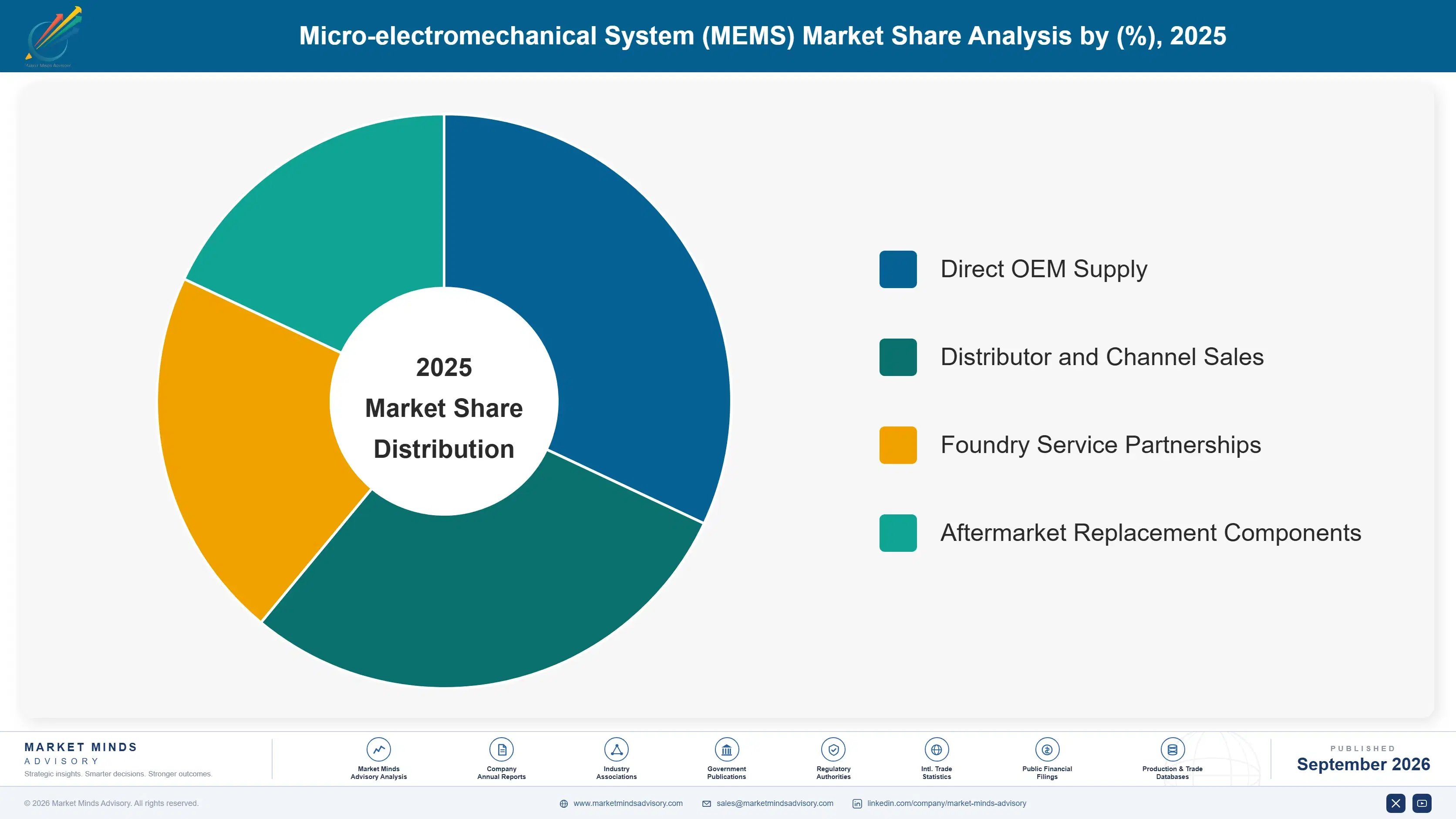
  • Direct OEM Supply
  • Distributor and Channel Sales
  • Foundry Service Partnerships
  • Aftermarket Replacement Components

By Region

  • North America
  • Western Europe
  • East Asia
  • South Asia and Pacific
  • Latin America
  • Middle East and Africa
  • Eastern Europe

Scope, Methodology, and Coverage

Every figure in this report is reproducible from documented input assumptions. The scope below maps the historical period, the forecast horizon, the segmentation dimensions, and the countries covered, alongside the underlying primary and qualitative methodology.
Historical Period
2020 to 2025
Forecast Period
2026 to 2036
Base Year
2025 (USD billions; MMA Primary Research Dataset, September 2026)
Market Definition
The MEMS Market covers micro-electromechanical sensors, actuators, and system-in-package devices fabricated using microfabrication techniques, sold across automotive, consumer electronics, industrial, and healthcare applications. It excludes traditional macro-scale sensors and standalone integrated circuits without a mechanical microstructure component.
Quantitative Units
USD Billion, unit shipments, CAGR percentage
Segmentation Dimensions
Sensor Type, End-Use Industry, Commercial Dimension, Region
Regions Covered
North America, Western Europe, East Asia, South Asia and Pacific, Latin America, Middle East and Africa, Eastern Europe
Countries Covered
United States, Canada, Germany, United Kingdom, France, China, Japan, Taiwan, South Korea, India, Australia, Brazil, Mexico, Israel, Poland
Key Companies Profiled
Bosch, STMicroelectronics, Texas Instruments, Broadcom, TDK InvenSense, Knowles Corporation, Infineon Technologies, Analog Devices, Murata Manufacturing, Goertek, AAC Technologies, Hitachi, Panasonic Industry, MEMSIC, Silicon Labs, Vesper Technologies, Colibrys, Akustica, Cirrus Logic, Amphenol
Quantitative Methodology
Primary survey, n=3,800 respondents, Q4 2025, six countries; demand-side model with trade association cross-validation
Qualitative Methodology
47 expert interviews, Q4 2025; applied to validate demand model assumptions, identify emerging dynamics, and assess competitive positioning
Report Format
PDF and XLSX data workbook (Word format preview document)
Publisher
Market Minds Advisory
Report Code
MMA-2026-TEC-936
Published
September 2026
Contact
sales@marketmindsadvisory.com | www.marketmindsadvisory.com

Purchase the full Micro-electromechanical System (MEMS) Market Report (2026 to 2036).

This report provides a comprehensive assessment of the global MEMS Market through 2036. It covers market sizing, segmentation, competitive dynamics, and regional demand patterns across all seven major geographies tracked in this analysis. The analysis examines how automotive qualification and sensor fusion packaging are reshaping vendor positioning across the sensor manufacturing industry, alongside silicon wafer and foundry capacity exposure across the broader global semiconductor supply chain. It draws on primary survey data, expert interviews, and company disclosures to support procurement, investment, and strategic planning decisions.
Ten-year market sizing and forecast model
Seven-region demand and competitive intensity breakdown
Five-vendor competitive benchmarking and moat analysis
Segment-level growth trajectory and margin analysis
Foundry cost exposure and mitigation pathways
Anonymized client case study with recommendations

Built For The People Who Decide

From boardroom strategy to bench-side execution, this report is read cover-to-cover by leaders shaping the next decade of their industry, turning demand scenarios, market dynamics and valuation benchmarks into decisions.
CXOs/ Presidents/ VPs/ Managers
M&A and Corporate Development
Strategy Teams and R&D Heads
Procurement and Product Directors
Regulatory and Compliance Leaders
Investor Relations and Equity Analysts