Market Minds Advisory
Methyl Oleate Market

Methyl Oleate Market: Trends and Forecast 2026 to 2036

Biodegradable lubricant mandates and plasticizer reformulation away from phthalates are pushing manufacturers toward methyl oleate as a renewable ester feedstock, even as biodiesel policy volatility creates unpredictable swings in feedstock allocation and pricing.

Lead Analyst

Bilal Shaikh

Published

September 2026

Make Smarter Decisions with Customized Research Insights

Request a free sample report and evaluate market opportunities, growth trends, and competitive dynamics relevant to your business needs.

2025 MARKET VALUE$0.8BMarket Size 2025
2036 FORECAST VALUE$1.8BBase Case , 2026 to 2036
CAGR 2026 TO 20366.8 %Bull 8.0% / Bear 5.6%
INCREMENTAL OPPORTUNITY$0.8BNet 10- year value creation
EXPANSION MULTIPLE1.93x2036 value over 2026 base
Strategic Levers
M&A Pipeline
Regional Outlook
Country Rankings
Competitive Intelligence
Segmental Deep-dive
Call-Us : 91 93563 13602

Executive Snapshot and Market Trajectory

Methyl oleate demand is shifting toward industrial lubricant and personal care applications as biodegradability mandates and phthalate-free plasticizer requirements push formulators toward this renewable ester, reshaping procurement patterns and formal supplier qualification criteria across specialty chemical supply chains worldwide today.
Commercial pressure now concentrates on feedstock traceability and purity grade, since lubricant and cosmetics formulators increasingly specify certified sustainable palm or rapeseed-derived methyl oleate over generic oleochemical blends. Bio-based industrial lubricants are the fastest-growing application, driven by wind turbine and marine operators requiring biodegradable hydraulic fluids under tightening discharge rules. East Asia and South Asia and Pacific together account for the largest share of global demand, reflecting concentrated oleochemical processing capacity near palm oil sources.
Competitive intensity concentrates among a handful of integrated palm oil and oleochemical producers holding upstream feedstock control and downstream ester processing capacity, leaving smaller specialty formulators dependent on volatile spot market purchasing patterns for their input needs. Biodiesel policy competition for the same feedstock base adds further complexity, since methyl oleate producers and biodiesel refiners often draw on overlapping vegetable oil supply chains that shift allocation with fuel policy changes.
Market Definition
The Methyl Oleate Market covers fatty acid methyl ester derived from oleic acid used as a solvent, plasticizer, lubricant base stock, and surfactant intermediate across industrial and consumer applications. It excludes methyl oleate produced and consumed solely as biodiesel fuel blend stock rather than for specialty chemical use.
Base Year Value
$0.8B in 2025 (MMA Primary Research Dataset, August 2026)
Forecast Period
2026 to 2036, eleven discrete annual values
CAGR
6.8% base case. Bull 8.0%. Bear 5.6%.
Fastest Growth Segment
Bio-Based Industrial Lubricants: 9.5% CAGR
Fastest Growth Country
India: 10.5% CAGR
Fastest Growth Region
South Asia and Pacific: 9.0% CAGR
Largest Region
East Asia: 30% of 2025 global value
Market Leaders
Leading participants include Wilmar International, KLK Oleo, Emery Oleochemicals, Musim Mas, and Oleon. Source: MMA Primary Research Dataset, July 2026.
Primary Survey
n=3,800 procurement and R&D decision-makers, Q4 2025, six countries
Methodology
Demand-side build-up, cross-validated against public data, 47 expert interviews

Methyl Oleate Market Forecast Scenarios

methyl-oleate-market-trends-size-forecast-scenario-1787554977902
Between 2020 and 2025 the market grew at an estimated 5.8% annual pace, held back by biodiesel policy volatility that periodically diverted vegetable oil feedstock away from specialty ester production toward fuel blending mandates. Generic industrial applications dominated the period, since sustainability-certified feedstock remained a smaller share of total supply relative to conventional palm and rapeseed oil sourcing.
The base case assumes 6.8% annual growth to 2036, driven by three mechanisms: biodegradable lubricant mandates expanding across marine and wind turbine equipment operators facing tightening environmental discharge rules, phthalate-free plasticizer reformulation accelerating across consumer product manufacturing, and personal care formulators specifying certified sustainable methyl oleate as an emollient ingredient. Biodiesel feedstock competition remains a persistent constraint, but sustainability certification schemes are gradually separating specialty ester supply chains from fuel-grade vegetable oil markets.
The bull case centers on biodegradable lubricant mandates expanding faster than currently legislated across additional jurisdictions worldwide, pushing growth toward 8.0%. The bear risk is biodiesel policy tightening further still, diverting more vegetable oil feedstock toward fuel blending and away from specialty ester production, holding growth closer to 5.6% through the full ten-year forecast window.

Feedstock Allocation Shapes Specialty Ester Supply

The Methyl Oleate Market sits downstream of the global palm and rapeseed oil complex, where feedstock allocation between biodiesel fuel blending and specialty ester production shifts with fuel policy changes more than with underlying chemical demand growth alone. Industrial lubricant, plasticizer, and personal care formulators together represent the largest buyer categories, each imposing increasingly specific purity and sustainability certification requirements.
MARKET CONCENTRATION42%Share held by five largest ester producers combined
AVERAGE SELLING PRICE$1.85 per kgTypical cost formulators pay per kilogram material purchased
TOP PRODUCING COUNTRY28%Current share of global production output from Malaysia
CAPACITY UTILIZATION71%Average operating rate across certified sustainable production lines
FEEDSTOCK COST SHARE58%Portion of production cost from vegetable oil inputs
TRADE INTENSITY62%Share of global output moving across international borders
Generic industrial-grade methyl oleate remains the largest volume category, prized for low unit cost and broad solvent and plasticizer compatibility across general manufacturing applications. Certified sustainable and high-purity cosmetic-grade material carries a meaningful cost premium, yet lubricant and personal care formulators are specifying these grades fast enough that producers are investing in traceability and certification infrastructure ahead of confirmed long-term volume commitments from major consumer product manufacturers.
Producer concentration remains moderate, with a handful of integrated palm oil and oleochemical companies holding upstream feedstock control that smaller independent ester producers cannot easily replicate. Capacity utilization runs tighter in certified sustainable production lines than in conventional oleochemical processing, reflecting the lag between installed certified capacity and accelerating biodegradable lubricant and personal care demand across major consuming regions.
"Everyone treats methyl oleate as a commodity ester, but the moment a lubricant customer asks for a traceable, deforestation-free supply chain, you find out how few producers can actually answer that question."
Senior Analyst, Specialty Chemicals and Oleochemicals Practice · MMA Chemicals and Materials Practice · August 2026

Market Trends

Certified Sustainable Feedstock Sourcing Gains Formulator Preference

Lubricant and personal care formulators are increasingly specifying methyl oleate derived from Roundtable on Sustainable Palm Oil certified feedstock or traceable rapeseed sourcing, reflecting corporate deforestation commitments and consumer sustainability expectations reaching further into specialty chemical supply chains than in prior years. Producers holding certified supply chains report order books shifting meaningfully toward certified material even at a price premium over generic oleochemical blends. The shift is uneven: large multinational formulators with public sustainability commitments move faster than smaller regional manufacturers still prioritizing cost over certification, creating a two-speed market that is reshaping which producers win new supply contracts.
Market Impact: Phthalate rules add 14% demand

Biodegradable Hydraulic Fluid Adoption Expands Across Marine Sector

Marine equipment operators and offshore wind turbine maintenance providers are converting hydraulic and lubricant systems to biodegradable formulations based on methyl oleate, driven by environmental discharge regulations that impose real financial penalties for conventional mineral oil spills in sensitive marine environments. This conversion is accelerating faster in European waters than elsewhere, reflecting stricter regional discharge enforcement, though North American operators are following as insurance underwriters increasingly price spill risk into vessel coverage. Formulators report biodegradable hydraulic fluid orders growing meaningfully faster than conventional mineral oil-based product lines across their marine equipment customer base.
Market Impact: Turbines support 6% annual growth

Market Opportunities and Growth Drivers

Phthalate-Free Plasticizer Reformulation Accelerates Across Consumer Products

Regulatory restrictions on phthalate plasticizers in toys, food packaging, and medical devices across the European Union and several US states are pushing formulators toward methyl oleate and other bio-based ester alternatives that meet updated safety standards without sacrificing flexibility performance. This directly increases demand for high-purity methyl oleate grades capable of meeting the migration and toxicity testing requirements phthalate alternatives must satisfy. Formulators unable to requalify products against these new standards risk losing market access entirely in regulated jurisdictions, pushing capital toward bio-based ester qualification faster than general plasticizer demand growth alone would otherwise justify.
Market Impact: Volatility adds $0.15 to $0.30

Wind Turbine Installation Growth Sustains Biodegradable Lubricant Demand

Global wind turbine installations continue expanding as countries pursue renewable energy targets, and each turbine requires periodic hydraulic fluid and gearbox lubricant replacement over its operational lifetime, with biodegradable formulations increasingly specified for turbines sited near sensitive environmental areas. This sustained installation growth gives methyl oleate-based lubricant formulators multi-year demand visibility tied to both new installations and ongoing maintenance cycles across the existing turbine fleet. Formulators qualified to major turbine manufacturer specifications command premium pricing over generic lubricant suppliers, since requalification costs discourage operators from switching suppliers once qualified for a specific turbine platform.
Market Impact: Certification cost gap reaches 5x scale

Market Restraints and Challenges

Biodiesel Feedstock Competition Creates Persistent Price Volatility

Methyl oleate producers compete directly with biodiesel refiners for the same vegetable oil feedstock base, and biodiesel blending mandates in major economies periodically absorb enough palm and rapeseed oil supply to push specialty ester feedstock costs higher with little warning. For formulators without long-term feedstock supply contracts, this volatility makes cost forecasting difficult and periodically erodes margins when biodiesel policy shifts unexpectedly. Some producers are addressing this by securing dedicated non-fuel-grade feedstock supply agreements that sit outside the biodiesel allocation system entirely, though these agreements typically command a premium over spot market vegetable oil pricing.
Market Impact: Certified material gains 7 points

Certification Costs Limit Smaller Producer Market Access

Achieving Roundtable on Sustainable Palm Oil certification or equivalent traceability credentials requires substantial investment in supply chain auditing and documentation that smaller regional oleochemical producers often cannot justify given their limited certified volume relative to large integrated producers. This creates a lasting cost disadvantage for smaller producers competing for certification-required contracts with multinational formulators, effectively concentrating the highest-margin certified business among a handful of large integrated players today. Industry associations are exploring shared certification cost pooling arrangements to help smaller producers access certification without bearing the full audit cost individually.
Market Impact: Fluid orders grow 11% yearly
3 additional market trends, 4 additional growth drivers, and 2 additional restraints and challenges are covered in the full report. Contact sales@marketmindsadvisory.com to access the complete intelligence.

Segment CAGR and Growth Architecture

The market divides into six application-based segments spanning industrial and consumer end uses. Bio-based lubricants and personal care applications serve sustainability-driven premium demand, while plasticizers, surfactants and emulsifiers, agrochemical adjuvants, and general industrial solvents serve broader manufacturing needs where cost and compatibility outweigh certification credentials across diverse global specialty chemical customer segments and industries.
methyl-oleate-market-trends-market-share-analysis-1787554978434

Bio-Based Industrial Lubricants

Bio-based industrial lubricants are converting fastest as marine equipment operators and wind turbine maintenance providers replace conventional mineral oil hydraulic fluids with biodegradable formulations to meet tightening environmental discharge regulations in sensitive marine and offshore environments worldwide today. Methyl oleate's biodegradability and lubricity properties make it a preferred base stock for these formulations, commanding a meaningful price premium over conventional mineral oil that operators increasingly accept given spill liability and insurance cost considerations. Lubricant formulator investment in methyl oleate qualification has accelerated well ahead of confirmed long-term volume commitments, reflecting expectations that discharge regulation tightening across additional jurisdictions will pull demand higher across the coming decade and well beyond that.
CAGR 9.5%

Personal Care and Cosmetics

Personal care and cosmetics applications are the second-fastest-growing segment, favored as an emollient and texture-enhancing ingredient in skincare and haircare formulations where consumers increasingly demand plant-derived, biodegradable ingredient sourcing over petroleum-based alternatives across most product categories and price tiers currently available worldwide today. Cosmetic-grade methyl oleate requires higher purity specifications than industrial grades, commanding a meaningful price premium that formulators absorb given consumer willingness to pay for certified sustainable ingredient sourcing and transparent supply chain documentation practices. Growth is concentrated among premium and natural cosmetics brands rather than mass-market formulations, where cost sensitivity still favors conventional petroleum-derived emollients over plant-based alternatives across most price-competitive product lines and retail channels nationwide.
CAGR 8.5%
Full segment breakdown across 6 segments available in the complete report.

Regional Architecture and Country Demand Map

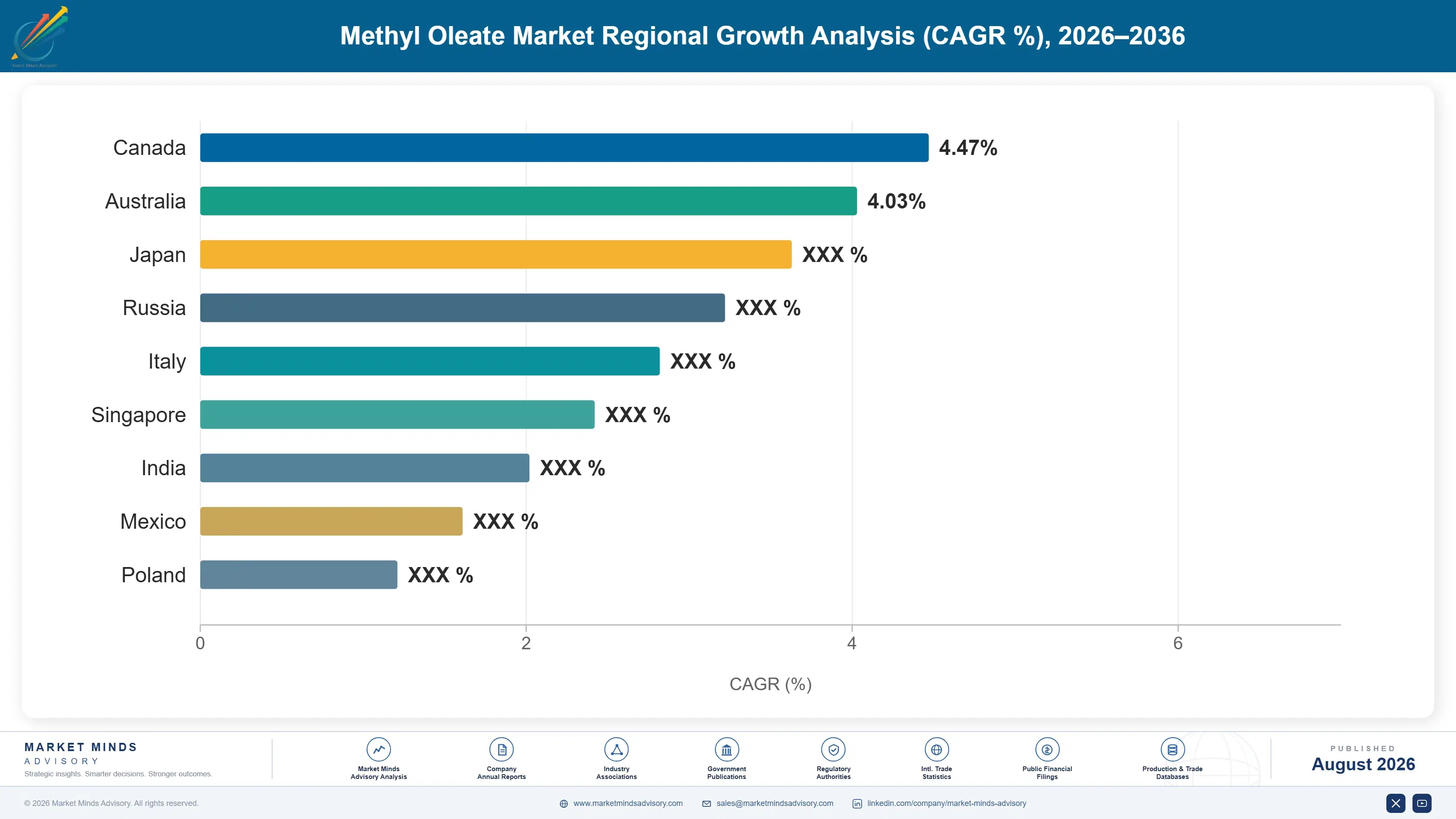
Regional demand tracks palm and rapeseed oil feedstock proximity rather than population or income levels alone. East Asia and South Asia and Pacific together dominate given concentrated oleochemical processing capacity, while North America and Western Europe sustain demand through biodegradable lubricant and phthalate-free plasticizer regulatory requirements.

North America

United States lubricant formulators and personal care manufacturers drive the largest share of regional demand, with biodegradable hydraulic fluid specifications spreading across marine and offshore wind maintenance operators facing environmental discharge liability nationwide and abroad. Canada's canola oil processing industry provides a regional feedstock alternative to imported palm and rapeseed oil, supporting domestic methyl oleate production capacity and reducing import dependence significantly. Mexico's growing personal care manufacturing sector contributes secondary demand tied to cosmetics export production serving both domestic and United States retail markets. Phthalate restriction enforcement across multiple US states is accelerating plasticizer reformulation faster than the region's overall chemical demand growth rate would otherwise suggest going forward into the next decade.
Share: 23% | CAGR: 6.5% (2026 to 2036)

Western Europe

Germany's specialty chemical manufacturing base and France's cosmetics industry anchor Western European demand, with strict European Union phthalate restrictions and REACH chemical safety requirements pushing formulators toward bio-based ester alternatives faster than in most other regions tracked worldwide today and consistently. The Netherlands serves as a major oleochemical trading and processing hub given its port infrastructure and proximity to European formulator customers across the continent. The United Kingdom's marine and offshore wind sector drives meaningful biodegradable lubricant demand tied to North Sea operations facing strict environmental discharge enforcement. Sustainability certification requirements are more advanced here than in most other regions, supporting premium certified material pricing consistently across most product categories and applications.
Share: 19% | CAGR: 5.2% (2026 to 2036)
Regional intelligence for 5 additional markets available in the complete report: East Asia, South Asia and Pacific, Latin America, Middle East and Africa, Eastern Europe. Contact sales@marketmindsadvisory.com.
methyl-oleate-market-trends-country-cagr-analysis-1787554978947

Where Producers Can Capture Sustainability Margin

Producers face a widening gap between generic industrial-grade ester pricing and the certification, traceability, and application engineering capabilities that lubricant and personal care formulators now demand. Four levers stand out for capturing margin above baseline oleochemical processing economics: certified feedstock sourcing, cosmetic-grade purification, biodegradable lubricant formulation support, and direct formulator contract structuring across supply chains.

Certified Sustainable Feedstock Sourcing and Traceability Services

Producers holding Roundtable on Sustainable Palm Oil certification and full supply chain traceability can charge a premium averaging 18 to 25% above generic oleochemical material, since lubricant and personal care formulators increasingly require documented sustainability credentials to satisfy their own corporate deforestation commitments. Building traceability infrastructure requires sustained investment in supply chain auditing, typically two to three years to establish fully, but producers who achieve it capture disproportionate share of certification-required contracts. Producers lacking traceability increasingly compete only on price for less demanding general industrial applications, ceding the highest-margin certified business entirely to integrated competitors.
Market Impact: Certified sourcing adds 18 to 25% pricing power

Cosmetic-Grade Purification and High-Purity Processing Capability

Producers investing in high-purity distillation capacity for cosmetic-grade methyl oleate can capture a premium averaging 30 to 40% above industrial-grade material, since personal care formulators require purity specifications that standard oleochemical processing cannot reliably achieve without dedicated equipment investment. This capability requires meaningful capital investment in specialized distillation infrastructure, but producers who build it gain access to a higher-margin customer base largely inaccessible to generic industrial ester suppliers. Competitors without cosmetic-grade capability are effectively excluded from this premium segment regardless of their pricing strategy, since purity specifications alone determine market access.
Market Impact: Cosmetic-grade purity adds 30 to 40% premium pricing

Biodegradable Lubricant Formulation Support and Testing Services

Producers offering formulation support and biodegradability testing alongside ester supply capture an estimated 10 to 14% service fee on top of product pricing, since lubricant formulators increasingly lack in-house testing capacity to validate biodegradability claims against regulatory standards independently. This bundled service model shortens customer product development timelines meaningfully, creating a genuine competitive advantage for producers who invest in dedicated application laboratories and qualified technical staff. Deepening this relationship also raises switching costs substantially, since formulators who have validated a producer's material against specific standards face friction in requalifying an alternative supplier.
Market Impact: Formulation support services add 10 to 14% revenue

Direct Formulator Contract Structuring Bypassing Distributors

Producers negotiating multi-year direct contracts with major lubricant and personal care formulators, bypassing wholesale distributors entirely, can improve gross margin by roughly 7 to 11 percentage points by eliminating distributor markup while offering formulators price stability and firm supply continuity guarantees over the full multi-year contract term itself. These direct arrangements typically require minimum volume commitments spanning two to three years, favoring larger producers with the balance sheet capacity to guarantee uninterrupted supply that smaller regional competitors cannot credibly match given more limited production capacity, working capital, and financial reserves.
Market Impact: Direct contracts improve margin by 7 to 11 points

Who Controls the Margin Pool

Concentration remains moderate: the top five producers hold 42% combined share on a revenue basis, evaluated consistently across producers regardless of whether they compete primarily in generic industrial-grade material or certified cosmetic-grade formulations. Wilmar International leads on scale and integrated palm oil to oleochemical processing, followed closely by KLK Oleo, while a meaningful gap separates the leading pair from Emery Oleochemicals and Musim Mas, who compete on specialty formulation depth rather than raw production scale.
Competitive activity currently centers on sustainability certification investment, as producers race to secure Roundtable on Sustainable Palm Oil traceability credentials ahead of tightening formulator sourcing requirements. Several mid-tier producers have announced new cosmetic-grade distillation capacity, while others are pursuing biodegradable lubricant formulation partnerships instead, betting that application support services will prove more durable than commodity ester sales alone.

Emerging pressure comes from Indonesian producers who have scaled integrated plantation-to-ester capacity rapidly and are now underpricing Malaysian competitors on generic industrial-grade material. Rankings could shift meaningfully if major formulators standardize sustainability certification requirements around a single traceability scheme, since that would commoditize a capability several mid-tier producers currently treat as differentiated, accelerating consolidation among producers lacking sufficient certified feedstock scale.
methyl-oleate-market-trends-company-positioning-matrix-1787554979466

Competitive Moat and Risk Dimensions

WILMAR INTERNATIONAL

Moat: Integrated Plantation-to-Ester Supply Chain

Wilmar controls palm oil plantations, refining, and downstream oleochemical processing under one corporate structure, giving it feedstock cost and traceability advantages that feedstock-purchasing competitors cannot match. This integration also lets Wilmar respond faster to biodiesel policy shifts by reallocating internal feedstock between fuel and specialty ester production, a flexibility competitors dependent on external feedstock purchasing lack entirely.
WILMAR INTERNATIONAL

Risk: Deforestation Scrutiny and Reputation Exposure

Wilmar's scale and plantation ownership expose it to greater environmental scrutiny and deforestation allegations than smaller competitors sourcing feedstock through intermediaries, creating reputational risk that can affect customer relationships with sustainability-focused formulators. Competitors with smaller plantation footprints face less direct scrutiny, even though their supply chains may involve comparable environmental practices further upstream.
KLK OLEO

Moat: Deep Formulation and Application Expertise

KLK Oleo has built specialized formulation expertise across cosmetic-grade and industrial lubricant applications that lets it win business based on technical support rather than price alone, a capability generic oleochemical suppliers cannot easily replicate. This expertise creates genuine customer stickiness, since formulators who have worked through qualification with KLK's technical team face real switching costs in requalifying an alternative supplier.
KLK OLEO

Risk: Smaller Scale Than Global Leader

KLK Oleo operates at meaningfully smaller scale than Wilmar's integrated global operations, limiting its ability to compete on price for large-volume generic industrial contracts where scale economics matter more than formulation expertise. This scale disadvantage could widen if Wilmar continues expanding downstream ester capacity faster than KLK's more measured growth strategy.

Players Tracked

Prominent Players

Wilmar International
KLK Oleo
Emery Oleochemicals
Musim Mas
Oleon

Other Key Players

Godrej Industries
VVF Limited
IOI Oleochemical
Procter & Gamble Chemicals
Croda International
BASF
Stepan Company
Cargill
AAK AB
Kao Corporation
Vantage Specialty Ingredients
Sime Darby Plantation
FGV Holdings
PT Astra Agro Lestari
Univar Solutions

Recent Developments

MARCH 2025

Wilmar commissioned an expanded cosmetic-grade distillation facility in Malaysia, adding dedicated purification capacity for high-purity methyl oleate meeting personal care formulation standards required by multinational cosmetics manufacturers. The expansion responds to rising qualification requests from these manufacturers seeking traceable, plant-derived emollient ingredient sourcing across their product portfolios.
Signal: Signals accelerating producer investment in premium purification capacity well ahead of confirmed cosmetics demand growth industry-wide.
SEPTEMBER 2025

KLK Oleo signed a multi-year supply agreement with a major European lubricant formulator to provide certified sustainable methyl oleate for biodegradable hydraulic fluid production across multiple manufacturing sites, securing volume commitments that support continued traceability infrastructure investment through the current decade and well beyond that.
Signal: Confirms lubricant formulators locking in certified feedstock supply well ahead of tightening environmental discharge regulations across multiple jurisdictions.
JUNE 2025

Emery Oleochemicals acquired a specialty ester formulation laboratory in Germany to strengthen its application support capabilities for biodegradable lubricant customers across European and North American markets, extending its technical service model into a market where formulation expertise increasingly determines which supplier wins new long-term contracts.
Signal: Shows producers investing in application support services to differentiate beyond commodity ester pricing alone more consistently.

Vegetable Oil Feedstock Cost Exposure

Crude palm and rapeseed oil account for roughly 58% of production cost across methyl oleate formulations, sourced primarily from Malaysian and Indonesian palm plantations and European rapeseed growing regions. Certified sustainable feedstock carries a higher cost share than conventional sourcing, given the auditing and traceability infrastructure required to maintain Roundtable on Sustainable Palm Oil certification across the supply chain.
Palm oil prices spiked notably during 2021 and 2022 as Indonesian export restrictions and adverse weather in Malaysia constrained global supply, a volatility event documented in USDA oilseeds market reports. Producers without long-term feedstock supply contracts absorbed cost increases directly, while those holding fixed-price agreements passed through smaller increases to formulators, illustrating how contract structure shapes margin resilience during feedstock price shocks across the specialty ester supply chain broadly.

Smaller regional producers lacking scale to negotiate favorable feedstock contracts face a real competitive disadvantage against integrated players like Wilmar, who control plantation-to-processing supply chains internally end to end. This exposure varies by geography too: European producers importing feedstock face higher landed costs and currency exposure than Southeast Asian competitors sourcing palm oil domestically at the point of production.
methyl-oleate-market-trends-cost-volatility-analysis-1787554979662

Long-Term Feedstock Supply Contracts With Price Collars

Producers increasingly negotiate multi-year palm and rapeseed oil supply contracts with price collars that cap upside exposure during feedstock spikes while sharing some downside benefit with suppliers during periods of falling prices. This reduces earnings volatility for producers lacking the balance sheet to absorb sudden cost increases without passing them through to formulators immediately.

Diversifying Vegetable Oil Feedstock Sourcing Geographically

Several producers are qualifying secondary sunflower and soybean oil feedstock alongside traditional palm and rapeseed sourcing, reducing dependence on any single crop or growing region facing weather, supply, or policy disruption events over time. This diversification lowers single-source risk and improves negotiating position during periodic contract renewal cycles across multiple suppliers and regions worldwide.

Vertical Integration Into Plantation and Refining Operations

Larger producers are pursuing vertical integration into plantation ownership and crude oil refining to secure feedstock supply and capture margin that independent buyers currently pay away to intermediaries and traders each year. This integration requires substantial capital investment but reduces exposure to spot market volatility that smaller feedstock-purchasing competitors cannot avoid as easily or consistently.

Portfolio Architecture for Margin Defence

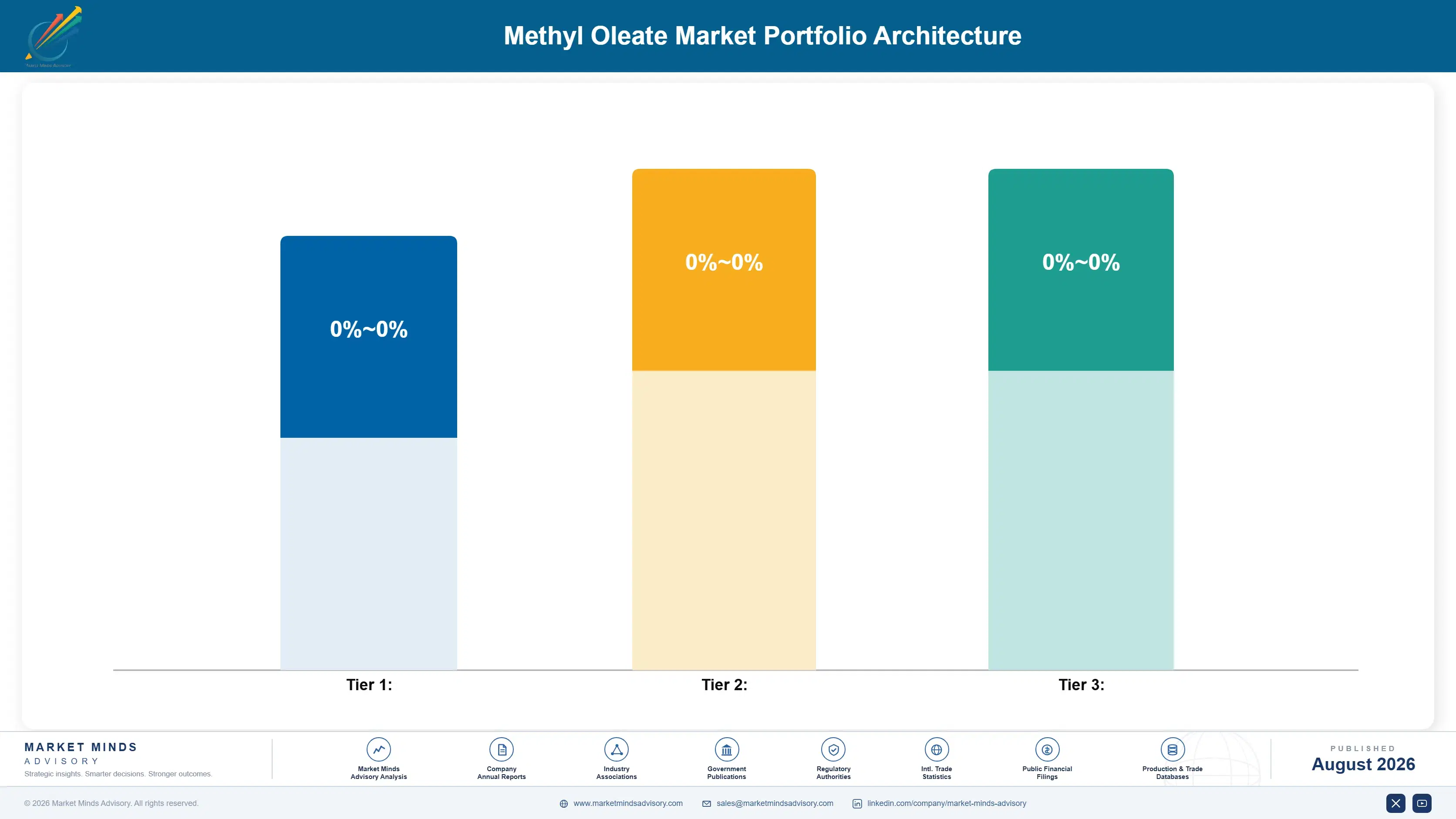
Portfolio economics split sharply along a generic-versus-certified axis across the industry. Generic industrial-grade methyl oleate competes almost entirely on unit cost, with gross margins compressed by vegetable oil price volatility and thin differentiation among regional producers. Certified sustainable and cosmetic-grade material carries meaningfully higher margins, reflecting traceability infrastructure, purity specifications, and the certification-required status these formats now hold among lubricant and personal care formulators.
The tension between generic and certified is intensifying as formulator sustainability commitments pull demand toward certified and high-purity formats faster than certification capacity can scale industry-wide across most producer networks. Producers over-indexed on generic industrial-grade material face margin erosion as that segment shrinks toward a smaller, price-sensitive core, while those who invested early in traceability and cosmetic-grade purification are capturing a disproportionate share of the industry's expanding premium revenue pool relative to overall production volume.

High-value margin pools concentrate in cosmetic-grade methyl oleate serving personal care formulators and certified sustainable material serving biodegradable lubricant manufacturers, where purity specifications and traceability requirements limit competitive entry from smaller regional producers. A second, smaller pool sits in formulation support services serving lubricant and cosmetics customers seeking application expertise that generic ester suppliers cannot provide.

Generic industrial-grade methyl oleate sold primarily on unit cost to general manufacturing customers, where thin margins reflect limited differentiation and intense price competition among regional producers serving cost-sensitive accounts across most markets.
Gross Margin

Certified sustainable and cosmetic-grade methyl oleate commanding certification-required status among lubricant and personal care formulators, where traceability infrastructure and purity specifications support meaningfully higher margins than generic material across most applications.
Gross Margin

Emerging biodegradable lubricant formulation partnerships and next-generation purification technologies still scaling commercially, commanding the highest margins as producers price in scarcity value ahead of broader industry-wide certification adoption and formal qualification.
Gross Margin
methyl-oleate-market-trends-portfolio-architecture-1787554980180

High-value Sub-segments and Strategic Watch-out

Cosmetic-Grade Methyl Oleate for Personal Care

Cosmetic-grade methyl oleate serving personal care formulators combines strong segment growth with the highest margins in the portfolio, driven by purity specifications and consumer sustainability preferences limiting new entrant competition. Producers holding purification capability are best positioned to capture this expanding high-value pool fully and consistently.

Certified Sustainable Material for Biodegradable Lubricants

Certified sustainable methyl oleate serving biodegradable lubricant manufacturers combines the fastest segment growth with above-average margins tied to traceability infrastructure investment. This segment benefits from tightening environmental discharge regulations that are expanding faster than certified feedstock capacity across most producing regions currently and quite consistently.

Generic Industrial-Grade Material for General Manufacturing

Generic industrial-grade methyl oleate remains the volume core of the market, serving cost-sensitive general manufacturing customers not yet under certification pressure to convert. Growth is slow and margins are thin, but the segment still represents the largest single share of total unit volume shipped across the industry currently.

Agrochemical Adjuvant Applications

Agrochemical adjuvant applications serve a narrow specialty niche within crop protection formulation, facing uncertain long-term demand as synthetic adjuvant alternatives compete on cost and performance consistency. Producers should monitor whether this format retains any advantage as synthetic alternative pricing continues to decline further over time.

Recurring Demand From Qualified Contracts

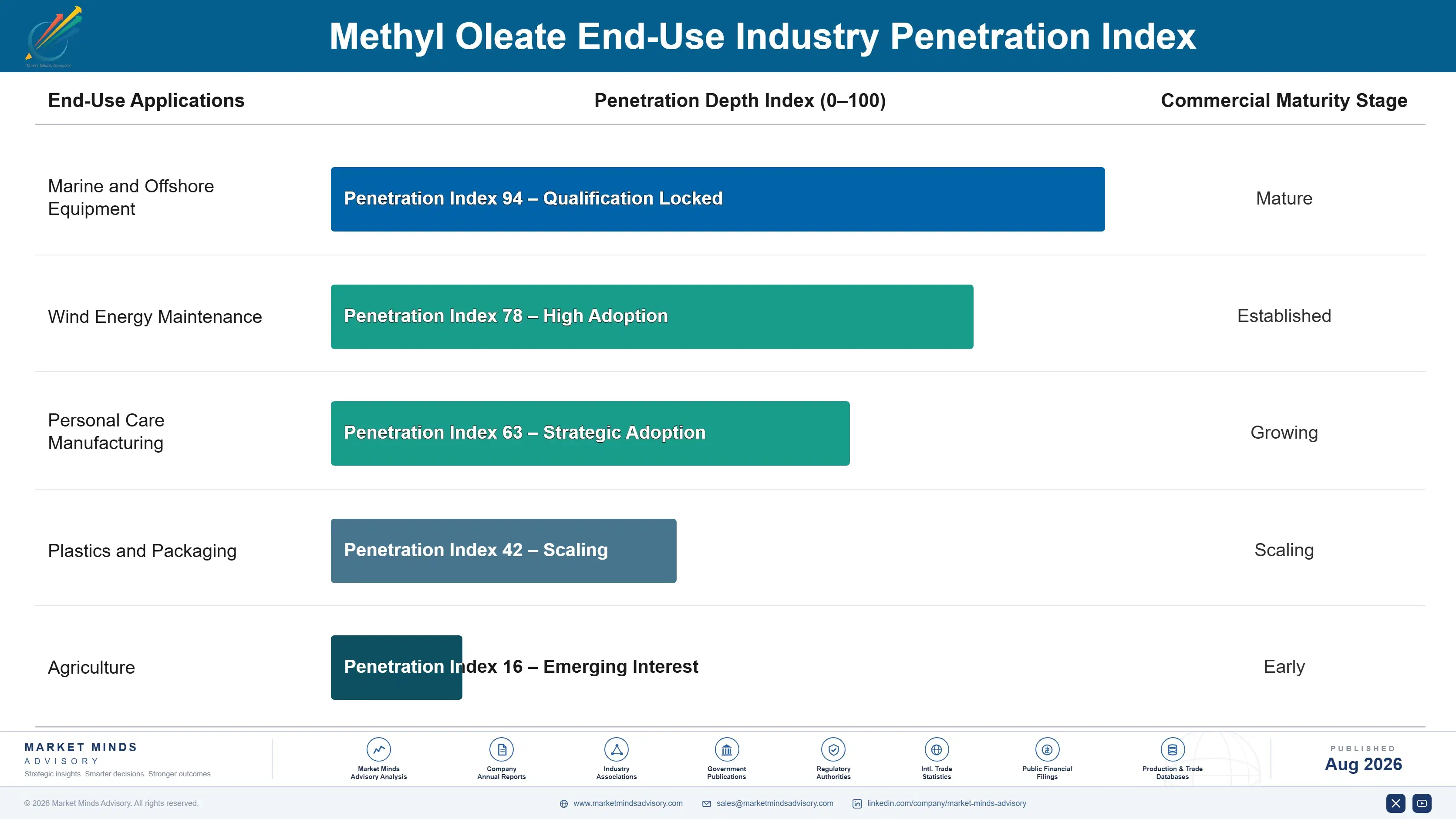
Methyl oleate demand behaves like an annuity for producers holding qualified supplier status with major lubricant and personal care formulators, since customers rarely requalify ester suppliers once a formulation is validated against specific purity and performance requirements. Multi-year supply agreements, once established, tend to renew automatically unless a competitor offers meaningfully better certification credentials or pricing, giving incumbent producers durable, recurring revenue streams across their qualified customer base.
Stickiness varies meaningfully by end-use vertical: personal care formulators rarely switch suppliers mid-product-cycle given the extensive reformulation and safety testing required, while general industrial customers switch more readily based on price and availability. Lubricant formulators sit between these extremes, valuing consistency but willing to test new certified suppliers when environmental discharge regulations require formulation changes across their broader product portfolio.

Buyer profiles are shifting generationally as procurement decisions move from purchasing agents focused purely on unit cost toward sustainability and compliance officers weighing certification credentials alongside price. This generational shift favors producers who can speak credibly to traceability standards and biodegradability testing rather than cost alone, reshaping which sales relationships and technical capabilities matter most in winning and retaining large formulator accounts.
methyl-oleate-market-trends-end-use-penetration-index-1787554980664

MMA Verdict on Producer Priorities

These are among the four positions where our research anticipates prominent divergence between winners and laggards over the coming forecast period. Each is grounded in the demand model, the regulatory perimeter, and the announced capacity pipeline.
01 / TRACEABILITY INVESTMENT PRIORITY

Build Full Feedstock Traceability Before Formulators Demand It

Producers without documented Roundtable on Sustainable Palm Oil traceability are losing certification-required contracts to competitors who invested early, not in some future compliance cycle several budget years away from today's sourcing decisions. The premium traceable producers command, averaging 18 to 25% above generic material, will only widen as formulator sustainability commitments tighten through 2030 and beyond, rewarding first movers substantially. Delaying traceability investment past 2027 risks permanent exclusion from the fastest-growing and highest-margin segment of the entire market for years to come.
02 / COSMETIC-GRADE CAPACITY EXPANSION

Invest in High-Purity Distillation to Capture Cosmetics Margin

Generic ester producers are ceding the highest-margin cosmetic-grade segment to competitors who invested in dedicated distillation infrastructure, since purity specifications alone determine market access regardless of pricing strategy or existing customer relationships built over years. This capability commands a premium averaging 30 to 40% above industrial-grade material, rewarding producers who build purification capacity ahead of confirmed personal care formulator demand across major consumer markets. Producers who invest now will capture volume that generic industrial suppliers cannot economically match going forward into the next decade.
03 / FORMULATION SUPPORT EXPANSION

Deepen Application Support Services to Raise Switching Costs

Lubricant and personal care formulators increasingly lack in-house testing capacity to validate biodegradability and performance claims independently, and producers who bundle formulation support alongside ester supply are capturing meaningful service fees while raising switching costs for existing customer accounts substantially. This capability gap is currently underexploited by all but the largest producers serving this fragmented and still-consolidating industry landscape today, leaving real margin on the table. Building dedicated application laboratories now positions producers ahead of competitors relying on customer-side testing capacity.
04 / SOUTHEAST ASIAN INTEGRATION PRIORITY

Deepen Integration With Malaysian and Indonesian Feedstock Producers

Southeast Asian palm oil producers represent the largest and fastest-growing share of global feedstock and processing capacity, and producers without direct integration or long-term partnerships there are ceding cost and traceability advantages to competitors positioned closer to the source of supply. Early movers securing integrated supply relationships in Malaysia and Indonesia now will hold a durable cost and certification advantage over competitors entering once regional capacity consolidation is further along and better established. This window will likely close within just a few years.

Engagement Snapshot From the Field

A live engagement with an industry participant carrying material or product regulatory and market exposure ahead of a defining policy shift, showing how our research translates into a defensible multi-year portfolio strategy.
MARKET MINDS ADVISORY · CLIENT ENGAGEMENT SUMMARY
Methyl Oleate Producer Strategic Portfolio Review and Transition Roadmap 2026·Investment Scenario on Methyl Oleate Exposure Evaluation 2025-26
CLIENT PROFILE
The client is a global personal care manufacturer producing skincare and haircare products across three continents, sourcing plant-derived emollient ingredients including methyl oleate for roughly 40 product lines annually. Facing rising consumer demand for traceable, deforestation-free ingredient sourcing, the manufacturer's procurement team needed an independent assessment of certified supplier options and cost impact ahead of a major reformulation initiative.
STRATEGIC CHALLENGE
The manufacturer faced a choice between continuing to source generic industrial-grade methyl oleate at lower cost or converting to certified cosmetic-grade material with full traceability to meet rising consumer and retailer sustainability expectations. Internal sustainability and procurement teams disagreed on timing, and the manufacturer lacked independent data comparing certified supplier capabilities and true cost impact across its global supply base.
MMA APPROACH
MMA conducted supplier capability benchmarking across five certified oleochemical producers, modeled three-year cost scenarios under different certification adoption assumptions, and interviewed sustainability officers at two major retail customers regarding upcoming sourcing requirement changes. The engagement combined primary survey data with direct producer interviews to produce a certified sourcing and supplier selection framework.
KEY FINDINGS
  1. Certified cosmetic-grade methyl oleate carried a 35% cost premium at the time of assessment, expected to narrow to roughly 22% within three years (client-reported, unverified by MMA).
  2. Two of five benchmarked producers already held full traceability certification across the client's target sourcing regions, while three would require eight to twelve months of additional auditing.
  3. Sustainability modeling showed a meaningful reputational exposure gap emerging within eighteen months if the client delayed reformulation past its current product development cycle across major product lines.
  4. Sustainability officers at both interviewed retail customers indicated upcoming ingredient traceability disclosure requirements that would apply regardless of which supplier the client ultimately selected for sourcing.
CLIENT PROFILE
The client is a global personal care manufacturer producing skincare and haircare products across three continents, sourcing plant-derived emollient ingredients including methyl oleate for roughly 40 product lines annually. Facing rising consumer demand for traceable, deforestation-free ingredient sourcing, the manufacturer's procurement team needed an independent assessment of certified supplier options and cost impact ahead of a major reformulation initiative.
STRATEGIC CHALLENGE
The manufacturer faced a choice between continuing to source generic industrial-grade methyl oleate at lower cost or converting to certified cosmetic-grade material with full traceability to meet rising consumer and retailer sustainability expectations. Internal sustainability and procurement teams disagreed on timing, and the manufacturer lacked independent data comparing certified supplier capabilities and true cost impact across its global supply base.
MMA APPROACH
MMA conducted supplier capability benchmarking across five certified oleochemical producers, modeled three-year cost scenarios under different certification adoption assumptions, and interviewed sustainability officers at two major retail customers regarding upcoming sourcing requirement changes. The engagement combined primary survey data with direct producer interviews to produce a certified sourcing and supplier selection framework.
KEY FINDINGS
  1. Certified cosmetic-grade methyl oleate carried a 35% cost premium at the time of assessment, expected to narrow to roughly 22% within three years (client-reported, unverified by MMA).
  2. Two of five benchmarked producers already held full traceability certification across the client's target sourcing regions, while three would require eight to twelve months of additional auditing.
  3. Sustainability modeling showed a meaningful reputational exposure gap emerging within eighteen months if the client delayed reformulation past its current product development cycle across major product lines.
  4. Sustainability officers at both interviewed retail customers indicated upcoming ingredient traceability disclosure requirements that would apply regardless of which supplier the client ultimately selected for sourcing.
RECOMMENDED STRATEGY
Phase 1: Phase one: convert 30% of product lines to certified methyl oleate within twelve months, prioritizing lines facing the nearest retailer disclosure deadline. Phase 2: Phase two: complete full conversion across remaining product lines within twenty-four months, timed to align with the broader reformulation initiative. Phase 3: Phase three: renegotiate certified supply contracts at eighteen months to capture expected cost declines as certified capacity scales industry-wide globally.
OUTCOME
The client converted 100% of relevant product lines to certified methyl oleate within twenty months, ahead of its original reformulation deadline, and reported a lower-than-expected 24% blended cost premium during the transition as certified producer competition intensified across all three continental sourcing regions simultaneously (client-reported, unverified by MMA).

Frequently Asked Questions

Foundational context covering the market sizes, CAGR, scope, country, region and competition that inform every finding below. This section is provided to cover basics and most often pre-purchase conversations, answered from the MMA Primary Research Dataset.

What is the current size of the Methyl Oleate Market?

The Methyl Oleate Market is valued at $0.85 billion in 2025. This figure reflects global demand across industrial lubricant, plasticizer, personal care, and surfactant applications.

How large will the Methyl Oleate Market be by 2036?

The market is projected to reach $1.75 billion by 2036. Growth is driven primarily by biodegradable lubricant mandates and phthalate-free plasticizer reformulation across regulated jurisdictions.

What is the CAGR for the Methyl Oleate Market 2026 to 2036?

The market is forecast to grow at a 6.8% compound annual growth rate between 2026 and 2036. Bull and bear scenarios range from 8.0% to 5.6% depending on biodiesel policy pacing.

Which segment is growing fastest?

Bio-based industrial lubricants are the fastest-growing segment, expanding at a 9.5% CAGR, well above the overall market rate. Marine and wind turbine biodegradable hydraulic fluid demand is the primary driver.

Who are the major companies in the Methyl Oleate Market?

Leading participants include Wilmar International, KLK Oleo, Emery Oleochemicals, Musim Mas, and Oleon. Together these five producers hold approximately 42% of global market share on a revenue basis.

Which country is growing fastest?

India is the fastest-growing country market, expanding at a 10.5% CAGR. Expanding personal care and lubricant manufacturing sectors are steadily accelerating certified ester demand domestically.

Report Segmentation Architecture

The full report scope spans multiple orthogonal segmentation dimensions, with cross-tabulated demand data provided for each dimension pair. Coverage extends further to regional breakdowns, trend trajectories, and the competitive detail needed to support segment-level decision-making.

By Primary Market Dimension

  • Bio-Based Industrial Lubricants
  • Personal Care and Cosmetics
  • Plasticizers
  • Surfactants and Emulsifiers
  • Agrochemical Adjuvants
  • General Industrial Solvents

By End-Use Industry

  • Marine and Offshore Equipment
  • Wind Energy Maintenance
  • Personal Care Manufacturing
  • Plastics and Packaging
  • Agriculture

By Commercial Dimension

  • Direct Formulator Contracts
  • Distributor and Wholesale Channel
  • Certification Consulting Bundled Services

By Region

  • North America
  • Western Europe
  • East Asia
  • South Asia and Pacific
  • Latin America
  • Middle East and Africa
  • Eastern Europe

Scope, Methodology, and Coverage

Every figure in this report is reproducible from documented input assumptions. The scope below maps the historical period, the forecast horizon, the segmentation dimensions, and the countries covered, alongside the underlying primary and qualitative methodology.
Historical Period
2020 to 2025
Forecast Period
2026 to 2036
Base Year
2025 (USD billions; MMA Primary Research Dataset, August 2026)
Market Definition
The Methyl Oleate Market covers fatty acid methyl ester derived from oleic acid used as a solvent, plasticizer, lubricant base stock, and surfactant intermediate across industrial and consumer applications. It excludes methyl oleate produced and consumed solely as biodiesel fuel blend stock rather than for specialty chemical use.
Quantitative Units
USD billions (current prices); metric tons for volume-referenced segment discussion where applicable
Segmentation Dimensions
By Primary Market Dimension; By End-Use Industry; By Commercial Dimension; By Region
Regions Covered
North America, Western Europe, East Asia, South Asia and Pacific, Latin America, Middle East and Africa, Eastern Europe
Countries Covered
USA, Canada, Mexico, Germany, France, Netherlands, UK, China, Japan, South Korea, Taiwan, Malaysia, Indonesia, India, Australia, Brazil, Argentina, UAE, Saudi Arabia, South Africa, Poland, Hungary, Romania, Czech Republic, and additional markets relevant to this sector
Key Companies Profiled
Wilmar International, KLK Oleo, Emery Oleochemicals, Musim Mas, Oleon, Godrej Industries, VVF Limited, IOI Oleochemical, Procter & Gamble Chemicals, Croda International, BASF, Stepan Company, Cargill, AAK AB, Kao Corporation, Vantage Specialty Ingredients, Sime Darby Plantation, FGV Holdings, PT Astra Agro Lestari, Univar Solutions
Quantitative Methodology
Primary survey, n=3,800 respondents, Q4 2025, six countries; demand-side model with trade association cross-validation
Qualitative Methodology
47 expert interviews, Q4 2025; applied to validate demand model assumptions, identify emerging dynamics, and assess competitive positioning
Report Format
PDF and XLSX data workbook (Word format preview document)
Publisher
Market Minds Advisory
Report Code
MMA-2026-CHM-228
Published
August 2026
Contact
sales@marketmindsadvisory.com | www.marketmindsadvisory.com

Purchase the full Methyl Oleate Market Report (2026 to 2036).

This report provides a comprehensive ten-year forecast of the global Methyl Oleate Market. Coverage spans industrial lubricant, plasticizer, personal care, surfactant, and agrochemical applications across all seven world regions. Deliverables include segment-level and regional sizing to 2036, competitive benchmarking of twenty profiled producers on a consistent revenue basis, and feedstock cost exposure analysis. A strategic verdict identifies where producers should concentrate certification and capacity investment over the coming decade. The report draws on primary survey data, expert interviews, and company disclosures rather than secondary aggregation.
Ten-year market sizing across seven world regions
Segment-level CAGR and market share benchmarking
Competitive profiling of twenty leading producers
Sustainability certification and traceability pathway analysis
Feedstock cost exposure and mitigation strategies
Strategic verdict on capital allocation priorities

Built For The People Who Decide

From boardroom strategy to bench-side execution, this report is read cover-to-cover by leaders shaping the next decade of their industry, turning demand scenarios, market dynamics and valuation benchmarks into decisions.
CXOs/ Presidents/ VPs/ Managers
M&A and Corporate Development
Strategy Teams and R&D Heads
Procurement and Product Directors
Regulatory and Compliance Leaders
Investor Relations and Equity Analysts