Market Minds Advisory
Metal Working Fluids Market

Metal Working Fluids Market: Biocide withdrawal, disposal economics and near-dry machining to 2036

The biocide package that kept water-mix fluids stable for fifty years is being withdrawn on health grounds, and nobody has an answer that costs anything like what the old one did.

Lead Analyst

Bilal Shaikh

Published

September 2026

Make Smarter Decisions with Customized Research Insights

Request a free sample report and evaluate market opportunities, growth trends, and competitive dynamics relevant to your business needs.

2025 MARKET VALUE$11.4BMarket Size 2025
2036 FORECAST VALUE$17.9BBase Case , 2026 to 2036
CAGR 2026 TO 20364.2 %Bull 5.4% / Bear 3.0%
INCREMENTAL OPPORTUNITY$6.0BNet 10- year value creation
EXPANSION MULTIPLE1.51x2036 value over 2026 base
Strategic Levers
M&A Pipeline
Regional Outlook
Country Rankings
Competitive Intelligence
Segmental Deep-dive
Call-Us : 91 93563 13602

Executive Snapshot and Market Trajectory

Formaldehyde-releasing biocides kept water-mix machining fluids stable for half a century and European reclassification is removing them. Without effective microbial control a sump spoils in around five weeks rather than many months, which raises consumption, downtime and disposal together. Nobody has a cheap answer to any of it.
Bio-based ester fluids grow at 6.3%, half again the market rate of 4.2%, on flash point, lubricity and disposal characteristics rather than on any environmental preference anybody is expressing. East Asia holds 30% of value on Chinese machining volume that nothing elsewhere approaches. Near-dry machining consumes around 60 millilitres an hour against flood cooling. That removes the sump entirely rather than managing it, which is a considerably better answer than reformulation.
Five suppliers hold 44% of fluid volume and the concentration follows formulation and service capability rather than base oil access. The economics nobody prices properly are that fluid is roughly 1.2% of a machined part's cost while disposal runs at 2.7 times the purchase price. Total cost is dominated by what happens after the fluid stops working, and purchasing still tenders it by the litre. Two budgets, two people, no conversation. Nobody reconciles the two.
Market Definition
This report covers fluids supplied for metal cutting, grinding, forming and protection operations, spanning soluble oil emulsions, semi-synthetic fluids, full synthetic fluids, neat cutting oils, bio-based ester fluids, and minimum quantity lubrication fluids. Value is measured at supplier level on concentrate-equivalent volume. Excluded are hydraulic and gear lubricants for machine tools, quenching and heat treatment fluids, cleaning chemicals, cutting tools and tooling, and fluid handling equipment.
Base Year Value
$11.4B in 2025 (MMA Primary Research Dataset, August 2026)
Forecast Period
2026 to 2036, eleven discrete annual values
CAGR
4.2% base case. Bull 5.4%. Bear 3.0%.
Fastest Growth Segment
Bio-Based Ester Fluids: 6.3% CAGR
Fastest Growth Country
India: 7.2% CAGR
Fastest Growth Region
South Asia and Pacific: 6.4% CAGR
Largest Region
East Asia: 30% of 2025 global value
Market Leaders
Fuchs Petrolub, Quaker Houghton, Castrol, Master Fluid Solutions and Blaser Swisslube lead the market. Source: MMA Primary Research Dataset, July 2026.
Primary Survey
n=3,800 procurement and R&D decision-makers, Q4 2025, six countries
Methodology
Demand-side build-up, cross-validated against public data, 47 expert interviews

Metal Working Fluids Market Forecast Scenarios

metal-working-fluids-market-trends-size-forecast-scenario-1787555553743
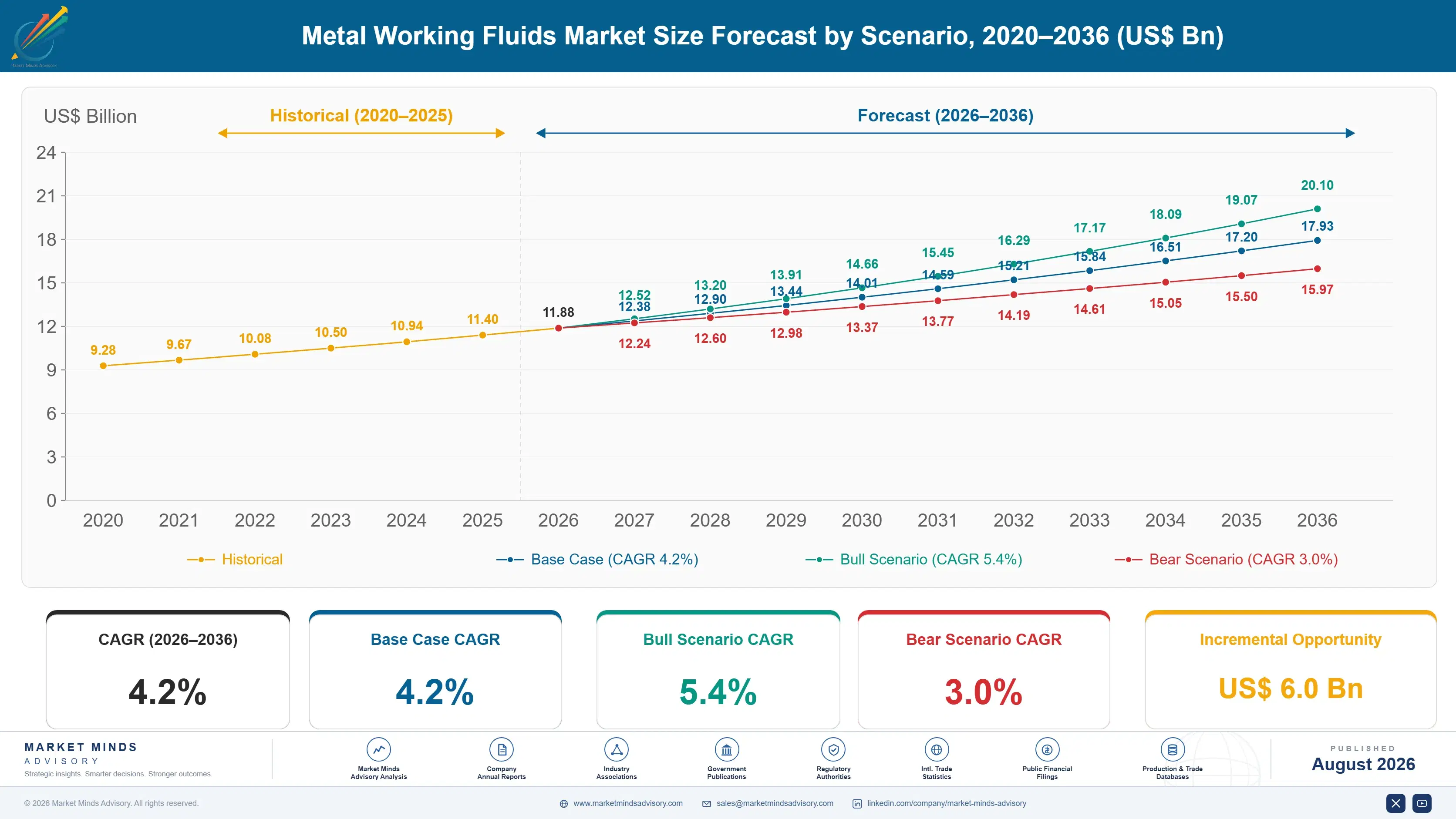
Growth ran at 3.2% between 2020 and 2025 and machining activity explains most of the variation. Manufacturing output recovered unevenly across the period after pandemic disruption. Underneath that, formulation requirements tightened considerably as boron, secondary amine and formaldehyde-releasing chemistry came under regulatory pressure in Europe, forcing reformulation work that raised cost without adding any performance the customer could perceive.
The 4.2% base case rests on three mechanisms. Asian machining volume keeps expanding with manufacturing investment across China, India and Southeast Asia, and every machine tool consumes fluid continuously. Biocide withdrawal keeps pushing formulations toward more expensive microbial control and shorter sump life, which raises value per litre even as efficiency improves. And aluminium content in electrified drivetrains keeps growing, requiring chlorine-free non-staining chemistry that conventional fluids cannot provide. None of that is optional.
The 5.4% bull case is near-dry machining adoption slowing rather than accelerating, since minimum quantity lubrication cuts volume dramatically even while raising value per litre. The 3.0% bear case is electrification reducing machined content per vehicle faster than aluminium specification requirements raise value, since an electric drivetrain contains far fewer machined parts than the engine and transmission it replaces.

Losing The Chemistry That Worked

Water-mix metalworking fluid is a warm nutrient solution circulating through a machine tool, and the only reason it does not turn into a microbiological disaster within weeks is the biocide package. Formaldehyde-releasing chemistry did that job cheaply and reliably for fifty years, and European reclassification of formaldehyde is removing it from formulations. Alternatives exist, cost considerably more and work less dependably. A sump without control spoils in around five weeks, raising consumption, downtime and disposal together.
TOP-FIVE CONCENTRATION44%Combined position across metalworking fluid supply held by leaders
SUMP LIFE WITHOUT BIOCIDE5 weeksHow long a water-mix fluid lasts before microbial spoilage occurs
FLUID COST PER PART1.2%Portion of machined component cost attributable to the fluid
DISPOSAL COST MULTIPLE2.7xHow far spent fluid disposal exceeds the purchase price
BASE OIL COST SHARE57%Portion of formulation cost attributable to the base fluid
MINIMUM QUANTITY LUBRICATION RATE60 mLHourly fluid consumption under near-dry machining compared with flood
The economics of this product are badly misunderstood by the people who buy it. Fluid represents roughly 1.2% of the cost of a machined component, and disposing of it afterwards costs around 2.7 times what it cost to purchase. Total lifecycle cost is therefore dominated by what happens once the fluid stops working, not by the price per litre that purchasing departments tender on. A fluid lasting twice as long is cheaper on everything except the number anybody compares.
Near-dry machining is the answer nobody frames correctly. Minimum quantity lubrication uses around 60 millilitres an hour against flood systems circulating thousands of litres, which removes the sump, the biocide problem and the disposal bill simultaneously rather than managing any of them.
"Everybody in this industry is trying to replace the biocide and the more interesting answer is to stop having a sump at all. Near-dry machining eliminates the microbiology, the disposal cost and the health exposure in one decision, and it gets sold as a lubrication choice."
Director, Industrial Lubricants and Manufacturing Fluids Practice · MMA Chemicals and Materials Practice · August 2026

Market Trends

Biocide withdrawal shortens sump life and raises total cost

Formaldehyde-releasing biocides controlled bacterial and fungal growth in water-mix fluids cheaply and dependably for fifty years, and European reclassification of formaldehyde as a carcinogen is removing them from formulations across the continent and increasingly beyond it. Replacement chemistry costs considerably more and performs less consistently against organisms that adapt. A sump without effective control spoils in around five weeks rather than many months, which multiplies fluid consumption, unplanned machine downtime and disposal volume together. Commercially this raises value per litre while making customers considerably angrier about a product that used to give them no trouble at all.
Market Impact: Consumes 30% of global volume
Near-dry machining removes the problem rather than managing it

Minimum quantity lubrication delivers around 60 millilitres of fluid an hour directly to the cutting zone, against flood systems circulating thousands of litres through a sump that requires filtration, microbial control and eventual disposal. That eliminates the microbiology problem, the disposal bill and the aerosol exposure question in a single decision rather than managing each separately. Adoption is limited by workpiece material, tool geometry and chip evacuation rather than by cost, and it grows at 6.0% where those constraints permit. Suppliers selling it as a lubrication choice are underselling what it actually removes from a customer's operation.
Market Impact: Requires 0 chlorine content

Market Opportunities and Growth Drivers

Asian machining volume expands with manufacturing investment

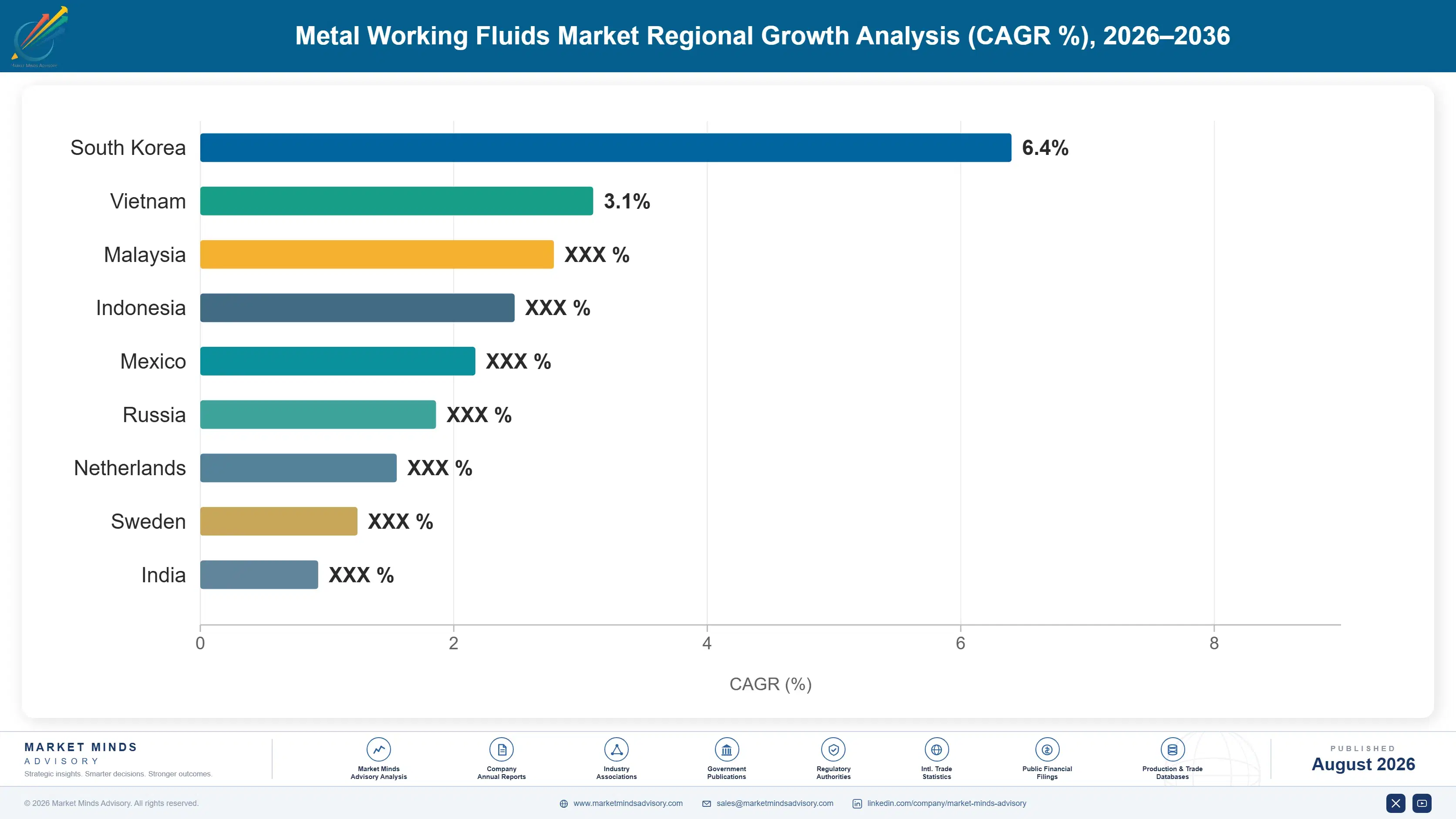
Chinese machining activity across automotive, industrial equipment, electronics and general engineering consumes metalworking fluid at volumes nothing elsewhere approaches, and that consumption follows machine tool population rather than any purchasing decision. Indian manufacturing expansion adds the fastest growth of any country at 7.2%, driven by both domestic demand and export component manufacture. Southeast Asian machining is expanding with supply chain relocation across Vietnam, Thailand and Malaysia. Every installed machine tool becomes a permanent fluid consumer, which makes this demand unglamorous, predictable and considerably larger than the specialty segments attracting attention.
Market Impact: Removes 3 formulation ingredient classes

Aluminium content demands chlorine-free non-staining chemistry

Electrified drivetrains and lightweight structures have raised aluminium content across machined components substantially, and aluminium requires fluid chemistry that conventional steel-oriented formulations handle badly. Chlorinated extreme pressure additives stain and corrode aluminium, active sulphur causes similar problems, and alkalinity levels that suit steel attack aluminium surfaces. That forces reformulation toward chlorine-free chemistry with controlled pH and specific corrosion inhibition. The commercial consequence is that the same machine shop now needs multiple fluids or a compromise formulation, and the specialised aluminium products price above the general purpose fluids they replace. Compromise formulations satisfy neither metal properly.
Market Impact: Disposal costs 2.7 times purchase

Market Restraints and Challenges

Occupational exposure regulation constrains formulation options

Metalworking fluid aerosol exposure is associated with occupational asthma, hypersensitivity pneumonitis and dermatitis, and exposure limits have tightened across European and North American jurisdictions. The root cause is that machining generates mist regardless of formulation, and workers breathe it across full shifts. Beyond biocides, boron compounds face reprotoxic classification and secondary amines can form nitrosamines with nitrite contamination, removing two further formulation tools. Commercially this forces continuous reformulation that raises cost without any performance the customer perceives. Suppliers are responding with low-mist formulations, better filtration guidance and near-dry alternatives that remove the exposure entirely.
Market Impact: Cuts sump life to 5 weeks

Purchasing tenders on price while disposal dominates cost

Fluid represents around 1.2% of a machined part's cost and disposing of spent fluid costs roughly 2.7 times the purchase price, which means total cost is dominated by what happens after the product stops working. The root cause is that purchase and disposal sit on different budgets managed by different people who do not compare notes. Commercially this rewards cheap fluids that fail quickly and punishes durable ones that cost more per litre. Suppliers are responding with fluid management contracts, sump monitoring and cost per part pricing that put both halves of the arithmetic in front of one decision-maker.
Market Impact: Uses 60 millilitres per hour
3 additional market trends, 4 additional growth drivers, and 2 additional restraints and challenges are covered in the full report. Contact sales@marketmindsadvisory.com to access the complete intelligence.

Segment CAGR and Growth Architecture

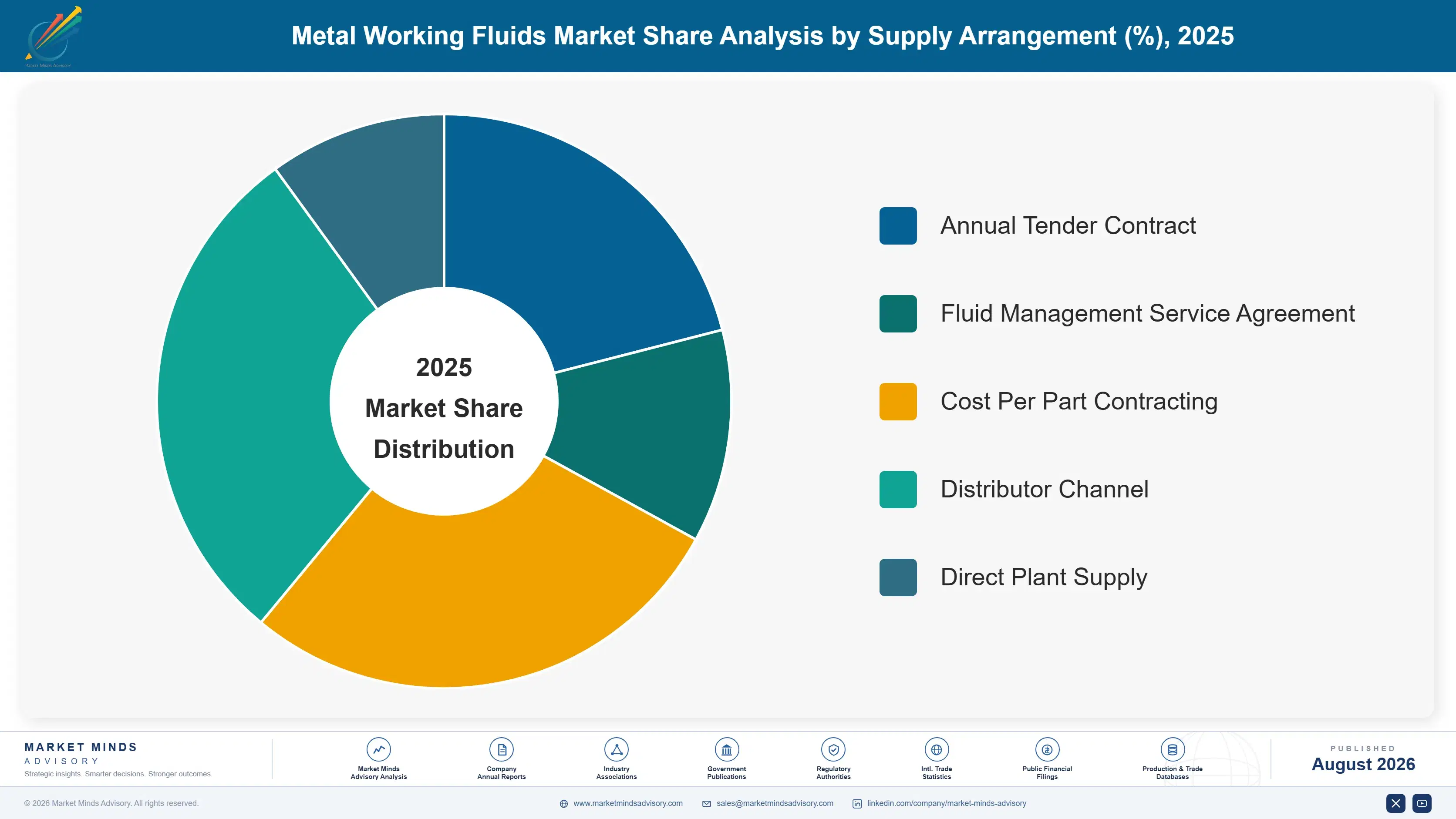
Fluids are classified here by formulation type, since that determines the microbial behaviour, the disposal route and the machining operations a product can serve. Metal being machined, end industry and supply arrangement are handled separately in the framework, because one formulation type serves several materials and industries without any change to the product. Formulation type governs everything.
metal-working-fluids-market-trends-market-share-analysis-1787555554284

Bio-Based Ester Fluids

Growing at 6.3%, half again the market rate, ester-based fluids are winning on technical grounds rather than on the environmental positioning that usually accompanies them. Esters carry higher flash points than mineral oils, which matters in high-speed operations generating serious heat, and they lubricate better at the tool interface because the polar molecule adheres to metal surfaces in ways paraffinic oils do not. The disposal characteristics are genuinely better, which matters considerably when disposal costs 2.7 times the purchase price. Cost per litre runs above mineral formulations and the total cost comparison favours esters wherever anybody actually performs it. Very few purchasing departments do. The total cost comparison is rarely made at all.
CAGR 6.3%

Minimum Quantity Lubrication Fluids

Near-dry machining delivers around 60 millilitres an hour directly into the cutting zone rather than flooding the workpiece from a circulating sump, and the products involved are entirely different from conventional fluids: high lubricity esters and fatty alcohols applied as fine mist, never recirculated and never spoiled. Growth at 6.0% reflects adoption limited by chip evacuation, workpiece material and tool geometry rather than by any economic argument. What the technique actually delivers is the removal of the sump entirely, which takes microbial control, disposal cost and aerosol exposure out of the operation together. Suppliers selling lubrication performance are describing a fraction of the value. Removing the sump takes three separate problems away at once, which is what customers actually buy.
CAGR 6.0%
Full segment breakdown across 6 segments available in the complete report.

Regional Architecture and Country Demand Map

East Asia holds 30% of value on Chinese machining volume that nothing elsewhere approaches, alongside Japanese formulation capability. North America follows at 24% on aerospace and general engineering. Machine tool population rather than economic size decides this map almost entirely. Regulation reshapes the product elsewhere.

East Asia

Chinese machine tool population is the largest anywhere by a wide margin and consumes fluid continuously across automotive, industrial equipment, electronics and general engineering, which is what puts this region well ahead on volume. Domestic formulators serve most of that demand at prices international suppliers do not attempt to match on general purpose products. Japanese formulation capability is the most sophisticated in the region and supplies both domestic precision machining and export markets at premium specification. Korean automotive and shipbuilding machining adds substantial volume. Growth at 5.2% follows manufacturing investment and shows almost no sensitivity to the regulatory pressures reshaping European formulation. Regulatory pressure barely reaches formulation here. Volume follows machines.
Share: 30% | CAGR: 5.2% (2026 to 2036)

North America

Aerospace machining is the region's most demanding application, involving titanium and nickel alloys where fluid performance determines tool life directly and cost per litre is genuinely irrelevant against the value of the workpiece. Automotive machining volume is declining as electrification reduces machined content per vehicle while raising aluminium specification requirements. Occupational exposure regulation is active and fluid management service models are more developed here than anywhere. General engineering and job shop machining is fragmented and price-driven. Growth at 3.8% sits below the market average and reflects the automotive machined content decline offsetting aerospace and industrial demand. Aerospace demand is genuinely price-insensitive because the workpiece is worth far more than any fluid decision could ever save.
Share: 24% | CAGR: 3.8% (2026 to 2036)
Regional intelligence for 5 additional markets available in the complete report: Western Europe, South Asia and Pacific, Latin America, Middle East and Africa, Eastern Europe. Contact sales@marketmindsadvisory.com.
metal-working-fluids-market-trends-country-cagr-analysis-1787555554801

Where Fluid Margin Actually Sits

Four moves matter for a supplier losing the chemistry that made the product work and selling into a purchasing process that ignores where the cost actually falls. Two are about pricing the whole arithmetic rather than the litre, and two are about the technique that removes the problem entirely. Reformulating around each restriction is not among them.

Price on cost per part, not price per litre

Fluid is roughly 1.2% of a machined component's cost and disposal runs at 2.7 times the purchase price, which means total cost is dominated by what happens after the product stops working rather than by what it cost to buy. Purchasing tenders the smaller number because that is the budget they hold. Suppliers offering cost per part or per machine hour pricing put both halves of the arithmetic in front of one decision-maker for the first time. That conversation rewards durable fluids and effective sump management, which is exactly where a serious supplier's advantage sits.
Market Impact: Addresses a full 2.7 times fluid disposal multiple

Sell near-dry machining as problem removal

Minimum quantity lubrication uses around 60 millilitres an hour against flood systems circulating thousands of litres, and it removes the sump, the microbial control problem, the disposal bill and the aerosol exposure question in one decision rather than managing each separately. Suppliers presenting it as a lubrication technique are describing a fraction of what it does. Presenting it as the removal of every fluid problem a plant manager currently has reaches a completely different conversation and a different budget. Volume falls dramatically and value per litre rises considerably, which most suppliers read as a threat rather than a repositioning.
Market Impact: Cuts consumption to just 60 millilitres per hour

Take the aluminium specification before competitors do

Electrified drivetrains and lightweight structures raised aluminium content across machined components substantially, and chlorinated additives, active sulphur and steel-oriented alkalinity all cause staining and corrosion on aluminium surfaces. That forces chlorine-free formulations with controlled pH and specific inhibition that general purpose fluids cannot deliver. Shops now need either multiple fluids or a genuine dual-metal product. Suppliers qualifying aluminium chemistry into programmes early hold positions that survive the whole component lifecycle rather than a tender period. Aluminium content per vehicle has risen roughly 40% across the electrified transition, which makes this a permanent specification change rather than a passing one.
Market Impact: Delivers 0 chlorine content across every aluminium formulation

Move the sump conversation to management contracts

Biocide withdrawal cuts sump life to around 5 weeks without effective control, which multiplies consumption, downtime and disposal for a customer who used to have no trouble at all. That problem is operational rather than chemical and it cannot be solved by selling a different drum. Fluid management contracts covering monitoring, top-up, filtration and disposal address it directly and price against the whole cost the customer now faces. Suppliers still shipping product into a problem they did not create and cannot fix from a drum are losing accounts to competitors who arrived with people.
Market Impact: Manages a much shorter 5 week sump life

Who Controls the Margin Pool

Five suppliers hold 44% of metalworking fluid volume, measured on concentrate-equivalent volume at supplier level, the basis used throughout this section. That concentration rests on formulation capability and service infrastructure rather than base oil access, since base stocks are widely available and the value sits in additive packages, microbial control and the people who manage sumps. The gap between leaders and everybody else is service presence rather than any chemistry advantage. Chemistry alone defends almost nothing.
Competition runs on three dimensions. Formulation capability under regulatory constraint, which has become genuinely difficult as biocides, boron and amines are withdrawn. Service infrastructure, since sump management is the customer's actual problem. And application knowledge across metals, particularly the aluminium chemistry electrification demands. Price competes hardest in general purpose fluids where domestic formulators participate freely. Sump trouble is what actually moves accounts.

Rankings shift as regulatory pressure raises the formulation barrier, which favours technically capable European and Japanese formulators over general purpose blenders. Near-dry machining redistributes value away from volume suppliers entirely. Service-led suppliers are taking accounts from product-led ones wherever biocide withdrawal has caused genuine operational trouble. Service presence decides more than formulation now.
metal-working-fluids-market-trends-company-positioning-matrix-1787555555323

Competitive Moat and Risk Dimensions

FUCHS PETROLUB

Moat: Regulatory formulation capability

Fuchs has reformulated repeatedly around European restrictions on biocides, boron and amines, which has built formulation capability under constraint that general purpose blenders have never had to develop. As those restrictions spread beyond Europe, that experience becomes a commercial advantage rather than merely a compliance cost, and competitors face the reformulation work from a standing start.
FUCHS PETROLUB

Risk: European volume decline exposure

A substantial share of volume sits in European automotive and industrial machining, where machined content per vehicle is falling with electrification faster than anywhere else and manufacturing output has not recovered. Formulation capability defends margin and does not create volume. Competitors weighted toward Asian machining face growth this position cannot access from its existing footprint.
BLASER SWISSLUBE

Moat: Cost per part positioning

Blaser built its commercial approach around demonstrating total machining cost rather than fluid price, which is precisely the argument this market's economics support and almost nobody else makes. That framing reaches production engineers rather than purchasing departments and it converts a commodity tender into a productivity discussion where the fluid price becomes almost irrelevant.
BLASER SWISSLUBE

Risk: Scale against volume competitors

The cost per part argument requires technical engagement per customer that does not scale in the way drum shipment does, which limits how many accounts can be served well. General purpose competitors reach far more customers at lower cost per relationship. In price-driven job shop machining the argument frequently cannot be made at all.

Players Tracked

Prominent Players

Fuchs Petrolub
Quaker Houghton
Castrol
Master Fluid Solutions
Blaser Swisslube

Other Key Players

Chevron
Shell
TotalEnergies
ExxonMobil
Idemitsu Kosan
Yushiro Chemical Industry
Nippon Grease
Zeller+Gmelin
Oelheld
Motul
Cimcool
Petrofer
Condat
Milacron
Henkel

Recent Developments

MARCH 2025

European formulators withdrew formaldehyde-releasing biocide grades

Metalworking fluid formulators withdrew grades containing formaldehyde-releasing biocides across European markets following reclassification, replacing them with alternative microbial control chemistry at higher cost and shorter effective sump life. This was regulatory compliance rather than any commercial transaction. Customers experienced the change as a product failure rather than a regulatory one.
Signal: Replacement chemistry costs more and works less well, which turns a product that gave no trouble into an operational problem
AUGUST 2025

A machining group converted a plant to near-dry lubrication

An automotive component manufacturer converted a machining plant from flood cooling to minimum quantity lubrication, citing disposal cost, sump management burden and worker exposure rather than any lubrication performance requirement. This was a process conversion rather than any transaction between suppliers. Lubrication performance never entered it.
Signal: Conversion is being justified on problem removal rather than lubrication, which is how this technique will actually spread
JANUARY 2026

A supplier launched cost per machine hour contracting

A metalworking fluid supplier introduced contracts priced per machine hour rather than per litre, bundling monitoring, top-up, filtration and disposal into a single figure covering the whole fluid lifecycle. This was a commercial model change rather than any product development or acquisition. Disposal is included in the figure.
Signal: Pricing the whole arithmetic rather than the purchase puts disposal in front of the buyer, which favours durable formulations

What Moves Formulation Cost

Base fluid accounts for around 57% of formulation cost, drawn from mineral base oils, synthetic esters or polyalkylene glycols depending on the product type. Additive packages covering extreme pressure, corrosion inhibition, emulsification and microbial control make up most of the remainder. Blending and packaging costs are modest. Technical service and sump management labour sit outside cost of goods and are frequently uncosted entirely.
Base oil prices moved sharply through 2021 and 2022 on crude and refinery margins, and IEA data record the movement across those years. Fuchs recorded raw material cost pressure across its lubricant operations in its Annual Report 2022. Suppliers on annual industrial contracts absorbed most of it, since a machining customer sets a fluid budget yearly. Biocide replacement raised additive cost independently across the same period.

The cost line nobody manages properly is technical service, because it appears nowhere in a tender and determines whether the customer's sumps actually work. A supplier maintaining monitoring and troubleshooting carries a cost a drum shipper does not, and tenders treat both as identical products. Biocide withdrawal made that service more necessary, which widens the gap between what suppliers spend and what tenders recognise.
metal-working-fluids-market-trends-cost-volatility-analysis-1787555555518

Bundle service into machine hour pricing rather than absorbing it

Technical service determines whether sumps work and appears nowhere in a price per litre comparison, which means suppliers providing it subsidise customers comparing only unit cost. Machine hour or cost per part contracts make the service visible and priced. Customers declining that structure identify themselves as drum accounts to be served accordingly rather than supported at a loss indefinitely.

Index industrial contracts to published base oil benchmarks

Base fluid at 57% of formulation cost prices on crude and refinery margins that move for reasons unconnected to machining demand, and annual fixed pricing transfers that exposure entirely to the supplier. Indexing to published base oil benchmarks with quarterly reset removes it. Industrial customers accept the mechanism readily because every other lubricant they buy already works that way.

Reformulate proactively rather than in response to restriction

Biocides, boron compounds and secondary amines have all come under restriction within a few years and further ingredients will follow the same path. Suppliers reformulating only on withdrawal face rushed qualification and disruption every time. Anticipating the pipeline and requalifying ahead spreads cost and removes the emergency entirely. Customers notice and remember it when tenders come round again.

Portfolio Architecture for Margin Defence

Margin here tracks how difficult a fluid is to formulate and how much service it requires rather than what it costs to blend. General purpose soluble oils and semi-synthetics run at gross margins in the high teens against domestic formulators meeting the specification adequately. Aluminium-specific and high-performance synthetics run considerably better on formulation difficulty. Bio-based esters, near-dry lubrication fluids and managed service contracts run higher again, because the customer is buying an outcome rather than a litre.
The tension is that general purpose volume keeps blending capacity loaded while specialty and service business earns the returns, and the two reach entirely different buyers. A job shop comparing drum prices and a production engineer costing machining per part share no decision criteria at all. Suppliers serving both from one commercial organisation have generally found the volume business consuming the technical resource that service contracts require, which shows up as failed sumps at exactly the accounts that were meant to demonstrate the model.

High-value pools sit in near-dry lubrication, aluminium chemistry and fluid management contracting. None of the three competes on price per litre. Blending capacity by itself defends very little where formulations are widely understood.

Volume / Commodity-Adjacent

General purpose soluble oils and semi-synthetics sold into job shop and general engineering machining on price per litre. The eight-point range separates suppliers with indexed base oil contracts from those absorbing crude movement on annual fixed industrial pricing.
Gross Margin: 16%-24%

Premium / Certified

Aluminium-specific chemistry, high-performance synthetics and aerospace-qualified fluids where formulation difficulty and material compatibility narrow the supplier field. The ten-point spread reflects application knowledge, since the same fluid performs differently across metals and operations.
Gross Margin: 28%-38%

Sustainability / Regulatory / Next-Generation

Bio-based esters, near-dry lubrication fluids and fluid management contracts priced per machine hour or per part. The eighteen-point range is wide because these price against total machining cost rather than against any fluid a buyer could benchmark.
Gross Margin: 36%-54%
metal-working-fluids-market-trends-portfolio-architecture-1787555556022

High-value Sub-segments and Strategic Watch-out

Fluid Management Contracting

Biocide withdrawal cut sump life to around five weeks and created an operational problem no drum solves, which is exactly what management contracts address. Pricing per machine hour also puts the 2.7 times disposal multiple in front of the buyer. That is a conversation nobody was having.
Gross Margin: 38%-54%

Near-Dry Lubrication Fluids

Compounding at 6.0% and using around 60 millilitres hourly, which removes the sump, the microbiology, the disposal bill and the exposure question together. Suppliers selling it as lubrication performance describe a fraction of the value. It also eliminates the worker exposure question entirely, which safety functions notice.
Gross Margin: 36%-50%

General Purpose Water-Mix Fluids

The volume that keeps blending loaded and the segment domestic formulators take on price wherever specifications permit. Manage for utilisation and base oil indexation rather than margin, because differentiation is not genuinely available. Domestic formulators hold the cost position permanently here. Utilisation is the lever.
Gross Margin: 16%-24%

Aluminium Machining Chemistry

Electrification raised aluminium content and chlorinated additives, active sulphur and steel alkalinity all damage it, which forces chlorine-free formulation. Early qualification holds positions across a component lifecycle rather than a tender. Customers notice staining on aluminium immediately, which makes qualification unusually decisive. Early qualification wins it.
Gross Margin: 32%-44%

How Fluid Demand Renews

Demand renews continuously and invisibly, which is why this product gets so little commercial attention until it fails. A machine tool consumes fluid every operating hour through evaporation, drag-out on chips and periodic sump changes, and nobody makes a purchasing decision about any of that. What renews periodically is the supply contract, usually annually and usually on price. The consumption is automatic and the commercial relationship is not, which is an awkward combination.
Stickiness depends almost entirely on whether the customer's sumps are causing trouble. A plant running clean sumps with long fluid life has no reason to change supplier and frequently no reason to think about fluid at all. A plant fighting microbial spoilage since biocide withdrawal is actively looking, which is why service-led suppliers are taking accounts now that were untouchable three years ago. Aerospace and precision positions hold longest on qualification.

The decision-maker sits in two places that rarely speak. Purchasing holds the fluid budget and tenders on price per litre. Production engineering holds the machining cost and waste disposal holds the spent fluid bill, which together dominate the actual arithmetic. Suppliers who only ever meet purchasing are addressing the smallest of the three numbers involved.
metal-working-fluids-market-trends-end-use-penetration-index-1787555556511

Where To Place The Bet

These are among the four positions where our research anticipates prominent divergence between winners and laggards over the coming forecast period. Each is grounded in the demand model, the regulatory perimeter, and the announced capacity pipeline.
01 / TOTAL COST REPRICING

Charge per part, not per litre supplied

Fluid represents roughly 1.2% of a machined component's cost while disposing of it afterwards costs around 2.7 times what it was purchased for, which means the total arithmetic is dominated entirely by what happens once the product stops working. Purchasing tenders the smaller figure because that is the budget they hold and the only one they see. Cost per part or per machine hour contracting puts both halves in front of a single decision-maker, and that conversation rewards durable fluid rather than the lowest price per drum.
02 / NEAR-DRY REPOSITIONING MOVE

Sell the removal of every fluid problem

Minimum quantity lubrication delivers around 60 millilitres an hour against flood systems circulating thousands of litres through a sump requiring filtration, microbial control and eventual disposal at considerable expense. It removes the microbiology, the disposal bill and the aerosol exposure question in one decision rather than managing each of them separately and expensively. Suppliers presenting it as a lubrication technique are describing a fraction of what it actually does, and presenting it as problem removal reaches a plant manager rather than a purchasing department.
03 / ALUMINIUM QUALIFICATION TIMING

Take the chemistry electrification is forcing

Electrified drivetrains and lightweight structures have raised aluminium content across machined components substantially, and chlorinated extreme pressure additives, active sulphur and steel-oriented alkalinity all stain or corrode aluminium surfaces in ways customers notice immediately. That forces chlorine-free formulation with controlled pH and specific corrosion inhibition that general purpose fluids simply cannot deliver. Machine shops need either multiple fluids or a genuine dual-metal product, and suppliers qualifying early hold positions that last a full component lifecycle rather than a single tender period.
04 / SERVICE MODEL CONVERSION

Arrive with people, not another drum

Biocide withdrawal has cut sump life to around five weeks without effective microbial control, which multiplies fluid consumption, unplanned downtime and disposal volume for customers who previously had no trouble whatsoever from this product. That problem is operational rather than chemical and no different formulation shipped in a drum resolves it for them. Fluid management contracts covering monitoring, top-up, filtration and disposal address the actual difficulty, and suppliers still shipping product into a problem they cannot fix remotely are losing accounts steadily.

Engagement Snapshot From the Field

A live engagement with an industry participant carrying material or product regulatory and market exposure ahead of a defining policy shift, showing how our research translates into a defensible multi-year portfolio strategy.
MARKET MINDS ADVISORY · CLIENT ENGAGEMENT SUMMARY
Metal Working Fluids Producer Strategic Portfolio Review and Transition Roadmap 2026·Investment Scenario on Metal Working Fluids Exposure Evaluation 2025-26
CLIENT PROFILE
A European metalworking fluid supplier with annual revenue around EUR 140 million (client-reported, unverified by MMA), blending soluble oils, semi-synthetics and synthetics for automotive and general engineering customers. Technical service was provided free alongside product supply. Roughly 75% of revenue came from annual tender contracts priced per litre. No management contracts existed. Service cost was never separately measured.
STRATEGIC CHALLENGE
Customer complaints about sump spoilage had risen sharply since biocide reformulation (client-reported, unverified by MMA) and several accounts were lost. Management proposed accelerating development of a replacement biocide package. Nobody had asked whether the customers were experiencing a chemical problem or an operational one they had never previously needed to manage.
MMA APPROACH
MMA assessed the failing accounts against sump maintenance practice rather than assuming the formulation was solely responsible, establishing what had actually changed in those plants. Total fluid cost including disposal was calculated per customer and compared against the tendered price. Near-dry conversion economics were modelled for suitable operations, and competitor service models were benchmarked through the expert interview programme.
KEY FINDINGS
  1. Most failing sumps combined the reformulated product with maintenance practice that had been adequate under the old biocide and was no longer sufficient at all.
  2. Total fluid cost including disposal averaged well over three times the tendered purchase price at every account examined, and no customer had ever calculated it themselves.
  3. Roughly a fifth of the client's customer operations were technically suitable for near-dry conversion and none had ever been approached about it by anybody.
  4. Competitors winning the lost accounts were selling monitoring and sump management rather than any superior biocide chemistry, which the client had not recognised at all.
CLIENT PROFILE
A European metalworking fluid supplier with annual revenue around EUR 140 million (client-reported, unverified by MMA), blending soluble oils, semi-synthetics and synthetics for automotive and general engineering customers. Technical service was provided free alongside product supply. Roughly 75% of revenue came from annual tender contracts priced per litre. No management contracts existed. Service cost was never separately measured.
STRATEGIC CHALLENGE
Customer complaints about sump spoilage had risen sharply since biocide reformulation (client-reported, unverified by MMA) and several accounts were lost. Management proposed accelerating development of a replacement biocide package. Nobody had asked whether the customers were experiencing a chemical problem or an operational one they had never previously needed to manage.
MMA APPROACH
MMA assessed the failing accounts against sump maintenance practice rather than assuming the formulation was solely responsible, establishing what had actually changed in those plants. Total fluid cost including disposal was calculated per customer and compared against the tendered price. Near-dry conversion economics were modelled for suitable operations, and competitor service models were benchmarked through the expert interview programme.
KEY FINDINGS
  1. Most failing sumps combined the reformulated product with maintenance practice that had been adequate under the old biocide and was no longer sufficient at all.
  2. Total fluid cost including disposal averaged well over three times the tendered purchase price at every account examined, and no customer had ever calculated it themselves.
  3. Roughly a fifth of the client's customer operations were technically suitable for near-dry conversion and none had ever been approached about it by anybody.
  4. Competitors winning the lost accounts were selling monitoring and sump management rather than any superior biocide chemistry, which the client had not recognised at all.
RECOMMENDED STRATEGY
Phase 1: Phase one: pause the biocide development programme and build a sump monitoring and management service instead, since the failure is operational. Phase 2: Phase two: present total fluid cost including disposal to every major account, moving the conversation from purchasing toward production engineering. Phase 3: Phase three: approach the suitable operations about near-dry conversion, accepting the volume loss for the margin and relationship it creates.
OUTCOME
The biocide programme was scaled back and a sump management service launched during 2026. Total cost presentations have converted three accounts to machine hour pricing. Two near-dry conversions are under way, and the client reports complaint volumes falling substantially (client-reported, unverified by MMA). Volume held throughout the change.

Frequently Asked Questions

Foundational context covering the market sizes, CAGR, scope, country, region and competition that inform every finding below. This section is provided to cover basics and most often pre-purchase conversations, answered from the MMA Primary Research Dataset.

What is the current size of the Metal Working Fluids Market?

The market was valued at USD 11.4 billion in 2025, rising to an estimated USD 11.88 billion in 2026. East Asia holds the largest regional share at 30% of value.

How large will the Metal Working Fluids Market be by 2036?

MMA forecasts USD 17.92 billion by 2036 under the base case, an expansion multiple of 1.51 times the 2026 value. That represents USD 6.04 billion of incremental value.

What is the CAGR for the Metal Working Fluids Market 2026 to 2036?

The base case runs at 4.2% compound annual growth between 2026 and 2036, with a bull case at 5.4% and a bear case at 3.0%. Historical growth from 2020 to 2025 was 3.2%.

Which segment is growing fastest?

Bio-based ester fluids lead at 6.3%, half again the market rate, on flash point, lubricity and disposal characteristics rather than environmental preference. Near-dry fluids follow at 6.0%.

Who are the major companies in the Metal Working Fluids Market?

Fuchs Petrolub, Quaker Houghton, Castrol, Master Fluid Solutions and Blaser Swisslube hold 44% between them. Formulation capability and service infrastructure rather than base oil access sustain those positions.

Which country is growing fastest?

India leads at 7.2%, driven by machine tool installation across automotive component manufacture, general engineering and export supply chains that all keep expanding rather considerably.

Report Segmentation Architecture

The full report scope spans multiple orthogonal segmentation dimensions, with cross-tabulated demand data provided for each dimension pair. Coverage extends further to regional breakdowns, trend trajectories, and the competitive detail needed to support segment-level decision-making.

By Formulation Type

  • Soluble Oil Emulsions
  • Semi-Synthetic Fluids
  • Full Synthetic Fluids
  • Neat Cutting Oils
  • Bio-Based Ester Fluids
  • Minimum Quantity Lubrication Fluids

By End-Use Industry

  • Automotive Component Machining
  • Aerospace and Defence Machining
  • General Engineering and Job Shops
  • Industrial Equipment Manufacture
  • Medical Device Machining
  • Energy and Oilfield Equipment

By Supply Arrangement

  • Annual Tender Contract
  • Fluid Management Service Agreement
  • Cost Per Part Contracting
  • Distributor Channel
  • Direct Plant Supply

By Region

  • North America
  • Western Europe
  • East Asia
  • South Asia and Pacific
  • Latin America
  • Middle East and Africa
  • Eastern Europe

Scope, Methodology, and Coverage

Every figure in this report is reproducible from documented input assumptions. The scope below maps the historical period, the forecast horizon, the segmentation dimensions, and the countries covered, alongside the underlying primary and qualitative methodology.
Historical Period
2020 to 2025
Forecast Period
2026 to 2036
Base Year
2025 (USD billions; MMA Primary Research Dataset, August 2026)
Market Definition
The market comprises fluids supplied for metal cutting, grinding, forming and protection operations across automotive, aerospace, general engineering, industrial equipment, medical device and energy applications, covering soluble oil emulsions, semi-synthetic fluids, full synthetic fluids, neat cutting oils, bio-based ester fluids, and minimum quantity lubrication fluids. Value is measured at supplier level on concentrate-equivalent volume across tender, service, distributor and direct channels. Hydraulic and gear lubricants for machine tools, quenching and heat treatment fluids, cleaning chemicals, cutting tools and fluid handling equipment fall outside scope.
Quantitative Units
USD billions (current prices); thousand tonnes concentrate-equivalent supplied annually; USD per tonne by formulation type
Segmentation Dimensions
By Formulation Type; By End-Use Industry; By Supply Arrangement; By Region
Regions Covered
North America, Western Europe, East Asia, South Asia and Pacific, Latin America, Middle East and Africa, Eastern Europe
Countries Covered
China, Japan, South Korea, Taiwan, India, Thailand, Vietnam, Malaysia, Australia, United States, Canada, Mexico, Germany, Switzerland, Italy, France, United Kingdom, Sweden, Austria, Spain, Poland, Czechia, Slovakia, Hungary, Brazil, Argentina, Mexico, Turkey, Saudi Arabia, South Africa
Key Companies Profiled
Fuchs Petrolub, Quaker Houghton, Castrol, Master Fluid Solutions, Blaser Swisslube, Chevron, Shell, TotalEnergies, ExxonMobil, Idemitsu Kosan, Yushiro Chemical Industry, Nippon Grease, Zeller+Gmelin, Oelheld, Motul, Cimcool, Petrofer, Condat, Milacron, Henkel
Quantitative Methodology
Primary survey, n=3,800 respondents, Q4 2025, six countries; demand-side model with trade association cross-validation
Qualitative Methodology
47 expert interviews, Q4 2025; applied to validate demand model assumptions, identify emerging dynamics, and assess competitive positioning
Report Format
PDF and XLSX data workbook (Word format preview document)
Publisher
Market Minds Advisory
Report Code
MMA-2026-CHM-657
Published
August 2026
Contact
sales@marketmindsadvisory.com | www.marketmindsadvisory.com

Purchase the full Metal Working Fluids Market Report (2026 to 2036).

The full report sizes the global metalworking fluid market to 2036 across six formulation types and seven regions, measured on concentrate-equivalent volume at supplier level. It treats biocide withdrawal as an operational problem rather than a formulation one and quantifies the sump life and total cost consequences directly. Competitive analysis covers 20 participants evaluated on concentrate volume, with moat and risk assessment for the two leaders. Disposal cost is modelled alongside purchase price throughout, since the two together dominate an arithmetic that tenders never capture. Four quantified revenue levers close the analysis.
Six-formulation segment sizing with segment-level growth rates
Seven-region share and growth breakdown to 2036
Twenty-participant competitive map on one volume basis
Disposal cost modelled alongside purchase price per application
Biocide withdrawal consequences quantified by sump life impact
Four quantified revenue levers with commercial impact ranges

Built For The People Who Decide

From boardroom strategy to bench-side execution, this report is read cover-to-cover by leaders shaping the next decade of their industry, turning demand scenarios, market dynamics and valuation benchmarks into decisions.
CXOs/ Presidents/ VPs/ Managers
M&A and Corporate Development
Strategy Teams and R&D Heads
Procurement and Product Directors
Regulatory and Compliance Leaders
Investor Relations and Equity Analysts