Market Minds Advisory
Menopause Supplement Market

Menopause Supplement Market: Menopause Supplement Market: prescription competition, claim asymmetry and the symptoms pharma ignores to 2036

This category grew because menopause stopped being unspeakable rather than because the products got any better, and prescription drugs now exist for exactly the one symptom it was built around.

Lead Analyst

Lisa Gevelber

Published

September 2026

Make Smarter Decisions with Customized Research Insights

Request a free sample report and evaluate market opportunities, growth trends, and competitive dynamics relevant to your business needs.

2025 MARKET VALUE$2.8BMarket Size 2025
2036 FORECAST VALUE$7.5BBase Case , 2026 to 2036
CAGR 2026 TO 20369.4 %Bull 10.7% / Bear 8.1%
INCREMENTAL OPPORTUNITY$4.5BNet 10- year value creation
EXPANSION MULTIPLE2.46x2036 value over 2026 base
Strategic Levers
M&A Pipeline
Regional Outlook
Country Rankings
Competitive Intelligence
Segmental Deep-dive
Call-Us : 91 93563 13602

Executive Snapshot and Market Trajectory.

Prescription non-hormonal drugs for hot flushes now exist and carry clinical trial evidence no supplement can approach. That removes the flagship claim from a category built entirely around it, and most brands here have not yet said anything at all about what happens next. Very few have prepared an answer.
Sleep and mood targeted formulations grow at 14.1%, half again the market rate of 9.4%, because those are the symptoms prescription medicine is not addressing and women experience them for around seven years. North America holds 31% of value, helped considerably by claim rules permitting brands to describe what a product is for. Europe authorises no menopause claims at all. That asymmetry decides shares.
Five manufacturers hold just 17% of category value, which makes this among the most fragmented consumer health markets anywhere, built largely by founder brands speaking directly to women that established companies had ignored for decades. Repeat purchase sits at 34%, and a woman with seven years of symptoms who buys once and leaves is the clearest possible evidence that the products are not doing what she hoped. Nobody has fixed the underlying problem.
Market Definition
This report covers supplements formulated and marketed for symptoms of the menopausal transition, spanning botanical phytoestrogen formulations, standardised isoflavone and equol products, micronutrient and bone health formulations, sleep and mood targeted formulations, vaginal and urogenital health products, and adaptogen and cortisol management blends. Value is measured at manufacturer level on retail sales. Excluded are prescription hormone therapy, prescription non-hormonal treatments, general multivitamins without menopause positioning, medical devices, and cosmetic products.
Base Year Value
$2.8B in 2025 (MMA Primary Research Dataset, August 2026)
Forecast Period
2026 to 2036, eleven discrete annual values
CAGR
9.4% base case. Bull 10.7%. Bear 8.1%.
Fastest Growth Segment
Sleep and Mood Targeted Formulations: 14.1% CAGR
Fastest Growth Country
India: 12.8% CAGR
Fastest Growth Region
South Asia and Pacific: 11.6% CAGR
Largest Region
North America: 31% of 2025 global value
Market Leaders
Bayer, Nestle Health Science, Haleon, Otsuka Holdings and Pharmavite lead the market. Source: MMA Primary Research Dataset, July 2026.
Primary Survey
n=3,800 procurement and R&D decision-makers, Q4 2025, six countries
Methodology
Demand-side build-up, cross-validated against public data, 47 expert interviews

Menopause Supplement Market Forecast Scenarios

menopause-supplement-market-trends-size-forecast-scenario-1787555516622
Growth ran at 8.2% between 2020 and 2025 and culture rather than science explains nearly all of it. Public conversation about menopause changed genuinely and quickly across several markets, driven by broadcasters, workplace policy and women who declined to keep quiet about it. Founder brands reached an audience established manufacturers had ignored for decades. Product efficacy did not improve measurably during the period and demand rose regardless.
The 9.4% base case rests on three mechanisms. Sleep, mood, joint and cognitive formulations keep growing at rates above the category because prescription medicine is not addressing those symptoms and women experience them across roughly seven years. Urogenital health products keep expanding as a conversation that was previously impossible becomes ordinary. And Asian demand keeps rising where hormone therapy access is limited enough that supplements are the default rather than an alternative.
The 10.7% bull case is a supplement demonstrating genuine efficacy in a properly powered trial, which would separate one product from a category currently judged as a whole. The 8.1% bear case is prescription non-hormonal treatment becoming widely accessible and affordable, since that takes the vasomotor symptom entirely and leaves this category defending the symptoms nobody has studied properly.

Built On Conversation, Not Evidence

This category expanded because a conversation changed rather than because anything got better. Menopause moved from something women managed privately to something discussed on television, in workplaces and among friends, and demand followed almost immediately. Founder brands reached an audience established companies had ignored for decades, using formulations largely unchanged from what pharmacy shelves already held. The growth was real and the product improvement was not, which is an uncomfortable foundation.
TOP-FIVE CONCENTRATION17%Combined position across this category held by leading manufacturers
VASOMOTOR SYMPTOM PREVALENCE75%Portion of women experiencing hot flushes during the transition
PERMITTED EUROPEAN HEALTH CLAIMS0Number of menopause claims authorised for use in Europe
REPEAT PURCHASE RATE34%Portion of first-time buyers who purchase the product again
INGREDIENT COST SHARE39%Portion of manufacturer cost attributable to raw formulation inputs
AVERAGE SYMPTOM DURATION7 yearsTypical period women experience transition symptoms before resolution
Prescription medicine has now arrived at the symptom this category was built around. Non-hormonal treatments for vasomotor symptoms carry clinical trial evidence that black cohosh, red clover and soy isoflavones have never produced despite decades of study. Around 75% of women experience hot flushes during the transition, and a woman who can get a prescription that works has limited reason to persist with a supplement that might. The category's flagship claim is being taken by somebody with better data.
The regulatory picture makes this stranger. Europe authorises no menopause health claims whatever, which means a product cannot state what it is for. The identical formulation carries a symptom claim in America and sits unlabelled in Germany, and the market shares reflect that asymmetry directly.
"The honest position is that this category was carried by a cultural moment and is now meeting a competitor with clinical evidence. Whoever runs a proper trial on sleep or joint pain first will own a segment that nobody in medicine is currently bothering with."
Principal, Women's Health and Consumer Nutrition Practice · MMA Healthcare Practice · August 2026

Market Trends

Prescription non-hormonal treatment claims the flagship symptom

Non-hormonal prescription treatments targeting vasomotor symptoms directly have reached approval and carry properly powered trial evidence that botanical menopause supplements have never generated across decades of study. Around 75% of women experience hot flushes and that symptom is what most of this category was built to address. A woman with access to a treatment that demonstrably works has limited reason to continue with one that might, and physicians now have something to recommend rather than nothing. The commercial consequence is that supplements must either produce genuine evidence or move toward symptoms prescription medicine has not addressed at all.
Market Impact: Covers symptoms lasting 7 years
Claim regulation splits the same product across markets

Europe authorises no health claims relating to menopause, which means a product cannot describe what it is intended for on pack or in advertising, while American structure and function claims permit brands to state exactly what a woman should expect. The identical formulation is therefore a menopause supplement in one market and an unlabelled botanical in another. Commercially this concentrates value in permissive jurisdictions and forces European brands to communicate through channels regulation reaches less easily. It also means European consumers frequently cannot identify what a product is for, which suppresses trial and compounds an already weak repeat rate.
Market Impact: Drives 12.8% Indian growth

Market Opportunities and Growth Drivers

Symptoms prescription medicine ignores remain entirely available

Sleep disruption, mood change, joint pain, cognitive fog and urogenital discomfort affect large proportions of women through the transition and receive a fraction of the clinical attention that vasomotor symptoms have attracted. Prescription development has concentrated on hot flushes because they are measurable and were the obvious target. That leaves a group of symptoms lasting around seven years with no pharmaceutical answer and considerable consumer demand for something. Growth at 14.1% in sleep and mood formulations follows that gap directly, and it is the most defensible ground available to anybody in this category.
Market Impact: Loses 66% of first buyers

Limited hormone therapy access makes supplements the default

Across much of India, Southeast Asia and parts of Latin America and Africa, hormone therapy is expensive, unavailable or culturally unacceptable, which means supplements are not an alternative to medical treatment but the only option most women have. That is a fundamentally different commercial position from Western markets, where a supplement competes against a prescription the woman could obtain. Indian demand grows at 12.8% on a population entering the transition in enormous numbers with rising urban health spending. The market there is not about preference at all, and brands built around Western positioning frequently misread it.
Market Impact: Delivers 0 authorised European claims

Market Restraints and Challenges

Repeat purchase failure wastes the acquisition spend entirely

Only 34% of first-time buyers purchase again, which is remarkable in a category where symptoms persist for around seven years and a satisfied customer would buy continuously. The root cause is that most products do not produce an effect the woman can detect, and a consumer who feels nothing after a month has no reason for a second purchase. Commercially this makes marketing spend enormously inefficient. Brands are responding by extending initial supply periods so a trial runs long enough for any effect to appear, and by targeting symptoms easier to notice than hot flush frequency.
Market Impact: Targets 75% symptom prevalence directly

Clinical evidence for the core botanicals stays weak

Black cohosh, red clover and soy isoflavones have been studied repeatedly across decades and the aggregate evidence remains mixed at best, with effect sizes that trials struggle to separate from placebo. The root cause is that these are traditional-use ingredients selected before anybody could measure what they did, and nobody has funded the trials that might resolve the question properly. Commercially this leaves the category judged as a whole rather than product by product. Some manufacturers are investing in standardised extracts and equol chemistry where the evidence is genuinely stronger, which is expensive and slow.
Market Impact: Permits 0 European menopause claims
3 additional market trends, 4 additional growth drivers, and 2 additional restraints and challenges are covered in the full report. Contact sales@marketmindsadvisory.com to access the complete intelligence.

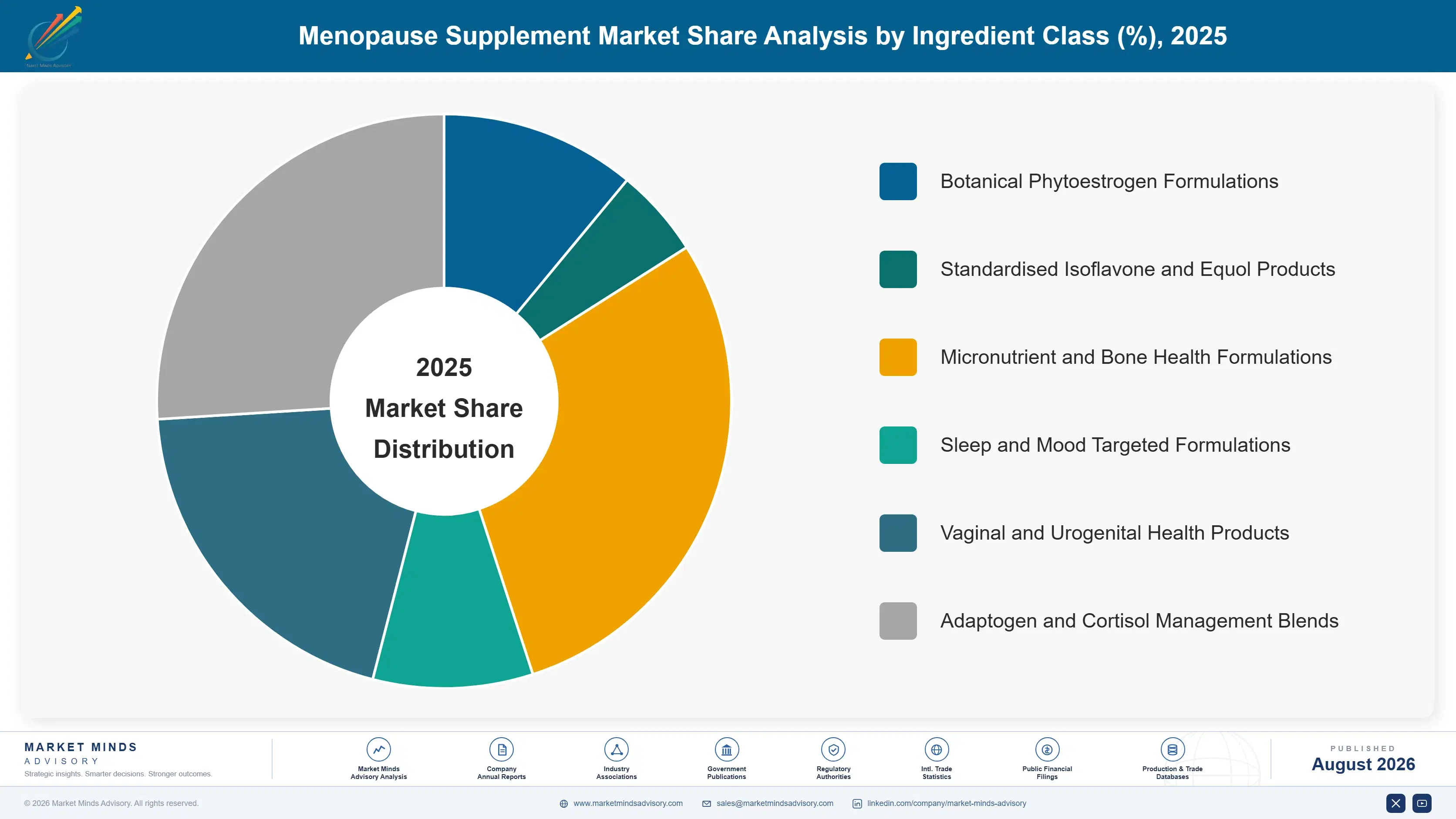
Segment CAGR and Growth Architecture

Products are classified here by ingredient class, since that determines the symptom addressed, the evidence available and what a brand may legally claim in each market. Distribution channel, consumer age stage and purchase motivation are handled separately in the framework, because one ingredient class reaches women through pharmacy, online and clinical channels alike. Class decides the claim.
menopause-supplement-market-trends-market-share-analysis-1787555517195

Sleep and Mood Targeted Formulations

Growing at 14.1%, half again the market rate, this segment occupies ground prescription medicine has left alone entirely. Development in menopause pharmaceuticals concentrated on vasomotor symptoms because they are measurable and obvious, which leaves sleep disruption, mood change and cognitive fog affecting large numbers of women with no clinical answer available. Those symptoms also have an advantage this category badly needs: a woman notices whether she slept, which makes any genuine effect detectable in a way that hot flush frequency counting never is. That detectability supports repeat purchase directly. The ingredients here are also better evidenced than the traditional menopause botanicals, which helps considerably where claims regulation permits saying so.
CAGR 14.1%

Standardised Isoflavone and Equol Products

Equol is produced when gut bacteria metabolise soy isoflavones, and only a minority of women can produce it at all, which explains a great deal about why soy isoflavone trials have returned such inconsistent results across decades. Supplying equol directly rather than its precursor removes that variability and is the closest thing this category has to a mechanistically coherent product. Growth at 12.4% follows both the evidence and Japanese and Korean research that has taken this considerably more seriously than Western manufacturers did. The manufacturing involves fermentation rather than extraction, which narrows the supplier field usefully and supports pricing that botanical formulations cannot command anywhere. Very few competitors can make it.
CAGR 12.4%
Full segment breakdown across 6 segments available in the complete report.

Regional Architecture and Country Demand Map

North America holds 31% of value partly because claim regulation lets brands say what a product is for, which Europe does not permit at all. East Asia follows on equol research and functional food culture. Regulation shapes these shares more than symptom prevalence does. That asymmetry is decisive.

North America

Structure and function claim rules let a brand describe what a product is intended to do, which is a commercial advantage no other major market grants and it shows directly in category size. Founder brands speaking to women through direct channels built this market faster than established consumer health companies reacted, and several were subsequently acquired at valuations reflecting that. Prescription non-hormonal treatment is reaching American women faster than elsewhere, which puts the vasomotor claim under pressure here first. Hormone therapy access is broad and prescribing has recovered from decades of suppression. Growth at 9.0% sits below the market average because prescription competition arrived here earliest. Founder brands still lead the conversation here.
Share: 31% | CAGR: 9.0% (2026 to 2036)

Western Europe

Europe authorises no health claims relating to menopause, which means a product cannot state on pack or in advertising what it is intended for, and consumers frequently cannot identify what they are looking at. That single regulatory fact suppresses trial rates and compounds the category's already poor repeat purchase performance. British public conversation about menopause changed more dramatically than anywhere, driven by broadcasting and workplace policy, and demand rose despite the claim restriction rather than because of any labelling. Hormone therapy prescribing has risen sharply and supply shortages occurred. Growth at 7.8% is the weakest of the seven regions and reflects the claims regime directly. A woman frequently cannot tell what a product is for from the pack itself.
Share: 24% | CAGR: 7.8% (2026 to 2036)
Regional intelligence for 5 additional markets available in the complete report: East Asia, South Asia and Pacific, Latin America, Middle East and Africa, Eastern Europe. Contact sales@marketmindsadvisory.com.
menopause-supplement-market-trends-country-cagr-analysis-1787555517714

Where Category Margin Actually Sits

Four moves matter for a category that grew on a cultural moment and now faces a competitor holding clinical trial data. Two are about the symptoms nobody in medicine has bothered to address, and two are about the repeat purchase failure that wastes every marketing pound spent. Defending the hot flush claim is not among them.

Move toward symptoms prescription medicine has ignored

Pharmaceutical development concentrated on vasomotor symptoms because they are measurable, which leaves sleep disruption, mood change, joint pain and cognitive fog affecting large numbers of women across roughly seven years with no clinical answer at all. Those symptoms also carry a commercial advantage this category needs badly, since a woman notices whether she slept while hot flush frequency requires counting. Detectability supports repeat purchase directly. Growth at 14.1% in that segment reflects both the gap and the detectability, and brands still defending the vasomotor claim are competing against clinical evidence they cannot match.
Market Impact: Serves a segment now compounding at 14.1% annually

Fund one properly powered trial and separate yourself

The whole category is judged together because no individual product has ever produced convincing evidence, which means a brand with a genuinely effective formulation gains nothing from it commercially. A properly powered trial on a specific formulation and a specific symptom costs less than a year of category marketing and would separate one product permanently from every competitor. It would also open claim language in permissive markets and possibly in Europe, where 0 menopause claims are currently authorised. Nobody has done it, which makes the opportunity unusually clean for whoever moves first.
Market Impact: Opens the 0 claims currently authorised in Europe

Extend first purchase supply beyond the trial period

Repeat purchase sits at 34% against symptoms lasting around seven years, which means the category acquires expensively and loses almost everybody. Part of that failure is timing rather than efficacy, since most formulations need weeks before any effect could appear and a thirty day pack runs out before a woman could judge it. Selling ninety day initial supply changes what she is able to evaluate, at the cost of a higher entry price the marketing has to justify. Brands that made this change report materially better retention, which transforms acquisition economics.
Market Impact: Addresses a very poor 34% repeat purchase rate

Build for markets where prescription access is absent

Across India, much of Southeast Asia and parts of Latin America and Africa, hormone therapy is unavailable, unaffordable or undiscussable, which makes supplements the only option rather than an alternative to medicine. That is a completely different commercial position from Western markets and Indian growth at 12.8% reflects it. Brands built around Western positioning, price points and claim language consistently misread these markets and lose to local manufacturers who understood them. The population entering the transition there is larger than every Western market combined, and almost nobody international is serving it properly.
Market Impact: Enters new markets now growing at 12.8% annually

Who Controls the Margin Pool

Five manufacturers hold just 17% of category value, measured on retail sales at manufacturer level, the basis used throughout this section. That fragmentation is unusual even for consumer health and it happened because founder brands reached an audience established companies had ignored, funded by venture capital and sold direct rather than through the pharmacy relationships incumbents controlled. The gap between leaders and everybody else is distribution reach rather than any formulation advantage. Chemistry explains almost none of it.
Competition runs on three dimensions. Trust and communication, since a woman choosing here is acting on limited evidence and buys the brand that speaks to her credibly. Distribution across pharmacy, grocery and direct channels. And symptom positioning, which decides whether a product competes with a prescription or occupies ground medicine has left alone. Price competes less than the fragmentation suggests. Trust does most of the work here.

Rankings shift as established manufacturers acquire founder brands, which has happened repeatedly and continues. Prescription competition disadvantages anybody positioned on vasomotor symptoms. Whoever produces genuine trial evidence first would separate from a field currently judged collectively, and that has not happened yet.
menopause-supplement-market-trends-company-positioning-matrix-1787555518236

Competitive Moat and Risk Dimensions

BAYER

Moat: Women's health category credibility

Bayer holds decades of women's health presence spanning contraception and hormone therapy, which gives it credibility with both consumers and pharmacists that a supplement brand cannot manufacture quickly. In a category where the buyer is acting on limited evidence and needs to trust somebody, that history does commercial work no marketing budget replicates. Pharmacy recommendation in particular follows established relationships.
BAYER

Risk: Prescription portfolio conflict

A substantial prescription women's health business makes it awkward to promote supplements as an alternative to medical treatment, since the argument devalues the larger portfolio directly. Independent supplement brands make that case without internal difficulty. As prescription non-hormonal treatment takes the vasomotor claim, this tension becomes more rather than less commercially uncomfortable.
OTSUKA HOLDINGS

Moat: Equol science and fermentation

Otsuka funded the research establishing that only a minority of women metabolise soy isoflavones into equol, and it manufactures equol directly through fermentation rather than supplying the precursor. That is the closest thing this category has to a mechanistically coherent product supported by genuine science, and the fermentation capability narrows the competitive field considerably.
OTSUKA HOLDINGS

Risk: Limited Western market presence

The strongest science in this category sits with a company whose consumer presence outside Japan and parts of Asia is modest, which means the product reaches a fraction of the women it could serve. Western brands with weaker formulations and better distribution outsell it comfortably. Converting scientific advantage into commercial position requires channel investment that has not been made.

Players Tracked

Prominent Players

Bayer
Nestle Health Science
Haleon
Otsuka Holdings
Pharmavite

Other Key Players

Church & Dwight
Reckitt
Amway
Herbalife
Blackmores
Swisse Wellness
Solgar
Jarrow Formulas
Metagenics
Thorne HealthTech
Bonafide Health
Ritual
Perelel
Kindra
Arkopharma

Recent Developments

FEBRUARY 2025

A supplement brand repositioned entirely around sleep and mood

An American menopause supplement brand relaunched its range around sleep quality and mood rather than vasomotor symptoms, citing prescription competition on hot flushes. This was a positioning and formulation change rather than any transaction, and it moves the brand toward symptoms with no clinical alternative available.
Signal: Brands are retreating from the vasomotor claim voluntarily, which suggests they understand what clinical evidence does to a category
AUGUST 2025

An established manufacturer acquired a founder-led menopause brand

A large consumer health manufacturer acquired a founder-led menopause supplement brand, buying direct consumer relationships and communication credibility rather than any formulation or manufacturing capability. This was a completed acquisition rather than a partnership between the companies involved. Formulation played no part in the valuation at all.
Signal: Incumbents are buying audience rather than product, which confirms that trust rather than chemistry is what this category sells
NOVEMBER 2025

A manufacturer commissioned a controlled trial on sleep outcomes

A supplement manufacturer commissioned a properly powered controlled trial examining sleep outcomes in perimenopausal women, aiming to substantiate claims that current evidence cannot support. This was an internal research commitment rather than any transaction, and results are not expected for some time. Nobody has funded this before.
Signal: Somebody has finally decided evidence is worth funding, and whoever publishes first separates from a field judged collectively

What Moves Manufacturer Cost

Raw formulation inputs account for around 39% of manufacturer cost, and the range spans commodity botanicals costing very little to fermented equol costing a great deal. Encapsulation, packaging and quality testing make up a substantial further share. Marketing and customer acquisition sit outside cost of goods and dominate the profit and loss in a way manufacturing never does. Clinical research is a separate matter entirely.
Botanical input prices moved through 2021 and 2022 on harvest conditions and freight disruption, and USDA and national agricultural data record the supply variability across those seasons. Haleon noted input cost and supply chain pressure across its consumer health operations in its Annual Report 2022. Manufacturers holding retailer price agreements absorbed most of the movement, since a grocery or pharmacy chain sets shelf price for a period and does not reopen it because a crop disappointed.

Acquisition cost rather than ingredient cost determines whether a brand here survives. With repeat purchase at 34%, a brand acquires a customer who buys roughly one and a half times, so marketing must be recovered on the first purchase. That arithmetic is why so many founder brands sold rather than scaled, and why supply period matters more than ingredients.
menopause-supplement-market-trends-cost-volatility-analysis-1787555518432

Extend first purchase supply to ninety days minimum

Most formulations need several weeks before any effect could appear and a thirty day pack expires before a woman can judge it, which turns an efficacy question into a timing failure. Ninety day supply gives the product a fair trial and raises the entry price marketing must justify. Brands making this change report better retention, which matters more than formulation.

Contract botanical inputs across multiple growing seasons

Black cohosh, red clover and similar botanicals behave like agriculture rather than like chemistry, with harvest variability that spot purchasing turns into a bet on weather. Multi-season contracts convert that into a known cost and secure allocation when harvests disappoint. Smaller brands lacking purchasing scale should aggregate through contract manufacturers who hold better positions than they can obtain independently.

Separate clinical research budget from marketing spend

A properly powered trial costs less than a year of category marketing and would separate one product permanently from a field judged collectively, yet it competes for the same budget and always loses to campaigns showing immediate return. Ring-fencing research spend acknowledges that the two do entirely different work. Brands treating evidence as marketing expense never fund it.

Portfolio Architecture for Margin Defence

Margin here tracks evidence and positioning rather than ingredient cost, because the raw materials in most of this category are inexpensive and the price a woman pays reflects what she believes rather than what it cost to make. Commodity botanical formulations run at gross margins in the high thirties against private label and undifferentiated competition. Standardised extract and micronutrient products run better on specification. Equol, clinically supported formulations and urogenital products run considerably higher, on scarcity and on addressing needs nothing else does.
The tension is that commodity botanicals still carry most of the volume while differentiated products carry the future, and moving between them requires either science nobody has funded or positioning most brands lack the credibility to claim. Several manufacturers have added premium products without the evidence to support the pricing, which consumers detect and which damages the brand rather than the category. That is a more expensive mistake than it appears at the time.

High-value pools sit in sleep and mood formulations, equol chemistry and clinically substantiated products. Only one of the three currently exists at scale. Formulation capability by itself defends nothing where the ingredients are published and available to everybody.

Volume / Commodity-Adjacent

Commodity botanical formulations using black cohosh, red clover and soy isoflavones against private label and undifferentiated competition on shelf. The ten-point range separates brands with contracted botanical supply from those buying spot against variable harvests each season.
Gross Margin: 34%-44%

Premium / Certified

Standardised extracts, micronutrient and bone health formulations where specification and quality documentation carry the price rather than any symptom claim. The twelve-point spread reflects brand credibility, since identical formulations sell at very different prices depending on who is selling them.
Gross Margin: 44%-56%

Sustainability / Regulatory / Next-Generation

Equol products, sleep and mood formulations and anything with genuine clinical substantiation behind it. The sixteen-point range is wide because these price against scarcity and evidence rather than against the ingredient costs that anybody could benchmark.
Gross Margin: 54%-70%
menopause-supplement-market-trends-portfolio-architecture-1787555518925

High-value Sub-segments and Strategic Watch-out

Sleep And Mood Formulations

Compounding at 14.1% on ground prescription medicine has left entirely alone, and carrying a commercial advantage the category needs badly. A woman notices whether she slept, which makes any real effect detectable and supports repeat purchase directly. Nothing in medicine addresses it at all. Nobody competes.
Gross Margin: 56%-70%

Clinically Substantiated Products

Nobody has funded a properly powered trial, which means the whole category is judged together and an effective product gains nothing from being effective. Whoever publishes first separates permanently, and the cost is less than annual marketing. The economics of that decision are unusually clear.
Gross Margin: 58%-70%

Commodity Botanical Formulations

Still most of the volume and directly exposed to prescription competition on the vasomotor claim these products were built around. Manage for distribution reach rather than margin, because the evidence will not improve to defend it. Prescription evidence will keep improving against it. Distribution is the lever.
Gross Margin: 34%-44%

Prescription-Absent Markets

Across India and much of Asia, hormone therapy is unavailable rather than merely optional, which makes supplements the only choice rather than an alternative. Indian growth at 12.8% reflects that, and Western positioning consistently misreads it. Local manufacturers currently win these markets easily. Positioning misreads it.
Gross Margin: 44%-58%

How Category Demand Renews

Demand should renew monthly across roughly seven years of symptoms and mostly does not, which is the single defining economic fact about this category. A woman experiencing the transition is a long customer if the product works and a single purchase if it does not, and repeat purchase at 34% describes which of those is happening. Every acquisition pound is recovered on roughly one and a half purchases, which has driven more founder brands to sell than to scale.
Stickiness depends entirely on detectability. Products addressing symptoms a woman can perceive changing, particularly sleep and mood, retain far better than products addressing hot flush frequency that she would have to count to evaluate. Clinically substantiated products would retain best of all, if any existed at scale. Commodity botanical formulations retain worst, because nothing distinguishes the experience of taking them from taking nothing.

The buyer arrives better informed and more sceptical than she did five years ago. Public conversation that built this category also taught women what the evidence actually says, and a woman who has read about black cohosh trials is a harder sale than one who has not. Brands that grew on the conversation now meet its second effect.
menopause-supplement-market-trends-end-use-penetration-index-1787555519413

Where To Place The Bet

These are among the four positions where our research anticipates prominent divergence between winners and laggards over the coming forecast period. Each is grounded in the demand model, the regulatory perimeter, and the announced capacity pipeline.
01 / SYMPTOM REPOSITIONING PRIORITY

Go where medicine has not bothered to look

Pharmaceutical development concentrated entirely on vasomotor symptoms because they are measurable and obvious, which leaves sleep disruption, mood change, joint pain and cognitive fog affecting large numbers of women across roughly seven years with no clinical answer whatever. Those symptoms also carry an advantage this category needs badly, since a woman knows whether she slept while hot flush frequency requires counting to evaluate at all. Detectability supports repeat purchase directly, and brands still defending the vasomotor claim are competing against trial evidence they cannot match.
02 / CLINICAL EVIDENCE INVESTMENT

Fund the trial nobody in this category has

The entire category is judged collectively because no individual product has ever produced convincing evidence, which means a brand holding a genuinely effective formulation captures nothing commercially from that fact. A properly powered trial on one formulation and one specific symptom costs less than a single year of category marketing spend and would separate that product permanently from every competitor selling on belief. It would also open claim language in permissive markets and potentially in Europe, where currently 0 menopause claims are authorised for anybody.
03 / TRIAL PERIOD EXTENSION

Sell ninety days, not thirty, from the start

Repeat purchase sits at 34% against symptoms persisting around seven years, which means the category acquires customers expensively and loses two thirds of them immediately. A meaningful share of that failure is timing rather than efficacy, since most formulations require several weeks before any effect could appear and a thirty day pack expires before the woman can fairly judge it. Selling ninety day initial supply gives the product an honest trial at the cost of a higher entry price, and brands making the change report materially better retention.
04 / ACCESS-ABSENT MARKET ENTRY

Serve women who have no prescription option

Across India, much of Southeast Asia and parts of Latin America and Africa, hormone therapy is unavailable, unaffordable or culturally undiscussable, which means supplements are not competing against medicine but substituting for its complete absence. That is a fundamentally different commercial position and Indian growth at 12.8% reflects it directly. The population entering the transition across those markets exceeds every Western market combined, and international brands built around Western positioning, pricing and claim language consistently misread it and lose to local manufacturers.

Engagement Snapshot From the Field

A live engagement with an industry participant carrying material or product regulatory and market exposure ahead of a defining policy shift, showing how our research translates into a defensible multi-year portfolio strategy.
MARKET MINDS ADVISORY · CLIENT ENGAGEMENT SUMMARY
Menopause Supplement Producer Strategic Portfolio Review and Transition Roadmap 2026·Investment Scenario on Menopause Supplement Exposure Evaluation 2025-26
CLIENT PROFILE
A European menopause supplement brand with annual revenue around EUR 34 million (client-reported, unverified by MMA), selling botanical formulations positioned on hot flush relief through pharmacy and online channels in five markets. Marketing spend was heavily weighted toward digital acquisition. Products shipped in thirty day packs. No clinical research had ever been commissioned. Retention was never analysed.
STRATEGIC CHALLENGE
Customer acquisition cost had risen for three consecutive years (client-reported, unverified by MMA) while retention stayed flat, and management proposed increasing digital spend and adding a premium formulation. Nobody had established why acquired customers were not returning, which meant both proposals would have bought more of a customer the business could not keep.
MMA APPROACH
MMA separated the client's growth problem into acquisition efficiency and retention using purchase panel data across the served markets rather than accepting the spending explanation. Prescription non-hormonal treatment availability was mapped against the client's positioning. Pack size effects on retention were tested through the expert interview programme, and symptom-level demand was sized separately for sleep, mood and vasomotor claims.
KEY FINDINGS
  1. Retention rather than acquisition explained nearly all of the deteriorating economics, which meant additional digital spend would have accelerated the losses rather than reversing them.
  2. Roughly half of non-repeating customers stopped within the first pack, before any formulation could plausibly have produced an effect they were able to detect.
  3. Prescription non-hormonal treatment was becoming available across three of the client's five markets, putting the entire hot flush positioning under pressure that would only increase.
  4. Sleep and mood claims faced no prescription competition at all and were growing considerably faster, and the client held formulation capability it had never marketed that way.
CLIENT PROFILE
A European menopause supplement brand with annual revenue around EUR 34 million (client-reported, unverified by MMA), selling botanical formulations positioned on hot flush relief through pharmacy and online channels in five markets. Marketing spend was heavily weighted toward digital acquisition. Products shipped in thirty day packs. No clinical research had ever been commissioned. Retention was never analysed.
STRATEGIC CHALLENGE
Customer acquisition cost had risen for three consecutive years (client-reported, unverified by MMA) while retention stayed flat, and management proposed increasing digital spend and adding a premium formulation. Nobody had established why acquired customers were not returning, which meant both proposals would have bought more of a customer the business could not keep.
MMA APPROACH
MMA separated the client's growth problem into acquisition efficiency and retention using purchase panel data across the served markets rather than accepting the spending explanation. Prescription non-hormonal treatment availability was mapped against the client's positioning. Pack size effects on retention were tested through the expert interview programme, and symptom-level demand was sized separately for sleep, mood and vasomotor claims.
KEY FINDINGS
  1. Retention rather than acquisition explained nearly all of the deteriorating economics, which meant additional digital spend would have accelerated the losses rather than reversing them.
  2. Roughly half of non-repeating customers stopped within the first pack, before any formulation could plausibly have produced an effect they were able to detect.
  3. Prescription non-hormonal treatment was becoming available across three of the client's five markets, putting the entire hot flush positioning under pressure that would only increase.
  4. Sleep and mood claims faced no prescription competition at all and were growing considerably faster, and the client held formulation capability it had never marketed that way.
RECOMMENDED STRATEGY
Phase 1: Phase one: freeze the digital spend increase and convert the range to ninety day initial supply, accepting a higher entry price the marketing must carry. Phase 2: Phase two: reposition the primary products around sleep and mood rather than hot flushes, ahead of prescription competition reaching remaining markets. Phase 3: Phase three: commission a properly powered trial on sleep outcomes rather than launching another premium formulation without evidence behind it.
OUTCOME
Ninety day packs launched in early 2026 with retention improving materially on the converted lines. Repositioning around sleep and mood is complete in three markets. A sleep outcomes trial is commissioned, and the client reports acquisition cost stabilising for the first time (client-reported, unverified by MMA).

Frequently Asked Questions

Foundational context covering the market sizes, CAGR, scope, country, region and competition that inform every finding below. This section is provided to cover basics and most often pre-purchase conversations, answered from the MMA Primary Research Dataset.

What is the current size of the Menopause Supplement Market?

The market was valued at USD 2.8 billion in 2025, rising to an estimated USD 3.06 billion in 2026. North America holds the largest regional share at 31% of value.

How large will the Menopause Supplement Market be by 2036?

MMA forecasts USD 7.52 billion by 2036 under the base case, an expansion multiple of 2.46 times the 2026 value. That represents USD 4.46 billion of incremental value.

What is the CAGR for the Menopause Supplement Market 2026 to 2036?

The base case runs at 9.4% compound annual growth between 2026 and 2036, with a bull case at 10.7% and a bear case at 8.1%. Historical growth from 2020 to 2025 was 8.2%.

Which segment is growing fastest?

Sleep and mood targeted formulations lead at 14.1%, half again the market rate, occupying ground prescription medicine has entirely ignored. Equol products follow at 12.4%.

Who are the major companies in the Menopause Supplement Market?

Bayer, Nestle Health Science, Haleon, Otsuka Holdings and Pharmavite hold just 17% between them. Distribution reach and trust rather than formulation advantage sustain those positions.

Which country is growing fastest?

India leads at 12.8%, where hormone therapy is largely unavailable outside major cities, which makes supplements the only option rather than an alternative to medicine.

Report Segmentation Architecture

The full report scope spans multiple orthogonal segmentation dimensions, with cross-tabulated demand data provided for each dimension pair. Coverage extends further to regional breakdowns, trend trajectories, and the competitive detail needed to support segment-level decision-making.

By Ingredient Class

  • Botanical Phytoestrogen Formulations
  • Standardised Isoflavone and Equol Products
  • Micronutrient and Bone Health Formulations
  • Sleep and Mood Targeted Formulations
  • Vaginal and Urogenital Health Products
  • Adaptogen and Cortisol Management Blends

By End-Use Industry

  • Pharmacy Retail
  • Grocery and Mass Retail
  • Online Direct to Consumer
  • Practitioner and Clinical Channel
  • Specialty Health Retail
  • Workplace Health Programmes

By Consumer Stage

  • Early Perimenopause
  • Late Perimenopause
  • Postmenopause Maintenance
  • Surgical and Medical Menopause
  • Hormone Therapy Adjunct Use

By Region

  • North America
  • Western Europe
  • East Asia
  • South Asia and Pacific
  • Latin America
  • Middle East and Africa
  • Eastern Europe

Scope, Methodology, and Coverage

Every figure in this report is reproducible from documented input assumptions. The scope below maps the historical period, the forecast horizon, the segmentation dimensions, and the countries covered, alongside the underlying primary and qualitative methodology.
Historical Period
2020 to 2025
Forecast Period
2026 to 2036
Base Year
2025 (USD billions; MMA Primary Research Dataset, August 2026)
Market Definition
The market comprises supplements formulated and marketed for symptoms of the menopausal transition across pharmacy, grocery, online, practitioner and specialty channels, covering botanical phytoestrogen formulations, standardised isoflavone and equol products, micronutrient and bone health formulations, sleep and mood targeted formulations, vaginal and urogenital health products, and adaptogen and cortisol management blends. Value is measured at manufacturer level on retail sales. Prescription hormone therapy, prescription non-hormonal treatments, general multivitamins without menopause positioning, medical devices and cosmetic products fall outside scope.
Quantitative Units
USD billions (current prices); million units sold annually; USD per unit by ingredient class
Segmentation Dimensions
By Ingredient Class; By End-Use Industry; By Consumer Stage; By Region
Regions Covered
North America, Western Europe, East Asia, South Asia and Pacific, Latin America, Middle East and Africa, Eastern Europe
Countries Covered
United States, Canada, Mexico, Brazil, Argentina, Colombia, United Kingdom, Germany, France, Netherlands, Sweden, Denmark, Spain, Italy, Ireland, Poland, Czechia, Hungary, Romania, Japan, South Korea, China, Taiwan, India, Australia, New Zealand, Thailand, Singapore, United Arab Emirates, South Africa
Key Companies Profiled
Bayer, Nestle Health Science, Haleon, Otsuka Holdings, Pharmavite, Church & Dwight, Reckitt, Amway, Herbalife, Blackmores, Swisse Wellness, Solgar, Jarrow Formulas, Metagenics, Thorne HealthTech, Bonafide Health, Ritual, Perelel, Kindra, Arkopharma
Quantitative Methodology
Primary survey, n=3,800 respondents, Q4 2025, six countries; demand-side model with trade association cross-validation
Qualitative Methodology
47 expert interviews, Q4 2025; applied to validate demand model assumptions, identify emerging dynamics, and assess competitive positioning
Report Format
PDF and XLSX data workbook (Word format preview document)
Publisher
Market Minds Advisory
Report Code
MMA-2026-HLT-084
Published
August 2026
Contact
sales@marketmindsadvisory.com | www.marketmindsadvisory.com

Purchase the full Menopause Supplement Market Report (2026 to 2036).

The full report sizes the global menopause supplement market to 2036 across six ingredient classes and seven regions, measured on retail sales at manufacturer level. It treats prescription non-hormonal competition as a category-level threat rather than a passing development and maps exposure by symptom positioning. Competitive analysis covers 20 participants evaluated on retail sales value, with moat and risk assessment for the two leaders. Health claim regulation is quantified by jurisdiction, since the same formulation is a menopause product in one market and an unlabelled botanical in another. Four quantified revenue levers close the analysis.
Six-class segment sizing with segment-level growth rates
Seven-region share and growth breakdown to 2036
Twenty-participant competitive map on one retail basis
Prescription competition mapped against symptom positioning by market
Health claim permissions compared across every major jurisdiction
Four quantified revenue levers with commercial impact ranges

Built For The People Who Decide

From boardroom strategy to bench-side execution, this report is read cover-to-cover by leaders shaping the next decade of their industry, turning demand scenarios, market dynamics and valuation benchmarks into decisions.
CXOs/ Presidents/ VPs/ Managers
M&A and Corporate Development
Strategy Teams and R&D Heads
Procurement and Product Directors
Regulatory and Compliance Leaders
Investor Relations and Equity Analysts