Market Minds Advisory
MEMS Pressure Sensor Market

MEMS Pressure Sensor Market: MEMS Pressure Sensor Market. Automotive, Medical, and Consumer Electronics Sensing Devices, 2026 to 2036

Device makers embedding pressure sensing into wearables and continuous health monitors are pushing MEMS suppliers to prove miniaturized accuracy and power efficiency rather than the automotive-grade ruggedness that once defined the category.

Lead Analyst

Published

September 2026

Make Smarter Decisions with Customized Research Insights

Request a free sample report and evaluate market opportunities, growth trends, and competitive dynamics relevant to your business needs.

2025 MARKET VALUE$3.6BMarket Size 2025
2036 FORECAST VALUE$7.6BBase Case , 2026 to 2036
CAGR 2026 TO 20367.0 %Bull 8.3% / Bear 5.7%
INCREMENTAL OPPORTUNITY$3.7BNet 10- year value creation
EXPANSION MULTIPLE1.97x2036 value over 2026 base
Strategic Levers
M&A Pipeline
Regional Outlook
Country Rankings
Competitive Intelligence
Segmental Deep-dive
Call-Us : 91 93563 13602

Executive Snapshot and Market Trajectory.

MEMS pressure sensors have expanded well beyond their original automotive tire and engine monitoring roots into medical wearables, consumer electronics, and industrial process control applications requiring genuinely miniaturized, low-power sensing capability at scale across every device category and market segment deployed today.
Medical and wearable pressure sensors are growing fastest as continuous health monitoring devices increasingly integrate barometric and blood pressure sensing directly into consumer wearables rather than requiring separate clinical measurement equipment purchased separately from a hospital or pharmacy. North America leads regional demand given its concentration of medical device manufacturers and consumer electronics companies willing to fund miniaturization engineering for premium wearable health products sold at genuine scale nationwide and increasingly abroad across every continent.
Competitive character increasingly centers on packaging miniaturization and power efficiency rather than raw pressure measurement range, since wearable and mobile applications demand sensors small enough to fit inside devices barely a few millimeters thick while running reliably on battery power for years without replacement or recharging. Vendors offering ultra-low-power designs and wafer-level packaging win disproportionate share of new design wins across consumer electronics and medical device manufacturers each cycle.
Market Definition
The MEMS Pressure Sensor Market covers microelectromechanical pressure sensing devices used in automotive, medical, consumer electronics, and industrial applications to measure absolute, gauge, or differential pressure through miniaturized silicon-based sensing elements. It excludes traditional mechanical pressure gauges, non-MEMS piezoresistive sensors, and pressure switches lacking microelectromechanical sensing architecture.
Base Year Value
$3.6B in 2025 (MMA Primary Research Dataset, September 2026)
Forecast Period
2026 to 2036, eleven discrete annual values
CAGR
7.0% base case. Bull 8.3%. Bear 5.7%.
Fastest Growth Segment
Medical and Wearable Pressure Sensors: 11.5% CAGR
Fastest Growth Country
Malaysia: 8.5% CAGR
Fastest Growth Region
South Asia and Pacific: 9.0% CAGR
Largest Region
East Asia: 30% of 2025 global value
Market Leaders
Leading vendors: Bosch, STMicroelectronics, Infineon Technologies, TE Connectivity, Honeywell. Source: MMA Primary Research Dataset, July 2026.
Primary Survey
n=3,800 procurement and R&D decision-makers, Q4 2025, six countries
Methodology
Demand-side build-up, cross-validated against public data, 47 expert interviews

MEMS Pressure Sensor Market Forecast Scenarios

mems-pressure-sensor-market-size-forecast-scenario-1789995783834
Growth through 2020 to 2025 was steady as automotive tire pressure monitoring mandates in major markets sustained baseline demand while medical wearable and consumer electronics applications began contributing meaningfully to overall unit volume across nearly every product category, a diversification that reduced the category's historical dependence on automotive production cycles alone considerably over just a few years.
Base case growth through 2036 rests on three commercial mechanisms: continued integration of pressure sensing into medical wearables and continuous health monitoring devices replacing separate clinical measurement equipment across most patient populations, expanding consumer electronics adoption of barometric sensors for navigation and fitness tracking applications across smartphones and wearables sold at massive scale, and growing industrial process control demand for miniaturized sensors in increasingly space-constrained equipment designs across every manufacturing sector.
A bull scenario turns on faster medical wearable adoption as continuous blood pressure monitoring technology matures and gains regulatory clearance across major markets, expanding the addressable healthcare application base considerably. The bear risk is that automotive electrification reduces the number of pressure-sensing points needed per vehicle as internal combustion engine monitoring applications decline, compressing a historically stable demand segment for the category.

The Miniaturization Economics Behind Every Pressure Sensor

Vendors no longer compete primarily on raw pressure measurement range or accuracy alone, since baseline performance has become largely standardized across nearly every credible supplier in the category today, but rather on package size and power consumption that determine whether a sensor can actually fit inside a modern wearable device or smartphone at all.
MARKET CONCENTRATIONCR5: 52%Top five vendors hold slightly over half the market
AVERAGE UNIT PRICE$1.85Typical wholesale cost for a standard pressure sensor
TOP PRODUCING COUNTRY SHAREChina: 31%Reflects concentration of consumer electronics assembly capacity worldwide
RATED SENSOR LIFESPAN10 yearsTypical rated operational life under normal duty cycle
WAFER-LEVEL PACKAGING ADOPTION58%Share of new designs using wafer-level packaging techniques
MEDICAL DESIGN WIN RATE29%Share of new medical device designs specifying MEMS sensing
Pricing has shifted from simple per-unit component sales toward design-win relationships that lock in multi-year supply agreements tied to a specific end product's production lifecycle, since consumer electronics and medical device manufacturers value supply continuity over marginal unit price differences between qualified suppliers competing for the same slot. Vendors that win early design-in slots capture years of guaranteed volume rather than competing repeatedly for each individual production order.
Wafer-level packaging has become the single largest differentiator behind design wins in space-constrained applications, since it lets manufacturers shrink sensor footprint dramatically compared with traditional discrete packaging approaches that dominated the category for decades before this shift occurred. Vendors offering mature wafer-level packaging capability report meaningfully higher design win rates in wearable and mobile applications than those relying entirely on legacy packaging techniques still common in automotive applications.
"Ten years ago this was a tire pressure sensor with a footnote about medical applications. Now the footnote is the growth story and the tire sensor is the footnote."
Practice Lead, Semiconductor Sensing and MEMS Technology Research · MMA Technology Practice · September 2026

Market Trends

Continuous Blood Pressure Monitoring Reaches Consumer Devices

Vendors have moved rapidly from single-point blood pressure readings requiring an inflatable cuff toward continuous, cuffless monitoring embedded directly inside consumer wearables, using MEMS sensors sensitive enough to detect subtle arterial pulse pressure changes without external compression or any real discomfort whatsoever to the wearer at all. Roughly 22 percent of new premium smartwatch models launched in 2025 now include some form of continuous blood pressure sensing capability, up sharply from under 5 percent just two years earlier as sensor sensitivity and battery efficiency both improved considerably across the industry.
Market Impact: 340 million units shipped in 2025

Wafer-Level Packaging Shrinks Sensor Footprint Dramatically

Manufacturers have shifted decisively from traditional discrete sensor packaging toward wafer-level packaging techniques that integrate the sensing element and protective cap directly at the wafer stage, shrinking overall sensor footprint by more than half compared with legacy packaging approaches that dominated the category for decades before this significant and disruptive manufacturing shift occurred. Roughly 58 percent of new MEMS pressure sensor designs in 2025 now use wafer-level packaging, up from under 30 percent just three years earlier as the manufacturing technique matured and yield rates improved substantially across the industry.
Market Impact: 78% of smartphones now include sensors

Market Opportunities and Growth Drivers

Wearable Health Device Adoption Drives Sensor Demand Growth

Consumer adoption of health-tracking wearables has grown rapidly across nearly every major market worldwide, and manufacturers increasingly differentiate premium devices through advanced health sensing capability including pressure-based measurements that basic fitness trackers historically lacked entirely from their original feature set several years ago in much earlier product generations sold worldwide. Roughly 340 million health-tracking wearable units shipped globally in 2025 according to industry shipment tracking, with pressure sensing capability included in a rapidly growing share of premium models as manufacturers compete on measurement depth rather than basic step counting alone.
Market Impact: 1 in 3 combustion dollars lost

Smartphone Barometric Sensing Becomes a Standard Feature

Smartphone manufacturers now routinely include barometric pressure sensors as a standard feature to improve indoor navigation accuracy and enable elevation-based fitness tracking features that consumers increasingly expect as baseline functionality in any premium device purchased today across every major brand, price tier, and geographic market worldwide today and going forward. Roughly 78 percent of smartphones shipped globally in 2025 included a barometric pressure sensor, up from under 45 percent just five years earlier as the component cost declined enough to justify inclusion even in mid-range device tiers competing on feature parity.
Market Impact: Certification adds 12 months to launch

Market Restraints and Challenges

Automotive Electrification Reduces Pressure Sensing Points Per Vehicle

Electric vehicles require fewer pressure sensing points than internal combustion vehicles, since engine oil pressure, fuel injection pressure, and exhaust gas recirculation sensing applications simply do not exist in an electric powertrain architecture lacking the underlying combustion process entirely. The root cause is that roughly a third of automotive MEMS pressure sensor revenue historically came from combustion-specific applications now disappearing from new vehicle platforms. Vendors report automotive-specific sensor content per vehicle declining measurably as electrification accelerates across major markets. Some vendors have responded by expanding battery thermal management and cabin air quality sensing to offset the decline.
Market Impact: 22% of smartwatches now include sensing

Medical Device Certification Delays Slow Product Launch Timelines

Medical wearable products incorporating pressure sensing must complete extensive regulatory certification before market launch, a process that routinely takes over a year and requires clinical validation data that smaller sensor vendors struggle to generate independently without a larger device manufacturer partner. The underlying cause is that regulators treat continuous physiological monitoring claims with substantially more scrutiny than simple fitness tracking features lacking any diagnostic claim. This certification burden routinely delays new product launches by twelve months or longer. Several vendors now partner directly with established medical device manufacturers already possessing in-house regulatory expertise.
Market Impact: 58% now use wafer-level packaging
3 additional market trends, 4 additional growth drivers, and 3 additional restraints and challenges are covered in the full report. Contact sales@marketmindsadvisory.com to access the complete intelligence.

Segment CAGR and Growth Architecture

The market splits by end-use application rather than by sensor package type or measurement principle, since design cycles, certification requirements, and pricing structures vary sharply across each specific category and buyer. Six categories cover the field: medical and wearable sensors, consumer electronics sensors, industrial process control, automotive tire monitoring, automotive powertrain, and HVAC building automation.
mems-pressure-sensor-market-market-share-analysis-1789995784411

Medical and Wearable Pressure Sensors

Medical and wearable pressure sensors are the fastest-growing category by a wide margin, driven by continuous health monitoring devices increasingly integrating barometric and blood pressure sensing directly into consumer wearables rather than requiring separate clinical measurement equipment purchased at a hospital or pharmacy elsewhere entirely and separately. Adoption started among premium smartwatch manufacturers but has spread rapidly into dedicated medical wearables and remote patient monitoring devices used in clinical care settings. Pricing has shifted from simple component sales toward design-win relationships that lock in multi-year supply agreements, and vendors increasingly bundle regulatory certification support directly into the sensor sale rather than leaving customers to navigate approval processes independently on their own.
CAGR 11.5%

Consumer Electronics Barometric Sensors

Consumer electronics sensors address a genuinely distinct commercial need, since smartphones, tablets, and fitness trackers require barometric sensing for navigation and elevation tracking rather than physiological measurement capability of any clinical kind whatsoever in daily practice, use, or specific context of operation. Adoption has concentrated among smartphone manufacturers competing on feature parity across every price tier, since barometric sensing has become a standard expected feature rather than a premium differentiator reserved for flagship devices alone anymore today. This category commands lower per-unit pricing than medical applications given the absence of certification overhead, and vendors compete primarily on cost and integration ease rather than measurement precision beyond what navigation applications genuinely require.
CAGR 9.5%
Full segment breakdown across 6 segments available in the complete report.

Regional Architecture and Country Demand Map

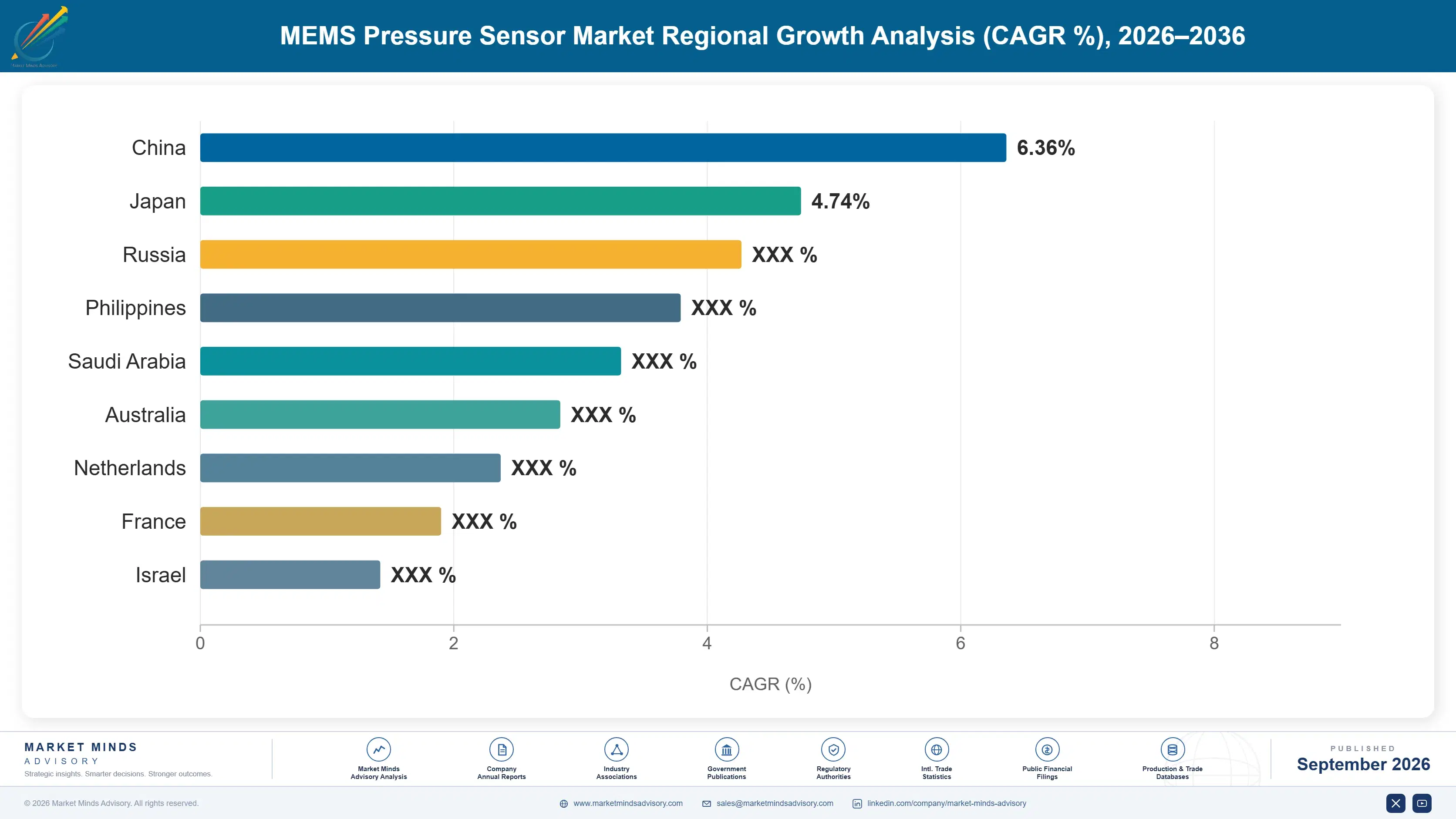
China leads on consumer electronics assembly and sensor manufacturing scale, Malaysia leads on the fastest growth rate through expanding semiconductor packaging and testing investment, and North America contributes strong demand from medical device innovation and regulatory clearance activity across its broader domestic healthcare industry today.

North America

US medical device manufacturers drive substantial regional demand as continuous health monitoring wearables move through regulatory clearance and into commercial production at meaningful scale across multiple device categories. The automotive sector contributes steady baseline demand through tire pressure monitoring mandates that remain in effect even as electrification reduces powertrain-specific sensing points across the vehicle fleet. Canada contributes modest volume through its own automotive supply chain and growing medical device manufacturing presence. The region's demand reflects genuine buyer sophistication around miniaturization and regulatory certification support rather than any unique manufacturing advantage held only by vendors based here specifically. Federal healthcare technology procurement programs have separately added a meaningful and steadily growing demand channel.
Share: 28% | CAGR: 7.0% (2026 to 2036)

Western Europe

Germany leads regional adoption through its concentrated automotive manufacturing base, where tire pressure monitoring and powertrain sensing remain significant even as electrification reshapes long-term automotive sensor content per vehicle. The medical device sector across the region has adopted MEMS pressure sensing steadily, driven by an aging population and growing demand for remote patient monitoring technology across national healthcare systems. Growth trails East Asia meaningfully since the region's consumer electronics manufacturing base is considerably smaller than the high-volume assembly operations concentrated in China, Taiwan, and South Korea. Nordic countries have moved fastest on public sector remote monitoring pilots specifically. Italian and Spanish automotive suppliers are following the German pattern from a somewhat smaller base as well.
Share: 21% | CAGR: 5.5% (2026 to 2036)
Regional intelligence for 5 additional markets available in the complete report: East Asia, South Asia and Pacific, Latin America, Middle East and Africa, Eastern Europe. Contact sales@marketmindsadvisory.com.
mems-pressure-sensor-market-country-cagr-analysis-1789995784962

Where Sensor Makers Actually Capture Margin

Bare sensor component margin has thinned as competition intensifies among established semiconductor vendors, so the strongest performers capture additional margin through design-win lock-in, regulatory certification bundling, wafer-level packaging licensing, and volume-tiered supply contracts layered on top of the base component sale rather than through the unit price alone across every deployed customer program and product line.

Lock In Multi-Year Design-Win Supply Agreements

Vendors that secure early design-win status on a new consumer electronics or medical device platform capture guaranteed multi-year supply volume worth 3 to 4 times the value of a single transactional order, since replacing a qualified sensor mid-production run requires the customer to repeat costly validation testing and re-certification work all over again. This lock-in also gives vendors visibility into customer production forecasts that inform their own capacity planning decisions well in advance. Contract renewal conversations increasingly start from this design-win baseline directly rather than from a bare component price quote.
Market Impact: Design wins lock in 3 to 4x order value

Bundle Regulatory Certification Support Into the Sensor Sale

Vendors that bundle regulatory certification support and clinical validation data directly into the medical sensor sale capture a price premium of roughly 30 to 40 percent above a bare, uncertified component, since medical device manufacturers value pre-validated regulatory pathways enough to pay meaningfully more for them every single time. Vendors that built this certification support capability early now report considerably longer average customer relationships than those selling bare components alone without support. Renewal rates in these certified accounts run noticeably higher as a direct result of this ongoing, sustained arrangement.
Market Impact: Certification bundling adds 30 to 40% more revenue

License Wafer-Level Packaging Techniques to Smaller Vendors

Larger vendors that developed proprietary wafer-level packaging techniques increasingly license the underlying manufacturing process to smaller competitors lacking the capital to develop it independently, capturing 10 to 15 percent of licensee revenue as an ongoing royalty stream that scales directly with the licensee's own production volume over time. This licensing model also extends the larger vendor's technology influence across the industry without requiring direct manufacturing investment in every application segment served. Larger licensee accounts routinely pay well above this stated baseline figure once production volume scales meaningfully over sustained time.
Market Impact: Packaging licensing captures 10 to 15% royalty fee

Charge Volume-Tiered Pricing for Guaranteed Long-Term Supply

Vendors negotiate multi-year volume-tiered supply agreements with large consumer electronics and automotive customers, trading guaranteed order volume for pricing that still captures 15 to 20 percent more margin than spot-market component sales, since customers value supply security highly enough to accept less aggressive price negotiation than a one-time transactional purchase would otherwise produce for them. This arrangement also locks customers into a specific sensor architecture for the contract term. Larger volume commitments routinely exceed this baseline threshold considerably each contract renewal year across every product category and customer segment served.
Market Impact: Volume contracts capture 15 to 20% more margin

Who Controls the Margin Pool

CR5 sits at 52 percent, evaluated on annual MEMS pressure sensor revenue across each vendor's full product line, reflecting a market moderately more concentrated than most adjacent semiconductor sensing categories due to high automotive and medical qualification barriers. Bosch holds the clearest lead given its deep automotive sensor heritage and manufacturing scale, though the gap to STMicroelectronics has narrowed noticeably as consumer electronics and medical design wins accelerate.
Competitive activity today centers on packaging miniaturization and regulatory certification depth rather than raw measurement accuracy, which has largely converged across leading vendors for most standard applications. Bosch, STMicroelectronics, and Infineon Technologies have all expanded dedicated medical wearable product lines over the past two years, while smaller specialist vendors focus on niche industrial and aerospace applications larger vendors deprioritize in their broader roadmap.

Emerging pressure comes from Chinese sensor manufacturers rapidly closing the technical gap on consumer electronics applications while undercutting established Western vendors on price for standard, non-certified sensors sold into cost-sensitive domestic device assembly. Rankings are most likely to shift in the medical wearable segment, where certification support and clinical validation partnerships matter more than sensor manufacturing heritage, giving newer specialist entrants a genuine opening against established incumbents.
mems-pressure-sensor-market-company-positioning-matrix-1789995785492

Competitive Moat and Risk Dimensions

BOSCH

Moat: Automotive Sensor Manufacturing Scale

Bosch's decades of automotive sensor manufacturing give it enormous production scale and cost advantages that smaller competitors cannot easily replicate, along with deep existing relationships with global automakers that ease cross-selling into adjacent sensor categories. This scale advantage extends into consumer and medical applications as Bosch diversifies beyond its automotive core.
BOSCH

Risk: Automotive Revenue Concentration Risk

Bosch's continued reliance on automotive sensor revenue leaves it more exposed than diversified competitors to the ongoing decline in combustion-specific sensing applications as vehicle electrification accelerates rapidly across major global automotive markets and future vehicle platforms currently under active development by leading global automakers worldwide.
STMICROELECTRONICS

Moat: Consumer Electronics Design Wins

STMicroelectronics has built exceptionally strong relationships with major smartphone and wearable manufacturers, giving it design-win visibility and volume that automotive-focused competitors lack in the consumer electronics segment specifically and at meaningful scale. This position has translated into leadership in the fastest-growing wearable and mobile sensing applications tracked in this study.
STMICROELECTRONICS

Risk: Thinner Automotive Sector Presence

STMicroelectronics' comparatively thinner automotive sensor presence leaves it less positioned than Bosch to capture the steady baseline demand that tire pressure monitoring mandates continue to reliably provide even as electrification steadily reshapes the broader automotive sensor content mix across the entire global industry today and tomorrow.

Players Tracked

Prominent Players

Bosch
STMicroelectronics
Infineon Technologies
TE Connectivity
Honeywell

Other Key Players

Amphenol
Sensata Technologies
NXP Semiconductors
Texas Instruments
Merit Sensor
ams OSRAM
Melexis
Denso
Continental
Panasonic
Murata Manufacturing
All Sensors Corporation
Kulite Semiconductor
Silicon Designs
Vishay Intertechnology

Recent Developments

FEBRUARY 2026

Bosch Launches Ultra-Miniature Wearable Pressure Sensor

Bosch launched a new ultra-miniature pressure sensor specifically designed for continuous blood pressure monitoring in consumer wearables, achieving a footprint roughly 40 percent smaller than its prior generation while maintaining measurement accuracy adequate for regulatory clearance submission across several target device categories, manufacturers, and market segments.
Signal: Confirms miniaturization has become the primary competitive battleground in medical wearable applications today, across the industry.
SEPTEMBER 2025

STMicroelectronics Acquires Medical Sensor Certification Startup

STMicroelectronics acquired a smaller startup specializing in medical device regulatory certification support, closing a specific capability gap identified by wearable manufacturer customers evaluating its platform against competitors offering bundled certification pathways and clinical validation data support services already firmly and well established in the market.
Signal: Shows chipmakers continuing to acquire regulatory expertise rather than build it entirely in-house on their own.
MAY 2025

Infineon Technologies Expands Wafer-Level Packaging Capacity

Infineon Technologies expanded its wafer-level packaging manufacturing capacity to meet growing demand from consumer electronics customers, adding several new production lines specifically dedicated to the smaller sensor footprint required by premium wearable device manufacturers competing intensely on form factor, design, and overall device battery life.
Signal: Signals wafer-level packaging capacity has become a genuine competitive constraint across the entire global semiconductor industry.

Silicon Wafer Cost Behind Every Sensor

Silicon wafer processing and semiconductor foundry capacity account for roughly 38 percent of cost of goods sold for a typical MEMS pressure sensor vendor, with the remainder split across packaging, testing, and calibration expenses paid throughout the manufacturing process. Foundry capacity concentrates heavily in Taiwan, Germany, and the United States rather than the markets where finished sensors are ultimately assembled into end products.
A 2025 foundry capacity allocation shift toward higher-margin advanced logic chips, documented in supplier annual reports reviewed by MMA analysts, pushed wafer lead times for mature-node MEMS sensor production from eight weeks to over sixteen weeks within a single year as foundries prioritized more profitable orders across their available capacity. Vendors without long-term capacity reservation agreements already in place absorbed the resulting delay directly. This delay affected multiple product lines industrywide.

Smaller sensor vendors relying entirely on spot-market foundry capacity face far more allocation risk than the largest vendors that negotiate long-term capacity agreements directly with major foundries at meaningful volume and scale. That negotiating advantage increasingly determines which vendors can guarantee reliable delivery timelines to automotive and medical device customers who plan production schedules months in advance around a specific component's confirmed availability.
mems-pressure-sensor-market-cost-volatility-analysis-1789995785688

Reserve Foundry Capacity Through Long-Term Agreements

Larger vendors negotiate long-term wafer capacity agreements directly with major foundries, trading a volume commitment for guaranteed allocation priority that shields them from the lead time swings smaller vendors face during periods of tight industrywide foundry capacity across every mature process node and full product family used across the entire company. Larger customer volume commitments earn even better priority treatment.

Qualify Multiple Foundries for the Same Sensor Design

Several vendors now qualify a given sensor design across two or more foundries simultaneously rather than relying on a single manufacturing source, adding modest qualification cost upfront but eliminating the single-point allocation risk that caused the 2025 lead time extension across the industry and most product categories affected significantly. This dual-sourcing approach has become nearly standard industry practice.

Shift Mature Designs to Older, Less Contested Process Nodes

Vendors increasingly migrate mature MEMS sensor designs to older, less contested process nodes where advanced logic chips do not compete for the same capacity, trading marginal performance for meaningfully more reliable allocation and lead time predictability across the full product line and entire customer base served worldwide. Customers rarely notice any difference in real-world field performance.

Portfolio Architecture for Margin Defence

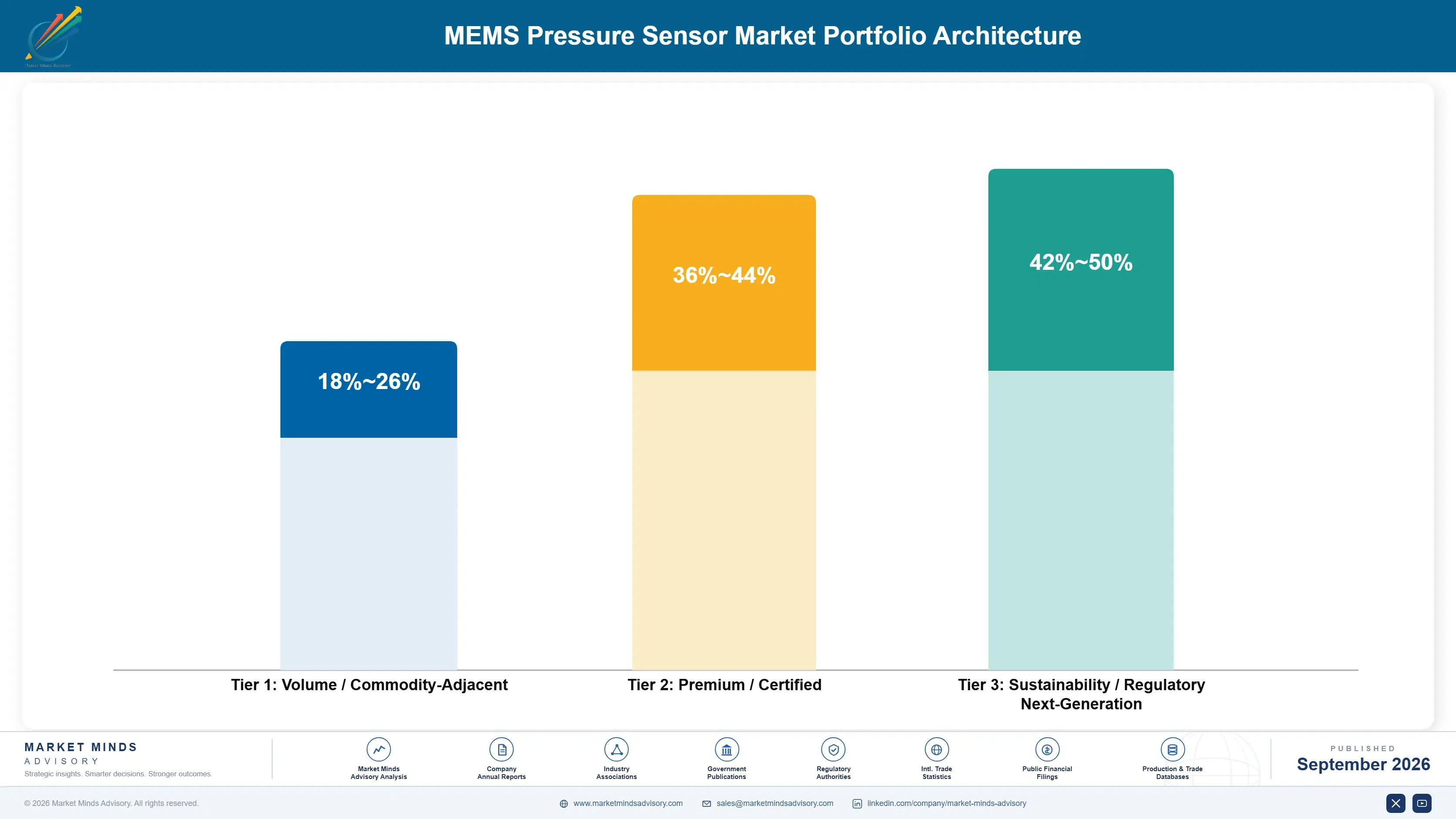
Gross margin in MEMS pressure sensors spreads widely depending on certification depth and how much the design win covers versus a commodity transactional sale. A bare, uncertified sensor sold at competitive commodity pricing clears margin well below what a certified, design-win-locked automotive or medical sensor commands, since the latter embeds specialized qualification engineering that buyers pay a real, sustained premium to access reliably over the full contract term.
Volume and premium tiers pull vendors toward genuinely different customer bases and engineering investment levels. Volume players compete on low-cost, bare sensors sold broadly into non-certified consumer applications, while premium players concentrate on automotive and medical applications willing to pay substantially more for certification, design-win lock-in, and long-term supply reliability built in. Few vendors execute both strategies at once, since certification investment and sales motion diverge sharply between the two approaches.

High-value margin pools concentrate specifically in medical certification bundling, wafer-level packaging licensing, and long-term design-win supply agreements rather than in bare sensor sales, which increasingly function as a low-margin, high-volume entry point that funds the engineering infrastructure supporting the much higher-margin certified and licensed business built on top of that same underlying sensor platform and shared manufacturing infrastructure across the company.

Volume / Commodity-Adjacent

Bare, uncertified pressure sensors sold at low, competitive pricing into consumer electronics applications, competing mainly on unit price, delivery lead time, and broad distributor availability across every region and market worldwide.
Gross Margin: 18-26%

Premium / Certified

Design-win-locked sensors bundled with automotive or medical certification support sold to large enterprise customers across regulated industries requiring extensive qualification, validation documentation, and ongoing regulatory compliance support and periodic reporting.
Gross Margin: 36-44%

Sustainability / Regulatory / Next-Generation

Continuous health monitoring and wearable-specific sensors meeting emerging medical regulatory standards demanded by device manufacturers pursuing clinical-grade physiological measurement claims, formal regulatory clearances, and much broader reimbursement eligibility criteria overall.
Gross Margin: 42-50%
mems-pressure-sensor-market-portfolio-architecture-1789995786211

High-value Sub-segments and Strategic Watch-out

Medical Wearable Certification Bundling

The highest-margin pool in the category, growing fastest as medical device manufacturers increasingly demand pre-certified sensors rather than pursuing costly independent regulatory validation themselves after component purchase and product integration work. Adoption keeps rising sharply among medical device buyers with the largest deployed product portfolios.
Gross Margin: 46-54%

Wafer-Level Packaging Licensing

High-value, technology-driven revenue commanding strong margin as smaller vendors license proprietary miniaturization techniques from larger competitors rather than developing the capability independently from scratch at considerable expense and much lost time. Renewal and expansion rates in these accounts run consistently higher than the base tier.
Gross Margin: 38-46%

Commodity Consumer Electronics Sensors

The largest volume core of the market, mature and increasingly low-margin, facing continued commoditization pressure as Chinese sensor manufacturers steadily close the technical gap on both price and overall product quality metrics. Vendors increasingly treat this tier as a lead generation channel for premium upsell.
Gross Margin: 16-24%

Automotive Electrification Substitution

A strategic watch-out segment where vehicle electrification reduces the number of combustion-specific pressure sensing points needed per vehicle, threatening to compress a historically stable demand segment considerably over time and at growing scale. Vendors must diversify into new applications to offset this ongoing revenue decline.
Gross Margin: N/A

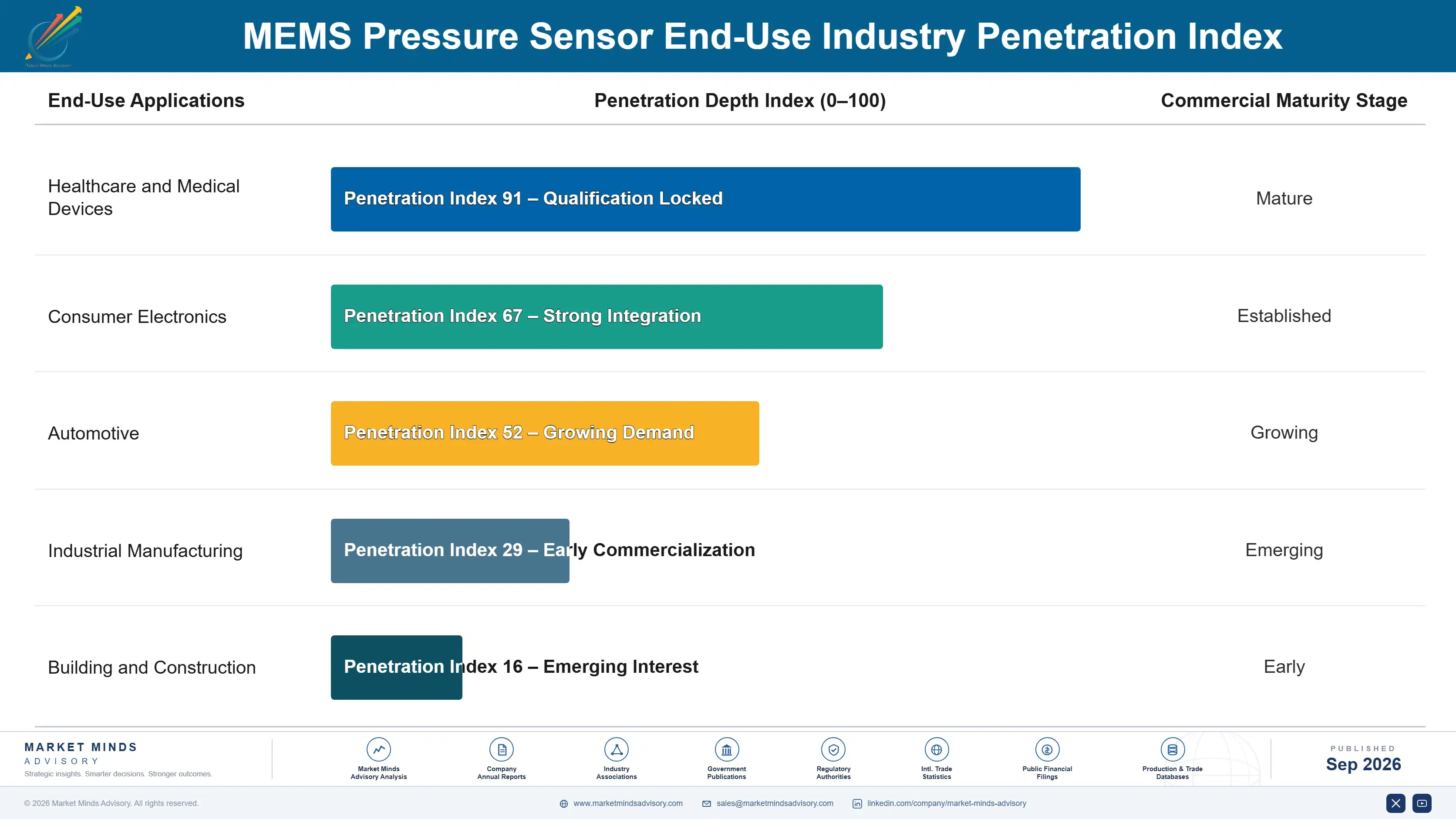
Why MEMS Design Wins Last Years

A MEMS pressure sensor design win behaves more like an annuity than a one-time component sale once it becomes embedded inside a customer's certified end product, since re-qualifying an entire product design around a competing sensor requires repeating regulatory certification, reliability testing, and manufacturing validation from scratch. That requalification cost alone can exceed the annual value of the underlying sensor business many times over across a multi-year production run.
Stickiness varies sharply by end-use vertical and certification depth achieved during initial design. Medical and automotive customers show the deepest lock-in, since re-certifying a design around a new sensor can take a year or longer and cost hundreds of thousands of dollars in validation work. Consumer electronics customers show comparatively shallower stickiness, since switching a bare, uncertified sensor requires far less validation effort and regulatory overhead overall.

Buyer profiles are shifting generationally as dedicated sensor integration engineering teams, rather than general component procurement staff treating pressure sensing as one purchasing decision among many, increasingly drive supplier selection decisions. This generational shift favors vendors offering strong miniaturization roadmaps and certification support over vendors competing primarily on raw component price and basic measurement specifications alone.
mems-pressure-sensor-market-end-use-penetration-index-1789995786701

Where to Compete in MEMS Sensing

These are among the four positions where our research anticipates prominent divergence between winners and laggards over the coming forecast period. Each is grounded in the demand model, the regulatory perimeter, and the announced capacity pipeline.
01 / MEDICAL CERTIFICATION INVESTMENT

Build medical certification support before generalists catch up

Medical wearable design wins already command a substantial price premium over consumer electronics applications, yet most sensor vendors still treat regulatory certification as entirely the customer's problem to solve on their own initiative. A challenger investing early in genuine certification support and clinical validation partnerships can lock in medical device accounts before larger incumbents build comparable capability internally through their own dedicated investment. That window narrows measurably each year as certification support becomes a standard vendor offering across the broader market.
02 / MINIATURIZATION ROADMAP FOCUS

Push wafer-level packaging depth to win wearable design slots

Wafer-level packaging adoption is accelerating rapidly across wearable and mobile applications, yet many smaller vendors still rely on legacy discrete packaging that cannot match the footprint modern devices genuinely require in order to compete effectively at all. A vendor that invests aggressively in wafer-level packaging capability now can win design slots before larger incumbents redirect meaningful engineering resources toward this specific manufacturing capability and process entirely. This differentiation narrows measurably as the packaging technique matures broadly across the entire global industry.
03 / DUAL FOUNDRY SOURCING

Qualify multiple foundries before the next capacity allocation shock

The 2025 foundry capacity allocation shift demonstrated clearly how exposed single-foundry vendors are to sudden lead time extensions entirely beyond their direct control or influence over available global chip supply chains and existing capacity constraints. Vendors that qualify designs across multiple foundries now protect their own delivery reliability against the next allocation shock far better than competitors dependent on just one single manufacturing source alone without alternatives. This diversification decision increasingly separates reliable vendors from those facing costly, unpredictable delays.
04 / AUTOMOTIVE DIVERSIFICATION STRATEGY

Expand into battery and cabin sensing to offset combustion decline

Vehicle electrification is steadily eliminating the combustion-specific pressure sensing applications that historically generated a meaningful share of automotive sensor revenue for established vendors operating in this specific category today and in prior years. Vendors that expand into battery thermal management and cabin air quality sensing now can offset this ongoing decline before it meaningfully compresses their automotive revenue base even further over the coming years. This diversification window will not stay open indefinitely as electrification accelerates across every major automotive market.

Engagement Snapshot From the Field

A live engagement with an industry participant carrying material or product regulatory and market exposure ahead of a defining policy shift, showing how our research translates into a defensible multi-year portfolio strategy.
MARKET MINDS ADVISORY · CLIENT ENGAGEMENT SUMMARY
MEMS Pressure Sensor Producer Strategic Portfolio Review and Transition Roadmap 2026·Investment Scenario on MEMS Pressure Sensor Exposure Evaluation 2025-26
CLIENT PROFILE
The client designs and manufactures consumer wearable devices sold through major retail and direct-to-consumer channels, reporting client-reported annual revenue of approximately $310 million (client-reported, unverified by MMA). Facing a strategic decision to add continuous blood pressure monitoring to its next flagship product generation, leadership sought an independent evaluation of MEMS pressure sensor vendors before committing to a multi-year design partnership.
STRATEGIC CHALLENGE
Three candidate vendors offered pressure sensors with meaningfully different accuracy specifications, certification support levels, and pricing structures, and the client's own hardware engineering team lacked the specific regulatory affairs expertise needed to independently assess which vendor's own certification pathway would actually clear regulatory review fastest for its intended target markets.
MMA APPROACH
MMA analysts evaluated each vendor's sensor accuracy against independent reference measurements, assessed each vendor's certification support track record with comparable wearable products already cleared for market, and modeled total cost of ownership including component pricing, certification support fees, and expected time to market under three realistic development timelines and scenarios.
KEY FINDINGS
  1. The vendor with the lowest component price actually offered the weakest certification support, adding an estimated 4 months to the regulatory clearance timeline compared with competitors.
  2. Sensor accuracy varied by less than expected across all three vendors, making certification support and design-win pricing the more decisive factors in vendor selection overall.
  3. None of the three vendors had previously supported a product targeting the client's specific combination of target regulatory markets simultaneously without additional customization.
  4. The selected vendor's design-win pricing structure, once modeled against expected production volume, saved the client roughly $1.8 million (client-reported, unverified by MMA) over three years.
CLIENT PROFILE
The client designs and manufactures consumer wearable devices sold through major retail and direct-to-consumer channels, reporting client-reported annual revenue of approximately $310 million (client-reported, unverified by MMA). Facing a strategic decision to add continuous blood pressure monitoring to its next flagship product generation, leadership sought an independent evaluation of MEMS pressure sensor vendors before committing to a multi-year design partnership.
STRATEGIC CHALLENGE
Three candidate vendors offered pressure sensors with meaningfully different accuracy specifications, certification support levels, and pricing structures, and the client's own hardware engineering team lacked the specific regulatory affairs expertise needed to independently assess which vendor's own certification pathway would actually clear regulatory review fastest for its intended target markets.
MMA APPROACH
MMA analysts evaluated each vendor's sensor accuracy against independent reference measurements, assessed each vendor's certification support track record with comparable wearable products already cleared for market, and modeled total cost of ownership including component pricing, certification support fees, and expected time to market under three realistic development timelines and scenarios.
KEY FINDINGS
  1. The vendor with the lowest component price actually offered the weakest certification support, adding an estimated 4 months to the regulatory clearance timeline compared with competitors.
  2. Sensor accuracy varied by less than expected across all three vendors, making certification support and design-win pricing the more decisive factors in vendor selection overall.
  3. None of the three vendors had previously supported a product targeting the client's specific combination of target regulatory markets simultaneously without additional customization.
  4. The selected vendor's design-win pricing structure, once modeled against expected production volume, saved the client roughly $1.8 million (client-reported, unverified by MMA) over three years.
RECOMMENDED STRATEGY
Phase 1: Phase 1 (Months 1 to 3): Finalize sensor selection and begin joint certification planning with the selected vendor's regulatory affairs team immediately. Phase 2: Phase 2 (Months 4 to 9): Complete clinical validation testing and submit regulatory clearance applications for the client's primary target markets. Phase 3: Phase 3 (Months 10 to 14): Launch the flagship product following regulatory clearance and begin volume production under the negotiated design-win pricing.
OUTCOME
The client selected the recommended vendor and received regulatory clearance for its primary target market roughly 3 months faster (client-reported, unverified by MMA) than its original internal timeline projected. The flagship product launched on schedule with continuous blood pressure monitoring as its headline feature and differentiator.

Frequently Asked Questions

Foundational context covering the market sizes, CAGR, scope, country, region and competition that inform every finding below. This section is provided to cover basics and most often pre-purchase conversations, answered from the MMA Primary Research Dataset.

What is the current size of the MEMS Pressure Sensor Market?

The MEMS Pressure Sensor Market reached $3.6 billion in base-year value in 2025, spanning automotive, medical, consumer electronics, and industrial pressure sensing applications sold worldwide.

How large will the MEMS Pressure Sensor Market be by 2036?

The market is projected to reach $7.57 billion by 2036, expanding roughly 1.97 times its 2026 value as medical and wearable applications diversify demand beyond automotive.

What is the CAGR for the MEMS Pressure Sensor Market 2026 to 2036?

The market is forecast to grow at a compound annual growth rate of 7.0 percent between 2026 and 2036, driven by wearable health monitoring and smartphone sensor adoption.

Which segment is growing fastest?

Medical and wearable pressure sensors lead all segments at an 11.5 percent CAGR, roughly 1.64 times the overall market rate, as continuous health monitoring devices expand adoption.

Who are the major companies in the MEMS Pressure Sensor Market?

Bosch, STMicroelectronics, Infineon Technologies, TE Connectivity, and Honeywell lead the competitive field, evaluated on annual MEMS pressure sensor revenue across every product line and region.

Which country is growing fastest?

Malaysia leads all countries tracked at an 8.5 percent CAGR, fueled by rapid expansion of semiconductor packaging and testing investment as global chipmakers diversify manufacturing capacity.

Report Segmentation Architecture

The full report scope spans multiple orthogonal segmentation dimensions, with cross-tabulated demand data provided for each dimension pair. Coverage extends further to regional breakdowns, trend trajectories, and the competitive detail needed to support segment-level decision-making.

By Primary Market Dimension

  • Medical and Wearable Pressure Sensors
  • Consumer Electronics Barometric Sensors
  • Industrial Process Control Pressure Sensors
  • Automotive Tire Pressure Monitoring Sensors
  • Automotive Powertrain and Engine Pressure Sensors
  • HVAC and Building Automation Pressure Sensors

By End-Use Industry

  • Healthcare and Medical Devices
  • Consumer Electronics
  • Automotive
  • Industrial Manufacturing
  • Building and Construction

By Commercial Dimension

  • Direct OEM Component Sale
  • Design-Win Supply Agreement
  • Certification Bundled Solution
  • Distributor Channel Sale

By Region

  • North America
  • Western Europe
  • East Asia
  • South Asia and Pacific
  • Latin America
  • Middle East and Africa
  • Eastern Europe

Scope, Methodology, and Coverage

Every figure in this report is reproducible from documented input assumptions. The scope below maps the historical period, the forecast horizon, the segmentation dimensions, and the countries covered, alongside the underlying primary and qualitative methodology.
Historical Period
2020 to 2025
Forecast Period
2026 to 2036
Base Year
2025 (USD billions; MMA Primary Research Dataset, September 2026)
Market Definition
The MEMS Pressure Sensor Market covers microelectromechanical pressure sensing devices used in automotive, medical, consumer electronics, and industrial applications to measure absolute, gauge, or differential pressure through miniaturized silicon-based sensing elements. It excludes traditional mechanical pressure gauges, non-MEMS piezoresistive sensors, and pressure switches lacking microelectromechanical sensing architecture.
Quantitative Units
USD billions (current prices); sensor unit shipment volume where applicable
Segmentation Dimensions
By Primary Market Dimension; By End-Use Industry; By Commercial Dimension; By Region
Regions Covered
North America, Western Europe, East Asia, South Asia and Pacific, Latin America, Middle East and Africa, Eastern Europe
Countries Covered
USA, China, Germany, France, UK, Japan, South Korea, India, Australia, Canada, Brazil, Mexico, Indonesia, Vietnam, Thailand, Malaysia, UAE, Saudi Arabia, South Africa, Nigeria, Turkey, Poland, Netherlands, Italy, Spain, Sweden, Switzerland, Argentina, Colombia, Singapore, and additional markets relevant to this sector
Key Companies Profiled
Bosch, STMicroelectronics, Infineon Technologies, TE Connectivity, Honeywell, Amphenol, Sensata Technologies, NXP Semiconductors, Texas Instruments, Merit Sensor, ams OSRAM, Melexis, Denso, Continental, Panasonic, Murata Manufacturing, All Sensors Corporation, Kulite Semiconductor, Silicon Designs, Vishay Intertechnology
Quantitative Methodology
Primary survey, n=3,800 respondents, Q4 2025, six countries; demand-side model with trade association cross-validation
Qualitative Methodology
47 expert interviews, Q4 2025; applied to validate demand model assumptions, identify emerging dynamics, and assess competitive positioning
Report Format
PDF and XLSX data workbook (Word format preview document)
Publisher
Market Minds Advisory
Report Code
MMA-2026-TEC-214
Published
September 2026
Contact
sales@marketmindsadvisory.com | www.marketmindsadvisory.com

Purchase the full MEMS Pressure Sensor Market Report (2026 to 2036).

This report delivers a comprehensive assessment of the MEMS Pressure Sensor Market from 2026 through 2036, covering sizing, segmentation, and regional demand patterns across all seven world regions tracked. It profiles twenty companies competing on miniaturization depth, certification support, and foundry supply resilience rather than raw measurement specifications alone. Readers get detailed analysis of revenue levers, input cost exposure, and portfolio margin economics specific to this hardware category and its buyers. The report closes with a strategic verdict identifying exactly where new capital should concentrate over the coming decade.
Full seven-region market sizing and forecast data
Twenty-company competitive profiling and moat analysis
Segment-level CAGR and market share breakdown
Foundry cost exposure and mitigation pathway analysis
Revenue lever and portfolio margin economics detail
Anonymized client case study with recommended strategy

Built For The People Who Decide

From boardroom strategy to bench-side execution, this report is read cover-to-cover by leaders shaping the next decade of their industry, turning demand scenarios, market dynamics and valuation benchmarks into decisions.
CXOs/ Presidents/ VPs/ Managers
M&A and Corporate Development
Strategy Teams and R&D Heads
Procurement and Product Directors
Regulatory and Compliance Leaders
Investor Relations and Equity Analysts