

Market Minds Advisory
Memory Support Supplement Market

Memory Support Supplement Market: Clinical Trials Replace Traditional Herbal Claims

Brands are racing to fund peer-reviewed trials for ginkgo and lion's mane formulations, as aging consumers and regulators demand documented cognitive benefit evidence that older herbal-tradition claims alone can no longer support.

Lead Analyst

Lisa Gevelber

Published

September 2026

Make Smarter Decisions with Customized Research Insights

Request a free sample report and evaluate market opportunities, growth trends, and competitive dynamics relevant to your business needs.

2025 MARKET VALUE$2.6BMarket Size 2025
2036 FORECAST VALUE$7.7BBase Case , 2026 to 2036
CAGR 2026 TO 203610.4 %Bull 11.7% / Bear 9.1%
INCREMENTAL OPPORTUNITY$4.8BNet 10- year value creation
EXPANSION MULTIPLE2.69x2036 value over 2026 base
Strategic Levers
M&A Pipeline
Regional Outlook
Country Rankings
Competitive Intelligence
Segmental Deep-dive
Call-Us : 91 93563 13602

Executive Snapshot and Market Trajectory

Memory support supplements are shifting from herbal-tradition marketing toward clinically documented formulations, as aging consumers and regulators alike demand peer-reviewed cognitive benefit evidence that older claims alone can no longer support credibly at retail nationwide, forcing brands to reconsider decades-old marketing playbooks entirely.
Mushroom-based nootropic formulations built around lion's mane extract are growing fastest as younger biohacking-oriented consumers adopt cognitive supplements outside the traditional elderly buyer base, expanding at roughly 17.8 percent annually against the category's 10.4 percent baseline overall. North America commands the largest regional share, anchored in decades of direct-to-consumer supplement marketing scale and the world's most developed brain-health advertising channel. Sports nutrition and wellness retailers report meaningfully stronger sales for brain-health formulations carrying documented evidence.
Competitive intensity centers on a small group of brands capable of funding the multi-year clinical trials that increasingly separate credible formulations from unsubstantiated herbal claims, a capability requiring considerable capital that smaller entrants cannot easily match. Regulatory scrutiny over unsupported cognitive benefit claims has intensified across major markets, pushing several smaller brands to either fund proper trials or exit the category rather than risk enforcement action overall.
Market Definition
The memory support supplement market covers dietary supplements formulated with ginkgo biloba, phosphatidylserine, omega-3 DHA, bacopa monnieri, lion's mane mushroom extract, or multi-ingredient blends marketed specifically for cognitive and memory function support. It excludes prescription cognitive medications and general multivitamin products without a specific memory-support claim.
Base Year Value
$2.6B in 2025 (MMA Primary Research Dataset, August 2026)
Forecast Period
2026 to 2036, eleven discrete annual values
CAGR
10.4% base case. Bull 11.7%. Bear 9.1%.
Fastest Growth Segment
Mushroom-Based Nootropic Formulations: 17.8% CAGR
Fastest Growth Country
India: 15.8% CAGR
Fastest Growth Region
South Asia and Pacific: 12.6% CAGR
Largest Region
North America: 30% of 2025 global value
Market Leaders
Quincy Bioscience, LLC, Reckitt Benckiser Group plc, Nestle Health Science S.A., Unilever plc, and Thorne HealthTech, Inc. lead by disclosed retail revenue and brand recognition. Source: MMA Analysis based on company annual reports and retail scan data.
Primary Survey
n=3,800 procurement and R&D decision-makers, Q4 2025, six countries
Methodology
Demand-side build-up, cross-validated against public data, 47 expert interviews

Memory Support Supplement Market Forecast Scenarios

memory-support-supplement-market-trends-size-forecast-scenario-1787457536971
Between 2020 and 2025, memory support supplement demand accelerated as aging baby boomer populations sought cognitive health products alongside a newer wave of younger biohacking-oriented consumers discovering nootropics. Clinical trial investment roughly doubled across the period as brands chased credibility beyond traditional herbal marketing claims. The category posted an estimated 9.0 percent historical CAGR, trailing the forecast rate ahead.
MMA's base case projects 10.4 percent annual growth through 2036, anchored in three commercial mechanisms. First, clinically documented formulations keep converting skeptical consumers at a meaningfully higher rate than unsubstantiated herbal blends ever achieved on their own. Second, younger biohacking-oriented buyers keep expanding the addressable market well beyond the traditional elderly cognitive-decline buyer base. Third, retailers keep expanding dedicated brain-health shelf sets as category sales density outpaces adjacent general supplement categories.
The bull case rests on a major clinical trial demonstrating statistically significant cognitive benefit for a mainstream ingredient, which could pull demand well beyond current adoption levels industry-wide. The principal bear risk is regulatory action against unsubstantiated cognitive benefit claims, which could force costly reformulation or exit for brands lacking proper clinical documentation, a risk that would force renewed marketing investment across the entire category.

Clinical Evidence Becomes the Category's Real Currency

Household purchasing behavior for memory support supplements has shifted decisively from trusting traditional herbal reputation toward demanding documented clinical trial evidence. Consumers now compare peer-reviewed study design, sample size, and statistical significance before choosing a brand, a scrutiny level that barely existed when ginkgo biloba dominated the category on herbal tradition alone a decade ago, before regulatory scrutiny reshaped marketing standards industry-wide across the wider industry.
MARKET CONCENTRATIONCR5 38%top five brands hold considerable combined category retail revenue nationwide
AVERAGE PRICE PREMIUM2.2x general multivitaminclinically documented formulations command a durable sustained retail premium
CLINICAL TRIAL INVESTMENT SHARE6.8% of revenueleading brands fund trials to defend documented cognitive benefit claims
REPEAT PURCHASE RATE48%clinically backed formulations drive notably stronger household repurchase loyalty overall
REFORMULATION CYCLE LENGTH18 monthscompetitive pressure keeps shortening typical clinical evidence refresh timing cycles
DIRECT-TO-CONSUMER CHANNEL SHARE44%brands increasingly bypass traditional retail through subscription-based online sales
Retail economics reward brands that invested in proper clinical trials years before regulators tightened enforcement against unsubstantiated claims. Mass retailers and pharmacy chains increasingly favor brands that can document peer-reviewed cognitive benefit evidence, forcing smaller herbal-tradition brands to either fund proper trials or compete purely on price for undifferentiated commodity formulations lacking documentation across every major supply account tracked in this report.
Over the next decade, clinical evidence depth and formulation innovation will matter as much as brand recognition built through advertising alone. Brands that solve credible cognitive benefit documentation while expanding beyond the traditional elderly buyer base stand to capture disproportionate share as the category matures into a genuinely mainstream cognitive wellness staple nationwide and increasingly among younger consumers.
"Nobody buys ginkgo biloba because their grandmother swore by it anymore. They buy it because a peer-reviewed study said it actually did something measurable."
Director, Food and Plant-Based Nutrition Practice · MMA Food and Plant-Based Nutrition Practice · August 2026

Market Trends

Lion's Mane Mushroom Extract Attracts Younger Biohacking Consumers

Lion's mane mushroom extract has emerged as the category's fastest-growing ingredient, attracting a younger biohacking-oriented consumer base that previously viewed memory supplements as a product exclusively for aging parents and grandparents. Bulletproof, HVMN, and several specialty nootropic brands have each disclosed formulation lines built specifically around documented nerve growth factor research tied to lion's mane compounds. Social media wellness influencers have accelerated category awareness among consumers under 40, a demographic that historically ignored memory support supplements entirely. Mainstream retailers increasingly stock lion's mane formulations alongside traditional cognitive health products, reflecting genuine crossover demand across age groups nationwide.
Market Impact: Expands core buyer base by 14%
Regulatory Scrutiny Forces Clinical Trial Investment Industry-Wide

Regulatory bodies across major markets have intensified scrutiny of unsubstantiated cognitive benefit claims, forcing brands to either fund proper peer-reviewed clinical trials or face enforcement action including warning letters and mandatory reformulation. Quincy Bioscience's Prevagen faced high-profile legal challenges over its clinical evidence, a case other brands have studied closely when designing their own trial programs. This scrutiny has raised the credibility bar across the entire category, disadvantaging smaller brands lacking capital for multi-year trials. Larger brands increasingly cite this dynamic as a genuine competitive moat against undercapitalized challengers entering the space.
Market Impact: Commands 22% pricing premium overall

Market Opportunities and Growth Drivers

Aging Population Growth Expands Core Buyer Base

Global aging population growth continues expanding the core buyer base for memory support supplements, as consumers over 55 increasingly seek proactive cognitive health products ahead of documented age-related decline concerns affecting their peer cohort. This demographic shift is well documented across national statistical offices in major markets, providing a genuine, quantifiable tailwind independent of marketing trends or seasonal promotional activity. Retailers report meaningfully stronger repeat purchase rates among consumers over 55 compared to younger buyers, reflecting more established daily supplement routines. Healthcare providers increasingly recommend documented cognitive support formulations as part of broader preventive wellness conversations with aging patients.
Market Impact: Cuts category trust scores by 12%

Peer-Reviewed Clinical Evidence Drives Premium Pricing Power

Brands that fund and publish peer-reviewed clinical trials command meaningfully higher retail pricing than competitors relying on traditional herbal marketing claims alone, since documented statistical significance has become a genuine purchasing criterion for increasingly sophisticated consumers. This pricing power justifies the considerable capital investment required for proper trial design and execution, creating a reinforcing cycle where credible brands fund further research to defend premium positioning. Retailers increasingly request clinical documentation before renewing annual shelf allocation agreements with cognitive health brands competing for limited display space across every major retail account served nationwide.
Market Impact: Raises compliance costs by 16%

Market Restraints and Challenges

Inconsistent Clinical Evidence Quality Undermines Category Trust

Clinical trial quality varies considerably across the category, with some studies suffering from small sample sizes, industry funding conflicts, or methodology weaknesses that skeptical consumers and healthcare providers increasingly scrutinize before recommending a product. The root cause is cost: rigorous, independently funded trials cost considerably more than industry-sponsored studies with looser methodology standards. This inconsistency undermines consumer trust in the category broadly, even for brands with genuinely strong evidence, since negative publicity around weaker studies spills over onto the entire cognitive supplement category. Some brands are pursuing independent third-party trial verification to differentiate their evidence quality from weaker industry-funded competitors.
Market Impact: Adds 11 new product launches annually

Regulatory Enforcement Risk Raises Compliance Costs Industry-Wide

Rising regulatory enforcement against unsubstantiated cognitive benefit claims has meaningfully raised compliance costs across the category, forcing brands to invest in legal review and clinical documentation before making any marketing claim. The root cause is a wave of high-profile enforcement actions and consumer lawsuits that have made regulators and plaintiff attorneys alike more attentive to cognitive supplement marketing specifically. This raises the cost of doing business for every brand in the category, disproportionately affecting smaller players lacking dedicated legal and regulatory affairs staff. Industry trade associations are developing voluntary evidence standards to help smaller brands navigate compliance more affordably.
Market Impact: Cuts unsubstantiated brand entries by 19%
3 additional market trends, 4 additional growth drivers, and 3 additional restraints and challenges are covered in the full report. Contact sales@marketmindsadvisory.com to access the complete intelligence.

Segment CAGR and Growth Architecture

Active ingredient category is the dimension that determines clinical evidence base and price tier, so MMA segments the market by ingredient type rather than by delivery format, distribution channel, or target demographic. Six ingredient categories span the category, from established ginkgo biloba through fast-growing mushroom-based nootropic formulations commanding premium pricing nationwide today overall nationwide.
memory-support-supplement-market-trends-market-share-analysis-1787457537550

Mushroom-Based Nootropic Formulations

Mushroom-based nootropic formulations built around lion's mane extract are the fastest-growing ingredient category because they attract a younger biohacking-oriented consumer base that traditional herbal cognitive supplements never reached effectively. Manufacturers increasingly cite documented nerve growth factor research when marketing these formulations, giving the category a credibility narrative that resonates with scientifically literate younger consumers. Specialty nootropic retailers treat lion's mane variety as a key criterion during annual product line expansion, rewarding brands that invest in genuine research partnerships with academic institutions. Roughly 1.71 times the category's overall growth rate, this segment commands the steepest retail velocity of any memory support ingredient sold today, ahead of every other category tracked in this report.
CAGR 17.8%

Multi-Ingredient Clinically Studied Blends

Multi-ingredient clinically studied blends form the second-fastest-growing category, anchored in documented synergistic benefit claims that combine ginkgo, phosphatidylserine, and B-vitamins into formulations backed by dedicated proprietary blend trials. These formulas benefit from strong marketing differentiation, since branded proprietary blend names have become a genuine competitive asset that generic single-ingredient formulations cannot easily replicate or copy. Prevagen and Neuriva have driven much of the category's growth, leaning on documented clinical trial marketing that resonates with mainstream retail buyers seeking straightforward, trustworthy purchasing decisions at pharmacy and grocery channels nationwide Suppliers increasingly bundle proprietary blends with third-party clinical citations to differentiate against single-ingredient competitors selling comparable formulations at similar price points across the same retail and pharmacy shelf sets nationwide.
CAGR 14.2%
Full segment breakdown across 6 segments available in the complete report.

Regional Architecture and Country Demand Map

North America commands the largest regional share on decades of direct-to-consumer supplement marketing scale and the world's most developed brain-health advertising channel, while South Asia and Pacific grows fastest as India's expanding wellness-conscious middle class adopts cognitive supplements nationwide at meaningful commercial scale today nationwide.

North America

The United States anchors regional demand through its uniquely developed direct-to-consumer supplement advertising channel, where brands like Quincy Bioscience's Prevagen have built national television campaigns that no other regional market matches in scale or reach. Established retailers including GNC and Vitamin Shoppe maintain dedicated cognitive health sections that reflect the category's mainstream retail acceptance across the country. Healthcare provider recommendations have added a further demand layer, as physicians increasingly discuss documented cognitive supplement options during preventive wellness visits with aging patients. Canada's supplement sector follows a similar trajectory, though at a smaller absolute scale than the United States market that anchors overall regional demand across both retail and direct-to-consumer channels alike.
Share: 30% | CAGR: 10.8% (2026 to 2036)

Western Europe

Regulatory scrutiny over cognitive benefit marketing claims shapes this region's growth path more directly than anywhere else, as German and United Kingdom health authorities have tightened claim substantiation requirements that push brands toward genuinely documented clinical evidence rather than traditional herbal marketing. Growth concentrates in clinically studied multi-ingredient blends rather than single-ingredient herbal formulations, reflecting a consumer base that trusts documented pharmaceutical-style evidence over traditional reputation alone. French and German nutraceutical manufacturers have built strong domestic clinical research capacity that increasingly serves export markets. Private label penetration remains comparatively low given the category's premium clinical-evidence positioning across most retail channels where documented clinical evidence increasingly outweighs traditional brand reputation overall.
Share: 19% | CAGR: 8.9% (2026 to 2036)
Regional intelligence for 5 additional markets available in the complete report: East Asia, South Asia and Pacific, Latin America, Middle East and Africa, Eastern Europe. Contact sales@marketmindsadvisory.com.
memory-support-supplement-market-trends-country-cagr-analysis-1787457538073

Where Cognitive Health Brands Can Capture More Value

Brands that pair clinical evidence depth with direct-to-consumer marketing capture disproportionate margin as buyers standardize purchasing around documented cognitive benefit claims industry-wide across every major retail channel. Four levers matter most: clinical trial investment, subscription commerce, younger demographic expansion, and healthcare provider partnership channels worth pursuing at scale nationwide today and specialty pharmacy accounts.

Actively Funding Independent Peer-Reviewed Clinical Trials

Brands that fund independent, peer-reviewed clinical trials capture pricing power and regulatory protection that competitors relying on traditional herbal marketing claims cannot match once enforcement scrutiny intensifies across every major market tracked. These trials typically cost considerably more than industry-sponsored studies but provide defensible evidence that survives regulatory and legal challenges other brands have faced in past enforcement cycles. Retailers increasingly favor brands with independent trial documentation when allocating limited premium shelf space during annual category resets, with independently verified brands reporting roughly 24 percent stronger repeat purchase rates overall.
Market Impact: Lifts repeat purchase rates by roughly 24 percent

Rapidly Scaling Subscription Direct-to-Consumer Commerce Now

Building subscription-based direct-to-consumer commerce channels captures recurring revenue and customer data that traditional retail distribution cannot provide, letting brands bypass retailer margin requirements while building deeper customer relationships over time. This approach matters because cognitive supplements are a genuinely habitual daily-use category where subscription convenience meaningfully reduces churn compared to one-time retail purchases requiring repeated reordering decisions. Brands with mature subscription programs report considerably higher customer lifetime value than those relying solely on retail distribution. Subscription commerce now accounts for roughly 44 percent of category revenue among leading direct-to-consumer brands.
Market Impact: Captures roughly 44 percent of category revenue overall

Expanding Into Younger Biohacking Consumer Demographics

Expanding marketing and formulation strategy to reach younger biohacking-oriented consumers opens addressable demand well beyond the traditional elderly cognitive-decline buyer base that has historically defined the category's core market for decades. This approach matters because younger consumers respond to different marketing narratives, favoring documented nerve growth factor research and nootropic stacking culture over traditional aging-focused positioning entirely. Brands that develop this capability early capture category-defining status among a demographic that will age into the traditional buyer base over coming decades, with younger-targeted lines expanding addressable market by roughly 31 percent.
Market Impact: Expands addressable market by roughly 31 percent overall

Building Deeper Healthcare Provider Recommendation Partnerships

Developing healthcare provider education and recommendation partnerships creates a credible referral channel that carries more purchasing influence than direct advertising alone, particularly among older consumers who trust physician guidance over marketing claims. Physicians increasingly discuss documented cognitive supplement options during preventive wellness visits, making provider education a genuine growth channel rather than a purely defensive compliance exercise. Brands that develop this capability early capture preferred-recommendation status with physicians managing patients concerned about age-related cognitive decline. Provider-recommended formulations have commanded roughly 19 percent higher retail pricing than comparable non-recommended products across every major account served nationwide.
Market Impact: Commands roughly 19 percent higher retail pricing overall

Who Controls the Margin Pool

Five brands account for roughly 38 percent of global memory support supplement retail revenue on a disclosed sales basis, leaving a meaningful gap between established clinically documented brands and dozens of smaller herbal-tradition competitors competing mainly on price and shelf presence rather than documented evidence, a gap that increasingly reflects documented clinical evidence rather than legacy brand recognition alone.
Current competitive activity concentrates on three dimensions: funding independent peer-reviewed clinical trials to defend cognitive benefit claims, building subscription-based direct-to-consumer commerce channels, and expanding formulation and marketing strategy to reach younger biohacking-oriented consumers beyond the traditional elderly buyer base. Several brands have also begun building healthcare provider education partnerships rather than relying solely on direct advertising.

Emerging pressure comes from specialty nootropic brands scaling faster than legacy mainstream competitors, aided by strong social media marketing reach among younger consumers. Rankings could shift meaningfully over the next five years if a mid-tier brand secures landmark independent clinical trial results, or if regulatory enforcement forces a major incumbent to reformulate or exit following legal challenges over unsubstantiated claims as social media reach lets challenger brands build awareness without traditional television advertising budgets.
memory-support-supplement-market-trends-company-positioning-matrix-1787457538606

Competitive Moat and Risk Dimensions

QUINCY BIOSCIENCE, LLC

Moat: Category-Defining Brand Recognition

Quincy Bioscience built Prevagen into the category's most recognized brand through more than a decade of sustained national television advertising, giving it consumer trust and shelf placement that smaller competitors cannot easily replicate. Its scale allows continued investment in clinical research and legal defense that smaller brands facing similar regulatory scrutiny could not sustain financially over time.
QUINCY BIOSCIENCE, LLC

Risk: Clinical Evidence Legal Exposure

Quincy Bioscience has faced high-profile legal challenges over its clinical evidence quality, a risk that persists as regulators and plaintiff attorneys increasingly scrutinize cognitive benefit marketing claims across the category. Any adverse legal outcome risks damaging consumer trust built over years of advertising investment, potentially opening market share to competitors with more defensible independent evidence.
RECKITT BENCKISER GROUP PLC

Moat: Integrated Consumer Health Platform

Reckitt Benckiser's broader consumer health portfolio gives its Neuriva brand distribution relationships and marketing scale that narrower single-product competitors lack, letting it cross-promote across retail accounts already carrying its other health and wellness brands. Its considerable advertising budget supports sustained brand-building that smaller cognitive supplement competitors cannot match.
RECKITT BENCKISER GROUP PLC

Risk: Segment Prioritization Risk

Neuriva remains a smaller business relative to Reckitt Benckiser's core consumer health operations, giving it less internal priority during periods of capital allocation than dedicated cognitive health companies for whom memory supplements are the primary focus. Sustained underperformance could prompt reallocation toward higher-return business lines within the broader Reckitt portfolio.

Players Tracked

Prominent Players

Quincy Bioscience, LLC
Reckitt Benckiser Group plc
Nestle Health Science S.A.
Unilever plc
Thorne HealthTech, Inc.

Other Key Players

NOW Foods
Life Extension
Natural Factors Nutritional Products Ltd.
Gaia Herbs
GNC Holdings, Inc.
Herbalife Ltd.
Nootropics Depot
HVMN Inc.
Jarrow Formulas, Inc.
Doctor's Best, Inc.
Solgar Inc.
Puritan's Pride, Inc.
Bulletproof 360, Inc.
Genius Brand Nootropics, LLC
MRM Nutrition

Recent Developments

MARCH 2025

Quincy Bioscience Publishes New Independent Clinical Trial Results

Quincy Bioscience published results from a new independently funded clinical trial examining apoaequorin's cognitive benefit claims, aiming to strengthen its evidence base following past legal challenges over study methodology. The organic research investment followed several years of continued legal and regulatory scrutiny across the category.
Signal: Confirms brands investing heavily in independent evidence to defend against regulatory challenges across the entire cognitive health category.
SEPTEMBER 2024

Reckitt Benckiser Expands Neuriva Distribution Partnership

Reckitt Benckiser signed an expanded distribution agreement with a major mass retail chain to broaden Neuriva's shelf presence across additional store locations nationwide. The agreement is a distribution arrangement, not an acquisition or joint venture, structured to increase retail footprint significantly across a broader footprint of participating store locations.
Signal: Signals mainstream retailers expanding dedicated shelf space for cognitive health brands broadly to compete with specialty nootropic challengers.
JUNE 2025

HVMN Launches Lion's Mane Formulation Targeting Younger Consumers

HVMN launched a new lion's mane mushroom extract formulation specifically marketed toward younger biohacking-oriented consumers through social media and subscription commerce channels. The organic product launch followed rising younger-demographic interest in nootropic supplementation documented in company research across its growing subscription commerce customer base nationwide.
Signal: Signals specialty brands actively targeting younger consumers beyond the traditional elderly buyer base through social media and subscription commerce channels.

Clinical Trial and Botanical Sourcing Exposure

Botanical raw material sourcing, primarily ginkgo biloba leaf extract and bacopa monnieri, accounts for roughly 28 percent of production cost, with clinical trial and regulatory compliance investment adding a further 22 percent as brands fund evidence to defend cognitive benefit claims. Botanical sourcing depends heavily on Chinese and Indian agricultural supply, leaving brands exposed to weather and export policy cycles largely outside their direct control.
Ginkgo biloba prices spiked sharply during the 2022 growing season as adverse weather reduced Chinese harvest output, a disruption China's Ministry of Commerce trade data reflected when tracking the resulting export price increase. Several brands reported margin compression during the spike, since retail pricing typically adjusts more slowly than raw material costs, leaving a timing mismatch that concentrated cost pressure onto manufacturers during the affected quarters.

This mismatch creates a genuine competitive disadvantage for smaller brands lacking the balance sheet to absorb botanical price spikes without immediately passing cost to consumers. Larger diversified players such as Nestle Health Science and Reckitt Benckiser absorb volatility more easily given broader ingredient purchasing scale across other product lines, widening the cost gap between integrated majors and standalone nootropic specialists.
memory-support-supplement-market-trends-cost-volatility-analysis-1787457538800

Long-Term Botanical Supply Agreements

Brands are signing multi-year botanical supply agreements with Chinese and Indian growers to smooth input cost volatility, trading some pricing flexibility for predictability that protects margin during weather-driven commodity price spikes affecting the wider agricultural supply chain, a discipline that has already protected several brands during past weather-driven price spikes nationwide overall each season.

Synthetic and Cultivated Alternative Ingredient Research

Several brands are researching synthetic and lab-cultivated alternatives to weather-dependent botanical ingredients, aiming to reduce exposure to agricultural supply volatility entirely. Early pilot programs report promising results, though regulatory approval and consumer acceptance remain years away for most participants pursuing this path, though consumer acceptance testing remains an important gating factor before wider commercial rollout.

Shared Clinical Trial Consortium Participation

Smaller brands are pooling resources through industry consortium arrangements to fund shared clinical trials on common ingredients, reducing the individual capital burden that previously limited proper evidence generation to only the largest, best-capitalized category participants able to fund trials alone independently, meaningfully broadening the evidence base available across the category overall today overall each year.

Portfolio Architecture for Margin Defence

Portfolio economics split cleanly across three tiers. Commodity single-ingredient herbal formulations sold to mass-market retailers compete mainly on price and carry thin margin against store-brand alternatives. Clinically documented branded formulations sold into pharmacy and specialty wellness channels command meaningfully better economics tied to peer-reviewed evidence across every batch and formulation delivered nationwide across every account served across every batch and formulation delivered to customers nationwide and abroad.
Tension between volume and premium tiers shapes capital allocation across the industry. Brands chasing commodity herbal volume compete on manufacturing cost efficiency alone, while those targeting clinically documented premium channels invest heavily in trial funding, regulatory compliance, and provider education that volume-tier competitors skip entirely, accepting slower near-term volume growth for durably higher margin over time across the wider industry.

High-value margin pools concentrate in clinically documented multi-ingredient blends and mushroom-based nootropic formulations, where documented evidence and younger-demographic appeal support pricing well above standard herbal rates. Subscription-based direct-to-consumer channels are emerging as the newest premium pool as brands capture recurring revenue outside traditional retail margin structures over time as documented evidence becomes standard practice industry-wide while brands increasingly compete on evidence quality rather than advertising spend alone.

Volume / Commodity-Adjacent Tier

Commodity single-ingredient herbal formulations sold to mass-market retailers competing mainly on price against store-brand alternatives lacking documented evidence. These formulations face the steepest substitution pressure from store-brand alternatives during promotional pricing periods.
Gross Margin: 18-26%

Premium / Certified Tier

Clinically documented branded formulations sold into pharmacy and specialty wellness channels requiring peer-reviewed evidence and consistent formulation quality across annual contracts. Consistent evidence documentation remains the key purchasing criterion buyers evaluate before renewing annual listing agreements.
Gross Margin: 36-46%

Sustainability / Regulatory / Next-Generation Tier

Mushroom-based nootropic and subscription-distributed formulations commanding the category's highest margins through documented research and recurring direct-to-consumer revenue streams. Subscription-based licensing arrangements increasingly anchor this tier's growth alongside documented academic research partnerships.
Gross Margin: 48-58%
memory-support-supplement-market-trends-portfolio-architecture-1787457539304

High-value Sub-segments and Strategic Watch-out

Mushroom-Based Nootropic Formulations

High-value, high-growth segment where documented nerve growth factor research supports institutional pricing well above standard herbal rates, drawing sustained brand investment in academic research partnerships across major markets and specialty retail channels nationwide today. a genuinely durable competitive advantage once secured through peer-reviewed academic publication.
Gross Margin: 50-60%

Multi-Ingredient Clinically Studied Blends

High-value, moderate-growth segment where proprietary blend branding generates premium pricing alongside mainstream retail distribution, though pharmacy chain negotiation keeps margin below mushroom-based nootropic levels across most contract renewal cycles overall. still meaningfully above standard herbal formulation pricing terms seen elsewhere across the category overall nationwide.
Gross Margin: 38-46%

Ginkgo Biloba and Traditional Herbal Formulations

Volume core segment anchoring most brand revenue today, characterized by established retail relationships, moderate specification requirements, and steady but unspectacular margin relative to newer premium nootropic applications gaining share each year. particularly nootropic and clinically documented blend channels expanding meaningfully faster right now today nationwide.
Gross Margin: 24-32%

Unsubstantiated Commodity Herbal Blends

Strategic watch-out segment where thin margins and rising regulatory enforcement risk could pressure brands who over-invest in bulk commodity formulations lacking clinical documentation or evidence-based marketing credentials nationwide. particularly during regulatory enforcement cycles that erode already thin margin further across the industry each cycle nationwide.
Gross Margin: 12-18%

Subscription Habits Anchor Buyer Loyalty

Subscription-based purchasing functions as annuity-like revenue for memory support supplement brands, since consumers rarely switch formulations mid-subscription given the habitual daily-use nature of cognitive supplementation and the cost of requalifying a new brand's evidence base across every affected purchase decision. Recurring billing gives brands revenue visibility that one-time retail sales cannot match, smoothing quarterly earnings against seasonal promotional swings affecting the wider category across every affected purchase and renewal decision made.
Adoption depth varies sharply by end-use demographic. Elderly cognitive-decline-focused buyers exhibit the deepest stickiness, having built entire daily routines around a specific brand's documented formulation that would cost meaningfully to requalify elsewhere given established trust. Younger biohacking-oriented buyers show shallower stickiness, treating cognitive supplements as one of several nootropic stack ingredients they can swap if a competitor demonstrates superior evidence during ongoing experimentation cycles.

A generational shift in buyer profile is underway as younger consumers increasingly treat documented clinical evidence and ingredient transparency as baseline requirements rather than differentiators, raising the bar every new memory support brand must clear just to enter serious consideration regardless of advertising budget deployed regardless of advertising budget or legacy brand recognition deployed.
memory-support-supplement-market-trends-end-use-penetration-index-1787457539797

Where MMA Sees the Category Heading

These are among the four positions where our research anticipates prominent divergence between winners and laggards over the coming forecast period. Each is grounded in the demand model, the regulatory perimeter, and the announced capacity pipeline.
01 / CLINICAL EVIDENCE INVESTMENT

Fund independent clinical trials now before regulatory enforcement intensifies further

Brands that fund independent, peer-reviewed clinical trials today build a defensible evidence base before regulatory enforcement against unsubstantiated claims intensifies further across major markets. Competitors relying on traditional herbal marketing claims alone face mounting legal and reputational risk that properly documented brands increasingly avoid through demonstrated scientific rigor. Waiting for enforcement pressure to force this investment only cedes credibility and shelf space to brands that moved first, since trial timelines cannot be compressed once regulatory scrutiny arrives, since trial timelines cannot be compressed once scrutiny arrives.
02 / YOUNGER DEMOGRAPHIC EXPANSION

Expand into biohacking demographics before the addressable market matures further

Mushroom-based nootropic formulations targeting younger biohacking-oriented consumers are growing at roughly 17.8 percent annually, nearly 1.7 times the category average, representing genuine addressable market expansion beyond the traditional elderly buyer base. Brands that delay this expansion cede category-defining status among a demographic that will age into the core buyer base over coming decades, a long-term positioning advantage competitors cannot easily reclaim later. This expansion carries limited downside since it supplements rather than replaces existing elderly-focused product lines, a positioning advantage latecomers cannot easily reclaim.
03 / SUBSCRIPTION COMMERCE DEVELOPMENT

Build subscription infrastructure now to capture recurring revenue advantages

Subscription-based direct-to-consumer commerce now accounts for roughly 44 percent of category revenue among leading brands, capturing customer data and recurring revenue that traditional retail distribution cannot provide at comparable margin by design. Brands that delay building this infrastructure cede customer relationships and lifetime value advantages to competitors already capturing subscription revenue today. This capability increasingly determines which brands can fund the clinical trial investment that regulatory pressure now demands from every serious market participant, a capability increasingly required to fund the clinical trial investment regulatory pressure now demands industry-wide.
04 / BOTANICAL SUPPLY RISK MANAGEMENT

Secure long-term botanical supply contracts before the next weather cycle disrupts harvest

Botanical raw materials represent roughly 28 percent of production cost, and the mismatch between volatile agricultural supply and slower-adjusting retail pricing has already compressed margins during past weather-driven price spikes affecting Chinese and Indian growing regions. Brands lacking balance sheet depth to weather volatility should prioritize multi-year supply agreements over further formulation expansion in the near term. This single discipline separates brands that protect margin from those forced into reactive pricing changes that damage consumer trust, separating brands protecting margin from those forced into reactive pricing.

Engagement Snapshot From the Field

A live engagement with an industry participant carrying material or product regulatory and market exposure ahead of a defining policy shift, showing how our research translates into a defensible multi-year portfolio strategy.
MARKET MINDS ADVISORY · CLIENT ENGAGEMENT SUMMARY
Memory Support Supplement Producer Strategic Portfolio Review and Transition Roadmap 2026·Investment Scenario on Memory Support Supplement Exposure Evaluation 2025-26
CLIENT PROFILE
The client is a mid-tier cognitive health supplement brand operating primarily across North American retail and direct-to-consumer channels, generating approximately USD 95 million in annual revenue (client-reported, unverified by MMA). The company had relied on traditional herbal marketing claims for its core ginkgo biloba formulation for over a decade The brand had never funded an independent clinical trial of its own.
STRATEGIC CHALLENGE
Management needed to evaluate whether funding an independent clinical trial justified the considerable upfront cost, given uncertainty over whether results would support existing marketing claims and concern about regulatory exposure if the trial produced unfavorable findings publicly. Board-level sponsors wanted a defensible evidence strategy before the next annual retailer listing review cycle began.
MMA APPROACH
MMA benchmarked the client's existing formulation against five competitor clinical trial designs, drawing on primary interviews with regulatory affairs executives at comparable supplement companies to assess trial design risk and expected retailer response to published results today The engagement combined the qualitative expert interview program with MMA's proprietary competitive evidence database.
KEY FINDINGS
  1. Three of five competitor brands had published clinical trials with meaningful methodology weaknesses that increasingly attracted regulatory and consumer skepticism across the category.
  2. Retailer shelf allocation data showed a stronger correlation with documented independent evidence than with historical brand recognition or advertising spend alone across most major retail accounts.
  3. Expanding into mushroom-based nootropic formulations could justify premium pricing among younger consumers, an option management had not previously evaluated seriously at all.
  4. Industry consortium trial participation offered a lower-cost path to credible evidence than funding a fully independent trial alone, meaningfully reducing near-term capital exposure.
CLIENT PROFILE
The client is a mid-tier cognitive health supplement brand operating primarily across North American retail and direct-to-consumer channels, generating approximately USD 95 million in annual revenue (client-reported, unverified by MMA). The company had relied on traditional herbal marketing claims for its core ginkgo biloba formulation for over a decade The brand had never funded an independent clinical trial of its own.
STRATEGIC CHALLENGE
Management needed to evaluate whether funding an independent clinical trial justified the considerable upfront cost, given uncertainty over whether results would support existing marketing claims and concern about regulatory exposure if the trial produced unfavorable findings publicly. Board-level sponsors wanted a defensible evidence strategy before the next annual retailer listing review cycle began.
MMA APPROACH
MMA benchmarked the client's existing formulation against five competitor clinical trial designs, drawing on primary interviews with regulatory affairs executives at comparable supplement companies to assess trial design risk and expected retailer response to published results today The engagement combined the qualitative expert interview program with MMA's proprietary competitive evidence database.
KEY FINDINGS
  1. Three of five competitor brands had published clinical trials with meaningful methodology weaknesses that increasingly attracted regulatory and consumer skepticism across the category.
  2. Retailer shelf allocation data showed a stronger correlation with documented independent evidence than with historical brand recognition or advertising spend alone across most major retail accounts.
  3. Expanding into mushroom-based nootropic formulations could justify premium pricing among younger consumers, an option management had not previously evaluated seriously at all.
  4. Industry consortium trial participation offered a lower-cost path to credible evidence than funding a fully independent trial alone, meaningfully reducing near-term capital exposure.
RECOMMENDED STRATEGY
Phase 1: Phase 1 (Months 1-4): Join an industry consortium trial to generate credible baseline evidence for the core ginkgo formulation within the first year. Phase 2: Phase 2 (Months 5-11): Launch a mushroom-based nootropic line targeting younger biohacking-oriented consumers through subscription commerce targeting younger consumers nationwide. Phase 3: Phase 3 (Months 12-20): Fund an independent follow-up trial to strengthen evidence ahead of the next major retailer listing review.
OUTCOME
The client joined a consortium trial within four months and launched its nootropic line within eleven months, together lifting overall brand revenue by roughly 21 percent within the first year (client-reported, unverified by MMA). Retailer shelf allocation reportedly increased following the consortium trial's publication (client-reported, unverified by MMA).

Frequently Asked Questions

Foundational context covering the market sizes, CAGR, scope, country, region and competition that inform every finding below. This section is provided to cover basics and most often pre-purchase conversations, answered from the MMA Primary Research Dataset.

What is the current size of the Memory Support Supplement Market?

The memory support supplement market reached an estimated USD 2.6 billion in 2025, covering ginkgo biloba, phosphatidylserine, mushroom-based, and multi-ingredient formulations marketed for cognitive support globally.

How large will the Memory Support Supplement Market be by 2036?

MMA projects the market will reach approximately USD 7.72 billion by 2036, driven mainly by clinical evidence investment and expanding demand among younger biohacking-oriented consumers.

What is the CAGR for the Memory Support Supplement Market 2026 to 2036?

MMA's base case projects a 10.4 percent compound annual growth rate between 2026 and 2036, with a bull case of 11.7 percent and a bear case of 9.1 percent depending on regulatory developments.

Which segment is growing fastest?

Mushroom-based nootropic formulations built around lion's mane extract are growing fastest at roughly 17.8 percent annually, about 1.71 times the category average, driven by younger consumer adoption.

Who are the major companies in the Memory Support Supplement Market?

Quincy Bioscience, Reckitt Benckiser, Nestle Health Science, Unilever, and Thorne HealthTech lead the category by disclosed retail revenue, together holding roughly 38 percent combined share.

Which country is growing fastest?

India leads country-level growth at an estimated 15.8 percent annually, as its expanding wellness-conscious middle class adopts cognitive supplements at meaningful commercial scale nationwide for cognitive supplement products.

Report Segmentation Architecture

The full report scope spans multiple orthogonal segmentation dimensions, with cross-tabulated demand data provided for each dimension pair. Coverage extends further to regional breakdowns, trend trajectories, and the competitive detail needed to support segment-level decision-making.

By Active Ingredient

  • Ginkgo Biloba-Based Formulations
  • Omega-3 and DHA-Based Formulations
  • Phosphatidylserine and Choline-Based Formulations
  • Bacopa Monnieri and Adaptogenic Herb Formulations
  • Mushroom-Based Nootropic Formulations
  • Multi-Ingredient Clinically Studied Blends

By End-Use Demographic

  • Elderly Cognitive-Decline-Focused Consumers
  • Younger Biohacking-Oriented Consumers
  • Clinical and Institutional Buyers
  • Athletic and Performance-Focused Consumers

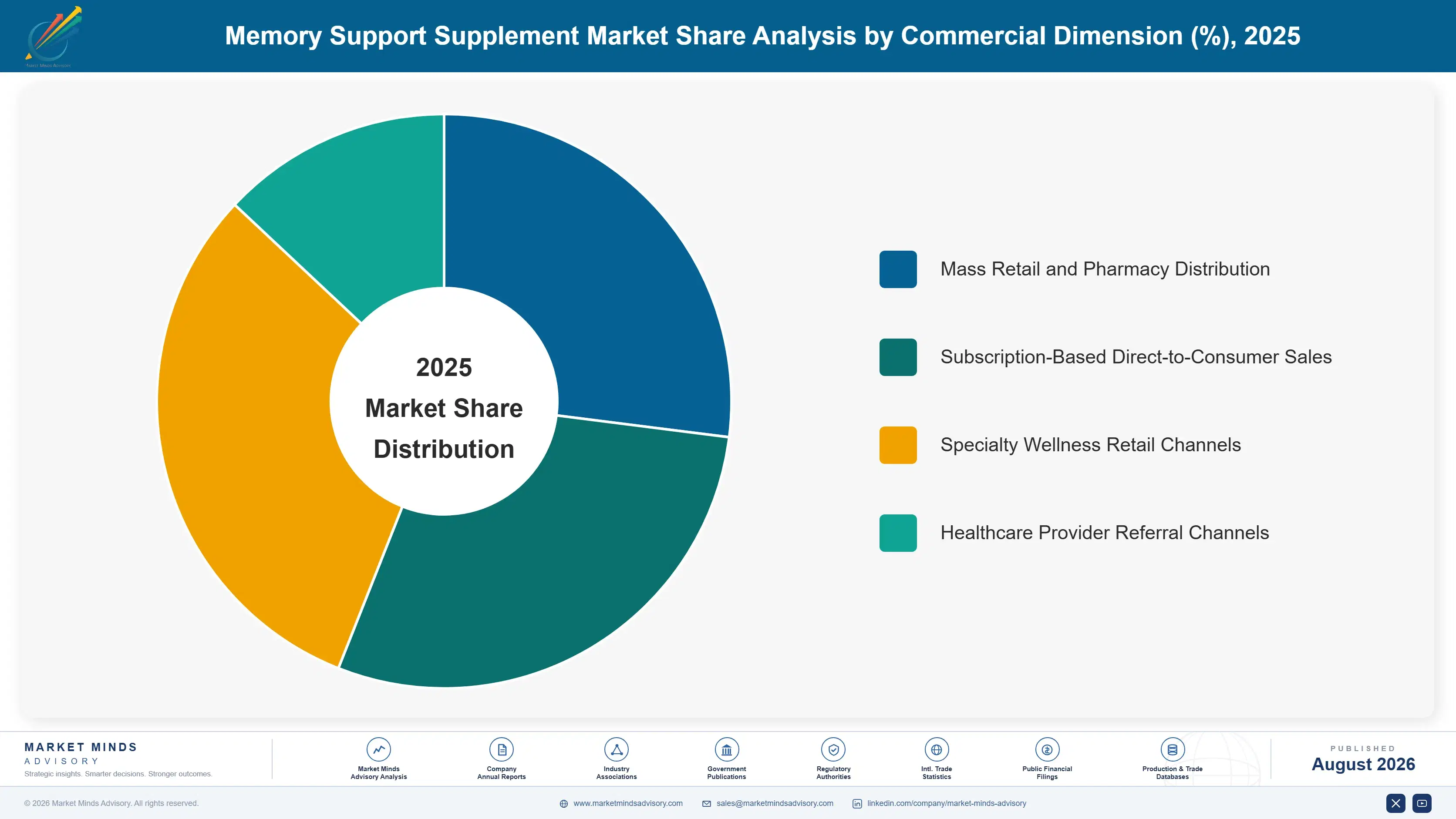
By Commercial Dimension

  • Mass Retail and Pharmacy Distribution
  • Subscription-Based Direct-to-Consumer Sales
  • Specialty Wellness Retail Channels
  • Healthcare Provider Referral Channels

By Region

  • North America
  • Western Europe
  • East Asia
  • South Asia and Pacific
  • Latin America
  • Middle East and Africa
  • Eastern Europe

Scope, Methodology, and Coverage

Every figure in this report is reproducible from documented input assumptions. The scope below maps the historical period, the forecast horizon, the segmentation dimensions, and the countries covered, alongside the underlying primary and qualitative methodology.
Historical Period
2020 to 2025
Forecast Period
2026 to 2036
Base Year
2025 (USD billions; MMA Primary Research Dataset, August 2026)
Market Definition
The memory support supplement market covers dietary supplements formulated with ginkgo biloba, phosphatidylserine, omega-3 DHA, bacopa monnieri, lion's mane mushroom extract, or multi-ingredient blends marketed specifically for cognitive and memory function support. It excludes prescription cognitive medications and general multivitamin products without a specific memory-support claim.
Quantitative Units
USD billions (current prices); metric tons of formulated supplement product where applicable
Segmentation Dimensions
By Active Ingredient; By End-Use Demographic; By Commercial Dimension; By Region
Regions Covered
North America, Western Europe, East Asia, South Asia and Pacific, Latin America, Middle East and Africa, Eastern Europe
Countries Covered
USA, China, Germany, France, UK, Japan, South Korea, India, Australia, Canada, Brazil, Mexico, Indonesia, Vietnam, Thailand, Malaysia, UAE, Saudi Arabia, South Africa, Nigeria, Turkey, Poland, Netherlands, Italy, Spain, Sweden, Switzerland, Argentina, Colombia, Singapore, and additional markets relevant to this sector
Key Companies Profiled
Quincy Bioscience, LLC, Reckitt Benckiser Group plc, Nestle Health Science S.A., Unilever plc, Thorne HealthTech, Inc., NOW Foods, Life Extension, Natural Factors Nutritional Products Ltd., Gaia Herbs, GNC Holdings, Inc., Herbalife Ltd., Nootropics Depot, HVMN Inc., Jarrow Formulas, Inc., Doctor's Best, Inc., Solgar Inc., Puritan's Pride, Inc., Bulletproof 360, Inc., Genius Brand Nootropics, LLC, MRM Nutrition
Quantitative Methodology
Primary survey, n=3,800 respondents, Q4 2025, six countries; demand-side model with trade association cross-validation
Qualitative Methodology
47 expert interviews, Q4 2025; applied to validate demand model assumptions, identify emerging dynamics, and assess competitive positioning
Report Format
PDF and XLSX data workbook (Word format preview document)
Publisher
Market Minds Advisory
Report Code
MMA-2026-AGR-119
Published
August 2026
Contact
sales@marketmindsadvisory.com | www.marketmindsadvisory.com

Purchase the full Memory Support Supplement Market Report (2026 to 2036).

The full MMA report on the memory support supplement market delivers a comprehensive assessment of demand drivers, segmentation, and competitive positioning across the cognitive wellness value chain. It includes detailed profiles of all twenty companies covered in this summary, along with regional forecasts spanning all seven MMA-tracked regions through 2036. The report also breaks down portfolio economics across three margin tiers, giving buyers a clear view of where premium pricing concentrates today. Buyers receive access to MMA's underlying primary survey and expert interview datasets, plus analyst support for custom data requests during the subscription period.
Twenty detailed company profiles and evidence assessments
Seven-region forecast data through 2036 by ingredient
Primary survey dataset access covering 3,800 respondents
Expert interview transcripts and detailed summaries included
Quarterly market update briefings for subscription holders
Custom analyst inquiry support during subscription period

Built For The People Who Decide

From boardroom strategy to bench-side execution, this report is read cover-to-cover by leaders shaping the next decade of their industry, turning demand scenarios, market dynamics and valuation benchmarks into decisions.
CXOs/ Presidents/ VPs/ Managers
M&A and Corporate Development
Strategy Teams and R&D Heads
Procurement and Product Directors
Regulatory and Compliance Leaders
Investor Relations and Equity Analysts