Market Minds Advisory
Memory Integrated Circuits (IC) Market

Memory Integrated Circuits (IC) Market: Memory Integrated Circuits Market. AI Accelerator Demand Reshapes Memory Chip Economics.

Explosive AI accelerator demand for high bandwidth memory is straining fabrication capacity, forcing memory chipmakers to reallocate wafer output away from conventional DRAM and NAND toward faster, higher-margin memory products.

Lead Analyst

Published

September 2026

Make Smarter Decisions with Customized Research Insights

Request a free sample report and evaluate market opportunities, growth trends, and competitive dynamics relevant to your business needs.

2025 MARKET VALUE$155.0BMarket Size 2025
2036 FORECAST VALUE$420.6BBase Case , 2026 to 2036
CAGR 2026 TO 20369.5 %Bull 10.8% / Bear 8.3%
INCREMENTAL OPPORTUNITY$250.9BNet 10- year value creation
EXPANSION MULTIPLE2.48x2036 value over 2026 base
Strategic Levers
M&A Pipeline
Regional Outlook
Country Rankings
Competitive Intelligence
Segmental Deep-dive
Call-Us : 91 93563 13602

Executive Snapshot and Market Trajectory.

AI accelerator demand is pulling memory chipmakers' capital spending toward high bandwidth memory at the expense of conventional DRAM output, tightening supply across data center and consumer electronics customers simultaneously this year, a rebalancing few forecasters modeled correctly even twelve months ago given how quickly the shift actually happened.
Hyperscale cloud operators building out AI training clusters are the dominant commercial force, competing directly with smartphone and PC makers for allocated wafer capacity as fabs prioritize the highest-margin memory products available today across every major foundry relationship they hold. High bandwidth memory is growing fastest by a wide margin, and East Asia retains overwhelming production concentration through Samsung, SK Hynix, and Kioxia manufacturing operations spread across South Korea, Japan, and Taiwan.
Competitive intensity centers on a small handful of players capable of the advanced packaging required for stacked memory dies, leaving conventional NAND and DRAM producers exposed to commoditized pricing cycles that persist for years at a stretch. Export control policy covering advanced semiconductor manufacturing equipment continues reshaping which fabs can access the newest lithography tools, forcing several producers to redesign multi-year roadmaps entirely around what remains available.
Market Definition
The memory integrated circuits market covers semiconductor devices designed for data storage and retrieval, including DRAM, NAND flash, NOR flash, SRAM, high bandwidth memory, and emerging non-volatile memory technologies sold as standalone components or packaged modules. It excludes memory controllers, storage system enclosures, and finished solid-state drives sold as complete consumer products.
Base Year Value
$155.0B in 2025 (MMA Primary Research Dataset, September 2026)
Forecast Period
2026 to 2036, eleven discrete annual values
CAGR
9.5% base case. Bull 10.8%. Bear 8.3%.
Fastest Growth Segment
High Bandwidth Memory (HBM): 24.0% CAGR
Fastest Growth Country
United States: 11.5% CAGR
Fastest Growth Region
South Asia and Pacific: 11.5% CAGR
Largest Region
East Asia: 34% of 2025 global value
Market Leaders
Samsung Electronics, SK Hynix, Micron Technology, Kioxia Holdings, SanDisk Corporation lead the field. Source: MMA Primary Research Dataset, July 2026.
Primary Survey
n=3,800 procurement and R&D decision-makers, Q4 2025, six countries
Methodology
Demand-side build-up, cross-validated against public data, 47 expert interviews

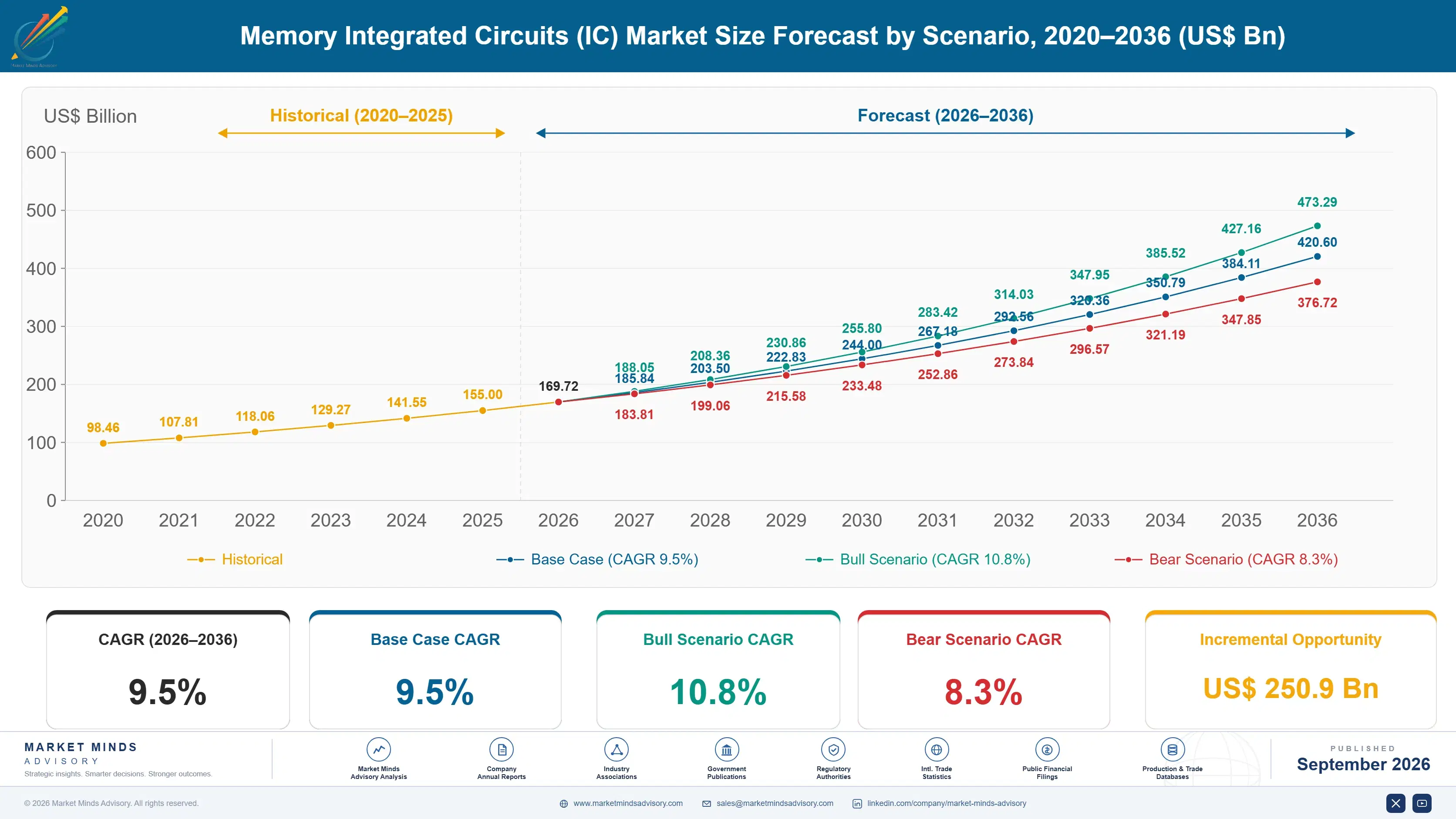
Memory Integrated Circuits (IC) Market Forecast Scenarios

memory-integrated-circuits-market-size-forecast-scenario-1788419209886
Between 2020 and 2025 the memory IC market moved through a pronounced boom-bust cycle, with pandemic-era demand spikes followed by a sharp 2023 inventory correction that cut prices meaningfully across DRAM and NAND alike. AI accelerator demand emerged late in the period as a stabilizing force, holding the historical annual growth rate near 8.2 percent despite the volatility.
The base case assumes hyperscale AI infrastructure spending keeps growing at a double-digit pace through the decade, fab capacity additions for high bandwidth memory lag demand by roughly eighteen to twenty-four months, and conventional DRAM and NAND pricing stabilizes as producers shift a growing share of wafer output toward higher-margin products. These three mechanisms together sustain a forecast compound annual growth rate near 9.5 percent through 2036, with advanced packaging capacity as the binding constraint.
The bull case assumes AI training cluster buildout accelerates faster than current capital expenditure plans anticipate, pushing growth toward 10.8 percent if packaging capacity expands ahead of schedule. The bear case assumes a renewed inventory correction similar to 2023 hits smartphone and PC demand simultaneously, capping growth near 8.3 percent as producers again face oversupply in conventional memory segments.

Cyclical Commodity Meets AI-Driven Scarcity Pricing

Memory pricing runs in multi-year cycles driven by the gap between fab capacity additions and end-demand swings, making producer profitability far more volatile than in most other semiconductor categories. Producers that can shift wafer allocation quickly between DRAM, NAND, and high bandwidth memory weather these cycles better than single-product specialists, since AI demand growth increasingly offsets weaker consumer electronics cycles across the calendar year.
MARKET CONCENTRATION78% CR5Top five producers dominate global revenue share tightly
AVERAGE SELLING PRICE VOLATILITY±35% per cycleTypical price swing across a full memory cycle
TOP PRODUCING COUNTRY SHARE44%South Korea accounts for largest single-country output share
FAB UTILIZATION RATE83%Share of installed wafer capacity running active production
WAFER COST SHARE61%Silicon wafer input costs as share of unit expense
PRODUCT CYCLE LENGTH4 yearsAverage years between major memory generation node transitions occurring
Market concentration remains high, with the top five producers controlling roughly 78 percent of revenue, reflecting the enormous capital intensity required to build and operate leading-edge fabrication facilities at meaningful scale. Advanced packaging capability for stacked memory dies has become the critical differentiator separating producers who can serve AI accelerator customers from those still competing purely on conventional commodity pricing terms.
Average selling prices swing considerably more than unit volumes across a typical cycle, since pricing carries most of the adjustment burden when supply and demand fall out of balance temporarily for extended stretches. Producers increasingly hedge this volatility through long-term supply agreements with major hyperscale customers, locking in committed volumes years in advance rather than relying entirely on spot market pricing dynamics.
"Everyone treats memory as a commodity until the cycle turns, and then suddenly it is the tightest bottleneck in the entire AI supply chain. The producers investing in packaging capability now will set pricing power for the rest of the decade."
Lead Analyst, Semiconductor Technology Practice · MMA Technology Practice · September 2026

Market Trends

AI Training Clusters Drive HBM Capacity Expansion

Hyperscale cloud operators expanded AI training cluster capital spending sharply through 2025, and high bandwidth memory demand tied to accelerator shipments grew even faster than the underlying compute hardware market itself. Producers announced a combined 40 billion dollars in new advanced packaging capacity investment across South Korea, Japan, and the United States to meet orders already booked years in advance. This capacity race is reshaping capital allocation priorities across the entire memory industry, pulling investment away from conventional DRAM lines that once absorbed the bulk of available capital expenditure budgets during a typical cycle.
Market Impact: AI infrastructure spend crossed 250 billion
Long-Term Supply Contracts Replace Spot Market Pricing

Major memory producers signed multi-year supply agreements covering roughly 60 percent of high bandwidth memory output for 2026 and 2027, locking in committed volumes with hyperscale customers well before production even begins at any meaningful commercial scale. This shift toward contracted revenue reduces the pricing volatility that historically made memory producer earnings difficult to forecast across a full multi-year industry cycle. Producers with the largest contracted order books are using this revenue visibility to justify accelerated capital spending on next-generation packaging production lines, an advantage smaller rivals cannot yet match today.
Market Impact: NAND content per device rose 25%

Market Opportunities and Growth Drivers

AI Training Infrastructure Spending Drives Memory Demand

Global AI infrastructure capital spending crossed 250 billion dollars in 2025, and memory represents an increasingly large share of the bill of materials for each AI accelerator shipped compared to prior generations of computing hardware. Cloud operators are now the largest single customer category for high bandwidth memory, surpassing traditional server and networking equipment makers combined for the first time in the industry's history. This demand pull is reshaping fab investment priorities across every major memory producer's roadmap, with capital increasingly directed toward advanced packaging rather than conventional planar memory cell shrinkage.
Market Impact: Delays access by roughly 3 years

Smartphone Camera and On-Device AI Features Boost NAND Demand

Flagship smartphones now ship with substantially larger NAND storage capacity to support on-device AI features and higher-resolution camera systems, lifting average NAND content per device by roughly 25 percent over the past two full product generations released to market. This steady content growth partially offsets slower smartphone unit shipment growth industry-wide, giving NAND producers a demand tailwind independent of the broader device replacement cycle entirely. Producers serving premium smartphone tiers are capturing disproportionate share of this incremental NAND revenue as flagship devices increasingly differentiate on storage tier options available to consumers.
Market Impact: Fab construction now exceeds 20 billion

Market Restraints and Challenges

Export Controls Restrict Advanced Equipment Access

US export control rules covering advanced lithography and deposition equipment continue restricting which fabs in China can access the newest manufacturing tools, limiting how quickly domestic Chinese producers can close the technology gap with established leaders. The root cause is a deliberate policy choice tying equipment sales to national security review, not a natural technology constraint that market forces alone could resolve. This has pushed affected producers toward domestic equipment development programs and legacy node optimization strategies, a mitigation path that yields real but considerably slower progress than direct equipment access would allow.
Market Impact: Adds 40 billion dollars packaging capex

Capital Intensity Limits New Entrant Participation

Building a leading-edge memory fab now costs upward of 20 billion dollars, a capital requirement that has effectively closed the industry to new entrants for over a decade and concentrated production among a handful of established producers. The root cause is the physics of shrinking memory cells combined with the enormous fixed cost of extreme ultraviolet lithography tools required at advanced nodes. Producers are mitigating this through joint venture fab arrangements and government subsidy programs, particularly in the United States and Japan, that spread the capital burden across multiple stakeholders rather than one balance sheet alone.
Market Impact: 60 percent of HBM output contracted
3 additional market trends, 2 additional growth drivers, and 4 additional restraints and challenges are covered in the full report. Contact sales@marketmindsadvisory.com to access the complete intelligence.

Segment CAGR and Growth Architecture

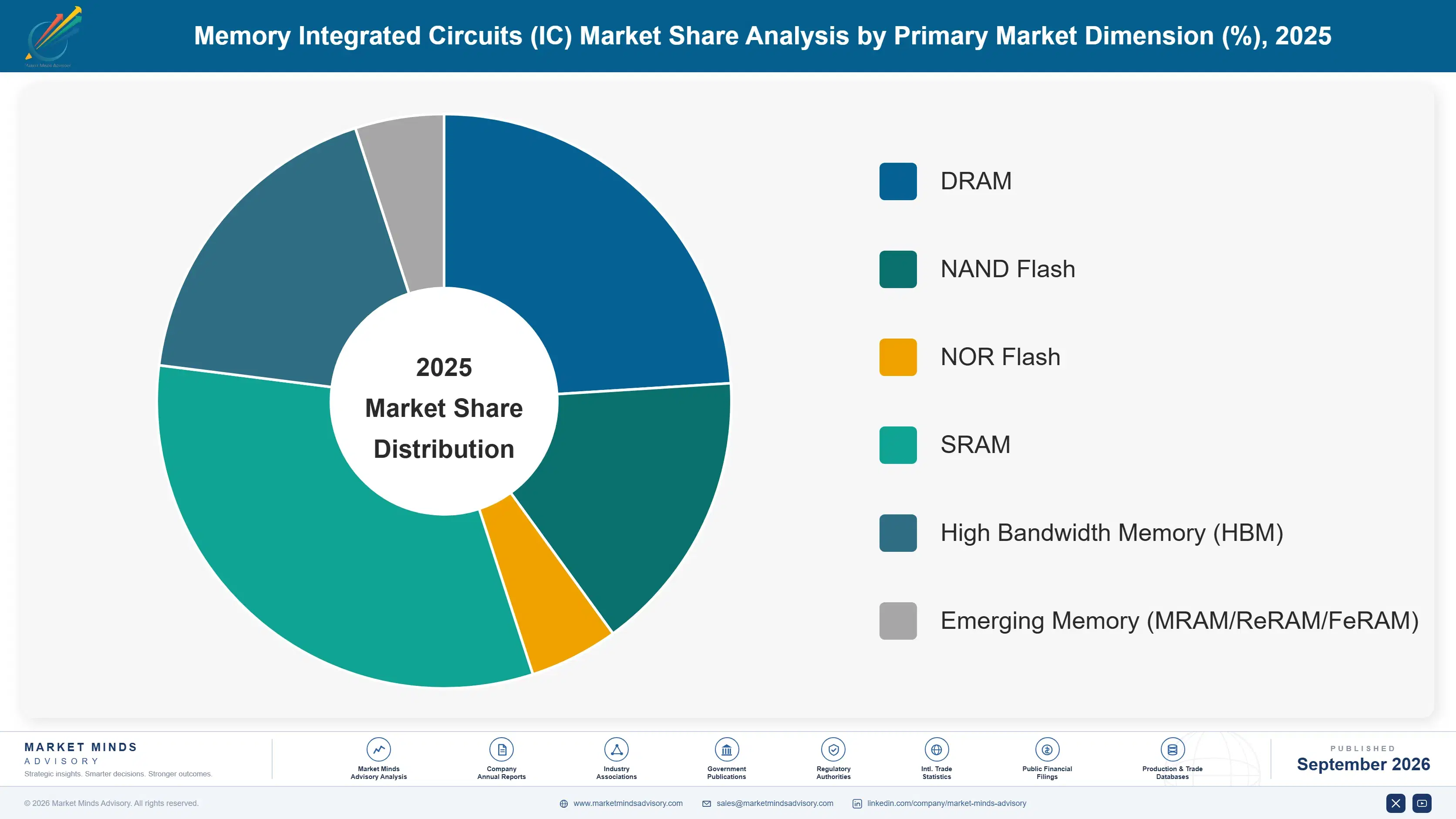
The memory IC market segments by underlying storage technology and architecture, spanning DRAM, NAND flash, NOR flash, SRAM, high bandwidth memory, and emerging non-volatile memory types, each serving distinct performance, density, and cost requirements across computing, storage, and embedded applications, evaluated on a single consistent revenue basis. Product life cycles vary widely across these six categories.
memory-integrated-circuits-market-market-share-analysis-1788419210423

High Bandwidth Memory (HBM)

High bandwidth memory stacks multiple DRAM dies vertically using through-silicon via interconnects, delivering far higher bandwidth per package than conventional DRAM at a substantial cost and power premium justified only by AI accelerator workloads. This segment is growing fastest because AI training and inference hardware simply cannot function without it, unlike general-purpose computing where conventional DRAM remains perfectly adequate for most workloads today. Producers have struggled to keep pace with demand, and advanced packaging capacity, not silicon wafer supply itself, is now the binding constraint limiting how much volume producers can actually ship to customers each quarter of the year. Pricing for this segment carries a substantial premium over conventional DRAM given the added packaging complexity involved.
CAGR 24.0%

Emerging Memory (MRAM/ReRAM/FeRAM)

Emerging non-volatile memory technologies, including MRAM, ReRAM, and FeRAM, store data without power using physical mechanisms distinct from conventional charge-trap flash memory cells, offering faster write speeds and better endurance for specific embedded and automotive applications across the industry. Growth is fast relative to a small current base as automotive and industrial customers adopt these technologies for applications requiring both non-volatility and near-DRAM write speed simultaneously in a single component. Volume remains modest compared to DRAM and NAND, but design wins in next-generation vehicle electronics and industrial control systems are expanding the addressable market meaningfully each year that passes. Several major automakers have already committed to multi-year sourcing agreements covering next-generation vehicle platforms.
CAGR 16.0%
Full segment breakdown across 7 segments available in the complete report.

Regional Architecture and Country Demand Map

East Asia dominates memory IC production and revenue through Samsung, SK Hynix, and Kioxia manufacturing concentration across South Korea, Japan, and Taiwan, well beyond typical regional bands given fab investment scale, while North America leads high bandwidth memory demand through aggressive hyperscale AI infrastructure buildout nationwide.

East Asia

South Korea's Samsung Electronics and SK Hynix, alongside Japan's Kioxia and Taiwan's advanced packaging foundries, together give this region an unusually dominant 34 percent share, exceeding the standard regional band because global memory fabrication capital investment is so heavily concentrated in these three countries rather than distributed globally. This share genuinely reflects where leading-edge wafer fabrication and advanced packaging physically occur, not merely where end demand originates, a distinction that matters more for memory than most other technology categories. China's domestic producers, led by Yangtze Memory Technologies and ChangXin Memory Technologies, are expanding output quickly but remain years behind the region's established leaders on advanced node capability. Japan's ongoing government-backed semiconductor revitalization program adds further capacity investment across the region.
Share: 34% | CAGR: 10.8% (2026 to 2036)

North America

Hyperscale cloud operators headquartered in the United States, including the major AI infrastructure builders, drive the region's outsized demand for high bandwidth memory even though almost none of the physical fabrication happens domestically. Micron Technology remains the only major memory producer with substantial US-based fabrication capacity, benefiting from federal semiconductor incentive programs passed in recent years. Canada contributes a small design and testing presence but negligible fabrication volume of its own. The region's growth rate outpaces the global average because AI infrastructure capital spending here continues expanding faster than in any other single market tracked. Data center construction across several southern and midwestern states is adding meaningful new memory demand tied to power availability.
Share: 24% | CAGR: 10.2% (2026 to 2036)
Regional intelligence for 5 additional markets available in the complete report: Western Europe, South Asia and Pacific, Latin America, Middle East and Africa, Eastern Europe. Contact sales@marketmindsadvisory.com.
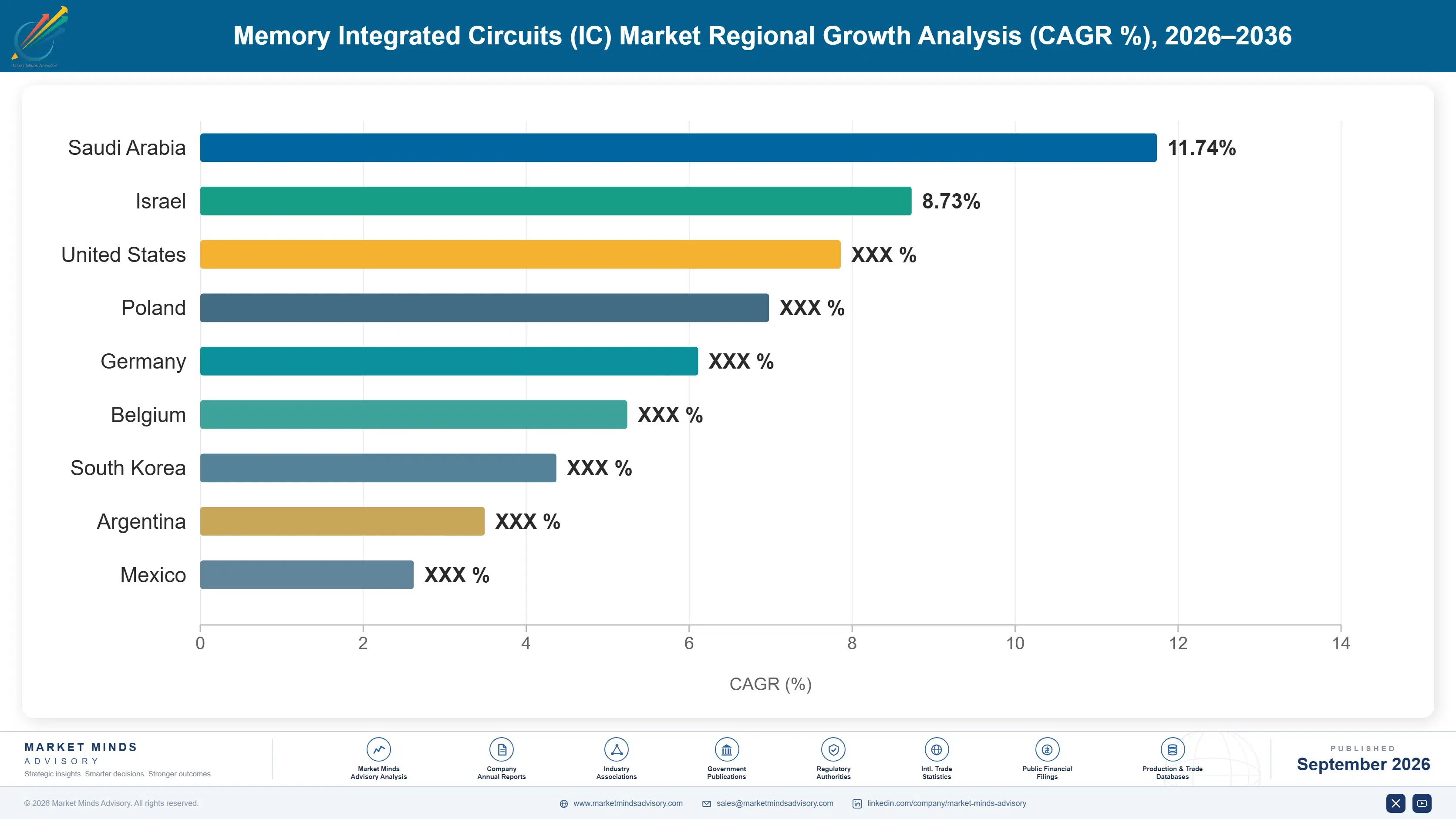
memory-integrated-circuits-market-country-cagr-analysis-1788419210940

Where Memory Producer Margins Concentrate Fastest

Producer profitability increasingly concentrates in advanced packaging and long-term contracted capacity rather than conventional commodity wafer output, as leading players redirect capital toward high bandwidth memory and lock in multi-year customer agreements that reduce cyclical earnings volatility considerably over time. Government incentive programs are reshaping where new capacity gets built. Fabrication location decisions now hinge partly on where subsidies exist.

Prioritizing Advanced Packaging Capacity Over Conventional Lines

Producers that redirect capital expenditure toward advanced packaging capability for stacked high bandwidth memory dies capture a materially higher margin than those still investing primarily in conventional planar DRAM production lines. This packaging capability requires specialized through-silicon via equipment that only a handful of producers currently operate at commercial scale, creating a genuine capacity bottleneck. Producers with early packaging investment are capturing gross margins averaging 15 percentage points above conventional memory lines, a gap that has widened further as AI accelerator demand keeps outpacing available packaging capacity across the industry.
Market Impact: Adds 15 points gross margin versus conventional lines

Locking In Multi-Year Hyperscale Supply Agreements

Securing multi-year supply contracts with hyperscale cloud customers converts volatile spot market revenue into predictable committed volume, letting producers justify capital spending decisions years ahead of when conventional spot pricing visibility would normally allow such commitments. These agreements now cover roughly 60 percent of high bandwidth memory output, giving contracted producers meaningfully lower cost of capital than rivals still selling primarily into spot markets. Producers without comparable contracted revenue face a persistent valuation discount from investors wary of unhedged exposure to the industry's traditional multi-year boom-bust pricing cycle dynamics play out.
Market Impact: Covers 60 percent of HBM output under contract

Expanding Specialty Automotive Memory Product Lines

Automotive-grade memory products, qualified to stricter temperature and reliability standards than consumer electronics parts, command a meaningful price premium over standard commercial memory while facing far less direct competition from commodity Asian producers focused on high-volume consumer segments. Producers investing in automotive qualification programs are capturing design wins on next-generation vehicle electronics platforms years before volume production even begins, locking in durable revenue visibility. This premium averages roughly 30 percent above equivalent commercial-grade memory pricing, rewarding producers willing to absorb the multi-year qualification cost and testing burden upfront entirely each time.
Market Impact: Automotive memory commands roughly a 30 percent price premium

Building Domestic Fabrication Capacity Under Government Incentive Programs

Producers expanding fabrication capacity in the United States and Japan under government semiconductor incentive programs are capturing subsidized capital costs unavailable to competitors building capacity purely on commercial financing terms alone. These programs have collectively committed over 30 billion dollars in incentive funding across both countries, materially lowering the effective cost of new fab construction for qualifying producers. Producers securing this funding gain a durable cost advantage on new capacity relative to rivals financing expansion entirely through commercial capital markets, an advantage that compounds across successive multi-year investment cycles ahead.
Market Impact: Government programs offer over 30 billion in incentives

Who Controls the Margin Pool

Competitive concentration sits at a high 78 percent CR5, reflecting the enormous capital intensity that has kept new entrants out of leading-edge fabrication for over a decade. Participants are evaluated here on revenue, the most commercially consistent basis across producers with very different product mixes. The gap between Samsung, the clear leader, and the fifth-ranked producer remains wide, unlike segments where challengers compete on closer footing.
Current activity centers on advanced packaging capacity expansion, as producers race to qualify through-silicon via manufacturing lines fast enough to meet AI accelerator customer commitments already signed. Several producers have also announced joint venture fab arrangements with government backing to share the capital burden of new leading-edge capacity. Long-term supply agreement negotiations with hyperscale customers have intensified as producers seek revenue visibility.

Emerging pressure is coming from Chinese domestic producers like Yangtze Memory Technologies and ChangXin Memory Technologies, which are closing the technology gap faster than export controls were designed to allow. This threatens established leaders' pricing power in conventional NAND and DRAM segments over time. Rankings are most likely to shift as advanced packaging capability, not raw wafer capacity, increasingly determines which producers can serve the highest-margin AI accelerator customer segment.
memory-integrated-circuits-market-company-positioning-matrix-1788419211468

Competitive Moat and Risk Dimensions

SAMSUNG ELECTRONICS

Moat: Leading Advanced Packaging Technology

Samsung's scale in advanced packaging for high bandwidth memory gives it a manufacturing lead that smaller competitors cannot easily replicate, since the through-silicon via equipment and process expertise required take years to develop internally. This lead lets Samsung command premium pricing on the highest-margin memory products while competitors still ramp comparable capability. This depth continues expanding.
SAMSUNG ELECTRONICS

Risk: Exposed To Chinese Competition Rising

Samsung faces intensifying competition from heavily subsidized Chinese domestic producers in conventional DRAM and NAND segments, where price competition is fiercest and margins are already thinnest. As Chinese producers close the technology gap in commodity segments, Samsung's conventional memory business faces sustained pricing pressure that its advanced packaging business does not yet face.
SK HYNIX

Moat: Vertical Integration Across Memory Types

SK Hynix maintains strong positions across both conventional DRAM and high bandwidth memory, giving it a broader product portfolio than competitors focused narrowly on a single memory type or application segment. This breadth lets SK Hynix serve customers seeking a single supplier relationship across multiple memory categories, simplifying procurement for large hyperscale accounts.
SK HYNIX

Risk: Heavy Reliance On Few Customers

SK Hynix derives an outsized share of its highest-margin high bandwidth memory revenue from a small number of major hyperscale customers, creating concentration risk if any single customer shifts its accelerator architecture or supplier strategy. This customer concentration is considerably higher than in the company's conventional memory business lines.

Players Tracked

Prominent Players

Samsung Electronics
SK Hynix
Micron Technology
Kioxia Holdings
SanDisk Corporation

Other Key Players

Yangtze Memory Technologies
Nanya Technology
Winbond Electronics
Powerchip Semiconductor Manufacturing
GigaDevice Semiconductor
Everspin Technologies
Renesas Electronics
Infineon Technologies
STMicroelectronics
ChangXin Memory Technologies
Macronix International
Integrated Silicon Solution Inc
ADATA Technology
Kingston Technology
Longsys Electronics

Recent Developments

FEBRUARY 2026

Samsung Expands HBM Packaging Capacity In South Korea

Samsung Electronics announced a new capital expenditure commitment to expand advanced packaging capacity for high bandwidth memory at its South Korean fabrication facilities, targeting a substantial increase in output by 2027. The investment responds directly to accelerator customer demand already booked well beyond current capacity.
Signal: Signals leading producers are racing to add advanced packaging capacity ahead of AI accelerator customer demand.
OCTOBER 2025

SK Hynix Signs Multi-Year HBM Supply Agreement

SK Hynix signed a multi-year supply agreement with a major AI accelerator customer covering a substantial share of its high bandwidth memory output through 2028, providing committed revenue visibility for planning. The agreement includes pricing formulas tied to production cost rather than pure spot market rates.
Signal: Signals hyperscale customers are now locking in committed memory supply years ahead of accelerator production needs.
MAY 2026

Kioxia Forms Joint Venture For New Fab Capacity

Kioxia Holdings formed a joint venture with a Japanese banking consortium to fund construction of a new NAND fabrication facility, sharing capital costs across multiple stakeholders rather than financing the project entirely on its own balance sheet alone. Construction is expected to complete in 2028.
Signal: Signals producers are increasingly sharing the capital burden of new fabs through joint venture financing structures.

Lithography Equipment Concentration Risk

Extreme ultraviolet lithography equipment accounts for roughly 40 percent of leading-edge fab construction cost, with the entire global supply concentrated in a single Dutch equipment manufacturer that no producer can easily substitute. Silicon wafers and specialty gases make up most of the remainder of variable production cost, sourced primarily from Japanese and South Korean chemical suppliers with decades-long customer relationships.
The 2021 to 2022 global semiconductor shortage, documented in the US Department of Commerce's semiconductor supply chain report and referenced across producer annual reports, delayed several fab expansion projects by twelve to eighteen months and forced customers to accept allocation-based rationing of memory products during the worst shortage months. Lead times for advanced packaging equipment remain considerably longer than pre-shortage baseline levels even today. today

Producers without direct relationships with the sole extreme ultraviolet equipment supplier face a meaningful competitive disadvantage in accessing next-generation manufacturing nodes, since order backlogs now extend years into the future for new tool deliveries. This exposure varies significantly by geography: producers operating in countries covered by export restrictions face additional licensing hurdles that producers in unrestricted countries simply do not encounter.
memory-integrated-circuits-market-cost-volatility-analysis-1788419211664

Securing Multi-Year Equipment Delivery Slots Early

Leading producers now place equipment orders three to four years ahead of planned fab construction, effectively pre-booking scarce lithography tool delivery slots before smaller competitors can compete for the same allocation. This locks in future capacity but requires committing capital years before revenue materializes, a trade-off only well-capitalized producers can consistently afford to make.

Diversifying Wafer And Chemical Supplier Relationships

Producers are qualifying additional wafer and specialty gas suppliers beyond their traditional Japanese and Korean partners, reducing dependence on any single chemical supply relationship during a future disruption. This diversification adds qualification testing cost but meaningfully reduces the risk that a single regional disruption event could halt production across a producer's entire global fabrication network simultaneously.

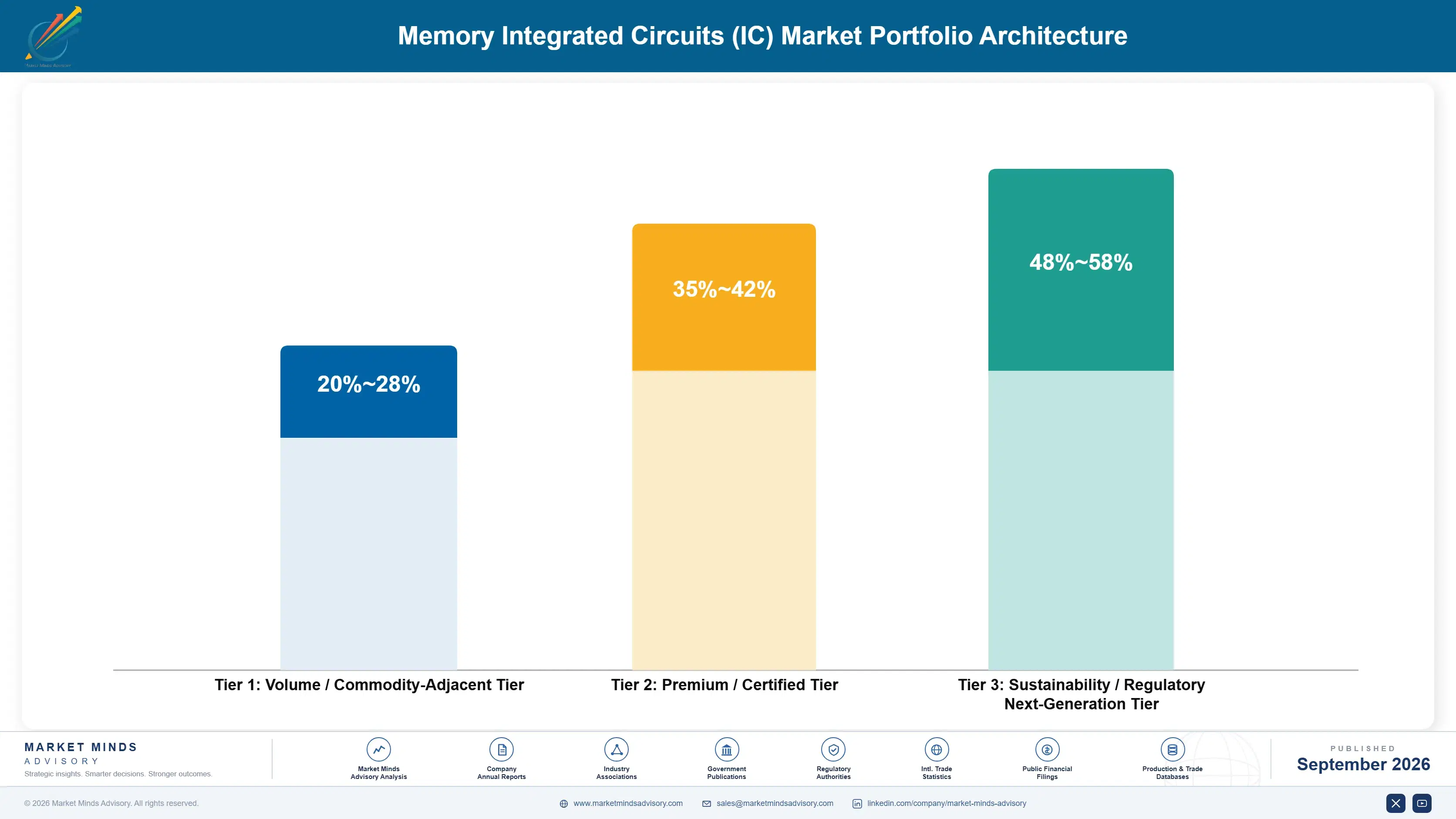
Portfolio Architecture for Margin Defence

Portfolio economics split across three tiers running from commodity conventional DRAM and NAND sold near marginal production cost up through certified specialty automotive memory and next-generation high bandwidth memory bundled with advanced packaging services. Gross margin widens dramatically moving up this ladder, since packaging complexity and qualification barriers create defensibility that pure wafer output alone cannot provide, and investors increasingly value producers by their revenue mix.
Volume tier memory competes almost entirely on cost per bit, leaving producers with thin and cyclical margins that depend heavily on scale and capacity utilization to remain profitable across a full multi-year cycle. Premium tier memory instead competes on qualification and reliability standards, letting producers charge meaningfully more per unit while facing far less commodity price pressure during downturns. This tension shapes capital allocation decisions across every producer's roadmap.

High-value margin pools concentrate almost entirely in the next-generation tier, where high bandwidth memory and advanced packaging generate premium pricing unavailable to producers still selling standalone conventional memory. Producers positioned only in the volume tier face real profitability ceilings that next-generation-tier competitors do not share, regardless of unit volume shipped across any fiscal year.

Volume / Commodity-Adjacent Tier

Commodity conventional DRAM and NAND flash sold mainly into consumer electronics and general computing applications, competing almost entirely on cost per bit against several large-scale global producers operating at full capacity.
Gross Margin: 20-28%

Premium / Certified Tier

Certified automotive-grade and industrial memory products qualified to stricter temperature and reliability standards than commercial parts, commanding premium pricing from customers requiring long product lifecycles and rigorous multi-year testing cycles.
Gross Margin: 35-42%

Sustainability / Regulatory / Next-Generation Tier

Next-generation high bandwidth memory bundled with advanced packaging services, positioned for AI accelerator and hyperscale data center customers prioritizing bandwidth and power efficiency well above pure unit cost considerations entirely.
Gross Margin: 48-58%
memory-integrated-circuits-market-portfolio-architecture-1788419212159

High-value Sub-segments and Strategic Watch-out

High Bandwidth Memory (HBM)

High bandwidth memory sits in the high-value high-growth quadrant, combining the fastest unit growth rate tracked with the widest gross margin band once advanced packaging premiums layer on top of conventional wafer pricing, making it the clearest priority for producer capital allocation across this entire decade.
Gross Margin: 48-58%

Automotive and Industrial Specialty Memory

Automotive-grade specialty memory occupies the high-value moderate-growth quadrant, generating strong per-unit margin from vehicle electronics qualification even though growth trails high bandwidth memory, because automotive design cycles and rigorous testing requirements take considerably longer to complete than typical consumer electronics product development cycles ever require.
Gross Margin: 35-42%

Conventional DRAM and NAND Flash

Conventional DRAM and NAND remain the volume core segment, generating the bulk of current unit shipments at thinner and more cyclical margins, still essential for producer scale economics even as growth slows relative to high bandwidth memory entering the category more aggressively each budget cycle.
Gross Margin: 20-28%

NOR Flash and Legacy Embedded Memory

NOR flash and legacy embedded memory form the strategic watch-out segment, facing real commoditization risk as newer emerging memory technologies increasingly absorb applications natively at comparable cost, threatening producers that never diversified beyond simple embedded memory product lines into richer, higher-margin categories over the years.
Gross Margin: 18-24%

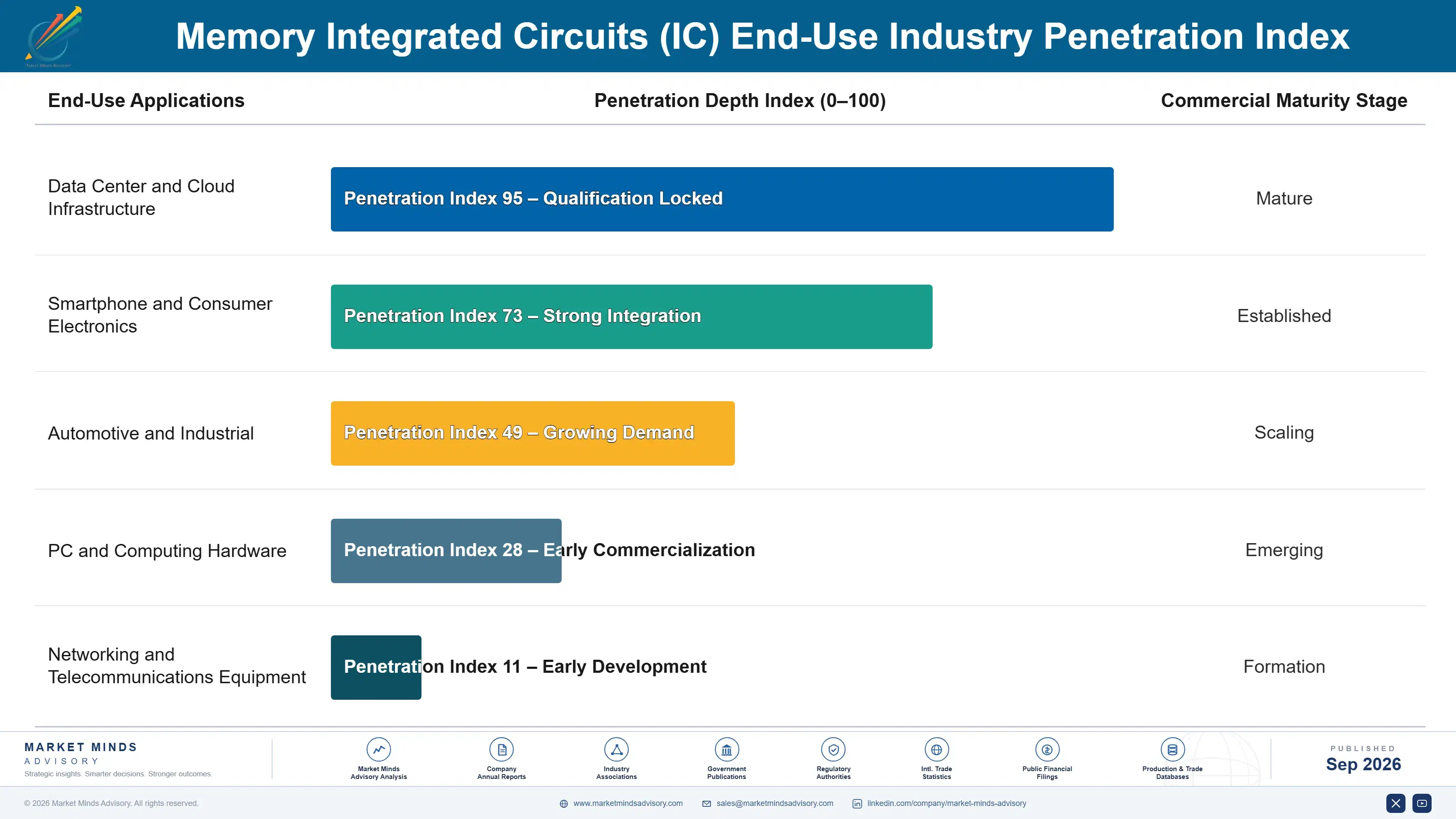
Long-Term Contracts Stabilize Memory Producer Revenue

Long-term supply agreements with hyperscale cloud operators are converting what was once purely spot-market memory revenue into multi-year committed volume contracts, giving leading producers unusually stable revenue visibility for a historically cyclical industry. These agreements typically lock in pricing formulas tied to production cost rather than pure spot market rates, smoothing revenue across the industry's traditional boom-bust cycle. Investors increasingly reward producers for this contracted revenue mix over pure spot exposure.
Adoption depth varies sharply by end-use vertical: data center customers building AI training infrastructure commit to multi-year capacity reservations well ahead of production, while smartphone and PC makers still largely purchase through shorter-term spot and quarterly contracts. This gives data center demand far more forecasting stability than consumer electronics demand, which remains tied closely to broader device replacement cycles and discretionary spending patterns.

Buyer profiles are shifting generationally as hyperscale cloud infrastructure teams, rather than traditional device original equipment manufacturers, increasingly drive product roadmap conversations directly with memory producers years before volume production begins. This generational shift toward infrastructure-first customers is reshaping which memory specifications producers prioritize, favoring bandwidth and power efficiency over the pure cost-per-bit metrics that dominated prior decades of product development entirely.
memory-integrated-circuits-market-end-use-penetration-index-1788419212661

Where Memory Producers Should Focus Capital

These are among the four positions where our research anticipates prominent divergence between winners and laggards over the coming forecast period. Each is grounded in the demand model, the regulatory perimeter, and the announced capacity pipeline.
01 / ADVANCED PACKAGING INVESTMENT

Prioritize Packaging Capacity Before Conventional Wafer Expansion

Producers still allocating the bulk of new capital toward conventional planar memory expansion are missing the highest-margin opportunity available in this cycle, since advanced packaging capacity for high bandwidth memory remains the industry's binding constraint. Producers with early packaging investment are capturing gross margins averaging 15 percentage points above conventional lines, a gap that keeps widening as AI accelerator demand keeps outpacing available capacity. Producers slow to redirect capital risk ceding the highest-margin customer relationships to faster-moving competitors within the next two capacity cycles.
02 / LONG-TERM CONTRACT STRUCTURING

Convert Spot Market Exposure Into Committed Multi-Year Volume

Producers still selling primarily into spot markets face persistent valuation discounts from investors wary of unhedged exposure to the industry's traditional boom-bust pricing cycle, a discount that contracted competitors increasingly avoid. Roughly 60 percent of high bandwidth memory output is now covered by multi-year agreements, and producers without comparable contracted revenue are losing negotiating position with hyperscale customers already committed elsewhere. Building contracted revenue now, even at a modest initial scale, secures customer relationships before rivals consolidate remaining committed demand.
03 / GOVERNMENT INCENTIVE POSITIONING

Pursue Subsidized Capacity Under National Semiconductor Programs

Producers expanding fabrication capacity under United States and Japanese government incentive programs are capturing subsidized capital costs unavailable to competitors financing expansion purely through commercial markets and traditional bank lending channels. These programs have collectively committed over 30 billion dollars in incentive funding, materially lowering effective construction costs for qualifying producers positioned to take advantage of the opportunity now. Producers that secure this funding early gain a durable cost advantage on new capacity that compounds across successive investment cycles for years to come.
04 / CHINESE COMPETITION RESPONSE

Prepare Conventional Segments For Chinese Producer Cost Pressure

Chinese domestic producers like Yangtze Memory Technologies and ChangXin Memory Technologies are closing the technology gap in conventional DRAM and NAND faster than export controls were originally designed to allow. Established leaders' pricing power in commodity memory segments faces mounting pressure as these producers scale output with heavy state subsidy support behind them, undercutting price assumptions built into prior planning cycles. Producers should decide now whether to defend conventional segment share directly or accelerate the shift toward advanced packaging where competition remains considerably thinner.

Engagement Snapshot From the Field

A live engagement with an industry participant carrying material or product regulatory and market exposure ahead of a defining policy shift, showing how our research translates into a defensible multi-year portfolio strategy.
MARKET MINDS ADVISORY · CLIENT ENGAGEMENT SUMMARY
Memory Integrated Circuits (IC) Producer Strategic Portfolio Review and Transition Roadmap 2026·Investment Scenario on Memory Integrated Circuits (IC) Exposure Evaluation 2025-26
CLIENT PROFILE
The client operates a growing colocation and cloud infrastructure business across the United States, serving enterprise customers building AI training and inference workloads. Facing rapidly rising high bandwidth memory costs and allocation constraints from major producers, leadership needed a clearer framework for structuring long-term supply commitments. Annual revenue was reported at approximately 1.8 billion dollars (client-reported, unverified by MMA).
STRATEGIC CHALLENGE
Leadership faced a choice between locking in multi-year supply agreements at current pricing or waiting for anticipated capacity expansion that might ease allocation constraints and lower prices. Internal teams lacked the market intelligence to judge whether current scarcity pricing reflected a temporary spike or a durable multi-year shift in memory economics tied to AI demand.
MMA APPROACH
MMA built a supply and demand model spanning announced producer capacity expansion plans through 2028, cross-referenced against primary survey data on hyperscale customer commitment patterns from comparable operators. The analysis quantified the likely duration of current allocation constraints under multiple capacity ramp scenarios. Findings were presented to the client's procurement committee alongside a recommended contracting strategy rather than a single buy or wait verdict.
KEY FINDINGS
  1. Advanced packaging capacity, not raw wafer supply, was identified as the binding constraint likely to persist through at least 2027 based on announced expansion timelines.
  2. Producers offering multi-year contracts at fixed pricing formulas tied to production cost offered meaningfully better long-term value than accepting ongoing spot market exposure.
  3. Waiting more than twelve months for anticipated capacity relief risked losing negotiating position as competing hyperscale customers locked in available supply first, the analysis found.
  4. Diversifying supply commitments across three producers rather than concentrating with just one meaningfully reduced allocation risk without materially increasing blended per-unit procurement cost.
CLIENT PROFILE
The client operates a growing colocation and cloud infrastructure business across the United States, serving enterprise customers building AI training and inference workloads. Facing rapidly rising high bandwidth memory costs and allocation constraints from major producers, leadership needed a clearer framework for structuring long-term supply commitments. Annual revenue was reported at approximately 1.8 billion dollars (client-reported, unverified by MMA).
STRATEGIC CHALLENGE
Leadership faced a choice between locking in multi-year supply agreements at current pricing or waiting for anticipated capacity expansion that might ease allocation constraints and lower prices. Internal teams lacked the market intelligence to judge whether current scarcity pricing reflected a temporary spike or a durable multi-year shift in memory economics tied to AI demand.
MMA APPROACH
MMA built a supply and demand model spanning announced producer capacity expansion plans through 2028, cross-referenced against primary survey data on hyperscale customer commitment patterns from comparable operators. The analysis quantified the likely duration of current allocation constraints under multiple capacity ramp scenarios. Findings were presented to the client's procurement committee alongside a recommended contracting strategy rather than a single buy or wait verdict.
KEY FINDINGS
  1. Advanced packaging capacity, not raw wafer supply, was identified as the binding constraint likely to persist through at least 2027 based on announced expansion timelines.
  2. Producers offering multi-year contracts at fixed pricing formulas tied to production cost offered meaningfully better long-term value than accepting ongoing spot market exposure.
  3. Waiting more than twelve months for anticipated capacity relief risked losing negotiating position as competing hyperscale customers locked in available supply first, the analysis found.
  4. Diversifying supply commitments across three producers rather than concentrating with just one meaningfully reduced allocation risk without materially increasing blended per-unit procurement cost.
RECOMMENDED STRATEGY
Phase 1: Phase 1 (Months 1 to 2): Negotiate initial multi-year supply agreements with two producers to secure baseline committed volume immediately. Phase 2: Phase 2 (Months 3 to 6): Add a third producer relationship to diversify allocation risk across geographically separate fabrication capacity. Phase 3: Phase 3 (Months 7 to 12): Renegotiate pricing formulas as new capacity comes online, capturing improved terms where leverage allows.
OUTCOME
The client secured committed high bandwidth memory supply covering the next three years across two producers, avoiding an estimated 40 million dollars (client-reported, unverified by MMA) in incremental spot market premium costs. The diversified supplier strategy proceeded on the recommended timeline, and procurement leadership reported meaningfully improved planning confidence heading into subsequent budget cycles.

Frequently Asked Questions

Foundational context covering the market sizes, CAGR, scope, country, region and competition that inform every finding below. This section is provided to cover basics and most often pre-purchase conversations, answered from the MMA Primary Research Dataset.

What is the current size of the Memory Integrated Circuits (IC) Market?

The memory IC market reached approximately 169.72 billion dollars in 2026, according to MMA Primary Research Dataset, July 2026. This figure covers DRAM, NAND, NOR, SRAM, and high bandwidth memory revenue combined globally.

How large will the Memory Integrated Circuits (IC) Market be by 2036?

MMA projects the market will reach approximately 420.6 billion dollars by 2036 under the base case scenario. That represents roughly a 2.48 times expansion over the ten-year forecast period from 2026 through 2036.

What is the CAGR for the Memory Integrated Circuits (IC) Market 2026 to 2036?

The base case compound annual growth rate is 9.5 percent through 2036. Bull and bear scenarios range from 10.8 percent to 8.3 percent depending on AI infrastructure and cycle conditions.

Which segment is growing fastest?

High bandwidth memory is growing fastest at 24.0 percent CAGR, roughly 2.53 times the overall market rate. AI accelerator demand and advanced packaging investment are driving this segment's outsized expansion versus conventional memory.

Who are the major companies in the Memory Integrated Circuits (IC) Market?

Leading companies include Samsung Electronics, SK Hynix, Micron Technology, Kioxia Holdings, and SanDisk Corporation. These five players hold a combined 78 percent share on a revenue basis.

Which country is growing fastest?

The United States is growing fastest at approximately 11.5 percent CAGR, driven by hyperscale AI infrastructure buildout despite holding minimal domestic fabrication capacity. This outpaces East Asia and other established production centers considerably.

Report Segmentation Architecture

The full report scope spans multiple orthogonal segmentation dimensions, with cross-tabulated demand data provided for each dimension pair. Coverage extends further to regional breakdowns, trend trajectories, and the competitive detail needed to support segment-level decision-making.

By Primary Market Dimension

  • DRAM
  • NAND Flash
  • NOR Flash
  • SRAM
  • High Bandwidth Memory (HBM)
  • Emerging Memory (MRAM/ReRAM/FeRAM)

By End-Use Industry

  • Data Center and Cloud Infrastructure
  • Smartphone and Consumer Electronics
  • Automotive and Industrial
  • PC and Computing Hardware
  • Networking and Telecommunications Equipment

By Commercial Dimension

  • Direct OEM Sales
  • Long-Term Supply Agreement
  • Distributor and Broker Channel
  • Spot Market Sales

By Region

  • North America
  • Western Europe
  • East Asia
  • South Asia and Pacific
  • Latin America
  • Middle East and Africa
  • Eastern Europe

Scope, Methodology, and Coverage

Every figure in this report is reproducible from documented input assumptions. The scope below maps the historical period, the forecast horizon, the segmentation dimensions, and the countries covered, alongside the underlying primary and qualitative methodology.
Historical Period
2020 to 2025
Forecast Period
2026 to 2036
Base Year
2025 (USD billions; MMA Primary Research Dataset, September 2026)
Market Definition
The memory integrated circuits market covers semiconductor devices designed for data storage and retrieval, including DRAM, NAND flash, NOR flash, SRAM, high bandwidth memory, and emerging non-volatile memory technologies sold as standalone components or packaged modules. It excludes memory controllers, storage system enclosures, and finished solid-state drives sold as complete consumer products.
Quantitative Units
USD billions (current prices); wafer and unit shipments where applicable
Segmentation Dimensions
By Memory Technology Type; By End-Use Industry; By Commercial Dimension; By Region
Regions Covered
North America, Western Europe, East Asia, South Asia and Pacific, Latin America, Middle East and Africa, Eastern Europe
Countries Covered
USA, China, Germany, France, UK, Japan, South Korea, India, Australia, Canada, Brazil, Mexico, Indonesia, Vietnam, Thailand, Malaysia, UAE, Saudi Arabia, South Africa, Nigeria, Turkey, Poland, Netherlands, Italy, Spain, Sweden, Switzerland, Argentina, Colombia, Singapore, and additional markets relevant to this sector
Key Companies Profiled
Samsung Electronics, SK Hynix, Micron Technology, Kioxia Holdings, SanDisk Corporation, Yangtze Memory Technologies, Nanya Technology, Winbond Electronics, Powerchip Semiconductor Manufacturing, GigaDevice Semiconductor, Everspin Technologies, Renesas Electronics, Infineon Technologies, STMicroelectronics, ChangXin Memory Technologies, Macronix International, Integrated Silicon Solution Inc, ADATA Technology, Kingston Technology, Longsys Electronics
Quantitative Methodology
Primary survey, n=3,800 respondents, Q4 2025, six countries; demand-side model with trade association cross-validation
Qualitative Methodology
47 expert interviews, Q4 2025; applied to validate demand model assumptions, identify emerging dynamics, and assess competitive positioning
Report Format
PDF and XLSX data workbook (Word format preview document)
Publisher
Market Minds Advisory
Report Code
MMA-2026-TEC-602
Published
September 2026
Contact
sales@marketmindsadvisory.com | www.marketmindsadvisory.com

Purchase the full Memory Integrated Circuits (IC) Market Report (2026 to 2036).

This report delivers a comprehensive assessment of the global memory integrated circuits market, covering historical performance from 2020 through 2025 and forecasts through 2036 across all seven major world regions. It profiles the twenty leading producers shaping DRAM, NAND, and high bandwidth memory technology, including detailed competitive positioning and recent capacity expansion developments. The analysis quantifies segment-level growth across six memory technology categories and evaluates revenue diversification opportunities including advanced packaging and long-term supply contracts. Primary research draws on a 3,800-respondent survey and 47 expert interviews conducted in Q4 2025.
Ten-year revenue forecast by segment and region
Competitive benchmarking of twenty profiled producers
Regional demand driver analysis across seven markets
Advanced packaging capacity and cost risk assessment
Revenue diversification and long-term contract lever analysis
Anonymized client case study with strategic recommendations

Built For The People Who Decide

From boardroom strategy to bench-side execution, this report is read cover-to-cover by leaders shaping the next decade of their industry, turning demand scenarios, market dynamics and valuation benchmarks into decisions.
CXOs/ Presidents/ VPs/ Managers
M&A and Corporate Development
Strategy Teams and R&D Heads
Procurement and Product Directors
Regulatory and Compliance Leaders
Investor Relations and Equity Analysts