Market Minds Advisory
Membrane Separation Ammonia Cracker Market

Membrane Separation Ammonia Cracker Market: Membrane Separation Ammonia Cracker Market. Hydrogen Carrier Economics Redraw Import Terminal Design.

Green ammonia's emerging role as a dense hydrogen energy carrier is pushing membrane cracking technology from pilot demonstration toward commercial import terminal deployment across Japan, South Korea, and Europe rapidly now.

Lead Analyst

Published

September 2026

Make Smarter Decisions with Customized Research Insights

Request a free sample report and evaluate market opportunities, growth trends, and competitive dynamics relevant to your business needs.

2025 MARKET VALUE$1.8BMarket Size 2025
2036 FORECAST VALUE$4.6BBase Case , 2026 to 2036
CAGR 2026 TO 20369.0 %Bull 10.3% / Bear 7.7%
INCREMENTAL OPPORTUNITY$2.7BNet 10- year value creation
EXPANSION MULTIPLE2.37x2036 value over 2026 base
Strategic Levers
M&A Pipeline
Regional Outlook
Country Rankings
Competitive Intelligence
Segmental Deep-dive
Call-Us : 91 93563 13602

Executive Snapshot and Market Trajectory.

Membrane separation ammonia cracking is shifting rapidly from laboratory demonstration toward commercial deployment as import terminals across Japan and South Korea commit meaningful capital to hydrogen carrier infrastructure this year, reshaping equipment procurement timelines faster than most suppliers anticipated. Suppliers are scrambling to adjust. Adoption is accelerating.
Commercial momentum concentrates around metal-organic framework and catalytic membrane reactor technologies, both delivering higher hydrogen purity at meaningfully lower energy input than conventional thermal cracking routes still common across older facilities. East Asia leads adoption given heavy dependence on imported hydrogen carriers for power generation, while Europe follows closely as national hydrogen strategies mature into firm procurement commitments across multiple countries. Contracted volumes already exceed several gigawatts.
The competitive field remains fragmented among established engineering firms adapting legacy ammonia synthesis expertise and specialist membrane developers scaling genuinely novel materials at commercial volume. Regulatory hydrogen purity standards, shipping infrastructure investment, and terminal permitting timelines will jointly determine which cracking technology captures the largest share of import terminal contracts over the coming decade, with early movers already locking in multi-year supply relationships. Rankings among contractors could shift meaningfully as contracts finalize.
Market Definition
This report covers equipment and systems using membrane separation technology to crack ammonia into hydrogen and nitrogen for energy carrier applications. It excludes conventional thermal cracking without membrane separation and ammonia used as fertilizer feedstock.
Base Year Value
$1.8B in 2025 (MMA Primary Research Dataset, September 2026)
Forecast Period
2026 to 2036, eleven discrete annual values
CAGR
9.0% base case. Bull 10.3%. Bear 7.7%.
Fastest Growth Segment
Metal-Organic Framework Membranes: 13.0% CAGR
Fastest Growth Country
Japan: 10.5% CAGR
Fastest Growth Region
South Asia and Pacific: 11.0% CAGR
Largest Region
East Asia: 32% of 2025 global value
Market Leaders
Haldor Topsoe, Casale SA, KBR Inc, Yara Clean Ammonia, Fortescue Future Industries. Source: MMA Primary Research Dataset, July 2026.
Primary Survey
n=3,800 procurement and R&D decision-makers, Q4 2025, six countries
Methodology
Demand-side build-up, cross-validated against public data, 47 expert interviews

Membrane Separation Ammonia Cracker Market Forecast Scenarios

membrane-separation-ammonia-cracker-market-size-forecast-scenario-1788254885096
Membrane ammonia cracking grew from a small pilot-scale base between 2020 and 2025, expanding at roughly 7.8 percent annually as early demonstration projects proved technical feasibility. Most activity through this period remained confined to research consortia and a handful of pilot terminal installations rather than commercial-scale deployment across the wider industry. Investment accelerated only after 2023, once demonstration units confirmed durability under continuous operating conditions.
The base case assumes steady commercial scaling driven by three mechanisms: firm hydrogen import commitments from Japanese and Korean utilities, falling membrane material costs as production scales beyond pilot volume, and tightening national hydrogen purity standards that favor membrane separation over conventional thermal cracking routes. Combined, these forces support 9.0 percent compound annual growth through 2036 as terminal operators commit to full commercial-scale procurement. Engineering contractors are already retooling supply chains to meet this anticipated demand curve.
A bull scenario built around accelerated European hydrogen import terminal approvals and faster Japanese utility procurement could push growth toward 10.3 percent annually. A bear case tied to delayed permitting and persistent membrane durability concerns under continuous operation could instead pull growth down toward 7.7 percent. Either path still implies meaningfully higher cracking capacity than currently installed worldwide.

Import Terminal Investment Redraws Cracking Equipment Demand

Membrane separation ammonia cracking equipment demand is concentrating around import terminal projects rather than distributed industrial installations, reflecting the hydrogen carrier economics driving early commercial adoption. Terminal operators favor membrane technology over conventional thermal cracking given meaningfully lower energy input requirements and higher achievable hydrogen purity for downstream fuel cell and industrial applications. Import-dependent economies are treating terminal cracking capacity as strategic infrastructure rather than ordinary industrial equipment procurement.
MARKET CONCENTRATIONCR5 52%Top five suppliers hold roughly half industry revenue
AVERAGE SELLING PRICE$4.2M per unitReflects typical mid-scale commercial terminal cracking system pricing
TOP COUNTRY SHAREJapan 24%Leads global demand through committed import terminal projects
CAPACITY UTILISATION68%Reflects early-stage commercial ramp across newly commissioned installations
TRADE INTENSITY41%Share of equipment value sourced through cross-border supply chains
FEEDSTOCK COST SHARE34% of COGSPalladium and specialty ceramic inputs drive input cost
Equipment suppliers face a genuine technology choice among palladium membrane, ceramic membrane, and emerging metal-organic framework materials, each carrying different cost and durability tradeoffs under continuous industrial operation. Palladium membranes remain the commercial default given proven durability, though material cost exposure is pushing several suppliers toward alternative chemistries actively. Suppliers diversifying membrane chemistry early may capture disproportionate share as material costs shift over coming years.
Demand growth through 2036 depends heavily on national hydrogen import commitments translating into firm equipment orders rather than remaining exploratory pilot programmes. Japan and South Korea have moved furthest toward binding procurement, while European terminal operators still work through permitting and final investment decisions across several major projects. Equipment lead times of eighteen to twenty-four months mean today's orders shape which suppliers dominate early deployment.
"Nobody expected thermal cracking incumbents to lose ground this fast. Membrane suppliers with proven continuous-operation durability data are winning terminal contracts that would have gone to conventional technology two years ago."
Senior Analyst, Energy Transition Practice · MMA Energy Practice · September 2026

Market Trends

Japan and Korea Commit to Import Terminal Buildout

Japanese and South Korean utilities have moved decisively from feasibility studies to binding equipment procurement for ammonia cracking terminals, driven by national hydrogen strategies targeting several million tonnes of imported hydrogen carrier annually by the early 2030s. JERA and KEPCO have each announced terminal projects incorporating membrane separation cracking units rather than conventional thermal routes, citing lower energy input and higher achievable hydrogen purity for downstream fuel cell and industrial blending applications. This shift is pulling forward equipment orders that industry participants had previously expected only toward the end of the decade, compressing supplier lead times considerably across the region.
Market Impact: Locks in 3.2 million tonnes demand
Metal-Organic Framework Membranes Reach Commercial Pilot Scale

Metal-organic framework membrane materials have progressed from laboratory demonstration to pilot-scale commercial deployment faster than most industry participants anticipated, offering meaningfully higher hydrogen selectivity than legacy palladium membranes at potentially lower material cost once production scales beyond current pilot volume. Several specialist developers have announced pilot installations at import terminal sites, testing continuous-operation durability under real commercial conditions rather than controlled laboratory environments. Success in these pilots would meaningfully undercut palladium membrane cost structures, a genuine threat to suppliers whose commercial position rests heavily on established palladium membrane technology and long operating track records.
Market Impact: Cuts energy input 30 percent

Market Opportunities and Growth Drivers

National Hydrogen Import Targets Lock In Demand

Japan's Basic Hydrogen Strategy and South Korea's Hydrogen Economy Roadmap both specify binding annual import volumes for ammonia as a hydrogen carrier, translating directly into equipment procurement for cracking terminals over the coming decade. These targets carry government-backed offtake support mechanisms that reduce commercial risk for terminal developers, encouraging faster final investment decisions than would occur under purely market-driven economics. European countries are adopting similar frameworks, though implementation timelines lag roughly two to three years behind the more advanced Asian programmes currently driving most committed orders. Equipment vendors are adjusting regional sales strategy accordingly.
Market Impact: Adds 15 to 20 percent

Membrane Technology Cuts Energy Input Versus Thermal Cracking

Membrane separation cracking consumes meaningfully less energy per tonne of hydrogen produced than conventional thermal cracking routes, a decisive advantage as terminal operators face rising scrutiny over the carbon intensity of imported hydrogen supply chains. This energy efficiency advantage directly improves project economics, particularly at the terminal scale where energy costs represent a substantial share of total operating expenditure across the equipment's working life. Suppliers able to demonstrate audited energy consumption data are winning a disproportionate share of new terminal contracts as procurement teams tighten technical evaluation criteria considerably. This gap is widening as evaluation criteria tighten.
Market Impact: Adds 18 months average permitting delay

Market Restraints and Challenges

Palladium Membrane Cost Exposure Limits Margin

Palladium membrane systems remain the commercial default given proven continuous-operation durability, but palladium price volatility exposes equipment suppliers and terminal operators to significant input cost risk that is difficult to hedge over multi-year contract terms. The root cause traces to concentrated palladium mining supply, with Russia and South Africa together controlling the large majority of global production capacity. Suppliers are mitigating this exposure through long-term supply agreements with refiners and by accelerating development of ceramic and metal-organic framework membrane alternatives that eliminate palladium dependence entirely, though these alternatives remain earlier in their commercial maturity curve.
Market Impact: Adds 3.2 million tonnes capacity

Permitting Delays Slow European Terminal Approvals

European hydrogen import terminal projects face lengthy environmental and safety permitting processes that regularly extend project timelines by eighteen months or more beyond original developer estimates, delaying equipment orders and complicating supplier capacity planning across the region. The root cause lies in fragmented national permitting authorities that have not yet developed standardized review frameworks for ammonia cracking terminal safety cases specifically. Developers are mitigating this through early regulatory engagement and by pursuing permits in jurisdictions with established ammonia handling precedent, such as existing fertilizer import ports, rather than entirely greenfield sites.
Market Impact: Cuts membrane material cost 25 percent
3 additional market trends, 4 additional growth drivers, and 3 additional restraints and challenges are covered in the full report. Contact sales@marketmindsadvisory.com to access the complete intelligence.

Segment CAGR and Growth Architecture

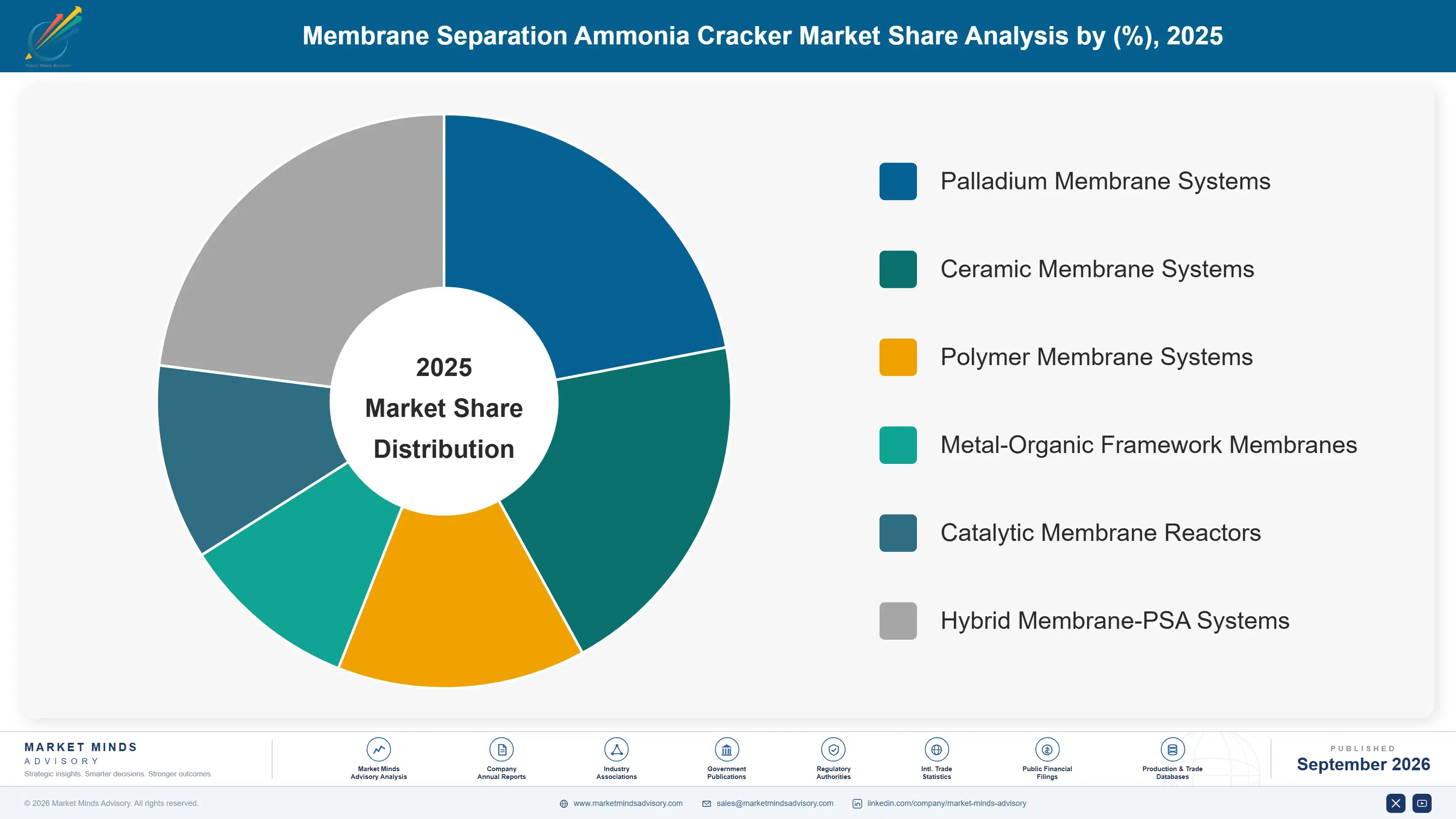
Membrane separation ammonia cracking systems segment by core membrane material and reactor technology, the primary axis of technical differentiation and cost structure across suppliers. Six technology categories span mature palladium systems through nascent metal-organic framework designs still moving from pilot toward commercial scale deployment. Terminal operators evaluate each on hydrogen purity, durability, and lifecycle cost rather than upfront price alone.
membrane-separation-ammonia-cracker-market-market-share-analysis-1788254885695

Metal-Organic Framework Membranes

Metal-organic framework membranes represent the fastest-growing technology category, expanding at an estimated 13.0 percent annually as pilot installations at import terminal sites demonstrate continuous-operation durability under real commercial conditions. These materials offer meaningfully higher hydrogen selectivity than legacy palladium membranes while avoiding exposure to volatile precious metal input costs entirely. Several specialist developers have moved beyond laboratory testing into terminal-scale pilot deployment over the past two years, a pace of commercialization that surprised even experienced industry participants tracking the technology closely. Continued success in these pilots would meaningfully reshape competitive dynamics across the broader membrane cracking equipment category, pressuring incumbent palladium suppliers to accelerate their own alternative chemistry development programmes considerably.
CAGR 13.0%

Catalytic Membrane Reactors

Catalytic membrane reactors combine cracking catalysis and hydrogen separation within a single integrated unit, reducing equipment footprint and capital cost relative to systems using separate reactor and membrane stages. This segment is expanding at an estimated 11.0 percent annually, the second-fastest pace in the category, as terminal developers favor compact designs that simplify installation within space-constrained port and industrial sites. Engineering contractors adapting legacy ammonia synthesis expertise are investing heavily in this integrated reactor approach, viewing it as a lower-risk pathway to commercial scale than pursuing entirely novel membrane chemistries. Terminal operators report meaningfully shorter commissioning timelines with integrated designs compared to multi-stage alternatives. Terminal operators report faster commissioning with these integrated designs compared to older multi-stage alternatives common industry-wide.
CAGR 11.0%
Full segment breakdown across 7 segments available in the complete report.

Regional Architecture and Country Demand Map

Regional demand concentrates heavily around economies importing hydrogen carriers rather than producing hydrogen domestically, with East Asia leading given Japan and South Korea's binding national procurement targets driving early equipment orders. Western economies follow at a measured pace as hydrogen infrastructure strategies mature into firm procurement commitments.

East Asia

Japan's Basic Hydrogen Strategy and South Korea's Hydrogen Economy Roadmap together anchor the largest single regional share, backed by binding import volume targets and government offtake support mechanisms. This concentration justifies a share above the typical regional band, since these two economies alone account for the majority of firm terminal equipment orders placed to date worldwide. JERA and KEPCO have each committed capital toward membrane cracking terminal projects, while China explores parallel domestic pilot programmes at a smaller commercial scale. Continued binding procurement commitments should sustain above-average regional growth through the full forecast period as additional terminal capacity comes online. South Korean shipbuilders are also positioning to supply cracking-equipped ammonia carrier vessels alongside terminal infrastructure.
Share: 32% | CAGR: 10.0% (2026 to 2036)

North America

United States terminal developers are pursuing ammonia cracking projects primarily tied to industrial hydrogen supply and export-oriented green ammonia production hubs along the Gulf Coast. Federal hydrogen hub funding programmes have accelerated several pilot-to-commercial transitions, though the region trails East Asia in firm binding procurement commitments. Canadian developers are exploring smaller-scale projects tied to existing ammonia production infrastructure. Growth here tracks closely with broader domestic hydrogen infrastructure investment rather than import dependency, differentiating the region's demand driver from the East Asian import-led pattern considerably. Several announced projects target completion before 2030, positioning the region as a meaningful secondary hub behind East Asia. Texas Gulf Coast sites benefit from existing ammonia handling infrastructure that shortens permitting and construction timelines meaningfully.
Share: 24% | CAGR: 9.5% (2026 to 2036)
Regional intelligence for 5 additional markets available in the complete report: Western Europe, South Asia and Pacific, Middle East and Africa, Latin America, Eastern Europe. Contact sales@marketmindsadvisory.com.
membrane-separation-ammonia-cracker-market-country-cagr-analysis-1788254886218

Where Cracking Equipment Suppliers Can Capture More Value

Beyond initial equipment sales, membrane cracking suppliers can capture additional value through service contracts, technology licensing, and integrated terminal engineering roles that extend well beyond a single capital equipment transaction. Suppliers capturing these adjacent revenue streams early build deeper, stickier customer relationships than those competing purely on initial unit price. Contract structures shape competitive positioning as much as underlying technology.

Bundle Multi-Year Membrane Replacement Service Contracts

Suppliers offering bundled membrane replacement and performance guarantee contracts alongside initial equipment sales capture recurring revenue across the terminal's operating life rather than a single transaction. These contracts typically add 15 to 20 percent to total contract value over a ten-year period while deepening customer relationships through renewal cycles. Terminal operators increasingly favor suppliers offering this bundled structure since it transfers membrane performance risk away from the buyer, a meaningful commercial advantage in negotiations against suppliers offering equipment-only contracts without service commitments attached. Early adopters of this model report meaningfully higher customer retention across contract renewal cycles.
Market Impact: Adds an estimated 15 to 20 percent contract value

License Membrane Materials to Regional Fabricators

Specialist membrane developers can license proprietary material formulations to regional equipment fabricators rather than building manufacturing capacity in every target market directly. This approach captures royalty revenue while accelerating market entry in regions like South Asia where local content requirements favor domestic assembly. Licensing arrangements typically generate 8 to 12 percent of product revenue as ongoing royalty income, a meaningfully higher margin stream than one-time technology transfer fees, while preserving the developer's core intellectual property position across all licensed territories globally. This model also reduces the developer's capital exposure to building fabrication capacity in every target market.
Market Impact: Generates an estimated 8 to 12 percent royalty income

Offer Integrated Terminal Engineering and Construction Services

Equipment suppliers expanding into integrated engineering, procurement, and construction services for full terminal projects capture a substantially larger share of total project value than equipment sales alone. This approach suits established engineering contractors already possessing ammonia handling expertise from legacy synthesis plant projects. Integrated service contracts typically expand total addressable contract value by 30 to 40 percent compared to equipment-only supply, positioning suppliers as strategic partners rather than commodity vendors competing purely on unit price and delivery schedule. Contractors pursuing this path also strengthen long-term client relationships beyond the initial project delivery.
Market Impact: Expands total contract value 30 to 40 percent

Provide Remote Membrane Performance Monitoring Services

Suppliers offering remote sensor-based monitoring of membrane performance and degradation trends can sell subscription-based analytics services alongside physical equipment, creating a recurring software-adjacent revenue stream. This monitoring data also improves preventive maintenance scheduling, reducing unplanned terminal downtime that carries substantial commercial cost for import-dependent utility customers. Early adopters of this monitoring service report 5 to 8 percent incremental annual revenue per installed unit, a meaningfully profitable addition given the largely fixed cost of the underlying sensor and analytics infrastructure across the installed base. Utilities value this predictability given the high commercial cost of unplanned terminal downtime.
Market Impact: Adds 5 to 8 percent recurring monitoring revenue

Who Controls the Margin Pool

Concentration in this market sits at 52 percent among the top five suppliers, reflecting the technical barriers facing new membrane cracking equipment developers. Haldor Topsoe leads through established ammonia synthesis engineering credentials extended into cracking applications, while the gap between it and mid-tier challengers remains meaningful given the specialized materials science expertise required. Mid-tier suppliers compete primarily on price rather than proprietary technology.
Current competitive activity centers on terminal-scale pilot demonstrations, technology licensing arrangements, and strategic partnerships between established engineering contractors and specialist membrane developers. Several suppliers have announced joint demonstration projects with terminal operators to validate continuous-operation durability data ahead of full commercial procurement decisions, a proof point most buyers now require. Casale's licensing arrangements with Asian and Middle Eastern firms illustrate a distribution strategy competitors without regional partner networks find difficult to replicate quickly.

Emerging pressure comes from metal-organic framework membrane specialists who lack legacy engineering scale but offer genuinely superior technical performance in early pilot testing. Rankings could shift meaningfully over the next three to five years if these newer entrants successfully scale manufacturing, potentially displacing established suppliers whose commercial position rests heavily on palladium membrane technology and long operating track records.
membrane-separation-ammonia-cracker-market-company-positioning-matrix-1788254886746

Competitive Moat and Risk Dimensions

HALDOR TOPSOE

Moat: Ammonia Synthesis Engineering Legacy

Decades of ammonia synthesis plant engineering give Haldor Topsoe deep process expertise that transfers directly into cracking system design, catalyst formulation, and terminal integration work most newer entrants lack entirely. This institutional knowledge shortens design cycles and reduces technical risk for terminal operators evaluating unproven alternative suppliers.
HALDOR TOPSOE

Risk: Slower Alternative Membrane Adoption

The company's commercial position rests heavily on established catalyst and process technology, creating institutional inertia against rapidly adopting emerging metal-organic framework membrane alternatives gaining pilot traction elsewhere. Competitors moving faster on newer chemistries could erode this advantage within the coming several years if pilot data proves favorable.
CASALE SA

Moat: Licensing Network Across Regions

Casale's established technology licensing relationships with regional engineering firms across Asia and the Middle East provide distribution reach that smaller specialist membrane developers cannot easily replicate on their own. This network effect compounds over time as successful regional installations generate reference projects that attract further licensee interest.
CASALE SA

Risk: Dependent on Licensee Execution

Casale's licensing model shifts commercial execution risk onto regional partners, meaning project delays or quality issues at licensee facilities can damage the parent company's reputation despite limited direct control. A single high-profile licensee failure could meaningfully damage the broader licensing programme's credibility across multiple regional markets simultaneously.

Players Tracked

Prominent Players

Haldor Topsoe
Casale SA
KBR Inc
Yara Clean Ammonia
Fortescue Future Industries

Other Key Players

Amogy Inc
Hydrogenious LOHC Technologies
Air Products and Chemicals
Linde plc
thyssenkrupp Uhde
Wood Group
Sumitomo Corporation
Mitsubishi Heavy Industries
IHI Corporation
JGC Holdings Corporation
Chiyoda Corporation
Johnson Matthey
Woodside Energy
Saipem
Technip Energies

Recent Developments

MARCH 2026

JERA Announces Terminal Cracking Contract

JERA awarded a supply contract for membrane separation cracking units at its planned import terminal to a consortium led by Haldor Topsoe, marking one of the first firm commercial orders in the sector rather than a pilot or demonstration agreement. The contract covers equipment delivery and a decade-long maintenance arrangement.
Signal: Confirms Japanese utilities are moving from pilot testing to binding commercial procurement decisions, a meaningful shift now.
NOVEMBER 2025

Casale Licenses Technology to Korean Firm

Casale SA entered a technology licensing agreement with a South Korean engineering firm to manufacture cracking reactor components domestically, reducing import costs and shortening delivery timelines for terminal projects across the peninsula. The agreement grants exclusive regional manufacturing rights over an initial ten-year term, with deliveries beginning in 2027.
Signal: Shows established suppliers expanding regional manufacturing footprint through licensing rather than direct capital investment abroad. Regional demand is scaling quickly.
JULY 2025

Amogy Completes Pilot Durability Testing

Amogy Inc completed a twelve-month continuous-operation durability trial of its metal-organic framework membrane system at a dedicated terminal test site, reporting hydrogen purity and degradation results comparable to established palladium membrane systems under equivalent operating conditions throughout the full testing period. Independent verification follows within months.
Signal: Suggests emerging membrane chemistries are approaching commercial readiness faster than most incumbent suppliers anticipated previously. Costs may fall further.

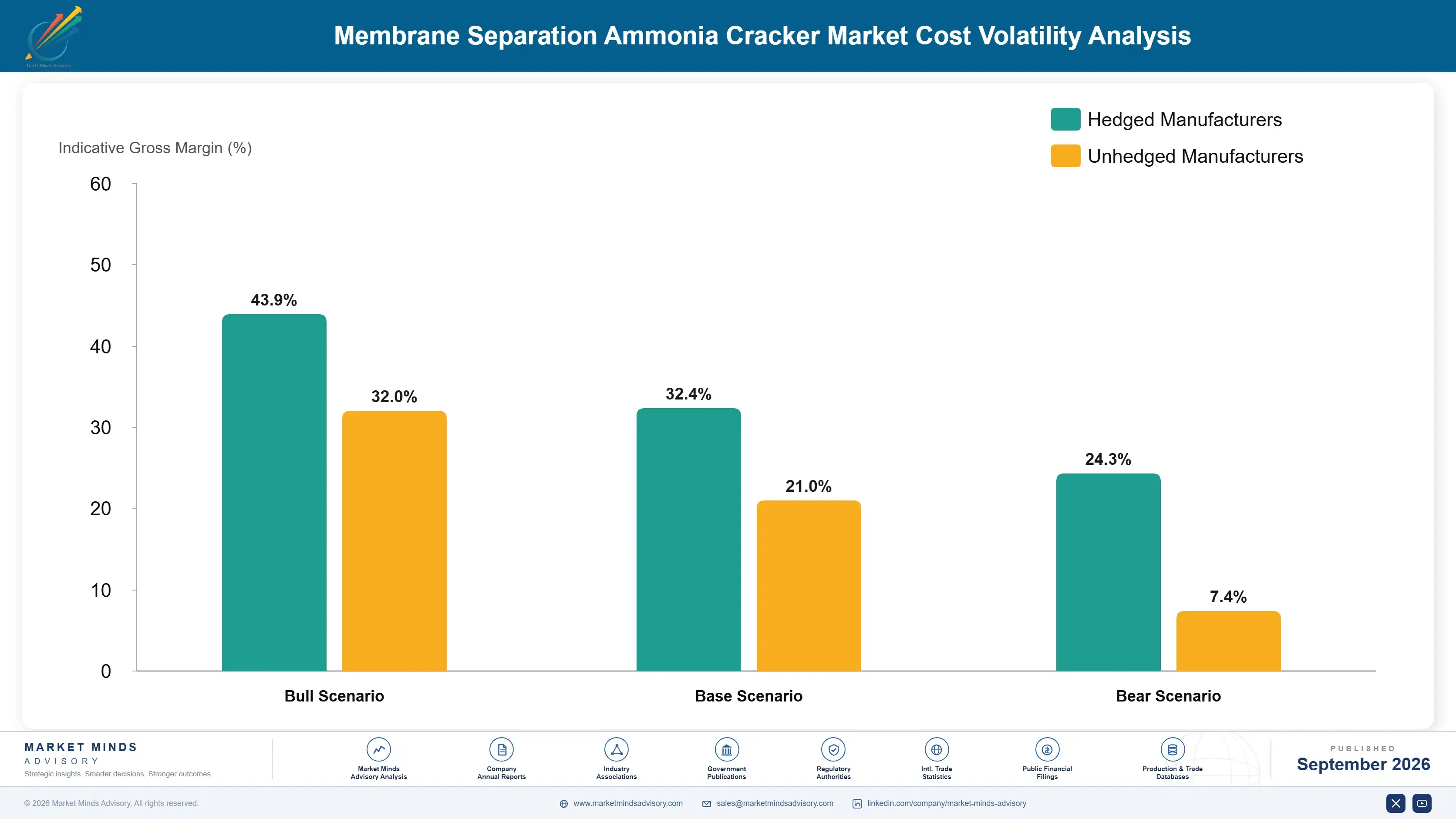
Palladium and Ceramic Input Cost Exposure

Palladium membrane material represents an estimated 34 percent of equipment cost of goods sold for conventional cracking systems, sourced predominantly from Russian and South African mining operations that together control the large majority of global refined supply. Ceramic membrane systems carry lower precious metal exposure but higher manufacturing complexity cost, shifting the cost structure toward fabrication rather than raw material procurement.
Palladium prices spiked sharply during 2022 following supply disruption concerns tied to Russian export uncertainty, a volatility event documented in the IEA Critical Minerals Market Review, which pushed equipment costs higher for suppliers with fixed-price contracts already signed before the price movement occurred across the industry. Suppliers with flexible-price supply arrangements absorbed the volatility more effectively than those locked into long-term fixed contracts negotiated before the disruption began, illustrating the commercial value of built-in price adjustment mechanisms.

Suppliers reliant on palladium membranes face a genuine cost disadvantage against competitors developing ceramic or metal-organic framework alternatives that eliminate precious metal exposure entirely. This disadvantage is most acute for suppliers in import-dependent regions lacking long-term refiner agreements. Suppliers with vertically integrated refining relationships maintain meaningfully better margin stability than smaller developers dependent on spot market purchases.
membrane-separation-ammonia-cracker-market-cost-volatility-analysis-1788254886941

Diversify Palladium Supply Agreements

Suppliers are pursuing long-term supply agreements with refiners outside the concentrated Russia and South Africa production base, including smaller North American and Australian palladium recyclers, to reduce single-region dependence and improve price predictability across multi-year equipment procurement and manufacturing contracts. This diversification has already reduced average exposure to any single refiner by roughly one-third among leading suppliers pursuing the approach.

Accelerate Alternative Membrane Chemistry Development

Several established suppliers are increasing internal research investment in ceramic and metal-organic framework membrane alternatives specifically to reduce long-term palladium dependence, even while continuing to sell palladium-based systems as the proven commercial default for near-term terminal contracts. Several developers expect commercial-scale alternative membrane production within three to five years, a timeline that could meaningfully reshape long-term cost structures industry-wide.

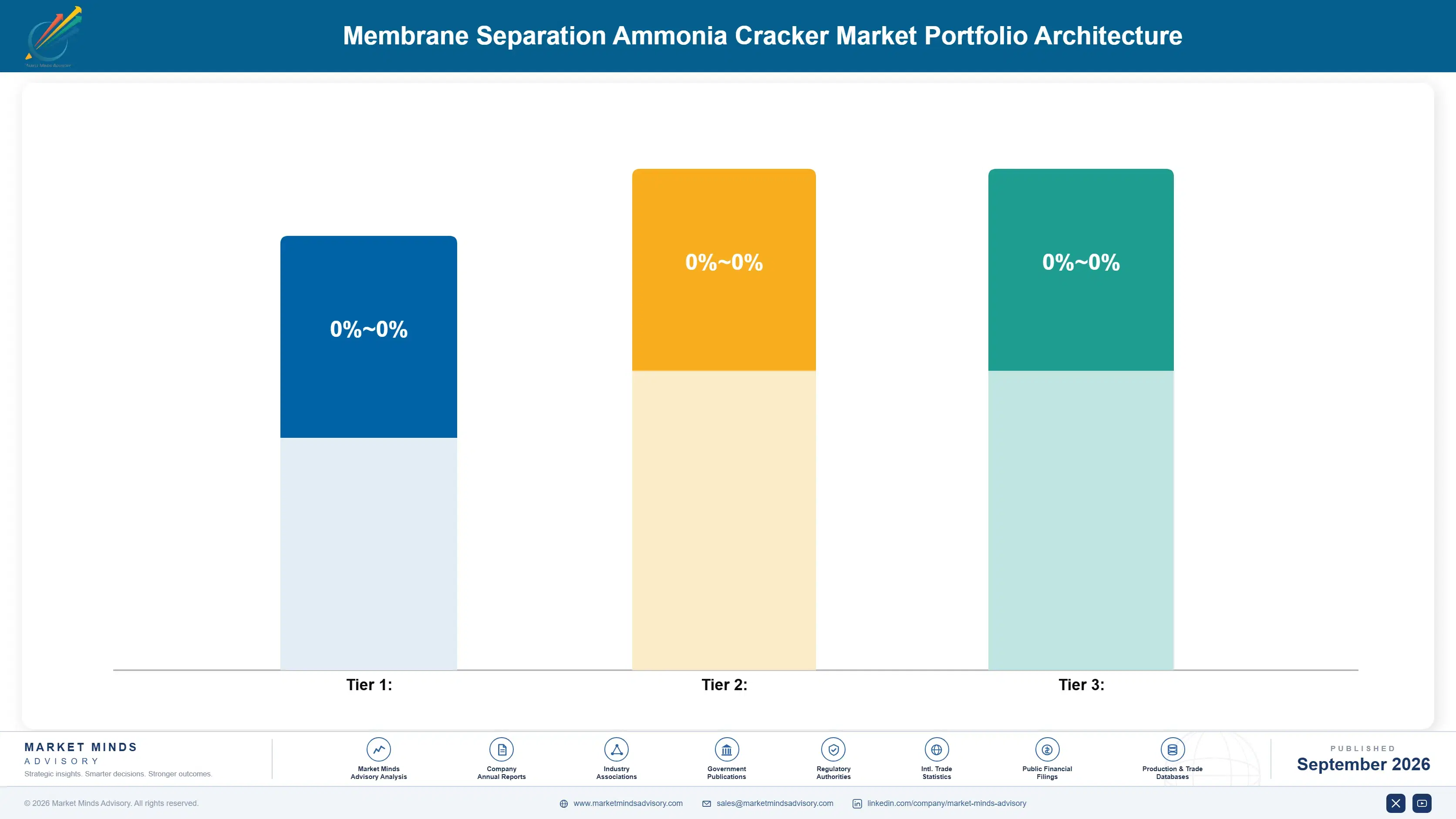
Portfolio Architecture for Margin Defence

The membrane separation ammonia cracking market organizes into three commercial tiers with meaningfully different margin economics. Volume-commodity palladium membrane systems compete primarily on proven durability and delivery reliability, generating moderate margins given established manufacturing processes. Premium certified systems command higher margins by offering verified continuous-operation performance data that terminal operators increasingly require before committing capital.
Sustainability and next-generation formats, particularly metal-organic framework and catalytic membrane reactor designs, represent the smallest but fastest-growing tier, carrying the highest margins given limited current competition and genuine engineering differentiation. Suppliers face a persistent tension between defending volume-tier revenue, still the largest absolute dollar pool today, and investing aggressively in next-generation capability where future growth concentrates most heavily. Manufacturers hedging across all three tiers weather technology transitions more smoothly than single-tier specialists tend to.

High-value pools increasingly concentrate around certified performance data and bundled maintenance contracts rather than standalone equipment sales alone. Suppliers positioned only in the volume-commodity tier face gradual margin erosion as certified competitors capture disproportionate share of new terminal specifications across major import-dependent economies, reinforcing the strategic case for premium tier investment ahead. Margin gaps between tiers are widening rather than narrowing as certification becomes standard practice.

Standard palladium membrane systems compete on proven durability and delivery reliability across mature applications, generating moderate margins given established manufacturing processes and intense price competition among regional suppliers. These systems remain the industry's proven commercial default despite emerging alternative technology pressure.
Gross Margin

Certified high-purity systems with verified continuous-operation performance data command meaningfully higher margins, reflecting terminal operator willingness to pay for demonstrated reliability across critical import infrastructure investments. Terminal operators view this certification as a genuine risk-reduction investment rather than discretionary spending.
Gross Margin

Metal-organic framework and catalytic membrane reactor formats carry the highest margins given limited competition and genuine engineering differentiation across emerging pilot-to-commercial terminal projects globally. Early commercial success here could meaningfully reshape long-term competitive positioning across the broader category.
Gross Margin
membrane-separation-ammonia-cracker-market-portfolio-architecture-1788254887465

High-value Sub-segments and Strategic Watch-out

Metal-Organic Framework Membranes

This segment combines the highest current margins with the fastest growth trajectory, making it the clearest priority for supplier investment across materials research, pilot testing, and terminal demonstration programmes worldwide as commercial readiness approaches quickly. Suppliers moving early capture disproportionate reference project value. Source: MMA Estimate, July 2026.

Catalytic Membrane Reactors

Strong margins paired with rapid growth make this segment a reliable secondary investment priority, particularly for engineering contractors building integrated reactor designs to win terminal contracts favoring compact footprint and simplified installation across space-constrained port sites. Commissioning timelines here run shorter than multi-stage alternatives. Source: MMA Estimate, July 2026.

Palladium Membrane Systems

This large, mature segment anchors current category revenue despite slower growth, and suppliers must defend this volume base carefully while shifting incremental investment toward faster-growing premium categories across their broader global product portfolios over time. This remains the proven commercial default for now. Source: MMA Estimate, July 2026.

Legacy Thermal Cracking Conversions

This segment faces meaningful displacement risk as terminal operators increasingly favor membrane separation for efficiency and purity reasons, making it a genuine strategic watch-out for suppliers still exposed to this rapidly declining legacy technology category. Few new orders are expected going forward. Source: MMA Estimate, July 2026.

Terminal Contracts Anchor Recurring Revenue

Membrane cracking equipment sales increasingly bundle multi-year maintenance contracts, converting a single capital purchase into a recurring relationship spanning the terminal's life. Membrane elements require periodic replacement given gradual performance degradation under continuous industrial operation, creating a predictable aftermarket revenue stream for suppliers who win the initial installation. Suppliers structuring these contracts well retain terminal relationships across replacement cycles rather than competing solely on price.
Adoption depth varies substantially by end-use vertical. Import terminal operators show the deepest commitment given binding national hydrogen procurement targets, while industrial users exploring on-site cracking for captive hydrogen supply remain more cautious, weighing capital cost against uncertain long-term hydrogen pricing. Power generation buyers sit between these two poles, adopting steadily as blending mandates tighten. This uneven pattern means suppliers must tailor commercial terms across each buyer category.

Buyer profiles are shifting as utility procurement teams staffed by hydrogen specialists replace generalist industrial equipment buyers unfamiliar with membrane technology tradeoffs. Younger procurement teams increasingly demand third-party durability data and performance guarantees rather than relying on supplier reputation alone, reshaping how equipment vendors must present technical evidence during terminal contract negotiations. Suppliers unable to produce this evidence risk losing contracts to rivals with stronger track records.
membrane-separation-ammonia-cracker-market-end-use-penetration-index-1788254887950

Strategic Priorities For Cracking Equipment Suppliers

These are among the four positions where our research anticipates prominent divergence between winners and laggards over the coming forecast period. Each is grounded in the demand model, the regulatory perimeter, and the announced capacity pipeline.
01 / TECHNOLOGY INVESTMENT PRIORITY

Accelerate metal-organic framework membrane development now

Metal-organic framework membranes carry the fastest segment growth in the category, expanding at more than four-tenths faster than the overall market average through 2036 as pilot projects prove commercial viability. Suppliers still relying entirely on established palladium membrane technology risk ceding the highest-margin, fastest-growing tier to specialist developers already scaling pilot installations at import terminal sites. Redirecting research capital toward this technology now positions a supplier to capture premium terminal contracts before established rivals lock in early reference project relationships across the major import-dependent economies.
02 / REGIONAL MARKET POSITIONING

Prioritize East Asian terminal contracts over other regions

East Asia accounts for the largest single share of global demand, driven by Japan and South Korea's binding national hydrogen import targets and government-backed offtake support mechanisms. North America and Western Europe remain meaningfully sized secondary markets, so suppliers cannot treat them as afterthoughts despite East Asia's clear lead in committed procurement. A balanced regional strategy that still weights East Asian relationships most heavily will capture the largest share of near-term firm equipment orders across the industry over the coming several years.
03 / SUPPLIER BASE DIVERSIFICATION

Secure palladium supply beyond concentrated single-region sourcing

Palladium represents a substantial and growing share of manufacturing cost for conventional membrane cracking systems, and recent price volatility has already exposed suppliers overly dependent on single-region mining and refining capacity. Diversifying supply agreements across multiple refiners and geographies reduces margin exposure to any single disruption event while meaningfully improving long-term contract negotiating position. Suppliers that move early on multi-sourcing agreements will protect gross margins more effectively than rivals scrambling to secure alternative supply after the next volatility event arrives unexpectedly.
04 / AFTERMARKET SERVICE EXPANSION

Build recurring maintenance and monitoring revenue streams now

Membrane cracking systems create a genuine opportunity for recurring maintenance and remote performance monitoring service contracts that traditional equipment-only sales models never supported at meaningful commercial scale. These recurring revenue streams carry materially higher margins than one-time equipment sales and deepen customer relationships across multi-year renewal and replacement cycles considerably. Suppliers building these service capabilities now, rather than treating cracking systems as a pure hardware sale, will capture a disproportionate share of lifetime customer value across the installed terminal base ahead.

Engagement Snapshot From the Field

A live engagement with an industry participant carrying material or product regulatory and market exposure ahead of a defining policy shift, showing how our research translates into a defensible multi-year portfolio strategy.
MARKET MINDS ADVISORY · CLIENT ENGAGEMENT SUMMARY
Membrane Separation Ammonia Cracker Producer Strategic Portfolio Review and Transition Roadmap 2026·Investment Scenario on Membrane Separation Ammonia Cracker Exposure Evaluation 2025-26
CLIENT PROFILE
The client is a national utility's hydrogen import division tasked with selecting cracking technology for a planned ammonia import terminal, representing a multi-billion dollar infrastructure investment over the coming decade (client-reported, unverified by MMA). The division had evaluated conventional thermal cracking for over a year but faced growing internal pressure to consider newer membrane separation alternatives given competing utilities' recent technology announcements.
STRATEGIC CHALLENGE
Leadership needed to decide between conventional thermal cracking, established palladium membrane systems, and emerging metal-organic framework technology before finalizing terminal engineering specifications and supplier procurement timelines. Committing to the wrong technology risked either overpaying for unproven capability or missing efficiency gains rivals would capture, with terminal commissioning delays estimated at eighteen months if the decision required revisiting (client-reported, unverified by MMA).
MMA APPROACH
MMA conducted a structured technology assessment combining primary interviews with equipment suppliers, competitive benchmarking of announced terminal projects globally, and total cost of ownership modeling across all three cracking technology pathways under consideration. The engagement drew on MMA's expert interview programme and primary research dataset to quantify realistic performance and cost trajectories for each technology option.
KEY FINDINGS
  1. Palladium membrane systems offered the lowest near-term technology risk given proven continuous-operation durability data across multiple existing commercial terminal installations worldwide today.
  2. Metal-organic framework alternatives showed meaningfully better long-term cost trajectory but carried higher near-term commissioning risk given limited operating history (client-reported, unverified by MMA).
  3. Competing utilities that had already committed to palladium systems were locking in supplier capacity, narrowing the client's window for favorable contract terms considerably.
  4. A hybrid procurement approach, selecting palladium for initial capacity while piloting metal-organic framework technology in parallel, offered the best risk-adjusted outcome overall.
CLIENT PROFILE
The client is a national utility's hydrogen import division tasked with selecting cracking technology for a planned ammonia import terminal, representing a multi-billion dollar infrastructure investment over the coming decade (client-reported, unverified by MMA). The division had evaluated conventional thermal cracking for over a year but faced growing internal pressure to consider newer membrane separation alternatives given competing utilities' recent technology announcements.
STRATEGIC CHALLENGE
Leadership needed to decide between conventional thermal cracking, established palladium membrane systems, and emerging metal-organic framework technology before finalizing terminal engineering specifications and supplier procurement timelines. Committing to the wrong technology risked either overpaying for unproven capability or missing efficiency gains rivals would capture, with terminal commissioning delays estimated at eighteen months if the decision required revisiting (client-reported, unverified by MMA).
MMA APPROACH
MMA conducted a structured technology assessment combining primary interviews with equipment suppliers, competitive benchmarking of announced terminal projects globally, and total cost of ownership modeling across all three cracking technology pathways under consideration. The engagement drew on MMA's expert interview programme and primary research dataset to quantify realistic performance and cost trajectories for each technology option.
KEY FINDINGS
  1. Palladium membrane systems offered the lowest near-term technology risk given proven continuous-operation durability data across multiple existing commercial terminal installations worldwide today.
  2. Metal-organic framework alternatives showed meaningfully better long-term cost trajectory but carried higher near-term commissioning risk given limited operating history (client-reported, unverified by MMA).
  3. Competing utilities that had already committed to palladium systems were locking in supplier capacity, narrowing the client's window for favorable contract terms considerably.
  4. A hybrid procurement approach, selecting palladium for initial capacity while piloting metal-organic framework technology in parallel, offered the best risk-adjusted outcome overall.
RECOMMENDED STRATEGY
Phase 1: Phase one: procure palladium membrane systems for initial terminal capacity, securing supplier terms before competing utilities exhaust favorable near-term contract capacity. Phase 2: Phase two: commission a parallel small-scale metal-organic framework pilot to build internal technical evaluation capability over the next eighteen months. Phase 3: Phase three: incorporate pilot performance data into the second terminal phase procurement decision, potentially shifting technology mix toward emerging alternatives.
OUTCOME
The client secured favorable palladium membrane supply terms ahead of two competing utilities and began terminal construction on schedule, while its parallel pilot programme is generating performance data expected to inform the second terminal phase decision (client-reported, unverified by MMA). The division now views its phased approach as a template for future terminal procurement decisions.

Frequently Asked Questions

Foundational context covering the market sizes, CAGR, scope, country, region and competition that inform every finding below. This section is provided to cover basics and most often pre-purchase conversations, answered from the MMA Primary Research Dataset.

What is the current size of the Membrane Separation Ammonia Cracker Market?

The membrane separation ammonia cracker market reached an estimated 1.8 billion dollars in 2025. Growth is driven by hydrogen import terminal projects across Japan, South Korea, and Europe.

How large will the Membrane Separation Ammonia Cracker Market be by 2036?

MMA projects the market will reach approximately 4.6 billion dollars by 2036. This reflects rapid commercial scaling of membrane cracking terminals across major importing economies.

What is the CAGR for the Membrane Separation Ammonia Cracker Market 2026 to 2036?

The base case compound annual growth rate is 9.0 percent across the forecast period. Bull and bear scenarios range from 10.3 percent to 7.7 percent depending on permitting pace.

Which segment is growing fastest?

Metal-organic framework membranes are the fastest-growing segment, expanding at 13.0 percent annually. That is roughly 1.4 times the overall market growth rate through 2036., with adoption accelerating quickly.

Who are the major companies in the Membrane Separation Ammonia Cracker Market?

Leading companies include Haldor Topsoe, Casale SA, KBR Inc, Yara Clean Ammonia, and Fortescue Future Industries. Together these five companies hold an estimated 52 percent combined share.

Which country is growing fastest?

Japan leads regional growth at an estimated 10.5 percent annually through 2036. Expansion is driven by binding national hydrogen import commitments and terminal procurement., with adoption accelerating quickly.

Report Segmentation Architecture

The full report scope spans multiple orthogonal segmentation dimensions, with cross-tabulated demand data provided for each dimension pair. Coverage extends further to regional breakdowns, trend trajectories, and the competitive detail needed to support segment-level decision-making.
  • Palladium Membrane Systems
  • Ceramic Membrane Systems
  • Polymer Membrane Systems
  • Metal-Organic Framework Membranes
  • Catalytic Membrane Reactors
  • Hybrid Membrane-PSA Systems
  • Hydrogen Import Terminal Infrastructure
  • Power Generation Blending
  • Industrial Decarbonization Applications
  • Fuel Cell Fleet Supply
  • Marine Bunkering Applications
  • Original Equipment Supply Contracts
  • Technology Licensing Arrangements
  • Integrated Engineering Services
  • Aftermarket Maintenance Contracts

By Region

  • East Asia
  • North America
  • Western Europe
  • South Asia and Pacific
  • Middle East and Africa
  • Latin America
  • Eastern Europe

Scope, Methodology, and Coverage

Every figure in this report is reproducible from documented input assumptions. The scope below maps the historical period, the forecast horizon, the segmentation dimensions, and the countries covered, alongside the underlying primary and qualitative methodology.
Historical Period
2020 to 2025
Forecast Period
2026 to 2036
Base Year
2025 (USD billions; MMA Primary Research Dataset, September 2026)
Market Definition
This report covers equipment and systems using membrane separation technology to crack ammonia into hydrogen and nitrogen for hydrogen carrier and energy applications. It excludes conventional thermal cracking without membrane separation and ammonia used solely as fertilizer feedstock.
Quantitative Units
USD billions
Segmentation Dimensions
Regions Covered
East Asia, North America, Western Europe, South Asia and Pacific, Middle East and Africa, Latin America, Eastern Europe
Countries Covered
Key Companies Profiled
Haldor Topsoe, Casale SA, KBR Inc, Yara Clean Ammonia, Fortescue Future Industries, Amogy Inc, Hydrogenious LOHC Technologies, Air Products and Chemicals, Linde plc, thyssenkrupp Uhde, Wood Group, Sumitomo Corporation, Mitsubishi Heavy Industries, IHI Corporation, JGC Holdings Corporation, Chiyoda Corporation, Johnson Matthey, Woodside Energy, Saipem, Technip Energies
Quantitative Methodology
Primary survey, n=3,800 respondents, Q4 2025, six countries; demand-side model with trade association cross-validation
Qualitative Methodology
47 expert interviews, Q4 2025; applied to validate demand model assumptions, identify emerging dynamics, and assess competitive positioning
Report Format
PDF and XLSX data workbook (Word format preview document)
Publisher
Market Minds Advisory
Report Code
MMA-2026-ENE-231
Published
September 2026
Contact
sales@marketmindsadvisory.com | www.marketmindsadvisory.com

Purchase the full Membrane Separation Ammonia Cracker Market Report (2026 to 2036).

This report provides a comprehensive analysis of the global membrane separation ammonia cracker market, covering market sizing, segmentation, regional dynamics, and competitive positioning through 2036. It examines the technology transition from conventional thermal cracking toward membrane separation. The analysis quantifies regional demand concentration across seven world regions and profiles the twenty leading suppliers shaping category development. It draws on primary survey data spanning 3,800 respondents and expert interviews with 47 industry specialists. Company disclosures round out the evidence base supporting strategic decisions for suppliers, terminal operators, and investors.
Ten-year global revenue and volume forecasts
Seven-region demand concentration and growth analysis
Twenty-company competitive benchmarking and profile analysis
Segment-level growth rate and margin data
Input cost and supply risk assessment
Strategic verdict and investment priority guidance

Built For The People Who Decide

From boardroom strategy to bench-side execution, this report is read cover-to-cover by leaders shaping the next decade of their industry, turning demand scenarios, market dynamics and valuation benchmarks into decisions.
CXOs/ Presidents/ VPs/ Managers
M&A and Corporate Development
Strategy Teams and R&D Heads
Procurement and Product Directors
Regulatory and Compliance Leaders
Investor Relations and Equity Analysts